Alexei Navalny answers questions at a meeting in Yekaterinburg
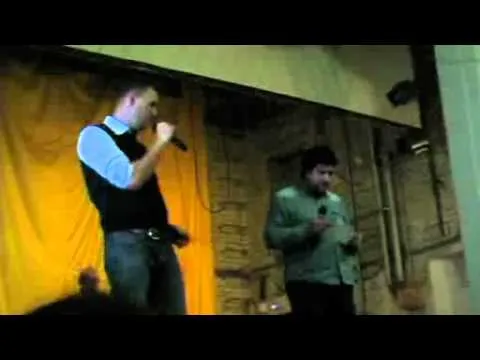
While Alexei was speaking,
I didn't let the remnants
of my mathematical education in this hall dry out.
17 seats and 20 rows makes 340 people, and they
filled the aisles too, so a little over 400. In the city of
Yekaterinburg, 600 polling sta-
tions.
[music]
There are enough people for every polling station in
Yekaterinburg: one qualified
observer at each polling station, in my
experience—and I’ve been doing election observation for more than
4 years—can work wonders if they
firmly know their rights. If they are
motivated, if they understand why they
came there, if it’s not some granny who
knits a sock for 500 rubles (about $5) or something, I don’t know. But
a real observer, someone whose
eyes are shining, who understands why it’s necessary
to watch and how to watch—they’re afraid of them.
Fear drives them into stupidity. I mean,
that truly epic power switch
that was flipped off 45 seconds before the end got
190,000 views. That’s more than
the monthly audience of all UTV programs
put
together.
That doesn’t come from great intelligence.
These are obvious mistakes. Of course, now they’re
already clutching their heads, but they couldn’t
help making mistakes. When a person
is afraid, they make mistakes, and they will
keep making them again and again. Our observers
will keep pressing them. They’re terrified—terrified of
people who work for an idea,
because they know perfectly well that
there’s no one like that around them. They can
deceive themselves all they want; they can get 30, 40,
50 percent—I don’t know—from state employees, soldiers,
people pressured into it, however they like—but
they themselves know perfectly well
that all those people voted under
coercion. And they also know perfectly well
that for every one of their people at our rally,
somewhere there’s a line in a ledger
showing how much they were paid to go
there. They’re afraid of people who come
for no reason other than to do something, just because,
and spend their own time, their own hours, because
to them that is something absolutely
irrational. They can deceive themselves however they like
in their reports, but around them
there’s nothing like that, and they know it perfectly well.
And what we need to do now, in this
final week before the election, is
exploit that sense of fear, make
them make even more mistakes, more and
more. And in that case, you and I, we
will inevitably arrive at one of two
outcomes: either United Russia’s result
in this election will, at least in
Yekaterinburg and Sverdlovsk Region,
be what it really is. And that is
20–25 percent, very unlikely any more. Or, because of
their stupidity, they’ll make so many mistakes and commit so many
violations, create so many problems, that it will be
absolutely obvious, absolutely
documented, and we’ll be able to show
it to tens of thousands, hundreds of thousands
of people. Yes, of course.
In their stupidity,
they’re capable right now of exposing themselves
practically without limit. But we
can’t do everything right this second.
We come to a United Russia headquarters where
gifts are being packed up for distribution
to pensioners, and black-market newspapers are lying around.
After that, the city administration
announces that Volkov, with brass knuckles and a crowd of
drunk, stoned aides, burst into
the veterans’ council building. That’s all
fine. But all of this quietly
accumulates, it’s work, and every such
incident—they understand perfectly well that this too
is being collected somewhere, filed away, and
will come in handy in some future, hypothetical Nuremberg (a reference to a future reckoning or tribunal),
which, quite obviously, will take place
fairly soon. So even this
is absolutely not meaningless. I’m
glad to keep smashing them—faith is not the problem here.
That’s it.
So, colleagues, this is why our work
has meaning, and the fact that a huge number of people
came here, and there’s no ledger entry
showing how much anyone was paid for it—that is our
main weapon. And they’re all sitting there
already scared stiff.
[applause]
Right now, this election campaign is
a battle for the big cities—the million-plus cities.
In all the million-plus cities, first of all,
it is much harder to falsify results. This is
not Chechnya, not Tambov Region. Second,
the ratings are extremely low in the central
district of Moscow, and really
in these cities there should be—there really should be—
a real battle. So
I want to understand: is Yekaterinburg ready for
this battle?
Ready? I can’t quite
hear you.
Ready! I believe in victory, I absolutely believe
that this time, at least
in this city, we will not let them steal it. They
stole Volkov’s victory, but it seems to me
that by doing so they made a very big
mistake. That’s where it will begin. Now let’s move on to
questions. Let’s go, let’s start with questions. Yes, you
can moderate then. Yes, as usual at our
meetings with—before that, how does it go again—
I’ll moderate. Just a couple of words.
May I say a few words? Yes, let's.
Let's do questions first, and speeches afterward.
Only if you have time left.
You can see there are a lot of people, so this meeting
can be filled with real substance.
Yes, I just want you to support us.
We can do that there. Let's keep it very brief for now.
The Russian people, the state-forming nation,
have no territory of their own,
no power of their own, no faith of their own, nothing at all.
That's who is in power. So right now we are
specifically deciding as a group to go onto the website
and send Medvedev a telegram, and one to the Duma as well.
that the Russian people need Russian
power, and that they should get out of power, in short.
In practical terms, to state it fully, or
if someone wants to add something more, specifically here.
These elections are invalid.
One second. All right, I understand. Let's, colleagues...
Since there are no microphones, let's
let's
try not to all shout at once.
So, the best telegram you can send them
is the one you'll send on the fourth.
[applause]
of the month.
Make it so that in
Yekaterinburg, United Russia gets 15%.
That will be the best telegram. That's the kind of
telegram that will land with a bang,
straight in the Kremlin. That's what needs to be sent to them.
That will be the best telegram.
So, colleagues, it is perfectly obvious that
without microphones, we cannot have people from the audience
shouting out; instead, please pass up
a note.
No, this is a concrete matter—your proposal.
...
[music]
in writing.
The first question, the very simplest one,
and most straightforward: how do you assess
the political prospects of citizen
Medvedev?
Well, listen, just go
online, please, and type in
"the prospects of Comrade
Medvedev"—there's already, again, that joke
that was going around. Toward the end
of the election campaign, he decided to puff out his cheeks
and show that he was in charge of all
the missiles. And the joke goes like this:
Russia now threatens the whole world
with warheads and 500
badmintons. That's the future of citizen
Medvedev: he has become a laughingstock, and he has become
an embarrassment for the whole country. There really were
a great many people
—I spoke with them—who wanted to believe him.
After all, he said a great deal
about fighting corruption, about how things needed
to be changed. We were ready
to believe him. In fact, in order
to go from low approval ratings to high ones,
they needed to do some very
simple things. Let him jail everyone involved in
the Magnitsky case—those crooks—and his rating
will go up by 5%. Let him jail everyone involved in
the Domodedovo case, and his rating will rise by another 10%.
Let him do at least something. Instead,
all right, all right... Next
question. I usually sort the questions by
topic so they're at least somewhat
grouped together, but this time, technically,
that may not be possible, so we'll do them in random order.
What about Ural separatism, or
a Ural Republic as part of a
confederation—your view?
My view? I held a rally in Moscow
called "Stop Feeding the Caucasus," and my opponents there told me:
"You know, in the Urals
or in Novosibirsk, a more popular idea is
'Stop Feeding'
Moscow." You know, as a Muscovite, I
fully support that idea. What have I
gotten from the fact that we sucked in all the money
from everywhere else? Nothing. I got nothing. I live
next to an oil refinery,
and I don't see any changes. I
get nothing but constant traffic jams and
an insanely expensive life in Moscow. Everything is twice
as expensive as in Europe, and from all that money
I get nothing. So I think this whole
problem of separatism is contrived.
When we say "Ural Republic," I
understand that what is really meant is a very
simple idea: don't stick your nose into other people's business.
Why should anyone here be told how to build a metro
or how to sweep the streets? It's complete
nonsense that all these issues are decided from
Moscow. Power should be where people
live, and in that sense the city administration of
Yekaterinburg should have
more powers than the Kremlin, absolutely.
Well, there is foreign policy, there is the army, and
the notorious 500 badmintons, and that's it.
Everything else, please decide within the framework of
your own authority. So a Ural
Republic is a wonderful idea.
[applause]
Alexei, I fully and completely support
the slogan "Stop Feeding the Caucasus." Do you
think there is
an alternative to the existing
Caucasian sultanates among the peoples
of the North Caucasus? Are there people there
who want to live differently, who share
European values—freedom, human
rights—who want to live
in a democratic Russia?
In fact, this whole "Stop
Feeding the Caucasus" topic seems to some people there
to be anti-...
because over there it's a complete
nightmare and utterly hopeless trash, uh, yeah.
The negative selection that exists throughout
the rest of Russia, where only
crooks and thieves rise to power, has there
reached some kind of absolute apex.
I mean, over there it's really just
thugs and bandits who go into power.
That is, you can advance in
government only if you are, quite literally,
a murderer and some kind of criminal. So
the republics, despite all that, live in
poverty—most of them, I mean.
That's the paradox, uh.
People keep saying, enough already, nothing
works out, that both Moscow and we
are feeding exactly three
or seven clans; the money goes to
gold bars and the like.
Motorcades roll by there, local ones, like
30 Porsches, with an escort of 40
Mercedeses—that's where all this
money goes. Of course, people are the same everywhere.
There are also huge numbers of people there
who want to live normally, by
normal rules. They want to
work and get decent
money for it. But there, basically, if you want
to achieve anything, then join
some local police force (militsiya, the old-style police),
take part in robberies and pogroms,
be part of some Sharia army that's
being created, and so on. So I
absolutely believe that despite the fact
that the Caucasus has a huge number of
basic problems—a feudal society
and this kind of communal, clan-based structure—still,
there are many people in the Caucasus
who definitely want the same thing
we do: justice, that's all.
Question from the hall: you need to answer while looking
people in the eye—why are human rights activists being targeted, while you
are still alive and
free? That's a question that, honestly,
I frankly don't have
an answer to. I don't know why. I got lucky, well,
I got lucky. Again, there's that saying that the fact you're
still free is not your merit, but our
failure, because the system is
such a mess—such chaos—that probably some
order just never reached the right place. I don't know. I
have never received any threats. Well, a
criminal case has been opened against me.
It was fabricated a year ago, and nothing
has happened. Once I was summoned for
questioning, and that's it—the case is just hanging there, the deadlines
keep getting extended, nothing happens. I mean,
for a while I noticed that a car was
following me, watching me. But now
it seems even that has stopped. I really don't
understand, and I think that actually all
of this is greatly exaggerated. Well,
maybe they're watching me, maybe they're watching
him, but if people focus on
the right things—campaigning against crooks
and thieves and so on—then everyone here
present
is on our side. There are more of us here than there are staff members
in the local FSB (Federal Security Service), so we'll be watching them
rather than them watching
us. You can't kill everyone.
The inevitable question:
will you put forward your candidacy
in the Russian presidential election? Well, after all,
how many times a day, on average,
do I have to answer the question,
will there even be a presidential election
in Russia? I haven't heard that one has been scheduled.
There won't be a presidential election. In March there will be
a procedure for transferring the throne,
which will end in some strange
way. By the way, it's very funny—in Moscow, by the way,
I haven't seen this, but here, on some building,
there's this gigantic poster hanging
up, right, with Putin and Medvedev in some kind of
very suspicious
closeness. I mean, forgive me, maybe this isn't
a very decent joke, but every time
I hear discussion of that poster of yours,
I have only one question: which one of them is holding whom by the butt?
It's very suspicious.
Uh.
As for this handoff—on what date are they
planning to carry out such a
transfer? In reality, the possibility
of participating in it doesn't exist. The procedure
for registration is such that collecting signatures
is impossible. I took part in the procedure
of collecting
signatures—Volkov can confirm that.
[applause]
Who will you personally vote for,
which party? Well, I don't know whether all of you
here use the internet, but right now there's a popular
little sheet going around with a cutout pattern
for a children's cube, and on each
side is the name of a party.
Who should you vote for? Your
cube doesn't matter in the slightest. That is,
if you like one party
more than the others, vote for it. But if you
don't have any particular preference at all,
it really doesn't matter. What matters is
to deprive
the party of crooks and thieves of its monopoly.
The other parties, the opposition parties—I
mean the opposition guys—are
under control.
Their leaders are corrupt, and so on, but
there are still other people there. In any case, when they
get into the Duma (the lower house of Russia's parliament), when they maybe
start pulling chestnuts out of the fire with our hands—yes, that's exactly what I'm calling for—
they themselves are too cowardly to
do anything. They are absolutely afraid.
So yes, perhaps we can deliver some
victories or better results for them,
since they themselves are incapable of doing it.
Well then, we will make sure they get into
the Duma (the lower house of Russia’s parliament), in stronger positions, so that they
at least start—well, so that they crawl out
from under the bed and at least a little begin
to nip at this party, United Russia. That is
the task. So frankly, I don’t care—it makes
no difference at all, not the slightest
difference, who you vote for. Personally, I
literally decided by drawing lots. Whatever—against
any of those little parties of thieves.
Just a second, colleagues.
Let’s take the final question, the one we can’t
do without: why do you need
Russian Marches?
Russian Marches?
As for the Russian Marches—well, they exist.
That means they are needed by a fairly large
number of people. Whether we like it or not,
Russian Marches and the conservative
nationalist movement do exist. That is
a political fact. Whether we dislike it
or like it, it exists.
It exists in any case. There really are
a significant number of people who come,
including some crazy youth and all the rest.
But our task, our responsibility, our
duty, if you like, is to make sure that
more normal people come to the Russian Marches,
because the issues discussed there are, in
principle, ones that are being raised there and are
absolutely valid and appropriate. Do we like
the fact that Russia ranks second in the world
in the number of illegal
migrants? No, we do not. Do we like
the fact that Russia
is in first place...
[music]
...that the Caucasus is effectively not
part of the country? No, we do not. Do we like
the fact that real
Sharia armies are being created there? Look, officially
on television they show all this stuff—
Kadyrov has created some kind of his own—well,
not exactly a gang, not exactly police, just
some bearded men with assault rifles. They
pray three times a day, they are required
to pray—in other words, a Sharia
army has literally been created with our money. Do I like that?
Do a huge number of people like that?
Either we start discussing these issues
ourselves, substantively, or we hand these
questions over to those very young
guys.
So our responsibility
is to make sure all these
nationalist concerns are discussed,
to look for solutions, and not...
How do you feel about the slogan
"Russia for Russians"?
[music]
...just to get a few more votes.
Did you watch it yesterday?
Well, I can forgive him a lot,
for the fact that yesterday he made Shtain
end the debate in epic fashion by saying, "Yes, we are
the party of... therefore for..."
[music]
[applause]
Why is this happening in the London court?
...
In fact, what is happening there
in the London court is where the chronicle
of modern Russia is being written. And it is
astonishing that all these people, all
our officials—when we ask them
questions, send them telegrams, ask them things
during elections—they simply ignore all of us.
But the moment
a London judge said, "Right, witnesses,
come here," they all came running: Abramovich,
Berezovsky,
Voloshin, various officials—a huge
number of people standing there, nodding
their heads, taking the oath, and saying, "The
truth, the whole truth, and nothing but the truth," and then telling
how they stole and looted here. And what is
astonishing is the way they treat our
country—as some kind of bantustan.
Quite simply, without the slightest embarrassment, there
in front of hundreds of reporters present,
they say: yes, we privatized this, and for it
we didn’t pay a kopeck (a tiny Russian coin). Yes, over here we
seized this, then Badri Patarkatsishvili did something there,
then we moved in, then there were
gangsters, and then they became officials, and they
tell all this as if here, in our country,
there really is some wild frontier of free
hunting—as if we don’t have a country but
some native tribes, and we neither
hear nor know any of it. They see themselves as these sophisticated
guys who come to these native
tribes, give them a little mirror and
a red rag, and in exchange take away
a million tons of oil. What is happening
in London is actually wonderful in the sense that
it shows us
who really runs the country.
It really shows...
All our elite, which accuses
the opposition of being agents of Western
influence—well, they themselves are exactly the ones who,
the moment the governments of
the United Kingdom or the United States decide to lean on these people,
for any reason whatsoever, they will give up absolutely
everything here—I don’t know, nuclear missiles and
air defense systems, whatever. These people will surrender it all
just to be allowed to keep
what they have in London, in Switzerland, in the United States. And there it’s all
very simple: behave yourself properly, all right,
and you can go on pretending to be some native little tsar here.
and drive around in some Mercedes too, and
buy football clubs. But the moment
you misbehave, the police will come for you
and say: money laundering. We’ll take everything from you,
they’ll confiscate it.
For four years — like what happened to Lazarenko, if
you remember, there was once a prime minister
of Ukraine. He strutted around like a big shot, all puffed up,
then the Americans didn’t like something,
and boom — they put him away for six years, and took the money.
The exact same thing could happen at any moment
to Abramovich, with Putin’s
money, with Medvedev’s money. These
people understand that perfectly well, and they trade away
the country’s national interests in exchange
simply for their own
money. Next question. I think it’s entirely
in the spirit of a question from an ordinary shoemaker from
the town of Polevskoy, Leonid Bystrov. You
are calling on people to vote for any party
except United Russia. However, there are known
cases when, in elections, the winners were
Communists who, after some time,
switched over to United Russia. So what is the point
of voting for just any party then? Thank you.
for
Well, that is a big problem. There have indeed been
cases in our Novosibirsk
region where, several times, the winners were
Communists — or rather, not really Communists,
but people who beat United Russia and brought
to power individuals who, the very next day,
joined United Russia. That problem does exist.
But here, you see, my friends,
you have to trust someone. Take Volkov, for example —
theoretically, you could elect him too, and he might
turn around and join United Russia. Is that possible?
Yes,
theoretically. But you have to trust someone; there is
nothing else
you can do. In any case,
you understand, by pushing these people through,
we force United Russia to do at least
something. They at least have to enter into
some kind of negotiation process,
bargain, buy off Zhirinovsky,
persuade Zyuganov, do something with someone,
because right now they simply
don’t care about anything. They just sit there
and keep pumping, latched onto
the oil stream, and do absolutely
nothing. And this whole thing itself,
this holding on to power — for them it is a very
comfortable process.
Let’s at least make it so that this
power becomes like a slippery fish in their hands,
so that they have to do at least something.
You have your own tally of millions saved
from the budget, but at the same time you
admit that no one has been jailed. So that means
the stealing will continue. Then what is the point
of your work, apart from
populism? Well, that is partly
the question with corruption: how many people have you put
in prison? Well, the answer is zero. And in this
system, they can put me in prison; I cannot put them
in prison, because they are the power.
Look, here’s an example close to home for you.
Last time, almost a year ago,
I spoke here and talked about your
interchange costing 7 billion rubles (about 7,000 million rubles).
And then, after I left, your Yekaterinburg city administration
— I kept saying everywhere that
Navalny seemed to have said nothing special,
nothing was happening. Well, here is my report to you:
the bidding had been scheduled for December,
now it has been moved to March of next
year. We had it canceled several times; several
people were fined thanks to our
complaints, administrative penalties were imposed.
The whole city — they are delaying the construction
of a giant interchange that the entire
city needs, only because they want to rig
the tender like that.
I believe that this means our work is not in vain,
because at the very least, once again, we are not letting them
simply open a suitcase full of
money, write in whatever amount they want, and
walk away. So in any case, we are creating
problems for them; in any case, by accumulating
materials, I am absolutely sure, convinced
100 percent — otherwise I would not have been doing this
for even a single day —
that
I believe in it, I am absolutely convinced that
the people
present here will help me do it,
will help themselves do it, because
it cannot be that in a country of millions,
you understand, there are
100,000 people who have stolen
everything, looted everything, robbed everything, while everyone else
just sits there nodding and doing nothing else.
[music]
That will not last forever. Sooner or later, the day
will come. But when that day
comes — I don’t know, in a year, in three years,
or in three years — it is very important for us to remember
one very serious thing: we will not forget, we will not
forgive. That is, it must not happen
that something changes and then again, well,
people say, all right, let’s forget some things — ‘whoever
brings up the past should lose an eye’ (a Russian proverb). No, we
will bring up the past, and each of you will get what
you deserve.
Why, why did you go to London? Who there
cares so much about Russia, and why did you not
want one of the meetings to be filmed?
In fact, you can look online —
I had four meetings there,
and all of them were filmed.
You can watch them online, by the way.
It was a very interesting trip, and I...
The most interesting part there was a meeting, uh...
a meeting with what you might call the London
Russian community. It was really quite simple.
It was amusing to see who these people were, what kind of people they were there.
I don’t know—rich kids, officials’ children, students, who
they are. After all, there are nearly
300,000 Russians living in London, and well, of course I didn’t see
all 300,000 of them. But the people who
came to the hall, in a smaller gathering,
were fairly ordinary people who simply
had moved there for some personal reasons; for some,
a spouse had left, someone had found a job there,
settled in there—ordinary people. But I can tell you
that they are much more painfully affected by what is happening
here than many people living there might think.
For them,
all this talk about children and real estate in some district, if it is
just some abstract figure, some kind of district
where some children live—well, none of us has even been to that district.
But for them, they see
this person every day, they see
all of it in the society pages.
[music]
They see people leading some astonishingly luxurious
life. For them, these court cases that
are taking place in London mean a lot
to them. This humiliating and
demeaning attitude from the local press
and the local elite toward Russians is very
important to them. They say: we want to be normal
citizens, but here we are treated like
some kind of natives who loot their own
country, stay silent back home,
then come here brazenly, not ashamed of anyone,
and people laugh at them and laugh
at the whole country. It really hurts,
it really does, because, well,
they are just ordinary people. Out of those
300,000
people, 290,000 are completely ordinary
people who work there as
managers or in similar jobs, earning ordinary salaries,
struggling to get by, paying off mortgages,
sending part of their money
to relatives, and in fact
a significant number of them would like
to return. And they are simply furious
because they see all this.
People... I
think that if
we move to
Russia
Konstantin’s book
about Alexei—did you take part in creating it?
[music]
There isn’t really anything substantial I could write
in those memoirs. When we finally achieve something,
then we’ll write them. Rankov did indeed write
a book. My role
consisted of the fact that he spent
several hours interviewing me there,
asking all sorts of questions, starting with
whether I had pets in childhood
and ending with various
questions about children. He wrote the book. To be honest,
I myself still haven’t even held it in my hands,
haven’t seen it, haven’t read it, don’t know anything about it.
I don’t feel very comfortable about it
because the title is rather pompous.
Navalny... crooks and thieves—we can see that in
essence they are crooks and thieves, and they don’t like me.
They are wary, but for now I wouldn’t
say that they are outright panicking because of me
or running away, unfortunately. But they will run—and when they do,
that’s when it will be time to write memoirs.
The classic question—read it with expression:
“And where do you get your money?”
Excellent, I know I may look suspicious,
but in fact I don’t need that much money.
I have an office where
10 people work, and my task
is to earn enough money to pay these
people their salaries. Moreover, a significant part
of them are paid through the project
RosPil—that is, everyone chips in together
money. So you’ve already paid them?
I have to pay salaries
to everyone else, cover the office rent, and earn
enough for my own living expenses and my family, so my legal
practice—that’s it.
[applause]
It’s less difficult to answer that
because, you know, a famous lawyer—
for many people, hiring one is like
inviting a celebrity performer
to
a corporate party, and
that’s why many simply pay, because
he’s a well-known lawyer.
[music]
...
Look, if you vote for a party that won’t make it into parliament,
your vote gets redistributed among the winners.
First and foremost, it strengthens the ruling party’s
monopoly on power. So does that mean you should vote
for absolutely any party that has a real chance?
Well, look, if we approach it
mathematically, we understand that voting for
a party that is guaranteed to get through means
giving 100% of your vote. If
you vote for a party that may not
get through, that means that, what, about
30% of your vote will go to United Russia.
But I’m against turning this into something where everyone is told what to do—everyone decides for themselves.
I’m against having any kind of discussion on this topic
at all, because
one of the advantages of our campaign is that when we say
“vote for any party against the crooks
and thieves,” everyone supports us. This is hugely
appealing to the Patriots of Russia,
A Just Russia, Yabloko, the Communists—
everyone. But when we say, well,
it would be better to vote for the Communist Party, that appeals
to the Communist Party, but not to everyone else.
Accordingly, we deprive ourselves of a huge number
of essentially volunteer campaigners.
our company. So there’s no need for that.
to discuss it—everyone studied math at school,
everyone went through it, everyone did; everyone can
speak for themselves, but nevertheless I believe
that the best path, after all, is
simply to cut it out.
Edit the question to fit today’s atmosphere
in the United States.
How do you feel about it? And in general, what is your
assessment of the group... I love the state, I love...
the state. And in general, what is your assessment
of political themes in rock
music? I haven’t heard it, but it’s funny that
when I was walking in here to the hall, I was stopped by
your very famous local singer. I don’t
know—some people like him, some don’t
like him. But he’s definitely well-known: Alexander
Novikov. You know him? He stopped me there,
grabbed me by the hand and said, “I wrote
a song against United Russia (the ruling political party),”
“it’s going to blow up—get a million views,” something like that.
“It’ll just explode.” So, that
shows that, well, the mood is changing,
and we’ve seen how the mood is changing
quite recently at Olimpiysky (a major Moscow indoor arena), yes, when a very
simple reaction from the audience, yes, followed for this
guy, and we saw how such a mighty tyrant
instantly deflated into some very
small, frightened person, because
the next day he no longer went to
Olimpiysky—he got scared, just in case. And
a day later, when he came to the State Duma,
there was whistling at his appearance. So
the mood is changing, and Putin did have
real popularity—genuine
popularity—but he squandered it, he wasted it.
He converted it into money, he
made billions out of it for
his inner circle. For everyone else, he could have used that
popularity to do something good
for the country, to do something useful for it and for
the Ozero dacha cooperative (a well-known group tied to Putin’s inner circle)—all these people,
all of them official billionaires, and a huge
number of unofficial billionaires as well.
So what, is he supposed to be offended at us now
because we whistle when he appears? Therefore,
this rock music and all these things—
they’re indicators. Unfortunately, I haven’t heard
that song, but I think that various kinds of
folklore, creativity, and so on,
[music]
anti-Jewish... That is, I don’t need to—we
are in a unique situation. I don’t need
to persuade musicians to write these
songs—they write them themselves, because they
simply hate United
Russia just as much. I’d also like to add that this
this
topic turns out to be very unifying.
This theme—against crooks and thieves—
when I walked in here, I felt a little
pang in my stomach, also because
Alexander Vasilyevich... really
doesn’t like me very much. He was very deeply
offended by me a year and a half ago over the story
around Labor Square, about “smashing someone’s face in,” and
he’s a man who
means it, and so I, with a certain, a certain
apprehension, was hesitating before going in.
Before entering, yes, I was hesitating. But he’s much
taller than me, bigger, you know. And when
he rushed over to me—to me and to Alexei as well—
including to Alexei about the song, and to me
he says, “Come on, let’s go after United
Russia.” So that, basically, put me at ease.
I have a question here: do you consider it
necessary, for a better future for Russia,
to separate from our country’s territory
Chechnya or other territories of the North
Caucasus? Let me disagree—but they have already
separated themselves, in effect. I don’t know,
who here studied law, but everyone reads about
the five characteristics of a state, right? And in
the situation with Chechnya, we have
only one sign of a unified state,
because we have a single currency.
The only thing that represents Russian
authority on the territory of Chechnya, Ingushetia,
Pakistan—are the portraits of these
guys that are hanging here with you,
suspiciously close to one another.
That’s all, nothing else. And so this is the kind of
exchange we get: you hang the portraits
and deliver 10% for United Russia, and we from our side
don’t want anything from you at all—do whatever
you want—and we’ll also give you enormous
amounts of money. So right now the issue is not
separation, but rather, if anything,
bringing Chechnya, Dagestan, and so on back into the fold.
I believe
that the issue is—they don’t want to separate, yes, and
Kadyrov’s words are well known, when he says
that “we will not allow you to separate from us.”
Well,
fine then. No one is allowing anyone anything.
What we are talking about here, what we should be talking about,
is simply budget equality. Guys, you are
subsidized republics, subsidized ones.
You should receive the same amount of subsidies
as Ryazan, as Tambov, as
Smolensk. Here we have Sverdlovsk Region,
a donor region. Sverdlovsk Region
if it decides to give you money, then fine, give it.
If not, then earn it yourselves. That’s
all. This is a more important
and substantive issue than some
questions about, so to speak, Russia. In the next
question, I really liked the
abbreviation.
I'm just curious how many years...
the central office can count any percentage it wants
for the ruling party, do you think?
Well, actually, they do
that bearded official, surname...
Churov. Of course they can, with...
basically, they can do whatever they want, and they
don't even have to do it through manipulation—they can simply
announce on Channel One that United
Russia got
99%. But that's dangerous too, after all
you could get your face smashed for that. So how
do they proceed?
in the Urals, for United Russia
so the task...
...will be an observer who catches a violation
in
...then 20, and then...
...because, well, objectively...
85—there is a high probability
that
the votes still...
[music]
If I blow up the system, that's already
dangerous. It seems a lot depends on the composition
of the precinct election commissions
and district ones. They are
mostly teachers, employees...
[music]
[music]
[music]
an observer who is fearless, an observer who doesn't
get scared
goes up to the chair and says: we will
monitor the documents
all-Russian...
sits on the commission, and it's not a small
salary... in the commission, 5 rubles—would someone, for 5
rubles, get involved in some potentially
criminal case? That's the question
again, this government will fall because there is no one
willing to
defend it. Maybe some of us will come out there
to some square—not many, but for them
so our active position will make it so
that all these bought-off, first of all dishonest
people—they're doing a pretty good job
of nothing; they just move ahead and stay where they are
There are several similar questions ahead here
I'll ask one of them
about who owns the media and power
I can't answer that
question—we Illuminati are forbidden to
[applause]
ask that. Maybe I should have a drink of
water and rest, but for now—what is your
attitude toward Khodorkovsky?
It's complicated. I said publicly after
the first
case: well, in reality they were siphoning off money
just like everyone else. So after
the first case, we...
then Abramovich, Potanin
and, I don't know, Deripaska and all the others should be sitting there with him. That
was the issue then. But after the second case
against Khodorkovsky—well, this is simply
an absolute fabrication, completely
an outrage against justice, against
the legal process, against everything really, especially
after those revelations by
that secretary of the Khamovniki District Court (in Moscow)
who said that it had been prepared in advance
from above. In other words, it's just some kind of
mockery and a spit in everyone's face now
and to say now that
Khodorkovsky is not being excluded for political reasons is
simply ridiculous. Of course he's in prison because
they're afraid. I don't understand what exactly they're afraid of
but, I mean, some kind of
uncontrollable factor might arise—who knows
Maybe he won't do anything. Honestly
speaking, I think they should release him and nothing
would happen. Or maybe he'll start financing a revolution
or get involved in something. And
since they're afraid of everything, just in case
they removed Volkov from
the ballot. Nothing happened. Exactly
the same way they are keeping him there—Khodorkovsky is sitting
for life. I think he understands that he is
in for life—either until he dies or
until the life of this
regime ends. He has served 8 years, yes? So whatever he did
he has already done his time for it. Here, people don't get that much even for murder
No. So of course
Khodorkovsky must be released. But he
can only be released under
a new government
In the current situation, you can't issue
such an ID card? Yes, that's true, which means
I'm no longer a candidate, so I can't send an observer
on my own behalf. We will get out of this situation
in two ways. The first
traditional way is through the newspaper
Civic Voice and a number of friendly
media outlets that will issue credentials
for media representatives whose rights are similar
to those of an observer. Moreover
the right to conduct photo
and video recording at a polling station is explicitly spelled out, and
that's very good. Plus, of course, we are holding
talks with parties—not even with parties
as such, but with individual decent
people. This evening I'll also be meeting with
Andrei Alshevskikh and with
other guys as well. And of course we
will get a certain number of credentials
from them, especially if, as we
hope, we have more than 600
people and we can, so to speak, cover polling stations with double
density—
you can't have two observers from one media outlet at one
polling station, so it would be great if
say, one is from a media outlet and one from
a party or a candidate, so that one could
go to the bathroom while the other continued
to monitor everything. So, while I have the chance
once again
we are constantly recruiting observers
Come on, come on, come on, stop by
78 Krasnoarmeyskaya Street, our campaign headquarters.
It now operates exclusively as follows:
as Golos's office and as the headquarters of the campaign "Not One Vote for United Russia."
Not One Vote for United Russia, and basically
from 10 a.m. to 9 p.m. every day, without days off,
someone is always there.
Or, better yet, of course, write to Vladi
by email at g.com — I suppose everyone already knows that address perfectly well.
I suppose everyone already
knows it.
So, let's dream a little.
Let's imagine: the party of crooks and thieves has been defeated.
But that does not mean
an automatic renewal
of democratic institutions, the disappearance
of corruption, or that a new party of power will not emerge.
So what happens then, in your view?
It doesn't work like this: United Russia gets
15%, and suddenly happiness arrives,
officials become smarter and honest, and so on.
There are no fairy tales. But any positive
changes can happen under conditions of
political
competition. Where do we need to begin? It is clear
that Russia can climb out of the pit
it is now in.
There... let's...
[music]
This may be the last such moment in history — this enormous
amount of money that has fallen into our lap.
Something like this may never happen again, and
in 15 years, oil may no longer be needed by anyone.
Needed in
China, by 2020, all public
transport will already have been switched to electricity.
So we still have some
remnants of this historic chance
to grab it by the tail and do something.
But we can see that right now it is being squandered ineptly.
Something can be done, but only if we make
this system at least somehow turn,
real political competition,
the independence of the courts, real change
in the law enforcement system, the return
the emergence, the return
of effective owners instead of oligarchs.
Over the next 10 years, our task,
our responsibility as citizens, is to use this chance.
There will be no fairy tale.
Just because we bring down United Russia does not mean
wonderful, marvelous people will suddenly appear
who will fix everything for us at once.
They will not appear. But at least there is a chance that they
will gradually come to power in a more
free system. A criminal case has been opened against Konstantin Krylov
under Article 282 (the Russian law on incitement of hatred/extremism).
For his chant at a rally: "Stop feeding the Caucasus."
If Krylov gets a prison term, what will that lead to?
Are you not afraid that you might repeat
the fate of Konstantin Krylov and Yuri Shumov,
who received a life sentence?
Well, Volkovs are afraid to go into the forest, as they say.
You understand, any of us, any person, can be
thrown in prison.
And we should not deceive ourselves. Yes,
these people may seem ridiculous,
playing badminton and all that, but in a situation where
there is a real threat to them — to their money,
their freedom, and so on — these people will resort to
any
crimes, and they will look
very different. Of course, right now they're all smiles and niceties,
but then they will no longer look so funny.
We need to be fully aware of that, and any
person engaged in any kind of
independent activity
takes certain risks. The only thing that can offset those risks is you.
If you
take on
part of them. There is no other way here.
When Volkov is alone, he is afraid; but when there are
already 500 people with Volkov, he is less
afraid. When 50,000 people are with Volkov,
then it is already the authorities who are afraid, and Volkov is not afraid at all.
And there is no other way.
Krylov may be imprisoned because they do not
want
there to be any real
legal
and normal forms of existence
for nationalist movements. They want
nationalism in Russia to
exist in the form of some kind of thug ghettos,
so they can say to the West, "See?
Of course, we are...
[music]
...
I think that if they imprison him,
the consequences will be unpredictable.
It will simply break out one way or another.
[music]
Otherwise, they will start handing out weapons.
Yes, everything I say here, I write about openly.
Completely freely, without any doubt.
We just had a meeting
with volunteers, and when we
arrived, we found Mr. Kayan there,
from the Center for Combating Extremism, waiting for us.
So, well, there are these little barriers in place.
In fact, I wanted to say — I've come to realize
that for making clips/excerpts,
we already have ready-made material.
I said that it can be done, and I have...
even among those who are in this hall right now,
among those
What methods will you use
to rouse the people, to broaden this?
[music]
At Olimpiyskiy (a major Moscow arena), they are not indifferent, because
what is indifference? Yes, maybe they
will not engage in some kind of
normal civic activism, but they will simply
vote against United Russia. So because of
that supposed indifference, something may still happen.
In any
case, we can see that the era of that kind of cynicism
of the 1990s is passing, in various ways.
For a reason: people are fed up, because
people feel that this really is
their last chance, because they feel
that if these two clowns stay for another 12
years, then it won’t just be a matter of, well,
them sitting around a bit longer. You start thinking like this:
in 12 years I’ll already be, like,
47, and then you think: by then
your children will have grown up. My daughter was born
under Putin, and she’ll go to university under
Putin. I’ll have grandchildren under Putin, and all of this
will just fall apart, crumble. We have 150,000
people leaving the country every year, so
this apathy is coming to an end, because that
apathy will simply lead to the destruction of the
country.
And politics based on
political manipulation, simply on deceit and
everything else—it no longer works, and
all of that is no longer effective, and people are now simply
saying simple things: what is
good, what is bad. It seems to me that
there is less and less apathy. Today I saw
I was with Leonid at a meeting with his
activists, and you know, I’ve seen a great many
party campaigners
campaigners who work during elections,
and the people sitting there with him
were fundamentally
different.
Usually, they’re middle-aged women
who are being paid. But there, sitting with him,
were all these young guys who
weren’t being paid anything at all, but
even so, there wasn’t the slightest trace of apathy there.
These are very serious changes,
very serious changes. I’m not sure
that
five years ago anyone would have come
to this hall to listen to some
I don’t know, two obscure people who
are saying fairly banal
political things. I mean, we’re not singing, we’re not
dancing, we’re not performers, not comedians, we’re not doing
anything like that. Yet people still came to listen.
Why? Because apathy really is becoming
less common. People understand that apathy
will lead to the point where everyone will have to flee the country.
How do you feel about the Nakh-Nakh movement
that calls for spoiling ballots?
Well, I view it negatively. It is a
completely pointless movement, and it is
somewhat irrational and strange. That is,
I mean,
I disagree with those people who
talk about a boycott, although I can understand
their position: we believe the system
is fraudulent, built on lies. We
don’t believe in it, so we won’t go to the polls.
That I understand. I don’t agree with it, but I
myself once held that position. I think
it’s ineffective, but at least it makes sense to me.
But when people tell me, “We’ll go to the elections,”
thereby half-recognizing the legitimacy of these elections,
we’ll help boost turnout,
and we’ll send our own observers
to observe things there, but at the same time we’ll
spoil our ballot because we don’t
believe in the system”—so you’re participating in it
but don’t believe in it. And on top of that,
in regional elections we’ll vote
for Volkov, meaning that at the regional
level we do trust the system, but at the very same
polling station, in the federal
elections, we’ll spoil the ballot because
we don’t believe in the system. Well, that’s such nonsense and
such absurdity, and it seems to me that, overall,
this idea, this ideology, has received no
support at all. The best proof of that
is that. So, questions from Twitter
are our priority, so we’ll skip ahead.
Why do you
so fiercely, I know many people
know
Arkady Dvorkovich, a presidential adviser, while Mikhail Prokhorov’s brother
swears—but I
prefer to know that he exists
because he says all sorts of unpleasant things.
There are many people who say such things; I can’t
control that.
Please, another question as well: in short, how
can you recognize political provocateurs
of the kind that have existed in Russian history?
It’s impossible.
There’s
no
way
to know. Anyone can turn out to be a provocateur,
or sell everyone out for money and
turn out to be that kind of person. Anyone can.
You can’t live that way; it’s impossible to proceed as if everyone
around you is bad, corrupt, and for sale.
[music]
Provocateurs? I believe in myself. I believe in the people
who are doing all sorts of good
things right now. And, you see, to sit there analyzing
this hall and think: yes, there are 300 people here, and among them
surely five are plants, four are
FSB officers, and seven are provocateurs—well, what would that
get me? I proceed from the assumption that there are definitely
normal, decent people present who will
do the right things. There’s no need
to try to
sort anyone out; you just need to do something
right yourself. That is, every time you make a
decision, you simply need to consult
your conscience.
[music]
Do you feel that
this was a takeover? And unfortunately he began
to act in such a way that, well, he created
all the preconditions for that takeover. I, in
general, welcomed his appearance because
any new person who enters
politics is, in any case, a good thing.
Whether he's Kremlin-backed or not,
honest or dishonest, in any case he
is doing something, creating something new.
He's creating problems for the authorities.
He created those problems, and they came after him.
Unfortunately, he stepped back, that's how it is.
He took a step back; I hope he'll return.
As the saying goes, people have long memories, and
since he said ten times that there would be
persecution there—well, fine, good.
It would be good if he actually pursued it. Well,
if he's afraid, that'll be a pity. We'll see. So, I
found a question for me here so that Alexei could
take a break.
And listen, with your permission, here
there are about seven questions about the Khaganate and the Masons.
Since I am, as it were, a representative of the Khaganate,
I'll step in so that everything is clear to Alexei about who is behind
what, and then we'll finish with this, because
it's impossible not to mention it, especially since
I studied for a while at Yale University,
which is, in fact, known for the fact that
it has these secret societies there—
lots of films have been made about them, Skull and Bones and so on.
So yes, they really do exist,
these secret societies. It's very
funny: for example, there are buildings there
that nobody has seen inside; someone goes in there,
I don't know, maybe through some side entrance, they slip in,
and so on. So secret societies do exist—
that's a fact. As for the Khaganate, I don't know.
Well, you can believe me or not,
but I am a member of these secret
societies, and in fact it's impossible to join them
if you arrive as an adult to study there.
They have some kind of elaborate system there,
I don't know, maybe they drink blood or
sacrifice someone or something like that at an early age.
So I was already
too old to take part in the ritual
sacrifice. Here's another very important
question: were you involved in the construction of
the resort complex? Thirty-five percent of the budget
was being sent off.
There is, in fact, a well-known story connected with
this so-called 'Putin's palace'; I looked into the issue.
I studied it and spoke with Kolesnikov, who
was involved. It's a real fact, absolutely
a confirmed fact.
The documents are all there.
There was a scheme under which
medical equipment was purchased, and 30% of
the cost of that medical equipment went
into a literal common slush fund.
They set up an offshore company as that slush fund,
to which they transferred 30% of the value
of the medical equipment. It amounted to nearly
more than a billion dollars,
that was transferred. That's a fact, not some
made-up story. All the documents exist; I've seen them.
And they were collecting money there, telling each
other that it was supposedly for some kind of
good cause, but in the end that money
built
a grand palace that was built by
an Italian; all the materials came from Italy.
What's especially funny is that they didn't even pay customs duties.
I spoke with
Kolesnikov: a ship would arrive at the port of Novorossiysk
with marble from Italy, and it had to be
cleared through customs—you can't just
bring it in like that. Officials would come,
and that was the way all these people operated.
That's how it all worked. And actually,
this is one of those cases that
will absolutely, sooner or later, be
examined in some kind of our own
version of a RICO-style trial, because there
is all the evidence there. All the papers are there,
and there is a real, living
witness who is now living abroad.
He exists, and he's ready to pursue this.
It's simply an illustration of how
the organized criminal group led by
citizen Vladimir Vladimirovich Putin
organized this very
criminal scheme for stealing money,
laundering that money, and investing it
into some kind of personal
real estate. It's a very interesting case. I
think that sooner or later someone very
serious will be punished for it. And by the way,
as a follow-up: do you think our
Constitution is so bad that it can be
within the existing constitutional
order? The Constitution is just words
written on paper. It's not that the Constitution is bad,
it's just that unfortunately we are not organized enough
to put all these people
in their place. They don't operate by the Constitution,
they ignore the laws completely.
They just act by brute fact, that is,
like, 'I'll take everything,' said greed; 'everything, everything,
I'll buy,' said evil; 'I'll take it all,' said force.
They simply came and, as a matter of fact, took everything from everyone.
In reality, they don't even have such a
large corporation—there are literally about
30 people who run everything. They
usurped and seized power. But there aren't
that many of them, and they don't rely on any Constitution.
They rely simply on their own
brazen audacity, or I don't know, boldness,
and this kind of smash-and-grab approach.
They rely on anything at all; they rely on the fact that we
sit here and nod along. But there are fewer and fewer people nodding,
and more and more who are ready to object.
A couple of related questions to move on to next.
Two related questions. How many followers altogether
do these kinds of publications bring in, and why?
Why are the Nashi activists (pro-Kremlin youth movement) so
stupid? That’s another thing I just can’t explain.
Because really, Nashi and all the rest of them—
they have, of course, greatly
added to my popularity. I mean,
I would probably be much less well known
on the internet, and I’d have fewer
followers, if they didn’t keep
doing things like
making these pointless,
crazy, ridiculous
accusations, caricatures, and so on.
So even people who may
not like me very much, or don’t like
some of my ideas and so on,
say, “Damn, you people are so
disgusting to us that we might even
be ready to support Navalny—we’re against
you.” And yes, they really do.
There are two options here: either believe in some conspiracy
that exists within their own ranks
against themselves, or proceed from the assumption
that they’re idiots. I’m more inclined to think
they’re idiots.
So, the question about Nashi was asked on
a little slip of paper like this. I ask you to
note
pay attention: we’ll have some of these after
the event. So, while Alexei is taking a break: what is
the wording of the Supreme Court’s decision to strike it down?
So, we still don’t know what
the exact wording of the Supreme Court’s decision is,
because the reasoning section has not yet
been prepared, hasn’t arrived yet, and certainly hasn’t yet
reached Yekaterinburg. So we can
only guess, based on the fact that
it was clear that the foundation would be
the logic of the Central Election Commission,
that is, it was no accident that at the appellate hearing
a representative of the Central
Election Commission showed up—he wasn’t too lazy
to come, even though he had no right to,
because he had not been present at the court of first instance.
So.
And
well, anyone who knows the case understands they have to squeeze through
between two, so to speak,
walls: on the one hand, they need to
remove me, but on the other hand they can’t, in doing so,
accuse all those people who came to court of being false witnesses
and so on, and so on.
Because then they would have to open
criminal cases against them under Article 307
for knowingly false testimony, and that
would not look very good. Now, the key point is this:
I’ll post it on my blog soon, by the way—we made a full
full
transcript of the proceedings. The key moment
that the representative of the Central
Election Commission emphasized was this: yes, you brought in some
number of people, but not
all 66—slightly fewer, perhaps. So in
these specific points, the experts
were mistaken, but on the rest they were right.
That’s an interesting logic, right?
Out of 66, in fact, we more or less established
through witness testimony that
the experts were wrong 49 times, but
for the remaining 17 times there is no reason not to
trust them. I think it is precisely this logic that
will ultimately form the basis of the
Supreme Court’s decision. That’s a guess—we haven’t yet
seen it—but it allows them to do everything
very neatly, to slip through, so to speak.
That is, on the one hand, remove me, and on the
other hand, not offend the people—and offending people
is something they’re already afraid of. Now, two more
related questions: one for Alexei, one
for me. Have you read the book Cloud
Democracy, written by your friends, one
of whom is standing on this stage? And a question for me
that came in by text message: will you
be talking about the volunteer
movement and about democracy? Well, of course.
I’ve read it. I posted that book on my
blog.
I have tried, and will keep trying,
to spread these ideas as widely as possible. I
absolutely believe that society is now
at a stage of development where
issues can already be decided by a fairly
broad circle of voters. That is,
everyone here, every person in this room, has in their pocket
a mobile phone; everyone has
a computer, and so a significant
number of issues that 100 years ago
were resolved through
representative democracy can now
simply be decided directly by popular
vote. Not every issue,
of course—you can’t decide questions like how much
tax to pay that way, because everyone will say
as little as possible—but a large number of issues
can be decided that way. I more or less
agree with that.
And by December 4, we are preparing to launch a series
of major votes and elections on various
issues. So get involved,
join us. And one more thing—I wrote about this
recently on my blog, but I’ll repeat it because
it’s important: we have a public organization registered with
the Ministry of Justice called
the Volunteer Movement, and its
registered charter sets out the same
logic that is implemented in the electronic
democracy system: people themselves
pool money to implement projects
they propose project ideas and discuss them
today we are fully ready to
organizationally, this is a volunteer
movement based on a technological
platform of electronic democracy; there will
be more publications about this, please
follow closely and
join. Not a question, but a suggestion: take
me on as an intern in my second
year. If you study well, then we will, of course,
of course
only we won’t be able to provide you with
housing, and in general we get a lot of these
kinds of proposals, quite a lot of them come in
but our work is very
specific
it’s the classic problem of a small
organization: the organization is small
there are many projects, and administering them is
difficult. Everything is fairly expensive, so
unfortunately, I’ll say right away that I
don’t have the capacity to, well, run around there
with students and so on. I love them all
very much. But if a person is inexperienced and doesn’t
know how and can’t work, we simply
don’t have the capacity to deal with that, because
that simply means I’ll spend
one fewer day in court, write fewer complaints
to the prosecutor’s office and so on. We need
people who are ready with a high degree of
self-sufficiency. From here, from Yekaterinburg, there’s no need to go
to
to Moscow. What is your attitude toward
the 2012 conference in which you
participated? I have a positive attitude toward all
new initiatives. I don’t know whether Milov
will create some new party. Yes, he
expressed such an
idea. My opinion hasn’t changed: I believe that
taking part in organizing a party according to
their system and spending
time and money on it is fairly pointless. What is a
party? They suggest building for yourself a
little wheel: jump into that wheel and run
like a squirrel, and it will
keep spinning. I do not claim that my
way of opposition struggle
is the most effective. Let a hundred
flowers bloom. Yes, Vladimir Milov created a party
and spent some time on it; none of that
was wasted. Different things need to be done
but I don’t think that trying to create
systemic parties is, right now, the most
effective approach. So I wish Milov and his colleagues
well. What is modern Russian
liberalism for you?
I immediately think of The Twelve Chairs and Ippolit Vorobyaninov’s line about the
“tragedy of Russian liberalism.” May I not
answer that question? Then another
good question: leave the country or
not? Emigration is capitulation, that is,
to leave means to surrender. It means
that everything here—nothing
will work out, everything will collapse, and then
the crooks and thieves will keep running wild.
I can’t do that. I lived abroad for half a year while
I was studying, and I can’t live there. I mean, it irritates me that
Americans there
are constantly smiling and asking, “How are you
this week?” All of that—I just can’t
handle it. I’m very uncomfortable. I can’t
live without the Russian language; I suffer. So, well,
I really have no option at all. Not
because things there are somehow terribly
bad—people get used to everything
and the quality of life there is much better. But I
want to be here. Generally speaking, I quite
like everything in Moscow except the terrible
traffic jams. So I believe that, I don’t know,
out of 140 million, sooner or later 100,000 will come out
Okay, so two questions for me and then
we’ll move on to questions from the audience so I can take a break. What will you
do about Forkons? He constantly
insults me beyond the bounds of the law. He
insults me beyond the bounds of the law. I don’t care
that means. And the second question, from a
note: will you put forward your candidacy in
the elections?
[applause]
Then here’s the proposal: let’s take a couple of
questions from the floor, and then, so that no one feels
slighted, I’ll shuffle these written questions
and Alexei will draw them. Otherwise I’ll again
be accused of
feeding him questions. Pass the microphone
Listen, let me repeat
the questions. Please line up
Suppose your campaigning worked one hundred
percent and United Russia suffered
a crushing defeat on December 14.
The majority in the Duma would then belong to the Communist Party and the LDPR (Liberal Democratic Party of Russia), or to
A Just Russia. We won—but what would that give us? Why are Zyuganov and Zhirinovsky
better than Putin and Medvedev? Everyone heard
the question.
We won tactically, we won
because these people are forced
to negotiate with Zhirinovsky and Zyuganov, and that in itself is already
a victory. You understand? The Duma in the 2000s
when Yabloko and the Union of Right Forces were there
was not very good, but there
was variety; different things happened. That is,
it is impossible to imagine that in
today’s politics the kinds of things
that happened then could happen now. The task is
to finish off this government until we
achieve free elections
and squeeze its real support ratings. On what
is Putin’s power based? It is based
not on this and that, but on a real
support rating. He does have a real rating, and on
that real rating he built his
the main instrument of its power
that instrument is essentially United Russia
using this instrument, they wage...
this is the most effective instrument
This instrument must be destroyed, and thereby
make life easier for ourselves. That does not mean that
tomorrow, as you put it, the Communist Party and the LDPR...
will build us a bright future. It
means that we will still have a lot of
work ahead of us. But at least
there will be an opportunity to do it. So, uh, yes.
please
Right now, before the elections, a great many
different demonstrations are being held, and at the same time
at the same time
even lawful demonstrations are usually
broken up. Here are some examples, for instance
the demonstration last Saturday, for example, uh
there is also another one — that is, I know that
on December 3, several parties, for example
the Communist Party and the LDPR are planning to gather at 1905 Square
to hold a joint demonstration. According to
my sources, there will be deployed there
no fewer than ten police units. What do you think
about that — police, excuse me. How do you
feel about it, and what should be done to
fight it? Well, do you mean how I feel about the fact that
the police have been deployed, or how I feel about the fact that
the rally
has been organized? And the only way to fight this
is with one thing: more people at the rally. Well,
it is impossible to disperse it if
50,000 people have gathered — in Yekaterinburg’s conditions
even 5,000 people would be impossible; they...
they can disperse anyone. Moscow’s
police say quite openly
that if there are 500 of you, we’ll disperse you;
if there are 10,000 of you, we’ll just stand there;
if there are 100,000 of you, we’ll follow you, and that’s it.
There is no other way — only mass participation. These
people understand nothing else, and they
are very, very afraid of it. Everything there
will collapse instantly when not
100 people gather, but thousands. So that means we
must do everything so that people
demand their rights, including by going out
into the streets
So how do you feel about Strategy-31?
Eduard
Limonov? I view it positively. I think
it is the right strategy. For a number of reasons, it
is stalling right now because
the authorities are cunning enough not to
simply disperse them, but rather to
[laughter]
split them apart
without a microphone
Yes, I think highly of Strategy-31. The idea
the concept was absolutely brilliant in terms of
the fact that everyone knows when and where
to go. There is no need to spend time, effort,
or energy informing people — everyone knows
that on the 31st, at a certain time,
you come to a certain place. But as I already
said, these crooks are not just crooks — they are
quite cunning crooks, and
smart enough, so they split the organizing committee
and turned it into Alexei in one place
and Limonov in another. Right now it is not
working, unfortunately. But as an idea, it
was absolutely correct, and Strategy-31 is a
good thing
One more Ural-related question: do you know
about Anton Bakov’s project, the Russian
Empire? I know Anton himself; as for the
Empire, not really. He did call me once,
to be honest, it was
interesting. I mean, Bakov is a very
interesting person, and I think he
may well come up with something quite interesting
So, another question from the audience
please. Well, to begin with, allow me
to introduce myself: Vladislav Zatrapil. As you understand,
that is a pseudonym; I cannot give my real name
I am the editor-in-chief of an unregistered
online publication
Monarchist
Truth. Do you think you will remain
in the pack after...
[music]
[applause]
I cannot name it for the simple reason that I am afraid
they will seize on it, because they will start smearing
its pages, so to speak. Let me put the question bluntly: if we
that is, if the monarchist movement supports
you, will you support
the monarchist movement if it supports you?
So, are you crowning me here with your
— you know, putting some kind of
thing with gold sparkles on me
and off I go? No, this is all-Russian, for now
for now
Let us put it this way, the question is this: if we
join the strategy of voting against
everyone, as a united group of 4,500 people,
would that be a weighty argument in organizational terms
for you to provide us with some
I — as for those conditions, I offer you anything
you want. But the important point is that
even though you are a monarchist movement, you
should of course support this strategy
because in fact there is already a monarch, but this
monarch is a very bad one. So let us
make use of the monarchist movement as well. I
just remembered a joke
Look, our time has naturally
become limited now by the absence of a
microphone, and we have four minutes. I have two
organizational
announcements. The first organizational
announcement is that our
staunch supporters downstairs
have identified a group of our...
numbering... and a huge request not to
not
trample them. Please leave carefully, do not
go ahead with provocations and so on, there you go
the second announcement is that
someone lost a hat; that's more important
news for the world—well, if
this—sorry, if that was, if that was
a note with a question
then
[music]
so, let's be honest: the last three
questions, because our time has really
run out, basically, and up to now all of these
questions that came from the audience, they
were repeating what was already on the
notes; that is, it's kind of—once again, are there
any questions from the audience that aren't on the
notes? All right, you in the back are waving your hand
go ahead with the question. Well, more about
the professional sphere in the Sverdlovsk region
and as is well known, the Chairman of the Government
but there is a very
interesting organization here called
the Development of Education. That is, it's the
structure through which practically
most of the funding for
the development of education in the region passes, and
this institution is headed by Ms. Gre
that is, the wife of the Chairman of the Government
and in this connection the question arises
whether this can somehow be addressed
in connection with the federal law on
civil service, since this constitutes a
conflict of interest. But there's another nuance
when this body was transferred from the jurisdiction of the
Ministry
of Education to the government, it changed its
status, and previously Ms. Grena was
the director, and now she has become the rector. So
is there anything that can be done? Well, I
can answer for Alexei here, since I just
know this situation well, and not even
because my wife's last name is Redina
but simply because
so to speak—well, they just happen to be namesakes, yes, and
because people wrote to me many times about
the conflict involving this body and about this whole situation
it's pointless. This morning we
were at the office; people came to see Alexei
and said, here you go, a 70-page file where
it is clearly proven that I
should have been fined for crossing the street
in the wrong place 100 rubles
but was fined 200, so please stop this
lawlessness
it's still impossible to treat all this
this situation—I can explain it to Alexei in detail
because I know these kinds of
situations very well; there are hundreds, thousands of them, and while they may
seem very huge to those who are
involved in them
the truth is, my friends, the problem
with Gridino I cannot solve for you from Moscow
no one but you will solve it here, and
today some guys came to see me who want to
organize a RosPil (anti-corruption project) branch here in
Yekaterinburg—some local branch. Excellent
we organize it ourselves, we fight everything ourselves
the rescue of the drowning is the work of the drowning themselves
if someone thinks there is
some magical guy in Moscow who
can do something that no one else
can do—that's not true. Neither my
qualifications nor anything else are actually
somehow
significantly better, or even better at all, than
your local lawyers'. We unite ourselves
we poke into everything ourselves with a sharp stick at
the level of our own region
any other hands? Yes, the person in
yellow, simply because you look very
frozen. Here's a question: Alexei, do you follow
the development of the economic situation in
the world? I mean, regularly
the news says, among other things, that
for example there
Greece will go bankrupt; it's part of the global
government. It
will organize—Spain will go bankrupt too
and as for us, everything used to be
fine, and they told us: look, we have no
crisis at all. And now, roughly speaking, we're again facing
the prospect that
in general—well, I think we've been through this
once before, when Putin, if you remember, said
there's a crisis everywhere, but here we have some kind of
quiet lagoon and so on. And then a month later
it hit so hard that it really hurt
naturally, we are part of the global economy, and
we depend on it more than almost any
other country. If production falls in
China, they need our oil and metals there
30% less, and that's it—everything will be a disaster
for everything. So, well, I am not inclined toward
overly apocalyptic scenarios, I don't
tend to build them, because nothing like that
is really going to collapse outright, even if Greece
or Spain declares default, which I
doubt. I don't think that, uh, something
so terrible for Russia
will happen. What we have is this terrible
situation already happening; it has simply turned into
an ongoing routine, and even without
Spain and without Greece, things will be
quite bad for us
in the near future, if nothing
changes. Here's a question from
the media, apparently. The question is this, so, about
your case involving RFS and what you wrote
on social media about how they aren't sending you
a summons—what happens next there, generally speaking?
What's the progress? The progress is this: we won
two court cases. Well, that is, there are a bunch of things there
As for the procedural aspects, this case
was opened by the Main Investigative
Directorate of the Investigative Committee. That
is, the highest-ranking body that can
initiate criminal cases opened a case under the article
for the first time ever in history, because, well,
normally such cases are opened by the police
at a low level, but they opened it and sent it
straight to Kirov. Right now we have this kind of
procedural mess going on: we say that
it should be heard in Moscow, and they
say in Kirov. We’ve already won twice there,
in the court of first instance and in
cassation. So really, everyone
basically doesn’t care. In Kirov, a special investigative
team has been created,
two police colonels, both
investigators for especially important cases. When
I came to see them once, they said,
“Damn, we’ve got a murder here, and instead they’ve
dumped you on us.” But just in case, they
set up an investigative team. Nothing
is happening, and nobody can close the case
because it’s apparently scary — after all, it was
opened in Moscow. If they opened it, then there must have been a reason,
right? But there’s nothing there to
investigate further, there are no materials, so everyone
is just sitting and waiting. So, young man
in red — yes, that gentleman stood up, well, his
question is well known, he asks it every
time at meetings.
Question.
No one else? Let him ask his question. So,
why did you have one of our Yabloko people thrown in jail on purpose
right before the elections? I’m saying, this question
comes up every time. Please, why don’t you
express any
support? I
have repeatedly, repeatedly written publicly
and spoken publicly about the fact that I believe Petlin
is being held in pre-trial detention wrongly, but at the same time, so to speak,
I’m not going to grovel or curry favor over it — I’ve
spoken publicly on this issue many times.
Pre-trial detention is wrong, but at the same time
his actions were absolutely unacceptable.
They’re building there on anthrax-contaminated land,
please, and they were calling on
people in the style of, “Let’s all say together,”
“Down with the party of crooks.” Now, you say that
you believe in people, that is, you believe in us.
We’ll understand you. How from this
collective rallying cry — what was the point of it? Excellent
question. Actually, maybe I should
answer it this way: at first I was calling on you,
let’s do something together, all of us united.
Why am I doing this at all? Because you already
understand all of this anyway. What’s the point of me standing here
and just shaking the air? It’s an absolutely fair question. I’m
exactly the same as you. I don’t
have any special new information. I
won’t tell you anything that you don’t already know
without me, and I think your will for
change
may very well be no less than mine,
maybe even greater. But I do what I can do,
what I must do. So if there is
an opportunity to come here and somehow, I don’t know,
put some pressure on your minds — well,
even if it seems pointless, I do it. I believe
that you are the same as I am, and I am the same as
you. But together we’ll do it. If I can inspire you
even by a milligram, then
it wasn’t in vain. And if I couldn’t, then I couldn’t.
But I was obliged to do it. And I
will leave here partly with a sense of
duty fulfilled. And you, I hope, with a
sense of duty,
a sense of duty that in your struggle
for
the city you will not give up your position and will give this
our common enemy a worthy response.
[applause]
A brief question, after the question about
rallies: do you know about what
happened in Belarus? Do you think that in the
worst case, could this threaten
us as well?
Do you think
so? I think the so-called Belarusian scenario
is the priority scenario
that our party of crooks is now considering.
They see that everything is falling apart and
they have no other way to maintain control
except to crack down on everyone and
throw people in jail. You know, there was a situation there when
the head of a polling company
published approval ratings, and Lukashenko’s rating
according to his data had dropped sharply, and that same
evening
he was arrested. So their only
method of silencing people is exactly this kind of thing.
And I think they are considering this
as their priority option. But whether we allow
them to do that depends on us after all.
Lukashenko tightened the screws on everyone when he had
there
75%. I have a feeling that we
are already ready to tell these guys
no — that option is impossible. And the
booing at Olimpiyskiy (a major Moscow arena) and Putin’s fear of appearing,
and the deputies in the Duma not standing up, and
15 or 20% for United Russia in the city of Yekaterinburg
will not allow them to carry out a
Belarusian scenario. I represent the Chechen diaspora
in the Sverdlovsk Region. If you have time,
I’d like to speak with you. Let’s
do it after the event. We need your support
need
We need the support of absolutely everyone,
of all people. If the Chechen diaspora that
lives here consists of decent
I am absolutely certain that reasonable people
their attitude toward this government is no different
from that of Russians, Tatars, I don't know,
or people from Venus. We are all more or less
the same, and we all live in this world, all of us
understand what is good and what is
bad, and when we see that in the Magnitsky case
there is all the evidence and
photographs showing that the man, on the day of his death,
was tortured—photos of his hands torn
by handcuffs, there is testimony from the detention facility
staff that they
used batons, and then Medvedev speaks to us, and
the head of the Investigative Committee
says that no special means
were used—Russians and Chechens alike
feel the same way about this. I am sure that
everyone will say exactly the same thing to these
people, everything that needs to be said. Thank you.
[applause]