Today, I’d like to use a concrete example to explain once again why there is no real fight against corruption in Russia—and cannot be—despite the endless talk about it.
As is well known, corruption is one of the main threats to the country’s national security. That is exactly how Alexander Bastrykin, head of the Investigative Committee, once titled one of his articles.
Russia has a special constitutional body responsible for preparing decisions in the field of security:
This body is headed by President Putin, and its chief organizer is Security Council Secretary Nikolai Platonovich Patrushev.
As you can see from Nikolai Platonovich’s biography, there is hardly anyone further removed from business and money-making than he is.
He has spent his entire life in state-funded public positions—positions where engaging in business is not merely prohibited, but would constitute a direct criminal offense.
Nikolai Platonovich Patrushev is privy to virtually every state secret there is.
Such high office—the country’s top security official!—carries enormous responsibility and demands exemplary, transparent family finances.
So today, on anti-corruption day—corruption being a security threat—let’s examine them together:
Publicly available records show Patrushev’s 2008 declaration, his last year working at the FSB. That year, he and his wife earned 3.3 million rubles combined. His wife accounted for 137,000 rubles of that. She owned a plot of land measuring 4,541 square meters.
In 2009, Patrushev’s wife earned 348 thousand rubles.
In 2010, 2011, 2012, and 2013, she earned 360, 242, 456, and 259 thousand rubles respectively. In total, over six years, Nikolai Platonovich’s wife earned 1.8 million rubles.
At the same time, her declaration unexpectedly acquired a second plot of land, measuring 1,976 square meters, along with a 1,416-square-meter house and an outbuilding of 259.5 square meters.
When we discovered this, we felt terribly sorry for Patrushev’s wife.
Just imagine how remote this property must be for Elena Patrusheva to afford that much space on an income of 1.8 million rubles over six years.
Most likely, the “house” in the declaration meant a giant shack somewhere in Siberia, and the “outbuilding” a shed for hay and firewood. We pictured a grim scene: the wife of the former head of the FSB spending winter evenings by the stove, fending off bears with a stick through a broken window. How else could it be?
But as it turned out, we were badly mistaken.
The 1,416-square-meter house, the 259.5-square-meter outbuilding, and the 4,541-square-meter and 1,976-square-meter plots are located not in Siberia, nor even in Vladimir Region, but in the most ultra-elite dacha district in Russia and Moscow: Serebryany Bor.
Especially attentive readers will notice that the owner’s surname is missing from the records, replaced instead by some “for official use” notation.
That surprised us at first too. We had seen thousands of property records, and nowhere had we encountered anything like it. Everywhere else, the owner’s surname was listed. But then we remembered that we were dealing with the head of the FSB, so it is hardly surprising that he would want to make it harder for us to identify his residence. “But how did you find me?!” Nikolai Platonovich Patrushev will surely exclaim at this point when he reads this post.
Very simply.
It is logical to assume that Patrushev’s wife’s house, outbuilding, and two plots are adjacent. So we search Moscow for a 4,541-square-meter plot.
Seven plots turn up, and only one of them is designated for the construction and use of a private residential house. That allows us to identify without error the Patrushev family’s house, outbuilding, and second plot.
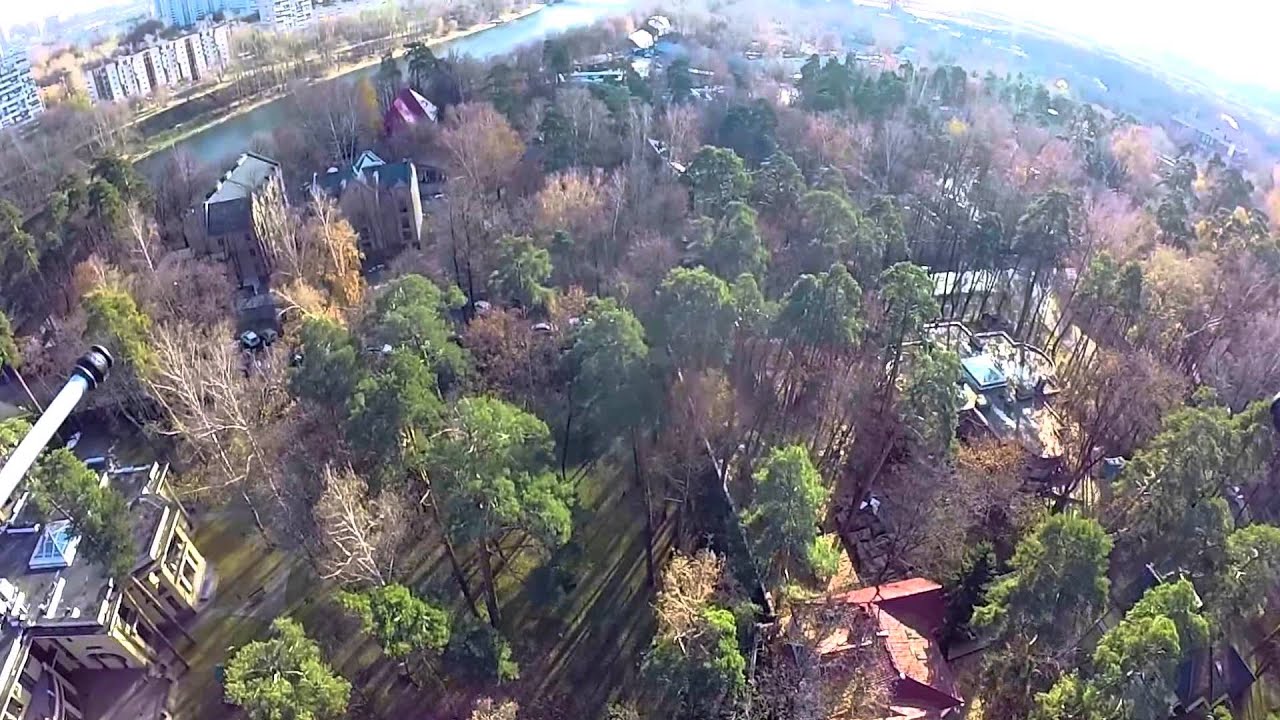
Here is what Patrushev’s house looks like from satellite imagery.
The house is even marked on Wikimapia with a telling comment:
Naturally, after some employees in our investigations department—with the involvement of FSB officers, what irony—were placed under travel restrictions, they could hardly miss the chance to go fly over a dacha located within Moscow city limits.
There it is, the house on the left.
Here the river looks like a literal poverty line.
And here is the full flight video:
There are currently 11 properties for sale in Serebryany Bor. None of them is anywhere near this luxurious. There is a plot three times smaller and a house half the size (a 700-square-meter house on 20 sotkas of land—about 2,000 square meters). It is listed for 12 million euros ($744,000 per sotka, or per 100 square meters). There is also a separate 3,800-square-meter plot listed for $28 million ($750,000 per sotka). So we can take $750,000 per sotka as a benchmark price. That means this property is worth $45,975,000 (FORTY-FIVE MILLION NINE HUNDRED SEVENTY-FIVE THOUSAND DOLLARS). At the August 2008 exchange rate of 25.27 rubles to the dollar, and taking real estate price trends into account, that comes to 1.1 billion rubles. And that is the most conservative estimate.
Given that Elena Patrusheva earned 1.8 million rubles over the previous six years, at that price she would have had to save for 3,666 years without eating a thing.
Note that we calculated everything in 2008 rubles, because if we converted these sums into 2014 rubles, there would not be enough room on the calculator screen.
Perhaps her husband helped Patrusheva acquire this property, so she would not need to become the immortal Duncan MacLeod to save up for the house?
In 2008, while working at the FSB, Patrushev earned 3.3 million rubles. After leaving the FSB, his income rose sharply: in 2009 it reached 13.5 million, and over the next four years he earned 81 million rubles. Even setting aside the fact that the house appeared when Patrushev was earning relatively little, the figures are still nowhere near comparable.
Perhaps Patrushev was simply allocated this house as someone in need of improved housing conditions? No: he had already been given an apartment in Moscow measuring 256.6 square meters, in a ведомственный дом (a state ведомство-affiliated residential building) on Rochdelskaya Street, where Sobyanin’s daughter lives.
Nor can this be a rented state dacha: most likely, the state dacha appears in the declaration as “house in use, 265 square meters”.
So there you have it. Tell me: what kind of anti-corruption campaign can possibly exist in a country where the family of the Security Council secretary (and former FSB director) acquires a house worth 1.1 billion rubles in 2008 prices?
If it was acquired below market price, then it was either a bribe or theft of state property.
If it was bought at market price, then with what money? Their earnings are nowhere close.
No fight against corruption is possible until officials’ spending starts matching their income.
No fight against corruption is possible as long as society—meaning us—has no right to obtain documents explaining what funds are used to acquire houses like this.
No fight against corruption is possible until illicit enrichment—spending that exceeds lawful income—is treated as a criminal offense.
This is what we must push for, and it should become the main political demand of all Russian citizens who believe that corruption and high-ranking corrupt officials really are a threat to Russia’s national security.
Please share this post—let’s brighten everyone’s International Anti-Corruption Day.
Here is an image for social media.
PS If we make a push, we can collect the remaining signatures today, on the anniversary of the convention’s signing.
PPS As for international experience: China’s equivalent of Patrushev—the former Minister of Public Security Zhou Yongkang—was arrested on corruption charges three days ago.