This is a post about the perfect test case. It matters, so please read it.
So, you know that the country is going through a highly performative—purely for show, really—campaign of de-offshorization and the “nationalization of the elite.” In particular, laws have been passed banning officials, deputies, and senators from owning foreign assets. There is even a strict penalty in place: immediate dismissal from office.
You also, of course, know that the ACF regularly finds among members of Putin’s elite exactly what they themselves have banned: foreign real estate, bank accounts, companies, and so on.
Unfortunately, the overwhelming majority of such investigations do not end the way they should—at the very least with a dismissal—but with our information somehow simply dissolving into space and time, without attracting the interest of the “competent authorities.”
Officials caught violating the rules come up with downright ridiculous explanations that allow them to dodge what ought to be inevitable dismissal.
Neverov blames it all on his mother-in-law, Liksutov forgets about his offshore company, Gorbunov says he has a company like that in Croatia which is apparently allowed, and so on and so forth—half my blog is about this_._
That is why Georgy Alburov from the ACF (let me remind you that he has a court hearing coming up soon in Vladimir) decided to launch a demonstrative perfect test case. One involving someone close and dear to this government—not some minor figure who can be easily sacrificed—and one where there is absolutely no way to wriggle out of it.
One where the documents are apostilled, the company was personally registered, the official is listed as a “businessman,” and so on.
So that if the official is not fired for this, we can shove this case in the authorities’ face every time they babble about the “nationalization of the elite.”
The effort paid off: we found such a case. Read on, and we invite everyone to watch closely how the authorities react.
On September 6, 2011, a Russian citizen named Vyacheslav Fetisov purchased shares in the newly registered Cypriot company OMNILINER LTD. This is a perfectly normal practice: instead of waiting for an offshore company to be registered, people simply buy a ready-made company from nominee founders.
A strikingly familiar name, isn’t it? It brings to mind Senator Vyacheslav Fetisov of United Russia, whom we exposed a year and a half ago for owning an undeclared 1,000-square-meter apartment. Is it him? There is enough information here to verify it: the name, date of birth, address, and even passport number are all listed.
Well then, let’s check.
Here is our senator
Hmm, the date of birth matches—April 20, 1958. But how many Vyacheslav Fetisovs with that birth date could there be in Russia? Millions, obviously. We need to check the address. We requested an official property record extract for the apartment listed in the document.
Well, look at that—it’s the very same Ladlena Yuryevna Fetisova, the wife of the senator of the same name, in whose name the legendary 1,000-square-meter apartment is registered.
Here is the apartment in Fetisov’s disclosure filing
We of course requested official apostilled documents with seals from Cyprus so that we could file formal complaints demanding Fetisov’s removal.
Folder with Cypriot documents for OMNILINER LTD—you can check everything yourself.
Fetisov still owns this offshore company to this day; here is a current screenshot from the Cyprus business registry.
This offshore company is active and connected to lotteries and sports betting pools.
We remember very well the “Liksutov maneuver,” when in a similar situation he said that he had “shut everything down” and that “the lawyers screwed up,” so we found Fetisov’s second active Cypriot offshore company. It is called SAFETEL LTD. It was purchased on the same day as OMNILINER.
The share purchaser’s details match the details given when the previous offshore company was bought.
By the way, note the field labeled “επάγγελμα,” which says “Businessman.” “επάγγελμα” translates from Greek as “profession.” Not bad for Fetisov, who has already been a public official for 13 years, to describe himself that way, given that he is not allowed to engage in business.
The documents, naturally, were obtained officially, apostilled, and attached to our complaints demanding Fetisov’s resignation.
Fetisov still owns the offshore company to this day.
All the documents we dug up on this offshore company can be viewed here.
It is harder to “forget” about two offshore companies, isn’t it? Especially when you bought them just a year and a half before passing a law under which owning them means certain removal from office.
We found a third Fetisov offshore company as well (though surely not the last). It is called F.I.S.S. CHESS 4X4 LTD. Only this offshore company, unlike the previous two, was not bought by Fetisov but founded by him. In other words, his signatures appear on the incorporation documents.
Here is a screenshot from the Memorandum and Articles of Association:
At one point Fetisov was handing out pucks with his autograph in large numbers—you do not need to be a handwriting expert to see that it is the same person.
The offshore company was registered in December 2011, a little more than a year before the law banning foreign assets was passed. Fetisov still owns its shares to this day.
As with the others, we obtained an official certificate for this offshore company as well.
All the documents for it are here; again, you can verify everything yourself.
To sum up. All the conditions of the perfect test case have been met:
We have a senator close to V. V. Putin, even a participant in his “hockey government,” known in certain circles (that is, when the crooks from the Kremlin play late-night hockey in a tight little group with favored professional hockey players).
The senator has three active offshore companies, one of which was not purchased but founded by him—there is no way to forget that one.
These offshore entities are joint-stock companies, and ownership of foreign shares is explicitly prohibited. There is no room here for legal hair-splitting over stakes versus shares.
We have obtained apostilled documents for these companies.
Even in the offshore companies’ incorporation documents, Senator Fetisov is identified as a “businessman.”
For owning shares in any one of these companies, Fetisov must resign under the very law he himself helped pass.
The Anti-Corruption Foundation and the Progress Party are demanding the immediate removal of this United Russia senator. We have prepared and already submitted formal appeals:
We also could not resist collecting comments from several senators and deputies (courtesy of the Russkiy Mir publishing house) on whether the law banning foreign assets is a good one and whether violators should leave office.
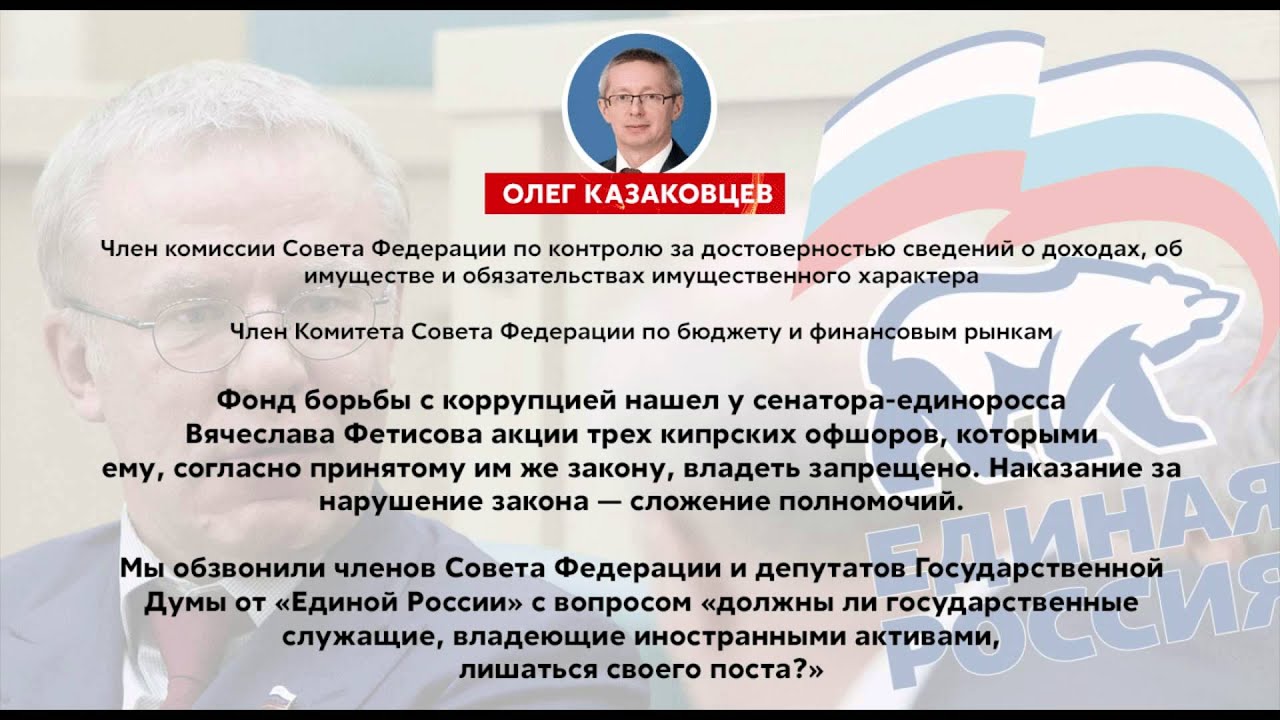
Enjoy the comments of Senators Dzhabarov, Shatirov, and Kazakovtsev, and Deputies Trapeznikov and Vyborny (all of them United Russia members!), united in condemning those who, here and there among us, sometimes do not want to liquidate their offshore companies.
Energetic Zhora even put together a special website for this case: https://fetisov.fbk.info/. It has all the documents and a countdown showing how long “immediate removal from office” will actually take:
I ask everyone interested in seeing how this turns out to help us spread the information. And to all media representatives as well, as the saying goes: please do not pass this by.
After all, we really ought to find out how this “nationalization of the elite” actually works.
I will end with a special disclaimer: we have nothing against Fetisov or his outstanding sporting achievements. Let him go on with hockey and business if he likes. He just has to choose: either make money or sit in public office lecturing the rest of us from his foreign properties on how we are supposed to love our country.