
Several people asked me what I think about billionaire oligarch Usmanov giving up his Russian tax residency. And they asked with that sly little smirk, you know, assuming it would be hard for me to answer directly, because “it’s all so complicated,” and a representative of the Russian opposition is supposedly expected to criticize oligarchs only reluctantly.
As if they’re just part of the market economy. Freedom to choose a tax haven. - Well, you didn’t privatize a factory in the 1990s, but he hustled and did. So what complaints can you have against him now? He just thinks faster than you do.
All that sort of thing.
It seemed important to me to state my position with absolute clarity, and in explicitly political terms, which is why our new video is about exactly this.
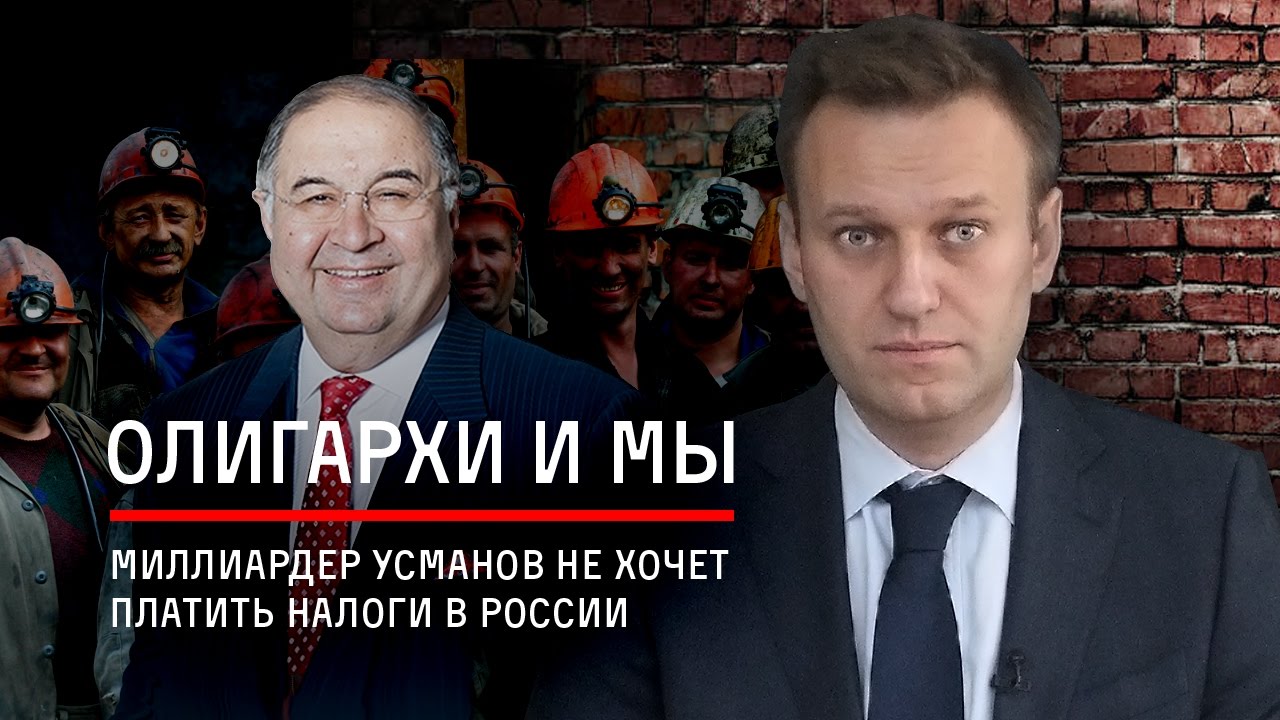
Let’s define whom we mean by an “oligarch” for the purposes of this discussion. To me, an oligarch is, of course, not just any very rich person, but someone who: derives the main and fundamental source of their wealth from the biggest privatization deals and, above all, the loans-for-shares auctions; controls major chunks of the natural resources sector; profits in a monopoly or near-monopoly market; created a quasi-monopoly around a major state-owned company (for example, the Rotenberg brothers around Gazprom); has close ties to the authorities, who use all kinds of informal and illegal means to help enrich the oligarch. And in return, the oligarch provides political loyalty and helps strengthen the regime through similarly informal and illegal methods (for example, Mamut, shutting down Lenta.ru, or Usmanov himself, imposing censorship at Kommersant).
The last point is the most important; in fact, that is the classic definition of oligarchy.
The size of the fortune is not the primary issue.
In that sense, dollar billionaires like Volozh (Yandex) or Galitsky (Magnit) are not oligarchs, while the pitiful multimillionaires Chubais (Rusnano) and Sechin (Rosneft) are unquestionably oligarchs.
The chief oligarch is Putin. He fits every single point listed above; he just keeps his wealth in the accounts of trusted proxies: Timchenko, Roldugin, Kolbin, and so on.
Not every big businessman who loves Putin and his regime is an oligarch. He may just be a fool, but if the main source of his wealth and the foundation of his business is entrepreneurial ability, then let him love whoever he wants. That’s his business. The person is doing business and creating value; for that alone, we can say thank you.
In every case where he is not an oligarch, an entrepreneur is your bro.
An oligarch is not your bro. We need to put an end to this idea that democrats, for some bizarre reason, somehow like oligarchs a little more than everyone else. It’s nonsense left over in some people’s heads from the early 1990s, when democrats were the ones for the market economy and for businessmen, while the communists were for Gosplan (the Soviet state planning agency) and all that other garbage.
The communists would shout “oligarch” at any businessman. And the democrats would shout back: we like him, he’s a good guy.
Back then, Putin too was a “democratic free-marketeer,” running circles around Sobchak (Anatoly Sobchak, the reformist mayor of St. Petersburg). He liked everything, everything suited him, and the collapse of the USSR did not provoke the slightest objection from him.
Twenty years have passed since then. Everything is different now, the old terms have lost their meaning, and...
people with democratic views should be against oligarchs. Oligarchs are corrupt operators, crooks, thieves, hypocrites, election-riggers, censors. They are part of this regime and no better than it.
Many people think oligarchs are a little better, because they’re just very cowardly. In private conversations they’re pleasant people, and they’ll go on and on about how bad Putin is, how sick they are of him, how he brings out the worst in people. And how he, the oligarch, would love to go to a protest rally, but he’s afraid (I have a company depending on me). Sorry, but 99% of the rest of the people in power possess that same “virtue” of cowardice. In private conversations they all say exactly the same thing: Putin is bad, people are bad, I’ll definitely go to a rally when it’s no longer scary, etc. (I have children).
There’s no need to be indulgent toward oligarchs “because deep down they think differently.” They all think differently deep down. Doublethink is the foundation of this regime.
Speaking out against oligarchs, their yachts, their lifestyle, and their tax avoidance (the reason for this post) does not mean rejecting capitalism and the market economy. On the contrary, oligarchs destroy market relations. They operate outside the rules, they impose monopoly; normal business will always lose out when competing with oligarchs.
That is why libertarians in particular (who for some reason regularly criticize me for my negative attitude toward oligarchs) should be the first to hunt down these villains and beat them to death with copies of their favorite book.
In Russia, 88% of the national wealth is controlled by 0.1% of the population. What more is there even to say? What the hell does stopped being a Russian tax resident even mean? This is outright robbery, and that needs to be said plainly.
Usmanov can tell us all he wants about his investments in Uber. Fine, he invested—so what? What is the source of those investments, and of 90% of his wealth in general? Here it is:
Privatized giant Soviet mining combines. They dig iron ore concentrate out of an open pit, and that’s it. They started digging back in the 1960s; at some point Usmanov simply showed up there and said to the miners underground:
- Hi there, workers. The fruits of your backbreaking labor used to be spent by idiots in the Soviet government on the arms race and aid to socialist regimes in Africa. But now I’m the boss here, and I’m going to spend the fruits of your backbreaking labor on buying Uber shares and the world’s largest yacht, Dilbar.
And what exactly are we supposed to love or respect here?
Do you know the average salary of a worker at the Mikhailovsky GOK (Mining and Processing Plant) shown in the picture?
The working conditions there are hazardous and harmful. The work is hard. There are injuries and early deaths.
Here is the information from the 2015 reporting.
38,700 rubles. Before tax.
Meanwhile, a miner in the United States earns about **330,000 rubles**.
That’s the whole business model: underpay a miner in Russia, invest the savings in American Uber.
The ingredients of citizen Alisher Usmanov’s success: a plant (Soviet-built) + concentrate from the ground (belonging to all of us) + a worker’s wage (poverty-level) + support from the authorities (crooks).
As a citizen of Russia, under these circumstances, can I accept that Alisher Usmanov has ceased to be a Russian tax resident?
No, I cannot.
If you can’t either, help spread this video. And this post as well—consider it my anti-oligarch manifesto.
P.S. Don’t forget to subscribe to the channel and support ACF.