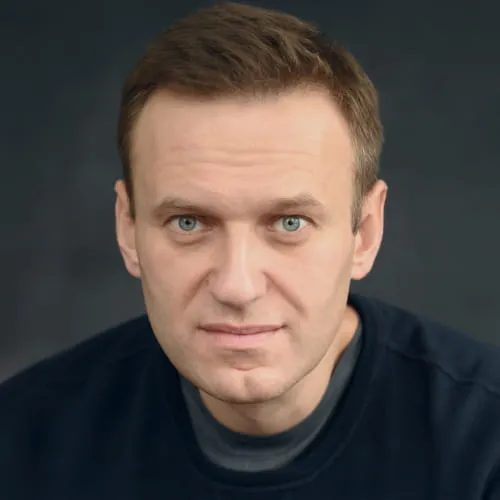
I never wanted to be a TV host or anything like that. It’s a pretty awkward job if you don’t have the rare ability to act completely naturally in front of a camera. Still, censorship—which has strangled most media outlets, including online ones, and keeps shrinking the information space—is forcing us to come up with new ways to communicate with people.
Actually, there’s nothing especially new about this: YouTube channels in Russia are developing rapidly, but in politics—especially opposition politics—they’re still used relatively rarely.
In fact, we put a video channel into the ACF’s (Anti-Corruption Foundation’s) work plan back last year, after the success of the film Chaika. The 5 million views and the 38 percent of citizens who had heard about our investigation impressed us. It became clear that it made sense to invest effort in this direction.
But we were afraid to actually start filming, editing, and doing everything else on our own. The mysterious world of video was enticing, but intimidating too.
For example, we made the video about Shuvalov’s corgis with help from kind people outside the team.
Then we spent a long time thinking about whom we needed to hire and what complicated equipment we should buy, and so on.
Consultations with experienced people helped, and above all Valentin Petukhov (Wylsacom). He gave us a ton of useful advice—for which many thanks—and explained that video isn’t nearly as scary as it looks on screen. It’s all simpler and cheaper than it seems.
So we chose a “cheap and cheerful” approach. Friendly TV professionals—thanks to them as well—gave us a few lessons, organized a mini-course on Final Cut at the ACF, and helped us make several trial videos.
We decided to shoot in the simplest and cheapest way possible: a single shot, at my desk, against the wall in my office, painted with write-on paint.
From the outside, it looks like this:
On August 25, we released our first fully self-produced video: How the Two Top United Russia Figures Live, which got 700,000 views.
Since then, we’ve been releasing two videos a week, and so far we can report the following:
We’ve released 16 videos.
The channel has 233,000 subscribers. That’s not much, but it is, by the way, more than TV Rain has—though of course YouTube has never been a priority for them.
If you haven’t subscribed yet, please subscribe—it’s incredibly important.
Over these two months, we’ve gained 155,000 subscribers, and our goal is to reach one million.
It’s a вполне achievable goal: as it turns out, there are as many as 103 channels in Russia with more than a million subscribers.
We’ve had 13 million views and half a million likes in two months.
The average number of views per video is 752,000. If you exclude the most popular video from the calculation—since its result is far above the norm—the average comes to 553,000 views.
The top five looks like this:
5th place — “How the Two Top United Russia Figures Live” — 716,389
4th place — “A Video That Violates Court Bans” — 849,539
3rd place — “Putin’s Chef, the King of Dislikes: A Success Story” — 914,441
2nd place — “One Flew Over the Nest of a Crazy Governor” — 959,239
1st place — “Dmitry Medvedev’s Secret Dacha” — 3,767,952
We now add English subtitles to all our latest videos right away.
You may have noticed that we tried to find a dedicated person to head up video production, but we didn’t succeed. For now, we seem to be managing without one and doing everything with a four-person team: Kira Yarmysh (scripts, producing, bass guitar), Anna Bogomolova (camera, editing, drums), Anatoly Kravchenko (graphics, keyboards), and me (vocals, bagpipes). For all of us, this is extra work on top of our main responsibilities; we haven’t hired anyone new yet.
Naturally, the substantive content is prepared by the entire ACF team.
What’s the hardest part? As it turned out, the hardest thing is smiling on camera, and so far I haven’t managed to do it in any of the 16 videos. Right now my style is basically the robot Werther (a stiff-faced character from a Soviet children’s sci-fi film), but I’m working on it. Maybe someday I’ll manage to be on camera without thinking, “Alexei, this is work, keep recording—just make sure the horror doesn’t show on your face.”
And of course, it’s not easy to immediately figure out how YouTube works—it’s a brave new world for me. It has a huge number of its own subtleties and nuances, from the best time to publish to the ways of getting into the magical “YouTube top,” which instantly brings in a ton of views.
Everything here is very different from a regular text blog. For example, as I said above, it’s incredibly important that people actually subscribe to the blog and click like.
I used to wonder: what kind of nonsense is this—why do they all parrot “subscribe to the channel, hit like” in every single video? And now I say it myself, because audience reach, getting into the trends, and so on all depend on it.
In short, we’re figuring it out little by little.
And of course, scripts, recording, and all the rest take quite a lot of time. In other words, there’s simply more work now.
Overall, I can say that I’m very glad we launched video, and I’m satisfied with how the process is going. I only regret not doing it earlier. After all, an average of half a million views per video is substantially more than the usual audience for one of my posts.
Our creative plans.
Here I’d like to ask your advice. Looking at how Vyacheslav Maltsev’s channel is set up, I decided it’s a pretty effective model. He records a 90-minute video EVERY DAY, and each one gets watched by around 150,000 people. And it costs practically nothing.
I can’t manage every day, but I’d like to go live once a week in the evening with a one-hour show in the style of “Alexei Navalny talks to a computer screen.” In other words, something like a radio program such as *Personally Yours* on Echo of Moscow (a well-known independent Russian radio station), but on YouTube. Answers to questions, discussion of the latest news.
We could also try inviting guests, but that’s for the future.
Your opinion matters to me here. A weekly live show is a real commitment: once you start doing it, you have to keep doing it. So is it worth starting, and would you actually be interested?
So it would be very important to me if you voted and answered this question, along with a couple of others about the video blog.
Do you watch the ACF video blog?
Do you like the ACF video blog format?
Do you think the ACF video blog is a worthwhile project?
Are you subscribed to the ACF video blog?
Do you support the idea of my weekly live show on YouTube?
Thank you for your answers, and thank you for supporting the ACF. Of course, we make the video blog possible only thanks to your donations as well.
Subscribe to our channel—they tell the truth there.