
"I hate it with a furious, rabid hatred"—that’s how people in the legendary hypertext world of FidoNet (an early pre-internet network popular in Russia) used to describe the feelings I get when I read city administrations’ replies to our RosYama project.
Where they used to respond to complaints about broken roads with the embarrassed line, "included in the repair plan for a future period," now they say it outright: we’re not going to fix anything because there’s no money.
Or, at best, as in Voronezh: there’s money only for the main thoroughfares, not for ordinary streets.
And that immediately raises a question for me: why did we get involved in Syria, for example, if there’s no money? That’s exactly what I talk about in my new video. The naval fuel oil alone for the Admiral Kuznetsov to sail in clouds of black smoke from Severomorsk to Syria and back cost 128 million rubles.
If we’re so poor that we can’t even fill potholes in our biggest cities, then maybe we should take part in military operations a bit more modestly—without all these PR stunts, like firing expensive cruise missiles at villages and donkeys? There’s no military logic to it; the only purpose is a "demonstration of military might."
For a change, it would be great to demonstrate that might by fixing the roads in Voronezh. Because as things stand, it turns out we’re bombing it too.
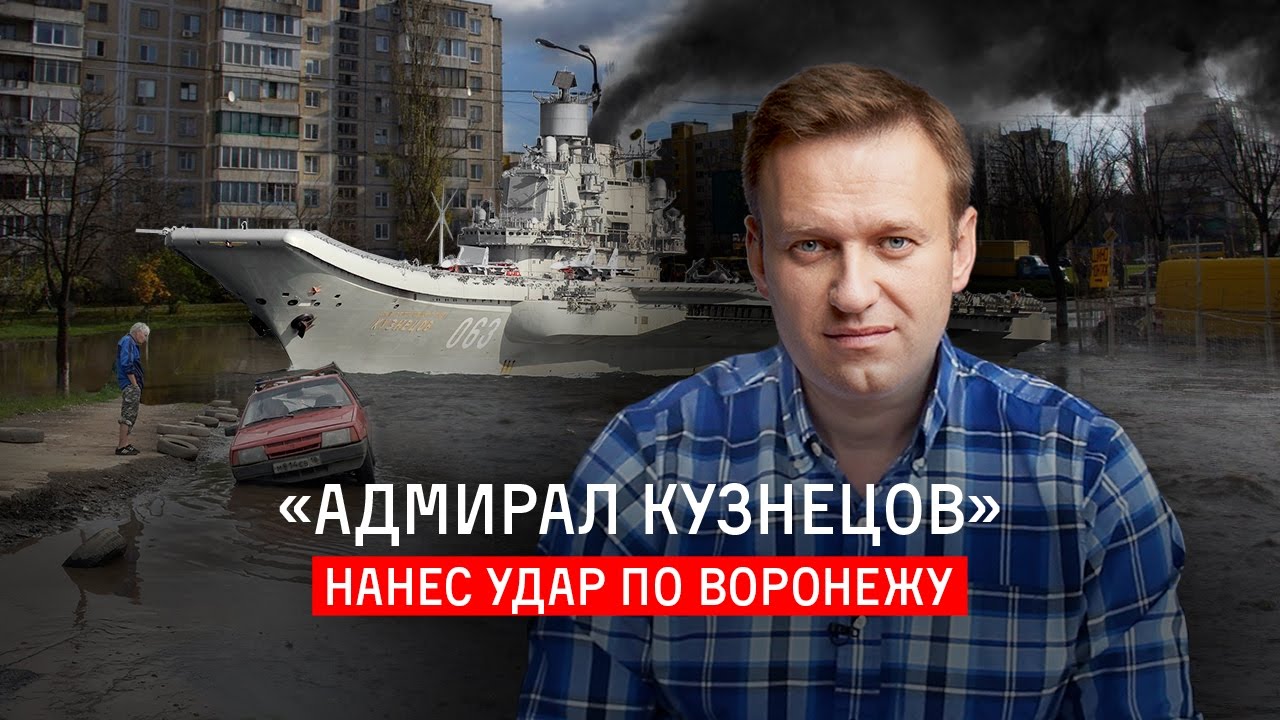
And let me answer right away everyone who’s already about to write to me: no amount of money is too much for fighting terrorism. We have to bomb ISIS from our aircraft-carrying cruiser now so that tomorrow ISIS doesn’t come into our homes.
The bitter truth is that even without ISIS, 25,000 to 30,000 people die on our roads every year. And poor road surfaces are one of the main causes of traffic accidents.
It’s as if some hypothetical ISIS were to storm a small town like Gagarin in the Smolensk region every year and slaughter the entire population.
It’s simply a fact: Russia’s bad roads kill more people every year than the total number of victims of terrorist attacks in all of post-Soviet Russian history.
So a pothole on a road in Voronezh, Rostov, or Krasnodar is more dangerous than ISIS, and more money should be allocated to dealing with it.
Yesterday I saw a link on Twitter to an article: Opposition activist maps all of Krasnoyarsk’s potholes.
An opposition activist isn’t supposed to do anything about them; the city administration is supposed to just fix everything.
This is Krasnoyarsk. A major city, one of the country’s industrial leaders. A thousand potholes, for crying out loud. And those are only the ones that violate GOST (Russia’s state technical standards), meaning they’re supposed to be repaired within ten days.
Now look at this:
Translated into plain English: dude, we can’t repair Vilyanskaya Street because all the money went to the road from the hotel to the stadium.
Just wonderful. That’s what you call having no pants but wearing a hat.
Then why the hell are we hosting the World Cup in Volgograd if things are that bad there? Volgograd is actually Russia’s 14th-largest city by population; more than a million people live there. And we, the world’s number one oil exporter, can’t fix the roads there because everything went into the stadium?
That’s how all our money gets spent on putting on a show for foreigners: the most expensive Olympics, the most expensive stadiums, a cruiser sailing to Syria. It all generates great headlines in the foreign press. But the headlines will fade, the championship and the Olympics will end, and we’ll still be left with the same thought—"Damn, will Russia really never have good roads?"—every time a car’s suspension slams into the asphalt.