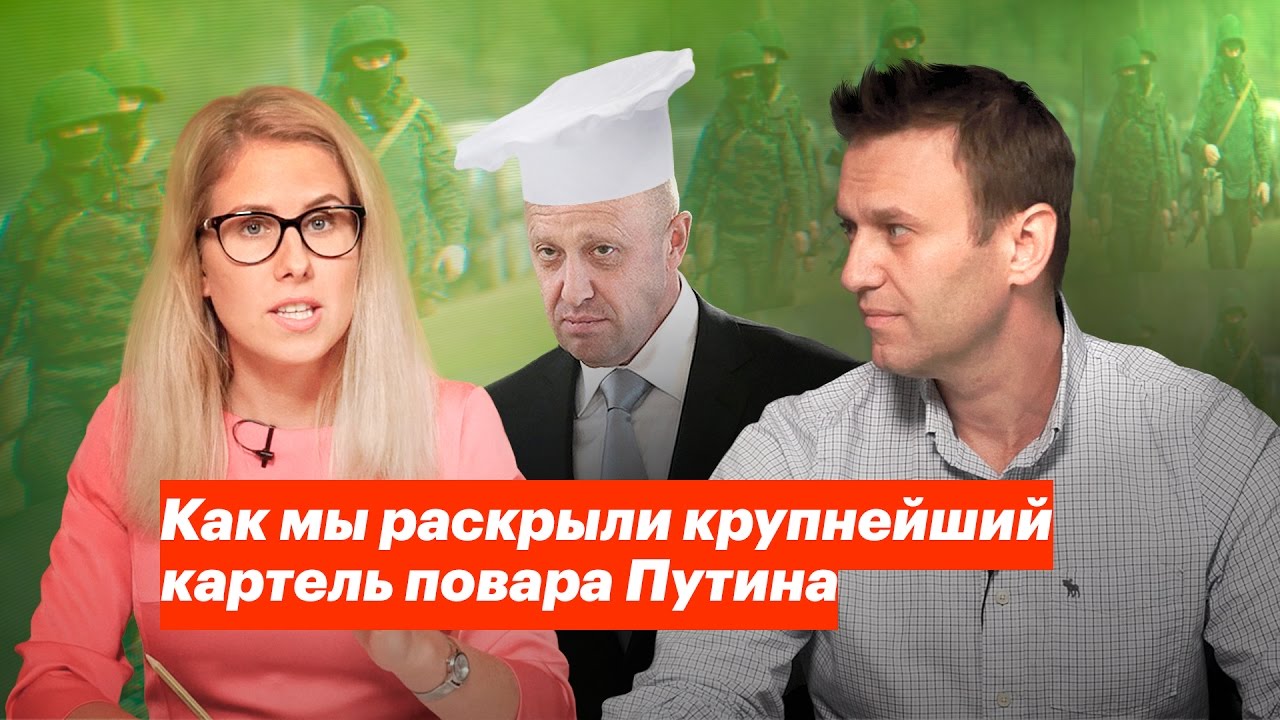
Hooray. We have uncovered and documented proof of the existence of a cartel created by the now-notorious “Putin’s chef,” Yevgeny Prigozhin. Through this cartel, Prigozhin, in collusion with Defense Ministry officials, stole money from state defense procurement.
In total, more than 23 billion rubles were spent, and we estimate that at least one-third of that was stolen.
Until now, the largest cartel case reviewed by the antitrust service involved fraud totaling 3.5 billion rubles.
Our case involves 23 billion rubles, which makes it the largest cartel whose fraudulent scheme has reached formal proceedings.
On Monday, the antitrust service is due to issue its ruling on the cartel, and unfortunately there is a chance that the FAS will get scared, back down, and significantly soften its decision—letting Prigozhin’s main companies off the hook for fines or something along those lines.
Unfortunately, the pattern of recent years shows that there is plenty of talk and plenty of threats, but as soon as the matter involves people close to Putin, the result is either minimal fines or the whole case is quietly buried.
All the details are below, but let me say right away: the 23-billion-ruble cartel is what we were able to prove documentarily. In total, more than 180 billion rubles passed through these schemes.
We are enormously proud of this work, especially because we have a personal score to settle with Prigozhin: we believe he was behind the attack on the husband of Lyubov Sobol, an ACF lawyer who exposed the “chef case” together with our other lawyer, Valery Zolotukhin.
Thank you to everyone who supports ACF and makes investigations like this possible. If you value our work, now is the perfect time to show it by donating your hard-earned ruble.
Watch the video about the case, and below you’ll find all the documents.
How we uncovered the cartel collusion among Prigozhin’s companies:
Initially, we uncovered a cartel of little-known companies (Nordenergo, Teplosnab, TKS, and others) in tenders run by a Defense Ministry subsidiary, JSC GU Housing and Utilities. Fontanka (a St. Petersburg news outlet) conducted a parallel investigation: while we focused on antitrust violations, Fontanka established the companies’ links to Yevgeny Prigozhin.
We noticed something odd: the justifications for the initial contract prices were being provided by the same companies—Komponent LLC, Spetsresurs LLC, RusKompleks LLC, and Ekobalt LLC. So we started looking into them. It turned out that all of these companies had been created recently and had also received billions of rubles directly in state contracts from the Defense Ministry. Together with ASP LLC, Prometey LLC, Ars-Service LLC, and Megaline LLC, they took part in a cartel scheme to monopolize the market for servicing Russia’s military towns. In total, this involved 23 Defense Ministry tenders worth 23,552,765,956 rubles.
Now, a year later, we have conclusive proof that all of these companies were under Yevgeny Prigozhin’s control, at least through the end of 2015, and were managed through the parent organization, Concord Management and Consulting LLC.
The first evidence:
Before they received these contracts, only one of them—Megaline LLC—was known at all; the rest of the companies were entirely unremarkable.
Even a preliminary review of these companies’ activities makes it clear that they are shell companies with nominal owners, and do not look like serious businesses capable of winning state contracts worth billions. Not one of them had experience servicing housing and utilities in military towns. Some of the companies had been created shortly before receiving the contracts.
Open sources provided enough information to establish links among the companies: one Anton Nikulichev founded Ekobalt LLC and KOMPONENT LLC, while Maksim Moskalev, the former general director of RusKompleks LLC, is the actual director of Megaline LLC.
Ekobalt LLC and KOMPONENT LLC were originally registered at addresses literally next door to each other, in neighboring offices: 75 Kondratyevsky Prospekt, Office 5N, St. Petersburg 195271, and 75 Kondratyevsky Prospekt, Office 4N, St. Petersburg 195271.
In addition, four of the six companies received EMERCOM (Russia’s Ministry of Emergency Situations) operating licenses in remarkably coordinated fashion. The license numbers are consecutive, and they were all issued on the same day: Megaline LLC — License No. 78-B/00703 dated 22.04.2015; Spetsresurs LLC — License No. 78-B/00704 dated 22.04.2015; RusKompleks LLC — License No. 78-B/00705 dated 22.04.2015; Ekobalt LLC — License No. 78-B/00706 dated 22.04.2015.
The reduction from the initial maximum tender price was the same in every case: minus 1% from the starting bid price.
Table with links to the state contracts
On these grounds, we filed a complaint with Russia’s Federal Antimonopoly Service (FAS) against these companies on January 26, 2016. In August 2016, the FAS officially opened an antitrust case, which is still under review; the next final hearing is scheduled for May 22, 2017.
We were able to review the antitrust case at the FAS, which was opened on ACF’s complaint. From the case materials—specifically, from various organizations’ responses to FAS inquiries—we learned even more about the links among these companies and obtained the key document that allowed us to expose Prigozhin’s entire network of firms: a bank statement from Megaline’s account.
Evidence obtained after reviewing the case at the FAS:
The same IP address
All of the firms are linked to one another through their IP address. Every company in the cartel logged into the electronic tender platforms from the same IP address: 37.77.135.2.
This IP address belongs to Concord Management and Consulting LLC, a company registered in the name of Yevgeny Prigozhin’s mother, Violetta:
In response to an FAS inquiry, the company Tensor provided information on the email addresses used by all the cartel companies when submitting official reports. It turned out that all of the email addresses were registered under a single domain name belonging to Prigozhin’s company Medstroy LLC: office-vp.spb.ru. The contact phone number for the domain owner is +7 812 6770585, which matches the phone number of Concord Catering Combine LLC, another Prigozhin company.
Identical auction applications and responses to FAS inquiries
All of the companies gave roughly the same response to the FAS inquiry about collusion: we do not keep records of the auctions we participated in during that period, so we cannot provide an answer.
The application documents are, in fact, identical word for word. For example, in auction No. 0173100004515000637, the applications submitted by Ekobalt LLC and RusKompleks LLC list the same manufacturers in more than 250 line items, and the manufacturers’ names are written identically down to the space before the comma after the name. Example: “GK Sevkabel LLC , Russia.” This strongly suggests that the first parts of the applications were typed up by the same person, then copied, with only the font changed. For comparison, the application submitted by a participant outside the cartel is formatted completely differently.
The documents approving major transactions were likewise produced as if from the same template.
For example, the resolution approving a major transaction by Spetsresurs LLC:
From the antitrust case file, we were able to obtain a bank statement for Megaline’s Sberbank account.
The bank statement showed that:
There are dozens of companies financially linked to one another through loan agreements; more than 40 of them are Prigozhin companies, and six are entities of the Russian Defense Ministry.
Some of the companies involved in these loans are state customers themselves—namely GUZhF LLC and its branches (a “granddaughter” company of the Defense Ministry, responsible for maintaining housing stock in military towns) and JSC GU Housing and Utilities (a “daughter” company of the Defense Ministry, responsible for housing and utilities services in military towns and routine repairs of Defense Ministry facilities). For example, ASP LLC transferred a total of 300,000,000 rubles to GUZhF LLC (Moscow branch) under some kind of loan agreement, and a total of 42,500,000 rubles to JSC GU Housing and Utilities. Both GUZhF LLC and JSC GU Housing and Utilities gave and received substantial loans from Prigozhin’s companies after the state contracts had already been signed.
These loan agreements had a specific designated purpose and were directly tied to Defense Ministry contracts, as they were titled “KZhF loan agreement,” where KZhF apparently stands for “barracks and housing stock.”
Some of these loan transfers were intended to move money from one Prigozhin company to another so that the funds could then be used as bid security for participation in tenders.
The chart shows that Concord Management and Consulting transferred funds into Megaline’s account, and Megaline then used that money to secure its own tender bids and the bids of other companies controlled by Prigozhin.
In legal terms, this is called unlawful coordination of economic actors, which is strictly prohibited by law. And restricting competition through collusion can expose the participants to criminal prosecution.
On the basis of this evidence, ACF filed a complaint with the FAS seeking to hold Concord Management and Consulting LLC liable for coordinating the economic activity of the cartel participants.
Other interesting facts also came to light:
The sole owner and manager of one of the companies—RusKompleks LLC—is a man who is currently being held in pretrial detention (SIZO, a Russian remand prison) on charges of fraud on an especially large scale.
Here, from the FAS case materials, is a copy of a RusKompleks LLC resolution listing the company’s general director and sole participant (owner):
We learned that he was in pretrial detention by chance, from a power of attorney processed by the head of the detention facility where this talented entrepreneur is currently being held. A man with the exact same full name as Filippenko is a defendant in a case involving fraud on an especially large scale (Part 4 of Article 159 of the Russian Criminal Code).
Despite the fact that its owner and manager is in pretrial detention, the company continues to win tenders; since the power of attorney was issued, it has received state contracts totaling 99.5 million rubles.
Another astonishing fact: another company that received a total of 3.4 billion rubles from the budget has, as its charter capital, only a desk and a chair—literally. If it fails to meet its obligations to the army and goes bankrupt (which is far from rare among Prigozhin’s companies), the state will be left with nothing but this junk.
In addition, thanks to the antitrust case documents, we were able to establish links between Prigozhin’s companies and the contracting entities—the Defense Ministry structures.
We are convinced that Prigozhin could not have obtained state contracts on such a massive scale without direct support from, and collusion with, the Defense Ministry leadership.
This is supported not only by a general understanding of how multi-billion-ruble state contracts are awarded in this country, but also by specific facts.
Fact 1:
A number of Prigozhin’s companies have branches and offices located on restricted-access territory—inside Defense Ministry military units.
ACF has already written about how Prigozhin’s company Exedra Plus LLC has an office inside Closed Military Town No. 2 in Moscow. The companies in the cartel described above likewise have branches in places no ordinary outside company could even dream of accessing.
For example, ASP LLC established a branch directly inside a Russian military unit in Armenia.
It is hardly surprising that this very company later won the tender to service that territory.
Spetsresurs also has a branch on the territory of a military unit.
Fact 2:
The Russian Defense Ministry allowed a company to perform work without a valid clearance for state secrets, even though such clearance was required under the terms of the contract. Specifically, Prigozhin’s company RusKompleks LLC did not have a valid license to work with state secrets while carrying out sanitary maintenance of barracks and housing facilities in Defense Ministry military towns in 2015. We learned this because, while performing that work, RusKompleks LLC was also trying to participate in other tenders, but its application was rejected due to the absence of a valid state-secrets license.
Fact 3:
The monopolization of the military-town maintenance market was made easy by the deliberate bundling of lots (state contracts) in Defense Ministry tenders. The work was divided not into small orders for individual military towns, but by military district. As a result, the lots (state contracts) were worth billions of rubles, and only Prigozhin’s companies—armed with the right insider information and special “advantages” in the bidding process—could win them.
Fact 4:
The links between Defense Ministry entities and Prigozhin’s firms are visible in certain loan agreements they concluded with each other after the state contracts were signed. For the money transfers between Defense Ministry structures and Prigozhin’s firms, see the chart of Megaline LLC’s bank transactions and its description below.
Conclusion: what is described above is only one Prigozhin cartel worth 23 billion rubles. In total, through similar schemes, Prigozhin obtained more than 180 billion rubles in contracts from the Russian Defense Ministry and its subordinate organizations. The facts indicate that the Defense Ministry was simply handing contracts directly to Prigozhin’s firms while colluding with them.