Unboxing is a popular genre. It’s a great way to rack up views and subscribers. But unboxing a gadget made with Russian taxpayers’ money is also a very instructive film.
You can see with your own eyes what happened to our hard-earned 10 billion rubles (about $150 million at the time).
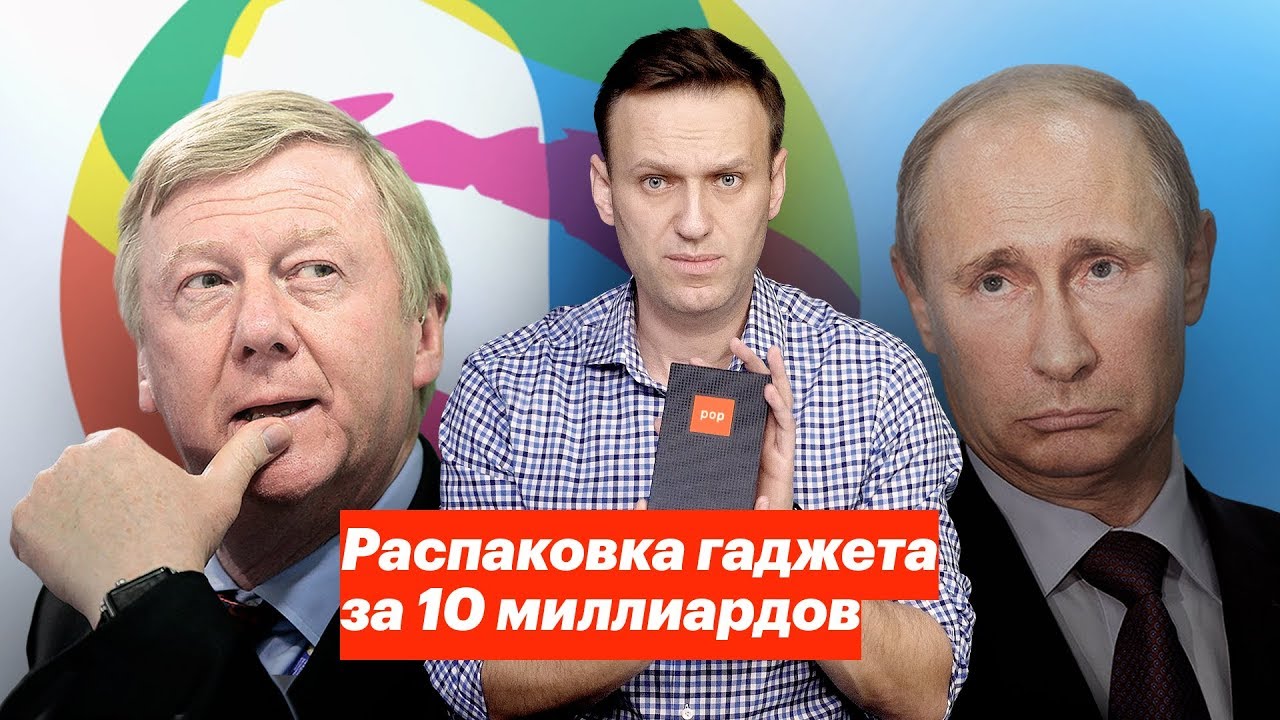
I urge all of you to watch the video. It seems very important to me—because it is both legal and factual proof of what Putin’s regime is capable of achieving in high technology.
It is a picture of Russia’s technological future if this man stays in power for another 12 years. And that technological future will be funded quite generously.
And for those who prefer reading, or simply want to understand every detail thoroughly, I invite you to read the story below. Those 10 billion rubles were indeed blown. It’s a big and important case. We studied it meticulously and are leaving it here for the record.
So. What you see on the back of this little phone case is a display made by PlasticLogic.
And don’t think I dug up some archival photo from 2007—no. This little case is the last real product ever made using these displays.
That already seems strange, doesn’t it? And how will you feel when I tell you that we—you and I, as taxpayers—invested 10 billion rubles in developing this technology?
Don’t believe me? You should. Let me explain from the beginning.
Chapter 1. How Chubais Made a British Company Rich
Let me start from a distance. The state corporation ROSNANO was founded in 2007 and immediately received 130 billion rubles from the government to create and develop the nanotechnology industry in Russia. Despite all the innovative zeal, in its first two years Chubais and his team managed to spend only about a quarter of those funds. But once money has been allocated, it has to be spent. Otherwise, they won’t give you any more.
In 2010, a joint project with the British company PlasticLogic was announced. By that point the company was already 10 years old and had developed plastic electronics technology, including so-called flexible displays.
Despite the company’s long history, by then it was, to put it mildly, already “questionable.” Whatever PlasticLogic took on, nothing seemed to work out.
Starting in 2004, they tried to do something with Siemens; in 2008 they came up with an e-reader; in 2010 they tried once again to launch it. But by then there were already countless different e-readers on the market, the iPad had already arrived, and all of it was about one and a half times cheaper.
Here’s what people were writing about PlasticLogic at the time:
In mid-2010, right after its failed market launch and the cancellation of its manufacturing plans, PlasticLogic found itself in serious trouble, and investors were looking for buyers for the company. The task seemed hopeless.
Until the good fairy who rules over state funds appeared.
I mean Chubais and ROSNANO, of course.
In 2010, ROSNANO invested 4.6 billion Russian budget rubles in PlasticLogic—that is, $150 million.
Let me repeat: Chubais decided to pour a huge amount of money into a completely failed project that had shown no promise for 10 years.
Why did he do it? No normal person could understand it. In fact, this was an absolutely unique situation, and the deal was even called the largest one-off transaction in the history of European venture investment. The largest investment in a project that was obviously doomed.
Don’t spend too long puzzling over it—I’ll explain right away. Chubais makes decisions like this simply because he can. He doesn’t want to think, plan, or evaluate projects in terms of profitability and prospects.
What Chubais wants is to wave a flexible screen around at a conference and show Putin a “unique iPad-killer tablet.”
Chapter 2. Chubais the “Genius” Investor and His Plans
I have two pieces of news for you. Bad and very bad.
The bad news is that the $150 million I mentioned above was only ROSNANO’s first investment in PlasticLogic.
In 2011, they decided even that wasn’t enough. So they put another 2.5 billion rubles ($80 million) into a project with years of losses and failures behind it. Then more. I won’t bore you with tedious details from the financial statements—let me just show you the final result.
By 2014, the total invested had reached 9 billion rubles. Here is the figure straight from ROSNANO’s annual report.
I’d gladly give you more recent data, but ROSNANO stopped publishing detailed project reports. Here’s what the same kind of report looked like in 2016.
Last year the figure was there, and now it isn’t. They must have been so busy, so wrapped up in nanotechnology, that they simply forgot to mention it. Or maybe it’s just written in nano-font and we can’t see it.
Back to those 9 billion. With that money—and the money of some other mythical investors—Chubais was planning something truly grand.
Let’s listen:

“What we have prepared now is a computer for educating schoolchildren. Today it contains a full set of textbooks for all sixth-grade subjects. And this is not just a set of textbooks—they have been adapted for the computer, with hyperlinks. And with the support of the Ministry of Education, we will test a thousand such units in several regions of the country... If the experiment succeeds, if the Ministry of Education confirms that it works, then we will move to very large-scale production.”
A “unique tablet computer”! With hyperlinks?!!! WOOOOW.
Let me remind you that this meeting between Putin and Chubais took place not in 1993, but in 2011. Apple had already released the second generation of iPads. And Chubais was still boasting about hyperlinks and books loaded onto a tablet.
Let’s look at Chubais’s other plans as well.
The “new” electronic textbook was to be produced at a specially built, “most advanced” factory in Zelenograd. For some reason, ROSNANO was not at all bothered by the fact that Plastic Logic already had a factory in Dresden that was supposed to produce exactly these kinds of tablets, but never reached full capacity.
A factory wasn’t enough for ROSNANO! In Zelenograd, on the campus of MIET (Moscow Institute of Electronic Technology), they were also going to build a research center.
Brace yourself, Zelenograd. Specialists will come pouring in any minute now, salaries will soar like in Silicon Valley, and there’ll be nowhere to park all those Teslas.
In short, a couple of months after the tablet was presented to Putin, the contract to build the factory was signed, the site was selected, and the design for a 55,000 m² factory—14,000 m² of it laboratories, let’s not forget—was approved.
Look how beautiful it is.
A PITY IT WAS ONLY DRAWN.
I think by now you’ve already guessed which piece of news at the start of this chapter I called “very bad.” If not, let me spell it out.
NONE OF IT WAS EVER BUILT!!! Nothing happened, do you understand? Nothing at all. No miracle textbooks for schoolchildren, no factory in Zelenograd, no laboratories, nothing. Even that miserable screen case from ROSNANO was a failure.
Chapter 3. Chubais and ROSNANO Change Their Tune Mid-Air. The Little Cases Are No Longer Theirs.
If you remember, I started with the little cases. Let’s finish with them.
The last notable attempt to use PlasticLogic’s products was a project to make phone cases with an additional screen. Back in 2015, you could still buy them on Amazon.
You saw the case itself above; the only thing worth adding is that it cost $129—about 8,000 rubles at the time.
Chubais was very proud of those cases. Very.
ROSNANO claimed that its manufacturing company had secured as much as $25 million in orders, and that one of the projects it had delivered was screens for these little cases. Chubais himself bragged about the cases on Twitter.
It got to the point that during my debate with him on TV Rain (an independent Russian TV channel), Chubais “just happened to bring along” this little case and even gave it to me.
In response to the host’s questions, Chubais was unequivocal: “This is our second screen and our invention.” He went further and said that this was “a breakthrough point, and this technology is at the launch stage, like a rocket.” LIKE A ROCKET!
Naturally, once it became clear that the cases had failed, ROSNANO publicly disowned the project. The rocket was no longer theirs.
Very convenient. If it works out, then it’s a rocket and a breakthrough point; if it doesn’t, then some outsiders made it and we had nothing to do with it.
Chapter 4. Where Else Chubais Lied to Us
And one more very small (but important) remark. For the record.
At those same debates, Chubais reproached me, saying that if I had properly studied ROSNANO’s history, I would know that “one of the basic principles of ALL our investments [at ROSNANO] is that we are ALWAYS minority shareholders.... And this is done so that, as a result of our work in any project, we can exit that project. We exit the project, and it remains the property of the majority shareholder.”
That is almost a verbatim quote—you can listen to that segment here.
So let’s see what stake this “always minority shareholder, ROSNANO” has in Plastic Logic.
Now, after seven years of “investing” in plastic electronics, ROSNANO is effectively the sole owner of the Plastic Logic group of companies.
Originally, the main investor, Oak Investment Partners, began exiting the project as early as 2013. We do not know the exact buyout price for the shares, but since ROSNANO ultimately became Plastic Logic’s sole shareholder with a 99% stake, it is fair to say that the buyout was financed with ROSNANO’s funds—that is, with Russian taxpayers’ money.
Chapter 5. So What Happens Next?
By now, my friends, you have probably already understood that nothing will happen next.
You understood it, but Chubais did not.
Barely holding back either tears or laughter, I report the following: in the filings of PlasticLogic’s foreign companies, we discovered that ROSNANO continues to pour substantial sums into this company. In 2015–2016, the British company FlexEnable (PlasticLogic’s new legal entity) received 700 million rubles in loans from Russia!
Add that to the 9.3 billion rubles that ROSNANO officially listed in its 2015 annual report, and you get those same 10 billion rubles.
Makes you sorry for the money, doesn’t it?
And they could have built roads. Or treated sick people, bought expensive medicine for someone. Or sent many, many top students to study at the world’s best universities, paying for their tuition and living expenses. They could have done and bought a great many things.
But all we got was this little box sitting in the archive of the ACF (Anti-Corruption Foundation).
So, folks, add your signature in support of my nomination.
And send money to our shared election campaign.
This will not go away on its own.