I’m going to explain what we’ll do next and what our political strategy is.
Everyone keeps asking: Alexei, explain the plan.
Our plan has many parts, and today I’ll talk about the part that concerns electoral struggle. In other words, elections.
Here it is. Smart Voting: https://2019.vote/
Let me stress this: the strategy I’m unveiling today concerns elections specifically. There are rallies, there are protests, there are investigations, and so on and so forth, but there are also elections. They differ, and we treat them differently. Some can only be boycotted, as was the case with the last presidential election. In some, participation is almost pointless because of the scale of the fraud. But in others, it is entirely possible to win. This applies first and foremost to elections in major cities.
For example, they will be held next autumn in Moscow. For example, they will be held next autumn in St. Petersburg. One way or another, a huge number of people will take part in them.
There will be different plans, different lists, and different ideas. The arguments will be endless.
We are proposing our own strategy for fighting in elections, and I very much ask everyone to read my post carefully and watch the video.
Think it all through. If you support us, say so. Register. If you disagree, then write and explain why. Tell us what plan could be better.
We put ours together on the basis of long reflection, extensive sociological research, and discussions with opinion leaders we trust.
We are convinced that this strategy is the best thing that can be done right now when it comes to elections. None of this will be easy. We understand how the Kremlin will begin to push back against it. We understand its weak points, but this is the best option available.
So.
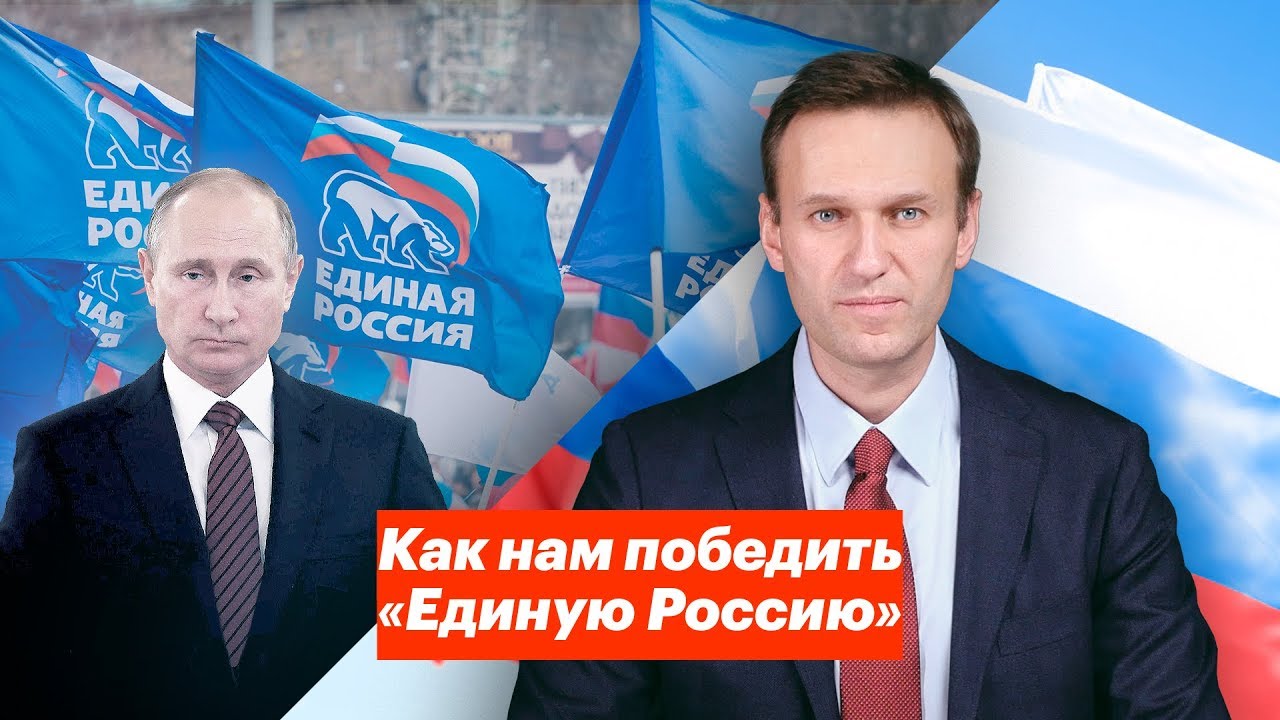
We believe that the main and realistic goal in elections can be to break United Russia’s monopoly.
It would be great, truly great, to have our own party. A real one, a good one. The Russia of the Future party. It would hold primaries and nominate excellent candidates. Not cowards and not stooges.
And it will nominate them, but we all understand perfectly well that the Kremlin is afraid of our party and will not register it. And it will try to remove our candidates from the ballot.
That is why “legal politics” (that is, the sphere where elections exist) will remain a closed zone open only to “systemic players” — that is, parties and candidates that are more or less under control. We need to break this situation, but also understand what to do if it does not break.
United Russia is losing popularity, and the increase in the pension age dealt a serious blow to this party of crooks and thieves, yet its candidates keep winning districts in 99% of cases. Why?
It’s simple math. United Russia is guaranteed at least 30–35% of the vote thanks to administrative pressure, television propaganda, and herding state employees to the polls. The other 65–70% vote against United Russia, but for candidates from different parties. The standard lineup is: second place for the Communist Party, third or fourth for A Just Russia and the LDPR, and a few crumbs for Yabloko and the rest.
So the majority is against United Russia, and yet they win again.
They would never win if the Communist Party, A Just Russia, and the LDPR divided up the districts. They would not win if Yabloko and the Communist Party divided up the districts in the central areas of major cities.
But this is the main task of the Presidential Administration: to make sure the parties do not come to an agreement. To make sure Communist Party candidates denounce the “sellout liberals,” while Yabloko supporters brand the others “stupid Stalinists.”
If everything works this way, then a United Russia candidate wins even with 35%.
We saw what happens when this scheme breaks down quite recently in elections in four regions, where Putin’s candidates unexpectedly lost.
There was a spontaneous consolidation of voters. In the first round, everyone went and voted their usual way. But in the second round, everyone set aside ideological preferences and voted for “the strongest contender.”
We took an active part in that. Do you think we wanted to campaign hard for an LDPR candidate in Khabarovsk? Do you think we were thrilled to support a Communist in Primorye or Khakassia?
No. But we saw the bigger picture: United Russia’s monopoly has to be broken. That is why we recorded videos in support of LDPR and Communist Party candidates, paid to promote them, and I campaigned for them on my program.
It worked, and the benefits of defeating United Russia candidates are infinitely greater than the downsides of ending up with a governor who is for Zhirinovsky or for Stalin.
Will this keep working on its own in every election from now on?
No.
1. Gubernatorial elections have a second round; all the others do not.
2. The Kremlin will make sure the systemic parties become even less capable of reaching agreements.
And it may seem that you and I can do nothing about this.
But in fact, we can. Two words: consolidated voting. Or, as we have named our project: Smart Voting.
We first experimented with this during the “Barvikha experiment”, when Pamfilova had only just taken over the Central Election Commission, and we discovered that the authorities were terrified of it.
And now the conditions are even better:
- voter turnout is falling. Of course it is — people are not interested.
- the ratings of United Russia and Putin have dropped significantly.
And you and I can (attention: this is the whole point of the project) agree on whom to vote for. Choose the strongest contender and push that person through in order to defeat the United Russia candidate.
In a situation where systemic parties and politicians will NEVER come to an agreement among themselves, we can make that agreement ourselves.
In other words, the opposition — in the form of the voters themselves — will a) unite, b) come to an agreement, and c) divide up the districts.
And here you immediately reply to me:
- Alexei, you’ve lost it. Forty percent of voters cannot come to an agreement. Don’t overestimate your capabilities. You can’t do this without television. You might persuade a few percent. Maybe 10. Or 25 in the biggest cities. No more. That won’t be enough.
And I’m telling you: we have done the math. And you can look at the calculations. We do not need to persuade 40%. With turnout this low, the people who are online are enough for us. The only thing that matters is that they vote not ideologically, not for “their own party,” but smartly. All together, collectively, for one candidate against United Russia.
In fact, for a typical election in a major city — specifically in Moscow and St. Petersburg in the upcoming elections — what we need is for the following to take part in Smart Voting:
- 3% of the total voter roll made up of people who previously did not care about elections at all and did not vote.
plus
- one-third of those who were already voting and voting against United Russia.
Note: 33% not of the total voter roll, but of those who were already voting for the opposition. This time they simply need to vote in unison for one name.
And then we will genuinely deprive United Russia of its majority. And there will be votes to spare. In fact, this is still a pessimistic model. We can see that the formula 3% new voters + 33% of those already against United Russia will be enough.
Let’s look at specific districts. The biggest upcoming election is the Moscow City Duma, where United Russia holds 38 of 45 seats.
And they won most of those seats EXCLUSIVELY BECAUSE VOTERS’ BALLOTS WERE SPLIT AMONG OPPOSITION CANDIDATES.
Let’s look at three specific districts where United Russia candidates became deputies, but where, respectively, a Communist, a Yabloko candidate, and an A Just Russia candidate would win if we applied Smart Voting.
I removed the names, and once again I want to urge you not to focus on them. All the candidates may be fairly bad. But our goal is to break United Russia’s monopoly.
Break it, and we will be able to put forward decent candidates too.
Southeast Moscow. The United Russia candidate wins with 40%. And it will be very easy for us to unseat him at this turnout level (it was 21.04%) if a relatively small number of us stop overthinking how bad the Communists are and simply vote for that candidate as an anti–United Russia instrument.
Southwest Moscow. An A Just Russia candidate wins easily under Smart Voting:
North Moscow. A Yabloko candidate gets through easily here if all of us vote for them.
Our main problem will be that the parties themselves will categorically refuse to take part in this. They will be forbidden to, and they are afraid.
So there will be hysterical cries: WHAAAT?! Vote for Stalinists?!
After that, Yabloko will once again end up with 0 seats, even though it could win 5 or 6. All it would take is accepting that the Communists will get 15, and that 15 districts should be left to them instead of fielding a pointless candidate in all 45 districts.
The parties cannot and will not come to an agreement. But we will. At the very least, we will try.
Anyone who wants to dig into the numbers from these examples and see for themselves that the math is on our side can go here.
The obvious question is: how will you determine the “strongest contender,” that is, the runner-up candidate?
In fact, it is easier than it seems. First of all, we will simply analyze the results of previous elections. Plus polling. Plus, let’s be honest, most of the time it is already clear which candidate is stronger — who is actually working and who is not, who has information resources and name recognition.
Of course there will always be arguments about this. But we will conduct an honest and objective analysis and explain the choice in a way that the majority can agree with.
Primaries could be held, but there is one problem with them. The authorities will simply refuse to register the winner of the primaries for the election. Still, it is a possible mechanism. In a normal system, it is the best one.
How does this work in practice?
1. You think it all through and decide to take part. To unite with everyone else for Smart Voting. If you have not decided, then ask me questions, clarify whatever you need. In the coming months, I will be doing nothing but explaining and clarifying.
2. You register on the website, giving the building where you live (no apartment number needed), so that we understand which electoral district you belong to.
3. Using the results of previous elections, polling, and so on, we determine “candidate number two” — that is, the non–United Russia candidate with the best chance of winning. We send you instructions on whom to vote for and explain why we made that choice.
Let me say right away: for now, we can reach the very lowest level — district municipal deputies — only in St. Petersburg. At the moment, our project covers the federal level, regional legislative assemblies, and city assemblies in major cities. But we are working on that.
4. Together, you and I campaign for everyone to join.
5. In the last month before the election, you and I campaign with all our might so that even those who are less interested in politics than we are will still visit the website, enter their address, and get a voting recommendation.
That is how we will win. Not immediately, of course. Everything will be difficult and hard.
But I assure you: right now there is no other more effective electoral strategy.
The only way is to vote smart. If you and I have not agreed in advance, then going to the polls makes no sense at all.
Think it over. Register. Be sure to discuss this with your friends and acquaintances. You can criticize it — the main thing is to discuss it.
This is our plan and our new major campaign.