
Today, Lyubov Sobol will demolish the biggest myth created by propagandist Margarita Simonyan to fool her senile Boss and the dim-witted officials around him, all straight out of the CPSU (the Soviet Communist Party), so she can keep getting colossal budgets. Applause to Lyuba and her team. This is an excellent exposé—read it to the end and watch the video.
We all know that RT is pathetic.
We all know that nobody watches it as a TV channel or as a news source.
But until today, RT’s chief still had one stronghold: YouTube and its millions of views.
In the third installment of the series “How Margo Simonyan Stole Everything in Sight” (here are part one and part two), you’ll see Sobol burn this stronghold—one that turns out to be inflatable—to the ground.
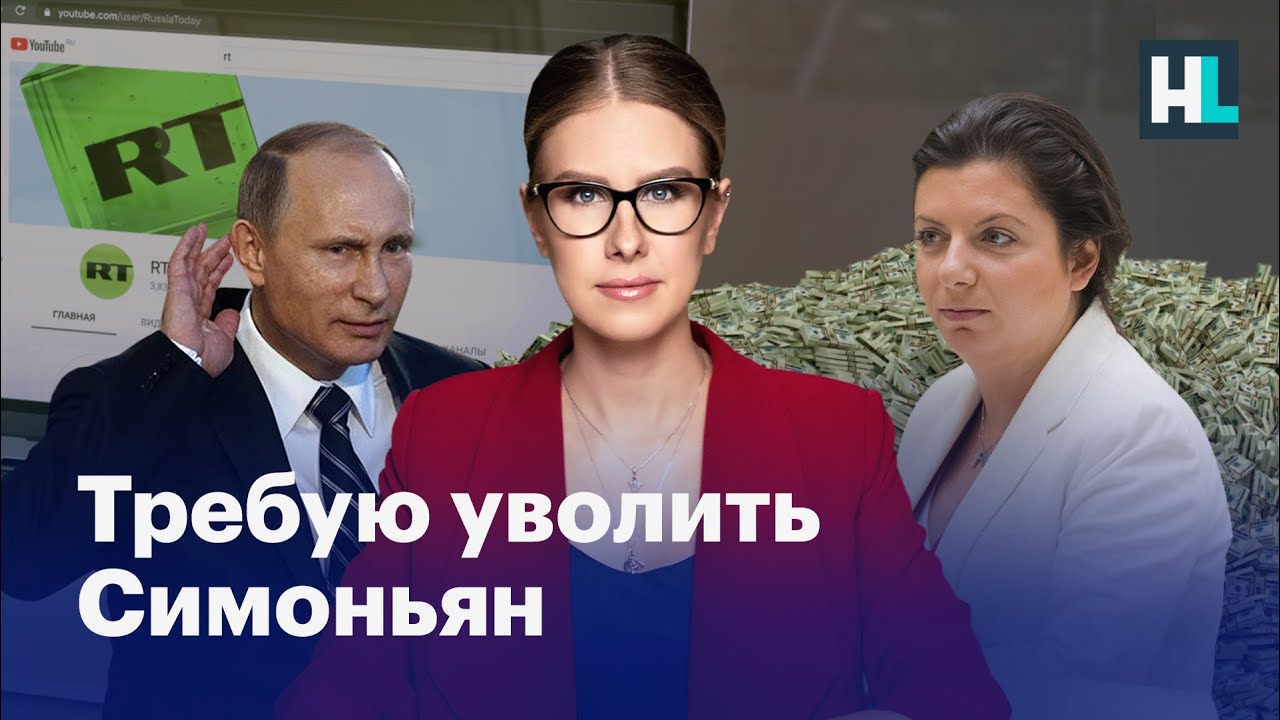
Not long ago, Margarita announced with great fanfare that RT’s network of YouTube channels had reached 10 billion views. No news channel had ever achieved such staggering results. Every global competitor had been left behind—from CNN to Al Jazeera. All had fallen before the might of Margarita Simonyan’s propaganda machine.
Just go to Margarita’s Twitter. On a regular basis, she tells us all about RT’s incredible successes.
Here she is boasting about RT’s success in Germany, here in France, here again in Germany, three months at the top—nobody can catch up with RT.
Apparently, she does the same thing in the presidential administration: lays a folder full of billion-view figures on the table, saying, “We need more gold, my lord.”
Margarita’s self-congratulation reaches almost unimaginable heights. She seems not just a model student, Komsomol member, and athlete (a stock Soviet phrase), but a genuine superhuman.
CNN, BBC, and Euronews are left nervously smoking on the sidelines, she writes.
Whatever happens in the world, everyone always, always watches only RT, the editor-in-chief boasts.
But all of that exists only in Simonyan’s imagination. In the real world, “Russia’s number one propaganda weapon” is watched by practically no one.
Never mind us—we’re already used to the fact that Simonyan isn’t always sincere. But deceiving the Boss? How does that work? You’re a brave woman, Margarita. Aren’t you afraid they’ll throw you out of Moscow’s elite drawing rooms for this?
We investigated RT’s YouTube channels and found out what they really are: grotesque view inflation, including through porn sites; Indian bots in the comments; and fantastical budgets disappearing into people’s pockets. And we have proof.
There are many signs that can reveal artificial boosting. For example, any schoolkid will tell you that if you’re looking at a video with more than a million views, like this video from RT Spanish, but only 95 comments, then something is probably off.
Here’s a video with more than a million views and… 37 comments.
Compare that with any video that has genuinely collected more than a million views. New or old—it doesn’t matter. For example, the January 15 episode of “On the Facts” with Lyubov Sobol. One and a half million views. Fourteen thousand comments.
Or another video from the Navalny LIVE channel: “How VKontakte Became Friends with the Kremlin”. 1.3 million views. And nearly six thousand comments.
Here’s the BBC’s English-language YouTube channel. This video was posted more than six years ago. 1.6 million views and eight hundred comments.
Now let’s look at the comments themselves, at what they actually say. Who writes them—people or bots? It’s easy when the bots are sitting in Olgino (a district of St. Petersburg associated with troll farms)—they’re simple to identify. It’s harder when they’re in India or Bahrain.
But even here there’s a very simple method. What do normal comments look like? It’s simple: in ordinary comments, people express their opinions about the content of the video. They discuss it. They argue. And it doesn’t matter what kind of video it is. Whether Echo of Moscow posts a clip called “Prank: Portrait of Putin in an Elevator, Residents Shocked,” or Yevgenia Albats conducts an interview, the comments will be about what’s happening in the video itself.
Now let’s look at what comments under RT videos look like. Like this:
Fortunately, there are now plenty of tools that let you find out what people are writing in any language. And when you read things like this, you start to doubt whether these commenters are real at all.
Or when people suddenly start posting proper names in the comments under a video.
RT is just a special kind of TV channel, following its own path. A path of falsification and buying comments on cheap online marketplaces around the world.
Take, for example, the most-viewed video on Russian-language RT, “Children’s Final”: students from Moscow football schools reenacted the 2018 World Cup final. One of the most-liked comments translates from English as: “I suppose this is the English comment you were looking for.”
There were indeed many comments like that. People from all over the world were writing: “Here is the English comment you asked for.”
On top of that, people wrote: “Here is your Spanish comment, as requested.”
And here is the Vietnamese comment you were looking for.
Truly, football is international, and the World Cup brings people together! Though what really brings them together is 5 cents per comment. Or how much do you pay, Margarita?
Many people in the comments were asking how they had ended up on this video.
The replies echoed them: “Yes, Santiago, I also have no idea how I ended up here.”
Let’s be blunt: many people were simply baffled as to how they had come to be watching this video.
And the strange things in the comments don’t end there. Many people left comments in Russian, but as if they had been run through an automatic translator. So sometimes the comments made no sense at all.
Korean and Japanese commenters were all writing, as if copied from the same template: “Cute referee.” Literally copied and pasted—sometimes down to the exact character.
Apparently, even 20 billion rubles (about hundreds of millions of U.S. dollars) is too little for Margarita to create even the illusion of interest in her channel. So they had to place orders on Asian gig platforms with instructions like: “Post any comment under this video in English, Spanish, Russian, or Vietnamese.” And people happily flooded into the comments, but because the pay was so tiny, they didn’t bother much and simply wrote: “Here’s your English comment.”
But there are even more interesting cases. She prefers to inflate views through porn sites. As a result, under some videos you can find wonderfully concise porn comments. Then again, where else would you boost RT content if not on porn sites? It all makes sense.
For example, here is one of the most popular videos on RT Spanish, with 13 million views. The very same RT Spanish that American generals supposedly describe as America’s main threat. At least, that’s what Margarita says.
Though it later turns out that he wasn’t a general at all, but an admiral, and that he said nothing of the sort about RT. At least Google knows nothing about it. But who would be surprised that Margarita lied again?
So this video has 545 comments. Almost nobody writes anything about the video itself. Instead, there are lots of comments like these:
13 million views. And almost no comments from real people.
Margarita, are you okay?
For a state channel receiving billions to boost views through porn sites—what kind of person do you have to be? What level of cynicism does that take? And then to cheerfully report: people watch us, people comment on us, we’re number one.
The easiest way to spot artificial boosting is by how a video’s views are distributed over time.
If there are no signs of virality—forgive the word in these difficult times—if there are no comments, and a video that nobody watched for years suddenly gets a million viewers and then stops being watched again, then you don’t need a fortune-teller: the views were inflated.
But to have something to compare it with, let’s first look at what normal view patterns look like.
Here’s a video with me: “Navalny on Galkin and the Pipe of Proletarian Hatred.”
Do you see the spike in views at the beginning? And the further on it goes, the more the growth rate declines. That’s a fairly typical pattern for YouTube.
Here’s a TV Rain segment: “Yury Dud Tried to Ask Kandelaki a Question.”
A gradual accumulation of views with peak activity right at the start. It all makes sense: first, lots of people watch a new video, and then interest fades.
And this is what the view graph for a cat video looks like. Because we all know what the internet really exists for.
So what does the video with the porn comments show us?
The video was uploaded in January 2016. Unfortunately, we were unable to obtain statistics from before 2019. Why? It was hidden from users for a long time, which means no stats were being collected.
But from September 1, 2019 onward, here’s what we have.
The video had been uploaded four years earlier. For some time it was hidden from users. By the time it was made public, it already had two million views—even though absolutely nobody had left comments under it.
And then, over the course of a few months, this ancient video picks up another 11 million views—from 2 million to 13 million.
And the views per hour—just look at them! Again, for no apparent reason, the graph suddenly shoots up and then drops just as sharply. A four-year-old video was being watched by an average of 10,000 people per hour, and then suddenly everyone stopped.
Margarita, do you people really think everyone else is an idiot?
Here is Yury Dud’s video with BadComedian, which—just like yours—was watched by 13 million people.
See? Real human interest, not bots. Bots for which you’re allocated billions.
All right, let’s keep scrolling. A video on RT Spanish: 1.3 million views, 132 comments.
At first glance, 1.5 million views and 132 comments tells you everything. A classic diagnosis. But let’s still look at the view graph.
If anyone didn’t understand, let me decode what you just saw—what that mysterious zigzag actually is.
The video was uploaded on February 25, 2015. Over three years, it got 32,000 views. Then, literally in a couple of days, it gained a million views and stopped growing again. Remember this: if you see step-like jumps on any graph, you’re being deceived.
Margarita, are you kidding? No, you really are mocking us. All of us. And your wonderful Boss too, the one you’re feeding this nonsense to. Are you really inflating views this brazenly and hoping nobody catches you red-handed?
We saw a lot while scrolling through RT Español. Very strange step patterns.
And million-view videos with only hundreds of comments.
We even saw YouTube clawing back RT’s views for overly aggressive boosting. See that sudden drop below the baseline? That’s YouTube deciding the views were growing too abnormally and deducting some of them.
But enough picking on poor RT Spanish. Let’s go through the other regional channels in Simonyan’s media empire, and in particular that long-suffering video about the child footballers. How was it watched?
Well, would you look at that! What beautiful statistics! Let me explain what these graphs mean. This video was uploaded on July 18, 2018. Note that it was posted at the very peak of interest in the football World Cup, when getting views should have been easy.
But no—despite all the hype, despite how ultra-trendy the topic was, the video did not become popular. In six months, it got only 30,000 views.
Anyone will tell you that, unfortunately, with 99.9% probability, this video was never going to take off and was unlikely to break even 50,000 views in the next few years.
And yet suddenly the view graph shoots sharply upward. Completely out of nowhere. From January 6 to March 6, the video crosses the 1 million view mark. Then from March to April it grows phenomenally to 8 million. And this rapid growth coincides in time with the appearance of all those strange—and at times downright baffling—comments.
Maybe these anomalous views appear only on Russian and Spanish RT? No, unfortunately not.
It’s exactly the same everywhere, across all channels. And you can find exactly the same signs of artificial boosting on any channel in the RT network.
RT America:
RT Arabic:
You can go to any RT channel yourself, install the necessary software, and admire what the theft of public funds looks like in graph form.
Here’s another curious detail from the world of RT: in February alone, RT Español uploaded more than 1,000 videos! At first glance, such hard work and efficiency might seem enviable. But one small clarification: a significant portion of those videos are other people’s videos taken from the internet. In plain language—reuploads. And those are precisely the videos that get the most views. For example, RT uploads the crying boy that had gone viral on Facebook. Or a video about tigers attacking their trainers.
We also established through some simple calculations that all 1,000 videos on the channel collected 13 million views over the month. But wait—doesn’t the statistics page show 32 million views? That’s right: 32 million total views for the month, but 19 million of them are views on old videos. How can that happen for a news channel, where everything depends on the current news agenda?
The explanation is very simple: the boosting is done primarily on old videos, because it’s harder to track manipulation there. Who is going to check the statistics of a video released in December 2016? Or in 2013? Nobody. Well, almost nobody ;)
And if you inflate views on videos from 2013, YouTube counts them as views for the current period. So the figure that ends up in the statistics folder on Putin’s desk is exactly that—32 million for February. See, we’re delivering results. Please give us more money. And Putin signs the document, not even suspecting that he’s allocating money for thin air—for views that do not exist.
And if the presidential administration saw RT’s real statistics, nobody would ever let them anywhere near the budget. Much less into Moscow’s elite drawing rooms.
So let’s sum up: RT inflates the views on its YouTube videos, buys comments, and falsifies statistics. And they don’t even shy away from boosting videos through porn sites.
Thanks to these fake statistics, they ask for more and more money for their media operation. The presidential administration sees these fake numbers and gives them astronomical budgets, thinking they’re funding propaganda. But in reality, they’re funding thin air. Fabricated statistics. And porn comments.
And now I want to address Margarita directly. If you think we have slandered you, do one very simple thing: make all your statistics public. Show us: look, these suspicious graphs are explained by this and that.
If Margarita fails to provide any coherent explanation, then I demand that Simonyan be fired. That is the most appropriate decision in this situation. And the entire RT structure should be audited for misuse of funds. If confirmed, a criminal case should be opened.
And to make sure Margarita does not ignore our appeal, we ask for your help. Calmly and politely ask her on any social network: how do you explain the anomalous statistics on your videos, Margarita? Perhaps you could share your internal analytics with the taxpayers who fund your channel?
It would be good if our journalists asked these same questions too. Real journalists, not propagandists armed with “inside information” straight from elite drawing rooms.
Tell your friends about our video and subscribe to our channel. We have neither 10 billion inflated views nor 20 billion rubles (roughly hundreds of millions of U.S. dollars) siphoned off.