We need this campaign because this picture is monstrous.
And our lives "after coronavirus" will largely be determined by how fully we grasp the gravity of what is happening and whether we are ready to make an effort to save these people—and ourselves.
54% of citizens say their incomes have fallen. 24% say they have lost their income entirely.
But even the lucky 35% whose incomes have not fallen will become poorer too. Two months of quarantine will wipe out 10% of GDP. A quarter of the population losing its income means the death of a huge share of small businesses and major losses for medium-sized ones.
You can self-isolate from the virus, but not from the economic downturn. It will catch up with you at the very least through rising prices.
The good news is that any discussion of how to save citizens, businesses, and the economy can—and absolutely must—be framed around one figure: 120,614.
That is how many rubles there are in Russia's reserve funds for each one of us. These are figures from the Central Bank of Russia as of March 1.
This is not some abstract valuation of all Russia's wealth, nor is it current budget money used to pay public-sector salaries and pensions.
It is a reserve. We built it up to use in "hard times."
No one doubts that such times have arrived. The question is whether we will use the reserve to ease the burden on people and businesses, or once again stupidly hand it over to state-owned companies and oligarchs, as was done in 2009 and 2014.
The governments of developed countries are now fairly united. Their actions are similar and based on the following logic:
We are requiring people to stay home. People and businesses are suffering and taking losses. If they become poorer, everyone will suffer. What is the solution? Give them money.
It may be hard to imagine, but super-capitalist countries like the United States, Germany, the United Kingdom, and Canada are now directly handing out money to citizens and business owners. In Germany, if you are self-employed, you submit an application and within a week you receive between €9,000 and €15,000. You do not have to pay it back. It is for you, so that you survive. In the United States, the government will transfer $1,200 to you. That is about 90,000 rubles. In Canada, everyone will receive $2,000. In Spain, they are doing the same, and so on. Even poorer countries are trying. Georgia, for example, is poorer than Russia, but there they completely canceled utility payments for the duration of the epidemic.
In Russia, however, things are different. Our economists also believe that now is the time to move to direct support measures for people and businesses—to give them money.
The Russian government, however, takes a different view. It does not consider it right, as President Putin said, to "burn through the reserves." Moscow Mayor Sergei Sobyanin stated this idea even more bluntly. Asked whether people should be helped directly, he said that if everyone is helped, the budget will crack.
The most paradoxical thing about the current situation is that even though one in four people in the country has been left without a source of income, there is no organized movement or political pressure demanding the start of direct payments.
This must begin immediately. We need to unite everyone around five simple demands:
These demands are realistic. The country has enough money to meet them. They are supported by leading economists. They are grounded in global experience.
So what does a "nationwide campaign" mean now, during quarantine?
Rallies—the most effective and visible way to put forward demands—are unavailable.
So let us look for advantages and opportunities in what we do have right now. Let us make lemonade out of lemons.
What are we forced to do? Stay home. What do we do at home? Sit on the internet.
That means we need to run a nationwide campaign online.
Goal: to create a level of political and public pressure at which Putin and his government will be forced to implement the "five steps" (in one form or another, of course, while telling everyone that this wise government decided to do it on its own), for fear of losing political support.
Task: make sure that more than 100 million people learn about the five demands. This is absolutely realistic. 94 million Russians use the internet, and absolutely everyone uses their mouth to talk to one another. There can be no doubt that out of 100 million people who hear about the "five steps," 99 million will support them.
Practical task: inform the first 15 million people about the "five steps" and secure their support.
Fifteen million is the number of people you and I can reach in a single day if we want to, without even straining ourselves. All it takes is for each person to spend three minutes posting on social media and sending links to friends.
Most important step No. 1: formalize the demands. If someone is vaguely demanding something somewhere, that can be ignored, with the response that "the president is not aware."
We will begin by making sure the news about our movement sounds not like "people online are discussing..." but rather: "this many millions have signed the demands."
We all view online petitions with varying degrees of skepticism. And you do not need to explain that to me—I was the first to collect the required number of signatures on the official ROI portal (the Russian Public Initiative platform).
But right now it is an excellent campaigning and information tool. And a very simple one. Very easy. You sign it and tell everyone around you about it, urging them to do the same.
There are three main petition platforms:
ROI. Everything there is fully official. If we collect 100,000 signatures, the government will have to respond in some way. Our petition was uploaded there back on April 13, but crafty officials are still refusing to publish it. They are keeping it "under moderation." Apparently, they understand the danger.
VK petition. This is a powerful tool. Our first goal here is to collect three million signatures, and that will be a huge campaigning instrument.
Change.org. A popular platform. Here we will start with one million signatures.
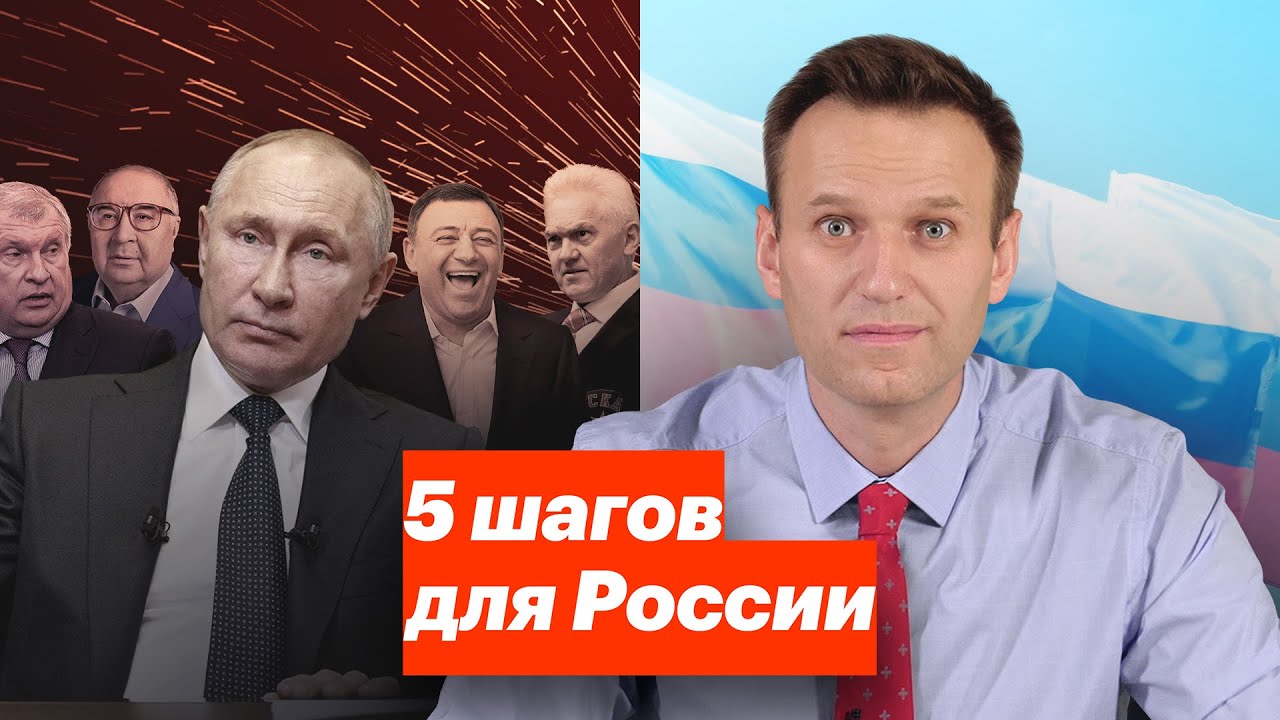
To make things easier for you, we created a single website called "5 Steps for Russia". There you will find the demands in brief, a detailed explanation, and links to all the signature platforms.
The campaign is built on a small contribution from each person. And this is exactly the kind of situation where your personal action matters—and where that is the only thing that matters.
Each of us has enough free time right now. What no one has enough of is money. Whether we receive help from our own reserve depends only on us. We need these 5 steps for Russia. Let us make them happen.