The Russian ruling elite’s complete lack of embarrassment about the way they live never ceases to amaze.
The recent scandal involving Foreign Ministry spokesperson Maria Zakharova, who told us that foreign vacations and air travel should be available only to wealthy people in clean, nice clothes, while everyone else should know their place and choose simpler holidays, is directly connected to this. This is exactly how the Russian authorities think Russia ought to be organized. The elite, all polished and dressed up, should not have to worry about the plebs. And the plebs, in turn, should keep quiet and pay taxes. They may look at the good life, but not touch it.
Well then, let’s take a look. Since we’ve now spent weeks feeling miserable, stuck at home, let’s go all in and talk about glamour and fashion. Kira Yarmysh has taken over my channel and turned it into a fashion blog for a while.
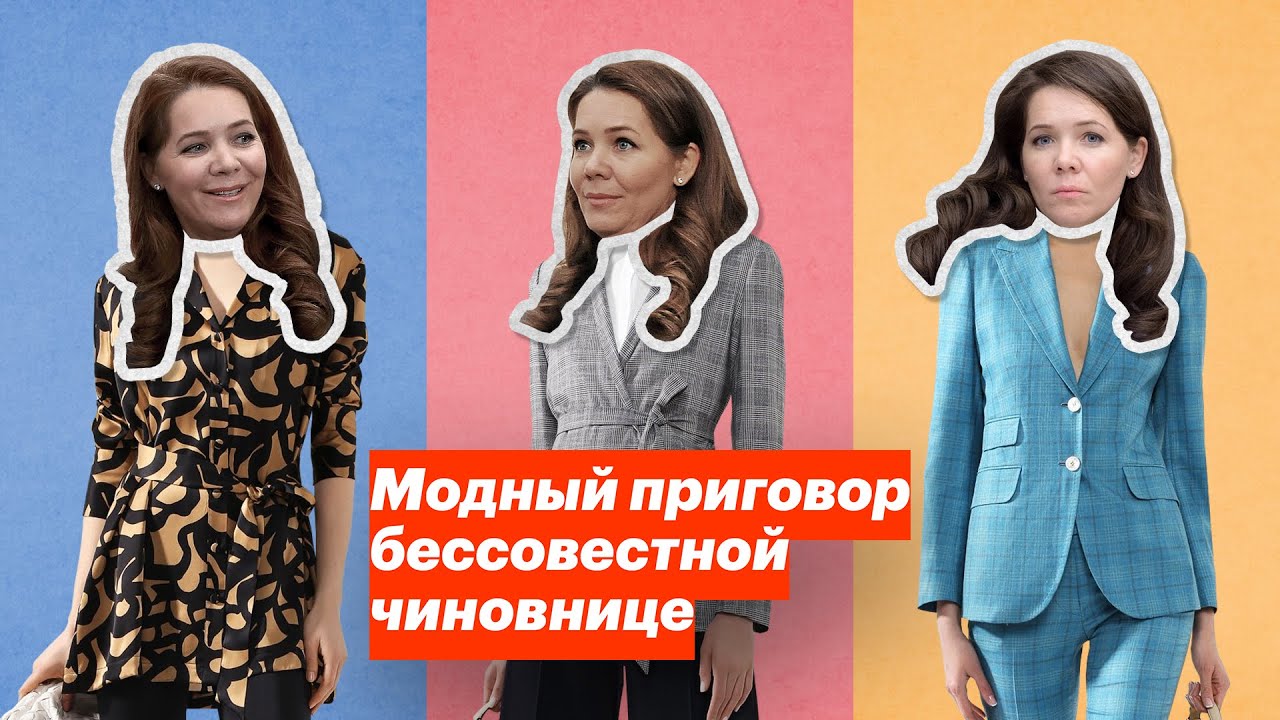
Just look at this selfless woman, who is now constantly on television. Throughout all 22 years of her government career, she has worked side by side with Sergei Sobyanin. Wherever he went, she followed. From Tyumen to the presidential administration, and then to the Moscow city government. And so fate has decreed that she is now Moscow’s deputy mayor for social development. Anastasia Rakova.
She oversees the departments of education, healthcare, social protection, labor, and many others. It is an entirely unglamorous area of responsibility—not innovation, not investment, not business, not construction. It is dusty, difficult work: the work closest to ordinary people. And not just to Muscovites in general, but to the most vulnerable, the least protected, the neediest. Doctors, teachers, children, people with disabilities, the sick, veterans, orphans, pensioners, the poor—these are the people whose affairs Anastasia Rakova handles. And for whose well-being she bears personal responsibility.
And right now her position is one of the most important in the country. No joke—she is the top official in charge of medicine in the city with the highest number of infections. She commands an entire army of medical workers, and like a true commander-in-chief, she addresses that army, trying to raise its morale.

A very heartfelt address. You can just imagine an ordinary Moscow nurse or ambulance paramedic, standing in line for hours to admit yet another coronavirus patient, watching it and thinking: “To hell with the working conditions, the respirators we don’t have, the salary. What does any of that matter now? Better for me to unite with Anastasia Rakova and Sergei Semyonovich (Sobyanin’s patronymic, used deferentially) and work for free—we’re TOGETHER, after all.”
But no, dear nurse or paramedic. Unfortunately, you are not together. And the warning sign that you are not together can be found in that very same video. You just have to look closely.
Do you know how much a nurse earned after working for a month on three shifts—that is, doing the work of three people—in the now-famous Kommunarka hospital complex? 26,000 rubles. Do you know how much the brown Loro Piana belt Anastasia Rakova chose for her touching address costs? Exactly twice as much. 52,000 rubles on the TSUM department store website.
Perhaps you think this was some absurd accident? Villains slipped an expensive belt onto Rakova and treacherously filmed her in it, while in reality she dresses very modestly, in keeping with her office?
Alas. Here is the Moscow official appearing on Channel One. There she first scolded the shashlik-makers (people going out for barbecues), because of whom everyone supposedly had to be put under a full lockdown, but then she shared some good news too—financial aid for Muscovites. Magnanimously recognizing how difficult lockdown is, Anastasia offered sick elderly Muscovites a mind-blowing payment of 4,000 rubles, of which 2,000 were paid immediately. Can you imagine?! Anastasia, bravo! 2,000! Right away! Whatever will they do with all that money? Good thing the other 2,000 will be paid at some unclear point after the end of the nonexistent lockdown!
This video interests us not because we want to laugh at the pitiful attempts by the Moscow government to pretend they are supporting anyone. What interests us is the outfit Anastasia wore when delivering this news.
The T-shirt is easy to identify from the words “speak kind and bright words” printed on it—it is by the Italian brand Brunello Cucinelli, priced at 46,000 rubles. Over the T-shirt she is wearing a dark blazer—we recognize it by the side stripes and turned-up cuffs—the same brand, priced at 160,500 rubles. It is not hard to calculate that, above the waist alone, Anastasia is wearing the equivalent of the one-time payments given to 100 Moscow pensioners with chronic illnesses.
Last week, Anastasia Vladimirovna appeared on another federal TV channel—Rossiya 1. Here we are interested in her shirt and shoes. Anastasia had already worn this look to the opening of a coronavirus ward in one of Moscow’s hospitals. The shoes—Jimmy Choo—cost 45,000 rubles. The silk Kiton blouse—94,500 rubles.
How can a BLOUSE cost almost 100,000 rubles? Of course, very expensive things do exist, but this is really something else, isn’t it? It is all about the brand. Kiton is one of the most expensive brands in the world. It is an old Neapolitan factory, family Italian traditions, exclusively handmade work, and limited-run items. The brand is known for business suits worn by the richest and most famous people in the world—presidents, Hollywood stars, and… Moscow Deputy Mayor Anastasia Rakova. And she, in particular, is simply obsessed with them.
We spot a suit by this very brand on Anastasia Vladimirovna in this photo from the Russian Presidential Academy of National Economy and Public Administration:
According to what the website tells us, 25 tailors worked for about a full day on this cashmere jacket for Anastasia.
The price of the suit matches the labor of the Italian seamstresses—507,000 rubles (here is the jacket, and here are the trousers).
Now let’s add some context. By virtue of her office, Rakova is responsible for setting and enforcing the subsistence minimum for Muscovites. It is a quarterly process: officials get together and calculate how much a Muscovite needs to live normally for a month. For food, utilities, household appliances, clothing, gasoline—everything. They set a figure, and it then becomes the basic benchmark used to determine wages, pensions, benefits, and so on. And quite recently, at the end of March, Rakova was handed a fresh calculation—the subsistence minimum in Moscow: 16,843 rubles per month. She thinks it over and decides: “Yes, that sounds about right. That is exactly how much a Muscovite needs to live normally. It is about 30 times less than my suit as deputy mayor for social policy—so everything checks out. Let’s sign it.”
This is turning into a rather sad and bitter fashion blog, isn’t it?
But let’s not be sad—let’s move on. After all, Anastasia “I’m together with the doctors” Rakova is simply obsessed with suits, and we are only at the beginning of her collection.
Here is another interview in which she sings the praises of her boss, Sobyanin. Anastasia is wearing a beige blazer by her favorite brand for 250,000 rubles, trousers for 116,000, and Louis Vuitton shoes for about 70,000 rubles. Total look: 435,000.
In this photo we see a bright blue summer set, again by Kiton. The blazer—300,000, the trousers—100,000.
By now you probably recognize the signature check pattern—a gray version of the suit. The jacket—270,000, the trousers—103,000. 373,000 altogether.
Here, from the bright white stitching, we identify a jacket costing 250,000.
Here is another jacket, very similar to the gray suit but still different—another 240,000.
And here is a photo of Anastasia speaking at the “Medicine and Quality” conference. Her seventh Kiton blazer, this time for 293,000 rubles, along with a turtleneck for 80,000 and trousers for 85,000.
You may doubt that this is the very same turtleneck. Indeed, there are no identifying marks, and it looks completely ordinary. Surely something like that cannot cost 80,000!
It can. On the website of Rakova’s favorite brand, Kiton, this brown checked pattern is shown worn with exactly this kind of turtleneck. Whatever Anastasia’s consultant suggested, she bought. To her, 80,000 is not money—she came for a blazer, so why not pick up this little extra too?
We have shown you just 10 recent public appearances by official Rakova. Only official events, no paparazzi shots. And in these 10 photos alone, we found more than 3 million rubles’ worth of clothing. She KNOWS she will be photographed; these are PUBLIC events. She cannot fail to understand that the clothes can be identified (and very easily, as we did). And she understands just as well that no public official can afford to dress like this. But the desire to wear the most exclusive things in the world overrides common sense.
Many people will probably say: “Why are you obsessing over clothes? That’s trivial—billions are being stolen through curb contracts over there.” Of course billions are being stolen, and we tell you about that constantly. But this matters too. Because offshore accounts and secret foreign villas are well hidden, concealed, disguised. Here, by contrast, we have a clear daily indicator right before our eyes of how a Moscow official really lives. How much money she actually has—not on declarations, not on paper, but in physical reality.
Now let’s turn to Moscow Mayor Sergei Sobyanin’s Twitter. A model official Twitter account: “Look how efficiently we work! Look how we are saving Muscovites!” Here he has posted photos from a huge construction site—another temporary hospital with 1,500 additional beds is being built near Kommunarka. In one of the photos, among a crowd of other officials, we spot Anastasia Rakova.
You have to admit, in this photo nothing seems suspicious at all: surely here, at a construction site, Anastasia dressed modestly. Alas. We identified the Chanel scarf for 78,000 rubles very quickly. The coat took more work. But no matter—we found a Loro Piana cashmere coat for 448,000. The right color was not on the website, but we specifically verified that it is the exact same model.
Scrolling further through Twitter, we see photos again—this time from the opening of a coronavirus ward in a Moscow hospital. Very recent pictures, from May. We can see a tiiiiiiny piece of Anastasia Rakova. Literally one eye. And a shoulder.
And on that shoulder is yet another checked reversible Loro Piana coat, this one for 477,000.
It is impossible to wrap your head around how an official who thinks it is normal to spend half a million rubles on a single coat can deal with the problems of the poor, pensioners, or veterans. What can she possibly know or understand about how ordinary Muscovites live, what subsidies they need, and how much money they need for food, when she herself walks into a store and hands over the equivalent of two years of a Muscovite’s pension for one coat? Ten public appearances—and that is already the price of a one-room apartment in Moscow. Add just two coats—and it is a two-room apartment.
Finally, I have an interesting observation for you. There is one detail you cannot help noticing. Anastasia Rakova completely neglects accessories. We have shown you so many photos—very expensive suits, tops, shoes—and yet there is almost no jewelry at all. The same tiny stud earrings. Some little bracelet now and then, a string. She never wears a watch. Nothing around her neck either. Or, very occasionally, a cross.
It is genuinely strange. If you are so preoccupied with your outfits that you are willing to buy the most expensive suits in the world for half a million rubles, then surely your eye would also fall on jewelry? Maybe some earrings or a ring? How is it that, judging by the photos, the only thing that is exceptionally expensive about Anastasia is her clothing?
There is a simple and logical explanation for this. Before each public appearance, official Rakova carefully removes all her jewelry (which is, naturally, even more expensive than her clothes), neatly puts it in a box, and does not put it back on until the cameras are off.
How do we know this? From the same place our most loyal readers do. In 2015, we published a roundup of the most expensive jewelry worn by female officials, mostly from Moscow City Hall. Anastasia Rakova shone there just as she does today. We wrote about her love of the jewelry house Van Cleef & Arpels: look, she has the classic set (necklace and earrings), a pendant, and even a diamond butterfly.
She likes rings too—for example, this Bvlgari one for 550,000.
But what she loves most of all is diamonds. Look at how she used to come to meetings of the Moscow government. As if she were going to the Oscars. A pendant and, of course, earrings from the jewelry house Graff. We requested the price back then and learned that such a set costs more than 8 million rubles.
For most Russians, that is a pretty decent apartment; for official Rakova, it is an everyday trinket. The only pleasant part is this: from 2015 to the present day, not a single photo of Rakova wearing these or any other expensive pieces of jewelry has appeared online. She and her friends at City Hall were simply forbidden from wearing them during working hours. It will be interesting to see what happens now.
I want to end with a fairly obvious observation: what we are dealing with is colossal social stratification. A gigantic crack separating us—ordinary people—from them: the ultra-rich, utterly shameless officials, the so-called servants of the people whom we support. And this is not only about material things—yes, one of Anastasia’s scarves costs as much as the average Muscovite’s entire annual clothing budget. But the main point is something else. Rakova may not say outright that she considers the people around her second-rate, pathetic ragamuffins, but the way she behaves says it better than any words could. That is exactly why people like Rakova are categorically opposed to giving people 20,000 rubles now, as we propose in the “5 Steps” program. They sincerely believe we are entitled to nothing at all. What 20,000? For what?
But when it comes to their own income, anything goes. According to her official declaration, Anastasia Rakova’s average income over the last 5 years has been 7 million rubles a year. There are no other declared sources—she is unmarried and has spent twenty years in government service. Yet from just a few official photographs, we counted more than 15 million rubles’ worth of clothing and jewelry.
Let me repeat: this is only what she chose to be photographed in. Given her tastes and her scale of spending, it is frightening to imagine what else she owns. It is obvious that Rakova lives on far more than a deputy mayor’s salary. But it does not even occur to her to hide it. She proudly wears evidence of her corruption on her body, feels no embarrassment appearing in it in public or going on federal television in it. She does not care in the slightest whether anyone learns the price of her вещей, because she is afraid of nothing. She has a lot of money. Really a lot. She could use it to light a barbecue at her dacha, but Rakova chose another way to dispose of it—to buy the most expensive clothes in the world. And public opinion on the matter simply does not interest her. She can drape herself in diamonds like a Christmas tree in ornaments, go out to face doctors working for 20,000 rubles—and it seems perfectly normal to her. Because she has earned it. And the doctors, in her view, have not.