Greetings to all the good people of Khabarovsk and the Russian Far East. Today’s investigation is a small contribution from the ACF (Anti-Corruption Foundation) to help you.
What is happening in Khabarovsk Krai, in the bigger picture, is a confrontation between “the Far East and Putin.” And the man who officially represents Putin in the Far East is the hero of our story today. He bears direct responsibility for all the conflicts and election rigging in the Far East in recent years, and we want everyone to get to know him better.
Him—and the little elephant statues in front of his mansion.
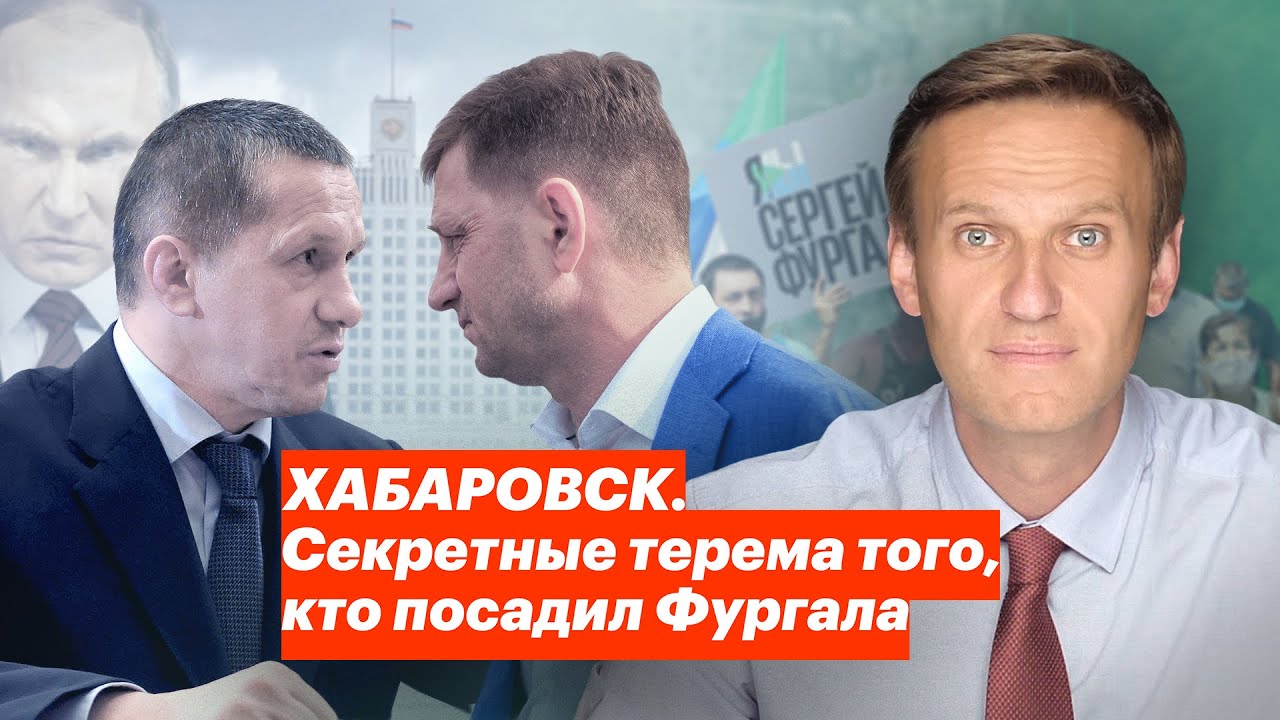
For 13 days now, rallies have been taking place in Khabarovsk Krai in support of the arrested governor, Sergei Furgal. And you are probably wondering how this happened at all: why he was jailed, why people took to the streets, and what can be done about it.
Let me tell you: we looked into the man who orchestrated Furgal’s imprisonment. It’s all first-class stuff—secret estates, undeclared land, and a family compound. We’ll show you all of that, but first let’s talk about what exactly happened in Khabarovsk Krai.
Many people think it was all very simple: the governor was arrested, and everyone immediately took to the streets in his support and against Moscow’s rule.
But in reality, this is a long-running battle between the region’s residents and the Kremlin. And that is exactly how it should be understood. The Kremlin, Putin personally, and Putin’s appointees who run the Far East hate Khabarovsk Krai and its residents because time and again they beat them at the ballot box.
The beginning of our story. September 2018. Putin is actively backing a candidate named Vyacheslav Shport. At the time, Shport was a member of United Russia’s supreme council. He had already become governor before—in 2013 he defeated, incidentally, that same Furgal.
So no expense was spared for Shport—money, television coverage, administrative pressure, everything. But the region’s residents told Putin something he absolutely did not want to hear: your rule is bankrupt. We are not going to vote for your candidates. And in the runoff, Sergei Furgal defeated United Russia’s Shport, winning 70% of the vote. That number is very important. Because just a few months earlier there had been a presidential election, and Putin received 66% in Khabarovsk Krai. He never forgave Furgal for that.
Yes, of course, plenty of governors here get 70 or 80 percent. Meaning: whatever number they fabricate is the number they get.
But Furgal was against the authorities and against United Russia. And he won more votes than Putin. From that moment on, Furgal became an enemy, and there was a specific man tasked with organizing the war against him. That man is Yury Petrovich Trutnev, Putin’s plenipotentiary envoy to the Far East. By virtue of his office, he coordinates all the FSB, Investigative Committee, and other such agencies there.
What’s more, they took revenge on all the region’s residents: a highly symbolic decision was made to move the capital of the Far East from Khabarovsk to Vladivostok. That way they punished the people of Khabarovsk and at the same time helped United Russia candidate Kozhemyako win in Primorye. Because this is important to understand: it is not just Khabarovsk Krai acting up on its own. The entire Far East is deeply dissatisfied.
So after the 2018 election, Furgal became an enemy. Then came the 2019 elections. We remember them very well, because we organized Smart Voting in them to reduce the number of United Russia deputies. And the combination of Smart Voting with the fact that the region had a governor who was not from United Russia produced a stunning effect. United Russia lost every single seat in the Khabarovsk city duma election, and in the legislative assembly of all Khabarovsk Krai they won only 2 seats.
Why did this happen? Very simply. United Russia is supported by a minority. Smart Voting helps the majority avoid splitting their votes, rally behind a single candidate, and win. And when the authorities are not controlled by United Russia, they do not falsify the results. Whoever wins, wins.
It was a colossal slap in the face to Putin’s regime, delivered by the people of Khabarovsk Krai.
After that, the Kremlin sicced them on him, and the very next month Yury Petrovich Trutnev, together with his investigators, operatives, and men in black ski masks, began dealing with Furgal in the authorities’ favorite way: by fabricating criminal cases.
Searches are carried out at the Amurstal plant linked to Furgal’s family. His aide Nikolai Mistryukov is arrested.
At the same time, in November 2019, the famous conversation between Furgal and Trutnev took place. The recording was obviously made by Furgal himself. He says: you’ve launched an attack on me, but the people are protecting me. And Trutnev responds by stating the main problem outright: Furgal’s approval rating is rising, while Putin’s is falling.

After that, everything unfolds according to the rules of real politics. Furgal publicly tears into officials, most of whom are from United Russia, and boosts his rating in the process. The federal authorities, on Putin’s orders and through Trutnev, go after Furgal through newspapers and criminal cases.
And then came another election—quotation marks intended. The nationwide vote. It was extremely important for Putin, and he hoped that Furgal, intimidated by criminal prosecution, would organize ballot stuffing like elsewhere across the country. But he did not. Turnout came to 44%, one of the lowest figures in the country. The instruction had been to fake something around 70%.
This is how it looks from the Kremlin. We are great and powerful here. And over there, in the middle of nowhere in the east, there are 1.315 million insolent serfs who, under their governor’s leadership, have publicly humiliated us over several years in three elections in a row and set a bad example for everyone else.
Furgal had to pay. His arrested aide, Mistryukov, was sitting in a cell in Moscow. He had cancer. He was not being given pain medication. A person in that situation has nothing left to lose. He will testify against anyone.
And that is exactly what he does. He writes that Furgal was involved in murders from 15 years earlier. Furgal is arrested immediately. He too is flown to Moscow by plane. Then they begin trying him behind closed doors. And everyone understands why: there is no evidence. And if the trial were open—and especially if it took place in Khabarovsk—everyone would see what a fake the FSB and the Investigative Committee cooked up under Envoy Trutnev’s direction.
And what happened next, you know. The streets of Khabarovsk, Komsomolsk-on-Amur, and other cities filled with people. The scale of the demonstrations was such that, for Moscow, it would have meant 700,000 people. And this went on for several days in a row.
Nevertheless, Putin decided to settle the score for this humiliation by humiliating the people of Khabarovsk Krai in return. He appointed them a new governor: Mikhail Degtyarev, who until then had seen Khabarovsk only on the 5,000-ruble banknote. Degtyarev was my opponent in the Moscow mayoral election. He received 2.86% then. Later he ran in another Moscow election and won 6.72%.
Thousands of people are marching through Far Eastern cities shouting: we need a local governor. We want to choose one ourselves. And Putin, smiling, appoints them one of Zhirinovsky’s boys.
Degtyarev got exactly the reception he deserved, and I hope the people of Khabarovsk will not swallow this public humiliation.
But this has been a very long introduction to an investigation about another man. I urge everyone to support the people of Khabarovsk Krai in whatever way they can. And we at the Anti-Corruption Foundation want to express our support as well. Because in essence this is a confrontation between the Far East and Putin. In practice, it is Envoy Trutnev, carrying out Putin’s will, who is jailing Furgal and trying to restore United Russia’s position in the region.
Trutnev himself is also a member of the party’s supreme council—one of the country’s top United Russia figures.
In 2013, Trutnev was appointed presidential envoy to the Far East. This is one of those cases where you do not need to be a political scientist to understand what he does—it is written right into the title of the job: plenipotentiary representative of the president. In other words, he is Putin incarnate, specially for you, dear people of Khabarovsk. He answers to no one but Putin, carries out his personal orders and plans, and deals with your problems on his behalf.
And he presents himself to you as the embodiment of legality. Honest, upright, proper. A man who will punish those who break the law. So let us see whether Yury Petrovich Trutnev has any right to lecture you, the people of Khabarovsk, on how to live.
Trutnev has spent nearly a quarter of a century in public office. He is one of Russia’s most powerful officials, yet he remains largely unknown to the broader public.
But you in Khabarovsk know him a little better than the average Russian. Judging by the news, he comes to see you as often as once a year (lucky you!), and each time he solemnly inspects the local facilities—an airport, a school, a sambo training section.
But absolutely no one—neither in the Far East nor in the rest of Russia—understands one important thing: where does Yury Petrovich get his money? This is Trutnev’s biggest mystery. It is an anomaly of the highest order. His income for 2018 was half a billion rubles. Numbers like that are hard to grasp, so compare it with your monthly income. Trutnev earns 45 million rubles a month. That is roughly a thousand times more than a well-off resident of Khabarovsk. In 2017, Trutnev declared 377 million. In 2016, 357 million. And it is the same in every declaration we were able to find. Since 2006, Trutnev has consistently declared annual incomes in the hundreds of millions of rubles, and the figure rises every year.
Naturally, we could not help taking an interest in this. Especially since the man practically invites scrutiny—just look at his vehicle fleet: a Porsche Cayenne, a BMW X6, a Mercedes ML, snowmobiles, ATVs, and so on.
A look at Trutnev’s assets shows that he deserves a place among the richest and most bloated members of United Russia.
But even after sifting through hundreds of extracts, certificates, and documents, and rereading everything written about official Trutnev over the past 25 years, we still did not learn the answer to the main question: where does the money come from?
Yury Petrovich Trutnev went into business in the early 1990s. And like many businessmen of that era, he did a bit of everything—imported sports equipment and office equipment, opened stores in Perm. According to reports, he made his main money importing Swiss chocolate into Russia—Kinder Surprise eggs and other hard-to-find sweets. On the Russian side, this was handled by Trutnev; on the Swiss side, by Oleg Chirkunov, who at the time was an active officer of the SVR, Russia’s foreign intelligence service. Incidentally, the two of them later became governors of Perm Krai one after the other.
But this did not last especially long. As early as 1996, Trutnev ran for mayor of Perm and won. His partner Chirkunov returned from Switzerland to Russia and took over their business in Trutnev’s place. Trutnev, meanwhile, took charge of Perm. His official career went well, and four years later, in 2000, he also won the gubernatorial election—becoming head of Perm Oblast, which was later merged with the Komi-Permyak Autonomous Okrug to form Perm Krai.
After another four years there, Trutnev was sent to Moscow to become minister of natural resources. He spent eight years in the government. And after that, as you know: the Far East.
Is it possible to combine the job of mayor, governor, or federal minister with running a business? Of course not. It is impossible both legally and physically—either you govern a huge region or you run a business. There is not enough time for both at once. And there is also the conflict of interest. In any case, Trutnev had to sell his business, which by the early 2000s had grown into a large wholesale and retail network. And he did sell it, although accounts differ as to when exactly. Some say it was in the late 1990s; others say it was before moving to Moscow, but paid in installments. In short, there is no clarity.
But we found a way to establish this for certain. United Russia used to rely on a classic political trick. Its party lists for State Duma elections were filled with popular regional politicians—well-known, recognizable figures. People voted for them willingly, and then, once those politicians won, they gave up their mandates and passed them on to lesser-known United Russia members, who ended up in the Duma instead. Trutnev was used as just such a locomotive candidate. He sort of took part in State Duma elections twice, even though he was a minister the whole time and had no intention of entering parliament.
This matters to us because every State Duma candidate files a very detailed campaign declaration. Unlike an ordinary declaration, it includes a full list of shares they own, as well as the balances of all their personal bank accounts.
So it turned out to be very easy for us to confirm what was going on with Trutnev’s business. Here is his 2006 campaign declaration. We look at what he owns and see that there is no business left. There is still a huge income figure—134 million rubles—but it appears to be specified as proceeds from the sale of property rights. Presumably that refers to the business. We double-check in the 2010 campaign declaration, and no shares appear there either.
So for many, many years now, Yury Trutnev has not been able to receive dividends from shares in any business.
So where does half a billion rubles a year in income come from?
It is the same story with all United Russia figures: Shuvalov, Volodin, Mishustin, and just recently Shaposhnikov. Some legend about a business in the 1990s, then decades in public service—and all of them are billionaires.
And Trutnev is exactly the same. He had a business. He sold it many years ago. Then he spent lavishly. Bought houses, apartments, Maseratis and Porsches. But he just keeps getting richer and richer. His income keeps growing and growing.
When you have money and spend it, you end up with less. But if you are one of Putin’s ministers or envoys, the laws of economics work differently. No matter how much you spend, you just keep getting richer.
So I suggest that every resident of Khabarovsk Krai and the Far East begin any conversation with Trutnev with one question: explain where your enormous income comes from. What exactly did you invest in back in the late 1990s that a river of money has been flowing into your pockets ever since? No matter how much you spend, there is always more.
And one more small detail. The perfect portrait of a Putin loyalist and a United Russia man. An official—a multimillionaire with an insane income—begs the state for an official apartment in 2005. A nice, expensive one: 153 square meters on Rochdelskaya Street. And then he privatizes it in the name of his 11-year-old son, Alexander. A needy man, you see. Tell me, when was the last time people in Khabarovsk were handed free apartments?
And Trutnev got it. Then he sold it—to his longtime business partner, former vice president and deputy of the Perm regional legislature, Andrei Kuzyaev. He and the Trutnev family have been tied together by joint business projects for some 20 years now. Trutnev, incidentally, still owns a garage in that building. Understandable: if you have that many Porsche Cayennes, you need a lot of garages to keep them in.
Now let us move on to something especially infuriating, and we hope it will be mentioned at the rallies in Khabarovsk.
Did you know that Trutnev is apparently such a critically important figure that every intelligence service in the world is hunting for information about him?
Have you heard of the CIA’s secret program to kidnap the strategically vital presidential envoy to the Far Eastern Federal District? I have not, but apparently it exists, and Trutnev is in mortal danger every minute. After all, all his property has been classified. You will not find it in the official database.
But something tells me Trutnev is being hidden not from Mossad or the CIA, but from you, my dear readers in the Far East. So that you, sitting in your two-room panel apartments and paying 6,000 rubles a month in utilities, will NEVER, UNDER ANY CIRCUMSTANCES, find out where and how your presidential envoy lives.
Putin is sparing your nerves. I will not. Take a look.
The last property extract in which Trutnev had not yet been classified was the extract for his house in Serebryany Bor in Moscow. We still have it from 2016—we are careful like that.
This is what that extract looks like now. Instead of Trutnev, it says: Russian Federation.
And then comes the really bad news: this real estate was sold in 2018 by the Russian Federation—that is, by Trutnev. And that is that. From now on, whatever Trutnev buys in the future, it will be impossible to find out about it. Everywhere, instead of his name, it will say “Russian Federation.”
At the Anti-Corruption Foundation, we take this as a personal challenge. A challenge from brazen, thieving United Russia officials who think that insignificant little people like us have no right to know where they live.
We do.
We armed ourselves with Trutnev’s latest declaration and saw that in 2018, at the same time the above-mentioned plot disappeared, a new one appeared. And Trutnev had clearly expanded. The plot was now twice as large—7,000 square meters (0.7 hectares)—the house was also twice as large as before, at 820 square meters, and there was even another house, apparently a guest house.
We were ready to turn every cadastral map in the country upside down to find plots with houses like that. But it was not necessary. Trutnev’s new house turned up within minutes, because it is located right next to the old one.
This is Serebryany Bor, a protected natural area in western Moscow, right within the city limits. A huge artificial island where several dozen of Russia’s richest people live. And it is easy to see why—the place is wonderful. It is about 15 minutes by car to central Moscow, yet you live as if in the countryside: pine forest, your own beach, peace and quiet. Because of its location and natural setting, real estate here costs more than it does on Rublyovka (Moscow’s elite luxury suburb).
And here is Yury Petrovich Trutnev’s brand-new house. A three-story wooden terem (traditional ornate Russian mansion) right at the water’s edge. An enormous luxury log house: 820 square meters, three stories. There are also two smaller cabins on the property—for guests and staff.
Living in Serebryany Bor is incredibly expensive. Right now, a house half the size of Trutnev’s and far less luxurious is for sale for 1.2 billion rubles. So we can estimate his little mansion at no less than 2 billion rubles.
And now we have an important task. Envoy Trutnev must be forced to resign.
Reason number one. In officials’ declarations there is a special section where they are required to report all major purchases if the cost exceeds their income over the previous three years. They have to state where the money came from. As you can see, Trutnev left this section blank, despite buying a new house.
His total income over the previous three years was 888 million rubles. But the cadastral value alone of the real estate he acquired was 960 million. The market value, as I said, is more than 2 billion. Trutnev was required to explain where he got that kind of money, but he did not.
Reason number two for resignation. An even more important one. Let us take another close look at Trutnev’s plot. These are the 7,019 square meters he declared. In reality, the property is twice that size.
It is connected to the neighboring plot (6,874 square meters). Envoy Trutnev is in fact using the adjacent plot, registered to a legal entity with no formal connection to him. But this is nowhere indicated in the documents and is not declared. He even laid a special path from his house to the other plot.
There is no doubt: this is a single property with a total area of almost 1.5 hectares. Here are satellite images from 2018, when Trutnev bought the plot. April—no fence:
May—still no fence, but the path is already there:
August 2018—everything exactly as it is today:
That means that in his 2018 declaration, Trutnev was required to list the neighboring plot that he uses. If the plot is not in the declaration, then resign.
People of Khabarovsk and the entire Far East: at your next rally, add this slogan—Trutnev must resign. Put Trutnev on trial. He lies in his declarations. He deceives people. He has absolutely no right to lecture you about life or the law.
We have dealt with Envoy Trutnev’s little Moscow nest, but that is not his only residence. I would like to say that we are now moving to Khabarovsk or Vladivostok, but alas. Trutnev’s family estate and main refuge are located 5,000 kilometers from Khabarovsk—in Perm Krai. Yury Petrovich was born in the settlement of Polazna near Perm. And just 3 kilometers away, literally 50 years later, he established his family compound. The place is called Lukomorye and is considered one of the most luxurious places to live. And it really is superb—on the bank of the Kama River, deep forest, wooden houses, and not even fences between them.
The entire small peninsula in the image above, the adjacent land, and the buildings on it are the Trutnev family’s country estate. Their compound stretches across almost 3 hectares.
The only hint that a particularly high-status resident lives here is the helipad with a hangar.
But if you fly a little farther, you can easily spot Trutnev’s signature terem.
A little off to the side we see a jet ski and a building on the shore. Trutnev’s son Alexander calls it “the little bathhouse” on social media. Compare the photos—they match perfectly; it is the same building.
Construction here began in 2008, and they concealed themselves well from the start. Officially, the hectares are leased by a company that was first registered to a Cypriot offshore entity and later transferred to another of Trutnev’s sons, the eldest one—Dmitry.
We also found a recent court ruling: Trutnev’s company sued the local Ministry of Natural Resources, which wanted to raise the monthly lease rate. But it got nowhere. For the next 49 years, Dmitry Trutnev will lease 2 hectares of land here for just 30,000 rubles a month.
As you can see, if in Moscow Trutnev hides behind a corrupt Rosreestr (simply erasing records about himself), then back in Perm he is lord and master. Formally, nothing here belongs to him; everything is supposedly state-owned and supposedly leased by his son. The houses are not even officially registered—nothing has been formally documented. But everyone knows: this is where a state official lives. With a country estate, a bathhouse, and a helipad.
By the way, as for his eldest son, Dmitry Trutnev... In one interview, his official father philosophized that, after all, ministers’ children have to do something with themselves. So his son does. But UNDER NO CIRCUMSTANCES is it connected to him in any way. To quote our envoy verbatim: “My eldest son is an adult and free to do whatever he wants. Though if he were to do something in the field of subsoil use, I would probably be very ashamed.”
What fine and wise words. But do you know what Trutnev’s son actually does? Oil extraction and refining. He owns a stake in a joint venture with Lukoil, and this year alone they received four new licenses to develop fields in Perm Krai.
So by Yury Petrovich Trutnev’s own words, he ought to be burning with shame every day and every hour. But for some reason, he is not.
To make this absolutely clear once again: daddy spent eight years as minister of natural resources, and the son makes money from those same natural resources—oil and gas. I am sure getting licenses is terribly difficult for them; they must be clawing them out through fierce competition. The younger Trutnev’s business partners are exactly the same people his father did business with in the 1990s. From companies linked to those same people, he bought his Moscow country house (Chirkunov), and through them he also “sold” his apartment (Kuzyaev). So who, exactly, is in the oil business here? The younger Trutnev the businessman, or the elder Trutnev the official?
And that is the essence of this confrontation. A gang. A real gang, hiding behind the name “United Russia” or “the party of President Putin’s supporters,” simply devouring the whole country. And now they have run into the people of Khabarovsk Krai, who for their own reasons started voting against them. They elected their own governor. They refused to falsify elections. They took to the streets.
And that is a threat to the gang. The gang is afraid, because so many people came out that they could tear the whole place apart, and no National Guard would be able to help. So now they will try to deal with it through deception, bribery, and propaganda. Blur everything. Drag it out. Wait for people to get tired, then crush the protests and let Furgal rot in prison.
The protesters’ demands are absolutely lawful and perfectly clear:
1) If Furgal is guilty and there is evidence, then bring him back to Khabarovsk and try him in an open court. 2) We want to choose our governor ourselves. 3) We do not want United Russia anymore.
But Khabarovsk Krai can achieve this only with the support of the whole country. Each of us must help them overcome censorship and the information blockade. Support any of their actions—rallies, demonstrations, strikes. We all hope they will refuse to recognize Degtyarev as governor, will not allow themselves to be deceived, and will not leave the streets.
At the very least, Siberia and the Far East can hold solidarity actions and take to the streets. In all the major cities there, the mood is the same as in Khabarovsk.
And most importantly: the Kremlin is going after Khabarovsk Krai right now simply because it is the only region where United Russia lost everything. You and I must create several more regions like that.
If you want what happened in Khabarovsk, sign up for Smart Voting right now. It worked there, and it will work in your city too if we unite and bring everyone who opposes the authorities into it. In September there will be elections in 31 regions. Either we take some seats away from United Russia, or they will devour us again.
This will be a long, exhausting confrontation, but our country is at stake. And we do not have another one.
If you want to stand with the ACF, take a look here and sign up for a monthly donation of any amount.