On August 20, Alexei Navalny was poisoned and remains in a coma to this day. It happened as we were returning from a trip across Siberia, where we had been filming several investigative documentaries about regional politics. Today we are publishing the first one.
On September 13, elections will be held in 39 regions of Russia. Forty million people will have a chance to influence what happens in their city. But the problem is that people rarely pay attention to regional elections and often have no idea what local deputies are even for. Everyone thinks real politics is Putin, the State Duma, famous ministers—when in fact they are only the tip of the pyramid. Its foundation is made up of dozens of regional legislatures across the country, and our daily lives depend on them. Right now they have been captured by United Russia, but as soon as we strip it of its majority, the villains’ grip on power will begin to melt away.
How to do that—we’ll explain using the example of the country’s third-largest city. Our task is to liberate the capital of Siberia from its occupiers.
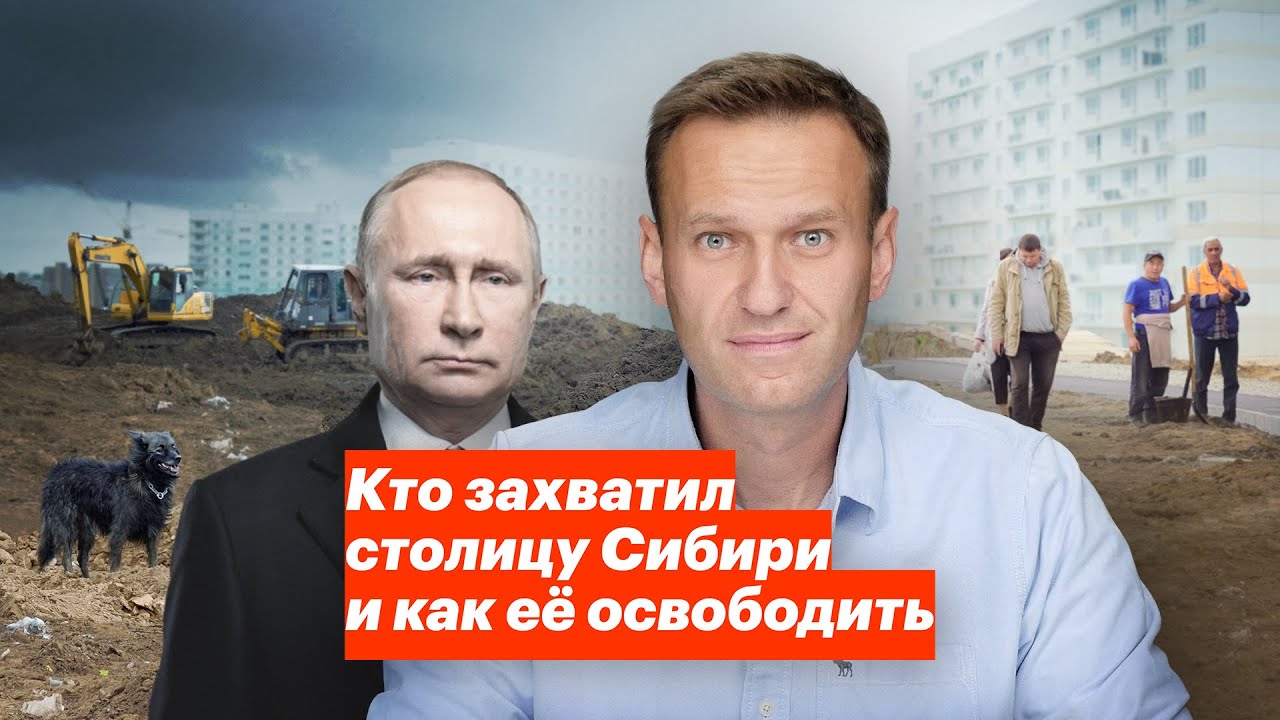
Why Novosibirsk? What is so special about it that makes it the main battleground in this round of the fight?
The first reason is a strong opposition. United Russia is not facing a scattered group of lone individuals here, but the Novosibirsk 2020 coalition, formed by different political forces. They reached an agreement and united. That alone is a major achievement. The coalition is led by Sergei Boyko, the city’s most popular opposition politician, who came second in the recent mayoral election. In other words, there are real candidates here worth voting for.
The second reason is that elections are rigged less here. People just aren’t used to it. There are regions in Russia where you can’t simply tell all the schoolteachers, “Stuff stacks of ballots into the boxes.” They don’t know how, and they wouldn’t do it anyway. Novosibirsk is exactly that kind of city.
Now we need a precise calculation. We’ve declared war on the ruling party. We want to deprive it of its majority. So how many votes do we need to do that?
1.2 million people are registered voters in Novosibirsk and can vote in the city council election. But how many of them will actually show up? We have a rough idea. Last time, turnout in the same kind of election was 20%. This time it is unlikely to be much different. That means 240,000 people will decide the outcome and elect the 50 members of the city council. For United Russia to lose and for the Novosibirsk 2020 coalition candidates to win, we need just over half of those who turn out—that is, 122,000 people. We know for certain that we can mobilize that many, based on previous elections and in particular on the recent vote on Putin’s “reset” of presidential term limits (156,000 people voted “no” then).
But here’s the problem: 122,000 people voting haphazardly for different candidates will get us nowhere. United Russia will still collect 30% of the vote from those whose minds have been washed by propaganda, while everyone else’s votes will be spread thin. So we need not only to bring 122,000 people to the polls, but also to make sure they vote the same way—for the strongest challenger to United Russia.
We have a tool that will let us do exactly that: Smart Voting. It proved itself extremely well in the elections a year ago. Our task now is to persuade 122,000 Novosibirsk voters to go to the Smart Voting website, register, and vote for the right candidate. On top of that, we need to send 1,800 election observers to the polls. Because even though Novosibirsk does not have a tradition of large-scale fraud, United Russia will gladly start one the moment it realizes it cannot win otherwise.
Let’s take a look together at what the Novosibirsk city council currently looks like and who sits in it. We open the list of deputies and see that more than a third—18 out of 50—are property developers or representatives of developers. And those are only the ones we know about for sure.
What does that mean in practice? A city legislature cannot function properly when it contains such a large, consolidated bloc. It doesn’t matter whether these people are 18 florists, 18 school administrators, or 18 builders—they will use power in their own interests. That is exactly what is happening in Novosibirsk right now. A construction monopoly has captured an entire branch of government: they write laws to suit themselves, they pass the budget, they perform the oversight function. They build, inspect themselves, allocate money to themselves—in other words, they simply run the city.
In their place there should be normal deputies who care about the interests of citizens and their voters. Instead, the seats are occupied by construction lobbyists whose only concern is how to get another piece of city land, build as many apartments on it as possible, and sell them as quickly as possible. Are the interests of Novosibirsk residents taken into account in this process? No.
Take Novosibirsk’s District 36, for example. Its local deputy is one of the richest members of the city council, United Russia politician Alexei Dzhulai.
His company, Diskus, is building entire neighborhoods in Novosibirsk—hundreds of prefabricated apartment blocks in the Plyushchikhinsky and Prostorny residential districts. Literally everyone in Novosibirsk knows about Diskus buildings. They have earned a grim reputation for their appalling construction quality. They are built from the cheapest possible materials, and badly built on top of that.
Dzhulai owns a factory that produces concrete panels, and then uses those same panels to build his housing blocks. The cheapest materials, cutting costs on absolutely everything. The new housing is practically unfit for habitation. It is dangerous to live there. People receive keys to buildings with no elevators, no railings, no electricity. Wind blows through the gaps between the panels, and all around there is an endless construction site: heavy machinery, mountains of trash, and concrete slabs instead of roads and courtyards.
But that’s not all—after buying an apartment, people keep paying Dzhulai because he also owns the management company. Water, electricity, heating—the money for all of that goes to him as well.
Dzhulai has effectively monopolized an entire district along with the people living in it. He owns everything—buildings, parking lots, management companies, shops, internet service. If you live in Plyushchikhinsky or Prostorny, then every day, whether you want to or not, you are paying tribute to Dzhulai. And now United Russia politician Dzhulai wants you to re-elect him to the city council.
Dzhulai desperately needs his deputy’s seat, and it’s obvious why. Without his mandate and his power, his business scheme would simply stop working. He wouldn’t just go bankrupt—he would most likely end up in prison.
See for yourself. Could any authority not bribed with kickbacks possibly say that a building like this is fit for occupancy? And yet people moved in, despite the grass-covered ditch in front of the entrance.
Could city authorities, if they were not controlled by the construction mafia, decide that these buildings had been completed and were fit to live in? Of course not. This is unfinished construction. There are no roads here—it is a building site.
What would a normal deputy from this district say if a developer were handing over buildings with amenities like this? He would either drive Dzhulai out or force him to do everything properly. Cheap housing does not mean it should be dangerous to live in.
And it is dangerous to live there—every single day. Last year, at one of Dzhulai’s construction sites in the Prostorny residential district, a 10-year-old boy was electrocuted. He was playing outside—not on the construction site—and nearby there was a pile of trash with exposed wires hanging over it. His family had moved to Prostorny just a week earlier.
And Dzhulai gets away with all of it. Hundreds of lawsuits have been filed against his companies, and fines totaling millions of rubles have been imposed—and nothing happens. His deputy status allows him to ignore it all. The lion’s share of the court cases are claims from city hall over Dzhulai’s failure to pay rent for the land his buildings stand on. How does he pull that off? Simple: he is the власть—the power itself. In his district, he gives the orders, so he spits on the courts and his obligations.
This is Dzhulai’s own special trick: getting land from the city and not paying for it. He does the same thing even at his country house (dacha). In the photo below you can see a small bay that, on paper, is listed as a boat station. He leased this plot in order to shield his house from prying eyes. And even for that luxury, he does not want to pay.
Incidentally, he keeps his distance from his own housing developments. His 250-square-meter apartment is located in Novosibirsk’s nicest district—Akademgorodok (the city’s famous scientific and university hub).
And his daughter moved even farther away—to Germany.
The good news is that District 36 has an excellent candidate from the Novosibirsk 2020 coalition—Daniil Markelov. He would be a thousand times better as a deputy than the developer and United Russia politician Dzhulai.
UPDATE 31.08.2020. While we were writing this post, we learned that a court had removed our candidate Markelov from the ballot. This was done at the request of Alexei Dzhulai, who used courts, prosecutors, police, and the election commission under his control to stage a full-blown special operation to have Markelov’s signatures declared invalid. Dzhulai is quite literally a mafioso who will do anything to keep his seat on the city council—a seat he has every chance of losing. That makes it all the more important to vote AGAINST Dzhulai on September 13. If you live in this district, register with Smart Voting, and we will send you the name of the candidate with the best chance of defeating this crooked United Russia politician. Not a single vote for Alexei Dzhulai.
Let’s continue our tour of the Novosibirsk city council. There are still many more people we need to meet.
If last year Alexei Dzhulai topped the ranking of the largest developers in Novosibirsk Region, this year he was overtaken by a colleague—another United Russia deputy, Kirill Pokrovsky.
Pokrovsky’s business is a perfect illustration of how everything works in Novosibirsk: a construction mafia and a family mafia rolled into one. He himself sits on the city council, his father sits in the regional legislative assembly as deputy speaker, and his mother works in the governor’s administration. A nice little place has been found for everyone.
The story is almost identical to Dzhulai’s. Our deputy’s father, Yevgeny Nikolayevich, became the owner of a reinforced concrete products plant while serving as an administration official. You can probably guess the rest. Concrete blocks for apartment buildings, standard designs, and nonstop construction. The Pokrovsky family’s main source of income is the Chistaya Sloboda residential complex, developed by KPD Gazstroy.
Even Putin’s presidential envoy Menyailo came specially to Chistaya Sloboda to wag his finger at them: until recently, it was impossible to leave this housing development by public transport, and the nearest stop was a 30-minute walk along an unlit road. But the apartment blocks keep going up and up. Meanwhile, Novosibirsk mayor Lokot works as the Pokrovskys’ personal advertising agent—cutting ribbons, touring and praising the buildings, and even recording special videos about how easy it supposedly is to get to Chistaya Sloboda from the city center. Such enthusiasm!
Deputy Pokrovsky very much wants to be re-elected to the city council, and to do that he needs the votes of the people living in his housing development. But he himself is unlikely to be able to vote for himself there, because for some reason he did not want to live in Chistaya Sloboda. His house is on an island. The contrast with the prefab housing estates where Pokrovsky’s voters live is enormous.
This place is 25 kilometers (about 15.5 miles) from central Novosibirsk. At the moment, there are only a few dachas on the island, which even has its own access road. Our hero owns one of them. Pokrovsky’s plot measures almost 2,000 square meters, and the main house has an area of 268 square meters.
Deputies living on islands—sure, that’s great. It’s obvious that United Russia sells deputy seats to rich little Pinocchios (a Russian idiom for spoiled rich kids). But surely there must also be some true-believing Putin loyalists in there—people not driven by money, but by devotion to Vladimir Vladimirovich’s course. We kept looking and looking. And we found one: Yevgeny Yakovenko, one of the leaders of Novosibirsk’s United Russia branch.
A typical uncle from a party congress: an Afghan war veteran, a statist. On the surface, he has spent his whole life working with veterans’ organizations and living on a single salary.
According to his asset declaration, everything is fairly modest. And what could possibly be immodest about a veteran and civic activist?
But in reality, this major Novosibirsk United Russia figure—you’ll laugh—is also a property developer. He just put the business in his children’s names. His son had “built” an entire neighborhood by the age of 25:
His daughter, although she lives in Dubai, formally owns kiosks in the Novosibirsk metro:
A whole pile of other retail businesses is also registered in the children’s names—mostly kiosks and small shops in Yakovenko’s district. But there is real estate too. Here, for example, is Yakovenko’s house in Novosibirsk.
And when it’s too cold to swim in the pool, you can always go to Sochi, where Yakovenko also has an apartment registered in his daughter’s name.
In fact, to expose Deputy Yakovenko and understand that he is no selfless Afghan veteran, all you have to do is look closely at his photographs.
The family’s lifestyle immediately raises a lot of questions. A 19-year-old son in a Porsche, Monaco, Dubai, and all the other accessories of a true United Russia politician.
And there is another piece of evidence right there on Yakovenko’s wrist.
An entire watch collection. Deputy Yakovenko wears a modest Audemars Piguet worth 1,115,000 rubles to meetings with residents of his district. He also poses in it for official photo ops—with a United Russia flag, of course:
For public appearances, the Afghan veteran deputy prefers a Cvstos watch. The same model as the one on his wrist can be bought for around 1.5 million rubles.
Or take this one. A special occasion—special watch. A meeting with veterans.
Deputy Yakovenko wearing a Breguet watch worth 2 million rubles:
In Yakovenko’s District 35, the Novosibirsk 2020 coalition has its own candidate—his name is Vyacheslav Yakimenko. He works for Navalny’s Novosibirsk headquarters, is running an active campaign, and if you live in the district, you have almost certainly seen him. Vyacheslav would be an incomparably better deputy than the secret businessman Yakovenko, who is far more interested in his watch collection than in his duties as a legislator.
We hope we have convinced you that nothing good can be expected from developers in the legislature. But that naturally raises the next question: are the deputies who are not developers any better?
Unfortunately not. Take Sergei Bondarenko, a United Russia deputy with no connection to construction.
Like other United Russia politicians, he also profits off the residents of Novosibirsk. But his corruption scheme is a special one.
Sergei Valentinovich Bondarenko became a deputy in 2005. Even earlier, he entered municipal service and took charge of the city funeral bureau, called MUP IMI (a municipal unitary enterprise).
After some time, Bondarenko went into business—he created a joint-stock company founded by the municipal IMI enterprise itself and a firm set up by the deputy’s wife. The joint-stock company was also called IMI. At first it was owned fifty-fifty, but the state’s share was gradually diluted until the city lost control over the funeral industry.
In Novosibirsk, everyone knows that if tragedy strikes and someone dies, the relatives are supposed to call the short number 063. You think you are calling the municipal IMI, but you end up with the commercial IMI founded by the relatives and close associates of this United Russia deputy.
And after that, everything works exactly the way the funeral business usually does. There is a basic rate, which goes to the municipal IMI. But then there are much more expensive add-on services: dressing the deceased, applying makeup, digging the grave, and so on. The grieving relatives are pressured into buying and paying for all of it, because otherwise there will be no funeral. That money then goes to the commercial IMI and other firms founded by the very same people. Appreciate the elegance of the scheme. You can privatize a city enterprise—or you can privatize its customers. Our United Russia politician privatized the dead.
Now let’s look at a concrete example of how Deputy Bondarenko’s corruption scheme works—how exactly he takes money from ordinary Novosibirsk residents and puts it in his own pocket. There are two twin companies: the state IMI, where our deputy Bondarenko is the director, and the commercial IMI, where the director is his wife’s brother.
After that, it’s simple. People who come to bury their relatives and loved ones simply do not look closely at whom they are paying and what for. You would think that payments like this normally go into the public budget, but in Novosibirsk it works differently.
Let’s take a specific example. Here is an article by journalists from Tayga.info, describing the case of a woman who was billed more than 80,000 rubles by IMI. Of that amount, 79,000 rubles went to the commercial IMI company and related businesses.
The article mentions that she had to pay 10,000 rubles for the memorial meal to an individual entrepreneur named “Larisa Olegovna Sukhareva.”
Do you know who that is? Let Larisa Olegovna tell you herself.
By the way, she is also running in the election, also from United Russia, and wants a seat in the Novosibirsk Region legislative assembly.
There is another woman as well—Anna Mikhailovna Vodopyanova, director of Akademiya.ru LLC, the company to which IMI hands its funeral contracts.
Where did she come from, and who is she?
Another assistant to Deputy Bondarenko. She had actually planned to run against Boyko in his district, but apparently something fell through.
Apparently there was no one to leave the funeral business with. As you can see, United Russia politician Bondarenko is not embarrassed in the slightest and openly diverts money away from the city budget to his relatives, friends, and assistants.
We could tell a story like this about every deputy. They are all like this, and until we get rid of them, there is no chance of a normal life. Whether we do get rid of them, though, depends on just ten minutes of effort from everyone reading this post. Remember: our goal is 122,000 people voting through Smart Voting. To make that happen, every resident of Novosibirsk Region needs to send this video to others, recommend that they watch it, and register on the website. If you take part, we can pull this off easily.
The political fate of all these mafia clans is literally hanging by a thread. But if we do not finish them off now with Smart Voting, the next chance will not come for another five years. If we want a better future, then right now we need to do a little campaigning, then go vote, and then, if necessary, take to the streets to defend our choice. This will work—there is no other way.