This is the kind of thing you see in fantasy movies: you look at a city and see a peaceful scene. Passersby are walking along, a couple is embracing, parents are rocking a baby in a stroller, retirees are sitting on a bench. But if you look with magical vision, there’s a vortex over the city, electric discharges, and horrible creatures sucking blood at night.
That is exactly what is happening in Tomsk. On the one hand, everything looks fine—a beautiful city, Russia’s student capital. But on the other hand, everything here is entangled in corruption, and it affects every person’s life. This is not a figure of speech—the local mafia has taken over the city so thoroughly that all Tomsk residents are forced to pay tribute to it many, many times every day, even though most of them do not even realize it.
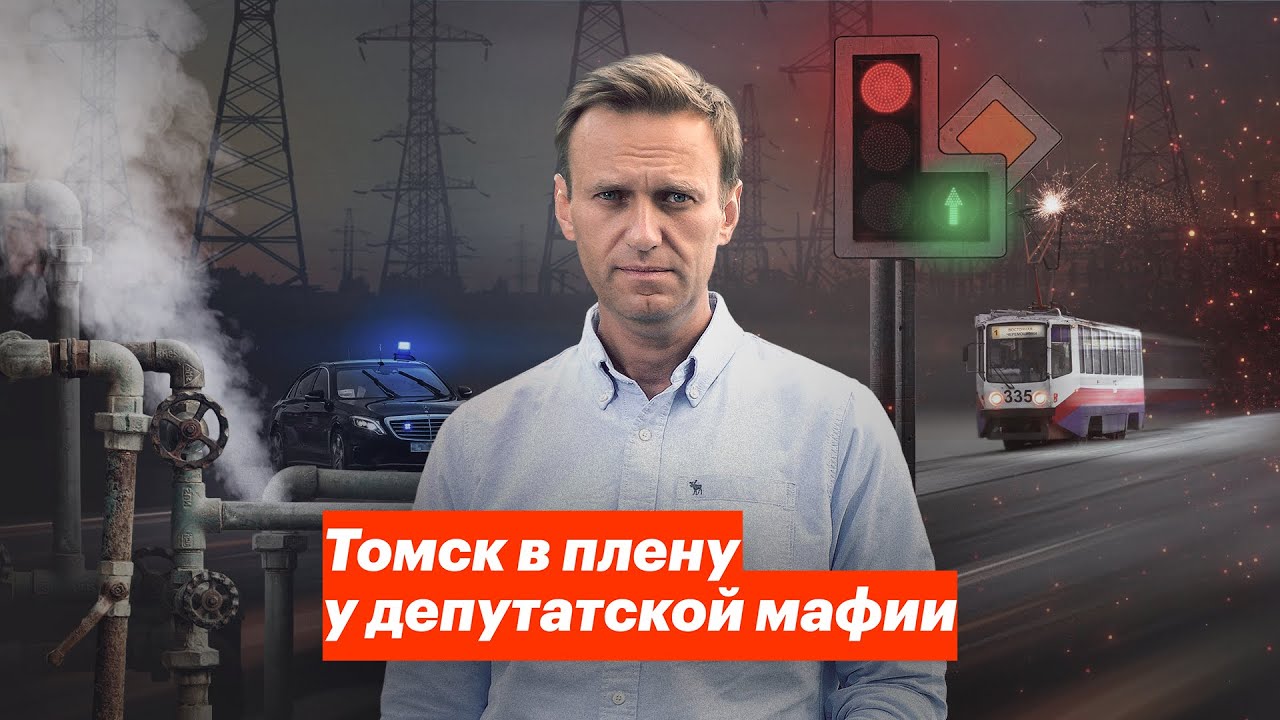
If we have decided to declare war on Putin’s party, United Russia, then Tomsk is one of the best places to do it. We will tell you how the city works, and you can help us get this story to every Tomsk resident. On September 13, people need to come to the polling stations, take on United Russia, and throw it out of the Tomsk parliament with the help of Smart Voting.
What does a day in the life of any person in any city consist of? They wake up, get out of bed, turn on the light. Then they have breakfast, drink tea, leave the house, and go to work. It seems like ordinary routine—what does United Russia have to do with it? Quite a lot, actually. If you live in Tomsk, the moment you flip a switch, turn on a tap, ride the elevator, or throw out the trash, your money goes to United Russia deputies.
The proof is sitting in every Tomsk resident’s mailbox. All you have to do is take a close look at the utility bills. That is exactly what we are going to do now.
Power grids wrap around any city; they are its circulatory system. They are everywhere—wires, poles, transformer boxes. Through these networks, electricity generated at power plants is delivered to your street, your building, your stairwell. The person who controls all of this controls the entire city. A kind of megaboss who can go “click” on the switch—and Tomsk is plunged into darkness.
This megaboss understands that if such a vital urban system is under his control, people will pay him as much as he wants. And he can steal as much as he likes.
Our megaboss is named Vladimir Tikhonovich Reznikov.
Tomsk’s city power networks ended up in the hands of this fairly well-known local figure. He is known because for many years he served as director of Gorset, when it was state-owned. More broadly, he is a prominent man: since 2001 he has been either a deputy in the regional legislative assembly or the city council, an honored builder, an honorary citizen, and the leading United Russia figure in Tomsk—the head of the party’s local branch.
But here is the trick: very few people noticed the key change in his status. Reznikov used to be the hired director of a MUNICIPAL enterprise that managed Gorset:
And now he has become the owner of a COMMERCIAL company that does the same thing:
Do you feel the difference? He was a director; now he is an owner. The money that all Tomsk residents pay for electricity no longer goes into the city budget, but into the pockets of Reznikov and his partners.
So who are his partners? First and foremost, his own son, Maxim Reznikov, whom his father also shoved into politics—and right now he too is running for the city council.
Reznikov Sr. led his son into politics by the hand long ago—he has already had time to serve as a deputy, then as a deputy mayor of Tomsk, and then as a deputy again. Now he is in charge of municipal services in the city council, as head of the committee. Very convenient.
The electricity mafia also has a backup deputy—Elena Borisovna Telkova, who is running on United Russia’s party list.
Telkova is Reznikov’s deputy on the municipal services committee and, coincidentally, the Reznikovs’ business partner—she owns 10% of Gorseti LLC. In other words, one deputy son on the city council is not enough for them. They are taking over power literally committee by committee.
So how exactly do our utility-deputies make money? The scheme is as follows. We are simplifying, but this is the basic idea. The figure you see on your bill is the tariff per kilowatt-hour of electricity. It is made up of several components, but roughly 40% of that amount is payment for the use of the city’s power grid—that is, for transmitting electricity through the wires to your home. The more efficiently the electricity transmission company operates, the less you pay for transmission.
Now let’s look at how this works in practice. For example, Gorseti spends 4.4 million rubles on repairs to its video surveillance system. The supplier is Sistemkompleks.
The same company also supplies Gorseti with fire alarm systems.
At first glance, everything seems normal. But no. The company is owned by another of Deputy Reznikov’s sons, Igor.
Or take something from a completely different sphere: Gorseti buys drinking water for itself from a company called Siberian Eco-Drinks, for 8 million rubles. That company belongs to Reznikov Sr.’s grandson.
Or this: the rental of executive cars—a Mercedes and a Land Cruiser. From whom does Gorseti rent them? From a company owned by a certain Galina Petrovna Yasyuk.
This same enterprising woman also sells Gorseti crushed stone, pipes, cables, and decorative lighting. Do you know who she is? She is the head of Gorseti’s cafeteria. Alongside her cafeteria job, she also sells the company whatever its bosses decide they want to buy.
If a utility company buys everything—from bottled water to Land Cruisers—not from normal suppliers in a competitive market, but from its own affiliated firms, what do you call that? Corruption and kickbacks. And you, the people of Tomsk, will pay for it through your electricity bills.
Tomsk residents pay the Reznikov deputies for all electricity. Trams, streetlights, traffic signals—all of it is controlled by the Reznikovs, and they profit from all of it. Do you use the internet at home? One of the largest providers belongs to Reznikov. Surveillance cameras on residential buildings? They are installed by a Reznikov company. There are also hair salons, a hotel, and even the bottled water brand Yunona in stores—it too is produced and sold by the Reznikov family. Tomsk’s vodka production? That belongs to the Reznikovs as well.
The Reznikovs are very wealthy deputies. Over the past three years, their combined family income has totaled 226 million rubles. And that is only counting the family members who file financial disclosures. In other words, it does not include brothers, grandchildren, and various friends in whose names businesses are registered. So we think the people of Tomsk have every reason to take a look at where and how their deputies live.
Maxim Reznikov owns a plot of land measuring 1,000 square meters. The house (300 square meters) has four floors and two staircases, and the ground floor is used for parking, because Reznikov Jr.’s car collection is so large that it does not fit into a separate garage.
And here is Reznikov Sr.’s secluded house. The house itself, conveniently hidden by trees, measures 510 square meters. It has three floors and, judging by the number of chimneys, a great many fireplaces. The actual area of the plot is about 7,000 square meters. It also contains a garage, several other buildings, a garden with trees, and a private pond.
The next bill is our guide to the story of another deputy who pulled off a scheme very similar to the one at Gorseti, only this time with the water utility. Here we focus on whom Tomsk residents are paying—Tomskvodokanal LLC—and how they are paying, through something called the Tomsk Settlement Center. Both companies lead us back to the city council again, just by different routes.
Tomskvodokanal is the company that, as you might guess, pumps water from the river and wells, purifies it, and sells it to consumers—both individuals and businesses. The sewer system, accordingly, is theirs too.
“Here today, gone tomorrow” is a bad pun when talking about a water utility, but that is exactly what happened to it. It was city property, managed by the city, and then—just like that!—a deputy from the “party of power” set his sights on it.
Who exactly? Let’s meet him—another United Russia deputy who has been sitting in the city council for 19 years and wants to keep sitting there.
He is a typical decorated official—deputy chairman of the city council and head of the United Russia faction. His name is Kirill Novozhilov.
In 2010, the city’s water supply and wastewater system were handed over for long-term management to a well-known French company that promised multi-billion-ruble investments and its European expertise. So far, it all sounds good, right?
But in practice, things turned out very differently. Yes, the French really were there. But the promised billions in investment and the full modernization of the water utility never happened. Instead, in 2011 the city council deputies approved a new investment program—rather than 7 billion rubles, it contained just 1 billion, and for some reason they decided to “invest” not through the French, but through ordinary Tomsk residents—by raising tariffs.
Among the deputies who approved this was our hero Novozhilov. All that time, behind the “French” label and through offshore companies, it was he who owned the water utility. And today Tomsk’s water utility is not Tomsk-owned at all. It is Czech. Its real owner, through a Czech company, is United Russia member Novozhilov’s sister, Darya Tokminina.
And Deputy Novozhilov himself owns the Tomsk Settlement Center—you saw it at the top of the bill. You pay for water through it specifically so that not a single kopeck slips past the United Russia cash register.
Novozhilov runs the water utility exactly the way his fellow United Russia member does at Gorseti. Holding a monopoly position in the market, he knows that you will have to pay for whatever they manage to stuff into the tariff. That is why the water utility’s biggest contracts go to him and his relatives. This enterprising family handles pipe laying, repairs, construction, pump station design, and even wastewater treatment.
The relatives’ services do not come cheap. That is exactly why water tariffs in Tomsk have nearly doubled over the past five years. And make no mistake, they will rise again. That is precisely why United Russia member Novozhilov needs a seat on the city council.
At this point, you probably want to ask: what kind of Tomsk anomaly is this? How did United Russia members manage to swipe virtually the entire city infrastructure clean?
This is no accident. There is a famous Russian meme that Chubais is to blame for everything. Well, here that is not a meme—it is reality.
In the early 2000s, Tomsk launched a huge housing-and-utilities reform. It was a well-known Putin-era initiative: a specially created коммунal giant would appear in the country and centrally manage housing and utility services. This mega-company was called Russian Communal Systems, its founding father was Anatoly Chubais, and it was headed by Mikhail Abyzov, who is now under criminal investigation. They planned to combine electricity, heating, gas, and all the other sectors into one and manage the whole thing.
Several cities were chosen for the experiment, including Tomsk. At the time, Tomsk’s mayor was Alexander Makarov. He opposed the creation of the monopoly, saying that a single giant would not be able to manage housing and utility services effectively, but no one listened to him. The monopoly was created, but it existed without any oversight and was used mainly to siphon off budget money. The result was predictable—the experiment failed. Someone had to be blamed, and they found that person quickly: they jailed Mayor Makarov himself.
A few weeks after Makarov’s arrest, Russian Communal Systems announced that it was leaving Tomsk. The monopolies it had created returned to city management, but they did not stay there for long. Cunning United Russia members saw that RKS had built ready-made money-making machines and rushed to privatize them. First, Deputy Reznikov took over Gorseti, and a few years later Tomskvodokanal went to Deputy Novozhilov.
We have one bill left—the invoice from the management company.
The management company Zhilishche is part of yet another utility giant, which also includes Tverskaya Management Company. Together, these two firms manage nearly 150 apartment buildings in Tomsk’s Kirovsky and Sovetsky districts. They collect utility payments, issue bills for electricity, water, and maintenance of common areas, remove garbage, and maintain the entrances. What Russians call *kvartplata*—the standard apartment maintenance and utility charge—all that money goes to these management companies. And of course, Tomsk’s United Russia members could not possibly pass up such a juicy piece of infrastructure.
It seems we are repeating ourselves for the third time, but what can you do—the scheme is the same everywhere. Once there was a municipal enterprise called Zhilishche Management Company. It serviced residential buildings, and its hired director was United Russia deputy Sergei Panasyuk.
At the same time, while serving as deputy mayor for housing and utilities, he created a commercial company with the same name—Zhilishche—and building maintenance was gradually transferred to it. The firm now belongs to his wife.
But that is not even the most interesting part. The Panasyuks’ secret partner in this business is an old acquaintance of ours—Artyom Yuryevich Chaika, the son of Russia’s former prosecutor general. The stake is registered in the name of his wife Marina Chaika’s aunt. In the same building where the Zhilishche office is located, the Panasyuks and Artyom Chaika’s mother-in-law have lived side by side for many years. This is also where payments from tens of thousands of Tomsk residents flow.
Sergei Panasyuk is a deputy and the director of the state-owned company TomskRTS. It sells thermal energy and services Tomsk’s heating networks. His wife, Elena Panasyuk, together with the wife of another former deputy and deputy mayor, Vladimir Khan, establishes several management companies. Panasyuk’s daughter is brought into the business as well; she owns two more management companies in other districts. In total, there are four firms and nearly 200 buildings—making this the largest management company in the city. And all of it, under different names, is run by the same people: officials’ wives. And…the family of former Prosecutor General Chaika.
What is Chaika even doing in Tomsk, you may ask? That is a separate remarkable story worth dwelling on. Marina, the wife of former Prosecutor General Chaika’s son Artyom, is from Tomsk. Her family still lives here, including her aunt, Elena Karpenko.
One might say: well, so what, she lives there; these are different families, distant relatives, and so on. But that is not the case. Elena Karpenko is one of the key figures in Artyom Chaika’s empire. She acts as his trusted proxy and nominee—the relative in whose name things can be registered when Artyom does not want to own them openly.
For example, the salt business we described in our Chaika investigation: the Kireyevsk and Maloyaroslavets salt works in the Tula and Kaluga regions. After our investigation, Artyom Chaika admitted that these were his assets and registered them in his own name. But in 2018, in a single day, he supposedly got rid of them and sold them. In fact, he did not get rid of them at all—he simply transferred them to this same Karpenko, his wife’s aunt.
The transaction was absolutely a sham, because in 2019, a year after the sale, when Governor Dyumin was inspecting the Kireyevsk salt works, it was Artyom Chaika personally who showed him around.
To be honest, we are not even sure that this Chaika relative knows that she is supposedly a major businesswoman whose holdings in the Tula region are being personally inspected by the regional governor. Probably not.
But we understand very clearly what is happening in Tomsk. City deputies, with the help of their relatives, wives, friends, and acquaintances, have seized and registered in their own names literally everything connected to municipal utilities. Electricity, heating, water, apartment charges—they have built a truly perfect system that allows a handful of deputies to make half a million Tomsk residents pay them for everything, one way or another. Their presence in the city council, their status on city committees and commissions—these are an integral and absolutely necessary part of this large-scale money-extraction scheme.
The municipal services committee has been turned into a villains’ club. ALL of our heroes today sit on it. In a normal system, it should be made up of deputies whose job is to make services better and ensure that people pay less.
In Tomsk, it is exactly the opposite. Sitting there, in the literal sense, are people who have no goal other than raising tariffs for city residents. This is not even a conflict of interest—it is legalized mafia rule.
That is why they do not let ordinary outsiders become deputies. The city council must remain a mafia club, because otherwise newcomers would destroy everything and threaten not only United Russia’s family money, but also the freedom of the city’s bosses. After all, for what they have been doing for many years, they absolutely belong in prison.
There is a great word for this: ouroboros, the snake that bites its own tail—an ancient symbol representing the cycle of things. And that is exactly the kind of closed loop that has existed in Tomsk for many years. United Russia deputies own the entire city infrastructure and take money from every resident. With that money, they get elected and become deputies. As deputies, they raise tariffs, and people pay them more. And with that money, the deputies get elected again, so they can repeat the cycle once more: raise tariffs in order to earn more and then get reelected.
Breaking this cycle is easy: all you have to do is not elect them this time. Elect other people as deputies—people who will instead control tariffs and fight utility monopolies. To choose different deputies, all it takes is 31,000 Tomsk residents. If that many people in Tomsk register with Smart Voting and vote on September 13 according to its recommendation, then not a single United Russia member will remain in the city council. Not one. And that will be a colossal blow both to the utility mafia and to the party of power.
Everything here depends entirely on us. A working tool—Smart Voting—exists. And it is a personal choice for every city resident. You take part and bring down United Russia—or you stay home, sit in front of the TV, and then keep paying it more and more every year.
This post is about Tomsk, but something similar is happening in your city too. And Smart Voting needs your vote as well. A normal life is closer than we think. Do something to bring it nearer.