
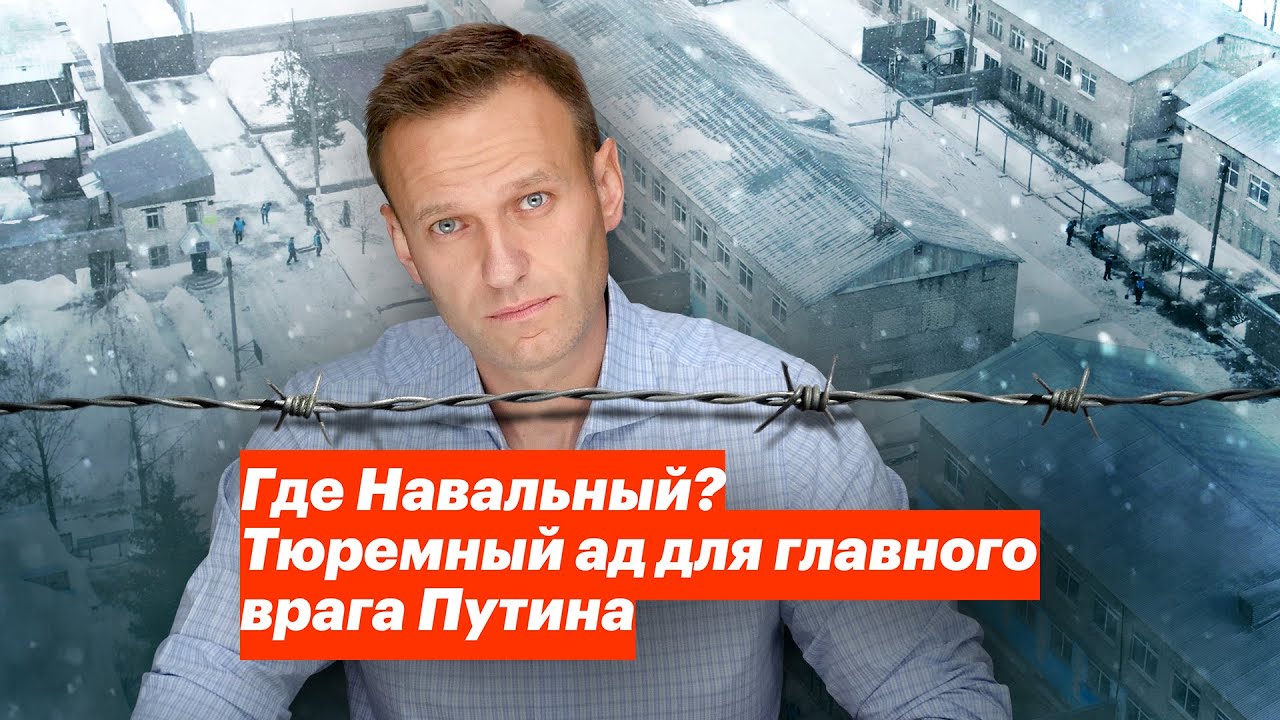
In recent days, everyone has been trying to figure out where Alexei Navalny is. There is both an answer to that question and no answer at the same time. Yes, that happens. Neither Alexei’s lawyers nor his relatives—no one was notified that Navalny was being transferred from Matrosskaya Tishina detention center and taken somewhere else. On the morning of February 25, he managed to write: “They told me to pack my things, I’m being transferred somewhere—either to a neighboring cell or to a neighboring region.” So officially, we still do not know WHERE Alexei Navalny is.
But alongside that—see for yourself. A source, journalists, and human rights advocates are all saying that Navalny was taken here: Vladimir Region, the town of Pokrov, Penal Colony No. 2.
For the past six months, the whole world has been watching what has happened to Alexei Navalny. The poisoning, the hospital in Omsk, the lies of the local doctors, the evacuation, Novichok. Squirming Russian propagandists and officials. The exposure of his own poisoning, Navalny’s conversation with an FSB officer, and Putin’s lies. Then came his return to Russia, the arrest, the film about the palace, the court hearings, more court hearings, his final words, the sentence. Tens, if not hundreds, of millions of people around the world have been following the life of ONE man without looking away. Because that man is Putin’s main enemy.
And now, according to Putin’s plan, silence is supposed to begin. Two and a half years of long-awaited silence. Putin seems to think that his greatest dream is finally coming true—that Navalny is disappearing. No one knows where he is or what is happening to him, and no one is watching what Navalny does or says.
But of course, we are not going to give Vladimir Vladimirovich that satisfaction. Not this time. So today, we invite you on a tour of the place where, in Putin’s design, Alexei Navalny is supposed to spend two and a half years of his life. We will show you what this place looks like and how it works—what a Russian prison is, and how Putin has decided to keep taking revenge on Navalny.
The essence of Penal Colony No. 2 in Pokrov, in short, is this: nothing is allowed. We spoke to people who served time here, who had been here, whose relatives are imprisoned here. And every time we heard the same thing—nothing is allowed. Humiliation, psychological pressure, physical violence, threats, and total isolation. In Russia, this is called “lawful punishment,” a path to rehabilitation. But in reality, it is torture.
Penal Colony No. 2 is one of the strictest prison camps, a so-called “red” zone. Here, power does not belong to the inmates (as it does in “black” zones), but to the administration—and to the prisoners the administration uses like slaves.
Let’s start at the very beginning. This is where they bring you from pretrial detention.
They unload you from the vehicle, take your belongings, force you to stand facing the wall and squat. And then they beat you. Immediately. According to numerous accounts, the first thing that happens to you when you enter the grounds is that you are beaten. It is “preventive”—so everyone knows their place. Navalny was not beaten. And that was so astonishing that the media even reported it as news. A good start, isn’t it?
Then comes the search. The prisoner is taken to the punishment cell block.
There, in front of the administration and other prisoners, you strip completely naked and squat again. You are issued a uniform—pants, a shirt, underwear, and a set of outerwear. Those are all your possessions for the next several years. Right there, your head is shaved with clippers. Then they photograph you.
Next comes the psychologist. “Now that’s service,” many will say. “A psychologist, no less.” But that is not how it works in reality. The psychologist is not interested in anything about you. They hand out colored cards and ask you to arrange them in the order you like them. Then they do it again several times. Blue symbolizes calm, red or orange symbolizes willpower. You choose, you arrange them, and the psychologist presumably draws some important conclusions... Yellow means a desire for communication. Anyone who picks it deserves sympathy: the main rule of this colony in Pokrov is no communication, total isolation. But more on that later.
After the psychologist comes a conversation with a doctor. Here too, everything is simple. If you do not have a medical file, then you do not have any illnesses either. Poisoned with Novichok? Spent three weeks in a coma and only a few months ago had to learn to walk and speak again? Show your medical file. If it is not written there, then it does not exist.
Next comes a meeting with the administration. Here they either beat you again or humiliate you psychologically—in short, they remind you that you are not a person and you have no rights. Proceed to quarantine.
On the way from the punishment cell block, everyone stops here.
Prisoners are handed a broom. What? Why? We’ll explain. You have to take the broom, start sweeping, and then ON CAMERA (the administration is filming you) say: “I do not support the inmates’ way of life.” It is a kind of special humiliating oath.
This is where quarantine takes place.
Two weeks of abuse and maximum pressure. This is where you encounter the colony’s main “feature.” You are not allowed to talk. At all. You live in a room with several dozen people and cannot speak to them. It is forbidden.
Your day in quarantine looks like an endless chain of meaningless tasks. You are never simply allowed to exist; you are constantly doing something, carrying out orders. Wake-up, an order to go to exercise, you listen to the anthem, do the exercises, then an order to make your bed. Then an order to make your bed again. Or to take off all your clothes, fold them according to regulations, and put them back on. Then an order to line up and make your report—this happens dozens of times a day. You stand rigidly at attention and report your full name, year of birth, criminal article, start of sentence, end of sentence. Then there may be an order to repeat the exercises—squatting again or swinging your arms. Or an order to stand still. Or an order to make your bed again. Dozens of times in a row, people perform meaningless rituals. They are simply being tormented. Their minds are being broken.
Now we come to a particularly interesting part. These orders are not given by guards or colony staff. They are given by so-called orderlies, or “activists,” as they are called here. They are prisoners just like the others, but they have struck a deal with the administration and, in exchange for privileges, do its work. They boss you around, force you to make and unmake your bed for three hours straight, or order you to memorize the list of colony employees. They can search you, beat you, do whatever they want. These inmates live under special conditions: for example, they are allowed to wash whenever they want. Or they are allowed not to keep their hands behind their backs at all times. In return, they do the jailers’ work—they never leave other prisoners’ sides, day or night, they keep logs in which they record your every word, every answer, and then take this dossier to their superiors for review.
After quarantine, everyone is transferred to the strict-regime barracks.
This is an important stage, whose only purpose is to show what will happen if you behave badly. Here, you still are not allowed to talk to one another. But prison entertainments appear—for example, collective television viewing. They watch federal TV channels, news, or lectures. The prisoners are seated in rows, and each one must keep their back straight and their legs together. Sit the wrong way—reprimand. Close your eyes—reprimand. Not watching TV is not allowed.
As far as the daily routine is concerned, nothing changes. One order after another. Often it is simply an instruction to stand for hours and look down. Raise your head—reprimand. Fail to greet someone—reprimand. An unbuttoned button—reprimand. A few reprimands like that, and there goes any chance of parole.
From this strict-regime barracks, you are then transferred to an ordinary one—where you are supposed to stay permanently, and where things are supposedly easier.
But that is in theory. In practice, they can keep you here for months. An ordinary barracks is a huge room for 60 people. Bunk beds in two rows. Each person is allotted two square meters. A bedside table and a chair. From here, they take prisoners to work, once a week to church, and to wash. There is a shower in the barracks. But, as a reminder, you are not allowed to use it—it is for the “activists” who cooperate with the administration.
Personal time almost does not exist. If you are lucky, you may be allowed an hour, an hour and a half, when you can sit on the edge of a stool and read. But political prisoners, as a rule, are not lucky. Otherwise, the whole day is either work or hours of mandatory television viewing. There is no FSIN-Pismo electronic mail system here; only paper letters arrive. To reply, you get half an hour a week. They give you a pen and a sheet of paper, and you can write a little. But an orderly will sit next to you and watch what you write. If he does not like it, he will simply take everything away and throw it out. And yes, for political prisoners, the ban on communicating with other people applies here too.
And remember how Alexei Navalny was recently given the status of escape risk? Funny, of course—but do you know what that means? It means that every two hours, someone comes up to him with a video camera and makes him give a report—full name, year of birth—you remember the drill. And at night, every hour, a colony employee comes in, shines a flashlight on him, films him sleeping, or wakes him up so that he has to identify himself again.
All of this is real torture in the literal sense of the word. The deliberate destruction of a human being, the abuse of a person’s very identity—it has nothing to do with law or justice. This is the Middle Ages, created by Putin and his officials in the middle of Europe in 2021.
We are sure that for most of you, what we have described today comes as a disturbing revelation. To be honest, even we do not always fully grasp the extent of the madness and lawlessness in these places.
Alexei Navalny is there not because he is a criminal, but because Putin does not like him. He is there because he did not die after the attempted poisoning. He is there because he dared to return to Russia. Because for years he told us the truth about Putin’s corrupt regime, about the party of parasites, crooks, and thieves, about a president clinging to his chair so he can go on stealing and enriching himself indefinitely.
Freedom for Alexei Navalny.