
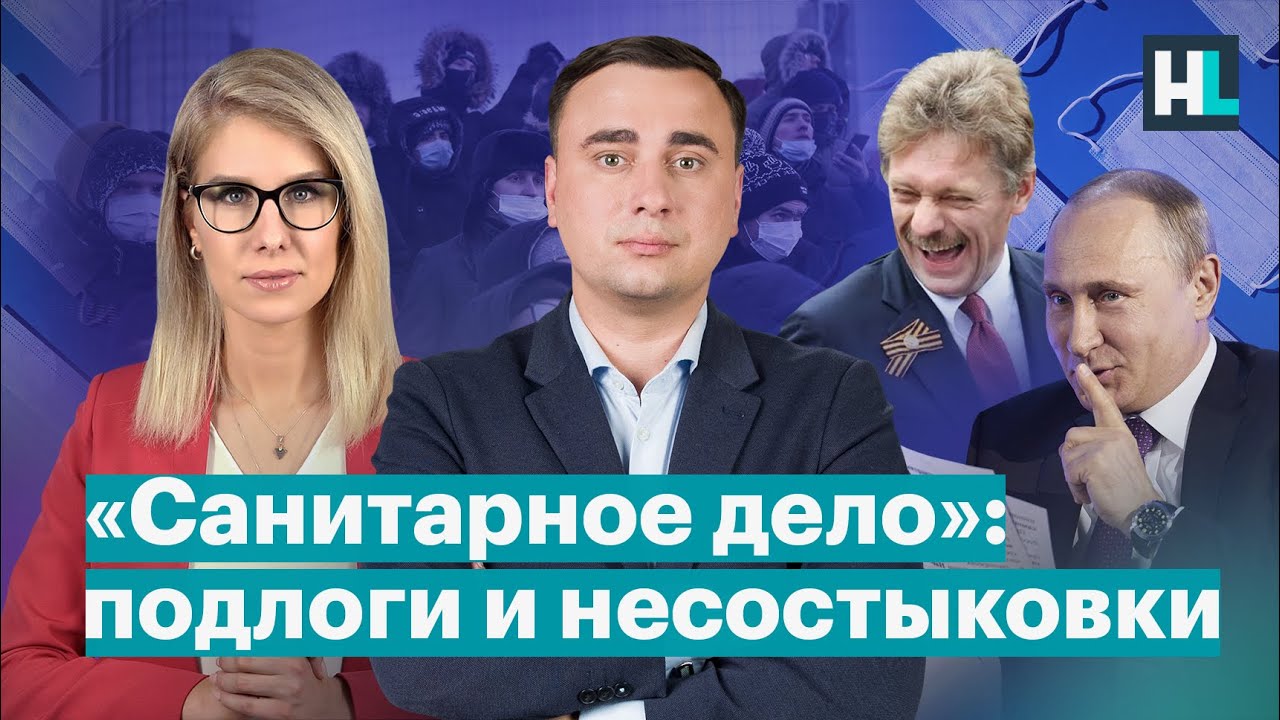
Look at these photos. Which one do you think violates public health rules for holding public events?
This is the “New Knowledge” forum, which took place quite recently. Dmitry Peskov is speaking. The hall is packed.
And this is the big March concert at Luzhniki, “Crimean Spring,” remember? Putin himself even spoke there.
And this is the January 23 protest in Moscow for the freedom of Alexei Navalny.
In the first two cases, the authorities say no public health rules were violated. After all, the authorities themselves organized those events. But in the wake of the pro-Navalny rallies, a criminal case was opened immediately, and ten defendants in it are facing real prison terms. Navalny’s press secretary, Kira Yarmysh, has already been under house arrest for four months. Another defendant, Konstantin Yankauskas, lost his father. The stress and worry over his son caused him to suffer a stroke. In the hospital he contracted coronavirus and died from complications. Because of his house arrest, Kostya could not even say goodbye to his father.
And all of this is happening in a criminal case that does not even have any victims.
We analyzed the case files in the criminal proceedings against Oleg Navalny and Lyubov Sobol, which have already been sent to court. It was clear before that the case was fabricated and politically motivated, but now we have proof.
As you may recall, on January 23—one week after Alexei Navalny returned to Russia and was arrested—rallies for his freedom took place across the country. Citizens have an entirely legitimate constitutional right to speak out, including at rallies, against any injustice. All the more so when the authorities imprison the country’s leading opposition politician. At the time, well-known cultural figures, civic activists, and simply people who care about our shared future openly spoke out in support of Alexei Navalny.
The authorities’ response was immediate. That very same day, a criminal case was opened, supposedly for violating public health rules. A team of no fewer than 25 investigators was assembled at once, including five lieutenant colonels of justice.
Just think about it: 25 salaried investigators pretending to be hard at work on a made-up criminal case. These defenders of the regime, sparing no effort, began drafting reports about supposed signs of criminal activity by people who posted calls for Navalny’s release. Not exactly backbreaking work.
That same evening, January 23, some young people were questioned, and they candidly told police that yes, they had been at the rally, but did not share Navalny’s views.
They said they had seen mass unrest involving minors. They also claimed to have seen some car being damaged. True, there is no evidence of any of this apart from their words—and it is unclear how exactly they ended up at the Main Directorate of the Interior Ministry that evening, January 23, since they had not even been detained. Yet they gave statements so neatly aligned, almost word for word, and so useful to the investigation. It is not hard to guess that the security services were using them to lay the groundwork for this criminal case in advance.
Later, the Investigative Committee reclassified the case from “violating public health rules” to “incitement to violate public health rules.” In other words, according to the prosecution’s logic, those same ten defendants allegedly and deliberately incited an unspecified group of people to go out into the streets and violate public health rules. It sounds like the ravings of a madman. All the more astonishing, then, that this legal heresy was handled by investigators for especially important cases, and that the case documents were signed by the head of the Investigative Committee’s Main Investigative Directorate, Major General of Justice Denis Kolesnikov himself—who, incidentally, was only recently appointed by Putin to the post. As we can see, the new appointee understands perfectly well what is expected of him from above.
Let us once again note just how absurd this situation is. The ten defendants in the criminal case, along with hundreds of public and cultural figures and thousands of people across the country, were calling on people not to stay silent, but to resist the lawlessness directed at Navalny and other political prisoners by every peaceful means available, including taking to the streets. But the legal tricksters at the Investigative Committee twisted everything into absurdity. And now people who called for justice have suddenly become inciters of crime, and ten of them are facing prison sentences.
But the Investigative Committee was relentless in its desire to curry favor with the bosses. Investigators brought in Moscow’s Department of Information Technology and Rospotrebnadzor (Russia’s consumer safety and public health watchdog) to use surveillance cameras and “social monitoring” to find people who had attended the rallies while infected with coronavirus—not only on January 23, but also on January 31 and February 2. If only they pursued real criminals with the same admirable persistence. We would be living in a very different country.
In the end, they found only four people who were supposed to be in self-isolation on January 23. But three of them had negative coronavirus test results in hand that day. The case files also include doctors’ testimony confirming that a person with a negative test cannot infect others and poses no danger.
That left the fourth person: Akel Dani Tammam. According to the young man, he was completely healthy on the day of the rally, and all his symptoms had already passed.
The Investigative Committee did its utmost to twist the story to make it seem as though Akel Dani had decided to take part in the rally under the influence of posts by the defendants in the so-called sanitary case. But the young man himself denies this. It was his personal choice. Moreover, he was not at the rally on Pushkin Square at 2:00 p.m. He did not leave home until 4:30 p.m. And later that evening—when many of the future defendants in the sanitary case had already been detained and were either at police stations or even in special detention centers—he was arrested not in the city center but near Matrosskaya Tishina in the Sokolniki district, as confirmed by the administrative report issued to him.
But judging by the case materials, the security services are hardly bothered by any of these inconsistencies. What difference does it make! Here is Sobol, for example, calling on people to come to Pushkin Square at 2:00 p.m. Here is a young man with no coronavirus symptoms leaving home at 4:30 p.m., yet not being on Pushkin Square at all. And here is a fake sanitary case that needs to be padded with at least some kind of material. So what conclusion do the investigators reach? That Akel Dani, sick with coronavirus and incited by opposition figures, left home in order to deliberately infect people.
If this is the best the senior officials at the Investigative Committee could come up with, then they clearly need some creative team-building exercises to develop their collective imagination.
And in general, how can you incite an unspecified group of people? You can incite a specific person to commit a specific crime. Neither Oleg Navalny, nor Lyubov Sobol, nor the other defendants in the sanitary case even knew Dani, much less could they have incited him to commit any crime.
The dishonesty and hypocrisy of this case are staggering. Judge for yourself: on January 22, exactly one day before the first protest in support of Navalny, Moscow introduced a whole series of public health relaxations. For example, museums, libraries, and cultural and sports institutions were allowed to admit visitors again at 50 percent capacity. How closely any of this was monitored can be seen from reports on concerts—for example, rapper Eldzhey’s show, which took place in Moscow on April 17.
Even more grotesque are the celebrations marking the annexation of Crimea, which took place at Luzhniki on March 18. The footage does not show even the slightest hint of social distancing. Did anyone hear about the people gathered there being checked against Moscow’s information databases? Or perhaps criminal cases being opened against the organizers for violating public health rules? Of course not. Here, people love Putin—or at least try to pretend they do—so they are allowed anything. But there, people do not love Putin. For them, it is batons, police vans, and time in special detention centers.
The case materials against Oleg Navalny and Lyubov Sobol are also full of blatant hypocrisy. Just look at what they write.
It turns out that police were doing everything they could to protect people from possible infection at the protest rallies—they were “distributing personal protective equipment to citizens.” Seriously: the case files are full of such documents bearing the signatures of chiefs from various security agencies.
You read the case materials and think: these are not baton-wielding security officers, just sweethearts. And then you read online about the beatings of peaceful people—how masks were torn off them, how they were randomly snatched from the crowd and shoved into stuffy, cramped police vans. And you tell yourself: no, they are not sweethearts at all. They are simply hypocritical liars. Just like their masters in the Kremlin, who gave them carte blanche for lawlessness both on the streets and in the quiet offices of the Investigative Committee. That is why they are not even embarrassed to lie. They calmly write in those same case materials that the threat of mass illness was avoided “as a result of the coordinated actions of law enforcement officers, who prevented close contact among the citizens present.”
For future reference: if a police officer grabs you out of a crowd, beats you with a baton along the way, and then drags you, pinned and twisted, into a police van, just know that this is how he is protecting you and those around you from a new coronavirus strain—and from a hundred other dangerous diseases as well.
But setting irony aside, it is clear that through its idiotic actions the police itself created the conditions for violating public health rules—not to mention that it was indiscriminately injuring innocent people.
So what do we have in the final analysis? Yet another slapdash criminal case, one that does not even have a mythical victim. Clearly politically motivated. Designed to accomplish several goals at once.
First: to intimidate everyone in whom conscience and a sense of justice are still alive. To intimidate you—ordinary citizens, patriots of the country—so that you resign yourselves to the idea that nothing in Russia can be changed anymore. That it is not even worth trying, because things will only get worse.
Second: it is a convenient way to isolate opposition figures. Put them under house arrest, restrict their use of the internet and phones, and make it as difficult as possible for them to run an election campaign, as has been done to Lyubov Sobol.
And of course, it is yet another excuse to smear the opposition through gutter media. To create conditions in which they are forced to keep making excuses for who knows what.
This vile, disgusting, and deceitful way of operating is the only way the Kremlin knows. And the agencies that, by some misunderstanding, call themselves “law enforcement” gladly copy this Kremlin style and fabricate absurd criminal cases.
We must resist this. If they fabricate high-profile criminal cases this shamelessly, just imagine the legal lawlessness that reigns in the regions, where local investigators, prosecutors, and courts work hand in glove because that is how things are done, because it is allowed, and even expected.
They—from Putin in the Kremlin to an investigator’s assistant in Kurgan—see themselves as the absolute masters of the country. But that is not true. In Russia, the people are the source of power. And the sooner you and I understand that, the sooner our country will begin to change for the better. And those changes will come. Take part in “Smart Voting” and help us fight the crooks and thieves.