Imagine a hypothetical scenario: Putin, Mishustin, and Matviyenko—the three most powerful people in the state—suddenly disappear. Who would be left in charge? In whose hands would Russia end up?
That person is Vyacheslav Volodin.
He is the top figure in the State Duma and the leading man in United Russia. Fourth in the formal hierarchy of senior officials, and probably even second in terms of public visibility. He is the author of the immortal principle, the pillar on which the entire Putin regime and its ideology rest: “No Putin, no Russia.”
It is hard to imagine anyone who loves Putin more. If there were a championship for adoring Putin, Volodin would take every prize place every single year.
He is the perfect, most archetypal Putin-era official. Volodin fit into this system so naturally that it is now hard to imagine it without him. He understood and mastered its key operating principle: praise Putin as if no better person exists in the world. Deliver what Putin wants—the coveted percentages for United Russia—and you become a true king of this life. Then anything is possible: stealing, building country estates, flying on private jets, and making billions from secret business dealings. And no one will say a word to you.
State Duma elections will be held on September 17, 18, and 19, and Volodin is running in them. He is standing in a district in Saratov, and he badly needs your votes. In the coming weeks, believe us, you will be hearing a looooot about what a wonderful speaker he is, what a caring leader he is, and how much he loves Russia. And we simply cannot pass up such a perfect opportunity to tell you what Putin’s biggest fan is hiding—and how much money he really has.
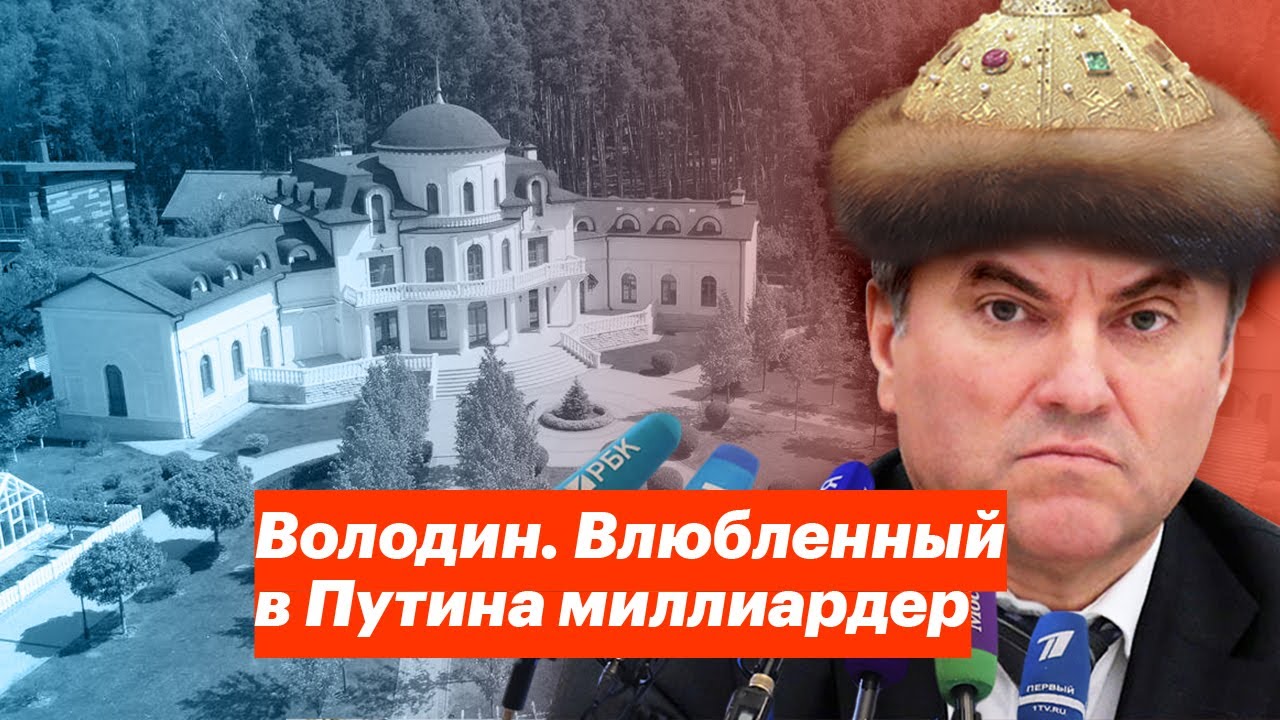
There is a cult of personality around Volodin in Russia. Entirely artificial, invented and implemented by Volodin himself, yet completely real—in one large region in particular, Saratov Oblast.
There, Volodin handles everything and solves every problem. Think we are exaggerating? If only.
Stray dogs? Volodin will drive them away.
A wall collapsed? Volodin will fix it.
The movie theater is not showing films? Volodin will sort it out.
Trash under your window? Your boss pushing you around? Nowhere to go to the bathroom? Volodin can handle it all.
His every move, every phrase, every public appearance is filmed by a dedicated camera crew, with multiple cameras from multiple angles. Even by drone. A team of state TV “journalists” follows him everywhere.
Why? And why is the speaker of parliament—a man who is supposed to be responsible for lawmaking—chasing away stray dogs and dealing with trash under people’s windows? It feels as though something has been mixed up. As if Volodin were not a legislator, not the top figure in the State Duma, but a governor, or a mayor, or a village chief—or rather, the head of every town and settlement in Saratov Oblast all at once.
The answer is very simple. Elections. And Volodin really needs you—especially those of you who live in Saratov. To achieve that, an utterly insane and unique PR machine was launched and paid for with state money. An entire infrastructure costing hundreds of millions of rubles, with one sole purpose: to literally manufacture out of thin air the image of the ideal United Russia politician—powerful, yet somehow so very simple and approachable. A high-ranking Moscow official, yet so hardworking. A philanthropist, yet modest. A man interested not in money or how to make it, but in how to help people.
The only man who can save Saratov. And most likely the whole country as well.
This image has not the slightest connection to reality. Today, step by step and in detail, we are going to dissect and destroy this mythical cult of one man. We promise: even people who thought they already knew Volodin was a crook and a thief will be shocked.
Vyacheslav Volodin is a billionaire. He is secretly involved in big business—not sometime long ago, as the legend goes, but right now. He makes insane amounts of money from it, money you will not see in his official disclosures. Just as you will not see his wife there. But she exists. And she is fabulously rich too.
A secret business, a secret spouse, country houses, apartments, a plane, and of course an 85-year-old mother who has earned billions of rubles over the past two years. We are going to tell you about all of it today.
Let us start with Saratov—the city where Volodin hunts. For gullible voters.
Despite his high office, Vyacheslav Viktorovich is, frankly speaking, not a very deep man, not very smart, and not at all inventive. Let us assume that at some point someone told him that the key to a voter’s heart lies through videos like these:
Once every two weeks—or even more often—Volodin drops his work in the State Duma and heads into the streets of Saratov on inspection. Then the public flogging show begins. Volodin scolds everyone he comes across as if they were little children. Everyone, for everything.
Here he is scolding the mayor of Saratov for having “blown” construction funds.
Here he is lecturing the city administration on how to live.
He tears apart the head of Volsky District, a fellow party member. But for some reason, at that moment he is speaking to the camera, not to the district head.
And here is Volodin at the circus, ripping into the director and the workers.
But please do not worry about these people. This is just a magician’s trick, an illusion. In reality, nothing will happen to these officials. The head of Volsky District kept his post after the public dressing-down, and even the regional construction minister whom Volodin called on to resign did not resign. Just a couple of minutes of humiliation for the crowd’s amusement—and then back to work.
The formula of these “brilliant” videos is exactly the same and repeated hundreds of times. Volodin issues orders to mayors, district heads, facilities managers, and they obediently report to him, stare at the ground, and tremble. Onlookers always stand around, spellbound, watching Vyacheslav Viktorovich criticize the quality of crushed stone. Then he orders everything fixed, and thanks to that, everything always ends well.
You can go yourself to the Instagram of Volodin’s “supporters” in Saratov, click on any video, and we guarantee it is almost always the same thing. The master, the lord of the estate, walks through the city, inspects his domain, and accepts the work. By the way, Vyacheslav Viktorovich’s range of practical recommendations is not very broad. It mostly boils down to one universal piece of advice: install a playground. It is a little worrying for Saratov—there is a real risk the whole city will soon turn into one giant playground.
The absurdity of what is happening bothers no one and raises not a single question. The obedient mayor trails after Volodin like a naughty little boy, repenting. And then on television they will surely tell viewers about Volodin’s twelve labors a day and even make a biographical film. Timed not to an anniversary or a birthday, no—but to the anniversary of Volodin’s departure for Moscow, the anniversary of Vyacheslav Viktorovich leaving Saratov Oblast. Strange they did not declare it a day of mourning.
We do not know who this is supposed to work on, but this very, very mediocre performance, unchanged and with the same cast, repeats week after week.
And it would all be funny and ridiculous if not for one thing. These press tours, which serve no purpose other than promoting Volodin, cost all of us a great deal of money. And unfortunately, it is us paying for them, not Volodin.
How do you think an incumbent lawmaker should make his campaign trips? One who wants to be reelected and keep churning out repressive laws while skimming money for yet another villa?
He should take his enormous salary—at least half a million rubles a month—peel off a tiny little piece of it, and use that money to buy tickets to Voronezh, Oryol, or Rostov-on-Don. In other words, to the region he wants to represent. According to his official disclosure, Volodin earned 84 million rubles in 2020.
That is enough not just for a plane ticket to Saratov—it is enough to charter a riverboat with an orchestra and sail to Saratov along the Volga three times a month.
But even that luxurious mode of travel does not suit Volodin. He prefers to go about his campaign business another way—by climbing onto our backs. Not literally, of course, but that is effectively what is happening.
See for yourself. Open the Telegram channel “Volodin Saratov”. It creates the illusion that Volodin is always in Saratov. Every day there are several news items about Volodin’s activities in Saratov—constantly solving problems, wisely directing the regional governor and the city mayor. The channel regularly posts messages saying, “Vyacheslav Volodin is working in Saratov Oblast today.” Take four recent posts—July 10, June 5, May 19, and May 14. That is enough to understand how Volodin gets to Saratov.
On July 10, an ultra-expensive Falcon 7X aircraft with the flight number RSD4 arrives in Saratov.
On June 4, a different Falcon—but with the same flight number, RSD4—lands in Saratov.
On May 19, flight RSD4 is once again operated by a Falcon and lands in Saratov. On May 13, you have probably already guessed what happened. The same plane flies to the same place.
This would be a good moment to wonder: maybe we are misleading you, and this is actually just a regular daily Moscow–Saratov flight?
Unfortunately, no. Look at the aircraft’s paint scheme, its livery. It bears the flag, the coat of arms, and the proud inscription “Rossiya” (“Russia”). The planes are owned by the Presidential Property Management Department and operated by the Special Flight Squadron “Rossiya”—the very same unit that flies Putin around the world. When you see Putin stepping off a plane onto a red carpet, this is exactly the kind of aircraft standing behind him.
These planes are used to transport only a handful of top officials on matters of exceptional state importance: international summits, meetings, official visits.
As for the flight number RSD4, it appears to be Volodin’s personal flight number regardless of the aircraft. Wherever he flies, the number stays the same. The “4,” presumably, means that the fourth-ranking person in the state is on board. Here is a flight on June 30 flying to Dushanbe. There, Volodin conveys Putin’s greetings to Tajik President Emomali Rahmon. On April 27, Volodin demands in St. Petersburg that European countries compensate Russia for bringing coronavirus onto its territory, and his personal flight is there too.
Both the speaker’s international work trips and his effectively personal, campaign-related flights—to inspect toilets and sidewalks in Saratov Oblast—are provided to Volodin under the same arrangement: he simply summons a free plane at the taxpayer’s expense.
We checked everything carefully. Over the past year, planes carrying Volodin flew to Saratov 25 times. Twenty-five there and twenty-five back. Fifty flights in total.
How much did these 50 campaign flights cost the budget? Let us do the math. The Falcon 7X was built to fly 11,000 kilometers (about 6,835 miles) to the other side of the world, not for short hops to Saratov, and it costs the budget a great deal. On average, more than $20,000 per leg. That comes to more than $1 million in flights in the last year alone.
Seventy-five million rubles from the budget were spent so that Volodin could show up in Saratov and, under the gaze of several cameras, recommend installing a playground.
We have dealt with Volodin, lord of the Saratov lands. Now let us look at another incarnation of Vyacheslav Viktorovich, another facet of his political image. Volodin the philanthropist.
It is hard to think of another person who does so much charity work. You watch the videos and it seems as if a halo is about to appear over the speaker of parliament—or as if he is about to tear off his last pair of trousers and give them to a needy resident of Saratov.
This image was inflated for years. “Sources close to” Volodin told TASS that Volodin had spent 46 million rubles on charity. Now that is what you call strong source work and a journalistic scoop.
Or take another year—Volodin’s aide explained where and how much Volodin had donated. And so it goes every year. In super-detail. Listing every fund and every project.
And if you listen to news reports from Saratov, you get the impression that every construction project, every repair, every renovation, every celebration—everything is a charitable project of Vyacheslav Volodin.
Doubts begin to creep in if you simply stop and do the math. If you believe television, social media, and Volodin’s other PR people, his charitable projects include:
Is there even a person in Russia—or in the world—who has spent that much on charity in a single city? And how could 40 million possibly cover all of it? And Volodin’s good deeds supposedly extend not only to Saratov, but to all of Saratov Oblast and even neighboring regions.
Volodin alone turns out to be like a small state—building homes, roads, schools, stadiums, and restoring historic mansions.
Of course, that is impossible and unrealistic. But just as with the staged scoldings of officials, this absurdity bothers no one.
We figured out how Volodin’s “charity” actually works. And we found that it has very little to do with Volodin himself. It is yet another show designed to fool voters.
Let us look at one example: Vyacheslav Volodin took patronage over the entire settlement of Yelshanka. You remember the formula. Volodin arrived, looked around, and solved everything. Here it is the same story. He himself says he is going to implement a charitable program there: demolish the barracks and build an apartment block. Construction begins, and Volodin is endlessly praised for such philanthropy.
Just look at this report on Rossiya 1 (a state TV channel). A special feature: a little girl plays the piano in a cramped barracks room, the family lives in dilapidated, unfit housing, but then Volodin appears and they are rehoused. He is shown striding forward inspirationally to piano music. And the building goes up.
There is no doubt who is supposed to be seen as the main figure here—this construction project is officially called a charitable project of Vyacheslav Volodin. In front of the camera crew, the head of the State Duma speaker’s local office advises residents to start choosing furniture as soon as possible.
They also announce that this is not all. On Volodin’s initiative, a whole new life is supposedly about to begin there—a public square, a park, an ice palace.
So what is the problem? At first glance, it seems simple: the building is new, good that it was built. But there are three problems.
First. It is not charitable foundations that are supposed to relocate people out of decrepit barracks, but the state. That is what the federal budget is for, what the regional budget is for, what taxes are collected for—so that people do not spend decades living in slums.
Second. What does the speaker of the State Duma have to do with this, and why is he involved at all? He heads a legislative body, so why is he crawling around construction sites pretending to give people apartments?
Third—and most important. This is not Volodin’s charitable project. Volodin did not build housing for 700 people with his own money. He makes a token donation, while the hundreds of millions needed for construction are provided by state companies—Gazprom, Transneft, and others. But television does not mention that. And there is not a word about it on Volodin’s website. Yet if you look at Gazprom’s report, it turns out they were the ones paying for it.
Or in Transneft’s report: they provided money too. And apparently asked that no one, absolutely no one, mention it.
You might think this is a one-off case—that it was just poorly phrased, or they simply forgot to mention whose charitable project it really was. But this happens every single time. Every time you hear “Volodin’s charitable project,” in reality the money came from someone else.
Another example. Volodin’s flagship project, the boarding school for gifted children in Smolensk. It is generally regarded as his personal project. But the money for it, as we were able to confirm by phone, was provided by Lukoil. Also by AFK Sistema, by SUEK, and PERSONALLY by oligarch Leonid Mikhelson, owner of Novatek, who gave around 80 million rubles—but for some reason he did not want to discuss it with us.
And every resident of Saratov has surely heard of the city’s Pre-University School. Another charitable project of Vyacheslav Viktorovich. He is even described there as the institution’s “patron.” In reality, this educational institution was built with money from VTB—but the Saratov journalists loyal to the United Russia politician do not mention that. At least 100 million rubles came from the state bank. The same amount was again given personally by Mikhelson.
Even the poor fountain. You would think a fountain, at least, could be paid for personally. But here too it is the same old story. Thanks to Volodin, a fountain with synchronized lights and music was supposedly renovated, but in reality Sberbank paid for everything. In this case the bank does not even hide its donation, yet Saratov residents are still told that they should be thanking Volodin for the fountain.
The scheme works as follows. Volodin has a network of charitable foundations under his control. They are registered to people connected to him, run by the same individuals, and use the same phone numbers and addresses. Below are screenshots from the websites of two such foundations. It is not hard to see that they are more or less copy-pasted.
Here is a list of the foundations we were able to identify—almost certainly not a complete one:
State corporations, private companies, and businessmen make donations to these foundations in no particular order—the money is then mixed together, moved between funds, and spent on projects presented as Volodin’s personal charity.
In fact, this is a form of bribery. State companies and oligarchs secretly donate hundreds of millions of rubles, and Volodin spends that money on his PR projects. In other words, Gazprom, VTB, and Transneft are paying for Volodin’s election PR campaign. One glowing TV segment after another is aired. But Volodin did none of it. He took other people’s money, spent it, and then simply showed up for the photo op.
Dear residents of Saratov, we are speaking to you directly. This is your much-praised Volodin. This performance is for you. On television and online, you are told that Volodin is your savior and benefactor—but that is not true. It is entirely fabricated. Staged in the most literal sense of the word. Volodin takes you for fools and deceives you simply so that you will come out and vote for him. Do not do it under any circumstances.
Some achievements and assets Volodin claims as his own, while others he hides. Let us lift the curtain a little.
Take another careful look at Volodin’s disclosure. The 84 million rubles in income jumps out immediately, but we will come back to that later. For now, let us focus on what is not there—or rather, who is not there. Usually, disclosures list a spouse and their property—vehicles, housing, income. In Volodin’s disclosure, that section is blank. No wife.
Now look at this recent photograph, from 2020.
A ring. And in this one from 2019—a ring. And in 2018 as well. And so on, all the way back to 2013. Also pay attention to the line about children in the disclosure—their number has been steadily increasing since 2013 too.
Circumstantial evidence suggests that Volodin does in fact have a spouse. The man wears a wedding ring, and new children appear. But why rely on circumstantial evidence? Let us look instead at the corporate registry. Here is an extract for a company founded by Volodin’s mother and an unfamiliar woman named Yana Polyakina, who, as journalists noticed, became Yana Volodina in early 2020.
She is the real spouse of our United Russia speaker. But they have not officially registered the relationship. He wears a ring, she changed her surname, all the attributes are there—except the stamp in the passport. And we will tell you why.
Yana Polyakina was born in 1987 in Mordovia (a republic within Russia). By that time, Vyacheslav Volodin had already begun his political career: he was serving as head of a student trade union committee and carrying in his pocket not yet billions, but already a Communist Party membership card.
Polyakina came from a very poor family. Her parents lived in the Mordovian village of Bolshoye Ignatovo in a small 43-square-meter apartment. Polyakina herself initially worked at the Mordovian Palace of Culture.
At 21, already in Saratov, she opened a company called Saratov Printing House.
The second founder there, as you can see, was Nina Alexeyevna Pankova, born in 1937. She is the mother of Volodin’s longtime close associate and, incidentally, also a State Duma deputy from Saratov—Nikolai Pankov.
Most likely it was sometime then, in the late 2000s, that our modest Yana became better acquainted with Vyacheslav Volodin, who at the time was deputy speaker of the State Duma. That acquaintance appears to have affected her finances: in 2008, 21-year-old Polyakina bought an apartment in Moscow. Her first Moscow apartment. Eighty-three square meters on Akademika Anokhina Street. Price: 25 million rubles.
In 2013, a minor son appears in Volodin’s disclosure. And Yana Polyakina acquires new expensive real estate. For example, a 373-square-meter apartment on Usacheva Street in Moscow. One like that costs 500 million rubles.
Bought it at 26—what an achiever. But that is not all.
Two weeks later, she also buys a 1,000-square-meter mansion outside Moscow worth 200 million rubles. By this point that is hardly surprising—the young woman is clearly well provided for—but what is interesting is where it is located. Here is Volodin’s country house, officially listed in his disclosure, and here is Yana’s house.
A little earlier, by the way, she had also bought a 172-square-meter townhouse right there nearby.
During this time, Yana also managed to drive an Infiniti, a Cadillac Escalade, and a Porsche SUV worth from 6 million rubles upward. All of Yana’s property—worth more than 700 million rubles, including the Cadillacs and Porsches—would have had to be declared by Volodin if he had not merely worn a ring but officially registered the marriage.
You have to admit, that disclosure would not have looked very good, and voters in Saratov might not have appreciated it. So Vyacheslav Viktorovich—our man-of-the-people politician, our honest and transparent public servant—simply does not officially marry Yana. No wife, no extra questions about where all her money came from.
But even if we set aside the wife’s assets hidden from the disclosure, Volodin himself is not exactly shy—in 2020 he declared 84 million rubles, in 2019—100 million, and in 2018—71 million.
Income like that cannot help but raise questions—and it did. We published an investigation into his country house back in 2013. Then in 2018 we found that Volodin’s mother, who was 82 at the time, owned an apartment of nearly 400 square meters in an elite residential complex in Moscow. Such a place costs around 230 million rubles. And again we asked questions. Volodin is a man who has spent his entire life in public service and politics. Where could he possibly have gotten that kind of money?
Volodin points us to this line in his biography.
In 1999, for 10 months, between working as vice governor and moving to Moscow for the State Duma, he took part in the “creation of business structures.” Took part. In the creation. Of business structures. And that is all. The wording is so meaningless and empty that, outside articles about Volodin, it appears nowhere else at all.
Volodin has explained several times where his money came from. The claim is that it came from selling shares in the company Solnechnye Produkty (“Sun Products”). This is a holding company that included several oil-and-fat processing plants in Saratov, Novosibirsk, Armavir, and Moscow. They produced mayonnaise, sunflower oil, mustard, and various other fat-based products.
There are a huge number of questions about this story. How did a vice governor acquire those shares in the first place, how much did he pay for them, and where did he get the money? And most importantly, why does Volodin himself not remember—and keep getting confused about—how much he sold those shares for?
In 2017, Volodin stated that the income from selling the shares amounted to 592 million rubles. The same amount was confirmed by an anti-corruption review conducted by the Presidential Administration at our request. In other words, it does not get more official than that.
But just a year later, Volodin changes his story and says that no, he received $100 million from selling the shares. And another $100 million, it turns out, went to his mother, who also supposedly owned shares. At the old exchange rate, $200 million is 5 billion rubles. That is almost ten times more than he himself claimed a year earlier. Very convenient—the amount changes depending on what is needed.
The story of the shareholder mother is downright laughable. This 70-year-old investor, with business assets worth at least $100 million, invited journalists into her home. The result was a charming article about a simple woman, a former teacher, living in an ordinary small Saratov apartment. With doilies on the shelves and chats with elderly neighbors outside the building. A rather strange atmosphere for the owner of one of the country’s largest producers of sunflower oil and mayonnaise.
The pensioner says she has no privileges or perks and lives an ordinary life—only for it later to emerge that at age 82 she bought a 400-square-meter apartment in Moscow.
But in any case, however murky Volodin’s business story may be, it is over. That is what Volodin has repeated many times, very clearly: I sold everything in 2007. It does not even matter for how much—the important thing is that he sold it, left business behind, and has spent the last 14 years doing politics only.
Should we believe Vyacheslav Viktorovich?
No.
To discover how Volodin makes money and where he hides it, we are going to travel… Actually, we are not going anywhere. The key to unraveling Volodin’s secret business empire is in Saratov.
Look at this building. Volodin has a huge 185-square-meter apartment here.
He bought it in 1999, meaning he “earned” it while serving as vice governor. Later, Volodin broke the law by failing to declare this apartment. In 2006, before the elections, he transferred it to his mother, and then the apartment ended up with a company called Invest Holding.
That firm belongs to her and another relative of theirs—the father of Volodin’s secret wife, Yana Polyakina.
And this very company throws open the door to Volodin’s business empire. This company and its subsidiary Invest Plus hold everything that Volodin does not want to own officially. For example, a two-story penthouse in Moscow worth half a billion rubles, which previously belonged to Volodin’s wife, Yana Polyakina.
They also own office premises on Bratislavskaya Street totaling 450 square meters, worth 76 million rubles.
The subsidiary Invest Plus owns an 870-square-meter mansion at 10 Sovetskaya Street, Saratov. There it is—a beautiful old building constructed in 1917.
And who is based there now? The Saratov regional branch of the United Russia party. And it pays rent for the building directly to Volodin’s family—732,000 rubles a month.
But the main asset is neither apartments nor offices. In 2005, the Solnechnye Produkty holding company—or more precisely, its parent company Buket—became the owner of the Moscow Fat Processing Plant. At that time Volodin still had a stake in Solnechnye Produkty; this was before he sold his shares.
This plant is, you could say, a legendary old Moscow enterprise—it was originally opened under Anastas Mikoyan (a prominent Soviet statesman).
Since the 1930s it had produced vegetable oil and margarine, and later it began making the famous mayonnaise brand “Moskovsky Provansal.” It was a very large enterprise.
The factory was located in Tekstilshchiki on a 20-hectare site. Another facility was in western Moscow, right on the Moskva River—a prime location. Nearly 3 hectares.
In 2013, it was decided to shut the plant down, move production elsewhere, and build huge residential complexes on its land.
But wait—why are we telling you all this? Since 2007, Volodin has supposedly had nothing to do with it; he sold his shares. So why should we care what happened to the fat processing plant?
But shares are not the only way to make money, are they? Our crafty speaker came up with the following scheme. The land under the Moscow plant belongs to the city, and the enterprise held it under a de facto perpetual lease stretching decades into the future. In 2010, the fat processing plant began a reorganization. It was split into three companies:
a) the plant itself, responsible for production—the Saratov joint-stock company “Fat Processing Plant”
b) and two separate companies to which the real estate was transferred—that is, the factory buildings themselves, the production facilities, and the rights to the city land’s perpetual lease.
As a result, the land under the plant in Tekstilshchiki ended up with JSC Graivoronovo, while the land in western Moscow, in Mnyovniki, went to JSC Inspire. The fat processing plant then began renting the land and buildings from these firms.
The owners of the two new firms were unknown. It seemed as though this was all one group of companies, since everything was happening as part of the reorganization. But no. We found that the real owners of these firms—and therefore of all the plant’s real estate—were Volodin. Or rather, his family.
Look at the report of JSC Graivoronovo (now renamed Volzhsky Park). 17.3% belongs to Invest Holding, which is owned by Volodin’s mother and father-in-law. And another 23.5% is registered directly to the father-in-law himself—there he is, Yuri Gennadyevich Polyakin.
Now look at the report of JSC Inspire; there it is even simpler. One hundred percent of the shares belong to Invest Holding and Polyakin. Not a single outsider involved.
That is how Volodin “left” the oil-and-fat business—by taking with him all the land, all the buildings, and all the facilities of the largest plant. But even that is not the whole story.
You have to do something with land, make money from it somehow. It’s silly to just wander around these golden Moscow hectares, fighting off giant hogweed, when you could be building Luxury Housing there instead!
That’s exactly what Volodin did, except he decided not to build anything himself and simply sold all the land to major Moscow developers. In Tekstilshchiki, the factory has now been replaced by this wonderful residential complex, built by the company PIK.
In total, the Volodin family’s stake in JSC Graivoronovo was 40.874%. The deal is estimated at 3–5 billion rubles. That means the Volodin family received, by the most conservative estimate, 1.5 billion rubles — and most likely more.
And the same thing happened with the workshop site on the Moscow River — it too has now become luxury housing. Based on the value of the land, experts estimated the deal at 3 billion rubles. And let’s remember that the company there was entirely owned by the Volodin family. They enriched themselves quite nicely.
What’s funny is that all the media outlets writing about the sale of these plots assumed that the land of the “Oil and Fat Processing Plant” belonged to the “Oil and Fat Processing Plant.” We’re happy to correct that misunderstanding: the land had long belonged to the family of State Duma Speaker Vyacheslav Volodin, and he made almost 5 billion rubles from it.
Now let’s briefly return to the subject of charity. Take a look at the headlines — these come out every year:
“Volodin spent HALF of his income on charity.” He earned 80 and gave away 40. Well then. Volodin’s income from the factory sold in Tekstilshchiki in 2019 was 1.5 billion rubles. Plus another 100 million “officially” declared in his disclosure. So half would be 800 million rubles. And 40 million is 2.5%, not half. This is the hundred-and-fiftieth piece of proof that you can’t trust a single word the United Russia people say.
We’ve proved that Volodin is a billionaire. We’ve shown how he makes his money. One small thing remains — to see what he spends it all on. So let’s head to yet another place where construction is being overseen personally by Vyacheslav Volodin.
But it’s not in Saratov Region, and you won’t find livestreams from here on Volodin’s Instagram. The media doesn’t run regular segments about the wonderful playgrounds and sports facilities here. We are, of course, talking about Vyacheslav Volodin’s favorite dacha. We showed it back in 2013, but since then Volodin has climbed the career ladder, and his dacha has become noticeably more impressive.
And now let’s talk about elections. Because Volodin doesn’t just take part in them — he is also responsible for them.
Before moving to the State Duma, Volodin served as deputy head of the Presidential Administration in charge of domestic policy. Unofficially, Saratov Region, as well as the neighboring Penza and Volgograd regions, are considered Volodin’s political fiefdom. He is personally on the hook for the results there before his beloved Putin.
And as you may already have noticed, wherever Volodin gets involved, he throws himself into it with great zeal. But the result is usually rather absurd. In the last State Duma elections, Volodin became famous for the so-called “Saratov anomaly”.
His analytical abilities were enough to understand that fabricating a 90 percent Chechen-style result for United Russia in Saratov would be a bit much. Too unrealistic. So he decided to fake a smaller number instead. But Vyacheslav Viktorovich didn’t have enough talent or brains to carry out this fraud neatly. He told the local election commission: we need a modest figure, and one that won’t make anyone suspicious — an uneven one. Say, 62.2%.
So they snapped to attention, and at more than 100 polling stations in Saratov Region, United Russia posted the exact same result — 62.2% of the vote. No matter how many people showed up, no matter what the turnout was, United Russia got the same percentage everywhere. And Volodin was the head of United Russia’s regional party list that time.
The probability that this happened by chance — rather than because the vote tallies were rewritten — is the same as if you flipped a coin right now and it came up tails 150 times in a row.
Five years have passed. This September there will be another State Duma election. This time Volodin is running not on the party list, but in single-member constituency No. 163. It includes the Kirovsky, Leninsky, and Frunzensky districts of Saratov. Nearly 500,000 voters.
The well-known Saratov Communist deputy Bondarenko was supposed to run in this same district. But Volodin deprived us of the pleasure of watching that showdown and instead handpicked weaker opponents for himself. So that not even a mouse could slip through, so that there would be absolutely no chance of losing.
That’s his calculation. But remember: everything Volodin does, he does diligently — and badly. And you, everyone watching this video right now, can ruin Volodin’s plans. First and foremost, those of you who live and are registered in Saratov. We have an excellent tool that works — Smart Voting.
If everyone votes the same way for one opponent of Volodin — rather than splitting their votes among several — those votes will add up, and Volodin will lose this election. It’s a very simple and very effective tactic, and even Volodin understands that. So he will rig the vote with all his might: herd state employees to the polls, block observers, stuff ballot boxes, rewrite protocols. For him, it is crucial not only to win personally, but also to create the impression that everyone in Saratov adores United Russia and Putin.
And we must not let these crooks from United Russia steal the election for Volodin. We plan to send three independent observers to every key polling station in Russia, and we will send even more specifically to Volodin’s district.
The whole country’s attention must be focused on Saratov. We will do everything we can to make sure they have no opportunity to falsify results, stuff ballots, or rewrite protocols. And you must help us.
If you live in Saratov and your employer is threatening to fire you unless you go vote for Volodin — go, but don’t vote for him. Mark your ballot for the other candidate recommended by Smart Voting. There is nothing to be afraid of here: your boss will not see your ballot, will not be standing with you in the booth, and it is impossible to verify exactly whom you voted for.
If you are a member of a precinct election commission, do not give in to pressure — do not alter ballots, even if your superiors ordered you to. This is a criminal offense, and if you are caught, believe me, Volodin and United Russia will not save you. They will pretend that you decided to commit the fraud on your own, that they had nothing to do with it, and that you should be punished.
And finally, if you are a voter living in Volodin’s district — SMART VOTING. Yes, it may be unpleasant and distasteful to vote not for the candidate you actually like, but for the one who has a real chance of winning. But let’s be realistic. Good independent candidates were not allowed to run in this election at all.
These are not real elections. There is no contest here between different agendas, platforms, and strong politicians. The September vote is simply a procedure for filling parliament with the number of United Russia deputies Putin needs, so they can do whatever they want: raise the retirement age, reset presidential term limits, rewrite the constitution, steal, and jail people. And the only task before us this year is to make sure there are as few United Russia deputies as possible.
And as for Volodin’s candidacy, this is now a matter of conscience and principle — to show this disgusting little liar, who imagines himself the ruler of Saratov Region, that he is no lord and no master. That you will not let yourself be deceived by staged videos and television reports. That a children’s playground is not enough to buy your vote. You are entitled to those playgrounds anyway. Volodin is simply selling you, for a second time, what is already yours. Volodin spends 75 million rubles a year from the budget just to fly to Saratov on a private jet, walk around broken-down roads, scold everyone, show off for the cameras, and then fly back to Moscow.
Here is the Smart Voting website. You can register here — it takes half a minute. You don’t have to give your name or any personal data; you simply leave us a way to contact you a few days before the election so we can tell you: here, candidate Ivanov is polling at, say, 20%. But if everyone who previously voted for Petrov, Sidorov, or Smirnov votes for Ivanov, then he won’t get 20%, he’ll get 50%. Any person — literally any person — would be better than a United Russia deputy.
Don’t like the website? Download the app instead (here for iOS, here for Android). But most importantly, don’t miss this opportunity. Don’t ignore the election just because everything seems obvious and nothing will change. If you do nothing, then yes, nothing will change. But if you unite and vote smartly, things will change — just as they already did in the elections two years ago and last year. Take part in Smart Voting.
And one last thing. Here is a special anonymous dropbox for sending us messages, and here is our Telegram bot, if that’s more convenient. Write to us at report.navalny@gmail.com if you know anything else about Volodin or about other crooks from United Russia who want to get elected to the State Duma. And share this investigation, because everyone should know about Volodin.
Freedom for Alexei Navalny.