
Elections in Russia are rigged. That is a sad fact of life. It is an integral part of Putin’s Russia, without which Putin’s Russia could not exist. But it is one thing to understand this in theory and another to see how it works in practice. Today, our investigation is about a critically important cog in this system of election fraud—the Central Election Commission. More specifically, about one of its members, a loyal friend of Vyacheslav Volodin, who has done a fine job of cashing in on his position at the CEC.
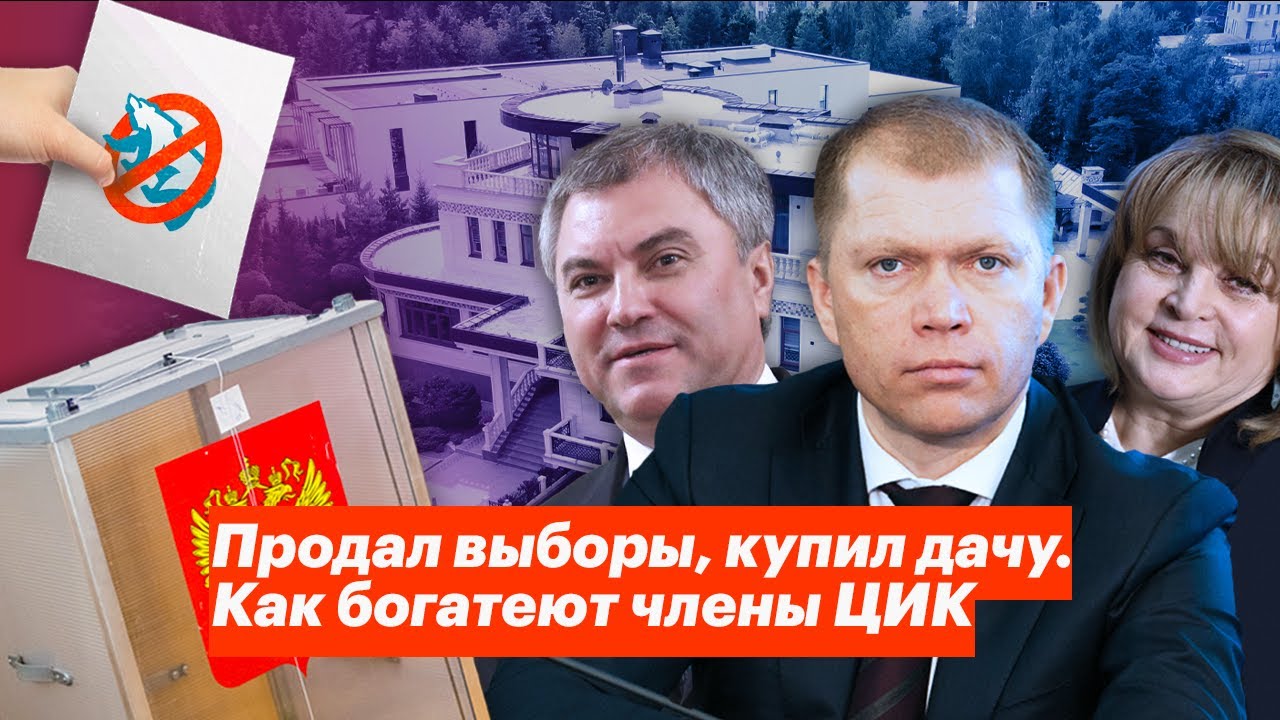
Take a United Russia candidate. His real approval rating is, let’s say, around 20 percent—roughly speaking, those are the people who genuinely support Putin’s party. Then there are those under administrative pressure—public-sector employees, security personnel, and others who are forced to vote for United Russia under threat of losing their jobs.
But to win, you need more. Ideally, over 50 percent, with a comfortable margin. So where do you get the other 30? From all over, little by little. That is the trick: you cannot get them all in one place. You cannot stuff enough ballots to add 30 percent—they would notice. Simply inventing the numbers is risky too, because there are observers and representatives of other parties at polling stations. You cannot distort the result that dramatically in one go. So the missing 30 percent is assembled from different sources, bit by bit.
A busload of carousel voters will show up here. The same people will be driven from one polling station to another so they can vote multiple times. Or there is home voting—very convenient. Someone goes around apartment buildings with a ballot box and comes back with a nice thick stack of ballots for United Russia. That adds a little more. Social workers will persuade elderly women and bring them gifts. Utility workers will hang posters for the United Russia candidate Putin wants, while tearing down his opponents’ posters and removing their leaflets from mailboxes. Local newspapers will suddenly and entirely free of charge start singing the candidate’s praises in unison. That helps too. Then there is electronic voting—intimidate an employee, stand behind them, and watch the screen while they vote. There are another couple of percentage points. And of course, we should not forget the classic lawlessness either: barring opposition candidates, fielding spoiler candidates with the same surname, removing people from the ballot, and so on.
As we can see, there are many methods, they are varied, and different people and agencies are responsible for them. But at the head of this entire scheme is, without question, the CEC—the Central Election Commission. These are the people who organize elections, count the results, and bear overall responsibility for them. The CEC is the top authority. Without its sanction, a candidate cannot be removed; without its consent, results cannot be falsified. It has all the power needed to stop and prevent any manipulation, from shameless ballot stuffing to petty cheating. But it does not do that, and that is precisely the main purpose of its existence: to cover up violations, ignore them, and justify them. And in other cases, it simply carries out outright lawlessness with a straight face: barring strong candidates, switching off cameras at polling stations, and organizing week-long voting on tree stumps so that Putin’s presidential term limits could conveniently be reset to zero.
But despite the fact that the CEC is a key tool for keeping Putin in power, it remains fairly inconspicuous in itself. Here is an image you may have seen on television or online. This is a CEC meeting.
You will of course recognize Pamfilova, our so-called martyr. She is sitting at the center of the table. But the others—no one knows who they are, neither by face nor by name. And yet each of them is a very important cog in Putin’s system. They do serious work—and, importantly, criminal work. They carry Putin’s United Russia on their backs. And naturally, the rewards match their contribution. The president is very pleased with them.
Take, for example, this man sitting to Pamfilova’s right: Nikolai Bulaev, her chief deputy.
A very important gentleman—we did an investigation about him a couple of years ago. He moved to Moscow for work from Ryazan, where he had been a local United Russia politician, and he arrived with virtually nothing: some real estate in the Ryazan region and an inexpensive car. Here is his 2006 asset declaration:
Now let’s open the latest one:
Isn’t it a miracle! The 104 sq. m apartment is in a beautiful building on Starovolynskaya Street; Bulaev received it from the Presidential Property Management Department. Another 155 sq. m is a brand-new apartment, also provided by the city of Moscow, right in the center in a new building.
A Lexus, an Audi A6, an Audi A7, an ATV, a snowmobile, a motorcycle. And this does not even include his adult daughter’s apartment—another 133 sq. m in the neighboring building next to her parents. Not bad for just 10 to 13 years.
Let’s move further along our table of guardians of honest elections. Boris Safarovich Ebzeev. We also did an investigation about him. A very imposing gentleman.
The chief brain of the CEC, a lawyer and guardian of the law. Ebzeev surprised us greatly. Or rather, his grandson did. At the age of four, still a preschooler, he bought—yes, actually bought—a huge two-story apartment in an elite residential building near Ostozhenka in Moscow. It is 274 sq. m, with a market value of half a billion rubles. At age seven, the CEC member’s grandson acquired a house on Rublyovka (an ultra-elite residential area outside Moscow).
Today, however, we are going to meet Boris Safarovich’s neighbor on this panel—there he is, to the right: Anton Lopatin.
He has been a CEC member for ten years. He is the person responsible for the State Automated System “Vybory” (“Elections”)—the system where all official protocols are entered—and now also for electronic voting.
To understand where he came from and why he interests us, we need a brief digression—into the biography and habits of our hero’s main patron, the man to whom he owes everything: Vyacheslav Volodin.
Volodin has a truly remarkable talent for placing absolutely all of his friends and relatives into government jobs. It is like Putin and his St. Petersburg circle, but the Saratov version. All you have to do is trace the careers of people who have ever worked as Volodin’s aides or secretaries, and everything becomes clear.
Take Nikolai Pankov, for example.
He worked as Volodin’s aide both in Saratov and in the State Duma in the early 2000s. Then he became a lawmaker himself, has been an MP for 14 years, and is running again now. Volodin’s most loyal squire—the two are inseparable.
Now MP Pankov has his own aide—Volodin’s 28-year-old nephew, Yevgeny Barabanov. His mother, Volodin’s sister-in-law, is also in public service—she has been placed in the staff of the Saratov election commission.
Another assistant is Olga Batalina.
She worked as Volodin’s assistant in Saratov. She went on to become both a State Duma deputy and one of the main faces of Volodin’s project, the All-Russia People’s Front. And there too, in the ONF, Volodin’s wife’s sister, Nina Polyakina, born in 1991, has been very conveniently placed. She is in charge of paperwork there.
Another of Volodin’s aides in the State Duma was Ivan Lobanov.
Volodin was even his academic supervisor. In 2017, Lobanov was appointed rector of SUM, the State University of Management in Moscow. And as his deputy, a vice-rector, Lobanov appointed Volodin’s eldest daughter, Svetlana. She became a vice-rector at the age of 28—a vice-rector of a major Moscow university—with a salary of 436,000 rubles.
And people say young scholars are not appreciated in Russia.
Lobanov has since been promoted again—he now heads the Plekhanov Russian University of Economics. Here is his photo on the rectorate’s website, and to the side—notice this—his deputies.
But we do not see Volodin’s daughter here. Has the deputy speaker really stopped using his position to place his relatives in cushy jobs? Of course not. She has simply been hidden. Here is the official list of vice-rectors of Plekhanov University; by law, their incomes must be disclosed. There are seven of them, including Svetlana Vyacheslavovna Volodina.
But the website shows only six people. You will not find Vice-Rector Volodina there—she is a secret vice-rector. And really, why should any of us, or the students, know who their vice-rector is? That would just be unnecessary information.
That is the end of our digression; by now, you have probably understood the principle. Volodin himself latched onto the state budget thirty years ago, and in parallel he has been securing government jobs and positions for everyone he likes—placing some in parliament, some in the party, some in the ONF—so that he has his own people everywhere.
And our main character today, Anton Lopatin, entered Volodin’s circle of favorites in exactly the same way.
He met Volodin in the late 1990s in the Fatherland party. He then became Volodin’s aide in the State Duma, and later the head of his secretariat. In 2010, Volodin moved into government, but instead of taking his aide Lopatin with him, he placed him somewhere warmer and closer to his heart: in his own business, which Volodin secretly runs alongside his public office. In 2009, Volodin’s 73-year-old mother, a schoolteacher from Saratov, became the owner of a company called Invest Holding. Soon afterward, secretary Anton Lopatin became the firm’s director. Volodin’s personal assets and real estate were registered to this company, including a 370 sq. m penthouse in Moscow and a mansion in Saratov. And as we found in our recent investigation, Invest Holding owned buildings, workshops, and land rights in Tekstilshchiki, on the grounds of the former Moscow Fat Processing Plant. In 2019, all of this was sold to developers, and the Volodin family grew richer by 1.5 billion rubles.
In 2011, Lopatin was replaced as director of Invest Holding by Volodin’s future wife, Yana Polyakina.
Lopatin himself was sent to where he is now—the CEC. There he does exactly what a crook from the CEC is supposed to do. For example, in Saratov, Volodin’s hometown, an election commission member caught a carousel voter red-handed—a man carrying a whole stack of ballots already marked for United Russia. Lopatin went there to look into it, and he did indeed look into it. He said that nothing had been proven and that, in any case, the ballot stuffing had not affected the election result. So really, what is there to worry about?
Over many years of working with Volodin, Lopatin learned the most important lesson from his boss: that the budget—taxpayers’ money—is the best source of personal enrichment. That simply working in public service for a salary alone is somehow too small-time. There is always a way to make a little extra on the side—the main thing is to do it discreetly.
And even in his corrupt schemes, Lopatin follows his patron’s rules: put everything in relatives’ names, preferably relatives with a different surname, and pretend you have nothing to do with it. Let us look at Lopatin’s declaration:
Everything looks very modest. He lives on his salary; there are no outrageous apartments, country houses, or airplanes. Officially, like Volodin, he has no wife either. But perhaps he used to? Here an old phone directory and an ancient traffic police database come in handy. We notice that a woman with the same surname shares the same phone number as Lopatin: Natalia Lopatina.
She was registered at an apartment on Vatutina Street. The apartment’s area is 74.2 sq. m.
We compare this with Lopatin’s old declaration and see that his daughter once lived in an apartment of exactly the same size.
So Natalia Lopatina is definitely the mother of our CEC member’s child, and most likely his former wife. And this apartment belongs to a certain Maria Vasilyevna Lopukhova.
That, accordingly, is Lopatin’s former wife’s mother—in other words, his mother-in-law. This is enough for us to put together a simple family tree, which we need in order to continue this investigation.
We found several companies linked to 71-year-old Maria Vasilyevna Lopukhova. Let us not judge too quickly—perhaps, in theory, after retiring she decided to start some business of her own. Maybe she opened a café, or a bookstore, or some other small business for a peaceful old age. But the first thing we see is... some kind of Civil Initiatives Foundation.
Here is their old website, the public portal “I Am a Citizen,” and a talk show with Tesak (the alias of Russian neo-Nazi figure Maxim Martsinkevich).
A rather strange occupation for a pensioner, isn’t it? It is also interesting to look at the other founders of this foundation: Volodin’s wife and blogger Ruslan Ostashko, who now makes a living by conducting “investigations” and trying to prove Yulia Navalnaya’s nonexistent German citizenship.
We will call this foundation merely a warning sign, because the problem with CEC member Lopatin’s mother-in-law is, of course, not primarily in the public or political sphere. Here is another of her companies—Mediaprofi. Among its former founders, once again, are both that useless blogger and Volodin’s wife.
For many years in a row, this company has been making money from government contracts—with the CEC.
For the Central Election Commission, they provide services to ensure the functioning of email tools within the State Automated System “Vybory.” That is the very system for which Lopatin is officially responsible at the CEC. The son-in-law is in charge, and the mother-in-law makes money from it. Here are the contracts concluded in 2017, 2018, and 2019.
But that is not all. There is also a company called Information Systems JSC. It too earns money from contracts with the CEC or its subsidiary companies. In total, we were able to find such contracts worth 150 million rubles.
For nearly 5 million rubles a year, they catalog and store the software documentation, code, and certificates for the State Automated System “Vybory.” The owners of this company are concealed, but if you study the company documents carefully, you come across a familiar surname: shareholder Maria Vasilyevna Lopukhova, Lopatin’s mother-in-law from the CEC:
This situation looks as if it were copied straight from a textbook—it is a classic example of a conflict of interest. Lopatin cannot be working at the CEC while members of his family are making money from CEC contracts. Especially since Lopatin is specifically responsible for the technical side of the State Automated System “Vybory.” In other words, he is literally the one deciding what the CEC needs to do with the system, what to procure, and so on. An investigation should begin right now, this very minute, and Volodin’s crony Lopatin should be immediately removed from all CEC infrastructure. And criminal proceedings should be opened.
And while law enforcement races toward the CEC with sirens blaring and lights flashing, let us head somewhere else.
For once, let us go not to Rublyovka, but to an area no less prestigious: the Kuntsevo-9 gated cottage community. This is also in western Moscow, but much more central, closer to the city, just beyond the MKAD ring road. Nearby are the long-forgotten Skolkovo center and the famous dacha of former Deputy Prime Minister Igor Shuvalov.
Right in front of us, on a 0.5-hectare (5,000 sq. m) plot, stands the country estate of Central Election Commission member Anton Lopatin. Formally, it is the mansion of his mother, 68-year-old pensioner Vita Nikolaevna Lopatina.
The main house has an area of 916 sq. m. It has four floors, including a basement level. You can find listings for houses built to the same design and use them to get an idea of what is inside. On the top floor there is a library. Inside there is a large fireplace hall, six bedrooms, seven bathrooms, a kitchen-dining room, a study, a private wine cellar, a bathhouse complex, and even an elevator.
At the entrance to the property there are wrought-iron gates, and opposite them stands nothing less than a guard house. That is exactly how it is listed in the documents—a guard house. Its area is 102 sq. m. Apparently, security guards sit there around the clock, protecting pensioner Vita Lopatina, in whose name this country residence is registered—so that no crooks make off with her pension.
There is also a large one-story guest house on the property, measuring 284 sq. m (on the right in the photo). Presumably, Lopatin’s former mother-in-law can stay there too—the very woman thanks to whose government contracts the Lopatin family became so wonderfully enriched.
The owner of this country house outside Moscow has no business of her own, but she does have a pension of 21,000 rubles and a son who is ready to carry out any Putin whim at the Central Election Commission. To estimate how much such a property is worth, we can look at existing listings, and there are plenty of them. Nearby we find a much more modest house on a plot three times smaller—it is for sale for 220 million rubles.
There is also a much more substantial property nearby, with a house and garden twice as large—but the price is over 1 billion rubles.
Even by the most conservative estimate, our pensioner Lopatina’s country estate cannot possibly be worth less than 450 million rubles today.
And this is not his only real estate. Just a 15-minute drive from the country house, Lopatin has an apartment in the Nezhinsky Kovcheg residential complex. It is a wonderful location, right next to the Setun River Valley nature reserve.
This living space, 107.8 sq. m, was officially declared by the CEC member. But there was no need to declare another neighboring apartment, because once again it is registered to his pensioner mother. Altogether, the Lopatins own more than 200 sq. m in Nezhinsky Kovcheg, now worth around 75 million rubles.
Is there any honest way for an official, a CEC member, to end up owning half a billion rubles’ worth of Moscow real estate? No. But if honest people worked at the Central Election Commission, you and I would be living in a completely different country. A country where legislative bodies are made up of people whom Russians actually support. Where some vile United Russia politician or propagandist is not dragged into the State Duma by sheer force, but instead is sent packing by voters. And of course, a country where it would be impossible to rewrite the constitution through a sham referendum and reset the term limits of a president who has already been in power for twenty years—and start counting those terms all over again.
At the beginning, we said that a United Russia candidate’s victory is secured by thousands of people, by an entire complex and multifaceted system of fraud—each person pulling in the percentage needed for victory in their own way. In reality, that is both fairly complicated and fairly dangerous—after all, they are committing crimes. But you and I are in a much simpler and more pleasant situation. We have Smart Voting. It is an entirely legal and safe way to make sure a United Russia candidate loses, despite all the efforts of the CEC members. To win in a single-member district, a United Russia candidate only needs to get more votes than the other contenders. United Russia’s rating right now, even according to the state-controlled pollster VTsIOM, is 27 percent. Here are the ratings of the other parties. If we simply agree to vote not in a scattered way, but for the single strongest opponent of the United Russia candidate, that is it—no carousel voting or home voting will help them anymore. The United Russia candidate will be far behind.
To find out whom to vote for—which candidate has the best chance of defeating the United Russia nominee—you need to register on the Smart Voting website, leave your email address there, and receive the recommendation directly in your inbox. Or download the app (for iOS and for Android); there is no need to register there or leave any personal data, and on election day we will send you a reminder—find your polling station by address, remember who the Smart Voting candidate is, and go vote. Do not forget: the Smart Voting website, like all websites connected to Navalny, will definitely be blocked. Do not leave it until the last minute—right now, make sure you are prepared and ready to take on United Russia this September.
Freedom for Alexei Navalny.