A year and a half ago, our colleague Ruslan Shaveddinov was abducted. On December 23, 2019, the electricity in his apartment went out. His mobile phone stopped working: the carrier suddenly suspended service—no signal, that was it. The door was sawn open, security forces stormed into the apartment, turned everything upside down, and seized his equipment. Then they put him in handcuffs, took him out, and escorted him to the airport.
Next came a regular commercial flight to Arkhangelsk—handcuffed and under the watch of police and military personnel. Then he was flown on a special flight to the Arctic, to the Novaya Zemlya archipelago. Ruslan spent a year on Novaya Zemlya—serving in the army.
Or rather, it was only called “service.” In reality, it was something quite different.
A special minder was assigned to Ruslan immediately—a contract serviceman who filmed his every move. Ruslan ate, slept, sat through classes—and there was always a man with a camera beside him. Later, this footage would turn up in Kremlin-aligned media, accompanied by stories about what a wonderful time Ruslan was having in the Arctic.
Every effort was focused on making sure Shaveddinov could not call anyone. That he wouldn’t somehow get hold of an iPhone on an Arctic island and send some criminal message. Soldiers were punished for speaking with him. Phones were confiscated from other people and even broken so that under no circumstances could anyone let him make a call. Then they started jamming mobile service across the entire base.
Soon Ruslan was sent to live in a metal barrel-like shelter 300 kilometers (about 186 miles) from the nearest settlement. There was an improvised kitchen for preparing canned food and a sleeping area with a portrait of Putin and an icon on the wall. To get water, they had to melt snow. Going outside at night was forbidden—polar bears roamed around. There was, of course, no communication there at all.
This format of “service” was invented specifically for him. In reality, it was no service at all—it was arrest and exile. For working at the Anti-Corruption Foundation. For working with Navalny, making videos, campaigning. Shaveddinov was a political enemy, which meant that for him the army was not “service to the motherland,” but a means of revenge.
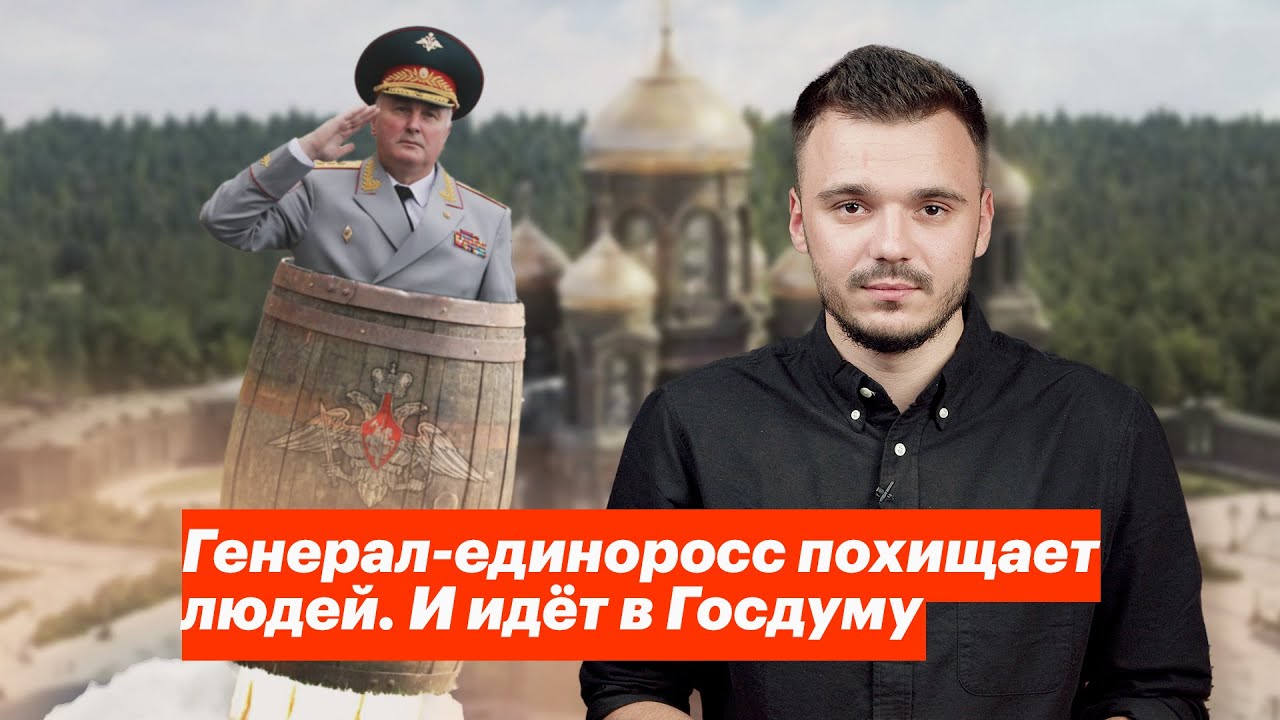
The command on Novaya Zemlya told him outright that his situation really was special. There was a man who called regularly and gave orders about him. A big boss with a general’s stars, who instead of attending to a general’s duties was busy making Private Shaveddinov’s life worse. That man’s name was Andrei Valeryevich Kartapolov.
A deputy defense minister. The deputy responsible for patriotic education in the armed forces. A political commissar. And it was he who oversaw this wild special operation in a barrel. Six months later, when another of our colleagues, Artyom Ionov, was abducted in exactly the same way and sent off to the army in Chukotka, he was told the same thing: sorry, nothing personal, Colonel General Kartapolov is supervising this and asking for reports on your whereabouts.
We are not telling you all this for no reason. Deputy Defense Minister Kartapolov is heading to the State Duma (the lower house of Russia’s parliament). His name is on United Russia’s list of candidates in Moscow.
Formally, Kartapolov is the head of the Main Military-Political Directorate, as stated here. This directorate is responsible for military-patriotic education. It oversees the moral and ideological component of the Russian army. The directorate is actually new—it has existed for only three years. But in essence it is a reincarnation of the famous Soviet military-political administration, which handled political propaganda and party agitation in the Soviet Army.
Now the ideology is that Russia is surrounded by enemies, that the whole world has declared war on Russia. Therefore, people must build churches, pray, venerate relics, and love Putin very, very much. These are the “traditional values” Kartapolov is there to enforce.
Remember, for example, when Putin wrote that article about Ukraine? He wrote it, people laughed, and moved on. But now soldiers are made to study it and take notes on it during political education classes. They are seated like schoolchildren and ordered to memorize the leader’s words.
Or worse. According to Kartapolov himself, to teach soldiers some sense, they show them Nikita Mikhalkov’s TV program Besogon. They all watch the episodes together and then analyze them. And apparently, it works.
Kartapolov is one of the main overseers of the construction of the Armed Forces Cathedral—you have surely seen it.
In the icon cases (where saints’ relics are usually kept), there are fragments of parachute cord. Or a piece of an ANT-2 aircraft. There are grilles made from war trophies, and in the museum you can see Hitler’s cap.
There is a main icon there, donated by Putin. He paid 14 million rubles from his “personal funds”—nearly two years’ salary. He did not skimp. It was painted on boards from a gun carriage dating back to the Battle of Poltava. The boards are fastened together with rifle stocks from soldiers who fought in the Great Patriotic War (the Soviet term for World War II).
After the icon was painted, Kartapolov spent another year and a half flying it around military garrisons from Crimea to Vladivostok and admiring it. It was transported on a Defense Ministry plane, with ceremonial receptions at every airport. In local churches, crowds of soldiers and children from Yunarmiya were herded in so they could touch Putin’s icon. It is frightening to imagine how much this tour cost the Defense Ministry. Especially since the only stated goal was for the icon to return to the cathedral “prayed over.”
You have probably also heard about the mosaic panels. The ones with Putin. Patrushev. Bortnikov. Lavrov and Shoigu.
There were ones with Stalin too. Everyone was very surprised at the time: what does a church have to do with Stalin?
In response, our hero today, Kartapolov, said that “Stalin is our supreme commander-in-chief,” who “bore the full burden of the war,” and that Stalin even brought religion back. And all those who are unhappy with Stalin, he said, are acting on instructions from certain gentlemen abroad.
And his main project is Yunarmiya (the Young Army). It is unpleasant to draw parallels, but it is a militarized movement for children aged 8 to 18.
On their website, against a backdrop of firing tanks and military aircraft, they say they teach kindness, compassion, and love. Formally, the movement is voluntary, but in practice it is compulsory. Here, for example, is a letter demanding that Kartapolov funnel all officers’ children into Yunarmiya. Whether you want to or not, you join. Dad’s boss ordered it. The same goes for schools. Under various pretexts and through various tricks, schoolchildren are forced to join. So they can listen to deputies and priests telling them about holy war. Yunarmiya already has nearly a million schoolchildren. They are brainwashed from the age of eight, and the organizers rejoice: children with weapons—how wonderful, how patriotic!
And if Colonel General Kartapolov has taken it upon himself to raise a million other people’s children, then we cannot help asking the obvious question: how does he raise his own?
It is very hard to find any information at all about Kartapolov himself. In fact, it is very hard to find any information at all about anyone in the Defense Ministry who holds a senior position. Dollar millionaire Sergei Shoigu, who really dislikes people learning how he, his children, and his mistresses live, decided that ordinary Russians have no business knowing how he and his generals live. So by 2021, roughly everything had been classified. Procurement? Classified. Suppliers? Classified. Names in the state property register? Classified.
For example, this is the country house of Shoigu’s deputy, General Tsalikov.
This house and huge plot on Rublyovka (Moscow’s elite suburban area) are worth more than he earned in his entire life. We identified this dacha by the square footage listed in Tsalikov’s declaration. In the property extract, instead of his name, it says: Russian Federation. Oh, so you learned to identify properties by square footage, they thought? So now they have classified the declarations themselves as well. Now Shoigu’s deputies, including our hero today, political commissar Kartapolov, simply do not publicly report their income. Their names have been erased from the general list of declarations. For this year and all previous years.
But of course that will not stop us. Andrei Kartapolov lives here, in an elite building in the very center of Moscow, on Ruzheyny Lane.
The Defense Ministry gave him this 112-square-meter apartment in 2016.
But he is officially registered at a different address, on Znamenka Street.
That is the Defense Ministry building. Hundreds of military personnel and their families are registered there, and at one point his daughter, Varvara Andreevna Kartapolova, was registered there as well. Date of birth: April 18, 1987.
Because of her age, Varvara obviously missed the chance to join Yunarmiya, but it is still interesting to see what exactly she does.
We take her taxpayer identification number, assigned to her in 2003 under her old surname. And we see that her name has changed—to Varvara Andreevna Guryanova.
The first thing we see is that she is a professional dog breeder.
She has her own kennel in Rostov-on-Don, where they breed working dogs—shepherds and Newfoundlands. On Instagram, Varvara calls herself a crazy dog lover—and it is true, her feed is nothing but dogs, shows, and trophies.
We check her phone number; it is listed on the kennel’s website. And in the classifieds too—it is all dogs, dogs, dogs. Well, and she is also selling an aquarium.
At first glance, it all looks fairly harmless—she is just living an ordinary life in Rostov-on-Don. Not racing around the capital in a Maybach, but actually breeding and selling puppies. An unexpectedly modest occupation for a general’s daughter.
But… in our investigations, there is always a “but” at this point. In July 2019, our breeder’s professional interests changed sharply and unexpectedly. She became a co-owner of a machine-building plant located a thousand kilometers from Rostov and her kennel!
And not just any plant. Kartapolov’s daughter owns a stake in Brasovsky Machine-Building Plant LLC. Very little is written about this plant online, and if you look at their website, it becomes clear why.
In addition to metal structures, pipeline fittings, and various valves, the plant also manufactures, for example, special containers for ammunition. Hermetically sealed packaging for ammunition containing toxic substances—that is, containers for transporting chemical weapons. If you think they may be exaggerating, take a look—they officially hold a license from the FSB and the Defense Ministry to work with state secrets.
And it gets worse. Brasovsky Machine-Building Plant, in which the daughter of a deputy defense minister owns a stake, also serves the Defense Ministry.
They design and manufacture equipment for special fortification facilities. These are secret permanent Defense Ministry sites—various bunkers, underground command posts, communications hubs, shelters, and ammunition storage facilities. Ultra-secret, ultra-reinforced sites that can withstand anything: earthquakes, attacks, even missile strikes.
And what is separately amusing is that despite all this secrecy, they write right on the plant’s website: we made this valve here, that device there. Project codename “Deposit,” codename “Pointer,” codename “Knowledge.”
Right now, by the way, Brasovsky Machine-Building Plant is still carrying out Defense Ministry orders, building something for Strategic Missile Forces facilities.
And this is where it becomes awkward and unpleasant. Kartapolov is literally the man teaching us how to love the motherland. He is teaching nearly a million Yunarmiya children his own set of values and how to bow before relics. He lectures about patriotism and love for the homeland. And meanwhile, he has set his own child up to make money from government contracts tied to that very homeland.
Now he may end up in the State Duma, where a cushy chair as head of the defense committee has been prepared for him, and he will go on holding icons in one hand and stealing with the other.
Whether he gets into the State Duma or not depends on you. The fewer Muscovites vote for United Russia, the greater the chance that Kartapolov will not be elected. Let us use that chance: come out and vote against United Russia. Join Smart Voting. Download the app (in the App Store or Google Play). No registration is required, and you do not need to leave any personal data—just remember on voting day to check who the Smart Voting candidate is in your district, and vote.
Freedom for Alexei Navalny.