
If Moscow were to erect a monument to its greatest corrupt official, the living embodiment of lies, theft, kickbacks, and outrageous, brazen, shameless wealth, it would be a monument to our hero today.
It would have to stand in the central square, in the most prominent spot, because the man has earned it. It would need tons of gold, the whole area around it dug up, maybe a dome too? Or a giant obelisk? And a shopping mall underneath the monument. Because he is the true symbol of corruption. Ask any Muscovite on the street which living official has stolen the most from the city, and we are sure they will say: Resin.
Twelve years ago, in 2009, this issue of the newspaper *Vedomosti* came out.
It is hard to imagine now, but back then Vedomosti ran a full-page spread of officials and their watches. Journalists found a Breguet worth $32,000 on Medvedev, a Patek Philippe worth $29,000 on Naryshkin, another Breguet on Miller for $100,000, and one worth $300,000 on Ramzan Kadyrov. But the top spot went to Vladimir Resin, with his famous—legendary, even—$1 million watch. Many people probably did not even know watches costing $1 million existed until then. But there it was, on the wrist of the capital’s chief builder, Luzhkov’s deputy, and Moscow’s chief foreman, as he called himself.
By the time the watch scandal broke, Resin already seemed like some ancient artifact inherited from the collapse of the Soviet Union. He was already 74 then. He was a man from the past, a legendary crook who seemed to be kept around for past services rendered.
And there was no doubt that after Luzhkov’s scandalous dismissal—he was fired for an “outrageously high level of corruption”—his accomplice Resin had no chance of hanging on. He would be lucky if his advanced age kept him out of prison. But 12 years have passed. Resin is 85. And he is running for the State Duma. He wants to become a deputy from Moscow, the city he personally defaced and robbed.
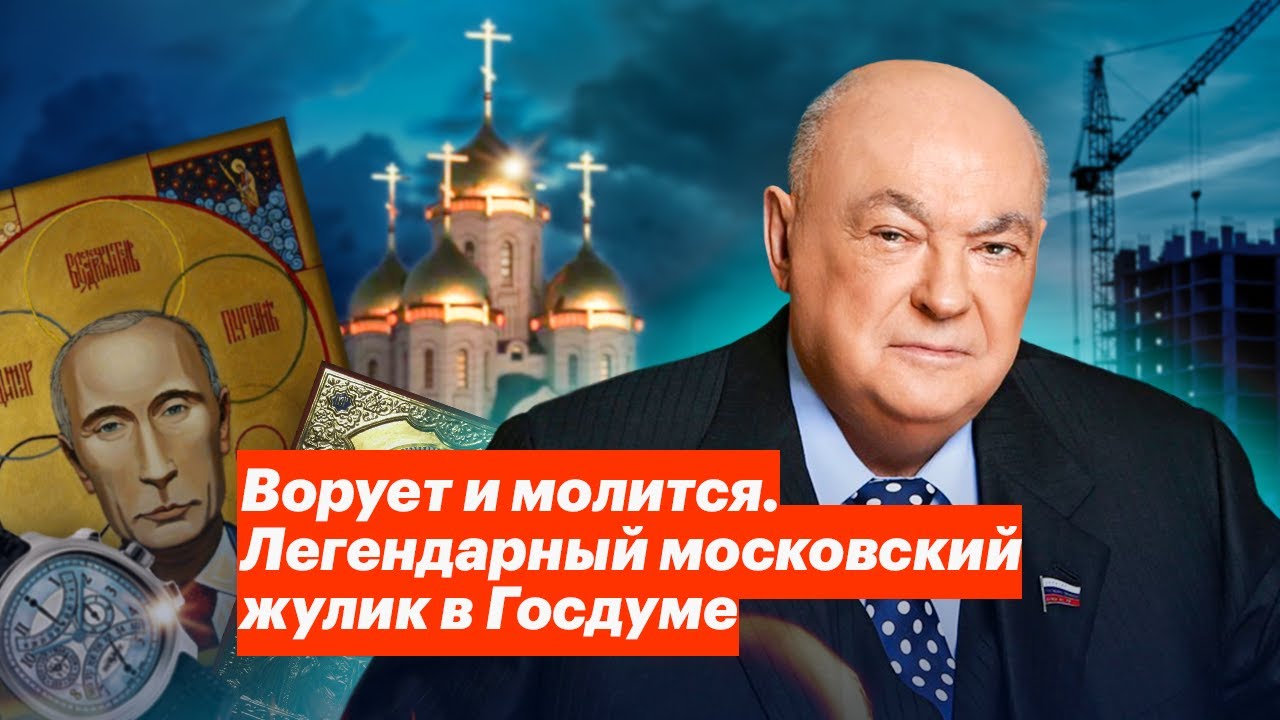
He steals and he prays. That is literally ALL Vladimir Iosifovich Resin does in his post as a State Duma deputy. He does not speak from the podium. He does not draft laws or make political statements. He does not campaign, give interviews, or ask Muscovites to vote for him. He simply steals and prays. And he wants to keep doing it until his last breath.
Vladimir Resin began working as a construction official 60 years ago. Just imagine that. Resin was 17 when Stalin died. Born into a nomenklatura family and married to the daughter of the administrative chief of the Council of People’s Commissars—that is, effectively a minister, by today’s standards—Resin had everything needed for a perfect career in the USSR. He worked at Glavmosstroy and Glavmosinzhstroy, Soviet construction agencies, and later headed Moscow’s construction complex.
He was friends with Brezhnev’s daughter. He helped implement Stalin’s 1935 master plan for Moscow. He took part in building the tunnel under New Arbat, worked on the BAM railway (the Baikal-Amur Mainline), built the Yasenevo district, and sports facilities for the 1980 Moscow Olympics.
He considers the collapse of the USSR a tragedy, yet he came through perestroika just fine, was close to Yeltsin, and became a symbol of Luzhkov-era construction in the 1990s. The $1 billion Cathedral of Christ the Saviour—with car washes and VIP rooms—the 100-meter monument to Peter the Great that is impossible to look at without tears: all of that is Resin.
Victory Park, with an even bigger obelisk and some kind of moth-like sculpture—Resin is proud of that too.
As it turned out, Luzhkov himself sketched the composition on a scrap of paper, and Zurab Tsereteli filled in the rest. Manezhnaya Square, dug up—by his own account—out of fear of protests, so that instead of a square there are now domes with an entertainment center underneath: thanks to Resin for that too. Demolished, permanently lost, or simply mutilated historic buildings and architectural landmarks—that is the Moscow Resin built for us.
He fit into every era. In the 1970s there was a saying about Soviet commissar Mikoyan: “from Ilyich to Ilyich without a heart attack or paralysis” (meaning from Lenin to Brezhnev, both of whom were called Ilyich). It meant that Mikoyan somehow stayed in power under both Lenin and Brezhnev. He survived, adapted, and avoided repression. From Lenin to Brezhnev was about 50 years; it seemed like eternity. Well, Resin outdid him. He has been an official for 60 years. Khrushchev, Brezhnev, Andropov, Chernenko, Gorbachev, Yeltsin, Putin, and then Putin again and again—and through all that time, Vladimir Iosifovich Resin has remained an official.
How did he manage it? Very simply: by having no views of his own and by groveling before his superiors.
Resin’s personal financial heyday began under Luzhkov. In the 1990s and early 2000s, when Resin was deputy mayor and headed Moscow’s construction complex, he turned it into the perfect grazing ground for corrupt officials. He followed one core principle: steal yourself, but make sure your boss steals even more. That is how his boss’s wife, Yelena Baturina, by 2007 controlled more than 20% of Moscow’s development market. And she stole so much that 15 years later she was still one of Russia’s richest women.
Resin is unique, a genuine museum piece. While wearing a $1 million watch on his wrist, he headed an anti-corruption committee. When asked, “Vladimir Iosifovich, where did you get a $1 million watch?” he simply said it was all “fabrication, lies, and slander.” And he kept wearing it as if nothing had happened.
Like Don Corleone, barely moving his tongue, the head of the anti-corruption committee offered to sell his famous $1 million watch so he could send the money to an orphanage. Though for some reason he would keep $50,000 for himself.
Resin’s deputy on that anti-corruption committee was Alexander Kosovan, head of the city construction department. This year alone, his family company received state contracts worth 12 billion rubles — making them the biggest beneficiaries of Moscow’s renovation program. All the Moscow developers who landed multibillion-ruble renovation contracts are connected to Resin in one way or another. Some worked under him at city hall, others served as his advisers at different times, and still others—like the head of the company Krost—endlessly praise Resin and call him their mentor.
There is no need to go that far or burden ourselves with analyzing public procurement. Developer Sergei Polonsky personally said that he paid Resin a bribe. He filed a statement with the Prosecutor General’s Office admitting: I, so-and-so, gave Vladimir Resin a bribe to re-register development rights in my company’s name. I was asked for a bribe in the form of a giant penthouse worth $10 million. I was told to register it in the name of deputy Leonid Slutsky, whom people call Resin’s illegitimate son, and... I did it. And indeed, we checked: here is the penthouse. Here is the property record. And here is the owner—the wife of deputy Slutsky.
Did anything happen to Resin after that? No. It all rolled off him like water off a duck’s back. On television, Putin fights corruption, but in reality this is what happens: Moscow’s second most important official openly takes bribes for three decades—sometimes in watches, sometimes in penthouses—and nothing happens to him.
Resin should have gone to prison in the late 1990s. Then again in the mid-2000s. After the watch scandal, and after Luzhkov’s dismissal. But instead, in 2010, this 74-year-old mummy of a Soviet builder was dragged into the United Russia party. Why? He himself does not know. For the same reason, perhaps, that he still keeps his Communist Party registration card in his desk drawer. And his party membership card at home. Or for the same reason he once served as the face of Luzhkov’s party, “Our Home Is Russia.”
Times changed, and Resin became a Putin-era United Russia man. He fit in seamlessly—and for the long haul. Even though Resin had promised to leave along with Luzhkov, he quickly changed sides, adapted, and became deputy to the new mayor, Sobyanin. Then he was shipped off to the State Duma—while continuing to advise Sobyanin on a voluntary basis—and there he was given a new honorary role: the Patriarch’s best friend.
It is a rather unexpected friendship between two men seemingly united only by a love of expensive watches. Resin repeatedly called himself an atheist and in 2010 said that he was not religious and had not even been baptized. But a year later he had dropped all other plans and begun praying to God with great zeal. If you look at the news reports about Resin over the last 10 years of his time as a deputy, you will find nothing but endless churches. Churches, icons, priests, prayers.
He became obsessed with building churches everywhere in Moscow. Two hundred new churches, one in every district of the city. One hundred of them are already completed. You can run the experiment yourself. Search for news about Resin over the last five years—the entire current parliamentary term. You will find 126 stories about Resin visiting, opening, or saying something about a church. Thirty-two stories about construction. And THREE items about his work in the State Duma. THREE.
When does Resin actually work as a deputy? He is constantly busy with church matters. More than that—even his office is not in the State Duma, but in Nikitsky Lane, in the building of the urban development policy department.
And we are being asked to elect him to another term in the State Duma, so he can continue not showing up for work and building churches.
Moscow’s chief developer, of course, could not leave himself and his family without luxury real estate. A man who spent virtually his entire life in public service built his family nest on Rublyovka (Moscow’s elite suburban enclave). Here it is.
We head to the Landscape cottage community in the village of Zhukovka. This plot of land measuring 110 sotkas (1,2)—that is, more than 1 hectare—belongs to Vladimir Resin. There is also a residential house here with an area of 1,630 square meters.
There is also a guard house here—177 square meters. A truly luxurious and sprawling Rublyovka estate.
Resin is first listed as the owner of this land in 2001.
It is entirely possible that he bought it even earlier. Resin has been an official for so long that when he already had the opportunity to steal enough for a Rublyovka estate, Russia did not even have a proper digital property registry. But we can estimate what the estate is worth today. Nearby there is a fully comparable property. Both the house and the plot are half the size, and it is priced at 550 million rubles. Which means Resin’s plot and house are worth about 1.1 billion rubles today.
Vladimir Resin has a wife, Marta Chadaeva. She turns 86 in October. At the same time the Rublyovka estate was being registered, Marta Yakovlevna Chadaeva became the owner of an apartment in central Moscow, at 3 Sechenovsky Lane.
It is in Khamovniki, in central Moscow, not far from the Kremlin and the Cathedral of Christ the Saviour. The apartment was purchased at the end of 2000, and its area is 168 square meters.
The building is small, with only 7 or 8 apartments. A similar apartment in this building costs 100 million rubles.
An interesting observation about the morals of United Russia officials. You have a 1,500-square-meter country house and a 170-square-meter apartment. You would think: what more could you possibly need—stop already! But in 2008, the Resin family declared themselves in need and received an apartment from the city of Moscow in an official residential building on Osenyaya Street. They registered the new home in the name of the same Marta Yakovlevna Chadaeva, Resin’s wife. They sold that apartment in 2019.
But we are not done with Marta Yakovlevna yet. For her 80th birthday, she decided to treat herself to a new garden plot. It is located here, also on Rublyovka, a beautiful place not far from Moscow, a small settlement in a forest clearing.
Resin’s wife’s country house stands directly between the homes of Luzhkov’s wife Yelena Baturina and Roman Rotenberg, the son of Putin ally Boris Rotenberg. The plot is 23 sotkas, and the house is 437 square meters. This dacha is worth 200 million rubles.
Resin and Chadaeva have one child, a daughter named Yekaterina Demidova. She too, naturally, owns expensive property. In 2009 she bought a 250-square-meter apartment in the White Swan residential complex on Michurinsky Prospekt. The value of Resin’s daughter’s apartment in that building is 143.5 million rubles.
And her husband—Resin’s son-in-law—has a 140-square-meter apartment in the legendary officials’ building on Rochdelskaya Street. Apartments in that building were given to the country’s entire bureaucratic elite. Such an apartment is now worth 69.5 million rubles.
Resin jokes that everyone in his household is retired. He is retired, his wife is retired, his daughter and her husband are retired. There is only one non-retiree—the grandson. He was named after his grandfather: Vladimir. He tried his hand at business, registering a Cypriot company in his own name. He signed an agreement with an American chain to open 50 restaurants in Russia. But nothing came of it; all his companies either shut down or earn nothing. Still, business failures did not stop him from buying a 150-square-meter apartment in Moscow’s Staropimenovsky Lane in 2013.
It is a very prestigious building, where a square meter costs more than 1.3 million rubles. We estimate the value of Resin’s grandson’s entire apartment at 200 million rubles.
The grandson also owns a commercial premises of 192 square meters on Arbat, at 17 Kompozitorskaya Street.
In the neighboring building, a similar ground-floor property is for sale at 474,000 rubles per square meter. So we can confidently value Demidov’s premises at 91 million rubles.
In total, we found 1.9 billion rubles worth of real estate belonging to the Resin family. But... that is only in Russia. In 1999, apparently so impressed by the brand-new Moscow shopping malls built by dad, Resin’s daughter and son-in-law set up a company farther away—in the Czech Republic.
A year later, immediately after turning 18, Resin’s grandson Vladimir Demidov became the third shareholder. Resin’s Moscow is clearly not to his taste either. Since 2018, he has listed his address as... Tel Aviv.
And his parents, it seems, can be congratulated on moving to the “unfriendly” state of the Czech Republic. Resin’s daughter and son-in-law list an apartment in Prague as their address.
In this building.
It is in the city center, in a historic building that was recently renovated. The apartment the Demidovs call their own belongs to their company. The apartment is about 300 square meters, and its price at the time of purchase in 2005 was €534,000. Today that is 46 million rubles.
Not bad, but you do not think that is all, do you?
The Demidovs’ company owns ten more apartments in Prague. Three are in this newly built house in a very picturesque location.
The Resin family spent €364,000 on them, or 31.5 million rubles. Another seven apartments (records one and two) are located here.
This is a residential complex on the outskirts of Prague. The Resins spent 68 million rubles on these seven apartments.
The total purchase value of deputy Resin’s family’s 11 apartments in Prague was €1.7 million, or 147 million rubles.
The total value of the real estate we found belonging to the Resin family in Russia and the Czech Republic is 2.051 billion rubles.
We have one small matter left. A symbolic nod to the free press, which existed in Russia until quite recently, but of which almost nothing remains. For twenty years, Putin has been destroying the media—first television, then newspapers, and now online outlets—so that no one can write about his mistresses, his dachas, his thieving friends, or the officials who became billionaires thanks to him.
An article like the one *Vedomosti* published 12 years ago is unimaginable today. But we will continue to report on corruption, on the crooks and thieves who are robbing our country.
And here it is: another $1 million on Resin’s wrist. In fact, even more.
Add them to Vedomosti’s earlier find, and the total comes to $2.3 million. 165 million rubles. In watches alone.
Very soon—this Friday, Saturday, and Sunday—Russia will hold elections to the State Duma. Resin is number four on United Russia’s regional party list. That means whether he gets in depends on what percentage of the party-list vote United Russia receives. If it is low, only the first candidate gets in; if it is higher, then two candidates do, and so on.
United Russia’s rating in Moscow is low. In Moscow, people hate United Russia. Putin’s administration understands this perfectly well, and make no mistake: they will do everything possible to steal this election. An unprecedented amount has already been done, and these elections—even before they have begun—can already be called the most dishonest in history: not a single independent candidate has been allowed to run. Whether linked to Navalny or not, there has simply been mass exclusion to eliminate all risk.
Voting has been stretched over three days, video surveillance is gone, the election monitors themselves have been labeled “foreign agents”, as have the independent media that report on fraud. Navalny is in prison. The Smart Voting website has been blocked. Threatening letters are being sent out: do not go to the polls, do not go.
But the main tool of these crooks in Moscow is electronic voting. It is through electronic voting that Muscovites are supposed to elect the incoherent, senile church-builder Resin. Nearly two million people—just imagine that, two million people—the Moscow authorities have herded into this electronic scam. First public-sector employees. Then their relatives. Then their friends. You do not want to bring in three friends each? Then your boss sighs—and puts you on a list. You do not want to vote for United Russia? Your boss sighs again. How unfortunate. He is disappointed.
No one has the right to force you to vote electronically. Say you are sick, tired, not in the mood—go to the polling station and vote there. If your boss is standing over your shoulder or asking you to hand over your login and password for the government services portal, remember: that is illegal. Your boss is a criminal. The law is on your side. If, God forbid, you have been fired or even threatened with dismissal, tell everyone you can. Sound every alarm. Write to us. No one has the right to fire you for not voting for United Russia.
If you can, vote in person rather than electronically. And in any case, to make sure United Russia gets as few party-list seats as possible, so that Resin finally loses the ability to steal and retires, vote for any parliamentary party except United Russia. This is very important. We understand that you may want to vote for someone more decent, to support likable old democrats or fashionable new parties. But voting for them on the party list is pointless. Votes for parties that do not clear the threshold do not simply disappear—they are effectively counted in United Russia’s favor. Someday, we hope very soon, all of us will have the chance to vote for and elect anyone we want, even the smallest and most unknown party. But for now that is impossible. Because the elections have been stolen by United Russia. And we must take them back.
This week we will publish the Smart Voting lists of candidates—the candidates with the best chance of defeating the United Russia nominee in each district. Follow our updates closely, download the app (AppStore and Google Play), use the Telegram bot, and look for it on Instagram and across all our social media.
Freedom for Alexei Navalny.