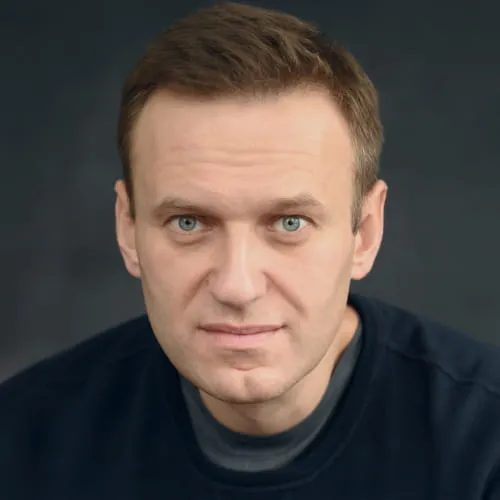
Today, the European Parliament held the ceremony for the Sakharov Prize awarded to Alexei Navalny. In his place, the prize was accepted by his daughter Daria.
Below is the text of her speech and a video of her remarks.
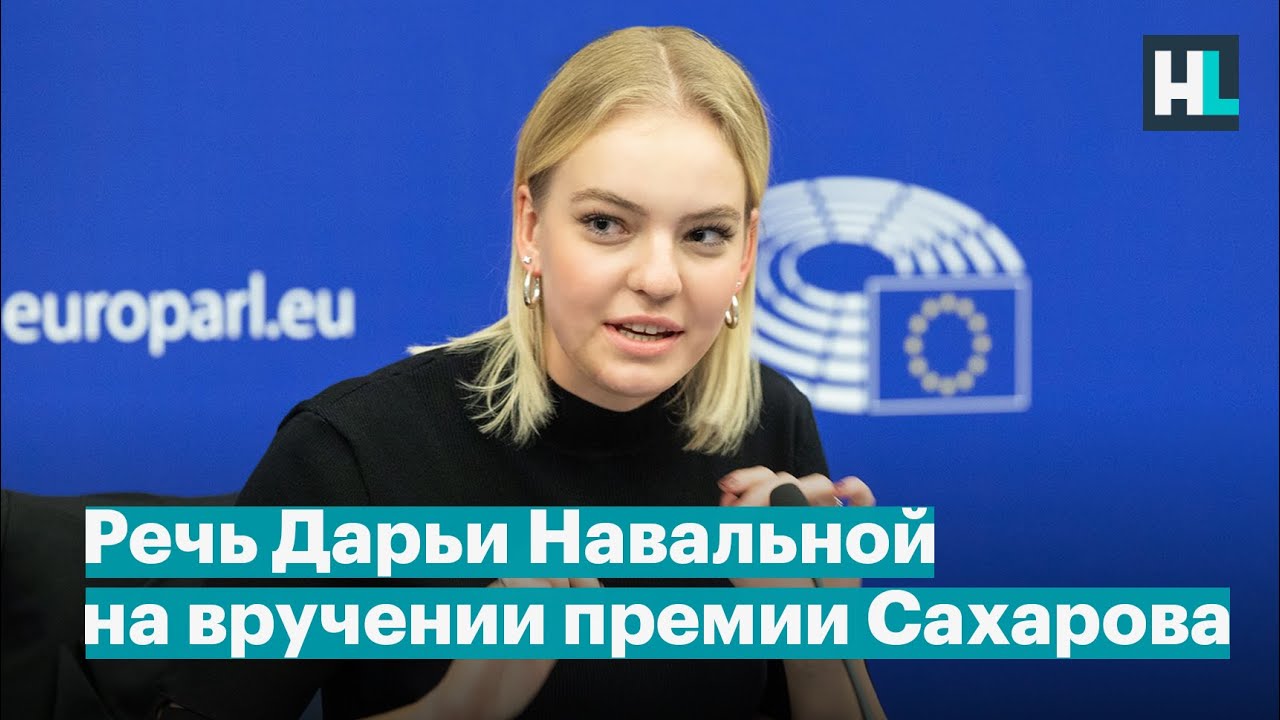
“Hello. Thank you so much, this is truly incredible.
Before I begin my speech, I just want to say that I am incredibly grateful to be accepting this award on behalf of my father, and at the same time very frightened. It is a great honor for me to stand before you here today, and as a 20-year-old student who knows very little about politics, I worry that I might somehow mess everything up.
When I heard that my father, Alexei Navalny, had been awarded this distinguished prize, I was overjoyed for two reasons. The first is that it is a tremendous honor, a recognition of his achievements and a high assessment of the work that he and his colleagues have done and continue to do. Most importantly, it is a signal of support to the tens of millions of citizens of my country who want a better future for Russia and are fighting for it.
I’ll mention the second reason too, even though it’s a little awkward. Um… my father is receiving an award from the European Parliament, and when that happens you get the unique opportunity to speak before the European Parliament. But unfortunately, for obvious reasons, my father cannot come, so… it looks like someone gets to rush off and book tickets to Strasbourg!
And then I realized that, of course, coming here is wonderful, but this is probably what my family’s nightmare—and mine personally—looks like. I go to various events and speak on behalf of my father. Sometimes he is even given an award. I accept the award. I prepare a speech. And I begin it with the obligatory joke… while he sits in prison. And I keep traveling, reading yet another article on the way about the horrific conditions in which he is being held. But what can you do? I go and speak. And he remains in prison.
And this concerns not only Alexei Navalny. Where are last year’s laureates—the Belarusian opposition—now? Mostly in prison. Where is Liu Xiaobo, the 2010 Nobel Peace Prize laureate, now? He died in prison.
And that makes me ask myself: why is it so difficult to free those who defend human rights? Why do they keep being thrown into prison not just around the world, but even in European—geographically European—countries in the 21st century?
Europe is great and powerful. The will of Europe’s people is expressed in the resolutions of the members of the European Parliament. And these are precise, correct, honest resolutions. They are supported by the United States and the United Kingdom. And by Australia, New Zealand, and the entire free world.
But they—people like my father—remain in prison, while more and more of their allies are thrown in there alongside them.
You know, I have heard this many times, and I am sure I will hear it again. Even in the corridors of this very session.
“You know, Dasha,” they will say to me, “we understand your emotions, because this concerns your family. But in the real world, we have to act pragmatically.”
And there, in the corridors outside the meeting, I will nod and say, “Yes, yes, of course.” What else am I supposed to say?! I am a 20-year-old student, and I do not feel very comfortable arguing with experienced and responsible pragmatists.
Well, at least here, taking advantage of the fact that I have the microphone, that no one will take it away from me, and that I do not have to argue with anyone face to face and feel impolite, I want to speak out against this pragmatism. After all, this is the Sakharov Prize. And Andrei Sakharov was, apparently, one of the least pragmatic people on the planet.
I do not understand why those who advocate pragmatic relations with dictators cannot simply open a history textbook. That would be a very pragmatic thing to do, and if they did, they would easily grasp an immutable political law: appeasing dictators and tyrants never works.
No matter how much people deceive themselves by hoping that the latest madman clinging to power will start behaving decently in response to concessions and indulgence, it will never happen. The very nature of authoritarian power implies constant escalation, growing aggression, and the search for new enemies.
And those who once said, “Let’s not push Lukashenko away and let’s continue the dialogue,” at the very moment when he was beating people and throwing them in prison, achieved only this: now, when he wants to imprison someone, he hijacks them along with a passenger plane.
Another thing that pragmatists—those who urge us to remember costs and economic losses—seem very reluctant to do is simply pick up a calculator and work out how much their pragmatism actually costs, particularly to European taxpayers.
Years of indulging Putin made him understand that starting a war was also an option if he wanted to boost his approval ratings.
How much will a war with Ukraine cost Europe? Even now, after the huge number of reports about Russian troops on Ukraine’s border, hardly anyone is reacting. No pragmatic trade cooperation will repay even a fraction of the direct costs that would have to be borne. Not to mention the cost of the time that Western politicians have already had—and will still have—to spend dealing with this problem instead of attending to their own countries’ affairs.
One of the opposition leaders, Boris Nemtsov, is murdered with shots in the back right by the Kremlin. And immediately a pragmatist appears, throws up his hands, and says: “Well, nothing can be done. Let’s limit ourselves to a strong statement, and then continue the dialogue.”
And then a second and a third are killed. A fourth is killed in central Berlin. A fifth in the United Kingdom. Then some warehouses in Europe are blown up. Then people are killed with chemical weapons. And what we know about are only the failed assassination attempts. How many successful ones were there? We all already know for certain that a genuine terrorist group has been created within Putin’s security services. A group that kills citizens of my country without trial or investigation. Without justice. They almost killed my mother, they nearly killed my father, and no one can guarantee that tomorrow European politicians will not drop dead after touching a door handle.
And so now you are already increasing police budgets. You are handing vast sums to the security services. You are spending billions on new ways to detect toxic substances. These are the consequences of that kind of pragmatism.
“Don’t push too hard, we need to act cautiously so as not to anger them,” says the pragmatist. And tomorrow dictators, emboldened by the West’s half-measures, simply bus thousands of people to the EU border, forcing women and children to storm fences, relishing the thought that someone might be shot or trampled in the crowd.
Let the pragmatists answer how much this will cost Poland, Lithuania, or the European Union as a whole.
I will also be told: what exactly do you want? These are sovereign countries with their own governments. Our options are limited. Or are you proposing to start a nuclear war to free political prisoners?
Of course, I am not proposing to start a war. But I would note that, although not very successfully, one is already underway, and it has real victims. It uses both cyberweapons and chemical weapons. The fact that European banks freely launder the corrupt billions of Putin and his friends, that the yachts of Putin’s oligarchs still make a splash in the European Mediterranean, or that 99% of the top officials of Russia and Belarus directly implicated in crimes can still travel freely around Europe, as can their families—this is a sure sign that many of those making decisions are not even trying to win so much as a small battle in this war. They talk and think far too much about “realpolitik,” treating actions based on ideas and principles as naive and foolish.
And you know what? It seems to me that the problem is this: the desire to appease a dictator again and again, not to anger him, to try not to notice his crimes for as long as possible—this is not a pragmatic approach. It is time to say this plainly. Under the banner of pragmatism, what we have here is cynicism, hypocrisy, and corruption.
The struggle between idealism and pragmatism is constant. It is a fierce battle in European politics as well. But even choosing the side of pragmatism should not mean betraying your principles.
When I wrote to my father and asked, “What do you want me to say before the European Parliament?” he replied: “Say that no one has the right to equate Russia with Putin’s regime. Russia is part of Europe, and we aspire to be part of it. But we want Europe itself to aspire to be true to itself as well—to those remarkable principles on which it was founded. We aspire to a Europe of ideas, of the triumph of human rights, democracy, and dignity, but we do not want a Europe of chancellors and ministers dreaming of landing a seat on the board of a Putin state company or taking a ride on an oligarch’s yacht.”
Today, here on this stage, accepting this distinguished award on behalf of my father, I thank you and, in you, I salute the Europe of ideas and principles. The European Union is an astonishing miracle created by peoples whose entire history consists of endless wars with one another. Despite all the difficulties and problems the EU faces and will still face, I believe in its future, and I believe that one day my country will become part of it.
A great responsibility rests on all of us, no matter who we are—members of the European Parliament or students. We simply live in a time when many problems, from the climate crisis to the survival of democracy, will have to be solved by us.
And as I conclude my speech, I want to quote my great compatriot, after whom this prize is named.
“Not out of false modesty, but in the interest of accuracy, I would note that my fate proved greater than my personality. I merely tried to live up to my own fate.”
I wish that all of us may have the strength to live up to our own fate.
Freedom for Alexei Navalny!”