
Over the past few months, one of the world’s main questions has once again been: what is happening on the Russia-Ukraine border now? For no clear, objective reason, by various estimates around 100,000 Russian troops have been massed in the Rostov, Voronezh, and Bryansk regions, as well as in Crimea. And more keep arriving every week.
The internet is flooded with photos and videos of military equipment being moved toward Ukraine. Footage shows trainloads of ammunition and armored personnel carriers, RKhM-6 chemical reconnaissance vehicles, and the heavy flamethrower system Solntsepyok. Here, tanks are being transported through the Bryansk region toward the border. And near Voronezh, Buk missile systems have been spotted.
No one understands what is happening, but the whole world is holding its breath. Could there really be a war?
War is the worst thing there is. It seems that every decent person understands and feels this on some subconscious level. War means tens of thousands, hundreds of thousands, millions of dead. It is the terror of knowing that your home could be destroyed the next second. That your loved ones could die, that 18-year-old conscripts will be sent to the front and never come back.
But that is how we see it. For Putin, it is not. His children, grandchildren, mistresses, and friends sit safely in palaces and villas in Italy and France. None of this touches Putin, whose money is kept in Swiss banks and offshore accounts on exotic islands. For Putin, war is not tragedy or horror — it is simply a tool of influence. Putin has reached the point where not a single respectable world leader wants to sit at the same table with him — so what is left for him? In a situation where, apart from the deranged dictator Lukashenko, no one will even shake his hand. Not much of a “geopolitician,” is he? So he thinks: I’ll send a couple hundred thousand soldiers to the border, and then we’ll see what happens. Maybe Biden will call? What do I care whether they get killed or not, or whether they kill someone else? If you won’t respect me, then at least you will fear me.
And then there are the truly sick bastards who dream of war with excitement. They practically drool over it, eager to get their hands on propaganda budgets as soon as possible.
So that once again, on every channel, it will be: the crucified boy, Carlos the air traffic controller, a Boeing a kilometer long.
We understand why the propagandists do this — for them, it is about budgets. We understand why Putin does it — he wants back at the negotiating table, to be treated as an equal partner again. But why did specific individuals take part in this war? We are not talking about local militias, but about Putin’s lackeys and servants, who were literally brought from Moscow to southeastern Ukraine almost eight years ago, people with no connection to the region, yet it was through their hands that this special operation was carried out — a war that should never have happened at all.
Because it is a great way to make money. Even to get rich. In just a couple of months in the so-called DPR, today’s subject managed to make millions of dollars — enough for expensive cars, luxury real estate in Moscow and abroad, and a seat in parliament, along with a career as a prominent member of United Russia.
To understand what our subject is willing to do simply for money, we need a brief historical detour. Into the very recent past. To reconstruct how, by 2021, we ended up at a point where the whole world, seriously and at the level of heads of state, was discussing whether Russia would launch a full-scale real war against a neighboring European country.
Early 2014. Ukraine underwent a revolution and a change of power. Using that as a pretext, and taking advantage of the chaos, Putin decided to violate every existing international agreement and procedure and annex an entire peninsula to Russia. In Crimea, where the population is predominantly Russian-speaking, Putin simply sent in troops. But he was afraid to do it openly, so the soldiers’ insignia and patches were removed. A referendum was held at gunpoint, and then, once it was all over, they said: oh yes, that was us.
At the same time, protests were breaking out across eastern Ukraine in various cities. Local residents, who were probably genuinely unhappy with the outcome of the Maidan protests, took to the streets, picked up weapons, stormed government buildings, and protested. Most likely, these protests would have gradually died down over time. As, in most cases, they did.
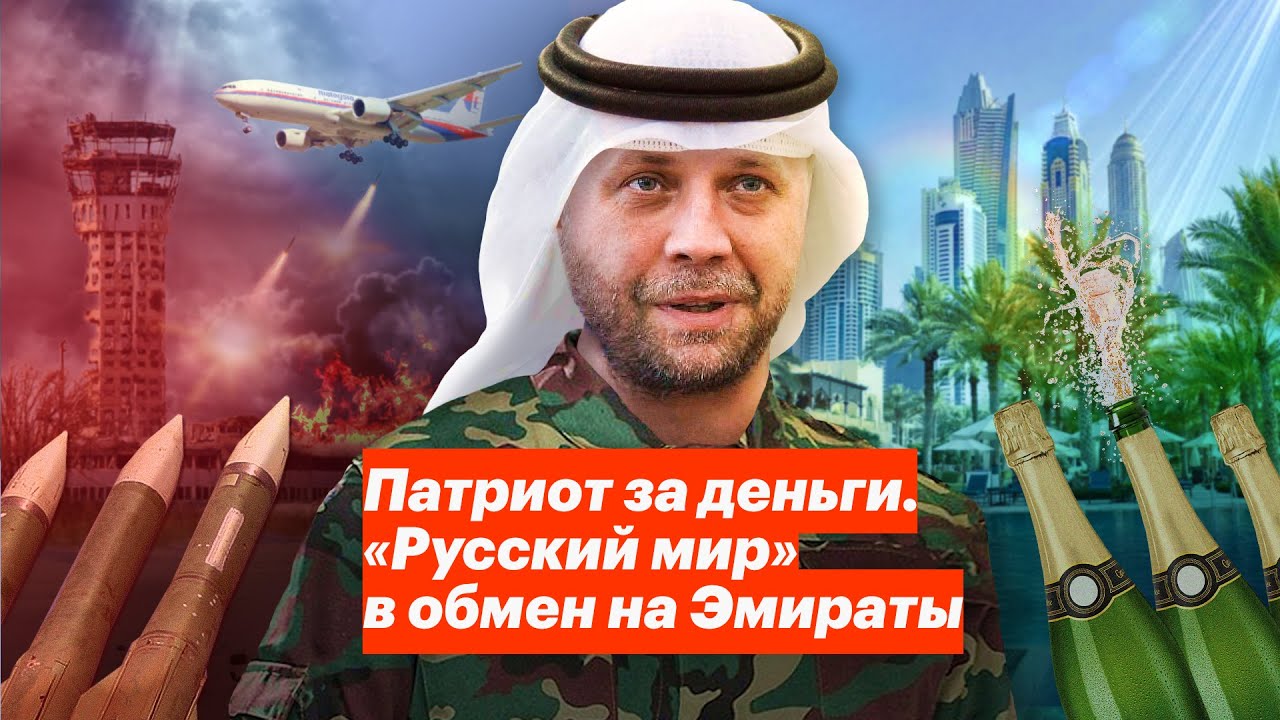
Except in two regions. Putin decided not to take them for himself, but simply to destroy them. The logic was literally: I do not need it myself, but you, Ukraine, will not have it either. The important question is: how was this done? And now it is finally time to meet the main subject of today’s investigation. A volunteer, a warrior of the “Russian world” ideology, the first head of the self-proclaimed DPR, and today — no, not some drunk who looks like he has been guzzling antifreeze, as these photos might suggest, but a deputy of the State Duma. Alexander Yuryevich Borodai.
You may feel like laughing at the absurdity of all this, but we are telling it exactly as it happened. No artistic exaggeration. If not for the terrible consequences, this story would sound more like a joke.
Borodai’s path from a marginal, irrelevant political analyst to a war criminal turned out to be shockingly short.
Alexander Borodai was born in Moscow and lived there his whole life. He seems to have worked as a journalist, writing pieces for the newspaper Zavtra, and by the age of 25 he had mastered an important profession — he became an independent PR consultant and political analyst. Later, he also became a crisis management consultant. Though that is according to his own account, to be fair.
Even after studying Borodai’s biography in detail, it is still no clearer what exactly he did. There are some supposedly valuable geopolitical notes, mentions of vague election campaigns, and even an old YouTube channel, Den TV, which he apparently helped create. It is there, incidentally, that one of the election campaigns where Alexander Borodai applied his talents can be identified. Judging by the number of videos and a special hashtag, Borodai handled PR support for the political campaign of Sergey “Spider” Troitsky from the metal band Korroziya Metalla. He was running for mayor of Khimki.
It is rather hard to understand why, when choosing whom to send to lead Donbas, they settled on Borodai, a Moscow political analyst. But then he explained it himself. He ended up there as a PR consultant, and later, when they needed to appoint the head of this new unrecognized republic, no one but him agreed. That is geopolitics for you.
Now let us briefly outline what Putin’s “brilliant” plan was and what exactly Borodai was doing in Donbas. In this region, with its Russian-speaking population that traditionally held more pro-Russian views than the rest of Ukraine, spontaneous civil protests emerged. Against the new Ukrainian authorities, against Maidan, against Yanukovych’s removal, and so on. Broadly speaking, this was an internal Ukrainian civil conflict — one part of the country supported one side, another part supported the other.
The situation could have developed in different ways: it might simply have faded away, or it might have ended with some kind of special new status for the Donetsk and Luhansk regions. In any case, nothing pointed to a massive humanitarian and military catastrophe stretching decades into the future. Until Putin decided to bankroll the conflict. To use Russian resources — civilian and military personnel, money, weapons — to keep it from burning out. So that Donbas would remain forever a hotspot with an unclear status and a subject of endless international negotiations, Minsk agreements, Normandy format talks, and so on.
But Putin did not dare do this openly. Russian “vacationers,” retirees, consultants, and all sorts of others descended on Donbas and, under the pretext of defending the “Russian world,” unleashed a war there. In other words, Putin did not do it himself — he did it through them. And who exactly were they, and where did they come from? God knows.
Their operating scheme was very simple. They had to pretend to be volunteers, deny any connection to the Russian military, intelligence services, government, or any official representatives. But at the same time, they had to carry out all their orders and report back to them. It was not Putin who destroyed Donbas, he gave no orders — it was us, just ordinary concerned political analysts from Moscow.
As became clear later, Borodai coordinated every action, every step, every breath with Vladislav Yuryevich Surkov, who served as Putin’s adviser and special representative on Ukraine. As part of an international investigation, audio recordings of conversations between Surkov, Borodai, and other “militiamen” were published and submitted to the court.
A supposed volunteer with no connection whatsoever to the Russian authorities is somehow discussing with Surkov the urgent need to send money. And that, to keep locals in Donbas from shooting them in the back, pensions and social benefits need to be provided.
Surkov orders Borodai to hold a demonstrative meeting, as if he were a governor, on preparations for winter. So that people know we are there for the long haul. Who is “we”? Wait — supposedly WE are not there at all.
Or here is Surkov apologizing for accidentally sending the wrong version of the constitution for the DPR and LPR, which had already been adopted, so now they need to vote again. Quite the awkward mix-up.
The intercepted conversations make it clear that in the summer of 2014, despite all their efforts, the Donbas militants’ plan was collapsing. They had literally only weeks left before they would all be wiped out, and to hold on any longer they needed weapons. Better yet, the official Russian army. Or at least the “little green men” (unmarked Russian soldiers). But Putin offered them neither. Donbas held the same kind of referendum as Crimea, but Putin did not recognize it. We were told on television about a crucified little boy in underpants nailed to a cross, but Putin did not send in troops. Instead, covert shipments of money and weapons began.
That is exactly how a Buk missile system ended up in the Donetsk region.
A surface-to-air missile system capable of shooting down aircraft. An international investigation, and later a court in The Hague, established that it was transported across the border by active-duty Russian servicemen from the 53rd Air Defense Brigade near Kursk, driven through Donetsk into separatist-held territory, and then taken back to Russia. The Buk was intended for the separatists to shoot down Ukrainian transport planes. But instead, it brought down a passenger Boeing with 300 people on board.
And there is our Moscow political analyst and PR consultant, Alexander Borodai, walking through a field strewn with body fragments. As a “head of state,” he hands over the black boxes to the international investigators.
He bears responsibility, of course, not only for those who fought and seized cities on his orders, but also for those 300 lives — people from Malaysia and the Netherlands who had absolutely nothing to do with Ukraine.
Borodai never showed any particular distress over the downed Boeing. Well, they shot it down, so they shot it down. He does have regrets, yes — for example, that they failed to capture another city, Mariupol. But never mind, they will try again!
This video — a very strange one, filmed against a camouflage net — came out in June of this year. It unexpectedly brought not only Borodai himself back from obscurity, but also Surkov, his handler, who had already left government service and is not the sort of person who gives interviews at all. But here he was, surprise, and not by accident. This was not just two war criminals reminiscing — it was a presentation. Borodai was preparing to run for the State Duma, and this was part of his campaign.
Borodai ran from the Rostov region, closer to Donbas, apparently hoping that residents of the Donetsk region who were being issued Russian passports in Rostov — and carefully bused in to vote — would be impressed by such a candidate.
And there was plenty to be impressed by. For example, his financial disclosure: income for 2020 — ZERO RUBLES.
A man who does nothing, works nowhere, lives on who-knows-what, shows up a couple of months before the election and says: elect me. He was on the United Russia party list, in eighth place — a spot that was not expected to win a seat.
But then a miracle happened. The governor, deputy governor, honored doctor, and teacher whom people in Rostov had voted for all gave up their mandates, and Borodai went to work in the State Duma instead. So now he sits there. He got a salary of half a million rubles, a driver, housing, and immunity from prosecution. A political analyst can be extradited to The Hague, but a member of parliament apparently cannot.
We will surprise no one by saying that absolutely all United Russia deputies in the State Duma are frauds, scoundrels, criminals, and thieves. Borodai joined their ranks with his head held high; he will take his rightful place among the liars and villains who call themselves representatives of the Russian people. But let us look at the details anyway — Borodai truly stands out. He has earned it.
The first warning sign is the car. As we remember, Borodai’s income for 2020 was 0 rubles. The total balance across all eight of his bank accounts was 313,000 rubles.
In short, he clearly is not living large. More likely, he is just spending down what little savings he has left. But Borodai behaves very differently. In April 2021, he buys a brand-new 2021 Lexus for almost 6 million rubles.
Quite unusual behavior for someone who earned 0 rubles the year before.
Next, in the disclosure, we find this apartment: 142 square meters.
This entry gives no context at all, and context matters. Alexander Borodai bought this apartment in Moscow in October 2015, a year after returning from Donbas. Its market value is more than 100 million rubles.
But of course, that is not all. What else do you think can be used to pay for services in unleashing a civil war? For a never-ending conflict in the middle of Europe that Putin can heat up and escalate at any moment whenever he feels like talking to the president of the United States?
Maybe a Hero’s Star medal would be a good reward? No. Maybe some rank? Or his own show on RT? Or perhaps Borodai was given an apartment in his people’s republic with a view of Donetsk airport? So he could come back and enjoy the fruits of his labor?
No again. But how about an apartment in Dubai? Now that we understand!
Recently, we got hold of a database of property owners in Dubai. It is interesting and informative, but fairly useless for investigations: a database from the internet is questionable evidence, even if you are confident in it yourself. We wanted something more reliable. And in the UAE, unlike in most countries, you cannot just walk in off the street and request a record showing who owns an apartment or villa. But we found a way around that, one that removes any doubt about the property owner. On an official Dubai website there is a convenient service: you can enter the purchase document number, the year of purchase, and the owner’s name, and the service will tell you whether that person currently owns that property and where it is located.
Let us test this with a simple example. We find the first official we come across with property in the UAE. Alexander Meshchansky, director of the Kremlin Catering Combine, declared an apartment measuring 185.3 square meters.
And here he is in our Dubai database.
We copy his name, add the purchase document number and the year of purchase, and voilà. Property found.
In the same database, we found our Alexander Borodai, born on July 25, 1972.
Borodai bought his apartment in 2015, shortly after returning from Donbas. We enter the year, the document number, the owner’s name, and check.
Success! Everything matches: Borodai still owns the apartment. He has even managed to rack up some kind of debt on it. Let us run a small experiment. We will change the name to Alexei Navalny.
Or keep Borodai’s name but make a one-letter typo. Then there will be no result.
The property belongs to that very Alexander Borodai and no one else.
The apartment is on Palm Jumeirah, the famous man-made palm-shaped islands.
Our Donbas militant has settled in this residential complex, GRANDEUR RESIDENCES.
It is designed in the style of some kind of Indian palace. The complex is surrounded by water on two sides. On one side, it is literally just 40 meters from the Persian Gulf; on the other, the beach is less than 100 meters away.
And those too lazy to walk to the beach can swim in the pool among the palm trees right in the courtyard.
Borodai can admire the pool and the beautiful courtyard right from the window of his 104-square-meter apartment.
Apartments like his currently cost €450,000, or 37 million rubles.
Borodai’s family does not make much effort to hide this property. Here is his daughter, Olga, posing for a photo in 2015 right at the entrance to their building.
Besides serving as additional proof, this lets us appreciate the wonderful view Borodai sees when he steps out of his Dubai home. Nothing like Donetsk.
And now for the good news for us and the bad news for Borodai. Like every parliamentary candidate, Borodai was required to declare all of his property. And the rules for foreign property are even stricter — no matter when it was purchased, the candidate must state the purchase price and where the money came from.
Here, for example, is what that is supposed to look like. Deputy Rifat Shaikhutdinov states that 20 years ago he bought a farmstead in Finland for 1 million rubles, and explains where the money came from — he had saved it.
Borodai’s disclosure contains no information at all about foreign property — only the Lexus, the apartments, and income of 0 rubles.
For hiding this apartment, Alexander Borodai should be stripped of his parliamentary mandate immediately. Let him go off on recess right now and never come back — there is nothing to discuss here. For his crimes in southeastern Ukraine, Borodai must be tried as a war criminal. One hopes that trial will come soon, at the very least for the 300 passengers killed aboard that Boeing.
That is the formal part. But more than anything, we want to show you his face once again and ask you to understand and remember: look, this man helped Putin unleash a war, sent our fellow citizens and citizens of a neighboring country to their deaths. Together with his subordinates and accomplices, he destroyed an entire region, shot down planes, and blew people up.
And all of it for an apartment in Dubai.
A typical servant of Putin. A man ready to kill without blinking for the sake of a Lexus and Palm Jumeirah. For almost eight years, with the help of scoundrels like Borodai, Putin has continued to torment Donbas — simply because he can. Because it is a geopolitical tool, and the secret graves of Russian soldiers who supposedly are not there are just collateral damage. What does Putin care? He does not care at all.
He does not care about the “Russian world” either, or about the people there, who were lured in, as Crimeans were, but are in fact simply being used as bargaining chips. Or about the money — probably trillions by now — spent on war in another country instead of on pensions and healthcare in Russia. After all, it is not Putin’s personal money, but public funds. What difference does it make? Classify all military spending, and that is that — no one will know anything.
The next time propagandists and officials are shouting from TV screens about fascists, punishers, and oppressed Russians somewhere, remember this story — and remember that these criminals do not care about Russians at all.
If, God forbid, a situation arises again where volunteers are summoned under patriotic slogans and flags, watch this video again. You are being called on to kill and to die yourselves. And some political analyst who came up with it will get yet another apartment in Dubai.
Freedom for Alexei Navalny.