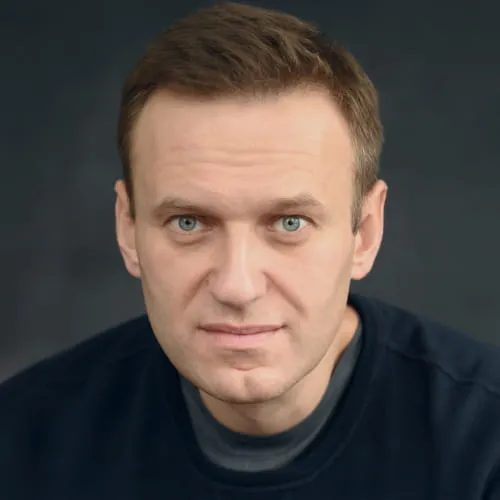
A year ago, on January 19, 2021, we released our biggest and most important investigation — Putin's Palace. Alexei Navalny told you a story that, without exaggeration, shook the world. The story of the largest bribe ever given to a public official. A story about who Vladimir Putin really is, how he lives, what surrounds him, and what kind of monument to his own corruption he built for himself on the Black Sea coast.
From TV screens — the very same TV screens where even saying Navalny's name used to be forbidden — we heard so many lies it was hard to comprehend. Hours, literal hours, of nationwide broadcasting were packed with conspiracy theories claiming that Putin's palace did not exist, that it was drawn, faked, planted. That all this gold and insane luxury — the home theaters, aqua discos, and even a private strip club — were just the product of our sick imagination. That this was Navalny's sabotage against Putin — no, against Russia itself. And why was our entire investigation supposedly made up? Simply because something like this could not possibly exist.
Today we will settle this once and for all. We will dispel any doubt about whether the palace exists. What it looks like — inside and out. What is there now, and what used to be there. We will show you hundreds of real photographs taken inside the palace and tell you even more about how Putin really lives. And about what Russian propagandists, acting on his orders, tried so carefully to hide and justify.
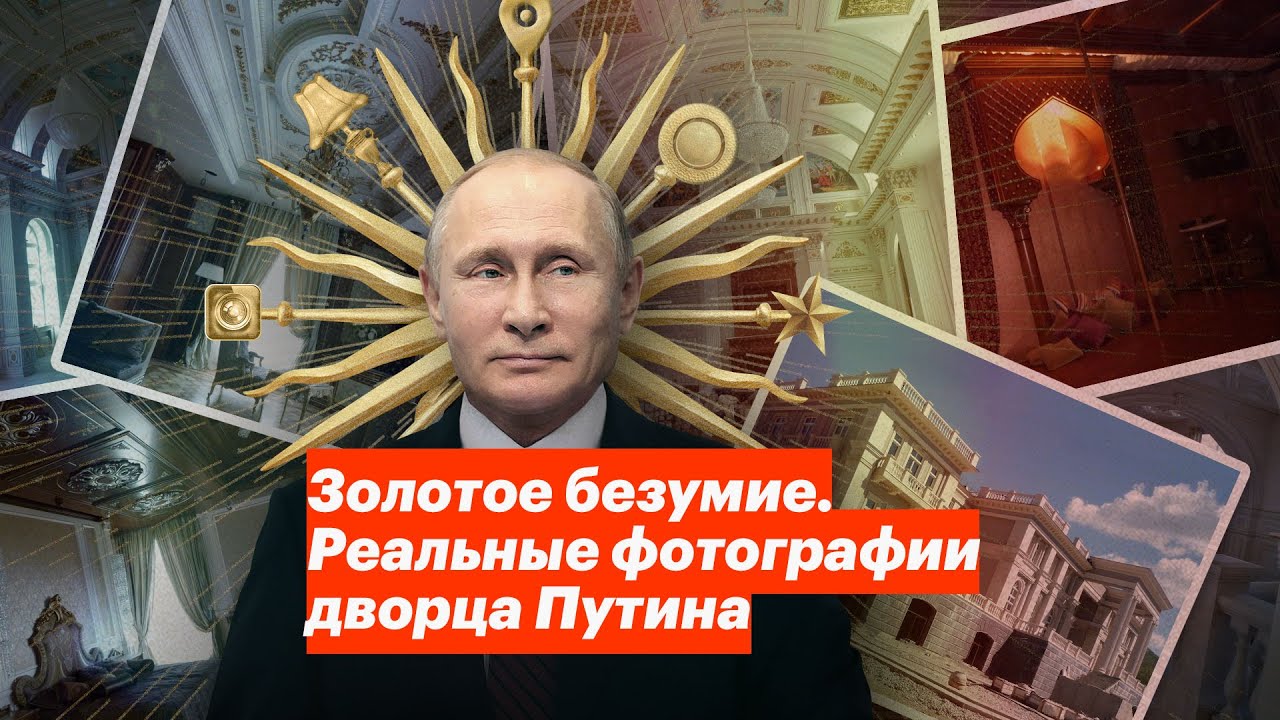
Every Navalny video ends with the words, "this is where the truth is told." And now we are going to prove it to you.
There is something deeply satisfying about this moment. How many times did we hear: it's all a cartoon, computer graphics, you made up this gold furniture, you made up all these monograms, moldings, frescoes. Navalny's team fooled everyone — it's all just their sick imagination.
And Dmitry Kiselyov offered what he thought was his strongest argument: Putin is modest, the most modest man on earth, he has nothing but a couple of shirts. Why would he need a palace? He's just not that kind of person.
We, meanwhile, have already studied these five hundred wonderful photographs sent to us from the construction site. Surprise: Putin is far worse than even we imagined. If you thought we went too far in the film with the interiors — exaggerated, embellished — you were very mistaken. Reality, as often happens, exceeded all our expectations.
We are going to show you real photographs of most of the rooms in Putin's infamous palace. We will look at them together, discuss them, and examine them in detail. But first we need just a couple of minutes to refresh our memory about what exactly we are looking at.
Last year, we managed to obtain the palace's floor plans from one of the contractors working on Putin's construction site (floors 1, 2, and 3). This is what those plans looked like — impressive, yes, but the scale is completely unclear. They are more like technical drawings: if you just look at them as they are, you understand almost nothing.
But in fact, the files themselves contain a huge amount of detailed information — different layers showing the floor, the materials, and the patterns on it.
The same goes for the ceilings — you can tell where there is stained glass, where there is molding, where there are carved panels.
There is also an astonishingly detailed furniture register, with every item listed by name and catalog number.
At the time, we ordered the catalogs for these brands — they are too exclusive, too bespoke to be sold online — and found out what all these bizarre royal divans actually look like in real life. We put all that information together and created a 3D visualization: what Putin's palace was supposed to look like according to the design. Some parts were rendered with near-photographic accuracy, since a couple of photos had leaked from the palace about 10 years earlier.
Other parts we had to fill in ourselves. Say the plan simply said "wood panel on the wall," and that was all the information available. In such cases, we relied on the overall style, the color scheme, and our own idea of what beauty might look like. More precisely, what a power-obsessed former KGB man might consider beautiful.
And how shockingly accurate we were in some respects. And how wrong we were in others. We have mixed feelings — somewhere between wanting to pour a truckload of ashes over our heads because, apparently, we seriously underdid it a year ago, and... well, on the other hand, who could have known? Who could have imagined this? Even the most imaginative person in the world would not have had enough imagination for it.
This part of our tour through Vladimir Putin's inner world will work like this: first we look at our 3D visualization, then at photographs taken in exactly the same places. And we compare them. Honestly and objectively, we compare where we got it right and where we did not.
Let's start with the simple and obvious: the exterior of the building. The inner courtyard, the fountain, the balconies, and the galleries.
And of course the main entrance. The eagle. Nothing here will surprise you — except perhaps the accuracy of our visualization.
We pat ourselves on the back and move on. To the places you cannot see from the outside.
This, in case you forgot, is the reading room. We see the perfectly executed floor pattern — exactly as it is in real life.
With its vaulting and gilding, this hall vaguely resembles St. George's Hall in the Kremlin.
Only here there is noticeably more gold. This was our recurring mistake throughout. Yes, we gilded everything too. Literally every wall, column, niche, and of course the ceiling. And the space beneath the ceiling. But not enough. We didn't go far enough. We held back.
Let's note how closely we matched the columns. The bookshelves — perfect. The golden eagles are in place too, along with the spirit of some traffic police chief from Kuban (a southern Russian region) who would definitely appreciate a reading room like this.
Our next stop is no less than the master's bedroom. As you may remember, Putin's quarters are not just a room with a bed — they are an entire infrastructure of several rooms: a sitting room, the bedroom itself, then another sitting room, then a dressing room and a bathroom.
Here is the first sitting room. Let's compare. The floor — bingo.
The ceiling — very good.
The walls — wood paneling and wallpaper — very close.
Our only miss — and a point off for us — is that we underestimated the number of eagles. Here they are above every door.
Now the boudoir. We were magnificent. Almost as magnificent as this canopy bed. The bedside tables, even the lamps — everything is spot on. We also guessed the wallpaper color quite well.
The dresser — there it is, just as expected, with a mirror and a candelabrum above it. Everything is in place.
And against the opposite wall we see a sofa.
As you remember, the floor plans included a full furniture list, and we ordered the catalogs. So let's just double-check that we were right. Here is the sofa that was supposed to be here according to the plan, along with two side tables.
This is what the sofa and side table look like in the catalog.
Now look at the photograph from Putin's bedroom — it is exactly the same furniture set.
Let's also check this ottoman with tassels and gold legs — yes, it's there. The very same one.
And the corner furniture set. According to the plan, there should be two armchairs here — striped, judging by the catalog — and a coffee table with gold trim.
And here it all is in a real photograph:
As for the eagles, we are embarrassed to admit that we messed up again. Who could have known there would be eagles even in the bedroom? But believe us, this is not the strangest place where our national coat of arms appears on the walls.
The next room is the second sitting room, or lounge, as it is officially called. Two armchairs, a table between them, and a TV stand.
A sofa.
We placed the light fixtures correctly, nice and neat.
The ceiling — we didn't go far enough. Point off.
We continue our comparative-analytical tour. A 40-square-meter bathroom. The marble columns are there, as is this entire bathing chamber — or whatever one should call it.
We also hung the light fixtures well, though in real life they are of course more lavish.
The shower stall is there.
We have 30 photographs of this bathroom alone, from every possible angle. And this was one of the things people had a lot of questions about when we released our film. The armchair. People said: why are you lying, what kind of aristocratic armchairs are supposed to be in a bathroom? What nonsense is this?
Well, here you go, skeptics. There is an armchair in there! Clearly a comfortable one, with cushions, and within arm's reach of the toilet.
And now let us move to the place that Putin himself deigned to comment on.
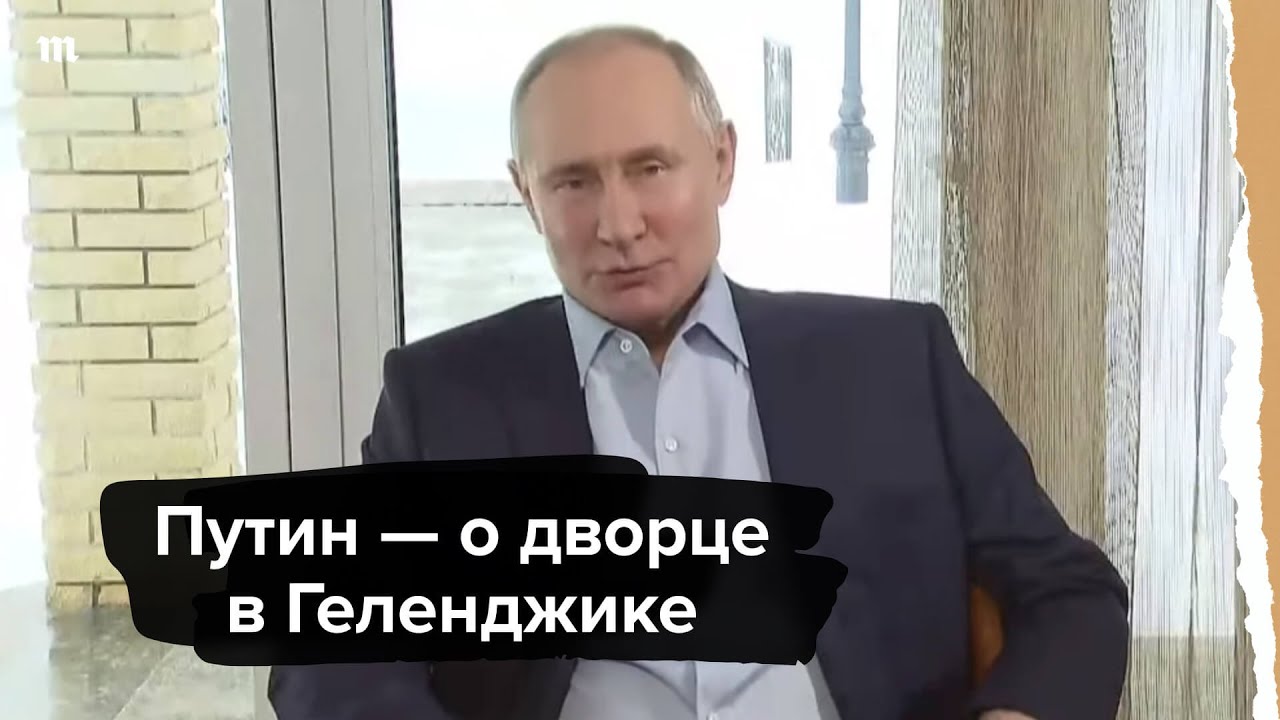
Here we have some constructive criticism. This one is on us. We seriously underestimated the pool — which is why Vladimir Vladimirovich didn't recognize it. In our rendering it looks like some school swimming pool compared with what is actually there.
First of all, our visualization is missing the naked women protruding from the walls. There are a lot of them.
We also failed to imagine those enormous medallions. We did not include the stucco work.
Instead of a bas-relief of Poseidon, we drew some idiotic flourish.
Our fault. In short, Putin would not even dip a toe into the kind of pool we drew. Though overall, you have to admit, we captured the mood.
Unlike the next place. Here, well, we do not know what we can do. Apologize? Tear our hair out? It is both embarrassing and rather funny, because honestly, this was impossible to predict. We imagined this room as light, white, with gold trim and burgundy fabrics — roughly like a fine classical theater would look, if someone decided to build one inside their home.
But it is all wood. All of it. Everything you can see is made of, carved from, wood. The walls, the ceilings, the balconies — all wood with gilding.
We showed you the imperial boxes — three of them, in two tiers. Here they are in the real photographs. The same size and shape, but everything is paneled in dark wood.
Between the boxes, by the way, there are female figures again. Caryatids, naturally, also made of wood.
So that settles the theater. Apologies have been made. The bedroom, the reading room, the pool — we have already been many places and seen a great deal. But there is one room in this house that holds a special place in our hearts. The strip club. Or the hookah lounge, as it is called in the official plans.
We have photographs of this place too. When we saw them, we felt what a scientist must feel when proving a theorem. Or what someone must feel after spending decades saying they saw Bigfoot, no one believing them, and then finally catching Bigfoot and leading him in by the hand.
A brief aside. When we found this place on the house plan and realized that here it was — a windowless room, with a stage, round sofas, and some marking on the stage that looked like a pole — that it could be nothing other than, forgive the expression, a private home strip club, we still could not quite believe it ourselves.
We remember perfectly how, for hours on long, long calls, we discussed it with 3D designers and architects: maybe this was a mistake? Maybe we had misunderstood something? Maybe it was not a pole? And not a stage? And if it was a stage, maybe it was for something else? We would be laughed at if we said that the president of the Russian Federation had a strip room in his home.
And right up to the last moment — in fact, even after the film was released — we kept thinking: if we got anything wrong, it was probably this. It was an unpleasant nagging feeling that maybe we had accused the man unfairly. Maybe there was nothing there at all.
But when we saw the photographs of this place, those feelings vanished completely. The strip room, the hookah lounge — call it what you like — exists. And it looks far worse than we could have imagined.
We tried very hard to make this place as tasteless and gaudy as possible. Our benchmark was whether a room like this would appeal to a gypsy baron. But what Navalny called in the video the most expensive hookah lounge in Makhachkala (a city in Russia's North Caucasus) turned out to look more like the cheapest.
Let's freeze the frame and take a look.
This is what the place looks like in real life.
A stage covered in cushions. Sofas, televisions, a pole. And... behind it, on the wall. We hardly even know how to describe it. A portal? The silhouette of a temple tower? This is definitely the place — there is no room for error here, everything from the position of the doorway to the screens and furniture matches the plan exactly. But these Aladdin-style temple structures were beyond anything we could imagine. We were thinking of an oriental style, One Thousand and One Nights and so on — but this much?
And if you think this portal-tower is some special stage decoration — who knows, maybe the dancer liked an oriental aesthetic — you are very much mistaken. These things are everywhere.
Here is the neighboring wall, with two of these temple-like structures on it. Even though this photograph was taken earlier, before the renovation was finished, the pole is already in place. The wall on the left has the same thing.
We need to look more closely at another photograph where the lower part of this structure is visible. We do not know what goes on in these people's heads. And we do not want to know. But even in the private home strip club, they installed golden eagles.
The national coat of arms, apparently so that visitors to this private establishment would not forget exactly which country they had seized and looted.
Let us move on to the next, no less fascinating part of our tour: the places we saw on the floor plans but did not include in the famous virtual tour. Otherwise our film would have been three or four hours long. Which does not make these rooms any less interesting. Let's see what else the palace contains.
Let's take a quick look at the second most important bedroom. It is located in the wing opposite Putin's and laid out the same way — with its own sitting room.
Then the bedroom itself.
And behind the bedroom, a hidden lounge.
It too has a beautiful sea view, so clearly someone important stayed here. Or some important woman.
We enter through a door like this, with an eagle on it.
And we see a lilac bed with a high Rococo-style headboard.
A bed like that costs 1.3 million rubles.
Next to the bed are two bedside tables costing half a million rubles each.
Also in the shot is a dresser with a mirror costing 1.5 million rubles.
Opposite the bed, as in Putin's bedroom, a television rises out of a special cabinet.
We turn around and notice, in the opposite corner, a marvelous velvet ottoman decorated with carving and gold.
You too can buy one for 800,000 rubles.
Now let us look at a set of photographs from the dining room — more precisely, the small dining hall. A year ago, when we were making the film, we had only one picture of it — this one.
And now we could practically offer a full 360-degree tour.
The dining tables here are packed in fairly tightly, arranged in a U shape, and each one seats about 10 people. It is a rather strange, uncomfortable setup, of course, but as we can see from archival photographs of Putin's banquets in Moscow, this is exactly how they prefer to sit.
Before we leave, here is an armchair — we found it in the catalogs too. 800,000 rubles.
Russians, why buy used foreign cars for the same money when you could buy such a wonderful armchair instead? Think about it.
Now the office. More precisely, an entire wing of the building on the ground floor devoted to affairs of state. Here it is on the plan: the corridor.
To the left, the meeting room.
Straight ahead is the office. To the right is a room modestly labeled on the plan as a utility room. But in fact, the plan shows lots of outlets and special racks for telecommunications equipment. This is obviously where the secure communications system is housed.
This is what the meeting room looks like. Its walls are entirely finished in wood. The ceiling too.
In the middle stands a round table and six chairs. We check them against the catalog and confirm — they are exactly the same.
On this wall there is some kind of niche above the fireplace; we hope it is for icons, to balance out the strip-club hookah lounge. And note the doors — they are double doors. This is the only place in the palace with doors like these.
By the way, do you know where else double doors are installed? In Putin's office in the Kremlin. Here, though, they are upholstered in something soft — perhaps for better soundproofing, or perhaps to make it more comfortable to bang your head against them.
The corridor. Expensive, opulent, wooden, eagles everywhere. Familiar.
And now the main room. 131 square meters. This is the office. Not shabby and bureaucratic like the one in the Kremlin, but an OFFICE in the full sense of the word. A tsar's office. There is even more wood here. A T-shaped desk. We saw it in old photographs too, with a worker standing nearby.
The office has a marble fireplace. Next to it are enormous bookcases — a good place to store your essays on Ukraine. Beneath each windowsill we see a golden eagle.
It makes you wonder where they got them all. Did they walk into some wrought-iron workshop and say: could we get huge golden eagles on golden radiator grilles? You know the eagle on the coin? Exactly that one, please. Five hundred of them. Thank you.
And now let us look at the furniture. The owner — or perhaps the designer — was clearly bitten by Louis XIV. This is probably the most extravagant furniture set in the entire palace.
But Putin likes this sort of thing. It suits the taste of a graduate of the Red Banner Institute of the KGB and a man from a St. Petersburg back alley. He saw things like this at the Hermitage, so naturally he needs the same at home.
No point hiding it: of course it is immensely satisfying, a year later, to look at all this decor and interior splendor in real photographs rather than in drawings and plans. It makes us want to hang giant banners saying, "we told you so." And many people did not believe us.
And that inevitably brings us to the next subject: the propagandists. A year later, it is now clear that Navalny's film triggered such a political crisis that it was simply impossible to deal with it in the old way — by ignoring it. Something new had to be invented.
A few weeks after the palace investigation was released, when the view counter was already approaching 100 million, the Kremlin decided it could no longer remain silent.
And then two teams of pro-Kremlin propagandists at once — Kiselyov's Vesti Nedeli and the online outlet Mash — were blessed with an Enormous Journalistic Stroke of Luck. A site that had been Russia's most secret construction project for 15 years suddenly opened its doors to them, and the builders gave each team a tour of several rooms. All for one purpose: to show that there was nothing there. Just a construction site. Everything at a very early stage.
But there is a problem with the propagandists' story. When we showed you the palace from the air, we ourselves pointed all this out and explained it: there was a huge construction site, scaffolding everywhere, building materials, machinery, and so on. We even found out why. The palace was literally being rebuilt from scratch because of a mold problem that had spread throughout the interior.
In other words, all the marble and finishings we saw in the photographs had been ripped out. The furniture had been moved into storage or destroyed. The palace is being renovated, we told you. And then the propagandists showed exactly the same thing.
But just out of curiosity, let us show you what the places those corrupt Putin lackeys — who for some reason call themselves journalists — were led through actually looked like before they were allowed in.
In its very first shots from inside the palace, Vesti Nedeli shows us a corridor of bare concrete, meant to convince viewers that there had never been any marble, eagles, monograms, or multimillion-ruble furniture here.
But here is the problem. We have photographs of this corridor taken before it was completely stripped bare. Here is a photo taken literally from the same spot where the Vesti cameraman was standing.
Let's return to the Vesti Nedeli report. On the right side of the corridor we see a recess in the wall, and opposite it the place where a door should be.
A little farther past the door stands a column.
In the room on the left you can see the opening for a door, and farther on, beyond it, another door is visible.
A couple of shots later, a huge window becomes visible in the room. Ahead in the corridor, two columns facing each other leave no doubt: to our left is the music room.
Excellent, because we have a great many photographs of the music room, which now is just a concrete shell. Once it was something entirely different — finished, gleaming, and ready to welcome Vladimir Putin to its grand piano. Here is that very window of the music room we just saw, and the door is visible too.
The column is hidden beneath layers of finishings. But the most remarkable thing in this room was the ceiling. You can see it in this photograph, but in this shot from another angle it is even clearer. On the left is the very door through which Dmitry Kiselyov's cameraman is looking. Beneath the ceiling are arched structures, and the ceiling itself is covered in gold and painted with frescoes. The gentleman strolling through the hall in flip-flops is clearly admiring the marble fireplace, the many eagles, and the beauty around him.
Next, the Vesti Nedeli correspondent wants to show us that the other rooms in the palace are also completely empty, and takes us down a corridor. They even speed up the video to impress viewers with the endless grayness and concrete emptiness.
But they did that in vain, because it was precisely in this passage through the corridors that we found new evidence of the palace's former opulence. Let us look closely and compare it with the plans. The cameraman's route begins on the basement level: the first door on the right (1) is the cosmetology room, the second (2) is the hair salon.
Next we enter a large room called the cocktail hall. Here it is, by the way, in our photographs.
We move on past the entrance to the movie theater (4) and through the tasting room (5). It is now piled with construction materials. And just after that, we stop.
This room is even more cluttered, but traces of the old interior remain. According to the plan, we are in the wine cellar.
In reality, of course, this is not a cellar at all, just a wine storage room with a huge glass refrigerated chamber inside it. We have photographs of this room, so let us compare them with what Putin's propagandists are showing us. It is easiest to see here, and the angle is very similar. The two windows on the right are in place, and the glass refrigerator in the center of the room has vanished without a trace, but the workers did a sloppy job on the walls. When dismantling the wine room, they did not remove the brown paint around the windows — it has been fully preserved and matches our photograph perfectly. Nor did they remove the paint beneath the wooden wine cabinets — there it is, white in color.
We have been talking for so long about the main house, the palace itself, that we almost forgot that Putin's palace is actually an entire estate covering nearly 8,000 hectares. There are many other buildings there too — a church:
An underground hockey rink, which, by the way, has just officially been registered under the name "Sports Building No. 1." So we were right.
And the greenhouse, which we showed you as well:
Friends. We are sorry — this is embarrassing — but it is not a greenhouse. We, being ignorant and unenlightened people, were misled by the plants on the roof of this building. We thought it was an exotic garden. But after the investigation was published, we were sent a great deal of additional information that shed light on what it really is. It is a restaurant.
More precisely, it is not even a single restaurant but a complex of several restaurants for different moods. Like a mall food court, only private. It can seat perhaps 12 people for dinner at once, maybe 20. And we also underestimated its size when we called this building 2,500 square meters. The basement alone covers 2,167 square meters. Then there is a first floor of roughly the same size (2,100.3 square meters) and a second floor of about 1,500 square meters (1,456.3). Its total area is 5,700 (5,723) square meters.
On the building plan, the space under the canopy is labeled the “beer restaurant terrace.” Vladimir Putin likes beer—this is no secret, and he has said so many times.
But there are many beer lovers in the world, and Vladimir Putin is probably the only one who thought of building a beer restaurant at his country residence.
Inside the building, if you enter through this terrace, you find a bar for seven people, a lounge area, a dining room for 12, and even a game room. What exactly Putin plays there after drinking beer is unknown. Maybe there’s foosball and darts, or perhaps even a branch office of the casino from the main house.
So Putin has had his beer, played some games—what more could he want? Maybe watch a movie? Easy. Right nearby there’s a private six-seat screening room. It’s just on the other side of the wall from the bar. Very convenient: you can dash out for another beer without missing your favorite film about poor but brave Soviet intelligence officers.
Also on the first floor are numerous rooms for the staff of Putin’s mega-restaurant: cloakrooms for waiters and other personnel, showers, a room for storing containers (presumably empty ones), a finishing kitchen, a hot kitchen, a dishwashing room, even separate rooms for tableware, and two rooms for storing alcoholic beverages.
Not bad, you might say—but didn’t we promise you something exotic, incredibly luxurious and unusual, and then show you nothing but some beer joint? Fair enough. Now we’ll show you real luxury. For that, we need to go up to the second floor of the restaurant complex.
Looking at the plan, the first thing we see is a 50-square-meter karaoke hookah lounge.
We’re not surprised by a room like this—we saw one in the palace too. This new hookah lounge also has a stage. Too bad we can’t tell whether there’s a pole on it. A multipurpose room: hookah, stage, and karaoke all in one. It’s easy to picture Putin standing in the smoke after having a double-apple hookah, stepping onto the stage, and performing his favorite song by Lyube (a patriotic Russian band). Next to it are two more rooms: a green room and a dressing room. That’s where the invited performers get ready to entertain our leader. There is also a separate room here—the hookah-lighting area. No doubt it must be lit by a special high-ranking hookah attendant from the Federal Protective Service. Because the president’s security comes first.
Let’s catch our breath after the hookah lounge and move on. Here we have a 140-square-meter billiards-and-cigar room and a mysterious exhibition area. What exactly is on display there, we don’t know—maybe Olympic medals, or maybe amphorae raised from the seabed. Nearby there’s another bar—this time for eight people.
And then things get more interesting. The Italian restaurant area has a total floor space of almost 300 square meters. We’ve already noted that Putin loves Italy: his entire palace was designed by the Italian architect Lanfranco Cirillo and furnished entirely with Italian furniture. This restaurant includes a lounge area for six people, a dining room for 20, a concert area, and a 30-square-meter wine room.
Putin likes wine, and he produces it at his own facilities in the nearby settlements of Divnomorskoye and Krinitsa. This is, of course, yet another example of Putin’s hypocrisy. He banned ordinary Russians from buying Italian products—Italian cheeses and cured meats are unavailable in Russia, and the products that are found get crushed by bulldozers. But sanctions are for ordinary people—why should Putin care? He can afford to build an Italian restaurant at his country residence stocked with Italian products.
Let’s move on to the pan-Asian restaurant. It’s even bigger than the Italian one—244 square meters of interior space and its own 340-square-meter terrace. The restaurant consists of a lounge area for eight people, a dining room for 12, and several very exotic zones. There is a tea ceremony area for four people. Here Putin and his KGB friends put on special kimonos, sit on the floor, bow to one another, and drink tea. Next to it is a Chinese dining area—that is, a special place intended for consuming Chinese food. And for some reason, we’re sure they’re not eating instant noodles there.
Farther to the right is a place whose name, we’re sure, you’ve probably never even heard. At least without Google, we never would have guessed what it was. We’re talking about the teppanyaki area and the teppanyaki master’s area. Teppanyaki is a style of cooking in which the chef (apparently a teppanyaki officer from the Federal Protective Service) prepares food on a wide iron griddle next to the diners, after which the hot dish goes straight onto their plates.
The service rooms on this floor are interesting too. There is a teppanyaki kitchen, a room for storing alcoholic beverages—the third one in this building already—a security room, a room for servicing a separate screen installed in the Italian restaurant, and a room called the adjutants’ room. The word “adjutant” brings to mind images of uniformed men surrounding a great military commander or emperor—and that is exactly right. Putin calls his aides adjutants. In this restaurant complex, they have a separate room of their own with a private bathroom.
After Putin has sung karaoke, smoked hookah, had some beer, and enjoyed a teppanyaki ceremony, he can go up to the roof of this building and stroll among the plants along an artificial body of water. At first we didn’t even realize it was water—we thought that was just the color of the roof. But then, when we got the building plans, we looked more closely and saw ripples on it.
If this were a real tour, at this point they’d count us all and herd us onto the bus. All right, everyone, take your seats, the tour is over, check that the person next to you is there, and let’s go. But we still have one important part left.
You haven’t forgotten Putin’s brilliant plan, have you: the palace supposedly isn’t his at all, but Rotenberg’s. And it isn’t even a palace—it’s an apartment hotel, a resort. A year has passed. A year is obviously more than enough time for our judo-loving friends Vladimir Vladimirovich and Arkady Romanovich to sort out all the legal formalities, so to speak. Let’s see what changed. Almost nothing changed.
Putin’s palace is not just that enormous building and the underground hockey complex; it also comes with 7,800 hectares of land.
Huge vineyards with a château in the neighboring settlement of Divnomorskoye.
And a winery under construction in another village—Krinitsa. Changing the owner of any of this would be an extremely complicated process, impossible to carry out unnoticed.
There is nothing. Literally nothing at all. In January, when we published the investigation and Rotenberg said the palace belonged to him, then in the following February, and then in March—nothing happened. The owners of the houses and land plots did not change. The owners of the companies that own these properties did not change. Rotenberg was not even made the formal owner of the palace; his name was not entered into the documents. He simply came out, said a few words, and that was it.
The only thing that hints at Rotenberg in any way is a change of director at the company that owns the company that owns the palace. The new director’s name is Sergei Guzhelev.
He had been employed by one of Rotenberg’s companies.
Although online he is more often mentioned as an FSB officer. He sits on the board of a counterintelligence veterans’ foundation. This appointment appears to have been made solely to prop up the Rotenberg cover story, to generate headlines like these.
We looked very hard for Rotenberg. Honestly. His people, his money, his companies. Any sign at all that the owner had really changed and that this was now Rotenberg’s. But instead, for some reason, we found Kovalchuk.
Another of Putin’s closest friends from St. Petersburg. Take, for example, the new director of the company that owns the palace. He signs documents, orders furniture, and generally handles all operational matters. His name is Nikita Vokhmin, and he is 33 years old.
He is from the Karelian town of Lahdenpokhya.
This area is known for the fact that Putin’s friends, the Kovalchuk brothers, built a residence there where Vladimir Putin vacations. Vokhmin’s father was the head of that district and apparently met the Kovalchuks there. The younger brother of the palace’s new director, Daniil Vokhmin, worked for the Kovalchuks at the Dacha Wintera park hotel and at Igora Drive, the racing circuit registered to Putin’s nephew. Even now, Vokhmin is still listed as a player on the football team affiliated with Kovalchuk’s Bank Rossiya.
Well, maybe Rotenberg is at least paying for the construction in Praskoveevka? If a private apartment hotel is being built, surely it shouldn’t be financed with state-company money. Not at all. We carefully studied the palace’s new financing scheme, and everything remained exactly as it was. State companies did not stop funding the construction after Rotenberg claimed it as his own.
Transneft, headed by Putin’s friend Nikolai Tokarev, was paying more than 100 million rubles a month under the guise of “rent” for some vague premises in the palace—and it is still doing so.
And a Rosneft subsidiary, headed by another of Putin’s old friends, Igor Sechin, not only continued financing the vineyards attached to the palace—it actually increased that funding, from a little over 40 million to 46 million rubles a month.
These are payments from June and July 2021—just six months earlier. So tell us: why the hell are state companies still paying for Rotenberg’s hotel?
Funding also continued from Putin’s friend Gennady Timchenko and from the son of another Putin associate, Vladimir Kolbin. In short, everything is the same as before. The palace was being built for Putin, and it still is. And we were expected to be satisfied with Rotenberg’s absurd stories about an “apartment hotel.”
To sum up what we’ve seen, more than anything we want you to hear, understand, and believe one very simple idea: the truth will prevail anyway. And the truth is on our side.
Along with this video, we are publishing several hundred real photographs that came into our possession. So that you can look for yourselves and make sure: we did not lie about anything, we did not exaggerate anything, and we did not make it look more luxurious than it is. Everything we showed you a year ago fully corresponds to reality. And sometimes reality turns out to be worse.
And this is how it will be with all of Navalny’s investigations. This time, a year passed—and we received irrefutable confirmation that we were right. With some other investigation, it may take longer—but do not doubt it: the obvious truth, the truth that cannot be disputed, will come out all the same. We may have to wait. But it will happen anyway.
And Putin understands this perfectly well. He certainly knows that our investigations are true—we talk about him, his friends, and the criminal schemes in which he himself takes part. And no matter how much he makes propagandists squeal about “cartoons” and “editing,” no matter how much officials shriek about “compote” and “compilation” (references to dismissive official talking points)—the truth cannot be hidden forever.
That is why he tried to kill Navalny—simply to stop it. To stop the investigations he was releasing, to stop the politics, the posts, the broadcasts, the streams.
To stop the laughter and contempt provoked by an aging dictator, the richest man in the world, who has stolen so much that he can afford absolutely anything—yet builds himself a striptease hall, an aqua disco, and a personal beer restaurant. To stop the hatred one cannot help but feel toward the sleek United Russia party functionaries, bursting with stolen wealth.
And the investigation into the palace is why Putin will never let Navalny go. He will keep extending his sentence, inventing new cases, tormenting him in prison, and creating unbearable conditions. Because this is personal. The palace is his main and favorite pet project—and Navalny ruined it.
But he will not succeed. While Alexei is in prison, we will continue doing his work. And in his place, we will keep saying: Putin is talentless. Putin is nothing. Putin is a thief and a liar.
He imagines himself the heir to a great Russia. A monarch. An aristocrat. He wants to live in a palace no less grand than the Winter Palace (the former imperial residence in St. Petersburg). He installs double-headed eagles everywhere to emphasize that he is the successor to the Russian tsars. But what he ends up with is a parody. Not even a bad copy—just a pointless, hopeless long-term construction project with naked women sticking out of the walls and armchairs facing toilets.
Putin wants to go down in history. To be remembered as an outstanding political leader who outplayed everyone. But this is what he will be remembered for: a moldy palace near Gelendzhik with a strip club.
And for cowardice as well. For a panicked fear of his opponent. For his refusal to engage in open, normal political competition.
He will be remembered for this: instead of defeating Navalny in an election, he came up with smearing Novichok on his underwear so that Navalny would die in agony. Instead of answering questions—direct, simple questions—he lies to the entire country’s face, and those who catch him in those lies, he imprisons. This is Putin’s real legacy. We will defeat him. Be afraid of nothing. Never give up. Believe that you are right. Freedom for Alexei Navalny.