Justice does not exist in Russia. Putin destroyed it. Not by accident, and not through negligence. He dismantled the courts deliberately and systematically. Go outside and ask people. Ask your friends what they’ll tell you about the Russian courts. That they’re corrupt. Fake. It’s practically an axiom of Putin’s regime. Everyone knows it!
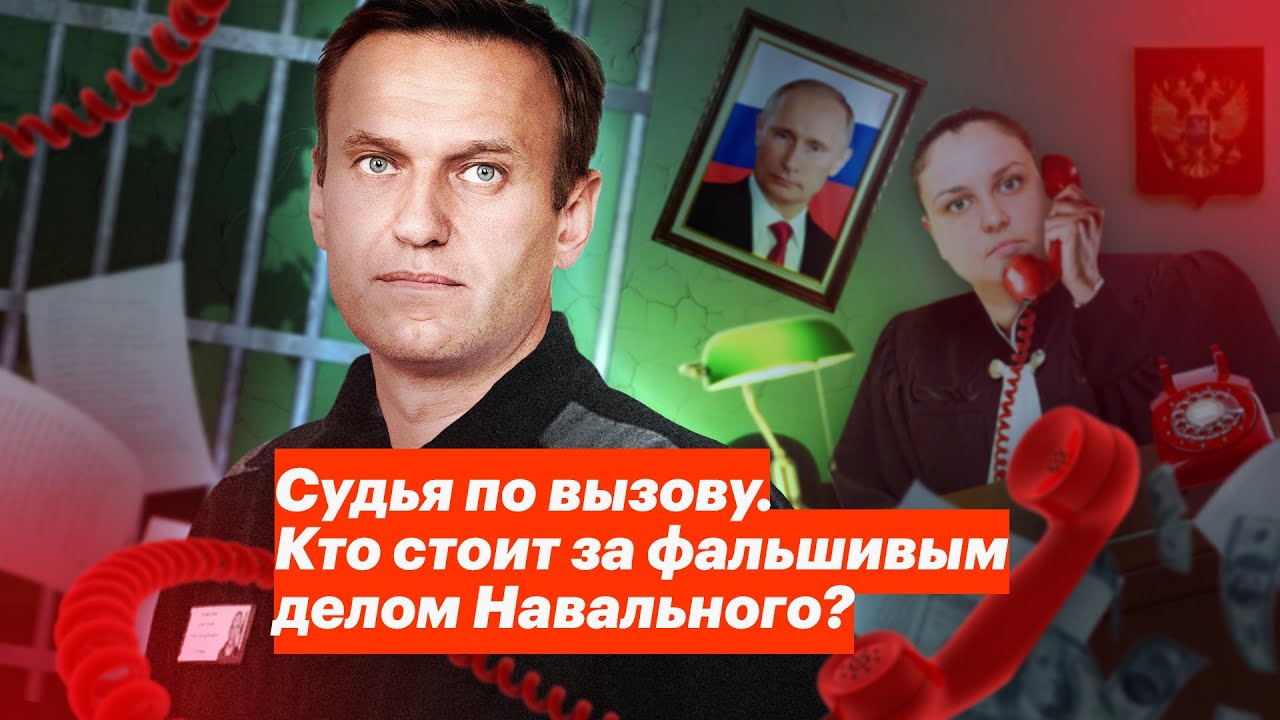
The judge decides nothing. The judge picks up the phone and does whatever he or she is told through the receiver.
Everyone has heard about this, but few have seen it with their own eyes. But today, as these exact methods are being used to rig the country’s most important trial—the trial of Alexei Navalny—we will tell you and show you how it is done.
Who is taking part in the criminal special operation to lock Navalny away for another 15 years—and, most importantly, who is paying for it.
February 15, 2022. Vladimir Region. Penal Colony No. 2. Almost 10 a.m. The colony’s assembly hall, where events for inmates are usually held, has been converted into a courtroom. Some kind of backdrop has been hung up. Tables have been arranged. A desk for the judge has been placed on the stage, with flags behind it.
There are 13 minutes left before the announced start of the first hearing in Navalny’s case. Judge Margarita Kotova’s phone rings. There is a man’s voice on the other end, and the judge drops everything to speak with him for half a minute.
The clock shows 10:00—the time the proceedings were scheduled to begin.
Navalny and his lawyers are in the courtroom, the prosecutor is in place, and journalists have gathered in a separate room.
But Judge Kotova does not come out of her back room. She is waiting for a second call. It comes at 10:13, and Judge Kotova speaks with the same man for almost a minute.
Half an hour later, nearly an hour behind schedule, the hearing finally begins. Everyone takes their seats. But the proceedings do not last long.
Just a couple of minutes later, Kotova announces a “technical recess” and returns to her little room.
On our screens we see the footage that spread around the world: Alexei talking with his wife Yulia, with his lawyers, waving, sending greetings.
At that moment, Judge Kotova receives a third call. It comes at 10:49, immediately after the door slams shut behind her. The same number. A brief half-minute conversation, and the judge returns to the courtroom.
That day, her interlocutor will call once more. A lunch break is announced at 13:48.
At 13:52, the judge’s mysterious friend calls again. They speak for half a minute.
It seems as though the entire first day of the trial is built around these phone calls. The proceedings cannot begin without them. Recesses are announced specifically for these calls.
Judge Kotova is speaking with a man named Yevgeny Vladimirov—that is how he appears in phone contact lists.
Vladimirov is an employee of the Presidential Administration.
The phone number he is calling from was used to obtain a pass issued by the Presidential Administration. In 2019, by presidential decree, Putin awarded a man with that name the rank of State Counselor; the document lists his position as head of the Department for Public Relations.
It appears that Vladimirov is one of the Administration officials who “professionally” work on fighting Navalny: we also found his phone number in the Smart Voting database—apparently an occupational necessity.
On February 21, the second day of Navalny’s trial, Judge Kotova spoke with Vladimirov three times. The last call came less than half an hour before the hearing began.
It is worth stating the obvious: there are no circumstances whatsoever connecting a judge of the Lefortovo District Court and an official from the Presidential Administration. There is simply no lawful reason, not even in theory, for these two people to be calling each other repeatedly and discussing things during the trial—literally during the trial. Interrupting hearings and slipping out to talk quietly. Judge Kotova, whose salary is paid by us, the public, so that she can issue independent rulings in accordance with the law, obediently takes instructions from the Presidential Administration like an errand girl.
Putin’s Administration, acting on orders from the boss, organized the entire Navalny trial. This whole special operation—from fabricating evidence to coordinating the judge’s actions. And now we will prove it to you.
In 2017, Sergei Kiriyenko, the First Deputy Chief of Staff of the Presidential Administration, held a meeting there. The outlet Proekt describes this in detail in its investigation. Putin was preparing to run for president for a fourth time, Navalny had also announced his candidacy, and the investigation “He Is Not Dimon to You” had recently been released. The largest protests in years swept across Russia. Kiriyenko gathered experts and political analysts and asked the question: should Navalny be imprisoned? The question of jailing Navalny was decided right there, in the Presidential Administration. At that time, they decided not to jail him.
It was also there, in the offices of the Presidential Administration, that funds for fighting Navalny were allocated. Political grifters like the woman in that famous photograph, Kristina Potupchik, came to Putin’s Administration asking for money from the slush fund for their contracts and projects—Telegram channels about the opposition, fakes, smear campaigns, and so on.
One such Kremlin contractor is Konstantin Kostin, director of the Civil Society Development Foundation and himself a former head of the Presidential Administration’s domestic policy directorate.
In his hacked emails, published on one of the Telegram channels, you can find both his requests for money from the Presidential Administration and some insane multi-phase plans for fighting Navalny.
And here is a very interesting email from his secretary.
The email contains a memo explaining that a special donation was made to Navalny in the name of pensioner Mikhail Kostenko. Then, a few months later, a lawsuit was filed in that same name, claiming that Navalny had deceived the pensioner. The email includes photos of the lawsuit itself.
Now let’s return to the courtroom in the penal colony in Pokrov. On February 28, a pensioner who quite literally understands nothing is questioned by video link. He asks people to repeat themselves, shouts, and says he himself does not know what Navalny’s deception supposedly consisted of. This is the same Mikhail Kostenko from that memo prepared by the Presidential Administration contractor.
Kostenko says he has no complaints against Navalny. He says the statement was written not by him but by a lawyer—Ilya Remeslo. In other words, pensioner Kostenko is a story invented entirely by Kremlin officials. Kostenko himself does not understand what the court is even talking about.
And this Remeslo, who pulled off the Kostenko scheme and brought in a stand-in pensioner—where did he come from? We have already discussed him in one of our previous videos. Remeslo is a hired lawyer, a crook used to invent fake stories about Navalny.
A man who deserves no attention at all—if not for his bank transfers, which very conveniently ended up in our possession. Can you guess who pays Remeslo’s salary? The very same people who invented the pensioner: Presidential Administration contractor Konstantin Kostin.
Ilya Remeslo receives about 10 million rubles a year from three legal entities, all of them connected to Konstantin Kostin. The first, Ruposters LLC, used to belong to Kostin himself, and then he transferred the company to his employee Stanislav Apetyan, who also worked in the Presidential Administration.
The second, Universal Media Technologies, is also registered to one of Kostin’s subordinates.
Mediamarker, the third company paying Remeslo, belongs to another “expert” from Kostin’s foundation, Alexander Faib.
Several contracts were signed between these three companies and Remeslo for consulting services, legal support, and even media analysis of the information landscape.
And for all this he is paid enormous sums—fees for services that do not exist. In 2020 alone, he received 10,382,000 rubles. That is 865,000 rubles a month for fighting Navalny.
Ilya Remeslo has repeatedly published the banking information of ACF employees, so why shouldn’t we take a look at what he himself spends the millions on that he was paid for falsifying cases against Navalny.
Here, for example, he is making a payment for a Volvo XC60.
Here he is paying for a hotel stay in Finland over the New Year holidays.
Here he is buying something for 127,000 rubles at a Yakutian diamond jewelry store.
He likes to shop for clothes at Hugo Boss.
Or he simply withdraws cash from an ATM over and over again in 100,000-ruble amounts.
One small but important detail remains. Where do these Kostin-linked companies that pay Remeslo get their own funding? Officially, there is no budget line in Putin’s Administration for fighting Navalny. Formally, the Presidential Administration is supposed to be dealing with other matters. And here it is: the Kremlin’s very own slush fund.
Money flows into the accounts of the three legal entities that bankroll lawyer Remeslo from people you know very well—the recurring stars of Anti-Corruption Foundation investigations. The largest sponsor is Oleg Deripaska.
Through his companies Rusal, GAZ, EN+, and the Volnoye Delo foundation, he transferred 189 million rubles to the companies of the Presidential Administration contractor.
The second-largest sponsor is MegaFon, a company that belonged to oligarch Alisher Usmanov. They paid one of the firms 107 million rubles.
All of this money is sent under vague service contracts. It is unclear what services a group of former Putin Administration employees could possibly be providing to the GAZ automotive group, Russian Aluminium, and MegaFon.
Now let’s go back and take another look at what happened in Navalny’s trial. Here is the list of people who appeared in court for the prosecution—the people brought in to slander Navalny and accuse him of fraud.
Vitaly Serukanov, a disillusioned former supporter who worked briefly at Navalny’s headquarters and now works for RT (formerly Russia Today, a state-funded Russian media outlet).
Two former Anti-Corruption Foundation employees—Gorozhanko and Mishchenkov.
Four supposed victims of fraud—including the odd-job worker Koshelev, who also works part-time towing cars and deposited a million rubles into our accounts from who-knows-where.
Pensioner Kostenko, who donated 50,000 rubles but then supposedly regretted it and demanded the money back.
Two genuine ACF donors: Kuzin and Karnyukhin.
And then there is the Kremlin lawyer whose professional occupation is fighting Navalny—mostly by simply lying about him on television and on social media. That is all the investigation was able to produce.
So, former employees Mishchenkov and Gorozhanko refused altogether to testify against Navalny. Gorozhanko said that investigators threatened him, forced him to memorize testimony, rehearsed it with him, and simply made him come to court so that he himself would not be jailed.
The two genuine ACF donors can also be removed from the picture. Both have old criminal cases hanging over them, which were used to intimidate them. As we found out, the tow-truck driver Koshelev turned out to be a drug addict; he has a suspended sentence for amphetamine possession. In court, he even mixed up the number and gender of his own children.
And that leaves only pensioner Kostenko, whose donation, as it turned out, was organized by the Presidential Administration; the fraudster-lawyer Remeslo, who receives 10 million rubles as a subcontractor of the Presidential Administration for fighting Navalny; and the crook Serukanov, who works for RT (formerly Russia Today, a state-funded Russian media outlet), created and overseen by Gromov, a deputy chief of Putin’s Administration. And of course Judge Kotova, who cannot even walk into the courtroom without a call from her handler in the Administration.
And this is supposed to be an honest and fair trial? The entire case was fabricated by specific people holding specific positions in a specific state institution. And right now, as the court retires to prepare its so-called verdict, that verdict is being written somewhere in the building on Staraya Square by Putin’s officials.
We have no doubt that the verdict will be guilty; that Navalny will be sent away for 10 or 15 years, another sentence in yet another fabricated case; that everyone involved in this special operation will receive tens of millions from their oligarch sponsors. Every day throughout this period, we covered this outrageous trial of Navalny for you, because it is impossible to stay silent and accept this situation. We demand the immediate termination of this absurd, contemptible process that is somehow called a trial. In reality, it is a public reprisal against the country’s leading politician.
Freedom for Alexei Navalny.