
Today, the penultimate hearing in Navalny’s case took place. It included the closing arguments and Alexei’s final statement.
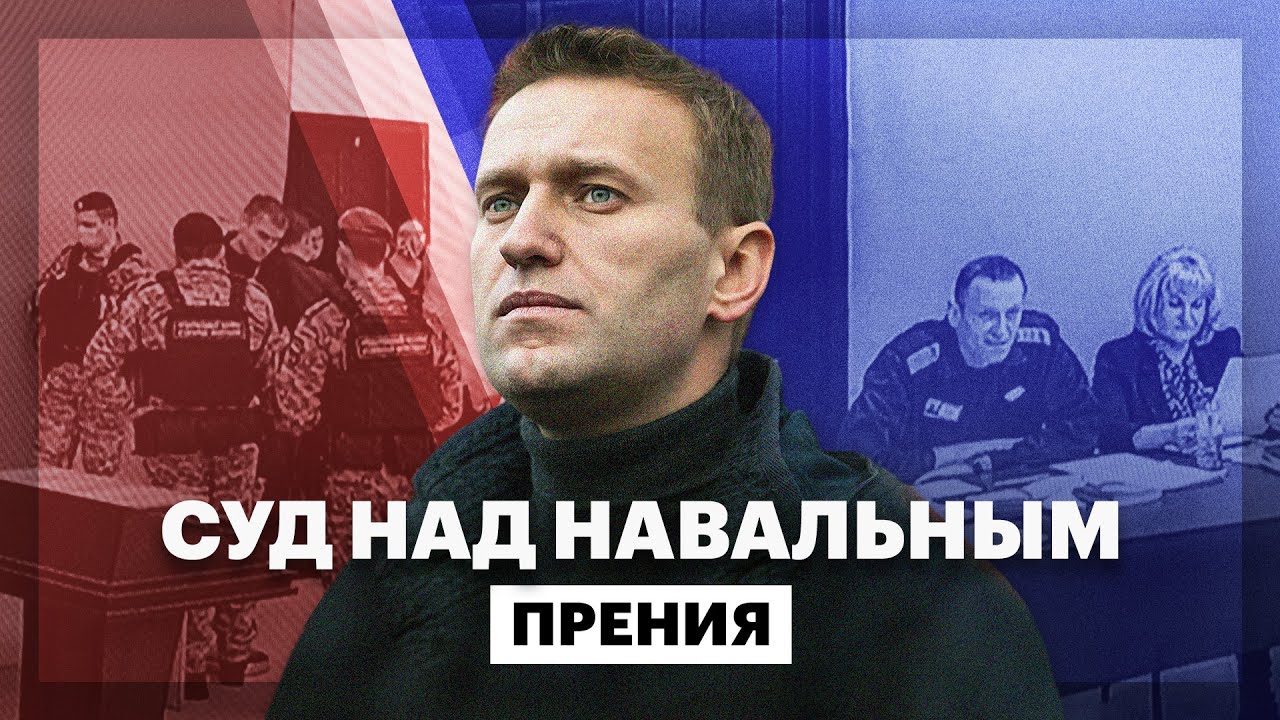
First, prosecutor Nadezhda Tikhonova repeated the charges: Navalny had raised money to fight corruption, she said, but in reality spent it on extremism — on discrediting the authorities, for example. She then listed Alexei’s bank card expenses: from 2016 to 2020, he spent a total of 8 million rubles (about US$85,000–$90,000 at recent exchange rates). From earlier hearings, we remember some of what that included — a dentist, for example, or a Netflix subscription. But this time the prosecutor went even further. “He denied himself nothing,” she exclaimed, “for example, he hired himself a driver and a press secretary!”
Tikhonova then asked the court to take Navalny’s “danger to society” into account and sentence him to ten years in prison and a fine of 1.2 million rubles (about US$13,000). Combined with his current sentence, that would amount to 13 years in total, plus another two years of restricted freedom.
Immediately afterward, the court announced a short recess. When it ended, Alexei’s lawyer, Olga Mikhailova, demanded clarification on what prison regime the prosecution was seeking. Alexei is currently being held under the general regime — meaning somewhat less harsh conditions, more care packages, and more visits. At first, the prosecutor dodged the question and refused to answer, saying she had already said everything. Mikhailova insisted, and the prosecutor then declared that she could not remember without her notes and therefore needed another recess to check!
After 45 minutes — and, evidently, a series of calls with her superiors — prosecutor Nadezhda Tikhonova finally reappeared in the courtroom and said with relief: the prosecution is seeking a strict-regime sentence.
Why strict regime? For that, a person has to be recognized as a “repeat offender,” meaning the authorities must claim he committed two similar crimes under the same article of the criminal code. And the second offense must have been committed only after he was found guilty of the first. So: Navalny is currently in prison because of the Yves Rocher case, under the fraud article. And in order to classify Alexei as a repeat offender, the prosecution had to invent not only that he had stolen donations in the first place, but also that he did so while ALREADY in prison. The prosecution said this in court with a straight face: that while in the penal colony, Navalny continued committing crimes. And now it is precisely this absurd legal trick that makes it possible to transfer him to stricter conditions.
Penal Colony No. 2, where Alexei is currently being held, does not have a strict-regime section. That means he would have to be transferred to another colony — farther from Moscow and harder to access.
Then Alexei himself spoke during the closing arguments. He said that at this stage he was supposed to express his view of the case, but he had nothing to say because there is no case at all. The investigators managed to drag four planted witnesses into court, involving a total of 2 million rubles (about US$22,000). And for that, the prosecution is asking for 13 years, even though statistically, people here usually get less even for murder.
Then the court announced another recess, after which Alexei was supposed to deliver his final statement. But in practice, he was not really allowed to do so. The video feed cut out literally every thirty seconds, so journalists could not hear what Alexei was saying, and no one else was able to record the speech.
Of course, this was done deliberately. Alexei’s final statement was, without exaggeration, the most important moment of the entire trial — his main political speech, in which he spoke about the poverty into which Putin has plunged Russia, and about the war. Putin’s lackeys simply could not allow that speech to make its way beyond the prison walls.
At the very end, the video feed briefly returned, and Alexei managed to say: “Leo Tolstoy said something profound, wrote it in his diary…” — and then the feed cut out again. But here is what Alexei said next. On June 4, 1904, Tolstoy wrote: “War is the product of despotism. Without despotism, there could be no war; there might be fights, but not war. Despotism produces war, and war sustains despotism. Those who want to fight war must fight only despotism.”
Please share this video and share these words. This is the most important thing Alexei wanted to say today. Putin is war. And if we want to fight the war, then we must fight Putin.
Alexei’s sentence will be handed down on March 22.
Places