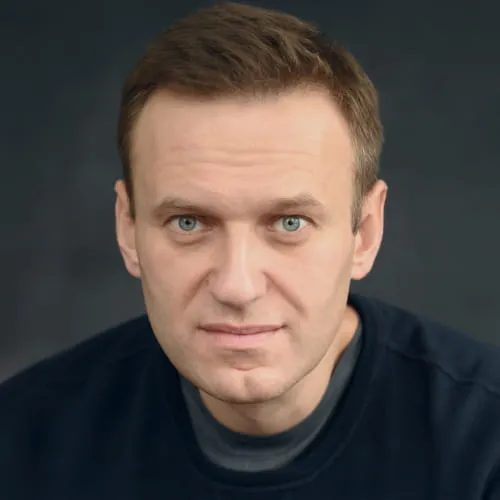
Alexei Navalny was asked to write a welcome address for the Democracy Summit in Copenhagen посвященного информационным технологиям.
Below is the text of Alexei’s letter in Russian and English:
“When I received the invitation to write a few welcoming words for a conference on democracy and technology, I thought I should do it, because I am exactly the right person for it. Information technology plays a major role in my life. My prison’s regulations state it plainly: ‘Correction of inmates through constant video surveillance and informational influence.’
So I am a resident of a small informational dystopia, with cameras and electronic locks at every turn. Except, of course, this is Russia, so the electronic locks have naturally broken down, and the doors are still opened with enormous metal keys.
I greet the organizers and participants of the Copenhagen Democracy Summit. You clearly have much to discuss.
It is a complete cliché to say that the new information world can be both a blessing for democracy and a great evil. Nevertheless, it is true. Our organization built all of its work around information technology and achieved serious success through it, even when it was operating in conditions that were effectively underground. And those same technologies are now being actively used by the Kremlin to arrest participants in protest rallies. It is proudly proclaimed that all of them will be identified even with their faces covered.
The internet gives us the ability to circumvent censorship. And yet, at the same time, Google and Meta, by disabling advertising in Russia, deprived the opposition of the ability to run anti-war campaigns, handing Putin an enormous gift.
We all have many questions. Should internet giants continue pretending they are ‘just businesses’ and ‘neutral platforms’? Can anyone go on claiming that social media users in the United States and Eritrea, in Denmark and Russia, should all operate under the same rules? How should the internet respond to state directives, given that Norway and Uganda seem to have somewhat different ideas about the role of the internet and democracy?
All of this is very complicated, very contradictory, and it all needs to be discussed. Without forgetting that discussion must also lead to concrete solutions.
We love technology. We adore social media. We want to live in a free information society. So let’s figure out how to stop the bad guys from using the information society to drive their peoples—and all of us—back into the Dark Ages.”
***
“When I received the invitation to write a few welcoming words for a conference on democracy and technology, I thought I should accept, because I am exactly the right person for it. Information technology plays a major role in my life. My prison regulations say as much: ‘correcting inmates through constant video monitoring and informational influence.’
So I am a resident of a small informational dystopia, with cameras and electronic locks at every turn. Except, of course, this is Russia, so the electronic locks have naturally broken down, and the doors are still opened with huge metal keys.
I greet the organizers and participants of the Copenhagen Democracy Summit. You clearly have much to discuss.
It is a complete cliché to say that the new information world can be both a blessing for democracy and a great evil. Nevertheless, it is true. Our organization built all of its work around information technology and achieved serious success through it, even when it was operating in conditions that were effectively underground. And those same technologies are now being actively used by the Kremlin to arrest participants in protest rallies. It is proudly proclaimed that all of them will be identified even with their faces covered.
The internet gives us the ability to circumvent censorship. And yet, at the same time, Google and Meta, by disabling advertising in Russia, deprived the opposition of the ability to run anti-war campaigns, handing Putin an enormous gift.
We all have many questions. Should internet giants continue pretending that for them it is ‘just business’ and that they are ‘neutral platforms’? Should they continue to claim that social media users in the United States and Eritrea, in Denmark and Russia, should all operate under the same rules? How should the internet respond to government directives, given that Norway and Uganda seem to have somewhat different ideas about the role of the internet and democracy?
All of this is very complicated, very contradictory, and it all needs to be discussed. Without forgetting that discussion must also lead to concrete solutions.
We love technology. We adore social media. We want to live in a free information society. So let’s figure out how to stop the bad guys from using the information society to drive their peoples—and all of us—back into the Dark Ages.”