In pre-revolutionary Russia, when a bride was married off, her family was expected to assemble a dowry. Wealthy noble families sent the bride off with chests of linens, lace, and featherbeds, as well as porcelain, silver, and icons. The most aristocratic families even included land with serfs, or sometimes a factory or securities. When Emperor Alexander II married off his daughter Maria Alexandrovna, she received 70 dresses, 40 trunks of linen, 4 fur coats, and, of course, jewelry — sapphire and diamond pieces.
Here is another example: a painting by Vasily Pukirev from 1873 titled Receiving the Dowry in a Merchant Family According to the Inventory. A clerk carefully records everything offered along with the bride, examining and appraising the dresses. Stacks of bed linen are laid out on the table, and everything is neatly packed into special chests.
In Soviet times, many of you probably remember — and may even still have — Czech dinner sets, Riga porcelain, crystal, or silverware that no one was allowed to touch: wedding gifts, a kind of dowry too. Mothers and grandmothers stood in line for hours at department stores to buy something, preferably imported. After all, you couldn’t send a bride off empty-handed.
The tradition is outdated now. It is already hard to imagine the bride’s parents literally having to pay extra or offer the groom some benefit so that he would agree to marry her. But the idea is not alien to Vladimir Putin. When his elder daughter Maria got married, her young Dutch groom landed a lucrative position at Gazprom.
When the younger daughter, Katerina, got married, her husband Kirill Shamalov received Sibur shares worth more than 11.5 billion rubles as a gift. True, later — as often happens with dowries — he had to give them back when they divorced.
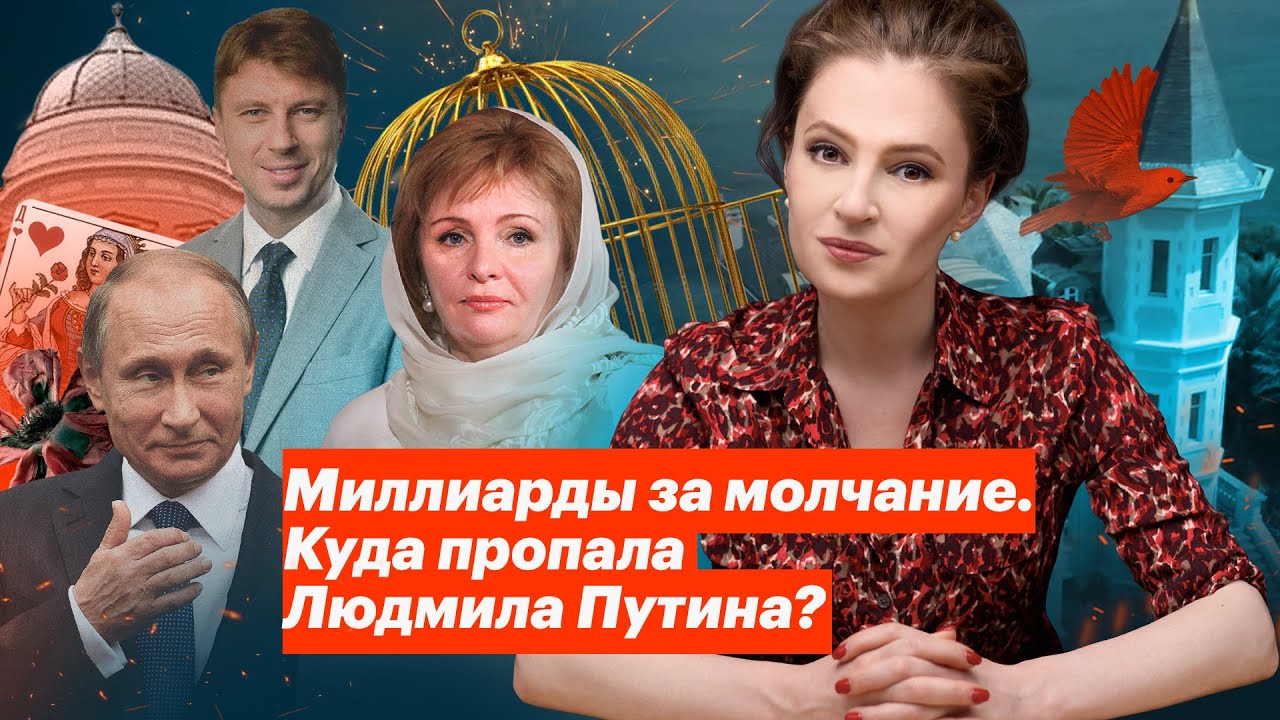
But you may be surprised: there is one more woman for whom Vladimir Putin arranged a dowry worth billions, plus an unconditional guaranteed income of several million a month, as well as apartments and villas all across Europe. Can you guess who this lucky bride is?
In 2014, during his annual televised Q&A show, the “Direct Line” («Прямая линия»), Putin said that he first needed to marry off his ex-wife, and only then think about himself. And he did. To a young, handsome athlete twenty years younger than the bride. In 2015, 57-year-old Lyudmila Putina married 37-year-old Artur Ocheretny. She began a new life.
For once, Putin was not lying: he quite literally married her off himself, assembling a generous dowry — payment for 30 years of an unhappy marriage. Payment for the fact that while Putin changed mistresses, had children with them, and showered them with elite real estate, she stood silently by his side and helped him perform the “traditional moral values” he so adores. Payment to keep her silent now.
Lyudmila and Vladimir Putin were married for 30 years, and for the last twenty of those years, their marriage was a complete and utter sham.
Lyudmila was used a couple of times a year, or even less often, as living stage decor. She would put on a headscarf and stand through a church service once a year.
And yet Putin says he is Orthodox Christian, a believer, and a defender of tradition and family values.
And it was downright absurd. Remember: 2010, the national census. A census taker supposedly came to the Putins’ home and found them in a very strange interior: an old television that probably no longer even turned on, a VCR underneath it, some little doily on the table. On a beige sofa sat two complete strangers, dressed for some reason in the same color as the sofa, straining to pretend they were a family.
This was 2010: Putin’s palace in Gelendzhik, with stucco, frescoes, and an “aqua disco,” was already nearly finished; his 57-meter yacht had already been delivered; Alina Kabaeva was already in the State Duma and flying on private jets. His daughter by his mistress Svetlana Krivonogikh was already seven years old. And on television, they showed us this modest family man.
All those years, we knew nothing about Lyudmila Putina, the first lady. Normally, a president’s spouse appears at events, accompanies her husband on trips, meets with other first ladies. Here — nothing. By the early 2000s, Lyudmila Putina had turned into a ghost. She was deliberately hidden from us, never allowed to say a word on her own, and went unseen in public for years. And even more so now: who even remembers Lyudmila Putina? Where is the mother of Putin’s two daughters now? What happened to her after the divorce? We will tell you.
Lyudmila and Vladimir Putin met at a concert by Arkady Raikin (a famous Soviet comedian) in Leningrad in 1981. Mutual friends introduced them and invited them on a double date. They dated for a couple of years, and Lyudmila Putina later said that her suitor was less than impressive — he would be hours late for dates and was constantly dissatisfied and cold.
Even so, they got married and soon afterward moved to Dresden, where Putin worked at a KGB station. Lyudmila sat at home completely alone in a foreign country with a newborn daughter, and later with two.
We can learn how Lyudmila Putina really felt about what was happening and how the Putin family lived from her letters, which she wrote by hand and faxed to her German friend. We already showed them in our investigation into Putin’s palace, but there is much more of interest there. The same goes for the book that this very German friend wrote about their acquaintance — in both German and Russian.
Everything written there inspires, above all, deep pity. Lyudmila Putina was utterly unhappy. She complained to her friend that she was basically a nobody, domestic staff, that Putin came home at night, sat around with friends, and she had to serve them food and drinks.
She wrote that she wanted to take up a hobby, make things with her hands, tried to talk to her husband about it, and he showed not the slightest interest.
When Lyudmila went to visit this friend in Germany, Putin told her on departure that the friend deserved a monument for agreeing to spend time with his wife.
That said, it should be noted that Lyudmila’s constant exiles abroad did not look entirely miserable: every year, several times over, she went to France — to the seaside in summer, skiing in winter. She also went skiing in Switzerland. And spent six weeks with her daughters in the south of France.
Wherever she went, her friend writes, Lyudmila spent insane amounts of money in boutiques on clothes, cosmetics, and trinkets. She saw no problem with this. And when Putin was offered the post of deputy press secretary to Yeltsin in 1996, she told him to refuse, because in such a job there was no opportunity for extra income.
But the events of the summer of 1998 are perhaps especially revealing. The book says that when Lyudmila learned Putin had been appointed head of the FSB, she was devastated by the news: he had not consulted her, had not asked her, and she desperately did not want a return to the old life.
She said that while Putin worked for the KGB, her life had been a nightmare and that, in essence, she had not really lived at all.
This is confirmed by her personal letters as well. Here is one written literally in those very days. Lyudmila writes that she does not understand how to go on living, that she feels as if she is slowly dying, and asks what comes after death.
This was Lyudmila’s last letter to her friend. She wrote it while on vacation on the French Riviera, then they spoke by phone a few more times, and after that they were forbidden to communicate, for security reasons. Lyudmila survived those events nonetheless; a year and a half later Putin became president, and she became first lady.
But the desire to write and share her feelings did not disappear: in 2006, she started a LiveJournal (a popular early Russian blogging platform), an anonymous online diary. Lyudmila kept it under the fictional name Lena, changing only one other thing besides her name: she knocked ten years off her age. We discovered this diary several years ago, and at first, honestly, it was hard to believe. But let us compare what Lena says about herself with what we know about Lyudmila Putina.
Let us start with the simplest things. Lena mentions that she has daughters. That matches.
She writes that one of them studies dance. That fits too.
She lived and studied in St. Petersburg. Also correct.
By education, a philologist.
A Capricorn by horoscope. Putina’s birthday is January 6, so that fits.
And then come tiny details that rule out any coincidence entirely. Lena writes that she worked on a lathe. That detail also appears in Lyudmila Putina’s biography.
She skis and plays tennis — both are hobbies Lyudmila is known to enjoy.
She went to see Ostrovsky’s The Storm at Sovremennik Theatre. Putina went too: there is an official statement on the Kremlin website.
Lena also has a white toy poodle.
And here, compare with the photos — the Putins did indeed have poodles.
Here is Lyudmila showing one of them to George Bush.
And here is another funny detail. Lena writes that she once went to a strip club on Hamburg’s Reeperbahn, naming the exact street.
And here is a passage from a book by a German journalist close to Putin, who writes that Putin, his friends, and their wives went to some erotic show in Germany in St. Pauli. The Reeperbahn street mentioned in Lena’s LiveJournal is the main street in that district.
German media also reported that in the 1990s Putin liked to have fun there, going to clubs and casinos. We do not question Putin’s fondness for striptease — the man built himself a private strip club at home.
In short, there is no doubt. And beyond the biographical facts, we learn many interesting things. For example, that Lyudmila Putina is plainly bored and has nothing to do. At first she looks for a hobby, but does not find one.
Then she gets into psychology.
Then yoga.
Every day she sleeps until one, until two, sometimes until five in the evening, then drinks coffee, and then gets bored.
And her entire LiveJournal is littered with pseudo-psychological online quizzes and discussions of their results. Your feminine archetype.
What tattoo would suit you.
Your psychological age.
What your beauty resembles.
What you smell like.
What kind of drink you are in sex.
She discusses pickup artist Alex Leslie, posts jokes that are absolutely signature Putin-style (read this one or this one), and does not understand what emoticons are.
As early as 2006, Lyudmila Putina was unable to figure out whether the 800 rubles being asked for a Christmas tree ornament meant $300 or $30. She bought it anyway and was delighted to learn it was $30.
But our favorite post is titled “Mother Russia.”
In the comments, someone who must have been clairvoyant writes that this is all just posturing for the West, and then war will begin, traitors will be hunted down, and people will be used as cannon fodder. This is 2007. And Lyudmila completely loses it. First she rushes to defend her husband. She says that his policy is independent and effective.
Then she says that teachers’ and doctors’ salaries have been raised and that a war on corruption has been declared.
There she also boasts that her information does not come from television, but from acquaintances who are directly involved in all this — you could put it that way.
At some point it is as if Putin simply took the keyboard away from her, because the comments turned into a real “Direct Line.” Someone wrote that they were not receiving child benefits, and she said that this could not be true and demanded that they write to her by email so she could look into it.
And here is another classic example — geopolitical thuggery in her husband’s style.
As for her relationship with Putin himself, there are plenty of revelations there too. She writes about various lovers and admirers while her “husband drinks her blood.”
In November 2006, some kind of critical moment clearly occurs: Lyudmila writes that she is in pain, that it is hard for her to breathe.
In those same days, she exchanges many messages with people about how to survive a breakup, about quarrels, and about freedom.
As we know, the divorce would come seven years later, and unlike the marriage — which can hardly be called successful — here Lyudmila Putina got very lucky.
Formally, under the law, when spouses divorce and their children are adults, it is simply a matter of dividing the property.
Everything acquired during the marriage — and in the Putins’ case that means literally all their property — is to be split exactly in half. But judging by the official declaration, Vladimir Putin gave Lyudmila nothing: the small apartment in St. Petersburg stayed with him, the old Niva SUV stayed with him, and even the Skif trailer stayed with him.
No personal property is listed for Lyudmila Putina in the declarations, and she did not receive half the assets. Formally, if one looks at the official documents, she was left with literally nothing.
But we know Putin well: on an annual salary of 8–9 million rubles, he somehow builds himself a palace and saves up from his paycheck for the Scheherazade yacht, worth 75 billion rubles.
His second cousin’s son — a very distant relative — owns Gazprom shares worth 8 billion rubles. Naturally, Putin also arranged a golden parachute for his ex-wife: a future dowry of phenomenal generosity. It is just that Putin did not pay for it — we did.
You all know perfectly well, dear readers: when Vladimir Putin steals, he hides behind patriotism and charity. The same happened here.
Several times in her LiveJournal, Lyudmila Putina mentions going to work. It is hard to call it real work — she arrives there around three and leaves an hour later — but still.
As soon as she became first lady, apparently as part of some minimum required public program, she was handed a public project — support for and development of the Russian language. The wording was vague: she was supposedly a patron of some foundation called the “Center for the Development of the Russian Language,” founded in November 2000.
Lyudmila attended several events, such as roundtables on children’s books and the Russian language, congratulated the winners of a Russian-language competition in Kazakhstan, held a live link-up with the ISS in France for local schoolchildren studying Russian, and even issued a stamp and an envelope in honor of her foundation. And that was basically it.
The project looked like a complete shell — clumsy PR wrapped in abstract slogans about the Russian language. Promises of socio-cultural transformation and of creating a positive image of Russia abroad. What do such phrases usually mean? Exactly: theft.
Let us move to Moscow. 9 Vozdvizhenka Street. The building in the photo is known as the Volkonsky House. The mansion was built in 1774 and for a time belonged to Prince Nikolai Sergeyevich Volkonsky, Leo Tolstoy’s maternal grandfather.
He was the prototype for old Prince Bolkonsky in War and Peace. Tolstoy himself visited this house regularly, and several scenes in War and Peace take place here.
Here old Prince Bolkonsky hosts formal dinners with Moscow generals, where they discuss the possibility of war with Napoleon — or rather, why it surely will not happen. Here Natasha Rostova meets the relatives of her fiancé, Andrei Bolkonsky, fails to win them over, and from that moment her relationship with Prince Andrei is doomed. Here, after the war, Pierre Bezukhov comes, runs into Natasha by chance, and realizes he loves her — soon they marry.
Tolstoy describes the house as old and gloomy, presenting a “majestically pleasing sight.” Inside are “old-fashioned tall furniture, enormous mirrors, powdered footmen.” This house is a true noble family seat, old-fashioned even by the standards of War and Peace.
Later the mansion belonged to the Ryumin princes, and several photographs have even survived showing what the house looked like around the turn of the twentieth century.
Pre-revolutionary interiors, furniture, vaulted ceilings, and large halls.
The mansion is unquestionably part of our shared historical and cultural heritage. After all, this is where the events of War and Peace unfold and where its characters live — probably the most famous work of literature in the Russian language. It could have made a very interesting museum.
But this building effectively no longer exists. Let us look at old photographs and compare. Here is a postcard from 1900: in the foreground is Arseny Morozov’s mansion, in the distance you can see a Kremlin tower, and that light-colored building on the right is our house.
Here is another photograph, where the mansion is clearly visible.
And here, carriages have already been replaced by automobiles. This is the 1940s; our building is on the right, recognizable by its dome.
Here is a photo from 1967: you can see our house and, in the distance on Kalinin Prospekt, the famous high-rises only just being built.
Almost twenty years later, in the 1980s, everything is still in place.
2011 — the last time we see the building like this.
And this is the building now.
It is hard to call it a mansion now; it is an office center. The building has sprouted two whole extra floors, the dome has been altered and raised upward, and now it is surrounded by walls and some kind of improvised glass balcony.
Farther up the street, another building has been attached to the mansion, somewhat similar in style, but entirely new construction.
So what happened? In both the Soviet years and the 1990s, the house was state-owned and protected as a historical monument. Everything began to change in the very first years of Putin’s rule. First, in 2001, the building was granted to Lyudmila Putina’s “Center for the Development of the Russian Language” for free use. Consider the wording: a huge building in central Moscow was handed over free of charge to the president’s wife “for carrying out tasks that help secure Russia’s national interests.”
That was also when the first reconstruction of the house began. It was paid for by the Konstantinovsky Foundation, which at the time was overseen by Vladimir Kozhin, head of the Presidential Property Management Department — in plain terms, Putin’s chief steward.
In 2005, the Presidential Property Management Department — that is, Putin — decided that leasing was not respectable enough, and the historic mansion was transferred into the Center’s ownership.
In 2006, the plot of land under the building — more than 4,000 square meters — also became the Center’s property. This time it was gifted by Moscow City Hall.
But even that was not enough. In 2010, another building was constructed next to it, covering 4,000 square meters.
When they ran out of land, they decided to grow upward. But you cannot just slap two extra floors onto a historic mansion and mutilate a heritage site. So the building’s protected status was removed in advance, in 2009. After that, they could do whatever they wanted.
By 2013, they had dismantled the southwestern corner of the house — precisely the part that had belonged to Tolstoy’s grandfather — as well as the dome, the courtyard facade, and the coat-of-arms panel on the main facade.
Heritage activists and cultural figures protested and appealed to Vladimir Putin himself to intervene and stop the construction. It did not work.
So, under the banner of protecting Russia’s national interests and defending the Russian language, the house of the grandfather of the great Russian writer Leo Tolstoy was wiped off the face of the earth.
The funniest part of this story is that amid all this mad construction and theft, they forgot about the Russian language. This public role was quite literally foisted on Lyudmila Putina. As you can see from her LiveJournal, let us say her relationship with the Russian language is not especially strong; it is clearly not her field of interest. But what is she actually interested in? Exactly: online psychology quizzes.
So in 2009, the “Center for the Development of the Russian Language” was renamed the “Center for the Development of Interpersonal Relations,” and the Center began doing completely different things. Things they themselves describe as creating conditions for solving various important socially significant issues in Russian society and fostering a favorable psychological climate in the country.
Let us look at the lectures and training sessions they offer. We will go through them in order. A master class called “Marzipan Tales”: guests are invited to learn legends about marzipan and even decorate a marzipan souvenir.
Next: a training session called “Attracting Money into Your Life” — and here they certainly know what they are talking about.
For 1,200 rubles, you can attend the training session “Women Who Run with the Wolves: The Primordial Woman in Each of Us.”
Lyudmila Putina’s Center also offers a lecture titled “Three Catch-Up Industrializations of Russia.”
And if you pay extra, after the lecture there is a VIP dinner with Pyotr Shchedrovitsky, a “methodologist” and former adviser to Kiriyenko — trendy and current.
And so on: a research group called “The Goddess in Every Woman.”
A seminar called “The Triangle of Health” for 12,000 rubles.
A master class called “Working with the Shadow: The Energy of the Magician Archetype.”
A lecture called “Solving the Mysteries of Dreams.”
It is worth noting that none of these lectures has been updated since 2018, and the latest news item on the website was posted more than a year ago.
So here is what we get: there was a foundation for protecting the Russian language. We were told that defending the Russian language was so important and difficult that it required gifting them a 7,500-square-meter building one kilometer from the Kremlin. Then the foundation completely changes its focus: no more Russian language, now it is training sessions about the goddess in every woman and a seminar called “The Triangle of Health.” But the building remains. A miracle!
It is time to meet the director of the foundation who so carefully selects these programs and organizes lectures on the mysteries of dreams. Artur Ocheretny. He is Lyudmila Putina’s husband.
Artur Ocheretny was born in Lyubertsy, in the Moscow region. When Lyudmila Putina became first lady, 22-year-old Ocheretny, according to old databases, was working for the Rossiya TV channel.
Then, in 2003, he began organizing events and celebrations, and that appears to be how he met Lyudmila.
Among the testimonials on his company’s website, you can see a thank-you letter from the “Center for the Development of the Russian Language.” It is signed, incidentally, by one L. A. Chemezova — that is Lyubov Chemezova, the first wife of Rostec head Sergei Chemezov and one of Lyudmila Putina’s closest friends. They found positions for all the wives — how enterprising.
Ocheretny stopped working as an event organizer and in 2010 became director of Putina’s foundation, which had just recently been renamed the “Center for the Development of Interpersonal Communications.” From August 2010 to the present day — that is, for 12 years already — he has remained its permanent director, under whose leadership the foundation operates.
Projects are carried out and money is received under his signature. That matters.
Formally, Lyudmila Putina has nothing to do with the foundation. She is called a curator, a patron, a trustee — whatever you like. But she holds no formal position. She is not the director, not the owner, not a member of the board. Judging by the official information, this is Artur Ocheretny’s foundation.
And it is precisely onto the foundation of Artur Ocheretny — an unknown party organizer from Lyubertsy — that money rains down from nowhere. He somehow finds hundreds of millions for reconstructing the building on Vozdvizhenka, obtains all the permits for massive construction one kilometer from the Kremlin as if by magic, and it is to his “Center for Interpersonal Communications” that sponsors line up. That is how it looked until 2015, and in 2015 the situation became somewhat clearer. Lyudmila Putina officially married Artur, changed her surname to Ocheretnaya, and everything made more sense: money was being shoveled at the new lover of President Putin’s ex-wife.
Now let us look at how the foundation’s finances work. We studied the bank transfers of the “Center for the Development of Interpersonal Communications” over the last three years. The Center’s three biggest sponsors are Moscow City Hall, Gazprombank, and Severstal, owned by Putin ally oligarch Alexei Mordashov. He also owns part of the National Media Group, whose board of directors is headed by Alina Kabaeva. Mordashov is a kind of special-purpose oligarch assigned to support Putin’s women.
Over three years, the Center received a total of 175 million rubles from Moscow City Hall.
140 million from Gazprombank.
And 100 million from Severstal.
These are the ones paying the Center for thin air. For services that do not exist. Gazprombank, the Moscow government, and oligarch Mordashov are the ones who simply, out of the goodness of their hearts — or rather at Putin’s command — hand hundreds of millions of rubles to the fly-by-night outfit of his ex-wife and her lover. And they spend it with pleasure.
From the Center’s account, they ordered Italian furniture in a style we know well, as well as lamps and decorative figurines worth 26 million rubles.
Artur Ocheretny himself issued himself a corporate card and uses foundation money to pay for restaurants, hotels in Sochi, and even purchases at the House of Porcelain.
The Center’s accounts paid six million rubles to sports coach Ivan Cheprasov.
Artur Ocheretny is literally obsessed with triathlon, constantly takes part in competitions, and the Center pays for it.
But of course, these sums are literally just pocket change, crumbs compared with the other financial flows of our Bonnie and Clyde. The only real reason the “Center for the Development of Interpersonal Communications” exists is the building on Vozdvizhenka Street.
It is almost 12,000 square meters in the very heart of Moscow, seconds from Arbatskaya metro station and six minutes from the Kremlin. The building itself and the land beneath it are worth around 10 billion rubles, and renting out this property is how our couple makes its money.
The scheme works like this: the “Center for the Development of Interpersonal Communications,” to which the state gifted this building for its supposedly vital seminars and lectures, simply leased out the entire property to a commercial company. That company is called “Meridian,” and it belongs personally to Lyudmila Putina-Ocheretnaya.
And then “Meridian” subleases the premises, collecting huge sums from tenants and keeping the money for itself. The largest tenant here is VTB, which occupies 3,000 square meters and pays Lyudmila Putina’s company 123 million rubles a year.
Sberbank is also a tenant—Lyudmila Alexandrovna receives 32 million rubles from them.
There are also plenty of smaller tenants: a pharmacy, Burger King, a debt collection agency. Altogether, “Meridian” earns more than 250 million rubles a year from rent.
“Meridian” is basically a special wallet for Lyudmila Putina. Rental income flows into it. And the “Center for the Development of Interpersonal Communications” transfers money into it as well.
In March 2019, the charitable foundation transferred 250 million rubles to Lyudmila’s company account. In March 2020, it transferred another 138 million.
Everything is neatly funneled into this company and then distributed from there. Lyudmila Alexandrovna pays herself a generous salary. Until October 2020, she was paying herself 1 million rubles a month, plus two annual bonuses of 3.5 million rubles each. Then in October 2020, she apparently decided her work was undervalued and raised her own salary to 2 million rubles a month.
But salary is not the whole story. Following the example of her ex, Lyudmila Putina helps herself to donations as well. Let’s trace it by date: on 13 March 2020, Gazprombank donates 70 million rubles to the “Center for the Development of Interpersonal Communications.”
Four days later, on 17 March 2020, that sum plus part of other donations is transferred to Meridian’s account.
And that very same day, it lands in Lyudmila Ocheretnaya’s personal account.
In just two years, Putin’s ex-wife—a lifelong homemaker who says the thought of looking for a job never even crossed her mind—“earned” 232.5 million rubles.
Lyudmila invested another 361 million rubles in the closed-end mutual fund “Gazprom-Investment,” which in turn invested in the identity verification system Verifier.
It was reported that they planned to make money from electronic voting.
In addition, she invested money received from the “Center for the Development of Interpersonal Communications” and from rental income into the microfinance company “Carmoney,” which issues microloans secured by cars. Lyudmila owns part of this microfinance business through Meridian’s stake in a Cyprus offshore company.
Apparently, issuing microloans to struggling Russians seemed such a promising business to Putin’s ex-wife that last year she doubled her stake in Carmoney—from 7% to 14.5%—by buying an additional block of shares from the company’s founder for 64 million rubles.
Lyudmila continued profiting from poverty by acquiring a stake in the company “Zaprosto!” This firm leases smartphones, offering phones even to people who have been denied credit or a loan.
Quite a family scheme: Putin makes Russian citizens so poor they need microloans just to survive until next month, and his ex-wife profits from those very microloans.
The announcement that the Putins were divorcing came in yet another strange and absurd way. First came the news that the couple had gone to the theater to see the ballet Esmeralda, and during intermission journalists from federal TV channels just happened to approach them, cameras in tow.
First they asked twice how they liked the ballet, and then came the third question: the journalist supposedly forgets all about the ballet and says she has heard rumors that the Putins are no longer living together.
It is unclear who this circus was meant to convince. The ballet Esmeralda, which they supposedly liked so much, is probably symbolic in some way. Its plot is based on Victor Hugo’s The Hunchback of Notre-Dame. But the ballet completely changes the ending. In Hugo’s original novel, the heroine Esmeralda dies tragically. In the ballet, she does not. The librettist, the French choreographer Perrot, wanted the main characters to survive and for Esmeralda to live happily with her beloved.
And so Lyudmila Alexandrovna’s divorce from Putin turned out to be anything but the tragedy she had feared. A new life began—far freer and far richer. She started making her dreams come true.
This story is an example of Putin’s hypocrisy: for years he has talked about patriotism, about the West’s terrible plots, about how Europe is decaying and impossible to live in. And what does his ex-wife do after being handed suitcases of money and married off? She buys up property in that supposedly decaying Europe. And not randomly, either, but with purpose.
Anyone who has closely studied Putin’s biography—especially the period in the 1990s when he began stealing at St. Petersburg City Hall and living large—knows that there are several places in Europe that are especially dear to him. As it turns out, they are dear to Lyudmila and her new husband as well.
Biarritz. France’s Atlantic coast, an old and very beautiful resort town. Once a retreat for aristocrats and nobility.
As you may remember from Lyudmila’s correspondence with her German friend, the Putins loved traveling to France, including here. Boris Berezovsky said that it was to Biarritz that he flew in the summer of 1999 to meet Putin, who was vacationing there, and propose that he become Yeltsin’s successor.
Back then, the Putins vacationed modestly. But 15 years later they returned to these beloved old haunts with money. At the end of 2012, Putin’s daughter Katerina and his son-in-law Kirill Shamalov bought a mansion in Biarritz for €4.5 million. Or perhaps it was gifted to them by the previous owner—Gennady Timchenko, an old friend of the president.
The villa stands right on the oceanfront and looks like a small castle. It has three stories. At the top there is a small terrace overlooking the water. In the garden, there is a pool gone green, and the owners are unlikely to be changing the water anytime soon, since the villa was recently seized under sanctions.
In December 2013, that is, six months after the divorce was announced, the Putins bought a second villa here. Or rather, to be precise, the Ocheretnys did. This magnificent 450-square-meter villa was registered in Artur Ocheretny’s name for €5.3 million—about 240 million rubles at that year’s exchange rate.
The villa is located just outside Biarritz, in the town of Anglet. It is about a ten-minute drive from Lyudmila’s daughter’s villa.
And the house stands out immediately: this Art Deco villa outshines all the neighbors. Just behind the house, very close by, is the Atlantic Ocean, and the nearest beach is only a four-minute walk away. The living room and dining room windows face the ocean, and from there you can step out onto the terrace.
According to the sale listing, the second floor contains four bedrooms, along with bathrooms and a billiards room. From the second floor you can go up to the upper terrace, framed by shrubs. There is also a jacuzzi on the roof. The Ocheretnys also have their own half-hectare garden, a swimming pool that is currently covered, and above it a small platform with a rotunda. There is also a second building on the property—a caretaker’s house, at least according to the previous owners’ original plan, or possibly a guest house.
According to local residents, the last activity at the villa was in February of this year, but after the war began both the grounds and the house were deserted. Apparently, the Ocheretnys do not feel especially safe when someone paints a Ukrainian flag on the gate and adds “Fuck Putin.”
But an unpleasant message on the fence is unlikely to stop them from traveling to such an incredibly beautiful place. Neither Artur Ocheretny nor Lyudmila is under European sanctions to this day. While Putin destroys Ukraine’s civilian population, they are still free to vacation here.
There is another place that appears in Lyudmila’s letters no less often than France. In the 1990s, the Putin family spent a full six-week vacation here with the Chemezovs, as she told her friend. Davos. And that trip was clearly not the only one—Ksenia Sobchak said that as a child she also vacationed in Davos with her parents, the Putins, and the Roldugins.
Just look at the beauty of it, those mountains... In summer, alpine greenery and crystal-clear lakes; in winter, a magnificent ski resort.
Artur Ocheretny made so much money from personal growth seminars that a year after buying the French villa, he also bought a 200-square-meter apartment in this building.
Swiss journalists reported on it for the first time this year, and the Davos secret became public knowledge. The apartment is worth 3.5 million Swiss francs, or 263 million rubles at the 2015 exchange rate.
The floor plan of the Ocheretnys’ apartment shows three bedrooms, a huge living room combined with a dining room, several dressing rooms, three showers, three bathtubs, and four toilets. And of course, a huge balcony with a wonderful view.
The views really are stunning. Right behind the apartment, just a few meters away, begins a vast Swiss mountain forest—an excellent place for walks and for finding the goddess within. There is also a blue lake nearby, where you can go windsurfing and enjoy other water sports.
So in the space of 13 calendar months, Lyudmila Putina’s new lover, the director of her foundation, blew more than half a billion rubles on European real estate. And not just any real estate, but symbolic properties in places tied to Lyudmila Putina’s warmest memories—places she would want to return to.
But there is one more place. Another country that Lyudmila had fallen in love with even before meeting Putin. By training, Lyudmila Putina is a Romance philologist specializing in Spanish.
Spain was where she and Putin liked to spend their vacations, and it was also the destination of one of their first official visits as the country’s first couple, in 2000.
And here, in Malaga, we found not one but two apartments belonging to Putin’s ex-wife. The first, the smaller one, was bought in 2011.
Artur Ocheretny, who was already director of the “Center for the Development of Interpersonal Communications” at the time and at the very least a trusted associate of Lyudmila Putina, bought an apartment here measuring 229 square meters, 60 of which are terrace space. The property is on the ground floor in Block B2.
The block is laid out so that when you step outside, you are practically right next to a large swimming pool.
In addition to the apartment, Ocheretny bought a 15-square-meter garage that same year. The auction value of the apartment was nearly €800,000, and it was financed with a 20-year mortgage—though it is hard to say why, since they clearly had the money.
Otherwise, how could Artur Ocheretny have bought another apartment in the neighboring building in 2014?
It is much larger than the first: 405 square meters, of which 214 square meters are taken up by the terrace.
On top of that, our couple bought two more garages in the new block: one measuring 40 square meters and the second 26. From the registry extract, we learn that the apartment cost €1.3 million and was also financed with a mortgage.
This residential complex, Lomas del Rey, or “Royal Hills,” is located on Malaga’s so-called Golden Mile. Residents share four swimming pools, a leisure club, and 24-hour security. All of it is surrounded by 2.5 hectares of luxurious gardens, constantly maintained by gardeners. There is a beach five minutes from the apartment, and several golf and tennis clubs nearby as well.
So in just a couple of years, the newly divorced Lyudmila Putina, who had never worked, and her new husband bought up nearly 600 million rubles’ worth of real estate. And for some reason it was all in France, Switzerland, and Spain—not in Vologda Region or Krasnodar. At the same time as the divorce, Lyudmila suddenly had so much money that she literally did not know what to do with it. She put it into investment funds and startups. She spent it on Italian furniture and coaches.
Why exactly are we giving her a building in central Moscow that will support her for life and bring in hundreds of millions a year? Why are seminars about finding the goddess, the she-wolf, the inner resource within yourself now paid thousands of times better than the work of a university professor? Why is the Moscow city government subsidizing a woman who buys houses in Europe as casually as trinkets?
What we are dealing with is outrageous injustice and disgusting hypocrisy. Putin’s friend is an oligarch, Putin’s bodyguard is a governor, Putin’s secretary is the head of Gazprom, his nephew is a Gazprom shareholder, his mistress runs a media holding. And now the husband of Putin’s ex-wife is a billionaire. People often write under our videos saying, so what, he’s the president—he’s earned it, he can’t exactly live in a shack. But excuse me, has Artur Ocheretny—who simply married the wife Putin got tired of—earned it too? And Lyudmila herself, apparently, is entitled to it for long service and for keeping quiet? As if all of them are entitled to it, and you are not.
Lyudmila and Artur Ocheretny are not on Europe’s sanctions lists. As recently as late June, Artur Ocheretny took part in a triathlon in Denmark, and in April in Finland. The only thing that changed after the war began is that Ocheretny started concealing which country he represents.
But where his money comes from cannot be hidden. It is money stolen by Putin, who supports them like Robin Hood in reverse: taking from the poor and giving to the rich. And everything we hear about patriotism, “traditional values,” and family morals is just a screen Putin has built behind which he hides while looting the country.
It is very important not to stay silent about this and to tell the truth. Help spread this investigation: share the link on social media, send it to people you know, and subscribe to our YouTube channel.
Freedom for Alexei Navalny!