
During the coronavirus pandemic, more than one million people died in Russia. A huge number of them died horrific deaths: not making it to intensive care in time, not living long enough for an ambulance to arrive, or not surviving until a ventilator became available.
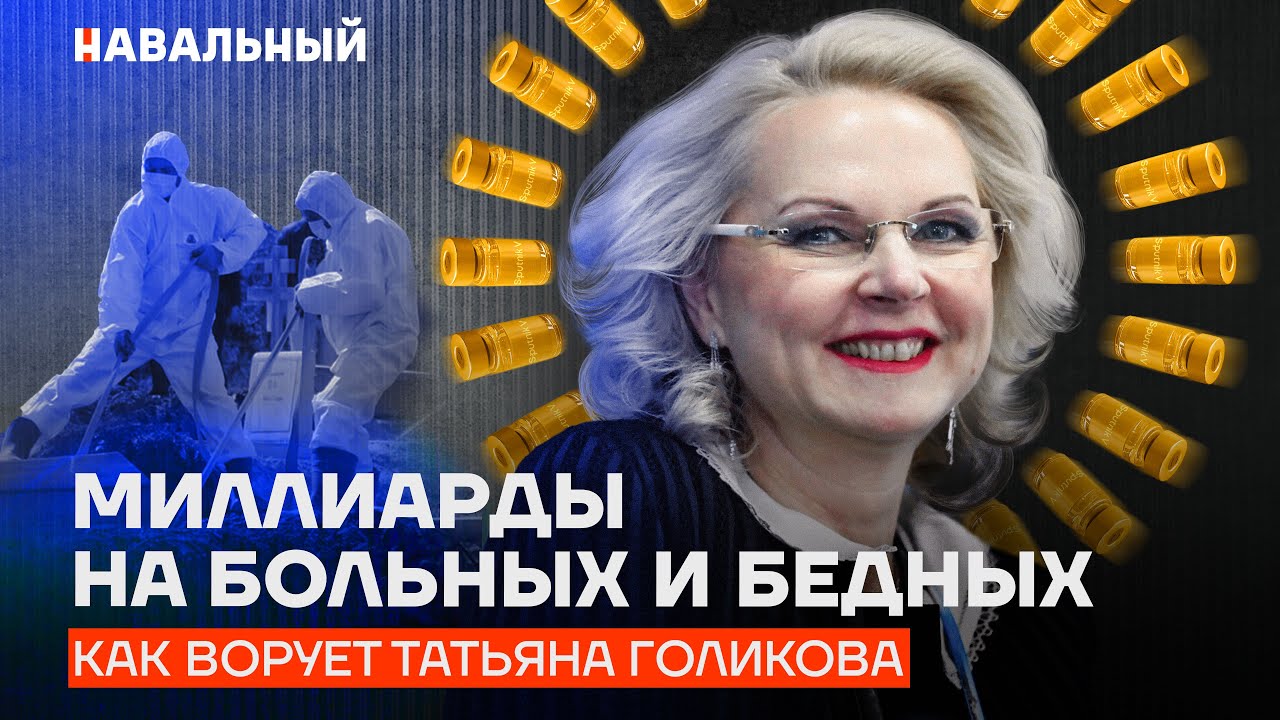
The causes of their deaths were concealed, false diagnoses were assigned, and the statistics were manipulated. Millions of people lost their jobs, went bankrupt, and saw their businesses shut down. Some families were left with literally nothing to live on. The state provided no meaningful support. Someone is responsible for this. Someone profited from it.
This is one of those rare cases that do happen from time to time: when the wildest conspiracy theories turn out to be true. When theories that seem like pure madness end up describing reality with unsettling accuracy.
Coronavirus, vaccination, Sputnik, medicines, and childhood immunizations. These are the things on which one Russian family—a family of government officials—made billions of rubles. They built a perfect system in which the head of the family, acting on behalf of the state, decides when, with what, and how we are treated, while their children profit by selling those same medicines to the state.
A flawless corruption scheme, guaranteed enrichment, the perfect crime—one our protagonist today has been committing right under our noses for years.
Tatyana Golikova, deputy prime minister. Former health minister. Head of the coronavirus response task force. The main public face of the fight against COVID—and, really, of medicine in Russia as a whole.
Every day, 3,480 people are born in the country. Every minute, right now, three babies come into the world. From their very first moments of life, they enter a complex system of medical and social care. They are examined, treated if necessary, and vaccinated against diphtheria, whooping cough, tetanus, and polio. And Golikova profits from that.
Every day, unfortunately, someone falls ill. Cardiovascular disease, cancer. These people are treated. And Deputy Prime Minister Golikova’s family profits from that too.
According to the World Health Organization, Russia ranks first in Europe for the number of new HIV cases. It is a real epidemic. Every year, 70,000 people are diagnosed as HIV-positive. They need treatment—treatment for life—and Golikova profits from that as well.
And then, of course, coronavirus. Why did Russia never get the vaccines used by the rest of the world? Why, despite millions of deaths and widespread distrust of Sputnik, were foreign vaccines still never allowed into the country? The answer is simple: because Golikova’s family makes money from Sputnik.
They make so much that they can afford to live like the richest people on earth. Flying on private jets while the borders are closed to you; sailing on yachts, indulging in expensive hobbies, and buying up villas in the most beautiful parts of Europe, where they have been spending their money for years. And so far, despite the war, nothing is stopping them from continuing to do so.
Costa del Sol Airport in Málaga—a place our protagonists know well. The private jet parking area.
For many years, this is where the official’s personal family aircraft flew in: a Bombardier Challenger 600 worth $32 million, or about 2 billion rubles.
Journalists reported in 2020 that Golikova, a government official, travels the world by private jet. It is genuinely not hard to verify: on August 29, 2018, Tatyana Golikova flew to Omsk, and this aircraft was there as well.
A year later, in July 2019, the plane heads to Murmansk. Golikova had flown there to inspect an oncology clinic.
In October 2021, Golikova was in St. Petersburg dealing with funding for Lenfilm (a historic Russian film studio), and the plane was there too.
In 2019 alone, Golikova’s personal family jet flew to Málaga at least nine times, and on three of those trips Golikova herself was on board.
And if a 2-billion-ruble jet no longer surprises you, at least appreciate the sheer hypocrisy. Golikova has headed the coronavirus task force from day one. She imposed restrictions on international flights; on February 26, 2020, she publicly urged Russians not to travel abroad unless absolutely necessary.
Two days after those words, the Golikova family’s plane lands in Málaga. Clearly, out of absolute necessity.
In March 2020, when coronavirus was raging in Italy, just a month after Golikova asked Russians not to go there at all, her plane turned up in the Italian cities of Pisa and Grosseto.
And so it went all year: we were told to stay home, while they were off to the UAE, Sardinia, Cyprus, Turkey, and France.
Russian healthcare has a full name and patronymic. It cannot be otherwise, surely. None of this exists in a vacuum. Hospitals, intensive care units, drug prices, patient wards, doctors’ salaries—these are not natural phenomena. Someone is responsible for them. And that person is Tatyana Golikova. The senior official responsible for the entire sphere of social policy: healthcare, education, and pensions alike.
A girl from Novosibirsk with cerebral palsy cannot get surgery because—believe it or not—there was no quota left for her:
Another four-year-old girl can only be saved by chemotherapy and a stem cell transplant. Her attending physician at a Moscow hospital says they do not have the necessary drug and nothing can be done. So 790,000 rubles must be raised through charity and the medicine bought abroad.
You know of thousands of cases like this yourself. Children, adults, the elderly. Everyone passing the hat, everyone trying to raise money. What is this, exactly? We are an immensely rich country—where did the money for these people’s treatment go? Where did the money go that could have kept hospitals from looking like this?
Or like this:
Golikova bears full responsibility for this.
But instead of making sure there are enough quotas for everyone and that cockroaches are not running around hospital wards, she plays Mother Teresa, the caring patroness, appearing in touching TV segments. She visits schools, cancer hospitals, hospices. There she talks to children, worries about women in labor, hugs the elderly, gives them gifts, and radiates concern with every gesture.
Golikova became deputy prime minister 4.5 years ago. Before that, she served as health minister, presidential aide, head of the Accounts Chamber (Russia’s state audit body), and deputy finance minister. In 1987, still under Soviet rule, Golikova became a government official—and she has remained one ever since: 35 years.
Few people fully grasp the scale of her current powers. She is one of the most influential officials in the country.
She has the broadest portfolio of powers: demographic policy, healthcare, education, migration policy. She is responsible for social policy—insurance, social benefits, pensions. She oversees and coordinates the work of ministries: the Ministry of Health, the Ministry of Education and Science, the Ministry of Labor, as well as Rospotrebnadzor (the federal consumer and public health watchdog), the Pension Fund, and many other agencies.
Her job is, quite literally, to make sure there are no poor people in the country, that the elderly are not rummaging through trash bins, that orphans do not end up on the street or in psychiatric institutions at 18, and that children do not have to raise money for treatment by text message; that medicines are affordable and, quite simply, actually available in pharmacies and hospitals. And she has failed at that job.
Instead, for at least the past ten years, she has been building a perfect system for personal enrichment. Let’s take a closer look.
What is this magnificence? What is this luxurious estate? Who laid out these beautiful gardens and dug these artificial ponds?
And who, for heaven’s sake, put statues of cows on the roof?
It is here, just outside Moscow, in a house measuring 1,800 square meters, that Tatyana Golikova lives—the official responsible for your and my social well-being.
And do not let it trouble you that a person whose job is to find an extra 1,000 rubles a year for a pensioner lives in a house worth half a billion rubles. Do not let the cascading ponds and waterfalls trouble you either.
Or this garage, or the servants’ house measuring 430 square meters.
In front of the main staircase, by the way, we see an interesting sculpture: a donkey harnessed to a cart. Presumably, it symbolizes Golikova’s many long years of hard work in public service.
Strange, of course: a lifetime in public service, and yet such a country estate. But do not let that trouble you either. Formally, after all, the house does not belong to Golikova, but to her husband, Viktor Khristenko.
In 2003, Golikova married her colleague, another official with a long career behind him—Viktor Khristenko. At the time, he was a deputy prime minister, and soon afterward he became minister of industry, remaining in that post until January 2012. That was exactly when they moved into this house.
At first, they hid it. And it is easy to see why: their combined annual income at the time was around 10 million rubles. The house was registered to offshore companies, while the officials supposedly rented it. In 2014, Alexei Navalny published an investigation into this, and in 2016, as if to prove us right, the house was transferred directly into Khristenko’s name. But our protagonists did not stop using offshore structures. They continue buying up real estate—only now abroad.
Golikova and Khristenko have no children together. But Tatyana Alexeyevna has a stepson, Viktor Khristenko’s son from his first marriage, Vladimir Khristenko. He is our main character today—the one on whom all the family’s love has been lavished. In abundance.
Just look at this amazing video we managed to find. It was shot in 2006, 16 years ago. Vladimir Khristenko was turning 25, and this music video was a sort of filmed birthday tribute for the big occasion. Unfortunately, the audio has not survived, so we can only imagine what is going on—but the visuals are more than enough.
It all begins with young Khristenko strolling pensively through a garden in fashionable jeans, sitting down on a bench, and discovering a book there.
It is called Rails. Pipes. Wires. The author is Viktor Khristenko—his father.
He seems surprised, starts leafing through it, looks at the pictures—and suddenly falls into medieval Rus...? He grabs a sledgehammer and starts forging a horseshoe. Sure, why not.
Next scene. A woman appears in some sort of red flamboyant getup, with a corset and ruffles, cheerfully singing something against a scenic natural backdrop.
Believe it or not, that is Golikova herself. Compare it with an old photo of the official.
Then the scenes of rural life continue: peasants are sawing a log, building a house, and Vladimir Khristenko is helping them. Golikova keeps singing merrily. They mow hay, harvest some kind of grain, drink milk.
Then comes an unexpected twist: a crowd of naked girls runs out of a bathhouse toward young Khristenko. Golikova, who at the time was deputy finance minister, keeps singing.
Then our hero wakes up, upset that both the naked girls and his stepmother in a sarafan (a traditional Russian dress) were all just a dream, and sadly walks home. What is happening here? What even is this video? There are so many questions.
Here is the explanation. The birthday video features employees and managers of the Chelyabinsk Pipe-Rolling Plant. Back in 2006, young Khristenko worked there while his father was minister of industry and energy.
Khristenko senior is himself from Chelyabinsk. He was repeatedly said to hold a stake in the Chelyabinsk Pipe-Rolling Plant; reports claimed he secretly owned it. In any case, even as industry minister, Khristenko senior visited this particular pipe plant often and regularly—and even brought Putin there.
His daddy got him a job there right after university and, naturally, straight into a senior role—as head of international projects. At 24—now that is career growth—young Khristenko became CEO of a plant subsidiary producing pipeline equipment. Two years later, at 26, he was put in charge of the company that owned the Chelyabinsk Pipe-Rolling Plant’s oilfield service assets. By 2008, our young executive was already commenting to journalists on oil and gas deals, explaining how he had acquired a drilling company in Taymyr.
Impressive, isn’t it? Clearly a gifted young man, so well versed in metallurgy—how else could he have risen so fast? There is just one “but” in this story: the moment his father stopped being industry minister, young Khristenko’s career in metallurgy ended. Instantly. He lost interest in pipe-rolling, oil, and metallurgy altogether and came under the wing of another family member—his stepmother, Golikova, who at the time was health minister.
That is how fate turned. In 2011, Golikova’s beloved 29-year-old stepson—the one for whom she makes music videos—decides to invest in pharmaceutical nanotechnology! In drug manufacturing, through a company called Nanolek. What does the Chelyabinsk Pipe-Rolling Plant have to do with medicines? Apparently, that is just how things worked out.
But that is not all. Next comes Chubais.
Rusnano becomes Khristenko’s co-investor in building a plant in the Kirov region. In other words, state money is pumped into it under grand slogans about import substitution and promises that unique medicines based on cutting-edge nanotechnology will be invented there. Chubais hails it as nearly the project of the century, and he and young Khristenko appear together in segments praising the wonders of Nanolek.
And now for the key ingredient of success. Imagine you are a real manufacturer of medicines and vaccines. How does your business work? You invest in launching a production line for a particular drug. You spend money and hope the drug will be in demand, that people will buy it. Maybe it works out, maybe it does not. But what if, before making any investment at all, you could guarantee that demand would exist—that your product would definitely be bought regardless of conditions, price, competitors, the market, or anything else? In a real, non-corrupt environment, that is impossible.
But when your stepmother is the deputy prime minister to whom the Health Ministry reports—then sure, no problem. That is the main secret of young Khristenko’s business success: an unremarkable, not especially comprehensible chart that does not look like a gold mine, but is exactly that. It is the Health Ministry’s national immunization schedule.
Here it lays out when everyone—from newborns to the elderly—must receive preventive vaccinations: tuberculosis, hepatitis, polio, everything is there. And state hospitals use this schedule to purchase vaccines. If you know exactly what will be included in that schedule—and it changes and expands—then there it is: a gold mine. The state will be guaranteed to buy your vaccine in enormous quantities and administer it to 140 million people.
The scheme works flawlessly. For example, in June of this year, for 3.4 million doses of the children’s vaccine Pentaxim, they received 3.87 billion rubles.
Overall, in the past 12 months, Nanolek has won tenders worth 12 billion rubles. In February 2016, Khristenko promised that within five years Nanolek would become the largest vaccine producer on the Russian market.
And there is another great twist in this story. A very Chubais-style twist. Just as Nanolek starts making billions from supplying vaccines for the immunization schedule, Rusnano unexpectedly sells a third of Nanolek to the other shareholders—that is, Golikova’s family—for 2.35 billion rubles, which is laughable given that the market value was around 8 billion, and exits the project. That is it: nanotechnology no longer interests them.
So Chubais spent several years fussing over Nanolek, poured Rusnano’s state money into it, lost three times as much on the sale, and in the end the state got neither money nor nanotechnology, while Golikova’s stepson got a business that brings him guaranteed billions. You can really feel the hand of an efficient Putin-era manager.
None of the nanotechnology or unique medical breakthroughs Nanolek promised ever materialized. No original vaccines or medicines were created. All Nanolek does now is localize—in effect, repackage—foreign drugs.
The story of Nanolek matters to us not just because it shows how deeply Golikova’s stepson has latched onto the Russian budget, but also because, through this company, we can understand exactly how this family hides its multibillion-ruble business empire. And uncover things even more impressive.
Here is how it works. Russia’s Nanolek is registered to a Cypriot company, Nanolek Holding Limited, which in turn is owned by two more Cypriot companies.
Then there are three more owners: the Russian company GloriaInvest, the Cypriot company PH&RE INVESTMENTS, and the closed-end mutual investment fund Industrial Investments.
The Cypriot company is straightforward: it officially belongs to Vladimir Khristenko.
And GloriaInvest is registered to yet another closed-end mutual investment fund, Management-Active.
Take note of the sheer number of these funds. They are the basic building blocks from which Tatyana Golikova constructed her corruption empire. Their essence lies in the word “closed.” In most cases, it is impossible to identify the owners; unit holders are not disclosed in Russian registries. But the fund itself can hold whatever you like—apartments, palaces, yachts, planes.
But in Golikova’s case, we managed to crack this clever scheme. The Industrial Investments fund belongs to that same Cypriot company owned by Vladimir Khristenko; the company itself disclosed this in its reports. And the Management-Active fund belongs to them as well. Such a complicated structure, and yet it all still leads back to the same family.
Hiding all your secret assets in closed-end mutual funds is, of course, a clever idea—but not quite clever enough. The thing is, while a Russian mutual fund can conceal its owners, by law it still has to report what the fund itself owns. It must publish online a full list of the fund’s assets and their financial valuation.
For example, the Industrial Investments fund owns shares in the Cypriot company Epidbiomed Group Limited and values them at 5.6 billion rubles.
And it was in exactly such a report from one of the Khristenko family’s funds that we found perhaps the most sensational discovery of all. What many had suspected: Golikova’s family has a stake in Generium, the largest producer of the Sputnik V vaccine. Rejoice, conspiracy theorists!
Let us move to the Vladimir region, Petushinsky District. Here is Penal Colony No. 2 in Pokrov, where Navalny served the first year of his imprisonment.
And here, just 7 km (about 4.3 miles) away, is a place far more pleasant and polished. This is the facility of Generium, a company that develops and manufactures medical products.
A vast site, 15,000 square meters of production space, more than 1,000 employees—this makes Generium one of Russia’s largest pharmaceutical companies. Especially good times came for the company in 2020: its net profit jumped from 10 billion to 65 billion rubles—only slightly less than the entire budget of the Vladimir region. The secret of such fantastic success is simple: Russia was carrying out mass coronavirus vaccination, and Generium became the largest producer of the Sputnik V vaccine. In a single year, they produced between 200 million and 300 million doses of Sputnik, developed a nasal vaccine, and sold tests.
And as we found out, Golikova’s stepson holds an option on 8.33% of this company. That means he can transfer that stake to himself at any moment—or sell it for nearly 5 billion rubles, which is how much those shares are valued at.
Another major shareholder in this company is Viktor Kharitonin, owner of the pharmaceutical giants Pharmstandard and Otisifarm.
They produce, among other things, Arbidol. Remember Golikova’s old nickname: Madame Arbidol. She earned it for shamelessly lobbying this pseudo-medical drug, for which no real evidence of effectiveness exists.
Golikova was not merely suspected of ties to Pharmstandard—she was even investigated in the State Duma (Russia’s parliament). But at the time, a presidential representative assured: no, we checked everything. Golikova and Arbidol are not connected in any way.
And we have now proved that they are connected—very much so. The family of Deputy Prime Minister Golikova, who is responsible for healthcare, is in business with one of the country’s largest drug manufacturers, including the maker of Arbidol.
And with that same Kharitonin, young Khristenko also has a business in Kazakhstan. He owns 12.5% of the Kazakh company NeoTechPharm.
That company owns the Karaganda Pharmaceutical Complex, which has a monopoly on producing Sputnik V and Sputnik Light in Kazakhstan. And of course, it also sells Arbidol.
Business, mutual funds, offshore companies, factories, pharmaceutical firms—all of this is terribly boring, and we are sure Khristenko and Golikova themselves are not especially interested in it. It is about money, not pleasure, not true love, not a calling.
It all began in February 2012. Viktor Khristenko had only just left his post as minister of industry and trade. You can probably imagine it yourself: a big, important phase of your life has ended, you feel a little lost, you do not know what to do with yourself, and you no longer have to go to work. And—as Khristenko himself said in an interview—he found himself a hobby. From February to May, he shut himself away with a coach in a special black room—a golf simulator—and practiced. Khristenko became so absorbed in the game that by May he was already out on a real course.
The interview was recorded at the end of 2016, meaning about four years had passed since the black room. By then, media mentions of Khristenko could already be found naming him the winner of the Big Spindle 2014 tournament. In 2015, Khristenko was elected president of the Russian Golf Association.
The hobby had obviously gone quite far. In 2016, construction began on a small private golf course at Khristenko and Golikova’s country estate. Right in the yard.
A year passes, and the hobby turns into—not a professional career or a championship title—but a business. In February 2017, through his companies, Khristenko bought three golf clubs in Russia at once.
The first and most luxurious golf club, covering 78 hectares, is called Pestovo, and it is located right behind the fence of their country estate outside Moscow.
Pestovo Golf Club consists of an 18-hole course measuring 6,685 meters in length. The club also includes residential houses and apartments, an equestrian center, and a yacht club. And, of course, the enormous clubhouse itself.
They describe themselves as “a corner of Victorian England in the company of an elite circle.” If you ever think of visiting, keep in mind that it is a closed venue—you cannot simply walk in off the street and buy a membership. Membership there, as stated on their website, is a lifelong privilege. And that privilege, by the way, costs from 2.5 million rubles.
There is another golf club, a more democratic one. It is called Forest Hills, and annual membership there costs 200,000 rubles and is available to anyone willing to pay that much.
The club is located in the Dmitrov district of the Moscow region, about an hour and a half from central Moscow, and covers 42 hectares. It has a chalet-style golf center with a restaurant, locker rooms, showers, and rental facilities.
And the third Russian club is not in the Moscow region but outside St. Petersburg. It is called Peterhof Golf Club. It is the only 18-hole course within St. Petersburg city limits that meets world standards. The owners themselves describe the course as charismatic, whatever that is supposed to mean.
In fact, this club is the most modest of them all. There are no “Victorian-style” houses here as there are in Pestovo. The restaurant is a tent, and the other buildings look temporary.
But there is a great deal of land here—86 hectares, more than at the other clubs. And this land is genuinely precious. The club was not named Peterhof for nothing: it is only 4.5 km (about 2.8 miles) from Peterhof Palace and the same distance from Putin’s residence, the Konstantinovsky Palace.
And here we have yet another bureaucratic miracle. From 2009 to 2017—the period when the golf clubs were purchased—Viktor Khristenko earned 164 million rubles. We know this for certain from his wife’s declarations. A huge amount of money: 18 million rubles a year, 1.5 million a month. Enough to buy a fine house and even occasionally rent a business jet for vacations. But it is nowhere near enough to buy three golf clubs whose value can be estimated at 7 billion rubles.
This is how the official Khristenko reinvents himself. No more public service, no more dreary government offices. This is real life: a magnificent, expensive sport that opens doors to any social circle and lets you live a beautiful, measured life.
Chelyabinsk metallurgy? The Ministry of Industry? Pipe-rolling? Oh, forget all that. He is a noble and refined gentleman. He is developing golf. Building golf courses with a corner of Victorian England. Let us talk about handicaps and the quality of the grass by the 16th hole—not about how he and his wife, two government officials, stole billions while in public service. Very convenient.
As nice and beautiful as the golf courses in the Moscow region and near St. Petersburg are, they have one huge drawback: they are covered in snow for most of the year.
But our enterprising golfer Khristenko came up with a solution. It is unconventional and entirely in the spirit of Putin’s bureaucratic elite: Khristenko built himself a golf club where the sun shines almost every day.
This is the far south of Spain, on the Mediterranean coast. The grand golf complex before you is the property of Tatyana Golikova’s family. It is all part of San Roque Golf Club: 500,000 square meters of land, two 18-hole courses. The club opened in 1991 and has since earned a reputation as one of the best golf courses in Spain.
The Khristenko family bought this club in 2017, and at the height of the coronavirus epidemic in 2020, Viktor Khristenko launched a massive renovation here: ponds were drained, the entire turf was relaid, and trees were literally transplanted from one place to another. The course reopened in June 2021. In addition to the courses themselves, the club includes a restaurant, shops, an equestrian center, and of course a huge clubhouse, right there in front of you.
There is also an impressive two-story villa here, measuring roughly 1,200 square meters. Khristenko got it together with the golf club, simply as an extra. For this family of Russian officials, however, the villa turned out not to be luxurious enough, and now it just sits there unused.
Golf is not just a club and a ball. It requires extremely expensive infrastructure, extremely expensive land, lots of staff, lots of carts. In 2019, Spanish newspapers wrote that a Russian “magnate” was buying the golf club. Khristenko simply did not explain to them that he had spent most of his life in public service and was, of course, no magnate at all. According to his declarations, he does not have enough money not just for this club, but even for a single house in this area.
Golikova and Khristenko’s golf business in Spain is valued at €40 million. Not their personal real estate, not their country houses or villas—just the courses and infrastructure. Converted into rubles at the time of purchase, that is nearly 3 billion. In other words, three times more than Russia’s second-largest city, St. Petersburg, spent on repairs to all its hospitals and maternity wards in 2021.
Here is something else interesting: a third generation of golfers is growing up in Golikova’s family. Khristenko’s granddaughter is only 12, and she is already making great strides in golf.
She competes in tournaments in Venice, Scotland, and the family’s own San Roque, which wishes her success in competitions on social media.
She is practically a local here; at least on social media, she says she lives in Marbella, the nearest major city to San Roque. For 35 years, Golikova, together with Putin, has been building for us a stable, prosperous Russia. And yet both Putin’s family and Golikova’s family prefer to live anywhere but Russia.
The Spanish golf club is managed by the same company that runs Khristenko’s clubs in the Moscow region and near St. Petersburg—Golfestate. It belongs personally to Viktor Khristenko.
But that is still not all, because there is always more money to be made. The golf club is now expanding and turning into a resort destination: five new villas are being built here. The first of them will be available to rent as early as next April, while the others are still under construction.
The price for one night is €1,400. The money will go to the Khristenko and Golikova family.
These are very beautiful villas—each has five bedrooms, a swimming pool, a gym, and a view of the sea from the upper balcony. And all of it, naturally, is right on the golf course: just step outside and play. How wonderful it must be, after snowy Moscow, to come here and enjoy the glorious Spanish weather, the warm sea, and good food.
As luxurious as these villas are, they are not luxurious enough for our protagonists today. These villas are for the golf club’s clients, while Golikova and Khristenko have already built themselves an even more impressive residence elsewhere.
Nothing in Spain is registered directly to this couple—they put everything under funds and foreign companies, which makes it easier to hide their assets. But we got a useful lead from the same Spanish outlet that reported on the golf club purchase. In another article about Khristenko, citing its sources, it reported that he had acquired a luxury villa worth €10 million. It even gave a fairly precise location: the elite gated residential complex El Mirador, consisting of six houses.
We found it. So far there are only four houses there—two have not yet been built. But the completed ones look utterly luxurious, and each has its own name. Here is Villa Vela, with a 1,500-square-meter house priced at €9.2 million.
Here is Villa Tucana, roughly the same size and price, and another one is Villa Dorado, with an area of 1,300 square meters and a price tag of €9.7 million.
And here is the most expensive villa in the complex. Its name is Villa Infinita, and its plot covers a full hectare. It costs €18 million, or about 1 billion rubles.
This enormous circular house stands on a large 10,000-square-meter plot. The house itself measures 2,500 square meters and has three levels. And as you step outside, you are greeted by a magnificent outdoor pool.
At the very top level of the house there is a lavish terrace measuring 890 square meters. Perhaps this is where Khristenko likes to sunbathe from time to time, and not only on the golf course, among the palm trees and other exotic plants.
In fact, there are trees everywhere here. The house is surrounded by abundant greenery, flowers, and small manicured gardens. All of this is obviously tended daily by local gardeners. There is even an artificial stream with a small stone bridge over it. The beauty is outrageous.
Inside the house there are no fewer than ten bathrooms, five guest bedrooms, and one master bedroom. Naturally, it also has an indoor pool, a spa complex, and a gym. All of it with wonderful views of either the city or the vast garden.
In the garden, besides the many places to relax, there is also a small golf course. Perhaps in case Khristenko ever grows bored of his other enormous golf complexes.
And here is the best part. The Khristenko family registered ownership of this villa in mid-February 2020.
Yes—at exactly the time when Golikova was urging Russians not to travel anywhere unless absolutely necessary, they went here to process paperwork.
The situation is quite unusual, even strange. The villa is in Spain, the officials are Russian, yet it is registered not to a Spanish, Russian, or some Cypriot company, but to a Portuguese one.
To be honest, this is almost the first time we’ve seen anything like it. What makes it even more interesting is that the company’s address is not some generic business center, but another villa—right on the coast.
So now we move to Portugal. Figueira do Guincho is a small village on the Atlantic coast, about 40 minutes from Lisbon. It is here, in this village, that the company owning Golikova and Khristenko’s villa in Spain is registered.
You can’t see much from behind the fence, but in fact there is a luxurious villa with a swimming pool there, with its own name: Casa do Guincho.
It is registered to another Portuguese company, Evrica Management, S.A.
According to the beneficial ownership record, it belongs personally to the younger Khristenko.
Their villa stands on a 4,300-square-meter plot. The main house is well hidden not only by a fence, but also by tall, lush trees surrounding it on all sides.
What stands out immediately is the terrain of the plot. It is very hilly, and at the very bottom the Russian officials carved out their own small pond with a bridge in the rock and surrounded it with palm trees. Right next to it is the entrance to some mysterious cave. A perfect place to hide a couple of chests of gold.
The house has an area of about 1,100 square meters. It has three floors, and inside there are five bedrooms with huge floor-to-ceiling panoramic windows. To the right of the house is a 20-meter swimming pool. Even in the owners’ absence, it is filled with water and waiting for guests. Beneath the pool and the wooden deck is a room of unknown purpose. It has five windows and its own separate entrance.
And now to the villa’s main attraction—the view from its windows. It is stunning. Golikova and Khristenko can step out onto the balcony, breathe in the ocean breeze, and admire the cliffs, the waves, and the endless expanse of water.
To our undisguised surprise, this villa was purchased as long as ten years ago. At the time, Khristenko’s son—the owner—was 31 years old, while the elder Khristenko had just left his post as minister of industry and trade. His wife, Tatyana Golikova, was then serving as a presidential aide. And they somehow had at least €1.2 million—the book value—to buy this vacation home in Portugal. This wonderful Portuguese villa was purchased on December 20, 2012, by a company owned by Vladimir Khristenko.
But the purchases did not end there. On the same day, another Khristenko company bought yet another villa. The second villa cost more and is located eight kilometers from the first.
Let’s move to the neighboring resort town of Cascais, even closer to Lisbon—just half an hour by car. It is a very touristy town. There are lots of yachts along the shore, some kind of floating amusement park, and of course a magnificent sandy beach.
This town is one of the most prosperous places in Portugal, home to the most expensive real estate in the country. It is full of restaurants, bars, and historic buildings. And there, just ahead, only 250 meters from the beach, we found the second Portuguese villa belonging to Tatyana Golikova’s family. They own this three-story villa with a pool, about 800 square meters in size, with five bedrooms. The price of this luxurious villa is €3.5 million.
Do you know what else the Golikova-Khristenko family spends the billions they earned from children’s vaccines and HIV medications on? When you already have everything—villas in two countries, golf courses, planes, country houses—where else can you put the money? Maybe send lots of text donations and save a child, or give it to some other charity? Maybe they built something to support vulnerable people—an orphanage, for example, a care home, or a nursing home?
No. They follow the Putin-era formula, tested over decades: earn in Russia, spend abroad. Even if you already have more foreign real estate than you know what to do with, just keep buying and buying. We head to the French Riviera, to Saint-Jean-Cap-Ferrat, near Nice.
In 2019, Vladimir Khristenko’s Cypriot company invested €51 million, or nearly 4 billion rubles, in the reconstruction of the five-star La Voile d'Or hotel and the adjacent Villa Ave Maria.
The reconstruction documents reveal what is planned for the site of the hotel. The hotel, built in 1925, and the adjacent villa are to be completely demolished and rebuilt from scratch—only much larger and more luxurious. The future eight-level hotel will have a total area of 7,202 square meters. It will contain 24 luxury apartments, a wellness and fitness center, shops, and an underground parking garage with 72 spaces.
This is what the hotel looks like now.
And this is what it will look like after reconstruction:
Golikova and Khristenko’s interest in the hotel business is not limited to France. Recently, they acquired a hotel in the very center of Moscow.
In April 2022, the building of the four-star Marco Polo hotel on Spiridonyevsky Lane—by Patriarch’s Ponds in Moscow—was put up for auction. The hotel has an area of 6,000 square meters. And it was not just the bare walls that were being sold: everything was offered “turnkey,” including appliances, textiles, tableware, decorative and interior elements, furniture, and gym equipment. Everything was included in the price.
The winner of the auction was Management-Invest, with a bid of 2.745 billion rubles.
This company belongs to Khristenko’s closed-end mutual investment fund, Management-Active—the same one that owns a stake in Nanolek. The company is managed by an employee named Elena Bubnova, who also works at Viktor Khristenko’s personal company, GolfEstate.
But their commercial real estate holdings do not end there. The fund owns Stoleshniki LLC, and the estimated value of its assets is nearly 2 billion rubles.
Behind that huge sum stands a beautiful four-story building in the very center of Moscow, on Stoleshnikov Lane.
It is the former income house (a pre-revolutionary apartment building built for rental income) of the merchant Karzinkin, built in 1883 in the Neo-Russian style. Of the building’s total 7,500 square meters, Khristenko’s companies own 6,400. Anyone can rent from the family of the deputy prime minister responsible for fighting poverty an office for 200,000 rubles a month or retail space for two million.
Journalists found another investment by Khristenko’s son in documents from the Cypriot government—a dataset on 2,500 people who applied for Cypriot citizenship in exchange for investment, which costs at least around €2 million. Here is the application by Vladimir Khristenko and his wife for Cypriot citizenship; the application was approved, and Khristenko’s son and his wife successfully became Cypriot citizens.
To calculate everything accumulated over a lifetime by this family of two officials—Tatyana Golikova and Viktor Khristenko—takes serious effort. A plane, a golf club in Spain and three golf clubs in Russia, villas in Spain and Portugal, property on the French Riviera and in Russia, investments, stakes in pharmaceutical companies. We even counted exotic items like the depository receipts purchased by their investment fund.
Just out of curiosity—it is interesting, after all, how much Tatyana Golikova and her husband managed to steal over their lifetimes. Our total came to 50 billion rubles. And that is most likely the lower bound: only what we were able to find, prove, and calculate. The real figure is much higher.
Twenty-three years ago, in 1999, Vladimir Putin—then still prime minister—published a programmatic article titled “Russia at the Turn of the Millennium.” It was about the plans with which Putin was entering the presidency for the first time, and what Russia would become under his rule.
How many times did we hear that afterward. We never did catch up with Portugal—not by 2015, not by 2022. GDP per capita is still half as high. And instead of developing the economy, investing in science and entrepreneurship, and catching up with Portugal, our young fellow citizens are now dying in the senseless criminal war that Putin started.
Golikova—the person whose job is to care for our pensioners—cares not about them, but about herself. She, not the people she is responsible for, has the means to come to Portugal and live in one villa worth 200 million rubles, or another one, or perhaps in neighboring Spain in yet another villa worth a billion.
And it is specifically because of Golikova, not anyone else, that our social policy is structured so that the older generation has to think about how to pay utility bills and not starve at the same time—instead of how to live with dignity.
We calculated the Golikova family’s assets at 50 billion rubles. None of you can really picture 50 billion. But let’s just break it down. Take, for example, a newborn boy with a heart defect: he needs 500,000 rubles for surgery to survive. Golikova’s wealth would cover 10,000 such operations. Or you have probably heard of spinal muscular atrophy—a rare disease that is barely treated in Russia. To stop the disease, a child needs an injection that costs 120 million rubles. That is an enormous sum; families raise it with help from the entire country. Every year, 200 such children are born in Russia. Half of Golikova’s money would be enough to treat them all. Her money would also be enough to build 10 huge hospitals with 500 beds each, or 50 new clinics, or maternity hospitals. Tatyana Golikova’s personal fortune is greater than the entire healthcare budget of Sverdlovsk Region; it equals five annual medical budgets for the whole of Kaluga Region.
We very much do not want this investigation to become just another video about corrupt officials. Our central figure is someone who for years has been responsible for other people’s lives—for how long they live, what their lives look like, their incomes, their pensions, and their old age. She bears responsibility for your relatives and acquaintances who were not treated, whose ambulance did not arrive in time, who often died decades earlier than they should have.
Tatyana Golikova has failed at her job. And now we at least understand what she was busy with—her stepson’s business, her husband’s golf hobby, and her own Spanish-Portuguese lifestyle. We cannot force Putin to fire Golikova—she is his loyal foot soldier and permanent aide. But we will do everything we can to ensure that the criminal Golikova and her family are placed under every possible sanction and stripped of their multibillion foreign assets. So that they can never again vacation or receive medical treatment in the West, and so that they lose their precious business. Unfortunately, that will not in any way compensate for the damage Golikova has done to our country, but it is something that together with you we can achieve right now.
We at the Anti-Corruption Foundation will demand Golikova’s immediate inclusion on sanctions lists. And please, support our work. It is very important that this particular investigation be seen by all those whose interests Deputy Prime Minister Golikova supposedly protects, so that they can see with their own eyes her houses in Spain, golf courses, planes, and Portuguese villas. Because this is money stolen from you.
Freedom for Alexei Navalny!