Moscow. A wonderful city that, let's be honest, really has become very beautiful. A progressive mayor, a progressive government, an urbanist paradise of parks and public spaces. A city where, in some places, it even seemed like there was freedom. Art, creativity, and even a measure of free speech.
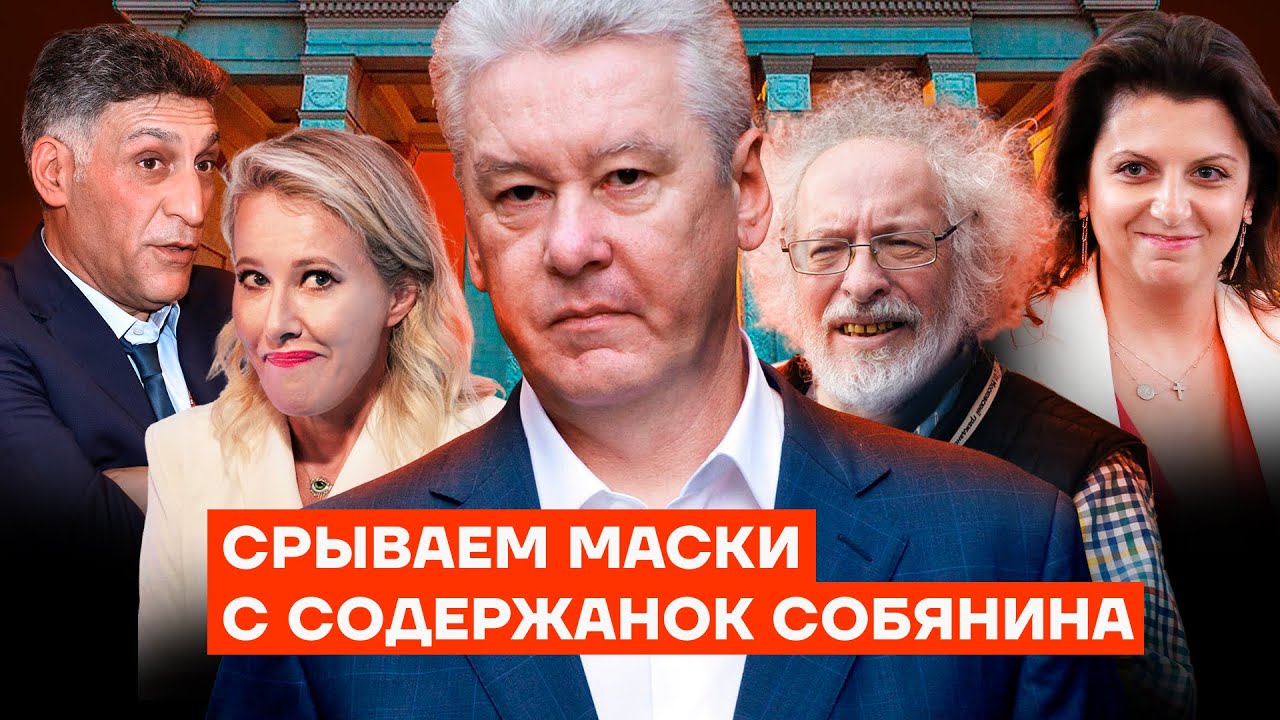
For that, one might have thanked Sobyanin—after all, Moscow has become so much nicer, hasn't it?
The creative intelligentsia and high society sing his praises. He can't be that bad, right? What exactly are you unhappy about? Look at this park, look at this embankment! So much has been done for the city. Don't forget that this September, when Sobyanin runs for a third term.
You could probably thank Sobyanin, since television tells us he beautified courtyards, built playgrounds, libraries, and cultural centers. But we are not going to do that, and no one else should either.
Because all this Sobyanin-style liberal splendor is a fiction, an illusion—or rather, plain fraud. Under the banners of beautification, cultural clusters, and various IT hubs, they stole enormous amounts of our money. And they spent it on finally destroying elections, bribing so-called liberal journalists, wiping out the last political freedoms, all while distracting us with parks and benches.
And while we admired them, we very quickly found ourselves in an impoverished country, with political prisoners scattered across prisons, with cops beating children and stuffing them into police vans. In a country that has been waging a criminal war for a year, where a single word against it can land you behind bars for a decade.
This did not happen by itself. Not all at once. And not by accident. It was a deliberate plan by United Russia. A policy Putin pushed for two decades. And he was helped by people you know very well.
There will be no palaces or yachts in this investigation. You will not see sweeping shots over expensive villas and olive groves. What you will see instead are corrupt people who seemed to many of you like decent, familiar figures, but who—whether out of greed or compromise—ended up deeply entangled in a filthy corruption scheme that is robbing us and destroying our country and our freedom. But let's start from the beginning.
When Sergei Sobyanin was “elected” mayor of Moscow in 2018, the centerpiece of his campaign was the My District program.
If you live in Moscow, you've seen this logo a hundred times and heard that it is one of Sobyanin's achievements.
What exactly this thing called My District is is not really clear. Sobyanin promises everything under the sun—from courtyard improvements to building new clinics and renovating housing.
All of this is supposedly done in accordance with the requests of Muscovites. In other words, someone writes to Sobyanin: there's nowhere to walk my dog in my neighborhood, build a dog park—and Sobyanin builds one.
But all of this is organized in a very strange and suspicious way. These things are built using Moscow's budget, yet the program itself, My District, is carved out as something separate. A separate budget, a separate legal entity.
A huge chunk of city spending—the most obvious and logical kind of spending—was put into a separate slush fund and handed over to an organization that does not have to disclose any data or hold official procurement tenders. It is accountable neither to municipal deputies nor to anyone else except Sobyanin himself.
The political design here is obvious. You and I understand that rebuilding roads, constructing schools, and improving courtyards and parks are already the mayor's job—that is what our taxes are for. But publicly, it can be presented very differently. That bench with a swing wasn't installed with your money; Sobyanin gave it to you as a gift. It's all thanks to him. Vote for him. So My District turns out to be a PR machine.
But this program has a second meaning too, one far more important. My District, which looks like a harmless urban initiative, is in fact Sobyanin's off-the-books fund and the off-the-books fund of United Russia in Moscow. City Hall transfers money there—huge amounts of money: in 2021 alone, nearly 14 billion rubles.
And then, completely unnoticed, that money is spent on Sobyanin's personal whims. On PR, on the familiar pamphlets about how much better Moscow has become, and—sad as it is to say—on fake opposition figures; on corrupt journalists and politicians who have been on the mayor's payroll for years.
Ahead of this year's Moscow mayoral election, we examined more than 100,000 bank transactions from the My District program over three years. And we uncovered one of the most striking schemes for siphoning off the city budget.
“Parasites” is one of our best-known investigations, published in 2020. Back then, Alexei Navalny explained how two propagandists—now among the chief cheerleaders for the war—were making insane amounts of money producing just one very lousy TV show, International Sawmill.
The show consists entirely of terrible jokes, insults, profanity, toilet humor, and praise for Putin. And our investigation showed that the scriptwriter (Simonyan) and the host (Keosayan) were getting more than 4 million rubles each per episode.
That money came from state companies, and our heroes were parasitizing them by selling the same show twice and cashing in on advertising. After our investigation, this family corruption scheme involving ads stopped working. Excellent.
But as happens in nature, when a parasite has done its work and there is nothing left to take from the host, it starts looking for a new one—a new source of nourishment and life. The same happened with our crook-propagandists: they found a new home, a new ant to latch onto and drain for their own benefit. To suck out every last budget ruble.
And that host is the budget of the city of Moscow.
Take a look (sorry you have to watch this filth, but it's necessary for the investigation): this is Margarita Simonyan's new show, called WTF (ChTD in Russian).
Margarita sits at home on a couch and every week pontificates on what she sees as the main issues: how brilliant Putin is, how he will destroy Ukraine, how Russia is really fighting NATO and will soon win.
She even claims that the Russian army already took Kyiv. In a week. More than a year ago. No one noticed, but that is the reality she broadcasts to her audience on Rutube, VKontakte, and wherever else this show is aired. Maybe someone will believe it.
Let's step away from Margarita's world of sick fantasies and watch one of the episodes in full. Total runtime: about 20 minutes. First segment: Simonyan revels in the bombing of Kyiv, clearly very proud of it. She calls Ukraine's leadership “stoned drug addicts” and threatens that things will be explained to them in terms they will understand if they don't get it. Then come shots of corpses being dumped into a pit.
Then it all suddenly cuts off, and out of nowhere a velvet-voiced announcer tells us about the Park Gallery, where you can visit the exhibitions Genealogy of Communities or Timiryazev Drift.
Next segment: Margarita celebrates Surovikin's appointment and says Ukraine is just about finished!
Another ad break, and again that same voice tells us the opening hours of the Polar Star sports and wellness center. There, “the water purification process is computerized,” and sports competitions are held for senior citizens!
Third topic: Simonyan explains how under Peter the Great, draft dodgers had their estates confiscated and given to informers, and hints that the same should be done now to those who do not go to the front.
And at the end, that familiar voice once again invites us to the flagship My Documents public services center at Voykovskaya. More than 280 types of services!
Next episode: Simonyan talks about how Ukraine supposedly planned to seize Crimea in 2023, and how good it is that Russia started the war.
Margarita's monologue is interrupted by an ad for a children's arts school in Kuskovo. Choral singing, a concert hall, art for children.
Then Simonyan says we will settle everything with missiles, since the Ukrainian authorities did not want peace. And right after that comes an ad block for a Moscow market: fresh vegetables, sweet fruit, come on by.
Sometimes it reaches the point of madness. In this episode, just twenty seconds after an ad for a children's music school inviting viewers to discover the mysterious world of music, Simonyan—smiling bloodthirstily—shows uncensored footage of a Wagner mercenary convict having his skull smashed with a sledgehammer. Naturally, she does not condemn Wagner's boss, Prigozhin, for it.
At first we thought this was some kind of public-service obligation. You can hardly even call it advertising; these inserts make no sense. They are all written from the same template, saying utterly banal things like, we have a music school in Biryulyovo, come visit. It is very hard to imagine that even one resident of Biryulyovo, after watching Simonyan's video about “Ukro-fascists” and the execution of a Wagner fighter, suddenly realized there was a music school right outside their window and rushed to enroll their child in solfeggio classes.
But the story starts making more sense if you look at the neighboring videos—namely, the shows of Margarita's husband, Tigran Keosayan. He has a program called Roskomnadzor Free, another talentless video column.
Let's watch. On June 12, Keosayan discusses the decline of the West: in Poland, people have been allowed to gather firewood; in Germany, they are being told to wash less often. The global crisis is naturally gaining momentum because of Russophobia and sanctions. He then says we are fighting against the open society and personal freedom imposed by America, and claims that everything Western should be shut down, quote, “to hell with it.”
The fiery monologue cuts off, and suddenly we are shown children in animal costumes—this is the arts school in Zhulebino! There you can not only study, but also receive a cash grant from the mayor of Moscow.
Next, Keosayan advises Putin on how to talk to Macron. And immediately after that... melodic music, a pleasant voice: the children's arts school in Brateyevo is opening its doors. Art for children.
We have a million more examples. This episode begins with Keosayan thanking the good Lord for sending us Putin. And immediately, without a pause: the Shabolovka Gallery. The episode is called PoeZry of the Russian Summer.
For about half the episode, Keosayan reads poems about Donbas. The final lines: “fire is what they need, they need to be bombed.” And immediately after that: contemporary art, the Peresvetov Pereulok Gallery, and the Sazha contemporary graphics shop—be sure to stop by.
At the end of the episode, Keosayan talks about drinking vodka in the street with some guys. Right after that, we are invited to the Start children's arts school. You can study art history and computer modeling there.
We see the same thing in another show. It is a documentary series of 64 (!!!) episodes. It is called Shot. It is devoted to how Keosayan made his latest film.
You probably did not even know it existed, yet there are 64 whole episodes about how each scene was filmed, how it was edited, how the sound was mixed. And in 62 of those 64 episodes, they advertise the same parks, libraries, and markets we already know. Who even watches this?
The scheme is very simple: Moscow City Hall—or rather, the My District program—pays money to companies controlled by Simonyan and Keosayan for carrying out an information campaign. One of those companies, White Lion Studio, received 185 million rubles this way.
And it paid 61 million rubles to Tigran Keosayan for his services as host and scriptwriter of the program Shot.
That is 1 million rubles for advertising in a show that does not even get 1,000 views. But that's not all: David Keosayan also got 56 million rubles from City Hall for the same thing.
Through another shell company, our propagandists got another 104 million rubles from My District. Again, supposedly for conducting an information campaign.
The money is again distributed to Tigran:
Tigran's brother:
And Simonyan's sister:
And here is something even more brazen: Keosayan's 26-year-old daughter, Alexandra, received 150 million rubles directly from City Hall. Alexandra is, in fact, a director and composer.
But Sobyanin pays her for some kind of online information campaign.
In total, for useless ad spots in their shows and, of course, for praising Sobyanin on their personal social media, the Simonyan family received 440 million rubles. Nearly half a billion in budget money, of which 365 million was simply funneled into personal accounts.
It is not hard to guess that Simonyan and Keosayan are not the only people pocketing hundreds of millions meant for improving Moscow. Naturally, the structures of propagandist Aram Gabrelyanov are in on it too.
That includes, of course, LifeNews, the Super website, and the Mash Telegram channels, which he owns together with Maxim Iksanov (the same man who toured Putin's palace and assured everyone it was an apartment hotel).
These mercenary gentlemen, under the guise of ordinary news and articles, churned out tons of material glorifying Sobyanin's urban-planning genius and praising his every sneeze.
Everywhere, My District is обязательно mentioned so that no one forgets: those bushes were not just planted, and that dog park was not just built—for all of it, you are supposed to thank Sergei Semyonovich.
For their services, Gabrelyanov and Iksanov received nearly 300 million rubles from Moscow's budget through several of their companies in just seven months.
Tsargrad. They will love Sobyanin for money there too.
The budgets there are more modest, though: the Orthodox oligarch Malofeev received about 40 million rubles from the mayor of Moscow.
Total: 780 million rubles just for Simonyan and two more propaganda dumps. In another time and another place, that alone would have been enough to trigger Sobyanin's high-profile resignation and a criminal case for misuse of budget funds. Just think about it: people pay taxes, hand over part of their honestly earned income to improve the city and quality of life, entrusting it all to the Moscow government and the mayor. And the mayor blows nearly a billion on utterly stupid, completely unnecessary self-promotion bought from the country's most notorious propagandists, enriching them with your money.
But today's case is much worse. Much sadder than reprinting press releases about parks and benches. My District is one thing, but what really concerns Sobyanin is politics, elections, the ability to hold onto power indefinitely himself and help Putin do the same. And that is exactly what most of the slush fund is spent on.
What about someone with supposedly “opposition” views? Someone who pretends—and is unfortunately seen by many—as an alternative and objective voice? Not bloodthirsty Simonyan, not mindless videos, but someone who will sincerely, in their own words, say: ah, what a magnificent mayor we have. We have a perfect example:
“Moscow has gotten better” is no longer just a meme—it is a standard of quality, envy, and hope. Ksenia Sobchak has dozens of posts like that.
Her husband, Konstantin Bogomolov, a darling of the authorities, served as Sobyanin's authorized representative and campaigned for him so sincerely, with such passion—and it paid off: he was appointed artistic director of the theater on Malaya Bronnaya.
Sobchak herself defended Sergei Semyonovich even when women and children were being beaten with batons in Moscow, when five officers at a time were clubbing unarmed protesters and dragging off anyone who disagreed to detention centers.
Sobyanin simply had no other choice, Sobchak says. It is a “big game” being played against him by people who do not want to see him become president. And the brutality of the riot police—well, what of it?
Can someone really do this for free? Can you record long promotional integrations saying Sobyanin is the best mayor and that elections from which no one was allowed to run—well, okay, that's not so bad?
Can an entire family sincerely urge their neighbors to vote electronically, knowing full well their votes will be stolen? For free? Does that sound like Ksenia Anatolyevna? Of course not.
Sobchak has her own company that handles PR and social media advertising. Ordinary commercial advertising.
But then in 2021, a new and unexpected client appears: the Agency for Creative Industries. It is one of the divisions of Moscow City Hall's Department of Entrepreneurship. Sobyanin commissioned Ksenia to produce a study of the fashion market. You can even browse it on the website.
Many, many slides with profound conclusions about how the fashion industry mainly depends on imports and how brands saw sales fall because of the pandemic. True, nowhere does it say a word about the fact that this analytical report was prepared by Ksenia Sobchak. Let us correct that omission: Sobchak received 20 million rubles for those slides.
That way, a few months later, this summer, when she once again remembers that everyone should vote for Sergei Semyonovich—and vote electronically—there will be no questions about a conflict of interest.
Now for a simple experiment. Let's recall the recent past: the end of last September, a week after mobilization was announced. Across the country, men of draft age were being swept up indiscriminately and sent off to kill and die. Military enlistment offices did not care about the law, medical examinations, or exemptions—they were taking everyone.
Then Sobyanin issues a statement: this will not happen in Moscow. In Moscow, he will personally make sure everything is in order, and unlawful draft notices will be withdrawn. Jubilation, joy, oh savior. Here is Sobyanin's Telegram post.
Now watch closely. First, the post is republished by all media outlets controlled by Sobyanin.
Then the news about benefactor Sobyanin appears in Mash; we have already established that Sobyanin pays them for this.
Next, Simonyan—who is also being paid—writes that “city staff” will now sit right inside enlistment offices and correct mistakes.
Solovyov writes the same thing.
And as if copied from a template—there is Ksenia Sobchak's post. The same thing, but with an extra heartfelt touch of her own: “Let's be fair—Sobyanin is doing something.”
What you are seeing is called a Telegram network. One message is broadcast through channels that appear, at first glance, to be completely unrelated, creating the impression that everyone is talking about it.
In reality, all of this is done for money; it is the same kind of advertising. Sobyanin was not going to save anyone from mobilization. In Moscow, enlistment offices were rounding people up in exactly the same way, waiting for them near metro stations, grabbing them and forcibly taking them to enlistment offices. And people died in exactly the same way. More than that, Sobyanin himself, as a member of the Security Council, took part in the decision to start this war. But Sobyanin very much wants people to think of him as a progressive, caring city leader—not as a war criminal.
Analyzing who else posted similar messages, we came across a find that will surely surprise many people: the Telegram channel of Alexei Venediktov, editor-in-chief of the radio station Echo of Moscow. The very same post: Sobyanin is helping withdraw draft notices. And at the end, an approving “Sergei Sobyanin. There you go.” As if to say: Sergei Semyonovich sorted it out!
Why is the editor-in-chief of a liberal—or, as many say, opposition—radio station publishing flattering posts about the mayor copied straight from paid propagandists? A coincidence, a heartfelt impulse, or an attempt to save the radio station?
No. Money. Venediktov does it for money.
It is like the saying: if something looks like a duck, swims like a duck, and quacks like a duck, but you are told, no, this definitely is not a duck, it is not even a bird, it is something else entirely. That is exactly the story with Venediktov.
Did many people suspect that something was off with statements like these? Of course. Did he say utter nonsense on air to an audience of millions? He did. Did he publicly cover for crooks—the subjects of our investigations—using all his authority to whitewash their reputations? Many times.
But there was one particular marker after which no doubt remained at all: electronic voting. An election reform that made it possible to completely change election results without ballot stuffing, carousel voting, or buses full of state employees. Literally with a single mouse click. Did the wrong candidate win—not a United Russia candidate? Snap—and a miracle happens. It turns out thousands voted online for the opponent. The result changes, and it is impossible to verify anything.
It was Venediktov who became the main public face of electronic voting. He even claims he invented it. Then he became its chief lobbyist and persuaded Sobyanin. And to every complaint about fraud, his answer is: you cannot prove anything.
We can. At least Venediktov's motivation—why he fronts for real crimes, and they are definitely crimes. Many people will say this is a form of compromise; that it was a way to save the radio station; that he is a good media manager, and as for electronic voting... well, he just got confused!
This is the history magazine Diletant, a monthly publication Venediktov has been producing since 2012.
He does this as a private individual; the magazine is published by the company Education—21st Century, which until recently was three-quarters owned by Venediktov and is now owned by his wife through the company Education—22nd Century.
And this is a special project of Diletant magazine, called "My District" (starting to guess yet?)
More than 120 issues of this magazine have been published. Take any one as an example: they are all more or less the same and made from a single template. First, a page with coats of arms:
Then a full spread advertising Diletant magazine, followed by several articles about the district and its history: where its name came from, what used to be there. Quite interesting, actually:
There is not much text, but there are large illustrations, infographics, and lots of photographs.
At the end of every issue, there is always a Scandinavian-style crossword from Ogonyok:
The print run depends on the district's population. For example, the issue about Bibirevo was printed in 80,000 copies.
And for Molzhaninovsky, where the population is many times smaller, they printed 20,000 copies.
The magazine has been coming out since the summer of 2019, on average three issues per month. It is free, distributed by district administrations, or you might get one as a gift if you happen to buy the main Diletant magazine in a bookstore. Most importantly, these magazines are the channel through which Venediktov directly receives money from Moscow City Hall.
Alexei Venediktov's personal company received at least 680.5 million rubles for publishing this magazine over two and a half years.
That is an enormous sum. For comparison, the annual budget of the large radio station Echo of Moscow, with nearly 200 employees, was smaller—516 million rubles.
If you break it down per issue, each such magazine cost Moscow taxpayers 6 million rubles. Money from City Hall is the main source of income for Venediktov's company—two-thirds of everything it has ever received.
He pays part of this money to himself: for example, 23 million rubles for various services.
Compared with 680 million, that is of course a small amount. The main share of Moscow's money is siphoned out of the magazine through other channels. Here is a fine example: 9 million rubles a year for proofreading text. That is 230,000 rubles per issue.
Let's do the math. Take any random issue—for example, No. 23, Lefortovo. Copy all the text, including spaces, page numbers, crosswords—everything. Count the characters, and you get 187,000.
They paid 230,000 rubles for proofreading—that is 1.22 rubles per character, or 1,220 rubles per 1,000 characters. The market price for such a service is many times lower—from 40 to 200 rubles. But that is only the beginning.
Much larger sums, under inflated estimates, are simply transferred to a special employee. Pavel Chirkin is a sort of one-man band: he is paid 600,000 rubles for layout and some kind of prepress preparation for each issue of My District.
Compare that with the cost of laying out an issue of Diletant magazine of similar size—it is almost three times cheaper, at 232,000 rubles.
And then, for example, there are banner images on the Diletant website.
Those cost 20 million rubles in budget money.
Another 9 million to the same person for designing souvenirs for the My District magazine.
Naturally, the money was cashed out immediately after payment. Another bottomless pit for siphoning off Moscow's money is the Diletant website: 44 million rubles was spent on its technical support, 1.5 to 2 million a month. We really recommend that you go take a look and judge for yourself what they are writing off such sums for.
What is the moral of this story? Yes, not everyone who presents themselves and seems to you like an ally really is one. That is certainly sad and depressing. But what concerns us here is not whether Venediktov is a bastard or not, or whether he sold out completely or only partly. What concerns us is that the institution of elections was finally destroyed through his actions. Muscovites—real Muscovites, for example from Krylatskoye and Kuntsevo, the very people who listen to Echo—went out and voted. They chose their deputy: in that district, at the polling stations, using physical ballots dropped into the box, Mikhail Lobanov won.
A pleasant young man, an associate professor at Moscow State University, teaching at the mechanics and mathematics faculty, running children's math clubs. By evening the votes had been counted, and Lobanov was in first place by a small but significant margin.
Right after that, they begin counting Venediktov's electronic votes. They say the results will come in an hour. An hour passes—nothing. Another hour—they ask people to wait. They hedge and make promises. By midnight there are still no results. By 5 a.m., still nothing.
Only by noon the next day were we told: the deputy would not be the mathematician Lobanov, but the propagandist you know, Yevgeny Popov. Suddenly, so many people had voted for him online that the result from the polling stations was overturned.
Put very simply: the result was fabricated. You voted for one person, and overnight the men from City Hall changed the result to the opposite. Here is your brand-new United Russia deputy. This is the story of one district in Moscow. The same thing happened in seven others.
Enough, really. A war is underway, the country is on the brink of destruction by a mad dictator, all media have long since been shut down, and it is no longer clear what compromise is even for. No more searching for shades of gray or inventing excuses. This story needs a bold full stop. Yes, Venediktov headed a great radio station, maybe he is a good manager, surely he has some other merits.
But unfortunately, he is part of the Putin-Sobyanin elite. He serves their interests—specifically Sobyanin's, specifically United Russia's. He is paid for it: a very specific 680 million rubles, a significant part of which he simply cashes out or transfers to his personal account. Merits are merits, but they do not change the fact that he plays along with criminals, takes fabulous sums of money from them, and deceives us.
Before moving on to the next big and important topic, we need to finish with the journalists. There is one more media outlet that, to our great surprise, de facto exists on money from Moscow City Hall—the TV channel RTVI.
From 2019 to 2021, 840 million rubles—more than a third of the channel's entire budget—was transferred to their accounts from My District, that is, from Moscow City Hall.
Another half a billion rubles came through shell companies, which then transferred the money to RTVI disguised as payment for advertising, online promotion, or simply as loans that were never repaid. In total, nearly 60% of RTVI's budget comes from Moscow City Hall.
Yes, that very channel where Shnurov was chief producer. The channel that was linked to Rostec; the channel closely connected to the likely well-known-to-you Redaktsiya and Alexei Pivovarov, who served as its editor-in-chief.
We can see at least some traces of what the money was paid for. Here is a series of 30 videos about Moscow that can be found on their YouTube channel.
But 30 videos for 700 million rubles? That just doesn’t happen. And not a single one of the videos released even reached 10,000 views.
There may be another, more logical explanation. The channel is actually controlled by Tina Kandelaki and her husband Vasily Brovko. And there is no reason to doubt Kandelaki’s ostentatious affection for Sobyanin.
We did not call the “My District” program Sobyanin’s and United Russia’s slush fund for nothing. Of course, it is not just about financing so-called journalists. Hidden inside this urban improvement program is money for buying off politicians as well; for the election campaigns of supposedly independent candidates who are in fact ordinary United Russia members. Just under cover.
While studying the bank transfers of “My District,” we came across an anomaly. A huge—simply gigantic—amount of money is being spent on sociological surveys. Very strange sociological surveys.
On organizing dog-walking areas — 39 million rubles.
On the most in-demand professions of today — 29 million rubles.
And on the professions of the future — 95 million rubles.
What is more, these surveys were commissioned at the same time. The first payments on them came at the beginning of 2021, and then the next tranches arrived around September 2021. As if, right before the mayoral elections, there was suddenly an urgent need for very expensive and very strange surveys.
We looked into everyone who received these obviously fake survey contracts, and we were very surprised. They all turned out to be political consultants—people who work on political campaigns and elections. The first payment came when preparations for election campaigns began, at the start of the year, and the last came in September, when the elections are held. Ksenia Sobchak, incidentally, was paid the same way and at the same time.
This woman in the photo from the Maldives is Ksenia Rutsynskaya.
And this is her partner — Vitaly Gorichev.
Rutsynskaya received 5 million rubles for a “survey on the professions of the future,” while Gorichev’s company was transferred an insane 90 million rubles for exactly the same survey on the professions of the future.
Now let’s check how Ksenia appears in other people’s phone books: “Ksenia Wasserman payment.”
Now let’s look at her partner’s social media. And there is Anatoly Wasserman everywhere. It turns out Gorichev is a political consultant; he worked on Wasserman’s campaign team in the 2021 State Duma elections.
Here is another suspicious survey paid for by Sobyanin: 44 million rubles for a survey on organizing dog-walking areas.
And another 86 million rubles for conducting a survey on the work of state veterinary clinics.
And all of this went to one person. Evidently, he really loves animals—almost as much as he loves elaborate headwear. This is political consultant Andrei Maksimov.
He headed Wasserman’s campaign team. He says he grew fond of him because he wears vests too. In those same State Duma elections, Maksimov also worked on Dmitry Pevtsov’s campaign. Here he is in a video wearing a branded T-shirt
And here he is carrying signatures to the election commission.
There are so many more of them that we need a map. Over here, TV host Pyotr Tolstoy ran and won. He is now Deputy Speaker of the State Duma.
His campaign was run by political consultant Oleg Zakhariyash.
His son, Yevgeny Zakhariyash, received 40 million rubles from the “My District” slush fund for a “survey on residents’ attitudes toward the implementation of the separate waste collection program.”
In the central district, which is considered opposition-leaning (an independent candidate would definitely have won there), Oleg Leonov was put forward—the coordinator of the “Liza Alert” movement, which searches for missing people.
He played the part of the most independent man in the world; that was literally the main theme of his campaign. He kept insisting that he was not a United Russia member, that he had simply grown up and lived in the district, just an ordinary person.
He was even detained by the police to show how oppositional he was—but alas. We found out that his campaign, too, was financed from Sobyanin’s slush fund. His campaign was managed by political consultant Alexander Molvinskikh.
He, in turn, was paid for this through the foundation of Konstantin Kostin.
Kostin’s foundation received 130 million rubles for surveys “on people’s attitudes toward the state of the air,” “on the accessibility of cultural events,” and our favorite— a survey “on residents’ attitudes toward the DANGER OF TICK BITES.”
District No. 207, Khovrino. That is where United Russia candidate Irina Belykh was running.
Her political consultant, Igor Dachenkov, received 60 million rubles from the mayor’s office for a “survey studying residents’ opinions on the accessibility of leisure activities.”
The mayor’s office also used our money to commission a survey on the “expansion of the list of city electronic services” — 37.5 million rubles. In reality, that money was spent on the campaign of United Russia candidate Tatyana Butskaya.
Just to be clear, these are not the official budgets of their campaigns. The official figures are here, in a special report by the election commission. It says that Belykh received exactly 40 million rubles for her campaign. That is the legal maximum; more is not allowed. And the 60 million through the slush fund was on top of those 40.
And one last thing on this subject. Let’s return to Kuntsevo, Krylatskoye, and Ramenki, where propagandist Popov was installed as a deputy through electronic vote-rigging. This young woman with the pink phone, standing next to Popov, handled social media and filming for the campaign. Her name is Ekaterina Tikhonova.
She wrote in detail on Instagram about how exhausting it was to work on the election campaign for as much as 18 hours a day.
We do not understand how she still had time left to conduct surveys, for which the mayor’s office (through yet another foundation) paid her 1.5 million rubles.
And here is another Popov staffer, Yulia Asoyan, writing “Hooray!” in the comments under a post about the campaign headquarters opening.
She also worked on Popov’s campaign and is very proud of its results.
Though in fact she was paid not for that, but for “sociological research” — 1.3 million rubles.
And here is Valentina Platonova, candidate Popov’s financial representative, the chief accountant.
She, too, was paid for fake research.
All of this was city hall money. First, 149 million rubles were transferred to a special political consulting fund for surveys on courtyard landscaping and playgrounds, and then that fund paid Popov’s female staffers. And even all that money—the official 40 million plus the slush-fund money—was still not enough to make Popov win. They had to stuff the ballot electronically.
There is much more. Over three years, 5.5 billion rubles were spent on such “surveys.” This is money taken out of the Moscow budget and funneled into the election campaigns of Sobyanin’s candidates, strictly according to his list.
Konstantin Kostin’s companies received half a billion rubles. Kostin is a Kremlin political analyst and an opponent of Alexei Navalny. We recently found a villa in Italy belonging to Kostin.
He, too, surveyed Muscovites about the danger of tick bites, and separately, for 75 million rubles, he conducted a survey on social payments and benefits for families with children. There are things in there that are utterly shameless and absurd. For example, ahead of the 2021 elections, Karina Bayburina, a specialist in lip and eye tattooing and eyelash lamination, received at least 98 million rubles for “services for distributing printed district media outlets.”
Who else but her.
And one more important point concerning politics, “independent candidates,” and the circus that elections in Moscow have been turned into. “My District”—that is, Sobyanin—also pays his own competitors. A few months before the election, 13.5 million rubles were transferred from “My District” accounts to the account of the “Center for the Protection of Citizens’ Rights,” a foundation of the A Just Russia party.
No, it is not as if there were any expectations—A Just Russia stopped pretending to be an opposition party long ago. Still, they could at least have had some shame.
But in the next case, there actually were expectations. And this one is a genuinely unpleasant disappointment. It is even a little awkward to write about—it will surely provoke attacks, some people may not believe it, but facts are facts. This is Kirill Goncharov, one of the leaders of the Yabloko party. He is deputy chairman of the Moscow branch. A young guy, only 30 years old, he ran in the same district as propagandist Popov and mathematician Lobanov, and even picked up some votes.
He writes a lot and often on social media—about politics, about his personal life, about hookahs, and about exes.
And he is very, VERY proud of the fact that he did not leave. As if he were the one opposition figure left, the bravest of them all, while everyone else lost their nerve.
What a brave man Kirill is! And a Yabloko man too, a decent person—look, Yavlinsky himself is campaigning for him. But Kirill’s bravery has a perfectly logical explanation: Kirill is also receiving money from Mayor Sobyanin.
In September 2019, Goncharov founded the “Sreda” Urban Nature Protection Foundation. The foundation’s goal was a worthy one: combating the harm caused by used batteries.
But Kirill proved far better not at fighting for nature, but at absorbing money through his foundation. About six months later, the “My District” program donated 14.2 million rubles to Goncharov’s new foundation, and then another 10 million. More than 24 million in total.
Some of the money really was spent on collecting and disposing of batteries, but most of it was shamelessly siphoned off. For example, 1.2 million rubles were paid for developing a website consisting mostly of news copied from other sites.
A conference—or rather, a Zoom call on the topic “Environmental Challenges of the Pandemic and the Problems of the Post-COVID Era”—cost 250,000 rubles.
Four likes, zero comments, inflated view counts.
Another 250,000 rubles went on another call on the topic “Environmental Journalism: Covering Environmental Protection Issues.” Another 290,000 went on a conference, “Urban Eco-Projects: Successful Environmental Protection Practices.” Besides that, Goncharov transferred millions of rubles to his friends:
Here is how Maksim Manolov appears in other people’s phone books:
And his ex-girlfriend, Ekaterina Tsalon (Magina):
That is the scheme: he may be a Yabloko man, but the scheme is the same as any United Russia member’s. Incidentally, Goncharov’s pre-election declaration listed a new Mercedes worth 3 million rubles—the equivalent of his official income over nine years. Quite a coincidence.
This September, Moscow will hold a mayoral election. Sobyanin’s election, let’s call things by their proper names. It will take place exactly 10 years after Navalny took part in this very same election.
Many of you remember that time. Some of you probably helped that campaign. Those who do not remember are probably looking at this footage now in amazement. How was it possible—Navalny free and allowed to run in an election? Navalny traveling around districts, holding meetings, discussions, forums; thousands of supporters, volunteers, campaign cubes (street canvassing stands); all of Moscow, and perhaps the whole country, discussing this election, in which Navalny won almost 30%, and Sobyanin was saved only by ballot stuffing.
How close victory was then, and how differently life might have turned out. How different our country might look if it were led by people who had honestly won elections.
That is why elections matter so much. That is why all the people we spoke about today, to varying degrees, helped destroy them. And that is a great loss. Destroyed democratic institutions, the absence of any accountability or reputation, the impunity of criminals, the shamelessness and venality of propagandists—these are what the Putin system, and Putin personally, need in order to survive.
And although we have most likely broken this scheme of stealing through urban improvement projects and bribing candidates and journalists, make no mistake—both Sobyanin and Putin will try again. And we must fight them for the sake of our common future.
Freedom for Alexei Navalny!