I’ve been meaning to write about this for a long time. Let this be my first post after the new sentence. Almost a confession. I need to overcome this hatred and fear—maybe you can help me do that.
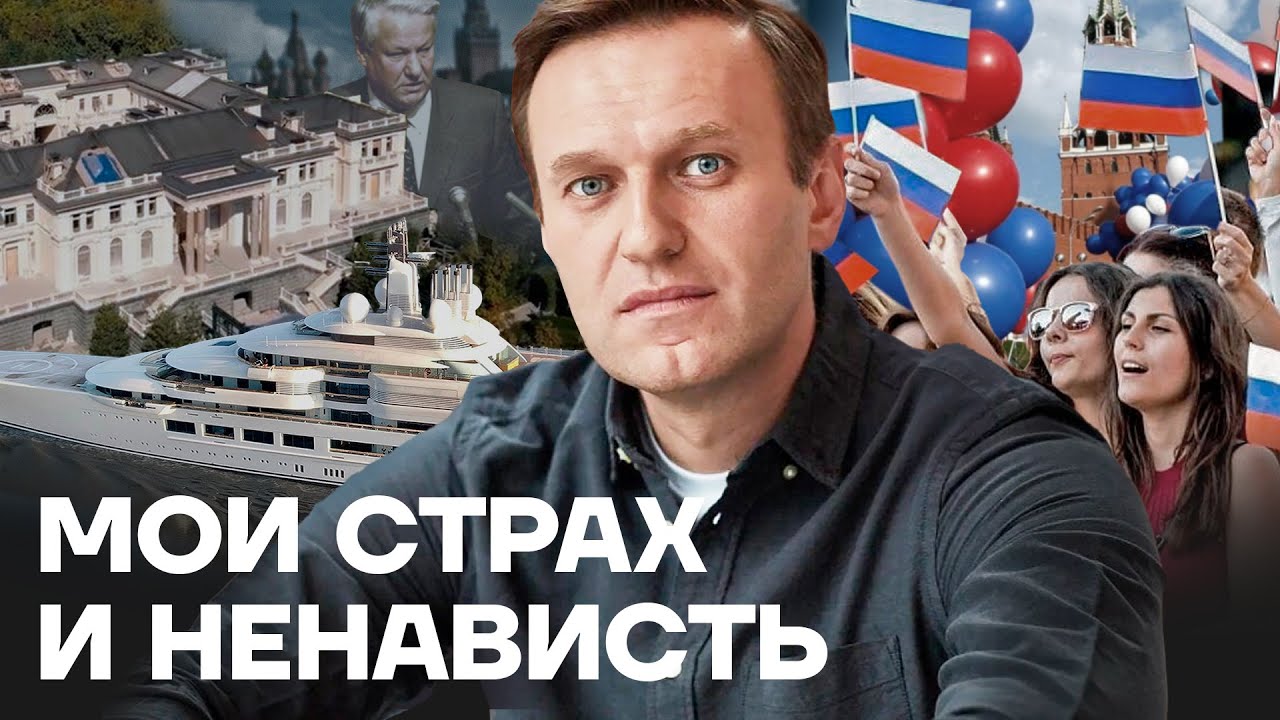
Hatred. People always ask about it a lot, and the letters have started coming again: so, do you hate the judge? Do you hate Putin even more? But I’ve said many times before that hatred is the main thing you have to overcome in prison. There are so many reasons for it here, and your powerlessness is the strongest possible catalyst. So if you let hatred run free, it will finish you off and devour you.
But I’ll admit honestly: I do feel it. And intensely. Internet old-timers will remember the meme: “I hate it fiercely, madly.” That’s about right. And it’s usually after these “trials.” The last one, by the way—the one where I got 19 years—wasn’t like that. On the contrary, we were all competing to shower one another with politeness. Not once during the entire proceedings did anyone raise their voice. That’s the most dangerous kind of judge: he’ll slap you with 19 years and somehow still make you feel sympathetic toward him.
What really sends me into a rage are the hearings at the local district court. The cases there are utterly simple, there’s no room for legal trickery, and the judges just openly and bluntly say that black is white: “No, this is white—look, it says so in the certificate,” and then issue blatantly unlawful rulings.
But even though sometimes, unable to hold back, I yell at some “judge” Samoilov, he’s not the one I hate with my enormous hatred. Nor the lawless, thieving cops from the penal colony. Nor the FSB officers who command them. Not even, you may be surprised to hear, Putin. In moments like that, I hate the people I once loved. The people I stood up for, the people I argued myself hoarse over. And I hate myself for ever having loved them.
Look. I’m sitting in my punishment cell and reading Natan Sharansky’s book Fear No Evil (highly recommended). Sharansky served nine years in the USSR; in 1986 he was exchanged in a spy swap. He moved to Israel, founded a party, and achieved enormous success. In short, he’s an impressive man. He also spent 400 days in solitary confinement and punishment cells. And I genuinely cannot imagine how he survived.
Sharansky describes his arrest and the investigation. It was 1977. I was one year old then. The book was published in the USSR in 1991. I was 15 then. Now I’m 47, and when I read his book, I sometimes shake my head to get rid of the feeling that I’m reading my own case file. For example: the punishment-cell/PKT building is a separate barracks behind barbed wire. The maximum term in a punishment cell is 15 days. And I wasn’t even surprised when, after several consecutive 15-day stints, I was transferred as a “persistent violator” to a PKT cell block for six months. Exactly the same.
In the foreword (remember, this was 1991), Sharansky writes that it was in the prisons that the virus of free thought had survived, and he hoped the KGB would not find an “antidote to this virus.” Sharansky was wrong. The antidote was found. And such an effective one that now, in 2023, there seem to be more political prisoners in Russia than there were in the Brezhnev-Andropov era (late Soviet period). But what does the KGB have to do with it? There was no creeping or overt coup in our country led by security-service men. They did not come to power by pushing aside democratic reformers. No. People did it themselves. They invited them in. They taught them how to rig elections. How to steal entire sectors of property. How to lie in the media. How to rewrite laws to suit themselves. How to crush the opposition by force. Even how to launch idiotic, incompetent wars.
That’s why I can’t help it: I hate, fiercely and madly, those who sold off, drank away, and squandered the historic chance our country had in the early 1990s. I hate Yeltsin with “Tanya and Valya” (his daughter Tatyana Dyachenko and Valentin Yumashev, key figures in his inner circle), Chubais, and the rest of that corrupt “family” who put Putin in power. I hate the swindlers we for some reason called reformers. By now it’s as clear as day that they were interested in nothing but intrigue and their own wealth. In what other country did so many ministers from a “reform government” become millionaires and billionaires? I hate the authors of that idiotic authoritarian constitution they sold to us fools as democratic, even though from the start it gave the president the powers of an absolute monarch.
What I especially hate them all for is that there was not even a serious attempt to remove the foundations of lawlessness—to carry out judicial reform, without which all other reforms were doomed to fail. I’ve been studying this a lot lately. Back in 1991, the RSFSR adopted a good concept for judicial reform, but by 1993 counter-reforms had already begun, aimed at building a vertical chain of judicial control. At the time, all political forces wanted honest courts. There was complete consensus in society. If an independent judiciary had been created, a new usurpation of power would have been impossible, or at least much harder. So don’t be mistaken: the machine that now so briskly hands innocent people sentences of 8, 15, or 20 years began to be built long before Putin. And now it’s clear: no one in the Kremlin or the government of the 1990s actually wanted an independent court system. Because such a system would have stood in the way of corruption, election-rigging, and the превращения governors and mayors into irremovable little princes.
I hate the “independent media” and the “democratic public” that gave full support to one of the most dramatic turning points in our modern history—the rigging of the 1996 presidential election. I repeat: at the time, I was an active supporter of all of it. Not election fraud itself, of course—that wouldn’t have pleased me even then—but I did everything I could not to notice it, and the overall unfairness of the election didn’t bother me in the slightest. We are paying now for the fact that in 1996 we decided that falsifying election results was not always a bad thing. The end justified the means.
I hate the oligarch Gusinsky (though he hasn’t been an oligarch for a long time) for demonstratively hiring KGB deputy chief Bobkov, who had been responsible for persecuting dissidents. Back then they thought it was a joke: ha-ha, he used to jail innocent people, and now he works for me. Like a bear in livery. In other words, not only was there no lustration—there was active encouragement of scoundrels. And now, literally, the very people who worked under Bobkov as young officers are the ones imprisoning Yashin, Kara-Murza, and me.
You often hear that Yeltsin’s government couldn’t do anything because it was opposed by communists in parliament. And yet that somehow didn’t stop the loans-for-shares auctions of 1996. But for some reason it did stop judicial reform and reform of the security services.
I hate the entire Russian leadership that, in 1991 (after the coup attempt) and in 1993 (after the shelling of parliament), held absolute power and did not even try to carry out the obvious democratic reforms. The kind of reforms that were carried out in the Czech Republic (which now has democracy and an average salary of 181,000 rubles), Poland (democracy and 179,000 rubles), Estonia (democracy and 192,000 rubles), Lithuania (democracy and 208,000 rubles), and other Eastern European countries. Of course, different people were in power then. There were some very good, honest, sincere people too. But they were a tiny minority, and their desperate, unsuccessful struggle only highlights even more clearly the corruption and shamelessness of the ruling elite of that time.
It wasn’t with Putin in 2011, but with Yeltsin, Chubais, the oligarchs, and the whole Komsomol-party gang calling itself “democrats” that in 1994 we turned not toward Europe but toward Central Asia. We traded our European future for the villas of “Tanya and Valya” on Saint Barth, the “island of millionaires.” And when the notorious Putin-era KGB/FSB men gained free access to political office, they hardly had to do anything at all. They just looked around and exclaimed in surprise: wait, you mean this was allowed? And if the rules of the game are that you can steal, lie, falsify, censor, and keep all the courts under your control, then we can really spread out here.
We let the goat into the cabbage shed and then act surprised that it ate all the cabbage. It’s a goat—its mission and purpose is to eat the cabbage; nothing else would ever occur to it. There’s no point trying to persuade it otherwise. It’s the same with a Putin-era official from the FSB: nothing will occur to him, and nothing can occur to him, except building himself an enormous mansion and jailing people he doesn’t like. I may not be able to stand the goat, but I hate, fiercely and madly, the people who let it into the cabbage shed.
Although of course I understand that it would be better not to hate anyone at all, and instead to think about how to keep this from happening again. And that brings me to my great fear. I don’t just believe—I know—that Russia will get another chance. It’s a historical process. We will come to another fork in the road.
I wake up on my prison bunk at night in terror and a cold sweat when I imagine that we had another chance, and yet once again we went down the same road as in the 1990s. Following the sign that says, “The end justifies the means.” The one with the fine print underneath: “rigging elections isn’t always bad,” “just look at these people—what kind of jurors could they possibly make,” “it doesn’t matter that he’s a thief, at least he’s a technocrat and he builds bike lanes,” “give these people free rein and look who they’ll elect,” “the government is still the only European in Russia,” and the other pearls of enlightened authoritarianism.
What I wrote about the 1990s is not a historical exercise, not introspection, and not pointless whining. It is the most important and most urgent question of political strategy for everyone who supports a European path and democratic development. I was deeply struck, I have to say, by the large collection of reactions to our investigation into Alexei Venediktov and Ksenia Sobchak. They received tens and hundreds of millions of rubles from a budget fund that served as a slush fund for United Russia. Venediktov, moreover, received 550 million precisely while he was heading the election-monitoring штаб and directly organizing the theft of voters’ ballots. He was the public face, promoter, and overseer of electronic voting, whose purpose was to take your vote and move it into the United Russia pile. The fraud in remote electronic voting has been thoroughly proven and is beyond any doubt. What astonished me was that there turned out to be a substantial number of people for whom neither the elements of the scheme—“money from the slush fund and election-rigging”—nor their combination—“money from the slush fund during election-rigging”—seemed either discrediting or significant. Oh come on, it’s nothing. Sure, they were up to something, but there’s no proof he was paid for the falsifications—he was just paid, and there were just falsifications. That was back in the age of mammoths. It all started as far back as 2019. No one even remembers anymore. None of that matters; the main thing is that he’s “against the war” now. As one tweet on the subject put it so neatly: “So what’s the big deal?”—as a national idea.
This is just one example, but it—like the situation with Murzagulov, like Khodorkovsky’s calls to take up arms and join Prigozhin’s units—shows perfectly well that even now, in 2023, against the backdrop of repression, imprisonment, and war, loyalty to principles is still treated with suspicion and seen by many as naive, romantic, or just “wearing a white coat” (a Russian expression for moral posturing). Personal loyalty, belonging to the same circle, old friendship—many people regard these as more important.
I am absolutely not proposing that Alexei Venediktov be shot, hanged, or neatly trimmed. No atrocities are needed. But surely it is possible simply NOT TO APPROVE of what he did—and is still doing, continuing to claim that electronic voting was not falsified—and not to regard him as a political ally. Because, forgive me, if for us a political ally is someone who sells our votes to United Russia, then who are we at all, and what are we for?
Then let’s just go join United Russia. We can create a faction there of hardline Sobyanin loyalists—that’s what I call them to myself—and the foundation is already in place. The same dream team rushes to defend the subjects of virtually every ACF investigation: Ksenia Sobchak (one, two), Alexei Venediktov, Maxim Katz (one, two, three), and former Nashi youth movement activist, and now somehow editor-in-chief of Novaya Gazeta, Kirill Martynov. Everything will be wonderful. There will be plenty of money. We, the hardline Sobyanin loyalists, demand: remove bad Putin from us at once and give us good Sobyanin and Mishustin, Shuvalov and Liksutov instead.
So make no mistake. Tomorrow there will be another chance—that very window of opportunity—and tomorrow we will once again have to deal with people who think that in some places elections should be canceled or rigged (“otherwise extremists will win”), that bribing journalists is normal (“we don’t pay anyone, we just asked a friendly oligarch to buy that TV channel”), that courts are better kept on a leash (“otherwise judges and jurors will be bribed”), that the кадровую backbone of the state must not be changed (“they’re professionals—we can’t just recruit people off the street”), and so on and so on. Right down to saying that the contract to build that bridge over there should be awarded not through a tender but to a “reliable contractor” we’ve worked with for years. And the people with such ideas will not be Putinists or communists at all—they will once again call themselves democrats and liberals.
Real life is complicated, hard, and full of compromises with unpleasant people. But at the very least, we should not voluntarily become unpleasant people ourselves, embracing corruption and cynical manipulation even before circumstances force any compromises on us.
I am very afraid that the battle for principles could once again be lost under the slogans of “realpolitik.” Please tell me how to get rid of this hatred and fear. I would be very interested to read your thoughts on it. I’ll ask for them to be mailed to me if there are any. For now, it seems to me that nothing better can be devised than to remain true to yourself and tirelessly explain to people, through many examples (by the way, Guriev and Treisman’s book Spin Dictators has been published in Russian; it has a great deal on exactly this subject, highly recommended), that democratic principles—pragmatism, an independent judiciary, fair elections, and equality before the law—are the best mechanisms for the harsh realities of life on the road to prosperity. Secret slush funds and dreams of a good dictator, by contrast, are a chimera and naive nonsense.
Only when the overwhelming majority of the Russian opposition consists of people who under no circumstances accept rigged elections, unjust courts, and corruption—only then will we be able to make proper use of the chance that will surely come again. So that no one, sometime around 2055, is sitting in a punishment cell reading Sharansky and thinking: incredible, it’s exactly like my life.