
Many will be surprised, but elections still exist. On September 10, they will be held in 40 regions, including Yekaterinburg, Omsk Region, Khabarovsk, Krasnoyarsk, Yaroslavl and Arkhangelsk Regions, Khakassia, and Yakutia. So we need to decide how to approach these elections, and I will allow myself to make some proposals.
Since 2011, the voting tactics we proposed have been recognized as the most effective. Even though each time they had to be defended in fierce debates. In an authoritarian country like Russia, simply getting more votes does not in itself guarantee either success or victory. Which, broadly speaking, is exactly what we see—considering where I am writing this post from. That is why we view participation in elections as a crucial, but far from the only, element of political struggle. Everyone has repeated the phrase “power in Russia will not change as a result of elections” many times, but I was the first to say it back in 2011. However, that does not in the least diminish the importance of the right election strategy.
The main thing to understand and remember—and this is the foundation of every one of our election strategies—is this: all elections are different. Decisions have to be made based on the specific situation. There are no universal rules. We must adapt in response to the authorities’ new tricks and inventions. Just look: since Putin’s very first year as president, the rules have changed in every election cycle so that our previously effective strategy would stop working. And we would be idiots if we kept doing the same thing instead of changing strategy to match the new rules.
In 2011, our campaign “vote for any party except United Russia” dealt a defeat to the ruling party. They received less than 50% of the vote and, in order not to lose their majority in the State Duma, resorted to completely blatant fraud in Moscow. That, in turn, led to a broad protest movement for the first time since the perestroika era (the late-Soviet reform period), and to the emergence of a new kind of opposition.
In 2013, for the first time in Russia’s history, we ran an election campaign in the Moscow mayoral race relying on volunteers and activists, and achieved a strong result without oligarch money or the use of state administrative resources.
And once again, only fraud saved United Russia candidate Sobyanin from a runoff and a stunning defeat.
In 2015, we drew nationwide attention to regional elections, which the Moscow-based opposition had previously ignored. But by then the authorities, realizing that we would hurt them in the regions too, barred people from our lists from running, despite protests and hunger strikes.
The most successful strategy was Smart Voting, first used in 2019. Before that, there had been an iron rule in Russian politics: an opposition candidate cannot win in a single-member district. To do that, you need at least 35–40% of the vote, and that is impossible without the help of a governor or mayor. But in 2019, on our very first try, we simply crushed Sobyanin, Putin, and United Russia in Moscow. Even though almost none of the independent candidates’ teams were allowed onto the ballot, Smart Voting, by backing the strongest candidates from the systemic opposition, won 24 out of 45 districts together with them, depriving United Russia of its majority in the city legislature. As usual, fraud saved the authorities. Moscow City Hall stole four seats and kept its majority. Still, a record number of genuinely opposition candidates made it into the capital’s parliament.
Realizing that they could no longer beat us in major cities, the authorities responded to Smart Voting by inventing “remote electronic voting” (REV). It is a system that simply fabricates non-existent votes for the preferred candidates, and there is no way to verify it: the system is monitored by the very people organizing the fraud. Despite that, Smart Voting also performed very well in the 2020 regional elections. That was when I was poisoned, in an attempt to kill me in Tomsk, where I had come to support independent candidates for the City Duma.
By the way, they did ultimately become deputies—I learned that while already lying in a hospital bed. In single-member districts, Smart Voting candidates won in Tomsk in 19 out of 27 districts.
And even in the most recent elections, already held in wartime—in September 2022, in the elections for Moscow municipal councils—more than 400,000 voters cast their ballots in line with Smart Voting’s recommendations, which backed only anti-war candidates (out of 700,000 who physically came to polling stations). Once again, they had to steal seats using REV—supposedly 1.7 million voters cast ballots electronically—and even so, 63 candidates we supported won seats.
And so we are faced with the question of how to act in the 2023 elections.
Since 2011, we have constantly been fighting two kinds of fools.
The first shout that all elections are bad, that taking part helps Putin, that elections decide nothing, and that everything should be boycotted. The second are just as foolish, only at the opposite extreme. They rush to participate in anything the authorities call voting, even if it is nothing of the sort. You could hang a sign saying “elections” on a beehive, a tree stump, or an outhouse, and they would immediately line up.
But every election—or “election”—has to be analyzed to understand: what can we achieve? Will participating weaken the authorities or strengthen them? Is there any possibility of oversight at all? Is there room for campaigning? What do they expect from us? What is the catch—and there is always one? Based on that, in some places we should vote and campaign with full force. In others, simply observe. In others, ignore it. And in others, run a campaign of strike action and active boycott.
Our best strategy, Smart Voting, cannot be applied to them. At least not in its previous form. Let me explain.
The level of fraud, including through electronic voting, is so high, and oversight is so restricted, that there is almost nothing electoral left in these elections. Let me say right away: not everywhere. In some places, participation is possible and necessary. In some places, we will use Smart Voting quietly, as much as possible. But overall, the ability to defend the result is very limited.
Again: all elections are different. For example, the elections in Khakassia, where even debates are taking place between the Communist governor and his United Russia challenger sent from Moscow, are interesting and competitive. Or the Yekaterinburg City Duma elections, where the city mayor and the regional governor are at war with each other. But the 2023 Moscow mayoral election has been set up so that no matter how you vote, you are voting for Putin. Either for Sobyanin, or for the “Putin wing” of the Communist Party, represented by Zyuganov’s grandson. If anyone tries to organize protest voting in Moscow, the channel for that protest has already been prepared in advance: Zyuganov’s grandson. He is not campaigning. He praises the authorities. He does what he is told. Protest voting may add a few votes to his total, but this is a complete copy of the Kremlin’s tactic with Sobchak in the 2018 presidential election: “Oh, we have an opposition? Well then, here you go, opposition, here’s your candidate. Go on, campaign for him, and then we’ll laugh at the results.” The level of public interest in the Moscow election matches that reality. It is the third most important election campaign in Russia. And I am sure most of you do not know any of the candidates apart from Sobyanin and Zyuganov.
So is it possible to achieve anything in the 2023 elections? I believe it is. It is just that our goals are returning to the most basic ones:
We, opposition-minded voters, must preserve the habit and the rule of going to elections. Sooner or later, Russia will hold relatively free ones. We must win them. That will not happen if we convince ourselves that elections are meaningless and unimportant, and get used to staying home.
We need to support people’s willingness to run for office. There are quite a few good candidates in the regions. Some are genuinely excellent. It is just that I personally am in a situation where it is better for me not to name them. But in any case, they need our votes and our support. And what we definitely do not need is whining that everything is pointless.
It is critically important to preserve what remains of the election-monitoring infrastructure. As I said, sooner or later Russia will hold relatively free elections, but even in those elections they will try to steal our votes again. We will need experienced observers.
Now, finally, to what should be done.
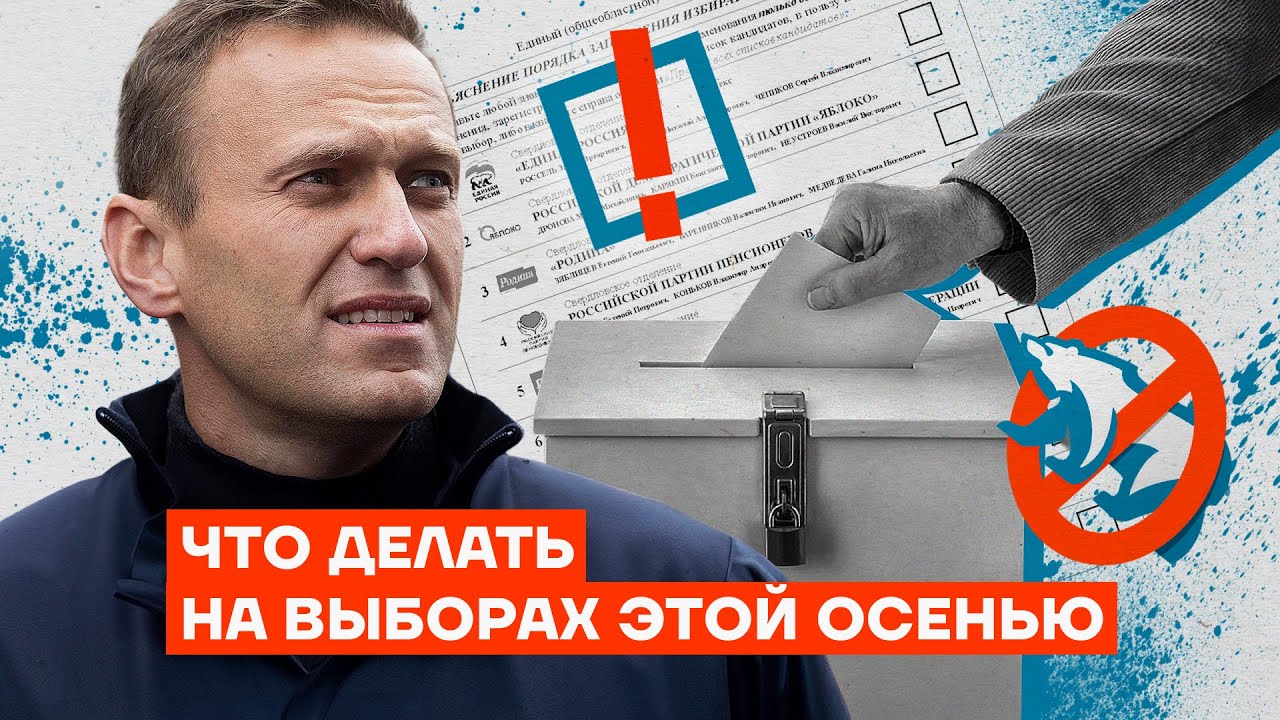
I believe that in the current situation we need to take a step back and return to the strategy of voting “for any candidate against United Russia.” Go to the polls with the goal of inflicting the greatest possible damage on the ruling party and its candidates.
On September 10, you should go to the polling station and vote.
Choose a candidate on the ballot who is not a member of United Russia, and vote for that person. There are good candidates—many of them.
Those running as independent candidates are doing the right thing, and they deserve support.
We will still use Smart Voting, but selectively and not publicly.
It is absolutely worth taking part in election monitoring and using every available opportunity to do so. Election-observer organizations still exist, and many of them work effectively.
The 2023 Moscow mayoral election does not matter. It is fake. You can vote, if only out of curiosity and to see the polling station, or you can ignore it. It is not even worth discussing.
Tactics for the presidential election in March 2024 can only be determined once the overall picture is clear regarding the rules, the candidates, and election monitoring.
Strategically, we consider Smart Voting and its participants to be the opposition’s greatest asset and best opportunity. But the key word here is “smart.” Having assessed the new circumstances, the war, and the political situation, we must act smartly and take a step back by voting for any candidate and any party against United Russia.
The English translation of the text is here.