Debate. Alexei Navalny, Boris Nemtsov, and Garry Kasparov
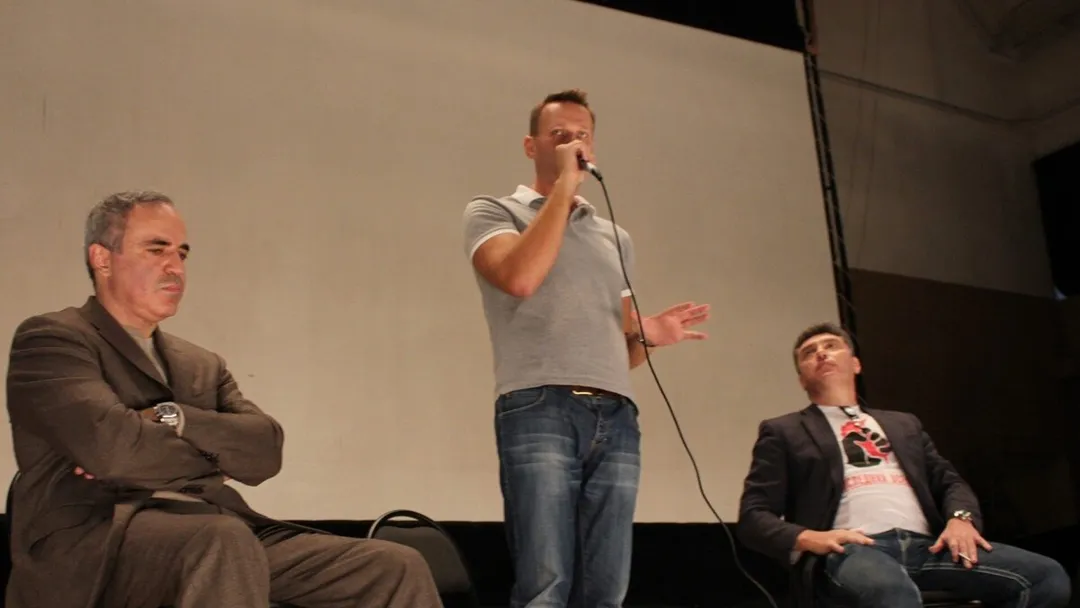
This is the event that, I
think, many have been waiting for—some with interest, others with anxiety.
It is quite possible that, after hearing what is said here,
some people will have to reconsider their own views on
what they should do in the December 4 elections.
As promised, we are now about to begin the debate,
which, if anyone wished,
could probably make it into the Guinness Book of Records, because these are unique pre-election debates,
in which the participants are people who are not actually taking part
in the elections themselves, and some are even calling for a boycott.
On the other hand,
in the Kingdom of Crooked Mirrors (a reference to a satirical Soviet fairy-tale world of distortion), it is hard to expect anything else.
And so now we,
the hosts of this part
of the forum, Irina VOROBYOVA and Vladimir VARFOLOMEEV.
We will now invite them here onto the stage, onto...
Here to us.
We should step aside.
We will stay here to invite onto the stage those
who will be taking part in today’s debate.
In fact, in this hall it is hard to imagine
that there is anyone among our participants whom you do not know.
But nevertheless, let us proceed fairly—that is, in alphabetical order.
So, let me introduce the first participant in the debate: Garry Kasparov.
Garry Kimovich, please.
Choose any seat.
Between the two chairs, as you may recall, there is emptiness.
So, again in alphabetical order.
The next participant is Alexei Navalny, Lyosha.
And the third, of course,
not the last, simply third alphabetically, is our participant Boris Nemtsov.
Boris Yefimovich, please.
That looks good.
Now that all the debate participants are in their places,
I would like to explain to you, ladies and gentlemen, and to you, dear
audience—no, not audience members, participants as well—some of today’s ground rules.
The debate will consist of three parts.
First, each of the participants
will present their view of what people,
people of good will,
representatives of Russia’s progressive public, should do.
In the December 4 elections.
We will set a time limit for each speaker: seven minutes.
Finishing sooner would also be fine.
That would leave more time for questions from the audience.
That will be the first part.
The second part will involve
good-natured, moderately
sharp questions, with no real limits, including personal remarks if you wish,
from today’s debaters—pardon me—to one another,
as well as a couple of questions from Vladimir and me.
And the third part of the debate will involve
questions from the audience. We will be down here, below the stage.
I think we will organize a few informal lines,
because with the microphone we obviously will not be able to reach the farthest corners of the hall.
And despite all this modern equipment,
we are still afraid of losing the microphone somewhere in the audience.
So whenever possible, we will ask you to come down here.
Perhaps we will be able to get somewhere nearby, and you will be able
to ask, on our main topic today—the election campaign
and participation or non-participation in the December 4 elections.
your questions to today’s debate participants.
Are the rules clear?
Gentlemen, are there any questions about the procedure or the format?
Any objections to the moderators?
Thank you very much.
Well then, I think we can begin.
Yes, of course.
Thank you for the reminder.
At the end, or closer to the end of our entire discussion, of the debate as a whole, after
the main questions from the audience have been voiced, we will ask you to vote
for the point of view represented today by our participants.
For that purpose, I hope everyone has received three sheets of paper in different colors.
But note that their shades are similar.
That is no accident, because the people here on stage today
are, of course, not irreconcilable opponents,
even when it comes to tactics for the parliamentary elections.
Later, so that over the hour and a half allotted to us you do not forget which color
corresponds to which position or which of our protagonists, we will explain that separately,
we will announce it later.
Everyone, everyone.
The sheets of paper you were given are the sheets
you will use to vote.
This is for ease of counting, so that we do not have to vote by a show of hands.
Even if you raise two or three,
so, during our debate, dear organizers,
please make sure that those in the audience who have just said
they do not have sheets do in fact receive them.
Do not worry, everyone will get to vote.
I hope so. Now we can begin.
I am handing over one of the microphones.
Garry Kimovich, to begin with, I have a request.
I have a request for everyone.
I will not...
Reliable comrades will play the role of Churov (Vladimir Churov, then head of Russia’s Central Election Commission).
They come highly recommended.
When the time allotted
for the first part is running out, we will signal to you or quietly whisper.
One minute left.
I understand that it is hard to let go of
such a tool of election campaigning as a microphone.
But I would still ask you to pass the microphone to the person next to you.
Only let me take this microphone—Adam, this one has a short cable.
Yes? We will keep you on a short leash,
so that our wonderful sound engineers can switch it off if necessary.
All right, I can go first.
Thank you very much. One second.
No, no, no, after all we agreed to proceed
I mean, I am not afraid to go first.
But if you have a different order, I would be concerned.
I am afraid of being accused of bias toward a candidate
in this case, because among these positions, going first
would simply favor mine, since my position is the most radical, the most extreme.
We are proceeding in strict accordance with the rules of the Russian language,
that is, alphabetically.
So then.
We begin in accordance with the Russian alphabet, and I have no intention of protesting.
Garry, please.
My position
on what is being called the December 4 elections.
And, by the way, this also applies to the subsequent farce that will take place
on March 2, what many call a special operation,
which ultimately leads, as many again agree, to the creation of illegitimate
organs of power, because what follows is a list of violations
committed by the authorities in conducting these elections,
even before we get
to the actual vote count—that is, the most flagrant violations of the Constitution,
the refusal to register political parties, and total control over the airwaves.
And so, naturally, all of this ends with Churov.
So we all know everything.
In my view,
the task of the responsible opposition
is to use the political landscape as it exists today in order to
prepare people for the changes ahead—or rather, to bring those changes closer.
Therefore, events like these should be used
as a unique opportunity to give people
an idea of what we can do and what this alternative looks like.
Just 20 or 30 minutes before our debate began, there was a presentation
of this very interesting electronic democracy system,
presented by our friends and colleagues from Yekaterinburg.
And Alexei also spoke very well, very vividly, about what?
About what this could be.
We have actually started talking about an alternative.
This is an alternative, and that is why it is called an alternative
—Democracy Two—because in principle it does not even
enter into any collision or conflict with the existing system.
This government exists, and it exists. It is not about us.
And when people tell me that, in principle, a boycott means a passive boycott,
if we are going to talk about the rules of language,
well, the word “boycott” came from English.
And it was connected
with rather
active actions by the Irish, who were protesting against Captain Boycott
on their land.
And, broadly speaking, those organized acts of sabotage
against all of the agricultural production
of Captain Boycott first forced the British government to send soldiers,
and then it turned out
that it was simply too expensive to keep supporting Captain Boycott, and he left.
So, in fact, the very word “boycott” implies something quite active.
So,
your not showing up at polling stations
as a form of boycott is not, in fact, a one-off step.
It is very important to remember what happened on December 4, or what will not happen.
Because we want power in this country to change.
We understand what will happen on March 2 of next year.
Broadly speaking, it does concern us, but we cannot change it now.
So to demand from our actions—as many ask, “what exactly should I do”
to change the situation instantly—is impossible.
The disease is too advanced for a single pill or a magic injection,
for some miraculous action, a wave of the hands, and then to say
that everything will work. It will not.
What we can do is consistently help ourselves
and our society in our country to rid itself of this step by step.
We must get used to the idea
that we will have our own holidays,
we must build our own alternative system,
we must seek out our supporters and like-minded people,
we must create our own governing bodies, even if we call them virtual.
You know, Peter the Great’s “play regiments” (military units formed for drills and games) eventually became the Imperial Guard.
But we must get people used to the idea that their participation in this farce helps the authorities.
It is not true that the authorities are prepared to accept low turnout.
No, no.
The authorities, in the final analysis, see
the electoral process itself as a kind of
sacred, obligatory ritual of self-preservation.
The numbers are more or less clear already now; presumably, through whatever channels are available,
those who have the means can probably find out
the final voting results for December 4.
But that is not even the main issue; rather,
there is the argument that if we do not come,
they will do something with our ballots, and the authorities will not care.
That is wrong.
Because, in the final analysis, the authorities really do feel this
mystical legitimacy.
That is not accidental.
They show 70 or 80 percent
of support there, but of course neither Putin nor Medvedev has ever had that level of support.
And, of course, United Russia does not have that support now either. It is falling.
But at the same time, they still feel there must be a majority.
That majority—it exists somewhere.
And in fact, that majority is not always a mathematical one.
That majority can be a majority on the Maidan (Kyiv’s central protest square), a majority in Tahrir Square.
That majority can materialize
as it did 20 years ago in the streets and squares of Moscow.
It was not a majority of the country’s entire population.
It is, in fact, the majority that represents
a dynamic
active minority that influences change in the country.
We need to work with people, convincing them that this is exactly how
power will change in this country.
They themselves must take some active position, and any participation
in these procedures actually does great harm.
We must use this moment to draw people to our side.
That means we need alternative voter lists.
That means you will have the option either to write a statement
to the election commission—a copy is attached.
“I request that I be removed from the list of participants in this farce,” and send us a copy as well
through the system you have just seen, in order
to register; or, as a voter, to obtain an absentee certificate.
That option also exists.
But it is very important that you step out of the system—they will feel it very quickly.
When people say, “Well, you will have 10,000 or 20,000,”
it is not so simple with numbers like that; in fact, the authorities have never faced anything like it.
I do not think all political activism in the country adds up to 100,000 people,
including the departments for combating extremism and terrorism.
All these political parties are, in reality, tiny in number.
We are not even talking about 2 million.
The core, the core that is not really a party at all, but a bureaucratic structure.
And it is clear that all these people will run
the moment they realize that this story is over.
And when we also bring up
the argument in support of
say, some other position—in this case, for example, the position of
voting for some other political party,
it seems to me that we need to understand that what is happening on December 4
cannot be directly compared, and no parallels can be drawn, with
what happened 20 years ago. Because 20 years ago
the CPSU had a real monopoly on power; the CPSU was the backbone of the state.
We understood perfectly well that this monopoly on power was not an empty phrase.
That is precisely why someone now forgotten by most people even in this hall
could, for a very long time, compete with Yeltsin for the highest office
at the Congress of People’s Deputies of the RSFSR (Russian Soviet Federative Socialist Republic).
He could do so solely because behind him stood
this immensely powerful party machine. Back then, that mattered.
Who today believes that the core is the backbone of the current government?
In other words, this argument in itself, whatever form it takes,
however historical it may
seem, has nothing to do with today’s reality.
This government.
This government is personalized; it rests, unquestionably,
on the already established cult of Putin.
And therefore our main task is to begin offering an alternative.
An alternative, thank God, can be formed,
can be formed with the help of new, modern technologies.
And we need to get people used to making use of every opportunity,
that any participation in this regime's affairs helps that regime.
Any participation—and, accordingly, any non-participation—weakens this regime.
That is precisely why our active position, I believe, is a boycott
and then withdrawing from the voter rolls, creating our own voter list,
creating our own alternative—that is the most frightening thing we can do
on December 4, on March 2, and on all the days that follow.
Because of course we will not defeat this regime in a single day.
We are running a marathon.
But we must remember that at some point there will be
the start of a 100-meter sprint, and we need to be ready for it.
Thank you. Thank you very much.
Alexei Navalny. Seven minutes have passed.
Thank you very much.
I appreciated the organizers' irony when I looked at the schedule.
There are two events on the schedule
at the same time: our debate and a roundtable on the topic "Do we need gay pride parades?"
So, as I understand it, they are monitoring where a fight will break out faster.
I think that here we are not—and despite the fact that this will probably be a sharp discussion
today, I urge everyone to remember that overall we are on the same side.
I'll stand up, if I may.
I've been trying to fight my habit of waving my arms around, but I haven't beaten it.
So I'm afraid I'll just fall off my chair and lose the debate on the spot.
And that is my secret
method of influencing the audience.
My position is very simple and clear.
I would just like to make it even clearer.
What is the strategy of struggle at the present moment?
At this political moment, the strategy of my personal struggle
is to fight for fair, free elections.
I want to take part in them.
I do not have that opportunity.
I want there to be elections in which everyone here could take part
—nationalists, communists, anyone at all.
We must work toward that.
When we talk about tactics of struggle, we must remember
that in these wonderful new free elections, we may very well lose.
And when we talk about tactics of struggle, I urge everyone to remember
that we are not the coolest people in the world, and we have no monopoly on the truth.
And a huge number of other people are also engaged in
their own kind of struggle.
And we have no right—and it is simply wrong—to say that you are
all prostitutes, Kremlin puppets, while we here are the only real heroes.
And that all the other systemic parties
are just a complete sham, and we will have nothing to do with them.
And only our tiny little group is the one true sect.
In fact, I myself also held those views for a while.
I realized they were wrong.
Yes, the existing parties
are different—some bad, some good.
All of them are, to one degree or another, under the Kremlin's influence.
That is a fact. Yes, they are timid and cowed.
Yes, they are not capable of truly mounting a strong stand
against this gang, this handful of people who have usurped power.
What is our goal?
And what are the tactics of struggle?
So we must help them do it.
When I say, "Come to the elections and vote for
any party against United Russia," we immediately gain
hundreds of thousands of activists from other parties who are ready to follow that logic.
When I put forward this slogan on my LiveJournal blog, which perhaps is read only by some
people who happen to have internet access,
a week later they sent me photographs.
Some old ladies in Udmurtia (a republic in Russia) were standing there with these slogans.
Not because it was such a great campaign,
but because that is simply how things are unfolding right now:
we must use these people in order
to push in the right direction. When we advocate a boycott,
which is what I supported in the last elections, I now simply admit that the idea
did not work out. The same goes for spoiling ballots.
We end up debating and fighting not Putin, but Mitrokhin.
He spoke here today.
You can say all you like that he is
some kind of Kremlin puppet, but I know that is not true.
They expelled me from the party.
I am not going to urge anyone right now
to vote for Yabloko, the Communists, or anyone else, but they exist—that is a fact.
They have tens of thousands of people, and they most definitely have
1,000,000 supporters.
They are afraid, sitting somewhere under the table
or under an armchair, afraid to come out and say what we can say.
That is our task.
So with our own hands we may be pulling the chestnuts out of the fire for these people, in order
to improve their chances of getting through somewhere.
But in doing so we are building a new political space,
a new political struggle whose essence is: all of us against them.
So all of us are against United Russia, which is the organizational
and political base of a gang, an organized criminal group.
I propose that we build this.
I am convinced that this is 100 times more effective than saying
"They are all losers, the Communists, Putin—awful prostitutes,
Mitrokhin, Yavlinsky—everyone is bad, and we alone will be the good ones."
That is exactly what the current discussion is turning into.
Look at the blogs on Echo of Moscow (a Russian radio station/news outlet).
There you have Mitrokhin writing against Nemtsov, Nemtsov against Mitrokhin.
Garry writes against Yavlinsky, Yavlinsky writes against Garry, and so on.
And yes, we can discuss all of this right now.
These are wonderful things, very interesting, and so on.
But right now this is harming the tactics of our struggle.
So we must, for these little people who have crawled under their chairs,
these systemic parties, we must now step out for them
and voice and promote this slogan: vote for any party against United Russia.
They will not say it themselves. They are very cowardly.
But they will follow this campaign; they are keeping their fig in their pocket (a Russian idiom meaning hidden defiance).
In any case, there are many of them.
We must support them.
We must build, I repeat, a system.
We are all against United Russia, we are all against this gang of crooks, otherwise nothing will work.
Otherwise we will once again get bogged down in endless discussion of
whether Zyuganov or some person X is a genuine, real opponent of Putin.
It is pointless.
They are opponents of Putin; they are just afraid to say so.
We must give them a chance to pull their cowardly little heads
out from under the sofas and armchairs.
They need that chance.
No one but us will give them such an opportunity.
Yes, but simply as a result of various circumstances.
That is just how it turned out.
Well, they are afraid.
They are afraid; we are not.
But in any case, we must use them.
We must do this together in order to exert pressure
on these people and force them to hold open elections.
I urge all respected colleagues to stop lurching from one thing to another.
Today we are creating a party, tomorrow we are boycotting elections.
Today we argue for a boycott, the day after tomorrow we urge everyone to spoil their ballots.
Five years ago I organized similar debates.
Yes, I organized similar debates where Garry Kasparov utterly demolished
Belykh on the supposed beauty of a boycott and said that we would all boycott the elections.
After that, The Other Russia and the National Assembly
called on people to come to the polls anyway and spoil their ballots.
Enough
of lurching around. Let's choose one strategy.
This is the strategy.
We are all against this gang of crooks.
If we need to include the Communists, Yabloko,
Right Cause, and even Bogdanov, that curly-haired
con man, that crook—then even he has to be included in this,
in this arrangement, if it serves our tactical goals right now.
That is our tactic in this struggle.
Thank you very much.
That was Alexei Navalny.
Boris Yefimovich, the floor is yours.
Good evening, friends.
Boris, maybe stand on a chair so you can outdo Navalny?
Why?
I'm already taller than Navalny as it is.
On a chair.
He stood on tiptoe.
Friends, you know, this is a rare situation.
In fact, this discussion has been going on for about three or four months now.
I think those present in the hall
have been actively following it and even taking part online.
I want to say right away: I do not
want to hand any gifts to Putin, Medvedev, or Surkov,
let alone Churov.
I don't want to hand gifts to anyone at all.
I believe we cannot conduct this discussion here
in some aggressive manner, with insults and so on.
We have a great deal in common.
What do I mean by that?
First, we all believe the country must have honest, open elections.
We all assume from the outset that these elections,
if they are held openly and honestly, will be recognized by us.
Third, we believe Putin's usurpation of power is a catastrophe for our country.
And we see removing him and his group from power as precisely the way to save the country.
Agree, that is a great deal that unites us.
Now, we do have differences over tactics.
Specifically, this disagreement concerns the date of December 4
and the so-called presidential election in March.
These differences are serious, but I would not say
that they should split us apart.
That is not going to happen.
There will be no split.
So what, exactly, are these differences?
Well, let's start there, since Harry (Garry Kasparov) and I don't have any major disagreements.
By the way, the position he outlined, and the one I am about to outline,
is set out in the decision of the Solidarnost movement. There it is.
And in addition, the People's Freedom Party also adopted
a position of active protest in the upcoming elections.
We do have disagreements with Alexei.
The disagreement is of the following kind.
First.
Alexei believes that these are, after all, elections.
Yes, they are not very honest.
Yes, of course, there may be ballot stuffing and so on.
But they are still elections, friends.
Over the past four years, I have taken part in elections three times.
Put quotation marks around that in your mind.
One time was in my hometown of Sochi, where Harry was there too, along with many others.
That was in April 2009.
Let me tell you what kind of elections those were.
They were, in effect, federal-level elections.
So you understand, Putin, Luzhkov, and Medvedev were all actively involved.
And then there were Harry and me, along with our team.
Ilya Yashin was the campaign manager.
Let me tell you the result.
Thirty-six percent voted early.
The Guinness World Records can take a seat.
Thirty-six percent voted early.
Among those who voted early, there was not a single vote for Nemtsov,
because the ballot boxes were completely uncontrolled.
On election day itself, I got 23%.
Those were the kind of elections they were.
Yes, Putin's appointee, a man named Pakhomov, won.
A barely literate man, someone who speaks poor Russian,
who insults Russians, Armenians—everyone indiscriminately.
And yet, he is now the mayor of the Olympic city of Sochi.
Story number two: the Moscow City Duma elections in the fall of 2009.
Seven of our candidates wanted to take part in the elections.
They collected signatures.
It turned out that more than 100% of the signatures submitted for Yashin were invalidated.
I emphasize: more than 100%.
Milov's own personal signature was declared invalid.
Kasparov's signature in support of Starikov was also declared
invalid.
And when Kasparov and I said, no, those are our signatures,
they said, don't try to teach our handwriting experts,
which signature is whose, all right?
So all the candidates were removed from the ballot.
But that was not the end of the story—the end came later.
When the votes were counted, it turned out that
there had been, mind you, in the capital of our motherland—
not in Chechnya, not in Dagestan, but in Moscow—
1,000,000 ballots had been stuffed into the boxes—1 million ballots.
The party of crooks and thieves really did
get about 37%, but they drew themselves a constitutional majority.
And the last brilliant story is Krasnenkaya Rechka in St. Petersburg.
I campaigned there twice for voting against all. Yes.
And there were people who supported Alexei and campaigned for any candidate at all,
except Matviyenko.
Although apart from Matviyenko, there was practically no one there except cleaners.
On the ballot.
That's true.
And even so, the vote came out 95% for Matviyenko.
The buildings where I campaigned for voting against all were removed from the precinct lists.
Removed—take note.
I went to a building there in Krasnenkaya Rechka, yes, I went into that building.
It was a 15-story building with 10 entrances; I went into three apartments.
People came to the school where they had voted all their lives.
They were told: your building no longer exists.
Your building is gone.
Do you understand why?
Because Nemtsov had campaigned there for voting against all.
The same thing happened on the Petrograd Side.
I managed to visit three buildings before our grandmothers and the Nashi activists (pro-Kremlin youth movement) there
put an end to our campaign together with the police, by the way.
Three buildings were removed. The result: 95%.
And now attention, guys: Navalny's supporters
and our supporters together.
Some were campaigning: vote against Matviyenko for absolutely anyone.
And we were saying: spoil the ballot.
And even then, according to Churov and Matviyenko, 95% voted for
Madam Matviyenko, and only 5% listened to us.
Do you like those results?
That is why there are no elections.
That is where we have to begin.
Then we just sit on our hands at home and do nothing.
I disagree.
In principle, from a moral and ethical point of view, of course,
taking part in this farce is bad, but it is a passive form.
You can never tell what happened there: maybe you were drinking with friends, maybe you had a fight with your wife,
maybe you overslept, after all, or maybe you went somewhere.
Why aren’t you participating at all?
Just because you are against this farce?
It is unclear. It is impossible to count that.
One minute.
Therefore, we propose the following: we need to protest actively.
You come to the polling station and protest.
You take the ballot, cross it out with a big X, and write, "Down with the party of crooks
and thieves, bring back elections, you bastards"—anything you like—and throw the ballot in.
Second, we need observers.
This is very important.
We need observers. And on this, we are united.
For example, with Alexei,
we agree that there must be observers, and we do not believe Churov (then head of Russia’s Central Election Commission), and we do not trust his results.
But wherever our observers
record the official protocol, naturally we will take those results into account.
I myself am ready to be an observer.
I live on Ordynka, and I am ready to be an observer.
Alexei is ready.
See, he is ready too.
Well, two people are already ready to be observers.
I think this must be done; we need to keep acting.
I am convinced that if it turns out that 1,000,000 people,
1,000,000 came and behaved this way, then, my friends,
that would be Triumfalnaya Square (a well-known Moscow protest site), Triumfalnaya Square,
except that not 1,000 people would come out there, but hundreds of thousands.
And that is what they are afraid of.
Why did they hold eight court cases against me, eight court cases,
after that little "red river" speech, why did they cancel the ruling
of the Constitutional Court saying that campaigning "against all" was allowed?
Because they are genuinely afraid of it,
Excuse me, they are not afraid of people voting for any party.
And one last thing.
Alexei did not state his position very precisely.
His position is precisely this: vote
for any party that can clear the threshold—well, yes, for any viable party.
Because if you vote for a party that clearly will not clear the threshold, then your vote
will in effect be redistributed in favor of those that do.
That is, it is effectively the same as voting against everyone.
Boris, but if we are talking about parties that can clear the threshold,
there are two: the Stalinist Zyuganov and the clown-puppet Zhirinovsky.
How can you make people vote for these gentlemen?
I honestly cannot imagine it. Thank you.
Thank you very much to all our participants.
Please do not keep the microphone by you.
You know, first of all I would like to address the organizers,
so that they make sure the audience has a chance to vote at the end,
because not everyone has those magic slips of paper.
So please hand them out, in any color.
We will simply ask people to raise their cards for each of the candidates
and in that way we will count,
what happened.
The organizers want to signal something with their hands.
All right, we will sort it out somehow.
Moving on.
I very much liked the remarks made by each of our participants.
Of course, I would like you by the end to arrive
at some common ground, so that our opposition would have a shared course.
But it seems to me, judging by your facial expressions, that it may take some time before that happens.
So let us move on to the second part, because in the first part
there were obviously no opponents; everyone said what they thought and what they wanted.
Now we will move on to the question segment,
and each of our participants will ask a question to every other participant.
That is, Garry Kimovich will be able to ask a question both to Alexei Navalny and to Boris
Yefimovich Nemtsov, and vice versa.
Yes, understood.
We have our own rules.
How will you be asking the questions?
So that no one speaks twice in a row?
Here we go again. Yes, that is correct, in accordance with the Russian language.
Please pass the microphone to Garry Kasparov.
Of course,
I will just guide you now.
Right now you are asking a question to Alexei Navalny, you are asking the question.
To Alexei Navalny.
I ask you, dear participants, please, when you ask your question,
please be brief, because I understand
that one can start with one’s own position and continue all the way to December 4, while those
who are answering should try to keep it to about three minutes.
You can and should speak while seated, because I feel
I ended up being the first, and, well, in general.
Whichever is more convenient for you.
As long as everyone answers the same way.
And can we make them?
If you want, we can tie Alexei Navalny to a chair.
If you want, we can do that.
He will just stand up together with the chair.
Let us begin.
Alexei,
you were just talking about how, tactically speaking,
it can indeed be very smart and tactically advantageous.
And in this case, do you think it is necessary specifically to split
the monolith of the current government? Because the specific people there,
Zyuganov, Yavlinsky, Zhirinovsky—you did not mention all of them,
but basically they are only afraid.
So here is my question.
These people did not appear yesterday, after all.
Zyuganov and Zhirinovsky have been in political life
longer than the Russian Constitution itself.
It seems to me that it is quite obvious
that these people have always traded on their political capital.
For example, in 1996 Zyuganov had a much better chance of laying claim to power.
Do you seriously think that
under a favorable scenario
these people can create a political opposition?
Will it not all simply end in another bargain, where Zyuganov gets some
new seats, some money, and Zhirinovsky, naturally, gets the same?
And in that case we will be
nothing more than participants in the redistribution of the filling of the Duma pie.
So do you seriously believe that Zyuganov and Zhirinovsky?
Well, let us not even mention Yavlinsky—he will not be in the Duma—that this is
a possible leader of the parliamentary opposition who will boldly
challenge Putin, Medvedev, Gryzlov, and so on down the list.
Yes, thank you.
First of all.
I said that we must proceed from the real situation.
It is what it is.
I have no other position to offer you.
And in this situation, they are what they are.
We must create more favorable conditions for them.
In a situation where Zhirinovsky, for example, is hovering on the edge of clearing the threshold,
he is more pliable than in a situation where he is sitting in the Duma and has received 20%.
Yes, maybe he votes for everything in exchange for money, but at the very least the sums will be larger.
serious
without us.
And you can laugh, but it's still pressure on them.
If it gets a large percentage, it will be harder to bargain with it.
If United Russia loses its 50 percent, it will be forced every day to enter into
some kind of bargaining and some kind of interaction with other parties.
That in itself is fundamentally important, because we'll all remember the State Duma before 2003
— there was a terrible Duma in 2003.
Well, excuse me, but that's nothing like what we have now.
Now they simply don't give a damn about anything.
They ignore the very existence of any position at all,
because they have more than 300 deputies.
Now imagine they have fewer than 300 deputies.
That would be a different Duma. If they had fewer than 225 deputies,
that would be a whole different story.
And, my friends, that applies to Putin too.
I still believe that Putin might, in free elections,
win, because he may well be the most popular politician.
But a Putin who wins with 30 percent is not the same as a Putin who wins with 70 percent.
Our tactical task is to make sure that United Russia
gets only what it actually deserves to get: 25 to 30 percent.
In that difficult situation, they will behave very differently.
No, no, don't give back the microphone.
Because now Alexei has the opportunity to ask
Garry Kasparov a follow-up question about his position.
A very short question.
Garry, what are we going to do?
I accept your position.
It's a perfectly valid moral position.
So, we ignore all of this, to hell with all these crooks,
we don't go anywhere. There's just one question: what do we do about Volkov?
About Volkov, who spoke today and who in this election is running
for the Legislative Assembly and for the Yekaterinburg city assembly — he's running,
he is coordinating the campaign against crooks and thieves,
and he is running on those slogans.
That is, he goes into the election and says: Vote for anyone against United
Russia, vote for me, because they are crooks and thieves.
What are we going to do about Volkov?
Because if we are calling for a boycott,
then Volkov will go flying over Yekaterinburg like plywood over Paris (a Russian idiom meaning to miss out completely).
Thank God.
Here, we are not making a decision that is binding on everyone.
After all, we're not United Russia.
And I know Lenya Volkov's position.
In any case, it should be said that he is running in a single-member district.
There is, after all, a certain difference in that.
Although I consider myself a consistent supporter of all
electoral procedures, we still have to admit that voting
for Lenya Volkov is somewhat different from voting for Zyuganov or Zhirinovsky.
So that is why, in my view, the issues of
municipal and regional elections should not now be mixed together with what
we are doing at the federal level,
because this is a kind of algorithm we are setting for the future.
That is, we proceed from the assumption
that nothing will end on December 4, and we cannot influence it.
Do you understand? All right.
Frankly, I am ready to reconsider my position.
If I believed for even a second that United Russia could get less than 50 percent
of the vote — it can't, because no one cares what its real percentage is.
Churov will produce the 'correct' number.
We understand that this percentage will be whatever Putin decides it should be,
and we cannot affect that.
They're saying that in Moscow there will be 1,000,000 ballots, and in St. Petersburg 95 percent already...
We understand that even that minimal
freedom of political leadership
of the so-called systemic opposition parties has been reduced to zero.
And Prokhorov's example shows that.
A man who was, well, as loyal as could be, at least 90 percent loyal,
and had already said everything there was to say about the opposition and about us.
And suddenly it turned out that, excuse me, even that tiny bit of room,
even just taking someone from the party list and having him become very popular, is not allowed.
Even Yevgeny Roizman is not allowed.
And we even understand that that wasn't really the issue.
The issue is total, 100 percent loyalty: one step to the right, one step to the left, and you're shot (a Soviet-era expression meaning zero tolerance for deviation).
Zyuganov and Zhirinovsky have survived so long because, well, they learned the lesson.
They know perfectly well that their financial and political well-being depends entirely
on following in the wake not of their own party, but of the ruling party.
And the ruling party is not the core of power.
Because the people
making decisions in Russia today, for the most part, are not even part of that core.
So, therefore.
Our position at the
federal level, it seems to me, will also serve as
a kind of mirror of what people should do about Volkov.
We've had these disagreements for a very long time.
I very much hope he succeeds in this election, but I believe
that Lenya Volkov's main prospects are connected not with
how he performs in this election in Yekaterinburg,
but with how the system he has now designed will develop.
Because if we manage to achieve something,
then Lenya Volkov will be one of the authors of the system that allowed us to create
a new alternative democracy in Russia, rather than just someone who fought the Communist Party or
the LDPR and the ruling core in municipal elections.
Thank you very much. No, give me the microphone.
I suggest you ask Boris Nemtsov a question.
That's hard to do after Boris
already warned us in advance that your disagreement is only minimal.
I'll have to think of something quickly now.
Well, it's clear that, let's say, our disagreements
really are tactical in nature by now.
Even the leaflets are almost the same color already.
I don't know.
It's interesting, really — whose position is whose?
Like this? Or no, wait.
No, actually, forgive me, yes.
A huge difference. Nemtsov — Nemtsov is orange.
You and I are quick.
Borya, I understand the logic of this position.
Indeed, laughter of this kind, with an element of mockery,
is an important weapon against any totalitarian power.
We know that well.
This is, so to speak, a historical lesson that goes back
literally to the very birth of democracy: any democratic government
fears this kind of ridicule, especially when it becomes open and public.
Alexei reproached me for calling for a boycott.
But later we did in fact call for people to cross out their ballots.
I'll say honestly: at the time, not having that
alternative, I believed that, in principle, it was the same thing.
Now I have a different opinion.
I want to put this question to Borya.
Crossing out ballots is a demand
that asks our fellow citizens to take a specific action.
Obviously, for the people sitting in this hall, that's not a problem.
You can cross it out, you can take it away, you can tear it up.
But in most places, even in Moscow, not to mention the provinces,
there may not even be curtains on the voting booths.
And it's clear that if the authorities begin to fight
against this campaign, then people simply start being intimidated.
And even someone who, well, wants to do this may feel,
in my view, a certain fear nonetheless,
that something might happen if I go and mark something there right now.
But do we really need, if we are saying that
these elections are illegitimate and that we are preparing for a strategic struggle
over a fairly long period of time, do we need to demand an act from people
for which many simply may not have
the inner resolve to carry out?
So what am I proposing?
You go to the polling station, take a ballot,
sign calmly and properly, step into the booth, out of sight.
If you're afraid of cameras, quietly take out a pen from above,
quietly cross it out, put check marks on it, write, "Bring back elections, you bastards."
Remembering Masha Gaidar and Yashin under the bridge, sign it like that?
Yes, if there is, I don't know,
take a photo of it so you can post it on VKontakte, on Facebook,
on Odnoklassniki, and show it off to your friends and colleagues.
Walk up to the ballot box and drop it in.
By the way, I would say this is a much less dangerous thing than, for example, the strategy of
"I'll take the ballot with me, not cast my vote." You understand, right?
That is a much more serious matter.
You took the ballot,
a police officer (militsiya, the former Russian police) runs after you and shouts something as he chases you.
It's state property, and you've taken it.
That takes courage.
That's a much tougher business than simply tearing up a ballot.
This is absolutely, I would say,
This is, of course, protest, one hundred percent, but it is a form of
protest that is safe—I emphasize, it is safe.
Now, what inspires me.
You and I often argue, Garry.
Here's what inspires me.
What inspires me is the hysterical reaction of the authorities to this tactic.
Hysterical.
But if a magistrate's court on Pyatnitskaya Street overturns a ruling by the Constitutional Court
that says campaigning "against all" is allowed,
funded out of one's own pocket—agree, that is a hysterical reaction.
If twice during my campaigning
against Matviyenko and everyone else I was detained,
and in an outrageously brazen way at that, if they sent after me
seven security service cars, escorting me as though I were, apparently, I don't know,
the country's chief extremist through our nation's second capital, St. Petersburg.
A hysterical reaction—if Churov holds a meeting in his office
on how to stop the "Vote Against All" campaign.
And one last small remark about laughter.
No laughter at all.
We really do have, in the "Vote Against All" movement,
some of our great satirists and poets.
Dmitry Bykov, a member of our movement, who was supposed to come.
Vitya Shenderovich didn't come either,
Yes, Dmitry Bykov wrote an anthem for the "Vote Against All" movement.
Yes, it was he who came up with the image of a kind of
little pig
with the fantastically vulgar name "Nakh Nakh."
As if you never heard anything like that in childhood.
Yes, indeed, they did.
But the matter is serious.
And when it became clear that people were being arrested,
detained, everyone understood that this was serious.
Now, are they doing the right thing?
I think that for a youth audience and an internet audience, they are doing the right thing,
but for older people, in my view, they are not doing it quite right.
That is why we prepared a leaflet—here it is, right here, here, here.
There are, generally speaking, no jokes here.
Yes, it says here: "Put a cross on the thieving власти"
and at the top: "Vote for Russia, vote against all."
And then it lists all the deeds of this very government: corporate raiding,
corruption, kickbacks, fraud, and so on and so forth.
Everything is very serious.
Politics, generally speaking, is a serious business.
The other thing is that in order to get a position across to people, when you have
only limited information resources, perhaps such great masters
of the pen as Bykov and Shenderovich are using the right tactic.
But I believe that we, of course, must
campaign in an absolutely serious way to the very end.
People who behave this way will not have any problems in principle.
I can tell you a terrible secret about Churov.
On September 1, 2007, Churov
campaigned for voting against all.
There is documentary proof.
Churov said: "And if you don't like anyone,
take the ballot, write whatever you want on it, and throw it into the ballot box."
He said that, true, back in 2007, but we will remind him of it.
Thank you.
Right now, three sides are competing for me.
Two different people: a journalist or moderator,
that's one person, and the second is, so to speak, a citizen.
And the citizen whispers to me: "Vladimir, we need to make sure
that these wonderful, likable people sitting on the stage don't start quarreling,
that they don't ruin each other's karma and other things that matter to them.
They are engaged in a common cause, and we need to make sure
that in the end everything turns out well.
But the other person says: where is the conflict,
where is the clash of different points of view?
We have seen the beginnings of that here.
But now, when two people with similar positions
are asking questions, we can feel the molasses flowing from behind the scenes.
Everything is so serene, so nice; they seem to be trying to ask sharp questions,
but in fact they are hugging each other and saying everything is right.
"Boris, you're right." Something like that.
So, to slightly
disrupt this smooth flow of the debate,
let's leave Nemtsov's question to Kasparov for the end,
and for now let's ask for some sharp questions.
I know your sharp questions.
Garry, and now I'd like to ask you to pass the microphone to Alexei.
Alexei, your question for Boris Nemtsov, please.
I have only one question.
The media have accumulated questions for Boris—how many questions?
One question. All right, go ahead.
Boris,
Over the past year, as far as I have observed,
you were engaged in trying to register the People's Freedom Party.
You had a very major discussion on this topic within the Solidarnost movement.
Some of your colleagues, some of whom are even present on this stage, said
that there was no need to play Kremlin games, register a party, and so on.
I watched your discussions carefully, and you said in response,
that we must register a party, we must go to the elections.
My question is: if, in the Kremlin administration, the stars had somehow aligned differently
and the PARNAS party had been registered, would that mean
that you, sitting here with me on this stage now, would be campaigning for my option?
My short answer is,
my short answer is: no, no, it would not.
Let me explain.
We fought for the registration not only of the People's Freedom Party,
but of all opposition parties.
It was precisely all opposition parties that were denied registration.
And there were no fewer than eight of them.
The ones I know, including, by the way, Udaltsov—I don’t know,
whether he’s sitting here or has left—including Limonov and The Other Russia.
There were eight of them.
That’s the first point.
Second, I believe that registering opposition parties
is a necessary condition for fair elections, but not a sufficient one.
For example, I said firmly: all right, guys, the parties
have been registered—good for you.
Now abolish censorship.
We’re all blacklisted.
Here sit the holy trinity—and not-so-holy trinity.
Everyone is blacklisted.
Have you seen Navalny on Channel One, Channel Two, Channel Four—or Kasparov?
You won’t see me or many others in this hall there.
So the second demand would be the abolition of censorship.
Third, replace Churov; fourth, public oversight
at polling stations.
Fifth, restore debates.
Don’t think that I’m opportunistically changing my position.
Nothing of the sort.
Moreover, I believe we have done enormous good for the country and the world.
We showed how cowardly they are, how afraid of us they are.
We showed how worthless these so-called elections are.
We showed what all these registered parties are really worth.
And we showed what this whole rotten political system is worth.
We did something good and useful, and we are continuing the struggle.
So this direction is necessary, because, as Garry has repeatedly
repeated, sometimes after a marathon comes a sprint, and at that point there’s no need for ‘oh dear, where are we?’
Why don’t we have a party?
Where will we go, how will we take part in elections, and so on and so forth.
So I believe that party registration was an important condition, but not the only one.
Thank you.
Yes. I just wanted to clarify.
So, PARNAS.
As a party, would it have taken part in the elections or not?
In the elections.
But would it have urged everyone to vote against all?
Us—would it have gone into the elections?
At least I—and to be honest, we—
didn’t really discuss that question much, even among the co-chairs.
So I’m expressing my personal point of view now.
PARNAS would have gone into the elections.
For example, I would have said the following: We demand fair elections.
We would not recognize the elections as legitimate, even with PARNAS participating.
If it turned out that there was censorship, that Churov was still in place, that they stuffed
tens of millions of ballots there using the Kadyrov method, that the party of crooks racked up
more than 100% of the vote not only in the Caucasus but in St. Petersburg as well.
By the way, I want to tell you that
the country
on some polling stations in St. Petersburg, Matviyenko surpassed
the 100% mark—just so it’s clear, 95% is not the limit.
Boris. Please answer.
In that case, would you call on people to vote against all?
I would call on people to vote against all if there were no fair elections.
That is, if our obvious conditions had not been met.
I’ll tell you more—precisely for that reason they did not register us,
precisely because they knew what we would do next.
Of course—they say, look,
our ratings are low, 1%, 2%, 3%.
What do they have to fear?
But they did have something to fear: they would have had to give us access to the media,
to let us in.
Well, then we would have started, naturally,
with Timchenko, the Kovalchuks, and Rotenberg, for starters.
Then we would have explained to them what Article 29
of the Constitution means, where censorship is prohibited, and so on and so forth.
They understood perfectly well what would happen next.
And as for me—you know, I sat in the State Duma
from 1999 to 2003, and I worked in the Supreme Soviet from 1990
to 1993, and I was elected to the Federation Council.
By the way, you know, they’ve looked into me—my biography
they know well, I think even better than I do—Boris.
I just want to say, you know, you can’t lure me into the Duma with sweet buns.
The position was firm: force them, force them to obey
the Constitution, give the country back its elections, including campaigning for them.
The Liberal Democratic Party—the real Zhirinovsky one.
Thank you very much.
And now, a masochist who got a ballot paper
but is urging people to vote against himself.
You have the opportunity to ask Alexei Navalny a question.
Please.
Well, I’ll begin. I have one short question.
I’m only just starting. The short answer will come
in a moment.
Short? Yes, mine is.
First, very briefly, so there are no illusions.
They elected a Communist mayor in Irkutsk.
What did the mayor of Irkutsk do first?
The Communist one?
He joined United Russia.
Next.
No, that’s not the end of the story.
The Communists won the election to the city council of Angarsk, in the same region.
What did the Communists do after winning the election there?
They joined United Russia.
Then they elected, from the Communists,
the mayor of Bratsk, together with Deripaska.
He didn’t have time to join United Russia—they jailed him.
Those are just examples from the East, along with Zhirinovsky, so there are no illusions.
In the city of Volzhsky, they won.
What did they do?
They all joined United Russia.
What illusions can there be? In the end, all of this, you see,
only strengthens this criminal regime—voting for these people, for the system.
And they are allowed in precisely because they are tame.
Isn’t that obvious? Every last one of them.
Some more so, some less so.
I think it is wrong simply from a moral point of view
to campaign for that scoundrel; and Bogdanov is completely beyond the pale.
So it turns out that this method includes such a procedure, such an option.
Boris, sorry—that was the question.
Second question.
A question. My question is a simple one, almost childlike.
Let’s say Churov.
On the fifth, or in the night of the fourth, Churov
announces the following results.
United Russia: 65%,
the Communist Party: 20%.
And Zhirinovsky—so that it adds up to 115%.
I have a question for Alexei.
Will you consider that your victory, your defeat,
will you say that these are not elections but a farce, that it is fraud?
How exactly will you comment on the results announced by Churov?
Alexei, please comment. Echo of Moscow radio.
I’ll start with Bratsk.
All right, since we were talking about that,
yes, they joined United Russia, and the mayor of Bratsk—
Irkutsk, and so on.
But what was far more important then, and is far more important now,
is that United Russia lost elections in Bratsk, in Irkutsk, and elsewhere.
If I had the roster of the Union of Right Forces faction as it was in
1999, Boris Nemtsov would be the only one on that list who did not join United Russia.
You were the ones who dragged them into the Duma.
You were the ones pulling them all in—people are weak.
KRASHENINNIKOV: That whole gang of yours,
that whole bunch—half of them are sitting in the Duma now,
people are weak, they get pressured, and they join. There was a case in Ryazan, right?
There was a mayor there who was not from United Russia. How did they remove him?
They simply shut off hot water across the whole city, and that was that.
Naturally, people immediately started to dislike him intensely.
That was how they forced him to join United Russia—otherwise the whole city would have suffered.
Yes, that is how they force people.
But much more important—much more important—is to make sure they lose.
They will lose.
Sooner or later, braver people will emerge who will not join United Russia.
As for the question of whether I will
consider this a victory—I will consider the process itself a victory,
if the process gets going properly. The guy sitting in the front row can go to hell.
Today, on a 'voluntary-compulsory' basis,
he put a sticker on the rear window of his car:
United Russia is the party of crooks and thieves.
And I put one on too.
And when we push this campaign forward successfully, that is the victory.
Forget your calculators. I have already won.
And he put one on too.
So set aside your own criteria for my victory.
Forget the numbers.
I am not going to argue about the fact that they will fabricate whatever numbers they want.
Organizing a campaign of 'we are against everyone, against them,'
all of us together against them—against United Russia, against Putin, against this pack of crooks.
That is what victory in the process looks like.
When we talk about social networks, homes, boycott—one way or another, it divides us.
Since 1991, Russia has not had any more or less
unified, normal civic and political movement
for free elections, for fair elections, for democracy, if you like.
I am proposing that we organize exactly such a movement, bring everyone together,
and go after United Russia relentlessly.
So, distributing these stickers and promoting these ideas
is not where it all ends on December 4—forget December 4.
This is what needs to be pushed forward.
It needs to be explained clearly, so that little Lenya Volkovs (a reference to opposition politician Leonid Volkov)
small-time deputies, and so on,
understand that, in order to get elected to their city council
in a town like Uryupinsk, the easiest way for them to win
is to run under the slogan 'United Russia is the party of crooks and thieves.'
That is when it will be a victory.
What matters here is action; the numbers do not matter.
Thank you, Alexei.
The thing is, unlike Vladimir, there is no inner struggle in me.
There is only a journalist in me who very much wants—who positively craves
a sharp question from Boris Nemtsov and Garry Kasparov.
Briefly, if possible.
You will find out in 2007.
And it is online, by the way—there is this unique photograph
of Garry standing at a polling station, holding a ballot he has crossed out.
Like this.
I do not know whether you can see it or not.
I mean, it is crossed out all over, with X marks everywhere—'to hell with all of them.'
There is also the 'Vote Against All' campaign.
That photograph exists—it is online.
By the way, Limonov is in a very similar photograph as well.
My question is this: what, exactly, has changed?
Four years have passed.
To imagine that political life
can be static means agreeing that
well, somehow things just go on as they are.
We worried for nothing that
the event would be all sweetness and syrup,
our good friends.
Everyone got that.
Please, go ahead.
Garry, did that throw you off?
No, not at all, not at all—
you know, if debates are a circus,
then they cannot do without some clowning in the ring
when someone comes out into the arena.
In 2007, I really did think that this was a form of boycott.
That is a photograph of Limonov and me together
at the polling station near my home, in a music school.
We crossed out our ballots and showed them on camera.
By the way, this is very important, because after all
Boris Yefimovich (Nemtsov) was taking part in the Duma elections at the time.
So, let us say, our disagreements
at that moment were of a more fundamental nature.
Now we have shifted—I have shifted toward a total boycott.
I believe we need to build an alternative, and Boris Yefimovich has in fact also moved
to this side now, since he too
is calling on people not to vote.
That said, in my view,
that form is already a bit outdated now, because it still does not provide
a sense of what we do next.
It is still a one-off action;
it really does give a person a certain moral satisfaction.
I do not fully agree with the answer that there will be no dangers
somewhere out in the regions, right?
You do not even have to go far from Moscow.
I think in the nearer
Moscow suburbs there will already be a problem, because, well, at many polling stations
the curtain is purely nominal, and they will be watching closely.
It is not as simple as just going in there and neatly crossing everything out.
It will not be that simple. No.
But in this case, even if we set aside, well,
the need for an ordinary citizen dissatisfied with the authorities to somehow
express that and thereby perhaps create some problems
with the police or, worse still, with plainclothes officers.
The main thing is the question: what comes next?
So, December 4. And then what do we do?
Do the same thing again on March 2?
No, there is no conception of an alternative.
It seems to me that today we have
already heard that presentation, and that is exactly the right direction.
We must develop an algorithm of refusal.
A boycott is, in fact, an active life stance.
We are not going to have anything to do with this government.
It should, as it were, remain somewhere through the looking glass.
Let us leave them there, and the numbers will begin to change in our favor.
Therefore, in my view,
the position today that follows most consistently from what was said
in 2007 is precisely the position of a consistent boycott.
Because
any
well, what?
any
feeling, if it is created in the mind of an ordinary voter,
a citizen deciding what to do on December 4,
that feeling of ambiguity.
It works against us; she works against us.
Unfortunately, every time I answer, I realize that my answer there
to Boris Yefimovich, he seems to imply some other answer for Alexei.
But the question was asked by Boris.
And it seems to me that we simply need to accept
a final decision: as far as this government is concerned, we really no longer
have anything left to sort out there; everything about it is clear, it is illegitimate.
And that means we must stop taking part in all the farcical
procedures that the authorities impose on us.
Thank you to Garry Kasparov, Alexei Navalny, and Boris Nemtsov.
That almost concludes the second part of today's debate.
Here, as part of the Last Autumn forum.
Next comes an important moment, when those gathered in the hall will be able to ask
questions to our friends today, our guests today, our comrades.
Let me remind you
that at the end there will also be a vote, when we will be able to decide whose position
is closer to us, whose arguments seemed the most convincing.
As for the format, we with the microphones will stay here and won’t go far.
So, if you like, there will be three small streams, so to speak,
along which we will take turns coming over with the roaming microphone.
First, as moderators, we will exercise our right,
because we also have questions for the participants in today’s discussion,
and they are addressed to each of you.
Let me speak as a citizen for a moment.
I have always gone to vote, ever since my time in the Soviet Army,
when I was herded there along with all the other servicemen.
Despite that, the very idea of voting still appeals to me, and time after time
I keep going, although with each passing year I get more and more
looks of surprise and questions from my acquaintances and friends.
Maybe I’ll go this time as well.
Why don’t all of you try to unite around one,
perhaps positive, idea?
Perhaps, despite all the drawbacks and all the barbs
that have already been directed here at the leader of that party.
Why not all unite this time
around the party that will almost certainly be on the ballot?
I mean the democratic party Yabloko?
It seems to me that if
the supporters of the three positions presented
here somehow unite
plus Yabloko’s own supporters, then the 7 percent
threshold could very likely be overcome.
And then 20, 30, or 40
deputies would appear in the State Duma, people who are generally decent and honorable.
We have seen Yabloko’s lists. Why shouldn’t we?
Why don’t you
unite around Yabloko and call on your supporters to do the same?
Let’s begin again in alphabetical order, please.
Garry, that’s a provocation.
It’s like the story of the white bull (a Russian expression for a tedious, never-ending repetition).
Well, of course it would be good to have 20, 30, 40 in the Duma,
or all 450 people who think in the same categories.
Maybe ideologically there would be some differences, but they would still think in terms of
a normal electoral
and democratic process.
Let’s not get into specific personalities right now,
who represent the parties: Yavlinsky, Zhirinovsky, and Zyuganov.
The Yabloko party, just like all the others,
registers—or, if that is the right word here, coordinates—
all of its electoral lists with the Kremlin administration.
And who can expect anything from a party
that is kept by the Kremlin?
Just like all the other parties?
In this case, it’s not even a reproach,
Although, of course, I have far more complaints about Yabloko and the Union of Right Forces (SPS).
I voted in the 1990s, like many people here.
Back then we were choosing between SPS and Yabloko.
There are, of course, far more grievances against them, because people expected some kind of change from them.
These are people who consistently discredited liberal ideas
in Russia, and the fact that they consistently lost those votes strikes,
in fact, at the very idea they claimed to represent.
In reality, these are parties built into the system, SPS included.
Now that one has disappeared, and Right Cause has appeared.
But the essence of it has not changed.
These are all systemic parties,
created with the direct participation of the Kremlin and now completely
controlled by the Kremlin—100 percent, simply 100 percent controlled.
So such appeals will mislead people, and that means deception.
If we call on people to vote for someone, that is deception.
We understand perfectly well that we will get nothing from them.
We would once again be leading people into error.
It is hard for people with democratic views
to call on
their fellow citizens not to vote at all.
That really is difficult.
But we must understand that today’s voting is a screen,
behind which a kind of neo-totalitarian regime is hiding.
And the Yabloko party, incidentally, together with liberal commentators like
Radzikhovsky, Svanidze, and so on, are playing a very dangerous role,
because they suggest that there is still something there, somehow.
As if some prospects still remain.
No, September 24 showed everything; there was no need even to go through
the long story of PARNAS, the Prokhorov affair, and then the brilliant
speech by Dmitry Medvedev—it should have demonstrated to everyone
what Russia’s political system is worth today.
The elections are over. Forget it. That’s it.
Any denial of this fact plays into the hands of the authorities.
And even an attempt to campaign for your own, so to speak,
well, for an ideologically close party, is very harmful.
Because
you can, of course, place your hopes in Zyuganov, but I would rather see
Sergei Udaltsov at the head of the Communist Party of the Russian Federation.
As long as we keep voting for Zyuganov or urging others to do so, he will never appear there.
We must fight for the renewal of the party, for new leaders to emerge,
young leaders.
And how can they appear when for how many years now?
Yavlinsky, Zhirinovsky, Zyuganov—almost 20 years already.
Putin has ruled for only 12, while for 20 years they have been offering the same old product,
the same old fare.
Thank you.
For me, probably,
on the one hand, it is easier,
and on the other hand, harder to answer this question, because I already united with them—I was
it was the first and only party of which I was ever a member.
I was expelled from it.
And probably I am precisely the one who has the most
personal, political—any kind of—complaints to make against Yabloko.
But I believe that in the current situation
including when it comes to Yavlinsky and so on, we must rise above that.
That is precisely why what I am proposing, what is called the
Navalny option—although I do not claim to have invented all this—is
entirely reasonable.
It suits the Yabloko party; in that sense I have united with it
to the same extent that I have united with Zhirinovsky and Zyuganov, and so on.
I believe that whatever Yabloko may be, it exists.
I signed in support of them.
Today I would sign for any other party that is allowed to run, except United Russia.
And I think: it is what it is.
We must use these people to crush
the regime of crooks and thieves.
Why not narrow your appeal?
Why not say not all parties except United Russia, but Yabloko except United Russia?
Because I’ll explain my idea once again.
When we say to vote for any party against United Russia,
the Communists, Zhirinovsky supporters, Yabloko supporters, and right-wing activists all like us.
When we say to boycott,
then they don’t like us, and we end up arguing with them rather than with United Russia.
When I say, let’s vote for Yabloko,
then naturally United Russia, the Communists, Zhirinovsky supporters, and so on don’t like us.
So let’s gather as many of those who might support us as possible,
and those who are not completely repulsive to us, in order to destroy those
who are utterly and absolutely repulsive to us. Thank you.
I like that closer to
the evening, the conversation has turned to love.
That is the right instinct.
We still have it in us, after all.
I could list a long series of complaints against our colleagues
in Yabloko, but I won’t do that.
If only because of the historical circumstances, at least.
Take Yavlinsky, for example. Back in the day,
when I was governor, he was, as it happens,
an economic adviser on my team.
That was in the wild 1990s.
He tries to forget about it now, but it is a fact nonetheless.
And there was a time when I personally voted for him.
I don’t know—like many people sitting in this hall, for example—despite the position of
the Union of Right Forces in supporting Putin in the presidential election.
I voted for Yavlinsky—you may be surprised.
So what?
And what comes next?
Well, I voted for him.
Instead of, having that license,
uniting the democrats, instead of inviting, among others,
those present in this hall onto the team, instead of creating a truly
united democratic opposition on the basis of Yabloko—what do we see?
What we see is a rabid, almost
hysterical desire to insult and destroy people like themselves,
including those sitting here on this very high platform, right?
All of us.
Take Bukovsky, whom this party nominated
for president—he told a brilliant joke about the party,
an old Soviet joke.
That is whom this party reminds Bukovsky of—the great, legendary dissident.
A clown comes out carrying a sack of shit,
walks into the middle of the circus ring, leaves the sack there, and hides
somewhere backstage; the sack explodes, everyone is covered in shit,
and then he comes out dressed all in white.
There you go. That’s it.
And so.
And year after year, this same story goes on.
Year after year, it’s the same thing.
But I can tell you this, friends: voting
for any party, including Yabloko, means that you agree
with a fraudulent procedure, that you are participating in it 100%
that you are not objecting, and that by voting even for a party
like Yabloko, which is in many ways ideologically close to us,
you are thereby strengthening the power of the crooks and thieves,
paradoxical as that may sound.
Another argument that Alexei made in the debate,
but for some reason is not making now.
The party is unlikely to get in, even if we vote for it now.
Everyone here knows that.
Well, you can see the ratings, you can see the trends.
It didn’t get in in 2003, and in 2007 it got 1.5 percent.
And it is unlikely to gain strength now, because there are no new people, no new ideas,
there is nothing—so it is very unlikely.
So those votes for it will be redistributed in favor of
the party of crooks and thieves.
That needs to be kept in mind.
Vote for Yabloko, a party that won’t clear the threshold.
From Navalny’s point of view, you are acting irrationally,
because those votes will be redistributed.
So it’s nothing personal.
I believe we must do everything possible to force them to return elections to the country.
After that, the Yabloko party must stop being a sect and turn
into a platform for the democratic opposition.
The Yabloko party must reinstate Navalny and Yashin.
There are also a lot of other people there—they even drove out our Piontkovsky.
It must abolish this shameful practice
where if you belong to Solidarnost, you can no longer belong to Yabloko.
Or if you belong somewhere else as well. Do you understand?
So let’s not strengthen the regime with our own hands.
Even if some of that party’s positions seem quite reasonable to you
and close to your own views—as many of them do to me, at least.
Nevertheless, I do not want to strengthen Putin. Thank you.
Thank you very much.
I’ll ask my question briefly, as is customary here.
And I’ll begin with the events of last Saturday,
when at the United Russia congress, 1,000,000 people in our country,
and not only in our country, saw what was later described as,
a peaceful transfer of power.
The link—the public, the citizens—was missing.
It simply was not there.
They just took it and handed it over.
Everywhere this has happened, where people did not believe
that elections really existed, that votes were being counted properly,
on election day, at the hour when the polling stations closed,
opposition supporters came out into the squares
by the Central Election Commission, onto the city’s central square.
What are the plans for December 4?
Ladies and gentlemen!
It seems to me that the question contains
a certain logical inconsistency, because it was said that
opposition supporters are being assumed a priori to be participating in the elections.
And indeed,
one can find many examples in modern history.
There is the Rose Revolution, there is
the overthrow of the Milosevic regime in Serbia, there are also
the Orange Revolutions in Ukraine.
But the problem is that today the real opposition,
the genuine opposition, is not taking part in the elections.
Can you imagine Zyuganov, Zhirinovsky, and Mironov coming out
with banners on the night of December 4 because their votes were stolen?
Of course the votes will be stolen, naturally.
I, for one, cannot. That’s the point.
And it seems to me that this in itself already is
grounds for stopping
this direct linking of the elections themselves with opposition actions.
Of course, what
Sergei Udaltsov said—of course, people taking to the streets is important,
but they are not truly connected
within the same political space.
They may be connected in time.
But it is not a single political space, as it was, say,
in Tbilisi or in Kyiv.
Therefore, in my view,
to pester the people sitting on stage, specifically,
asking what exactly you are doing there on December 4 or March 2 is probably not entirely correct.
Because all of us, in principle,
would consider it important, and possible for ourselves, to take part in elections.
That possibility does not exist.
And that is what fundamentally distinguishes the current Russian authorities
from similar regimes abroad.
This is a government that
has shut off every possibility.
It has closed every gate to any variation of an Orange Revolution (a post-election mass protest movement, as in Ukraine).
There are no options whatsoever
for transferring power through elections, even falsified ones.
Because there are no elections.
What we have is not rigged elections that could end in a Maidan (mass protest uprising, as in Ukraine),
we have none at all.
In other words, this government has made it impossible to carry out
the so-called Orange scenario, leaving a choice between Barack
and Gaddafi.
But these events are not connected with the elections in December of last year.
Mubarak, on the contrary, got 90% of the vote in Egypt—90%.
Where is Mubarak now?
Ten months have passed, and note that the events in Tahrir Square were not directly
connected with elections precisely because those who truly opposed Mubarak’s regime
had no real participation in elections at all.
Thank you.
They won’t bother you with questions anymore, sorry.
Well, I...
can repeat it.
It’s simply that this is the situation.
On the one hand, I urge everyone to come to the polls,
and on the other hand, I can confirm that the authorities—
and that I believe power in Russia will not change as a result of elections.
And I believe that tomorrow, the day after tomorrow, whenever—if 100,000 people
come out onto the streets of Moscow and stand there for just one day, they will change the country.
The next day we will be living in a different country.
But that is precisely why it is important,
I believe, to grow both in breadth and in depth.
This movement against the embodiment of crooks.
They are organizationally united in United Russia, and Putin leads them.
This matters, because when we say
that everyone is bad, then there’s no way in hell we’ll gather those 100,000 people.
May I ask a follow-up question: why shouldn’t that day be December 4, and why
wouldn’t all those people be the ones who do not believe that United Russia really got that many votes?
That day can happen on any day. It could happen on the fourth,
or on the third, and so on. It is absolutely unimportant.
In other words, the elections themselves have no significance.
What matters is a certain limit, the point at which people—when we will no longer be able
to persuade people by technological means.
Yes, when we saw how this happened in Ukraine, it happened suddenly,
with completely different people from different political parties taking part.
It will happen sooner or later.
We cannot organize that day, but we can bring it closer.
What I am calling for is precisely bringing that day closer.
Thank you.
My position is as follows.
I believe that if we can organize a mass street protest,
then we should take part in it.
And conversely, if we cannot, and only 100 brave people come out
to Triumfalnaya, Red Square, or other squares, then we should not do it,
because that would only strengthen the kleptocracy once again.
Imagine that after the elections they announce that 55 million people took part.
And then, for example, only 150 people come out into a square in Moscow.
All of them are then ushered into police vans.
I could go on listing names; many of them are sitting here in this hall.
Well, what would you want to say then?
That the elections were fair, that they were unfair?
They came out,
but there should have been a hundred times more of them.
First. Second, as a participant in the Orange...
Borisovich, may I ask a follow-up question?
So are you now admitting that you are not capable of organizing
any mass protest?
No, I gave you a clear answer.
If we are capable of bringing out a lot of people, then we should go out.
If we are not, then we should not.
Now, one second.
Now I will answer—no, you simply interrupted me.
I was just about to answer the part of the question that you called
a follow-up.
Now, when a mass protest takes place,
there is the experience of the Velvet Revolutions: Serbia,
Ukraine, Georgia, and so on.
Yes, this experience shows that these are different countries
with different histories, cultures, religions, and so on.
But everywhere there was mass protest.
Even Minsk, on December 19.
There was mass protest only when
participants in the elections came out into the square.
That is what I want you to understand.
It is very important.
In Serbia it was Koštunica; in Kyiv
it was Tymoshenko and Yushchenko,
in Georgia it was Saakashvili, and so on.
Yes, we must take this international experience into account.
If it turns out that these cowards, as Garry said,
have simply hidden in the corners and
are persuading Churov to draw them some percentage,
and are therefore in a coma, then that means the non-systemic opposition
can bring out exactly as many people as usually come out on the 31st.
Understood.
So if we do not want to—well, you know, there is a principle: first, do no harm.
If you cannot bring out tens of thousands,
as our friends and comrades did
on December 19 in Minsk—it ended in mass arrests, but nevertheless,
it was a tremendous protest that dealt a serious blow to Lukashenko’s regime.
And Lukashenko’s position is nothing like what it was before the 19th.
So if we cannot do that, it is better not to do it; and if we can, then we should.
And in that connection, my position is very pragmatic and specific.
If we can talk with any of these systemic figures specifically about protest,
then we should talk, and there is nothing to be shy about.
Talk with Yabloko, talk with A Just Russia.
As for Bogdan, he makes me sick, of course, but
I think it is pointless for you to talk with him as well.
So it is more or less clear whom it makes sense to talk to.
If they are ready to join in, we can do it, and then we should go out.
Will you speak with him?
Of course I will.
I have already laid out the whole plan for you.
Thank you to Garry Kasparov, Alexei Navalny, and Boris Nemtsov.
With that, we move on to the concluding part of today’s debate.
Thank you for organizing yourselves.
People say democrats cannot unite somehow.
But you took three lines and turned them into one.
So if anyone else wants to, come forward.
But Ira, tell me, what is our time limit?
Well, let’s say around 30 minutes.
So please keep your questions short and try to avoid philosophy,
because questions like that require long and wordy answers.
And I have one more request, if questions can be asked
to one specific person, not all three, because as you can see, three answers
take a very long time.
If possible, please keep it brief. Thank you.
I understand that it would be better
to ask just one person, but I have questions for all three.
That’s what democracy is for, so Ira can have her say.
My name is Olga Kurnosova from St. Petersburg.
So that she won’t feel offended that I didn’t comply with her request, I’ll say where I’ll be.
On December 4, I’ll be at Gostiny Dvor (a historic shopping arcade and central meeting place in St. Petersburg), then I’ll go to the city
election commission.
So, I’ll start with Alexei Navalny,
because his position is the most pressing for me.
I have a simple question: Putin is running for president.
In my view,
this has shown that the party system as it exists today is dead; it no longer exists.
Why do you want to invite us to vote for
Putin or Frankenstein?
The party system? It’s gone.
Well, you see, I started by saying that we shouldn’t think we’re the coolest ones around.
How many of you are there in St. Petersburg, around Gostiny Dvor?
It varies.
I’m sure that
the St. Petersburg communists—however much we may brand them as sellouts—
Matviyenko’s bastards, and so on—there are far more of them.
So it is absolutely wrong to say that all of you are Frankensteins.
When we ourselves are lying in a coffin, yes, blue already.
To say that everyone else is that, and that we have the right to say all sorts of things to them,
to make substantive claims against them.
But for Frankenstein to call others even more Frankenstein than Frankenstein
is not something he has the right to do.
I apologize to those asking questions,
but we cannot allow more, sorry, please.
Not one question for each participant,
but just one question per microphone.
And no one else wants to answer.
Good afternoon.
Yevgeny, Vologda. Together.
Navalny’s position is close to mine,
so accordingly, my question is either for Garry or for Boris.
So you’ll choose who answers?
Is Alexei’s position a unifying one?
Yes, it allows us to move forward together and express our position together.
It also allows us to create a foundation.
If United Russia gets 25–30%, that would be the main basis
for voting against Putin by March 2012.
The unifying position—vote against United Russia now—will make it possible to create that base.
To vote against Putin
do you think that is the right thing to do?
I understand that the easiest answer right now is
that Churov (then head of Russia’s Central Election Commission, often accused of falsifying results) will draw up not 25% for United Russia but 70% anyway,
but that is precisely what would make it possible to create a base and bring those people into the streets,
including, perhaps, with Alexei’s help, when he says that we all
voted against them, so now let’s all together
take to the streets.
Still, I have the feeling that we
are changing into something, that we still...
It feels like we’re all just telling the same old story over and over again.
It’s as if these other people just appeared out of nowhere.
As if they have no history at all.
So, specifically.
If we’re talking about Zyuganov and the communists.
First of all, everything Zyuganov has been doing in recent years
has been to stamp out any dissent, not ideological dissent,
but any anti-Putin dissent within his party.
The St. Petersburg organization has been crushed, the Moscow organization
has been completely crushed—they’ve long been in the grave already.
And everyone there was informing on everyone else.
Zyuganov concerns himself with only one thing: the slightest hint of dissent,
and who’s next in line? Expulsions are ready.
Even Yegor Ligachyov has started wondering whether Putin should really be supported.
He is absolutely pro-Putin.
We should not unite with those who are part of it.
They are simply the little brothers of the party of crooks and thieves.
That is what Zyuganov is doing.
They are engaged in deception—conscious, organized deception of all of us.
Now, as for the elections.
By the way, this question did not come up in March.
It’s good that you raised it again.
Do we have no backstory,
about what happened in Russia’s 1996 presidential election?
Zyuganov could have won, and maybe he actually did win.
And where was Zyuganov then? How did he fight for power?
He gave it all away, despite having enormous public support.
In 2000, power was handed from one set of hands to another; in 2004 as well.
Who was running against Putin then?
Even Zyuganov wasn’t there.
They put up Kharitonov and Zhirinovsky’s bodyguard, yes.
Well, as for 2008, we’re not even talking about the election itself anymore.
But there was one very important thing that happened in 2008.
When The Other Russia was being created, one of the main ideas was—and I remember it well—
that in debates with Nikita Belykh I said we should come together and find a way
to choose a single candidate and propose that one
of the registered parties nominate him.
For example, we campaigned for Gerashchenko.
He was not ideologically close to us, but still a suitable person.
But I asked Zyuganov directly back in 2006 whether he was ready—who was ready.
Naturally, none of this happened.
In December, after the elections to the so-called State Duma,
Limonov and I asked Zyuganov: whom do you want to nominate from the Communist Party, other than Zyuganov himself?
Do you have a choice? Alferov? Lukyanov?
Zyuganov knows perfectly well
that he must fulfill the terms of the Kremlin contract.
So let’s not engage in self-deception.
You are deceiving yourselves and deceiving our supporters.
He is Putin’s man, 100%.
Or maybe, by Kadyrov-style math, 110%.
So any attempt to say that this can be explained away—it can’t.
There are many good people there too.
The Moscow organization was completely crushed
precisely because it was not prepared to support this regime 100%.
The more we support Zyuganov, the fewer the chances of turning
the Communist Party into a normal organization, a left-wing organization,
that will oppose the regime rather than feed, rather than feed
on its scraps.
I support Alexei Navalny.
Please. Tatyana Zhiltsova.
I did not organize this.
I believe he is the only one here
who is completely honest. And my question is for Nemtsov.
You say
You say
that the authorities are reacting hysterically to your tactics.
I believe that this hysterical reaction is due to the fact that these tactics are actually working
in the authorities’ favor.
Because, as you say, people will vote for Yabloko, Yabloko will not get in,
and all the votes will be redistributed proportionally—or not proportionally—and go to United Russia
along with all the spoiled ballots,
The votes from spoiled ballots will be distributed proportionally among those cast for the parties.
That means most of them will go to United Russia.
So are you also, in this way, working for United Russia?
You know what your logic is like?
It’s classic female logic.
On the one hand, you admit that they are fighting against me,
and against those who—well, you admit it yourself—yes, there are facts: arrests, court cases.
Yes, there are threats that, God forbid, you could go to prison under Article 141.
These are facts, and you can’t argue with them.
And on the other hand, you say that we are working for the United Russia party.
You have to admit, that’s not very logical, is it?
Let me tell you about something else.
Take St. Petersburg,
it’s a brilliant example of the effectiveness of Navalny’s method and our method.
If we follow Churov (the former head of Russia’s Central Election Commission), if we follow Churov,
then that is the conclusion of today’s discussion.
Neither Navalny’s method nor our method works,
because Matviyenko got 95%, while those who voted
for God knows whom, or crossed out their ballots, got 5%.
So let’s have no illusions, all right?
But what do I consider important?
What matters is not creating the impression for them
that we are playing by their rules.
And the position of voting for any party except United Russia
is, in my view, a divisive position,
Because some vote for Zyuganov’s Stalinists, others for Zhirinovsky, the author of all sorts of laws.
So where is the unifying force in that?
What comes next?
Alexei and I, and Garry, are all against the United Russia party.
I’ll give him a ribbon right now so he can hang it up.
Here, take it.
Sure, he can hang it on my car.
It says there: the United Russia party, the party of crooks and thieves.
That is an absolutely normal, friendly position.
But guys, no illusions: 95%
they can write down whether you vote or don’t vote.
Do you understand? No,
I don’t think you do.
I’m explaining to you: vote or don’t vote, it makes no difference.
The result—listen, the result—
that Putin, Medvedev,
and their party are supposed to get will be known, I think, by around December 2.
I mean, so that we have no illusions and act accordingly.
Every governor—believe me, I know how this works.
Every governor.
Given the electoral preferences there, Kadyrov will get 110 percent.
If we call 1,000,000 people out to protest, like on Triumfalnaya Square (a well-known protest site in Moscow),
those people will later peacefully sweep this government the hell away.
But if we tell them to vote for this
citizen who brings flowers to Stalin, then they won’t come out anywhere afterward.
They’ll say, “We were deceived, that’s it, goodbye,” and quietly leave.
They’ll never listen again.
Please.
In short.
The situation with Matviyenko is actually a perfect
illustration that a campaign based on my principle works.
Because the situation with Matviyenko was resolved
precisely because you, dear Olga Kurnosova,
and your St. Petersburg comrades, Dmitry Gulyayev and others,
all united together and drove Matviyenko out of St. Petersburg.
What, is that not true?
Matviyenko is no longer governor, she is monstrously unpopular,
so she is no longer there in St. Petersburg, because everyone united
and started putting pressure on Matviyenko.
That’s why she was removed from there,
because with Matviyenko at the head of St. Petersburg, United Russia would have gotten 2% there.
Excuse me, but
Alexei, that has no direct bearing on the election results.
The process is more important than the elections.
I’m asking you very much, please, ladies and gentlemen,
let’s keep it shorter—look how many people want to ask you a question.
Viktor, Moscow.
Garry Kimovich, how exactly will a person who follows your
advice differ from someone who simply sleeps through the election?
Because, for example, I think that the more people get up
and go to the polls,
the more they will understand
that their time was wasted, the more likely they are to take to the streets
at some point.
That is far from obvious.
For example, I’m not sure that the people defending Khimki Forest
are all that concerned, generally speaking, with what they do on December 4.
A lot can be done without making December 4 the central issue.
And again, it seems to me,
I keep saying that what you do on December 4 or March 2
is not the essential thing, because what matters is active resistance to the regime.
We are moving into a mode of permanent boycott.
Thank God, these new technologies allow us to begin building
an alternative reality.
We need to build it so we can answer the question: what will come after Putin?
They keep saying it—even Alexei said Putin will win the election.
Honestly, I don’t know that he will.
I simply do not believe that a man who has never taken part in debates,
who speaks a peculiar kind of Russian he learned in the back courtyards of St. Petersburg,
that such a person is even capable
of explaining anything reasonably in a normal political process.
And by the way, he already ran the election campaign
for Sobchak: 48% in the first round, and then he lost in the second.
That’s how it was.
Putin, you might say, is allergic to elections.
So I would immediately take him out of the equation in this process.
And we,
it seems to me, simply need to build, I repeat, this alternative reality.
We need to know that there are people in Vologda, Krasnoyarsk,
Vladivostok, Krasnodar, and Kaliningrad who will be able to replace
the authorities when the difficult moment comes.
And what will replace it?
There are 50,000 or 100,000 corrupt officials there—
who will replace them? We need to know the answers to these questions.
We will not get those answers on December 4.
What’s more, we are confusing people, because people naturally want to take
the path of least resistance.
You show up, vote, and something will change.
Alexei said: we’ll vote now, and then they’ll sort it out. No.
Chirikova said this yesterday: no one is going to help you.
Everyone must understand that by December 4 we will no longer be able to do anything.
That train has already left the station, and by March 2 it will have left as well.
So we need to focus on the long term and understand what it is we need.
Each of us will have to do something.
New technologies, forums like this, allow us to start feeling out these horizontal
connections.
This process has nothing to do with unification.
And more than that, this process is harmful, because it misleads people,
showing them a false way out.
As if there were some simple solution: press a button, take a pill,
and that’s it, you know, everything is solved.
And then off you go on a date with Putin.
And now a question for Boris Yefimovich.
Boris Yefimovich just said that the authorities are afraid
of campaigning against them and are doing everything they can to prevent it.
My firm view is that the authorities are afraid of nothing.
They removed Prokhorov too, and they barred you solely because
you announced too early that during the debates
you would be taking the names of Putin's associates in vain.
So if you had behaved a little more shrewdly, they would have let you in, and only afterward
you could have raised the issue.
We have a huge number of young people who are unhappy with the current state
of affairs. There is no social mobility, and it's impossible to get a decent job.
It is necessary to build a movement, to lead that movement, and to make it
give young people proper slogans, and bring them out into the streets.
That, in my view, is the only chance to lead the youth protest movement.
Look, you've reproached me for not being cunning enough.
I should have been more cunning.
Prokhorov was more cunning.
He went to Putin and said, 'Vladimir,'
'May I take part in Right Cause?'
'I won't say a single bad word about you.'
Then he went to Anatolyevich (Dmitry Medvedev's patronymic).
'Dmitry, may I take part?'
'Well, sure, go ahead. But keep this in mind.'
And Misha, take note, he did not reproach either one of them.
Not once did he criticize them, not a word; he said nothing at all about what happened to him.
Clear, right?
Now I believe that the refusal to register opposition parties,
the blacklists that include people here on this stage,
all of that is, of course, a sign of weakness.
A sign of weakness, of course.
Look, there are three people sitting here, right?
Can you imagine a debate between Putin and one of the people here?
Well, for example, Putin.
I could have had a debate with Putin about Timchenko.
I would have asked him a few questions.
Tell me, what was Timchenko doing with you in 1991,
and he would say, 'He traded petroleum products with me.'
And why didn't food supplies reach St. Petersburg?
Silence. Next.
And why is the émigré Timchenko being given
the right to export 40% of Russia's oil?
And why did you hand over the right to trade in state oil?
And why did you hand over three fields on Yamal
with total reserves of 2.4 trillion cubic meters?
And those fields are like the Shtokman field, just a little smaller.
Why are you giving him discounts?
In the sale of Novatek shares worth 1,300,000,000?
What do you think? Navalny could have talked to him about Transneft,
and Kasparov about life in general?
That's where the question lies.
The question is: what do you think, what do you think Putin would have looked like after such debates,
and what percentage of citizens
would still say after that, 'Yes, he is our everything, let him rule us forever'?
I maintain, friends, that they are very cowardly; they are very afraid of us.
When the apparatus is being equipped with modern means of repression, when spending on the Interior Ministry
and the security services has increased twelvefold during Putin's years in power, when the unit
for combating extremism doesn't fight criminals at all,
and instead deals only with us from morning till night.
Do you think that is a sign of strength?
Of weakness, of course.
Garry is absolutely right when he says that Putin has a sad history
of participating in elections.
He has always lost them. Always.
He lost in St. Petersburg, he lost in the Leningrad Region,
incidentally, where he was pushing Zubkov for governor, right?
And he won there only by rights,
you may be surprised, but in 2000 he got only a little over 50% there.
Though there are doubts about the honesty of the vote count.
Yes, he is afraid; he is deeply insecure.
Clearly, he is much more afraid of us than you think.
And the fact that he is fighting us, surprising as that is to many,
means that this fear is growing.
My apologies to the dear participants in this process,
but it seems to me you are not hearing us when we ask you to keep your answers shorter.
So, if you don't mind,
I will limit your answers to two minutes, otherwise we won't get through everything.
Yevgenia, Moscow Region.
Originally I wanted to ask a question.
All right, straight to the final one.
It's just that while listening, a clarifying question came up.
I listened to Mitrokhin's speech, and he said that
he would like to take part in debates.
And that...
He invited everyone,
he said, various other opposition politicians into his party.
But you say he invited no one. So?
Listen, may I answer as a Mitrokhin specialist?
So, Sergei Sergeyevich Mitrokhin wrote a report.
Nemtsov.
Results.
Clear, right?
Before that, Surkov instructed a man named
Danilin, who calls himself a propagandist,
to write a Kremlin report with the same title.
Do I really need to explain anything further?
That is the plain truth.
There is no such document—yet such a document does exist.
Moreover, they created a Kremlin website,
where they posted Comrade Mitrokhin's speech.
So I am ready with him.
Listen, he hasn't invited anyone anywhere, as far as I know.
Maybe he recently invited Navalny. I don't know about that.
Let him say so himself.
They are not inviting anyone anywhere.
What's more, we do not need an invitation.
We believe that this Trojan horse now in operation is causing harm.
If I were them, I would open up the party—but not for themselves.
I'm prepared not to go there myself, but to open it for young civic activists,
including environmentalists, who truly risk their lives
and their freedom, so that they could defend the rights of a great many people.
But they are not doing that.
They are not doing it.
Look at their lists—where are the new faces there, where are the new names?
There simply aren't any.
What are you talking about? Thank you, Boris.
Time is gradually running out.
We will be able
to ask a few short questions and, I hope, get short answers.
I would ask the counting commission to prepare now for the start of the vote.
We will begin it a little later.
For now, one or two more questions.
I have a question for Alexei.
First, you are in favor of voting
for the systemic opposition, which, as everyone here understands, is not really opposition at all.
And second, you say that December 4 does not actually decide anything.
So, essentially, are you acting like a planted agent in favor of
United Russia, trying to neutralize all
possible civic protest that might happen on November 4?
Why?
Why are you working for United Russia?
Well, that's an excellent question, and it shows that
I apparently haven't explained everything clearly enough, but I won't get tired of repeating it.
This label in itself—this whole thing—
this stigma of “we are the opposition and you are not” is wrong.
They would be sitting here in exactly the same way.
Mitrokhin would be branding us here just the same, perhaps even more enthusiastically.
And he would say the same about Zyuganov too.
So I urge you not to say in advance that they are all bought off.
I was in the Yabloko party.
No, they are not some 100% Kremlin party—they are not.
They are not like that.
And Zhirinovsky is not like that either.
And Zyuganov is not part of a 100% Putin party either.
They have a hard, complicated political life, full of disgusting compromises,
but they are not 100% Putin parties.
That is why we should use these people to organize a movement
against United Russia, a practical movement against
real crooks, using real activists who already exist.
You see, there is no point in inventing some chimera about how there is now supposedly
some kind of civic protest that someone is neutralizing.
There is no protest—it has to be organized.
I have great respect for all the participants in this discussion.
But my question is this: I am closer to Garry Kimovich's position.
Deliberately, I will not force myself to lie and vote
for a party that I do not consider my own.
I will get an absentee certificate, but where am I supposed to go with it?
And what if there is no internet, for example?
I have it, but there are many people who do not.
That is exactly what we are going to be working on now.
There are options.
For example, creating an alternative voter list.
If the system is up and running by then,
the one that Lyonya Volkov and his colleagues are building, it will be used.
Of course, without the internet it is difficult.
The country is very large.
We do not have the resources
to collect such applications by mail.
Nevertheless, we will try to address this problem,
because, it seems to me, writing an application to the election commission
and obtaining an absentee certificate is a very important step.
You leave there and come here—numbers go down there and go up here.
So, all in all, over the next two months we will try to do everything we can
so that those who are ready to follow your example
will have the opportunity to become full-fledged voters
in an alternative political space.
Thank you.
Boris Kataev. Dmitry Ivanovich, I am in solidarity with Boris Yefimovich.
I have a question for you: how many?
Yes, we are in the same movement and party.
How many Muscovites came out to a rally in defense of
Yury Mikhailovich Luzhkov when they were pushing him out?
Not a single one came out.
There was no such rally.
That is exactly what I am asking.
By the way, that is a very important fact.
And I ask: what is better?
Let 1,000 people come out.
Of course that is not many, but it is more than came out to defend Luzhkov.
And after all, Mironov and Yavlinsky will not come to our rally in any case.
So which is better: 1,000 or nobody?
Thank you.
I, Dmitry Ivanovich,
I would venture to suggest that when Putin is
out of office,
not a single person, including from his own party, will come out to a rally either.
There is nothing new about that.
But we are talking about something else now.
We are talking now about the transfer of power.
Luzhkov's dismissal did not mean a change of power in the country.
I want to draw your attention to that.
It is obvious that if we are talking about a transfer of power,
then the comparison with Luzhkov is completely incorrect, do you understand?
I am telling you again: the success of the Velvet Revolutions was in their scale,
in their mass participation.
The Dissenters' Marches are dispersed by OMON riot police
in both Moscow and St. Petersburg as long as only 1,000 people take part in them.
Imagine if
100,000 people came out to Triumfalnaya Square.
How do you
think the same OMON officers, the same team of Putin and Surkov,
the same orders from Kolokoltsev—would OMON go against the people?
Of course, there is no such huge number now.
And only that is what can guarantee
a change in the situation in the country and the holding of elections.
Let's not mix apples and oranges.
You compared Luzhkov with Putin.
By the way, I am something of an expert on Yury Mikhailovich.
Just as I am on Mitrokhin.
Half a minute, Boris Yefimovich.
So I do not think that having so few people on the day of these so-called elections is acceptable.
It is a signal that the people have swallowed everything.
And what?
That too is a signal that the people have swallowed everything.
No, just a second.
That too is a signal that the people have swallowed everything.
Well, why sacrifice people who will end up behind bars afterward?
Maybe we should spare one another?
Boris Yefimovich, many thanks to everyone who asked a question.
Sorry that not everyone had a chance to ask one, but that is impossible.
Please understand us correctly.
Thank you for the brief answers.
Let's do this.
I believe that in this hall
everyone is honest,
not crooks and not thieves.
Yes. And everyone will vote only once.
I believe that is exactly how it will be.
We will vote by raising hands,
because these wonderful
pieces of paper were not enough for everyone.
So
there were not enough ballots.
We are changing things—changing the elections, changing the system.
Let's vote by raising hands
accordingly.
Yes, could we ask for the lights in the hall to be turned on,
so that it will be easier for the counting commission
to see, yes, to see who is voting for whom.
Keep your hands raised for a while.
I will simply announce the surname of one of our participants.
Those in favor of that person, raise your hands and keep them raised.
Until we finish counting and say, that's all, thank you.
You may vote only once.
Only once—I am repeating specifically that I believe
that everyone in this hall is honest and will vote only once.
So then, the lights—
we, since
we're not changing the rules of the game, except for the ballots.
As we go along, we'll vote exactly the same way we began our debate,
exactly the same way the questions were asked—that is, according to the rules of the Russian language.
So, dear friends, whose position?
The sophistication of what was said here, on this stage,
regarding your actions on December 4, feels closer to you?
At this moment, I ask you to raise your hands—
those of you who were convinced by
debate participant Garry Kasparov.
I ask the counting commission to count,
and you, dear friends, not to lower your hands.
Please keep them up a little longer.
12. The counting commission, please don't just stare.
What a schemer!
Who's for Kasparov?
Come on, get up here!
Who? For whom?
So I ask the counting commission to write it down among yourselves.
That's right, yes, and you can write it down. You can.
It'll be less of a police operation for the counting commission.
Thank you very much. With the hands—what can you do?
Have you counted everyone for Kasparov?
Counting commission? Yes, yes, you can lower your hands.
I won't announce the number just yet.
We'll announce it later.
The counting commission will come up here.
Everything is being done like grown-ups do.
All right then, let's move on.
Those of you who were convinced, regarding your actions on December 4, by
Alexei Navalny, please raise your hands
and keep them raised.
Alexei Navalny is no lightweight either.
Keep them up, keep your hands up.
Please, counting commission.
It's very hard to count you, because some people are raising papers and some are raising hands.
I hope it's only hands.
Keep them up, keep your hands up.
Over there, on...
You there—it's just dark in the upper section, it's hard to see.
Four sixty-five.
Guys.
Count it among yourselves.
Yes, counted it, wrote it down—please write it down.
So that later there won't be any...
Well, it seems to me...
Hands down. Thank you very much.
And finally, I ask you to vote now by raising your hands.
Those whom, in their actions on December 4,
Boris Nemtsov won over.
I didn't vote.
Vladimir VARFOLOMEYEV: Honestly,
I won't anymore, it's too late already.
And keep your hands up.
16, 18, 19,
20, 21, 29.
Our commission isn't exactly undercover today,
it's an open vote.
No intrigue at all.
29, 30,
30. 30.
May I ask, since everything has been counted?
Yes, lower your hands.
May I ask Nikolai Lyaskin to come up on stage and show us
what you ended up with there?
Or perhaps
we should ask someone with a beard to announce the results?
We're more used to it that way—scissors, scissors.
So who here has a beard
then? Someone bearded?
No, the bearded one.
Then go ahead, go ahead.
Let's do it this way.
No, I'm just trying to understand, you know?
Let's do it according to the rules of the Russian language. Yes, let's continue.
So, according to the count of our wonderful counting commission
and our honest vote by the honest people sitting in this hall,
67 people in this hall voted for Garry Kasparov's position.
Let's move on.
In this hall,
Alexei Navalny managed to persuade people to his position—
159 people.
For Boris Nemtsov's position,
52 people voted.
Thank you very much.
I'm sure we're all very honest and voted only once.
We're not leaving yet, right?
No, no, no. There—thank you very much, thank you.
Because we need to sum up more than just this debate.
So I hand the microphone over to the charming Evgenia
Chirikova.
Dear friends!
Well, first of all, as one of the organizers of the second civic forum
"Last Autumn," I would like to thank all of you from the bottom of my heart
for coming to our Civic Forum for this event.
and for being with us all this time.
And I want to say that we still have an interesting program ahead of us.
But if I may, I will sum up the preliminary results now.
And huge thanks to all of you
for the most interesting event of the past autumn.
Let me remind you of the words of Yuri Shevchuk.
The fact is that today marks nine days
since September 24.
He said that yes, this is
in some ways even a wake for Russian democracy, but he immediately added
that Russian democracy is like a phoenix,
it bursts into flame, lives on, and wins.
What do I want to say?
First of all, it's wonderful that we have all gathered here today.
It means that we have hope.
It means that the panic that began
after September 24
has to stop.
That whole 'Fantomas returns, Frankenstein rises from the grave, the mummy comes back' mood—
everything is terrible—
is actually premature.
And now for some brief preliminary results after the autumn.
Four completely new projects have been launched,
which, I think, will change a great deal in our lives.
The first project is, of course,
Volkov's project, Cloud Democracy.
I think this is an entirely new chapter in the history of
Russian democracy.
The second project we are launching is
the first environmental portal in Russia,
and that is also very important.
Third.
Today Verka Chayanova presented a new project,
"Army for a Proper Professional Army."
And this is also a very important project.
And, of course, Setevizor's new project.
I think this is also a matter of principle.
But we need to, as Garry Kasparov rightly says, create our own
alternative vision, our own alternative space.
I'm also very glad that all of us, as today's debate showed, are after all
ready to unite in our main struggle against the party of crooks
and thieves, who are stealing the future from us and our children.
Personally, that is exactly how I see it.
That is what truly unites all of us.
And, guys,
I can't help but say a huge thank you to the team
that prepared this civic forum, Last Autumn.
And enormous, enormous thanks to Petya Verzilov, a man
of impeccable taste, without whose involvement none of this would have happened.
It could be done.
Thank you, everyone, friends.
Thank you.
Boris, the organizers, and all the participants.
It was a great pleasure.
I would like to urge everyone to visit our project,
where you will find a great deal of very practical guidance
on how to join the campaign together against the party of crooks and thieves.
Thank you.