Debate: Alexei Navalny and Anatoly Chubais
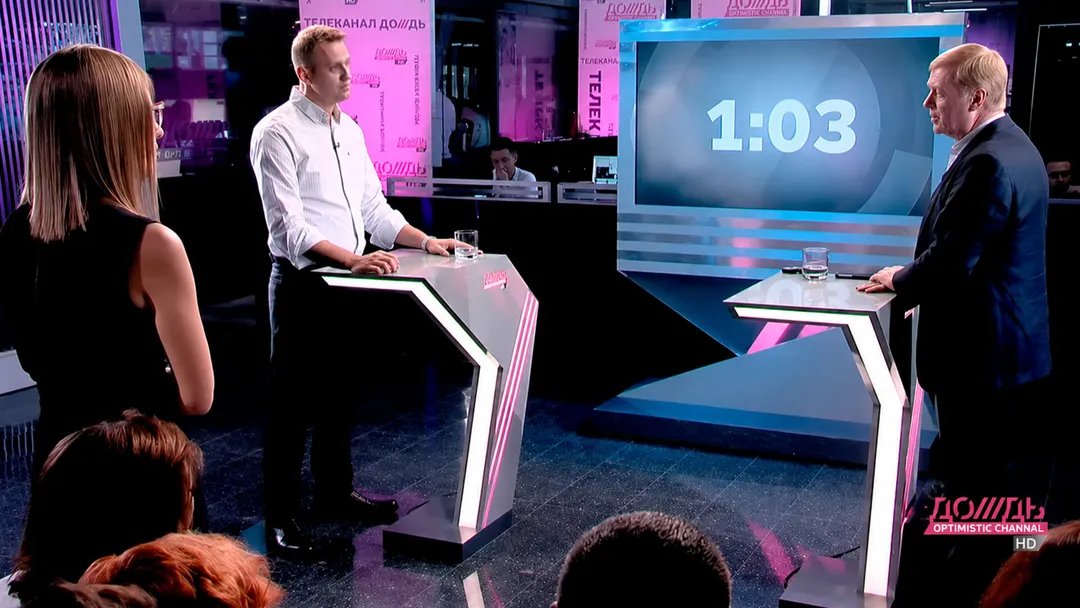
[music]
Direct Conversation
Good evening, my name is Ksenia Sobchak.
And this is Direct Conversation, here and now. I’d like to ask
to invite into the studio Alexei
Navalny and Anatoly Chubais.
[music]
Anatoly Chubais, we’re waiting for you by the registration desk.
Registration.
I’m glad everything began with a handshake.
Thank you for agreeing today
to this conversation. Let me remind our
viewers that today’s meeting, our conversation,
our discussion,
is the logical continuation of the discussion
that began after the post by Alexei
Navalny,
in which he accused Rosnano and Anatoly
Chubais personally of improperly spending
huge amounts of state funds, vast financing.
That is what we will be talking about today.
So, let’s begin.
[music]
Direct Conversation. To begin, I’ll outline
the rules of today’s broadcast. We will have,
let’s call it conditionally,
four rounds of our discussion. In the first,
I will ask a general question, and each of you will have
four minutes for a kind of opening statement and
remarks. In the second round, you will have
the opportunity to ask each other questions,
three questions each, in turn. In the third round,
you will face questions from viewers, which they
sent in to TV Rain (an independent Russian TV channel).
These questions are already posted on the website, and I
will choose several interesting ones for each
of you. And in the final round, we will sum up
the discussion and announce the voting.
Those are the rules. I would also like
to say that by mutual agreement we
decided that today’s discussion would be
narrowly focused and tied to the topic of
Rosnano. We will not, I hope, move
into personal attacks or discuss any
other topics related to
the biographies of our participants, simply
in order to create a certain new standard
of public debate. If everyone agrees with that,
then I suggest we begin with a question
and then with Alexei Navalny’s opening statement
as the attacking side; we also
agreed on that before the broadcast. So, my question to both of you:
you are both supporters of liberal
reforms, and on behalf of all viewers of TV Rain
I want to ask you: why did you decide
to choose each other specifically as opponents
when there are so many people around
in opposing camps? Thank you.
Thank you very much, Ksenia. Many thanks to TV Rain
for organizing these debates,
which are, of course, extraordinary
by today’s standards. And of course I cannot help but
begin with a compliment to Anatoly Borisovich:
thank you very much for
turning out to be the only head
of a state corporation willing to engage in an open
discussion,
willing to answer uncomfortable questions and
in general to interact with society in
such an open way.
Nevertheless, despite this compliment,
answering your question, Ksenia, I want
to stress in particular that in this sense I
am certainly not in the same camp as Anatoly Borisovich.
I came here to argue with him
precisely as with a representative, perhaps the foremost representative,
a pillar of state
capitalism and one of the leading figures
in the system of state capitalism
that Vladimir Putin has built, and in which
Vladimir Putin, among other things, created
the company Rosnano,
which we will be discussing today. I
truly believe that the company
Rosnano, in its current form, is ineffective,
unnecessary, and should be dismantled
or radically reformed. I
have three very clear messages
on this subject, three points on which I
stand.
First, and most importantly, let me begin with
a quote from a remarkable, very
smart man, who said this in 2006:
“Building state
capitalism is inefficient, almost always
corrupt, and strategically
unsustainable.” In 2006,
that man was Anatoly Borisovich
Chubais. And now I want
to appeal to Chubais of 2015 with the position of
Chubais of 2006,
saying that if there is one thing we
have learned over the last fifteen years, it is
that state corporations do not work.
None of them work; they bring us nothing.
The company Rostec (Russian state technology conglomerate) will not
give us any technologies; the company
Gazprom is not even capable of increasing
production; and the company Rosneft cannot
do anything at all except increase
salaries and bonuses. That is partly why from
Rosnano,
no matter who runs it, Chubais or
Ivanov, we will not get any nano-
technologies, because it is impossible.
State capitalism, as
Chubais said in 2006, is unsustainable
and ineffective. Number two: the inefficiency
of Rosnano is directly
evident from the key indicator. You
wanted Russia to become a leading
country in the field of nanotechnology. Thank
goodness there are two indicators that no one
can fake: the number of
publications and the number of patents. If
Russia is a leader anywhere, then
it is a leader exclusively in the area of
financing—we are second only to the United States, and
Japan, but in terms of the number of publications we are
in 12th place, and by the number of patents in the world, in
Western Europe, if we look at it, we are in
27th place, and in that sense we have not achieved these
results over seven years.
And in terms of the number of publications, we have actually fallen.
And third, finally, if we look at
specific Rosnano projects, the largest
projects,
Liotech, Optogan, the so-called Siberian
Silicon — you cannot deny that
these projects have failed. They simply do not
work. So this state
capitalism, this kind of venture
state venture model, simply does not
work, and there is no arguing with that.
So to sum up, Anatoly Borisovich (a respectful way of addressing Anatoly Chubais by first name and patronymic),
2015.
Please remember Anatoly Borisovich
of 2006, and finally admit that for Russia to
develop nanotechnology and any other
technologies,
it needs to attract investors, it needs
to develop the judicial system, and it also needs
to develop competitive elections,
free media, and for now investors
— foreign and even Russian ones — are
running away in horror when they see all these
state corporations of yours, including Rusnano.
They run because they are afraid of you. Please do not scare them.
Please, given that you are
a well-known person, a leader of public
opinion, and unlike
me and many others, you have the opportunity to speak with the State Duma (the lower house of Russia’s parliament), with
the government, with Putin — then don’t stay silent, and
state this simple idea honestly:
it is not state money — and so far you have already
received 240 billion rubles (about several billion U.S. dollars)
effectively from the state — that will give
rise to nanotechnology, but rather normal
institutional development. Thank you very much.
Thank you. We are a little short on time. Thank you, thank you.
Thank you. Well, and to TV Rain (Dozhd, an independent Russian TV channel) as well.
It seems to me that in any case, first of all, when
people directly express their
position, that in itself is always
grounds for respect for me. And secondly, I
think the best way to find things out is not only
by collecting some kind of black box
or some compromising material (kompromat), but simply to
ask questions directly and get answers to them,
which is exactly what you are doing now.
Therefore,
let us start with the first thesis: that Chubais
in 2015 betrayed the Chubais of 2006, integrated himself into
the Putin regime, sat on financial flows
under the roof of United Russia (the ruling political party), and the whole
rest of that set of accusations.
On the first point, from the first word to the last,
I am ready to repeat once again what
I said in 2006, and by the way not only
in 2006 — I also had some involvement
in the 1990s in what was, in essence,
the creation of a market economy in Russia.
Second, if we are speaking concretely about the substance
of what Rusnano does, then please,
Alexei, please do not confuse the term
known as state capitalism
with the term state companies — that is
not quite the same thing, or rather, not
the same thing at all. And if, as a second step, you were to even slightly
analyze the substance of what
we do, then you probably, while preparing
for this conversation,
would know that one of the basic
principles of all our investments
— and as of today we have 87 projects — is that
we are always a minority shareholder.
We do not just always have a private
partner; it is a partner who is the
controlling shareholder. And this is done
not by accident, but so that as a result
of our work in any project
we can exit that project. We enter
projects, support them, and then exit, and the
project remains in the ownership
of the majority shareholder, who
is, in fact, the driver behind it.
In that sense, my position today — and honestly,
I think it was exactly the same in 2006 —
is that if the state is capable of providing
support competently,
without destroying the owner's control,
then that is something it not only
can do, but should do. That is how
Silicon Valley emerged — it was financed for 30 years
by the Pentagon; without that there would have been
no Silicon Valley. That is how
the innovation economy emerged in South
Korea; that is how it emerged in Israel, starting
with the Yozma program and much else that
professionals know well. In that sense,
your first point — I reject it completely,
from beginning to end.
Now, the second thesis concerns the idea that
publications are needed and patents are needed. I agree
with the first and the second, but still, if you
had looked into it a little more, you probably
would remember what Rusnano was created for.
We were created for the purpose of building a nano-industry,
and in that sense our performance indicators do not include
publications at all — publications are the responsibility of
our colleagues from the Kurchatov Institute or
the Academy, and they do not even include patents, although
for the record, our portfolio companies do have them.
But that is not
the main criterion.
The main criteria are that we have created,
in essence, a nano-industry itself,
the volume of production in Russia at the
plants built by us. And in that sense,
well, you also know that all our
partners' indicators, as of today,
have been met. And finally, on the subject of
successes and failures: you probably did not accidentally
select, in preparing for this, exactly those projects
that are best known as our
failures, and which we ourselves talk about when
our failures, although I would not agree with all of them
you also mentioned the supposedly unsuccessful project
PolySilicon and the Liotech project, which
are far from being failures. We still
have a product called
the Russian lithium-ion battery, and
we understand how we are going to develop this product.
To finally set everything
straight, I will simply show you a few
photographs that conclusively bring this
story to a close. Here are several projects
that exist today among
the plants we built—projects of a kind that
did not previously exist in the country, and projects that
now have a real chance, and they
are operating. If you could put them on, and
please, let me run through them quickly in
the remaining time.
The Mikron project—no matter how much it is criticized—
whatever anyone may say, it is a genuinely
existing flagship of Russian
microelectronics, the most technologically
advanced enterprise in Russia in the field of
microelectronics, operating in Zelenograd.
There is nothing more efficient in the country.
Built by us together with the company
NEVZ-Ceramics, it revived Russia's
high-tech ceramics industry, from
armor coatings to knee-joint implants.
joints.
Danaflex: in Kazan, a plant was built for
the production of packaging film
for modern high-tech
food products, including those
made by leaders of the global
food industry in the West,
and supplied here. In Naberezhnye Chelny,
the best house-building plant in the country
integrates technologies ranging from
high-efficiency glass to
composite materials technology.
At RM Nanotech, we were the first in
Russia to build a plant for the production of
membranes that simply did not exist
in our country. And as you understand, this is used in everything from
gas separation to water purification.
And here, too, we effectively launched a Russian
composites industry, which is also
the foundation for the production of
modern fighter aircraft
and
modern sporting goods. Nuclear medicine centers—
tomorrow we are going to
Tambov to open another such center.
This is ultra-early diagnostics, which for
sick people is literally a matter of
life and death. Pharm-Sintez, which created one
of the two Russian pharmaceuticals that today
are being developed in the West by decision
for approval to begin
production there, and so on, and so
forth. I see I am running over time.
Unfortunately, you have already gone over your time.
You are exactly one minute over. I think it would
be fair to give
Alexei Antonov a chance—how do you comment on this?
Thank you, thank you for
the wonderful presentation. You could easily
head a PR company.
It was a great presentation, but you understand that when I
spoke about state capitalism, I
was not confusing anything—this is exactly what I meant.
I disagree when one person, even if
remarkable, is engaged in everything—
venture capital, and also
fundamental research, and so on.
All of this together, to me, is a frightening form of
capitalism: one person—Putin—decided
that we should develop nanotechnology. You
have told the story many times, very well, of how you
in 10 seconds
agreed to become the head of it. He simply
found a manager in 10 seconds, gave him
240 billion rubles, and they started building
some factories.
We analyzed publicly available
information on your largest projects,
which account for 30 percent of
investments. All of these projects are failures. I am not
saying that you have no successful
projects—you invested 158
billion rubles, of course you
have some successful smaller projects—but
all the largest projects are loss-making, and
that cannot be denied. It is simply a fact. But
when it comes to
your Liotech, which you said
might not be such a bad project—last
week
they stopped paying salaries. That probably
does show that the project is not very
good. Anton Borisov.
I am against all these things
that are done by private business all over the world
being done by the state. Madam Moderator is forced
to interrupt you. There will now be an opportunity
for a direct debate between the speakers.
You may either respond right now
or ask your question. Your point has been made.
That is all. It seems to me I should
I think it would still be fair if
Alexander were allowed to say something.
It would be fair if you answered, but then
we move on to the second round, agreed?
And will I be able to respond to this later?
Very briefly, perhaps, and directly:
once again, we are not engaged in
fundamental research at all. I cannot convince you of
that, apparently. That is first. Second, you
are clearly not choosing at random—you are selecting the most
problematic projects. I categorically disagree with you
that our largest projects are
all like that. I could just as easily talk
about Novomet,
whose products today compete with
Schlumberger on global markets in submersible
pumps, or about Monocrystal, which
today is a world leader—you know that.
you know, the world’s largest producer
of sapphire substrates for the LED
industry, holding 30 percent of that market
this is the largest project, yes
indeed, with the Liotech project we do have
problems; it is not one of the successful ones, but
as I said, we do not consider it a failure
it is in a difficult position, but it is a product
that we definitely intend to keep developing
in that sense. Well, what does Putin have to do with it? Ten
minutes of decision-making? We are talking about a factory
that has been built and that in any case
will remain in Russia, which our
...prepared 240 rubles
Anatoly Borisovich, you speak as if it all
came out of thin air. The state invested
240 billion rubles in your company in the form of direct
funding, as well as state guarantees, bonds, and so
on. It’s not as if you simply reached into your
pocket and said, “Here, Alexei, look, don’t
you dare criticize me — here’s a factory.” You took
a great deal of state money
and built and launched a number of projects
most of which, the biggest of which
of which
have, sorry, failed, and therefore
some were unsuccessful and some were successful
140 billion rubles, in accordance with
our business plan, will be returned
through tax revenues from the factories that have been built
no later than 2019–2020. Also
right now there will be an opportunity
in your open debate, with regard to each
other, to ask questions. Let’s begin the second round
of questions to each other. So then, who
[music]
Direct Conversation. Alexei Navalny. The second
round begins with Anatoly Borisovich
well, basically, we said, we agreed, but
still, Alexei, to be precise
you have only recently been dealing with the nanoindustry, as I
understand it, so in that sense I don’t have any
very direct questions, but if I may, there is
one main point that
I actually wanted to express
You see, from the outset Russia seems to you like a picture
that is entirely black and white. I simply remember very well
that letter of yours from which
all the discussion began, with the text saying that this
was a kickback-and-embezzlement outfit from the very beginning
created for insiders, which
lost all the money and is now demanding more, and
so on and so forth. When I hear
that text, I simply do not think about
the political process in which
you naturally exist — of course you think about it
that is understandable and natural — I simply think about
real, living people. There is, for example,
Mikhail Rudolfovich — I will now try
to put it properly — a corresponding member
of the Academy of Sciences from Novosibirsk
who has spent 25 years working on carbon
nanotubes, with which the nanoindustry began
the nanoindustry
the whole world knows about the spectacular effects
of carbon nanotubes, but no one in the world
— not Germany, not Japan, which worked hard on
this — was able to solve the problem of creating
modern production facilities. He went ahead and solved
that problem, step by step: first a tabletop
setup, then in a garage, then
a laboratory one, until today
there is genuinely in Novosibirsk one of the best
carbon nanotube production facilities in the world
with a price one hundred times, one hundred times
lower than the best global benchmarks. He
reads your text
“a kickback outfit, they couldn’t do anything,”
“they ruined everything” — how long is this going to
go on? “Disband them to hell”
I will not allow that. I will not allow anyone — neither
a federal minister
nor the leaders of opposition parties in the
State Duma (the lower house of Russia’s parliament) — I will not allow anyone to drag those people through
the mud, excuse the harsh
expression, because I am responsible for them, and
because I know what it took — he had to devote 25
years of his life to it — and I know
that with this plant he advanced Russia
more than many politicians ever do
Please, choose your words — don’t
operate in a black-and-white logic. Or do you consider
that the only possible view is one that fully
confirms all those accusations that
were set out in that letter? Still,
Of course the world is not black and white, but one thing in your reasoning
troubles me, namely that when I criticize
Rusnano, you put in front of you
a respected academician and start talking about
Navalny. Well, here is my answer to the respected
academician: no, I want to discuss Rusnano
— your state company, your
this rather interesting
state venture, where apparently
there are officials, and it is supposedly not quite a state company
Can I just finish my answer?
I am not saying that you have no successful
projects; of course you do. But when I
simply took your reports and read them from
2007 to 2014, I see that you
invested in 115, in my count, projects, and
simply adding up your profits and losses
for each year, I see 29 billion
rubles in losses. That is why I say that
the main thing you have produced so far is
losses. And, excuse me, in
August 2014 you also asked for
another 100 billion rubles from the National Welfare Fund
You tell me
not to allow something, and I say that I will not allow you
— within the limits of my, admittedly perhaps
rather modest abilities — simply
to keep pulling money out of the
national wealth fund
as all your colleagues in other
state corporations do. The world is not black and white
there are certainly good things, there are
wonderful, brilliant scientists, but in
Overall, the results of your company's work
now look completely
unsatisfactory. Please note that
indeed, we asked for reports of corruption to be sent to our black box
— facts of corruption, and so on.
I'm not pulling them out here from
my pocket — these corruption allegations — because
I have no proof. But openly and
quite simply, your reports, the Accounts Chamber report (Russia's state audit office),
and everything else simply show that
— forgive me — the company is still performing poorly.
In your defense, I will say this:
no one right now...
still, I insisted that I say this
in your defense: right now, you cannot
make money from nanotechnology in Russia.
It's impossible. I don't understand at all why you
started building the company in such a way that you
are supposed to return some money. You will
never get it back in Russia, because
at the current stage of nanotechnology
development, globally, these technologies
are not the kind of technologies
you can make quick money on.
That is why I believe you are developing
in fundamentally the wrong direction. You tell me
something frankly outrageous, excuse me:
among your indicators there are neither patents nor
publications. Then what is all this for?
What I want is for you to fund this
wonderful scientist, to fund
fundamental research,
applied research at an early stage,
and let excellent scientists receive very
large sums — we'll give you more money for that.
Yes, for scientists — fine. But I am against you
doing business at the state's expense.
You're engaged in business, and you're doing it badly.
As Chubais said, since 2006 he has...
The first giant victory. Alexei
Navalny said that not all projects
are bad. Fine — and now
let's try to structure
the second part of our discussion. I already
responded to the remarks that were made, and
here is my question-and-answer point: perhaps now
you can ask your question, and if it were now
formulated clearly, then it would be possible
to answer at least one of them. First of all,
it was said that Rusnano had a loss of 8,
13, 21 — but according to your own
reporting, it was 29 billion. You're mixing up positives and negatives.
Positives and negatives are combined
in a different way. First, the company
is planned to operate at a loss. Do you think I...
Two years ago, in one respectable...
Yes, based on the results of 2014, as you know perfectly well,
we made a profit, not a loss.
So from the standpoint of...
Please explain to the viewers what exactly
that profit came from. Certainly not from what
your friends write about regarding foreign-currency
deposits that were revalued. We did not...
because of that.
Well, of course not. Our foreign-currency deposits
had nothing to do with it at all. The profit was generated
through effective operations and
an increase in the fair value of our projects,
because we have a significant
share of projects with business diversification in
foreign-currency jurisdictions, which
were indeed revalued due to the exchange rate. Two
factors were at work. But the most important thing
is that you did not even notice
that.
I cannot simply brush aside these remarks.
You just said that we should
be funding science, and funding it
— Mr. Alexei, that's your point of view, fine, but
you truly do not understand the subject. We should not
fund science and R&D directly, but
the companies we created are beginning
to finance it because their businesses need it.
As of today, this year,
7.2 billion rubles
— I have told you about this — will go toward
funding not from the budget and not from Rusnano,
but from the businesses we have built.
These are the same businesses I was also talking about.
Not by chance — because without science they
cannot develop. Their share of spending
on R&D is about eight times higher than that of
Russia's manufacturing industry.
That is how business demand for
science funding is created.
Comparable state
funding was being distributed when...
In any case, they understand perfectly well what
they need and what they do not need in this sense. But without
fully understanding the subject, there is no need for grandstanding.
The picture is not black and white; it is a bit
more complicated than it seems to you.
I cannot tone down the emotion here, because
240 billion rubles are at stake, and if
— forgive me — in your official core
goals, goal number one
is stated as making Russia a leader
in the nanoindustry. I believe that if you
at the same time say that you are not
interested in publications or patents, but
are interested only in juggling
numbers, then you are misleading us.
We are interested in patents.
The nanoindustry, excuse me, cannot
develop without knowledge, and of course
it also cannot develop without patents.
What happens if there are no patents...
whether they are taught or not...
I did not say that it was only about patents.
It seemed to me we were almost getting lost in
details. The goal is not patents as such; the goal, it seems to me,
is that otherwise we will just go on
talking past each other endlessly. Still, I
want this to be interesting for viewers as well.
So let's move on to
specific questions. I think that Alexei Navalny
has them, and Anatoly as well. I
would still like to move away from general questions.
Excuse me, but after all,
I’m not speaking to just some employee here.
As the head of Rusnano, you are one of the most well-known
politicians in the country.
You are someone who influences people’s minds.
The moment I wrote that post—within five seconds—
you can’t imagine how many people
wrote to me, people I respect.
“You bastard, how dare you go after Chubais?”
“Stop immediately.” Roughly speaking, that’s what they were saying.
They say you influence a huge
number of people. So tell me,
as a prominent politician and as the head
of Rusnano, do you think that what
the country’s political leadership is doing now
over the past three years in terms of developing
science and fostering business
and entrepreneurship, and so on—does it
harm Russian science and, in particular,
nanotechnology, or is it rather
beneficial? Thank you for the question. Three minutes to answer?
All right. If we’re talking specifically about
what has been done over the past three years,
I would probably broaden the timeframe a bit—
to five or six years at least. There have been many steps
that were absolutely right,
balanced, and well thought out. And there are things
I disagree with. About both of those
one can speak clearly even within
three minutes. On the latter, I categorically
disagree with the decisions that led
to the shutdown of Zimin’s foundation (the Dynasty Foundation, a major private science charity), because I believe that was
a real blow to Russian science,
and I hope those decisions will be reversed.
I could go on about other mistakes in
this area, but at the same time I cannot fail to
see that in Russia, despite
the actions of many politicians, including
despite the actions of many others,
despite the actions of our esteemed
“competent authorities” (a common ironic Russian reference to security and law-enforcement agencies), and very
“competent” opposition politicians,
despite the obstacles that arise at every step,
and despite all that, I can say with certainty:
don’t help me, I’ll manage on my own.
The truth is, what is emerging is what
is called an innovation-driven economy.
It is emerging for a whole range of reasons, not just
because of the state. Russia is structured in such a way that
you cannot create innovation in Russia by government order.
You can’t create innovative companies by decree either.
So at the science stage there is
the Skolkovo Foundation, which, incidentally, funds
science. Then at the next stage,
the venture stage, there is the venture
corporation that finances early
stages. Then there is us. And as a result
of all this—and I say this with complete sincerity—
I am ready to say:
believe me, this is not propaganda, and not, not, not
some attempt to curry favor with you—
I genuinely believe that for the past six or seven years in Russia
an innovation economy has been built, step by step.
It’s just that with an innovation economy,
with innovation as such,
it’s like in an old joke about becoming an intellectual:
it’s very simple—you need to graduate from three universities,
except one must be graduated by your grandfather,
another by your father, and only the third by you. So we
are only now finishing the first university.
Only the very first
shoots have appeared so far.
They have sprouted in precisely the environment in which
you work as well.
Probably, if you were an opposition
politician in the Netherlands, things would develop somewhat differently
for you. But in this country, under these
conditions, all these Russian
mechanisms
operate in full, from beginning to end. But within them,
something real is emerging. More than that,
it is emerging to a significant extent
thanks to government support. And these are
facts that, regardless of political
orientation, any effective analyst
or politician simply cannot fail to acknowledge.
Well, I think that if
Alexei were a politician in the Netherlands,
his career would indeed have unfolded differently.
That seems to be complete consensus. We can move on
to the next question.
Anatoly Borisovich, this is your chance
to ask Alexei one more question.
I won’t take up time with a combative question,
or keep pressing with questions.
Asking Navalny questions is not really
my style. Any statement can easily be
turned into a question without actually saying one.
So I would just like to make
a brief remark of the following kind. Perhaps
you, Alexei, strayed a little beyond
nanotechnology, so I too will allow myself
to step a little outside that topic—though if I go too far,
please correct me. But this is serious:
your entire framework,
all these claims and accusations, is built in such a
completely black-and-white, utterly
black-and-white way.
You’re embarrassed now, and rightly so.
Tactically, I appreciate that. But at the same time,
what you actually wrote—what is written with a pen
cannot be chopped away with an axe, and on the internet, as
we know, even less so. It is simply an outrageous
insult to hundreds of thousands of people
who are actually doing real work. You see, what I mean is
that Russia is divided not only into
the opposition and the authorities—that is, of course, an important
division. There is another division
that is no less important: the division between
those who try to get things done in our
conditions, amid our difficulties, amid our
corruption, which you are fighting against,
and those who stand on the sidelines and say:
“This is wrong, that is no good.”
It just so happened in my life—well, that’s how it turned out—
that I have spent 25 years at this
crossroads. Twenty years ago, in much the same way,
Grigory Yavlinsky was saying the same sort of thing about me again.
which precisely reflects those same positions
told me that everyone steals everything
you can't do anything wrong there either
Gennady Zyuganov said essentially the same thing as well
Zhirinovsky didn't say anything different either
he told me the same thing about how they would act there
Oksana conveys it professionally
Dmitrieva from A Just Russia also said the same
they told me essentially the same thing
our respected, successful...
Barsukov, Kh..., Korzhakov—not everyone, at every level
at every stage they are against it, all of them, at every stage here
don't become part of this environment of confrontation
to join that line—you have a real chance
to become a politician of a different era, of a different
class; don't slip into this easy
and convenient, sweeping way of saying, 'Now we'll'
'smear them all, hit them all—now they'll'
see.' That doesn't work in the long run, and I
would like to see you as a politician, because
I disagree with much of what you
do, but I would genuinely like to respect
you. Opposition figures, don't stop me from doing that.
Of course, you can say you couldn't care less
about my respect, and you have every
right to feel that way. I'm not imposing it on you, but
believe me, this division between those who
do things and those who prevent things from being done, who watch
from the sidelines or simply get in the way
this is a division behind which stand hundreds
of thousands of people in our country who
think the same way I do. Don't reject them
in your work. That was Anatoly Chubais's three-minute
statement. Alexei Anatolyevich, your three-minute
response.
Your attitude toward me certainly matters to me, and I
don't want to be loved, but your
attitude toward me, as toward any other
person in Russia, matters to me, and I will not
stop
explaining my position, and I hope that you
will understand it. It's very interesting that you
mentioned Yavlinsky, because while preparing
for this debate, I watched all your debates throughout
your entire history—with Yavlinsky and Rogozin, all of them
I watched. Of course, I prepared seriously
I read all your
reports, Rusnano's reports—I read a great deal
It was very interesting. You
you said roughly the same thing to both Rogozin and Yavlinsky
roughly the same thing: 'Yes, I criticize,'
'but I'm the one doing things, and you're the one criticizing.' I think
well, maybe he wouldn't put it exactly like that, but still
and now you're saying the same to me, Anatoly Borisovich
Many years have passed already. Please, enough
with that. I really strongly dislike
this position you've created
for yourselves, this world in which you're some group of amazingly
wonderful managers from the city of
St. Petersburg
you came, excuse me Ksenia, and took over everything
and for many years now, all of you
have been running things
and you're sitting everywhere, and you're supposedly the best
the best deputies, the best state
managers, and somehow you just can't be
dislodged. And when people start criticizing you
you say, 'Why criticize me like that?
Navalny, I'm the one doing things, and you're not'
You're doing things? You received
240 billion rubles and you're 'doing things' with it
I disagree with that, Anatoly Borisovich. I'm not
speaking specifically about you, but about this whole
St. Petersburg mafia—'mafia' is a bad word—let's say, circle
Well, it's time for things to move on somehow
Are you really telling me that I
am somehow not a proper politician? I
am barred from running for office, my party was
liquidated
I am fully
prepared, excuse me, to take
a constructive position and argue with you
in the Duma (the lower house of Russia's parliament) and so on. We are ready to fight for
responsible posts in government and
so on. Only, excuse me, of course this is not
your fault, certainly, but your political
leader, Vladimir Putin,
jails me, jailed my brother, and our
political history is simply
a story of constant court cases—this one got
15 days in jail, that one got
several years, and so on. And you're telling me that you
are the one doing things while I
do nothing? I am ready to do the work
just step aside already, please
hold honest elections, and I am sure that in
the next cycle of fair elections, other
people will be doing the work, while you may
be the one criticizing. What exactly can be
done? Yes, I'll add this now—it is possible
Please, you have three minutes to speak
Anatoly Chubais can do something extremely important
something truly crucial. Anatoly
Chubais—that is, people who are very fond of
and when, for example, today Vladimir Putin
declares that foreign companies
are luring people with grants, supposedly somewhere out there in
schools, as he put it, 'combing through' our
Russian children, putting them on grants, and then
taking them abroad—Anatoly Chubais, as
someone interested in the development
of science and education, should say:
'Enough. I don't want to hear this garbage anymore'
'I want this sort of thing to stop'
'I want the country to function normally'
A brief reply from you, if you have one
but first, a few words
from Anatoly Chubais in response to Navalny, and then we
will move on to questions from the audience. Please
Yes, and then a brief response to Alexei Navalny's words
Chubais's brief reply: first of all, I
well... all right...
I fully understand everything you have had
to go through. Well, that is how Russian
life is устроена: some people are jailed, others are blown up
it depends on what someone prefers, in that
sense. Here we simply need, as it were, to return
to reality, you understand—and reality means
You want to drag me into politics.
I definitely won’t go into that field. I know that many people
want me to.
On the one hand, on the other hand, I’ll say this:
I’ve been working in the practical sphere
for 25 years. The place you’re heading, Alexei Alexeyevich,
I come from there. I know very well how things
are organized there, believe me, and I understand very well
how it works and how it doesn’t work.
It just doesn’t interest me. I don’t want
to do that. What interests me is not some fantastical
idea, but a project called Rosnano.
I’ve devoted my whole life
to it, unlike all the other projects.
A project of this substance, one that
really moves the country forward—I
truly believe that. I have never had
a more interesting project in my life. It is the most interesting one, and I
will keep working on it even if you
think I’m Putin’s lackey, that I’m
feeding off financial flows,
running some sham office for
embezzlement and so on. Even so,
I will keep doing it, because I believe
it advances the country no less
than—at the very least—what
you are doing, although I respect
your work. Thank you very much. We’re now going to take a short break for
a brief commercial, and then we’ll
return to the studio with questions from
our viewers. Stay with us.
[music]
Direct Conversation
This is *Direct Conversation*. I’m Ksenia Sobchak, and we
are continuing our discussion—
our meeting between Alexei Navalny
and Anatoly Chubais. We are now in
the third round, and now we’ll take questions from
social media, from viewers. We’ve collected them,
they are all now on the website, where they can be
viewed, and we selected what, in my
opinion, are the most interesting ones. The first question in
this round will be for Alexei Navalny.
So, a question from a user:
“Skolkovo is hard to understand, as are RVC (Russian Venture Company), the Internet Initiatives Development Fund, and others.
Why have you fixated on Rosnano?
Why not the others?”
I look into such a large
number of companies that it would be hard, I think,
to accuse me of focusing only on one. Anatoly Borisovich,
I’ve written probably twenty times more harsh posts about Skolkovo
than about
Rosnano. And indeed, compared with Rosnano,
Skolkovo is even worse—in fact,
several of these institutions are simply monstrous, terrible.
In that sense, I criticize all of these companies.
It’s just that
Rosnano received the most money.
Rosnano got an enormous amount
of money, and its activities are much harder
to conceal, and that is why this problem exists.
The problem—or rather, the peculiarity
of Rosnano’s work—is that if some
plant fails or some project collapses,
that failure can’t be hidden. And perhaps that is why, of course,
Rosnano takes all the blows. But
it is taking them for a reason:
it received more money than anyone else.
Please wrap up your answer. You have two minutes,
and may use them as you see fit.
Then the second question is for
Anatoly Borisovich Chubais, from a user:
“In 2011, you showed the president a tablet that
was supposed to replace textbooks.
What became of that project,
and what was developed at Rosnano?”
Yes, thank you for the question. Still, I would like
to say a couple of words about Skolkovo, even though
they may not hear me, in order to defend my colleagues.
You see, Arsen...
I already mentioned that Rosnano and Skolkovo are at different
stages. Skolkovo is at a much earlier stage.
Yes, a more preliminary stage. We are at
the stage of building factories. Whether it works out or not,
it is harder for us to hide, and we are not
really trying to. If something works, we say
it works; if it doesn’t, we say
it doesn’t. Skolkovo, however,
being at a much earlier stage,
with things like Skoltech (the Skolkovo Institute of Science and Technology), they
of course cannot demonstrate factories or
finished products. Objectively, they cannot,
and that doesn’t mean they are bad. It’s just that when
you unleash your criticism,
you should understand at least a little of the professional
side of it. If you ask me
about patents or about
fundamental science, that would be wrong. I am responsible for
factories. Ask me about failed factories.
Asking them about factories would be wrong; they should be asked
about patents and science.
If you frame it that way, then things become clearer.
As for the answer to your question,
this is one example of projects
that seemed to have failed. We
really were unable to make a tablet
that could succeed on the market. We did make it, it works, and even now
it would simply have been impossible to compete with the iPad.
The timing coincided in such a way that it was impossible. But
did you keep the project? We preserved
the technology. In fact, I brought something with me.
As of today, the first
commercial product has appeared: a second
screen, a second screen on a phone. If
someone here takes your picture and you send it to me,
you will appear here on this second screen.
YotaPhone received exactly these kinds of screens from us under contract.
These very screens. This is an entry into
the commercial sphere of flexible electronics.
And flexible electronics, from the point of view
of most experts, is
the basis for a huge breakthrough in wearable
electronic gadgets. So we believe that
this project is now right at the launch stage.
Like a rocket, it is genuinely capable of taking off
in the near future. Yes, this is our second
screen, right here. Thank you. I’ll answer briefly.
And I apologize for taking up the time.
As you comment from the audience, you’re asking from over there, well—
you’re asking them one thing, and asking me
something else. It should be the other way around: I
am asking, as a taxpayer, from the point
of view of common sense. Excuse me, but
the fact is, you already represent the state—you
are a state corporation, part of this very
state capitalism, all of you. And I believe
you did it wrong. I believe
that the development of nanotechnology, as it
was in Israel, as it was in the United States, as
it was in Japan, is connected with
first and foremost investing in
fundamental science and applied
research. And therefore, whatever it is that
you’re doing there—I’m asking all of you,
because all of you are the state.
You all have flashing beacons on
your roofs, so I’m addressing all of you.
You’re simply taking up too much time.
I have to note, Anatoly Borisovich (patronymic-based form of address), this could go on
forever. So let’s move on to
the next question from one of our viewers
on social media. Daniil Averin, a user,
asks you: if as a result of
your actions Chubais is removed from
his post, will you be satisfied? I will be
satisfied if, as a result of my
activity, Rosnano becomes more
transparent, is reformed, changes
the structure of its spending, when it
invests in scientists—[applause]
clap your hands if you like—but I will be
satisfied. Chubais can decide for himself where he
should be. I will be satisfied when a personnel
decision is made.
It’s true, Anatoly Borisovich said
a remarkable thing: “Well, Alexei,
I left politics, and so now I
am doing what I like at Rosnano.”
And excuse me, that sort of thing does not satisfy me.
You left politics?
People leave politics when they retire. Otherwise,
you’re simply inventing for yourselves these
comfortable positions. Maybe in those
comfortable positions you are doing good
things, but in a normal society that is not how it
is done. I want Rosnano to be headed
perhaps by a scientist,
someone who works in nanotechnology,
someone who has proven himself,
and as for these so-called effective managers
and administrators—I don’t want to see them anymore.
These endless representatives
of the St. Petersburg team (a reference to officials tied to Putin’s St. Petersburg circle), who can
apparently run everything in the country—I have no
specific vendetta against Chubais.
I agree that against the backdrop of the monstrous
state corporations, Rosnano does not look
so bad. I completely agree with that, and I
agree that perhaps some people at
Rosnano, and specifically those
being discussed, may feel offended.
“Alexei, but look at what’s happening at
Gazprom or Rosneft—why are you picking on us?”
But that does not justify them. So I
will go after them too—Sechin and everyone else.
So whatever happens there
with their resignations is a decision for them
and for the people who appointed them. I
am simply expressing my opinion.
Anatoly Borysych (colloquial form of Anatoly Borisovich), you will have a chance
to respond, and Alexei, to answer our
viewer’s question. I’ll read it out right away.
It is from user Roga Simpson: what
share of your personal savings do you
invest in startups?
Second point: Alexei Navalny said that Rosnano
is not as bad as all the other
state corporations.
We’re no longer a state corporation.
I have achieved a fantastic transformation.
Compare the two—just a few words
on your question.
I want to remind you that each
state corporation has its own role. Well, I don’t know—
it’s like different animals in nature:
there is a tiger and a hare, there is a wolf; they have
different roles in nature. Likewise, in the innovation
ecosystem there are different tasks. You shouldn’t
demand factories from Skolkovo (Russia’s innovation hub), and you shouldn’t demand from
us what is required of another institution. Transparency should be demanded,
and criticism is normal. By the way, I was told
that I supposedly said people should stop
criticizing me. I definitely did not say that.
I definitely did not say that. More than that, I believe
that in this sense you are performing
the right function. I would just like you
to do it more professionally, more
substantively. I am certainly not in favor of
shutting Navalny up, even if he
were to stop—that is definitely not me, in any sense.
Now a direct answer to the question that
was asked, about the transformations themselves
that Alexei N. is talking about.
We have actually gone down a rather difficult
path: from a state corporation, through a joint-stock
company, to a structure that
is called a family of private equity
funds, which is what we are becoming in
accordance with our strategy. This
year, Rosnano’s management company will not
belong to the state anymore.
The fund itself will remain under state ownership further on,
because it really consists of enormous
state money. But the management
company, being a purely managerial company,
should be acquired
by the partners, including me. I must
take money out of my own pocket, put it down, and
buy a stake in the management company—or rather,
I am expected to; this is what is being proposed to me.
It is in line with the strategy. I definitely want to
do it, and I want our managers
to take money out of their own pockets and buy
stakes in the management company, and thus
participate in the investments with their personal
money. That is what we have now come to.
The only interesting thing here is that this simply cannot be justified.
But not in
You can't do it this way: you cannot simultaneously be both
a government official at the same time and not
This is a classic conflict of interest.
Listen, I wasn't interrupting you. This is
simply a key point.
Again, this industry was not invented
this morning; it has existed for roughly 40 years, and
it has its own rules. One of those rules
is that management is separated from
the investor. The management company brings together
investors—LPs, so-called limited partners.
Among them there may be both state-owned
companies, sovereign funds, and pension funds,
down into
as well as private money. The essence of the task
of the management company is to raise these
investments. At the same time, the management company
is always, in every country in the world,
private. That's a law of the system. It's just that you
are not very familiar with this, though he
understands it perfectly.
Alexei will also have a chance
to respond to your question, and you can also
make your own remarks as well. So, they
from Kirov are asking Alexei Navalny a question:
What would you do with Rusnano's money? But
apparently they mean budget funds—public money.
Rusnano should invest money
where it will produce results, in the areas that
will drive the development of nanotechnology. We should
use the experience that has been gained
around the world; there is no need to reinvent the wheel.
It simply should follow the path taken by
the countries that have achieved
the greatest success.
Japan, the United States, the United Kingdom, and now China.
Funding for fundamental science and
applied research at an early stage of
development—that is where this money should go.
Let there be more of it; that would be exactly appropriate.
And to continue—Boris says to me
that this should not exist in our system.
We are different beasts.
That is why I am standing here—because you
have created
a monstrous freak: an elephant with
giraffe legs, plus wings, and all of you
keep whipping this elephant with a lash, saying, 'Fly,
fly,' but it does not fly. As a result, your money is wasted.
Nothing works, and it will not fly.
Boris, because this is exactly what I
started with: your system of state
capitalism is ugly and wrong, and
if you also bring this into
this monstrous thing—you just said that your
managers
will also invest their personal money in your projects—
well of course, then if
they are investing personal money, then
that means they will inflate the capitalization
of the projects. This is a classic conflict
of interest; this is where corruption begins.
I hope that never happens.
Understood, thank you very much. The next question
is for Anatoly Chubais, with an opportunity
to comment on what Navalny said.
Denis Livanov asks: Have
managers been held accountable for unsuccessful projects?
Managers exactly... several criminal
cases have been opened as a result of these...
The question is completely clear. Specifically, I
have already said before—although Alexei also
naturally used our own self-criticism—
that at a certain point in time
while transforming the company, we replaced 60 percent
of the management team, and this happened precisely at
the point when we realized that at this
stage we needed to shift toward
a classic business model, including
the privatization of the company.
When things are edited together with Alexei's remarks, well,
believe me, I don't know what words to use.
For specialists, these are elementary basics.
The innovation economy has its own
laws; they differ from the laws of the ordinary
economy. Proper venture industry
is built in its own way.
In this sense, in the innovation economy
there are early stages, middle stages,
and final stages. What is done at the first
stages is not done at the later ones, and one should not
demand it.
And there is no need to invent wings for it.
They do not exist where there should be early stages.
If we fail there early on, we will not succeed at the next
stage either.
Exactly the same way the structure is properly arranged
in any industry. But this is simply a basic
thing that, unfortunately, very few people in the country
know. That is true. In that sense,
it is even fair to make claims against me,
but believe me, this is how it is structured:
general partner management companies are required
to invest from 1 to 2 percent
alongside the major investors
they attract, using their own personal
money. These are mandatory investor requirements.
The share of money that you have invested
from your own wealth, without which
investors will not give you any money.
That is how these tasks are solved; this is not a conflict
of interest. Your understanding is about
25 years out of date in this field; it
has changed a great deal over that time, and
today we will do everything possible to
fully, despite your position,
support the creation of a Russian
industry in this sphere, on the basis of
the law that we worked on together,
called the law on investment partnerships, and
the framework we created—the first in Russia—for
private equity funds in Russian
conditions, which now do exist in our country after all.
So how many criminal cases do we have?
As of today, out of the six
existing criminal cases connected with this...
or otherwise by the activities of Company 4
initiated by us, and we will pursue
results despite the obvious
resistance we are facing
Thank you. A question for Alexei Navalny from
Nikolai in Orissa: there is a lot of
talk that Russia has long since
fallen hopelessly behind the West. Has it become
a worthwhile project at all?
First, a brief comment.
Boris, well, actually, this is 2015; there is no need
to speak to me and everyone else
as if
you were talking to some minister
in the government or to deputies who
in our system understand nothing and can
be fed any line. No, that is not how it works.
When I tell you about my
vision, it also completely
coincides with the view, for example, of the Russian
School of Economics, and before coming here I
read their extensive proposals; you know them too,
on improving
the institutions of innovative development. They
say the same thing: you should have
patents every year, Anatoly Borisovich.
Actually, I would understand
your condescending attitude if
someone told me, 'Alexei, we invested 240'
but earned a great deal.
But so far I see that the biggest projects,
frankly speaking, have failed. I see losses, and
in fact I do not have the slightest
reason to suppose that these
funny little things on the phone will
suddenly take off tomorrow. Your previous, previous
track record—sorry, but that is what I am relying on
for now—suggests that everything has been unsuccessful.
So there is no need to smile
condescendingly, please. As for
lagging behind, particularly in nanotechnology,
let us look at something very specific.
Let us see how many patents
were registered in 2014
in the field of nanotechnology in the United States, where
everyone strives to register them,
patents. So: American patents, 13
thousand; Japanese patents, 500; Chinese
patents, 30; Russian ones—how many do you think?
How many? Sixteen. Sixteen in total. That speaks to
a truly colossal
failure and a monstrous lag. This
monstrous gap is due to the fact that
money is being invested in the wrong places. Once again, I
say that Anatoly Borisovich should not be building factories,
whether good ones or questionable ones,
but investing in fundamental
research. And we need to develop
the market and infrastructure as a whole, because
without that nothing will work. But if you
know the figures for the flight of foreign
capital, you know the figures for how many
scientists are leaving Russia, and so on—without
addressing that, nothing will work. You refer
to Israel's experience. Something worked out there because
in the 1990s, 2 million
Soviet Jews emigrated there, of whom 8,000
were engineers, and those people
created innovation. You created the conditions there, while here
the authorities have driven everyone away. Thank you, Alexei. I
think that
Anatoly Borisovich is eager
to comment on
the School of Economics, but in addition
to that, a question from Elena Vasilyeva:
Navalny's investigations into
efficiency and corruption in
state corporations are important for society.
If he is ultimately imprisoned for this, will you come out
in his support? I hope it will not come to that.
That is being considered in this context.
I agree, I will answer the question. Give me
a moment. And look, I know very well
the text from the School of Economics
because it directly concerns us.
Well, I do not know whether to argue with you or
the opposite.
Take my word for it: there is no proposal there
to urgently demand patents. Once
again, that is our function.
Moreover, besides those obvious
arguments I have already mentioned, there are
other arguments. The point is that the funds
given to us from the budget have been spent
properly.
If we were suddenly to follow your advice,
which we should not do, they would become a one-time
expense. We are doing something else: we
are creating enterprises and businesses that,
as they develop and reproduce demand, annually
increase the volume of funding for science.
I gave you the figure: 7 billion
in 2015, in non-budgetary
business money in our projects. I know from all
our figures that this number will grow
two- to threefold over the next three to four years, and
that is a self-reproducing volume
of science funding, which is far more
important. You are talking about what
is happening with emigration, including
from science, which for me is an extremely
serious problem. It truly is a disaster for
the country. In that sense, by creating
40,000 jobs so far, of which
20,000 are highly skilled
positions,
unique jobs for which we specially
provided educational training, and
these people, who otherwise would essentially not
have had a place, have as a result found themselves
needed in their own country. Does that not make
an important contribution? And if we go further
into your area, we sincerely expect that
people of a different caliber are those for whom
it is not just an innovative economy, but one in which
the very highest professional
competence and intensive contact with
the best in the world, wherever it may be,
developing technologies means that
these people, in the end, they
what affects the social structure is the creation
of something that is categorically lacking
in the country, I think, and you will agree with me
of demand for democracy. We are not simply building a factory
— look further, look
deeper, look at the consequences for
politics, and you will understand: the situation
is not black and white; it is far more
complex. My support for democracy is enormous, but I
see that the authorities are simply
dispersing people, and over the seven years of existence
of Rusnano, while people are scattering because of this
Ali Racing
it is back from— you will now be
is it possible— I still want, for
our viewers, to get an answer, that is:
will you go out into the street for Navalny next
time, yes or no? No, no, no, no — just like that.
So, you will be the next to criticize
Dimagu— you say— next question.
Alexei Navalny, this is the last one for you
question in this round, from Fide Sumki, but he
asks you: do you have the nerve to join the board
of directors of Rusnano if Chubais nominates
you? Well, I’m not afraid of that at all.
And I would also go out in support of Anatoly Boris
if they were to imprison him unjustly, just as
I would for any other person — Anatoly
Borisovich, Gennady Petrovich, or Ivan
Ivanovich. I have gone out for anyone and I will
continue to do so if someone is being imprisoned unjustly.
Probably in
this lies our key political
disagreement. As for the board
of directors, I was on the board of directors
of Aeroflot, which is much larger than
Rusnano. I believe I worked there conscientiously
on behalf of the shareholders, and for example I
tried to be nominated to the board
of directors of Sberbank. This is my
professional activity: I try
to get onto boards of directors in order to
work on improving transparency
in companies, and in that sense I am ready to work in any
company, although of course
I think it is unlikely that anyone at Rus
would really like that idea. I’m not pushing myself on anyone — you
invited me, by the way.
In precisely that capacity, I would easily
be invited as a member. I already know that he
worked professionally in the capacity of
a minority shareholder — aggressive, tenacious,
persistent. That is exactly what the eyes and nose
so lower— more— hurray— departure
but we do this— those who rose up— nothing
has been achieved. Management does not nominate
directors; it nominates its own people, unfortunately.
That will not work. Returning to
the existing points, I must
clarify my position as well. The question is important.
I definitely will not change my position, but it is important for me
that I be understood as well in this
sense, in what I am saying. Generally speaking, I
have, as it happened, gone out into the street both
in August 1991 and on October 3–4 (during Russia’s 1993 constitutional crisis).
I believe that every step must
first answer for the consequences that follow it
once it is taken. In our country, Russian
reality, I think, and Alexei will agree,
Russia will only agree with the fact that
today, for us, business — especially when it involves
state money — and politics do not
mix. For myself, personally,
there is a simple, direct question: I must
choose one of the two.
My answer, guys, is yes: for 25 years I was engaged in
I was engaged in it before many of ours even appeared on
the political scene. And after that I
believe that, bluntly and unapologetically, I have
the right to choose.
Time is up. Alexei Navalny,
got worked up, but I think that directly
the taxpayer’s question toward Rusnano
is such a traditional line of attack. I think that
we will now ask a question— we will ask
and give less time for the answer, if you do not
mind. That would be fair.
Borisych, this question is also the last one for you, from
a user, Flot as a target roof
but you spoke about building
a globally competitive
Russian industry
in nanotechnology. Why, in that case,
is the drug Kagocel, which you are so
proud of,
not on the global market, not even on the list?
I have heard this objection many times, including
from the closest members of the team
around Alexei. But, guys, here is the thing:
in the entire history of Russian
pharmaceuticals,
there are two formulas developed in
Russia by Russian scientists that
have now reached the stage of clinical
trials in the U.S. — one for cancer, one for
something else. Two formulas out of two
formulas.
No, they are not produced there and have not reached the market
yet; they are at the clinical stage. And clinical development in
real life is six to seven years at a minimum. Of those
formulas, at least one belongs to our company,
the other does not, but we are related to it in
that sense. Kagocel,
is a fantastic breakthrough on the Russian
market: its share grew from one and a half percent to
30 percent, beating competitors under conditions
which, by the way, you quite recently
discussed with Vadim— with the professor
who created this innovative
Russian medicine. It will definitely go into
clinical trials abroad and will definitely enter
foreign markets.
But time is short, and the people
who prepared my part on both
medical technologies at Rusnano will not forgive me if I
go into that in detail right now.
Anton Borisovich, I would like to... well, I’m not sure, but...
a large part of the scientific community already
to strongly recommend to you
that you somehow sort out your
biomedical project, because when
Kagocel is a sham, at least so far
there have been no publications about it in serious
medical journals, and there have been no trials on
humans; it has not undergone them.
Boris says that for seven years books
nonsense... you won’t be able to fool anyone if you, if
you won’t be able to deceive people. That’s not me saying it,
that’s the truth, and I can state responsibly
that we have carefully
studied this and can assert that in
serious international medical journals
there are no publications whatsoever
about your unique medicines. If they were not
unique and in demand
then of course such publications would exist. There are almost
no publications, almost no patents. Your
biomedical segment is, for now,
a grand-scale... this is Arbidol number two (a controversial Russian antiviral drug), this is
this astonishing medicine, Kagocel
was included here in the list of essential
medicines.
And the World Health Organization
does not recognize it. I believe this is already
something bordering on criminality,
something criminal, and therefore Rusnano is obliged
to publicly show—not to me, but to doctors and biologists—
where these trials are,
where these scientific articles are, where these
tested medicines are. All right, let’s
since everyone agrees, I would give
the floor first. In Russia
there is an established procedure
for preclinical and clinical trials. I
already said that the clinical stage usually takes
five years, sometimes seven; preclinical is four
years. So this entire cycle, from the first to
the last stage, including clinical
trials consisting of three phases, each
with its own set of requirements from beginning to
end, was completed by Kagocel. I am ready to personally
hand over the full set of documents, without which
it simply could never have made it into
practical use. Please, for heaven’s sake,
for heaven’s sake. That’s first. Second, what you are
confusing
is that you are confusing the requirement for having
approval in foreign jurisdictions with
the Russian process for drug production. There is no, no
such blanket rule; no one has ever in their life
ever, in any requirement, ever
in clinical or preclinical practice, imposed
a requirement for publications. What is required
is testing on patients, testing
for safety, testing for
efficacy, testing on more than 100
people before...
...
Everything has to be... you are interrupting. In that sense,
I assure you that, first, it passed through all
stages; second, the requirement for publications
is made up. You keep repeating it without really
getting into the substance of the matter. And finally, the most
important point.
In general, I already mentioned that
the Russian pharmaceutical industry today is
a fairly competitive sector. If you had
looked not only at Wikipedia, where
all this is written, but gone further, you
would also recall that it has a whole
set of monstrous alleged consequences, ranging from
male impotence to female
infertility, which are elements of
the dishonest tactics you know well enough.
You live in your political
sphere; we have this kind of struggle too, and it is not
honest. Do not side with those
who do this dishonestly. Believe me,
in this field, both clinical trials and
a medicinal product on the market
have competitively proven themselves as something
else entirely, and to drag its author through the mud like this
is certainly unfair.
The clinical trials did take place, so that people...
Thank you. We’ll break now for commercials
for just a few minutes, and then we will have
the final part, the final
round, when each of you will have
the opportunity to make your closing
Thank you. *Direct Conversation* continues, and
the direct conversation between Alexei
Navalny and Anatoly Chubais continues, and we
are moving to the final round. Now each of
you will have three minutes to
speak based on everything
you heard from your opponent today
and draw some kind of conclusion
from today’s conversation.
We’ll start with Anatoly. Yes, let’s try this.
You know, as this conversation went on,
I’m really proceeding from what was
stated by you at the beginning.
And if we remove the emotions, the essence
of the difference in our positions, as I understood it,
was basically this: your position is that everything has failed,
nothing has been done, the money has been spent. Well, I
won’t even go into the insulting part
of your remarks. My position is this:
we have made mistakes; many of the criticisms were on target
and we responded to them.
If I understand correctly, in your original remarks
you reacted to my statement that we had made
certain mistakes. So what were those mistakes, and how
did we correct them, both before and now? And
going forward, we are not going to close our eyes to them.
For me, that was the key difference. As a result of
this conversation, I am generally satisfied: I heard
a different position. Really, the main thing
I wanted to get across to you is that this kind of
black-and-white picture is the wrong way
to portray things. The world is far more
diverse, and our work is far
more varied as well. And in that sense, when you
ask what is inside the black box, there you have it.
black boxes
a collection of complaints, before which it
nobly chose not to take advantage of it, embracing—damn it
things as gifts for you, and these gifts, they
essentially, it simply shows our
work in all its aspects, including the negative ones
and the positive ones as well. Here, you mentioned the Kremlin, not
to mention the one that did not receive it
it really did not work out, but you do want
to see it, and you should—here it is, with silicon
which we produced, but to market-ready
product we were unable to bring it—that is our
mistake, we acknowledge it, and that is indeed true
just like the return from the aforementioned
in total amounted to up to 1.4 billion
million, which for some reason you forgot to mention, but let us not
get carried away with this here
the product you mentioned, which
is pointless, which you absolutely do not
believe in—but that is your right, whether to believe in it
or not to believe in it, just as it is my right to
give it to you. I am giving it to you, especially since
this product literally has our own
Rostov image
picture. If Navalny walks around with
such a background, it seems to me this will be very
useful and will not hurt anyone
and finally, you quite rightly
speak about the fact that there must be products
that are—it's time for you, I sincerely
believe that we in fact already have a product of this kind
I have already mentioned it
I believe this is something that can, without any
exaggeration, become Russia's Gazprom
of the 21st century. It is precisely the work
of Novosibirsk scientists, work that
no one else in the world has done, and not simply in terms of
producing carbon nanotubes
of which there are many in the world—those exist—but this is work
to manufacture, on their basis,
modern carbon fiber composites with parameters
roughly 40 percent higher
than anything else available anywhere on Earth
work on producing modern
plastics for the automotive industry
that are electrically conductive, which greatly simplifies
this coating; work on producing
a transparent electrode, and this transparent
electrode became transparent thanks to the fact
that it contains carbon nanotubes; work
on producing elastomers, that is,
electrically conductive rubber
I insist that we are talking about
a project on the scale of a future Russian
Gazprom, and you, Aleksandrovich, should monitor and
verify what we achieve, what they achieve
they will receive. I am handing all of this over to you in full
for you to inspect
we are carrying out our obligations on a large
hotel—Boris, a suitcase, and all sorts of things
please, I say—a sweaty politician
Alekseich, you must check it, I need to
leave it so that the camera can show that
there is no money there. I will not talk about nanotechnology
and by the way, how can these rubber items and so on
be used specifically, Alexei
how can carbon nanotubes be used? Very
well, perhaps they should be tested not in Ukraine or
monofilament thread—they are a little inconvenient
I feel awkward, I have no gifts, I can
of course—they are of nanoscale size
so we simply cannot see them, but in the course of
the discussion today, I believe that
it is excellent and very useful that it
took place. I still stand by my
positions and maintain that the company Rosnano
in its current form has been structured
incorrectly; it is not viable
in full accordance with your advice
from 2006, and unfortunately it does not really
contribute to the development of nanotechnology
despite the fact that, of course, there are some
certain successes there. I believe
that it would be wonderful if
perhaps this discussion somehow shifted
the very paradigm of nanotechnology development
Rosnano toward the idea that, after all,
what needs to be funded first and foremost are
fundamental science and
without patents, without publications, without science
there will be no practical applications; there will be no
wonderful cases, no carbon
nanotubes—there will be nothing without scientists
this is important to understand. Nevertheless, I believe that
the main thing I want
to convey once again and repeat is that
nanotechnology, like any technology in
Russia, can develop
Russia has all the prerequisites for this: people
are there, educational institutions are there
we have everything we need in order to
develop. But for there to be
breakthroughs in specific fields
for this new
Gazprom to emerge, one must not allow the old
Gazprom—this generalized
state corporation—to devour the whole country. In order
for Russia to develop, for
nanotechnology to develop, we need proper
investment, both Russian and foreign
a proper judicial system
political competition
free media. I apologize for saying
such perhaps naive things, but
they are obvious, plain to see, and yet
it seems to me they need to be said constantly
it is impossible simply by some kind of
outdated state-corporation methods
to develop the most advanced scientific fields
it is simply wasted effort, no matter how much
money you take and no matter how huge a syringe you use to inject it
into some particular organ
in the body—it will not grow, nor will it
improve overall. What needs improvement is
the infrastructure, worn-out as it is, including
scientific infrastructure. We need to make it so
that instead of talking about a catastrophe—
that scientists are leaving—you would talk about how they are coming
I have five applicants lined up for every one position,
sending in their résumés.
That’s what one should aspire to. I understand
that this is not only your question, but also
your question. Anton, Boris, don’t you want to go
into politics? You understand that if you do,
you’ll never really leave it again. You’ve already left—
or rather, you remain in it.
That is exactly why you are standing in this position.
Neither Sechin, nor Miller, nor Chemezov—none of them
stands in this place, because you are
a politician. And I believe, and insist,
that you should use your leadership role for
a certain part of society, which unquestionably
exists, in order to
promote the right ideas. They simply
show wonderful souvenirs from PACE (the Parliamentary Assembly of the Council of Europe).
All right then, we’ve come right up
to the end. Right now I’m ready to launch
a vote on the outcome of this conversation and
ask the question that I will also ask
our viewers: namely, did this conversation work out
or not? Yes or no. Send us your
opinions and your answers on our website; we
will sum up the results in the evening news
broadcast. And the same question: did the conversation work out?
Did you understand each other’s positions?
Did you hear one another? From my
point of view, it definitely did. I want
once again to thank TV Rain (Dozhd TV channel),
and Anatoly Borisovich, for coming. Let me add
that these were extraordinary debates.
We have seen nothing like this before, and we can see
that the heads of state corporations simply
hide from journalists. I make
well-founded accusations of embezzlement
of billions, and if people hide and comment
to no one, while Chubais came and
is speaking, because I criticize
the company as a whole. I think this is very
important, and it would be good if this model of behavior
were adopted by other heads
of state corporations.
Therefore, I certainly consider this
conversation very important. Thank you very much. And
now, Boris Zimin—unfortunately,
I’m forced to return to nanotechnology. I
really believe that over the past
years in this country,
the culture of substantive discussion
through the efforts of various bloodthirsty
Solovyovs (a reference to pro-Kremlin TV host Vladimir Solovyov),
has been practically destroyed. Those are not discussions,
and this—
this is anything but
a substantive discussion. In that sense,
the fact that TV Rain proposed such an idea is
something I absolutely agreed to.
It seems absolutely right to me. It seems to me
that we really need to try somehow to create a standard here—
not in the mode of “you’re stupid”—“no, you’re
stupid”—“no, you stole”—“no, you stole,” but
to make an attempt to focus a little more on substance.
And in that sense, I think today, overall, it
worked, although perhaps some people
will be disappointed—they were expecting a fistfight and shouting.
And there are places where they were expecting a fistfight
and shouting. It didn’t happen, so they’ll have
to put up with it.
I am absolutely in solidarity on this point
with that position, because it seems to me
that it is indeed very important for this
format of direct conversation on TV Rain
to continue—that it be a platform for
a calm, balanced conversation
that will set entirely new
standards for discussions like this. Therefore,
thank you very much. This is a rare
opportunity to unite rather than divide
opponents. Thank you very much indeed.
And I want to remind our
viewers that tomorrow—a brief plug—at
20:00, watch an unprecedented interview with
businessman Mr. Pugachev
on TV
Rain, in the program *Sobchak Live*.
[music]