Debate: Alexei Navalny and Artemy Lebedev
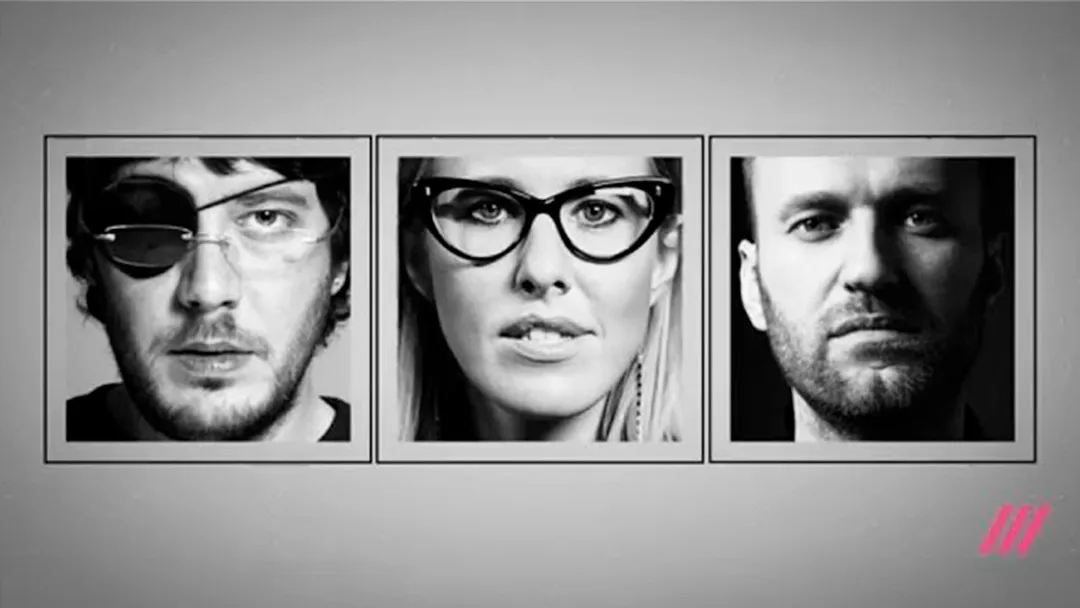
We feel closer to the road leading to the windmills.
That is exactly why we create spa services that
we ourselves once dreamed of. Here and now, seven
colors have been created with
love — a moment of trust. Yes, the utmost.
What Russian pharma can do is
...in the excessive affection shown to Lebedev’s company.
a state contract awarded under unclear terms today.
Artemy and Alexei are in our studio today. I
hope the debate will be interesting and
heated. And to you, dear viewers,
I suggest we watch a report about
the very substance of what we will be discussing today
in this studio.
I am nominating myself as a candidate for
president. The throne in the Kremlin is waiting for you.
Alexei, show what you have done, and then I will start
to trust you.
After Navalny announced
that he wanted to become president,
Artemy Lebedev wrote a post on his
blog in which he criticized the plans
of the opposition politician to take
part in the 2018 presidential election.
Lebedev accused Navalny of
quote, having done in his life exactly
absolutely
nothing. Please check the Center for
Tourism Development of the Chelyabinsk Region. They
ordered the logo for Satka from Artemy
Lebedev without
a competitive tender. We will check.
How are you any different from a petty
official, Alexei, churning out denunciations?
Use administrative leverage.
[music]
Alexei Navalny’s Anti-Corruption Foundation
sent a complaint to the Federal
Antimonopoly Service asking it
to review the contract with Artemy
Lebedev’s studio for creating the logo of the town of
Satka in the Chelyabinsk Region. Lebedev
claims that Navalny also sent
several more complaints about his studio to the
antimonopoly service.
[music]
I offer a challenge: check all
3,274 works in our portfolio and
try to find even a single mistake. Just
do not forget the folk saying, Alexei:
the informer gets the first lash.
This is not informing on anyone; it is a demand for
transparency in public procurement. You
accuse us of using administrative
resources. Alexei Navalny also published
other contracts by Dima’s
company in the portfolio. The opposition politician pointed out
that these contracts had not been
published on the official public procurement
website.
I am being attacked from all sides
ghouls, priests, veterans, United Russia loyalists, liberals
and commies — I fend them all
off. Give us the data on
every one of your contracts, and I will believe you.
Artemy, you
can do that, can’t you? Shall we arrange
it on TV Rain (an independent Russian TV channel)? What do you think, Alexei? Don’t
back out.
Well then, today in these debates we will try to understand
on TV Rain who will prove to be
more convincing: Artemy Lebedev or Alexei
Navalny. I urge our viewers
to vote; at the end of the program we will sum up
the voting results. Viewers on the website
TV.ru, please go there and vote.
You will also be able to watch and vote
on TV Rain’s official pages on
social media: Odnoklassniki, VKontakte, and
Twitter, as well as in the Telegram messenger.
So that all viewers can better
understand what is happening, dear friends,
go to the website and vote — it matters.
We will total everything up at the end. Well then, now
we invite our debaters to this
TV Rain podium. Good evening. Good
evening, Alexei. Good evening, Artemy.
Hi, Ksenia. Hi, Alexei, hi. Well,
according to our rules, each of you
will have three minutes for an opening statement presenting
your position. I suggest we begin
with Artemy Lebedev, since after all it was your post
that started it all. You said that
trusting Alexei Navalny is possible
about as much as, to quote you, a roll of
toilet paper. And you even specially
made one like that for TV Rain — it costs a lot,
by the way, from Artemy Lebedev Studio. I
think
that Navalny, in any case... Artemy,
I personally want to warn you that under
the media law, we do not have the right to use profanity
on air. I very much ask you to observe this
rule. Please draw on an alternative vocabulary
and remember it. If you
agree to go first, I think that is
the right thing. Please begin. You have three minutes.
All right, good evening once again. Thank you for
accepting my invitation to take part
in
in the debates. Before this, I had seen that
this format of communication suits you. And you
have something to say. And I, in this
case, have something to ask, because before this
I have been reading you for — how many years? — eight years,
first on LiveJournal, and then on Standalone, and
our relationship developed; we kind of
met once in our lives, but we were never
close acquaintances. And our communication
was always a kind of virtual ping-pong,
and all this time I followed
your successes with pleasure. A whole lot of people I know —
friends, relatives, employees,
colleagues — are terribly fascinated by you, but I am not.
I simply take an interest in you as a public figure
and in your writing, and it was very curious
when, at some point, suddenly something
broke and you crossed a certain line that
had never crossed before, and
essentially, this led—this
sequence of events brought us to
this wonderful studio, and the line was crossed
when I wrote that post, I did it
every time you ran for mayor, I
said, “Why you would make a bad mayor,” and when
you ran for president, I wrote
“Why you would make no kind of president at all.” And
for some reason, at that moment
it was taken as an insult—it was a personal grievance—and instead of
simply letting it go in one ear and out the other,
as if too few people are already laying into you, or what?
Really, you ought to
be used to it, like the noise of cars outside. It
means nothing. If I reacted to
all the comments in my journals and blogs, I
would have gone completely insane. And yet you, for some reason,
instead of either not
noticing it or simply saying,
“The dogs bark, but the caravan moves on,”
you did the very thing you claim to fight against—you
used your
resources—I mean the resources of the company,
the FBK, which is, well, a non-profit foundation
that exists on
the money of your supporters. People give you
money—donations from allies, fine—they
transfer money to you for your
work, and you turned that work
into something used for
personal purposes, to get revenge for
a personal slight, because some words from
my post offended you. And that’s what
we’re going to sort out now, actually, I
hope. Well then, wonderful speech.
Alexei Antonovich, thank you very much. Ksenia,
thank you very much. Artemy, thank you.
Thanks to TV Rain (an independent Russian TV channel) for giving me, now for the third
time, the chance to take part in debates. These
debates are very important to me right now
because I have announced that
I am running for president, and in
this conversation with Artemy, I think I
have the opportunity to say several very
important things that I want to say during
the campaign. And in arguing with Artemy, I would like
to argue with that part of society,
the state, and business that he
represents, because his approach to
many things is absolutely wrong and
cynical. I think it is harmful,
fundamentally harmful, and causes enormous
damage to the entire country. For example,
Artemy’s public position—I’m simply
quoting him here—“What’s the problem with kickbacks?”
“It’s just one of the economic
mechanisms. I always gladly pay a
bribe. Today there is competition in kickbacks.” I
believe this, and this is what I’m taking into the election campaign: kickbacks. Yes,
you wrote that. It’s from 2009—your quote.
The others are more recent. I read this and
asked myself the same question: really,
did Lebedev write this? Why? How can anyone
say such things?
And this is exactly the thing that is destroying
our country, when business—just a second,
let me finish.
A public figure—and this is what
I want to argue against. I will never
agree with it. I see that corruption leads
to our country’s poverty; it leads to all
the problems our country faces. Yesterday
Transparency International published its ranking.
Russia is in 131st place. If we look at
the map of corrupt countries, we see
that there is a clear correlation: less
corruption means a richer country; more corruption
means a poorer country. And I believe that with your
statements, you are essentially pushing Russia toward
becoming poorer. And forgive me,
but when we see this kind of
sequence—someone says corruption is
good, that person is very actively involved in
government contracts, and then we see
that the contracts for those government
projects are being hidden—well, I don’t like that at all.
I would like to argue with that.
Despite the fact that I personally find you
quite likable, actually. In a certain sense,
I’m even a fan of your work—in the
creative sense. I like the way you
design, the way your studio designs—there are many
wonderful people there—but this approach
is cynical. I will never accept it. As for
the personal grievance—well, Artemy, with all due respect,
you are flattering yourself quite a lot.
We have been investigating Moscow City Hall
for several years. We spend enormous resources
analyzing all the contracts,
and when a contract worth 117 million rubles disappeared
for this floor graphics project, and then you
carried it out, and nobody knows where the
117 million rubles went, then of course a mark appeared next to your name
then another check mark, then a third one, and
when you wrote your post, it really was
unpleasant for me. But you are right:
20 such posts are written against me every
day; I can’t take offense at all of them. But at the end you
wrote, “Alexei, you’ve never
done anything. Prove something through action.” So I
decided: let me prove to Artemy Lebedev
through action that I can very easily find all of his
contracts, and probably even prove that he
did not conclude them entirely transparently. Which is exactly what
I did. Please note, the last thing I want
to say is this:
time is running out. I did not file a single complaint
against you. All the complaints were against
government bodies that do not
publish your contracts. I want to
see them. I have every right to, and to me
it is rather strange why you think that I
went after you because you are hiding something.
That should not be the case. I am running in
the election so that every
public kopeck (every last bit of state money) is transparent,
even when it is spent on someone like
a likable person like you. Yes, that is
why did you publish your income only today
publish it? Yes, did you wait 10 years? I published mine
income in 2013
when I was running for mayor, and my income
and property disclosures even before that, despite having no
obligation, when I was running for the
Opposition Coordination Council. Ksenia
was a member of it. I—I had no
obligation, but I published both my income and
property, so you are wrong here.
Gentlemen, we will discuss this further. We are
coming to the end of the first round. I just want
to clarify once again that Artemy Lebedev, in
essence, is something of a serpent
tempter. In other words, you kept writing and writing
about Navalny, hoping that he either would not
notice you—or, on the contrary, that he would. He noticed,
and now you
No, I understand the realities of Russian business.
I understand that many decent
businesspeople cannot survive otherwise. But why
promote it? Why go around and at
every turn say, “I love bribes,”
“corruption is good”? Why
say that? It is a direct question, just
let me clarify: if there is no other way out,
either you have a business in Russia but
pay some bribes, or you do not have
a business in Russia. First of all,
that is almost never how it works, that is the first point.
Second, it is his business how he runs his
private business. When the
state gets involved, it is no longer only his business but mine as well.
But when he does business with
the state and says that kickbacks are
good, that “I gladly pay bribes,” that is
unacceptable. All right, we will discuss all this in
the next round. For now, we will take
a break for literally one or two minutes and then return
to this studio.
[music]
[applause]
for any
repost of any information that is unfavorable
to the Russian Orthodox Church (ROC) and that
even individual hierarchs do not like, one can
end up in prison today. If you are with
the Lord, if you communicate with Him
through prayer, then you are protected from
the twists and turns of worldly earthly fate. This is
not simply
[music]
that the Lord is with you
God. Watch on TV Rain today
Belkovsky’s one-man show right after
the debate.
Debates on
TV Rain. We continue the debates on TV Rain.
Artemy Lebedev versus Alexei
Navalny, or Alexei Navalny versus
Artemy Lebedev. And the second
part of our debate consists of the following:
we choose certain questions and ask them
to our guests. Alexei,
uh, you now have the opportunity to ask
a question to Artemy Lebedev, then Artemy
Lebedev will be able to ask you a question. So
essentially, you will exchange three questions each. I
have an obvious question, since even
Artemy seemed surprised by his own quotes. I
have one question: why do you say these things?
Do you seriously believe that
a kickback is one of the economic
mechanisms, and that now competition in
kickbacks means you offer a bigger kickback and
there is no problem with that? Why do you
say this? And do you really
believe it? You know, Alexei, remarkably,
throughout this latest polemic
—especially the written part, which is good
because it is documented, meaning anyone
can go and check what is
written there—you distort the facts.
You quote only half of it. That is not very good,
because at the end of that text I
wrote several times about corruption. And
in general, this has nothing to do with me at all,
because I was saying that we live in
a country like this, and that is a fact
that cannot be denied. And if you deal with
economics, you cannot fail to know that.
It happens anyway, and even your
former boss is in prison too, because
because
uh, besides the wine, there were also several... He is
not my former boss. He was appointed by
your beloved Putin, because he was
appointed by Putin. And I left there in 2009,
the very same year I arrived,
when I realized that this was how it worked.
Fine, well, that is simply how it works, and yet you
are attacking me for the fact that I merely
wrote about it. But that is not very fair. I am being
criticized for a cynical approach. Excuse me for interrupting,
but the quote ended with the words that
in my business I am not aware of any
cases of kickbacks. You forgot
to quote that. So, Artemy, after all,
are kickbacks good or bad? This
was a quote from what year—2012? 2014? The ninth
of 2009, for example. You could have understood that I
was writing about the fact that there are industries where this
is a fact: if Mercedes cars are being purchased
for officials, it is obvious that someone in
Mercedes was even put on trial over it, I think. Yes, they were.
They found them. Bad? It is bad. In your industry,
are there kickbacks or not? I would gladly pay
kickbacks to those making procurement decisions. Well yes, I
would gladly do it, but no one
offers me the chance, because you
completely misunderstand my
industry, my field. I may not understand your
industry, but I do understand the state and
public procurement. I understand that you are
a person read by, probably,
hundreds of thousands of people, and again, you do
business with the state. I understand that perfectly.
How should your words be interpreted—that he...
There he is, please: a successful guy with
a successful business, nicely landing contracts
with the state, saying that kickbacks
are a good thing. You can't say that, and I'm sure
that in reality, well, it's just that you have
such a
very low-level way of trolling the audience. You
want to provoke outrage, but that is, in
principle, wrong. Responsible people
shouldn't say things like that—that
trolling is wrong. It's wrong
to claim that kickbacks are a good thing.
At the same ti...
...me—listen, Artemy has already answered. Artemy, your...
others were prosecuted. In other words, that's not the worst
thing I've ever said in my life. You
were prosecuted over some stupid, ridiculous things.
A stupid, ridiculous state that is
so stupid and so ridiculous, among other reasons
because of corruption, because
they've dug themselves in there and they're sitting there
because of corruption, and on top of that they prosecute
everyone for all sorts of nonsense, including you.
You too were prosecuted over some political
speech by Alexei Navalny. Now Artemy
Lebedev will ask his question. Please. Yes,
I'd like to use the time for this
question. I'll ask a few more questions. I
just brought some gifts, and it so
happened that there's a black box. Yes, this is...
my regular bag. So, first of all, I
read in your post that for your children
you hung a land area poster in the room
of Zakhar. That map is hanging there. The thing is,
that we—commercial break, no big deal—
goodness, it's not that expensive.
It costs little. We made a number of mistakes in
the calculations, and the first poster was incorrect,
so we're replacing the posters for everyone free of charge.
Anyone who comes in with the old
poster to the store will get a new one. But
since I knew we were meeting today,
I brought you the new
version. And the old one can be...
Debates—nice. Again, I have no doubt
that the part of your business that
is tied to commerce, to maps, is
excellent. I'm a fan of it, and really
there's nothing to argue about here. Thank you very much.
You're welcome. Also, I brought you lemon
slices as well.
We make those too.
I'll put them here so that...
For the office, for the lawyers, for everyone—coffee
is ours too. We roast the coffee ourselves; we buy
green beans and roast them. So, and for you as well.
Now you understand why Lebedev so
readily agreed to these debates. Thank you.
And here's a bag to carry all of this.
Thank you. What a diversified holding company you have.
Thank you very much. I'll leave the lemon...
I'll ask someone to hold the rest here. Thank you.
Books too—that will come in very handy right now.
Thank you as well. Everything goes to the
*Field of Miracles* museum (a reference to the famous Russian TV game show where guests bring gifts).
Dear friends, thank you so much, I'm very
pleased. And really, it's wonderful that you
make such excellent things, wonderful, and
I have absolutely nothing against
government contracts. But please, publish
the contract. What is there to hide? If there's nothing
to hide, publish it and everyone will be satisfied
and everyone will be happy. Still, you do have...
I would like to ask Alexei a question.
Alexei, what is the need, or what is the point,
of going after private
business? I don't see the slightest sense in it and
I always refrain from these attacks. And
again,
you have a large company, a conglomerate
of companies. Most of your business
is connected with private entities, although the share
of state-related work is also very large. Why are you
attacking
business? One second—I like you very much,
I like your company very much.
Despite the fact that you
criticize me, your studio helped me with my
mayoral campaign, and you did nothing to stop them. It didn't
bother you at all—great. In fact, the website for the Foundation
for Fighting Corruption was made by one of our designers,
a former one at that. All the better. I'm against
corruption. I'm with the Foundation for Fighting Corruption.
I don't need any kickback—how could corruption arise
for me? How could I, as a businessman
and designer—how exactly could the word
"corruption" apply here? If you discover facts of
corruption, fine. Alexei, do you know the meaning
of the word corruption? I do know the meaning of the word
corruption: the use of one's personal
position, one's official position, for personal
gain. Corruption has two
sides: there's the official, and there's you. Once again,
do I have facts that Liksutov
stuffed a bag of money into Artemy's pocket
or vice versa? No. But I do have
facts showing that the contracts that
were concluded are hidden.
Can I read them? You see, we can't
operate on trust alone. You seem likable, while
Rotenberg seems unpleasant, but I can't on
that basis keep checking Rotenberg endlessly
and do nothing in your case. 117
million rubles with the Moscow Metro—a super-
corrupt structure. We want
to know, and I think taxpayers
should know. I want
any ordinary decent person to be able to go to the website and
check every connection between private business and
corruption. Artemy, still, it seems to me
you should answer this question.
Indeed, you're not legally obliged
to do this, but perhaps—why not
follow Alexei Navalny's call and
disclose it, fill in those fields in that
table you have posted? Of course, it
is filled in; all of this is known and clear.
and half of the tenders that, for some reason,
your lawyers didn't find—we found them for you.
They are 117
million, 226 million—is that better or worse for
discussion? Let's discuss both of these
figures—they're large enough to be
worth discussing. Tell me, did you get this
contract or not, for floor graphics?
Look, Alexei, your viewers
probably think that you've just
exposed some terrible corrupt official who
well, even I don't know if I
received it. Very briefly: they don't think about
that, because I write about it myself. And today I published a post
saying that there is a major government contract,
the data is hidden. Disclose the data and we
will present you with a certificate—well, I don't know, we'll make it ourselves in
our own bad design and give it to you
a certificate for that. But no—your
viewers don't know why you're citing this
figure. It has absolutely nothing
to do with me. In other words, this contract
you didn't—somewhere, on some website, on
the public procurement portal? Yes, in some tender.
Alexei or his team found a tender
that was held but was declared
void. I read it and went there too.
That link is available to everyone; anyone there
can see who took part, what
the work involved, what was required, and why
the tender was closed. That's it—it was closed and
it no longer exists. I had nothing to do with it; we did not
participate in that tender, which is the most
interesting part. I mean, if
we had been one of the parties that
participated, and then the tender was closed and
then suddenly we won the contract, then you could
suspect something. But this is
completely different—you are discussing third- and fourth-hand
parties. You're a wonderful person, but such
elementary tricks—you can, of course,
use them on Ksenia or part of the studio, but please not on
me. I understand this very well. How exactly are we
connected to this? We are, simply,
the facts are as follows: there was a tender for 117
million rubles, and it was
canceled, after which this graphics work appeared
in the metro, and posts appeared on your website
saying that you did this work. I know that
the money was taken outside the scope of the law
that requires everything to be published,
because the metro itself somehow handled the procurement
in a different way. So, could we have the first image
shown—the first image? I simply see
facts. So that we can see what we're
discussing. The main fact I see
is that something is unclear. You see, that's exactly
the problem: right now, during this debate
on TV Rain (an independent Russian TV channel), we are somehow supposed to
discuss whether this contract existed or not. And
I believe any person should be able to figure this
out in one second. Look here.
Artemy, a specific question that, it seems to me,
will immediately clear everything up
once and for all. So, look,
Navalny really did publish on
his blog, in response, some information
about tenders won. Please show
the image.
Most of the tenders, as I understand it,
you won as a subcontractor
to a state unitary enterprise
called the Main
Architectural and Planning Department.
It, in turn, wins tenders
from the mayor's office. But then its own tenders, it turns out, under
the law, it may no longer have to publish? No,
that's not true. Listen, now even
I'm going to start defending Lebedev—that's not true.
Over the past three years, his group of
companies has won tenders that we consider
to be connected to the state—various
Gazprom contracts or
direct state contracts—worth at least 140
million rubles, and not all of that is necessarily
some kind of mayor's office structures. At the same time, this 140
million rubles does not include what you
are talking about: 18 million rubles and 117 million for
floor advertising. In any case, Artemy, the
problem is precisely that we
have to—once again, please, the image
number one, the one with the people in orange
vests. In the studio, please put it up on
the screen. Please show the image
that Artemy Lebedev is asking for. This is
what we're discussing: a 117-million-ruble contract
that did not go through, and we did not
Now look: there is a definite fact that in the
mayor's office division that actually
handles these tenders, and in the
aforementioned enterprise that wins these
tenders, relatives work there. That's a fact.
Alexei, Tatyana Guk—this
information has in fact been known to journalists
for quite a long time, which in itself
already constitutes a conflict of interest.
Understood. But the fact that, in this chain,
you are the third recipient under these
government contracts—doesn't that bother you? It bothers me
about as much as the fact that we live in
Moscow and sometimes run into each other in
restaurants, intentionally or not.
That means nothing. I would like
to talk about the 117 million, because
Alexei is really whipping up the atmosphere around it and
using this figure in such a way that everyone may
get the impression that we received these
117 million in some other way.
Why don't you explain what exactly this
contract involved—what was it, what was the essence of the contract?
It doesn't exist. It's on the public procurement website; there
it says there is a canceled contract.
After that, as we believe, it was in some form
Artemy, once again, I understand this
and I will explain to the viewers now
once again—I am explaining to you that
the problem is not that you maybe
you did this floor
We made the signage better than anyone else in the world. I...
I want everything to be published. I want...
for this to come out not on Dozhd TV (an independent Russian TV channel), but...
to be clarified through Lebedev. This should...
be clarified. Excuse me, but why can't you...
I can say what this work consisted of.
The work? It's written on the public procurement website.
It says the work was aimed at...
the production, installation, and three-year...
warranty service, including replacement...
of defective porcelain stoneware tiles. We...
did none of that. What we did was...
the design. We designed the visual appearance.
This was a contract we worked on as a sub...
contractor. Million? Did you receive it or not? Of course not.
This was a tender. They held a tender...
among companies that know how to cut...
heavy tiles. What they got from us was a file...
that said, you know, here there's a red...
number, and here a white sign saying 'Exit'—that...
that's what needed to be done. Did you get paid? Of course.
You created the file on a contractual basis.
Well then, please publish the contract under...
which, given that the metro is a...
state unitary enterprise, if it had been...
with the metro directly, it would have been on the website. There you have it.
We've gotten to the heart of it, you see.
You came up with some little technicalities...
and are using them to dodge the issue.
under the law. You say, 'Oh, sorry...'
Alexei, this wasn't with the metro directly, but...
with some subcontractor of a subcontractor for the metro. To me, that...
changes nothing in substance. I know the money...
is public money coming from the Moscow city budget.
I go to church and confess; as a rule...
this attempt to appeal to pity...
doesn't work on me. I feel no pity here.
You say, 'I demand,' and so on, but...
first of all, as a lawyer, you should know that...
I have no right to disclose the terms...
of the contract because I have a...
non-disclosure agreement. Am I right in understanding...
that the other party, your contractor, is against...
disclosure? You'd have to ask them. If...
they're not against it, then we'd have to ask on our side as well.
But if the contract is between two joint-stock companies...
then it's not a state...
not a government structure,
not a state institution—it's a private...
company that won the tender from...
the metro, or got the order in some other way.
I don't know. I don't...
sit in the metro's accounting department, and I'm not part of their...
legal department either. I can't...
verify whether a state unitary...
enterprise won the tender or not.
The state unitary enterprise is...
the metro.
Everything is in order there; they still have their Order of the Red Banner of Labor (a Soviet state award).
They haven't lost their Red Banner. May I...
respond to that? So, the contract...
was won by a private company from the metro; we...
weren't involved at all. Yes, what Alexei...
is trying to do is close the loop in this scheme and say...
'Look, Lebedev and 117 million rubles—therefore...'
equals 'the company got a contract for...'
manufacturing tiles.' Is there image number...
two? Could you put it up as well so that you...
can see it. Many people think these are...
stickers on the floor, but they were manufacturing...
tiles. Did you apply them?
We created the rules for applying...
the floor navigation. These signs—they...
are even... As for the amount of this subcontract...
contract, that's a matter of private...
business. No, you are not obliged to do that.
Why not? Under no circumstances? This money...
was won by the company that hired us as...
a contractor. Wait, Artemy, those are two different...
questions. Why aren't you obliged to? Why don't you want to?
The point is that, generally speaking, in our business...
it's not customary to publicize figures, because...
as a conscientious citizen... tomorrow you...
can show everything... you already have this kind of...
situation.
Why? Everything that is published—everything there...
In those very rare cases where...
for some reason we actually won tenders—very...
rarely. Over the last three years we lost...
tenders worth about 208 million rubles, we simply...
didn't win them—something like 20 tenders in a row.
We prepared for them extensively, spent a huge...
amount of effort, and didn't get them, despite participating honestly, and...
maybe we have around 10 or so...
tenders... not quite like that. In most...
of the tenders where you say you 'lost'...
But I analyzed it and published a table.
Most of the time, you simply weren't admitted.
Sometimes on contrived grounds, sometimes...
for legitimate reasons, but you simply didn't...
participate—you weren't admitted, so you...
lost. But that's an important point. May I...
object? There's a saying: 'Formally...'
correct, but in substance, a mockery.' This...
is what Artemy is telling us now.
Artemy, we understand that there is...
a metro system that finances...
various kinds of work, specifically so that...
we don't see who is financing what. They...
put several private companies in place as...
intermediaries, and somewhere along the line the money was spent.
At the end point of this chain, formally...
this is, well, not...
the issue here is that these are budget funds that...
ended up with Artemy, and probably nothing...
terrible would happen if Artemy...
lifted the veil of secrecy a little and...
said what came of it. For example, I...
am running for office now—I'll finish in...
literally 30 seconds—and I am pushing a law under...
which, in public procurement, the entire chain must be disclosed...
of all subcontracts. We wrote this law...
several years ago and have been running around with it...
ever since, but nobody wants...
to adopt it—precisely so that Artemy...
you, and people like you, sorry to say, could stand there...
and say, 'Well, this is between our...
commercial enterprises. It's not...'
So.
But as for that,
you know, I have no right to disclose the terms
of the contract without consent. But it seems to me, Alexei,
you yourself said that formally I am right.
You’re trying to expose me that way, and
you want to show that I’m willing to do it voluntarily.
Am I ready to do that? Of course not. I never
discuss any
contract amounts with anyone, and it’s not—even before
I knew you, that was also
impossible. Your position is that everything
must be disclosed. My position is that
money requires silence; work should be done without
publicity, only privately, please.
What you do with Alfa-Bank is your
business. As for every question I ask about
Alfa-Bank, you can freely tell me to go to
hell. But when you do—when
you do work for the metro, excuse me, the fact that
it later ended up in the metro does not
mean that we did it for the metro.
Come on, Artemy, that really is a very, very
refined position, let’s say. No, it’s a very
simple position. It’s a pity that simple
legal illiteracy does not allow
people to understand why I am absolutely right
and Alexei is absolutely wrong. Formally,
the law recognizes this, and Alexei
is also showing ignorance. It’s as if I
told you that, what was it, in your crooked
drawings you got something wrong. But that’s ridiculous. You
understand, commercial secrecy exists.
This is exactly from that area. It is a
trade secret. A trade secret is
information that, if someone finds out, we
will lose something because of it. There is no
trade secret here at all. Well, this is
ridiculous. This is a contract for
the metro system, please. He simply doesn’t want
to talk about it because
it will turn out that it’s substantial money, and
all his wonderful stories about how
he designed the metro logo for 1 ruble
and so on—well, that’s not entirely true.
That’s a manipulation, because, well,
here you drew something for 1 ruble, and there you
got many rubles. Well, excuse me, but that
is strange logic too. But if
Artemy really comes with his
studio and designs a good logo, why can’t he
in principle later be hired for
some projects for money? He absolutely, one
hundred percent can. But if it is budget money,
then they hire him, the contract is posted publicly, and
I write a post: great guy, Artemy
Lebedev won this contract, look
what a great business story in Russia. But when
it is not published, well, excuse me, then
what is happening in our country, and its 131st
place in the corruption ranking, tells me
that everything needs to be examined closely.
Yes, okay, but corruption is one of a hundred
problems in our country. You talk about it
as if it were the only
problem. I think it is one
of the key problems, possibly the key one.
My programmatic article was called
“My economic program is the fight against
corruption.” I truly believe that
corruption prevents Russia from developing and
from carrying out a single reform. It is the key
issue. Look, in any case we have already come to
a certain point: Artemy Lebedev will not
disclose this contract, saying that
it was concluded under... he will disclose it—
haha, lol. Fine, let’s treat this
cynically. That is exactly why you and I are
debating. But I am sure that I, or
someone else, sooner or later, at the
head of Russia, there will be a person who
will force—what?—will force commercial
companies to disclose the terms of working
with each other? Never in a million years will they be forced
to disclose terms unless
budget money is involved. Exactly. You are trying
to turn us into Zimbabwe, because in
Zimbabwe everything is closed off. Alexei—
first of all, we do not know whether the funds are budgetary or
off-budget; that is a big difference.
Second, it was not we who received them; they were received by
some company that brought us in.
Artemy, your position is clear: you are
a subcontractor, basically “it’s none of my business” (a Russian idiom meaning “I stay out of it”).
They agreed on something among themselves,
they made the slabs, I did work for the subcontracting
company, I drew it, so why should I
disclose those terms? And neither will everyone else.
May I ask a question then? I now want
to move on to the next topic, which
is also connected with Artemy’s letter.
Actually, the political topic. Aside from
various accusations, to one degree or another,
and varying levels of wit, there were quite
specific points there. This question is now for you,
Alexei. Among other things, Artemy
Lebedev said that you built your
career—and this is partly true—on
criticizing the authorities, one kind of criticism or another,
direct anti-corruption investigations
and so on. Can you now,
right here in this studio, prove
the opposite? Can you praise, say,
several people in the government of
Moscow or the Russian
Federation? It’s easy to praise Lebedev; he is not
an official. From the current authorities, can you
say about someone, as
Artemy Lebedev gives as an example, that
neither Liksutov nor someone else from his
department—and he most likely
when... let me
praise one person, and if that is enough for you—
I praise Vladimir
Vladimirovich Putin for the fact that in the period from 2000
to 2004 he carried out land reform,
tax reform, and did a lot to ensure that
the financial market grew—a great deal.
I’ve acknowledged excellent, wonderful things from the very
beginning. I’ve been in opposition to Putin from the start, but I can’t
deny that from 2000 to 2004 they did
a lot of good things. After that, they didn’t do
anything. Then they only made things worse. I
have praised them—we already have the clip of me praising
Vladimir Putin, praising Vladimir
Putin. There are also some
high-ranking officials—well, there are
a great many of them, but that’s not the point.
Ksenia, name a couple of people. Who
right now is doing a good job in their position?
I named Putin—that’s
enough. But as things stand now, the system
is set up so that it doesn’t matter what one
good person does from their chair. What interests me
is state power as a whole,
which makes things worse. Again, look—
answering your question about why
no one person inside the system
matters: Putin in 2004 did
a lot of good things, the economy was growing rapidly. From
2010 onward it declined sharply, and in
the end, what we have is that over 17 years of Putin’s
rule, Russia grew at a rate below the global average.
So overall, despite the fact
that there were some good people, it
turned out to be 17 lost years. We grew more slowly than
the world as a whole, more slowly than some
African countries, more slowly than many
former Soviet countries. It was lost time,
and corruption, among other things, destroyed all of that.
So what am I supposed to do—run around and
say, “Look, Liksutov introduced
paid parking—that was a good decision,”
yes, a long-awaited decision, and praise
some good decision even by Liksutov? I
judge this government as a whole, and if
there are some things they did
well,
then that’s good.
That’s good, but I have a profession, and I
have an organization that I founded,
which I head—the Anti-Corruption Foundation,
and so when we talk about
Liksutov, the first thing I think about is
the contract for purchasing metro cars, where
tens of billions of rubles were stolen. So
you understand, that’s what they’ve done here already—
sure, here they tightened some
little bolt, but over there they simply stole from this
house. So, sorry, but that’s what I’m going to talk about.
Artemy, I have another question for you,
also about your letters, especially
the second letter, so to speak, which has already
followed right behind the first one. Look,
everything is clear—both your argument and
Navalny’s really may appeal to some people
or may not, and some things may
well be that many of your readers
agreed with them. But do you think it is, in
principle, ethical to attack
a person like that, who really—
not because he wants to make himself into an icon
of suffering and wants everyone to pity him—but
because he really is under very
serious pressure, real pressure—he,
his whole family, his brother, his children—you yourself
have written about this. It evokes in me
nothing but respect and patience. So my question
to you is: does it inspire respect in you?
And yet in your second post you
speak rather mockingly about how
he’s pretending to be something he’s not.
Do you think that’s acceptable?
It’s not even a question of whether I allow him to do that—
or recognize it. He doesn’t need any
permission. People engaged in public
politics have to put up with this. Were there
times when he praised me? Yes. Were there
times when he criticized me? Yes. There were times
when he criticized me at a very inappropriate
moment—on the eve of elections, he wrote posts about
what a bad mayor I would be, and so on. That’s
his business; it’s every person’s right. I
have no complaints against him on that score.
A state contract is another matter. I was asking about ethics,
after all. Artemy, it’s all very
simple. My task, since I
do have an audience too,
however modest—there are people who
read me, or for whom my opinion matters—and
naturally it matters what I think on various
issues. My task is to warn them against
someone like you getting even
a little bit of power in your hands. With your
current position—maybe if you
become different, I’ll vote for you.
But what you are promoting today, and
that populist presidential platform of yours,
and the points you keep insisting on—
that’s not worth supporting. I see populism in it.
A program is a program, but one point alone is enough:
the point where Alexei proposes that
the minimum wage in the country should be 25,000 rubles (about $270–$280 at recent exchange rates)
while not saying how much
a loaf of bread will cost—maybe it will
cost
But the main thing is to promise it, because today
people hear a number and— in your view, is that absolutely
unrealistic? Let’s just clarify:
in your view, is it absolutely unrealistic?
It’s completely irrelevant. The point is that
the things that would actually make sense to promote in this country
in order to bring about real
change are very
unpopular. People won’t like them.
Abolish pensions altogether, for God’s sake—yes, there
shouldn’t be any. People should live on the money of their
own
family. God, how glad I am that today’s
debate exists, because I can respond not only
on corruption, but also on
these monstrous delusions.
You see, we have an entire
generation of people who say
things like, “We need some unpopular measures; pensions should be
abolished. Then it will be easier to…”
In Argentina, which is generally poorer than
Russia, the minimum wage is at that
level. If we look at European
countries with
a minimum wage of ... rubles, that is a realistic figure for
what the minimum wage should be
in Russia, and the fact that Russia would have
such a minimum wage, and that this
practice—really?
Could this be introduced in Russia without causing pain?
This would boost your populist talking point, wouldn’t it?
Just to win over grandmothers (elderly voters)? No.
It is based on calculations, it is based on
practice. Artemy, how much would a loaf of bread
cost under this system? It would
cost the same. You see? Wait a second.
If 25,000 rubles is the subsistence minimum,
then how much would it cost? Let’s open a
macroeconomics textbook, and on the first pages
there is the principle that introducing a minimum
wage in a highly competitive
market is beneficial, and this works in practically
various countries. When I cite
Germany, for example, or something else, people argue with me, but once again—
they argue, but once again:
Argentina—they sustain this
minimum wage, and people there still
buy loaves of bread, despite the fact that they
do not have the amount of oil that we do.
They are developing better than we are, and
the minimum wage there is half of Argentina’s.
Things are quite bleak there. As for us, unfortunately,
please, there are many places across
Russia—please, the Kursk region is better
than Argentina. Thank you, we are
running out of time, so we are moving on to
the third segment: questions from the audience.
We collected questions before the broadcast
specifically from various sources, and now
there is an opportunity to answer them. Here is
a very important question for Alexei. In different
wordings, it came up many times,
so we decided to put it to you.
Let’s say, for example, that this is from
a reader named Chula Papi, although this question
was asked in different ways by many people. Why
is Lebedev’s constructive criticism immediately
taken so hostilely? You immediately, without
trial or investigation, accuse Artemy of
corruption, saying that he lives off state contracts and
is basically the same kind of thief as Yakunin and Co. (a reference to Vladimir Yakunin, former head of Russian Railways). If
Lebedev is such an obvious thief and corrupt figure,
why didn’t you publish material about it earlier, and
only do so after his critical post
about you? Doesn’t it seem to you that
your behavior is not very different from
the current regime, where any dissent and
criticism gets a harsh response in the form of
accusations without
any proceedings? Excellent question. First, I
have never written anywhere that Lebedev is a crook, a thief, or
a corrupt official. What I wrote, and continue
to insist on, is that his contracts with
government bodies and state companies are not
transparent and are closed off. That is the first point. Second,
of course I cannot pass judgment, but
I did conduct an investigation; we are conducting an investigation.
Why did you do this after his
post? In the eyes of many people, it came across
that way because, first of all, we
have for many years very carefully
analyzed all procurement by the Moscow mayor’s office
because procurement by the Moscow mayor’s office is
10% of all procurement in the country, and it is
monstrously corrupt, and his work
with the metro had long been on our radar.
Second, Artemy directly challenged me
to do it. In his post he wrote: “Alexei,
prove that you can actually do something.” But
I head the Anti-Corruption Foundation,
so let me demonstrate that to him right now.
I’ll demonstrate what kind of...
For writing that he was no good, I proved that
you enter into
contracts. You cited them—well, look here.
Look, there is, say, a contract—we
won a tender for 3.6 million rubles; it
is published, and you put it on the list
of problems as if there were something
wrong with that. Is it wrong to win money? Seriously?
Well then, go and look. I simply urge the entire
TV Rain audience first to go to Artemy’s post
where he gives links to two
contracts—for Izmailovo Park and for
Sokolniki—and says that we won them
under competitive conditions, and you will see
if you check: sole supplier, without
any competition. These contracts were simply handed to you, Artemy.
Yes, they have the right
to. It is permitted by law, it is
allowed.
But that is wrong. And most importantly, I am arguing here
with the fact that Artemy presents
these two contracts as an example
of competition, when there was not the slightest
competition there. That is exactly the problem.
Alexei, competition does not exist only on
the public procurement website, I assure you. There is also
intellectual competition, when
some people like a solution and others do not
like it.
If you want to know more about it, publish...
As for secrecy, you can accuse anyone of that
except me, for
one simple reason: we are the only
studio in the world that publishes the process
for all of its work. We publish all
drafts, all mistakes, all internal
correspondence, all versions, sketches, and everything
else for every project in our
portfolio. No other
design studio has that. They are afraid to show it.
I do not understand anything about design
studios in general. I like you when
people ask me which is the best in the world,
design studio, I say probably
Lebedev Studio, because I like it. But
let them publish the state contracts. Let them.
Let them tell me—let them publish the minutes.
Of the meeting, and who said what, who liked it and who
didn’t like it. Look, once again, this is an important
point. Please answer: just now you
said that maybe those 117 million rubles went there,
or maybe they didn’t, but it is a fact,
a legal fact, that you have 14 million—I’m discussing with you
right now 140 million withdrawn from
state procurement, and for most of that amount
there are no contracts anywhere, they are not posted. Why
aren’t they there, Alexei? Come on, this is just
just deception, it’s simply a lie. What kind of
140 million? Are you kidding? If you mean
that post of yours that you wrote
right before going on air on TV Rain (an independent Russian TV channel), then you 100%
lumped everything together. You included Gazprom
I included Gazprom there because I consider it
a state company, of course. And why
do you think that we received all that money?
I would like to know more about that too.
Ask Gazprom—they also have
a lot of lawyers there, they probably have free time
to answer you. Like any citizen
of Russia, I am supposed to receive... In the studio, you
don’t even understand—whose company is this?
Whose company is it? It’s the state’s. As I understand it,
Artemy will not disclose
the contracts.
One thing is certain: I will never agree with that.
Apparently Artemy will never
vote for me, because I will never
agree to that.
How can that be?
You have to compare toilet doors and
Gazprom’s money? Oh, please.
You understand, this is exactly what led Gazprom
to close all its contracts, and a week ago
we were told that Gazprom has a hole in its budget of
15 trillion rubles. It’s very important that you are discussing with me
this with me.
Gazprom. Let’s discuss another topic. Here’s a good
question, which has also been phrased differently
online. Well, let’s say
in Idris Isaev’s wording, I’ll ask it
now.
Why attack Navalny right now? Do you
know of any other presidential candidate
who, more than he does,
corresponds to your, as we understand it,
fairly liberal views? Well,
really, listen, it’s clear that there are many things
you don’t like about Navalny, but as of
today, if we don’t have
a “none of the above” option,
then Alexei Navalny is simply the most
popular politician who has no
real levers of power, an alternative and
opposition politician. Of all the people we
know, he is the most popular, even among those
who are also considered opposition figures, and
among today’s candidates he most closely
matches your views. No, that’s—that’s
a different question. Honestly, I don’t know.
Well, there are—we more or less know the people.
He would make a good president, I’m sure,
a competent technocratic president. He doesn’t
speak much and is serious. So if
Sobyanin ran for president—he is the only
person who, in my memory, has actually
proved something through action and got things done.
Specifically Putin, all the more so. So
you would vote for Putin? It’s obvious there—I
can see how the teams of advisers changed:
at first he looked foolish, then smarter,
then again, then normal. Now
everything is fine. Right now I have no complaints about
that team, though I don’t know what kind of
Putin he really is. Do you know? I don’t. Who
has been advising Putin, in your view?
Artemy, recently Alexei
Anatolyevich was talking about his
previous term, even the one before that. But
can you say something about the current one?
What is the most
positive thing? He has done a lot. Well, over
this term, what he has done
is make it possible to live normally in this country.
I remember very well—that’s a very general formulation.
Then may I ask a question? Yes, I didn’t want
to ask—put up the second slide—although
let me answer more simply instead. The best thing Putin did
was appoint Sobyanin to
Moscow. Appointing Sobyanin to Moscow
characterizes, in general, very well
the Moscow mayoral election. Please, we need
to speak. Alexei, are you again against the fact that
I—Artemy—
Question: Chichvarkin quite openly gave me
this contract with you, and
you just said that Putin made things good for you:
you can do business without
problems. And in an interview—I read your interview
with *Der Spiegel*—you say that over 25 years
you’ve had no problems at all, that you work here perfectly well.
But here I see the bank details: you
sign a contract with—and send money to—
you sign contracts through offshore companies,
the most opaque jurisdiction, the British
Virgin Islands, and funnel the money
—I’ll ask the question now—into a Lithuanian bank,
a Latvian one. So apparently things aren’t so
great here after all. I’m not criticizing you for that—you have
the legal right to do it—but in practice
it turns out that you say
everything is wonderful here, while behaving like
a rational businessman who does not want
to keep money in VTB (a major Russian state bank), who is afraid of this
country, our country, who is afraid of
law enforcement, who wants
to take his money out of Russia and transfer
it to a Latvian bank.
Why? When it was allowed to have offshore companies, we
had them. Now it’s not allowed, so we no longer
have them. You cite a contract, apparently with
Varm.
A contract—you have the right to do that, but why
do it if you wanted people to think that
—I admit it is absolutely legal, Varn.
having left Russia and moved to London with
his last suitcase and the last of his money, he
paid us to do design work
for his logo and website.
the biggest oligarch, Bely, who left for
London.
Early on.
Besides, I accuse you of hypocrisy because
you say everything here is great, but in fact
you've been acting differently for years. You probably know that better, yes.
That was about six years ago, yes, six years ago.
Putin was already bad back then, and now he has simply
become... relations with a British company
It's easier within the framework of the European Union to conduct
paperwork and operations. And we also have a company
in America. And we also have a company in
China. We have every right to do that, we
do business there.
What's more, Alexei, in China we
manufacture goods and ship them directly
to America, where we sell them, and we
also have the right to do that.
Then why don't you do that under Russian jurisdiction?
Why don't you do it here? We have very low taxes.
Your entire holding is split into
small companies; you pay very little.
Look at the credit lines: Sberbank and Alfa-Bank.
Loans? Oh, come on.
What are you talking about? Our entire payroll
project is with Alfa-Bank; we never
denied that, because you gave an example
of how we do business in the West, within
the framework of the European Union. We have
a separate company there; we have the right to do that.
The British Virgin Islands—that was five
years ago, and now that offshore company no longer exists.
Of course, as far as I know, now they've basically
kicked everyone out of there, if you're aware. You're just
pushing me toward the need for further
investigation, but I am not going to pursue it.
As I understand it, that offshore company
is still active—it would be quite easy to verify. But
that's not the point. You have the right to have an offshore company
in the Cayman Islands or anywhere else; just then
please don't tell us that everything here is
so great, so wonderful, and that it's
so wonderful to do business here, because
you don't actually want to do business here. How could I—
I'm not saying we don't have problems; there are
very, very many of them, including with taxes
and with the state. Low taxes?
Formally, fine. No, 50% is not low
taxes. I understand that as an NGO you pay
next to nothing, but in reality taxes are very
high. I completely agree that
in fact, what would you do as president
in this area? But the state...
...
so that salaries could be paid properly here, officially and on the books.
Let's respect our
rules. We are at the end of the second round, and we
have already established that Artemy Lebedev will
vote for Putin because he
awarded
contracts to his companies.
If they do business with the state,
then
their contracts with the state are published—find them.
I don't know why, but we found them, we
know about you.
Your fans—or your
supporters, whatever you call the people
who transfer money to you, as long as you're still
allowed to receive those transfers—I am also
very concerned that you'll be banned from receiving
money. They may be very surprised
to learn that I do not spend that money fighting me—I mean, fighting against me.
I don't spend it on that.
People from your electorate, of the same
age and with similar
views, have one complaint about Artemy Lebedev.
I have demands only of the bodies
of state authority: that they
publish contracts, including yours.
So you're waving a receipt from an offshore company?
Is that really the level you are stooping to?
Mr. President? Yes, that is
completely unacceptable, absolutely.
A perfectly acceptable level. Will you be showing my receipts?
The person who hired you and wants
disclosure also has that right.
Especially since with that contract we
will talk about it too—there is a question there.
You're such a likable person—why
be hypocritical? Simply put, when it comes to you as a
as a
businessman, there's one complaint: don't hide
state money. And when it comes to you as a
person I find very likable, the second complaint is:
don't be such a hypocrite.
You don't even believe all this yourself, what
you're saying. And that receipt shows the same thing.
It shows that you simply don't believe it, Alexei. Yes,
you keep trying to create in people
the impression that we received a lot of
state money. But that is simply not
true. The millions of rubles from Russian Railways do not count here...
We're going around in circles for the third time, gentlemen. We have
an audience, and the audience wants to ask you questions.
Dear friends, here is our first question.
For Alexei. Am I right in understanding—who among our
audience will be asking
the question? I would like to know:
there is talk of it, and Artemy says there were no
140 million, while you say there were. So
as a citizen of Russia, I am interested
in whether they really existed or not. I still
don't understand. Could you answer that question?
To you, as a
citizen, I can answer with complete certainty
that those 140 million did exist. We published
a table; it's all there on the public procurement website.
If you want—simply put, are you claiming
that Artemy received those 140 million?
Once again: Artemy has a group of companies, so
what is referred to as Artemy Lebedev is
a fairly large structure; it contains more than
ten companies, and he is not the owner of all of them.
Taken together, since 2013 these companies
in 2014, 2015, and
2016 won government contracts
from either the state or state-owned companies
like Gazprom, worth at least 140 million rubles. That is
a solid figure. Fine, I’m not saying that
all of them are corrupt, but for most of them
there is no real
data. A question for Artemy: who wants to ask
from our viewers: why don’t you
take part in government auctions
directly? Why do you use
companies that arrange
your participation in these auctions? In general,
first of all, we do participate. I understood you, I
mean, from your conversation I understood
that
over three years you lost tenders
for government contracts worth
208 million, is that right? But when you
when there is an intermediary, you manage
to obtain budget funds for financing
they’re no longer budget funds, they’re already private—
Wait. Money that comes
from the budget as its source comes into
a company which, for us—budget money
is budget money. Let’s not
No, they remain budget money if their source is
the budget and they
are used to fulfill a state order
they are.
I’m asking directly: they don’t let you into the auctions.
In your view, why don’t they let you in?
Why don’t they let us into the auctions? The thing is
Alexei, again, isn’t talking about
how much and whom they shut out, and looking at
our portfolio, where all our work is public,
everything we do is published; otherwise
Alexei would never even have found out about this floor
graphics in the
metro. You even listed as a complaint
against us that for three metro stations
we created the station-name typography
yes, what we did. It was simply through
an acquaintance with the architect, and there are still
another 230 Moscow Metro stations
left there. Who made those signs? It would never
even occur to you that behind
a station sign there is an author; we’re simply the ones who
popularize that. To my question: why don’t you
participate in auctions directly?
Why is it that you can obtain budget
money only through intermediary contracts?
It works poorly because the amounts
that are usually put out to tender are very
large. We’re not admitted directly; we
simply aren’t good enough at doing that, whereas with
private companies we know how to work.
They come to us, and Alexei shows
all the examples, and he himself once even wrote to me
to discuss design when
he was working with Sheremetyevo (Moscow airport), obviously not as an enemy,
and suggested organizing a competition.
Our company operates, it is fairly
well known on the market, and many people
come to us in order to buy design
from us. That is our job. After all, we have
Excuse me for a second—300 people work
at the company, and yet you’re not admitted directly? Well,
actually that speaks in Artemy’s favor
Lebedev’s favor: the state does not admit him.
No, as I understand it, Artemy means
that the contracts there
that are put out to tender are too large, and within them
he then takes certain segments of those.
Still, he very often really is not
admitted. We can see that in a large
number of tenders he was simply not
allowed into those tenders because
he was disqualified. For example, you
submitted the incorporation documents of the wrong
company several times, and so on. That happens too—
just mistakes, part of the job. But that does not change the essence.
It doesn’t change the essence. The point is that if
there is state money at the beginning,
then at the end the chain
of contracts should be disclosed. That’s all. Well, when you—if you
get the wheel in your hands, then you
will of course turn it where you want, but that
certainly does not depend on us. We work
within the legal framework, within the current
laws. Some of them are disgusting. We
If a private company from which you already
receive, indirectly, part of this
large state order allows you to publicly
disclose this information, would you do it?
Well, say I, Ksenia
Sobchak, call and make arrangements with that
company, for example, and they write: we
allow Artemy Lebedev—bad
practice. That means I would be against it, I
would be the first to send Ksenia Sobchak and
everyone else packing, because there can be no such
thing as “we allow Artemy Lebedev.”
There can and should only be one thing: “We
allow everyone,” if that is possible under the law.
So, under the law—the law in our country
allows us not to publish it.
We choose that; we believe that in this respect it suits us.
Officials are far more
to blame than you are. You are simply using
the system—a flawed system. Yes, unlike
you, we live in this country and
work here. We have results. Artemy, I
live in our country far more than
you do,
not on distant Foggy Albion (a traditional Russian nickname for Britain). And now we have
a person we have already started
talking about on the line. We’re moving on to the
next part, where we have two
people who have been following our heated
discussion all along and will also be able
to offer some perhaps interesting
comments. First, on Skype, we have
businessman and entrepreneur Yevgeny
Chichvarkin. Yevgeny, good
evening, can you hear me?
Yevgeny? Yevgeny can’t hear me. I
It seems you're on air in Ukraine. Please make it so...
please make it so that Evgeny can not only
admire my beauty, but also
hear me speak. Good evening, Evgeny. And on
the television? Yes.
Oh, sorry to bother you in London. I
know that you watched our debate.
Could you briefly tell us
about your experience working with Artemy
Lebedev? Alexei Navalny has already
shown the contract.
With
the studio of Artemy Lebedev, and from
the joint work, and from our broadcast,
of course. Once it went very successfully — it was
for Euroset (a Russian electronics retail chain).
And we had a big structure there, and
everything we ordered, everything we wanted done,
was done very humorously, with funny
some kind of funny, some kind of
swearing, back-to-the-village-store style — it was all very
great... Then what happened was this:
when we moved, when I
moved to the United Kingdom, I had
there was a very
great... Then what happened was this:
namely,
Evgeny, if you turn off the television,
then you won’t have that delay and you’ll
be able to speak normally.
Well, Evgeny wants both to
talk and look at himself at the same time.
That’s
normal with such minds.
Can you hear me? Yes, perfectly, perfectly.
Super. So, then the following situation happened:
instead of a big company, ours
became a very small one, and we
ordered a design, because I was absolutely
sure that
there was no one better than Artemy.
In general, I like
intellectuals. Better to lose with a smart person than
to find something with a fool — that’s my rule in life.
We ordered
a design for how the company should look, and
we ordered an online store. The design
was done, and it’s wonderful, despite the fact
that it was also long and expensive. But with
the online store, it didn’t work out.
It just dragged on and on and on.
They didn’t want to listen, and then this
contract, after more than a year, was simply
abandoned, after we had paid a fairly
large amount in advance and ordered the same thing
from a British company. Then I asked Tyoma (Artemy’s nickname) to
return a little of the money, but
Tyoma decided
that, basically, on the whole,
he could just rip us off and
that was that. My partner was suing Alfa (likely Alfa-Bank/Alfa Group), and
all in all, I thought it was absolutely
disgusting to keep digging into all of this any further.
Am I right in understanding that you
are accusing Artemy Lebedev of cheating?
I’m not accusing him of anything.
I simply have an extremely
ugly, unpleasant aftertaste from the last
job. The amount of €120,000 — is that
correct? Yes, €120,000. We paid
and did not receive the work. That is
a fact. I think that is quite a
serious accusation.
So: paid the money, received the work,
everything is fine — what is Evgeny even discussing?
Evgeny is holding a grudge against us. Evgeny said that
he did not receive the website work, that he
paid €30,000 for work on
the Hedonism logo, but €130,000 in total, right, if
I’m not mistaken? He paid and did not receive
the website work. What can you say to that?
First of all, Evgeny received everything.
He simply did not want to use it and
decided to get part of the money back. But we
did that work and put a huge amount of effort into it.
There is the full history of the entire relationship, there are
a lot of files. I consulted my
people, who said that the money
should not be returned because we
honestly earned it all. Evgeny was left with
hurt feelings and a bitter aftertaste. I’m waiting for the time when
a couple more years pass, he changes his mind, and
comes back to order a new design again. Evgeny,
but really, if this is a rip-off, that’s a seri...
then why
didn’t I
look into it? It was complete trust,
because I had been working with the person for
more than a year. I didn’t review the contract. Again,
as I said, at the time I was in litigation and launching a new
project, and if you go strictly by the letter
of the law, this would have gone to arbitration
for probably a year and a half in the United Kingdom.
I simply let it go, because at that mo...
five people were being held hostage in Putin’s prison
and had been there for two and a half years. I heard you; now
to the substance of what was happening here in
the studio: who personally seemed more
convincing to you?
I didn’t want to get into a fight with an unclear, unclear, unclear
outcome, but in fact
we did not receive that work. We
ordered it elsewhere for
28... I heard you. Now, regarding
the substance of our debate, who seemed
more convincing to you? In fact, we
did not receive that work; we ordered it
elsewhere for
2... I heard you. Now, regarding
the substance of our deba... the connection to
London is slow.
[music]
From afar, it seemed to me that the more
convincing one was Alexei. To me, the further it went, the
more so.
More and more. Despite the fact that he has a lot
of socialism in his rhetoric, despite that,
I found the idea of limiting the minimum there...
I don't like the salaries either.
I still don't like the idea of a professional
professional politician.
Look, in 2008 we were selling phones.
That year, we sold 12 million.
phones.
the legalization of phones in 2005.
We don't have time to talk about phones; we have
a different topic. How many do you think
phones did we sell to the state? Zero.
Because we decided that we wouldn't pay anyone
and we wouldn't take part in any tenders,
no kickbacks, no bribes.
I see. Yevgeny Chichvarkin, thank you
very much for your comment. We are moving
on to the next one, with a brief
comment: private individuals can have complicated
relationships. Well, when such
relationships exist, they can also be with
the state, and precisely for that
reason it is extremely important that everything be
made public, so that there are no
disputes where it's unclear who is right and who is
to blame. We've heard your position. So,
Demyan Kudryavtsev is joining us on Skype.
He was also following the discussion. Demyan,
good evening. Hi, where have we caught you?
Yes, sort of... well, here and there, everywhere.
No secrets there, no secrets at all, Ksenia.
It's just that Tyoma (Artemy Lebedev's nickname) looked today
weak, but he doesn't have to look strong. He is not
a politician, he is not a public figure, he is not
asking for our votes or our money in exchange for
being a good person and someone we like, and he
is not obliged to disclose his information, even though
I know much more than you would
probably like to know about Tyoma Lebedev. And
I'll even explain why now. But the principle
is very simple: if we demand from everyone
compliance with the letter of the law rather than its spirit,
because the spirit is something that can be
understood differently, then we want our officials
to follow the letter of the law, not
play dumb about it. If the law is bad, let's change it.
But we want the letter of the law, and a citizen
must also follow the letter. If the letter
is observed in disclosure, then it also has
the right to be observed in concealment. It is none of your
business where I am, and it is none of your business where
Tyoma keeps his money, if he keeps it
within the law. And if not within
the law, prove it, file a complaint with
the prosecutor's office. That's not how I wanted
to begin, but just so you understand
where I am, first of all. It was just
a question, not an interrogation.
Sorry, Demyan, I didn't think you were
in some kind of secret location.
Fine. No, actually, sort of at home, by the
TV. That doesn't matter. What matters
is the following: there are limits to the questions that
can be asked,
and there are no limits to the questions that can be
asked of Alexei Navalny, because
Alexei Navalny wants to be president of the
country. True, he does not object to being
asked them. But today Alexei Navalny
crossed the line of acceptable questions in
relation to Artemy Lebedev. Let me
take one step back. I'll now say what I
was going to say, and then we'll continue. So,
the thing is that there is
a disclaimer. As is well known, the TV channel does not
prepare very thoroughly for broadcasts; this has long been known.
So I'll have to tell the listeners myself
that I am a poor referee in this
clash, which seems strange and
pointless to me, for the simple reason that
I am, or rather was, a co-founder of the company
of Artemy Lebedev. In fact, I was
Tyoma's partner in establishing what
is called Artemy Lebedev Studio. So
that's actually why we chose you, Demyan.
So I cannot claim any kind of
objectivity in that sense.
I know too well how things work. And in
that sense, I also want to tell you how
they work, without disclosing any
specific facts. So, the point is that
when someone is called a major
government contractor—yes, indeed, he was not
called a thief—but it is important to understand that
the Russian language is complicated: when you
call someone that, you mean
that it is a large part of his business.
As far as I know, government contracts, at the time of the information I have,
for quite a long time,
well, for many years, have been
a negligible part of Tyoma's business. He would easily
give them up. He really wants
to earn every last kopeck, and in general
he is frugal, but
overall, this is not what made Tyoma
Lebedev who he is. So when we
say 'major government contractor,' we should
qualify that. That's the first point. The second important
point in this story, it seems to me,
is that it really is appropriate to demand—and Alexei
emphasized this several times—disclosure
of information from the state and its
direct contractors.
But from Tyoma one can demand only something
moral. But in fact it looks
like, you know, they are looking where
the light is better. Tyoma, as an internet troll, cannot
refuse a discussion, so
let's pressure him and demand
a moral stance from him, from the one who is closer, rather
than from the one who is harder to deal with. This is not a reproach
to Navalny in general, because he demands
a great deal from those who are harder to confront, and in
this case it is a reproach to Lebedev, who
says that Navalny has done nothing.
Public work to disclose
information, regardless of whether
on that basis a person deserves to be
president or not, is the most important
public work that he is doing.
That’s why Alexei, and very few people in this country,...
...were wrong in that post from the very beginning.
I see. I just wanted to clarify that...
Artemy Lebedev actually wanted...
...to take part in the debate himself, but I want...
...to repeat the question once again: do you think...
...that Alexei Navalny crossed a certain...
...line by asking a person who is not a politician...
...who is not planning to run for...
...any public office, these kinds of...
...questions today? And who would get your...
...vote today, specifically in this discussion...
...in terms of persuasiveness?
My enemies can vote in this choice.
As they say in *The Hunger Games*, you...
...seem to have forgotten that the enemy is not here. But we...
...are not looking for enemies; this is just a vote. We...
...do remember that. Demyan, there’s no need to choose like...
...professionals. I wanted to ask: you...
...have listened. I know that you have...
...good, warm relations with both Alexei and Artemy.
Two intelligent people came and discussed...
...an important topic. Who seemed to you...
...more convincing, or was it perhaps a draw, specifically from the point of view of...
...rhetoric and the expression of...
...their position? Look, if you have...
...a champion in weightlifting, one person, and...
...another person standing nearby who also...
...lifts weights—it's like in childhood: I...
...can jump higher than St. Isaac’s Cathedral (the famous cathedral in St. Petersburg).
There, I jumped—now let...
...St. Isaac’s Cathedral jump. You brought together people...
...who were undoubtedly glad about this...
...clash. Everyone loves publicity...
...but they do different things. Lebedev is not...
...at least in spoken speech, not...
...a specialist in rhetoric, and we value him...
...not for that, but for his other work. As for...
...Navalny, this is exactly the kind of work we value him for—
...rhetorical skill, yes, the ability to ask...
...questions. In that sense, thank God, he...
...does his job better than...
...Artemy Lebedev does his. But in my opinion, he is still...
...worse at it than Artemy Lebedev is at his own. I...
I heard you. Thank you.
He was speaking with our studio, and now...
...we’re going to a commercial break, and afterward we’ll sum up...
...the results. We had a vote, and we’ll find out...
...who won and will receive a poster from...
...Artemy Lebedev Studio. Stay with...
[music]
...us. For any...
...repost of any information...
...unfavorable to the Russian Orthodox Church, Moscow Patriarchate...
...that even some of its own hierarchs do not like...
...you can end up in prison today. If you...
...are with the Lord, if you communicate with Him...
...through prayer, then you are protected from...
...the twists and turns of worldly earthly fate. This...
...is not easy to understand, but you must not fear...
...a cop,
...the prosecutor, or the president, because with you...
...is the Lord.
God. Watch on TV Rain today...
...Belkovsky’s one-man show right after...
...the debate.
[music]
tyj zeb OS powiedz scie musy wy WJ
[music]
ki
[music]
The premiere of the film *The Story of Irena*...
...Sendler and an interview with director...
...Andrzej Wolf in the program *Kozyrev*...
...Online on Friday at...
...7:00 PM, on International Holocaust Remembrance Day...
...
[music]
I don’t know how it happened. It was evening...
...Wednesday, everything started spinning as if the earth...
...had slipped from under my feet, and for days now...
...I keep catching myself thinking that I, you know...
...simply love it. Siberian Collection—simply...
...love it.
Debates on...
...TV Rain, dear friends.
The debate: Navalny vs. Lebedev, or...
...Lebedev vs. Navalny. Time...
...to sum up...
...the results. Look, here are the numbers. I...
...will first...
...announce...
...the results on social media and find out what...
...was happening. So, on Odnoklassniki, 87%
...cast their votes for Navalny, and...
...13% for...
...Lebedev. On VKontakte, 69%...
...and 31% for...
...and further on Twitter, 64% for Navalny...
...and 36% for Artemy Lebedev. And also...
...Instagram,
...59% for Navalny, but...
...in the first...
...round, and...
...41% for Artemy Lebedev in...
...TV Rain’s...
...poll, 73% voted for Alexei Navalny...
...and 30% for...
...Lebedev. Thank you very much. It seems to me...
...that Demyan Kudryavtsev set the right tone...
...for the end of our...
...discussion. I wanted to say a few...
...important things. First of all, it is absolutely true:
...you’re fighting the wrong person. Lebedev is definitely not...
...some kind of worst person in the...
...world, or even the worst contractor, and...
...it is entirely possible that there is no...
...corruption there at all. And of course I would like...
...other people to be standing here—the ones who award...
...these contracts, or the truly biggest...
...figures, people like the Rotenbergs and Timchenko...
...the kings of state contracts, people who...
...make billions—they should...
...answer this question. And the fact that...
...Lebedev is standing here speaks well of him...
...because Artemy has shown himself to be...
...a brave person who is ready to...
...defend what seems to me to be such a...
an unpopular point of view, so
thank you for that, Artemy, very much
Nevertheless, I still believe that you
are a major government contractor; according to open-source data, we
can see that at least 20% of your
business now comes from government contracts, so you
need to answer uncomfortable questions.
Even though the private part
of your business is your own affair. Where you
keep your money is your own business.
And no one has the right to interfere there. And
the last and most important thing Kudryavtsev said
was that we should follow the letter of the law,
not its spirit. Here I categorically do not
agree, and that is the most important reason why
I am running in the election. The letter of the law is when, for
a one-person picket, people are jailed. The letter of the law is
when some crooks wrote
laws and, for example, do not allow me onto
the ballot. The letter of the law is when Lebedev
is put on trial simply for some nonsense, for
some post on social media, and when people
are being jailed for likes across the country right now.
What we need now is a government that
corresponds to the spirit of the law, to the principles
of justice, to the core ideas. I am running in the election
in order to defend these ideas, and the idea
of fighting corruption and rejecting it.
So I hope that today I managed to convince someone.
Thank you very much. Thank you, but that was
practically a political manifesto.
Artemy, yours is unlikely to be
a political manifesto, but I would very much like
to hear your conclusion, your
impressions of today’s conversation. Yes.
The conclusion is very simple: I still
remain of the opinion
that you simply
got things mixed up. It’s like I accidentally opened a jar of
poison, and it turned out that this is what you
had built up, and then it all spilled out
onto me. I read it all, yes, and after I see
the attacks against me and the accusations against me
and see their absolute
groundlessness, I begin to have
doubts about those
investigations. In that sense, you
have seriously undermined your authority in my
eyes, because by calling me a major
government contractor, you are of course being disingenuous.
If we go only by what you presented
in your table, over six years we completed 24
government contracts, including contracts
for things like Gorky Park or an app
for VDNKh (Moscow’s Exhibition of Achievements of the National Economy), which were done simply
for money from a commercial entity, for example.
Throwing all of that into the same pile is
wrong.
Gazprom has the right to order from us.
Every year we win the tender, receive
that work, and maintain all of their websites.
Yes, we are a large company and have been around for a long time.
We started doing this even
before you started doing everything
you do. I mean, who do you think should
win? A large company that works on this every
single day—that’s how it works. And I
would like to give one example
that ended with a certain result
that might perhaps
inspire you a little and somewhat change your overall
attitude toward the people around you, toward people, and toward
others in general, and in particular toward
the idea that, well, if there are answers, then they
should still be more proportionate.
Because right now, instead of going after corrupt officials,
you are using the resources
of the Anti-Corruption Foundation to fight
me. I am sure your supporters
who donate money did not give it to you for
that at all. Once again, that is not the case.
Artemy.
Here’s an example. In 2007, the Bank of Russia
announced a competition for the design of the ruble sign, and
one very, very bad option
was about to win. At that moment,
through unity within the design
community, the main players in the market came together,
including the three companies in
Russia that make typefaces: us, RHD, and
several other people who joined in—
also very prominent and important figures in design.
We agreed that we would create our own
version of the ruble sign, no one would know
who the author was, we would waive authorship, and
we would all support this version and
put it into all our typefaces. In other words,
the state would choose a ruble sign that
it would not be able to use, because
we were the ones making it, and we made that agreement. For 7
years we waited for that moment. For 7 years we
each used this
ruble sign as much as we could. It was completely
unofficial; people laughed at us, we looked like
fools because there was no official ruble sign,
yet we used it anyway. And then
after 7 years, in 2014, there was another
competition because a law had been passed
that required a ruble sign, and our
version was accepted, and since then it has appeared
on money. In fact, I brought you a little
money. Excuse me, but I want to give you
a one-ruble coin with the ruble sign on it, which
is the result of collective work. There was
no corruption in it, and that is what makes it good.
I will pay 13% tax on it. Most
most of the work we do
that you call government work
costs exactly 1 ruble—for example, a logo for
St. Petersburg or a logo for the metro. Those are
the real amounts; there was nothing more beyond that.
It may seem impossible to you,
but for promotional purposes, I believe that if
someone buys advertising for themselves for millions,
I buy advertising for myself for one ruble. Thank you.
Thank you, Artemy. I would like to thank you
both for taking part in
today’s debate. Thank you.
Many will say that this is what they were talking about today at the World Cup...
...even though that wasn’t really the topic. I believe that
of course, Art. Lebedev is a potential
voter for Navalny, and he has shown
that, for now, he is not your voter, Alexei Anatolyevich.
This voter wrote a sharp, sarcastic
post and came here with the opportunity
to defend his position. I sincerely wish
with all my heart that you, Alexei Anatolyevich,
have as many voters like that as possible
— people like Art. Lebedev. The kind who do not
try to please everyone and simply do their work well.
And thank you for coming
not for the first time and for taking part in these
debates. I think this is
a good experience and an opportunity to express
one’s position. Thank you. These were the debates on
Dozhd (an independent Russian TV channel). We will definitely
see each other again. That’s all, thank you.
[applause]
Thank you, Optimistic Channel.
Belkovsky.
Dear
friends, hello, good evening. Today
we once again have “Revelations of a Russian
Provocateur,” that is, me, Stanislav
Belkovsky, and our main topic is
the role of the Russian Orthodox Church
of the Moscow Patriarchate in contemporary
Russian history and politics. But before we move
to the concept,
to the main discussion,
it is going through difficult times in
both personal and technical terms. Ill is
Patriarch Kirill of Moscow and All Rus'.
In the world, he is Vladimir Mikhailovich Gundyayev. According
to some reports, before the Epiphany holiday
he suffered a minor stroke.