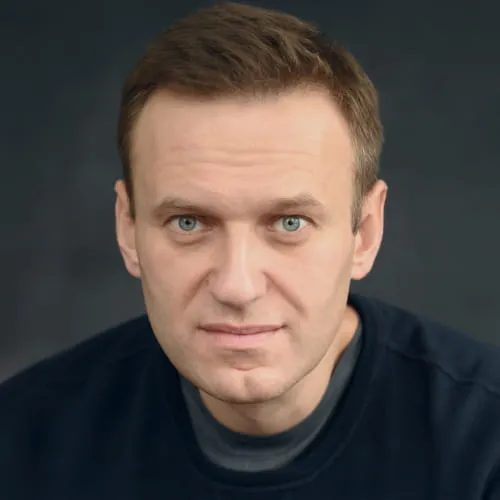
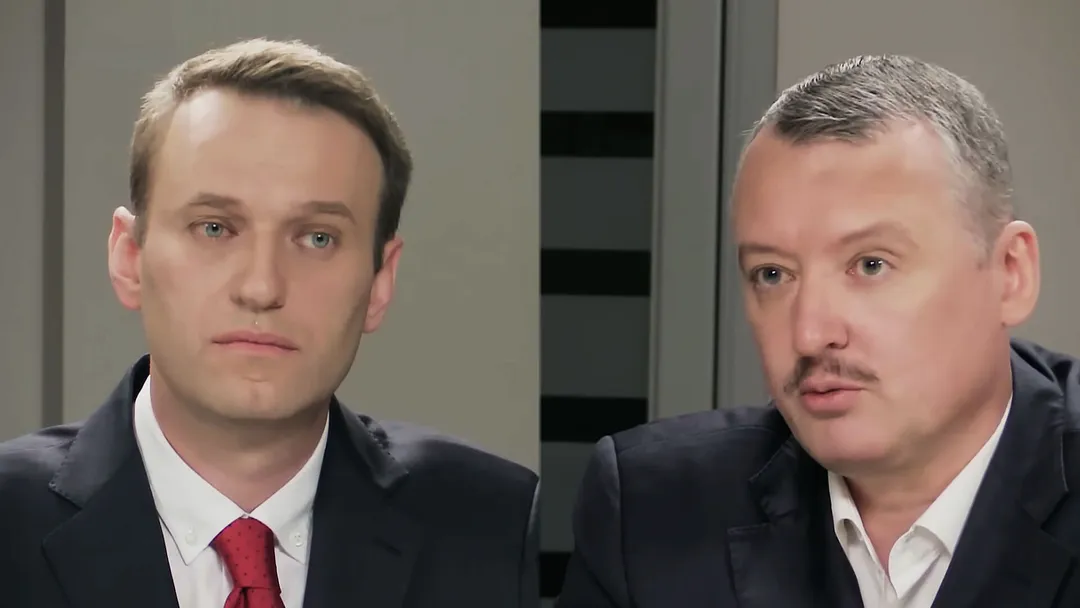
Debate: Alexei Navalny and Igor Strelkov
[music]
Good evening. In Moscow, it seems to be 8:00 p.m.
This is Debates Live, a live on-air conversation between
Alexei Navalny and Igor Strelkov.
My name is Mikhail Zygar, and today I will
moderate this conversation, apparently as
someone who has no connection whatsoever
to what is happening or to
contemporary Russian politics. I
study the history of the Russian Revolution and
run the project
1917, but today we have a different story.
A brief recap of previous episodes.
Why, exactly, did this
meeting take place? I am addressing Alexei
Anatolyevich
Navalny with a challenge to hold public
debates. I accepted this challenge because,
first, I am a supporter of open
political discussion and I am not afraid of debates,
and second, in these debates I will prove that
my—our—position is
truly patriotic. Igor
Strelkov outlined three debate topics: how
to defeat corruption, how he plans
to build relations with the West, and what should
be done about
[music]
Donbas. So now I will briefly explain
the rules under which Alexei Navalny and Igor
Anatolyevich Navalny and Igor
Ivanovich Strelkov will debate. Three rounds, as we have already
said, and they begin with questions
that the participants ask each other—
two questions each, in fact. One of them—that is,
the three main questions of the rounds—have already been
announced in the videos. Then there will be
an additional question from each
participant. Then our viewers will have
the opportunity to ask their own questions
to the participants. To do that, write on Twitter
or to me—my handle on Twitter is
Garoov. In any case, be sure
not to forget #DebatyLive. We will
be tracking it, and the most important questions on
the three topics—namely, the fight against corruption,
relations with the West, and
the situation in Donbas—on these three topics
we will put the most important questions to both
participants. And then, at the end
of each round, I will ask one question
of my own. To begin the first
round, we need to determine which of the
participants will answer our question first.
Since all of this is happening in the interests
of the viewers and not in our own interests, we should
try to make everything as
clear as possible.
For transparency, we can do it with rock-paper-
scissors. You'll throw, and—or perhaps
we should toss a coin instead? Though that is also somewhat
the viewers won't see the coin toss. Well, that's
a little
you...
It's up to you. I believe that on such
serious matters, given that these debates
are effectively taking place with a person who
is putting himself forward for the presidency,
we should still be a little more serious.
As a presidential candidate—well, I am running for
the presidency—rock-paper-scissors
is a familiar game to me. I'm ready, but I'm also ready for
a draw. I would like everything to be
fair. Which of you has a
coin?
I'm sure there won't be any problem finding
someone with a coin in this
studio. It's just that our viewers
won't see it. I hope it's obvious—not a Russian one?
No.
A Russian one. Well then, I'll toss it in front of me onto
the table so that at least you
can see it. Which of you calls it? Agreed, Igor
Ivanovich?
Please.
All right then. So, the first question will be answered by
Navalny, and we are beginning the first
[music]
round. So, the first round is devoted to
corruption. Let me briefly remind you what
the question from Igor Ivanovich
Strelkov was, exactly.
The question was: in what way
do you intend to fight
corruption once you come to power, and how will you
eliminate the financial
oligarchy? And, essentially, as a follow-up
to the question, there was an attempt to ask
what will prevent this financial
oligarchy from re-emerging. Your time starts now. Thank you very much.
Mikhail, thank you very much for the opportunity
to once again talk about these
points of my program. And
indeed, the fight against corruption is
the key plank of my program. Once again,
I can confirm that yes, I believe
the fight against corruption is the most important thing,
without which there will be absolutely nothing. And
it was very important to me that in
your address, in your challenge, I sensed
a certain skepticism—as it seemed to me—about
whether corruption can supposedly not be defeated
in Russia at all, that you simply can't
break through all of this. Alexei, I want
to say that I know how to defeat
corruption in Russia, I will be able to defeat it, and
I will prevail over it when I become
president of Russia. And my confidence
is based on the work of this fund, this
foundation, this organization, which is a
non-profit organization. Nevertheless,
it is an opposition organization, but nevertheless
for many years it has successfully
fought corruption. It has exposed
and gotten canceled corrupt tenders worth
tens of billions of rubles, and we have exposed
many officials, and we have published many
We know how to conduct investigations. I
know, and I know what I will do from
day one. Moving on to
complete, absolute specifics. Igor
Ivanovich, to fight corruption, one
main thing is needed, three political things
and several specific measures. Measure
number one, the main one, is the will to act. I
and my team have that will
to fight corruption, so we will
fight both corruption as a phenomenon and
specific corrupt officials. And the three
political things are, first,
political competition and fair elections.
I will allow everyone to run in elections, including you,
including nationalists, everyone who is not
allowed now. Second: independent
courts. Without them, there can be no fight against
corruption. I will make the courts independent,
including from the President of Russia. And
third: free mass media.
I guarantee that the media in Russia
will be free. Those are the three political factors, and
then several specific ones. Number one: I
will pass a law against illicit
enrichment. Right now, everyone online is
discussing the judge who, as you know,
held a $2 million wedding and
people are wondering what should be done about her. Well, I
know what to do with her: under my law,
she would already be under investigation, and then
in the dock. Second, I will introduce the
institution of independent prosecutors. Third, I
will abolish the insane state regulation in
Russia. There are 5 million businesses and millions of
inspections every year. I will reduce
the number of inspections by 200 times when I become
president. And perhaps the most important
of the specific measures: I will reform the
public procurement system. It is 32 trillion rubles every year,
of which six are stolen. We will make sure
that
the beneficiaries of every contract, of every
contractor, are disclosed, disclosed in
all registries, so that it will be impossible
to hide subcontractors the way it is done
now, and so that civil society organizations,
including ones like ours, have the
right to file complaints and gain access
to all documents. These are the measures
that, very soon after
I implement them, will bring Russia
and the citizens of Russia trillions of rubles in benefits
and make it possible to carry out all the other
reforms.
So, thank you to Alexei Navalny.
I think I stayed within the time limit. To Alexei Anatolyevich
Navalny, I think I stayed within
the allotted time. I tried. Now I am moving on to
the question that Alexei asked
Igor
Ivanovich: you seem to condemn corruption,
Alexei Anatolyevich said. So why did you
recently sit under those
portraits? There was a photograph where Igor
Ivanovich is sitting under a portrait of Putin.
Was it really unclear to you before who
all these people were? Have you really only now
seen the light? Was it really not clear to you that
these people have no goals other
than power and enrichment?
Your time has started, your time has started. Well then,
naturally, Alexei Anatolyevich, this
question from you is rhetorical.
Naturally, having spent a long time serving
in the Federal Security Service
in the central office divisions, I
knew perfectly well what
these people were, who they were, and how they
govern the country, and how they handle
the money they supposedly
earn.
In this connection,
I can only say
the following: in 2014, I supported Putin
because I genuinely believed—or rather,
came to believe—that he was carrying out
a revolution from above, because his actions
in foreign policy, which we will
return to later, I think
demonstrated that he had crossed the
Rubicon and had in fact entered into an irreconcilable
conflict with his Western
friends and patrons.
Consequently, I was sure that the next
step—the logical step, the only one that
would allow further progress
toward restoring
Russia’s sovereignty, including
economic sovereignty—would be the cleansing of his
own inner circle. What year was it when we
did not...
interrupt—we will still have time, I think, to discuss that. Yes,
in what year, after what was done with
Crimea, could one
go back? I believed that our
president was a sufficiently intelligent man,
sufficiently aware of his own actions,
to move logically to the next step.
Therefore, for a little more than
a year and a half—specifically until the autumn of 2015—
despite the many contradictions
that
arose from my views of
reality and, apparently, his views
of reality, I reluctantly believed
that in conditions of confrontation with the West,
the president, as supreme
commander-in-chief, had to be
supported. When those illusions
disappeared, the portrait
disappeared as well, just as it had appeared.
The only thing I can say is that when I
was still
serving in the central office of the
Federal Security Service, there was never
one hanging in my office, unlike in other offices,
although I was, in one way or another, a superior there.
a portrait of Vladimir Vladimirovich and
never, starting from
the campaign of the early 2000s, from the Second
Chechen campaign (the Second Chechen War), I did not regard him
with much trust, since, to preface
your—one of your questions—I can
say that I categorically did not
like what he did in Chechnya. From this
I conclude that the presence of certain artifacts on
the walls is not in any way
a compromising factor for me. As for
the rest, we will discuss your remarks a little
later. It seems to me I got carried away
indeed. So now we have
Alexei Anatolyevich asking
a follow-up question to Igor Ivanovich on
the grounds that you still—Igor
Ivanovich, I am not satisfied with your
explanation, and I wanted—I think you, I
apologize, are being evasive. Especially since
you worked in the central apparatus of the FSB (Federal Security Service), as
you
emphasized; you are a Russian nationalist and
a patriot in every interview. By
that year, I had already
been many times at trials where Russian
nationalists were sitting in cages for nothing
on
fabricated charges. By 2011, by
2012, in 2010, we knew that
these people did nothing but steal. But how could you
only in 2014 have
suddenly seen the light when your ideological
friends, colleagues, comrades-in-arms, nationalists
were already being imprisoned across the country? Alexei
Anatolyevich, do not forget that I
starting from 196
served in the military, and even now I
am considered an officer and serviceman, although
I am in
the reserve. Therefore, certain claims
relating to the fact that I toward someone
felt some particular way—those will not be
commented on by me. I knew
quite a lot, I think no less than
you. Moreover, I know many, including those
nationalists who were imprisoned; far from
all of them are angels with wings, far from
it, although many
let us say, were not approved of by me in terms of their convictions
—they were not guilty of what they were accused of
I apologize again. Therefore, in this
respect, I will not comment on how I
felt about it, I will not
do so. I can tell you quite
openly and honestly that starting from
1991, I never supported the
government that was established. Although
it must be said, I did not support the
government that existed before that year either. I never
hid, and do not intend to hide in
the future, that in my personal convictions I
am a monarchist, and for
me, Russia’s ideal is an autocratic
monarchy. Of course, one may smile and
shake one’s head, but nevertheless that is so
therefore I viewed these events, this
regime that arose and was built in 1991
and continued under Vladimir
Vladimirovich Putin, as a temporary
phenomenon, as a transitional stage
toward the restoration of Russia—Russia itself
Russia that will rely on all
of its history, and not only on the Soviet
or only the pre-Soviet period
accordingly, since at that time I
intended to serve, and did serve, and served
Russia as
best I could, without participating in political
activity, I considered myself entitled not to
not
comment on it. Hence all claims against
me about what I saw and what I did not see are point
less. I was not running for president, after all, I did not
announce that I
was going to lead the Russian
state. There are many
different thoughts on this matter; there may be many such thoughts
many. Incidentally, Igor Ivanovich has answered
one of the questions coming in
on Twitter about whether he intends
to run for president. Now you
have the opportunity to ask Alexei
Anatolyevich about his answer to your
question—what you are satisfied or dissatisfied with. I
listened carefully to your answer to my
basic question and understood only one thing:
you are not going to
change anything. You are going to act within
the framework of the system that has existed since
1991, with minor changes, and since
the 2000s under Vladimir
Vladimirovich, who became the successor
to Boris Nikolayevich, you are going to introduce
some very minor
cosmetic changes into this system
which, in my view, in and of itself
produces corruption. I heard nothing
about that. Courts—that is wonderful
A free press is excellent
free elections are great, but I did not
hear how you intend to destroy
the system that breeds corruption. How are you
going to destroy the oligarchic
regime which in itself is the
guarantee of this
corruption? Igor
Ivanovich, perhaps I was not sufficiently clear
in explaining, but to me this sounds like
a prepared question, and you were expecting from me
a prepared answer
to a different thesis. What I described is
not cosmetic change. A free and
fair court system in Russia is by no means
a cosmetic change. Right now you cannot
participate in elections, your
associates cannot participate in elections
I am forbidden from participating in elections, and
to let in anyone who wants to participate, from liberals to
nationalists—these are not cosmetic
changes. Finally introducing laws to combat
illicit enrichment is a tremendous
breakthrough for Russia, because this is precisely
that very oligarchic elite. But
look at all these officials
who earn 3–5 million rubles a year, but
live like Arab sheikhs—they will be
held criminally liable
solely on the basis of a mismatch between income
and expenses. Well, I already cited that judge
from Krasnodar as an example—this is
undoubtedly a revolutionary change in
the good sense of the word. If you expect me
to restore the monarchy, and if only
the restoration of the monarchy is, for you,
something essential—no, I will not
restore it. But under Yeltsin, too, there was
an unjust oligarchic regime, and there were no
real attempts to build
a normal state for Russia’s citizens.
Under Putin, exactly the opposite
process is underway. This very
comprador elite you are talking about
—I completely agree—has
usurped power. They have created a new
aristocracy. They are recreating a feudal
regime. What I am proposing will destr
oy this feudal regime, while at the same time
freeing up enormous sums of money,
enormous resources, and creating new
opportunities for reform in Russia. What
I am proposing is a concrete plan to fight
corruption, and specific measures that
have been used successfully
in many other countries. We are drawing on
that experience.
I know how to make a brief remark, but
this is all political economy and everything else
besides. I think you know that Marxism
was not, in fact, built out of thin air;
Marx did not invent it from nothing, and the theory
of the base and superstructure, I think, is also
well known to you. Everything you said concerns
the superstructure. I heard nothing about
changes to the
base itself. Wait.
As for influence from the superstructure, from the side of
the courts and so on, I do not hear how you
intend to reform the economic
system, the economy, because as long as
the economy remains in the hands of the oligarchy, in
the hands of the oligarchy, you can
shuffle officials around as much as you like, introduce whatever
kind of press you want—the result will still
be the same: one set of crooked
officials will be replaced by others
just as crooked. Whatever you introduce will not
be enforced. Therefore, as a
presidential candidate, I want to hear specifically
how you are going to change the economy,
what you are going to do in this sphere. In
your program, nor in
your answer, do I hear that. So
then, from the point of view of Marxism-Leninism,
the base and
the superstructure
political economy—social being determines consciousness.
The base determines the superstructure. So, Igor
Ivanovich, it’s just that you probably do not
have some of the figures at hand.
I will tell them to you now, and it will become
clear where our base really is. You have confused
the base and the superstructure. And those procurements I
was talking about—I am saying that this system
needs to be reformed, and you tell me
that it is some minor trifle. It is 32
trillion rubles a year—37% of Russia’s GDP.
Thirty-seven percent! That is not nothing—that is the country’s entire economy,
which is precisely what belongs
to the oligarchs. And when someone tells me that
corruption is just some minor issue, and
that we should reform something else instead, that means
there is nothing else in Russia, no
other sector of the economy, no other
economic base, besides this one. We need
to get in there; we need to free up
the colossal sums of money that are being stolen
every day. We need to drive out those very
oligarchs. That is exactly what I am talking about. And who
are the oligarchs now? These friends
of Putin—they are the oligarchs. I will free
the country from them. That is the main goal, the main task
of the fight against corruption. Nature abhors a vacuum,
Alexei Anatolyevich, but I did not hear
how you are going to eliminate the very conditions
that produce oligarchs, do you understand? Yes, you may
disperse the oligarchs, let us say—but you do not want to hear
Igor Ivanovich. I repeat once again: that is why
I said there are three political factors:
political competition; I will shorten
the presidential term to four years. I am not
talking about politics—I am talking, in this case,
about the economy, because the fight against
corruption is not only a political
but also an economic issue. All right, I understand
that perhaps you are not hearing me. I
maybe—let us
then give the floor to our viewers and
listen. Or rather, I will now tell you
what they are writing. Many of them do not
specify whom exactly the question is for, and here
the most frequent question concerning
the fight against corruption—I will phrase it. Here it is:
it is formulated as follows: how exactly will you
fight corruption if all
the supposed fighters against it—for example, the FSB, the Interior Ministry, judges, and the prosecutor’s office—
are themselves corrupt? And another version of the same
question: what will happen to the FSB afterward? I think
this question can be put to both
participants, because it is not specified
who exactly it is for. Alexei Anatolyevich answered last,
so now Ivano—well,
since I am not seeking the post of
chief anti-corruption fighter and do not
intend to,
that is, I am not one, I can say what it looks like
My view of this situation
So then, if we are talking about the fight against
corruption in general, then first and foremost
it is necessary to cut the ties that
have been imposed by the oligarchic class itself, that is,
If it comes to that, let us return to
the issue of the West. I think this is connected to
freeing Russia’s economy from the status of
a raw-material pipeline, a raw-material appendage of the West
without this, no one will ever
defeat corruption. I am not speaking rhetorically, I
am speaking to you frankly. The State Duma, of course,
if you do not do this, you will do
nothing. Briefly, on the question of what should be done and how
to deal with the FSB (Federal Security Service), I will say this, as
a state official who has been
here, indeed, Alexei
Anatolyevich is absolutely right: a fish rots from
the head. If honest and capable people are put at the head of the security services,
the security services
will begin functioning normally, and
a process of self-cleansing will begin. But
this is only on the condition that the heads of the security services and
other law-enforcement agencies are not part of
that bureaucratic-oligarchic system, as
they are now. Alexei Anatolyevich, of course, we cannot
leave in their posts those people, those
generals who, first of all,
themselves
are corrupt and observe this
corruption, which in itself is
an official crime. They should not
remain in their positions. But why were you
a general and watching all of this?
But I want to say that, of course, there are enough
people whom we can appoint to leadership
positions—normal, honest people.
There is enough money in the budget to pay
them decent salaries, and the system
will work. If only there were the will to do it. Igor Ivanovich,
regarding your remark—well, as
Dmitry
Anatolyevich Medvedev says in such cases, commenting on our
investigation: “This is some kind of compote” (a muddled mix). You
have mixed in the raw-material economy. Of course, it is
a crucial task to fight against Russia’s position
as a raw-material appendage, but with
corruption this is not directly connected. If
in Russia, those sectors of the Russian economy
that are not connected with raw materials are just as
equally
corrupt. Clear political
measures and specific anti-corruption measures
will make it possible to carry out any
reforms, including getting rid of
the status of a raw-material appendage. It is just, well,
there has to be some logic in
one’s actions, that is all. Alexei Anatolyevich,
the only thing I will say in response is that within
three minutes it is extremely difficult to present one’s view
logically and coherently
on this issue. And to do it in one minute
is even harder. Therefore, in this
case, compote is compote, but nevertheless
it is quite difficult to put it differently.
I think we need to move on to the questions.
Viewers, I think that since our conversation
is going quite lively, we will now
ask—I will now ask one final
question to each of the participants. Especially since
there have not been many questions about corruption. I
think everyone knows Alexei’s attitude toward corruption,
everyone is familiar with his position.
[music]
It is also more or less clear from his answer. So,
here is a question that comes up, and I have somewhat
combined several different questions being asked on
Twitter. They are connected both with your
biography and, in part, with corruption.
Partly so: with whose money did you
organize the incursion into eastern Ukraine,
the seizure of Sloviansk? Where did you get the weapons? Who
financed your operation, if not
representatives of the oligarchs?
Uh, I can say that I got the weapons in
Crimea. There I also got a very small amount of
money, which I had in a very
limited amount. As for the other questions, as an
officer on whom people still continue to
depend, people who are still continuing
to serve and fight, I simply cannot and will not
answer, because an answer
to
that would deprive me of my officer’s honor.
But again, look—I am not the source of these questions.
These questions are not coming from me. This is not
an interview; this is a conversation, a conversation with
the audience. They voiced them, and I am answering. So I ask you to understand
me in advance, those viewers who
say: if you do not want to answer, then you do not want to. All right, then
a question for Alexei Anatolyevich, precisely
about the raw-material appendage. Alexei, what
reform awaits Russia’s oil and gas
resources?
First and foremost, we must stop
exporting raw materials. We still earn
quite substantial
money from them, but we could
earn much, much more. We have
not properly built a single new
oil refinery. Well,
you would think: Putin has been in power for 18 years, 18 years
of huge oil prices—well then, build
plants, process it. Let us sell
petroleum products abroad, some kind of
materials—we would earn more.
But absolutely nothing has
happened here. So of course diversification
of the economy, even in terms of raw-material
exports, is needed, because what does Russia live on?
Oil, gas, mineral fertilizers—that is,
the most primitive forms of exports.
I am ending the first round here. To be honest,
I do not know about our viewers, but I am not
impressed by our participants’ answers.
I hope that in the second
round the answers will be much sharper. Especially since
it is a much more populist topic.
[music]
Topic. So, the second topic is relations with
the West. So, who is starting?
Who started before? So now Igor Ivanovich
will begin answering.
And why do you keep repeating this nonsense that
the West is the enemy? You should understand that
we have completely different problems, for example
Islamism, the North Caucasus, and so on.
Then Alexei listed the problems
that seem to him more important than
the West’s machinations. Your time. Well then,
I believe that we need to look at
the root of the problem, once again go back to the
2000s and ask:
who helped build the system
that you criticize so desperately, though I
criticize it quite harshly myself? Who
covered for it? Who allowed our oligarchy
to take trillions of dollars out of Russia?
Who helped privatize the Soviet
economy—perhaps not very efficient in the
consumer goods sector, but effective in other
areas—and in this way
ended up being swallowed up precisely by Western
companies and destroyed? Who, so to speak,
helped turn it into a raw-materials pipeline, and
who is interested in it remaining
that raw-materials pipeline? I answer
this question quite logically: in this
the countries most interested are, first and foremost, the
Western countries. One could broaden that, of course,
and add Japan and so
on. That is not important. It is they
who are interested in nothing being produced here
except raw materials or products of
primary processing.
They were interested in this for all 27
years, they are interested in it now, and
they will remain interested in it.
Next, that concerns the economy. Now as for
politics: no one has ever needed a strong Russia
throughout its history, starting from
times probably even before Peter the Great
(the Russian tsar who westernized the country). It has always been the aim, one way
or another, to break it into smaller pieces and subjugate it.
That has not changed, so speaking at all about
any change in the West’s position on
this, I consider meaningless.
Further, the West is categorically opposed to
the reunification of the Russian people, who
were split apart by the borders drawn by the Bolsheviks
and then torn apart again in 1991
while still alive, so to speak.
And how strongly it opposes this we can see after
the events of that year. And I really do not
understand how we are supposedly together with the West
when Western countries, the United
States, and NATO deploy troop contingents to
the Baltics and place missile defense systems in Poland,
and in every possible way strengthen the once again greatly
weakened grouping around Russia after 1991.
I am not even
speaking of the restoration of an absolutely
Russophobic regime and its direct support by every available means.
Therefore, in my view,
the West was and remains our economic and
political enemy. Moreover, the West
is interested in preserving the comprador
elite that currently governs
Russia, or at best replacing it with
something even more
to its liking. Thank you, Igor Ivanovich.
Alexei Anatolyevich, Igor Ivanovich
asked you a question: how do you plan
to build relations with the West? Will you
support the WTO, and will you
oppose attempts to fragment Russia
which, as is well known, were being made even
before the collapse of the Soviet Union and
are being made by the West now? Relations
with the West, with the East, with China, with Africa
and Southeast Asia—I will build them
in such a way that it is beneficial to us.
That is the prism through which I see it: is it beneficial
for Russia? And forgive me for such a perhaps
primitive approach: do the citizens
of the Russian Federation earn more
from it? That is the basic thing. I just wanted
to return to your answer,
because, well, it is, you know, a somewhat
childish position: in 1991
all our troubles came from the West. You
have surely seen those remarkable
documents from St. Petersburg City Hall from the time of Sobchak
and Putin, which described how
Vladimir Putin, together with his
associates, who are now
federal ministers, carried out schemes
with precious metals, selling them
abroad. Was that the West? I do not know—
did Chamberlain come there and teach Putin
to fiddle with precious metals? Was it the West
that conducted the loans-for-shares auctions here? Of course not.
Of course.
Of course there is an international division
Every country acts fairly
selfishly. And this is not just some abstract
West in relation to Russia—does Germany
not compete with France? And does
France not jealously try to defeat
the United Kingdom and Germany economically in
Europe? Of course it does. Every normal
government defends its own interests.
And of course, well, European countries,
European politicians—is it really in their interest
for us to sell to Europe—when 42% of our
trade is still with Western countries—
not raw materials, but at least
petroleum products? Of course not. They
want the oil refineries
to be on their territory. But these are simply
rational actions in pursuit of their own interests.
Trump acts in the interests of the United States, Mexicans
in the interests of Mexico, Canadians in the interests of Canada,
Germans in the interests of Germany first, and then
in the interests of the European Union, and only in
Russia, truly, does the elite act in
for their own personal corrupt
interests. These people are, well, rootless
cosmopolitans, excuse me — they have no roots, no
tribe; it makes no difference to them whether it is the West or not the West.
If tomorrow it becomes выгодно for them to keep
their capital in Hong Kong or Singapore
or in Zimbabwe or somewhere else, they will just as surely
also
reorient everything toward the West.
And all those troubles that arose because of
our own officials, because of our
government. And as for the WTO, I
cannot help but note here, unfortunately,
that many people are simply saying things
that are evidence that, well, it is unclear whether you
understand what is happening. You, Igor
Ivanovich, unfortunately keep repeating that
it was not the West that forced Russia to join the WTO.
It was Russia that spent many years trying to
join it, because it was in our interest
to do so. Russian
metallurgical companies carried out a massive lobbying
campaign in order to get into the WTO.
They spent 15 years on this so that
trade wars would not be waged against them, and
who negotiated the terms of accession to the WTO?
Putin. I would have conducted those negotiations differently.
So, Anatolyevich, your attitude toward
the WTO — what would you do in the post of
president? The WTO is a trade
organization; the whole world is in it. For
most sectors of Russia’s economy right now,
the conditions
and the current situation make WTO membership beneficial. If we
leave the WTO tomorrow, that very West of yours
— the West that you consider an enemy —
will applaud, because
a huge number of Western companies
will be able to squeeze our exporters whenever they want.
Trade agreements are complicated. At
the present moment, we simply must
negotiate.
The WTO is an organization about a country’s efforts
to defend its interests.
Russia
the government our interests just
does not defend them. Now an additional question regarding
what we heard from
Alexei. Igor Ivanovich, still, I
do not really understand what it means to sever
some kind of ties between someone and someone else.
Look, you say that we must sever
ties with the West, that the West is our enemy. Vladimir
Vladimirovich Putin and his entourage
are the main exponents of Russian non-citizen
Finland, state contractors — the Rotenberg brothers
their nephews, they are there too, in Finland, and so
on. I still have time. They are the West.
Timchenko and Rotenberg — that is the West. They are
the occupation colonial administration
of the West in Russia, precisely the same one that
the West installed here in 1991
and continues to support vigorously.
A brief clarification: the Rotenbergs and Timchenko
and all the rest — it was the West that brought them here.
That is, they did not emerge from Putin’s childhood circle;
the West brought them here. When
the British came to India, they did not bring
all the officials there, nor did they place them everywhere.
Most of the so-called
Indian Empire was governed by the same
nabobs, shahs, and sultans — that is,
local feudal lords who became
performers of the functions of British officials.
So there is nothing surprising about this.
The same situation has simply repeated itself here.
Having conquered and subordinated the country,
mostly, by the way, not directly by force of arms, and in
our case specifically not by military force,
they found the people who run
the economy and politics in the interests of
Western partners. In fact, the whole
policy of Boris Nikolayevich (Boris Yeltsin), and after
him, to a significant extent until
2014, and now that of Vladimir
Vladimirovich, has followed this, this
corridor. May I make a brief clarification, if
I may? I still do not really understand.
Let us imagine that you can do such
things. Please explain to me whom in
the West we are supposed to defeat so that in Russia
there would be no Rotenberg, Timchenko, and all the rest of
that crowd. We do not have to defeat anyone
in the West. But if you
had listened carefully to my question — by the way,
I did listen. Yes, in your main allotted time
you still did not answer; you did not touch at all on
the most important question: that Russia
is a divided country. Germany was allowed
to reunify, but Russia is not allowed
to reunify. Again, you are ignoring that
question, but I think we will return to it
in the third part, about borders drawn
arbitrarily across the living body of the Russian
people
by the Bolsheviks, which are not
ethnic boundaries. The West is using all
its strength not only to preserve these
borders, but also to adjust them
in favor of the country’s further disintegration. What, then,
is the West to us in this case, as
a state? You spoke a great deal
about citizens of the Russian Federation, whereas I am
speaking first and foremost about the Russian people, and
secondly — which is also important —
about the citizens of Russia. So,
for me, any Russian living outside
the borders of Russia, the Russian Federation,
has exactly the same rights as any
Russian citizen. Well, sorry, that is how it is. If you
want to make a brief remark, you may. I
will simply turn to you. A brief remark: it seems to me
that you have not followed closely enough
my political biography. In those
years when you were still serving — not that I am trying
to needle you — in the central apparatus of the FSB (Russia’s Federal Security Service),
and not speaking on political matters, I was with
a person with whom I now strongly
I parted ways with Zakhar Prilepin on this.
In a sense, your colleague.
I signed the manifesto of the Narod movement, which stated
that this was Russia’s most important problem and
task: that the Russian people have
a truly enormous
wound, a tremendous problem — Russians
are the largest divided people in
Europe. That is why I have spoken openly on these issues
for many years, and I continue to do so.
But excuse me, if you are saying
that the Bolsheviks carved up the borders while the country was still alive,
but it was the Bolsheviks who
drew them. So what are you proposing I do now?
For the sake of some vague idea of fighting
the West, are we supposed to
So, do you recognize these? — I recognize
the current borders of the Russian Federation.
Of course. — The ones drawn precisely
by the Bolsheviks, correct? I am in 2017,
and in 2017 the Russian Federation
has borders. But actually, right now we are just
I am, in fact,
anticipating your remark and want to
ask you a general question from
the viewers. I’ll phrase it roughly like this:
is it possible
to restore — how is it possible to resist
the West and restore Russia to its former
borders, and is it possible to restore in
Russia a monarchical system? I think
that is roughly what you were just
about to comment on.
A brief remark: once again, I want to emphasize, as I have
always stressed — do not confuse
this with some kind of programmatic position.
As for a monarchical system,
at the present moment, restoring
autocracy in the form it existed
in 1917
is impossible, if only because
at that time
the overwhelming majority of the population of the Russian
Empire was Orthodox Christian, or otherwise
professed another religion.
And so restoring it within those borders is also
impossible — within the borders of the Russian Empire,
naturally, if we are talking about Finland
and Poland, and the rest as well, it is impossible.
However, I believe it is necessary
to restore the natural boundaries
of settlement of the great Russian people,
which, in my view, consists of three
main parts: Great Russians, Little Russians,
that is, Ukrainians, and Belarusians.
The question is: should we start a military
operation against Kazakhstan tomorrow in order
to seize northern Kazakhstan, where
Russians live? The answer is no. What you are saying
is demagoguery. So we are supposed to restore everything —
but how?
What, launch a military operation tomorrow
against Belarus? No need. — Well, that is
what I’m asking you. You are planning to be
president, after all. I stand for
my position is this: I stand for
giving Russian citizens the chance
to live normally, to become more prosperous, to
develop, so that Russia no longer has this
horror and nightmare where you go to a hospital
in the Moscow region
and the ceilings are collapsing. I believe that
for the sake of these chimera-like ideas — let’s
restore all of this — we cannot. Do you
really believe this can be done?
If we do not restore, including the economic
integrity of the former country, then do not
forget: it is possible to do something right now,
right now, immediately — simply take action and
do it. In three years, Russia could be living
significantly better; Russian citizens could
be earning — excuse me again for the
simplistic approach — salaries twice
as high, through normal methods of
reform. We are drifting a little — we are drifting
very far
off topic. I would say this strongly
reminds me of something, and I would even say
it reminds me of Boris Nikolayevich Yeltsin (Russia’s first president), who also
promised the same thing in 1990 and 1991.
Not in exactly the same words,
but it was the same promise. Just wait,
the 500 Days program, and then we would
all start living well. The 500 Days program was not
adopted. Boris Nikolayevich promised a lot,
but unfortunately he surrounded himself
with people like Vladimir Vladimirovich
Putin and Anatoly Borisovich Chubais,
who, incidentally, still to this day
sits very comfortably on enormous amounts of budget
money. And Boris Nikolayevich Yeltsin
carried out no democratic reforms at all.
He did not fight corruption; he rode a
trolleybus a couple of times and declared
that he would fight the nomenklatura (the Soviet-era ruling elite), after
which he began rebuilding that very nomenklatura
and turned his inner circle into
billionaires. I have an absolutely clear
program, completely the opposite of that,
and it is aimed at the interests of citizens. No, unfortunately,
there is no particularly strong, clearly expressed
interest among our audience in the subject of the West.
It seems to me that this topic does not really
concern our viewers very much, so I will ask
perhaps one more question. Alexei
Anatolyevich Navalny is being asked how, at
the present moment, relations with
the United States and the European Union can be improved, and how
relations with Trump should be built. This
probably concerns our third
question. First of all, in order
to resolve a significant part of the issues concerning Donbas,
Ukraine, and everything else, it is necessary
to implement the Minsk agreements so that
most of the sanctions can be lifted, while some
of those sanctions will never be lifted. Overall,
once again, this whole topic
of normalizing relations is also
Much of what Igor Ivanovich says is demagoguery.
These countries will always act in
their own interests. Trump will act
in the interests of the United States, and Europe will be very
far from pleased if we really
start getting rid of our status as a
raw-material appendage, because, well, they do not
want that. They want crude oil
to keep flowing to their oil refineries.
Therefore, we should not be thinking about
how to normalize relations with
the West; we need to think about how to
normalize our own country, and that is our
main
task. Mr. Ivanovich, since you
talk a lot about the West, users
are asking—Twitter users: who
exactly is “the West”? Could you explain
specifically, more specifically than in a single
word, what the object of your indignation is?
It is a group of the most economically developed
countries, mostly united in the
North Atlantic bloc, led by
the United States. That, for me, is
the conventional “West,” if you can put it that way. Well,
there are, of course, certain people, certain
organizations. Yes, naturally, there are
people, there are organizations.
These are the heads of oligarchic corporations
that significantly influence
politics both in the United States and in
Europe.
It is an established state apparatus.
It is political
systems. I do not remember all of them politically—why should I
name them one by one? An intelligent person understands
what I am talking about: the United
States.
And when you speak of the West and the Euro-Atlantic
bloc, the Atlantic countries, we can see
right now that a huge
conflict is taking place: Trump wants European
countries to pay more into NATO, and they do not
want to pay. The contradictions between
countries, even within the EU, are enormous. Yet you
describe the West to us as essentially
a monolith. They can quarrel among themselves as much as they like,
but they have common interests
that they will defend, and
always do defend, with a very hard, unified
force, as one
front. These interests consist in the fact that
the biological and
mineral resources still remaining on Earth must first and
foremost serve their prosperity.
So how much has the policy
of the United States and of that same
North Atlantic bloc changed after
1991, after the disappearance of
their global rival, the socialist
system?
Before 1991, the United
States and the conventional West
did, yes, turn into showcases those countries to which
they gave help in the
struggle against socialism
and, earlier, against feudalism.
They rebuilt Japan,
which had been devastated almost to rubble, and
even allowed it to compete within
their own sphere; West Germany as well, and so on and
so forth. Name me even one
country that America and its allies entered
after 1991, after
the global adversary disappeared, and which they
did not destroy but instead
rebuilt. What did they do? They smashed
Yugoslavia. Name me even one
prosperous country from among the former parts of
Yugoslavia. Look at Iraq, Libya, and now Syria.
Igor Ivanovich, everything you are
saying leads to one conclusion: it means that no
“West” is to blame at all, but rather the people sitting in
the Kremlin and the Government House are
the real villains who are preventing us from
developing and are keeping us as a raw-material
appendage. It was not the West, not Trump, who made it so
that 70% of our exports are made up of oil.
Excellent. Then I will now wrap up
our second round. But this time, unlike
the first time, I will not ask a question of my
own. Now, from me, a short rapid-fire
question—literally one for 10 seconds, a yes
or
no. In the history of the Russian opposition, there have been
different
attitudes toward the West and toward how the West
should impose sanctions on Russia.
For example, an opposition figure who lived
100 years ago, Maxim Gorky,
wrote articles saying that the West should not
lend money to the Russian government
and should impose sanctions on the government.
Academician Sakharov supported
economic sanctions against the Soviet
Union. Alexei Anatolyevich, do you
support maximum sanctions
against the Russian
Federation—against people, and
against...? Like Gorky, I wrote an article for the newspaper
*The New York Times* saying that yes, I believe
sanctions against oligarchs and Putin’s
friends—I, of course, as a citizen of Russia,
am against sectoral
sanctions. I consider sanctions against
Putin’s
inner circle effective; even against Russian citizens, sanctions
must be imposed, of course, if it is in the interests
of Russian citizens. And, Ivanovich, you talk a lot
about the West. Have you been to any Western
countries? Tell us where you have been, and in
which foreign languages do you read
and speak? Good question. No, I have not been to
Western countries; I have not been to
Europe at all, except for Yugoslavia during
the Bosnian war, and passing through Hungary
and Romania as well, on duty during
the Kosovo war in 1999, literally.
Only for a very short time, and not in any other countries.
I have never been to Western countries, although they are mentioned quite often.
It comes up quite often. My older sister, because of her work,
in business... We are speeding everything up, and
we are starting the third
round. So, the third round is about the situation in
Donbas and in Cr
Crimea, which, which was surrendered, and Ivano...
Accordingly, what will you do with
Donbas or Crimea? Are you going to
hand them back to Ukraine? And further on,
there is the characterization of Ukraine as a place where
there is, in Igor's view, a fascist
leadership. Thank you very much.
This is an important question. Igor Ivanovich, I want
to begin answering it—not from afar, but simply by saying this:
I would like you, from my answer to
this question, from the way I approach it,
to understand the essence of my
presidential program as well. So,
first: last night there was news that
Russia had entered the top five countries
worst for pensioners to live in.
The day before yesterday there was news that
Russia's natural population decline
had tripled. The country is dying out, and
third: every single day I see
notices from Russian hospitals saying that
Russian citizens must come—and
must come, you'll understand in a moment—
must come to hospitals with their own
bandages and iodine. And this has a direct connection to Donbas,
because the war
that you started is an expensive thing,
one that is destroying Russia's economy,
that is taking from citizens of the Russian Federation,
from my fellow citizens, whom I am running
for office to protect, their last money—
their last money. Twenty million people are below the poverty line, and
you are de facto telling me: Alexei,
you must finance wars—huge,
costly wars. So, Igor
Ivanovich, my answer is no: Russia cannot
sustain this and cannot afford
to wage war. Of course, the tragic
events in Donbas are tragic for everyone; they are
tragic events, terrible deaths.
Ten thousand people have died, and even now
far fewer people are dying, but they continue
to die. But forgive me for
this phrase: a bad peace is better than a good war.
There are the Minsk II agreements. I know that you
do not agree with them. Well, I do not know whether to call
them your colleagues or now
your opponents—the leaders of these
republics—they were part of this process.
The Kremlin, unloved by both me and you, was part
of this process. Europe, the United States, and Ukraine were
part of this process. In the Minsk
agreements I see provisions that are, well, extremely
important for you and for us—for everyone. These are
the special status of Donbas, enshrined in
the Constitution, language, elections, and so on and
so forth. It will be difficult—monstrously difficult—
to implement all of this. But it is still better,
forgive me, to implement it than to fight,
because Russia has no money for this war
and cannot wage it. In your
most recent interview, well, you said
something monstrous: literally the day before yesterday, 'We
will still fight Ukraine over
Donbas.' No, we will not. We want to, and are
categorically opposed. Already now we have
3 million refugees—1.5 million from one side
and 1.5 million from the other side. As president
of Russia, what am I supposed to do with these
refugees? They are living in Rostov Region,
they have neither salaries nor jobs. Therefore,
I would like to stop all of this. I would like
a peaceful settlement in Donbas and
would like to end the war. In this,
the country is interested.
The country has a stake in this. So now a question for Igor Ivanovich:
Why were you silent for three years about who shot down
the Boeing, and who shot down
the Boeing? I will answer the same way I answered before:
the militia did not shoot down the Boeing, because it lacked
the means with which it could have
shot it down. All the air defense assets
that were at my
disposal included five Igla MANPADS
and one Strela-10, which at the time of the Boeing's سقوط
was in Zugres and was covering
Zugres accordingly.
The militia under my command could not have shot down the Boeing,
simply no way. I cannot and will not give any other comments
on this matter for
one simple reason: I did not participate in
the investigation and am not even interested in it
on principle. That is all I wanted
to say on this subject. And now I
will use the remaining time to
criticize you a little.
You said a great deal here about
the fact that while I was serving in the FSB (Russia's Federal Security Service),
you were already a Russian nationalist, you were already
speaking up for the Russian people. Well then, where are
the Russian people in your view, Alexei Anatolyevich? Are they
only in the Russian Federation for you? And
those people who, after 1991,
millions of Russian people, remained outside
Russia's borders—are they not Russian? Do they
have fewer rights to our common
destiny and to what is ours in common? They want
to stay alive, they want to remain
alive; they do not need war, Alexei
Anatolyevich. Excuse me, their
rights are being brutally trampled, first and foremost
their cultural rights. Excuse me, no one would have
risen up either in Crimea or in Donbas if
—forgive me—you had been there. Here I was
asked whether I had been to Europe. No, I had not.
But I was in Crimea and I was in Donbas, and
if the situation had developed differently, I could have
been in Odesa or I could have been in
Melitopol. We were expected
everywhere. For 25 years, over the years since
1991, Russians...
The people of Ukraine grew tired of the moral and
cultural genocide—quiet, of course—
that was being carried out against them.
They were tired of being treated as second-class people. And
has it become easier for them now? No, it has not.
It has not become easier, and that is my main, fundamental
complaint against Vladimir Vladimirovich
Putin. You say that you would easily
end the war in one stroke—you would hand over
Donbas. You say that you would unilaterally
transfer the border to Ukraine and
fulfill your... I have your...
literally, this is what you just said.
In previous interviews, you said you intended
to hand over the Donbas border to Ukraine. I
looked carefully—I can quote it.
One of the points was that you said you would
transfer the Donbas border separately from
the issue of Crimea. Well, immediately after that
the question of Crimea would arise. Alexei Anatolyevich,
we have—I have very little time, 3
seconds—but I conclude that you have never
been a nationalist, and certainly are not
one now, judging by what you
have said. And it is highly doubtful that you are
a patriot. Well, as for Crimea, I think we should discuss it separately.
Ask an additional question.
Go ahead, Igor Ivanovich. First of all,
this juggling of yours—nationalists, non-
nationalists—none of that matters.
Do you understand? And how can one regard as
a true nationalist—using your own
terminology—a person who
keeps emphasizing that he is an officer everywhere, yet
sat in the state authorities, sat in the FSB (Russia’s security service),
watched all this injustice and did not
say a single word? Is that how Russian nationalists behave?
Apparently not. As for
the issue of Russian nationalists: half a year
ago I appeared as a witness at the trial of
Alexander Belov—a perfectly genuine
nationalist. They threw him in prison on
what was basically a fabricated sentence, just like
dozens of other nationalists. So please do not
make some kind of
claims against me about whether I am a patriot or not.
Because my position is patriotic;
it is real. And yours, excuse me,
for the perhaps lengthy comment,
is hypocritical.
Russians were sold out in Turkmenistan for a gas
contract. Russians were driven out of Uzbekistan.
Six hundred thousand Russians were driven out of Chechnya, but you
you understand everything—you only started being so
appropriative.
But only at the point where it is advantageous to Putin
do you speak out, and where it is not advantageous to Putin...
Let me ask a question: in what year did you graduate from university?
Graduate? I graduated from university in ninety-
five, if I’m not... Do you know where I was in
ninety-... year? You should carefully
study this. In that year, having a higher
education and fully having the
opportunity to receive an officer’s rank,
nevertheless I did not wait for that and went
as a volunteer to fight in Chechnya. I fought there
...
In the year when I graduated from the Moscow
State Institute of History and Archives,
having no military
specialization and not yet having completed military
service, the very next day after defending my
thesis I took my Mosin rifle (the classic Russian three-line rifle) and with my
friend, who was later killed, went to Transnistria
to defend the Russian people. What does that mean...
For the second Chechen war, I wrote a pile of reports, and in
the end, from that year until 2005,
I was in Chechnya. I was there—allow me, not in
words alone.
You may believe me. So when you
start making some kind of
claims against me about who defended what and
telling stories about some Belov
Potkin who, excuse me, never defended Russians
in any way other than with his tongue—well, excuse me,
after that it simply looks ridiculous.
Alexei Anatolyevich, simply ridiculous. Unlike you, I
defended Russians not only
in Donbas, and I came to Donbas not
to unleash a war, as you accused me of doing,
but to defend the right of the Russian people to
self-determination, to reunification with the main
part, to reunification into a single
state. And why is it, Igor
Ivanovich, that since 2014 you have not been there?
I will answer for you myself: because
those people who are now in Donbas might kill you.
You say this is not
a reproach; I am simply saying that.
Please listen to me. I will formulate
my question. So, you believe that in
Donbas something is happening, or
something good was happening, but in the words of
Igor Ivanovich—whose interviews I read regularly—we know that in Donbas
we know that in Donbas
there is a corrupt regime of murderers; your
former comrades, militia commanders,
are being killed by various Wagner private military companies
protected by Putin’s cook (a reference to Yevgeny Prigozhin), as we are investigating.
So forgive me, but the fact that you
have such a heroic biography, that you went
to fight here and went to fight there, does not
change the whole system, in which as a result
of what you did, there is now sitting there
a gang of corrupt officials and those people who
would kill you if you went there. Igor
Ivanovich, right now you are answering Alexei
Anatolyevich’s question and then immediately
asking your own question. And that is precisely
my main complaint against
Vladimir Vladimirovich Putin: that in
2014, when it was possible to annex to Russia—or at least give
to Russia, or at least give the opportunity
for all the Russian regions
of Ukraine to determine their own future, at a time when both the financial and
economic situation of Russia was
fairly solid—he did not
do it. And since you reproached me for that...
Why I ended up here rather than in
Donbas, I can say the following: I was not
afraid that I would be killed. If I had been afraid
of being killed, I would not have gone either to Crimea
or, all the more so, to Donbas. Believe me, there
were plenty of situations when I could have been
killed — you may not believe it, but in any case, if
I
had had a choice, had had the opportunity to choose
for myself and remain in Donbas, I
would have stayed in Donbas. Unfortunately, I
was given such conditions that
I could not remain in Donbas. What exactly those were,
forgive me, but as a military man I cannot answer you
for now. This is already the third time you have said that
there is military secrecy and you cannot
answer the question now. Yes, Igor Ivanovich is answering,
and then the question is asked precisely — and
I emphasize this — this is where my
main complaint regarding Ukraine lies: toward
this government, toward Vladimir Vladimirovich (Putin)
personally, and toward his entourage. But Alexei
Anatolyevich, listening to you, I understand that in
fact, if you differ from
Vladimir Vladimirovich on this issue,
it is only for the worse. Because he,
however clumsily and imperfectly,
having created these criminal regimes,
which, by the way, are not much worse than the one in Kyiv, but
for a number of reasons
poorer — at least he leaves open the possibility
for future reunification, which is what
my comrades in Donbas fought and died for.
In my militia there, 95% were
locals, not Russians who had come there; only 5% of my
men were volunteers. That is what they
died for. And you are going to hand them
back to Ukraine. In that respect, you
are, forgive me, much worse than Putin in my eyes.
Do you have a question for Alexei Antonovich? I
don’t even know; I think maybe
there are too many questions. May I
just comment on the answer then?
Then let us give the floor — of course
we will give the floor to our viewers. Most of the
questions are for Igor Ivanovich, and one
of them is this: Why did you first begin
posting on Twitter the joyful news about
an An-26 being shot down — “a birdie fell” — and then
frantically delete it when it turned out
to be about the Boeing?
I answer: I wrote nothing on Twitter,
because I was not on it. Nor was I
present on any of the social
networks. The only place where, as of July 2014,
I posted my reports
was the FT section of the
Antiques Forum. All my reports from that time
are preserved there in a separate section. If
anyone is interested in what I wrote on
that day, they can look it up and verify it.
I did not write that message, that is all.
Excuse me, there is on the internet, on the internet
there is an anonymous
video recording — anonymous, I do not know who
the author is — where it is stated that this
message was not taken from my page
on the Antiques Forum. I can give my word of
honor, I can swear on the
Bible that I did not write that
message. But on the other hand, it makes no
difference whether people believe me or not. The most
common question users ask
Alexei Navalny is this:
Do you consider
Strelkov a war criminal, and how
do you envision a trial of Igor Ivanovich
Strelkov? Well, for me, a war
criminal — I do not like throwing around
phrases and such, you know,
labels. Igor Ivanovich likes to
say, “We are nationalists, patriots, and you are not,”
and it turned out from the debate that
after all he likes Putin more, and
more than that, Igor Ivanovich, you still believe
that he will restore something there, just as
you believed back in 2014, and
still do now,
while understanding that you are deceiving yourself.
As for war criminals,
that is a precise term. If he killed
non-combatants, if he committed certain
acts that are directly listed in
legal documents, then any
person, including Igor Ivanovich, would be
subject to legal proceedings. If
it is established that non-combatants were killed, or
that he enslaved someone, or
engaged in looting, then whether he is recognized as
a war criminal is a matter for the court, not for
Alexei Navalny. I can say
politically that I do not like his
position on Donbas; it is harmful,
absolutely. He is in fact saying, well, I
cannot debate Putin, Putin is afraid to
debate, but Strelkov here — in effect, Igor
Ivanovich — is now voicing Putin’s
position, and I am arguing with him politically. And
matters concerning war criminals will be
dealt with by the courts.
And Igor Ivanovich, a question for you:
Has anyone at all among the people
living in Ukraine been better off after what you
did there in 2014? I mean both
eastern Ukraine and Ukraine as a
whole. I believe that whether things became
better for them or not can only be
judged by the outcome of this war, which
is still ongoing. We already have results now.
What results?
Wait, that is just as
rhetorical a question as asking whether
life became better for the people of Ukraine in 1943,
when Stalin decided to liberate it from
the Germans. In my view, without the reunification of
Russia, without the full reunification of
the Russian people and the revival of our country
in whatever form, there will be
impossible—completely impossible for us.
We were torn to pieces, and until those pieces
are put back together, all the fine words about how
we can now, within one separate
territory of the Russian Federation, manage
to rebuild—
they have absolutely no chance of
being realized. How can one even talk about
how, without the reunification of the Russian
people, after leaving nearly a third
of Russian people outside the country's borders, we have the right
to build a new Russia? How can we
do that? To me, that is absurd. To me, it is
impossible. Go on, ask the next question.
Well, you've combined several questions into one, and
what should be done with the current
leaders of the DPR and LPR (self-proclaimed Donetsk and Luhansk People's Republics), and also what
should be done with—what would you do with
Ramzan Kadyrov, who heads
Chechnya? That's quite a leap from Donbas to Chechnya, but
basically that's what you're asking. So, what
should be done with the leaders of the DPR and LPR?
That is a matter of the same Minsk II agreement, where,
as I recall, an amnesty is spelled out.
Igor Ivanovich speaks about these leaders
probably even more harshly than
many Ukrainian internet users do,
because he knows these people
personally, and his comments are
certainly not complimentary. I know one thing:
I would like this war
to end as soon as possible, so that
refugees could, if possible, return to their homes, and
so that there would be no more problems. We should not
be spending money on this. Sorry again for
that approach. I still have
time, as I can see from the clock. And
therefore
Russian-Ukrainian and European
negotiations, and all the sponsors of the second
Minsk agreement, must resolve this
complex and difficult issue, which
affects different parties. As for
Ramzan Kadyrov, with regard to him, first of all there should be
an investigation conducted
into his possible
involvement in the murder of Boris
Nemtsov. May I make a brief remark?
Go ahead.
Alexei Anatolyevich, unfortunately, your plan
to hand over the border—or perhaps fortunately, I don't even
know how to put it—will lead to an even greater
number of refugees. That's not my plan, that's
not my plan. And what you're trying to do—
to stop the war—it will not stop because of that.
As soon as you surrender
Donbas—let's speak plainly—
as soon as you hand Donbas over to Ukraine, the question
of Crimea will immediately arise. And as long as in Kyiv
the current authorities remain in power,
openly Russophobic, genuinely
Nazi—though in a mode, as they say,
so to speak—
there will be no reconciliation with Ukraine,
and war, in one form or another,
is inevitable, you understand. May I ask a question?
Please tell me, Igor Ivanovich,
how did it happen that you alone are standing there
looking so spotless in your white coat, while I
see the Kremlin, which I do not
like, as a sponsor of the Minsk
agreement; Ukraine, Europe, the DPR and LPR,
various people within the governments of these
republics—they signed the Minsk
agreement. And now, first of all, you are
more or less the only one saying it is bad, and
on top of that, for some reason, reproaching me as if
these were my agreements and my plan. I'm not accusing you—
you are saying that I would surrender Donbas,
whereas I am saying that I simply want
to implement the agreements that
the DPR and LPR signed, right? I'm not saying—
I'm not saying that you—I'm saying that
what I mean is that
you intend to carry through to the end that same
treacherous policy of our
president, who, yes, first of all gave up all of
Novorossiya (a political term used by Russian nationalists for parts of southeastern Ukraine), in effect, although he could have
liberated it; who gave up all of Ukraine, as a result of which
it ended up in the camp
of our enemies and effectively became
a weapon of the West, in the West's hands, turning
it into a second Poland. Could I at least make
a brief clarification on that point?
It's just very
important. No, Igor Ivanovich, explain to me:
why do you consider this
a betrayal, while Plotnitsky and Zakharchenko,
the ministers, and everyone else—the entire
establishment, as I understand it, of these
republics—do not consider it betrayal?
Anatolyevich, well, what can I say? But
you do consider Timchenko and Rotenberg
not to be such worthy
citizens, shining examples, right? Well then, think
about whom our rulers could possibly have installed
whom they could have put in place after
they refused the possibility of carrying out
a revolution from above in Russia—whom could they
have put there? People just like themselves.
Absolutely. If you believe that the creatures
of the Kremlin are traitors, then all those people—
including Plotnitsky and Zakharchenko—
are traitors too, if only because
if Igor Ivanovich Strelkov, also known as Igor
Vsevolodovich Girkin, came to Donbas purely
as a volunteer and became the de facto commander
of the militia—well, that is what happened in reality, though later
the Supreme Council formally approved it—nevertheless,
and he was neither a citizen nor a resident of Donbas,
whereas they are native residents of Donbas whom
the people, for better or worse, elected as the heads—note this—
of the republics, the people's republics. After that, they
signed the Minsk agreements, in which
they recognized themselves as the heads of certain
districts within Ukraine. If they are
local residents, then—
after all, they swore allegiance to the people's...
I’m not sympathetic to the republics at all, but I don’t
understand why you think that
it’s your— I don’t think that my
or my opinion
is shared by people; it’s just that they don’t know
the tactic that they
have been sticking to for the last hour and 12
minutes: they’ve been calling each other Putin and
saying, “No, you’re the one acting like Putin.” “No, it’s
you who are acting like Putin.”
Then let me ask one final question
that will allow you to draw some, uh,
some general conclusion. It’s a question about ordinary
people, and it also comes up on Twitter
and it’s probably the most common accusation
made against each of you: that in fact
you don’t care about ordinary people who
were once your supporters. This is what
people write about you—that you, I’ll quote, that you
ran away from Donbas and abandoned those
who stayed there.
And in general, how do you sleep at
night after that, and what do you dream about? Well, yes, and in general
you too, Alexei Anatolyevich, are accused of something similar:
that you don’t care about those
people who were your supporters.
You don’t write on
your Twitter or in your blog about those
supporters who suffered because of you.
You write about corruption, you write
some positive news, but about those people
who are being sentenced in the March 26 case
you stay silent. All right.
Unfortunately—if I may, I’ll begin—unfortunately,
unfortunately. I wish it weren’t so,
but it is, and my
Twitter and my blog are simply packed
with news about daily arrests,
detentions, about the everyday forms
of pressure my
supporters are subjected to—the people around me,
and simply random people who
join in, and then the regime picks them as
targets. I write about this every
day. It is pain—my pain—and a great
suffering for our entire organization. Unfortunately,
yes, but we are fighting a leviathan
that wants to devour everyone, anyone who
is dissatisfied—from nationalists and patriots
of every kind to liberals
of every kind, democrats, the left and the right. And unfortunately,
yes, we are not in a position—I’ll say this plainly—
and I say it with pain—we
cannot even list all the names
of those who are under
pressure—thousands, tens of thousands of people; this is not
an exaggeration—who still join
our movement, join our
campaign, because they see the bigger
picture: that if we do not fight this
now, if we think only about ourselves—like, “how awful,
I was detained for 10 days” (10 days)—that is
fundamentally
insignificant compared with what
needs to be done. We are doing everything possible, we
... Well then, the only way I can
justify myself before my
comrades who accuse me of
having
abandoned them—they are not, let’s say, making the same
kind of accusations as the scum do.
I think it’s not hard to figure that out.
And those who served with me in
the same units, who served on my
staff, already know that perfectly well. But
the only thing I can say in my defense
is that I have received nothing either for my
so-called flight or for my
service. I live on the same basis
as I did here before—indeed, you could even say
worse, because
before Donbas, before Crimea, I had a very well-
paid
job, strong social guarantees, and I could
look to the future with confidence. Now I am
a salaried employee, living on my wages and
military pension. I have nothing extra.
Therefore I can honestly and openly
say: in every case I acted as
my conscience told me to, and as I understood
my duty. Perhaps I was mistaken; I am not
a saint and I could have been wrong. Nevertheless, the fact
that I am here now and not there
means that I cannot be there
physically. I cannot even enlist as a private soldier
in that army, because I would not
be allowed to cross the border, and if I were,
I would simply be deported from there. I am not
going to be a clown and put on a show
for the sake of my own publicity. I think this is
an excellent ending for our debate
because a show really, a show really
did not
happen. You gave us the chance to say a couple of
minutes more as a closing statement. I
apologize for stepping onto the host’s
territory. I believe that, of course, we did not
end up with a show, but of course you still have
the opportunity to fix that. Perhaps
you could explain why you came to
these debates at all. Let’s give each of you one minute.
However you like—let’s once again
And I came to these debates precisely in order
to look Alexei
Anatolyevich in the eye and understand whether he really
thinks what he says and says what he
thinks. Unfortunately, yes: he really
does say what he thinks. Unfortunately, he
really is not a nationalist.
For him, nationalism is in the
past. Unfortunately, he— We did not have time
to discuss the Crimea question, but he is a questionable
patriot in the sense that he is still ready
to cast doubt on
Crimea’s status, simply on the grounds
that there was some referendum there, and so on.
And unfortunately, I did not understand how he
plans to defeat corruption, because
fighting corruption, even with the
harshest judicial measures, would not
eliminate its
root cause, in my view, it would not work
It would be the same thing, only, so to speak,
all over again
there is a very high probability, Alexei
Anatolyevich, that if you come
to power, you will continue the same
exact line that before you was pursued by
Boris Nikolayevich (Boris Yeltsin), and then Vladimir
Vladimirovich (Vladimir Putin); you will
follow in the wake of the Western system,
in which Russia has no place except as a raw-materials
appendage, simply none
the main misconception in which, as
we saw today, Igor
Ivanovich remains, is that patriotism for
modern Russia is, well, some kind of
romantic mood. As you said, I
picked up my three-line rifle (the Mosin rifle) and went off somewhere
to fight. That may be good, it may
be that at that moment you did something
right in accordance with your
convictions, but I
there are cities with no roads, there are
hospitals with no bandages, there are schools
that are falling apart, and we have thousands of
schools being shut down every year, we have 20 million
poor people in the country, and we are in total hopelessness
our life expectancy in the country is
laughably low. You say people are dying
in Donbas, but people are dying in
hospitals every day because they cannot
get proper medical care in Russia in 2017
therefore
for me, patriotism in Russia right now is
action aimed at ensuring that
the citizens of Russia, Russian people, live better
and more prosperously right now. Right now I
am living in
the year 2017, and I am a real person from the
real world, so in the real world I
intend to solve those problems that
exist. I do not want to live in this chimera
that we must
immediately unite with Belarus
seize something, annex something, and all
the rest of it. Of course, we should
help Russians, and we must understand and
always remember that Russians are the largest
divided people in Europe, but helping people
right now means not war, but a fight against
corruption and improving the economy. I
hope I have finished my thought. I
thank our audience for having
stayed with us through it
one moment. Well then, let us hope
that the culture of political dialogue from
today onward will only
develop rather than degrade. That is all
all the best