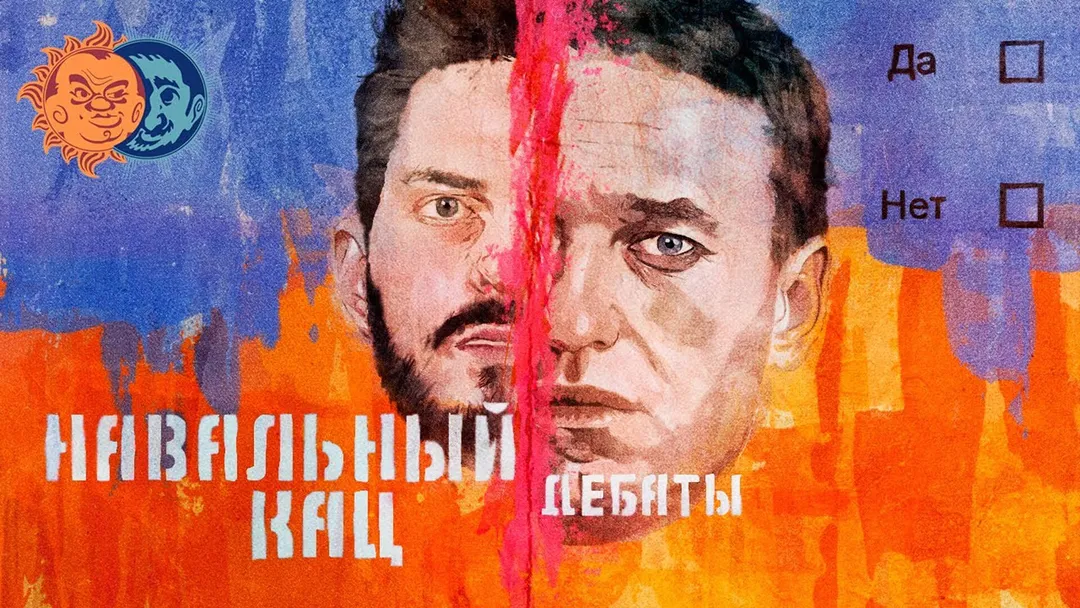
Debate: Alexei Navalny and Maxim Katz
You're talking... Michael, you don't know me yourself.
So, Michael, this has to be handled somehow.
Right now, well, listen, both of them can actually be heard.
So basically, everything is fine now.
Give me the stream itself, yes, and then send me...
the link.
Hello, friends. I want to personally apologize on my own behalf
for the delay, for the fact that unfortunately
there were technical issues, and they are connected
exclusively with me, not at all with
the speakers who are here with us today.
They are here, and today we will probably...
try to have a discussion on the topic of
voting strategy regarding the amendments
to the Constitution. Here with us is Alexei Navalny.
Hello, Alexei... and Maxim.
Hello, Maxim.
Good evening. Yes, everything can be heard clearly, everything
can be seen clearly. I can't hear Maxim, and I can't even
see him. Did you hide him? Has he hidden from
me, maybe? You can hide me visually,
but you can't hide him, and you won't be able to. But hear him—
you should be able to hear him... even...
Well, I don't know—if you can hear me,
I'm speaking just to test the microphone for now.
I could hear him when the sound was being set up.
Then the problems started.
Alexei, through Hangout itself it should
be audible, not through the stream link itself.
Not through the broadcast, because it comes with
a delay. A little while ago I could hear you
perfectly. Can you hear me?
Because I can hear... Maxim, say
something. I'm speaking for a test.
I can hear you, Alexei. Such a thoughtful...
A thoughtful face, apparently.
I thought maybe Maxim had suddenly
said something. No, I can hear you, but into the void...
Maxim... so he was wildly...
Maybe... we're all in the same...
in the same time zone, so I can't tell.
I believe, I believe.
So, we need to figure out how to solve this problem.
At the moment I don't really understand it. If you can hear me,
if I can hear Maxim, and you
can hear me, then you should be able to hear
each other. Let's do this: Alexei, try
reconnecting to this call.
All right, once again I apologize for
the technical problems. As you can see, everything is very
makeshift, all very sudden. Let's call this a quick
debate—literally a blitz debate, like
in chess, a chess-style blitz right here.
Maxim, say something. Yes, testing.
Can you hear me? He said yes, I can hear you. I
don't understand how that's possible. Alexei, I can hear you
perfectly, it's just...
And I could hear Maxim perfectly just now. How
can you not hear him? Maxim, maybe
try...
On what phone? What are you making up?
Maxim, why don't you try
reconnecting, probably to this same
meeting, to this same stream
using the same link. But I just... earlier I
I saw... no, there should be a small icon.
I can see you, I can see you on the big screen, and in the
small icon for him it's just black.
You won't be seeing Maxim. You are only supposed to
hear him. So, shall we reconnect?
Reconnect, yes. Maxim, to this exact
link, where it's audio only.
Please reconnect one more time.
I apologize for the technical side of
the broadcast. Apparently there's some kind of—I don't know—
some strange bug. We'll
hopefully sort it out. Right now I can see and
hear you. Say something. Yes, you can be heard perfectly.
Now let's turn off the video. Yes, understood, now
it's audible. Alexei, and you—say something. Yes, I am.
I'm speaking. Apparently it's picking up both video and audio.
Because, well, when I added him like that, I also couldn't
hear him. Then I was forced to... there he is, but I...
The sound disappeared again. Strange.
Unclear. Damn, right now you can't
interrupt the stream when we
lose each other. No, I can't interrupt anything.
So, Maxim, connect back
there, turn off the second Hangout, and I'll reconfigure
the whole setup. We'll work
in these even more improvised, almost field-like
conditions. Back to the page. So, right now it's not...
Alexei can't be heard. I need to switch back.
Here—now it can be heard well, consistently.
Let's try one last time. Right now I—no, there
it's already... none of that will work now. Maxim, just
stay here, stay where you are. I'll
just turn it on in Hangout, that's all, nothing more.
That's all. It doesn't matter. We've buried
the idea of a nice picture. Today we'll
essentially be here, accordingly, we'll
basically just talk here today, and that'll do.
Maxim, are you here? If he is here, I
can't hear him right away. Now I'm ready to listen.
Everything can be heard. You need to turn everything else off.
You'll be taking turns, which means at the moment
when one person is speaking, the other will stay silent.
Maxim, please turn off the second signal.
Otherwise the sound isn't coming through properly. That's it.
Thank you very much, everyone. I welcome
Maxim Katz. Hello, Maxim, good
evening, and hello, Alexei. Is everyone
hearing everyone properly now? Yes.
May I start right away with this question:
Alexei, Michael—do you object to these
debates being broadcast by the TV channel Dozhd (an independent Russian TV channel)?
They were planning to, and some difficulties came up there. It seems to me
it's important that everyone who wants to can see it.
And I don't plan either to give permission or
to forbid anyone from broadcasting them. In general,
I'm against the very idea that, in principle,
someone gets to decide
who may broadcast something. So it is what it is.
So no, I'm not against the broadcast. It should
go ahead. I won't issue strikes to anyone. I'll put it this way:
politically, it matters to me very much, because
this needs to be resolved somehow. So let it be available to everyone who
is watching our debate. Can we connect it?
the livestream. Well, everyone can make their own statement
and draw their own conclusions. Let's
move on to the topic of our discussion
today. By the way, I don't know whose
audio is echoing—probably yours, Maxim.
Could you turn the sound down a little, if
possible? And put on headphones, please, so
we don't get double audio. All right, let's
move on to the debate—we don't have
much time.
It's clear that everyone is pressed for time; moreover,
we're already running late, especially because of
the technical difficulties that came up.
Maxim Katz has challenged Alexei
Navalny to a debate on issues related
to boycotting the upcoming
constitutional vote. At the same time, personally
I would add that I do not think this will be
a contest between the strategies of boycott
and non-boycott, because none of the people
who are with us today has
defended the position of voting "yes."
At the same time, the people joining us on
the livestream today—Maxim Katz and Alexei Navalny—
have different views on the strategy
for action within the framework of the
constitutional vote. Let's
begin with opening statements. Each of our
respected speakers will have three minutes.
I will keep time and warn you
when it is running out. Since it was Maxim
who challenged Alexei Navalny to this debate,
let's begin with Maxim's
opening statement. Your time starts now. Yes, thank you again.
Good evening. I'm glad that this conversation has, in the end,
taken place. I would like to begin with two important
points. First, Alexei tried
to back out of these debates, but he couldn't. I
want to thank everyone who exerted
public pressure on him. I'm sorry that you
were called bots and insulted,
but you see, in the end you achieved
what you wanted: these debates happened, and Alexei agreed
under pressure from his own audience.
Now to the point. This is a substantive
debate. I've already been accused of
trying to frame it as boycott
versus participation, even though my opponent is supposedly not for
a boycott.
They don't exactly insist on it, but this discussion
is about developing a clear and unified
strategy. This kind of extra-legal
plebiscite is an attempt
to legitimize, through this procedure, an
entrenched autocrat. This is a very delicate and
dangerous moment for the political
management of such a system. This is not an opinion;
it is a fact confirmed many times over by
practice, from Venezuela to South Korea.
Such extra-legal
procedures create major risks for autocrats,
especially now, against the backdrop of
the crisis and declining trust and approval
ratings. The idea of this plebiscite has already gone
from not very good to absolutely terrible for
the authorities. The behavior of the propaganda machine, which
very carefully avoids
the issue of Putin's lifelong presidency
and instead proposes voting so that
there will always be sunshine, blue skies, and all good things—just
not for Putin—clearly shows that they understand
their problem. Right now is a very bad time
to
demonstrate loyalty to autocratic rule,
and the organizers understand this well. But
for the opposition not to seize this moment,
not to take advantage of this
moment now, and not to
form a unified strategy, not to inflict
the maximum possible damage on the organizers of this illegal
procedure,
is simply a crime against
our supporters, against those who trust us.
We could have taken advantage of the
window of opportunity created for us by
an authoritarian regime administered by people
who have outlived their era, in some strange
technological fit. It is collapsing
with all its might, but so far we have not
done that. Instead, we are discussing
whether to participate in it or
ignore it, whether it has already been adopted, and so on.
At a very important
historical moment, we are speaking vaguely,
saying you can do it this way, or that way, or some other way.
That should not be the case. We should not
act like this. It is disrespectful to our supporters and
to those who have placed their trust in us. I believe that
to spend 20 years building a political career,
as Alexei has done, successfully growing his audience
and collecting people's contacts for Smart
Voting, and then, at the key
and most difficult moment for Putin's government
in 20 years of its existence, not
to present a clear position—this is
irresponsible. That is the main reason why I
challenged Alexei to this debate, and I hope that
today we will sort all of this out. Thank you.
Thank you very much. Your three minutes are up.
Now, in response, giving his
opening statement, Alexei Navalny,
please—you have three minutes. Thank you.
Thank you very much, Marat. Thank you very much, Mike. And
hello to this wonderful audience. I
actually, before every election, before
every vote, take part in
this kind of de-
well, discussing strategy like this always
happens, because people are different. But
today I feel both
at home and a little out of place, because in
99 percent of cases I am the one
arguing for participation in elections. And in general,
it would be hard to find a politician in Russia
who has urged people to participate in elections more than I have.
Smart Voting—every one of my videos
ends with me practically driving you
crazy: register for Smart Voting.
Go vote—what more is there to say?
Voinov and Baka are facing criminal cases.
Because of Smart Voting, because—
we took part in elections, and right now I am
urging you to take part in the vote that
will take place in September, and our network of headquarters
works on elections. No one knows about
the elections in Novosibirsk or Cheboksary, but we do.
We work on them, we take part in elections when
we participate in elections, we still
make an effort, and I try to assess whether the election
is really an election or not. Because if you simply
run into every booth with a sign saying
"vote" carrying a ballot, you might end up running into
an electrical room and get electrocuted there.
And I certainly do not recognize this
procedure as an election. And the biggest deception taking place
here, generally speaking, is that
we are calling this an election, even though
it was specifically created by a separate law.
It is a separate special mechanism; it is not even
called an election—it is called
a vote, in which first and foremost
we are being asked to vote for something that
has already entered into force. And there are no
alternative views here. All specialists
independent in constitutional law
say exactly that. There is no proper procedure there,
there is absolutely no oversight there, and
if an observer somehow manages to get in by chance, then
at the polling station they are expected to
remain there around the clock for seven days
in order to do anything at all. In other words,
this cannot even be compared with elections in
Chechnya.
People are herded there en masse, absolutely. And most
importantly—sorry—speaking personally,
it was very important to me that Maxim opposed
the line of argument that, frankly, I find
horrifying and unacceptable—you have already deleted it.
The idea that, yes, of course, some people
will die when people take part in the vote,
but that it will mostly be observers—
meaning there is real pressure on them at the commissions.
Here,
150 people are dying every day. Twenty
regions have canceled parades right now,
thereby acknowledging themselves that the situation is horrific.
Their largest cities are saying
that they do not have enough capacity. Is it even possible
to conduct this vote safely from
the standpoint of the epidemic? Every
polling station will turn into a small zone of
infection, and you, Maxim, are saying that
it is no less safe than going to the store,
literally repeating Ella Pamfilova (chair of Russia’s Central Election Commission).
In the literal sense, the exact same talking point. And that is precisely
why our position is fairly
Your three minutes are up. Finish up. No, hold on, I—
All right, understood. Then finish, Maxim,
and then we’ll continue. For the sake of order—
we do not object. Forty—why? All right, let’s do it.
Exactly one minute. Therefore, we believe that overall
this discussion is rather
pointless, because it does not do anything
except split
the opposition electorate. Well, this—this
will be seen by, at most,
a million people. The task is to tell everyone
about Putin’s “resetting” of his term limits, not to argue about this specifically.
If we are talking about participation, we must
honestly warn people that yes,
there are reasons why one might go
and vote, but there are also serious risks.
Therefore, if you decide to stay away
and not recognize it, that is absolutely your
right as well. If you do not want to recognize it
because you do not want to vote for something
that has already been decided, that is entirely your right.
You simply need to speak to your supporters
honestly. Well then, since we have had
this kind of timing
desynchronization, Maxim, you get one more minute
to somehow compensate for
the added time. Once again—wait—
before you begin,
I would once again like to ask both
speakers, first of all, not to
tap on the microphone if you have one,
and second, to put on headphones.
Probably, Maxim, this applies more to
you, because—yes, I cannot right now
put on headphones here. All right, then
make the sound a little quieter if possible.
As quiet as possible, otherwise they will hear
I wanted—
So, the minute has started. On the subject of
coronavirus, I need two minutes for that
as an answer to the question, because you
We will not drag this out. We will return to that topic
within the framework of the question, so let’s
keep it to a minute. All right then, all right then.
Let us move on to some of my
questions, since you have done me the great
honor—thank you very much, Maxim and Alexei—
for entrusting this to me, though they
absolutely should not have, from a technical standpoint,
as we can see right now. But
at the same time, I hope not to let down, so to speak,
their trust in terms of substance.
And so I will begin with a question for Alexei, as
the last speaker. Alexei, Lavrov
is next. You hold a position that
is tied to a broader ethical stance
on this vote: that it is not
legitimate, that it is not
lawful, that it is not even
worthy of attention in the current conditions,
for the simple reason
that it does not correspond to any
ethical or legal
or substantive standard, from any meaningful point of view.
It is not worthy of serious consideration. But if
we set aside everything else and choose between
only two positions, namely
the position of boycotting or the position of
voting against, which of the two would you
prefer as the more effective one from
from the point of view of expressing one’s own
protest, please.
A minute and a half to answer—this is an abstract
question, entirely hypothetical, and here
one could also add
and also that someone has been taken hostage by fascists
so that this could be decided. We are dealing
with a specific procedure that is not
called an election—a specific
vote in which, as we can see,
people are being herded; it is simply taking place under
pandemic conditions. Therefore, as a practical
politician, I look at the real situation and
say that there are two crucial
factors here. First: it is impossible to take part in
this because it is absolutely illegitimate
and it has already been decided. Second: the pandemic.
Therefore, it is immoral.
To call on your supporters right now en masse
to go out to polling stations without warning them about it
—that is why, once again. But most importantly,
once again, the task and strategy
of the opposition now is that it must
explain to people that this is a reset
and not waste time on a meaningless
argument that, in fact, comes up again and again every year.
From this point of view, I’ve taken part in this argument 25 times.
Whether to boycott it or not—there is no sense in
that; there is not the slightest vulnerable spot there.
Putin’s weak point lies in
telling the population, which does not know,
and using the time for campaigning to explain that
this is a reset, that this is Putin’s
self-renewal. That is exactly
effective action, that is,
a civic act. Today, a young
man tore down a leaflet and was immediately hit
in the face. That, in fact, you understand,
is what the authorities fear. When we
say that in fact this
vote is a sham, that in fact its
purpose is to reset Putin’s term limits—that is,
between these two options, you do not
have to answer with only two options. I
am finding my own option, which
I am sticking to. There are no two
options, Michael. There is reality, there is
the real Russia of 2020. In this Russia, in
2020, Putin is carrying out a special operation
for this purpose. He came up with a special law
and threw out absolutely all the rules. He
threw observers out of polling stations. He
made it so that your vote has
no value whatsoever.
I think everyone here agrees on that,
on what you are saying about how he threw out
the rules and invented—look, when
Michael Nacke’s vote was nullified and he
could do nothing about it, then one needs
to do something else. And I suggest this:
if Michael Nacke wants to go to
the vote, if he feels inclined to do so, then go,
but be careful. But remember that
the probability that your vote will be
counted is practically zero. As
I already said, even elections in Chechnya
are 100 times more honest and transparent than
this vote. We sent observers to Chechnya
and there was a normal
result there. When, at polling stations in
Chechnya, observers were sent, at those
stations where they were present, the result was
very different from those same stations
where there were no observers. And the trick here is that at these
polling stations there are no observers; they simply
are absent. So what are we talking about here? There are no
observers. You are not even calling for
more observers; you are calling
for
what exactly? For nothing. Well, that is a vivid
example. In fact, our strategy—my first
video was about the fact that we would engage in
observation, we support it, that is, we
have lots of people involved there. It seems to me we are already having some kind of
dialogue with
you, and somehow with Maxim as well, and overall we
should connect this more clearly, because questions
—when Protassov asks a question, questions are
a clarification of the positions on which you
stand. And the position itself is that
there can be no observation there at all;
it is simply directly prohibited.
As for observers—okay, I also do not
have that. Maxim, you will now be asking each other
questions; we will definitely get
to that. I am sure that, first of all, you do not have
such a deep or such a great degree of polarization
between you that you cannot ask each other
questions. And secondly, I would like
to outline your positions before
moving on to the next question. Three minutes and 30
seconds was the length of Alexei’s answer, and my
question was a clarifying one, so your question
will accordingly get a corresponding
amount of time as well. Maxim, please tell me:
you are not calling for a boycott; you are calling
for people to come and vote
against.
Please tell me: despite the fact that you
probably agree with Alexei and with many of our
viewers that
the procedure taking place is illegal,
illegitimate, unlawful, and leads only
to—tell me, please—what is your calculation here?
That is, as a result of these people coming to
the polling stations—10–15 percent of the protest-minded
electorate—what exactly would you like
to achieve?
And what exactly are you calling for? Please do not spare
your three minutes. I would like
to achieve a situation where there are more
“no” ballots in the boxes. Then, perhaps, the results
of the vote would have to be falsified.
Right now, the situation is such that if there are
more ballots from people voting no lying there,
then there will be no need to count everything honestly or throw out
any observers, and there will simply be
an honest victory under a close count.
Naturally, in carrying it out, it is legitimate.
An unacceptable, utterly worthless procedure.
But I am calling on people to
put their trust in the ballot.
Unlike the 2018 elections,
when there was also debate over whether they should be
boycotted, protested against, or
whether it was worth taking part,
and voting against Putin — now the situation is completely
different. In society now, there has been a sharp
drop in Putin’s approval ratings.
The street surveys we conducted,
full street polling in Nizhny
Novgorod,
Tomsk, Yaroslavl, and now we are doing it in
Ulan-Ude and a number of other cities — the picture
is the same everywhere: 70 to 80 percent
of people encountered one after another on the street,
when surveyed, say they want to vote against
the amendments. In other words, right now there is a very clear
public mood: people in society want
to vote against. But you understand
that this is a random, not
a representative sample at all. I
believe that if in three cities you surveyed
150 passersby, and in all three got 80
percent against, then one can assume
that a substantial
number of Russian citizens are likely preparing
to vote against the amendments.
You can talk as much as you like about
the limitations of sociology, but even
the official polling data
show 33 to 45 — that is a very small
gap, and in this situation we need to
agree on a clear approach for such a
situation in society, when for the first
time in 20 years it has clearly shifted
against the current authorities.
It is irresponsible for opposition leaders
to put forward a vague
position on this. It seems to me
the position should be clear: we are against it.
That’s all. We are proposing
that you express this very carefully by coming in
a respirator (protective mask),
however you decide, and voting no. We
are against what is happening, we are against
the resetting of term limits, we do not like all
this propaganda, and we call on all of you
to oppose it, to persuade your neighbors
to come and cast a “No” vote. Fine, if
it is stolen, then we will know that eight
out of ten actually voted against, and the votes were stolen.
And if we simply
stay home and say that the procedure
is illegitimate, that the amendments have already been adopted, whatever —
that is not how it works. If we sit silently at home and
complain in our kitchens, then no one will
know our opinion. We will get the same situation
as in any Moscow mayoral election,
when 30 percent of the population turn out and
the pro-government candidate wins simply because of
the turnout of administrative voters
who bring along their friends and
acquaintances.
Maxim, that is exactly what happened in 2013 —
people with definite views stayed home.
Always, Maxim, Maxim...
At every election, Maxim, absolutely
no elaborate construct is needed — you need to take
one position. We always express the view:
against, and that’s it. Maxim, Maxim, we have 30 seconds left.
You and Alexei have a great deal
in common, for example, including the fact
that you do not answer a directly
posed question directly. The directly posed
question is as follows: please tell us
the ultimate goal of the strategy
that you are proposing.
No, a clear goal. Sorry to interrupt — not
an ethical position about how one must not
stay home, not some instrumental
position, but the actual end goal,
the result that should be achieved. The ultimate
goal is this: there should be more “No” votes in the ballot boxes
than anything else, and society should have a complete
understanding and confidence that everyone
voted against these amendments. Everyone
should know that the people around them are against them.
After that, no announcement on television
will be able to convince people that they voted
in favor. And after that, Putin’s power simply
comes to an end. Understood? So the goal
is that if you vote “No,” Putin
goes. If society comes out against
these amendments, then Putin will lose all
legitimacy. That is why he started this whole
story. Okay, the idea is clear. Alexei,
and one more brief question.
Alexei, Maxim, and after that you will be able
to debate with each other, ask each other
questions, and give answers.
Alexei, please tell me — the question for you
is of the following nature: for a long time, the Anti-Corruption Foundation
— and yes, when I say
the Anti-Corruption Foundation, I mean
essentially Alexei Navalny’s political camp,
because, well, it is clear that the Anti-Corruption Foundation,
in addition to
engaging in political activity,
also conducts investigations.
And everyone present, including Maxim and me,
I think, evaluates these investigations
positively, from a favorable
point of view, and is inspired by them. Nevertheless,
the Anti-Corruption Foundation
is also engaged in politically
aggregating a certain electoral base and
motivating it in order to make
certain political decisions. You
proceed
from what, at least as I understand it, this
part — which I approve of — from
the technological constraints at this
specific moment. That is, when you
see that there is an opportunity to influence
whether something can be changed, as in
In the Moscow City Duma elections, you used Smart Voting.
When you see that it's impossible to influence anything,
you advocate the opposite strategy —
a boycott. Please tell me:
you're surely familiar with Maxim's position, with his
videos and his arguments — and not only Maxim's,
but also, among others, the position of Ekaterina
Shulman, Valery Solovey, and all the others.
The others as well.
Please tell me what you fundamentally
disagree with in what they are proposing.
When many people — and according to polling, including
what we see in the data — come and vote "no,"
it becomes harder to falsify
those votes. A "no" vote is harder to manipulate than
an absent vote. And indeed, even if it's not a victory
for the "no" position, it is still
a vivid expression of disagreement.
Could that somehow change
the political landscape? What about this
position troubles you? What makes you
unwilling to support it? Please,
you have three minutes.
You used the words "a vivid expression of your
disagreement."
But participation in this vote is not
a vivid expression of your
disagreement. What I dislike most
about Shulman's position — though she didn't say this —
and not about Solovey either, but what
Maxim said — Maxim, I was honestly
embarrassed for you just now. You seriously told us
that you conduct
street surveys — that is, a person walks around
with a microphone on the street — and you call that
sociology. We won't get into a dispute
about methodology right now, but it's genuinely embarrassing.
For a person who has been involved in politics for many years,
this is an outright lie, and unfortunately,
you are spreading this lie to your supporters,
to the people who watch your YouTube channel.
You are broadcasting this lie, saying,
"Guys, this is some kind of sociology." And as for
official polling,
what you just said was also,
and I apologize, but simply a lie.
Bluntly. Here, I have in front of me
the results
of Open Russia's polling — that is, not ours —
showing a ratio of 61 to
39 in favor of the amendments. Our polling — not
Kremlin polling, you understand — shows 67 to 33.
Levada Center's polling also shows about 60 to 40,
not at all what you're saying. That's why I repeat
for the millionth time: first, there is no
80 percent. There isn't, precisely because
we are here in this great broadcast with
the pleasant Mikhail Naki, instead of
campaigning every day and
explaining to people that this is a reset (of presidential term limits), and in that sense,
well, forgive me, friends, but
this claim that, basically, "I know,
I walked through the streets of Nizhny
Novgorod and Ulan-Ude, and 80 percent are
against Putin, so come
vote and tomorrow Putin will leave" — well, that
could be called a naive approach
if I knew, Maxim, that you were definitely
a completely naive person. But since you're not,
this is simply some kind of
misleading of people,
and I really, really don't like it.
It means that getting rid of this government will come
as a result of long, painstaking,
prolonged work. Smart
Voting is very difficult, very
resource-intensive, and quite dangerous, as we can see
from the situation with our headquarters, but it is
a real strategy, because there each person's vote
matters. We saw that
in the example of the Moscow City Duma. Alexei...
We have 30 seconds left, so
I will still ask you, in these remaining seconds,
to answer my question specifically, not
with reproaches or replies to
Maxim,
but rather: what exactly seems harmful to you
about people going and voting
against? What here seems to you
unacceptable? I believe there is nothing
unacceptable about it, of course. But I
believe people should very clearly
understand that they may go if they
think that's better, if this is
a civic act, if they are not afraid
of getting infected or infecting their relatives.
They can go there; there is nothing
wrong with that. In fact, the point of our
strategy is: we do not recognize it, we do not
go, or we vote against. What I consider
unacceptable is lying that observation can be
organized there, because it cannot.
I also consider unacceptable the lying
about polling, because
real polling, independent
polling, does exist. That is what is unacceptable.
But going to vote — by all means,
please do, just be careful. In these same
schools, by the way,
three days after the voting, these same
teachers will be receiving students — I mean,
this is simply monstrous from the standpoint
of the morality of supporting all this.
The morality of supporting it, understood. And before
you begin directly
asking each other questions, the temperature
of the discussion will probably rise even further.
If even my questions are already prompting you
to reproach each other, what will happen when you
start addressing each other directly?
Nevertheless, I will try
to preserve at least some neutrality
and keep this discussion constructive.
By asking Maxim Shevchenko a question. Maxim, and to you,
accordingly, on
their questions within the framework of my questions. But
all right, you say that we have a story
connected with an incredible...
In support of the “No” position, you say that
we also have a historical precedent, if we take
Russia in recent times: consolidation
around a negative attitude toward the authorities. And at the same time, in
your answer to the previous questions, toward the end of it,
you rather uncertainly, but nevertheless,
said that the outcome would be, essentially,
that Putin will leave power. And of course
I smiled at that point; Alexei surely
smiled too, and all our viewers as well. And I
don’t think you sincerely believe that
if everyone votes “No,” then the very
next day Putin will come out and say, “Well,
sorry, goodbye, I didn’t realize that you
were simply against it. Otherwise I would have
left long ago; I just didn’t, that’s all.
So, sorry, I’m packing up and leaving.” And so,
my question is this: tell me,
please, let’s suppose that your
strategy of voting against it proved
successful, and everyone went to the polling stations despite
the epidemiological restrictions, which I’m
sure you and Alexei will still discuss
in your questions to each other. Everyone went and
did it. How exactly do you plan
to convert that into political
change within Russia? The answer to that
question is not about what exactly I
am planning or what my plan is.
It will happen on its own when society
begins to change its view of
what is happening and starts to develop
a demand for change or distrust of
the current authorities.
Then change gradually happens, one way
or another. Right now it is completely impossible
to predict how exactly that will happen.
But to suppress this public mood,
this desire to say “No” to the authorities, which clearly
exists now—even Alexei cited
polling data, for some reason using the term
“lies” and so on, which doesn’t seem very
appropriate in this kind of dialogue. But I believe
that Alexei, for example, is sincerely
mistaken. When even Alexei cited
the figure of 60 to 40,
is that really so little? Have we ever had 40
percent firmly against the authorities in
any situation?
And that’s in polling data, meaning
well before the event itself. So right now
there is a consolidation of
protest, and this kind of activity among ordinary
people,
not just some small group watching
broadcasts,
but across the country. And this is reflected both in
people’s answers to these street questions, which
are not sociology—I didn’t call them
sociology. It is simply a chance to listen
to what people think, what kind of
arguments they have. All of this expresses it, and we
must support this wave as opposition leaders—
if I may put it that way; certainly as far as
Alexei is concerned. I don’t know about myself, but Alexei
is definitely an opposition leader. We must support
this wave.
We must tell people: yes, you should
go and say “No.” You are absolutely right.
You must not “reset” Putin’s term limits. All of this
is deception. This is not a vote about animals or the memory
of ancestors; there is no real vote on that here. This is
a vote to extend Putin’s rule into
effectively lifelong presidency, and we
must say no to that. We must
send a clear and understandable message. We should not
be speculating about what will happen afterward—whether
this or that will happen later, whether people will vote
and everything will be stolen, or people will vote and then
be outraged that everything was stolen, or whether the authorities will somehow
maneuver their way out of it or won’t be able to.
Our job is to take our step. Our step
is to say “No.” It’s really
very simple. It is a very simple idea.
It consists of one phrase only: simply go and
say “No.” Why do you have to
complicate it with elaborate stories about how
everything has already been decided, that this is already some kind of
unclear procedure, and maybe
you might as well stay home? Why? Why
can’t you just go and say “No,” Maxim?
I’ll ask you, Alexei, to answer
my question after all. Yes, I understand that
you are already having an indirect debate and
answering each other in your responses to my
questions. You will have time for that,
though admittedly there is only a very little time left
before that point. So I would like
to hear an answer specifically to my question,
namely: how exactly would a “No” vote
or an active “No” campaign—which,
let’s say, mobilizes these 10–15 percent
of the electorate—let’s imagine an extraordinary scenario
in which everything works out for you and people go
and believe in it, Alexei supports the “No” campaign,
yes, and tomorrow together with you records
a joint video where you’re running out
holding hands—or maybe not holding hands,
because of social distancing—but both
of you are shouting, “Vote no!” And then everyone
says, “Yes, we’re voting no,” and 10–15
percent of this protest-minded electorate
goes to this vote on the constitutional amendments
and votes no. What happens next?
In other words, the start of what plan is that?
The start of what dynamic? The start of what kind of
strategy? Michael, I don’t have an answer to
that question. I cannot program
the future, and I do not have a plan
for replacing Russia’s ruling regime
step by step, starting today and ending
in 2024 or at any other point. I simply
believe that when you are asked what you
think—when we are asked, “Do you agree that
Putin should become president for life?”—you should
answer, “No, we do not agree.” That’s all. It is very
simple. You do not necessarily need to have a plan for
what will happen after that.
Your position, too, Alexei, isn’t really an ethical one—
it turns out it’s actually quite utilitarian.
Utilitarian. I thought that if people
got used to the idea that they must not protest
through silence, and that they must always express
their opinion, then one way or another people
would achieve what they want. People now clearly
want change. If they pursue it
instead of listening to political
leaders who tell them to sit still and
stay silent, then... but
no political leaders, except the Yabloko party (a liberal Russian political party),
and its leader Rybakov, are actually suggesting
that people should sit still and stay silent. So it seems to me
this blow
is aimed a bit in the wrong direction. But nevertheless,
you will have the opportunity to take jabs at
each other as much as you like.
Now to the questions directly. Alexei,
I ask that the question be asked in 45 seconds.
Oh no, let’s do it differently: Maxim, 45 seconds
for your question. Sorry, I got a little
sidetracked from the format I had started with.
Maxim, 45 seconds to ask the question; Alexei
will answer it, then he’ll ask you his own,
and you’ll answer that.
So, Maxim, your 45 seconds
to ask the question. Yes, Alexei, look:
the problem with your position is not the boycott or
voting against.
It’s in its extreme vagueness and
lack of clarity. “Not recognize”—you tell me,
what does “recognize” mean? What kind of verb is that
to use here?
If someone is not going to do anything, is that inwardly
“not recognizing,” or boycotting, or voting against?
What exactly should people do? And an important point: your
close associate Leonid Volkov
recently said that now everything
is different, and that even under a procedure like this,
campaigning against a president with a real
approval rating of 30 percent is not at all the same
as campaigning against a president with a
real approval rating of 60 percent. Right now everything
is going badly for the authorities; the Kremlin’s political strategists
have overplayed their hand and bitten their own tail.
Five seconds. It’s they who are in a space
of vagueness—from morning to night.
You, however, must
offer your supporters the clearest possible
and most unambiguous course of action. I ask
you to state clearly what, in your
view, should be done now. Alexei,
your answer, two minutes. In my view,
what needs to be done now is not to recognize this procedure
and to tell everyone around you that its purpose
is to “reset” the term limits (allowing Putin to run again). It seems to me,
Maxim, that basically all your reasoning
is built on absolutely false premises:
that the only action, the only
way to say no, and so on, is
to go and vote in this procedure.
You know, in 20 years this is the most
far removed from an actual election that
we’ve seen. Maybe that tells us
something. And finally, this is the most
important thing: to say no, you can
go to a rally; to say no, you can
hand out leaflets about the vote; to
say no, you can write a tweet; you can
support political prisoners.
There is a huge number of ways to be active. But
what really means staying on the couch and
doing nothing is choosing, from the whole
vast palette of ways to confront this
disgusting government, simply going to
a vote where, as you know, your vote
doesn’t really count for anything. And yet you just
reproached me for having
an unclear strategy. Well, excuse me,
but just before that I listened to you explain that
we should vote in such a way
and then say this afterward, but only
if someone does this, someone does that... but we
the main thing is that we must answer no.
Say no every day
through every action you take. Tell some Putin-supporting grandmother
about the raising of the
retirement age. Tear down a notice
in your apartment building entrance about this vote and put up
a proper notice instead. There is no
simple way to fight Putin. That is exactly why
he invented this new setup,
because he is afraid of real elections, and
he created a special mechanism where
the individual vote, specifically the vote itself, has no
real significance, but everything else you can
do matters enormously. Alexei,
a question for Maxim. Thank you. No clarifications?
No, no... in your
answer... better to move on. But the problem
is, Maxim, that if within the framework
of one answer to one
question we try to cover everything once and for all,
then don’t you think that
your position is also somewhat muddled?
And you’ll be able to answer that within the
response to Alexei’s question, I think.
Alexei, your question to Maxim, please.
All right. Maxim, Chelyabinsk,
Yaroslavl, Pskov, Saransk, Orenburg, Nizhny
Tagil, Petropavlovsk-Kamchatsky, Tomsk, Penza,
Kursk, Belgorod, Oryol, Perm— in these cities
the parades were canceled, effectively acknowledging that the situation there is catastrophic.
St. Petersburg, Yekaterinburg, and
Novosibirsk have said that they have run out of
hospital beds.
And those are, by the way, the country’s 2nd, 3rd, and
4th largest cities. And you just
said that we, as responsible opposition leaders,
should call on everyone to go to polling stations.
Meanwhile, I’m flooded with videos of people crying and
saying, “Show my video on air. I
can’t get my mother admitted to a hospital. She
is dying, and they won’t take her in.” So am I supposed
right now
to urge these people to go to polling stations, knowing that they
will then vote on something whose outcome has already been decided?
accepted, fully aware that there is no
single observer who
will monitor it, and so I must
do it.
Maxim, before I start answering, I
would like to emphasize that this is one of
the key questions, actually, because
regardless of how both
speakers feel about the vote, how exactly one should
act—the issue of the epidemiological
situation and the concerns connected with it
affect supporters on both sides, regardless of who
calls whom bots and who does not call whom
bots. Yes, it is absolutely irrelevant; the positions
of both sides are really centered on this
one key question. And it is precisely for
this, Maxim, that many people turned against you,
taking some of your remarks specifically concerning
epidemiological safety during
the voting. So I ask you to spend
as much time as possible answering this in as much detail and as seriously
as possible—specifically this question. Your two
minutes, please. All right. We are talking
now about holding a mass
event covering the entire country.
To hold it in the form in which it
is planned is a crime. It is
an absolutely phenomenal act of irresponsibility
that will have unpredictable
consequences in scale and may kill many
people—and most likely will kill many people.
One could say that this is a crime
against humanity. In fact, I think that
if there is ever an investigation,
this could quite possibly be recognized as
a crime against humanity.
Three months of quarantine—all the sacrifices,
hotels, movie theaters that may never
reopen, hundreds of thousands unemployed,
millions who have lost income—most likely
now all of that will simply be wiped out.
All of it will have to be done again.
The vote itself risks
bringing Russia another month of
quarantine restrictions, and thousands more
bankrupted companies, another 100,000 and
millions of ruined families. But most importantly,
it will take lives. It will take lives regardless
of our behavior. We, together with
Alexei—Alexei, you and I—we are not
the ones calling this vote, and we cannot
cancel it. If we could, we would
certainly cancel it. I would
agree to that right now.
It is utter irresponsibility to hold
it now. We are not in a debate in
parliament; we are not deputies or senators.
Putin has scheduled this vote, and it will take place.
He will carry it out.
To stay in power, the leadership is ready
for purely political-technological reasons
to inflict such damage and expose
so many people to such danger. This is
an enormous problem, and we are obliged to
make the fullest possible use of the opportunity to
bring this government to an end. At the same time, of course,
we must explain to our supporters
all the risks of this situation, especially to members
of election commissions, who are at
the greatest risk. We must explain
how to protect themselves. Coronavirus is
deadly dangerous.
This leadership, living in its own fantasies,
has created conditions for its spread
by holding a vote like this or a parade.
That is certainly no less dangerous. You must
explain to supporters how to
protect themselves as much as possible while expressing their views. But
we do not have the right to refuse
to protest in such a situation. On questions, I
will allow, well, at most a minute. Maybe we
will make it much more combative—he already wanted exactly
on this topic... We will, like everyone, sort of
we will be like *What? Where? When?* (a famous Russian quiz show) when Maxim
asks for that minute, and then he would
only, the one thing we will not have is the help
of the experts. Sorry, we do not have that option in
today’s broadcast. Maxim, your
question to Alexei, yes, go ahead.
Right now in society, well, it is obvious that
the situation is such that people have definitely become more anti-government;
there are many more of them. A small
number of opposition-minded people who are
watching us now—but also a substantial number
of people. One can say that our polls showing
70 or 80 percent are not
representative—that is true. But even
Levada (an independent Russian polling organization) gives 40 percent. Why are you
dissuading people from the obvious
action they want to take?
Clearly, right now they want to cast a ballot against it.
And not just you, actually—
all the old leaders of the democratic
opposition are doing it too—Yavlinsky (Grigory Yavlinsky, liberal politician),
Kasyanov (Mikhail Kasyanov, former prime minister),
Moments like this do not come often, when people
want to come out against something, so why
why do this? Are you ready now
to direct all your efforts and resources toward
explaining to people that these amendments
must not be supported and that it is necessary
to oppose them in the way they see
as important—including going and
voting? Let’s continue. Could we ever have imagined
that Alexei would end up on the same
list as Yavlinsky?
But that is the question. Alexei, my answer
is exactly about that. Poor Grigory Alexeyevich (a patronymic-based form of address),
Maxim, just a year and a half ago I
was saying he was perhaps the best person possible,
that he should lead Russia, that he would get
a double-digit percentage, that he could
win if we went out and voted, and
now he has quickly ended up
written off as an old politician. So I
am telling people that this
still does not have great significance, because
it does not have great significance.
because their vote will not be counted, and
I told him that too, and that's where it started
the debate — that became the reason
because different people, including Maxim,
Katz, have just described to us, without
joking, a truly apocalyptic picture
because this is a monstrous situation, I mean
Maxim spent a long time explaining that
this is a nightmare, he said people
will die
many people will die, but then you
end it with, "Tim, come on, Alexei
call on them to vote." So even
if this were a real
vote, with actual votes counting,
there would be a major ethical question here. I
have run in elections and will
run again; I aspire to leadership
positions, and I cannot and do not want to treat
people cynically. I cannot take your
position, because that is worse than the authorities
You're saying, well, all of this is bad, everyone
will die — of course many people will die — but
the authorities scheduled it, so let's just
go vote right away. But I don't want to be like that
like Putin. I don't want to lie to people, so
my position is that
going there is dangerous, and given that
it is dangerous and meaningless, it is altogether
it looks absurd. What are people supposed to
do? My appeal to people is: get up and go
campaign against the amendments and against
Putin. You're right, Putin's rating is falling, but
it was even lower at one point when you
were taking up these amendments — because of the pension age (retirement age) issue
We held rallies then, and now we need
to campaign every day, not
go vote where your vote is worth
zero. Thank you, Alexei. And one clarifying question
from me, if you allow it, because I will
No, not from me — from you, from you, from you, according to
the rules it's not allowed. From me it is allowed, isn't it?
It isn't? Well, all right, let's consider this
part of your minute. Fine, let's
say it's part of that minute. Alexei,
you yourself have practically handed Putin a guarantee
You're proposing to go around and explain that
you're campaigning against Putin
ruling forever, while at the same time urging people not to
go vote. Right now, to go against
them — there is now going to be a nationwide
event, ballot boxes will be opened near every home
— a box where you can drop your opinion: no
or yes. How to seize that opportunity, I don't know, and you
are proposing to go around campaigning, saying
that you're against it, but you don't want to, so
Maxim, you're attributing to me a position
that I do not hold. What I said
is: if you want to go, then go, but
know the whole truth about this vote
because I cannot tell people
what you do: we walked the streets, 80 percent are
against
Ella Pamfilova said this is no more dangerous
than going to the store, so come on, guys
and girls, let's all go vote everywhere — and yes, that is
deceiving people, misleading them, and I
therefore tell people: oppose this
We can see from our polling/questions; I wrote a post
on this topic
that when you explain to people that this
vote is about resetting the terms (allowing Putin to run again), they
will vote against it, including those who
are forced to vote. Then our common goal
of opposing all this is achieved much
faster when we simply reach people who have not yet been reached
through campaigning and conversations about how
this is term-resetting, that this is the enthronement of
Putin. We see a direct correlation
— explain to a person that this is about his continued rule, and they
are against it. That's the point — the point is
just that — no dialogue, and let's not interrupt
Maxim, they are in the middle of—
Maxim, Maxim, Maxim, don't interrupt
Alexei, please. That is certainly not
what the rules of our debate provide for
Please let him finish. I wanted
to finish by saying that, Maxim, it makes no
sense for you to spend your energy on
criticizing the boycott supporters, and it makes no
sense for me to spend my energy criticizing
those who are going to vote. I explain
why I am not voting, but we should spend our energy
on campaigning
among people. So this campaign is a campaign to
explain that this is term-resetting, because otherwise
people came
but they simply gave the state authorities
the responsibility — we
voted, we voted — and that is exactly
what Putin wants
That's exactly what he wants. Look, before
we move on now to the closing question
and final statements, let's have one more
question from me. For some reason
I actually want to ask
some questions to Alexei and Maxim
because I can — I've been given a unique
opportunity to do so, an opportunity
that, as of today, and an opportunity of which
literally millions
of Russians are deprived. And I really am that very
voter of yours who has not yet
decided on a position, and I even held
a thread on Twitter, and since I love debates
and was involved in them professionally for some
time, in one thread I
criticized the boycott, in another I argued for
the position of voting against the amendments, and
there, with everyone who replied, I
debated them, so to speak, and in the end I
accumulated a certain number of
critical and key questions. Alexei,
and now you're giving — Mikhail, sorry
please, wait, this either doesn't make sense
There is still one question left, Maxim, there is still
one left — you will answer it now after
after you answer mine, if you
If you don't mind, I can wait for you again.
on my modest little channel, with
a bunch of technical flaws, which means my
question fits right into your
main line of argument, and it seems to me
it's the key one, because honestly, I
swear, throughout this whole period while you and
Maxim have been arguing remotely—not on
this broadcast, but beyond it, yes—
Maxim records videos about why refusing
to vote "against" matters, and you explain what problems there are
with that, and honestly I still haven't found
where your positions actually contradict each other. I mean,
I still haven't seen what exactly you disagree
about. That's exactly why I wrote that I don't
really support your refusal to debate, in
the sense that you're not taking a position of
boycott.
But I also don't support belittling
Maxim's position in your tweets, so
my key question, which it seems to me
you've just touched on in the answer you gave,
is this: you're proceeding from the idea that resources for
criticism are limited. You say we shouldn't
call on people to go vote—no, rather we
should direct all our efforts toward
saying that this vote is
illegitimate. But wait, Alexei,
is that really a contradictory position?
Can't you do both at the same
time? And yes, you're worried about
people's health, and I absolutely agree with you
on that, yes, because I also take the view
that you absolutely cannot trust the current
statistics on the coronavirus yet, and that this is
going to kill many people. But at the same time there are
these previously unpopular, and probably still unpopular,
options, like electronic voting
or at-home voting—I don't want to single them out
as some kind of PR gimmick just in Moscow and Nizhny Novgorod,
in Moscow and Nizhny Novgorod, electronic voting
is in effect there, while in all
the other places there's at-home voting, where under the procedure
if you do it through the door, as I,
for example—well, sometimes the police come,
I won't go into details—
but from behind the door you can make them
do everything that's written in their
instructions. Sorry for such a long-winded
question, but I'll narrow it down to one simple thing:
please tell me: if voting "against"
doesn't contradict what you're saying
about campaigning against it, and if there is a way
to do that, for example
electronically, would you be ready, for example, to
call on Moscow and Nizhny Novgorod
to vote against?
And for all those who sincerely want
to take care of their health—put on
respirators, or call for at-home voting, and
urge them to vote against—or do you see
some key, fundamental
problem here? I mean not just about
electronic voting, but
about all these formats—if we're talking about
Moscow, Nizhny Novgorod, at-home voting,
if we're talking about all of that, then there is
no contradiction here.
Those who want to go, who think it's possible
and see some point in it, and think there's a reason to—
and many people think, "I
have to go—it's a matter of principle."
I love that position. Go ahead,
go vote against. I've been saying that from
day one. What's more,
hundreds of thousands, possibly millions of people
will simply be forced into this
vote, and to all of them I say: guys,
vote against.
Do it, and don't be afraid to vote
against. So where is the disagreement? The basic,
key disagreement I have
with Maxim is that his argumentation
is built on absolutely false premises.
Intentionally or unintentionally, Maxim is saying
things about polling data that aren't true.
Maxim says things and then avoids answering,
for example about the fact that
when he's asked about monitoring, there's no answer. And I
am saying there will be no real monitoring there.
Maxim tells us that observers
will be able to catch something, but that's, damn,
just impossible to observe properly, let alone talk about it.
Maxim, Maxim needs to say this—Alexei...
There will be plenty of time for questions,
for you too, I promise, within the bounds of
fairness and the proper conduct of these
debates. I promise that you will have
an amount of time comparable to Alexei's.
Then there will be closing statements, and we
will finish. But this claim that
observers will catch something there, that this will
lead to protests like in 2011,
is absolutely untrue. If
you want a softer word, "untrue"—but really it's
simply deception. References to Ella
Pamfilova (head of Russia's Central Election Commission), who says this is no
more dangerous than going to the store—this is
simply deception. And the claim that
the Constitution hasn't been adopted yet—that's deception too.
We need to speak honestly: anyone who
wants to go vote out of principle,
go ahead and vote, but your vote most likely will not
be counted. It's already been decided. That's how one can
speak honestly. And as for me, I cannot build
any political strategy on deception.
I mean, what am I supposed to do—bend over? If tomorrow I
start lying to people about polling data,
about sociology, about FBK (Navalny's Anti-Corruption Foundation)—everyone already doesn't believe in
I don't even know what anymore.
If tomorrow I start
running these little street interviews and
saying, "80 percent are for me out on the street,"
I'll go somewhere and gather a bunch of
young people, and of course
there it'll be 100 percent "Navalny
for president," and then I'll say, "See?
So let's proceed from reality. That's just...
I don’t want to build anything on deception.
I don’t want to build any political strategy on deception, and
I’m urging Maxim to make sure that his own
strategy—which does contain a lot
that is valid, after all, even if I’m not a follower of it—
is built without deception. As for yours, it’s simply
something within the framework of which he’ll be able
to answer both your specific question and, later,
afterward we will, accordingly, give him
time to respond to all
the accusations that have been listed, including
the charge of outright lying—which, incidentally, Maxim did not
accuse himself of, I would stress. Still, I would
And since all of us here, the three of us, and
what is it, about 10 people
watching us—I think we’re all
more or less on the same side, so I
certainly wouldn’t try especially hard
to elevate some other people to the rank of enemies.
Some other people. Forty-five seconds for a quick response, yes.
Maxim, then let’s move to a question about
observers, since the subject has come up. I watched
as much as I could of your streams, your answers
and the questions.
These people ask: how is an observer
supposed to observe, or not? And you say, well,
there’s something there, or you say, well,
there are statements, there’s Golos (an independent Russian election-monitoring movement), and some groups
of observers who said that they
would observe. But you leave out the fact
that they all need the proper accreditation/directions, and
those authorizations don’t exist. So far only one city,
Yekaterinburg,
has said that some authorizations
the Public Chamber will give to Golos, and also
that was basically just said offhand.
So please, describe
the procedure specifically. Let’s suppose
an observer somehow got in, and now he has
seven days of voting.
Is he supposed to remain at the polling station for
all seven days?
Does he have to continuously, around the clock,
watch that ballot box, and somehow also
deal with the absence of
control checks?
At the same time, there are still mobile ballot boxes going around, and
so on. What exactly are observers supposed to do?
We here don’t believe that—sorry for
going on too long—but that there’s any real observer mechanism in place.
Understood, thank you very much. I would
also ask you, Maxim, within
the framework of this discussion,
to answer the question about your position on the strike/boycott.
We shouldn’t mix these things together.
That would basically spoil my question, well, yes.
I see we don’t have much time left.
I just had several questions and forgot, yes.
If necessary, friends, we can sit here with you for six hours.
We can sit here—as I understand it, you
are limited on time. For now, why don’t you
answer the one that’s already been raised by everyone.
Let’s not steer the conversation away from the issue of
monitoring the vote. Of course, I
absolutely agree with you: oversight of
this voting process is very problematic, very
much so. Of course, there are some
tools: there are commission members with the right
to cast decisive votes, who can decide
that they are ready to take on
enormous risks of infection, enormous
risks, and monitor it. Or maybe
someone already has antibodies, in which case their
risks are lower. They can decide
not to take those enormous risks, and
that is completely understandable. But overall, yes,
indeed, oversight of
the count is very problematic, and at very
many polling stations they will be able to falsify the results.
In my view, that is not a reason
to refuse to express
our position. We must put our
ballot marked “against” into those boxes, and after that
fine—some of them will
document things, we will try to catch
what we can catch; if we can catch it, we’ll catch it; if we can’t,
then we won’t. In any case,
it is impossible to falsify, what is it,
3,000 polling stations in Moscow
and 50,000 across the country—it’s impossible
if 60 percent are cast in all of them
against.
You cannot plausibly fabricate
results for all of them in a way that
won’t be noticeable. It will be revealed either
mathematically afterward, or at some
polling stations where honest
commission members are still found, there will be radically
different results. That is, if in the
boxes there is a majority of “no,” then we
will find that out, definitely. But if in the boxes
there is a majority of “yes”—and here, with
your example-setting, if you do not
go, you set an example and others also won’t
go—then they will end up with a majority of “yes” in their hands.
Then there will be no need
to falsify anything: they can count honestly.
There will be no need to falsify anything—honestly
open the boxes, count, and announce that 80
percent, or 70 percent, let’s say—if the entire
opposition didn’t show up, then that’s it.
And then afterward you explain that you do not
recognize this result. So, in
my view, yes, there are indeed enormous
problems. I agree. I’m not saying
that anything here is easy or
that monitoring is normal. But that is not a reason
to refuse to come and
state your position by voting no.
Maxim, for the sake of balance, in order
to make everything as fair as possible, I
will allow myself to ask you a question too.
Again, if the participants do not
object—and there was a request to keep it brief—
just say, Maxim: people came, yes,
they voted, again, in that hypothetical
picture we drew, where you and Alexei are hand in hand
and are definitely urging everyone to do so.
vote against
again, hand in hand, simply because
such a nice, beautiful Soviet image
and then, please tell me, what if they swapped everything out?
they falsified everything — yes, that happens, but we
objectively acknowledge — you, me, Alexei, and everyone else
the others
that there will be more fraud, and I think
there is no doubt about that, and you won’t argue with
that — that there are fewer mechanisms for monitoring
what is happening than there usually are in
ordinary elections
and there are fewer observers, there are no observers from
the parties, and the voting lasts seven days, and
it has been expanded to include at-home and electronic
voting — at-home voting now, which
is possible even without you having
any of the required grounds for it, yes, without
any illnesses — I think that
you would also admit that the room for
falsification is greater than it has been in any
other votes — I won’t say elections
because, in my view, Russia has not had real elections for a long time
— for about 20 years — because
an election is not just voting, but
voting is not their only
it is an important part of them, and so accordingly
many people came, many voted, they followed
you, they followed Alexei, they said yes, but
I mean, they followed Alexei because he called on them
to do so — and then, listen, most of us
we’ll take the majority now, we’ll change
we’ll change the game
but then everything was falsified, and
the game did not change, and the amendments were adopted, and
nothing happened, people are disappointed
they blame themselves, they blame Alexei — tell me
please, do you have any idea
of what to do if and when everything is
falsified? This is the same
question you asked me last
time, and the answer is simply that the meaning
of actions in the event that this happens
I do not have a strategy of action for the case
if that happens here, but I believe that you
must speak out; if they falsify it, then
we will assess the situation, we will see
how people react, to what extent they
understand that all of this has been falsified
what the public mood in the country will be, what
citizens will want, how they will
express themselves. But I do not understand why
the conversation about whether we should now
speak out against it or not needs
to be shifted into: but what will come of it
if we speak out and no one hears us?
But if we do not speak out, then certainly no one
will hear us. First we need to speak out, and
then see what happens. Well, I cannot
prevent falsification; I have no
ability to change the voting procedure
for the vote, Alexei, I do not — it has been set
as it has been set, and there is
some process already in motion; it
will happen whether we go there or not
it will happen; public-sector employees will come, their loyalists will come, and
other people too — 30 percent
will definitely vote yes. The whole question is
whether the people who listen to us will come and
vote no
and whether there will be more no votes than yes votes
— that is the question of the present moment
right now
What will happen if there are more no votes than
yes votes, and they draw something else? That is a question for the next day
after voting day — we will see
Who could have predicted that in 2011
what happened would happen? Before that, no one had any
Maxim, I’m talking about 2011, Maxim
Maxim, so often — sorry, sorry, Maxim, you
often appeal to 2011, so
Maxim, you often appeal to 2011
so I want to speak specifically about it
— what happened as a result?
Substantial protests began
then
the authorities came under significant
pressure, then
this endless conversation about how
everything is probably predetermined and nothing anyway
will work out, and there is a huge tank over there while we
are here trying to twitch somehow — I do not
understand why we should keep having it
We must speak out in order to see
the range of possibilities; we should not torment ourselves
or refuse to protest. We are not, after all,
doing something now like selling all
our property in order to invest it
into the campaign. By the way, I heard a couple of
times that people did that in 2013, and later
in order to donate a substantial
amount of money — they caused significant
harm to their family well-being. We urge everyone
not to do that, or if you do, please
do not recklessly and unforgivably undermine
your life for the sake of, right now,
making a move. No, what is being proposed is an extremely
simple action which, in Moscow and
Nizhny Novgorod, is absolutely
safe, perhaps, if you vote
electronically; in other regions, one can
take precautions, come
and express oneself. This action does not
require a guarantee of success, but if we do not
try to put pressure on
the system in situations like this, then
there definitely will be no success. Therefore we must
act — action is better than inaction. The position
is clear. And the question to Alexei
will be the last one, I think, and then
we will wrap up. So, I have two
questions; if that works, I will choose one
rather than trying to pack both into one, I think
because in any case you have asked — but
you are asking each other the same questions
and answering them in the same way, that is, in
fact, not quite directly and not all the way through
connected to this situation, but more broadly
I want to talk about the farm with Alexei.
Since this isn't the first time we're here, unlike in 2013,
about the concept of political leadership in
general, there are two approaches. The first is that we
go with the flow, study public opinion polls,
and say what people want to hear. And
the second is that we stand up for what we believe
is right, even when it's unpopular.
We explain it, we persuade people. As far as I can
tell, you're closer to the first path in
most cases. In the mid-2000s,
you were putting forward nationalist
slogans of some kind. I don't see that as
a huge problem, but still, back then
there was demand for it, and that's why you promoted it.
Then you were a liberal in the Moscow mayoral election;
the platform was very liberal, it was
also urbanist in tone at the time, along with
the classic paid parking proposals and everything
else. And then you decided to adopt a left-wing
agenda: trade unions, wages, and so on.
The only thing you always kept was
the fight against corruption.
Here, I take my hat off to you: everything is clear and
always firm and understandable. On other
issues, though, you seem to be chasing
the polls. Don't you think that
the second model of political
leadership is the right one—when you explain to people
what you believe in and what you consider
right, instead of chasing sociology (polling)
or public opinion, and simply hold your
line? Alexei, thank you very much.
Maxim briefly retold
my biography here, although it has nothing
to do with today's debate. Still, it was
nice to hear, and I want to say once again
that all the slogans and
programs I put forward, I supported then
and I support now. In that sense, I have remained
true to myself. As I see it, the question
for me personally about these two types
of leadership is beside the point. I
always take a proactive position. We
are genuinely fighting this government, and the government
is genuinely fighting back against us. In fact,
today they opened yet another
criminal case against me because they do not want
Smart Voting to happen, because
when you've said so much like this
about speaking out, speaking out, speaking out, and
then reduce it all to the idea that speaking out
means going and voting in this
completely fake vote, which
isn't even really an election—excuse me,
speaking out means calling people to a rally.
You mentioned the Moscow City Duma (Moscow's city parliament) here, and
what happened with the Moscow City Duma was this:
it worked out there because
the candidates called people to rallies, and then they were jailed
for it. I was jailed for it too, and many people
were in actual prison for it, by the way.
That is what action is, and that
is what speaking out is. Speaking out means, this
September, going in Novosibirsk or
Cheboksary to the elections and voting against
United Russia.
Speaking out means campaigning.
Speaking out means genuinely taking
an active position, and polling has
absolutely nothing to do with it. We conduct it, we
look at it, and honestly, they
understand that this, this right here,
absolutely
they understand that we would win in any
election, and that's why they deliberately created
a real scarecrow.
This scarecrow is called 'voting,' and you
are suggesting that everyone...
and stage this duel with this
scarecrow. It's not even a windmill;
it's something meaningless. For some people, maybe
it feels symbolically satisfying just to walk up to
this scarecrow and kick it.
Personally, I support that—the main thing is
to kick it without catching coronavirus and without
infecting your grandmother. But truly
acting, speaking out, is something entirely
different, and I have been doing that, as much as I can,
all these years. The people, my comrades,
who surround me, they do it too,
and I think they have proved by their actions,
that they are very active
politicians, not opportunists... I can't hear you.
Can't hear you. Me neither, can't hear, can't hear.
The mic... maybe let's hand over to each other
the questions for now. The issue is not
whether the audience can hear us—yes, that's an important
question, a small detail. All right, I
am back, I've returned. Can you hear me?
Great, you could hear me. I barely had time
to step away and everything fell apart at once. Good, can you hear me?
Since we agreed with you on
a certain time slot and
a certain format, therefore
Alexei, a question for Maxim, and then
we'll wrap up.
with closing statements, which I think will be
commensurate with the discussion. Obviously, we could
talk here for hours, and you have many questions for Maxim,
and Maxim and his audience have many questions for you and your
audience, but I
think this is a good beginning, at least
what happened today, with all
the technical glitches, including
my microphone cutting out for a while,
nevertheless, please tell us your
question for Maxim—and make sure it doesn't
duplicate what has already been said.
because we've already touched on several things.
All right, I understand. I also have many
questions for Maxim, but I will
stick to our agenda. And here's an
important point: yes, there is a kind of
déjà vu here. Maxim, in 2018 I absolutely
supported the voters' strike
and I believe it was a very correct
thing to do, and it was precisely thanks to that strike
With voters, we managed to make that strategy work.
At the vote, at the election.
For the Moscow City Duma, because we showed
look, these worthless candidates
say whatever you want, they won’t get
anything. We’ll fight for decent
candidates, and the worthless candidates
really did get about one percent there,
while many decent candidates became
deputies—excellent people. Now, in
2018, you were telling many people the same thing:
let’s vote for Yavlinsky.
This is the most correct strategy—don’t lie
on the couch.
Your voice, your vote, your statement
is to vote for Sobchak, whom I
have a very good opinion of. Apparently you think much
more highly of her than of him—why have you written him off like that,
the old guard?
And yet, please explain:
what exactly was the power of that statement in 2018
if a person listened to you and went
to vote for Sobchak, and then
then Sobchak—I don’t know—was like a hot-dog
vendor on every corner. Was there
really any point in that supposedly powerful political
statement? In fairness, I should note
on my own behalf that this is about as relevant to
the current agenda as the previous
question from Maxim Katz.
So, so, let’s not go backward
in reverse chronology just because people are starting to forget. The question—
the question was about your support. I allowed
that to be brought up. I’m noting this down—Maxim Katz, don’t
avoid the question. Let’s start with Yavlinsky,
about whom, for some reason, both you and other
people keep constantly urging me to speak.
I have a good attitude toward Yavlinsky.
He is a historical figure; he took part in all the key
events of our country and did not
always take the morally correct
position. Unfortunately, he was unable to gather
a substantial number of votes or
an audience.
He is a person I respect. Will you apologize
to
An important point: is he currently taking
the morally correct position? Wait, Alexei, this is
my—no, Alexei—stop, stop, Alexei.
Alexei, we interrupted Maxim when he
interrupted, and now we’re interrupting you, Maxim.
Let’s continue. The protest has shifted in tone.
If possible, don’t interrupt, because I
understand that dialogue is normal, but
this format is not the format
for talking over each other; do that elsewhere.
Yavlinsky’s morally correct position
right now? I think no, right now he is not
taking the correct position. I believe
that right now he is making a mistake on a tactical
question. That is, this is not comparable to
the issue of his attitude toward Crimea
or toward the war in Chechnya—that’s why he is a historical
figure. As for Yavlinsky,
regarding voting, at the time I believed
then, just as I do now, that we must
come and speak out. I did not call on everyone
I called on people to vote for Yavlinsky,
but I always added that you could choose
another candidate or spoil your ballot
without thereby reducing the percentage
for Vladimir Putin. I believe that when
there is a ballot box next to you, you should always
put your opinion into it—your protest,
whether that is a protest vote or a vote for your
candidate. That has always been my position,
always. In 2012 and in 2013, when we
ran for Moscow mayor and tried to win
the election, and in 2014, 2015, 2016, and 2017, and in
2011, and in 2019 and 2020—this has been my position
always. Usually, in an authoritarian
regime that controls all elections,
it makes all of them unfair. Whether it’s the elections
to the Moscow City Duma—were they fair? They removed
all the main candidates.
They barred Yashin, Rusakova, and others. Is that
a fair election? No, of course not. In
an authoritarian regime there cannot be fair
procedures that we could call
fair elections, because if there were,
they would start losing power—you’re right about that too.
They would lose power in that case. But we
must use what exists. Here they are,
opening the ballot box, and right now they
have problems. Yes, they really did not think through
this whole procedure, but then an unprecedented
crisis struck. They had planned this before the coronavirus
crisis, and now they have problems.
Their ratings have dropped significantly. You must
use every available opportunity, and
the 2018 presidential election was something we should
have used; we should not have
stood aside. And the Moscow City Duma elections were used very
effectively, and the municipal elections in
2017, where you were silent, but we
used them very effectively, and the election in
2019 to the Moscow City Duma as well, of course.
And now we must use this
vote to consolidate people
around the idea
that we do not support Putin’s lifelong
rule. You must give a very
simple, clear, and understandable message:
explain it to your relatives, explain it
to your neighbors, explain it to your acquaintances
that we are against this, and that you can go and express
your opinion.
Absolutely.
With full awareness of the importance of it, and with every precaution, so as
not to put yourself at risk under any circumstances.
If you are elderly, it is better to vote remotely or
not at all, or perhaps, if elderly people
are in a risk group, then it may be possible to
abstain and find someone who
will vote against after you persuade them. But we
must give a clear and understandable message to people who think
that we are against Putin, and we are going to vote
against Putin, and we go to rallies when
he is against the path, and we are taking part in
what exists now in order to show our
position—no inaction. That is my
view; I hope it is clear. Thank you very much. I
think we will move on to the closing
remarks—the closing, well, closing... I
would not call this a debate, to be honest. I would
call it a discussion, a conversation, because
again, despite
Maxim's efforts, despite being on
Alexei's side,
any strong contradiction in the positions. If
I am honest, I still do not understand why there is
something preventing people from
voting against it there, while at the same time, as
Alexei said, insisting on
the illegitimacy of everything happening and the
lack of legal status of everything else.
Alexei, let us start with you. Three minutes
to wrap up today's discussion, for
which thanks go to all the participants and
viewers, of course. Thank you very much.
Everyone, I am very glad that Maxim, in the end,
repeated several times quite insistently:
"We are against Putin, we are against Putin."
That is certainly true, and it is important to explain to everyone
that being against Putin means
doing various things that undermine
his ratings, his authority, his power—not
just voting, depending on the situation. If here
we are talking about voting, and here we
are talking about there being many victims, as
Maxim wrote, then that is, after all, you know,
a game changer.
We need to think a little and
explain everything to people very, very clearly. Or, after all, there are
the die-hard dissidents—they do not
believe in any of this, you understand, and they too
need it explained. This is important: when we
talk about unfair elections or something else,
then of course we will participate in
unfair elections—they are all unfair—but in
elections there is a special procedure for that.
Again, this is not even called
an election; there is nothing there. So within
the huge range of possible actions, this too
may have a place. But I would still like
the outcome of our discussion to be an understanding
of how many problems lie within this. I
am glad that Maxim agreed with me
and acknowledged that there is no
monitoring.
I am glad that Maxim acknowledged and described in detail
this situation with
the coronavirus. This is what people need
to have explained to them. I probably did not understand
whether Maxim acknowledged or did not acknowledge that
these amendments have, after all, already been voted through
and have already entered into force, but [__], yes, I understand.
And this is what people need to hear, and this is not
Well, and I have here a huge
number of quotes from all the best-known, most
important specialists in constitutional
law who speak about this. If Michael
gives us two more minutes, I will read them out in defense of this,
but I do not think that is even necessary.
If they are somewhere here, let us ask—not for permission,
but while I am here, and the heat of the argument is dying down with
you on stage, the goal is to survive. And in closing,
I want to say that right now
this really is an important moment.
But the importance of this moment does not lie
in the fact that they put a booth in front of us
and said, "This is a vote," although
there is no real vote there, and the ballots are simply
flying off to who knows where. The important moment
is the real drop in the ratings.
And the important point is that
when people understand that this is about resetting the terms,
they begin to orient themselves strategically,
they turn against the authorities, and this
is the moment that must be used—to wage
a major campaign around the fact that this vote is
a vote for "zeroing out" presidential terms, and we see that
people are campaigning in that way. Therefore,
once again I want to appeal to Maxim,
Ekaterina Shulman and Valery Solovey, I do not
know who else is taking part there—
various good people—let us direct
our energy outward. There are 60 million
people who do not understand at all that
this is a vote for resetting the terms; they
think it is about pension indexation and about cats.
That is where the blow should be directed, where the energy should go—not
toward castigating those who, for various
reasons, from coronavirus concerns to
a sense of moral unacceptability, do not want to go to
the polling station.
Thank you very much, Alexei. Maxim, your
closing remarks. Yes, so, first of all, I am
glad that by the end the tone
of the conversation changed a little.
We moved away from endless accusations of lying, and we
began speaking more constructively.
Naturally, I did not base my position on any lie,
and I am no longer accusing Alexei.
There may simply be an honest mistake.
People, if you are mistaken, please correct yourself.
Please. Now I should say that
the very subject of the discussion was slipping away from me a little here.
For the most part, we were in agreement on everything.
The only difference between our positions
is clarity
versus vagueness.
There is a completely clear action, a step
against it—that is, a step to express oneself
in opposition.
The first step is to vote no, and
the second step
is to look at the result of the first step.
Will they steal it or not? Most likely, the results
of the referendum will be announced as a victory
for Putin.
Most likely, that is how it will be, regardless of
what you choose—at least we should know the norm,
most likely. But the outcome and
the result in authoritarian regimes are not
synonyms. An explicit protest vote and
an obviously high turnout percentage
against blatant falsification, this is in some way
a new kind of political behavior overall
what the election organizers are doing now speaks to
the fact that they are not confident in the result
if they were confident, there would be no talk of puppies or
medicine, and no one would be bringing up billboards
with cheerful slogans, the way they usually hang during
ordinary elections: vote for Putin, yes
they even did that in previous election campaigns
before, there were billboards saying that Putin was calling on people to vote, whereas
now, not even the governors mention Putin
no, now no one is saying this is about his endless
presidency; now we’re supposedly voting for
kittens and the memory of our ancestors
this administrative nervousness, this herding
of state employees, these lotteries, the food giveaways—yes, all of this
is aimed at those who are most likely to
vote anyway. Yes, it’s the same thing: that is not how
winners behave, or people who are confident in
the outcome. The organizers know they have
big problems, and our task is to make sure
that TV cannot so easily deceive people into thinking that
there was some kind of overwhelming support
the only clear-cut choice, without any blurring
or any such intermediate positions,
is a call to vote against it
with an explanation of why, with detailed
arguments, but of course, certainly
while observing all safety precautions and
warning about the dangers of this vote
campaigning, explaining, persuading people
of course, about what exactly should be done here
in real life, not in this talk about presidency or the memory
of ancestors
but this campaigning must lead to
action; then people will act when
the number of victims, unfortunately, does not depend on us
this will happen anyway
we are not accomplices to this crime, and this
crime will have to be
investigated later, in my view. It already
happened the moment this kind of
voting format was appointed. There is no need to take on
someone else’s responsibility for the lives or
the economic consequences of this, which is
overall a catastrophic event, like
this vote, like that parade. But you must
explain to people how to reduce the risk of these
serious consequences, without avoiding
the expression of a clear and understandable position
here. Thank you, thank you
very much. Many thanks to Alexei
Navalny, and many thanks to Maxim Katz
for the fact that, as we all know, the viewers—including
those aware of some internal disagreements
between the two of you—and many thanks that for
our sake, for the viewers, you set them aside for
a while and really
presented your own positions. And it seems to me
that this is a landmark moment. We, without
studios—an extraordinary moment—just like this vote
apparently much more important than the vote, in
my view, because without the media, without
any additional editorial structures, without
affiliation with anything whatsoever, we
were able to come together, though not without difficulties,
and somehow exchange opinions
a lot of people watched us, thank you very much
everyone. And subscribe to the Anti-Corruption Foundation
and to the Alexei Navalny channels
Alexei Navalny Live
and donate to the Anti-Corruption Foundation. Subscribe to
Maxim Katz and his channel as well; it is
called, if I heard that right, City Projects
City Projects
and, well, why not, you can also
subscribe to our channel with Sasha Plyushchev, the very one
on which you are watching these debates. If you do not
understand why they are happening here specifically,
that’s fair
I do not really understand it either, to be honest, but
nevertheless, they took place here, and you can
subscribe to this channel. Thank you very much, everyone
all the best. And I think there will still be
a great deal more information that you will
hear and see in the run-up to the
vote
and most importantly, make your decision anyway
based on some kind of facts, but on your own
not by blindly following someone—whether Maxim
or Alexei or me—just blindly
following them. Thank you very much, all
the best. Thank you, Maxim. Thank you, Alexei.