Debate. Alexei Navalny and Vladimir Pozner
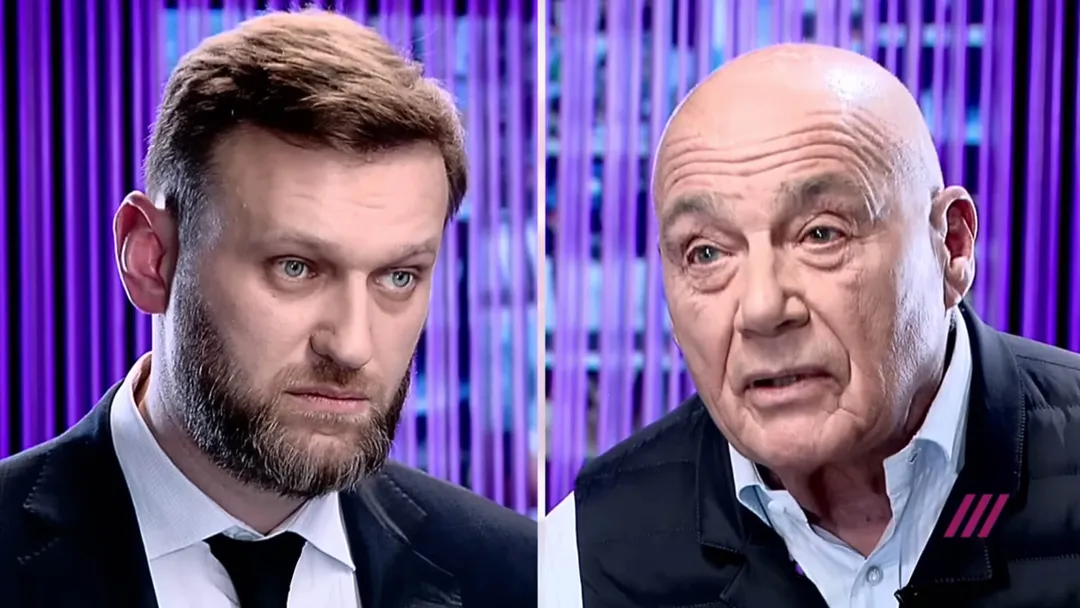
Debates on TV Rain.
Good evening.
In Moscow, it is 6:04 p.m.
My name is Ksenia Sobchak.
This is a debate on TV Rain.
But I hope that today this will not be a settling of scores,
about who is right and who is to blame, but a chance for those
on opposite sides of, let us say, these figurative barricades to hear one another.
Our topic today is as follows:
the suppression of important events: censorship or editorial judgment?
This topic has been widely discussed online and in the media,
especially after the tragic death of a girl in Moscow.
In particular, special attention
was drawn to the long-distance exchange
between Alexei Navalny and Vladimir Pozner.
That is precisely why we decided to hold this debate today
on TV Rain and invite them to our channel.
Before this debate, we conducted a poll on TV Rain's website.
The question was phrased as follows: Does the media have the right
to withhold information?
More than 2,500 people took part in the poll.
The results were quite predictable.
An overwhelming majority of TV Rain viewers answered: No, under no circumstances.
That is almost 74%.
Yes, if it threatens the interests of the country and society — 26%.
In other words, people have already sided with Alexei Navalny, which makes
Vladimir Vladimirovich Pozner's starting position all the more difficult, and yet he agreed
to come to TV Rain, which is especially gratifying.
Well then, after that poll, I would like
for us to move on to live voting,
because after the discussion the results may change significantly.
And now I would like to invite into the studio
politician Alexei Anatolyevich Navalny
and television host,
journalist Vladimir Vladimirovich Pozner.
Hello. Good evening.
Hello.
You may greet each other, shake hands.
Shake hands, my dears.
You see, we have now established that each of you recognizes the other as a human being.
A handshake.
And that is a sure sign that the discussion will be thoughtful and interesting,
and not, so to speak, overheated. Please take your seats.
And with that, we begin.
On Monday,
February 29, in Moscow, a 38-year-old nanny,
Gulchekhra Bobokulova strangled the 4-year-old girl in her care,
beheaded her, and then walked near the Oktyabrskoye Pole metro station.
Bobokulova, dressed in black and holding the severed head of the child,
was widely filmed and the footage was actively posted online.
She remained there for about an hour before being detained by police.
During the investigation, Bobokulova said that killing the girl
had been ordered by Allah and that it was revenge for Russian bombing in Syria.
Later, investigators disclosed a diagnosis of
schizophrenia that Bobokulova had been given earlier in Uzbekistan.
The only report on the murder shown on federal television
aired at 1 p.m. that same day on REN TV.
After that, the topic was banned on the federal channels.
According to sources, the camera crews
were pulled directly from the scene after a call from above.
Only two days later, on Wednesday, March 2, did crime news segments
carry brief reports about the arrest and the hearing at Presnensky District Court.
The flagship weekly news programs of the big three channels devoted
minimal airtime to the high-profile crime, without describing the murder itself.
On Wednesday, March 9, on the border between Ingushetia and Chechnya, a minibus
carrying human rights activists and journalists was attacked by unidentified assailants armed with clubs,
who beat everyone, including the driver, and then burned the vehicle.
The federal channels reported what had happened only the next day, after a reaction
from the Kremlin.
A week later, on March 16, in Grozny, an attack was carried out
on Igor Kalyapin, a member of the Presidential Human Rights Council.
The incident did not make it into a single federal evening news broadcast.
Brief reports appeared only the following day,
after a comment from Vladimir Putin's press secretary, Dmitry Peskov.
Censorship of mass information.
That is, demands made of a media outlet's editorial office by officials
of state bodies, organizations, institutions, or public associations
to pre-approve reports and materials, as well as the imposition
of a ban on the dissemination of reports, materials, or parts thereof.
The creation and financing of organizations, institutions, bodies,
or positions whose tasks or functions include
the exercise of mass media censorship is not permitted.
And I would like
to remind you that presidential press secretary Dmitry Peskov commented on this as follows:
The channels themselves chose not to show madwomen, and we support them in that.
Let us find out together whom our viewers will support.
You can vote in real time on TV Rain's website.
So, whose position is closer to your own?
Who is more convincing: Navalny or Pozner?
And now we begin our debate.
First, I would like each of you, through a kind of
general question, to present your position.
I think it would be right to begin with you, Alexei Anatolyevich,
because you were the first to articulate this position.
So my general question is this: Why, in your post devoted
to the issue of censorship on federal television regarding certain major stories,
did you make it personal and mention Vladimir Vladimirovich Pozner in particular?
After all, you would agree, he is hardly the most odious television host
and not even someone formally employed by Channel One.
Thank you very much, Ksenia.
First of all, I am very grateful to Vladimir Vladimirovich that he, of course,
being different from all the others
among Channel One's hosts, agreed to take part in this debate.
But this debate itself, the very way it is structured, seems to me to say more than anything else
about the state of the media.
I am debating a Channel One host
not on Channel One, where such a discussion is impossible.
I myself am effectively banned from Channel One.
And, for that matter, you are a well-known television host who, forgive me,
was pushed off every television channel.
So yes, I am talking about things that are obvious.
Censorship exists. It is unlawful, it is illegal, but it exists.
A crucial part of that censorship is suppression through silence.
I insist that suppressing socially important facts
is the same censorship, the same lie: when channels remain silent
about the crimes you have just mentioned,
that means they are lying about those crimes.
And to answer your question directly, perhaps this is a somewhat
unpleasant part of what I want to say, but it is true.
Vladimir Vladimirovich, you are part of this censorship,
you are part of this system
and an important link in it, because you are a respected person,
and this debate matters to me in part because it gives me the chance
to say to someone whose voice carries weight, Vladimir Vladimirovich,
that you should not take part in this; you should leave this system.
You are one of the few people who does at least say that censorship exists.
Then do not be part of it; do not, at your own expense and at the expense of your reputation,
solve the problems of bad people who are imposing censorship.
Thank you, Vladimir Vladimirovich.
You now have both the opportunity to respond, but since you're already here,
well, I would also like to ask.
It all began, in fact, with your interview.
And I would like to clarify something.
Are you really opposed to reporting on high-profile crimes like this,
Because after all, keeping something quiet and informing the public are completely different things.
That's not true. Well. That's obvious, yes.
What I said was that when they called me,
I was not in Moscow,
that the question of whether to give certain information or to give a lot of it is a very important one.
That is a matter for the editor or editor-in-chief,
who makes their own judgment about whether this is significant information or not.
But, for example, quite recently Rupert Murdoch got married yet again,
Rupert Murdoch, the major media magnate.
It was on the front pages of British newspapers.
Even though his marriage is of no significance to anyone,
except himself.
But it sells well.
And what I am saying is that it is not necessary.
You can publish that information, but you do not have to.
As for this terrible case, I said only one thing:
this is not something significant, it does not indicate a trend, it is not an example of,
say, Islamic extremism, as I understand it.
This was a deranged woman who committed a crime.
One can probably talk about it, but it must be done very carefully,
precisely because she is eternally.
Precisely because she is Muslim.
Given the mood in Russia, one has to be very careful with this,
so as not to inflame more of these feelings.
To say that this is important information, in my view, no.
Moreover, if I were the editor-in-chief, most likely,
I would have run it simply as a news item.
But I would not have played it up and dragged it out.
Now I want to tell you that I am very grateful for the advice.
Dugin gave me the same advice.
Do you know who that is?
Yes, yes.
That is, on the one hand, extremely—yes, he was extremely...
I do not know what to call it, extremely something, but he is your absolute opponent.
Yes, he believes liberals should simply be shot.
He also told me that, if it were up to him, he would remove you as well.
So it is interesting for me to hear essentially the same thing
from two such different people.
I believe that as long as I can reach a large number of people,
a large number of people, and say what I consider important,
because no one tells me what I can and cannot say,
then yes, I will keep doing it, I will keep doing it.
I am not taking part in anything.
I make my program, which, as far as I can
tell, enjoys a certain degree of success and
is considered important by a certain number of people.
I will continue doing it.
The moment it turns out that I can no longer do it, I will leave—go off who knows where.
As for you,
Alexander Anatolyevich, of course I would invite you onto the program
along with a number of other people whom I would invite, but cannot.
And I say this absolutely openly.
And I have said repeatedly that, unfortunately,
that is how things are
not only in Russia,
alas, I have experienced it elsewhere as well.
But one has to work in whatever way is possible.
For now, I believe I can work, and I try to work.
Well, I suggest we continue.
You each have the opportunity to ask one another three questions.
I want four.
If you have four, you know,
we are prepared to give you the opportunity to ask four questions.
Vladimir Vladimirovich.
Ah. My question to Vladimir Vladimirovich follows directly
from his bold statement that
yes, there really is a list of people who are forbidden to be invited, correct?
No, you have said this repeatedly.
There is no list.
You know a number of names—you cannot invite me,
as you just said, you cannot invite me.
That is, I can invite you, but I will be told no.
Excellent. So,
we do have a law of some kind; it exists.
The law explicitly states: censorship is prohibited in Russia.
Refusing to invite certain people according to a list—
me, whoever, any of these people—that is a violation of the law.
Well, I will definitely do this.
I have wanted to do it for a long time, but now I definitely will.
I will sue Channel One and Russian television
over the fact of censorship.
And I will call you as a witness.
And the basis of my claim
will be that, according to Vladimir Pozner, a respected man,
these people, Navalny in particular, are forbidden to be invited.
My question to you is very simple: will you still be
brave enough to come to court when I summon you?
As a witness for my side, a witness for the prosecution,
and confirm under oath the words that you have repeatedly
said in various interviews and are saying here.
So, I will say once again that I have not seen any list.
That is an important point.
But there is no list.
What is clear to me is that there are a number of
people who are not allowed onto federal television channels.
That is not news. I have said it many times.
You are one of them, at least as of today.
Yes, I will say that, of course, I have said it before.
Why would I not say it?
Once again, I
just want to tell you
that I have encountered this, this same thing,
in the United States and in England.
This is not...
I am finished, and I do not regard this as censorship.
I worked in Soviet times.
I know what that kind of censorship is, what that kind of censor is:
someone sitting in a separate room with a red pencil and a blue one,
and a stamp, and you have to bring your work there.
And he has to say yes.
And without that, it will not go on air and it will not be printed.
It was called Glavlit (the Soviet state censorship agency). Today, that does not exist.
What exists are personal decisions by individual people, which can be explained by various factors.
I do not equate this with censorship; I say that it is
a serious blow to freedom of the press
and to my right to invite whomever I want.
That, yes.
But I am very careful with the word censorship; to me, that is something else.
There is self-censorship; that is something from an entirely different sphere.
When a person protects himself out of fear,
worried that something might happen, that is already a different matter.
I have no questions for you.
Go ahead and sue me; I’d be interested.
I’ll invite you properly.
Thank you for being willing to come as a witness.
Well, first of all, if I receive a summons, then I’m obliged to come.
I’ve summoned you. The procedure there is such that I...
As a law-abiding citizen, I’ll come with great pleasure.
It will be interesting.
If Konstantin
Lvovich calls and says, “Lazil Vadimovich, well, don’t go—why are you dragging me into this?”
If I receive a court summons, I’ll go, and Konstantin Lvovich won’t say a thing.
I see.
But perhaps you still have something to ask?
Alexei?
No, it’s just that, you see, it seems to me that that evening
I didn’t quite understand your tone when you replied to me, Posner suddenly jumps in.
I won’t say anything at all.
I can explain, Vladimir Vladimirovich.
I run, and I’m fairly good at it.
It’s a mix that, probably on your side,
from my point of view, in what you are building, censorship is the most unpleasant part,
because you are undoubtedly one of the few people who has worked in different
countries, is respected, and is an expert on
how this works in different countries.
It seems to me that you are deliberately misleading all of us, and misleading
naive people in particular.
You say this is censorship.
You say it exists in different countries.
But excuse me, on the biggest television channels
there are no blacklists.
I cannot imagine a situation like that.
I’m saying there is no blacklist.
Or at least, that’s what you yourself said.
There is a set of people. I was told that.
There are certain people—please don’t invite the people on this list.
That is not a list.
A list is an order from above.
As for deception.
I worked for a major channel, it was called
I worked with Phil Donahue.
Not exactly a nobody. He hosted your program?
Our program was shut down because we were told
that we were too liberal and were not inviting the people we were supposed to invite.
If we wanted to keep working, we had to inform them in advance
of the topic and whom we wanted to invite.
And management had to approve it.
We said no, our contract was not renewed, and the program was closed.
That is not a lie; it is the truth. It is a fact.
Vladimir Vladimirovich, let’s not distort things.
There are specific points at issue in our dispute here.
There is a specific reason.
It lies in the fact that in Moscow
a monstrous crime was committed, and for two days
it was the top story in all independent media.
It was the main story.
Entirely in vain.
Then entirely in vain, because this is...
This is, in general, pandering to base instincts.
People are savoring this story. No.
That’s what this is. And that is also a fact.
This news story was...
Of course, if they had found another one involving the cutting off of five heads,
there would have been even more interest.
At the beginning you said that perhaps important news should not be suppressed.
Of course not.
So an extremist murder in Moscow, when a person walks down the street and
shouts “Allahu Akbar” and carries a head in his hand—that is not important?
Channel One, Vladimir Vladimirovich, Channel One.
When in Nizhny Novgorod an even more horrific crime was committed,
not political, but a man killed his six children there.
Channel One dwelled on it so much, giving out every detail in pursuit
of ratings.
They showed it—they were not ashamed to show it.
But when a real news event happened here, a genuinely
major incident that for two days was shown not only by Russian
but by all foreign channels as well.
So it turns out this is not interesting to Channel One, but that’s...
We can tell the difference.
I watched it, unlike you, apparently; I don’t know what they showed not on
the blue one, on the blue one,
I don’t know—they did show it, they did.
I’ll say it again: for me this news story is dangerous, because it will
further inflame hatred toward people of a different skin color, with different facial features.
It will continue to stir up anti-Muslim sentiment.
And in fact, this news story has no real significance.
It is the same as a media mogul getting married.
Only a different kind.
It is about attracting attention; it is about selling a product.
That’s what it can be called.
Then let me continue your thought logically.
You are telling me now: we do not show the crime.
Because not—not only not we...
As I argue a certain point, I have absolutely nothing
to do with broadcasting it; I’m not some fool.
But you said that you also would not have aired it.
I would explain why, though.
I would explain it simply. Look at how this works.
So, we won’t show this crime because everyone will get worked up and go
beat up Muslims.
We do not show how journalists were beaten in Chechnya, because all across the
country people will start beating journalists.
We do not show the investigation into corruption in Prosecutor General Chaika’s family,
because apparently everyone will start appointing their children to positions somewhere.
We do not show the corruption involving President Putin’s son-in-law,
because then sons-in-law across the country will also start getting involved in some kind of corruption.
Is that how it is?
It turns out, remarkably, that all news stories
that are unpleasant or uncomfortable for the authorities
immediately become, well, uninteresting, minor, some kind of nonsense.
Go ahead.
And for some reason you compare them to Murdoch’s wedding.
These are completely different things.
You began by saying, “Let’s not distort things.”
That is exactly what you are doing.
I am talking about one specific news story.
I am not talking about all the others that were not shown.
I did not come here to defend Channel One, or Channel Two, or Channel Four.
I came here to defend my point of view, and I have stated it.
And when you use this to start listing everything else,
that is distortion, my dear. And there is no politics in this; this is what I deal with.
Then I ask you this.
How do you understand censorship? Or is that your business?
That is what I am saying. It follows directly.
That is absolute distortion, because I am not defending that, do you understand?
So. That has been said.
The question is specifically about this episode.
If this is an instruction from above, then of course it is censorship.
Vladimir Vladimirovich.
In fact, right now you are speaking rather naively, it seems.
If there's an order from above, that's censorship.
Do you really think that these reports about journalists,
about Kadyrov, about corruption, aren't shown because there was no order from above?
I think they aren't shown because someone made that decision—whoever made it.
On Channel One, obviously, it's Konstantin Lvovich Ernst; on Channel Two, Dobrodeyev.
They made that decision.
I don't remember the surname of the new editor-in-chief.
They probably have their own reasons, and you can talk to each of them.
And you can ask: why didn't you show it?
Explain to me—why are you talking to me about this?
And maybe they'll tell you something.
I don't answer for them.
I'm not defending them.
I'm returning to what we were talking about.
There is news that, in my view, can quite calmly be left unshown,
and that's even better, because in fact it's not really news, it's just...
Well, how can I put it?
That's why I'm comparing it to that man's marriage: it's a
high-profile story, but it has no real significance at all.
So you think this murder in Moscow has no significance?
No, it has no public significance, of course.
And all the other media outlets that covered it were wrong
to journalists.
The entire public was wrong too—the people who read this news in horror, with a shudder.
It was read with enormous interest.
Just like Rupert Murdoch's marriage.
People are naturally drawn to reading that sort of thing.
Blood, crashes, disasters—this sort of thing.
Sex too—people want to read about it.
And if they can peek through the proverbial keyhole, they will.
But you know that—we're built that way,
and the media play on it everywhere.
And of course we play that game extremely well.
But at the same time, you have to admit, NTV lives on exactly this kind of news.
There really is a strange contrast here, when, broadly speaking, a stream of this kind of
thing is constantly airing on that channel.
But here—well.
I agree with you, so take it up with NTV.
What do I have to do with it? Here
you're part of the system, Vladimir Vladimirovich. I know you always emphasize that.
I'm not an employee of Channel One, but I will insist on that point.
Of Channel One.
I'm not a member of any party, and I'm not running for anything.
I just happened
to end up in Channel One's studio; I just happen to host a top-rated program,
which otherwise wouldn't exist.
A program is sold, and they buy it.
Vladimir Vladimirovich, but I buy it.
But you yourself said that a crucial condition for your presence on Channel One
and for them buying your program is that you do not invite certain people.
That is not the most important condition.
The most important condition is that people watch, that the ratings are good.
If people stop watching my program, then it won't be there anymore—that's for sure.
But one of the conditions I agreed to
when I went ahead—when I accepted a certain,
yes, unquestionably, I accepted a certain compromise.
Without question, it is that there are a certain number of people.
I won't give you specific names, but that makes no difference.
It makes an enormous difference.
The specific names don't matter in the sense that this is only...
Well, how should I put it? That's what people will focus on talking about.
I'm saying yes, there are about five such people whom I cannot...
You've publicly named Nemtsov before, I remember.
Nemtsov, Kasyanov.
And all these people criticize the authorities.
And that is precisely why they are banned from being invited.
It's blindingly obvious.
Vladimir Vladimirovich, please.
Oh, it's not obvious, is it? Well, of course it is. Yes, yes.
And I agreed to that.
I did agree to it.
Because at that point, censorship...
No, but in return I can do many other things.
You understand, I can slam the door and do nothing at all.
Simply not be there at all.
I could, say, translate books and so on.
I believe
though this may sound contrived, that I am doing something socially useful.
That is what I believe: that I make people think,
that I show them: look who your minister is.
Look who you have in this position.
That's what I try to do. I believe it's useful.
Alexei Anatolyevich, well then, don't you agree that indeed
television would unquestionably become even worse than it is now?
Or do you really believe that even here, the worse it gets, the better?
I believe
that television would become better.
If Posner comes out and says, 'I will not take part in this,'
that doesn't mean he will vanish.
Who knows where they drove you off to, Ksenia—you were pushed off all the channels, and yet here you are.
Our mutual acquaintance Leonid Parfyonov was thrown off the channels.
He cannot host the news.
He can only make documentary films, but he still exists.
Our mutual acquaintances—
Tatyana Lazareva and Mikhail Shats were effectively driven out of the profession.
They were deprived of any means of earning a living because they took part,
in particular, in the Opposition Coordination Council.
They weren't shot; their lives became difficult, but they still do it.
What kind of democracy do we have? 'They weren't shot.'
Still, that's great progress.
There was a time when they would have been shot.
You're smiling ironically.
And that is precisely why—Vladimir Vladimirovich, let me finish now.
My thought.
No one is holding a gun to your temple,
and you yourself agree to participate in this system of censorship.
And that is the worst thing that can happen.
To do nothing, right? And
to come out and
say: 'I am Vladimir Pozner, who worked in the Soviet Union,
who knows what censorship is, who sees that censorship
has returned to television once again'—that is not doing nothing; that is doing something.
The most important thing of all is that...
Your point of view?
Every person makes a choice.
As of today, I have made the choice I made.
And it seems to me
I was not invited here to be discussed.
This program isn't about me, or about you.
There are more important things, though perhaps you doubt that.
And we will return to this topic right after the commercial break.
Sorry to interrupt you,
but we do, after all, have advertising on TV Rain (Dozhd), which is a celebration in itself.
Let's take a break—we're live, and then we'll continue.
We will have questions from our viewers
precisely on the topic of today's program.
We continue the debate on TV Rain (Dozhd).
Today our guests are Vladimir Vladimirovich Pozner and Alexei Anatolyevich Navalny.
We continue our discussion about censorship on television.
or about editors-in-chief choosing to stay silent. So whose choice is it in the end—censorship
or the conscious decision of a particular editor?
Now comes the part where our viewers
from TV Rain will ask you questions; we collected them from various social networks
Facebook, Twitter, and now I’ll read them out to you one by one.
Our first question is for Alexei Navalny.
It comes from Maxim Bakov.
Imagine you were appointed Minister of Press and Information of the Russian Federation.
Would you offer Pozner a job?
And if so, what kind? If not, why not?
The answer to that question is very simple: no minister
has the right to offer Pozner a job—or not offer him one.
Any minister who starts meddling in things that are none of his business
and deciding whether hosts should be appointed or not—that minister
should not just be removed from office; he should be put on trial.
Pozner can do whatever he wants.
And like channel executives, he is constrained by the law,
including laws that restrict and prohibit censorship.
They are constrained by their editorial policy,
and by the public’s approval or disapproval.
Let there be many channels: Pozner on one, Kiselyov on another,
Parfyonov on a third, and on a fourth, Sitdev and Ksenia.
And no ministry or officials have
the slightest right to interfere in this situation, do they?
Let me follow up then: what would you do if you were Minister of Press?
I’m not even sure a structure like a Ministry of Press is necessary.
What’s needed is perhaps a small committee that issues licenses
to a limited number of media outlets—for example, broadcast licenses,
where different media outlets need to be allocated separate frequencies.
That’s where technical regulation is required.
That is what it should deal with.
Everything else follows directly from basic existing laws.
And mass media should live
or die depending on whether the public needs them or not.
Vladimir Vladimirovich, a question for you from Dmitry. No.
No, no, no, my dear.
I’m almost afraid to ask—from whom?
From Dmitry Nedorogoy.
The question is this: why did you narrow the issue down to whether to show it or not show it?
The issue is broader, as Alexei says: whether to discuss
or not discuss this terrorist attack and the reasons that gave rise to it.
You yourself refer to the American terrorist attack that was not shown there.
But did they discuss the event itself and the reasons that led to it?
Here, the whole topic was simply silenced altogether.
The question is right in every respect except one: it was not a terrorist attack.
When a deranged woman
says that Allah told her she had to do it,
to avenge Syria, that’s not a terrorist attack—that’s a sick person.
Excuse me, but no doctors have said that yet.
So how do we know she is a deranged woman?
Then let’s not rush.
Let’s not say things about which we know nothing.
Let’s find out.
If we are journalists, let’s find out for sure first, and only then speak.
So I’ll say again: if it was a terrorist attack, then of course it must be discussed.
But we know that it was not a terrorist attack.
So that is my answer.
The next question is for Alexei Navalny.
A user named Ivan asks: What information about yourself
or your family would you prefer not to make public?
Like any normal person,
I would prefer to make as little information about my family public as possible.
But what I do naturally places certain constraints on me.
The public is interested in what I do.
That’s why there are regularly cameras waiting for me
by the entrance, and journalists from NTV and other channels regularly pound on
my apartment door, frightening my children, among other things.
I can’t stop that, I can’t forbid it.
And even if I were an official, I’m not sure
that we should create a situation in which journalists can be forbidden
from taking an interest in my family, because the public has a right to know
basic information about how politicians live and where they live.
Do they live in Maryino or in the Seychelles,
what their relatives do, what property their relatives own.
After all, I take an interest in Putin’s son-in-law and others of that kind too.
I publish photos of houses and expose the accounts of officials’ relatives.
And that probably gives everyone else the right to take an interest in
where I live, where my relatives live, and what property they have.
Do they really pound on your door?
Or was that an exaggeration?
They press the doorbell.
They have the right to.
But there are things they do not have the right to do.
And they press the bell and keep holding it down.
Does that count as pounding on the door or not?
Have you tried punching them in the eye?
You know, my colleague Leonid Volkov is in
the city of Novosibirsk today, because he has gone there at his own expense for the eighth time.
Because once, when some
pro-Kremlin activists were throwing eggs at me, he pushed away a LifeNews journalist who had come with them
like this
with his hand, and a criminal case was opened against him—one of the few in Russia
for obstructing journalistic activity.
He is facing a real prison sentence.
So the moment I make
the Kremlin so happy as to punch some LifeNews journalist in the eye,
much as I’d like to, very much,
the moment I do it, I’ll get a fourth criminal case.
For a crime.
It turns out this is what’s possible.
Perhaps in that situation I’d quickly call you,
and you’d come, step out of the elevator, and nothing would happen to you.
You’d just say, Alexei Anatolyevich, to your accomplices: and this—well, we...
We’re in the same case as Vladimir Vladimirovich.
But here’s another question.
Vladimir Vladimirovich, why are you so dismissive of bloggers?
Why, against the backdrop of streams of lies from the official media,
do you accuse bloggers of writing whatever comes into their heads?
Doesn’t it seem to you that today, on the contrary, bloggers are more journalists
than professionals like Kiselyov?
I believe that many
people who are officially considered journalists are not journalists at all.
Who, for example?
I’ll refrain. Why is that? Because
they are not engaged in journalism,
they are engaged in propaganda.
And why don’t you want to name names?
Because I don’t want to.
I have that right. You do have that right. I’d just like to understand.
Why is it that today journalism
is in such short supply in this country?
There are journalists—few of them—who understand
that they have one duty only: a duty to their audience
to inform as objectively as possible and, despite being subjective, not to lie.
Everyone knows when they are lying.
And to try to present the full picture—not only what you like,
but also what you dislike—and to present it anyway.
that a blog is a blog.
I'm saying that a blogger is not a journalist.
Why?
Because it's not a profession; you don't get paid for it.
It's an activity,
sometimes very respectable, sometimes not.
But it isn't journalism. That's all I'm saying.
There's no contempt in that.
And really, it's mostly opinion.
Everyone writes whatever they want, and good for them.
But why—sorry for interrupting you—but we all remember that
Alexei Navalny, in fact, also started out as a blogger.
He isn't a journalist.
I'm not claiming to be one, by the way.
I would gladly not be doing this work,
if journalists were doing all the investigations we do, including those at Channel One (Russia's main state TV channel).
Then I'd be doing something else.
There seems to be some huge problem with Channel One.
Vladimir Vladimirovich, it's a big one—I haven't been able to get on there for many years, as you know.
Well, let's hope so. I'm sure that
it will be defeated in Russia, and maybe I'll even get onto your program.
Yes, well, maybe.
By then, perhaps someone will want to invite you.
You know, whenever there's an interesting person, someone significant for the country,
whether I like them or not, I invite them.
And there have been plenty of people I didn't like, as you can imagine.
So, there you have it—there's no contempt here.
It's just important to understand clearly that journalism is a profession.
Being a blogger is not a profession; they're simply different things.
So even if a blogger writes on topics related to it,
that still doesn't make them a professional.
It doesn't. No, that's clear.
A question for you, Alexei Anatolyevich.
If things go well, is lustration inevitable, including in the media?
And if so, how do you understand it?
Should someone like Vladimir Pozner, for example, be subject to lustration?
What is lustration? Let me first explain how I understand it.
That's an important clarification.
Because when people in Russia talk about lustration,
they don't understand what it is.
They think lustration means punishing certain specific people,
people they don't like—for example, Dmitry Kiselyov.
Let's not talk about Vladimir Vladimirovich,
let's talk about an obvious villain—punishing Kiselyov.
You are part of the censorship system, but calling you an obvious villain
would simply be wrong, because you suppress things.
But you still don't lie outright.
You suppress them directly.
You suppress things in the sense that
today you're saying, using this vague 'we,' that there are no lists.
It's a set of names.
I don't know who's saying that.
Suppressing things.
Everyone knows it—I can't invite them. Right.
Everyone knows that the management of all the channels
goes to the presidential administration on Fridays.
Those meetings are called planning sessions.
Everyone is told, and everyone knows it.
That's censorship.
Suppressing things.
You accused me, but I'm not suppressing anything.
I can't invite you.
I'm not hiding the fact that there are several other people as well.
I don't wish to name them, but that isn't suppression,
the fact that I can't invite them doesn't mean I'm suppressing anything.
'Suppressing'—you're just playing with words.
For example, when you say, 'I've seen censorship'—when
someone underlines something with a red pen, that's censorship; when they write it on an iPad,
that's somehow no longer censorship? As Pushkin might have said—what?
Benckendorff (the Tsarist official associated with censorship) is censorship.
And this is somehow something else.
I did say there was official censorship in the Soviet Union.
I was trying to describe what it looks like.
Now it's unofficial censorship; that's different.
I simply want to define things very precisely.
I categorically reject the claim that I'm hiding anything.
I said it plainly: yes, I make compromises.
I told you that without hiding anything and without being ashamed of it.
But I'm not concealing anything.
You describe censorship and then say,
'I can't name names.' On my own program.
Naturally, if I come onto yours, we might be talking about you.
Let's be completely straightforward.
You have that kind of life not on Channel One, but on the TV channel
Dozhd (TV Rain), of course. And they don't talk about me on Channel One either.
I'm saying myself that there is a difference. Let's move on.
All right, let's. Finish this.
About lustration.
Would Pozner be subject to lustration?
If such a process takes place.
This is not about personally restricting the rights of certain people on the basis of
some kind of class characteristic—that's a separate matter.
And I believe that people—real villains—who should be held
accountable can and must be held accountable
simply on the basis of the law,
and not for some other reason: they are breaking the law right now, they are committing crimes.
For example, Dmitry.
In your view, he is breaking the law, isn't he?
You yourself said at the beginning of your remarks that he is breaking the law,
because he is participating in censorship, which is illegal.
Accordingly, he too should be...
Vladimir Vladimirovich, unquestionably,
is an accomplice in this censorship; he is complicit.
Do you personally, as a
lawyer, believe that his offense is serious enough
for him to be subjected to lustration, lustration?
For what?
That is, he can work on the free
market, on free television—for God's sake, anyone can work there.
But I believe that people involved in censorship and in creating censorship
should not work on state television channels.
Though, really, there shouldn't be state television channels in the first place.
Then where should they work?
Would you go on air for an hour?
And if there are no state
channels?
There are plenty of private channels; they can work there.
So.
There should be public television.
Public television, certainly.
Well, it's just been a long time since I was counted among the criminals,
and it's very charming to listen to all this.
And curious, too..
That's a position. Yes, you're being ironic about it.
No, not at all, once again.
First of all.
I'm not saying you cut someone's head off while shouting 'Allahu Akbar!'
Or without shouting it, but I repeat,
With all due respect, you are part of censorship—censorship carried out illegally.
You agree to play by these rules, and that is why you are carrying out this censorship.
I do not believe that I am part of it.
I do.
On the contrary,
this is an extremely important program, so that people think,
so that they hear different things and different opinions.
And for now, this is happening on Channel One.
For now, just as some things are happening here.
And I want to tell you that the moment
in our country when it seems that what is happening
here poses a danger,
nothing more will happen here,
and my program will no longer air, along with many other things.
Because that is the situation in Russia.
Do you understand?
It is you—the people who agree to this.
Yes, of course, of course.
As of today, TV Rain can exist,
Echo of Moscow can exist, although 65% of it is owned by Gazprom-Media,
and The New Times magazine can exist.
Are you saying that all of this is done, essentially,
with that kind of silent consent?
That as of today, this is being allowed?
And here I would disagree with you.
Just a second, this is important.
For example, in my case—and not only mine.
I do not want to speak only about myself, but it is simply easier for me to speak about myself.
Many people are in the same situation.
I have been convicted three times, my brother was sent to prison, and in my Anti-Corruption Foundation,
there is not a single person
whose home has not been searched and who has not gone through interrogations.
I do not believe that this is something we are being allowed to do.
We simply do what we think is necessary, and all of you can do what you think is necessary as well.
But why, exactly,
is that incorrect?
I am explaining to you that when you are being persecuted, you believe you are doing the right thing.
Yes, yes. But are you being persecuted?
Whereas here, say, they are not being persecuted.
Sobchak is being persecuted. She was
thrown off all channels, despite the fact that she used to sit on Putin’s lap.
They are persecuting
TV Rain, Vladimir Vladimirovich—TV Rain.
TV Rain is being persecuted.
It could be shut down in no time.
They practically tried to shut it down altogether.
Vladimir Vladimirovich, it was pushed onto the internet; it used to be a broadcast channel.
So what I want to tell you is that, in this sense, we live in a country
where this can happen in a single second.
This is like that joke about Vladimir Ilyich (Lenin), you know.
After all, it could have been a razor across the throat.
We are supposed to say thank you very much that we were not killed, that...
I am not telling you this as something positive—I am telling you this as reality.
These are the conditions in which we live and work.
We must fight for something better.
And who is arguing with that?
Vladimir Vladimirovich?
Alexei Anatolyevich, we have someone who was also subjected
to censorship in his time—both direct and indirect.
He has been following our debate today,
and he has enormous respect for both of you.
So I think that his point of view regarding
this discussion will be of interest, first of all, to you and to our viewers.
Leonid Parfyonov is joining us via Skype.
Please put Leonid through. Hello.
Leonid, hello.
Hello, Alexei Anatolyevich, hello.
Well then, you have seen what is happening here?
Could you share some comments?
What do you think—who has the truth on their side today?
Well, first of all, it is good that such a debate took place at all.
It brings to mind the perestroika era, things like the program 12th Floor,
when people finally started debating something, because before that there had only been this supposed unity.
And still, when on federal channels an A Just Russia member debates a United Russia member, right?
Well, it is funny to treat that as a real contest—it is sport.
But here, after all, this is a discussion about an urgent problem.
It seems to me that, of course, there is censorship, but just because there is no one sitting there
with a blue pencil—in fact, Glavlit (the Soviet censorship agency) was also officially called
the Committee for the Protection of State Secrets in the Press,
it was not formally considered censorship.
So, broadly speaking, that does not matter.
The main thing is that we all understand that the authorities determine the agenda of the major media outlets.
That is it, really.
Yes, for example, Vladimir Vladimirovich, as a manager, as an editor-in-chief
of some media outlet, might decide that there was no need to cover
that story about the Uzbek woman with the child’s head.
But we know that all the channels were turned away from it, right?
And it leaked through blogs that correspondents had actually gone there.
Yes, that instruction came from a single center.
If an independent editor decides that this is the editorial policy,
it is clear that Cosmopolitan is a different magazine from Forbes.
That is one thing.
But when we know that all of this is coming from one single clever center, right?
Well then, what else can you call it if not censorship?
Yes. Well, the first thing that comes to mind is: Navalny cannot be allowed on Channel One.
And where can he appear, other than TV Rain?
Navalny came in second in the Moscow mayoral election.
He got more than a quarter of the vote there.
Did he appear even once on the TV Center channel?
That is a quarter of Muscovites’ votes.
In any mass media outlet at all?
What kind of channel is it where 10 years ago there was never anything bad
said about Luzhkov, and now there will never be anything good
said about Luzhkov, and accordingly nothing bad can be said
about Sobyanin either—how is that not a mismatch?
That is, of course, censorship.
This is, of course, the state authorities exercising direct control.
They control the agenda in the major media, doing it somewhat differently
than in Soviet times, but in principle it is no different.
The First Deputy Chief of Staff of the President of the Russian Federation differs from Mikhail
Andreyevich Suslov, who, as is well known, used to say: “What is this?
I am the Central Committee secretary for ideology, I open the newspaper
Izvestia, and I do not know what is written in it.”
After all, it is impossible that the first deputy head of the presidential administration—
whether Volodin or Surkov—would be shocked by something in the federal TV news.
“My God, what have they dug up about us!
We have been caught—they found out something like that, and we had been hiding it.”
Maybe, perhaps, something of that sort. Well, there you have it.
So call it whatever you like—it still ends up in the oven. Yes.
But if—yes, of course—if it is editorial policy.
But only if that editorial policy is independent.
And if under the cover of “editorial policy” they are simply protecting their
handler in the authorities and saying, “We decided this ourselves,”
“We freely decided ourselves that no, we do not need this.”
Like, Navalny
is of absolutely no interest to Muscovites, so why should he appear on TV Center?
Well then, please,
here are my
judgments, since I also worked in the Soviet media and was even
for some time a senior editor at regional television, true to the ideals of my youth.
So I would even carry other people's programs, folders with those programs,
and take them to that very place. There sat an old woman
wearing that very Orenburg shawl (a traditional Russian down shawl).
And she would stamp them.
Leonid Gennadyevich, we've now heard Vladimir Vladimirovich's position.
If he had been the editor-in-chief,
then he would not have treated this story as not particularly interesting.
And would you have shown this report on Namedni?
Probably, yes.
Well, judging by the reaction it caused, and since it was a weekly program,
And in what tone, in this case.
I mean, by the end of the week it would have been completely obvious to me
that among the week's news, this could not be ignored.
But again, that's a matter of my personal judgment.
Then comes the next question: whether to show the head, whether to do some kind of
I don't know, reconstruction there, whether to demand
an examination,
whether to omit the fact that she was, well, shouting some Islamist slogans there,
or whether they really should somehow be filtered out?
Because, well, who knows, it may really be a deranged person, and who knows what such a person might say,
and a madman might just as easily spout some Orthodox pieties, for example, right?
Well, anything can happen.
That's the next question: how exactly to handle it.
But I most certainly would have, simply because of the impact of the event itself,
the week would have been incompletely represented without it.
One more, final important question.
Alexei Anatolyevich raised the issue here
that, in essence, even such a respected person
as Vladimir Vladimirovich Pozner,
is participating in a crime, in censorship, which in
fact is taking place.
Do you agree with that?
Did you do a program with Pozner?
I heard everything. Thank you, I heard everything.
I agree with Vladimir Vladimirovich.
It's a question everyone decides for themselves.
Surely many people make compromises, but from no one else
except Vladimir Vladimirovich have we heard anyone speak about it.
That admission is worth a great deal too.
Would you make such a compromise?
Say, you.
You're friends with Konstantin Ernst, and he invites you.
Times have started to change.
He spoke with Volodin and Gromov.
It seems they're allowing Namedni to come back.
They say no, basically they haven't spoken like that for a long time
and they never cite anyone.
It's a matter of temperament.
No, but say they offer to bring back your program.
You just can't discuss the last five years.
Well, that's ridiculous, it's fantasy.
That simply can't happen.
No, it's a matter of temperament, you see?
Leo Tolstoy once cried, 'I cannot remain silent!'
And the rest of the country's population thought, more or less, why not just let it be and that's that.
It's a matter of personal choice.
Vladimir Vladimirovich says that yes,
he makes certain compromises, but for the sake of this or that.
I respect that choice, and I make some compromises myself, while others I do not.
It varies.
The very fact that Vladimir Vladimirovich speaks about it openly,
and that, in principle, one can discuss it with him,
is already more than enough, especially under current conditions.
Who are you voting for today?
Oh, I'm voting for freedom of speech!
You know, I'm against censorship.
Friendship is friendship.
Your provocation has failed.
Such tender little concerns of our impoverished state in a time of such ferocious
censorship—well, really, all this suppression is absurd in the 21st century.
So am I supposed to be against the bubble here now, or against Navalny?
Tell me when that might possibly prevail.
By the way, the capacities of different channels do indeed differ,
and Vladimir Vladimirovich chose not to show it on that channel,
but no one actually forbade it.
There is no single center controlling the other channels.
And neither the management of that channel nor the White House press secretary
said, 'What are these liberals allowing themselves? They've gone too far altogether.'
That too really was a matter of editorial policy,
which may be very unpleasant for a particular journalist,
when they push him out by saying, 'You don't fit our format.'
Or something like that.
By the way, that's actually a good question.
Really, why didn't you take this program to another channel?
We all know that in America there is, supposedly, progress too.
Let's just say we did go.
And what, everyone refused?
Well, we went to three—or rather, not we ourselves.
That's not how it's done in America.
There was an agent
who represented the most prominent American television journalists,
and he became genuinely eager to represent us and went to the three major networks.
Fox did not yet exist then; he went to CBS, NBC, and ABC.
On our behalf.
And he was turned down by all three.
I see. Leonid Gennadyevich, thank you for following our discussion today.
Well then, I hope you will still cast your vote,
even anonymously, so that we won't know who you voted for.
But we will know the final result.
Frankly, I think so.
I think he likes both of you.
Well. That's what I think the issue is.
And he probably believes that, despite our differing views,
we are not the worst thing in the country today.
There are more serious problems than Navalny's or Pozner's point of view.
That's true.
Which makes it all the more interesting that this conversation took place at all today.
It really is probably a pity that it
cannot yet take place in your studio on Channel One.
But it's good that at least now you were able to talk here.
We're going to a commercial break now, and afterward we'll sum up
the results of our viewers' vote and the results of today's conversation.
Stay with us.
Debates on Dozhd.
We continue the debates on Dozhd.
Suppressing important events,
censorship, or an editor's choice—that is the theme of today's discussion.
Vladimir Pozner and Alexei Navalny are speaking with each other today,
trying to determine where the truth lies
and what is really happening now in the sphere of censorship in our country.
There is one more important topic we have not touched on yet,
and after that we will move on to questions from viewers.
It's a matter of logic.
I would like to understand this suppression you were talking about, Alexei Anatolyevich.
What exactly is it, and why is it connected to the topic of nationalism?
Or why, according to your logic, this event
Was the specific murder of the girl censored?
Overall, that is fairly obvious.
Anything gets hushed up,
any fact that is inconvenient for the authorities or ambiguous for the authorities.
This particular crime was hushed up because, perhaps,
the woman was mentally ill, but she lost her mind specifically against the backdrop of Islamism.
And the fact that people go mad,
say that because of Russia's war in Syria they kill
someone and run around near the metro shouting "Allahu Akbar," and someone gets blown up.
Of course, that frightens society.
It once again confronts society with the question: why are we fighting in Syria,
and what is happening with all of this?
And so, just in case,
facts like these are supposed to be hushed up because they are problematic for the authorities,
plain and simple.
Do you really think,
that the average viewer of Channel One (Russia's main state TV channel) is sitting there now—I stress,
not the average viewer of Posner's program, but a Channel One viewer—
watching a report about this murder and thinking, "We're fighting in Syria for nothing"?
That is,
he thinks as follows:
there are too many migrants, and these migrants commit crimes.
He watches this footage
and does not understand why the woman walked around for half an hour with a severed head.
The police did not detain her.
He does not understand why 30% of the Russian budget is allocated to security.
And no FSB (Federal Security Service) officers come flying in on helicopters.
Usually some local police officer detains a woman like this.
Overall, why did this story have such enormous resonance?
Because it was not just a monstrous crime, a monstrous crime,
but also some pathetic police response to this crime, an inability to act.
And note this: at first they said it was a mentally ill woman,
and then the Investigative Committee stepped in.
Vladimir Vladimirovich did not agree with you and said that it was a terrorist attack,
so some kind of absurdity was unfolding around all this.
Of course, when a person looks at this,
he understands that the state is showing its incompetence,
and the state's incompetence must not be shown.
Do you agree with that logic?
From beginning to end? No, I do not.
It is a fine construction, very political,
all of that is understandable, but it is completely untrue.
Unlike my, shall we say, counterpart,
I do not presume to speculate about
what those people who make the decisions are thinking.
I really do not know that.
And you are not interested?
Not at all.
Not even slightly interested.
I thought—I am speaking about myself.
That is why I would not have shown it.
I said that quite clearly, didn't I?
So as not to inflame nationalism.
And that feeling, that attitude toward Islam—for me, that is a valid argument.
Everything else is secondary, perhaps.
Then where is the line, Vladimir Vladimirovich, in not inflaming nationalism, as you put it,
and, conditionally speaking, perhaps,
there were also proposals at the time not to mention the nationality
of people who commit, or...
For example, nationality was removed from passports as well.
Was that right or wrong?
Some say, no, I want "Russian" to be written there.
But it was decided that it was better to remove it after all.
Why?
Because the fifth line had a certain connotation.
I think it was right to remove it.
Others think it was wrong.
There is no single answer in this particular case.
My view is that one must be extremely careful with these things.
One must understand how people may react to it.
There is responsibility; after all, a journalist has responsibility.
When U.S. Supreme Court Justice
Oliver Wendell Holmes Jr. said, "A person has no right to shout 'Fire!'"
"in a packed movie theater just because he feels like shouting 'Fire!'"
Many said that was a restriction on freedom of speech.
"No," he said. "It is responsibility. Perhaps
one should be careful."
Vladimir Vladimirovich,
Nothing prevented the federal channels from reporting this story responsibly.
They should have said that a woman, possibly showing signs of mental illness,
committed a horrific crime, killed a child, and was detained by police.
It is being examined for possible extremism.
My dear sir, Muscovites could have taken that in stride.
Why, you may ask?
I am telling you once again what I personally would do.
If I were, God forbid, an editor-in-chief, what would I do?
I would not explain anything to anyone, I would say:
therefore, guys, we are not airing this.
Why?
Simply because I would consider myself right.
Someone else might say what you are saying?
No, let's air it, but let us still explain it so as to avoid possible trouble.
Well, fine by me.
I agree on one point with my longtime acquaintance—I dare even say friend—
Leonid Parfyonov: when this decision is made by
the editor-in-chief, that is normal,
but when all editors-in-chief make the same decision under someone's pressure,
that is wrong.
That is wrong; that is censorship.
Obviously, it exists. That is a fact.
But since the conversation was really about something else, I have in fact
stated my point of view.
Still, to finish this topic, you did not answer the question.
What is your personal opinion regarding nationality?
For example, whether or not it should be indicated in a passport.
It should not be indicated.
It should not. And nowhere in the world should it be indicated.
Citizenship is what is indicated.
In a story like this, should this woman's nationality be specified?
Should it be mentioned?
If you are telling the story, then you cannot just say
"a woman"; you have to go further.
In other words, details are necessary. There is no getting around it.
Then the question arises.
Who is she? A woman? Yes, she is a nanny.
What else?
Yes, she is Uzbek.
Yes, she was shouting about Allah.
And so on. There is no getting away from that here.
If you are going to tell it, then tell it.
There is no alternative.
Yes. Excellent.
Now we have questions from our audience.
I see the first raised hand, a completely random person.
From the audience: Ms. Sobol.
Please, the microphone is yours.
And I thought our audience meant the people watching on television.
They have already asked their questions.
Now we turn to the audience in the courtroom.
Hello, please introduce yourself.
My name is Lyubov Sobol.
I have a question for Vladimir Vladimirovich.
Just now you spoke at length and explained your position
regarding the story about the nanny who killed a child.
But what about other cases and other facts that Russian
state television keeps silent about?
The other day, in the city of Grozny, Chechnya, someone was beaten and pelted with eggs.
It was the head of the Presidential Human Rights Council's Committee
against torture, the highly respected and authoritative Igor Kalyapin.
He was attacked, beaten, and publicly humiliated.
And not a single state TV channel in Russia said anything about it.
Do you think this is also an unimportant fact, an unimportant case as well,
and not worth covering?
It is an important fact.
There are many such cases. But why?
It is an important fact.
So, dear friends, I am not responsible for Channel One.
Isn't that clear?
If you want to come after me, keep in mind that I know how to fight back.
I explained why I would not have aired that particular news story.
We were not talking about anything else.
I have absolutely no intention of discussing the policy of state channels with you.
That is not within my competence.
I am not an editor, I am not on staff.
I make a program called Pozner.
So take that up with Navalny, who says that there is censorship there,
and all sorts of other things.
But not with me.
Isn't that clear?
I disagree.
Would you have aired this case?
I am telling you once again, you know, you are playing the role of a prosecutor.
Well, that won't work.
I am an old man, an experienced man.
And I have encountered people like you, forgive me, many times.
I came to talk with Navalny about a specific attitude toward one news story.
I did not come here to defend Channel One or Channel Four.
Why did they show this?
Why did they show that or this?
Please address that to them, not to me.
Let me add something from a different angle.
If I understood correctly what the question just asked was about,
you have, so to speak, these five names of people who cannot be invited.
Is that your internal compromise?
Well, you are an influential person, someone who can somehow outsmart the system.
I am sure Kalyapin's name was not on that list.
Simply because, conditionally speaking, it would have been impossible to account for
even someone like him.
So perhaps by inviting people of that kind, maybe not such prominent ones,
not as well known as those you invite onto your program, but through that
you could talk about events that no one else will talk about.
Perhaps in one sentence you said “conditionally” three times?
You understand—conditionally, right?
I agree with you, of course, of course.
All right.
Is there a question for Alexei Navalny?
No, my question is more for Vladimir Vladimirovich.
If I may, it concerns one simple thing.
Today my associate, Leonid Volkov as well,
is being tried in Novosibirsk under Article 144 of the Criminal Code.
There is another side to this article, which says that
it also covers coercion to refuse to disseminate information.
So, Vladimir Vladimirovich, in your case, essentially,
when you are told that, say, Navalny cannot be allowed
onto Channel One, you are being coerced into refusing to disseminate information.
So what would you advise doing in such a case?
It seems to me that, as a citizen of your country, it would be perfectly normal to file
a criminal complaint, rather than have some lawyer file it in court.
That is one situation.
If you file a criminal complaint yourself, the effect will be completely different.
Why don't you file a criminal complaint?
I will just say right away that these are people from the K. (likely referring to the security services).
So, next question.
I want it to be for Navalny, then.
Someone comes up to our—to my vis-à-vis—and sometimes whispers something in his ear. Curious.
Something secret about...
About you? To prepare information, to force someone?
Listen, I cannot answer your question.
I have worked at many television companies,
and in all of them there were things like this.
For example,
there was a time
when Japan was heavily criticized in America
for not selling American cars there.
Well, they shut the door, and on our program we said that this was normal,
because American cars were worse than Japanese ones.
When American cars become just as good, then they will not be kept out.
Then it would really make sense to start talking about it.
The company
Motor, which made American cars,
and advertised with us, pulled its advertising.
The owner called us in and said, “Do you even understand what you are saying?”
And what about freedom of speech?
He said, “Yes, that's out on Freedom of Speech Street, not in the studio.”
How am I supposed to pay your salary if I have no advertiser?”
In principle, one could have sued him over it as an offense.
But that's ridiculous, it's ridiculous.
Well, maybe you would have acted that way.
Neither Donahue nor I acted that way; there were certain understandings.
As I told you, I agreed to it because I understood perfectly well that either
I would be able to host my program, or not host it at all.
That was my decision, as I said.
You don't like it?
But it is my decision.
Not yours.
That's all.
Thank you, we have heard your point of view.
So I would like to hear a question for Alexei Anatolyevich Navalny,
and not from someone from the FSB (Russia's security service).
Do we have someone here... someone who is not... dependent?
Not someone dependent on them, perhaps.
Yes, please.
As I understand it, you are saying
that any important news story should be shown,
that it ought to be aired.
In that case, can you formulate a universal algorithm
that an editorial office, or anyone making
decisions, could use to determine
whether this is important news, regardless of the consequences it may produce
as a result of being aired.
Whether it should be shown or whether it is not important enough,
so as to avoid these subjective discussions.
This is important, this is not important, and so on.
So that it would be objective,
so that it could even be formulated in law, for example.
It is formulated in law, it is formulated
in the many codes of journalistic ethics that exist, including in Russia.
At Vedomosti and RBC, for example, there are so-called dogmas.
All of this has been clearly formulated.
This is an event with major public resonance.
And that major public resonance,
especially now, in the digital age, has completely obvious
even technical indicators.
We can see that if everyone rushes to discuss it,
if social media is overflowing with it, then it is clearly an event with major public resonance.
Of course, this is not mathematics, and it would be impossible to simply write down a formula for it,
but anyone who has completed even a single course at a journalism faculty
understands this.
More than that, let's not deceive ourselves.
Every one of us understands what news is.
What matters is understanding what makes one news item less important than another.
People who work in television understand this much more subtly.
But I repeat: public resonance means that if people are discussing it,
if this news is catching on, then of course it must be shown on the main television channels
especially since in Russia those TV channels are funded from the state budget,
by taxpayers' money, by our money.
Well then, thank you. Is your question for Navalny, or
are you more interested in going after
Vladimir Vladimirovich Pozner, who came here to join us?
Especially since I completely disagree with what
Alexei Anatolyevich said. Right?
Because in fact, what matters is
how we understand what is important.
If a media outlet is privately owned,
then it is a business,
and a news item is not always, but as a rule, considered first and foremost
from the standpoint of whether it will attract attention,
whether it will boost TV ratings, whether people will buy the newspaper or not.
That is almost the main consideration for those media outlets,
and the overwhelming majority of them are privately owned.
So the very idea of what counts as important varies greatly.
To be completely frank,
we do not know how people
will react until we report the news,
it happens, and we have to decide whether to run it or not.
Maybe the reaction will be intense, or maybe there will be no reaction at all.
We do not know that either.
So as for what you say is written down—I have read all of those things, and more than that,
I have signed them—and whether it says or does not say
that something is socially significant,
significant is a very important word.
So I would tell you that there is no such algorithm; it is impossible to define it that way.
It is a personal decision for each individual,
but a personal decision cannot be imposed from above.
It is a personal decision.
I think that is disingenuous.
I am sure it is disingenuous, because
first of all, media outlets have specializations—some kinds of media cover some things.
Murdoch's wedding is not a huge story for socio-political media.
For socio-political media, it is not. If.
If we follow your logic, then
celebrity weddings would always lead the news.
But that does not happen.
There is a very substantial audience here that watches compelling
socio-political news.
It may be smaller, but people still watch it. That is the first point.
Second, we are not discussing spherical news in a vacuum here,
we are discussing specific things.
Look: whether it was the crime in Moscow involving a severed head, or the attack
on journalists in Chechnya, or the situation involving Kalyapin.
In all those cases, social media exploded, all online media
blew up, the number of reports went through the roof.
And on Channel One, someone sits there thinking: I don't know, I need to think about it,
whether this is important news, based on their own personal convictions.
That is an objective fact.
What do you know about what people at Channel One think?
Because I do not—I was simply expressing my own point of view again.
I once had a very interesting argument with Parfyonov.
He was on an internship,
an NTV internship in America,
and at that time there were heavy rains in Europe, and the river
in Prague overflowed its banks, flooding the Charles Bridge
from the 12th century, and an elephant drowned in the zoo.
And he described how everyone was running around looking for footage of the drowned elephant,
so they could start with that and grab the viewer's attention.
And the argument was this:
I said that if you always start with that—with the elephant—then gradually
the viewer will come to think that this is the important news, rather than
the fact that such a bridge, which is far more important, might have been lost.
So again, one has to think about whether
it is more important to sink the hook so the viewer does not switch away,
or instead to make them understand that the lead story is a very important
issue in journalism, one worth discussing—and the answer is not the same everywhere.
And as for Murdoch—of course, specialized tabloids are another matter,
the tabloids that make money from that sort of thing. May I briefly object?
If our original argument had been about whether a severed head should be shown
in close-up or not, then this line of reasoning would make sense.
But since in our case, on one side
of the scales there is showing it, and on the other not showing it at all, this argument
makes no sense, because here there was neither elephant nor bridge—there was nothing at all.
Channel One simply said nothing.
It deliberately concealed this information.
I insist that for any journalist—and really for any normal
person—it is generally quite clear what high-profile news is.
Why? But what is
public opinion?
Well, all right.
I think now is the perfect time to sum up the results of our viewer poll
and then, in fact, comment on the discussion itself and on those results.
Let's place our bets.
Do you have a
Do you have a gambling license?
I'm planning to make money off this.
What kind of person are you?
Who is egging Navalny on to punch someone?
I think the vote will go roughly like this:
85 to 87%
for Navalny, and the rest for me.
Wrong guess.
How nice that you're wrong about at least something.
So, here are our results.
Surely not 95.
In support of Alexei Navalny's position,
we have 62%.
Well, that's not bad for me.
For TV Rain's audience, right?
And for Pozner's position, accordingly, 37%.
Well then, I congratulate myself.
I think so, yes. That's the result we have.
On this station, I would say.
I wonder what the score would have been if we were on Channel One.
But unfortunately, we will never know that,
because on Channel One they do not...
Never say never.
In the foreseeable future.
I already said that I believe in victory.
I do what I do because I believe in the success
of our undertaking.
And someday on Channel One (Russia's main state TV channel), such a discussion will certainly
be possible, or perhaps it won't even be necessary,
because all these issues will have been resolved and there will be no censorship, and so on.
A very interesting topic.
Forget censorship.
More broadly, what should be done with information?
You can't possibly give all of it; there's so much information that you simply can't present it all.
So whether we want to or not,
we decide what goes on the front page, what goes on the second, and what goes on the last,
what gets one kind of headline and what gets another.
Where do we begin?
News is the most important part of journalism,
regardless of where you live or what the politics are.
That's interesting. Those are
fundamental questions.
Then we'll move on to specifics.
But right now, instead of discussing nuances and honesty,
Agreed. Agreed.
So I have one final question for both of you.
Are you satisfied with today's conversation, and what, essentially, do you...
I am very satisfied with today's conversation.
I want to say once again that, despite the fact that, Vladimir Vladimirovich,
I consider you part of this system, I am grateful to you for coming.
And these days, that is a brave thing to do for
someone who does not consider himself
a journalist for Channel One,
Nevertheless, you are clearly a person affiliated with Channel One.
The fact that you acknowledged this and said you were even ready to come to court and say these things
is very important. This is an important discussion.
And of course, we need to keep discussing this, keep doing it,
but we also need to keep fighting censorship, including through our own personal efforts.
Vladimir Vladimirovich, I urge you once again to do that.
I am glad that I came
here and that this conversation took place.
It seems to me that
we didn't really hear each other very well.
That's regrettable, of course.
Well, it turns out that not a single argument
was accepted.
Not by Alexei, and not by me.
So these debates
were probably for others—for those who were watching.
And not even for those sitting here, who are all probably professionals,
but for those out there watching television.
Because in fact this topic
is fundamentally important to me and to my profession.
But the accusations that were directed at me
did not upset me.
I'm already used to it.
But I think it would be good if
this kind of conversation—not shouting,
not the insults that are often heard,
but a genuine attempt
to reason things through—if such programs
existed not only on TV Rain (Dozhd, an independent Russian TV channel), but were accepted more broadly.
And in general, I support the idea that
there should be more private channels,
where different opinions are heard and where viewers can listen to this,
listen to that, listen to something else, and then draw their own conclusion.
Thank you very much.
Let me also say a few words on my own behalf.
I am glad that I had the honor of being here with you today.
Because in a certain sense,
it seems to me that I, and many of my colleagues as well, are all also...
The severed head of the girl—I know for certain
when it comes to myself, that I did not become a worse journalist.
And as a host of entertainment programs, after the rally,
where I came out and said some things that felt civically important to me,
I did not become a politician, and I was not pursuing any agenda.
But after that event,
my life changed dramatically, and within six months I was dismissed
from all the federal TV channels, even though I had a great many
different projects and new ones were constantly coming in.
All of that disappeared within a few months.
I do not believe that over those few months I became a bad host
of entertainment programs—let me stress, not even political ones at that time.
And of course, it seems to me that
this kind of wordplay, when we spend a long time talking about
what is important and what is not, what is really interesting and what is not,
very often—not always, Vladimir Vladimirovich—
but very often it is a way of glossing over a very great injustice,
when a large number of people cannot work in their profession
simply because their position does not align with the general party line.
They cannot work not only in political broadcasting,
but, as Alexei said, even in entertainment formats.
And this concerns not only me.
And it seems to me that this is another very important
indication, for me, that censorship absolutely does exist.
And so many of us who work at TV Rain (Dozhd),
we too are that very severed head.
So I want to thank you both for making sure your positions were heard
here today, and for the fact that this discussion took place.
And I would very much like people like you, Vladimir Vladimirovich,
to come on our TV channels more often, not be afraid to come, to come,
not fear the consequences, and have the opportunity to discuss these topics here.
It seems I wasn't exactly afraid.
You weren't, and that's why I want to thank you separately, because Alexei Navalny
is a frequent guest of ours, a regular guest.
So thank you for taking part in this today.
These were debates on TV Rain (Dozhd).
Thank you very much.
And thank you as well.
Say goodbye and shake each other's hands.
Thank you.
Thank you.