Moscow mayoral candidates' debate. Round 1
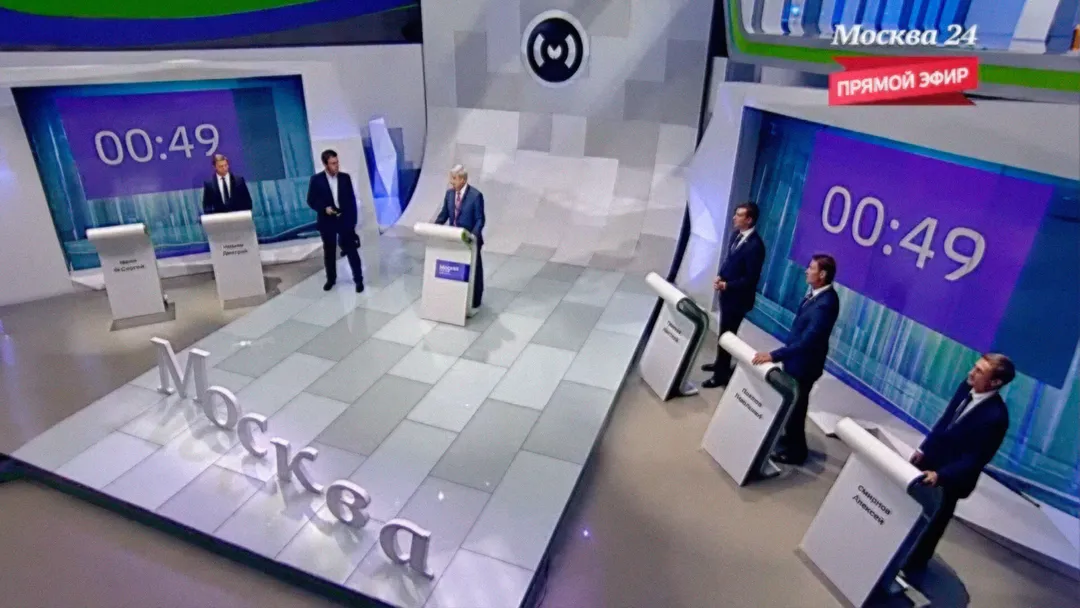
I suggest we begin. According to the draw that was held,
according to the draw that was held,
the first to speak is Ivan Melnikov. Ivan
Ivanovich, please, you have 2 minutes. I ask you
to keep to the rules.
I am running in this election to become
Mayor of Moscow and pursue policies in
the interests of Muscovites, and I feel broad
support. My party, the CPRF (Communist Party of the Russian Federation), trusts me, and
our supporters have backed my candidacy.
It has also been supported by left-wing and national-
patriotic organizations. I am trusted by
initiative groups of Muscovites with whom
I have held dozens of meetings. Many
research teams and prominent scientists support me,
starting with Zhores Ivanovich Alferov.
To govern the city, I have enough
both life experience and professional experience. I
have lived in Moscow for more than 40 years. During that time
I have gone all the way from a student dormitory
at Moscow State University to seeing my granddaughter born here. My friends
and colleagues are here. My
children are here. I have managed
large
teams, complex
organizations, and major infrastructure, and
I know what responsibility for
people's lives means.
And I am not ashamed of a single decision
I have made. The main reason I am running
in this election is that I am not satisfied with the current state of affairs. I do not
want Moscow to remain
a city of kickbacks, bribes, and deception, a city
of uncontrolled migration, homeless
construction projects, and reckless decisions
to merge educational and
medical institutions, a city where the humiliating положение
of the intelligentsia, the elderly, and
young people persists, a city where the authorities lie to your face,
where fraudsters inflate housing and utility tariffs, where
the masters of life have become incompetents and bandits
in luxury limousines. Change is needed.
A different strategy is needed. I have one.
Thank you, Ivan Ivanovich. Now we must
give the floor to Sergei Mitrokhin. Sergei
Sergeyevich, we apologize for the slight
technical hitch at the very beginning.
After all, this is live television, and all sorts of
glitches can happen. Please, you have 2 minutes.
Attention to the screen. Dear Muscovites, I
want to become mayor because I love Moscow.
As a native Muscovite, it pains me
to see what is being done today by
a team of outsider officials led by
Sobyanin. They do not respect Moscow or the views
of Muscovites; they do not care about them. They are violating
our city.
These talentless people are disfiguring our parks, and for this
huge amounts of budget money are being spent.
Instead of fighting illegal
migration, they profit from it, and in general
instead of solving the city's real
problems, money is spent on
cosmetic sprucing-up, window dressing, and some kind of
provincial aesthetic. It feels as though
they want to turn Moscow into
Sobyanin's village. They are taking away
Moscow from us.
In order to wrench Moscow out of the hands
of outsiders and wrench Moscow's government out of the hands
of outsiders and put it at the service of you,
the Muscovites, if I become mayor I will resolve all
issues in agreement with you. You will receive
a voice on all matters. Together with
you, we will defeat corruption, and we will
have money to solve social
problems and to help pensioners,
people with disabilities, and children. There will be money for
the development of our
city. You should believe me that I will solve
these problems. Five reasons: first, I love
Moscow; second, I have a clear
and concrete program of action; third, I
have a report on 10 years of work showing that I
have truly defended the rights and
interests of Muscovites and know their problems;
I respect them; and fifth, I have a team,
a professional team, and I have
the political will to solve these
problems. Support me, and I will return Moscow
to the Muscovites. Sergei Mitrokhin. Now the floor
goes to Mikhail Vladimirovich
Degtyarev. Please, you have 2 minutes. Attention
to the screen. Dear Muscovites, my name is
Mikhail Degtyarev. I have been nominated by the oldest
political party, the LDPR. We are 25 years old; we are
the youngest faction in the State
Duma, and we have the youngest top
governing body in the party, the Supreme Council,
of which I am also a member. I was supported by Vladimir
Zhirinovsky and the Moscow city
branch of the LDPR. I am 32 years old. I am an engineer,
an inventor, a Master of Sports in fencing,
and an experienced politician. The first time I was elected to
public office in a single-member district was
in 2004. Already 10 years
of parliamentary work have brought many
benefits to our fellow citizens, and our
program
is called Order, Comfort, Prosperity. That is
what Moscow lacks today. We will not
criticize anyone. We want to say that
Moscow needs a new impulse for development, and
the LDPR, represented by our leader,
has nominated me, a young man. We are sending
a signal to you, Muscovites: the authorities need
change, the authorities need new faces, and our
broad team will consist of people
with a wide range of political views. We
believe that Moscow must be cleared of
illegal migrants, that it is necessary
to eradicate all ethnically based crime.
We believe that kindergartens are overcrowded
and the waiting list is unworthy of Moscow. We will build
3,000 small-capacity kindergartens. This is
cheap and fast. We will provide schools with
hot meals for our schoolchildren, and for
half of them we will make it free.
we will fight for people with low incomes
traffic jams already today introduc streets for
Muscovites who are going to
their dachas (country homes) in an outbound format, we will clean up Moscow
the Moscow River; every metro car will have
free Wi-Fi and
climate control. Thank you, Mikhail Degtyarev.
That was the position of the LDPR candidate.
Alexei Navalny. Alexei Anatolyevich,
you have 2 minutes. Dear Muscovites,
My name is Alexei Navalny, and I... My
team, my like-minded supporters, and I are running in the
Moscow mayoral election. We are running a fairly
large campaign. I am confident
that many of you have already met one
of the thousands of volunteers who
are helping us. But the main part of my
campaign is meeting with voters. I
hold them every day, several times a
day, and I can already say now that I have
personally spoken with literally thousands of
Muscovites. And that is exactly why I say
here that I am absolutely certain that I am running with
the program Muscovites need. I
want to be that mayor, and I will become that mayor
whom Muscovites want to see. We know
what to do about corruption in Moscow. Our
Anti-Corruption Foundation, a nonprofit
organization, has already succeeded in canceling
corrupt contracts worth 59 billion rubles (about $1.8 billion at the time).
We have drafted bills, entire
sets of regulations. We know exactly what to do
about corruption in Moscow. I am running with
a program that states that already this
year we will change the budget in such a
way that we will increase social payments
to pensioners and all
those in need. We know that the Moscow
budget has the money for this. I know what
to do about the absolute lawlessness of
migration in Moscow. We will push for
the introduction of a visa regime with the countries of
Central Asia and Transcaucasia. We will ban
state institutions from hiring
migrants simply in order to
use them like slaves, because they
have to kick back part of their wages. I
urge you to support me—not just
to come to the polling stations, but also
to bring your acquaintances, friends,
relatives, and take an active stance.
I rely on active citizens. In my
team there are hundreds of people helping
fight corruption. When I become mayor, I
will rely on thousands of professionals
who will build a wonderful city
worthy of all of us. Come to the election,
vote for a future for yourselves and your
families. Thank you. Alexei Anatolyevich, now
we give the floor to Nikolai Levi... Nikola
Vladimirovich, you have 2
minutes. Dear voters, dear
Muscovites, it feels somehow awkward to
praise oneself, but I made the decision to run with an
alternative program for the development of
Moscow. At its core is the principle of social
justice. First, I propose
a systemic solution to the housing problem. In
current conditions, an ordinary Moscow
family is unable to buy housing. For the
middle class, a stock of non-commercial rental housing will be created,
for non-commercial rent, and for
low-income citizens, the volume of
social housing construction will be increased.
Second, today no one cares about the opinions of Muscovites.
Over the past 20 years, there has not been in Moscow
a single substantive referendum.
Muscovites have been deprived of the right to self-government.
In Moscow, what is needed as urgently as air is
an expansion of the powers of local
self-government and a higher status for the
municipal deputy. We have prepared
a draft law on self-government in Moscow.
It is the right of Muscovites themselves to decide what
our city should be. Third, all these years
historic Moscow has been barbarically
destroyed.
In place of architectural monuments there have arisen
faceless buildings and pompous offices. Our
city deserves a better fate. I will introduce
a complete moratorium on construction in
central Moscow. The city within
the Boulevard Ring should become an open-air museum
preserve. And
fourth, today’s Moscow is a city
of glaring social inequality. Here
are the highest prices in our country for
transport,
... and education. Moscow’s enormous budget
makes it possible to implement large-scale
social programs, and under my
leadership such programs will be
adopted. The city budget will work for
Muscovites. The rest is in my program,
A City
of Justice. Thank you, Nikolai Vladimirovich.
I think we are now moving on
to the questions-and-answers segment. First up we have number
Ivan Melnikov. Ivan Ivanovich,
please. While you are coming up here, I will explain
that
I would ask that questions be asked very briefly—
30 seconds, if you do not mind—and
not quite that short, of course, but still to follow
the rules: 2 minutes for each answer
to each question. Actually, taking advantage
of the moderator’s prerogative, with your permission I
will ask you the first
question. Surely all our viewers
and your voters are interested in the question of
your team. Nearly each of you
said in your remarks that you would
bring with you capable, competent
people who would do what
they are supposed to do. And surely there are
several key positions you have already
thought about—for example, finance,
security. If you would, please answer.
Please answer this question. You have 2
minutes. I support the formation of a
coalition government in Moscow.
I believe that
the socio-economic and political
situation is extremely difficult, and no single political
party can govern the city alone.
Tomorrow at 1:00 p.m. at the Interfax news agency, I
invite all journalists. I will be
holding
a press conference where I will present the full
composition of the new
Moscow Government, in the event that I
become mayor of the city. The structure will change somewhat.
I will have slightly more deputy mayors
than in the current government lineup.
There are 11 now, but their
responsibilities will be different overall. Looking at it as a whole,
the number of people in the city’s administrative system
will be significantly reduced, and
the funds allocated for it
will also be lower. I believe
that these functions should not be separated,
for example,
urban planning and road
construction. This is a single, integrated
set of issues that should fall under one
deputy mayor, and these matters should
be resolved together. There are a great many
situations in Moscow where poorly thought-out
urban planning and road
construction put
our residents in a difficult position. I encountered
such a situation in the Marfino district, when
highways were routed into an already built residential neighborhood
that pass literally
2 to 3 meters from apartment buildings and their entrances
(about 6.5 to 10 feet). It is simply impossible for people to live there, and
I deeply regret that the current Moscow
city leadership
did not even see fit to come and
hear residents’ complaints. And I deeply regret
that the voices of Moscow residents are very
poorly heard. And if possible, briefly:
do you already have any names? I do
have all the names. I am ready to name very
many names. Please, just one, if
possible.
For political affairs, the deputy mayor will be Oleg
Nikolaevich Smolin. For matters of
economic policy, Oksana Genrikhovna
Dmitrieva. Thank you, thank you. Sergei
Sergeyevich, what is your question for the candidate from
the CPRF (Communist Party of the Russian Federation), Ivan Ivanovich? He has just
met with voters in Izmailovo
and encountered the following situation:
The department
for capital repairs ordered the reduction of a public square, that is,
the destruction of Izmailovsky Square.
The department
of housing and utilities is also against it, but
the work is going ahead, the square is being destroyed. Does it not
seem to you that under Sobyanin, Moscow
has generally lost governability, and what do you
propose to do about it?
You have 2 minutes. Overall, I believe
that Moscow’s system of governance requires
very serious changes. I support
the idea
that elections to the Moscow City
Duma be held ahead of schedule. But I believe these elections
must be prepared very carefully. They must be
truly
model, honest, open elections,
elections Moscow can be proud of and
that will become an example for our entire
country. These elections must be prepared, and
that is because
the number of deputies must
be increased. It should be increased both
in general and in connection with the incorporation of
New Moscow. I believe that the three-tier
structure of Moscow’s administration—mayor’s office,
prefectures, and district administrations—is very costly,
prone to corruption, and completely ineffective. I
believe that Moscow needs to move to
a two-tier governance structure: the mayor’s office
and municipal deputies. At the same time,
municipal deputies
must have
broad powers. These powers
must be set out in Moscow law, and
they must receive the corresponding
financial resources. In other words, this should
be a governing body that is as close as possible
to Muscovites, resolves all issues
together with Moscow residents and in the interests
of Moscow residents. I believe that the Moscow
City Duma should have greater
oversight
powers. The Moscow Government should
require approval from the Moscow
City Duma. As I said,
tomorrow I will present the new composition of the
government. I assume that this
team will work, that is,
after the new composition of the
Moscow City Duma is elected, each of the
ministers will report to the Moscow
City Duma and receive approval as to whether he or she
will continue to head their area of responsibility
or not. Thank you very much. Mikhail
Vladimirovich, you have a chance within
30 seconds to ask your question. Ivan Ivano-
Let’s be frank: the communists destroyed
two countries—the great Russian Empire
and later
the Soviet Union in the 1990s. By the way,
the only party that defended
the GKChP (State Committee on the State of Emergency, the 1991 Soviet coup committee) was the LDPR, then led by
Vladimir Zhirinovsky. As is well known, all general secretaries
were carried out of the Kremlin feet first.
And today, we in the LDPR are nominating
me, a young politician, while you, with all
due respect to your age, already have
quite a few young communists. Why did you not
nominate a young candidate whom
Moscow wants? Thank you, thank you. You have 2 minutes.
on
In response: Dear Mikhail Vladimirovich, I
think that managing such a complex
city as Moscow should be done by a person who
has serious life and
professional experience. I believe that I have
both extensive life experience and extensive
professional experience; I have managed
large, serious teams with
complex infrastructure.
I am truly ready to govern
the city of Moscow. We have many young
people, a large cohort of young people, who
have been elected both to the party’s Central Committee
and to the Presidium of the Central Committee, but when
we were deciding this
issue, the party leadership concluded that
I had the best chance in this election. They
believe that I am the candidate who
can unite a broad spectrum of citizens
who are dissatisfied with the policies being pursued
in Moscow, ranging from the far left
to a significant segment of liberal and
democratic forces. Therefore, it was decided
to nominate me for the position of
Mayor of Moscow. I will say once again: I
believe that I am ready for this. And I
am, uh, confident that after five years in office
Muscovites will say: this is the mayor we
dreamed of, and the one who worked in our
interests. As for the destruction of
the Soviet Union and so on, Mikhail
Vladimirovich, I think that if it were not for
the Communist Party of the Russian
Federation, if it were not for the Soviet Union, if
it were not for those great victories that were
won both during the Great Patriotic War (the Soviet term for World War II, 1941–1945)
and in space, if it were not for those
universities and scientific institutions
that were built in Soviet times,
I think perhaps you would not only not be
standing at this podium, but might not exist at all.
Thank you for that answer, especially since
in my opinion the question was standard; the CPRF (Communist Party of the Russian Federation) always
asks such a
question. Alexei Anatolyevich, you have 30
seconds to ask your question.
Please. Ivan Ivanovich, you are an experienced
politician; you have gone through a large number of
election campaigns. As a voter,
I have many times watched these
election campaigns and
seen
that in United Russia I have never seen these debates,
because United Russia
used to refuse. And now the candidate from United
Russia, Sergei Sobyanin, has once again not come to the debates.
Why do you think this happens?
Why does it happen every time? You
know, I am very sorry that the candidate from
United Russia, Sergei
Sobyanin, is not taking part in these debates.
In general, I think that in world practice
there is such a
rule: if the incumbent-backed candidate refuses
to participate in debates, refuses
to answer the questions that other candidates
want to ask him, and in fact
refuses to publicly account for his
work, then he has no chance of being
elected. I very much hope that
someday this practice will exist in our
country as well; it would be a perfectly normal
political situation.
I think that for the incumbent
Mayor of Moscow to report back to
Muscovites is indeed very difficult, because the
problems we are talking about today, the ones
I am sure we will also discuss during
the next broadcasts, are in many
ways the result of the policies
being pursued by Moscow City Hall. I
believe that the main problems that exist
in Moscow stem from this, including the problem of
uncontrolled migration and the problem of
shifting responsibility for everything
onto Muscovites, from paid
parking
to
home ownership issues and major building repairs
that Muscovites themselves are expected to pay for.
I believe that this whole
matter needs to be regulated.
The CPRF faction submitted to the State
Duma a bill on mandatory participation of all
candidates in debates. This
applies to candidates for governor, for mayor,
and for president of the country. But
unfortunately, the United Russia party rejected
this bill, and for now such a
rule remains in force, which I am extremely unhappy with. Uh,
thank you, I would just, for the sake of
fairness, make a small correction: Sergei Sobyanin
is not from United Russia; he is self-nominated. Well,
but he is a member of its Supreme Council. Nevertheless,
next, please, Nikolai Levichev.
Please ask your question; 30 seconds. Dear
Ivan Ivanovich, the Moscow government
is trying to solve the traffic congestion problem by
building major transport arteries.
However, traffic jams are not decreasing, and
the quality of life of people living in nearby
buildings is sharply declining. On the same
North-Western Chord (a major Moscow highway project), the road will run
right under apartment windows, and the market
value of the housing drops sharply. The Moscow authorities do not intend to compensate for the damage.
I believe
that in all such cases
there should be compensation for the losses incurred by residents. And what
do you
think? As for compensation for losses,
it absolutely should
be provided in appropriate amounts. But I
believe that, in principle, Moscow’s
traffic jam problem, the problem of transport collapse,
is being addressed incorrectly. Questions of
urban planning and questions, questions of
transport interchanges and congestion, they
are interconnected
that Moscow is developing incorrectly as a
polycentric city
all traffic flows toward the center
of Moscow, and at the end of the day from central Moscow back out. Even in
the Soviet era, this was discussed as an absolutely
correct idea. Back then, perhaps, it was
less urgent, but now for Moscow it is
extremely urgent: for Moscow
to develop as a
polycentric city, it is necessary to develop transport
arteries; there must be large
clusters of people who work there, core
enterprises, state corporations,
and residential areas. This is the right way for
Moscow to develop, and it would significantly ease the burden on
the city. As for the historic part,
it should be more of a, well,
tourist center of Moscow, from which
it is necessary to remove as much as possible
shopping and entertainment centers, office
buildings. Moreover, this can be done quite
economically: tax and
rental rates for, say, museums
can be set at one level, while for office buildings
and, uh,
shopping and entertainment centers they
should be different. And overall, I believe that within
the limits of the Third Ring Road, it is necessary
to move out various depots,
uh, and other, so to speak, customs
terminals. Thank you, thank you, I let you
finish your thought. In general,
transport problems, in my opinion, are such a
fertile topic that one could devote
an entire separate program to them. I think you would not
mind, even if we agree on that
then let’s agree on it. Good, I’ll hold you to
your word. Today—today we’ll talk about this
specifically, Ivan Ivanovich. We thank you
for answering all the
questions that were asked. Please take
your place at the podium. The floor now goes
to Sergei Sergeyevich Mitrokhin
please. I have already voiced my question,
which I think is of interest to very many
Muscovites, regarding your team: whom will you
bring with you, who will be responsible for
the fundamental areas of the city’s
life? More specifically, if possible. As I
already said in my speech,
I rely on a professional
team. These are well-known Muscovites
from a wide range of
fields. They will be my leading
advisers; some of them will also hold
posts in the executive branch. Starting with
the economy: Grigory
Yavlinsky, a world-renowned economist,
Doctor of Economics. Next,
Alexei Yablokov, also a world-famous
environmentalist, perhaps the best-known environmentalist in
Russia, the leader of our faction
Green Russia within Yabloko (a Russian liberal political party).
Then there is Andrei Babushkin, a well-known
human rights advocate who specializes
in issues of oversight of
law enforcement agencies and their
conduct, which is exceptionally important in
Moscow. There is also Yevgeny Bunimovich, who
is Moscow’s leading specialist
in education. He once headed the
Moscow City Duma Committee on Education, and
in addition, he is also a specialist in
children’s rights and currently serves
as Moscow’s Children’s Rights Commissioner
in Moscow. At Yabloko, we also have
an anti-corruption center. These are young people;
they
study how public procurement is carried out in
Moscow. It is handled outrageously there; by
my estimate—by our estimates—about
one-third of Moscow’s budget is stolen through
the public procurement system. Alexei will confirm
this figure. So, heading
the anti-corruption center is a young man,
Vitaly Reznikov, and he
will head the anti-corruption bloc. He
will have many tasks, because this includes
work on anti-corruption cleanup of
the legislation of the Moscow government,
Moscow legislation in general, as well as
checking officials’ declarations on
income, property, and expenditures. This will be
a powerful anti-corruption bloc, because
the mayor of Moscow is capable of defeating
corruption in Moscow completely, if he
wants to do it. Thank you. The floor
goes to Ivan Melnikov
please. Your question, within 30
seconds. Your time starts now. Sergei Sergeyevich,
when visiting many districts of Moscow,
one encounters the following situation: in one
place, instead of a kindergarten,
they plan to build a hotel; in another place,
instead of a sports ground,
a shopping and entertainment center. And this
happens all the time. But the main thing is that the opinion
of city residents, the opinion of the residents of that
district, is not heard, while the results of public
hearings are manipulated. What do you think the problem is?
What is the problem here, Ivan Ivanovich? As you
know, I have very extensive experience fighting
infill development in Moscow. Let me once again
draw your attention to my report, *10
Years in the Service of the Muscovite*. Ten years ago I
stopped the first infill
development project. Unfortunately,
the situation has not changed much, although I
did manage to get Luzhkov (former Moscow mayor) to adopt
Resolution No. 714 abolishing infill
development, but it continues today
and, in fact, the situation has worsened. Now, answering
your
question: at one time I secured the creation of
an interagency commission that
approved infill development projects. It included
the city’s chief architect, Kuzmin
who, together with Muscovites whom I brought to
him, discussed what could be built
here: a kindergarten, or a so-called “people’s garage” (a budget public parking garage)
that they wanted to force on everyone, and
in many cases we managed to defend
either the kindergarten, or to leave alone
the square, or some other social
facility in places where people clearly
had agreed that it would not be there
Now the situation has changed. In
Moscow, we now have this kind of
troika, of sorts, called the Urban Planning
and Land Commission—an absolutely closed
body. It consults with no one; it
operates outside the rule of law, because
the legal framework in Moscow in the area of
urban development is completely absent.
We are living under a stillborn master plan; it
no longer reflects Moscow’s boundaries, which
have expanded. So, the absence of law in
construction-related matters, and the lack of
contact with Muscovites, the lack of
coordination with Muscovites—this situation
must be changed radically.
Everything must be brought back into a legal framework.
A new master plan is needed, one that should
reflect the latest concept
for Moscow’s development, both in terms of urban planning
and transport, and then that
master plan must be strictly
followed. A new system of public hearings is needed;
the results of public hearings
must be binding on the authorities. If
Muscovites do not want something built there, then
nothing should be built there. These issues must be resolved
in agreement and coordination with Muscovites.
Thank you, Sergei Sergeyevich. And if, if possible,
briefly: how much should a people’s
garage cost? Could you give a figure, in your
opinion? You know,
200,000. I think that if it is a people’s
garage, then at most an ordinary person, if
we take the average—because “people’s” also means
low-income—I think it should cost no more than
50,000 rubles, and the rest should be subsidized
by the city.
One moment, Sergei Sergeyevich, your party
has produced a great many remarkable figures
in Russian politics—well-known
deputies like Mizulina, now in United Russia, and Yarovaya,
and now candidate Navalny also came out of Yabloko (a Russian liberal political party),
that three-letter name, and basically
on the horizon we see only Lukin, who
goes to the migrant camp and keeps advocating for
their, excuse me, decent living conditions,
sometimes skirting the issue of
discrimination against ethnic Russians by the state.
Maybe it is time for you to withdraw and stop
this, you know.
The content of your questions, Ivan
Ivanovich, tells me that
you are not, in fact, very interested in Moscow’s problems.
I will answer your question, though you clearly
do not know much about them,
because otherwise you would have asked something
more relevant to Muscovites, who today are
dealing with the city’s main
problems. Yes, we had people with whom
we had to part ways. We had people
who left us on their own, because we
did not bow to the Kremlin, and you could not
build a political career through us. That is how we
differ from the LDPR (Liberal Democratic Party of Russia)—that is my first point.
Now, as for Vladimir
Petrovich Lukin, I believe that he
has performed the duties of
Human Rights Ombudsman with dignity. He
did not, by the way, leave the party; he merely suspended
his membership, as required by law. As for
the migrant camp you
mentioned, I was there and saw with my own eyes
what it was like. I personally believe that
the rights of migrants there—Sergei
Sergeyevich, let me finish—what rude
young people, and they want to be mayor, no less. So,
the point is not whether human rights are or are not being violated there.
The point is that
the whole exercise is absolutely pointless
and purely for show—something Sobyanin staged for himself
before the election. Why? Because no one
is going to eradicate the root of the problem:
to punish the employers who
hire them. For PR purposes, they have now been
rounded up,
locked up on the same grounds where they
were already being held before, and now they will be deported at
the taxpayer’s expense. Huge sums of money will be spent,
but there will not be fewer migrants in Moscow
under any circumstances. Because that
employer who is not punished for this
criminal activity
will hire new ones.
Therefore, I believe this is populism, and
proposals to endlessly
round up migrants are pointless—it is like
carrying water
in a sieve. The root of the problem must be eliminated: we must jail
the employers who hire undocumented workers.
Alexei Anatolyevich, your question. Sergei
Sergeyevich, I have known you for many years, for many years
you
have followed the issues in
housing and utilities very closely, tracking tariffs and so
on. I deal with this too. From my point of view,
tariffs in Moscow are completely inflated. When
I hear Sobyanin say that
the tariffs are justified, it seems to me that this is
a lie, and simply insulting
to Muscovites. What interests me is
your view on how
the tariff in Moscow is set. Is it fair? How much
is being stolen there, or not? Is it honest
or dishonest? In my program,
which is called *Let’s Start Change with*
*Moscow*, a large section is devoted to the problems of
housing and utilities. The main problem in housing and utilities, both in
Moscow and across our entire country, is total
lack of transparency. No one knows how these
How are tariffs set? Why do they rise so much faster
than inflation? If you look at a long-term
period, tariffs have outpaced inflation by 10 to 15 times.
And the reason is very simple: there is
collusion between officials, the suppliers
of these utility resources, and
management companies. Officials do not
check their data. Why do they raise
tariffs? Because they can raise them freely, and the ones who pay
the price are ordinary Muscovites, ordinary
citizens of Russia. It is simply a feeding trough
deliberately set up by our
corrupt elite for these very
utility services and the officials
who work with them. What needs
to be done? It is written in my program.
First of all, conduct an independent audit
of all tariffs, and then publish everything on
the internet, all the results, and require all
utility companies to report online
not in the fake way they do now,
but for real. The mayor has
the power to do this, and I will definitely
make it happen. We also need to carry out
a full review of the tariff-setting
process itself, because there has been no such review
in Moscow for 20 years. They simply
keep mechanically piling on coefficients, and that is all.
And of course, all the heads of these
organizations must be held
accountable—these offices, homeowners' associations, and management companies
that are later found
to have engaged in theft. They must be handed over to
law enforcement, taken to court, and they must
be jailed. New people must take
their place, and the Regional Energy
Commission must обязательно publish
tariff assessments on its official website
on the internet, in full
detail. If there is transparency and
strict oversight, tariffs could even
be reduced, including in Moscow. Thank you.
Thank you for your answer. By the way, your slogan is very
similar to Alexei Navalny's. Are you from the same
party? Nikolai Vladimirovich, you have 30
seconds. That is not a slogan, it is the title
of the program. Excuse me. Moscow is not just
choking in traffic jams—the city air
is simply dangerous to breathe, and the water is sometimes
harmful to drink. Nearly half of the city's enterprises
do not treat their
emissions, and modern waste-processing plants are not being built.
At the same time, the mayor's office,
under the pretext of beautification,
is filling parks with entertainment
complexes and slicing off pieces of
Moscow's green belt for shopping
centers and elite housing. What will you do
as mayor? You know, there is already experience here as well.
In this report, I
have a section on how I managed
to stop the practice of so-called
"adjustments." Under Luzhkov (former Moscow mayor), they used to cut off
pieces of green territory, supposedly
with compensation happening somewhere, no one knew
where, 100 kilometers away, and in this way
they built over parks and used them for
commercial purposes. I managed to stop
that. But now, from another direction,
Moscow's parks are being encroached upon under the guise
of beautification; what is happening is their
disfigurement. Losiny Ostrov
National Park—they are stripping away the topsoil
in the Novogorsk area and laying rolled
technical turf. This is simply environmental
murder—there is no other word for it.
That is why parks must be protected from these
talentless "beautifiers" who are currently
in charge. Illegal activity in parks must be stopped.
Go to
Losiny Ostrov and you will see what is
going on there: illegal parking lots,
illegal
production facilities, some kind of crumb material being made.
Sobyanin said that he had closed the dumps
in Losiny Ostrov. He did not. There are
five construction waste dumps there.
All users who
violate the park protection rules must be driven out.
They are devouring our green lungs. As
for polluters, there must be clear
monitoring of who is polluting, and specific measures for each
polluter: the stick and
the carrot. The carrot means incentives—
subsidies if they install treatment
facilities, some kind of tax
breaks. The stick means tough fines
for pollution, followed by a lawsuit to
shut down that operation. By the way, I managed
to achieve this even without being mayor:
the closure of the cement elevator in
Pechatniki, together with local residents, of course.
We raised the issue and kept pressing it.
The Moscow government, already under Sobyanin, by the way,
did close the cement elevator. But other
dirty industries also need to be
shut down and moved out of Moscow. Moscow
must develop an environmentally clean
economy. Thank you. Sergei Sergeyevich, you
have answered all the questions. I ask you to
take your seat.
Excuse me, I dropped my report. That's
all right. Yes, I am ready, please.
Please, I have been waiting just for you. Mikhail
... is now answering questions. The first
question: I have the same question about
your team—whom will you bring with you, what kind of
specialists, what kind of experts
who will be responsible for the vitally important
areas of Moscow's development? For Mikhail ...
the main thing will not be political
views, but efficiency, competence,
and the desire to work. And today, in the next few days,
perhaps even tomorrow, we are launching a website
called Team Moscow, where every
Muscovite, both new arrivals and
native residents, can leave their résumé. There
will be more than 5,000 vacancies there.
from district municipal officials and housing maintenance office directors all the way up to the deputy mayor of Moscow
and all of these people—the most active, the most
I repeat, the most capable—we are ready
to bring them into Moscow’s government, and today
any Muscovite will tell you that
the reinforced-concrete slab of Moscow’s власти
regardless of who is in charge—Sobyanin
or Luzhkov before him—at the very lowest level
remains an impregnable fortress for
people who know how to govern, and I am saying clearly: we
will give you, dear Muscovites, such an opportunity
including young people, including those who
came from other regions and bought
housing here, who want to live here
and raise their children here—such an opportunity
to enter Moscow’s government, we will provide. And
I want to say to the respected Ivan
Ivanovich: if Sergei Pavlovich
Korolev, the designer of the legendary
rocket
R-7, had died
in the dungeons of the NKVD (the Soviet secret police), we would have had neither
breakthroughs in space nor Yuri Alexeyevich
Gagarin, who was the first to go into
outer space; we would have had nothing
at all. Therefore, the Russian people and
the designer Korolev and Yuri Alexeyevich
Gagarin worked not thanks to the Party, but
in spite of it. And I too was born thanks to my
parents, and I built my career thanks to
the LDPR, the oldest political party
and as for the team, we will certainly keep some people
and take some others, perhaps from other
parties. Please—our party has plenty of
professionals.
Thank you. Ivan Ivanovich, I think
there is a question for you; you have 30 seconds.
Let us continue the conversation about science. In Soviet
times, colossal sums were allocated
to support science. You probably do not
know this, but I will not put you
in an awkward position—I will say it myself: in
Moscow, less than
less than
1% of the Moscow budget is allocated to support science and all that goes with it. Do you think that is
normal? And what needs to change so that in
Moscow, science and real
production can be supported? Thank you. To support
science, you have answered your own question:
first, money must be spent on it. And
not just on science in general—I am, in fact, deputy chair
of the committee on science and high-tech
technologies in the State Duma, and
I am an inventor myself and also hold a patent. We need
to train personnel. Has even one candidate spoken
about the four city universities that are
under the mayor’s control and accountable to him? Three of them are
teacher-training institutions, one is humanities-focused. Moscow
needs engineers—specialists like me
in management and so on. We will repurpose part of Moscow’s universities
in Moscow.
Together with the Academy of Sciences, we are doing this work.
We are planning to create a department of urban studies
—it does not exist now. So of course we will spend money on science,
but first and foremost, for
science, personnel are needed, and you know that perfectly well.
If we are talking about scientific
institutes, then
today, some of the institutions under the control of and accountable to
the Moscow government
are being shut down. Why? Because
the current authorities are not
interested in this. Moscow has become a commercial
city; commercial capital rules the roost and does not
pay taxes here. In my program, “Order,
Comfort, Prosperity,” it is stated that we
will bring the entire economy out of the shadows and out of
trade dependence. Moscow will become a scientific city, including
including
a high-tech one. And today we see
that same Zelenograd, the center of the electronics
industry. Why is it that in our country, at the
federal level, decisions are made to
build new production facilities in special
economic zones across the country when
the personnel are concentrated in
Zelenograd? The Proton rockets made by the Khrunichev Center
suffer because of staff turnover,
because of low salaries, because
Moscow engineers are leaving the
Khrunichev Center for commerce, for retail chains, and
then we worry when our rockets fall.
The engineer must be at the center of things in
Moscow. Back then, you voted against science
recently in
the State Duma. We will have
more than enough time for discussion.
Sergei Sergeyevich, please, you have
30 seconds. Mikhail, well, I have already shown my
report. Wonderful—you do not look like yourself there.
It says here how I
fought against infill development and the cutting down of
green spaces and parks. Well, I
sometimes, at our rallies that we
organized, saw the Communist Party faction there,
for example. But I never saw the LDPR there.
So I have a question. You have your own
report, but at least have you brought one from Saratov
about your activities in Saratov?
Where from?
With
the LDPR? One minute for the answer.
Please. Let us begin with the fact that, for example, in
Mitino, yes, we held events together. But that was
before the election, yes. There were events there, and
you—and you together with the respected
Ivan Ivanovich—were shown by the state TV channel
Rossiya 1, while Degtyarev, the real
opposition candidate to the authorities, was
for some reason not shown. So let us start with
that: you are shown because you
dance to the tune of
the well-known... Sergei Sergeyevich, stop
this circus. Dear
viewers, you can calmly go to the LDPR website, ru, where
my report as a State Duma deputy is posted,
and to my personal website, deino, and on
all social networks—I communicate personally, and
on Twitter and on Facebook and on
Odnoklassniki and VKontakte with our
voters. We live in the 21st century. These
little papers, these, these little papers that
you keep producing—and, excuse me, entire
forests are being destroyed because of your print runs—we don’t need them. We
have everything in electronic form, modern
information
technologies. As for the city
where I grew up—you know nothing about Russia. You’re con
fusing the beautiful Volga city, my
hometown, the city of Samara,
with the beautiful city of Saratov, which, by the way,
is where the curator of Kremlin policy, Mr.
Volodin, is from. So I want to tell you: I am
proud, and I believe that in this election, as a
candidate, I appeal to all Muscovites,
both native-born and those who came here—active
young people who link their future with Moscow.
I am the only one telling you: dear
Muscovites—and Omsk residents, Tomsk residents, people from St. Petersburg, and
people from Samara, Rostov, and Kazan. In other words, everyone
who came here, built, and defended the great
city of Moscow. Candidate Degtyarev does not divide
people into native Muscovites and those who simply live in Moscow, are registered here,
raise children here, and get things done—those are the people
I am addressing, all of them.
I represent them. Time for Alexei Navalny to ask a question.
A question—30 seconds, please. Mikhail, the leader
of your party used to be quite fond of
criticizing the previous mayor, Luzhkov, and
we even watched at a plenary session
as he said that everyone around Luzhkov was a crook,
a thief—shoot them, jail them, and so on.
All those same people have remained in those
positions.
Why is it that Zhirinovsky no longer wants to
shoot them and jail them? What, after all, is your
position on those people whom you previously
called crooks, and who have remained in the
Moscow city government? What should be done
with them? We believe that a person has the
right to work regardless of which team
they are on today—Luzhkov’s or Sobyanin’s.
If they are working and there are no grounds
for opening a criminal case or
if the person is not involved in anything illegal, then no.
But we believe corruption must be fought, and we
are fighting it. We constantly send
our inquiries to the prosecutor’s office and receive
responses, including positive ones, confirming
that one official or another has stolen.
In my program—as the only candidate, by the way,
who has said this—it is stated that when Degtyarev comes to
power, reports on income and expenditures will be required
not only from officials but also from
the director of a state-funded
institution. What do we have today?
Twenty-seven percent of the budget goes to capital investment.
Another 20 percent—a full one-fifth—is spent by
state-funded institutions,
from schools to museums, housing offices, and so on.
And only 11 percent goes to social policy.
So this is what we say: guys, those who
are spending this money—after the election, Degtyarev
will appoint an independent audit. And not only of the
budget. The budget is wonderful on paper, with
excellent program items, and everyone speaks so
beautifully. But I’m saying the money
is being spent inefficiently in state
budget-funded institutions, and every
manager will have to report—from
the school principal to the museum director and the housing office head—on
their income and expenditures, just like
officials and deputies. And those who are
caught—of course, we will fire them. The moment
there is a conflict of interest, out they go. That is in the
program of the LDPR candidate.
No one will be restricted in their rights for political reasons.
Whatever party they belong to, whether they worked with
Luzhkov—if they are a competent official
or worked with Sobyanin—they will
work for the benefit of Muscovites under the strict
control of Mayor Degtyarev. Thank you very much for
your answer. Levichev will now ask a question. You have
30 seconds, please. Dear Mikhail
Vladimirovich, the mayor has submitted to the Moscow City Duma
a bill
that will inevitably lead to the demolition of
thousands of architectural monuments, and there is
a danger that Moscow’s historic center
will very soon change
beyond recognition. What measures to preserve
Moscow’s cultural and historical environment would you
propose if you had the good fortune
to become mayor of this great
city? Thank you. Thank you. First,
that resolution—or rather, that draft law—
will of course be withdrawn.
The state land commission, which
makes all land-related decisions, is absolutely
non-transparent and probably
corrupt. In the program
*Order, Comfort, Prosperity*, it is clearly stated
that all issues related to protecting
Moscow’s historical environment will be
coordinated and approved
exclusively by one single body:
Moskomnasledie (the Moscow city heritage preservation agency). Today it has been
pushed aside,
and land specialists are deciding whether a
building should be a protected monument or not. For example, Kadashi, Block 401—
what is being planned there, the so-called
regeneration, is monstrous. But
excuse me, it is completely outrageous.
Therefore, all investment contracts
that affect the historical
heritage of Moscow will be
reviewed by me—I guarantee it. There will be no
failure to calculate what consequences this
will bring. Therefore, under Moskomnasledie
and under the mayor’s office, there will be a public council
consisting of leading restorers,
leading architects, leading scholars,
historians, and so on. Only after their
verdict will I be able to decide what
to do. As for what to do inside
the Boulevard Ring, the historic
the pedestrian area and the monument, or not
to do this at all—the main principle is
we need to stop demolishing historic
buildings; restoration
and preservation should be handled by
restoration specialists, not builders, and certainly not
architects who have no understanding whatsoever of
historical heritage, and so on
That is why Kadashi is the saddest
example—one everyone has heard about. Mikhail
was answering a question from his opponents
please, go ahe
because now coming to this podium is Alexei
Navalny. Alexei Anatolyevich, thank you very much. If
you allow me, I have the same question for you
about your team—the key positions that
will be responsible for the city’s fundamental, as it were,
functions. I began my remarks today
by explaining
how my election campaign is being run
I hold three meetings, three
rallies with voters every weekday
and five every weekend. These are different
meetings—sometimes around 20 people, sometimes
as many as there were yesterday in Mitino. At every meeting
the question of the team comes up. And every time
people tell me: don’t just give us names,
tell us the principles on which this
government will be formed. You know,
for example, that now when
civil servants are appointed, even now
in theory they go through personnel
commissions, undergo special
interviews, write essays, and so on
But can we—you as Muscovites, I as a
Muscovite—go somewhere and see
and find out why this person was appointed
prefect, and why someone else was not appointed
prefect? I will be the kind of mayor who
will finally create a fully open and
transparent system of personnel appointments
I have people to rely on. My program
was written by people—scholars of world renown. I’ll
mention only Sergei Guriev. So these
people, both on staffing issues and on
the formation of commissions, are of course
among the very best
specialists. In personnel decisions I will rely
on those municipal-level deputies
who work with me. These are people
who for years have been dealing with the practical
solution of Muscovites’ problems and know perfectly well
how Moscow’s systems work
It would probably be inappropriate to name
specific names during a debate. But I can say
with complete certainty that the full list
of all the people I would like
to see at the head of the political
leadership of Moscow City Hall will be
published by me in the second round of these
elections. I am confident that I will receive enough votes
to make it to the second round. I
will present the team that will lead
me to victory—that is, it will be freely
available online, and anyone will be able to read
the names. All personnel decisions will be
clear to Muscovites. The specific list
of appointments will be published in the second round. And
for now
the next question will be asked by Ivan Ivanovich
Melnikov. Please, you have 30 seconds for it
Alexei Anatolyevich, at practically
every meeting in Moscow, one of the topics
that comes up most sharply
is the issue of corruption and bribery in Moscow. This
concerns housing and utilities; people believe that up to 70—yes,
experts also believe up to 70% in kickbacks. This
concerns road construction, it
concerns
concerns the construction of buildings, offices, and so on
How do you propose fighting corruption
in Moscow?
Thank you, thank you very much, Ivan Ivanovich, for
that question, because this is exactly the field
this is what I have been working on for many long
years, and what our Anti-Corruption Foundation
has been working on—a foundation which, although essentially a non-
profit organization, nevertheless, I
believe, has achieved significant success in
this area. I have already said that we
have stopped corrupt contracts worth 59 billion rubles (about US$1.8 billion at the time) alone
from going forward. We are successfully conducting investigations
You know that we even showed several of your colleagues from
the State Duma, from United
Russia, the door, essentially
by publishing information about their foreign real estate
The main thing needed here to fight
corruption is transparency, starting with
utility rates. Why are they
stuffing sponsorship support into them and including it
in our rates? From my point of view, that is
corruption. We have all the documents
we simply need to hold these people
accountable. The same applies to
construction. The same applies to
road contracts. Look at how
things are done in Moscow now—who gets awarded
the biggest road contracts? Huge
construction projects are handed to the Rotenbergs
whose only qualification is that
they are friends of Vladimir Putin. In Soviet
times they were judo sparring partners/coaches,
and now they are somehow our road builders. I
want to become mayor, and I will be a mayor who
finally puts things in order. Not a single
tender will be conducted according to
murky, closed rules. Road
construction will be handled by road
builders, not by some obscure
Rotenbergs and other friends and
former classmates, university friends, neighbors from the
Ozero dacha cooperative (a well-known group tied to Putin). The construction
of the metro will be carried out by metro builders, not
as is the case now, when the largest lots for
metro construction are taken by Gennady
Timchenko, yet another friend of Vladimir Putin. We
have even drafted
entire bills on this subject—our Anti-Corruption Foundation
I worked on anti-corruption amendments to the federal
contract system, which the Ministry of Economic
Development was supposed to draft. We wrote all of it ourselves,
and we have everything laid out right down to the instructions.
We know exactly what needs
to be done: transparency, oversight, and strict
holding people
accountable.
Now, on the issue of illegal
migration: first, do you agree
Alexei, with what I was saying — that
this fight has to begin specifically with
employers, because simply
rounding up and catching undocumented migrants is pointless
if afterward a new undocumented worker is hired
for the job? And second, does the measure of abolishing visas
have any
real effect? Who is going to check those visas at
the border? We no longer have border guards — they were
abolished by Putin. Thank you very much, this is an important
question for me, because probably of all
the candidates, I hold the toughest
position on migration issues. To
begin with, I completely agree with you
that what is happening now is
just meaningless showmanship. They have
set up some kind of concentration camp
where 200 Vietnamese people are being held, and those
Vietnamese detainees are shown on television. I
invite
Sergei to come with me to Maryino, where
you can simply go out in the evening to Maryino Park
and round up thousands of these undocumented
migrants. If we want to build a
camp, then that camp would have
to hold a million people, and another million
people would be needed to guard them. Moscow
ranks first in the world in terms of
the number of undocumented migrants. I am
absolutely convinced that a visa regime, which
I insist on — a visa regime with
the countries of Central Asia and the South Caucasus — is
necessary. If Germany and France have
a visa regime for you and me,
then it probably makes sense for us to introduce one as well.
I do not understand why, in order
to travel to any European country,
I need to obtain a visa, while any
citizen of Kyrgyzstan or Tajikistan can,
even without an international passport, simply buy
a one-way ticket and come here. Well,
there are people there to check, there are people there
to check. And here, we can check in
Moscow the people who come here without
visas. If they crossed through a porous
border, then at least they will be caught
in the big cities and deported. And then
the employer will be paying bribes for them
— and that is all.
It is a matter of enforcement: they must not take bribes.
If a person does not have a visa, if they did not
obtain one, they are deported. I will become a mayor
who deports them. Besides,
the problem really is that
migrants come here not because
there are jobs here, but because
the mayor's office, contractors, and district administrations
bring them here. Migrants live in conditions
like slaves, 20 people crammed into a basement,
receiving an official salary of 35,000 rubles (about 35,000 RUB),
and then kicking back part of that salary to the head
of the district administration, the manager of the building management company,
the head of the DEZ (a Soviet/Russian municipal housing maintenance office), and so on. I want to become
the mayor who destroys this
endless corrupt system.
Thank you, Alexei Anatolyevich. I think
Mikhail Vladimirovich already has
a question. You present yourself as a fighter against
corruption, but one must understand: one must be
absolutely above reproach. You know perfectly well
that the Prosecutor General's Office has already said that through
Yandex.Money, allegedly, there have also been
foreign contributions to your election campaign. On
these questions, you will probably be answering
to investigators. My team and I
produced very similar campaign
tents costing 7,200 rubles (7,200 RUB), while you
say 12,000. On RosPil, you go after some people
and leave others alone.
Explain where the truth is, and who is
pulling your strings. Excellent question, Mikhail. Yes, I
would like to begin by saying, you know,
there is this strange thing happening here:
as soon as I uncover
a 308-square-meter apartment that was illegally
privatized by Sergei Sobyanin in the name of his
underage daughter, your
party immediately rushes out and says that I am receiving
foreign funding. Just a second.
Let me finish. I can tell you that
I am proud that I am the only
candidate who receives money for
his election campaign through
donations. Tens of thousands of people
send me 100, 200, 500 rubles (RUB) in order
to finance the campaign.
The Yandex.Money system has already stated today
that the prosecutor's office is lying about foreign
legal entities, and that the Prosecutor General's Office
did not even request any
documents from Yandex. All of this
is being done simply to distract
attention from the investigations that we
are conducting, including those involving Sergei
Sobyanin. But we will not stop them. As for
the matter of
your claims, I read with interest these
calculations of yours about various types of
campaign materials. Please,
let us respect the Muscovites who
are listening to this broadcast right now. I can
tell you that the campaign cube
that Muscovites see on the street as
part of our campaign, and which they
like, costs us 6,500. So you
somehow, apparently in keeping with the tradition
of the LDPR party, managed to buy them for more than
they cost at our campaign headquarters — 12,000.
That is precisely why people keep sending us
money, and I am sure they will continue
to send us money, because
through all my work over these years
I have shown that I can live by the same
rules that I demand of others. Our
Anti-Corruption Foundation is absolutely
transparent: you can see what
salary each person receives, who gets how much.
All financial flows are visible, and I
will become the kind of mayor who ensures that the city
works that way too: every kopeck (one-hundredth of a ruble), every
person, will be visible.
Thank you very much. Because—thank you
very much. A question now from Nikolai
Levichev, please. You have 30 seconds.
Thank you. Dear Alexei Anatolyevich, in
Moscow there are nearly 3 million pensioners. City
supplements to pensions are being eaten up by inflation, rising
utility tariffs and food prices. The authorities cannot
provide Moscow’s elderly residents
even with free medicines. Moscow
rejects our proposal for
additional payments to such a category of
pensioners as “children of the war” (people who were children during World War II). Elderly people often
feel cast out of life. How
do you think the older
generation can be included in active life? I fully agree with
you.
When one or another proposal is made to
increase social assistance—especially
since we are talking about relatively small sums—this is
simply outrageous and insulting toward
Muscovites. Moscow’s budget,
as you know, is 1.6 trillion rubles (about 1.6 trillion RUB). It is
enormous, an enormous amount of money
that is simply being squandered.
That is exactly why our program includes
a provision stating that when I am elected, we
will freeze the 2013 budget, this year’s budget,
until we increase
social payments to pensioners, large families,
and those in need. There cannot be, in
our richest city, a situation like this,
where pensioners, sick people, or people with disabilities
have to buy their own medicines. This is
a disgrace. In terms of budget size, we are second only
to Shanghai and New York. Moscow is one of
the richest cities in the world. We can absolutely
provide a decent standard
of living for these people. I will give just
one small example: in our
public procurement system—Sergei Sergeyevich here
said 30 percent. Even if
that is what is being stolen, if we reduce that amount,
that comes to 150 billion rubles a year (150 billion RUB) that Moscow
officials are embezzling through
public procurement. My team and I, our
Anti-Corruption Foundation, know exactly
how to save this money, and we
know that this money can be directed toward
payments to pensioners. And I repeat: this is
simply insulting when we hear from
a Moscow official or from Sobyanin
that they cannot
pay extra support to the elderly.
The money—when there is ten times more money
it simply slips away like sand through
their fingers, when the money is obviously
just melting away.
Our very simple, very clear, and very
effective anti-corruption measures
will allow us, in the very next few years,
to save tens of billions of rubles
which we will direct toward increasing
social payments to Muscovites and everyone who
is in need. Alexei Anatolyevich, thank you.
Your opponents—please take your place
by the podium. Nikolai
Vladimirovich, I have the traditional first
question, which concerns your team.
Who will be responsible for the most important
areas of work in the capital’s
leadership? I completely agree that
today it is most important to speak perhaps not about
personnel, but about the principles that
will underpin changes to the entire system
of governing Moscow. As for
the principles, they are based on
the principles of social democracy. As is well known,
in European countries that spent several
decades following this path, there emerged
a genuinely social state
and the mayors of cities governed by
social democrats have been far more
successful than Moscow. If we speak about
specific people, I would invite to the
position of adviser on economic
issues the director of the Institute of Economics
of the Russian Academy of Sciences, Ruslan
Semyonovich Grinberg, a social democrat by
conviction, with whom we work very closely.
And with the expert community, I would
interact with the help of Ruslan
Semyonovich. Of course, I also cannot fail to mention
such a person, well known
to Muscovites, who works in the
A Just Russia faction in the State
Duma and is our country’s leading specialist
on housing policy,
Galina Petrovna Khovanskaya. Galina
Petrovna has agreed to be my candidate
for the Federation Council from Moscow Mayor Nikolai Levichev.
I can also name another
candidate for the Federation Council from Mayor
Nikolai Levichev: Alexander Georgievich
Tarnavsky, currently a deputy of the State
Duma, who has experience working in the Moscow
City Duma. At one time he was
the only single-member district deputy
elected to the Moscow City Duma
despite the so-called Luzhkov list (referring to former Moscow mayor Yuri Luzhkov).
He also has experience serving as first
vice-governor of a major Russian
region.
So there are, of course, also people who
could be retained within Moscow’s system of
governance, but to name them today would be
would mean exposing them while he is still mayor.
of Moscow has not been replaced, Nikolai Vladimirovich.
Thank you for such a clear answer, Ivan
Ivanovich, please, you have 30 seconds to
ask your opponent a question.
Thank you, Nikolai Vladimirovich. Recently,
in Moscow, unfortunately, what is mainly being built
is commercial luxury housing,
shopping and entertainment centers, and office
buildings, while very little is being built now
in the way of social housing. Unfortunately, even
less than was being built several years
ago, while the waiting list for
social housing is enormous. This includes
residents of five-story apartment blocks, and people who have been waiting for years, while
now they are being pushed out under various
pretexts from that waiting list. How
do you propose to solve this
[applause]
problem? On this issue, let me emphasize in
my program, which can be obtained on
the streets of Moscow from volunteers and activists
of the A Just Russia party, I can say
that together with Galina Petrovna Khovanskaya
we have been fighting for several years to ensure
that an entire section be added to the Housing Code
that would deal with such an
institution as a non-profit housing fund,
a housing fund for non-commercial use.
What does that mean? The state
would provide either private developers
or a state construction
corporation—which I would also propose creating
when I become mayor of Moscow—with
certain tax breaks,
certain preferences, so that
the housing that is built
would be rented out, but not at market
rates, rather at rates where
the tenant would effectively pay only
operating costs and
future major repairs. According to our calculations,
the rent for a two-room apartment in such a
non-commercial housing
fund in Moscow would amount to
around
13,000–15,000 rubles per month. That is quite
affordable for the so-called middle
class, for whom the mortgage system as it exists today
is unaffordable. If today you
take out a loan from a state bank
for 5 million rubles over 10 years, then in the end you
will overpay by more than 4 million rubles. As for
social housing, first of all, this fund
for non-commercial use would make it possible
to reduce the waiting list, and secondly,
indeed, the 103,000 families who
are on the waiting list for social housing—that is
outrageous. More than 6 million square meters
of housing need to be built in Moscow just
for that waiting list to be cleared.
But all of this can be done if the mayor
of Moscow is a social democrat. Thank you.
Sergei Sergeyevich, please, your question.
30 seconds. Nikolai Vladimirovich, as soon as
paid parking was introduced
inside the Boulevard Ring, I immediately
conducted a public inspection on this
issue and discovered that neither State Duma deputies
—including you, for example—
nor city hall employees, nor employees of other
government agencies pay anything for
parking. So what do you think—
is that fair?
Well, I do not know why you decided that I do not
pay for parking. My car near
the State Duma—well, that means near the State Duma
it is state-owned, which means
it is government parking, and there are indeed many
questions about it. Indeed, parking remains
near government
institutions, near offices, which in my
view is unauthorized and completely
unfair. As for the
paid parking that has been introduced in
the Central Administrative District, well, I
believe it is unfair. I believe
that first of all, it is necessary to pass—you are
absolutely right—in the State Duma
a law on parking, because this
concept is not defined in law. Secondly,
parking was introduced as a method of fighting
traffic jams. But excuse me, at night in Moscow
there are no traffic jams. Why should people also
have to pay 50 rubles an hour for a car
to stand where it bothers no one? I
have publicly put forward my proposals on how
this system can be changed, which at
present is someone’s
business—we have not even yet managed to find out whose.
Ultimately, I believe that
it would be entirely reasonable if on weekdays
from 10 a.m. to 8 p.m. in central Moscow
parking cost 20 rubles an hour, while in
the nighttime and on weekends it would be
free. And the nightmare endured by
residents of the Central Administrative
District, who have the right to receive
only one permit for one
car—just imagine if you have
a family situation where two or three
generations live together. And what if a family has several
cars? And what if you do not have very good
relations with your wife? All of this, of course,
is absurd. Therefore, still, should deputies
pay for parking or not?
Please answer clearly after all.
On what terms? I, for example, do pay for parking
near the State Duma. I near
the State Duma, in fact. Oh, what an important topic
for every Muscovite. I, for example,
long ago forgot what it is like to go into the center by
car, because it is much
more convenient to take the metro. And now you are the one
being given the floor
to ask your question. You have 30 seconds.
Please. You said a wonderful phrase:
“the mayor should be a social democrat,” so
It turned out that I experienced the mayor firsthand.
the Social Democrat, Samara mayor Viktor Tar...
criminal cases, holes in the budget, ruined
infrastructure, and so on. So here is the question:
who exactly will you take onto your team from among
former mayors like these wonderful examples?
Social Democrats.
Well, we won’t be taking any former ones, that’s for sure.
Mikhail Vladimirovich, taking
this opportunity, I listened to the question you
asked my colleagues, the candidates for the
high office of Mayor of Moscow, and since I,
as deputy chairman of the
State Duma (lower house of Russia’s parliament), oversee the committee
on science and high technology, where
you were, in my view, given in advance, considering your
young age, the position of
deputy chairman of the committee, I
have been closely following your
work for two years. And I have a
counter-question for you: aren’t you ashamed, in
such an
audience, when discussing issues so important for
millions of Muscovites, problems
to act like such a petty political
hitman, one of those who bite at their own?
Aren’t you ashamed yourself? I’m asking you this because
I want to remind you how, amid
political disagreements with the leader of your
wonderful
party, everyone watched your rather gloomy...
betrayal, Nikolai Vladimirovich. The party...
political...
Why are you insulting me? What betrayal are you talking about?
You were asked a question: Tarkhov brought Samara to
a monstrous state—your A Just Russia man. Who
will you take? That’s all I asked.
Let me answer that
question.
You wanted to ask your
opponent something.
In the Committee on Science and High Technology, I
am working on amendments to the law on the Academy of Sciences.
From your answer, I didn’t understand: do you believe that
official cars should not... that the State Duma
should not pay for official
cars for deputies? No, no, I
on the contrary, believe there should be
no special parking privileges. The law should
be the same for everyone.
Thank you, gentlemen. We are taking up
Alexei Anatolyevich’s time. Alexei Anatolyevich,
please—things have gone off schedule. May we
ask a question? One second, Nikolai Vladimirovich.
You probably know that together with
my colleagues I drafted and introduced a bill banning
officials from buying cars
costing more than 1.5 million rubles (about 1.5 million RUB)
because what happens here is that
they all drive cars worth 7, 8, 9 million rubles.
Your faction, by the way, in the State Duma
supported it, for which thank you. The Communists
supported it, the LDPR supported it, but United Russia
doesn’t want to pass it. I collected 100,000
signatures in support of this bill, but United Russia still won’t pass it.
United Russia simply does not want to.
Advise us—how can we finally
get a law passed that gets all these
United Russia people out of their Mercedes cars? You, Nikolai Vladimirovich...
If I may, just for the record—10 seconds, I’ll
steal a few seconds from you. A few months ago,
Alexei Anatolyevich, I introduced such a
bill into the State Duma. It already
exists, this bill. We have
a slight difference in the maximum cost
of such a car, but the bill is not about
the cost... We’ll have to take time away...
time...
Here, one second—on this topic, one more question. You
know, I believe that there is no need at all
to buy cars for officials
below the rank of department heads.
Let them drive their own cars; you can add to
their salary the cost of a monthly transit pass.
Attention, we have deliberately paused now
for the cars on the streets
of Moscow. Let them use their own cars or
take the metro. Thank you, I have to interrupt you.
Your two minutes, please.
Dear colleagues and dear
viewers, we can introduce many
different useful bills, but I will
use these two minutes now to explain to you
that this will only be possible when
the State Duma truly represents
the interests of all
social strata and groups of the population.
Today, it has turned out that
49% of the vote received in the elections, officially recorded
in the elections to the State
Duma, was turned by the United Russia faction
into
75% of the parliamentary mandates. And de facto, well,
Ivan Ivanovich Melnikov, I hope, will not let
me lie—it has turned into 100% control
over the entire internal life
of the State Duma. Therefore, until
the reasonable-minded factions have
a majority, not one of the bills
that you, or you, or you, Ivan Ivanovich,
or we introduce and propose will
be passed. Therefore, right now we need
to practice in the Moscow mayoral election,
which they have tried to present as the most
honest, clean, and transparent. I
call on all citizens of Moscow to personally
watch how many people come to the polling station,
because in the elections to the Moscow
City Duma in 2009, a million
voters who came to the polling stations with their own
eyes saw that the turnout was not what
was officially recorded. I
can say this because in 2009
I said these words from the rostrum of the
State Duma. I filed with the
Moscow City Court a lawsuit demanding that these elections
to the Moscow City Duma be declared illegal, because
Yury Mikhailovich Luzhkov, who headed
United Russia's party list violated the law many times.
Election law. Let us
not allow this election
law to be violated in the Moscow mayoral election.
Thank you, thank you. Nikolai
Vladimirovich, we ask you to take your place
at your
podium. In fact, we have just touched on
a very important topic
in today's discussion here about
transport. This is a very pressing
issue indeed. How can we
make, make our city, well, and how
quickly, of course, free of traffic jams so that
it would be possible to drive, for example, to the
city center and back home. Tomorrow I
propose that each of the candidates—we
still have a little time—be given 30 seconds
to clarify their po—well, no,
we will not fully open up this topic. Let us devote the next
debate to this topic; that would be much
more logical. All right, I can in 30 seconds
say this.
Well then, we are simply offering you
within, within 30 seconds—I understand that
time, time is very short—for your closing
statement. Ivan Ivanovich, please.
Closing statement. All right. Dear
Muscovites, we have touched on various urban
problems. But I believe the main urban
problem is that the city of Moscow has become
a city for the rich and in the interests of
the rich. It is like one big
shopping and entertainment center. I stand
for Moscow being a city of science,
education, culture, and
high-tech industry. That is the kind of
Moscow Muscovites want to see.
Plea—such a
Mosc—
In closing, once again: five reasons
why you should vote for me. First: I
love Moscow. Second: I have a clear
program of action, an alternative to what
Sobyanin is doing today. Third: I have
a record showing how I have worked in the
interests of Muscovites and know their problems
from the inside.
Fourth: I have a professional
team I rely on. And fifth,
most importantly, I have
have
the very will that Sobyanin lacks today.
Thank you. The floor goes to Mikhail Degtyarev; you also have
30 seconds. We still have 11 rounds ahead, and
in each of them I will tell you about transport
problems, and about how we will expel all
migrants, and about how schools will have
hot meals, and how we will provide for everyone,
and how we will raise salaries for all public-sector workers
by the new year to 125 rubles, and what kind of
supplements we will pay to pensioners, mothers, and
others—I will tell you all about it. Be attentive.
Do not fall for provocations, and vote for
Degtyarev and for the LDPR. Thank you. The floor goes to Alexei
Navalny, please. Dear Muscovites,
I would like to address you now not even
as a candidate for mayor of Moscow, but as
an ordinary Muscovite, exactly like
you, living with these same problems,
living in an ordinary apartment in an ordinary
panel building, whose children go to an
ordinary kindergarten and an ordinary school. It is simply time for us
to take our city back. Our authorities
exist somewhere separately, and
are not oriented toward Muscovites at all, toward
us. They do not want to solve our problems and do not
hear us. I ask you to come to the polls.
I ask you to support me, and together we
will build a great city for ourselves. Thank you.
The floor goes to Nikolai Levichev. Thirty seconds. Friends,
Muscovites have a heightened sense of
self-respect, a sense of freedom.
I am sure Moscow will not vote in
lockstep. You have a choice. If you
are dissatisfied with the current authorities, if
Moscow's culture matters to you, if you are for
real change, vote for
a fair mayor. I believe in your intelligence and
talents. Moscow will become a center of culture,
high technology, and social comfort.
Vote for fair government in
the city. Ah, thank you, dear candidates.
Thank you for treating each other
with respect. Thank you for giving one another
the chance to speak, and our next meeting
will take place the day after tomorrow at the same
time, at 21:00, on the Moskva 24 channel. And actually,
it is a very good, very good topic—
transport. I think we will consider
devoting, devoting to it our
separate debate program on Moskva 24.
Until Wednesday, thank you for your attention. All the
best. Maybe we could at least take two topics, and—
[music]
well