Debate Among Moscow Mayoral Candidates, Stage 2
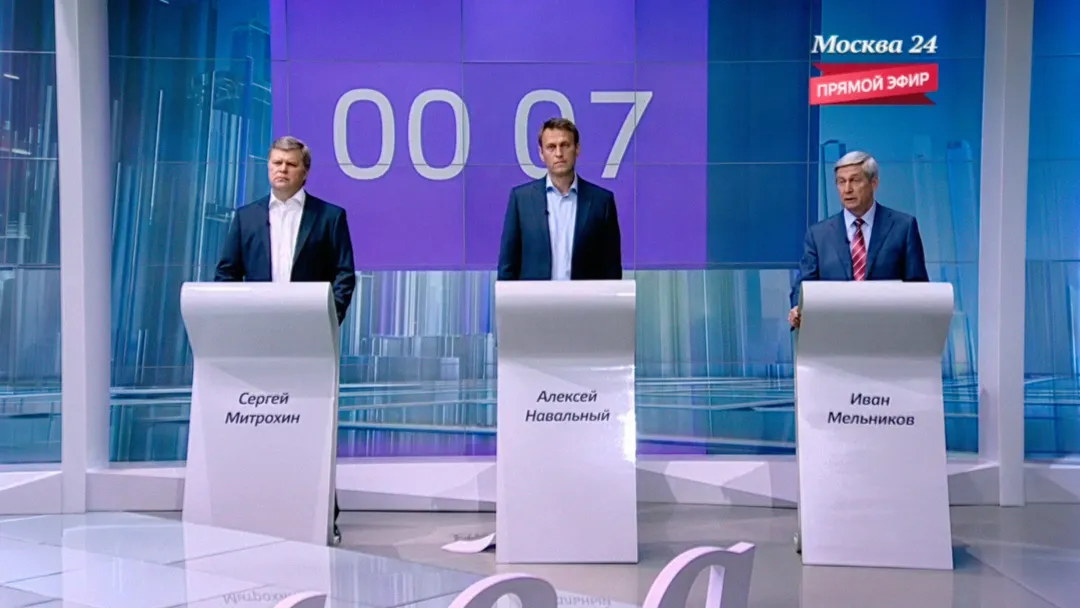
On the topic.
Transport is a very important and timely issue.
Every day, it concerns 1,000,000 Muscovites.
And I would like to begin, if I may, with a quick question, a quick poll.
And the first question I would like to ask.
A very, very popular question.
According to the drawing of lots we conducted, everyone is standing in the assigned order.
In accordance with those principles.
Nikolai Vladimirovich, how do you feel about paid parking,
about paid parking in its current form?
I view it negatively, because it is unclear why
a person who comes to the city center for work should have to pay roughly
10,000 rubles a month, which, in my opinion, is unaffordable for many Muscovites.
There is no justification for that.
Paid parking was introduced supposedly to fight traffic jams in the center.
But there are no traffic jams at night or on weekends.
Why should people have to pay 50 rubles an hour at night and on weekends?
My proposal is that parking in the center should be paid
only from 10:00 a.m. to 8:00 p.m. on weekdays, at 20 rubles per hour.
That is roughly comparable to what exists in major European city centers,
where it is affordable for residents and still helps maintain order.
Thank you very much for that answer.
Mikhail Vladimirovich, I have the same question for you.
How do you feel about paid parking?
Let us be clear.
Those who live in the center should not have to pay anything.
That is obvious, as is the case for people with disabilities.
But we need to understand that, of course, there should be a fee,
but it should be equivalent to a monthly metro pass.
In other words, a person should
choose either 1,200 rubles
for 60 metro rides, or 1,200 rubles
for a parking space for the month.
And the employer—
we understand that most workplaces and jobs are concentrated in the center.
People travel to the center for work, so employers should also make decisions
within the social benefits package: either 1,200 rubles for the metro or 1,200 rubles for a parking permit.
The same should apply to Moscow officials, deputies, everyone: 1,200 rubles.
I think that is a fair price.
Everything should be tied to the cost of public transport.
Either you take the metro or, of course, you park.
Thank you.
Sergei Sergeyevich, I have a similar question for you.
First and foremost, we must ensure equality for all Muscovites.
After paid parking was introduced
inside the Boulevard Ring, I conducted a public inspection and found
that, for example, State Duma deputies do not pay for parking, the Duma does not pay,
the Moscow City Duma does not pay for its guests, and neither does City Hall.
That should not be the case.
There must be complete equality.
That is the first point.
Second, of course, where there is a shortage of parking spaces,
where there is heavy demand, paid parking should exist,
but there should also be an alternative in the form of free parking.
In places where cars do not get in anyone's way.
In such places, the city should organize
free municipal parking lots.
There should be park-and-ride lots.
And people who use them should have the right to receive
free travel on public transport in Moscow for that day.
That would encourage people to switch from cars
to public transport and would help reduce traffic congestion.
Thank you, Alexei Anatolyevich.
The same question for the motorist.
This is, without a doubt, an important issue on which I have something to say.
But I would like to begin today's debate with the investigation
conducted by the Anti-Corruption Foundation, which became the reason for
an unprecedented raid on my supporters' apartment, which took place
yesterday, when police illegally broke into the home, at 4:00 a.m. sawed through
the door, intimidated people, and arrested my supporters.
This investigation concerns the elder daughter of Mr.
Sobyanin, who, as we found out, purchased for herself in St. Petersburg
an apartment measuring 204 square meters, worth 116,000,000 rubles,
which is five times greater than Mr. Sobyanin's income over the past 10 years.
First of all, I would like to address Sergei Semyonovich Sobyanin,
who is afraid to come to the debate, but I am sure is watching this broadcast.
If you think
that your police, your election commissions, and your other security agencies will somehow make it so
that we stop our investigation, you are mistaken.
Muscovites have the right to know where the children of high-ranking officials
get the hundreds of millions of rubles they throw away on apartments.
Alexei Anatolyevich, if you do not mind, still—
I am reading Life News right now; thank God there is internet here.
It says the apartment's owner gave permission for the search.
Well, Dmitry, do not read Life News; please talk to the people
who were yesterday dragged out completely illegally by their arms and legs.
And I think thousands of people saw it online.
You understand, the competent authorities will sort this out—about fair elections.
We should hand over, hand the floor to Ivan Ivanovich.
Please, go ahead.
You know, I will not answer this question directly at first, but will draw
a certain analogy with how I feel about paid education and healthcare.
I am reasonably okay with it, but only if
it does not replace free education
and does not replace free healthcare, but supplements them.
Unfortunately, life in both the country and in Moscow is arranged in such a way
that free
educational and medical services are being replaced by paid ones.
That is roughly how I feel about paid parking as well.
I believe paid parking has a right to exist,
but only when residents and citizens are provided with a sufficient number of
free parking spaces.
But if there is a huge area where there is no opportunity to park for free,
and only paid parking is available, I believe that is
abnormal, except perhaps in certain cases of
paid parking at office buildings, shopping centers, and so on.
Thank you.
My next question, essentially, was about how
public transport should be developed and whether it needs to be done on such a large scale.
But I think Nikolai Vladimirovich probably also
might want to give some time for some kind of response to Alexei Navalny.
And he asked a question
to him. I think we know the conflict.
Unfortunately, I do not hear Sergei Sobyanin here in this studio,
despite the fact that Nikolai formally—
On the question of public transport, please, you have one minute.
I believe that in the development of Moscow's transport system
priority should be given to public transport.
But since this conversation has come up, figuratively speaking,
the roadmap to a better future for our city lies
first and foremost in democratic procedures, in honest
and fair, transparent elections, when one candidate,
the acting mayor, promotes himself every day
on the main TV channels, directing things like a great leader,
Comrade Kim Il Sung, whether at a fishing collective farm or at a construction site,
Everyone understands that he is spending that time not on work, but on self-promotion.
And when another candidate,
who calls on people not to lie and not to be afraid, together with his associates
in the information
space, piles up layers of lies,
then that too is a path that leads us nowhere.
Democracy is procedures.
Whether we like them or not, they must be followed.
And if we do not like them, they should be changed by legitimate means.
The LDPR slogan is: Don't lie and don't be afraid.
Yes, if you want, you may object.
I'll give you a little time.
Vladimir, and...
Will the others get a chance at all?
The candidates? Everyone will.
Briefly, briefly.
To the respected candidate Levichev, I would say the following: if my complaints about candidate Sobyanin,
who first buys one daughter an apartment for 20,000,000 rubles, will not
then later organize raids on campaign headquarters, then that...
You see.
Nikolai Vladimirovich, Nikolai Vladimirovich.
Alexei Anatolyevich, as I understand it,
that conflict that somehow ended up being created between you?
Let's have Mikhail Vladimirovich answer the question, a very important
social question concerning public transport.
Given the current capacity of public transport,
it is only 800,000 passengers
into the city center during rush hour, from 8:00 to 9:00 a.m.,
while the actual passenger flow is 1,000,000 passengers.
Every hour during the morning rush.
Let's look. I took this from open sources. Unlike Alexei
Anatolyevich, we use open sources
for interesting data, not for dirty laundry.
The current mayor's office development strategy.
It says that the carrying capacity
of public transport will be increased to 1,000,200 by 2018.
At the same time, the forecast is 1.5 million.
So where is the logic in the current mayor's office?
We need to think ahead: new railcars,
climate control, new roads, new buses.
There is a clear imbalance in the mayor's office documents, in the strategy.
In my view, the focus should be solely on public transport.
Thank you.
Once again, this is the topic we chose together with you.
Two days ago, when the first round of debates took place.
Sergei Sergeyevich, please, you have the floor on public transport.
First of all, I believe that.
Today, those
projects being implemented by the Moscow city government,
are harmful to our city.
Instead of building new roads, they widen old ones, but traffic jams
will not decrease because of that; they will simply move from one place to another.
Most dangerously, these projects
are being carried out unsystematically and outside the legal framework.
If I become mayor of Moscow, then I
will base my transport policy on entirely different principles
— the principles of consistency, scientific planning, and a legal approach.
As a result, a new master plan for implementation will be developed.
Leading specialists, both domestic
and international, will be involved in drafting this plan.
And the priority in this master plan will, of course, be
given to the development of comfortable public transport.
Alexei Anatolyevich.
A major social question for you regarding the development of public transport.
Let's not speak abstractly about public transport.
I want to talk about something specific.
Just two days ago, the largest contract for
the construction of the Moscow metro was awarded: 550,000,000,000 rubles.
This tender went to a single company, and that is money for metro construction
for three years.
It was deliberately arranged.
The tender was designed so that it would go to one contractor,
who would then distribute subcontracts to his own organizations.
So it turns out that if previously the Moscow metro was built at a cost of
6,000,000,000 rubles per kilometer, which was twice as expensive as in Europe, now it will cost
9,000,000,000 rubles per kilometer, which is three times more expensive than in Europe.
And let's look at who the main contractors for metro construction are.
Are they metro builders?
Are they professionals?
No, we see all the same friends of Vladimir Putin there.
All those Timchenkos, Rotenbergs, all his St. Petersburg classmates and university friends.
So the enormous sums in the Moscow budget
must be used prudently, and we should build twice as much metro,
rather than simply feeding this endless St. Petersburg gang.
And do you know how much there will be today?
Spent on the metro through 2020.
You are now, you... Right now this is
what you want.
Tell me, 1 trillion is a microscopic contract,
if we look at the whole period from 2011 to 2020, I mean
a microscopic one and a half trillion.
In Moscow, a third of the city budget is 5%.
The issue is investment in the metro.
I am not defending the Rothschilds or anyone else.
You simply
differed on the figures.
We differed on the figures.
You are probably using different sources.
1 trillion for the metro is planned through 2020.
Ladies and gentlemen, the topic of public transport development is a proper and crucial one.
But I believe it is being handled poorly in Moscow.
It is being handled more for the benefit of business,
and not for the benefit of ordinary citizens, ordinary Muscovites.
Let's take the situation with the Moscow metro.
The metro is becoming an increasingly expensive
and increasingly dangerous mode of transport.
The ventilation works poorly.
Traffic jams have appeared in the Moscow metro, but not jams of trains,
rather jams of citizens who cannot get into a metro car.
Let's take dedicated lanes for public transport.
I will give a concrete example: bus route
No. 93 on Michurinsky Prospekt.
Well, it is perfectly obvious that when this route first began operating,
it worked well, and people got used to it.
But now the bus runs extremely rarely.
The main thing is to pack in as many people as possible, make it run less often, and squeeze out more money.
Ivan Ivanovich, if I may.
Do you ride the metro?
Yes, I ride the metro.
And how much does one metro ride cost?
Well, it depends on what ticket you buy: 28 rubles if you buy a pass, otherwise 30.
Well, just a clarifying question, in case.
Thank you. I have the next topic.
I have a good route.
Very interesting.
To Okhotny Ryad.
Ryad is talking about principles, about the principles of transport infrastructure development.
That is the expert view on this.
In June of this year, international transport expert V.
proposed at his lecture in Moscow introducing paid entry
onto the outbound highways, including, as we know, sections of Leninsky Prospekt.
Do you support such investments?
Could you move farther away?
You're hard to hear.
A question about toll sections on Moscow's outbound highways.
Yes, there was such an expert opinion.
Nikolai Vladimirovich, do you support that opinion?
I think the issue of outbound highways is much more complicated
than simply deciding whether they should be toll roads or free roads.
The fact is that all the outbound highways—and 19 of them are planned—
essentially end in a bottleneck
so to speak, and they will not make traffic jams disappear.
But they will significantly affect the well-being of residents
who live near the areas where these outbound highways are being built,
for example, parallel to Kutuzovsky Prospekt.
A highway that will cut through courtyards and recreational areas,
according to estimates, will reduce travel time by only 10 minutes,
but will cause enormous damage to the environment and
to the everyday lives of people in that area.
The widening of Shchyolkovskoye Highway has already led to the cutting down of
3,000 trees, which...
That came out.
Therefore, the problem of outbound highways
must be addressed systematically, together with all the other issues.
Mikhail Vladimirovich, how...
Experts in general should be...
Driven out of Moscow with a filthy broom, because for a Muscovite
there is no alternative to an outbound highway.
All over the world, a toll highway exists only where there is a free alternative nearby.
So please don't quote such figures anymore.
As for what is proposed in my platform, in the LDPR program.
All over the world there are reversible traffic lights.
When the flow of traffic in summer is toward the dacha (country house),
in winter toward the city center for work, and in the evening back from work.
And peak loads on the transport system are eased.
More precisely, public transport lanes are opened to motorists,
lanes in the opposite direction are opened, and so on.
In other words, there are many possible measures.
A green wave of traffic lights should work both outbound and inbound in the mornings.
So there are many measures that are not being implemented today.
And besides that, as I said, a differentiated
start to the workday is вполне possible, criticism.
Heavy traffic.
There was. About the fact that... it immediately increases.
The accident rate on the roads. This
traffic on Volgogradsky Prospekt is, of course, removed,
but runs into the usual capacity limits.
Sergei, you know about toll sections, but...
The proposal is, of course, absurd, including because—and this is the main thing—
the name does not correspond to
what is actually being done.
These are not so-called outbound highways.
Because there is nowhere to fly out to.
Where are you supposed to head out to from Yaroslavskoye Highway?
There are Mytishchi and Korolyov there.
The planned construction volumes are enormous.
There will be
a built-in transport collapse there.
Precisely because of this.
And Sobyanin's absurd projects to widen highways.
At one end there is a transport dead end.
In the Moscow Region. Which...
does not coordinate its urban planning and road policy with Moscow.
And if you become mayor, when will it end? And...
And in the center there is a transport dead end.
And all these outbound highways, all 19 of them, run into the transport collapse
that already exists in the center and on the Third Ring Road.
But there will also be added
additional capacity to this transport collapse.
At the same time, enormous budget funds will be spent
and a huge number of Muscovites will suffer.
All these projects must be frozen as quickly as possible.
Dmitry, literally 10 seconds just to make a small correction.
Of the 19 highways, in my view only the Yaroslavskoye one has any prospects.
I am familiar with... May I?
Correct that.
And it... practically...
There are practically none there. And he will leave the studio altogether.
May I correct that, Sergei Sergeyevich, if...
With all due respect, you do not know how the parking system works.
How it works,
today they are free for those who bought a round-trip metro ticket.
Two rides.
You said they should be made free
in Moscow. Come on, come on.
Let's respond to Sergei Sobyanin's criticism.
I don't understand you at all, that...
Everything is different, and you think in different categories.
Let's move on. Let's move on to Alexei Navalny.
Alexei Anatolyevich,
please comment on toll sections inside the city.
Dmitry, you began by quoting an expert.
Yes, I spoke with him several times, and I carefully
read all of his analyses, reports, and so on.
Because I want to be a professional mayor who does not simply consider
some isolated decisions, but tries to get to the heart of everything.
I can tell you that those proposals
that were quoted cannot be considered in isolation.
I agree with Sergei Mitrokhin: there are no outbound highways from Moscow.
We already had
that nonsense with Bolshaya Leningradka, into which an enormous amount of money was sunk
and we were promised that traffic would just fly along without traffic lights.
And every time we stand in traffic
on that Leningradka, we remember the 1,000,000,000 that was buried there,
he is talking first and foremost about the fact—and I completely agree with him—
that huge sums from Moscow's budget should not be
buried in these grand construction projects: the southern section of the MKAD (Moscow Ring Road), the North-Western Chord,
the reconstruction of Leninsky Prospekt—all of this is needed so that
contractors can enrich themselves, not so that the city can move faster.
If I may, very briefly.
If you become mayor, you will have to come to an agreement with the Moscow Region
to make sure there is no bottleneck.
Without a doubt, Moscow's transport problem
cannot be solved separately from the Moscow Region; it is one agglomeration.
I myself lived in the Moscow Region for many years; my parents live there too.
So I understand perfectly well that you cannot make things good here and not care about what happens there.
Ivan Ivanovich, please. Your solution.
I will not repeat some of the sound ideas my colleagues have already expressed.
I want to say the following:
unfortunately, the current Moscow authorities are structured in such a way
that it is profitable for officials to squeeze profit out of every centimeter of Moscow land.
And secondly, all problems
the Moscow authorities try to solve at Muscovites' expense, from paid parking
to major repairs of residential buildings.
And I view this idea in exactly the same context.
I believe it is unacceptable to solve all existing problems at Muscovites' expense,
at the expense of the pockets of those who are already barely making ends meet.
Indeed, all over the world such schemes are structured in such a way
only when there is an equivalent road that can be used free of charge.
it would be possible to introduce toll road sections or toll highways,
but not under any other circumstances.
Otherwise, it’s simply chaos.
Thank you. Thank you, I have a question.
I have a question that I’m sure everyone will appreciate, regarding this:
if you, Nikolai Vladimirovich, become mayor, naturally,
you will have to coordinate some of your decisions with the federal authorities.
Are you ready for that kind of dialogue?
In my
election platform, I noted that the mayor of Moscow
is a major political office in our country.
I appeal to the President of the Russian Federation that the mayor of Moscow, by virtue of the office,
should be included in the Security Council and, accordingly, have the opportunity
to speak with the federal authorities not from the position of a petitioner,
but from the position of defending the interests of city residents and the entire capital metropolis.
Therefore, I believe that
many of Moscow’s problems, including
the transport-related ones we are discussing today,
cannot be resolved without changes to
federal legislation, which today
is being lobbied for by the Moscow authorities, but not sufficiently in the interests of Muscovites.
I agree with Ivan Ivanovich: everything is being done to reach into the pockets of
ordinary citizens, Moscow’s taxpayers.
Thank you.
Mikhail Vladimirovich, the same question to you.
We need to understand what is beneficial for Muscovites.
Cooperation, including with the federal government, is also in Muscovites’ interests.
Some people say, “The president is bad, down with him, let there be conflict!”
But is your conflict really beneficial to Muscovites?
For example, I’ll ask Alexei another question later,
because it is in Muscovites’ interests for Moscow to have money,
and for Moscow to receive close attention from the federal authorities.
So of course we will.
And I want to say that I am the only candidate who says that together
with the federal government, we will adopt a development doctrine for the Central Federal District,
a unified one for the Moscow Region and Moscow, where it will be clearly spelled out
covering transport issues as well as food security,
a unified tariff policy, and a unified tax policy.
Because a Muscovite is not interested
in living in the center of a desert surrounded by regions.
With crime, with barren fields all around.
Moscow should be surrounded by prosperous agricultural,
beautiful regions.
That is beneficial for Muscovites.
Thank you.
Sergei Sergeyevich, the same question.
Well, I believe that, of course, the mayor of Moscow must maintain a dialogue
with the federal authorities, but in that dialogue he must not betray Muscovites.
He must not, for example, hand over Moscow’s property
to the federal center, as Mayor Sobyanin is doing today.
Non-residential premises are being handed over in batches, apartments are being transferred.
Where they go afterward, we do not know.
Yesterday, for example, Mayor Sobyanin handed over most of Moscow’s housing and utilities sector to Gazprom.
He sold the Mayak company.
That is, he effectively gave up the opportunity
to bring order to heat supply, make tariffs transparent,
ultimately reduce those tariffs, and deal with corruption in that system.
He handed all of that over to Gazprom.
Gazprom will not deal with it, because it is itself
a corrupt organization that inflates tariffs across the country,
and now it will inflate tariffs in Moscow with twice the vigor.
That kind of behavior will not happen in Moscow under me.
Thank you. Thank you.
Alexei Anatolyevich, I have the same question for you as well.
Let’s say you become mayor.
It is clear that there is also a certain federal interest here.
You are summoned to a meeting at the Kremlin—will you go, within the scope of those powers,
when I am obliged to attend a meeting, I will do what the
mayor of Moscow is supposed to do under the rules, and I will do what Muscovites expect from their mayor.
The mayor of Moscow is effectively the third-ranking official
in the country, controlling enormous sums of money and enormous power.
I will do everything
that I am required to do by law, but I will do it in the interests of Muscovites.
Right now the mayor
of Moscow relies on his voter, on his only voter.
Sobyanin has only one voter, and that is Vladimir Putin.
That is why Sobyanin does everything to please him, handing over all
Moscow contracts, from construction projects to school meals.
My relations with the federal authorities will be conducted properly,
but with absolute firmness, while defending the interests of Muscovites.
So, no Kremlin crooks getting Moscow contracts,
no Kremlin crooks taking tenders in the Moscow metro for themselves,
no Kremlin crooks taking over, as we said, housing and utilities companies,
under the law
there will be their own crooks, just like those who siphon off the budget.
Since we will not let the LDPR come to power, there will be no crooks,
so don’t worry.
Why, they’re siphoning off your campaign budget.
Have you already talked about your Cubas?
Six point five, while your campaign chief says twelve.
You yourselves
will we at least hear some evidence, since our Anti-Corruption Foundation
already has evidence on all these crooks.
I’m not talking about the LDPR right now, I’m talking about numerous officials.
We could use dump trucks
to haul all this evidence around; we have already bombarded the Investigative Committee with it all.
All these people, they...
Alexei Anatolyevich, let us, let us wait, let us wait for the decision
of the court, and then we will be guided by that judicial ruling.
So far, not a single official has filed a lawsuit against me in court.
Ivan Ivanovich, please.
Thank you very much. As a candidate.
Dear colleagues, dear Muscovites, I want to say that every serious
person who intends to become mayor of Moscow must understand
that he finds himself within a certain framework that he must take into account,
and within a certain system of federal laws that he must also take into account.
My entire socially oriented program for solving problems
of migration, housing and utilities, solving
the problems of the country’s industrial development, is written in such a way
and it contains very serious measures that can be resolved
within the current framework, based on the situation
with federal laws that the Moscow authorities are dealing with.
Another matter is that I believe the Moscow authorities,
Moscow as a whole, and the Moscow City Duma make very weak use
of the right
of legislative initiative to influence the adoption of important
federal laws that affect the most painful, most important issues.
Please give a little time to the others as well.
The mayor of Moscow must put before the federal authorities those tasks
that are vital for the city but fall within their jurisdiction.
Such as?
First of all, we have unprotected southern borders, if I may say so,
our border troops have been abolished.
Next year, we may...
When they leave Afghanistan, we will be talking about migration.
I think we can join the Security Council and raise these issues there.
We raised, we raised in the course of this discussion,
we raised the issue of the metro, and several statements have already been made.
I want to ask you, Nikolai Vladimirovich, what is your view?
First, what do you think about metro construction on such a large scale, and is it necessary in your view?
What should I say? About the metro?
Is it necessary to build and expand the metro on this scale, to keep extending it?
Please.
I should say that the A Just Russia faction in the State Duma (the lower house of Russia’s parliament)
every year, over the past three years, during discussions of
the draft federal budget submitted by the government,
has presented its own alternative budget, in which we found
funds for developing the metro systems of Moscow and St. Petersburg.
But I must say that simply increasing the number of
metro lines will not solve the problem.
Let me give you an example.
In many countries, light rail is five
to eight times cheaper than the metro and almost as effective,
especially on the outskirts of the city, which is highly relevant for Moscow.
Today, we hear the phrase “light rail” in the mayor’s office plans.
But there is no real priority given to developing this type of rail transport.
In Europe, a format such as a tram-
pedestrian street is very popular, while we barely even know what that is.
Thank you.
Let’s look at the plans that are currently in place.
Moscow currently has 185 stations and plans to build 67 more by 2020.
Of course, the metro is needed.
We need to understand that it is an efficient, fast, and excellent mode of transport.
But we also need to understand that there are shallow metro lines and deep-level ones.
And today officials are presenting us with projects, for example,
for shallow-level construction, saying that it is cheaper.
But take Ryazansky Prospekt, buildings 30 and 32,
where the construction is effectively shallow-level.
The metro there threatens an entire residential neighborhood.
So we need to approach this carefully; we should not cut corners on the metro,
including by bringing in contractors with extensive experience.
And the priority directions should of course include routes
to New Moscow (the territories added to Moscow in 2012), the eastern direction,
and, certainly, transport interchange hubs.
That is, today, at transport interchange hubs,
there are narrow corridors, stuffiness, and congestion—they need to be expanded.
Sergeyevich, what do you think of such plans?
Yes, metro development is necessary.
Of course, we need to build new stations and new lines; we need to build, to build a second
metro ring, because right now the center is facing gridlock.
There are simply too many people.
The train cars are extremely crowded, especially during rush hour.
It is necessary to relieve pressure on the center of the metro system
by effectively creating a second ring.
This is being done to some extent, but not enough.
More attention must be paid to safety in the metro.
And of course, I do not mean only public security.
At one time, I raised the issue of
installing emergency buttons when I was a State Duma deputy.
They were installed.
But we can see that lately less money has been allocated for safety measures.
And the result is
these very dangerous and troubling accidents, which have become more frequent recently.
I think more funds should be devoted to ensuring the comfort
and safety of metro passengers.
Thank you. And of course, stations should be built as well.
There is also the issue of overloading the power grid financially.
Alexei Anatolyevich, your turn—good heavens!
We should build a lot of metro, and we can build more of it.
Let’s simply look at the cost of the Moscow metro.
In Europe, one kilometer of metro costs between $50 million and $100 million.
In Russia, it cost $200 million.
Until recently, this was explained by the depth of construction.
After the latest corruption-tainted,
tender, apparently one kilometer of the Moscow metro now costs $300 million.
So what on earth is going on?
Why does it keep getting more expensive?
With the money available in the Moscow budget,
we can build more metro, and we should build it faster.
In China, metro systems are built roughly twice as fast and for far less money.
We should not just build it; we should finally start equipping
the train cars with air conditioning, with internet access, and so on.
Besides,
it is impossible to develop the metro in isolation from the rest of public transport.
If we build metro stations everywhere,
but a person
comes up to street level and sees some insane number of marshrutkas (shared minibuses),
taxis, and everything else, then that does not allow public transport
to function as an integrated system and properly carry and serve Muscovites.
We’ll talk about that too in a moment, but first the floor goes to you.
Ivan Ivanovich, thank you.
Without a doubt, I believe the metro is the most promising mode of transport for Moscow.
It needs to be developed further; I myself have been working on this issue for a long time.
And I was pleased.
I was recently at a rally in Mitino when some local residents came up to me
and thanked me for spending several years
pushing to have a metro line extended to Mitino.
But I believe we should not focus only on increasing the number of
metro lines and new stations; substantial attention must also be
paid to the safety, quality, and convenience of the Moscow metro.
To be fair, it must be said that recently in Moscow
more metro has begun to be built.
But I would not boast too much about that.
I am often
in Beijing, and the pace of metro construction there is roughly five
times higher than the current pace of metro construction in Moscow.
So I think Moscow still has very substantial room for improvement in this respect.
Thank you.
One very important point, in my view.
If I may, let me mention it briefly.
Today, the Moscow metro is not properly adapted.
I am not even talking only about people with disabilities and other passengers with limited mobility.
Fifty-four stations are not equipped, right?
That is a very serious shortcoming.
I was speaking about the metro.
Everyone, everyone now
will say it needs to be retrofitted.
It should be switched to low-noise wheelsets.
The noise in our metro today is terrible.
Worldwide, this is an anachronism.
Metro systems are already going public on stock exchanges.
And in the metro, Sergey Sergeyevich, there is also the issue of climate control.
It is very good now that one of the...
Let’s move this topic, let’s move this topic
to the next part of today’s program,
when you will simply be asking each other questions.
It’s just that right now
Alexei Anatolyevich said
a phrase about marshrutkas being “shahid taxis” (a derogatory expression implying they are dangerously unsafe)
that was the wording he used.
We campaigned against that,
whether marshrutkas are state-run or privately operated.
How can we make them safer?
I am very alarmed by Sergei
Sobyanin’s position, as he has proposed getting rid of route taxis.
As of today, there are approximately 600 such routes.
They carry 1.5 million people every day.
There are, of course, problems: drivers, migrants—there is also the problem
of illegal routes.
But as things stand today, this mode of transport cannot simply be abandoned.
I understand that it is, of course, easier to ban it than to put things in order.
That is painful and not particularly beneficial for officials, among others.
But in fact, as Ivan Ivanovich already mentioned,
when transport capacity is being calculated,
it turns out that a bus with a larger passenger load
will simply come less often, and people will wait at stops
not 10 minutes but 20, not 7 minutes but 15 or 25.
So marshrutkas (shared minibuses) are needed, but they need to be properly organized.
Thank you, Mikhail Vladimirovich.
We need to start with transport interchanges.
Moscow practically has none of them.
At every metro station exit, we see shawarma stands and so on.
All of this needs to be cleaned up and made presentable.
There should be convenient surface-level transfer stations.
And in the plans, by the way, that the Moscow Department
of Transport has partially revealed to us, there is mention of this as well.
The only thing that is unclear is how many and when.
By my calculations, there should be 200 transport interchanges.
Marshrutkas need to be brought into decent condition.
It is quite possible that some of them should be city-run,
perhaps even the dominant share, with fixed
fare documents.
Travel on marshrutkas should be included in the unified transport card,
just as buses, trams, trolleybuses, and the metro are today.
By the way, that is a real breakthrough.
Private operators should not be involved there; I mean state-run marshrutkas.
It is a very efficient, fast mode of transport, but it must be safe
and under control.
Thank you. Sergei Sergeyevich, you have one minute.
Of course.
Marshrutkas must not be banned.
In a situation where we have a very difficult transport
situation, every passenger should have the right to choose how to travel.
But, by the way, passengers can be helped with that by creating a system
of GPS navigation for passengers.
This is an American system.
In many, many regions of Russia, this system works and helps people
quickly decide how to get somewhere faster and avoid traffic jams.
We do not have that.
But, of course, marshrutkas must be regulated, and stricter requirements must be
imposed for technical inspections, because these vehicles are often unsafe.
And such drivers should, of course, be removed from this work.
There must be proper transport oversight
not only for marshrutkas, by the way, but for other types of transport as well.
And, of course, crime needs to be driven out of this sector, because in the sphere
of marshrutka routes there is a great deal of it.
These are simply bandits who should be put in prison.
Thank you. Thank you, Alexei Anatolyevich.
Look, I live near the Maryino metro station.
Until recently, it was the terminal station.
And people who got out near the Maryino metro station and wanted to go farther
to Dobrodeyeva, Zyablikovo, and so on—how were they supposed to get there?
By a bus that runs every 30 minutes?
Naturally, they used marshrutkas.
And all those Muscovites who currently lack
normal public transport use marshrutkas.
Marshrutkas are simply a sign that the transport system is working poorly.
That is exactly why I spoke about surface transport.
We must develop it.
We need more normal, good buses.
We must put the tram system in order.
What is a modern Moscow tram?
It is some kind of relic from 1968.
Modern trams, two-
car trams that move silently and can carry
huge numbers of people—that is what Moscow needs.
Normal, modern buses.
When we create a modern surface transport system
in Moscow, all these marshrutkas will disappear on their own.
There is no need to fight the symptom; we simply need to treat the disease.
Then marshrutkas will not be a problem.
By the way, a metro station will open there soon.
If I am not mistaken.
The next metro station has already opened near me—the one that was supposed to be called Brateyevo.
But Sergei Semyonovich Sobyanin, as everyone knows, named it
Alma-Atinskaya metro station.
All the residents collected 100,000 signatures, but they were ignored.
The metro station has already been opened. Thank you, Ivan Ivanovich.
I am in favor of having marshrutkas.
But I believe
that three conditions must be met.
First, marshrutkas must be under strict control by the Moscow authorities.
Second, the quality of the vehicles
that go out on the routes, and the convenience and comfort of that transport.
Excuse me, it is not even up to 20th-century standards, and we live in the 21st century.
And third, the drivers who operate marshrutkas.
In this connection, I want
to mention one serious problem.
Around Moscow, in the surrounding regions,
there are about 1.5 million Russian citizens,
who want to get jobs in Moscow,
and among them there are quite a large number of professional drivers.
I believe a system should be created in which marshrutkas will be
driven specifically by our own citizens who want to obtain
jobs in Moscow, rather than migrants, who are very profitable to exploit.
Thank you. Thank you. I mean, they should be the ones driving them.
I asked these questions specifically because
we wanted to hear your answers to them, since this is a popular issue.
Now you will have an opportunity to ask each other questions.
Questions.
The format is this: 30 seconds for the question, one minute for the answer.
According to the draw, Nikolai Levichev is number one.
Please, take your place at the central podium.
The question—and you ask the question.
Nikolai Vladimirovich, you are first, please.
Thank God, Nikolai Vladimirovich came without an angle grinder.
You have 30 seconds.
Dear Nikolai Vladimirovich,
you know perfectly well
that the carrying capacity today of both the Moscow Metro
and surface transport falls far short of the number of
passengers using the transport system.
So tell me this: the current authorities
are trying to do many things, but nothing seems to work out.
What will you do?
And by the end of your term, what will the carrying capacity of Moscow's transport system be?
You have one minute to answer, please.
Of course, I am unlikely to solve this complex problem in one minute.
But I can start from the points I have already mentioned.
The same high-speed tram that Alexei Anatolyevich also praised
can reach speeds of up to 90 kilometers per hour (56 mph),
and the number of cars can be more than just two,
And in some cities, the number of cars in a high-speed tram
in Europe is comparable to the number of cars in a metro train.
Therefore, this kind of development of modern means
will sharply increase capacity.
Take the trolleybus, for example.
Moscow’s streets are packed today with trolleybuses that are unreliable and uncomfortable.
They are not popular.
Time and again you see one traveling in its dedicated
lane with just one or two passengers inside.
Europe gave up trolleybuses long ago, even though, it would seem,
we still consider them a tremendous mode of transport.
London has been without them since 1962, Berlin since 1973.
All of this can be increased dramatically.
We should switch to other, more efficient means.
We have very little time left.
We have to give everyone a chance to speak.
Sergei Sergeyevich, please, your question.
Nikolai Vladimirovich, you quite rightly criticized
these major thoroughfares, so I have the following question.
When the Yabloko party was organizing protests against the widening of Komsomolsky
Prospekt, we managed to beat back that project. In the case of the reconstruction of
Leninsky Prospekt as well, and also, incidentally, the widening of Shchyolkovskoye Highway
and Entuziastov, which you mentioned, and against the duplicate road for Kutuzovsky Prospekt.
Why did your party not take part in these protests?
Why didn’t you fight for the rights and interests of Muscovites?
We have one minute.
Sergei Sergeyevich, apparently we have a habit here of not looking around
and not paying attention to what others are doing.
So I can tell you that the regional branch of the party
A Just Russia in Moscow was also dealing with these issues,
held its own rallies, and took part in rallies
organized by citizens’ initiative groups.
We know all these problems very well, and we also believe.
I think Ivan Ivanovich Melnikov feels the same way.
You didn’t see it, but we did.
We saw it
plain and simple.
Ivan Ivanovich Melnikov.
We also believe that we made our contribution to the public outcry that ultimately led
to the decision by the current city administration
to postpone the reconstruction of Leninsky Prospekt.
We hear citizens and organize.
Let me show you this first issue of the brochure Topical Moscow, which has already been prepared
during the election campaign on the basis of citizens’ appeals.
Some of the transport problems they raised with me are addressed here.
Thank you.
The issue, dear voters, will be based
on your proposals.
Alexei Anatolyevich, what would you like to ask Nikolai Levichev?
Nikolai Vladimirovich, judging by the fact that yesterday, together with your deputies,
you personally took part in a raid
on the apartment of my supporters and practically sawed through the door yourself,
you are clearly a very energetic man with a great deal of free time.
You are a deputy, a deputy speaker.
You receive a salary of 200,000 rubles (about $6,000 at the time) from the state budget.
Perhaps you could direct your energy toward
fighting corruption in the construction sector?
Here I agree with Sergei Mitrokhin.
You have done nothing in Moscow, and your party has been nowhere to be seen.
Maybe you should do some actual work instead of
using an angle grinder?
You have one minute to respond.
Well, I do not consider it necessary to justify myself when the information space
continues to be filled with blatant lies.
For many years now, our party has publicly
spoken out in the interests of Muscovites, in the interests of ordinary
citizens, criticized the authorities, and put forward its own proposals.
We simply believe that the existing system must be fought
not by underground methods, because dishonest methods,
unworthy methods, will never lead to a proper, just goal.
Alexei Anatolyevich, first you say it is your campaign headquarters, then you deny it?
You publicly stated that you had nothing to do with it.
These are people who live in that apartment.
You cannot saw through a door without a warrant,
you cannot come to people’s homes and force your way into their apartment.
That is elementary.
My role was that, following an appeal from
citizens who were being disturbed by your supporters at night,
carrying illegal campaign materials up and down to the fourth floor.
Please let me speak.
I contacted the appropriate law enforcement authorities.
To Alexei Navalny.
Now tell me, please, is this the biggest problem in Moscow?
My supporters carrying boxes, or is there a real problem?
In Moscow today, the real problem is an election that will be unfair and non-transparent.
And on your side, you are contributing to that as well.
Thirty seconds for Ivan Ivanovich.
Ivan Ivanovich, please.
You have the floor.
It has long been time to give a full minute
to ask a question, because I keep getting somewhat cut off.
Please. I...
I won’t be sawing anything.
May I have the chance to ask my question, Ivan Ivanovich?
Can we restart the timer? Or not?
Please restart the timer. Thank you.
Please restart the timer.
I had begun to say, Nikolai Vladimirovich, that already during the election campaign, on July 24,
the Moscow authorities announced plans to build a major
shopping complex on Leningradskoye Highway near Voykovskaya metro station.
They justify this by saying that the authorities
understand that these facilities will attract additional flows of cars,
but the city must fulfill its obligations to the investor.
How can construction be allowed when it is already known in advance
that it will lead to even greater transport problems?
Document.
Well, naturally, I completely agree with you.
The point is
that a huge number of transport problems stem from the fact that for 10 years,
or perhaps even longer, the Moscow authorities did everything contrary to common sense.
Where do transport problems come from?
Because we live in one place and work in another.
Children often have to be taken to school and kindergarten in a third location.
Within walking distance
there are no decent shops or services in residential districts.
So people have to go somewhere else to stock up on groceries.
And shopping and entertainment centers, naturally,
create enormous transport problems around themselves.
And the investor does not care about that, because he has already burned through
the allocated budget, as we all know very well.
How people are supposed to get to and from that shopping center is of no concern to him.
What we need to do, I repeat, is solve these problems
comprehensively, moving offices and shopping centers closer to where
people live. Thank you.
Nikolai Vladimirovich, please take your place at the podium.
Vladimirovich.
Please take the central podium, and Nikolai, your
your question, please.
Yes, of course.
I’ll show Mitrokhin all the materials and a few other things later.
Nikolai Vladimirovich, please, your question.
You have 30 seconds.
Well, one.
The trousers are fine.
Since you seem to understand the issue so well, I want to ask you this.
In Moscow today, fares for any form of public transport
are almost twice as high as in any other city in the Russian Federation.
I won't even compare the quality of transport services with Europe,
the level of comfort does not match the price.
What needs to be done to bring them down?
What needs to be done? First.
As soon as Moscow voters elect me mayor, we will freeze for five years
all tariffs and conduct a full audit
of everything from housing and utilities tariffs to transport.
To keep prices from rising, we need to find internal reserves.
And does Moscow's transport system have such internal reserves?
We need to understand that the cost of a fare is not just fuel and lubricants,
it's not just capital investment; today it also includes administrative expenses,
spending on officials, and other needs.
More broadly, when it comes to transport, you need to understand that we must move
places of employment out of central Moscow.
All business activity.
We simply need to relocate all business centers, the maximum possible number
of government institutions, and all housing construction
to New Moscow (the expanded territories annexed to the city), along with new student campuses and so on.
But we need to start by expelling 2 million
migrants from Moscow, who are exploiting our...
Sergeyevich, please, your 30 seconds.
Mikhail, in answering the host's last question, you said something absolutely
correct: that Moscow should be governed by Muscovites, not outsiders.
And don't you think that, to be consistent,
let me finish my question, that you ought to withdraw your candidacy,
because you're not a Muscovite—you came from Samara—and that you should withdraw it
specifically in my favor,
because I am the only one of all the candidates who was born in Moscow
and am a native Muscovite. Wonderful.
I do not divide Muscovites, Sergei Sergeyevich, into natives and newcomers.
I am a new Muscovite myself, and I want to reveal something interesting to you:
80% of housing is bought by young,
active people who come from the regions, who work here,
who want to make Moscow better and who tie their future to Moscow.
So there's no need to boast about your origins.
And you keep walking around with your programs
and reports—I already told you—nobody needs them.
You'd be better off...
You'd be better off doing what Mikhail Degtyarev did and putting out something useful like this,
at least doing something for Muscovites—like this free metro map.
You've had 10 years in public service. That's the report people need from you.
You mentioned, you mentioned in the previous round that
you supposedly stopped the construction of a cement plant in Pechatniki (a district in Moscow).
Let me remind you: the LDPR held five rallies and has been running around Moscow...
Helping groups that are defending
their courtyards, all their lives.
Thank you.
Hello, Mikhail Vladimirovich.
It's very hard to interrupt him, he just keeps going anyway.
Alexei Anatolyevich, please, your 30 seconds.
You'll still have time for debate.
Please,
please.
30 seconds for Alexei Navalny.
Show some respect, friends, let's not do this.
I'll ask a question, Mikhail, because you just said
the right thing: let's freeze tariffs for five years.
The question may not be entirely about transport, but it's related, as Sergei
Mitrokhin already said: just the other day
Mayak was privatized in a completely unprecedented and corrupt manner.
Is your faction, by the way, your faction ready to raise the issue
and send it to the prosecutor's office to investigate this MOEK spectacle?
Let me remind you of its history.
This is an organization created by Luzhkov, a middleman company,
which produces virtually no heat, no energy, nothing.
It was created for one purpose alone back under Yuri Mikhailovich (Yuri Luzhkov, former Moscow mayor),
whom we, our faction, as you know, quite successfully
tried for a long time to unseat, and President Medvedev
made the decision to open a criminal case against Sobyanin over the privatization.
As for the privatization, if it was carried out within
the law, then of course there will be no criminal cases.
But on the political level, I want to emphasize, we will of course
raise this issue.
All energy companies that serve
Muscovites must be accountable to the mayor; that's obvious.
And as for Mayak, the best thing would be simply to liquidate it.
It's a shell intermediary, it has no real existence; it buys heat
and energy from other companies. That's all.
All networks
should be transferred to the state, to the mayor's office balance sheet.
Ivan Ivanovich, please, your 30...
Seconds, Mikhail Vladimirovich.
On one television program, Moscow Deputy Mayor Mr. Khusnullin came with investors,
rather than with initiative groups of Muscovites, to discuss
urban planning and transport issues.
My question to you is this:
whom will you choose as your deputy mayor?
And will your deputy mayor act the same way?
Will investors, rather than citizens, be the priority for him?
Thank you. Excellent.
Of course, of course.
I want to emphasize that Mikhail Degtyarev's team
will be formed from different sources.
The first is the party, obviously.
The second is some capable current officials—not all of them are scoundrels.
We need to understand that.
Third, there are completely new people who cannot break through.
As I've already said, the reinforced-concrete slab of Moscow's власти,
if we're talking about the team in the broadest sense of the word.
Today we launched the website Team of Moscow. MSK.
Ru—you can find it on my Twitter and social media.
We are recruiting the most talented people, including for the construction sector.
At 99%, of course, there will be a different deputy mayor for construction and for transport.
I can put it this way: Maxim Liksutov and I will...
sit down at the table and discuss it.
What he is planning is generally not bad, but it needs to be adjusted.
Please take your places at the podiums, because...
Sergei Sergeyevich.
Nikolai Vladimirovich will now come here and answer the question. You have 30 seconds.
With respect, Sergei Sergeyevich.
I'm not very fond of today's rather fragmented discussion,
because in this format it's difficult to talk about an integrated transport system,
which Moscow does not currently have, but should.
Interchange transport hubs, for example, are only one fragment of the solution.
The main problem is that our different modes
of transport are completely uncoordinated with one another,
there is no unified management system, and traffic lights are not centrally controlled.
In your view, what needs to be done to make the system unified?
Yes. We need to
develop a concept for Moscow's transport development,
which must be closely linked to urban planning policy.
This must be done on the basis of scientific approaches.
And strictly within the framework of the law.
Right now, none of that exists.
There is neither a scientific basis nor any systematic approach.
And there is no rule of law either, because we are living under a stillborn master plan.
Moscow has already outgrown it, the master plan is outdated, and under conditions of such arbitrariness
and lack of any systematic approach, we are setting ourselves up for further
transport chaos and a worsening traffic collapse.
And on top of that, enormous sums from Moscow’s budget are being stolen through all of this.
So if I become mayor, I will address all these issues systematically.
By developing a scientific concept for Moscow’s development.
It will be discussed with Muscovites
at genuine public hearings, not sham ones like the current hearings.
And on that basis, a comprehensive program will be developed
to solve Moscow’s transport problems, as well as other urban problems.
It will be developed on a scientific basis.
No, this will happen very quickly.
Sergei Sergeyevich, but we have already clarified the issue of park-and-ride parking lots.
You have never been there and do not know that upon presenting
a metro ticket, they are free.
So I would like to ask you a question then. And as for the transport development strategy,
you have not heard anything about that either.
It exists; it simply needs to be adjusted.
And, as you rightly say, this issue must be approached scientifically, you see,
how many park-and-ride parking lots should there be, in your view,
how many parking spaces, and how many will you create by the end of your term?
You know, I have already said what I would create.
These specialists will be brought together—actual scholars, the kind you are talking about.
As I see it, a scientific framework will be developed here, by the way,
I am telling you, right now no one needs this from you.
There will be developed
a comprehensive concept for transport and urban development.
Before it comes into force in the form of a new master plan,
local problems will be addressed.
Yes, park-and-ride parking lots will be built,
yes, these very bottlenecks will be widened,
wherever it is possible to build
a small tunnel or an interchange that will not provoke any protests.
But today, none of this is being done.
Some roads will be laid, but major projects, including
through-traffic projects that should not interfere with the urban environment,
including a system of
light rail transport, and so on.
All of this will be developed on the basis of
a clear scientific concept and formally put into effect.
Alexei Anatolyevich, please ask your question.
Nothing is clear.
30 seconds.
Sergei Sergeyevich, you are of course following the situation around Leninsky Prospekt.
I know you have devoted a great deal of time to this issue.
A very strange thing is happening there.
At first, all the experts and specialists
said that reconstruction was unnecessary, but Sobyanin and Moscow City Hall said no,
all the experts are fools, reconstruction is needed. Now, because residents are protesting there,
Sobyanin said, well, fine, we will not do it.
The reconstruction of Leninsky Prospekt.
The question is:
Do you believe that City Hall will not deceive the Muscovites living on Leninsky Prospekt?
Do you think this demonstrates that there is no system at all,
that there is simply no system whatsoever?
I have already spoken about this.
As for Leninsky Prospekt, the project is monstrous, first and foremost.
Why?
Because the supposed well-being of some Muscovites—motorists—
is being achieved at the cost of the misery and suffering of the people living in those districts.
Their living space is being cut back, their familiar
urban environment is being destroyed, and for them the transport situation is only getting worse.
They spend more time
just to get onto this roadway, which is supposedly going to
move at tremendous speed, but in fact it will not
move at tremendous speed, because it runs straight into the city center.
And on the sides there are once again the same
bottlenecks that no one intends to widen.
This is merely a way of shifting traffic jams from one part of the city to another.
At enormous public expense, and at the cost of the suffering of hundreds of thousands of Muscovites,
if we take into account not only Leninsky Prospekt but also these other chord highways and so on.
Therefore, the guarantee that this will be done properly
Ivan Ivanovich, will have to fit into 30 seconds for these districts.
Sergei Sergeyevich, you are surely familiar with the problem faced by the residents
of the settlement, who insist that Nikolaya Street be removed from the project for the parallel route
to Shchyolkovskoye Highway.
If this is not done, there will be destroyed
a green square—a unique green space—that separates the residential area
from the industrial zone of CHP-23 (Combined Heat and Power Plant No. 23), and so on.
What is your view: why do the Moscow authorities refuse
to engage in a normal dialogue with city residents?
I already addressed this issue at
the previous debates.
They do not do so because they came to Moscow from far away.
They do not love Moscow, they do not respect Muscovites, they do not understand
what Moscow’s parks are, what public squares are.
Green spaces are being ruthlessly destroyed, including
under the guise of beautification.
And this sort of provincial aesthetic of tidying things up
is the main reason.
I have great respect for the residents of that settlement.
At one time, I fought for the demolition of the so-called final houses there
in the settlement, and for relocating people into normal, non-toxic, environmentally safe housing.
So far, I have only managed to get one building demolished—blown up in the literal sense of the word.
But not everyone has been rehoused yet, because the Moscow government
is not thinking about this problem.
This again is exactly what I was talking about.
It does not respect Muscovites; I would even say it despises them.
It believes it knows better than Muscovites themselves how to make them happy.
And Muscovites are treated like some kind of foolish children who must
constantly wait for this happiness.
I will address all issues in dialogue with Muscovites.
Thank you, Alexei Anatolyevich, please.
Nikolai Vladimirovich, please ask your question.
You have 30 seconds, no digressions.
Here are your 30 seconds.
We have gone through quite a few modes of transport,
but for some reason we forgot to mention one of the most important.
The one colloquially known as Number 11—the two feet.
What is life like for pedestrians in Moscow?
In 2012, more than 5,000 pedestrians
were struck by vehicles.
What do you think needs to be done so that pedestrians
in Moscow can feel comfortable and safe?
Thank you, Anatolyevich.
There is even a well-known saying
among many urbanists, city planners, and architects, who say
that the main way of getting around a city, and the main means of transport, is your feet.
So, of course, Moscow must finally become
a city that is comfortable to walk in.
Right now it is impossible to walk around freely everywhere because of chaotic parking; sidewalks
are clogged, pedestrian crossings are practically nonexistent, and so on.
The Moscow mayor’s office should solve this problem through basic planning and calculations,
through basic planning, what we are seeing now.
But this is, once again, you know, a kind of urban-planning chaos.
It has become fashionable to say: let's create a couple of nice pedestrian zones
and set up a few comfortable areas for Muscovites.
They made some nice pedestrian crossings there.
Everywhere else, the chaos remained exactly as it was.
This is not a task for the Master Plan.
Moskomarkhitektura (the Moscow Architecture Committee) and the other relevant bodies must
finally plan how all of this is supposed to be organized.
And if these decisions have been planned, they need to be implemented firmly.
Because to get cars off the sidewalks,
the authorities and the police already have the power to do that.
Ilyich, please, your question.
As for that...
I have already said: plan everything and use the measures that already exist.
DEGTYAREVA: The traffic police now...
Alexei Anatolyevich, please. We...
We have witnessed all these conflicts and the Prosecutor General's Office inspections.
There are suspicions that your associates are skimming your own campaign budget, including through Goop...
and through Yandex.Money, and so on.
Tell me, today the cost of one kilometer has fallen
for the road and bridge network to 3,000,000,001 rubles.
How much will it be under you, and how much will be skimmed under you?
That is the question.
You have one minute.
Mikhail, I am proud that my election campaign is being funded
by 1,000 people through small donations, and they continue to fund it.
And note that after those ridiculous remarks by your party leader,
we received an additional 3,000,000 rubles, because they were so absurd,
because your statements simply amuse people.
The people who are funding us,
the people who
are funding the election campaign, believe that
we are acting competently and with complete transparency.
That is precisely why, unlike you, who live off the budget, off
my own money, your party exists, while our Anti-Corruption Foundation exists as well.
And our election campaign
is funded with complete transparency; people continue to send money.
The main direct donors to our election campaign
are women between the ages of 50 and 57.
These women trust us, and they want at last to fund
a clean, honest campaign.
We should give the floor to Sergei Sergeyevich.
Please, Sergei Semyonovich, your question.
How much will 31 kilometers cost? Where is the answer?
Unfortunately, we are already at 30 seconds.
He dodged the question.
They will keep skimming just the same. That is the question today.
I am grateful to you for supporting
my initiative to find out why
Mayak was privatized.
Because by doing so, the Moscow government effectively gave up control over housing and utilities services.
Are you ready to join
my request to the prosecutor's office and the Investigative Committee regarding this project?
With pleasure, Sergei Sergeyevich, I can tell you and inform you that
the Anti-Corruption Foundation has already sent requests to the Prosecutor General's Office
and to the Investigative Committee, because we know for certain
that no proper valuation of Mayak was ever carried out.
We can clearly see, and everyone can already see, that this
will lead to complete monopolization; a 100% monopoly is emerging.
This monopoly will twist the arms of Muscovites
and everyone who lives in Moscow, everyone who works in Moscow.
Therefore,
you can join our request, and we will join yours.
I am in fact calling on everyone here, the State Duma deputies now standing
in this studio, not to pull the blanket over themselves, but finally to make sure
that at least once in modern Russian history
we deal properly with one corrupt case of illegal privatization
and ensure that this illegal privatization, which affects
15 million Muscovites, is overturned once and for all.
You and I do not have the authority, but at least the deputies here
from the State Duma, if they make the necessary request,
Ivan Ivanovich, please, your 30 seconds.
Several months ago, the mayor of Moscow instructed one of his deputies,
Mr. Khusnullin, to meet with residents of microdistricts 51 and 52
in the Marfino district, who have a whole range of problems.
He still has not met with them.
Alexei Anatolyevich, I remember the question you were asked last time.
I would like to ask you a similar question.
If you become mayor,
who will be your deputy mayor for housing and for transport?
Will it be one person?
Or two different people?
Thank you very much, Ivan Ivanovich, for the question.
As I said in the previous debate, in the second round of this election
we will publish detailed information about the personnel composition of our team.
I assure you that our transport specialist will be the better specialist.
A lot of different quotes from experts have been mentioned here, transport experts and others.
For me,
these are not just quotes; these are experts I have personally spoken with.
So the time I spend studying transport problems
both in terms of the corruption that occurs in the implementation of
construction contracts and simply in terms of studying urbanism—well,
I cannot, I probably
cannot say for certain that I devote more time to this than all the other candidates,
but I do devote an enormous amount of time to it.
So I assure you that my team,
which will deal with transport and urban planning
and city planning in general, will most certainly be
the strongest, because this is the most important area for the city of Moscow.
And we see that the colossal sums being allocated
can be used effectively.
Ivan Ivanovich, please take your seat.
And now Nikolai Vladimirovich Levichev will ask his question.
Please, your 30 seconds, Nikolai Vladimirovich.
Ivan Ivanovich, well,
it seems to me that in our chaotic discussion we have completely forgotten one more mode of transport.
The Moscow mayor's office, supposedly to keep up with the times, put
bicycles on the streets and even created a certain number of bike lanes.
And now a person who believed this was done for
their benefit gets on a bicycle, and then often
either rides onto the sidewalk meant for pedestrians or suddenly darts into some
lane for
dedicated public transport and ends up under the wheels.
Thank you, Nikolai Vladimirovich.
You know, at one of my meetings with Muscovites,
one of the people there
who took part in the meeting gave me a disc.
He is a cyclist himself.
He tried to ride the route from Poklonnaya Gora (a memorial park in Moscow) to Park Kultury.
He was unable to do it.
Someone seriously set Sergei Semyonovich up.
Really.
I mean that quite seriously.
But why do things like this and set the mayor up in this way?
But seriously speaking, you know, Moscow has an enormous number of problems,
and neither bicycles nor these decorative little flowers,
which, so to speak.
We're going, right?
Still, this here—instead of asphalt,
these paving tiles, they don't solve these problems.
You know, it's a bit of
something to report on, to improve the atmosphere.
But are you seriously
going to think about it?
Thank you. Thank you, Mikhail Yuryevich.
By the way,
regarding bicycles, Ivan Ivanovich, with great respect, but I saw you
on television riding a bicycle without a helmet.
It's outrageous that you're promoting that.
It's dangerous.
And now a question. The next person to answer.
The next question is this.
We recently held a rally; we're constantly fighting illegal gypsy cabs,
the so-called unlicensed taxi drivers who swarm around Moscow, driving on transit plates,
on foreign plates, paying no taxes, robbing people, and so on.
What will you do about this?
We propose expelling all of them and leaving it only to the state, so to speak. Yes.
But first, about that episode you saw on television.
Mikhail, the thing is, there was a youth bike ride in support of me.
Were they without helmets too?
No, no, everyone had helmets on.
They were riding through the city, along the streets of Moscow.
They simply asked me to ride a lap around the square,
to make sure I'm still perfectly capable.
That I can still sit on a bicycle.
A publicity stunt, Ivan Ivanovich.
Mikhail Vladimirovich, yes.
Now, as for the illegal cab drivers.
You can't.
As for illegal cab drivers, of course this must be fought decisively.
Absolutely decisively.
I've already said that around Moscow, and in Moscow itself,
there are huge numbers of people who would like to be car
drivers.
But unfortunately, their labor is not in demand.
That's very sad.
And, by the way, in Moscow a huge number of
driving schools and professional driver training programs have closed.
This situation needs to be corrected, and these people need to be directed into work.
Thank you, Sergei Sergeyevich, please.
30 seconds, Ivan Ivanovich.
Your platform includes a very sound initiative,
I have it in my platform as well: to review the law
that deprives residents of New Moscow of their property rights.
But how are you going to implement it if your faction in the State Duma
actually voted for that law—60 percent of them did.
And it also votes for the foreign agents law and the Dima Yakovlev law (the Russian law banning U.S. adoptions of Russian children).
How do you feel about all that?
You seem like a decent person, yet your faction votes this way.
That's just how it turned out.
Today we're discussing transport.
Please, Sergei Sergeyevich.
And I'll answer very specifically.
The Dima Yakovlev law.
Since the 1990s, our faction has consistently held the position
that the adoption of Russian children must be categorically prohibited, no matter by whom.
And we have never departed from that consistent position.
Ivan Ivanovich, by Russian citizens.
The way we said it made it sound as if, in general...
Foreigners.
It's not just foreigners.
As in, foreigners.
Of course, in this case we're talking about...
New Moscow, simply put.
A-and we are categorically against adoption.
We believe that a child under 16
should be raised in their own country, and then later can make that decision.
As for foreign agents.
You know, since the 1990s we've had foreign advisers working in the government,
or someone drafting a program for us
to transform Russian education.
Thank you. Alexei Anatolyevich.
Many people were allowed
to finish. For.
Five seconds. All right.
I am against external interference in Russia's internal affairs.
Thank you, Alexei Anatolyevich.
Please, your 30 seconds. Ivan Ivanovich.
Here in front of me is a list of the largest road contracts in Moscow.
By a remarkable coincidence, among those carrying out
these road contracts, I don't see any professional road builders.
But for some reason, every other one is a friend of Vladimir Putin.
I'm looking here: a 4 billion-ruble contract—Rotenberg;
56 billion rubles—Rotenberg; 8 billion rubles—Timchenko; 21 billion rubles—
Timchenko, and so on.
My question to you is: how did all these people appear, and what are we going to do with them?
And how will you break up this mafia?
So, I believe that in Moscow there is, in principle, a colossal problem
of monopoly—monopoly in construction, monopoly in road building.
Small and medium-sized businesses have been completely strangled; they can't function.
They've been strangled by taxes, strangled by rent, and so on.
As mayor of Moscow, the first thing I will do is create a normal competitive environment.
When there is a real market, genuinely different companies will be working
in housing construction, and different companies will be working in road construction.
That will significantly reduce costs and create a situation in which...
May I clarify: will you drive out those people, the ones who have already grabbed contracts
for themselves without tenders? If anyone...
Contracts awarded without a tender—naturally, all of them.
In fact, I will review all of this—everything that's still open.
We'll start from scratch.
And deal with the problems of housing construction and road construction.
That's all your time.
Thank you very much.
Unfortunately, our time is already running out, because in fact it ran out
10 minutes ago.
I just wanted to add, on my own behalf, regarding my...
A great deal was said today; still, it seems to me that Moscow did receive this money,
and, in essence, electricity should become cheaper,
Moscow should have received more.
And most importantly, Moscow should not have allowed a monopoly
in this market, because it is Muscovites who will be paying more in a year
through us. We have five seconds.
You know, Moscow simply went ahead and handed over
control of the largest monopolist to Gazprom.
Now it will no longer be able to rein in that monopolist.
Energy is also a very important issue, unfortunately.
The director is already telling me that our time is up; we'll see each other on Friday.
Also at 21:00 on the Moscow 24 channel, there will be election debates.
See you! All the best. Goodbye.
We're off the air already.