Moscow mayoral candidates’ debate, Stage 3
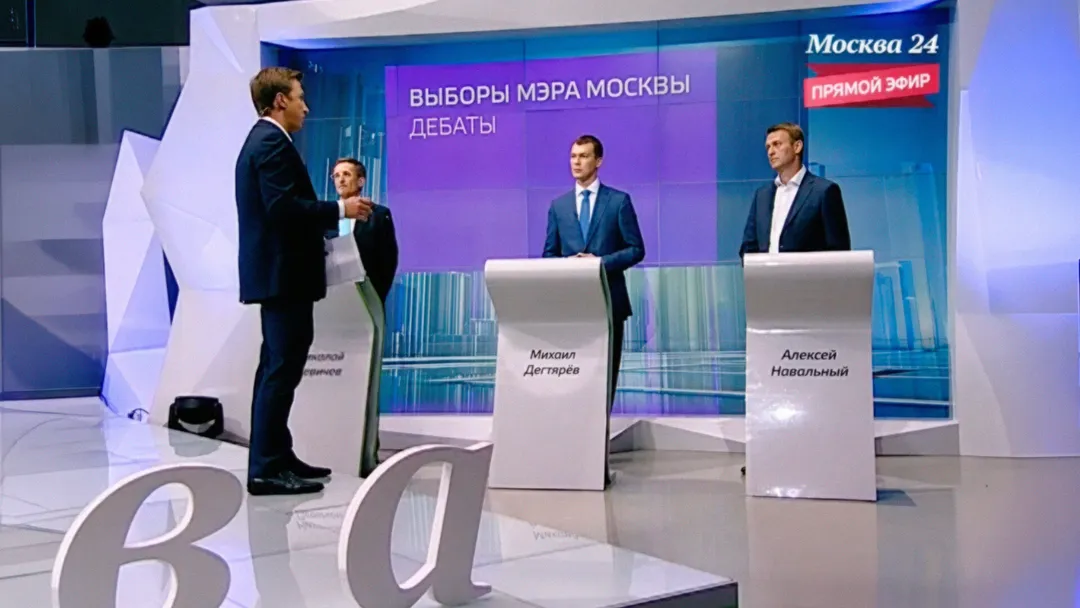
You are watching the TV channel
Moscow 24
Debate. Host: Dmitry
Shugorev. Good evening, dear
viewers. So, the debate on the channel
Moscow 24, the third and final installment. In
our previous broadcasts, we had a thorough
discussion—I mean the last one in particular—
as thoroughly as time allowed,
about transportation. But what about,
our voters may ask, the other issues
such as housing and utilities, the environment, illegal
migration, and social policy? Today
we will try to fill that gap as well. Let me
remind you that in the studio with us today are
Yabloko party representative Sergei
Mitrokhin—good evening; Ivan Melnikov from
the Communist Party of the Russian Federation; Nikolai Levichev from A Just
Russia; Mikhail Dektaryov from the LDPR; and Alexei
Navalny from RPR-PARNAS. Good evening. Right
from the start, we will begin with
the issue of housing and utilities, and so, in the order
determined by the draw, I will ask
Sergei Mitrokhin first, if I may. Sergei
Sergeyevich,
in your platform, you state
that everything will be decided by referendum,
including the issues that concern
everyone in the housing and utilities sector. The number
of signatures required to call a referendum
would be reduced from 2% of voters to 0.5%. But what about
the remaining 98–99% of citizens? Please, you have
one minute. Well, you know, you are somewhat
a little
First, we need to ensure transparency in monopoly tariffs,
above all those
that were just privatized—MOEK
and Vodokanal. Look, if you take
a long period of time, the growth
in tariffs has outpaced inflation by 10 times or more.
That means these companies are
fraudulent. They are fleecing us, they
build in
such markups
into the cost of their services. Therefore,
the first thing I will do is conduct an audit of all
these companies and secure the removal of their
managers, and bring to trial those
who have stolen. I will ensure a review
of tariffs and guarantee full transparency.
They will all publish their
information on their official websites
on the internet. Then tariffs can be
reduced. As for referendums on housing and utilities, I
do not have that in my platform.
Excuse me. Ivan, please tell us,
again quoting your platform: one of
the first steps of our team will be a ban
on raising tariffs; their level will be
approved by the Moscow City Duma. You are sometimes
criticized for this as a return to
the Soviet era. They say that now we have a market
economy, that this will not work. What
would you say to your critics? I would answer
very simply: it is absolutely obvious, and
all specialists say so, that right now
roughly 70% of the existing tariffs
consist of kickbacks. Therefore, the first thing
to do is
to freeze the current tariffs and разобраться generally
in the tariff-setting system. I believe that
the system is opaque, that the system
is deliberately convoluted so that citizens cannot
make sense of it. The quality of the
services being provided is appalling.
Moreover, I believe that in the housing and utilities system
we need to introduce such rules as, first, I
believe that for all pensioners living alone
housing and utility charges should be abolished. And furthermore,
for pensioners over the age of 65, housing and utility costs
even the current Moscow budget can
cover this. And if industry starts working again,
as set out in my platform,
the budget will receive even more revenue,
and the Moscow budget will have
such opportunities. Thank you.
Vladimirovich, if I may, also a quote
from your election platform:
tariff increases... you propose fighting...
through the removal of intermediary companies... You
say they are rising by more than 10%,
quite rightly. But how do you
intend to fight all this
not while working in the Russian government,
but in the post of
mayor? Thank you for the question. First of all,
taking advantage of this last
unique opportunity, I would like to address
the voters of the city of Moscow and offer them
our apologies for the fact that, thanks to
the Moscow government, which is the
owner of the Media Moscow holding company and,
accordingly, of this TV channel, we all
find ourselves in an environment
resembling KVN (a popular Russian comedy competition show). As is well known, in KVN, in
30 seconds you can make one joke; here
we can joke twice in one minute.
Let us assume that in the first 30 seconds I
made my first joke. My second joke is this: all
voters and residents of Moscow, on Monday at
every metro station, will be able to get my
campaign newspaper, where above all
attention will be drawn to the fact that
the Moscow government is collecting
for electricity usage—70 watts per
hour per month for one household. There you will find
how we intend to fight this.
Thank you, Mikhail Vladimirovich. A question for you
also on the subject of tariffs: freezing
tariffs until the results
of an independent audit are obtained—what exactly
are you aiming for? And how long should people wait?
A month? Three? I will begin by calling on
all my supporters, all supporters
of LDPR candidates for local self-government bodies
—as you know, elections are underway—to come to
the rally on August 22 at Bolotnaya Square at
12:00 noon. Next, I will say that we are going
as a single team, and 15 candidates for
local self-government deputies in New
Moscow were not allowed to run in the elections from the LDPR, and I
want to say this: I look at my
colleagues, and for two rounds already you’ve been pulling your punches
Let’s unite and demand the resignation
of the head
of the housing and utilities sector. By freezing it for all 5 years, we
believe that an audit will show that, in reality, in the
tariff, the actual cost is significantly lower
and the rest is markups and
administrative expenses. We will bring tariffs down altogether
reduce them, and the economy will function perfectly well
we will cut administrative costs and remove
all intermediaries from the market; the state
itself will return to the housing and utilities market. That I
guarantee. It was his... Alexei, we’re joking
we’re joking, Alexei Anatolyevich. I have a
question for you. We’ve heard a lot about how
you—how you
criticize; we’ve heard a lot about apartments
we’ve heard a lot about the embezzlement that
the information is well-founded, and all my criticism
is quite well-founded. Still, let’s
wait until this information is actually
verified. I wanted to ask you this:
imagine that on September 9, you
wake up as the Mayor of Moscow. You come
to work, and on your desk
there is this huge folder
of documents, and written on it is not—not
about how much property someone has, where, or who owns what
real estate, but simply
“Preparation for Winter.” Do you have
an understanding, for example, of how you would prepare
for winter? That’s the kind of thing voters
want to know. You know, in this situation, for me there is
nothing new. Every day when I
come to work at my Anti-Corruption Foundation
(an anti-corruption NGO), in front of me lies exactly the same
thick folder of documents that I
work with. Unfortunately, this folder of documents
really is very thick because
the Anti-Corruption Foundation has plenty to
work on. There will be less corruption when
I become mayor; then in such a foundation there will be
fewer folders of documents lying around
Preparation for winter in Moscow will proceed
according to plan. But when I speak about
housing and utilities, I must recall an important point
in my program, which says that
one of my first decisions will be
to cancel Sergei
Sobyanin’s unlawful decision to raise tariffs from August 1
Muscovites, and I as an ordinary Muscovite, we
must understand what we are paying for now
the tariff is unfounded; all these figures
are made up. Tariffs should be set so that we can see
what we are paying for. Right now, when we pay
for electricity and heating, we are also paying, among other things,
for a donation to United Russia from
Mosenergo of 300 million rubles (about 300 million RUB). So when we
throw out all the unjustified price tags and all
the unjustified amounts, the tariff will drop seriously
It will be interesting if you become mayor
to hear you then, when you
have to raise tariffs afterward. You will have
that opportunity. When I become mayor,
your TV company will be under my authority, and I
right now in Moscow the increase, the increase
is smaller than across Russia as a whole. Well, that’s the
reference. It only seems that way to you—the increase
Sergei Sergeyevich, please ask your
question. We’re going clockwise, clockwise
Ivan Ivanovich, please, your question
What will it be?
Ivan
Ivanovich, doesn’t it seem to you that today
the entire system
of housing and utilities in the city of Moscow is a system of one
grand fraud? For example, I
managed, through the courts,
to have
the meter servicing scheme—whatever that even was—
struck down, but they were skimming off 6 billion a year. And
what measures do you propose in order to
punish them?
So, the first thing I would like to note is that we
have been fighting for several months for the
possibility of holding a referendum in
Moscow on the issue
of freezing housing and utilities tariffs and, in the end,
figuring out what exactly these
tariffs consist of and why they are so high. We
went all the way to the Supreme Court, and the Supreme Court
supported us, but the Moscow City
Election Commission still does not
want to comply with the Supreme Court’s ruling
and schedule the referendum. I
believe that the referendum will definitely
take place, and we will keep pushing for it
so that we can...
As for how you will fight
fraud, because this sphere
has a huge
number
of frauds, but unfortunately
there is fraud in all spheres, and in order to
fight fraudsters, we need to change
the entire system of governance in Moscow. Thank you
and ask your question to Nikolai
Vladimirovich, please
On the topic of ecology, or on any topic?
Preferably on the topic of housing and utilities, of course. Well
what is unclear to you?
Understood. Nikolai Vladimirovich, please tell us
in your view, what needs
to be done in the housing and utilities system so that citizens
are convinced that the tariffs really
correspond to the services they
receive? Thank you for the question, Ivan Ivanovich
Whatever we do now in this area,
citizens will only become more convinced that
the tariffs are inflated and not justified by anything
since in Moscow there are around 400
management companies, and in a whole number of
districts of Moscow, monopolization of this sphere
has reached such proportions that a single
management companies handling 500 buildings each
manage them
and residents have no leverage over these
management companies, effectively none.
Residents need to be able to choose for themselves
which management company they want. In my
building, for example, there was a situation where
we wanted to replace the company that suits us
with one that actually meets our needs
or whatever it is called now. So
without
creating a competitive environment
here and stripping this sector of its monopoly
and corruption, we still won't
achieve anything. Nikolai Vladimirovich, last time you
criticized us simply because
we stayed on live air for too long.
Let me remind everyone once again that this time we have
exactly
one hour.
And Mikhail Vladimirovich, you have been living in
Moscow for several years now. Please tell us
how you pay for water, electricity,
gas, and what you do when
you receive figures that differ from those
from the previous month. We go and
pay, just as all our
fellow citizens do. Because people
are used to paying for what they consume. And
as for the increases you mentioned,
yes, since August. Look: there has been an increase in
gas, there has been an increase in electricity,
there has been an increase in water, there has been an increase in
heating, and we consider this
unjustified. And I do not understand at all
why Mr. Sobyanin decided to run for
mayor against the backdrop of a two-stage tariff increase.
From a political point of view, in
any country this would be suicide. And
to everyone who
considers unjustified
the bills issued by the DEZ (district maintenance offices) and
management companies, I can recommend only one thing:
contact our
LDPR (Liberal Democratic Party of Russia) public reception offices. Here is my program—
you can get it at every metro station—and
our lawyers will tell you how to properly
file a complaint. Sometimes it is not even necessary
to go to court to force
these scoundrels who fleece
all Muscovites. Do you want to ask
Alexei Navalny anything? You have 30
seconds. Mine is very simple, Alexei.
Well, I have long wanted to know: were you given
signatures by United Russia deputies during
the process of passing the
municipal filter, you put out materials by your
supporters without publication details,
and no one removes you from the race. From this we
draw the conclusion that you have some kind of
special immunity. The question is: how do you feel about
the idea of
letting foreigners into the housing and utilities market, or, if elected, will you
if elected, how
will you, on instructions from the Kremlin, which apparently
oversees you, still raise them? This is a question from
the housing and utilities sphere, please: will you raise them
or not? Will you let Americans in?
Please answer. Alexei, first of all, as for
my right to participate in
the election campaign and my right
to send campaigners onto the streets of Moscow,
despite the fact that the police
obstruct us, even Moscow City Hall does not
dispute and does not try to dispute
my right to take part in the campaign. This is
no special immunity. Look at
my rating.
Excuse me.
You are counting on falsification, not on
victory. He does not dare remove me from
the election because he understands that they will be
absolutely
legitimate. Right now we are not talking about
some mythical puppet masters.
Look at what is happening now: Gazprom is
monopolizing it.
What matters is that I, as mayor, would destroy this
monopoly, and Muscovites would pay for housing and utilities
what they actually cost. Thank you, thank you.
That was the topic of housing and utilities. We are now moving on to
another topic that is also important for our
voters: it is
the environment. Sergei Sergeyevich, once again
[text truncated]
the amount has been reduced thanks to new technologies
for purification. What is wrong with current purification technologies?
What do you not like about them? You know, even according to
official reports—we study
the work of the water utility—even according to official
reports, many samples contain a large number of
harmful substances. That means the purification technologies
being used are insufficient. There are
different methods: ionization, silver treatment. Our
specialists know about this. But in general,
pollution in Moscow is a terrible thing
because it means
a rise in cancer rates, a rise in other
diseases, which, incidentally, occurred during
Sobyanin's time in office, although on
television he claims the opposite. It seems
the first signal came when the Yabloko party
together with residents of Pechatniki achieved
the shutdown of a cement elevator terminal.
Mikha, don't lie.
There, on the site of the closed cement
elevator, they want to build a waste incineration
plant, although long ago we managed
to stop that program because
it causes very severe air pollution.
Instead of incineration, we need to focus on
waste recycling. Ivan Ivanovich, again
a question from your program: you talk
about environmental police units. But
what powers would they have? Right now there are
environmental patrols—how would this
be different? After all, these are not
law enforcement bodies. Yes, I will now
I'll answer, but first a few words about the previous
question. Right now in Moscow they use
chlorination technology. It is a very
outdated technology from many years ago,
from the time when plague and cholera
were rampant. It produces carcinogenic substances.
That is why Moscow has extremely high
rates of cancer; they are much
higher than in many other regions
of Russia. Therefore, we need to switch to
modern technologies, which all of
Europe has already adopted, such as ultrafiltration.
Now, as for the eco-
police: this is an official division
of the police that will monitor
compliance with legislation in the field
of environmental safety. The situation here
is extremely serious, and the main
reason is that anti-...
... [inaudible / unclear fragment]
Could Alexei Navalny be asked
a question for Sergei Sergeyevich about housing and utilities?
Please, you have 30 seconds. Excuse me,
forgive me, Sergei Sergeyevich. Please tell us,
in Moscow's system of
homeowners' associations (TSZh) there are simply a huge number
of falsifications of the very fact that these TSZh were created.
There are honest, normal TSZh that
work, but there are buildings where things were simply
falsified, and money for major repairs
was involved. What should be done with such buildings? Well, you
know, this is a very serious issue. I have
worked on it. Who organized all these
falsifications in the first place? A structure of the Moscow city government
called the GUIS (state engineering services body) was behind them.
There was an absurd situation where one employee
of the GUIS headed 30 TSZh at once. But there was
a loophole in the Housing Code that
allowed this, because it did not
require all participants in the meeting to...
There are many such loopholes today, both in
federal laws, which, incidentally,
many State Duma factions vote for. There is a huge
number of them, and they open the door to
theft and fraud through TSZh.
For example, fraudsters appropriate property
that belongs to all owners jointly. Therefore,
it is necessary to cleanse the legislation of
such corrupt provisions, and
those
fraudsters who created fake
TSZh must definitely be punished. The Moscow city government is not dealing with this issue today,
but if I become mayor,
I will definitely deal with this
issue. By the way, all contracts with
management companies are now
being revised; that is also in the news.
You know, contracts are being revised with
management companies, but again, no one is
educating Muscovites about
how they should fight this. Nadezhda...
Let's return, let's return to the topic of ecology,
because Nikolai Vladimirovich needs
to be asked a question. Incidentally, he is the only candidate
who has a line in his
program about
waste-processing plants.
This is an important issue, together with the Moscow Region (the area surrounding Moscow).
Why do you think... How
do you think, why did your
predecessors fail to do it? Because
for as long as I can remember, I have been hearing these
talks about waste-processing
plants. So why, why do you think
you will succeed? Because I am counting on
the fact that I
will win the Moscow mayoral election. My comrade
from the Social Democratic Party
... [unclear fragment]
and then we will be able to implement the program
that our party has long prepared,
which was presented back in the day to Sergei
Kuzhugetovich
Shoigu.
The problem cannot be solved in Moscow and the Moscow Region separately. In Moscow
5 million tons are generated annually,
and only 2% is sorted and recycled, whereas in
the European Union
the figure is 70%. This is a complex problem. In the 11
seconds I have left, of course I cannot
solve it. But I can make a joke in 5 seconds:
Citizens, there will be no garbage in Moscow if I
become... What kind of joke is that, really?
Mikhail Vladimirovich, again, a question for
you. By the way, you made a very
interesting statement: make Moscow
the largest recreational zone in Mos...
It's elementary. We have 120 km of waterfront in
Moscow. Moscow is, in general, a resort city, but
just look at the Moscow River—you can see all of this.
At present, even breathing is harmful. I explain: we
the first thing I will do after
being elected is announce a tender to clean up the Moscow River. All
the embankments will be fragrant, all of them
will be adapted so that
Muscovites can relax there. There will be free
Wi-Fi everywhere. And on Sparrow Hills we will create
the largest beach in Europe, free of charge, with
river sand, as it was in the 1970s.
And as for ecology, look
at what is happening now: bicycle transport is being developed
under the current
environmental conditions, instead of
developing it in parks, in
recreational zones, and building new parks.
The current authorities are throwing the most active
Muscovites under the wheels, forcing them to breathe
exhaust fumes. Ask any pulmonologist:
in 5 years this will cause delayed harm
to health. You cannot ride a bicycle
around the city today in the current conditions. I agree, but
I love riding a bicycle, I do, but
with a helmet on, not like...
And Alexei Anatolyevich, I also have a question for you about
bodies of water. You know, of the 64
ponds in Moscow, only a few are suitable for swimming.
By the way, tomorrow we...
... how can all of this be changed, in general?
if you want to be able to swim everywhere,
if you want to swim everywhere, then unfortunately
Moscow right now is not the kind of city where
you should live, sadly. And I also want
to be able to swim everywhere. I’m someone who lives
in southeastern Moscow, and if we’re already
talking about environmental problems, then I
can simply say that my family and I,
when we walk in the only nearby
park, the view I see is
the smokestack of the Moscow oil refinery,
whose emissions I have been breathing for 17 years.
And for 17 years I’ve been told that
in fact these emissions do not exceed—
that they are within the maximum permissible limits.
The same thing is happening with bodies of water,
the same thing is happening with elections, with
emissions. Law and order are the main things
needed for the
environmental situation to improve. If into Moscow’s
ponds, where you want to swim, they keep
dumping all that filth from auto repair shops,
car washes, and all those small businesses
located around them, which
dump it illegally while paying a small
bribe to the local
authorities.
That’s it, thank you, thank you. A slip of the tongue, Fred—
that was interesting. Thank you, Sergei.
Sergeyevich, please ask your question
to your neighbor, Ivan Ivanovich. Well, you know
that the Yabloko party is actively engaged in
protecting parks and green
spaces, and stopping infill development during which
those very green areas are cut down.
And your party has often
taken part in our campaigns; sometimes we
even joined forces. For example, in order
to prevent the construction of
waste incineration plants. So tell me,
have you ever seen at these rallies
the LDPR party, which lies that it
stopped the cement terminal in Pechatniki?
Three rallies— just a minute, Pechatniki, Mitino—
you run around courtyards. I personally saw one
time at a rally in Mitino. Beyond that, I have never
seen representatives of your faction.
That’s not true. There was recently a rally; we
did not go nowhere—
we were there. Stop this
about the LDPR. I want to say that indeed
the situation with this is very complicated. The fact is
that in Moscow, about
100,000 trees are cut down every year. In place of these
felled trees, they plant little shrubs.
Of course, this does not improve the environmental situation;
not only does it not get better, it
gets worse every year. The state of
the air in Moscow is terrible;
it exceeds
permissible limits by a factor of 10. I believe that those projects
that are now connected with the expansion of
major roads, the construction of parallel routes, when
public gardens are cut down,
entire park areas are cut down, and
roads are laid along residential buildings,
are extremely harmful to the environment
in Moscow. What question would you ask
the representative— the Communists were talking with
Yabloko. Oh, well then, Nikolai
Vladimirovich, I already said
the state of the air is perhaps worse than in
Moscow. And if you take even the industrial
cities of the Urals, the air there has become cleaner than in
Moscow. So what do you see as the reasons for the
terrible environmental situation
that has developed in our city?
I’m not even talking about those countries where
the environment has long been carefully
monitored. Is this happening because
the legislation and enforcement practice are not
demanding enough when it comes to
introducing modern
treatment
procedures in those industrial zones
that remain within Moscow and
for some reason still have not been moved outside
the city limits? But the main thing I
would like to promise Muscovites, without waiting
for the moment when I become mayor of Moscow,
is that on August 29 I am going to present,
together with the public organization
Green Patrol, a project to create
an interactive environmental map of Moscow
so that every resident can see
where they live, which harmful
substances are present in high amounts, and what they can do
to truly preserve their
health—or whether they need to get out of there, and
where they can go for a swim. Please ask
your question. Dear Mikhail
Vladimirovich, it seems you are already
trying to prove that you are a grown-up
boy, and it is not nice to interrupt adults. I
am once again giving you a friendly reprimand.
And my question is this: it is clear that
waste disposal is impossible without
separately collecting different fractions
of waste. So, do you think the Russian
soul is capable of, with German
thoroughness, sorting different fractions
of garbage for subsequent collection and
recycling? An interesting question— here you go.
Socialists. So he has already insulted
the Russian person. The Russian person is the most
capable: he can build rockets and
build giant megacities
that are the best, the most comfortable, like Moscow. He
can sort garbage separately too. I’ll let you in
on a terrible secret: in Moscow we already
have a separate waste collection program in operation.
It’s a pilot program and it needs to be expanded. And regarding
waste processing plants, you can
build them anywhere; the main thing is
to build them using new technologies and taking into account
the opinions of the residents who live nearby,
because these voluntaristic
decisions, not only in Moscow but also in the Moscow region,
but also in other regions, when no one is
asked, land is seized and they begin
putting up these monstrous structures
and as for who should work at
waste-sorting plants, they should be staffed by
those migrants who
are currently being held in temporary detention
centers, put to useful work. There, that solves
the issue of illegal migration.
Please, ask your question, Alexei.
Well, look, we know about your sentence in the
Kirovles case, which seems to be connected with
environmental issues. I won’t talk about ecology—I approached it
from a distance. I won’t talk about justice or
injustice. It’s entirely possible that you filed
an appeal and may even be acquitted
or perhaps even
something else. I want to ask: there are few forests in Moscow,
so why are you running for mayor of Moscow, and if
you lose, would you be willing to work for one of the
winners as head of
the department for Samara’s parks and
recreation areas? Listen, Mikhail, I
first of all would like to say that I am terribly
glad that you are a candidate for mayor of Moscow, because
without you, our debates would, well, have been
far less sparkling. You
said, as I understand it, that you are still heading back to
Samara, where you will head
some kind of department there. If I were
elected, I might even
invite you.
We joked around a little, and Muscovites
have seen our, your cheerful jokes, but
now they still want to hear my
view on the problem of Moscow’s forests,
Moscow’s forest parks. What is happening
right now, when the so-called
“clarification” of the boundaries of nature
reserves is used as a pretext to carve off
pieces of parks, is completely unacceptable.
Look at what is happening to Bitsevsky
Park. Look at what is happening to
it in bits and pieces, and all sorts of
suspicious holiday resorts appear,
suspicious hotels,
administrative buildings, houses, and so
on. If I become mayor, I will absolutely and
unequivocally ban forever the practice of
“clarifying” park boundaries in such a way
that they become smaller. Then again,
if I’m not mistaken, in Moscow recently
how many trees have
been planted?
Fifty...
Your time is up now, your time is up, Alexei.
Navalny, I’ll ask your question myself.
Sergei Sergeyevich will tell you about all
these falsifications. Sergei
Sergeyevich, Sobyanin’s government is very
fond of telling us that they
plant new trees. Everywhere they
cut down a piece of a park in order to
build a residential building, they slap up
a sign saying there will be compensatory
landscaping somewhere 8 km (about 5 miles) away. What do you
think about that? Is this
simply brazen deception and falsification
on the part of Sobyanin’s city administration, or not? You
know,
today the Moscow government really
does not like specially protected natural
areas. For example, they attached
Vorobyovy Gory (Sparrow Hills) to Gorky Park, but these are
completely different parks. Vorobyovy Gory
is a nature reserve; birds nest there. It should be
managed by conservation specialists,
not entertainment managers. And what will happen
there in Losiny Ostrov (Elk Island)?
They are not shrinking it—it is a national park—
but go in from the side of Bogorodsky
Bridge: they are stripping away the topsoil,
the natural layer that is hundreds, even thousands, of years old, and
laying rolled turf. This is simply
a crime. This is happening in all
parks—they have paved everything over with Sobyanin’s
tiles. Yesterday it was Losiny Ostrov, before that Ostankino,
where I managed to secure the
demolition of an illegal structure, including bathhouses
for officials from the housing and utilities department. Yesterday I
visited the ruins. But this outrage
continues: illegal construction,
parking lots in the same Losiny Ostrov,
illegal brothels—they cannot be
legal—illegal restaurants, all of this
continues in Losiny Ostrov. Yes, they cannot,
but they do exist in Losiny Ostrov, and in
that bathhouse that I
had demolished. You’re destroying Moscow, Sergei.
I’m not destroying Moscow.
Mikha...
Come on, come on. Sergei Sergeyevich, I have a
question for you now regarding
regarding
migration. Again, in your program
you write that jobs
currently occupied by migrants can realistically be replaced
with local Moscow workers. To do this,
it is necessary, in particular, to bring back to work
retired specialists. A very sensible
idea. But where will you find so many
retired specialists? You know, Moscow is
a very educated city. We have the Academy of Sciences,
which, thank God, has not yet
been shut down, and we will fight to ensure
that it is not shut down. I believe that
retirees who work in housing and utilities should
keep their Moscow pension supplement.
Working retirees in
fields that are important for Moscow should be paid
an additional supplement. That is the first point. Second, cheap
migrant labor means a decline in
labor productivity. In place of 100
migrants, two Muscovites can, using
modern equipment—the same
for example, a paving machine—do
100 times more than this enormous mass of cheap
quasi-slave labor. Right now, we are seeing a decline in
labor productivity because
our state encourages cheap labor
just like in Ancient Rome, which in the end
collapsed because of it, you see. That
is, if we reduce illegal
migration, it won’t just mean that Muscovites will
work — they will work using
modern equipment, and we will move
toward a 21st-century economy rather than
remaining stuck in the old economy. Thank you, thank you. Ivan,
I also have a question about your quote:
“by sharply reducing the number of migrants,”
“while preserving labor market stability, we, together with
representatives of ethnic diasporas,
will develop an action plan for
normalizing interethnic relations
especially among young people.” So, after
strict quotas are introduced and after
someone is deported from the country,
there will be something to talk about. Will that be a simple
conversation, or not such a simple one? Well, I’ll start
by saying that today’s Moscow
officials benefit from having millions of
illegal migrants as cheap
labor and siphoning off
fabulous profits from it. I want to say that
our faction has already introduced bills under
which, first, um, for
hiring migrants, employers will
have to pay much larger contributions into various social
funds, um, much larger deductions than
for hiring citizens of the Russian
Federation. Second, I introduced a bill on
the mandatory introduction of a work visa for
all migrants who are hired for
jobs. Interethnic dialogue, you know,
is always difficult. But I
believe that when the atmosphere
in the city of Moscow normalizes, when instead of more than
2 million there are 200,000 left, this
dialogue can be established, and it will be very
productive. Thank you. Another question on the topic:
a very sensitive issue. More than 50% of Muscovites
— this is a quote from your program —
believe that newcomers are trying
to make Muscovites live by their own
rules. In this line, did you mean
people who came from
the near and far abroad, or
our own fellow citizens who came from
Russia? Both
and the others. I can
answer. Since the question is about migration
issues, I want to say that
of course this problem cannot be solved with a magic wand
in one
stroke. So we need to move
gradually. To begin with, I propose
looking reality in the face and
determining how many migrants are not
the city quota of 186,000, but how many
migrants working today
are working in places where tomorrow we will not be able
to do without them, and setting such a
quota — let it be 800,000, maybe a million, I don’t
know — yes, in order to eliminate this
aspect of their presence. Because those
poor Vietnamese people who are being herded into this
ghetto — they didn’t come on their own; they were
brought here by their own mafia, which has teamed up
with our Russian and Moscow mafia
and for some reason none of the officials wants to
answer for that. Thank you. By the way, we have
already been working for more than x hours
this week in total, so again, returning
to the conversation about that — Dmitry, I’ve just come from
Golyanovo
a temporary detention camp
Well then, tell us about that, and
also tell
us: you are proposing a ban on the employment of
foreign citizens throughout the entire retail
trade sector — we heard, in the entire sphere of
consumer services. We have just heard from your
opponents that they can somehow
somehow
be redirected to other work. You yourself
proposed incineration
plants, those who are temporarily, temporarily, who are
being held temporarily. I was in Golyanovo — there were
450 Koreans there alone. They do nothing, they
lie on beds, and the Emergency Situations Ministry feeds them
buckwheat porridge with canned meat. Well, excuse me,
pensioners, the homeless, and children are not
fed like that in schools, yet there
they have washing machines there — they’re living like at a resort. Everyone
wants to go home, so I suggested: let them
work, while they are doing nothing, in
public, at least somewhat useful
jobs. In general, regarding migrants, we
say only one thing: we do not need a single
migrant, legal or illegal, here in Moscow.
Muscovites want to work, from route taxis
to those same garment factories. We have
people from the Moscow region and from
nearby regions who want to work. We do not need them at all.
We will drive them all out by 2015
and close Moscow to all legal
and illegal migrants. This quota system, when
some quota is announced and they
keep coming in and coming in and coming in — it’s corruption, and
we will jail everyone who organizes illegal
migration, and send them home along with them. About 3,000
have already been expelled, by the way. And regarding
Vietnam, interestingly, the embassy found
the embassy found 200 passports there, which speaks
quite clearly, as does the involvement of a local official.
And I will quote your program again:
“the inadmissibility of illegal migrant labor in
municipal services; otherwise, fines and
termination of contracts.” This is exactly
what we are all advocating now, and it is what
we are in fact doing now. There are
fines, and there are contract terminations.
Nothing of the sort. Let me first give
a general outline of my
anti-migrant policy, which is called the toughest among
all the candidates. That is probably
That is indeed the case; it is a tough measure, but nevertheless
it is based on the law. The first thing
I am talking about, and that I will push for,
is the introduction of a visa regime
at long last with the countries of Central Asia and
the South Caucasus. Here, colleagues, I will pursue this
at the federal level, and I find it ridiculous
when deputies here say that
they are going to shut something down when they cannot even
do that—the president already...
That is a distortion. The second thing I am
saying is that we will disqualify and
terminate contracts with those who hire
undocumented migrants. Right now, that is not happening.
Please: you go out, win a tender,
hire 50 citizens of Uzbekistan
illegally, and no one will take the contract away from you.
And third, within a year we will
ban state-funded public
organizations that work with
municipal money from hiring, with those funds,
foreign nationals. These three measures will work and
will seriously reduce both the number
of migrants and the number of crimes
associated with them. Thank you, thank you.
Sergei Sergeyevich, it is time to ask—how...
A question for me? Right now we are—we are asking
a question now. I was asking a question just now,
a question to him.
Now, please, go ahead and ask your question.
A question—a question from Navalny (Alexei Navalny) will follow
afterward. Please, on this topic, we have already
agreed: ask each other
questions. That is correct—the moderator has just asked
each question.
Listen, we have sorted it out. Sergei Sergeyevich,
please ask Ivan Ivanovich a question about
migration—or Navalny (Alexei Navalny), Ivan
Ivanovich. Well, for you. It seems to me that here
just now there was a certain
populism in saying that the main
culprits are these migrants. Do you not
think that the main
culprits behind migration are the Moscow city government
which allows them to work in
the housing and utilities sector?
That is exactly what I was talking about—I already
said: not only in the housing and utilities sector, but also in
construction and in other areas of business.
Of course it benefits Moscow officials
—I want to say once again—to have millions of
undocumented migrants, use them
as cheap labor, and derive from this
fabulous profits that go into
their pockets. Alexei, I want
to say that the relevant bill
on introducing a visa regime has been sitting for months in
the State Duma. I very much hope that
this—Ivan Ivanovich, well, it speaks
about work visas, just as your program does.
That bill is in the Moscow City Duma,
whereas I am talking about
the bill that is currently in
the State Duma. I hope that
other factions will support it. You know
that our border troops were abolished in this country,
that there is essentially no one to check visas.
Well, please—the border service
does the checking.
Around Moscow there are approximately 3.5
million Russian citizens—in Moscow and the nearest
Moscow region—who want to get
jobs in Moscow, in the construction
business and as drivers, but they do not have that
opportunity. Moscow
officials do not let them in because they make
less profit off them.
Therefore, the introduction of this law will make it possible
to regulate this situation. A question
for Nikolai Vladimirovich. Please ask it.
And there are 9 seconds left for it. Yes, all right,
a little more please—30 seconds.
Uh, Nikolai Vladimirovich, how do you
propose fighting illegal
migration, given that indeed
the roots of illegal migration lie not in
the migrants themselves, but in those who use
their near-slave labor and receive enormous
profits from it? I completely agree with you,
Ivan Ivanovich. Could I, 30 years
ago, when I arrived in Moscow, have imagined
that in the 21st century we would encounter in the capital
of our Motherland labor like this, with this
bestial grin of capitalism? Therefore, illegal
migration must be fought
by exposing its economic essence, its
corrupt economic essence.
That means we need to consider the bill we have introduced
stipulating that deportation—let us start
with this—of undocumented migrants
is carried out at the expense of the employers,
the swindlers who hired them.
These employers must bear
responsibility, up to and including criminal liability. And at the very
least, they must lose their licenses for
carrying out construction and other work in
the territory of the city of Moscow, so that they
think twice before doing it again. Then, little by little, we will
rid ourselves of illegal migrants. Well,
again,
I am not even talking about those who
come here not to work but to engage in crime,
but they simply need to be identified. Thank you.
Your question, Mikhail
Vladimirovich. Yes.
Professor Mikhail Vladimirovich, let us start with
schools. As is well known, Moscow schools are seeing
more and more children of these
unfortunate—or fortunate—migrants, and
these children do not know Russian, while
the city education program is
so
declarative that, in essence, they are left defenseless;
no one is helping them. What do you think
needs to be done in order to cope
with this problem? Let us start with the fact that in
the State Duma there is already
a bill from the LDPR faction (Liberal Democratic Party of Russia) that
is raising the requirements for knowledge of Russian
language, from labor migrants
to applicants for Russian
citizenship. A minimum of 10,000 words is
the average vocabulary needed to speak fluently.
This applies both to children and to those who
have come here, even though we did not invite them.
Of course, to be frank, let us begin here
by talking about the education program.
In Moscow, the program is, frankly speaking, not bad.
The main problem in schools today is not
education, but food, and I have already spoken about this.
I said so in the previous debate as well. They tell me
there is a Government resolution under
which schools are required to provide hot
meals. Has anyone actually seen these hot
meals? There are just scraps there, and at the expense of
the parents. So under me, of course,
we will improve education, but really
and most importantly, we will improve school meals
and make them, for Moscow, for Moscow
schoolchildren,
free of charge. And your question to Alexei
Anatolyevich. Alexei Anatolyevich, you are so
smiley.
You barely finished an American university, which
I am proud of, changed parties, dumped Mitrokhin with
his Yabloko (a Russian liberal political party), and now you are running from
PARNAS (People's Freedom Party), and all your activity is
some kind of murky business. So I
am asking you frankly: you have,
I repeat, a conviction. God willing, may it
be overturned. Are you planning to
emigrate from our great Russia yourself?
Not for the time being.
An excellent question. Thank you very much.
Mikhail, for that question. Despite the fact
that in our country, in our wonderful
country, and in my wonderful city,
which I love very much, there are a huge number
of problems that arise, including
because State Duma deputies keep stringing
us along for years. If you listen to them, they are all in favor
of introducing a visa regime, so why
do you not pass a law on it then?
Despite the fact that there are many
problems, I am running
in this election now in order to solve these
problems, because behind me stand
hundreds of thousands and millions of people who
are fed up with this life, fed up with the situation in which
Moscow ranks third in the world
by budget size, but by quality of life
it is in 154th place. And I am absolutely sure that
Muscovites will support my program. I
am sure they will come to the polls. Let us make it so
that the 20% of young Muscovites who
now say that they would like to
emigrate from Moscow will instead say
that they want to live in Moscow, work in
Moscow, and start their families in Moscow.
Surely they also want to ask their
question to Sergei. Well, “millions of supporters” is
all, excuse me, just empty talk. Support from millions
has to be measurable.
Come on, we do not have much time
left. Alexei Anatolyevich, please
ask your
question. I only know that in the
last election your great leader
got 4%, so please behave
more quietly. Sergei Sergeyevich, allow me
to ask you a question. I hold a huge number
of meetings with voters, and at
every meeting I ask: what is the
salary of a janitor, your janitor,
a Tajik or Uzbek? And everyone tells me: 8,
10, 15 thousand. Under the minimum standard, this
janitor should be earning 31,000. Who
is taking that money? Well, Alexei, you
know perfectly well that the main
employer of illegal migrants
is the Moscow city government, which
allows them to work in the housing and utilities system
where on paper one person receives the salary,
a cut is passed on to the migrant, and so he works cheaply.
If I become mayor, then I
will first of all ban from participating in
city procurement any companies
that hire illegal workers. That is first. Second, I
will force them to publish online
information for the public about their staffing lists
and salaries. And one more very important thing:
today there is Article 322.1, organizing
illegal migration. Criminal cases under
this article are not opened because
the authorities themselves are in on it with these
employers. So I will make this
article work.
We will jail
100 to 150 employers who want
to profit from cheap labor, and all of that in
Moscow. Stop it, Dmitry. Mitrokhin’s suspicious
mood swings—something
has to be done. God willing, there is still, there is still
something very interesting in your programs.
A statement—I will quote it briefly.
Because now there is time left only
for each of you to ask one another
a question. Well, may I make a suggestion? Or without
a suggestion—may I continue now?
Moscow pension supplements will
rise to 24,000. For example, you promise
—and what will the pension be? Well, there are various
promises here: instead of a tiny benefit for
each child, there will be 50% of the real
subsistence minimum, and so on and so
forth. We would also very much like
to hear specifics today on
social policy as well. Sergei Sergeyevich,
please ask your
question. Wait, so first I get to ask my question
—no, there will not be, there will not be. You know, I will move the question aside, we
we do not have much time left, so
I will give you the opportunity then. I wanted
to
my timer, because I was interrupted here.
Please restart the timer for
Sergei... Vseva Ivanovich, I have this...
I have a troubling feeling that Sobyanin
has already begun to back away from the city's social
obligations. There has been no
indexation of pension supplements; benefits
for people with disabilities related to garages and for veterans
have been discontinued. Tell me, please, don't you think
that if Sonin is elected mayor,
then later
both...
You know, I think that at best
what can be said is that over the past three
years, social obligations in Moscow
have been frozen, and given that there is
massive inflation,
of course Muscovites feel
socially, in terms of social
protection, significantly worse off. But there are
some very alarming facts, and about some of them
I simply must speak today. There is
the unique Hospital No. 6 for
Muscovites and elderly people; as a result of reorganization, it
is being merged, and
in effect it is ceasing
to exist. The situation is dire
for people with disabilities. Here, the company Mos-
Elektropribor is laying off
84 disabled employees, having received for these
jobs 16 million rubles from the Moscow budget two years ago
from the Moscow budget. The company Olimp
is removing 102 disabled workers, cutting jobs
after receiving 32 million rubles from the budget
of Moscow, and this, I believe, is simply
unacceptable in our capital. And what would you
like to hear from the candidate from
A Just Russia, Nikolai Vladimirovich?
You know, by the results of 2012, Moscow
was recognized as the most expensive city in Europe and
one of the most expensive cities in the world.
The gap between the richest 10 percent and the poorest 10 percent
is more than fiftyfold. Why do you think
this is happening, and how can such
terrible phenomena be
combated? Thank you. Ivan Ivanovich, I
completely agree with you. I hope that
Mikhalych won't interrupt me, but I
have my last minute on the air, and I
would like to address all Muscovites, all
voters, to congratulate them on the
upcoming City Day, which falls on September 7, and which
from the standpoint of election
law is the day of silence. And on behalf of
my fellow candidates for mayor
of Moscow, I want to appeal to acting mayor Sergei
Semyonovich Sobyanin, who promised that
he would spend that day from morning to evening
together with Muscovites in open
public venues: not to forget to invite to this
celebration us ordinary Muscovites,
the candidates for mayor of Moscow. This is not a holiday of
City Hall alone; it is a holiday for all
Muscovites, and a holiday for all candidates
for mayor of Moscow, and we should spend this day
together from morning until late evening.
Once again, I apologize to the viewers for
the fact that they are trying to make clowns out of us.
A wonderful toast, I think—a very Friday-like...
Please, ask your
question.
Mikha... social policy. I...
You are a young Muscovite, as you yourself
admit, yes. And here in Moscow, since
this year, a residency qualification has been introduced, and
the pension supplement bringing it up to 12,000 rubles
is received only by those who
have been registered in Moscow for at least 10 years,
while everyone else can count
only on the subsistence minimum—
7,137 rubles. You are a young Muscovite—how
do you feel about this? Extremely negatively.
Let me start by saying that we do not need to go to
City Day with Sobyanin—you go with him
as a sweet little pair; we'll go elsewhere.
Next point: the fact that 12,000
rubles as a minimum pension is completely
unacceptable. This is Moscow. Our average
salary, because some officials
and top managers of state corporations supposedly
bring it up, is 64,000 rubles. The average salary
of an ordinary person is 20,000 to 25,000 rubles; a pension is
12,000 to 15,000. Just look at prices in Moscow.
Therefore, we will cancel this residency qualification, raise
pensions, restore all supplements for pensioners, and
for all public-sector employees...
And do you know why? Because this
is written in the president's May decrees; they
are mandatory, and not one of
these people wants to be mayor—they have not even
read the president's mandatory decrees. On September 8,
vote for the LDPR candidate
—for me, for all the candidates...
Listen, I want to point something out. The draw
just worked out this way. I have a question for Mitrokhin, for
Melnikov, and for... Why do I keep
asking Navalny?
My question is for Navalny.
Ready. Ask your question to Navalny.
Please. All right then: will you carry out
the president's May decrees—reduce
road deaths, reduce ... mortality,
raise salaries to the average for
Moscow, and double them, as it says here in
this program of mine? And now it is already
Alexei Anatolyevich's time. Well, in general...
Dear Muscovites, this is unfair.
Why are all the questions for Navalny? I have
a very strict time limit, Professor...
Please restart my timer—it hasn't
started. Excellent, it's started, so I will
carry out my mayoral program, as
any normal mayor who ran with a program
is supposed to do. I
would like to respond, since we are talking about
social policy, about those
pension increases that are also in our
program, which you so ironically
dismissed as populist. In our
program there really is a strict
One point we will definitely carry out is that we
will double the Moscow supplement. Right now
it is 4,500 rubles, and we will double it. And
in doing so, we will establish a minimum standard
for the social pension at 16,000 rubles. This will
cost the Moscow budget 138 billion rubles,
and my team and I know where
to get this money. The Moscow budget
can already afford it as it is. Moreover,
our planned anti-corruption measures
our priority measures
will additionally free up no less than 180
billion rubles, so we have the money
to raise pensions for Muscovites.
On the 8th, come out and vote.
Bring your families. Vote so that
power returns to the people, please.
You still have a chance to ask a question
to Sergei Sergeyevich. We have very little time.
A very short question, very short,
a very simple question. Sergei Sergeyevich,
our authorities love to say that
Moscow's budget is socially oriented, and that in general
the policy is social, and everything is social in
our city. But for some reason the standard of living
is such that everything in Moscow costs twice
as much—food, a square meter of housing, a carton
of milk, a kilogram of meat—everything is more expensive than in
any European city. Is
the budget really social? Is this policy
really social?
I believe that this policy is plainly anti-
social, even in this very issue.
Look, there is a clear-out underway,
the destruction of neighborhood shops
within walking distance, and now markets have also been closed. I
recently went to the Vykhino market, and
pensioners asked me: are we supposed to go
to the supermarket now? Carrots and
parsley are more expensive there. So that alone is already
anti-social. Then there are the concrete facts.
Look, today the child allowance for low-income
families is 800 rubles. That is the cost
of the paperwork, essentially, of all the documents
needed to receive this benefit. I
believe that at a minimum, of course, it should be raised
to 10,000. We are talking about
people in need, I repeat. As for
people with disabilities—yes, ramps have been installed in some places, but
you cannot just put ramps in a few isolated spots.
They need to be everywhere, first and foremost in
building entrances, so that a person with a disability can actually get out
of the entrance. There need to be ramps at curbs as well.
None of this is being done.
It's nothing but PR and empty talk.
Thank you, thank you, dear candidates, for
answering, for answering
all the questions. Because right now,
in the course of this program, I think
your platforms have been presented very well.
It may have seemed that I was only asking Navalny
questions, but that was
the luck of the draw. You asked your questions and familiarized everyone
with your program, so
you presented that information
in your own way.
Let's try to correct that
in the next broadcasts. Let me remind you:
this week, instead of the scheduled
3 hours, we were on air for almost 4
hours. So, of course, we will see you again in
2 weeks on the Doveriye TV channel, very
early in the morning—it will be at 8 a.m. And next
week, waiting for you, waiting for you
will be Moscow in a Week, in a week, yes. And you
said in two—I'm getting mixed up again.
Something's off in my head. Dear Muscovites, vote for
the LDPR, and on September 8—yes, September 8—
there will be elections. Thank you very much for listening
to our
candidates.
Thank you.
Uh.