Debates for the Opposition Coordination Council
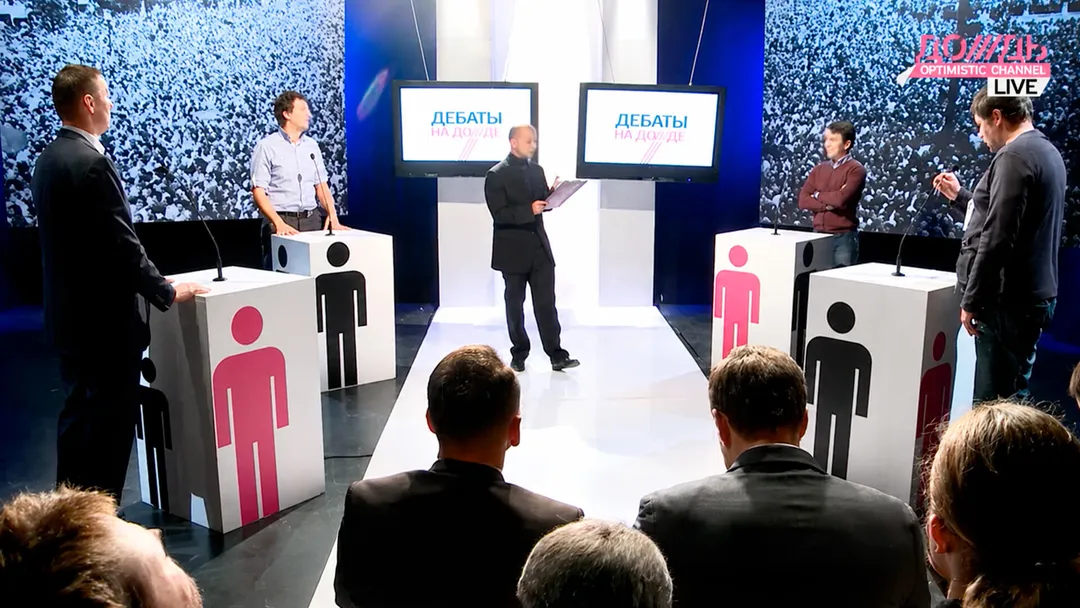
And we continue the debate on Dozhd (TV Rain).
These are the debates ahead of the election to the Coordinating
Council of the Russian opposition, and in this
round we have with us Dmitry
Bura.
A civic activist, historian
from Germany; Alexander Makshanov, chairman
of the committee of the political party Runet Leader
of the opposition;
in Udmurtia. One of the—sorry, the photos are very
small in this case. Pavel
Shelkov, a geologist, diamond specialist, member of the Moscow
branch of Solidarnost, co-chair
of the commission investigating the events of May 6
and the events in Krymsk, and Alexei Navalny
lawyer and public political figure.
Good
evening. You have 30 seconds to introduce yourselves, in
the order in which I named you. Dmitry
Burashnikov goes first. Hello. I am here
for a very simple reason: I
am representing the interests of my
associate and friend Maxim Sergeyevich
Martsinkevich, better known as Tesak,
who was unjustly convicted under Article 282
Well, thanks to our state, and
also to the colleagues who are present here.
Thank you.
Thank you. Alexander Makshanov, chairman
of the committee of the political party Rut—your
Good afternoon, dear friends, dear
viewers. My name is Alexander
Makshanov. I came here from the city of Izhevsk,
and why exactly have I come here?
You can see my thoughts,
how I see the Coordinating Council, in my promo video.
And what I want to convey is this: starting on the 22nd,
there will be voting. On a person's ballot
there will be 45 check marks. Naturally, first
they will go to the people he
knows, trusts, and respects.
That is right, but I would like to say
that people should also make a little effort
to look at new people, new faces,
new people and new ideas with which
people are coming forward. Thank you. Thank you, understood. And
Alexei Navalny, 30 seconds. Thank you. I am
36 years old, and the last time I was able
to vote in any kind of free election,
or relatively free election, I was
18 or 19. And now I am taking part in
free elections to the Coordinating
Council because I believe in democracy. I
believe in popular rule. I believe that people
should decide their own fate, that
the best strategy and tactics for the opposition
should be decided by those who are elected, not by those who are
appointed by some officials from
the presidential administration or the party
nomenklatura. Elections, fair competition,
debates, even with unpleasant people—this is what
will make us stronger, and what will help
us
win. Thank you. Your 30 seconds are up. And
Pavel Shelkov. Hello, friends, I greet
you all. I believe the main task of this
council is
the peaceful overthrow of the occupation regime
that prevents all of us from living. So,
the main problem of our opposition leaders is
that in 10 months they have not proposed
a clear program for transforming Russia
from a despotism into a normal European
democratic country. So we must,
the Coordinating Council must daily
oppose the thieves and crooks, proving
to the people that there is an alternative to the enrichment
of billionaires through building bridges to
uninhabited islands. The Coordinating Council
must move beyond rallies.
Your time is up. We are all on equal
terms. We have finished introducing
the candidates, and now my general question, or rather
request to everyone: let's stop with
the serious questions for a moment and begin with something very
serious in another sense. In Russia, as always,
there have always been difficulties with political activity and parties,
and Russian literature
the great Russian language
has often replaced and performed many
political functions. Please recall,
quote, or name your favorite
poem dedicated
to freedom, political activity, rights,
or happiness, finally. And we will start with Dmitry
Burashnikov.
I prefer prose, so if you'll allow me, I'll recall a prose work.
My favorite work of prose
by Russian
writers about the homeland, I would say,
or by any writers,
would probably be *A Sportsman's Sketches*.
All right, thank you.
And I have the same question
for Alexander. "If life deceives you,
do not grieve, do not be angry; on the day of despondency
be resigned—believe, the day of joy will come.
The heart lives in the future; the present is dreary.
Everything is fleeting, everything will pass; and what has passed
will become
dear." Thank you for not asking us
to dance; I think I will
refrain from reciting. I
will refrain from reciting. Let us
simply do something, act in such a
way that perhaps someday someone
will compose about us or about our time
similar
poems. All right, I would be very glad. And Pavel
Shelkov. Well, I will also quote one of our
classics: "Autocracy, villain! I hate you and your
throne; I rejoice with profound joy at your downfall
and that of your children..." Well, I would rather not mention the children.
"...I behold with profound joy..." Well, nowadays that is
considered extremist under the new
legislation. Yes, and it does not fall under...
The law on the protection of children's rights. Thank you.
Thank you very much. Yes, I’m moving on to each of the
candidates.
And Dmitry, you basically gave
me, so to speak, a pass. Tell me,
please. Well, I understand that we are in favor of
everyone being represented. Everyone
has the right to delegate, to be
represented, but is there really no
personal ambition? Do you really not see yourself as
someone in your own right, but rather as some kind of
shadow of Tesak (nickname of Maxim Martsinkevich, a Russian far-right activist)? After all, if you’re elected,
you’ll have to work. — Ah, no.
You see, here’s the thing: we never
took seriously the attempts to create
a second party of crooks and thieves. We decided
simply to test how the
democratic liberal council
of the opposition functions. And it turned out that the nationalists
of Martsinkevich — National Socialists, I want to
correct that — were unable to register
me, while the democratic
elections did register me. So now I’ve been registered,
what next? Well, let’s see what
comes next. We’ll make it through the debates, get into the
Coordination Council, I hope.
I hope our comrades, our
friends, will vote for me, and after that we’ll work. We’ll see
what we’re capable of together, yes or no.
We’ll see.
And Alexander Makshanov, please tell us:
you were a member of the Yabloko party and made a
truly phenomenal
career there. That applies not only to you in
this hall, but still — you even headed
your, so to speak, Udmurt regional
branch there, and then somehow Yabloko
was no longer enough for you, and you created the Runet Party
which, essentially — well, for now at least — is still
a tiny party. Was this because of some kind of
systemic disagreements, or do you simply
think it’s better to be the big fish in a small pond?
Absolutely not, I don’t think that
at all. As for Yabloko, it’s a very simple situation.
Yabloko is an excellent democratic school, but
the time for school must come to an end, and
a person has to move on. In this hall
there are people whose situation with Yabloko was almost the same,
and as we can see, they
moved on to other work. And the same is true for me here.
That is, I had already hit a ceiling where
I no longer saw any room for growth for myself. And the
ideas that I am now implementing in the Runet
Party — I had those ideas back in Yabloko, and I brought them
to Yavlinsky and Mitrokhin, but there was no understanding
there.
Thank you very much. Alexei, since we’re talking about
the Yabloko party, I’ll have to remind you as well
that it was part of your past, and there was also
a project in
Kirov, and you were close with Nikita Belykh
the governor of the Kirov region, and in fact
you already have a long political
history by now, and you were connected
with political analyst Stanislav
Belkovsky, and so on and so forth. But you
seem to outgrow everyone and somehow take no one
with you — neither the Yabloko party nor your friends
from it, nor any of the
Kirov people — not the forest, so to speak (a reference to the Kirovles case),
and so on. So how can we be
sure that
our current allies will not be
cast aside by you further down the road? I took everyone
with me. Every person I
worked with in Yabloko, and Belykh, with whom we
communicate less now — every person
taught me something, and I carry that with me
through life. It helps me tremendously.
That is exactly why we are now holding elections to the
Coordination Council: so that people can emerge
who are able to grow independently,
who, under pressure and in the absence of
administrative resources, in the absence of
access to the media, can still make themselves known and
grow as much as they want — even higher than me.
I will only be happy if there appear
people who can
compete with and defeat me or
any other candidate. Be
happy — you, you, and Dmitry Burashnikov
as well. And I will address my question to Pavel
Shelkov.
You are involved in commissions investigating
the events of May 6 and the investigation in Krymsk.
So, as they say, you are conducting an investigation
into the investigation — can we finally name
who is to blame?
Well, in one word, basically
Putin. Because in both
cases, this is essentially a product of that
system of irresponsibility, when,
for example, officials in Krymsk simply
did not bother to warn people that
they would be flooded and swept away that night.
Likewise, an order was given to disperse
a peaceful demonstration. I consider this
a crime, and of course those responsible will
sooner or later be punished and sent to
prison, taking the place of those whom they are now
trying to imprison despite their innocence. And I also
believe that the main culprit is Putin. Well,
yes, those are very interesting conclusions from the commission. And I
I
thank the participants in this round and their
support groups, as well as
the TV viewers. I remind everyone that
you need to vote on the Central Election Committee website,
202.org, for one candidate from this
group of four and for one candidate from all the participants
in tonight’s event. You can
vote on the website tvrain.ru, and this
voting is already underway. And among this group of four,
Dmitry Burashnikov is currently in the lead. Thank you.
[applause]