"Debates for the Opposition Coordination Council (Final)"
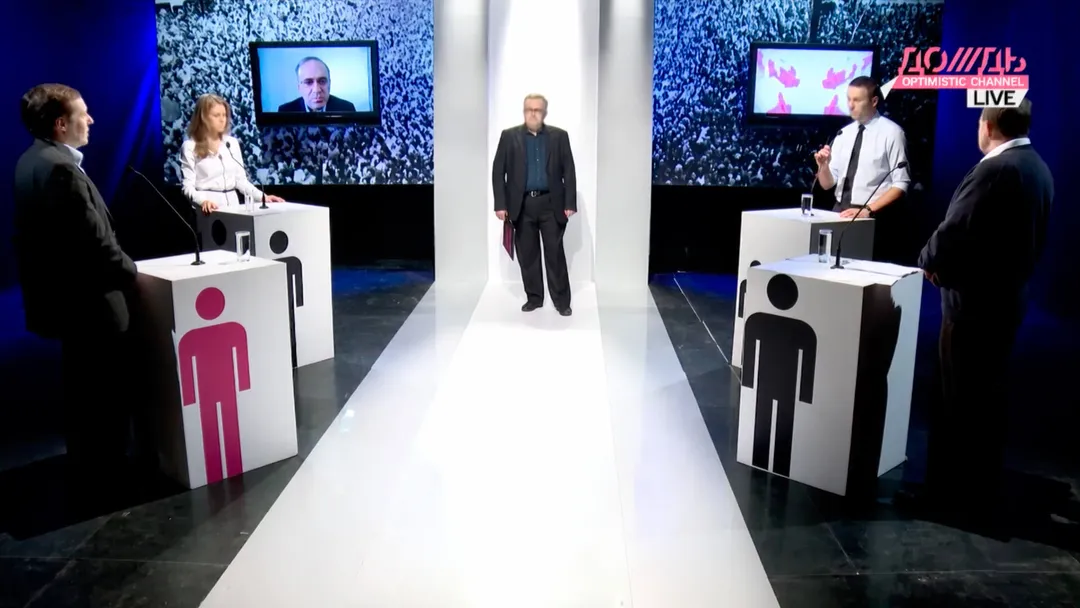
Debates on TV Rain.
>> Good evening. My name is Yury Saprykin, and
we are beginning the final debate on TV Rain.
On December 20 and 21—October 20 and 21,
sorry—the elections to the
Opposition Coordination Council will take place, but already
now events are unfolding rapidly. Today
another defendant was arrested—the eighteenth
in total
person charged in the Bolotnaya case: Sergei
Krivov. The 52-year-old Candidate of Sciences
(roughly equivalent to a PhD holder) is accused of having taken
a baton from an OMON officer (riot police officer) and beating him with that
baton. Also today, one of the candidates for the
Opposition Coordination Council was placed under
arrest:
Konstantin Lebedev. On the basis of
materials from the staged television film
*Anatomy of Protest 2*, he has been arrested for
2 months pending investigation. And we wish
Konstantin Lebedev a speedy
release, and to everyone involved in
these latest arrests we remind you that
there is a higher court as well.
And today, on the list of candidates for the
Coordination Council, there is one more
political prisoner and one fewer
politician. Ilya Ponomaryov has withdrawn
his candidacy from the elections to the
Coordination Council, and in turn we wish him
successful and productive
work on new, useful,
interesting laws, in the increasingly
honorable status of a deputy of the
State Duma of the Russian
Federation.
And let me remind you once again: our elections will take place
very, very soon, on October 20 and 21.
The elections are being held on the website cvk12.org.
I hope you have already managed
to register, because, as they say,
there’s only half an hour before takeoff—the registration
period has passed. Registration is closed. And for everyone
who has not yet completed verification, there are still
a few hours—or you could say, almost a whole
day—to get it done in time.
There are several ways to do this.
Let me quickly remind you of the main ones.
A nominal bank payment for a small
amount, a payment via Yandex.Money,
or a photograph of yourself with your passport open to
the first page, which should be sent to
the address cvk2012.org.
And probably the increasingly relevant method under
current conditions is
verification at regional
election commissions and at polling stations
in Moscow.
The main ones are operating at 19 Pokrovka Street
in the Tsiolkovsky bookstore near Kitay-Gorod. And
on Saturday and Sunday, another polling station will open
in the immediate vicinity of
the TV Rain studio,
at the Dom cafeteria on Red
October. You can also come to
the polling stations on Saturday and
Sunday and complete verification
immediately before the start of
voting. That is also entirely possible and
perfectly acceptable. As of this hour, on the
CEC website,
around 160,000 people have registered.
As for our debates,
today is indeed the final round,
a crucial moment, the last group of five
candidates. Some 200—almost 215 candidates
have passed through several rounds of
our debates over this time. Today you
will have to choose one participant from
this group of five. The name of the winner of this round,
as well as the winners of all the final
rounds, will be announced tomorrow at 10:30 p.m. on
TV Rain’s wrap-up broadcast, where we will
discuss the debates and the elections to the Opposition Coordination Council
with guests in the studio and experts. And once
again we will look at the performances of those who
won the final rounds, and at the most
interesting and memorable moments of
the debates overall. The format of our final
is as follows:
five participants ask each other
questions: 30 seconds for a question, 1 minute
for an answer. And we begin.
So, taking part in the last final round of our
debates are Mikhail
Anshakov, chairman of the Society for the Protection of
Consumer Rights. Good evening.
>> Hello.
>> Lyubov Sobol, a lawyer with the Anti-Corruption Foundation,
the RosPil project, and a member of the People's Alliance party.
Good evening.
>> Alexei Navalny, a lawyer and public
and political figure.
>> Hello.
>> Good evening.
>> Andrei Illarionov, economist. And,
>> good evening. And joining us via Skype is
Garry Kasparov, the thirteenth
World Chess Champion, leader of the
United Civil Front, and member of the bureau
of the Solidarnost movement. Good
evening.
>> Good evening.
>> Over the past week, you have already gotten used to
seeing these people in the studio. But before
we begin this cross-questioning,
we decided to look at what these
people do in their ordinary lives outside
the TV Rain studio, and talk with them about
how their lives will change after the elections to the
Coordination Council, and how the country’s life will change if the Council
achieves its goals. Our first
segment is about the life of Mikhail Anshakov.
For the last five or six years of my life, I have
hardly gone beyond not only the MKAD (Moscow Ring Road), but
even the Garden Ring. I
live in the center and work in the center as well.
This is quite a quiet place. Here
quite a cozy and comfortable place to work.
The Coordinating Council can and should
become a professional coordinating and
guiding body for the Russian
opposition, a kind of shadow government,
and a professional one at that. The main task
of the protest movement is to broaden
the social base of the protest.
The Coordinating Council needs practical people,
people who really know how to get things done,
who have successful experience in various
forms of civic action, perhaps
human rights work, and it also needs
representatives from the regions. The Constitutional
Council must first and foremost help build
civil society in Russia. As soon as
a developed civil society emerges in Russia,
it will be able to
set its own program against that of the authorities
and, accordingly, win the trust
of a great many people. We will, I
hope, fight for our bright
future.
>> Mikhail Anshakov, chairman of the Society
for the Protection of Consumer Rights, is the first
to answer questions from his fellow debaters. And
the question for Mikhail comes from Lyubov Sobol.
Please. Mikhail, I have looked through
your political compass, and on the question
about lustration you answered,
you answered categorically in the negative
that is, that you are against
carrying out lustration with regard to
party functionaries of United Russia.
So, as I understand it, you
believe that people such as Churov,
Bastrykin, Zheleznyak, and others may
be allowed to take part in elections
and hold the highest offices.
in Putin's Russia. And
if power changes hands, then I
have the following question for you. Do you not think
that the fact Putin is now in
power is the result of the fact that neither in
the 1990s nor in the 2000s was there
any lustration carried out, nor were
any lustration laws adopted? Lyubov,
forgive me, of course, but I don't understand. Either
I made a mistake when filling out the political
compass, or you confused someone else's compass
with mine, because I am in fact
a consistent supporter of lustration. I
already said this during the debate. I am precisely
in favor of the authorities being held
responsible for their actions.
The big mistake, specifically
after our communist
government, was that lustration was not
carried out. Because
indeed, if the authorities feel
their responsibility, then they
will treat
their duties, and the rights and freedoms
of the citizen, of the individual in the Russian
Federation, quite differently. And crimes must be
punished, in my view, and that is very
important. Therefore, one of the first tasks
of a new legitimate government in Russia will be
to carry out lustration. I am a passionate
supporter of these measures.
>> Tell me this: for a week now we've all been talking about
lustration, lustration,
lustration. But what, exactly, should
the form of this lustration be? For example,
say, in 1992, I
remember there was a trial of the CPSU (Communist Party of the Soviet Union) that was never
finished and, as people say nowadays,
was quietly dropped. But even so,
some kind of attempt was made. So,
what exactly do you mean by the word
lustration? Well, it's quite clear:
certain restrictions on the right
to engage in
certain kinds of activity, including
holding public office,
working as an official in certain
institutions, in law enforcement
agencies, or in the judicial system. These are
absolutely necessary measures, and without them we
simply cannot manage.
>> Thank you, Alexei Navalny. Your question
for Mikhail Anshakov.
>> Thank you very much. Mikhail, today I read
your blog. Let me try to reconstruct, in
order,
your latest posts and, apparently, some of your ac-
actions as well. You nominated
the Patriarch for the Nobel Prize. That
was an official, formal letter.
Then you turned yourself in, saying that
you should be prosecuted for
extremism because you had nominated
the Patriarch for the Nobel Prize. Then
you wrote an official letter
demanding that the Patriarch be excommunicated from
the Church. And the last official,
formal letter that you
sent said that you, as the
consumer rights protection society,
were demanding the replacement of
a president of inadequate quality. I
laughed a lot; it really was
wonderful. But the question is,
in the Coordinating Council, where exactly is the
line between this kind of trolling, joking,
and serious work? And won't it turn out
that behind these
jokes and wisecracks we will somewhat blur
the substantive work, because
people are sitting in prison while we seem to be
amusing ourselves by demanding that the Patriarch
be excommunicated from the Church.
>> Alexei, well, without jokes and banter it's hard even to look at
our reality at all.
It's my personal blog, and there I really do
allow myself certain liberties and
consider that entirely justified. Besides,
these blog posts, they
attract a great deal of public attention.
My task, precisely in this format,
perhaps a joking, playful one,
is to draw attention, in fact, to
serious problems.
As for our demand
to excommunicate the patriarch from the Church in connection with
canonical violations, and also
in connection with the patriarch’s nomination for
the Nobel Prize, all of this is connected with
the fact that, in my view, and right now
the Russian Orthodox Church
is in need of reform, is in need of
renewal, and this is a very important institution
for society as well. After all, the Russian
Orthodox Church, ever since the time of
perestroika (the late-Soviet reform period), carried great hopes
for society, in the sense that it could
become a kind of moral authority,
could have a positive influence on society,
but unfortunately, that did not happen.
>> You know, Mikhail, you should just get
a Twitter account. Jokes work better there.
>> I do have one, though I don’t post there very often.
write.
>> Andrei Larionov, please, your question
for Mikhail Anshakov.
>> Mm-hmm. Ah, Mikhail Genadyevich, perhaps I, too,
perhaps,
didn’t immediately understand all your jokes.
Maybe they are jokes, or maybe
not. Uh, in your first essay,
which is posted on the CVK website,
you said that one of the tasks of the KAS, from
your point of view, is
one of the primary goals: achieving consensus
among all opposition forces on
the fundamental questions of the future
structure of the state. You even
wrote “State” with a capital S.
The fundamental questions of the structure of the
state are reflected in the constitution. And
in your second essay, you simply reproduced
the first 10 articles of Russia’s current constitution
and then wrote, “the rest follows the text of”
constitution.ru,
that is, the entire text of the constitution, and
added that the efforts of other authors
to write better, broader, and deeper should
be considered graphomania, and their evil
should be punished to the fullest extent of the law,
except for the terms of office of the president
and the Duma. So here is the question
that arises for me: do you believe that consensus
among all opposition forces should
be reached regarding the current
text of the constitution, which does not need
to be changed, and that any attempt to introduce any
change, except for the length of the
terms of office of the president and the Duma, should
be considered evil graphomania and punished
to the fullest extent of the law?
>> Mm-hmm. Let me explain. First of all, I believe that
the constitution is far from exhausted.
It is quite a remarkable document in
every respect. These constant
attempts to rewrite the constitution, personally, I
do not like, because, in my view,
one can get completely absorbed in that work and
do nothing else. Especially
if this issue is taken up in the
coordination council, where various
political forces are represented, we will not find consensus
any time soon. Therefore,
the constitution, probably, like any
document, does need improvement,
but that is not the first-order or main
task for the Russian opposition right now.
to propose revising the constitution,
changing it, or putting forward similar
proposals. Within the framework of the current
constitution, in my view, it is possible
to build a civil society, it is possible
to build a democratic state, and
later on to think about its
improvement,
>> So, on the basis of the constitution that
brought us to the political
regime we have now.
>> And at this stage, to revise
the constitution, to rewrite the constitution, I
consider absolutely wrong. Well,
with the exception of those articles that
concern the terms of office of the president and
the deputies of the State Duma.
>> At the same time, the actual powers of the
president and the State Duma
would remain in the same state as
they are now.
>> This text, in my view,
is quite sufficient as a basis on which
to build a normal civil
society.
>> Thank you. Garry Kasparov, please, your
question for Mikhail Anshakov.
Probably, following up on the question
that Andrei
Larionov just asked you, I would still like to clarify. You
are, after all, a supporter of a parliamentary republic,
that is what you wrote in your essay.
>> Well, a parliamentary republic, in my
view,
not in its pure form, but with a strong
parliament and a president who is rather
somewhat limited in his
powers compared with what exists
now. That is the most acceptable form.
Excellent. You often write that
the opposition, for many years now, has, in
general, been going around in circles,
unable to achieve results,
because it lacks this kind of
broad social base, has nothing
substantial to appeal with. And you also, in a way, note
that over these years the opposition has done nothing
particularly significant. But it seems to me
that there is nevertheless a very important
point for a person who, like you,
is now joining the opposition current,
but to be consistent, because
the current constitution, it is
super-presidential. So if your
main idea of political reform
is connected with limiting the powers
of the president, how can one then claim
that the constitution in its current form is
untouchable, and that reforms can be carried out
without touching this very essence
of the Yeltsin-era constitution, which Putin,
incidentally, while hardly violating it at all, managed
to turn to his own advantage?
I am only saying that we need
to set priorities. What should be done
first, and what second? First of all,
I believe that in Russia we need
to build civil society; we need
political reform. Here the opposition
must play a decisive role, and only later
should the constitution be revised,
limiting the powers of the president or
other bodies. But if, first and foremost, we
focus specifically on
revising the constitution, rewriting
the constitution, it will lead to nothing good.
The energy of the protest
movement will simply be diverted in the wrong direction, not
the one where it is needed, whereas that energy could be applied
precisely to
developing the protest movement,
bringing new social groups into it,
groups that, although they now in fact
sympathize with the protest movement, are not
involved.
>> All right, the point is clear. We’ll deal with the constitution
later. Excuse me, but under today’s
constitution, without the president, no
political reform is possible.
>> Well, let’s proceed consistently,
step by step. Let’s work out
a certain step-by-step strategy, perhaps
within the Coordination Council, and then
act consistently.
>> If we’re talking about a step-by-step strategy,
fine, we’ll deal with the constitution later.
But take the Criminal Code, for example—is there
any provision, even just one, that you
would change first of all? Well, of course,
first and foremost, the articles punishing
extremism and leading to criminal
liability, because this is fertile ground
for serious abuse on the part of
the authorities.
In general, quite a lot could be
revised in the Criminal Code.
>> Mikhail Anshakov, chairman of the Society
for Consumer Rights Protection. Thank you. Your
answers have been heard; your questions are still
ahead. And now we move on to the next
participant in our debate. This is Lyubov
Sobol, a lawyer for the society—uh, sorry,
a lawyer for the Anti-Corruption Foundation
the RosPil project, and the People’s Alliance party.
Let’s watch a short clip about how
Lyubov Sobol lives, works, and
operates outside this studio.
This is the Federal Antimonopoly Service. And
in this building I spent practically
half a year of my life. At one time
I worked at the Presnensky District Court,
on the other side of the barricades.
The Coordination Council, at first, will
be engaged in some day-to-day operational work,
in principle, but in the future, I hope that
the Coordination Council will be able to become,
a body that offers a real alternative
to the current system.
The Coordination Council is a new
stage in the opposition’s activity. It is precisely about
coordinating and uniting the efforts of different
people. The Coordination Council should
bring together people who want to
change something. One of the goals of the Coordination
Council must certainly be the development of
citizens’ self-awareness, the development of
the institutions of civil society.
I believe that all of us together must
unite and start acting. And one
good joint effort shows that
there are people who can replace
those in the system.
They cut out the most important thing. I probably
spent practically the entire recording of this clip
talking about political
prisoners and about how the Coordination Council
should, first and foremost,
be engaged in defending political prisoners. It’s a great pity that
this was cut, because I thought
on the contrary that the whole clip would be devoted
precisely to that.
>> One thing that was not cut out caught my attention.
In what capacity did you
work on the other side of the barricades? Well, I
worked as a court session secretary
and also as a judge’s assistant
at the Presnensky District Court, which is notoriously
known for the Kozlov case and other
cases,
>> which gained notoriety as a
kind of zoological,
>> yes, a branch of the zoo.
>> Thank you. Lyubov Sobol is answering
questions from our candidates. Mikhail Shakov,
your question, please. Lyubov, you are running
in the election as part of a large group of
Alexei Navalny supporters, and in many
ways, you probably owe this stage
of your political career to him. So
tell me: in the clip you were drinking tea, and there
I believe that everything should be
in moderation. If, for example, into that same tea
you put 10 spoonfuls of sugar instead of two or three,
which is what you did, then you can
overdo it, and the drink will no longer be
as tasty. There’s no shortage of things
you can put into tea.
So what do you think: is there some
an acceptable dose,
a non-toxic dose, I would say.
of Alexei Navalny’s supporters in the
Coordination Council—couldn’t there be
a larger number of his supporters
making use of this remarkable body
that we are trying to create?
>> My question is this: do you consider yourself
a supporter of Alexei Navalny? Well,
partly, yes, I partly share his
views.
>> Ah, well, if we’re talking about that,
>> Well, I do not owe Alexei Navalny my
political or public
career, you understand? I still
consider myself an independent person.
>> Yes, I made the decision myself
to run for the Coordination Council
of the Russian opposition. And if we’re talking
about Alexei Navalny’s supporters, then I
believe that those people who
share the ideas of fair elections, yes,
rotation of power, fighting corruption, and
so on, can also be counted among
Alexei Navalny’s supporters. I
am an independent person and
independently handle civil cases in
court on behalf of RosPil (Navalny’s anti-corruption procurement project), and independently
make certain decisions within the
RosPil project. And my work is fairly
independent of the decisions that
Alexei makes in the political sphere—
Navalny. So I think that
if I were to answer the question, then
whether it’s 10 or 11, or 30 people—it’s very hard
to say how many people there are, for example,
in the Coordination Council who share
Alexei’s views. But I believe that, in
principle, all of us who are standing
here now are supporters of common ideas,
such as fair elections and honest
government.
>> In a sense, we really are all
supporters of one another,
despite the fact that here we have to
choose a winner in each round.
>> Ah, well, in any case, we have not established any toxic dose.
Ah,
>> yes,
>> let’s assume it can be any amount.
Alexei Navalny, and everything you wanted
to know about Lyubov Sobol, but were always
afraid to ask. Thank you very much.
First of all, Mikhail, if you had seen
the arguments Lyubov and I have in our foundation,
you would doubt that she is such a great
supporter of mine. Lyuba, just last
Sunday, you started a fight
at polling station No. 308 in
Khimki.
>> And you and the other
observers took part in that fight. And we all watched it,
and by then the whole country had seen it in videos on
YouTube. Nevertheless, all 19 observers
who were at your polling station were
removed. Nevertheless, the election
commission still carried out the
manipulations and fraud involving the voter
list that it wanted. And roughly
the same kinds of manipulations were carried out at
many thousands of other polling stations. And
on the 14th, elections were held in 4,000
municipalities. So here is my question.
After your fight, after you were
escorted out by OMON (Russian riot police), after, in
the end, the election commission got
what it wanted, do you still believe in
municipal elections in Russia?
>> First of all, yes, I believe in the institution of elections
in Russia; there is no other way.
A democratic society cannot do without
elections. Then, step by step—well, as for the
fight, I did not take part in it; I stood with
the other observers and we were preventing
the unlawful actions of the commission
chairman. We stood in the passageway and did not
allow him to carry the lists outside
the polling premises. In other words, we
were obstructing his illegal actions.
We did not take part in a fight; rather, the fight
was provoked by the chairman himself, and the
unidentified person who was shoving
the observers and preventing them from acting.
And as for observers, yes, I
wanted to say that I have extensive
experience as an observer. I have seen and taken part
as an observer in various election
campaigns. I want to say that what really pleases me now
is this trend of growth
not only in the number of observers, but also in the
quality
of the observers who take part in
elections. And we have not only learned
to detect falsifications, but have also learned
to stop them. At our polling station, we
did not manage to do that effectively, although
both candidate Chirikova and
the Communist Party candidate, as well as the head of the
Moscow Regional Election Commission, came there. We could do nothing about that crook,
the commission chairman.
But I believe that we must
move in this direction, we must
develop the observer movement in
Russia, train them better together with
Sonar, RosVybory, Citizen Observer,
and specifically improve the quality
of election monitoring for fair elections in Russia,
because this is a good thing, including
for the development of civic awareness.
>> I go as an observer to every
election that takes place, probably, in
Moscow and the Moscow region,
and have been doing so for several years now. And I
understand that a person who comes
just once and sees falsifications at a polling
station will never again
believe Channel One (Russia’s main state TV channel). And, well,
Election observers are a very good thing
for the development of civil society and
people’s civic awareness. And this brings us
to the question of what the
Coordination Council should be doing. Excuse me, I’m
going to use my official position here,
but I’d like to draw attention to the
appeal posted online today
by election observers from St. Petersburg
>> about precinct election commissions.
The point is that, caught up in everything we’re doing,
we may fail to notice that
right now
precinct election commissions are being formed,
and they will continue working for the next five years,
including, accordingly, during
the next elections to the State
Duma (the lower house of Russia’s parliament). And in my view, one of the
most urgent tasks right now is
to somehow get the observer movement
into these precinct election commissions
starting now.
>> Yes, Yuri, I completely agree with you. It’s
a very important issue to get independent
people onto precinct commissions so
that from within they can make
decisions, handle complaints,
and also fight from within the system
against vote-riggers and against commission chairs
who are often the very ones breaking the rules. In fact,
the greatest number of violations
are committed by the chairs of precinct
election commissions themselves. We need to fight
them in different ways.
>> Lyubov, here is my instruction to you as a deputy.
Please take this under your personal supervision.
Please.
>> Thank you. I’ll take care of it. Andrei Larionov,
please, your question for Lyubov Sobol.
>> Lyubov Eduardovna, I looked through the
materials you presented for
voters’ attention, and I noticed that
you are one of the few candidates who
draws attention to the importance of legal
reforms, reforms in the legal sphere and
the judicial system, as well as law enforcement
agencies. Well, presumably that reflects the fact that you are
a professional lawyer. So tell me,
please, in your view,
what are the priorities
from your point of view? What is more important
at the initial stage: political
reform or legal reform? That’s
the first question. And second, what do you think
could be done within the framework of the
emerging Coordination Council
in order to begin
carrying out
reform specifically in the legal
sphere?
Well, first of all, to carry out any reforms
you need to have power. So the opposition’s Coordination
Council, as long as we do not have governmental powers,
cannot implement them, and we do not
possess the political will in office needed
to carry out binding decisions. So the
Coordination Council can only
propose draft future reforms
that
>> to whom?
>> Ah, propose them to society, put them forward for
discussion, for adoption, and
offer an alternative. Accordingly, reforms
should first and foremost concern
the judicial sphere—judicial reform,
reform of law enforcement agencies,
and of course political reform must also
not be forgotten. Constitutional
reform as well. I believe that
I support the idea that there should be
limits on the president’s powers, and there should
be a clear constitutional limit on the term of office
in the Constitution: two terms
over a lifetime. Moreover, I believe there should be limits
not only on time in office
as president, but also
as prime minister, because
Russia has the sad experience of a person
not leaving power after finishing
their presidential term.
>> Do you mean Dmitry Anatolyevich?
>> Ah, yes, I mean Dmitry, I mean
both Dmitry Anatolyevich and Vladimir
Vladimirovich. Judges should be elected.
>> Right? I believe that, first of all, if
we speak briefly about judicial reform,
the first thing is the election of judges. First,
elected judges—or at least some form of selection,
that is open for discussion. But in any case, they should not
be appointed by the president, as
they are now. They should not
be subject to recommendations from the FSB (Federal Security Service). They should not
depend on law enforcement agencies or
on this system, as they do now.
They should be selected, perhaps,
by bodies including the judicial
community—that is, not necessarily
by the general public. That is open to discussion. The key point is that they should not
be appointed, and there should not be
control by court chairpersons over
the work of every federal judge.
Right now, a court chair can remove
a judge at their own discretion. The role of the court chair
should be reduced to, roughly
speaking, that of a farm manager (sovkhoz manager, i.e. a purely administrative role), so that they
are only checking whether there is soap in
the restroom. In other words, they should not be able to remove judges at
their own discretion, yes. And public
oversight, of course—public
oversight, which I have always supported and
will continue to support.
>> This is a very long conversation. I hope
we’ll have a chance to expand on it
somehow.
>> May I clarify: before the opposition gains
political power,
can anything be done?
>> Naturally, yes. Public oversight,
Just as RosPil is now engaged in
monitoring procurement and budget spending of 5
trillion rubles a year, yes, in this sphere,
RosPil is trying to work on this too and is fairly
effective in fighting it, and we must
monitor the judicial authorities and
exercise judicial oversight. Oh,
carry out public, I mean, public
oversight over compliance with the rules.
Garry Kasparov, your question for Lyubov Sobol.
Ah, Lyuba, well, RosPil’s work,
of course, is admirable. A great deal
has been done. Just to clarify: has even
a single criminal case been opened on the basis of
those facts of de facto multi-billion-ruble
theft that you uncovered?
>> Not yet, but we have not stopped
hoping, and we constantly send requests to the
prosecutor’s office and the investigative authorities,
appealing this. And there have already been reversals of
the investigators’ decisions refusing
to open cases. That is, there have been reversals,
ordering new reviews and new
checks.
>> And now a question. You said
you don’t have the proper powers. Let’s
imagine for a moment. So, that’s it, the Putin
regime has fallen, and Russia has a new
government. You have been put in charge of
corruption—or rather, of eradicating it. And
because, as we know, in Russia, as
Karamzin’s immortal phrase goes, “they steal” (a reference to historian Nikolai Karamzin’s famous remark about Russia), and
nothing really changes, and corruption
is like the Lernaean Hydra. Cut off one head,
and three grow back. So what can
be done, and is it possible to do it in such a way that
this monstrous evil, which
is corroding the entire fabric of the state
in Russia, could be eliminated?
>> Thank you very much, Gorkimovich, for the question.
When it comes to corruption, we need to distinguish,
first of all, between everyday corruption and corruption
at the highest levels of power. To fight
corruption at the highest levels of power, what is needed is
above all political will; what is needed is
turnover in power, because we
saw that when Sarkozy left his
presidential office, three weeks later
his premises were being searched. Accordingly,
if we have turnover in power, we will
have the possibility that one elite will
prosecute and bring criminal charges against the
elite that has left office and
lost its sweeping powers. And at the
everyday level, this again means first and foremost
judicial reform and reform of
law enforcement agencies, which
must be subject to oversight; judicial reform
can correct the mistakes of
the legislative branch and will
oversee the executive authorities. And
I spoke a little earlier here about judicial reform,
yes, and the main thing is
to make the courts independent in
Russia by fully vesting judges with
their powers, and by
eliminating
executive control over
the exercise of these powers
by judges, and through public oversight,
the development of civic institutions,
and the development of transparency and openness in this
system. And since, right now,
for example, there is a gradual increase in
openness and transparency in the commercial courts,
we must bring those same ideas to the courts of
general jurisdiction as well.
>> There. Thank you very much. And I am
extremely pleased that by the end of the debate
our candidates have finally realized that
the bell is not dogma, but simply
a reminder that could be
taken into account. You’ve been indulged.
>> Thank you. Lyubov Sobol, lawyer for the Anti-Corruption Foundation
and the RosPil project,
People’s Alliance party. We will return to
our debate right after the commercial break.