The Kirovles Case. Court video recording. Hearing 14
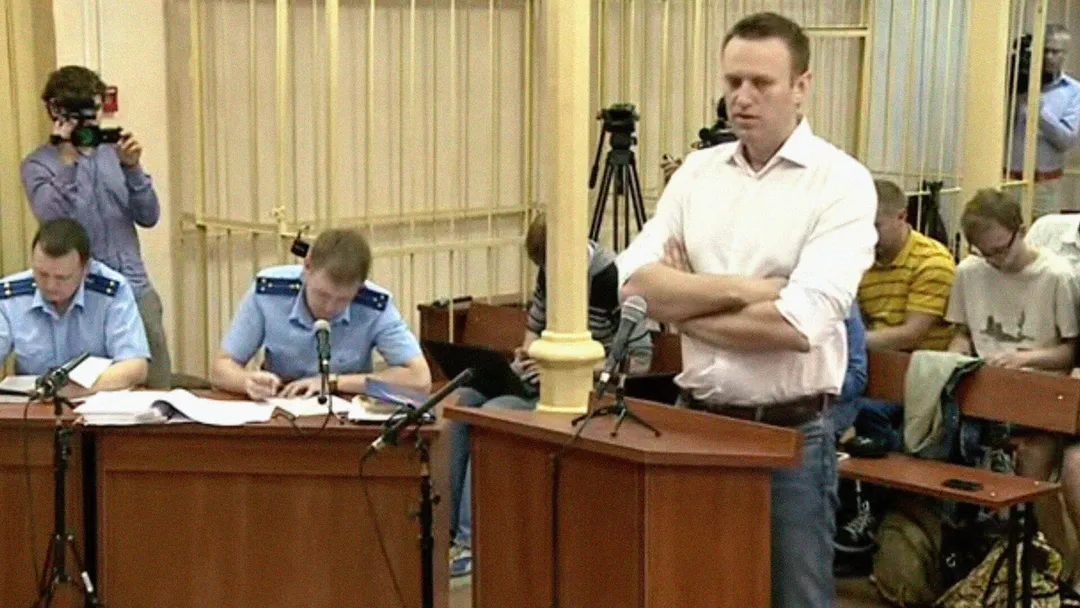
Please, take your seats.
>> The court investigation was brought up for consideration.
of the criminal case against Navalny.
The composition of the court in the case of Ofitserov has not changed.
The parties are present in full.
In this case,
it was planned today to question
the defendants. Is the defense side ready
to testify?
>> Certainly.
Who will go first? Please proceed with the testimony.
We have a motion from the de—
>> As usual, it is in writing; I will read it out.
Yes,
>> Understood.
>> To Federal Judge Blinov of the Leninsky District
Court of the city of Kirov.
From defendant Navalny, his defense counsel Mikhailova,
and Kobzev
a challenge.
The Leninsky District Court
of the city of Kirov is hearing criminal case
No. 1-225/213
on charges against Alexei Navalny
Anatolyevich of committing an offense
provided for by Part 3 of Article
33 and Part 4
of Article 160 of the Criminal Code of the Russian
Federation, and against Pyotr Yuryevich Ofitserov for
committing an offense предусмотренного
by Part 5 of Article 33
and Part 4 of Article 160 of the Criminal
Code of the Russian Federation.
The above criminal case is being heard
on the merits under the chairmanship of
Federal Judge
Blinov.
On June 11, 2013, during the court
proceedings,
when the parties were discussing the date
of the next court hearing, Navalny
and his defense counsel submitted
summonses requiring them to appear at 12:00 on June 13
2013 before the head of the
investigative team, an investigator for
particularly important cases of the Main Investigative
Directorate of the Investigative Committee
of the Russian Federation, Nesterov, in
criminal case No. 2011/460
711-12, for the purpose of carrying out
investigative actions.
In that criminal case, Navalny
is the accused, and with respect to
him there is currently a preventive measure
in the form of a written undertaking not to leave
and to maintain proper conduct.
At the court hearing, Navalny explained
to the court that he could not appear on June 13, 2013
in court, since he had previously been summoned
to the Main Investigative Directorate
of the Investigative Committee, located in
Moscow, for June 13, 2013, in order
to take part in investigative actions. However,
the court ignored the existence of
the obligation provided for in Clause 2 of Part 1
of Article 102 of the Criminal Procedure
Code, incumbent on Navalny,
as a defendant in another
criminal case, to appear at the appointed time
when summoned by the investigator. The court
adjourned the hearing until
10:00 on June 30, 2013. That is,
the shortest possible recess until
the next first working day,
since June 12, 2013, under
Article 112 of the Labor Code,
is a non-working public holiday,
Russia Day (a national holiday in Russia).
On June 13, 2013, shortly after
the resumption of the court hearing, the court
announced a recess until 14:00 that
same day. Then, after a brief
ten-to-fifteen-minute court
session, the court announced a recess until
15:00
that same day.
Then, after the court announced the rulings it had made,
at approximately 15:20 on June 13
2013, Blinov announced a
recess until 9:00
on June 17, 2013.
That same day, June 13, 2013, at 12:00,
Navalny and his defense counsel Mikhailova and
Kobzev appeared at the Main Investigative
Directorate of the Investigative Committee
of the Russian Federation before investigator
Nesterov to take part in investigative
actions in criminal case No.
2011/460
711-12.
Immediately after the conclusion of the
investigative action in the building of the Main
Investigative Directorate of the Investigative
Committee of the Russian Federation in the city of
Moscow, investigator of the investigative team
Safargalin, and the head of the investigative
team, Nesterov, served Navalny and his
defense counsel Mikhailova and Kobzev at 13:50
with three summonses regarding
the need to appear on June 17, 2013, at
9:00 at the Leninsky District Court of the city of
Kirov before Federal Judge Blinov
for the court hearing in the present
criminal case.
At the same time, investigator Safargalin
demanded that they sign for receipt
of the said summonses, which Navalny,
Mikhailova, and Kobzev categorically
refused to do, after which at 14:00
they left the building of the Main Main
Investigative Directorate of the Investigative
Committee of Russia, as confirmed
by the marks on the reverse sides of the one-time
passes Nos. 3985, 3986, and 3987.
Thus, the investigator of the investigative
team of the Main Investigative Directorate
of the Russian Federation, Safargalin, and his
immediate superior,
investigator for especially important cases
it is stated that Nesterov, from that division, as early as two
hours before the judge adopted the guilty
decision, announcing a recess in the court
hearing until 9:00 on June 17, 2013, knew
about this decision and, acting in the interests
of Blinov, attempted to officially notify
the participants in the proceedings of this
namely Navalny and his defense lawyers Mikhailov and
Kobzya.
At the same time, the following should be especially noted.
The following circumstances. First, Judge
Blinov is fully aware that
the investigator for especially important cases of the Main
Investigative Directorate of the Investigative
Committee of Russia, Nesterov, had previously, since August 30,
2012, been a member
of the investigative team that conducted
the preliminary investigation in the criminal
case against Navalny and Ofitserov,
which is currently
before him.
In particular, the prosecution read out
the relevant order concerning
the conduct of the preliminary investigation
by the investigative team, which is contained
in Volume 1, pages 198–199 of the case file.
Second. The sending and service of summonses
in criminal cases pending before
the courts falls neither within the functions of the bodies
of the Investigative Committee of the Russian
Federation nor within the competence of an investigator,
but is instead the duty
of officials of the Federal
Bailiff Service of Russia.
That is, under these circumstances, the defense
has every reason to believe that
first, either Federal Judge Blinov,
even before agreeing on the date of the next
court hearing with the defense
and the prosecution, and before the official
announcement of a recess in the court hearing,
informed officials of the Investigative
Committee of Russia of his intentions on
this matter and, through informal
requests, unlawfully, in violation of
established jurisdiction, instructed them
to serve the participants in the proceedings
with the relevant summonses; or, second,
officials of the Investigative
Committee of the Russian Federation
interested in ending this
case with a guilty verdict, made the said
decision—that is, the decision to announce
a recess in the hearing and to serve
summonses—independently, with
Blinov being notified of this afterward,
and he later, during the court
hearing, conveyed their will by adopting
the decisions required as a consequence.
Thus, Judge Blinov’s actions
directly indicate his direct
interest in the outcome of this
criminal case and a clear violation
through disregard of the requirements of Russian
legislation and international legal
acts, as well as the legal position
of the Constitutional Court of the Russian
Federation and the European Court of Human
Rights.
Thus, Part 1 of Article 120
of the Russian Constitution guarantees that
judges are independent and subject only
to the Constitution of the Russian Federation and
federal law. A judge’s independence
also includes impartiality. Part
4 of Article 15 of the Constitution
of the Russian Federation provides that
the generally recognized principles and norms
of international law and the international
treaties of the Russian Federation are
an integral part of its legal system.
The requirements concerning judges’ application of
principles establishing standards
of ethical conduct for judges, including
the principles of independence and impartiality,
are set out in the resolution of the UN Economic and
Social Council of July 27, 2006,
No. 2006/23.
Strengthening the basic principles of judicial
conduct. These are the Bangalore Principles
of Judicial Conduct. According to this
international legal instrument, a judge must
perform his or her judicial function
independently, based exclusively on
an assessment of the facts in accordance with
a conscientious understanding of the law,
free from any extraneous
influence, inducement, pressure, threat
or interference, whether direct or
indirect, from any
quarter and for any purpose.
A judge must not only avoid any
relationships or influences
incompatible with judicial office from the
executive or legislative
branches of government, but must do so in such a way
that this is apparent even to an outside
observer.
The ruling of the Constitutional Court
of the Russian Federation of December 8, 2003,
No. 18-P, in the case concerning the review
of the constitutionality of the provisions of Articles 125,
219, 227, 229, 236, 237,
239, 246, 254, 271, 378, 405, and 408, as well as
Chapters 35 and 39 of the Criminal Procedure
Code of the Russian Federation, in connection with
requests from courts of general jurisdiction and com-
plaints from citizens, set out the following
legal position:
by virtue of Articles 46–52,
118, Parts 1 and 2, 123,
Part 3, and 126 of the Constitution
of the Russian Federation, judicial functions
for resolving a criminal case and the functions
of the prosecution must be strictly
separated.
Each of them is assigned to
the relevant parties. The court, however,
which exercises judicial power
through criminal court proceedings,
on the basis of adversarial procedure and equality of the parties,
may not, in the course of the proceedings,
take either the side of the prosecution or
the side of the defense, substitute itself for the parties,
or assume their procedural
powers,
but must remain an objective and
impartial arbiter. Imposing on
the court a duty, in one form or another,
to perform prosecutorial functions is not
consistent with the provisions of Article 123
Part 3 of the Constitution of the Russian
Federation and hinders the independent and
impartial administration of justice. This is also required by
Articles 10, 118, and 120
of the Constitution of the Russian Federation, Article
6 of the Convention for the Protection of Human Rights and
Fundamental Freedoms, and paragraph 1 of Article
14 of the International Covenant on Civil and
Political Rights.
In a number of judgments, the European Court
including Kyprianou v. Cyprus
and Padovani v. Italy, stated
the following: in a democratic society,
it is important that courts inspire confidence
among the public. When it comes to criminal
proceedings, this includes the accused. To
that end, Article 6 of the Convention
requires judicial bodies falling
within its scope to observe
impartiality. Impartiality
usually means the absence of prejudice
and interest in the outcome of the case.
In the motion to recuse Judge Blinov dated
April 24, 2013, the defense specifically
noted that, quote, the court, just like
the Investigative Committee of the Russian
Federation, which on April 12, 2013 publicly
announced the acceleration of the proceedings against
Navalny, who was provoking the authorities,
and the Prosecutor General’s Office of the Russian Federation, in less than
less than 24 hours having reviewed 31 volumes of the
criminal case and examined one
box of physical evidence,
is making every effort to
bring this
political trial, which is inconsistent with the aims of
justice, to an end as quickly as possible, end quote.
The circumstances set out above once again
clearly demonstrate the stated
assertion. In particular, the court’s announcement on
June 11, 2013 of a recess in the court
hearing until 10:30 a.m. on June 13, 2013, and
the subsequent announcement of a recess until 9:00 a.m. on
June 17, 2013, that is, for the shortest possible
period of time, taken together
with the clearly expressed and obvious
coordination of the actions of Judge Plenov
and officials of the Investigative Committee
of the Russian Federation, cannot be
interpreted otherwise than as an attempt by
the Russian authorities to
bring this political trial, which does not
serve the aims of justice,
to an end as quickly as possible, as we again submit.
At the same time, we note that on June 13, 2013
the prosecution filed
a motion to change Navalny’s
measure of restraint from a travel restriction
and an undertaking of proper conduct to detention in
custody.
Having heard the parties’ positions, the court retired to
the deliberation room to decide
the motion filed, pursuant to Articles
255, 256, and 271 of the Criminal Procedure
Code of the Russian Federation. It should be
noted that no motions other than those
previously mentioned were filed by the prosecution on June 13, 2013.
No other motions were filed by the prosecution.
After returning from the deliberation room,
the presiding judge announced
a ruling denying
the motion filed by the
prosecution to change Navalny’s
measure of restraint.
The court also announced another
ruling, issued in the deliberation
room on June 13, 2013 following consideration of
the prosecution’s motion,
namely, a ruling ordering Navalny’s compulsory appearance.
We consider it necessary
to note that the prosecution did not file
a motion for Navalny’s compulsory appearance.
We note that compulsory appearance as a measure of
procedural coercion may be
applied to a defendant,
a witness, or a victim. However, the court could have avoided
accusations of lack of objectivity and
bias only if, after considering the prosecution’s motion
and
to change Navalny’s
measure of restraint pursuant to
Articles 255 and 271 of the Code and announcing
the ruling issued as a result of considering
that motion, it had then put before the parties for discussion
the question of
the need for Navalny’s compulsory appearance at the
court hearing. In view of the above,
the defense once again
comes to the conclusion that the court
in effect substituted itself for the prosecution
and performed a function not inherent to it,
which is incompatible with its
procedural status and role as an
independent and impartial arbiter.
The defense insists that the
circumstances set out in this motion
demonstrate that
the presiding judge in this case is not
free from outside influence, is not
independent, impartial, or
objective, and is incapable, when
hearing the criminal case and issuing
judicial decisions, of being guided
exclusively by the law; consequently,
is subject to recusal. On the basis of
the foregoing, and guided by Part 2 of
Article 61, Article 62, and
Article 64 of the Criminal Procedure
Code of the Russian Federation, we move for
the recusal of the presiding judge in
this criminal case, Judge of the
Leninsky District Court of the city of
Kirov.
Attachments to this motion:
copies of various passes issued by the Investigative
Committee of the Russian Federation in the names of
Navalny, Mikhailova, and Kobzev, numbers
3985, 3986, and 3987, on six pages
signed: Navalnaya, Mikhailova, Kobzev,
Kobelev
Now, please.
Defense counsel Kobelev supports the motion
as submitted. Counsel, do you support it?
Support it.
>> Defendant, yes.
>> Your Honor, I support it. I would like
to add that these events,
which are described in the recusal
application, looked, frankly speaking,
simply disgusting and, it seems to me,
completely undermine trust in the court
altogether. Because when I and
my defense representatives have
the opportunity to follow online
what is happening in this court, and we know
that a recess in the court hearing has been announced,
and we know that a new
court hearing has not— that is, the date of the new
court hearing has not been announced.
An investigator runs off somewhere for 15 minutes,
then returns 15 minutes later and, smiling,
tries to serve us with a court summons.
And when asked who he even is,
whether he is a bailiff (court enforcement officer), and
how he could possibly have a summons at all,
even though the date of the court hearing had not
been set, he simply smirks and gives
every indication by his whole demeanor
that it is the Investigative Committee
that determines the dates of court hearings. And
that it is the Investigative Committee that decides what
happens in the courtroom,
and not the presiding judges in this court.
Therefore, I fully support the
arguments that have been set out and ask that this
application be granted.
Next. Please.
>> Yes, Your Honor, I support it as well.
>> Yes, Your Honor, I support it.
>> On behalf of the prosecution, Your Honor, we
object to the granting of this
motion. We believe that the court acted in
strict compliance with the requirements of
criminal procedure law and within
the scope of its authority.
For my part, I also ask that
this motion be denied, believing that
the requirements of Articles 61 and
63
of the Criminal Procedure Code
of the Russian Federation have not been violated. As for
the date of the court hearing
on June 17, 2013, this
date was agreed upon with all
participants in the proceedings on June 11,
2013. That is, there was no secrecy
about it. As for
the issuance of a compulsory appearance order with respect to
defendant Navalny, under
the requirements of Article 113 of the Criminal
Procedure Code, the court is entitled, in
the event of a defendant’s failure to appear without
valid reasons, to issue with respect to him
a compulsory appearance order, the execution of which
may be entrusted to court bailiffs,
which is essentially what was
done. Therefore, no violations
of the requirements of criminal procedural
law were committed. Yes, therefore
it should be denied.
The court will retire to deliberate. The ruling on
the motion submitted will be announced
today at 9:55.
>> Ruling dated June 17, 2013.
City of Kirov. Leninsky District Court
of the city of Kirov, presided over by Judge
Bunov, with the participation of state
prosecutors: head of the department of
public prosecution of the
Kirov Regional Prosecutor’s Office, Bogdanov, prosecutor
of the public prosecution department of the
Kirov Regional Prosecutor’s Office, Cheregisinov,
defendant Navalny and his defense counsel,
attorneys Mikhailova, Kobzev, and Kobelev,
defendant Ofitserov and his defense counsel,
attorney Davidov, and court secretary Koshuno,
having considered in open court
the materials of the criminal case against
Alexei Anatolyevich Navalny, charged
with committing an offense under Part
3 of Article 33 and Part
4 of Article 160 of the Criminal Code of the Russian Federation; and Pyotr
Yuryevich Ofitserov, charged with committing
an offense under Part 5
of Article 33 and Part 4
of Article 160 of the Criminal Code of the Russian Federation, established that during the course of the
court hearing, defendant Navalny
and his defense counsel filed a motion and requested
the recusal of the presiding judge on
the following grounds: first, the judge scheduled
a court hearing for June 13, 2013,
at 10:30, despite the fact that on that
day Navalny had been summoned to the Investigative Committee of Russia;
second, before the decision was made to adjourn the hearing, the investigator
before the decision to adjourn the court hearing
to 9:00 on June 17, 2013,
attempted to serve the defendant
and defense counsel with court summonses to appear in court
at that time; third, the judge issued
an order for the compulsory appearance of the defendant without
a corresponding motion from the prosecution
side. Defendant Ofitserov, defense counsel
Davydov supported the motion that had been filed.
for the recusal of the state prosecutor.
They stated that the motion was unfounded. The court,
having heard the parties' views, comes to
the following conclusion: the grounds for a judge's recusal
are governed by part one and part
two of Article 61 and Article
63 of the Criminal Procedure Code of the Russian Federation, according
to which a judge may not participate in
criminal proceedings if he or she
is a victim, a civil
claimant, civil defendant, or witness in
the given criminal case, or has participated
as a juror,
expert, specialist, interpreter,
attesting witness, court session secretary,
defense counsel, legal representative,
suspect, accused person,
representative of the victim, civil
claimant, or civil defendant, or in the capacity
of an inquiry officer, investigator,
or prosecutor in proceedings in this
criminal case; or is a close
relative or relative of any
participant in the proceedings in this
criminal case; as well as in cases where
there are other circumstances giving
grounds to believe that he or she is personally, directly
or indirectly interested in the outcome
of this criminal case. Repeated
participation of a judge in the consideration
of a criminal case is impermissible. The stated grounds
preventing the presiding judge from
hearing the criminal case
are absent. The scheduling of the date and place
of the court hearing, in accordance with
Article 231 of the Criminal Procedure Code of the Russian Federation, and the issuance
of a ruling to adjourn the court
hearing for a specified period, in
accordance with Article 253 of the Criminal Procedure Code of the Russian Federation,
fall within the court's competence. At the same time,
the Criminal Procedure Code does not
impose on the court any obligation
to take into account, when setting the date of a court
hearing, the views of the parties in the case. On May 30,
2013, the schedule of court hearings
for June 2013 was established. The parties
were notified that the court hearings
would be held, including on June 13
2013 and June 17, 2013. On June 13,
2013, after hearing
the parties' views on the possibility
of holding the court hearing in
the absence of defendant Navalny, his
defense lawyers Kobzev and Mikhailova, the court
declared a recess in the hearing in order to
send inquiries to the Main Investigative Directorate of the Investigative Committee of Russia
for the purpose of verifying the statement by the defendant and
his counsel that they intended
to appear before that body for the conduct of
investigative actions. At the same time,
in view of the position expressed by the parties regarding
the impossibility of continuing the trial
in the absence of the defendants and
defense counsel, the court asked the investigator to
serve, should they appear, on defendant
Navalny and his defense lawyers, summonses to
appear at the next court hearing on the 17th of
June 2013, the date of which had been
announced in advance on May 30, 2013. In
this connection, the applicant's arguments about any
interest on the part of the court in scheduling
the court hearings for the stated
dates are clearly contrived. The applicant's arguments
that the judge was biased when issuing the
order to compel the defendant's appearance
are likewise unfounded. In accordance
with part three of Article 247 of the Criminal Procedure Code of the Russian Federation, the court has the right
to subject a defendant who fails to appear without
valid reasons to compulsory appearance, and likewise
to impose on him, or alter, a preventive
measure. The decision on compulsory appearance was made
by the court after discussion and resolution of
the prosecution's motion to change
the preventive measure in respect of defendant
Navalny. At the same time, the defense
quite plainly, in alleging
that the court was biased on the basis of
the decision it adopted, once again fails to take into account
the legally established procedure for appealing
a judicial decision, as provided for by Chapter 45
1 of the Criminal Procedure Code of the Russian Federation. In view of the foregoing, in
granting the recusal motion filed by
defendant Navalny and his defense lawyers
must be denied. On the basis of the foregoing, and guided by
Articles 266, 256,
and 271 of the Criminal Procedure Code of the Russian Federation, the court rules: to deny
defendant Navalny and his defense lawyers
their motion to recuse the presiding judge. The court
order has been signed. Please be seated.
Who will testify first?
>> I will.
>> Please step up to the lectern and stand.
I again explain to you the provisions of Article
51 of the Constitution, as well as
Article 47 of the Criminal Procedure
Code of the Russian Federation. You have the right
to refuse to testify against
yourself, your spouse, and other
close relatives. If you agree
to testify, you are warned that
your testimony may be
used as evidence in
the case, including in the event of your
subsequent refusal to maintain that testimony.
Do you understand the provisions of these articles?
>> Yes. Do you agree to testify
in this case?
>> Please answer your lawyers' question.
>> Alexei Anatolyevich, what can you
explain regarding the substance of the charges brought against you?
>> As to the substance of the charges against me, I
can
say that they are absurd. They
contradict the factual
circumstances of the case; they contradict
the witness testimony that has already
been given. It contradicts the
documents, including the expert reports,
contained in the case file. I can
state that I arrived in Kirov Oblast
in January 2009 at the invitation
of
Nikita Belykh, who at that time had not yet
officially taken office as
governor of Kirov Oblast, but had already
been appointed, and his candidacy had already been
submitted to the Legislative Assembly. In
that connection, he came here, to
Kirov Oblast, to the city of Kirov, in order
to hold consultations with members
of the Kirov Oblast government, who
at that time, in accordance with
the law, had temporarily resigned
and were awaiting new appointments.
And
Belykh proposed that I come here and serve as
his adviser, because I am
a lawyer specializing in
analyzing the effectiveness of managing
state property, in
identifying corruption schemes,
public procurement, and so on. And as he was forming his
team, he needed people who
could analyze various
enterprises that were in
financial distress, in
a pre-bankruptcy state, and so on.
At that time, there were many
such enterprises, because the start of his
governorship coincided with the international
financial crisis.
I accepted that offer from
Nikita Belykh and agreed to be his
adviser. I can confirm his
testimony that he did not make any proposal
for me to
become a civil servant.
But I did not accept those proposals. And my
status always remained that of
an unpaid public adviser. And this
status was absolutely well known to
everyone.
At one of the meetings,
which I have already mentioned, these
informal meetings with deputy
governors responsible for one sector or
another, there was a meeting with
a deputy governor, the former deputy
governor from the previous administration, Krepostnov,
who oversaw, among other things, the forestry
sector. And when he was presenting the forestry
sector, he invited various
officials there, including the heads of the
forestry department. And at that
meeting there was also Opelev, whom I
saw for the first time then. He was representing
the enterprise Kirovles as the largest
enterprise in the forestry sector and one of
the largest, if not the largest, overall
among the enterprises that were in
state ownership in
Kirov Oblast.
At that meeting it was announced that
the enterprise Kirovles was in a severe
financial situation. It employed
4,000 people.
It had large wage
arrears. There were also serious
complaints from the prosecutor's office regarding the non-
payment of wages. Because,
as you may recall, during the crisis
the federal executive
authorities instructed the prosecutor's office
to monitor enterprises where
wages were being paid late.
At that time it was a widespread phenomenon. All of this
was reported. It was reported
that Kirovles had enormous debts.
And, as
one
possible solution
to Kirovles's problems, the same
Opelev stated
that the enterprise needed new
sales markets. It allegedly had
hundreds of millions of rubles' worth
of finished products sitting in inventory. Therefore, as
Opelev said, 'Dear Nikita Yuryevich,
and your Moscow colleagues, all
we need is help with
sales, and then everything will improve for us. And
our debts of 200 to 250 million rubles
we will repay by
selling the surplus in our warehouses.'
And in those terms
the condition of Kirovles was discussed at
many ongoing meetings
later on, because, as I have already said,
it was the largest enterprise
in state ownership with such
serious problems. Kirovles's problems
were constantly discussed at
meetings in the finance department, at
government meetings, at
weekly briefings with the
vice governor responsible for
the forestry sector. They discussed
the debts, the inventory remaining in
the warehouses, the wage
arrears, and the loan
taken from Sberbank in order
to pay wages, which they were unable
to repay, and so on.
Accordingly,
Governor Belykh instructed me
to analyze in detail what
was happening with Kirovles, since the
deputy governor who
oversaw the forestry sector had resigned.
Some time later, the head of the
forestry department also resigned.
And the governor, well,
had fairly, had rather little
people he could rely on
to provide
reliable information about what
was happening in the forestry sector, and to suggest
some possible solutions. To that end, I
studied Kirovles documents and
repeatedly, yes, requested documents from
Kirovles, as the witnesses here have testified.
To that end, I met with
Kirovles’s counterparties and spoke with
participants in the forestry sector in general in order
to compare the situation of
private companies and
Kirovles itself.
To that end, Governor Belykh and I, um,
took numerous steps
to help Kirovles find some kind of
sales market. In particular, together we
as has been said here, repeatedly
traveled to Perm Krai (a region in Russia), visited
the Solikamsk Bumprom enterprise, and Belykh
made phone calls to the Kotlas
pulp and paper mill, and in general letters were sent to the largest pulp and paper mills
and so on. In other words, there were
undertaken
a large number of actions in order
to help Kirovles with sales
at a certain point. And this was
at the beginning of 2009. I got a call from my
acquaintance Ofitserov,
uh, and suggested we meet. At the meeting he
told me that he had
responded to Governor Belykh’s call,
who had repeatedly, in
the federal media, stated
that he very much wanted
new entrepreneurs to come to Kirov Oblast (a region in Russia).
As we remember,
the appointment of Governor Belykh, such a
liberal and opposition-minded
governor, caused a great deal of
public reaction. And for
several weeks Belykh was constantly on
television screens, giving a large number of
interviews. And in practically every one of those
interviews he said that he
intended to invite entrepreneurs.
Entrepreneurs would be comfortable
working in Kirov
Oblast. In this connection, every day
calls came in from various
acquaintances or simply people, from Belykh’s acquaintances
whom he redirected to me
or to other members of the team, who
would look into various
opportunities to do business in
Kirov Oblast. Therefore, Ofitserov’s approach
to me was absolutely
an ordinary event, one that
happened several times a
day.
And Ofitserov told me that he had heard these
appeals from Belykh, came to Kirov
Oblast wanting to engage
in business
in the forestry sector, specifically in the sale of
timber products, and had already independently by that time
become acquainted with Opalev and
visited the Kirovles enterprise. And he
asked me for my opinion as to
how it would be perceived and whether it would be
appropriate if he were to
conduct business
in Kirov
Oblast and, in particular,
work with Kirovles.
Naturally, since the main
problem, the stated problem
of Kirovles was the lack of sales, I
was extremely pleased about Ofitserov, just as
I would have been pleased about any company
that was prepared to buy from Kirovles
and I said that this was absolutely
the right thing. If he opened a business here
in Kirov
Oblast and paid taxes into the budget
of Kirov Oblast and
worked with Kirovles and finally bought
some part of this
ill-fated timber and thereby improved
the financial, uh, improved the financial
condition of the enterprise. I never
introduced Opalev and Ofitserov; they
met on their own.
Opalev’s statement that I allegedly
came to Kirovles for the first time in
Ofitserov’s company is absolutely
untrue, because the first time I
came to Kirovles together with Deputy Governor
Shcherchkov, who oversaw
the forestry sector. It was, well,
a visit by the bosses to a subordinate
enterprise. Opalev showed us around
the premises, showed us how everything
was set up there, and we left. Naturally,
I never, ever
introduced any Ofitserov to Opalev.
After that,
Ofitserov and Opalev interacted
entirely independently. But since
I had the task of thoroughly
understanding things, and I was working through it step by step,
what was happening at Kirovles, I
used my acquaintance with Ofitserov
to find out what was really
going on there. I used this
acquaintance in order to clearly understand
the pricing mechanism,
whether these balances on the books were real or unreal or
simply fictitious, and
the actual existence of the timber.
And since
the regional administration regularly
received a large number of complaints from
district heads and small business owners
about corruption at Kirovles or about
the enterprise’s rigidity and the impossibility
of working with it. Naturally, I also
was interested in all these issues.
Officerov. He gave me that kind of information
.
And I can say that, among other things,
thanks to the fact that Officerov was telling me
the real state of affairs at Kirovles, I
became the person on Belykh's team
who had the best understanding of
the problems of this enterprise. And as has been said here
more than once, I gave those
recommendations regarding the financial
recovery and restructuring of Kirovles,
which were implemented, unfortunately,
almost two years later. If back then
they had listened to my recommendations,
everything would have been completely different. And
it gradually became clear that all those
multi-million-ruble inventories of finished
products were all fictitious. And that
the enterprise was incapable of shipping
any meaningfully large batches
of products in a centralized way. As was shown here
by the witnesses, they said that
the problem in working, in particular, with
VLK, was that Kirovles could not
assemble large batches
of products. That was the problem. At
every meeting, Popolev said that
we have products worth 200 million rubles, and find us
large clients so they can buy this
product. In practice, they could not supply any product
to anyone. There was no inventory
left.
All sales were carried out through 38
state forestry units through this branch
network. The product sales system itself
contradicted the applicable
law, as I repeatedly
said. And in the course of analyzing
the production activities of Kirovles
I understood that one of the most important problems
was that they completely lacked
a pricing policy and a unified
sales policy. No one understood
how much product there actually was and at what
price it was being sold. Therefore
repeatedly, at public meetings and on the record,
I demanded of Kirovles, and I was not
the only one, that they streamline their
sales operations and sell everything through
a single settlement account, through their head
office, since all these branches
were not separate legal
entities. In fact, I was not even
demanding any major changes
from them. I was demanding that they
simply act in accordance with
the Civil Code.
And gradually, because
the information that Opolev kept presenting at
meetings, and the information
that I was receiving from
Officerov and from other representatives
of the forestry sector, based on the
documents that were given to me at
Kirovles, clearly contradicted one
another. And I began to have a serious
conflict with Opolev, because at
every meeting I maintained that everything
he was saying about the financial condition
of the enterprise and ways out of the crisis was
all untrue. And an analysis of the documents and
an analysis of the pricing, which I had, among other things,
carried out on the basis of Officerov's
data, showed that at the
enterprise, the management
was effectively living off embezzling
funds through the purchase of fuel and lubricants,
which they were buying
at above-market prices, and through
manipulations with
tariffs, road transport tariffs,
rail tariffs, and in the case materials
there is a document showing that
Kirovles
was spending on transport costs amounts
several times higher than
the rates of the officially existing
largest motor transport
enterprise located here in
Kirov Region. In connection with this, I
accused Opolev and his inner
circle, which consisted of his
daughter and his chief accountant,
the economist Bastrygin, of corruption. And so
because of this, the conflict moved into
an openly confrontational stage, since they
knew perfectly well that I was receiving real
information about the state of the enterprise, including
from Officerov, and their
response to this, by Opolev's decision, in order
to counter me in this
way, was the fabrication of this very
audit report,
the point of which was that
VLK was such a terrible company, and they, they
had to terminate the contract with it. After
this audit report
was submitted to the regional government,
Governor Belykh asked me to prepare
a review of it. I worked on that review
for several weeks.
Everyone here in the hearing heard the telephone
conversations about how I requested from
Officerov the data needed to prepare this
audit report, which, by the way,
directly shows that
I did not, after all, know his
internal accounting in complete detail.
Officerov provided me with all of that data.
I requested additional data from
Kirovles and prepared a review of this
audit report, which is included in
the case materials. In that review,
I stated that the part of the audit report
concerning VLK was absolutely false and
fabricated. In that review
my direct accusations are set out that
that funds at Kirovles were being embezzled for
fuel and lubricants and for transportation rates. Uh, in
the audit report, in my written opinion, I explicitly
made a direct call never again
to use the services of this auditing
company and, in general, possibly even
to consider initiating
criminal proceedings against them, and so on.
When
my report was reviewed at a meeting
that has been discussed here repeatedly, in the
presence of
May, Belykh, Rzamastev,
Bastrygina
and, possibly, someone else—I cannot recall exactly
right now. Belykh decided
to remove Opolev from his position. He
was removed from office. I, uh,
visited Kirovles several times in order
to try
to prevent a situation in which
such subordinates of Oficerov, first of all,
sorry, subordinates of Opolev, first and
foremost Bura and Bastrygina, would simply
destroy all the documents. But, as you
heard here, including from their
testimony, they refused to provide me with any
documents. And, but then
after some time, unfortunately,
the head of the department of
property, with whom I had
a conflict, which witnesses also spoke about
here, reinstated
Opolev in his position. After that I informed
Governor Belykh that I no longer
intended to deal with Kirovles’s problems.
Opolev had been reinstated. And I no longer dealt with Kirov
les.
A few months after
I had already left Kirov Region,
all those statements, recommendations,
and briefing notes that I had submitted
were ultimately recognized by everyone as justified and correct.
Kirovles was bankrupted
but under far worse circumstances
than it would have been at the first, at the
first stage. And I would like to say
that
those meetings with the heads of
the forestry enterprises, regarding which we
examined and heard rather
contradictory information here, and Opolev’s claim
that I was allegedly at
some meetings with the heads of
the forestry enterprises and that Oficerov was present—this is
absolutely untrue. Only once
was I at Kirovles when there were
some managers, uh,
managers of lower-level enterprises. It
was a meeting with the Kirovles trade union,
a ceremonial trade-union event,
which I attended accompanied by
the then head of the Department of
Forestry, exclusively
for representational purposes. I sat there looking important
on the presidium while the trade-union
leaders congratulated one another and
boasted about what wonderful
forestry workers they were. It was an entirely
ritual event. In no way
could there, of course, have been—there was neither
Oficerov there, nor could any
Kirovles or VLK have been discussed.
As for the statements
by Opolev that allegedly at meetings with
Shcherchkov or at some meetings with the
governor there was discussion of the idea that
some products needed to be sold through
Kirovles. That is absolutely untrue. All
of these meetings were officially minuted.
A large number of people attend them.
At a minimum, those present included
the head of the Department of Forestry,
his two deputies,
the head of the aerial forest protection enterprise,
the deputy governor, and some of his
assistants. So even to suppose that
in that group, at
official meetings, someone would suddenly for some reason
raise the issue of, let’s
sell Kirovles products through VLK,
is simply ridiculous even to imagine.
And the fact that this is Opolev’s lie, uh,
this is confirmed by witness
testimony, which was given, among other places,
here by participants in those meetings.
What else have I missed? I’m ready to
answer any further questions.
>> Please tell us, what do you know
about the unlawful activities
of Opolev? Are you aware that
>> As for Opolev’s unlawful activities,
when I began analyzing
the activities of Kirovles, let us say,
with particular scrutiny, because at some
stage it became clear to me that he
was misleading the government, taking advantage
of the fact that the governor was new, no one
understood anything yet, and all the old
leaders of the forestry sector had
resigned. When I realized that Opolev
was misleading everyone, I began to study
the activities of
Kirovles more closely. I discovered, in particular, that
on Kirovles’s premises there was
a company called Kirovlesproekt.
It was a limited liability
company that had been created
by Opolev and his associates, and where
his son worked. This company was located on
Kirovles’s premises without any
lease agreement. Equipment,
furniture, and computers were purchased for it at the expense
of Kirovles, without any contractual
relationship, and it was granted,
I do not even know what to call it,
probably a subsidy, or something similarly unclear
in some incomprehensible way. And this company was transferred
45 million rubles (about 45 million Russian rubles), which they also used
to buy equipment and finance
their operations. As I understand it,
including thanks to the fact that I raised
this issue and repeatedly spoke about
it, and incidentally, the auditor’s
review of the audit report also
contains information about this. Subsequently,
a criminal case was opened over the fact
that Opolev had abused
his official powers and unlawfully
transferred 45 million rubles to his son’s company.
But then this criminal case, quite
mysteriously, ended
with a refusal to pursue criminal charges on the one hand,
and on the other hand it
ended with Opolev giving false testimony
against me.
And please tell me, did you ever propose
that Opolev sign a contract between VLK and
Kirovles, and did you make any
promises to Opolev?
>> I never gave him any such instructions and
could not have given any instructions of that kind.
As I understand it, Ofitserov entered into
that contract with him entirely on general
grounds. Here, Kirovles employees in
their testimony said that
there were so-called
centralized contracts. They concluded
the contract on their own. I was aware
of this contract. Ofitserov told me
that he intended to conclude
such a contract. Later he informed me that
he had concluded it. Naturally,
he even told me some details
of that contract. But I never
gave Opolev any instructions on that matter. I never
discussed with Opolev or with anyone else
pricing policy, possible
discounts, delivery terms, all those
freight-carriage terms and various specific
details of this trade, and in fact
the records of the telephone
conversations that were played here
clearly show that I did not know all
those details. What interested me
was the very fact that the contract had been concluded
and the possibility of purchasing timber
through that contract, because I was trying
to understand whether this product
that Opolev talked about at every meeting
actually existed, but I gave no instructions
on that matter. I would also like
to state, of course, that I never
intended, planned, or received
any funds or benefits,
material or non-material, from
the dealings between VLK and Kirovles.
I never gave any money to
Ofitserov. Ofitserov never gave or promised
me any money, never bought me
train tickets, never paid for
my apartment, and there were no other
material aspects whatsoever in this
cooperation. My task
was, if you like,
to create for Belykh (a Russian regional governor)
a kind of success story. There had been a terrible
enterprise under the previous governor,
then a new governor came in and turned a terrible
enterprise into something decent. That
was my task.
I have no further questions,
>> please continue.
>> Ah, Alexei Anatolyevich, I believe I have
just one single question. Please tell me,
did Ofitserov ever personally ask you
at any time, before the contract was concluded,
between LLC "VLK" and Kirovles, during the period
when that contract was being concluded, or after it
was concluded, for any kind of budget guarantees from you
or
ask you to use some kind of administrative
leverage against Opolev in order
to pressure him into concluding
that contract? Or ask for any other
favors at all? Did Ofitserov ask you for that?
>> He never asked me for such
favors. He repeatedly complained
that Kirovles was not selling him products,
and he was not the only one complaining; a large
number of other companies did as well. Here I
need simply to explain an important point to the court.
In Kirov Region there are 12
million cubic meters of what is known as the allowable
annual cut. That is, all the timber in Kirov Region
that can be legally harvested.
At the same time, a significant part of
those 12 million cubic meters is located
in fairly
difficult geographic conditions — in
swampland, basically. It is quite
expensive to log. And at that time Kirovles had
2 million cubic meters of allowable cut under lease.
So in effect, all of the
most commercially attractive timber
was under lease to
Kirovles. And virtually all entrepreneurs
— practically all
entrepreneurs connected with
the timber industry — had to go
to Kirovles and ask them for that
timber if they needed it. And therefore
whenever Kirovles would not give them something
or there were some difficulties, they
would all call me or Shcherchkov at the
administration. Mostly, of course,
Shcherchkov. On all our trips out to
the districts and regions, someone would constantly
come up and complain about Kirovles.
They would say, they’re not giving us timber. And Ofitserov
was one of those people who
regularly told me that they could not
get timber shipped. And when there was a
meeting at which Opolev said, "
We still have 100 to 150 million rubles’ worth
of product left," and after the meeting I would call
to Ofitserov and would say, "So, did they
end up selling you the timber after all?" And he would tell me:
"No, they didn’t." I was getting
real information, but he never
asked me for any administrative
leverage, pressure, and so on.
Please tell us, could you give
any explanation regarding whether
you had an idea about creating
a unified trading platform for the sale of
timber products, and whether the activities of
OOVLK fit into that idea?
>> Yes, in fact, at the initial stage,
since, as I said, all the problems of
Kirovles and the timber industry in general
in Kirov Region were presented from the
point of view that there was no market. There was
a large amount of product, but no
demand. The obvious, basic solution
was simply to help with sales and,
in particular, through organizing a timber
exchange—not only for Kirovles, but
for all enterprises in the forestry sector.
Since, as I already said, Kirovles
was the main enterprise, it was supposed to be
the principal participant in that exchange. This
idea was considered for maybe a month
or a month and a half. On this subject I
consulted many people, and after about
a month and a half it became obvious that this
idea was completely unworkable and
meaningless, because there was no
timber. In other words, you could create an exchange, but
there would be nothing to sell on it. So, uh, in the
case materials this is often
mentioned, but it was one of those
stillborn ideas, and no real
practical steps in that direction were
taken. And of course it could not have been
done on the basis of VLK, because an exchange is
a special kind of legal entity,
regulated by separate
legislation, which requires
licensing, which requires
guarantees, which requires special
regulation, and so on. And of course,
a small company recently established
in Kirov Region could in no
way serve as any kind of
exchange.
>> I understand. I have another
question for you. Please tell me,
did you ever, uh, tell Opolev
or express a wish, or perhaps try to persuade
him that it was necessary to prohibit
the sale of products directly
through the forestry units, branches of Kirovles, and to issue
some kind of regulation that
would ban that method of sale?
>> As I already said, my demands
to Opolev were based on the law.
There was an enterprise that had been
created out of thirty-eight forestry units. Those 38
forestry units each sold their products
independently. It was impossible to get from them,
for example, a statement showing what had been sold
and at what price. So I really did
repeatedly, including at meetings, demand
of Opolev. Opolev, Bastrygina, and all of
Kirovles: please sell it properly,
so there is a normal price. You should be able to
show how much inventory you have left,
how much you sold last week,
how much you plan to sell next
week. And please sell all of it
through your single
settlement account by bank transfer. And
that was one of the key issues
in our conflict, because
naturally, the heads of the forestry units
were interested in
selling independently for cash.
And my demand to bring this
into compliance with the law at last was something they
absolutely did not like. They had some
utterly monstrous scheme involving the fact that
they were selling under powers of attorney,
then somehow putting that money into the cash desk
or transferring it to some personal settlement account
at Sberbank. All of this
existed despite the fact that it
quite obviously contradicted the law,
simply because nobody wanted to get involved.
Everyone understood that there were timber
settlements, and in them there was this kind of
semi-criminal gray—or even
black-market—business. But that business was
the only way to make money in those
timber settlements. So nobody wanted
to deal with any of it at all, so as not
to get mixed up in it. And nevertheless,
I really did demand of them
that they conduct business according to the law. There is
a Civil Code, and I saw no reason
why they could not, like all
other enterprises operating in Russia,
trade by bank transfer through a settlement
account.
Tell me, Alexei Anatolyevich, did Ofitserov ever
take part in meetings
held in the government of
Perm Region specifically in connection with the work of
Kirovles?
>> He was present at one meeting with
Shcherkov. Various businesspeople were regularly
invited to such meetings. And
at one of those meetings, as far as I
remember, Ofitserov was there, where he simply
explained,
he had essentially been invited
to testify
that I was right in my assessment of the enterprise
Kirovles, because he was precisely the
witness who would come in and say:
"I want to buy timber from them, but they won’t
sell it to me." And Opolev would be sitting next to him
saying, "But we have plenty of timber, and nobody
is buying it." That was the kind of situation it was.
a kind of face-to-face confrontation. But he was there
only once at that meeting. And at that
meeting, once again, no one
demanded that sales be made specifically through VLK.
That issue was not even raised,
only the question of whether there were
remaining stocks or not was discussed. And once
Officerov was at, uh, that meeting,
which was specifically devoted to
reviewing the audit report. Well,
he had to be there, because
it directly concerned him.
Everything else, all of Opolev's other statements
that he was there regularly, are
absolutely false, and they are disproved by
the minutes of these meetings, witness
testimony that was given here, and so
on.
>> At this stage, there are no further questions for
the defendants.
>> Does the defense have any official questions?
>> I have no questions.
>> The prosecution may ask questions.
There will be a few questions. Alexei
Anatolyevich, please explain: in
2009, while serving as an adviser to the governor
of Kirov Oblast, did you have a personal
office?
>> No, I did not have a personal office.
But there was an office assigned to the governor's advisers
on the third floor, and on it
there was a sign that read:
"Advisers to the Governor of Kirov
Oblast." And that office was used
by me, Adviser Kozmin, Adviser
Sitnikov, and several other
advisers whom Belykh regularly invited,
and they all used the same
office."
>> Uh-huh. Please explain: as an adviser
to the governor, what fell within your
authority? Did you have the right
to take part in meetings with the right
to speak in an advisory capacity?
>> As an unpaid public adviser,
mm, I worked on assignments that
the governor gave me. In practice, that
looked like this: there was some
problem or issue that required examination.
And the governor would ask me to look into it and
give my opinion in written or oral
form. One such assignment was
to sort out what was happening at Kirovles,
to find out what was really going on there, because
Kirovles was in a major conflict
with the forestry department and with
the finance department. There was a constant
scandal over these contracts and
so on. The information was contradictory.
Naturally, all the old forestry officials,
as I already said, had
resigned,
been dismissed, or
left on their own. So Belykh
asked me to look into it in detail so that
he would have some alternative
point of view on the matter,
formalized in the form of memos and
so on. As part of those
assignments, I attended meetings
with the right to speak in an advisory capacity. Everyone
knew my status perfectly well. And I would like
to add, generally speaking, that, well,
since
I really don't know why
my presence in Kirov Oblast
was discussed quite a lot and there were articles written
about it in the newspapers. And probably
my political position and my
investigations, which I continued to conduct
from here in Kirov Oblast into Gazprom,
Rosneft, and so on, drew
attention to me.
None of the people who were in one way or another
connected with the regional government
could have been under any misapprehension
about my status. Everyone
knew me; everyone knew perfectly well that I was
an unpaid public adviser; everyone
knew perfectly well that I was not
a government official. That too was discussed many
times. And everyone knew perfectly well
that I sat in on meetings, could ask
questions, and could request documents
or, more often, within the framework of a commission on which I sat,
I would ask for documents, and the documents
would be provided to the commission, but I could not give anyone
any orders, instructions, and so on.
I had no authority to do that. Everyone understood all this
perfectly well.
>> Since you were engaged, among other things,
in studying the activities of the state-owned enterprise
Kirovles, uh, in connection with this
work, were any working groups created under
the regional government?
If so, were you a member
of such a working group?
>> After Opolev was removed from his post, there was created
a special commission
to resolve the issue;
I do not remember exactly what
it was called, but its purpose was specifically
to determine Kirovles's path of development,
because there was an obvious conflict
situation. I insisted that
Kirovles should be put into
financial rehabilitation proceedings as quickly as possible,
stabilize the situation, and finally put an end to
this agony. There was an opposing position
from the property department. It has been voiced here
already, and it was that they
wanted to create 38 small enterprises,
uh,
still under state
ownership. Possibly leaving Kirovles as
a management company, and so
on. So these positions were
diametrically opposed and caused
a constant conflict. Therefore,
a working group was created, and everyone joined it.
And
in the end, this working group was supposed to submit
some kind of final
decision to the governor.
>> As far as you remember now, Alexei
Anatolyevich, who was part of this
working group?
Arzamastsev, Shcherchukov, me,
perhaps some other
managers,
the heads of the forestry department.
I simply, as I already said in
my testimony, this commission
was created, but since at a certain point,
when Opolev was reinstated in his
position, despite the fact that I was
categorically against it and in fact I was
effectively the initiator of my own dismissal, I informed
Belykh
Belykh—and both Shcherchkov and Belykh themselves confirmed this
in their testimony—that I no longer intended
to deal with Kirovles,
since my recommendations were not being taken into account. Therefore, from
a certain point on, in this commission I
was only formally listed as participating, but I
did not take part in the work.
>> Uh-huh. So am I right in understanding you
that only people who
were directly involved with this working group
either worked directly for or had ties
to the regional government?
Outside businesspeople could not
take part in this group?
>> Well, of course they could. The commission was needed
in order to study the problems of
Kirovles. Different people saw Kirovles’s problems
in different ways. And each person, in support of
their
own ideas, tried
to bring in people to this commission
who could do something or
explain something
and give some testimony or actually
work. At the stage of forming
this commission, I insisted that Oficerov
be made a member of it, because he
was the person who knew the condition of
Kirovles. And as was heard here in the telephone
conversations, I was insisting
that someone on this commission had to
actually work. When the commission
includes an adviser who no longer
wants to deal with Kirovles,
a deputy governor who does not have
time to deal with it, and the head
of the property department, who also
does not have time, the commission
is pointless. It cannot do anything, it
cannot accomplish anything. That is why I
demanded that they include people in it
who were perhaps of a lower rank, not
necessarily officials, but people who
would actually propose something and
analyze the situation.
Understood? In examining the financial condition
of KOGUP Kirovles, uh, it was confirmed more than once
during the court proceedings as well
that the company’s debts
had accumulated mainly because of
the burdensome, so to speak, lease payments
for the designated logging areas. As far as
you know, when was the lease agreement for these
plots concluded between the KOGUP and
the relevant department?
>> We need to distinguish here. Do you mean
the lease agreement for the forest fund, or the so-called
contract? Because people often
confuse the two. They had a
forest fund lease agreement and a contract for
forestry work. The forest fund lease agreement—
those same 2 million cubic meters (about 2 million m³)—
they acquired them at auction in 2008
under the previous governor. It was
a fairly effective
auction. A huge lot was specially created—
2 million cubic meters (about 2 million m³)—which
no one could take. Not a single
businessman in the region could afford
it. And it was predetermined
in advance that this entire lot would be taken by
Kirovles. And the business plan
provided for a fairly simple
scheme: they take 2 million cubic meters (about 2 million m³) at
a price of, I think, 140 rubles per cubic meter,
or 150, and sublease it for 450
rubles per cubic meter. If you take the official
business plan that they presented
to Governor Belykh when he was reviewing all this,
it is stated there quite plainly
in black and white. And in 2008 this worked perfectly.
They were rolling in money,
doing nothing, simply subleasing the timber rights.
In 2009, the financial crisis hit,
and their whole scheme
collapsed.
The real market price for leasing forest plots fell to 80
rubles, and they had no one left to sublease it to.
Therefore,
they really were unable
to pay the lease charges. But to say
that this was some kind of unbearable
burden or an excessively high price is
completely wrong, because they benefited from
that price, and it seemed very
low to them in 2008. And so they wanted
by some completely tricky and impossible
means, for example, to have the price of
this lease lowered for them. That was
impossible, because it had already been set
through a competitive tender. In that case, it would have been necessary
to terminate their lease agreement and
hold a new tender, because
Federal Law No. 94 existed.
They tried in some way, as has been said here
more than once,
to restructure, defer the debts, or
so that the region would forgive them. But that too
was impossible to do. It was a tax
payment to the budget. No one could cancel it
at all. Neither Belykh, nor the department
of finance, nor I, for that matter. And they understood that perfectly well.
understood.
And at those endless meetings they
kept saying: "Come on, well,
find some way to make it so that our
debts are forgiven." But forgiving them
was impossible. If those debts had
been forgiven, then standing here in my place would have
been all the officials from
Kirov Region who made that
decision. And you would be asking us these
questions. It was impossible to forgive the debts,
because they were tax debts.
>> Uh-huh.
Please explain when you first became acquainted
and where you first saw the employee of
Kogukerov Les Bastrygina,
>> as far as you remember,
she came together with Opolev to those
meetings that Cherchkov was holding.
Since Opolev, as you probably
had the chance to see for yourself, was extremely
weak when it came to finance in general, and he had
serious problems with
explaining anything at all. He would bring with him
Bastrygina, who worked with
the numbers, brought certificates, spoke about
those balances. And first and foremost she
was the one conducting this endless dialogue with
the finance department and the department
of forestry regarding
the recalculation of rent and so on. Well,
because she was, after all, a finance person, and they
spoke the same language; she was at
those meetings all the time.
>> So you first became acquainted with her,
or rather first saw her, at one of those meetings.
>> Well, at one of those meetings. I don't remember
which one, but they were happening constantly.
>> All right.
At these meetings held in connection with the activities of
Kogubki Rafles. At them there were
besides the employees of Kogubki Rafles
some calls saying that it was necessary
to defer this rent payment in order
to somehow normalize
the company's operations.
>> From the Kirovles side, from Opolev's side
and even, to a lesser extent, from Bastrygina—she
because she understood—this came from Oplev's side
but no one even took it
seriously. It was impossible to defer it.
It was a tax payment. How could it
possibly be deferred? They were not paying it, and the
debt kept piling up. My decision
was: "Guys, declare your
insolvency." And, as you know, under
the bankruptcy law, at least penalties
would stop being charged to you because you
had declared your insolvency. But
they did not want that and kept
demanding that their debts be forgiven and that they be
given some kind of subsidy. That was
impossible to do. Everyone simply
waved it off.
Did you ask Bastrygina to provide
you with any financial documents regarding
Gubka Rafles? A hundred million times. I spent entire
days doing nothing but demanding from them
some documents. They could not
prepare them, because they could not
use a computer, they did not
use Excel, and they made all their tables
in Word. And they constantly had
problems—they could not select the correct
data, could not break down their balances.
So I just kept requesting them constantly.
Well, not from Bastrygina directly, of course,
since, well, the system
of subordination was such that I was, so to speak,
the superior, so of course I asked Opolev
for those documents, and with Bastrygina
I did not communicate directly.
>> So what documents were submitted, then,
>> besides those accounting tables
>> the balance sheet, the balances that
existed, the balances broken down in detail. Well, at least
that is what I was asking for. In order
to analyze the company's financial
position, you need accounts receivable,
an analysis of receivables,
which part was recoverable and which was not.
For which part of the receivables
had even basic legal
steps been taken? Because Kirovles had on staff
83 lawyers—two for each forestry enterprise.
A paradoxical situation. And yet
there was no one to handle the recovery of
receivables. And all these
documents I requested in detail
constantly. They did not bring them. I
requested them again. And in this whole
procedure we spent many months. Well,
in the end, documents were submitted,
>> well, they submitted some basic ones on
debt, on
the supposedly existing balances,
on accounts receivable and
payable. They did provide the basic documents,
because without them they would not have been able
to prepare a balance sheet.
>> Uh-huh. And for what period?
>> Well, I requested them for all periods. Current ones
and for 2009. Well, of course, first and
foremost everyone was interested in 2009.
Then, as I already said, and as you probably
remember, since you are an employee of the
prosecutor's office, back in 2009 there was
a directive from the president that all
enterprises, especially state-owned ones,
that failed to pay arrears on
rent, should have criminal cases opened against their managers.
criminal cases initiated. And in the
performance indicators for work
For governors, this was the top priority.
The absence of, or a negative,
trend in wage arrears
in wages. This was a key issue. Everyone
was very afraid of it, and it was discussed endlessly.
Therefore, in order to
analyze what was going on with wages there,
they submitted daily reports on wages,
and
these reports were passed on further
to the federal center, and so on. So
they prepared these documents not only for me, but for everyone.
They prepared these documents.
>> Uh-huh.
As for the audit conducted in
relation to KBDKE Rafles,
as far as you know, on whose initiative
was the audit carried out?
>> Under the law, an audit
may be conducted
by the owner. So the Department
of Property initiated this
audit. And, as I already
said, since I was in conflict both with
Kirovles and with the Department
of Property, they conducted it in such
a way as to refute some of my
views about how Kirovles was operating. After that, I
repeatedly insisted on carrying out
an independent audit after all. And it was
decided that such an independent
audit would be conducted by one of the firms
from the so-called Big Four.
The world's largest audit firms.
>> What
>> A decision was made to hold a tender?
That tender was held, there was
a tender commission, and in the end, in this
tender, Deloitte won.
I think they even
signed a contract or sent a contract
based on the results of this tender to
Kirovles. But Kirovles refused
to sign that contract, and the audit
review was not
carried out for an obvious reason, because
that audit opinion would have shown
that I was right about everything and they were
lying about it all. Nevertheless, later, after
several months, I no longer had anything to do with it,
and a repeat audit opinion was
issued,
a review commissioned by the Department
of Property. It is in the case materials,
and it also showed that all those,
that entire analysis of the financial
position of Kirovles that I made was correct.
>> The repeat audit
was supposed to be carried out at whose expense?
?
>> At Kirovles's expense, of course.
It is paid for either by the client or by the Department
of Property itself. And the first audit was
conducted by the Department of Property under
Federal Law No. 94. Well, you could say
they manipulated the tender process a bit there,
and accordingly, they paid for it.
The subsequent audit opinion,
as I understand it, was commissioned
by Kirovles, and Kirovles as
the client paid for it.
>> Uh-huh. Alexei Anatolyevich, in that connection,
here is a question: do you have any
acquaintances at Deloitte & Touche? At
Deloitte & Touche, I do have acquaintances.
It is a large company.
In particular, I am a member of the committee
of minority shareholders of Sberbank. In
that committee, there are people from
Deloitte & Touche. I often, one way or another,
run into them and interact with them,
work with them while analyzing various
state-owned companies. Specifically in relation to
this situation, when I wanted to order
an audit opinion from one of the firms
in the Big Three and was simply trying
to understand how much it would cost, I turned to
an acquaintance of mine—I do not even remember
his name anymore; he was an acquaintance of
someone I knew—and he gave me
the phone number of a manager, with whom I
spoke in order to understand
roughly how much it might cost and
whether it was even possible for
the Kirovles enterprise to order an audit
from a firm
from the Big Three. We heard this conversation,
and that manager told me that
this audit would cost around
one million rubles. I understood that, in
principle, the price was acceptable. And Kirovles
announced a tender. In response to this tender,
not only Deloitte Touche submitted a bid, but also
Pricewaterhouse, also from the Big
Three, and some other company—I cannot
say right now. And Deloitte simply also
offered the lowest price.
>> I see. Uh,
well, essentially, based on your
testimony now, you have agreed that
the telephone conversations that were played here,
including the phone
conversation between you and a manager of
Deloitte Touche, did in fact take place?
As I said, my conversation with the manager
of Deloitte did indeed
take place. As for those recordings that
were played,
I consider them inadmissible evidence.
We have already discussed this at length here. I am not sure
that these recordings were not edited together. I do not
know from what source they were
obtained, but the case materials contain
evidence that there was
a tender conducted by Kirovles itself,
Kirovles,
>> there was a tender commission, and
all these facts showing that there was
an attempt to conduct a truly
independent audit by a major international
company—there were such attempts. Yes.
When speaking with the manager of this
company, did she explain to you what
documents she needed in order, so to
speak, to conduct an objective audit with
respect to Kirovles?
>> She did. She explained to me that in order
to give a more accurate estimate of the
price, they would need at least
a balance sheet, and some other
basic documents.
Let us return to the audit that was conducted
with respect to KOGUP Kirovles by Akadem Audit. Uh,
as you explained, its results
were discussed at a meeting, including at
that meeting, where your response
to this audit was also discussed. Was Ofitserov present
at that meeting?
>> Yes.
>> What was his opinion, what was his
position?
He was invited to that meeting
because the conclusion of that audit report
was that the company Kirovles
was in dire financial
condition because of its dealings with
the VLK company. That conclusion was completely
ridiculous, because the total volume
of cooperation with VLK was 15 million rubles,
while Kirovles’s debt stood at 250
million rubles, and its turnover was 1 billion rubles.
Therefore, naturally, Ofitserov was
invited, because, well, no one could
even believe that Kirovles could be ready to
fabricate data so brazenly. And
that was precisely the reason, one of the
reasons, why Belykh
stated right at that meeting that Opalev
was being removed from his post, because
well, it was of course extremely brazen
to falsify an audit
report to that extent.
>> And at whose initiative did Ofitserov take part
in the meeting? Who invited him? He
was invited by Belykh’s office, which
organized that meeting,
as I recall.
>> As for the activities of the Vyatka Forestry
Company, what is generally known about this
enterprise? Who organized it?
Who was the founder, and who served as
the general director of this company?
As Ofitserov told me,
and as far as I know now, this was
an enterprise that he created—Pyotr Yuryevich
Ofitserov founded it himself, on his own
initiative. He opened it
here, in Kirov Region, and
served as its general director,
made all decisions independently, and
worked independently for as long as
he remained interested in doing so.
>> Did you provide any assistance in
setting up this company? That is,
>> No assistance was provided in setting up the company.
There is no need to ask this question again
in another form. An answer has already been
given to this question. I personally asked
Navalny, and my colleague Mikhailova also
asked this question.
>> The question was phrased differently.
>> I ask that such questions be disallowed.
Do you remember when we were questioning witness
Opalev, you prohibited asking the same
questions over and over, Your Honor.
>> Wait a second,
>> as I recall,
>> let me make a ruling. Yes,
>> please ask questions to which
answers have not yet been received.
Anatolyevich, in your opinion, perhaps
from your conversation with Ofitserov you knew
about
what role in general, what purpose
the Vyatka Forestry Company was pursuing,
what place it was supposed to occupy in the
market for timber products in Kirov Region. Well, as far as I know,
Well, as far as I know,
Ofitserov founded a commercial company.
Under the Civil Code,
companies in Russia are divided into
commercial and non-commercial ones. And the purpose
of establishing a commercial company
is to make a profit. Ofitserov
stated his desire to trade in
timber and engage in other commercial
activities in the field of forestry.
This is an entirely normal and
natural desire. He wanted to work here
and make a profit. And everyone was
very pleased that a new
enterprise had arrived that wanted to work,
make a profit, and pay taxes in
Kirov Region. And I would note
that when Ofitserov told
me about these plans, I naturally
recommended to him,
and said that Belykh
supports various businesses in
the region, and any lawful
activity would be supported and
would receive favorable treatment on
the same equal terms as everyone else.
But of course, we require that
the activity be fully, as they say,
above board. And, as far as I
know, as is now clear from the case materials, this
requirement was fully observed. He
paid everyone entirely legal wages
and so on.
>> Mm-hmm. Well then, based on your testimony,
it follows that contractual relations between
the Vyatka Forestry Company and
KOGUP Kirovles nevertheless did not arise.
>> They did arise.
>> Once again,
>> What kind of contract was concluded between them?
A contract for what? Did you even see
the draft contract at all?
Well, of course I saw the contract,
since I was analyzing this audit
report. I knew the contract existed.
As I understand it, it was a standard
either commission agreement, or agency
agreement, or sales contract.
>> Uh-huh.
>> Did you take part in drafting
that contract?
>> No. Ofitserov sent me that contract,
asking me to look it over, which happens to me very
often—as a lawyer, people send me various
documents and say, “Take a look.” But as for this, well,
as follows from the case materials, I
probably did not even reply to the letter.
Later I studied that contract
while preparing a response to the audit
report. That was because in
the materials of that inspection, in the materials
of the audit report, the contract was
described as unconscionable. Because of that
I examined the contract carefully. I found no
signs of an unconscionable agreement
at all. It was an absolutely standard contract,
which provided for the liability
of the parties, which provided for
the possibility of terminating the contract. And
there were no problems—because, as we know, when
Kirovles did not want to perform this
contract, it simply did not perform it.
>> Uh-huh. Alexei Anatolyevich,
based on the correspondence that we
examined during the court hearing, there,
the following actions were, so to speak,
taken by Ofitserov. He sent
a letter that was supposed to be
addressed to the regional governor concerning
the provision of some kind of state-backed
budget guarantees for the Vyatka Timber Company, or
the regional government acting
as guarantor in obtaining a cash
loan. Can you comment
comment on that?
>> I can comment on that. As I already
said, 2009 was a crisis year, and
a large amount of debt accumulated
at many enterprises.
And to address the problems of those enterprises
at the federal level, there were allocated, if I
remember correctly, 300 billion rubles (about 300 billion RUB) for
financing so-called budget
guarantees on loans for various
enterprises. Here in the territory of
Kirov Region, as I recall,
4 billion rubles (about 4 billion RUB) were allocated as
guarantees for various enterprises. And
Ofitserov had this idea; he wrote to me
asking whether we
could get into this guarantee program.
And I immediately replied that this
was impossible, because such a guarantee
is issued against loans. There is a special
commission that decides on
the granting of a budget guarantee.
Naturally, no one was going to give any budget guarantee
to a company that had only just been
created. And this issue
was never even seriously discussed. In the
case materials there is my reply stating that
there would be no budget guarantees.
>> Uh-huh.
At the court hearing we also listened to
telephone conversations between two
men. And there, so to speak, the following
phrase was heard,
concerning a trip to Chechnya together with
Utinov by Opolev. In particular, I will now
read the quote. “Opolev is afraid, he is looking for
a new roof (criminal/political protection).” Can you
comment on that?
I am not prepared to comment on
that specific phrase, taken,
perhaps, out of the context of those
conversations, but, uh, I assume that
what was meant here was a situation in which,
since at that moment I was demanding
—
it was being discussed that he was in Chechnya and therefore was not
present at that very, uh, meeting,
after which he was removed from
his position. What I meant was that Opolev
was closely interacting with
Votinov and Arzamasov,
with whom I was at that moment in
conflict, as Votinov himself
essentially confirmed here, being
present. And, trying, so to speak, to avoid
responsibility and keep his
position, he was promising him something and
so on. But in fact, he was
reinstated in his position after
that.
Alexei Anatolyevich, let us also
focus on your relationship with
Ofitserov. The period that interests us is
April to September 2009. Was it a
business relationship, a friendship? How
often did you meet? How often did
you speak by phone during that period?
>> It was a relationship of, well, simply two
acquaintances. I was interested in
Ofitserov providing me with
some information,
real information about the state of
Kirovles. I naturally had
a general duty, like all
staff members of the governor’s office,
to assist businesses in some way. If
some entrepreneurs came with
questions—and they did so regularly—they
had to be advised or
told where they needed to apply, and so
on. And in that sense I did not single him out
from any particular circle, since Ofitserov
also lived in Moscow.
And naturally, people and
part of Belykh’s team, who came
from Moscow, would regularly
travel back together by train, and so on.
So from time to time I was in contact with him
about things like which
train he would take and which one I
would take, but there was nothing
business-related or, all the more so,
commercial about that relationship.
>> I see. Can you clarify how many times you
spoke with him by phone or exchanged text messages?
I spoke with him many times, especially during
the period when this audit
report was being prepared and during the period, so to speak, from
the beginning of the serious conflict
between me and Olev, which ended
with this audit report and my
response to that audit report. As part of
preparing documents related to all of this
and as part of preparing my response to
the audit report, I called him
several times a day asking him
to provide various documents. Well,
since the audit report
referred to documents, I needed
to obtain those documents, to request them
under,
essentially, Belykh’s instructions, because
he had asked me to provide a response to this
report. I was in contact with him very often
in order to obtain those
documents. Yes, many times. A lot.
>> I see. Uh, Alexei Anatolyevich, according to
the findings of the psychological and linguistic
expert examination reviewed here in court,
it follows that the subject and motive of your
telephone conversations with Ofitserov, including
among other things, were your interest
and agreement with Ofitserov in obtaining
benefit from the operations and management
of KOGUP Kirovles in favor of VLK.
Do you confirm this fact? If
not, why not?
>> Your Honor, the prosecution is now
trying to force Navalny
to assess the conclusions of the
psychological and linguistic expert examination.
Alexei Anatolyevich Navalny is neither
a psychologist nor a linguist.
How can he be expected to evaluate this
report? Moreover,
>> in light of the defense’s objection.
The question is withdrawn.
>> Your Honor, that is all we have at this stage.
No further questions.
>> Any questions?
>> Will the defense have any further questions?
>> No.
Please tell us, in your answer
to the prosecution’s question about who
invited Ofitserov to the discussion of the
audit report, you said that
someone from the governor’s office—the governor’s office
does it summon people on its own initiative
or on the governor’s instructions? Uh,
the system works in such a way that if
the governor is holding a meeting,
when he schedules that meeting, he says
who should be invited. Then his
staff ask the key participants in the
meeting who else should be invited. They
find out who is available and who is not.
That is how they set a date,
coordinating schedules. After that,
the governor’s staff make the
final decision on whom to invite
and whom not to invite. They themselves
make the calls and extend the invitations. That is
how the process works.
The fact that Ofitserov was supposed to be present
at that meeting was, generally speaking,
fairly obvious to everyone, since
the audit report that was the subject
of the meeting was 60% devoted to
VLK.
So are you saying that this
was not your initiative?
>> I think that when I was asked who
needed to be invited, of course I said that
Arzamasov, Shcherchkov,
Ofitserov, Bastrygina, Opolev, and so
on. And I think that everyone they
asked who should be invited
to the meeting probably named roughly the same
list of participants. Mm-hmm.
>> Well, one more question. You said that
you spoke and communicated with Ofitserov
simply as an acquaintance, as one
of the businesspeople, and that you did not
single him out from the others.
How do you explain, uh, the recording of your
phone conversations, for example, at night?
“Did I wake you or not?” How close, then, would you say
your relationship was at that time?
Or you may choose not to answer if
>> No, I can answer that question. Uh,
“Did I wake you or not?” may not necessarily refer
to late-night hours.
And you know better than I do that, for example,
in Kirov Region, even government
institutions begin work at
8:00 a.m. In Moscow, that practice is
not all that common, so, generally speaking,
any morning call is, well, just
a normal gesture of politeness, when
someone answers in a voice like this:
“mumbling into the receiver,” quietly—maybe he is at the movies,
or maybe you have just
woken him up. So you ask him:
“Were you asleep or not? That’s normal.”
>> And who most often took the initiative
in your communication? Uh, in your communication with
Ofitserov—was it you or him? Who was
more interested? When I was reviewing and, uh,
preparing documents for the response to the
audit report, then of course it was
me, because I was interested in
about providing a favorable review, and
I needed all the documents, and I, uh,
called him and asked for those documents
to be provided during normal working hours. Well, I don’t
want to offend the officers present here,
but that’s just how it was, I mean, in
Kirov Oblast I was seen as part of the higher-ups. Everyone wants
to be on good terms with the bosses, everyone
keeps calling them and, well, sort of
tries to stay in touch.
So at some ordinary time, perhaps
Ofitserov more often wanted to talk to me
when I needed something from him
when I needed to clarify something,
I would look for him and say, "Give me these
documents, give me those documents, and
tell me what might be going on in this forestry enterprise
(leskhoz)." So I had a table
of remaining timber stocks by leskhoz so that
I could understand whether the Omutninsk
leskhoz really had 50 million rubles’ worth of stock left. I called
Ofitserov and said, "Do you know
anything about the Omutnitsky leskhoz?" He,
if he knew something, would say so.
>> I see. At the same time, you say that
Ofitserov regarded you as
one of the bosses. And at the same time you say
that everyone in Kirov Oblast
knew that you could give neither
orders nor instructions.
>> Well, what does “the bosses” mean? A governor’s adviser
is part of the higher-ups, not
your direct superior. Not a superior for,
probably, most of the people who
watch the governor drive by ceremoniously
with flashing lights, and all those
people around him are considered
the higher-ups. That’s how, uh, in
Russia people understand this whole system,
who controls what, and so on.
Naturally, people who walk around
the administration building looking important
are seen as the higher-ups. For example,
is the Presidential Administration
(the executive office of the Russian president) your boss or not? Not directly,
it isn’t.
>> Let’s have you answer my questions,
not me answer yours.
>> Sorry.
>> Then it follows from your words that
with regard to your status, one of the officers was mistaken.
>> No. No one had any doubts
about what I could do,
what decisions I could make, and which ones I could not
make. Everyone understood perfectly well that
I could not give any orders, but
everyone understood perfectly well that I
provided the governor with a certain impression
or assessment. And that is why Ofitserov,
for example, being interested
in buying timber and developing his
business, would tell me that, for example,
Kirovles was not selling anything,
and was thereby deceiving people. And naturally, it
was important for him to get that idea across to me,
because, uh, all of this was being discussed
and discussed in the context of the claim that
there was supposedly plenty of timber, but no one wanted
to buy it.
>> Why did you turn specifically to Ofitserov,
as an expert on Kirovles?
I addressed questions not only to Ofitserov,
but to a large number of other people as well. And
as for Ofitserov,
I turned to him because, well, it seemed clear to me
that he was not local, that he had
no vested interest
in deceiving me, that he was in no way
connected with any local circles, and
so on. And, uh, I assumed that he
could give me some objective
information. But I received that information
from various sources. As I already said,
it never happened that the governor
would come to some district and
Kirovles would not be discussed there. Everyone came
either to complain or not to complain. You understand,
especially in a timber district,
that’s the whole local power structure. The local police officer
and the head of the leskhoz — that’s all the authority there is in
a timber district.
>> I see. Do you know whether other
entrepreneurs worked with Kirovles
as well?
>> Well, of course. As I already said, 2 million
cubic meters. And everyone who wanted to buy
timber bought it from Kirovles.
>> I see. During the court hearing, we
questioned some of those
entrepreneurs, as well as the heads
of organizations. Did you approach them with questions
about dealings with, uh, Kirovles in the same way
you approached Ofitserov? Look, at
this hearing, the following were questioned:
heads of leskhozes were questioned,
some enterprises that
deal with Kirovles were questioned, and
for example, a representative of
Solikamsk Bumprom was questioned. As I already said, I
didn’t just contact them — we went there,
spent a lot of time with them, and then I
spent a lot more time explaining
to Belykh why, despite the fact that we
went to Solikamsk, Solikamsk was not buying anything
and he ended up looking like a fool,
so naturally I dealt with them
as well. I asked them a great many things there.
Of course,
how can one explain why it was specifically Ofitserov who was
aware of the true state
of affairs in KOGUP Kirovles (a regional state-owned enterprise), and why it was to
him that you turned for
>> Look, Ofitserov, uh,
>> could confirm or refute
a key — one of the key — factors for me.
Now, Ofitserov knew nothing
about leases or state contracts. He had
It was pointless to ask that, but he
could provide fairly clear information
about the actual inventory on hand.
If at every meeting there was talk about product inventories,
the availability of products, and the ability to
ship those products. If at every
meeting Kirovles says: "We have
150 million rubles' worth of products, and tomorrow we will
sell them, just help us with one major
buyer".
In that sense, what was the governor's task?
Not to help find one major
buyer. At the same time, Ofitserov
was giving me parallel information that
there was no inventory at all, and they were not
capable of assembling large batches of
products, because besides his own
small contracts, he had also
as stated in the case materials, entered into
some contracts with
some Egyptians or Turks and so
on, and was prepared to take large
batches. But Kirovles turned out to be unable
to ship those large batches. This
was, for me, one of several basic
indicators: accounts receivable and
the ability to recover it,
>> the ability to pay off rental debts and
the ability
to generate substantial revenue
through sales and inventory. Those were the three
key factors. Ofitserov could inform me
about one of those three
key factors. Of course,
>> did that
>> Who else would have told me that?
>> So, did I understand correctly that from Ofitserov
you knew that in fact
that
>> there were no products at all and they could not
sell them? Then how do you ex-
explain your letter, signed by you,
as established during the court
hearing, addressed to Likamprom, stating that you
that you—that is, KOGUP Kirovles—had a large amount of
products that could be
sold,
>> because when that letter was written,
it was assumed that KOGUP Kirovles had
a lot of products, and Opalev directly asked
the governor and me: "Arrange it so that
the Salykamsk pulp and paper plant increase
our quota by 50,000 cubic meters." We
reached that agreement. And here
the representative of Salikam BumProm confirmed
it. They increased the quota by
50,000 cubic meters, after which they were unable
to sell anything. And this right here
was in fact one of the
key moments from which a very serious
conflict began. It turned out that I
had set the governor up: he had gone to
his former friend, a member of the
Legislative Assembly, spent two
days asking for the quota to be increased, and in the end
nothing was sold. Everyone ended up in
a very foolish situation.
>> Thank you. You may sit down.
The court declares a recess in the hearing until
11:30. We will continue after that.
>> Are there any further questions for the defendant
from the defense?
>> No. At this stage, any questions?
>> No. I have none.
>> I have none.
you
>> We now proceed to the questioning of defendant Ofitserov
please come to the stand
I also explain to you that in accordance
with Article 51 of the Constitution
of the Russian Federation and Article 47
of the Criminal Procedure Code
of the Russian Federation, you have the right
to refuse to testify against
yourself, your spouse, and other
close relatives. If you agree
to testify, your testimony may
be used as
evidence in the case, including
in the event that you later withdraw
that testimony. Will you answer
>> Yes, Your Honor.
>> The defense may begin.
>> Thank you. Petrovich, please tell us,
when you arrived in Kirov, and how you
met Mr. Opalev, and
how you ended up at Kondutor
>> From the very beginning?
>> Yes, from the very beginning.
>> Well, I first came to Kirov in
February 2009. Which part
of the month it was, I don't remember.
And the purpose of my trip was to study
the market in order to create a new
business. 2009 was a year of
crisis, yes, and my main business
had shrunk significantly. And so, in order
to find additional sources of
income, I decided to create a new company. At
that time, on television, on every channel,
they were talking about Kirov Region, saying that
Belykh was inviting new, well,
entrepreneurs there, and in general
would be helping develop
business in the region. And I thought
Kirov was an interesting region, so I went
there. That is, I first arrived in February
on the Vyatka train. And by then, basically,
knowing several dozen companies there
that offered timber in that region,
one of them was Kirovles. I also
rode around the city in taxis,
probably changing five or six
cars. And I asked them all sorts of questions
precisely about that—about what one could
do in Kirov. So after that I
had basically formed an idea
that it would most likely be timber, and
went back home to Moscow. After that, I
came back again and
in
started setting things up, that is, I submitted
the documents to register the company. And
I also went to Kogubkerafles, to the logging site
in Perevuka in order to meet
Vyacheslav Nikolayevich Opolev, since
he was the general director of the company
KRF Les. And in order to reach an agreement
on cooperation. That is—could you
turn off the air conditioner? It's blowing right on my back.
Please tell us, did you go
to Oplev on your own, or was someone
accompanying you?
>> Of course, on my own. I'm an adult already.
>> And what did you talk to him about?
>> Well, basically, I proposed
that we cooperate by entering into
a contract for shipments of timber products
from Ggubke Rafles to my company, and,
in principle, about long-term
cooperation. In other words, I offered him,
already understanding that for the timber industry, in
general, continuity of cooperation is a problem,
especially in the off-season. I offered guarantees
that I would sell no less timber
in the off-season than during the season.
Considering that February was the
off-season. And Olev liked the idea.
Moreover, it was a crisis period, and Opolev
was prepared,
well, to make just about any concessions for the sake of
those who would buy his products during
that period. And, basically, he and I
reached a preliminary understanding that,
yes, we would cooperate. But that time we
did not discuss any specific terms
in detail. Basically, for about
two hours he told me about the problems he had,
how bad things were for him, and how
glad he was to see me. But the specific terms
were not discussed.
Please tell us, Pyotr Yuryevich, how
your
cooperation with Sopolev developed afterward, how
the contract between Kogubkerovles and
OOV VLK was concluded, and what the circumstances of its
conclusion were?
>> Whew. Well, the cooperation with Opolev
developed rather difficultly, because
when I arrived in March and had already
started hiring employees,
rented an office, and rented an apartment here,
I basically started incurring, well,
fairly large expenses. And, uh, I
continued negotiations with
Topolev about concluding this contract.
The thing was that Opolev was
completely in favor on all points. He greeted
me like a close relative, but there was one thing
that we could not agree on
between us. He wanted me to buy
everything on a prepayment basis. But I know that
prepayment may not be recoverable,
so I was negotiating for shipments on
deferred payment terms, that is, payment deferred by
3–4 days after shipment. So,
that was, in fact, the only
sticking point—whether yes or
no. That is,
our negotiations with Sopolev sometimes lasted
for several hours. They were rather
sluggish—you couldn't call them active
negotiations—but nevertheless,
on everything else we
had reached agreement. In fact, they had even started
drafting the contract, but this was the
only point on which we simply could not
come to terms. But little by little
Opolev nevertheless
by the end of
March and already at the beginning of April, his
situation worsened. That is, everything became
even worse, because there were no sales, while
their expenses were enormous. And as a result
his debts increased. And then, finally,
he agreed, yes, to work with us. But, uh,
they drafted the contract; that is, the contract
they ultimately sent me was their version. I
inserted several clauses that were
extremely important to me, because I
planned to work in exports. And,
accordingly, the clause on performance
and non-performance of the contract was
important to me, yes, because in all Western
contracts they pay very great
attention to that. And accordingly, on
around April 14 or 15, Opolev
finally agreed to sign the contract.
Well, as they say, Bura sent me
the completed contract by mail, and I
signed it. And, basically, they signed
it as well.
Pyotr Yuryevich, when you say that
the contract was being prepared, whom exactly do you
mean?
>> Marina Valeryevna Bura—during that
month, she drafted
the contract in full. That is, I told her
what my wishes were, but everything
from beginning to end was drafted by her.
>> Are you insisting that the contract
was prepared specifically by employees of Kogubkeras, in
particular Marina Valeryevna Bura?
>> Of course, because that is exactly what happened.
And please tell us, those clauses in the
contract that you proposed inserting—
were those lawful requirements?
>> Yes, those requirements were absolutely lawful.
These were provisions on penalties for
non-performance of the contract or for
insufficient performance of it. That is,
this concerned the liability of one of the
contracting parties for poor-quality performance.
That is, if they had performed
the contract in full, they would have had nothing to fear.
So, accordingly, but if not
perform under the contracts, then they must
make an effort in the other direction as well. So,
yes, I’ll continue. Accordingly, I
expressed my wish regarding this clause,
because it was extremely
important to me. There was no objection
from their side. It remained in the contract.
As for reciprocal liability,
yes, Bura, Opolev, and Bastrigina
repeatedly said that reciprocal
liability did not exist, but if they had understood
contractual
relations a little better, or wanted to understand them,
they would have known that the courts of the Russian
Federation quite readily award
the other party—which, well, in this
case was the customer, as I was—for
non-payment, the Central Bank refinancing rate
for the number of days of delay, so
reciprocal liability
is provided for by the Civil Code of the Russian Federation. So what they
were saying was simply due to their low
level of qualification.
>> Tell me, Pyotr Yuryevich, when concluding
the contract, during its conclusion, during
the negotiations regarding
the conclusion of the contract between Kogubkerov
Lesa and OOVLK, did you personally exert
any kind of pressure on Oplivo,
psychological or moral?
And did you threaten him with any
reprisals?
Was there anything that would have allowed him to
say that?
Well, of course not, because, well,
let’s imagine for a moment how this
happened. A director
of a state-owned company with a workforce
of nearly 4,000 people and
turnover of a billion rubles, who
felt quite confident here,
because he was fairly well known, well,
in the industry, and then a person arrives
young enough to be his child, and a company
that had existed for less than a month—how could I
have threatened him with anything? In other words,
accordingly, all his statements that
I threatened him or somehow
coerced him are baseless, and all of them
are part of this false accusation of his.
>> Tell me, Pyotr Yuryevich, how did relations subsequently
develop between Kogubkerafleso
and VLK under the concluded contract, and
how were the terms
regarding price, quality
of timber products, delivery times, and
the technical characteristics of these
timber products determined?
The working terms were set out in
the appendices. That is, when we started working with
Khakup, I had basically already
from the experience of that month-and-a-half-long
contract negotiation, understood that
Khakup was very shady, right? A very
murky company, and its processes were very
poorly organized. That is why we put all these processes
into appendices to the contract, yes,
and they specified how exactly
the price would be agreed, how
contracts would be agreed,
well, and all the other issues, right down
to logistics, such as how, under
appendix number—whatever it was—number two,
I think. In other words, we wrote all of this down
so that later there would be no
discrepancies.
And how did this happen? My
employees, the employees of OVLK, searched for
clients all over the world. That is, well, across the whole
world—in Asia, Europe,
and Russia. And after that, they found
a contract, selected it,
well, negotiated the specifications,
agreed on the terms. After
they had reached a preliminary agreement with the client
about what the client
needed, they submitted those documents to me
so that I could assess how
realistic or unrealistic it all was. After
that, once we had filtered some of them out,
the ones that turned out to be
the most realistic were sent to Kagub in
a pre-approved format. That is,
there was an Excel form for this. Then,
accordingly, KOGUB, the employees of Kagub,
reviewed them, compared prices, compared
specifications, shipment times, and shipment
volumes. They would say whether they could or could not do it. And
if they could not, they said so.
If they could, they specified to what extent, yes,
or whether they could do it without reservations. Out of ten
contract applications that we sent
to Kagub, they accepted on average only
two or three. The other seven they
rejected because they did not
suit them either in terms of price, or
specifications, or for some other
reasons. Of those three accepted ones,
they fulfilled only one, and even then by no more than
50%.
>> Tell me, Pyotr Yuryevich, could these
terms that were agreed in the
appendices to the supply contract have been
included in the contract right away?
Including them in the contract was practically
impossible, because the clients
appeared one by one. They did not all appear
all at once in April—all 25
clients we found—but rather they
appeared one by one. Therefore, for each
client a separate
appendix was concluded. This is, in fact, standard practice
in the timber business. Moreover, because
we worked across the entire
product range of Kerofles and,
essentially, across the full nomenclature
of timber products, there were, um,
close to a hundred specifications. And if all of them
to include it, that would have been extremely, well,
difficult. And because
each appendix was a separate
specification, a separate product, and
for it, and all the technical terms, from
dimensions
to moisture content, delivery times, and
delivery volumes, were set out in the
appendix. That is why the price was also specified
there as well, because timber products are
a commodity that is quite
subject to seasonal price fluctuations
And the price that existed in
April, for the very same item,
is not the same as the price that appears in June
on the market. So if an appendix was
signed under the contract, for example, in April,
and another appendix was signed in
May, then obviously for the same
item the price would be different. Therefore, um,
the timber market made the right decision
to formalize everything through appendices. In fact,
that is how it was done before us at Kerofles,
and after us, and that is still how it is done now. And,
well, we did the same, because it was, well,
a normal approach. Petrovich, please tell us,
how the prices for
the timber products you purchased from
Kogubkerov Les?
How were they agreed upon, if they were, and if so,
by what procedure?
>> Well, prices were always agreed upon, that is,
it worked as follows.
Kokubrofle, signed either by Makaveev
or Opolev, would send me a price list
for the products they were prepared
to sell at. Those
were the so-called base prices,
from which we would negotiate
either upward or downward,
depending on how it worked out. But in May
it was more of a circus, because
both Makaveev and Opolev sent me
prices in this, um, in this, well, in this
approval form that were 30 percent,
50 percent, sometimes one and a half times higher than
the market average. When I went to them
and said, "What kind of
saw log is this? You have it priced at
2,500 rubles, while on the market it is 1,800 rubles.
Why?" They would laugh and say:
"Well, you're new, maybe
it'll work." And because my
employees called around roughly 20 to 30
local producers each week
specifically in order to compare,
well, to find out prices and monitor the market, I
would say, this is the market price,
and they would immediately, laughing, revise it to
the market average. Then the process went
as follows. That is, when
an order came in, they would, um, discuss
the specification and say that they were ready,
probably, at such-and-such a price. And if
we could tell the client to raise
the price, then, well, we would take it at the
price quoted by Kogub. If Kogub
said that
they could not change the price, yes, and
that the price was unprofitable, then we would refuse
the client or try to find the product from
other manufacturers.
Pyotr Yuryevich, please tell me,
have I understood you correctly that you did not
buy timber products from Kogubkerafles
below market price?
>> Svetlana Viktorovna, they would not have sold it to me
because every order
was a kind of bargaining session where they would
quote a price above the market price. When
I asked, "Gentlemen, this
price here, is it a market price?" I mean
they would say, "Pyotr, you know, whatever
the market price may be, we have
expenses, we have production costs,
which are what they are,
and we have to make a profit." I would say, "Well
I don't know your costs, because
I can't really assess them, but
this is the market price." So either we
agree on the market price, or,
sorry, the contract will not happen, because
my client will not buy, and I cannot
buy for stock. So, um, to say
that the price was below market is,
of course, amusing to them, but it is not true.
Tell me, Pyotr Yuryevich, were there many
counterparties working with VLK?
>> Active ones, about 25, I think. I may be mistaken
on the exact figure now, but around 20
to 30 client companies,
which we found, and there were also some that
did not work out, for which contracts had been concluded
between VLK and those clients, but
which Kogub accepted for performance but did not
fulfill—probably another twenty or so.
And why did Kogubkirafles not
fulfill the supply orders?
>> Well, it's simple. First of all,
Kokerov Les had no material. This is
what Navalny was talking about. That is, they
did not produce it. Accordingly,
when accepting an order, they knew in advance that
they would not ship that timber. For example,
a telling example is
matchwood logs. That is,
Opolev would constantly sit there
dramatically lamenting that he had
a huge quantity of matchwood logs. And if only
I would finally start selling them,
it would help him a great deal. Then he would be able
to ship more, because due to
his yards being clogged with
matchwood logs, he could not do anything
because it was all, well,
everything was bad because of that. But Opolev
understood perfectly well that selling
matchwood logs was very difficult.
Well, due to certain specific features
of the product. And that creates problems
when it comes to signing contracts with large
match factories there, as well as arranging deliveries, and
many, many other things. But since my partner
asked me to, I put my staff on it,
and in less than two weeks we
signed contracts with almost all
the match factories we could
reach. And as a result, to every destination
two or three railcars were shipped. And
most of them contained junk.
For example, Balabanovo Splits Matchprom
sent a complaint right away because
KOGUP had shipped nearly 50%
waste. I even sent
a quality specialist there, because I didn't
want to just take Matchprom's word for it; I sent a specialist
in quality control at my own expense, of course,
to investigate, and he came back and brought
photographs; there really was junk there,
half a railcar of junk. So, as a result,
literally after a month of work,
it turned out that KOGUP had no matchwood logs.
The same was true of pulpwood, and the same
was true of low-grade boards. That is,
as soon as Opolev said there was
a problem, and we started trying to
solve it, it turned out that none
of it actually existed. That was because KOGUP
had no management system in place.
And first of all, secondly,
it was more profitable for the forestry enterprises to sell
locally, because locally they sold
for cash, which they spent, well,
at least in part, on maintaining their own
forestry operations. But when they sold through
KOGUP, then, as we remember from the testimony
of the head of the forestry enterprises, KOGUP did not always
return the money to them. In other words,
>> Let's talk about the money.
Tell us, Pyotr Yuryevich, did VLK
pay for the supplied
timber products to KOGUP Kirovles, and how exactly
were those payments handled?
>> Under different appendices to the contract with VLK, there were
different payment terms. For some,
payment was due in 3 days; for others,
in 5 days; and for some, I think,
in 7 days, if I remember correctly. In some cases
the payment period was even longer, but that was
connected with the delivery terms
for the customers we were shipping to. Well,
if, for example, a customer paid us
after 30 days, then their money
would be passed on after 33 days. In other words, 3 days
were for processing. So when
the money came in from the customer, we
immediately transferred it to KOGUP for those
payments. But
if KOGUP did not provide properly
executed documents, for example
accounting documents, then we could not send the money,
because that would be illegal. That is, I can
only transfer money
against the documents that are actually on file.
And KOGUP still has not been able to prepare
documents for part of the shipments. They even
went to the arbitration court with simply
waybills printed out from a printer.
They said: "Here are the waybills, we shipped to
VLK. There are no signatures, no stamps, nothing.
Just like that." So, therefore, for
the documents that were properly prepared, we
did pay. My accountant was constantly
arguing with KOGUP's accounting department, with the same
Bura, telling them to prepare the documents so that
we could transfer the money, because
the money was piling up, and I could not just send it
off into the void. And what's more,
surprisingly, KOGUP asked us to do
something strange. Usually, when companies
do business, they ask for payment to be made
against specific waybills. That is, if goods were shipped under
waybill, say, No. 1219, then
the payment should also be marked against No. 1219, so that
it is easier to track the money. But
Bura and Bastrykina
demanded that we send
the money in lump sums. That is, simply
100,000, 200,000, 300,000 rubles. For which
waybills? They said: "We don't need that, don't
specify it; that's none of your business." And to me
that was obviously easier, but it was
sort of
the first time I had encountered a desire
to receive money in that kind of payment format.
Still, we kept sending
payments by waybill anyway. If there were no waybills,
we did not send the money. And now
the debt has accumulated precisely for those
shipments for which there were no waybills.
>> Tell us, Pyotr Yuryevich, did VLK
reimburse any expenses for
rail transport of timber products?
>> In this case, there were two options.
The first option was when the cost was included
in the price of the goods, that is, the rail transport cost
was included in the price of the goods.
Accordingly, KOGUP would say, in
these terms, here is the departure station,
here is the destination station, yes, the destination station
in this case, say,
Krymsk, and we want 5,000 rubles for that.
That includes the rail tariff, loading,
everything. We would say, "All right." And
we would pay those 5,000 rubles. The second
option, accordingly, meant that in this case
we were paying the tariff because it was
included in the price
>> cost price,
>> right? Well, in the seller's price. The second
option was when the tariff was listed separately, and
the value of the goods in the railcar, for example,
was 3,000 rubles, while the delivery cost
to the same Krymsk was 2,000 rubles.
Accordingly, we would transfer 3,000 rubles
for the goods and 2,000 rubles for
Rail tariff. That is, the case file contains payment orders
that, well, list the payment purpose as
payment of the rail tariff.
>> So, am I right in understanding that
there are two options? Either payment for
transportation, loading, and so on
is included in the price of the goods. Or it
is reimbursed through a separate payment
document.
>> Yes, that is standard practice. At the same time,
I would like to note that the transportation costs
were reimbursed to KAGUP immediately on the day
the invoice was issued. That is, not when
the client reimbursed us, but right away, because
that was the arrangement,
because KOGUP asked for those out-of-pocket expenses
to be reimbursed to them immediately. We
reimbursed them immediately.
Please tell us, Pyotr Yuryevich, how
can you explain
the testimony of witness Boripolev that
VLKM
took over from Kogubker the timber business of all the main
counterparties?
Well,
Marina Valeryevna Bura is a charming
woman, yes, and at the same time
she knows Federal Law No. 94 very well
and how to work under it, but at the same time she
understands nothing about sales. To her,
a big client is a client that
has extensive real estate, some kind of,
perhaps, um, a name dating back to, uh,
the Soviet Union. And to her, that is a big
client. To me, a big client is one
that takes large volumes and is ready
to buy for hundreds of thousands or
millions of rubles, preferably millions of rubles.
That is why she talks about big clients.
She means those with substantial
real estate holdings. But those same big
clients, most of them, three of them, I think,
uh, did not buy anything at all, right?
So what exactly makes a client 'big'? In
the fact that they are big. As for
the other clients, again, they
bought
goods, and they
were, well, low-grade in themselves, but on
I would like to note that the esteemed
prosecution submitted to the case, uh,
an expert report. In fact, that expert report
showed that on those huge
clients, yes, VLK earned
before taxes, that is, gross,
589,000 rubles. That is, after deducting
taxes and the payroll costs of servicing those
clients, I would have been better off not taking them at all,
because there was a lot of work. Now they
are one of VLK's problems, right? And
there was no money in them
to speak of.
>> I understand. Podurivich, please tell me,
did you make it a condition to Opolev, as part of
concluding the contract?
That it would be concluded only if
VK received from Kogubker Les, and
its main supply counterparties.
>> I did not understand the question. Please repeat it.
Please.
>> Did you ask Opolev to provide OOVLK with
their main supply counterparties
so that you could work with them?
Look.
>> No, I did not ask. It was just that when
there was a conversation on that subject, and when I
asked for Bura to work at my
company at least, well, for the first while,
because I thought that
I would not be able to get to grips with
the timber industry for quite some time, so, uh, when she
moved over, they transferred
those clients along with her, because, once again,
I repeat, there are a number of problems in working with those
clients. The first
problem is the size of the quotas. That is, KAGUP
always had small quotas, uh, but
not because the enterprise did not need
that product, but simply because KOGUP did not know how
to work with it. Just as an example, uh,
after the governor's trip to Solikamsk, yes,
they increased it by 50,000 cubic meters.
And that is impressive, yes. But my
manager went to the Mari Pulp and Paper Mill, uh, my employee
Denis, and in one week, without being either
a governor or some kind of adviser, in
a week he secured a contract for 20,000
cubic meters, which had not existed before either.
So quotas are generally a rather mythical
thing that buyer companies use
to protect themselves from suppliers, because the latter
constantly fail to meet their obligations.
So we had to increase the size of the quotas
and we could increase them. Uh, as for
the second point, regarding payments.
These companies are very
demanding when it comes to documentation, and
they are very
meticulous about how documents are prepared
and they demand the same
from suppliers. KAGUP could not do that. In
principle, it had only 100
accountants, so it was difficult for them. Whereas
I had one accountant, and he
managed just fine, so, that is,
accordingly, when KAGUP transferred
those large clients to me, on whom we
earned 500,000 rubles over that entire
period, I think they breathed
a sigh of relief, because they transferred
a huge volume of work, while in terms of
money they lost almost nothing.
>> So am I right in saying that
it was not especially profitable for Kogo itself
to work with these clients? Well, for example,
take Solikamsk, for instance, yes,
the same Bastregina and the same,
uh, the same
Opolev, they said, well, that they had there
an outstanding debt all the time of around
5 or 7 million rubles in overdue receivables. And
at the same time, those overdue receivables
were 100% overdue because
KOGUP could not prepare the documents. As soon as
KAGUP started preparing the documents for
Solikamsk, payments started coming in.
Tell us, Pyotr Yuryevich, how long
did the cooperation under
the contract between KOGUP Kirovles and OVLK last, and
what was the reason for its termination?
>> Well, the cooperation lasted until July.
And the grounds for termination
were, basically, sort of
the governor's statement that it was necessary
to terminate the contract at that
memorable meeting.
But in reality, work with KAGUP had already
almost come to a halt a couple of weeks before that
because KAGUP was not
shipping anything. That is, in July they
were still supposed to ship orders
that they had accepted for fulfillment in late
May and in June. So by July they still had not
been shipped. Therefore, when I was told
that the contract
was being terminated, it made no
difference to me at all, because either way they
were not shipping anything.
Pyotr Yuryevich, please tell us,
uh,
I have one more question.
Did you personally see that opinion by Vyatka
Academy Audit?
Ah, yes, I saw that legendary report.
>> And what can you say about it?
>> Well, that it is not a report at all, it is a
paid hit piece. And basically, it has as much to do with
auditors as
hedgehogs do with aliens. That is, none whatsoever.
>> Absolutely none.
>> A person simply cannot, in 4 days,
complete that volume of work, even if
he were Superman, because
to transfer everything from paper records into
electronic form—and KAGUP had no
electronic records, yes, everything there
was done on paper. So in 4 days
handling that amount of information is unrealistic. And
then you still have to sit down, think,
carry out analysis, do the analytical work, hold
discussions with KAGUP employees,
conduct interviews with KAGUP's clients. So
the workload there was at least
60 hours. And she supposedly did it all in 32 hours—
which is absurd.
>> Tell us, Pyotr Yuryevich, did Alexei Navalny
in any way take part
in concluding the contract between
the Vyatka Timber Company and Kirovles?
>> None at all. Navalny took no part in it.
>> Did Alexei Navalny introduce you
to Saponov?
>> No.
>> And did Navalny promise you any
guarantees when this contract was concluded?
>> No, because he did not.
Did you ever ask Navalny
for assistance in concluding the contract and
for the use of some kind of administrative
leverage to pressure Opolev
so that this contract would be signed?
>> No, of course not. I did not know that he could
pressure Opolev. In fact, judging by
everything, he could not pressure him anyway.
>> And tell us, Pyotr Yuryevich, did
Alexei Navalny ever visit you
at the office of LLC Vyatka Timber
Company?
>> Do you mean my office?
>> Of course,
>> then I do not understand the question.
And did you ever pay Alexei Navalny
any money,
or perhaps give him any valuable gifts?
>> Paid for a ticket, perhaps?
>> I never paid him anything, never covered anything,
and provided no other
material
benefits or incentives to him.
>> And please tell us, what kind of relationship
did you have with Alexei Navalny
during the period of your work
at SGUBK? Ah, well, during that period they were
the relationship of two acquaintances. And
basically, well, they were, you know, like
those of two acquaintances: we met occasionally, and
spoke on the phone, but to call them
even friendly would be too much.
Please tell us,
did
Navalny ever introduce you to Opolev?
Did you go to see him together?
>> He never introduced me to Opolev. Together
with Opolev, we did not go to see him.
What is in the case materials, and what
Opolev says—that I was introduced
to him by Navalny—actually happened
as follows. I, in fact,
asked Navalny for a meeting in his
office, or in one of the offices there, I do not
remember exactly, I think on the third floor, uh,
well, in the administration building
in the advisers' office. Right. So,
I came there, the conversation lasted literally 2
or 3 minutes. Opolev walks in, and I
was just saying that, well, I wanted
to work there, asking what he would advise. And he
says: "Here is Vyacheslav Nikolayevich, he is
the head of Kirovles there, the main
man here when it comes to timber." And Vyacheslav
Nikolayevich says: "Yes, actually, we
already know each other."
Navalny says: "Well, if you know each other, then
go into the corridor and work it out." That
was the enormous help Alexei
Anatolyevich provided to the arrangement.
>> Please tell us,
Pyotr Yuryevich, have you ever, together with Navalny,
taken part in any meetings at
Kogubka Rafles?
>> At Kogubka Rafles.
>> At Kogubka Rafles.
>> I took part once in a large
meeting at Kogubka Rafles. Uh, whether
Navalny was there or not, I cannot say
for certain right now. He may have been. And
the meeting was very unusual. I have only had
two such meetings in my entire life.
One was at Kerofles, the other at the institute, and
that one in Ryazan went as follows.
Navalny—sorry, Opolev—invited
me, saying we needed to talk with the forestry enterprises. I
thought there would be just a few people,
well, the directors of the forestry enterprises, who
were key personnel. But when I
arrived on the appointed day, there was nobody,
nobody there at all. The secretary said:
"Come with me." She escorted me and took me
to the assembly hall.
She opened the door, gave me a push in the
back. The door closed behind me. In the hall
there was a whole crowd sitting there, maybe
50 or 60 people. Oplev said: "And here is our...
and dragged me up to the presidium." He said:
"And now Pyotr Yuryevich will tell us
about the sales policy of our company." And
Pyotr Yuryevich just looked around, and that was it. And,
basically, I said something, right? That is,
I talked about how there would be VLK, about
how we would work, that I would
be fulfilling your orders, and so on.
Well, basically, all sorts of nonsense that
a person in that kind of situation might
say. Tell us, Pyotr Yuryevich, did you
ever tell Oplev that
VLK would be selling all, or at least
most, of the products that
>> Never. That is, when Toplev and I
discussed these issues, I said that, in
principle, given my understanding
of how the market works, I would be able
to sell a great deal. But I want to stress right away
that more than 20, at most
30% of the possible production volume, I
would not be selling. Those were
my ambitions, so to speak. But in reality
it turned out to be about 5%, right? So
>> And what do you yourself think, Pyotr Yuryevich,
was the contract concluded between VLK
and Kogubkerafles beneficial for
Kogubkirovles?
>> Well, of course it was beneficial, because at the
time when we signed the contract, first of all,
all specifications and all terms
were agreed only in cases where
they were beneficial to KAGUP. And,
second, when VLK appeared in KAGUP,
the directors of the forestry enterprises said that
up until mid-June we were
extremely beneficial, because we, in
effect, saved many forestry enterprises from
starvation, because we organized
sales and created sales volume. Moreover,
I want to emphasize that, uh, we sold nearly
60% low-grade products. It is not true
when they say that we sold only
high-grade products. For the most part, all
sales were of low-grade products. The other
thing is that, uh, in fact KAGUP
did not have low-grade products.
They just left them in the forest. That was all.
>> I have no further questions.
And the others?
>> No, not from us.
>> No. No, from the prosecution side
you may question him.
>> Thank you. Pyotr Yuryevich, please explain,
as far as you now remember,
when exactly the timber company was established at all.
By "established," I mean
registered with the tax authorities.
>> I keep forgetting—somewhere around the 10th,
I think, of March.
>> Mm-hmm.
>> Maybe
>> in 2009.
>> 2009, yes.
>> Mm-hmm.
>> Please explain: before your arrival in
Kirov Region to engage, so to
speak, in the timber-processing
industry,
>> had you engaged in this kind of
activity, specifically in the trade of
timber?
>> I was not engaged in the timber trade. I had
several clients who
were involved in timber processing, so in
my business, in consulting, yes, that is,
and besides I am a consultant on
sales organization, so for me
selling timber or military uniforms is,
in principle, no different, because, well, I
know the underlying principles.
>> And what was the staff size of the Vyatka
Timber Company? Uh,
>> At its peak, 13 people.
These were employees who were hired right
away directly afterward; I hired them
at the end of March and the beginning
of April, that is, in Kirov, through
job advertisements. Mm-hmm.
>> Did the company have an office? Did it have any
any
>> Yes, it had an office.
>> railway sidings, its own
motor vehicles, acquired assets of that kind?
>> But we were a trading company. We did not necessarily need that.
That is, those were not
core assets, and they belonged to those who
owned them.
>> Mm-hmm. Pyotr Yuryevich, from your testimony
it follows that you became acquainted with
Sopolev. Did he at all familiarize you with the activities
Who familiarized you with the company over those three years?
>> Well, for many hours he talked about how
badly things were going for them.
>> Uh-huh. Did he perhaps specifically instruct someone from
the staff to familiarize you with
the company’s operations, to show you
the balance sheet, I mean, to show whether the company
was actually operating or not?
>> Well, no one showed me the balance sheet, because
that’s an accounting document, and I don’t
understand it.
As for
those employees there who told me anything,
that was Bura Marina
Valeryevna. In principle, acting on
Oplev’s instructions, she explained
how they handled sales.
That is, from what she said it followed that no
>> Uh-huh. As for Bura, whose initiative was it, after all,
to employ her at the
timber company? Well, actually, it was,
of course, Oplev’s initiative, but
I didn’t object, because
I was interested in her as a
specialist. But then, after a couple of
months, I realized I no longer needed her
as a specialist, because
all the employees of
VLK had studied the state standards for
timber products. Uh-huh. As for
the supply contract between
Kogubkerofles and the Vyatka Timber Company.
On the part of Kogubkerofles employees, on
Oplev’s side, were there any
attempts to make changes to
this contract? Were any meetings held in connection with
this, or not?
>> So am I right in understanding that
you’re asking whether there were attempts to make
changes by the purchasing side’s employees?
Correct.
>> On that side, yes, how
>> they drafted it, how did you— Well,
naturally, they prepared it. Well, you
explained that after, uh,
once the alleged supply contract had been drafted,
you made corresponding
edits to it. Those
>> No, I didn’t say that.
>> He didn’t say that. He said he proposed
the relevant clauses.
>> The relevant clauses were inserted at your suggestion,
providing for liability,
since they would regulate,
which provided for responsibility,
please rephrase the question.
Indeed, that is not what he said. He
said that I proposed clauses on
liability in the event of non-performance of
an obligation. He said those clauses
were subsequently included in the contract.
>> Well, when they were drafting it, they kind of
included them because I had proposed them
uh, sometime around the end of March. That is,
how to put it, well, they seemed to me
important.
>> All right. Later, when the contract
came into force, were there any
attempts by Kogukerovles
to change those clauses?
>> Not once.
Were any meetings held, or not, in connection with
that?
>> No, not once. That is, there were no discussions at all about
there being any talks about
changing anything, and there were no conversations about
amendments whatsoever. And I’ll explain
what is happening here in this case.
They say that they tried
to change it. But what exactly did they want to change?
That penalty clause—when they
were holding, uh, according to them,
those meetings, there was not a single penalty yet,
so they could not have been considering them.
That is, prices, prices
were agreed for each appendix;
change something, yes? What else could have been
changed in that contract if it was their
contract? So those,
I would say, tales about how they
held meetings concerning
the oppressive nature of the contract are nothing more than
stories invented by a group of people acting in concert in order
to incriminate other people.
>> Uh-huh. Pyotr Yuvich, did you send the draft contract that
was later supposed to be concluded with
Kogotkirofres to anyone
for review, in particular to Navalny?
>> Do you mean the contract between Kerofres and VLK?
>> Yes, that one. Uh, I won’t
make things up now—I don’t remember. Uh,
it’s possible I did send it to someone. Uh,
if you clarify the question, I can answer
more precisely.
>> Well, at a minimum, I definitely sent it to lawyers, to my lawyers in
Moscow.
>> And to Navalny?
>> Navalny as well, possibly, yes, I may have sent it to him too.
>> Uh-huh.
>> But I definitely did not receive any response about it.
>> I see.
>> My correspondence with Navalny had
a certain pattern. That is,
I would send him something, and he would reply only
when it suited him, well, when he
needed something.
>> All clear. Please explain what exactly
the profit of the
Vyatka Timber Company was supposed to consist of, what it
was supposed to be in the course of
its contractual dealings
with Kogubkerofles?
>> Well, like any commercial organization,
unless trade has been banned in the
Russian Federation, profit consists
of the following: you buy at one price
and sell at a markup at another price. So
accordingly, in this case
That activity was not yet prohibited by law back in 2009,
and I think it still is not.
That is how we made our money.
In other words, we would offer a price that was attractive to them,
for example, 100 rubles,
and then we would sell it to some client,
say, in Latvia, for 110 rubles.
We lived off those 10 rubles.
>> Uh-huh. I see. As for your dealings with
former counterparties, such as Cuba,
which later switched to the Vyatka
Timber Company, as far as you now
remember, did the price and transportation terms
change with respect to those
enterprises?
>> Ah, the transportation terms did not
change. The price changed, and it
changed differently for different counterparties.
That is, it was somewhere from
three, I think, to seven, if I am not
mistaken, even less, up to 6%. And SGUP
started receiving less. But that money
went precisely toward everything else,
the work we did to increase
sales, the paperwork we handled,
and the fact that we dealt with all logistics-related
issues, and so on. So these were
normal commissions, even
small ones, I would say.
>> Uh-huh. And the profit that was received—where
was it later spent?
>> Well, you cannot really call it profit, because
profit is, in a sense, more of a
margin. Well, let us call it, uh,
profit, in your terminology. In this
case, it was spent on office rent.
We paid taxes, and all of them
went into the budget of Kirov Region.
We paid salaries, and we paid rent. Uh, in our
company, even Windows and Office were
properly licensed; we bought them by bank transfer as well.
And accordingly, all other
expenses were also cashless
expenses. And all of this was carried out through
the bank. Was there any wage arrears at the
enterprise?
>> No.
>> As for you personally?
>> As for me, it did arise sometimes,
because my approach was to pay the employees first,
and only then myself, but it
was never very large—maybe
a week or two.
>> I see. At present, uh,
as far as you know, were the obligations
of the Vyatka company fully
fulfilled with respect to payment for
Kirovles products? We have already reviewed
the materials on this. >> No, not in full. I already
said that for most of this
debt there are no documents.
That is, Kirovles, even when applying to the
commercial court, could not provide
signed documents. In the end, the
commercial court even denied their claim, even though
we did not provide
anyone to defend
our interests. In other words, whatever the court
decided, that was that. And accordingly, the court
refused because there were no documents.
>> Uh-huh.
Pyotr Yuryevich, from what you have said,
it also follows
that Kirovles often
delivered timber products late,
or not in full. Were there
any contractual
penalties provided for? Did you collect penalties
from them?
>> For most of the time, we did not even
talk about it. That is,
penalty
talk about penalties only began toward the
very end of our work together.
Because by then they had practically stopped
working altogether. They would take an order, they would
ship it.
>> Did Navalny later offer you,
after Oplev had been removed from
office, to take up the position
>> Navalny's?
>> Did Navalny later offer you,
after Opolev had been removed from
the post of general director of the state unitary enterprise Kirovles,
to take that position?
>> The position at Kirovles.
>> The position of general director of Kirovles. And
when, uh, in the administration
there—well, there were conversations about doing something
about Sopolev, and once I was
offered it,
but I declined that offer.
>> Were you part of the working group on
improving the efficiency of
Kirovles, which operated under
the regional government?
>> You know, I was told that I was part of
some working group, but I never
worked in it even once, because as I understand it,
it never actually functioned. So you were not
invited?
>> Well, I was told that I was included in something,
but what was there to invite me to? If it
never met, then there was no invitation.
>> A follow-up question, Pyotr Yuryevich, about
the meeting with the governor.
Who, after all, invited you to that
meeting?
>> I was invited by a staff member from the governor's reception office.
It was a memorable
phone call, because when she called,
my employee came running in with wide
eyes and, out of breath, said that the governor was
calling. I was stunned myself, picked up the phone,
and it turned out it was simply the governor's reception office, and they
invited me to it. That is why you do not
forget something like that.
>> Please clarify who was present at
meeting?
>> And present there, naturally, were
the governor, Cherchkov was there,
Arzamasov, Opolev,
and
I, and Navalny.
And someone else as well, I don't remember, maybe
there was no one else. That is,
I think there was someone else, but I can't
say for sure.
>> What was discussed at the meeting?
>> Well, the discussion was about why
Kirovles was doing so badly, because at that
point there were already some insane
debts there—350 or almost 400 million rubles,
which Kagub had blown on who knows
what. Right. And they spent a long time trying
to explain away those 400 million rubles by saying that,
uh, VLK, uh,
was working with Kagub and had taken away all those
major clients worth 500,000 rubles,
right, so accordingly, well, the numbers
didn't add up. And accordingly, this
report—which, well, I call a report in
quotation marks—was discussed from the standpoint
that I was being asked to give my
comments on this report. That is,
>> You mean the audit report?
The audit report?
>> Yes, well, my comment on that is, well, I
wouldn't call it a report.
Well, can you recall what exactly Opolev said
remember
regarding
>> regarding, yes, regarding the relationship between
Kagub and VBLK
there at the meeting,
but, uh, I'll put it this way: this report
was—well, why is it not a report? Because
throughout its reasoning
it was written based on Opolev's words. So
by reading the report, one can say that
he said roughly that, right? That is, uh,
once again he was saying that everything was bad
because we were working with VLK, but when
he was asked why the hell there was a 400
million-ruble loss when shipments to VLK amounted to only
12 at that point, he said: "Well,
look at the report." Yes, that is, and uh
overall, at this report—at this
meeting—there was a very remarkable
thing. When I said that the problem was not
that
Kokub was working with LK; in fact, for him that was
actually a good thing. The problem was that
Kogub could not control its
sales; all sales were being conducted off the books by
bank transfer, and the head of the property department was there,
Arzamasov. He said: "That's
right, because off-the-books is already cheaper,
since you don't have to pay taxes."
So they're doing everything right. After
that I was somewhat surprised and no longer
took part in the meeting, because
what was the point,
>> Well, aside from the Vyatka Timber Company
did Opolev make accusations against anyone
to the effect that, as a result of
this person's activities or
the activities of this entity, the enterprise
was suffering such losses? In particular, did he direct
any complaints at Navalny
?
>> I didn't understand the question, sorry. At
this meeting, did Opolev direct
complaints at Navalny to the effect that
as a result of his activities
Kirovles began to incur such large
losses.
Opolev made a lot of rather
sharp, heated
and in many ways emotional remarks there, but
to say that they were addressed
to Navalny—he was saying some things to Belykh
.
Well, I'm asking only with regard to Navalny
only
>> I can't say for sure, because, well,
no, I don't remember.
>> They were arguing, to the point that Belykh
had to step in, had to calm them down, that is,
well, he was separating them. But what
exactly they were saying, I don't remember.
>> Navalny and Opolev were arguing,
>> Yes.
>> They were making mutual complaints to each
other.
>> Well, they weren't exactly swearing. I don't remember it.
Well, I suppose it wasn't exactly sweet talk
being exchanged.
That's all, Your Honor, basically, at
this stage I have no further questions.
The defense has
>> a couple more questions, Your Honor, following
the prosecution's examination. Please tell me,
did changes involving the former
counterparties of Kirovles,
>> which subsequently became counterparties of
OVLK,
>> and did the change in prices
for supplies to them somehow
affect the fact that VLK began purchasing from
these counterparties timber products from
Kirovles at a price that was knowingly
below market?
>> No, of course not, the price was market-based. In
a number of cases it was above market.
It's just that in this case, uh, let's say,
we gave up around 3 to 5% of
the markup for our work in, well, in
managing these, uh, sales, but the price
was in any case above market.
>> Mm-hmm.
And please tell me, again following
your answers to the
prosecution, you said that
with respect to Kagub
there could have been penalties for the fact that they
they accepted the order and coordinated it
the appendix, but there was no actual
shipment.
>> And did VLK, for this shortfall in delivered goods,
for which Kogob did not carry out
shipment, face any sanctions from its counterparties,
or liability to its counterparties?
we were summoned to court in Vienna, and to litigate under
the Imond contract, which was a very
interesting contract. And they were shipping
poles there, yes. And, by the way, it is very
interesting because of its history, Your
Honor. The thing is that this
contract was quite large. And, uh,
when we entered into it, the fact was that
KOGUP had no specialists in
customs matters, yes, who could, in
principle, handle export
contracts. So when we took up this
contract, KAGUP began making shipments under
it. Right. Moreover, later
the following happened. KAGUB began
poaching my employees when
after we terminated the agreement in July, it started
poaching employees along with clients.
Denis Potapenko moved there, and
other employees came there too; some wanted
to move, and they did move. As a result, they
brought the Germans over to their side and
re-signed the contract in their own name. That is,
Kagubkerafles had the same contract,
uh, as I had with the Germans. So
the Germans told me: "From now on we will
buy from UGOP, and we will not buy from you
anymore." I said: "Fine, that's
all right then." And what happened next?
A month passed, and Kagub was unable to ship
a single truckload to Imond. They
started panicking and sent me
a claim, summoning me to court in Vienna
so that I would pay penalties under this
contract. And then Petr Petrovich Tyshlik approached
me and asked me
to help them ship two truckloads there,
which they had prepared, yes, because
they could not send them. In the end, I
helped them and shipped those two truckloads, but
after that we basically did not work with them anymore. So
that is why many of my clients
came to me with complaints that
we were not shipping, yes. This is simply the most
striking example. Well, I did not go to Vienna,
although I was summoned to court in Vienna over
this contract. So under
most contracts I bore
liability to my own
counterparties
for their non-performance. I understand. Thank you,
Petrovich. At this stage I have
no further questions for you,
>> You're welcome. Next.
>> No, no questions.
>> No questions.
>> Still, let's clarify whose initiative it was
regarding these old counterparties of the KGUP (state unitary enterprise).
Tolki, to re-sign the contracts with VLK.
It would be easier if you spoke a little louder so that
I can hear you.
>> And that was not my initiative. Definitely not.
Because, in principle,
I was not really even counting on that,
or preparing for it. Moreover, because
when Opolev handed this over to me,
well, for management of these contracts, I
had to expand
my accounting staff, that is, in order
to be able to service them.
So when they started discussing it,
I actually viewed many of the ideas of Gubki
Rafles positively, in order
to help them. That is, for example,
matchwood logs, pulpwood, and many
other low-cost items there, well, cheap, right? low-grade
boards. I got involved in them
in order to help the buyer in this
case when it was proposed to me, but overall
the contract was not a bad idea, so I
agreed.
>> Well, that's exactly what I'm asking: who proposed it?
>> It turns out, they did.
>> Kogubkirov Les,
>> personally Opolev.
>> Well, apparently, yes.
>> Interesting. Thank you. You may take a seat.
>> Next, the defense side.
Next, the defense wishes to present
written evidence. For this,
the defense needs a short recess.
>> Which case materials may be used?
>> Case materials in what sense?
>> Mm-hmm. One moment.
2 3 5 7 14
17 22 23 24 25 26.
>> Let's go more slowly.
>> All right. Two
>> 2 3 5 7 14 17. Next.
17 22
23 24
25
26
27
>> How much time?
>> Well, you can take the lunch recess, and
during that time the defense will review these
materials.
>> All right.
>> Before the recess. We would like
to submit to the record the original versions of those
documents that were presented to the court in
copies. This concerns the attesting witnesses' episode.
Now,
>> first, the original of the request
dated May 31, 2013, regarding the provision of
information
>> signed by Deputy Prosecutor
Yumshanov.
Also, the original of the letter from the deputy
head of the investigation department
of especially important cases concerning crimes
against state authority and in the sphere of
the economy of the Main Investigative
Directorate of the Investigative Committee of Russia
as a reply in response to Akatiy’s request
indeed, the original is attached
So,
the original attached to the application
of Vitaly Vyacheslavovich Yankovich dated June 3
2013. Written in his own hand.
Next, a copy of the passport of Vitaly
Vyacheslavovich Yankovich.
An original certificate from the Military
University dated June 7, 2013,
signed by Lieutenant Colonel Pisetsky.
Next, the original
of the statement by attesting witness Tarasyan
Kharen Gachikovich dated June 3, 2013, and
a copy of his letter, and the original certificate.
A copy of his passport, and the original certificate from
the Military University dated June 7, 2013
signed by Pisetsky.
A request was also submitted,
or rather, replies from the Investigative Committee
of the Russian Federation, the Investigative Committee of Russia, under
the signature of the deputy head
Alyshev, regarding Arzamassov’s
order to search for the accused
certified with a seal.
Next, the order declaring
the accused wanted internationally on March 4
2013, also certified
with a seal, the original
the order imposing a measure
in the form of detention in custody, also
certified with a seal
of the Main Investigative Committee
Do you support the motion as submitted
the defense’s position
The same as
that this was not a ruling.
Perhaps,
maybe
Zhim.
>> We need to
let’s go.
>> It’s all pointless already.
>> Read it. Yes.
Even what?
There will now be a mee— what?
Please, for consideration
>> your
>> for the court’s consideration.
>> For the court’s consideration.
Interesting.
In general, the court previously granted the motion to
add these documents in facsimile
copies; at present, the court finds no
grounds to deny the granting of
the motion to add the originals of the said
documents, and therefore they are admitted.
>> And why even make a motion with these documents?
>> Please.
And since, according to the certificates from the Military
University regarding the persons admitted
Tarasyan and Yankovich, they are on
barracks status, and those barracks
are located at the address: Moscow,
Volochaevskaya Street, building
3/4.
Whereas in the record of inspection of items
the addresses listed are Volochaevskaya, building 4/3,
block 4 for Yankovich, and for Tarasyan: Moscow,
Yunatov Street, building 22, apartment
49. In that case, the defense asks
that an appropriate inquiry be sent to
the Military University of the Ministry
of Defense of the Russian Federation, so that
the Military University of the Ministry
of Defense of the Russian Federation may answer
the question whether the Military University has on its books
barracks premises at the addresses
Moscow, Volochaevskaya Street,
building 4/3, block 4, and Moscow,
Yunatov Street, building 22, apartment 49.
>> Do you have it in writing, your
honor?
Once again, where, in your view, should the inquiry
be sent?
>> Moscow.
So, an inquiry to the Military University
of the Ministry of Defense of the Russian
Federation. The address is indicated in the certificate from
the Military University, along with the relevant
telephone numbers. And the inquiry should be as
follows: Is there on the books of
the Military University any barracks
premises at the following addresses?
Moscow, Volochaevskaya Street, building
4/3, block 4
>> and Moscow, Yunatov Street, building 22,
apartment 49.
>> Barracks,
>> yes, barra—.
>> Understood.
>> They are on barracks status, after all. Well,
this motion is granted.
>> And, Your Honor, there is one more thing I omitted,
regarding the documents submitted by the
prosecution. For Yankovich, they submitted
his passport: the first page and the second
page with his registration. For Tarasyan,
only the first page with the photograph was submitted. I
would ask that the second page
of Tarasyan’s passport also be requested, the one on which
there are entries showing his place of
registration.
Kharen Gagikovich
>> Do you support it? We do.
>> We support it.
>> I support it, I support it. The
prosecution, Your Honor, objects to the submitted
motion, in the part concerning the information
requested by the defense; it relates to
the present criminal case only through the inspection record
dated October 17, 2013;
this evidence has been accepted by the court
as admissible and relevant; we will render a ruling.
of the relevant ruling, therefore
for the request, the indicated average was not
any grounds for this, again,
will entail
additionally
>> I object, Your Honor, this, this
this evidence has not yet been found relevant by the court
because there has not yet been a verdict
yet, and this evidence has not yet been assessed in
the verdict, and as for
the motion to exclude the evidence
under the law, it may be submitted
any number of times; if the defense requests
that a review be conducted specifically concerning
the procedural aspect of that
evidence that you presented, and
for the defense, a number of necessary
pieces of information which it cannot independently
obtain, then the defense's motion
is naturally well-founded
Your
>> I fully support my colleague.
Having heard the parties, the court ruled
to grant the motion and send an inquiry
to the military university
regarding
whether, in fact, the addresses
indicated by the defense
are barracks. That is my understanding,
>> Yes. That's the point. Well, but as for the second request
from the second page of the passport, regarding the place
of registration of Rasyan Khakharin Gakovich
the court considers it necessary to deny it
are there any other motions, any
>> materials. Shall we take a recess.
>> Well, I understand. Since you have already begun making motions
regarding these documents, I am asking you
whether there are any others. A recess is declared
in the court hearing until
Let's make it until 1:45 p.m.
>> Let's make it 2:00 p.m.
What
until 2
Has the material been brought here?
>> Yes
please be seated.
The open court
hearing continues.
for which documents will the defense be moving
?
>> There, volume 2, case pages 24-25.
Should I name the document, or only the volume
and case pages?
>> Well, preferably, please name the document as well.
>> In volume 2, case pages 24-25: Results of the work
of KOGUP Kirovles for the first half of 2009
year; volume 2, case pages 26-69: explanatory
note to the financial statements
of KOGUP Kirovles for the first 9 months of 2009
volume 2, case page 72: contract No. 0129
dated April 15, 2009; volume 2, case pages
73 through 130: appendices to the
contract
volume 3, case page 1: cover letter
volume 3, case pages 2-18
income certificates, UKDM
volume 4, case pages 217-218: order establishing
a working group dated September 1, 2009
to assess the effectiveness of the activities
of KOGUP Kirovles; volume 5, case pages 24-26
ruling dated March 11, 2011 on
ordering a document inspection; volume 5
case page 27: cover letter; volume 5
case pages 28-39: document examination report
volume 7, case page 1: request dated the twelfth
of April 2011 addressed to the Department
of State Property of Kirov Region
volume 7, case page 2: response to the request
volume 7, case pages 3-97
copy of the report by the auditing
and consulting firm Analitik on
the audit of Kirovles dated May 4, 2009
No. 9/2010
volume 14, pages 128-129: ruling dated September 19
2012 on filing with the court
a motion to conduct searches at a bank
credit institution; volume 14, case page 130
131: ruling dated September 21, 2012 on
authorizing the search; volume 14
case pages 132-136: search record dated September 26
2011; volume 17, section/pages 59-60
ruling on the appointment of
a forensic financial and economic
expert examination dated January 30, 2012; volume
17, page 9: expert opinion No. 6/212 dated the 6th
of March 2012; volume 17, pages 85-86
ruling appointing an economic
forensic examination dated the twenty-eighth
of March 2012. Volume 17
case pages 94-102: expert opinion No.
9/2012 dated April 9
2012.
Volume 22, case pages 44-45
sale of products by the Luzsky forestry enterprise
a branch of KOGUP Kirovles; volume 23
case pages 44-45: minimum prices for timber products at
the Kikhnur forestry branch of KOGUP Kirovles
for 2008-2009; volume 23, case pages 46-49
50, 54, 56, 66, 74, 76, 82: invoices
volume 24, pages 33-34
invoices; volume 24, pages 118-119
minimum prices for timber products
of the Belokholunitsky forestry branch
of KOGUP Kirovles; volume 24, case pages 126, 138, 142
invoices; volume 25, case pages 33-34
minimum prices for timber products
of the Orlov forestry branch
of KOGUP Kirovles
for 2008-2009; volume 26, case page 59
letter from OOO VLK to KOGUP Kirovles; volume
26, case page 60: letter from KOGUP Kirovles to
OOO LK; volume 26, case pages from sixty
one to seventy-seven: correspondence
between VLK and KOGUP Kirovles regarding performance
of contract No. 0129 dated April 15, 2009
volume 26, case pages 82-86: correspondence between VLK
and KOGUP Kirovles regarding performance of the contract dated
April 15, 2009, No. 0129; volume 26
Page 87: agreement on termination of the contract.
Volume 26, pages 89–90: certificate of short delivery.
Volume 26, page 91: certificate of short delivery.
Volume 27, page 21: ruling granting the motion.
On granting the motion, volume 27, page 20.
Motion; we submit the related documents, volume 27 of the case file.
Pages 114–187: copies of payment orders.
In principle, there is one more copy.
Please give the floor to the prosecution.
Please.
>> Does the prosecution need time?
>> No, it does not. Part...
>> I have a question right away. After these
documents are read out, does the defense intend
to make...
>> after these documents are read out?
>> Does the defense intend to make
a motion to have any of these
documents declared inadmissible
as evidence?
>> What?
>> After that? If the court grants your
motion, will the defense have
a motion to have any of these
documents declared inadmissible
as evidence? We are presenting them to the court, so how
can we move for their
inadmissibility? If this evidence
just in case, there will be no such
kind of motion, except perhaps regarding these
motions.
>> That is exactly what I am asking about.
>> Please, your position. Well, let us proceed
as follows. The motion submitted by defense counsel
for Davydov and the defendant Ofitserov.
Do you support it?
>> We support it. Suppor...
>> Supported.
>> Support, support... I have...
>> I have nothing further.
>> If we do not object to the reading out of the
documents.
>> We do not object.
The court grants
the defense motion, and the following are read out:
the proposed documents: the second,
third, fifth, seventh, fourteenth,
seventeenth, twenty-second, twenty-third,
twenty-fourth, twenty-fifth, twenty-
sixth, and twenty-seventh.
Please pass them over.
Let us open the series.
There...
Case file 2, pages 24–25. Results of the work of Kogorovle...
for the first half of the year.
>> One moment, please.
Excuse me.
Please continue.
Results of the work of Kogubki Raflets for the first
half of 2009.
This analytical report
is signed by the Deputy General
Director for Financial and Economic
Affairs, Larisa Bastrygina
Gennadyevna.
The economic crisis in the country led to
a significant decline in production at
many enterprises, including those considered relatively prosperous,
so to speak. A significant downturn is being observed
in all sectors of industry.
The forestry sector,
being a raw-material industry with primary
processing, therefore has a high degree
of dependence on other sectors
of the economy. For that reason, the forestry sector
is more vulnerable than others to the effects
of the economic crisis. The increase
in tariffs on roundwood exports, the decline
in production in related industries, the liquidity crisis,
and the decline in
the solvency of most
enterprises negatively affected
the economic situation both in the forestry
sector as a whole and at Kogubkerovles. In
particular, although it had been quite
a respectable enterprise, so to speak,
Kogubkerovles over
a number of years had shown
positive financial results
in the form of annual
profit. In 2008, it earned
a net profit of 35 million rubles, and
more than 100 million rubles were transferred to the consolidated regional budget.
For 2009, it had been planned
to obtain a net profit of 15.6 million rubles.
However, already in the first quarter of 2009,
the enterprise posted balance-sheet losses
of 103 million rubles; for the half-year, 192 million rubles.
Of that amount, 102.2 million rubles was accounts payable
for lease payments,
for which permission was obtained
to pay in installments until the end of 2009. In the
first half of 2009, the enterprise's revenue
amounted to
61% of the planned figure,
or 340 million rubles, which is
77% of the revenue for the same period
last year. Cash receipts
in the amount of 287 million rubles amounted
to 51% of planned income and 51% of
actual income. Due to falling demand
for products and lower market prices,
for the first time in many years the enterprise failed to meet its plan
for product sales and, accordingly,
did not receive the planned income. For
many years, products at the
enterprise had been sold only on
prepayment terms.
However, given the decline
in the solvency of timber buyers
in the market at the beginning of the year, the enterprise was
forced to sell part of its products
on credit in order to avoid
irretrievable loss of the products, since
timber has a limited
storage life. As a result, the enterprise's
accounts receivable from buyers grew to 120 million rubles, and
outstanding receivables from buyers and...
to customers, which represented a 64% increase over
the amount outstanding at the beginning of the year.
Failure to receive payment for goods sold
led to a shortage of working capital.
As a result, there was an increase in
accounts payable, which doubled.
Outstanding liabilities to
suppliers increased by 7 million rubles (RUB), or 26%.
Debt on payments to budgets at all
levels rose to 145 million rubles (RUB), which amounted to
284%
of the amount outstanding at the beginning of the year. Without
the debt on lease payment obligations,
taxes and fees payable as of
July 1, 2009, would have been at the level of
the previous year. As of July 1, 2009,
there were no overdue liabilities on payments to
budgets at any level, but
liabilities to
personnel increased significantly, from 2 million to 32 million rubles (RUB).
Wage arrears exceeding
one month totaled 15 million rubles (RUB).
Due to the circumstances that arose, starting in
April, the enterprise did not have
sufficient timber raw material resources,
which are what generate the enterprise’s main
income. A state contract is currently at the stage of
being signed for the commencement of
reforestation work, for which
funding is provided
through forest resources, the sale
of which may lead to the receipt of
income. In addition, the enterprise is
working with debtors.
As a first priority, the enterprise pays
its debts
to employees and for
taxes and fees payable to budgets at all levels.
This approach to paying taxes
is also planned for subsequent periods.
Next, volume 2, case file 2669.
Explanatory note to the financial
statements of Kogubkerov Les for the first 9 months of
2009.
Financial condition is the most important
indicator of a company’s business activity and
reliability. It is determined by
the assets at the enterprise’s disposal
and the sources of its
financing. The enterprise’s financial performance
for the first 9 months of 2009.
Loss-making
225,407,000
rubles (RUB); for 6 months, 191,119,000 rubles (RUB).
The balance sheet total of the enterprise
decreased by 635,000
rubles (RUB). The absence during the period under review
of net profit at the enterprise
indicates the absence of the main
source for replenishing working capital.
The level of borrowed capital is so
high that the enterprise is in
a state of strong debt dependence, which means
there is a high risk of insolvency if
disruptions arise in the receipt of
income. The collection period for
accounts receivable is increasing, that is,
the business activity of the
enterprise is deteriorating.
As of October 1, 2009, the number of employees was
2,654 people.
The number of divisions is 34 forestry units
(leskhoz branches) plus the administration office.
So, the amount of the loss, 225,407,000
rubles (RUB), is included. Accrued for the lease of forest
plots
1,366,000
rubles (RUB). Loan from Sberbank of Russia, March 2009:
50,100,000 rubles (RUB).
That’s all.
Well, there it’s stated in thousands, so that means millions, but that
calculation was given in thousands.
So, volume 2, forestry case file 7072, contract No.
0129 dated April 15, 2009.
Contract 01/200, Kirov, April 15,
2009. Kogorov Les, represented by General Director
Vyacheslav Nikolaevich Oplev,
acting on the basis of the charter, hereinafter referred to as
the Supplier, on the one hand, and
Vyatka Forestry Company LLC, represented by
General Director Petr
Yuryevich Ofitserov, acting on the basis of
the charter and hereinafter referred to as
the Buyer, on the other hand, together hereinafter
referred to as the Parties, have entered into
this Agreement as follows:
Clause 1. Subject of the Agreement. 1.1 The Supplier
undertakes to supply timber products, namely
goods in accordance with the technical requirements
of the consignees, to the address of
the consignee specified in the appendix to
this Agreement, and the Buyer shall
pay for the goods on the terms
established by this Agreement.
Delivery of the goods during the term of
the Agreement shall be carried out in
accordance with the annual, quarterly, and
monthly schedule (quotas and
delivery volumes) established in the appendices to
this Agreement. The appendices to
the Agreement, signed by the Parties,
shall constitute an integral part of this
Agreement. The appendix contains information
on the name, quantity, and price.
the terms and timing of delivery, the type of
transport, and the delivery regions.
The appendices may also contain other
additional information. The Supplier
guarantees that at the time of delivery it
is the owner of the goods or has
the legally acquired right
to dispose of them, and that the goods supplied
are free from any encumbrances or other
third-party rights. Any amendments or
additions to any of the appendices
shall be made exclusively with the consent
of both Parties and shall be executed in
writing.
Section Two. Quality Requirements and
the procedure for acceptance of the goods.
2.1. Title to the goods shall pass from
the supplier to the buyer at the time
the goods are shipped to the consignee. 2.2.
Acceptance of delivered goods by
quantity and quality shall be carried out, where
deliveries are made to consignees that
have internal acceptance procedures in force, in
accordance with such internal acceptance
procedures as set out in the appendices
to this Agreement. For deliveries
to consignees that carry out
acceptance in accordance with standard rules,
acceptance of the goods shall be carried out in
accordance with Instructions P-6
dated 15 June 1965 and P-7
dated 25 April 1967, approved
by a resolution of the State
Arbitration body under the USSR Council of Ministers (the Soviet Union) with
subsequent amendments and additions,
taking into account the technical requirements for
the timber products supplied, as set out in
the appendices to this Agreement.
2.3. Calling the supplier’s representative to
participate in acceptance of the goods by quantity and
quality is not mandatory. Acceptance
shall be carried out unilaterally,
except in cases provided for in
the appendices to this Agreement. An
acceptance report drawn up unilaterally
shall have legal force.
2.4. The supplier shall have the right to
conduct bilateral acceptance. To
carry out bilateral acceptance,
the supplier must notify the buyer in
writing 3 days before the arrival of
the railcar, flatcar, truck, or vessel at
the destination station or port.
Demurrage or idle time for railcars, flatcars, trucks,
or vessels while awaiting the supplier’s representative
for bilateral acceptance
shall be paid by the supplier in the amount of the rental
or service/sublease charge for each day
of delay; any partial day shall be counted as
a full day. If the supplier’s representative is absent
at the time the vehicle is positioned
for unloading,
previously scheduled for
bilateral acceptance, the decision on unloading
shall be made by the consignee.
Based on the results of the final acceptance
of the goods, an acceptance report shall be drawn up,
the results of which shall be
binding on the other party. If
the actual quantity or
quality of the delivered goods does not match that stated
in the shipping documents or the terms
of the Agreement, the supplier shall be notified
by telegram or facsimile message.
2.6. The price for goods that do not meet
the requirements of the Agreement shall be specified in
the appendices to this Agreement.
The basis for a price reduction shall be
a commission acceptance report. Three. Price and
payment procedure. 3.1. The price of the supplied
goods of proper quality
shall be agreed by the parties in the appendices to
this Agreement, inclusive of VAT. 3.2.
The parties shall have the right to change the prices of
the supplied goods by making amendments
to the appendix to this Agreement.
Such amendments shall be made by
mutual agreement of the parties. 3.3. Payment for the goods
shall be made by the buyer by
transferring funds to
the supplier’s settlement account in accordance
with the payment terms and deadlines specified
in the appendix to this Agreement for
each consignee. 3.4.
For the buyer’s payment obligations, the date of payment
shall be the date the funds are debited
from the buyer’s account.
3.5. The buyer shall have the right, upon notifying
the supplier, to withhold from the amounts
payable to the supplier for the delivered
goods all amounts payable
to the buyer under this Agreement, including
penalties, fines, and the like.
Section Four. Delivery Terms and Deadlines.
4.1. The supplier shall deliver, and the buyer shall accept,
the goods in accordance with
the approved order. The buyer
shall place the order in writing by
fax or email. After
receiving the order, the supplier must
confirm receipt thereof,
confirm all of its parameters,
including quantity, quality, assortment, and price
of the goods to be supplied, sign the order, and
confirm it in writing by sending the form
by fax or email within
one business day.
If the supplier cannot
fulfill the order at all or in full,
it must notify
the buyer within 24 hours from the moment
the order is received. 4.4. An order shall be deemed
fulfilled provided there is full
consistency between the confirmed
order, the shipping/accompanying
documents, and the goods actually delivered.
4.5. In the event of delayed delivery of goods,
the buyer shall have the right to demand payment
of a penalty of 0.5% for each day of delay, but
not more than 5% of the total value of the goods under
the relevant delivery. 4.6. In the event of incomplete
fulfillment of the order, the supplier must
pay the buyer a penalty in the amount of
5% of the total value
of the undelivered goods. 4.7. In the event
of delivery of goods of non-conforming
quality in a share exceeding 20% of the total
delivery amount, the cost of returning the goods shall be borne by
the supplier.
If the consignee refuses acceptance
on quality grounds, the order shall be deemed
unfulfilled. In this case, the following shall apply
Clause 46 of this Agreement. 49.
Delivery shall be made by the mode of transport
in accordance with the terms specified
in the appendix to this Agreement.
The accompanying documents for each
shipment of goods must comply with
the requirements of the legislation of the Russian Federation and
the terms of the appendix for the relevant shipment.
Section Five. Liability of the Parties. 5.1.
The property liability of the parties
shall be governed by the current civil
legislation of the Russian Federation.
D. The parties shall be released from
property liability if the non-performance or
improper performance
of obligations occurred as a result of
force majeure circumstances specified in
Section Six of this Agreement.
5.3. Any amendments to the appendix to
this Agreement must be made
in writing and signed
by both parties, and shall constitute its
integral part.
Six. Force Majeure.
Seven. Additional Terms. 7.1.
The Supplier undertakes to supply
forest products harvested in compliance with
environmental protection laws and
requirements established by the legislation
of the Russian Federation. The Supplier shall bear
liability to the Buyer for
compliance with environmental protection requirements
by its sub-suppliers, contractors, and
consignors as regards
the forest products supplied to the Buyer.
At the Buyer's request, the Supplier
must provide information about the area
where the timber was harvested, and a document
confirming the legality of the allocation
of the timber for logging. 7.2. And the Buyer
has the right to know the Supplier's logging sites
and, if necessary, to monitor
the process of logging forest products, including
by inspecting the logging sites
through the Buyer's authorized
representatives.
At the Buyer's request, the Supplier
shall provide copies of documents
confirming the place of origin. 7.3.
The Buyer has the right, if necessary,
to monitor the production process of
sawn timber, including by
inspecting the production sites.
Eight. Final Provisions. 8.1.
Any amendments to the appendix to this
Agreement must be made in
writing and signed by both
parties, and shall constitute its integral
part.
8.2. All disputes arising in connection with the
conclusion and performance of this
Agreement shall be considered by the arbitration court
in accordance with the procedure established by
law. 8.3. Matters not addressed
by this Agreement shall be governed in
accordance with the civil
legislation of the Russian Federation and
other regulatory acts of the Russian
Federation. 8.4. The relations between the parties in
the performance of the contractual terms shall constitute
a commercial secret and shall not be
disclosed to third parties. 8.5. The Agreement
is executed in two counterparts, one of which
shall be kept by the Supplier, and the second by
the Buyer. 8.6. A document transmitted
by facsimile communication shall have
legal force; the parties undertake to
send to each other within 10 business days
the original copies of documents
transmitted by facsimile
communication.
The Agreement shall enter into force from
the moment of its conclusion and shall remain in effect until
31.12.2010
with the possibility of extension upon
agreement of the parties. On behalf of the Supplier
Kogubkerov Les OELN, on behalf of the Buyer
Ovyazko Forestry Company. Below are indicated
the legal addresses, telephone numbers, and
bank details of both parties.
Volume 2, case file sheets 73 through
133, appendix to Agreement No. 01/29 dated 15
April 2009.
Thus,
Appendix No. 1 to Agreement No.
01/2010 dated 15 April 2009
Kogubkeraflis, represented by General Director
Opo Vyacheslav Nikolaevich
acting on the basis of the Charter, hereinafter referred to as
the Supplier, on the one part,
Yegoskaya Forestry Company, represented by
General Director Officer Pyotr
Yuryevich, acting on the basis of the Charter,
hereinafter referred to as the Buyer, on the other
part, jointly referred to as the Parties,
have entered into this appendix to the Agreement as
follows. General Provisions. 1.1.
The Supplier shall be deemed to have fulfilled
its delivery obligation if it
has delivered the goods to the place agreed in the order with
the Buyer, within the time period and in the quantity specified. 1.2.
The Buyer or consignee shall have the right
to refuse acceptance of the goods if they do not
comply with the requirements specified in
this appendix. 1.3. If the Supplier
has delivered a greater quantity of goods than
specified in the order, the Buyer may
accept them in accordance with the prices
specified in the appendices. However, the Buyer is not
obliged to purchase the excess goods delivered
and may return them to the Supplier.
The return of excess delivered
goods shall be carried out by and at the expense of the Supplier. 1.
All terms and definitions used
in this appendix shall have the same
meaning as in the Agreement. A one
Section Two. Transportation Terms. 2.1.
Delivery by rail transport
is carried out in open-top railcars from the Russian Railways fleet. A
specification must be attached to the railway waybill
certifying
the quantity and quality of the shipped
products. A batch is deemed to be the entire volume
of timber materials supplied in one
railway car or under one
railway waybill. The goods
shall be supplied during the term
of the contract in accordance with monthly transportation plans
for shipments. 2.2. The details for dispatching
the goods by the consignee are specified in the relevant
appendices to this contract. 2.3.
The supplier shall monitor the cleaning of
railway cars before loading.
Otherwise, the supplier shall pay
the buyer a penalty for each uncleared
car. The basis for collecting the penalty may
be a standard-form report drawn up at
the destination station.
Thus, loading into railcars and motor vehicles
shall be carried out by the supplier in accordance
with the technical requirements for the placement
and securing of round timber and
sawn timber. 2.5. The minimum shipment standard
for timber products by rail
in open-top railcars or on flatcars
from the Russian Railways fleet is set at
55 cubic meters in one open-top railcar.
2.6. Stowage conditions
for the goods.
2.7. Railcar planning. 2.8. One-time
fees. 2.9. The supplier guarantees that
the marking of the goods makes it possible
to identify them without error in
accordance with the buyer's order.
And Section 3 governs document flow
under the contract.
Thus,
m
signed on behalf of the supplier by Director
Opolev, and on behalf of the buyer by Ofitserov.
Supplementary Agreement No. 2 to
Contract No. 01/29 dated April 15, 2009, dated June 22,
2009
Gubkerovles, represented by General Director
Opolev
and OVLK M, represented by General Director
Ofitserov
have entered into this agreement as
follows. Clause 1. Under the delivery terms
ex rail station of departure, the price for
pulpwood from June 22, 2009, by the shipment date
delivery region: Kirov Region
type of transport:
flatcar. Delivery of spruce-fir pulpwood
of first and second grade.
Also,
there is also indicated
the shipment date and transportation terms,
as well as the transportation cost.
It is stated that this agreement
is an integral part of the contract,
signed by Opolev and Ofitserov.
Appendix No. 3 to the same contract
dated April 29, 2009, regarding pulpwood
of coniferous species, signed on behalf of the supplier by
General Director Opolev, and on behalf of
the buyer by General Director
Ofitserov.
Delivery terms. Timber products shall be supplied
in batches from the supplier's warehouse
by road transport,
using the buyer's resources and at the buyer's expense.
Delivery basis: ex supplier's warehouse.
The price per cubic meter is established
in accordance with the delivery basis,
including VAT, and for coniferous pulpwood
100%, diameter 8 cm and above, at
a price of 627 rubles per cubic meter. Payment
for each batch of timber products
shall be made by transfer of funds
to the supplier's settlement account in
the amount of 100% prepayment on
the basis of an invoice issued by the supplier
consignee: OO AS
Kirov Region, the town of Kotelnich. Appendix
No. 4 to the same contract dated April 30,
2009
Delivery terms: delivery of sawlogs
of coniferous species. Delivery terms: delivery
shall be carried out by rail transport
in open-top railcars or on flatcars from the Russian Railways fleet, and
a specification must be attached to the railway waybill
certifying
the quantity and quality of the shipped
products.
Thus, the delivery basis is ex railcar at the station
of departure. Price and payment procedure: the price
for coniferous sawlogs is established
in accordance with the delivery basis, including
VAT, in the amount of 1.65 rubles per cubic
meter. The railway tariff shall be paid by
the buyer.
Payment for each batch of timber products
shall be made by transfer of funds
to the supplier's settlement account in
the amount of 80% prepayment and on the basis of
an invoice issued by the supplier
via facsimile communication.
Final settlement shall be made on the day of acceptance
of the timber products by the consignee. Payment
of the railway tariff shall be made
by transfer of funds to
the supplier's settlement account in the amount of
100% prepayment.
Consignee: OSTM, Bryansk Region,
Borodenka settlement.
Appendix No. 5. Dated April 30, 2009
.
to the above-mentioned contract. Coniferous sawlogs.
Coniferous.
Delivery terms
delivery shall be carried out by rail
transport in open-top railcars or on flatcars
from the Russian Railways fleet.
Thus, the delivery basis is ex railcar at the station
of departure. Price and payment procedure.
The price for pine sawlogs is established
in accordance with the delivery basis, including
VAT, in the amount of RUB per cubic meter.
The railway freight charge is paid by
the buyer.
Payment for each batch of timber products
shall be made by transferring funds
to the supplier's settlement account in
the amount of a 40% advance payment on the basis of
an invoice issued by the supplier
via facsimile communication.
Final settlement shall be made on the day of acceptance
of the timber products by the consignee. Payment
of the railway freight charge shall be made
by transferring funds to
the supplier's settlement account in the amount of
100% prepayment.
Consignee: Individual Entrepreneur Yarzhin Evgeny
Anatolyevich, Kursk. Signed
by Opolev and Ofitserov.
Supplementary agreement to the above-mentioned
contract, Appendix No. 6, dated May 29, 2009.
Supplier: Kogubkerov Les,
buyer: VLK, consignee:
Domostroitel.
Thus, the terms are agreed here
and added
Clause 6
stating that pulpwood is sold at
RUB 280 per cubic meter. Sawlogs
pine: RUB 1,770 per cubic meter.
So,
delivery terms.
Delivery shall be made by rail
in open-top railcars or on flatbed cars
from the Russian Railways fleet. Delivery is also made
by road transport.
Thus, the delivery basis is the consignee's
warehouse.
Payment terms. Payment for the products
shall be made by transferring
funds to the settlement account
of the supplier within 23 business days from
the moment of arrival at the warehouse
of the consignee and execution of the acceptance
certificate.
So,
Appendix No. 7 to the said
contract dated May 21, 2009.
Supply of edged sawn timber.
The species, thickness, width, length,
and length tolerances according to GOST (Russian state standards) are specified. Terms
of delivery. Delivery shall be made
by rail transport in
open-top railcars, railcars, or on flatbed cars
from the Russian Railways fleet. The volume of one shipment is not
less than 75 cubic meters.
A price per cubic meter is established.
Sawn timber: RUB 4,100. The appendix
contains the following provision stating that
the railway freight charge is paid,
reimbursed by the buyer. The buyer also
makes an advance payment of 50% of
the cost of the sawn timber on the basis of
an invoice issued by the supplier.
The remaining 50% shall be paid within seven banking
days from the signing of the acceptance certificate
for the sawn timber, provided there are no
claims regarding the quality and quantity of
the timber products. The details for
shipping the sawn timber are specified.
Signed by Opolev and Ofitserov.
Appendix No. 8
to the same contract, dated May 22, 2009.
This concerns the supply of coniferous
sawlogs; the following are specified:
technical specifications, species, length,
width, diameter, and so on. Terms
of delivery: by rail transport in
open-top railcars or on flatbed cars from the Russian Railways fleet, and
also by road transport.
Further,
a price per cubic meter is established
in accordance with the delivery basis, including
VAT. Prices are specified for
coniferous sawlogs of different diameters.
Diameter 16-18 cm: 1,330; 24-52 cm:
RUB per cubic meter; 26-46; 6-60.
So
it is further stated that
payment shall be made at the prices
effective on the shipment date indicated
by the stamp on the railway waybill or transport
consignment note. Payment for each batch
of timber products shall be made by
transferring funds to
the supplier's settlement account within seven
banking days from acceptance
of the timber products.
The supplier shall send payment documents,
invoices to the buyer,
VAT invoices, and so on.
Consignee: Uvokam Ka.
Uh-huh.
Appendix No. 9, dated May 22, 2009.
Year.
Also coniferous sawlogs, 20.
Delivery terms: road
transport.
Price per cubic meter, diameter 18-48 cm
17108
cm: RUB 1,615.
And 16 cm: RUB 760. Coniferous sawlogs.
Payment terms: seven banking
days from the acceptance of the timber products
and receipt of payment documents for the actually
accepted timber products.
Signed by Ofitserov and Opolev.
Appendix No. 10, also dated May 22, 2009.
Spruce-fir pulpwood. The following are specified:
quality requirements and the procedure
for acceptance.
As for the delivery schedule terms,
delivery shall be carried out evenly in accordance with
the annual inter-quarter schedule and quota.
So,
that is,
right. Consignee: OO Volga, city of
Balona, Nizhny Novgorod Region
delivery region: Kirov Region
type of transport: platforms of OAO Volga.
Appendix No. 11 to the contract dated the 15th
of April 2009, appendix dated May 27
2009, for edged lumber
of coniferous species.
delivery period: June 2009. Payment
for the goods shall be made upon actual
acceptance of the goods by the buyer or
an authorized person within 21
banking days by transferring
funds to the settlement account
of the supplier.
Further, Clause 3 states that when
shipping cargo by railway rolling
stock, the payer of the railway
freight tariff for transportation within the territory
of the Russian Federation is
the buyer. Payment of the rail tariff
shall be made by way of
100% prepayment on the basis of
a separately issued invoice by the supplier
invoice.
And the delivery is addressed to the consignee group
OOP PKF Zvest, signed by Olem officer.
Appendix No. 12 to the same contract.
The appendix is dated May 21, 2009
also signed by an authorized representative
and concerns the supply of edged softwood lumber
species.
Clause 3. Payment for the goods. Payment
shall be made upon acceptance of the goods
by the buyer or an authorized person within
45 banking days by means of
transferring funds to
the supplier's settlement account. We would especially like
to note that it is stated here that when
shipping cargo by railway rolling
stock, the payer of the railway
tariff for transportation within the territory
of the Russian Federation is
the buyer
the consignee is Mamedov K.M.
Appendix No. 13 to the same contract,
dated May 28, 2009.
This is a supply of
forest products referred to as
matchwood raw material.
The terms and delivery deadlines are specified.
The price and payment procedure are also specified.
The price of the goods is established
in accordance with the delivery basis, with
VAT included,
as well as rail details, tariff, and railway service charges.
Payment shall be made within seven
banking days after receipt of the
forest products.
The consignee is the match
factory Pobeda, signed by an officer
Oplev. Appendix No. 14 dated May 28
2009 for the supply of lumber
edged
the consignee is branch KSK 415
FUK 4 Novorossiysk; the appendix is signed
by an authorized representative
delivery terms: shipment by rail transport
in open-top railcars or on platforms from the Russian Railways fleet
also, the price and payment procedure
The price for lumber is set
for edged lumber at 4,900 rubles. Further
it is stated that the rail tariff is paid,
reimbursed by the buyer. The buyer
makes a prepayment of 80% of
the cost of the lumber on the basis of
an invoice issued by the supplier.
Final settlement shall be made within five
banking days from the moment of loading
the lumber into the railcar on the basis of
a faxed copy of the rail waybill,
sent by fax or email.
email.
Appendix No. 15 was signed on May 29
2009, signed by Oplev
officer, for the supply of wood products which
are referred to as birch plywood raw material.
The appendices agree on the technical
requirements for the goods, delivery terms,
road transport, and establish
the quantity, delivery deadlines, and acceptance of the
raw material.
Also, with regard to delivery, it is further stated that when
delivery is made by motor transport
of the supplier, the supplier must, no later than
three days after completion of shipment
of a batch of raw material, formalize by an act
in the prescribed form the delivered volume
and submit an invoice and consignment
note.
The pricing procedure and the procedure
for payment are established.
Payment for the supplied raw material shall be made
by the buyer within 14 banking days
after acceptance, on the basis of an invoice
and consignment note, by transferring
funds to the settlement account
of the supplier.
the consignee is Krasny Yakor plant
Appendix No. 16 dated May 29, 2009
supply of coniferous saw logs
signed by officer Polem; the consignee
is Sevlespil, Gorodovka
the appendix sets out the agreed
technical specifications, terms, deadlines
of delivery,
quality, acceptance of raw material,
prices, and payment procedure.
And we would like to note the following.
The railway tariff,
and in Clause 5, Prices and Payment Procedure.
The railway tariff to the destination
station is included in the price of the goods and
is paid by the buyer
in the amount of 100% prepayment on
the basis of an invoice or letter from the supplier, with
subsequent submission of a copy of the rail
receipt.
Payment for products under this contract
is made by transferring funds
to the supplier's settlement account
by the buyer's payment orders
on the basis of the supplier's invoice.
The invoice for the shipped batch
of products is prepared by the supplier,
and issued to the buyer within
5 days from the date of shipment
of the goods. The original is sent by mail.
Payment for the products is made within
five banking days after
receipt of the products at the destination
station on the basis of the supplier's invoice
.
Appendix No. 17 to the same contract
dated June 10, 2009
supply of timber products specified
as match logs. Consignee: Ufimskie
Spichki. Signed by Noplem Ofitserova, that is,
the appendix agrees on
dimensions
material, and product requirements
delivery terms. Under the delivery terms,
delivery is made by rail
transport in open-top railcars or on flatcars
from the Russian Railways fleet
price and payment procedure
It is stated that transportation costs
and the rail tariff are paid
by the buyer within two days from the moment
the invoice is issued.
The price for match logs is set
in accordance with the delivery basis, including
VAT, at 750 rubles per cubic
meter.
Appendix No. 18 dated June 1, 2009
consignee: Krymskie Zori; supply of
edged sawn timber
and under the section "Price and Payment Procedure"
it is stated that
the buyer pays 50% of the value
of the batch of goods when the goods are loaded into
a railcar on the basis of a faxed
copy of the rail waybill
and specification within four
banking days from the moment of receiving the copy
of the rail waybill by fax or email.
The remaining 50% of the cost of the goods
is paid by the buyer within seven
banking days from the arrival
of the goods at the buyer's site.
Uh-huh.
Next, Appendix No. 19, dated June 2009
signed by Ofitserov Polevoy.
consignee: Ugomontazhnik, conifer saw logs
.
Also, the section "Price and Payment Procedure."
A price is set for diameter from 16 cm
in the amount of 1,230 rubles per cubic meter.
Appendix No. 20 to the same contract
dated June 22, 2009.
And addressed to the consignee, LLC company
VtoorG,
also conifer saw logs. Price and payment
procedure. A price is set for saw logs,
diameter 24 cm, 1,700 rubles per
cubic meter. It is stated that payment
is made at the prices effective on
the date of shipment, by
transferring funds to
the supplier's settlement account in the amount of 50%
prepayment, on the basis of an invoice issued
by the supplier via
fax communication. Final settlement
on the day of acceptance. Final settlement
is made on the day of acceptance
of the timber products by the consignee.
Next, Appendix No. 20
21 dated June 16, 2009. Thus, addressed to
the consignee, ZAO Lisspichprom, city of
Balabanovo, Kaluga Region
supply of timber products which
are called match logs.
the delivery terms, technical
characteristics,
product requirements,
and price and payment procedure are specified.
A price is set
at 800 rubles per cubic meter.
It is stated that payment is made within
12 banking days from the moment of
acceptance of the timber products.
Payment of the rail tariff. It is also stated that
it is made by the buyer within 12
banking days from the date of shipment.
Signed by Ofitserov and Polevoy.
Appendix No. 22 dated June 19, 2009
.
The consignee is listed as Mariyskiy Pulp and Paper Mill LLC
supply of pulpwood of coniferous species. Also
the technical characteristics are specified,
as well as the product requirements.
Delivery terms. Under the delivery terms
it is stated that
delivery is made by road
transport, by and at the expense of
the buyer.
Price and payment procedure. It is stated.
It is stated that payment is made within
twelve banking days from
the acceptance of the timber products after
receipt of the signed acceptance certificate.
Appendix No. 23, June 2009.
also addressed to the consignee, LLC
"Mariyskiy Pulp and Paper Mill, hardwood pulpwood".
As in the previous appendix to
the contract, the product name is specified,
along with its characteristics and product requirements,
and delivery terms. Under the delivery terms
it is stated that delivery is made
by road transport, by and at
the buyer's expense.
Price and payment procedure. A price is set
for the timber products, and it is stated that payment
is made within twelve
banking days from the acceptance
of the timber products after receipt
of the signed acceptance certificate.
Certified by Officer's signature in this
appendix.
Appendix No. 24 dated June 29, 2009
the consignee is Orbit Orbitabe company
AZE 1025, Azerbaijan, city of Bakhun
supply of edged sawn timber
the characteristics of this
timber are also specified.
Species, nominal size, length-volume,
the product requirements are specified.
Delivery terms. It is stated that
delivery is carried out by rail transport in
open-top railcars or flatcars from the Russian Railways fleet.
It further states
the price and payment procedure. The payment procedure
is as follows: payment for the delivered goods
shall be made by transferring funds
to the supplier's settlement account
as follows: 100% within five
banking days from the time the railcar is submitted
to the departure station for loading
of the batch of goods being supplied, provided that
the supplier delivers to the buyer an invoice
for the delivered goods, accepted
by fax communication.
The buyer bears the costs of paying
the rail tariff from the departure station to
the destination station. Payment of the rail tariff to
the destination station shall be made by the buyer
upon provision of
to the supplier of a copy of the approved application
in Form GU-12, containing the shipping
details of the consignee,
provided by the buyer.
Signed by Officer UK.
Appendix No. 24.
Also, the consignee is Orbi company, AZ 1025
Azerbaijan, city of Baku.
Edged sawn timber.
The product requirements are specified.
As delivery terms, it is stated that
delivery is carried out by rail transport in
open-top railcars or flatcars from the Russian Railways fleet.
Also, the price and payment procedure are specified.
And as the payment procedure
the following is stated: payment for
the delivered goods shall be made
by transferring funds to
the supplier's settlement account in the following
manner: 100% within five banking
days from the time the railcar is submitted to
the departure station for loading
of the batch of goods being supplied, provided that
the supplier delivers to the buyer an invoice
for the delivered goods, accepted by
fax communication.
The buyer also bears the costs of paying
the rail tariff from the departure station to
the destination station. Payment of the tariff to
the destination station shall be made by the buyer
only upon provision of
by the supplier of a copy of the approved
application in Form GO-12, containing
the consignee's details
provided by the buyer. Signed by Officer
Opolev.
Appendix No. 25 dated July 1, 2009.
All under the same supply contract.
It is stated that the consignee is
in this case the Astrakhan Sea
Port. Supply of edged sawn timber
is specified
the type of forest products in the appendix
the dimensions and requirements for
the goods, and the delivery terms are specified. As
delivery terms, it is stated that delivery
is carried out by rail transport
in open-top railcars or flatcars from the rail fleet.
A price per cubic meter is also established
meter
and the payment procedure is agreed.
It is stated that payment for each batch
of timber products shall be made by
transferring funds to
the supplier's settlement account within 10
banking days from arrival at
the destination station. It is also stated that
transportation costs shall be paid by
the buyer as 100% prepayment
on the basis of an invoice issued
by the seller and sent by fax
three days before
loading the goods into the railcar. Signed
by Opolev and Ofitserov.
Now, Appendix No. 26 dated July 2, 2009
to the same supply contract
the consignee is Individual Entrepreneur Proskurin
Oleg Viktorovich, Astrakhan.
Supply of edged sawn timber. The appendix also
agrees upon
the type of product, product requirements,
technical specifications, and delivery
terms.
It is stated that delivery is carried out
by rail transport in
open-top railcars or flatcars from the Russian Railways fleet.
Thus, the price and payment procedure are established.
A price is established
in the amount of 3,700 rubles per cubic meter.
It is stated that payment shall be made by
transferring funds to
the supplier's settlement account within five
banking days in the amount of 50% prepayment
on the basis of an invoice issued by the supplier
and sent by fax, provided that
there is provision of
all shipping documents,
namely the shipping specification,
rail receipt, and also submitted via
fax communication and email.
Final settlement shall be made within
five banking days from the date of acceptance
of the timber products by the consignee. The appendix also
states that transportation
costs shall be paid by the buyer within
3 days after provision of the rail
receipt, sent by fax,
signed by Officer.
Appendix No. 27.
To the same contract dated July 3, 2009.
The consignee is
LLC "Extraforest," Moscow Region.
Thus, the supply concerns timber products,
edged sawn timber.
The appendix specifies the type of product,
its characteristics, and sets out requirements for
the goods, as well as requirements for the packaging of
the goods, and the delivery terms are agreed. In
particular, it states that delivery is also
carried out by rail transport
in open-top railcars or on flatcars from the Russian Railways fleet.
In addition, the parties agreed on
the prices and the payment procedure.
In particular, the price was set
for edged sawn material
at 4,200 rubles per cubic meter.
Also,
it is also stated that payment is made
after acceptance of the sawn timber
by the consignee's representative at
the shipping station by transferring
funds to the settlement account
of the supplier, with 70% paid in advance.
And on the basis of invoices issued by the supplier
and transmitted by fax communication
within 5 days from the date of
shipment. Final settlement is to be made within
seven banking days from the date of acceptance of
the timber products by the consignee.
It is also stated that transportation costs
are paid by the buyer within 3 days
after submission of the railway receipt
and the shipping specification sent by fax
communication.
Signed by O. Oficerov.
Appendix No. 28 to Supply Contract
No. 012009.
The appendix is dated June 3, 2009.
The consignee is
Alexinsky DOK. This is in Tula Region,
the city of Aleksin.
Supply of edged sawn timber.
Thus, the goods are described, along with the requirements for the goods,
and the packaging requirements.
Delivery terms. In particular, it is stated
that delivery of the goods is carried out
by road transport arranged by
the buyer.
That is, the supplier bears no expenses here
whatsoever.
The prices and payment procedure have also been agreed.
.
The price is set at 4,100 rubles per
cubic meter.
It is stated that
final settlement is to be made within seven
banking days from the date of acceptance of
the timber products by the consignee.
Appendix No. 29 is dated July 3,
2009. Supply of edged materials
of coniferous species, GOST 8486-86.
It is signed by O. Oficerov.
The consignee is OOPKF ZTV.
The type of goods is also specified, along with requirements for
their quality and packaging requirements.
The delivery period is specified as July 2009.
It is stated in the payment clause
that payment for the goods is made upon
acceptance of the goods by the buyer or
an authorized person within 21
banking days by transferring
funds to the settlement account
of the supplier.
And when the cargo is shipped by rail
rolling stock, the payer of
the railway freight tariff for transportation within
the territory of the Russian Federation, hereinafter
referred to as the rail tariff, is
the buyer.
Payment of the rail tariff is made by
making a 100% advance payment on
the basis of a separately issued
supplier invoice.
The agreed procedure and timeframes are also specified,
as well as the delivery terms and goods acceptance procedure.
Appendix No. 30. To the same contract
dated July 3, 2009: sawn timber
of edged coniferous species, GOST 8486-86.
Signed by O. Oficerov.
The consignee under this appendix to
the contract is
K. M. Mamedov.
In particular, it is stated that the delivery
period is July 2009, and that
payment is made upon acceptance of
the goods by the buyer or an authorized
person within 45 banking days by
transferring funds to
the supplier's settlement account. When shipping
cargo by rail rolling stock,
the payer of the railway freight tariff for
transportation within the Russian Federation is
the buyer.
Appendix No. 31 is dated July 8,
2009.
Thus, the consignee
is
a company called Socialno
Podkladov, located in the city of
Kozmin, on Towarowa Street — in Poland.
Thus, the supply concerns coniferous poles,
the delivery terms, and the requirements for the goods. In
particular, the delivery terms state
that delivery is carried out by road
transport.
And
it is stated in the payment procedure section
that transportation costs
are reimbursed by the buyer within
10 days from the date of shipment.
A price is also established
for coniferous poles, which includes
the following; specifically, the price includes
the cost of the goods, the cost of loading onto
the vehicle, the cost of
fasteners, packaging, and packing materials.
materials and transportation costs
shall be reimbursed by the buyer.
Appendix No. 32 dated July 8, 2009
addressed to the same company
signed by Officer Opolev. Also
delivery of coniferous poles.
So, also, uh, in the section, in the clause on price and
payment procedure. Unfortunately, I cannot
name the clause numbers because
the document is bound here in such a way that it is impossible
to do so. It states that the cost
of a unit of goods in the trial batch is
2,350 rubles per cubic meter,
and the price includes the cost
of the goods, the cost of loading into
the vehicle, the cost of fastening
the packaging, and packing materials.
Transportation costs shall be reimbursed
by the buyer within 10 days from the date
of shipment.
Appendix No. 35.
Also to Supply Agreement No. 0129.
The appendix is dated July 10, 2009.
Signed by Opulev and Ofitserov. Delivery
to the consignee ZIAdus, Latvia.
Delivery of edged sawn timber.
So,
and the clause on price and payment procedure.
It states that the price per unit of goods
is 5,000 rubles per cubic meter
and includes, that is, the price
includes the cost of the goods,
the cost of loading into the transport
vehicle, the cost of fastening the packaging,
and packing materials. Transportation
costs shall be reimbursed by the buyer within
10 days from the date of shipment.
Payment shall be made within
10 calendar days after the buyer receives
the invoice by fax.
Appendix No. 36 to the same agreement.
The appendix is dated July 13, 2009,
and signed by Opolev and Ofitserov,
the consignee is listed as Promkhim LLC,
city of Cherkessk.
So, the appendix agrees upon
the delivery of edged sawn timber.
The delivery terms are specified, in particular,
that delivery is made by rail transport
in open-top railcars or on flatcars from the Russian Railways fleet.
So, далее in the clause on price and payment
procedure it is stated that, uh, the price
is set at 4,000 rubles per
cubic meter. It is also stated that
payment of the rail tariff shall be made within
five banking days from the date
copies of the shipping documents are provided by fax
of the shipping documents. Payment
for timber products shall be made by
transferring funds to
the supplier’s settlement account in the amount of 50%
of the value of the delivered batch of goods within
five banking days from the date
the goods are handed over to the carrier, provided that
all shipping
documents are provided by fax; final settlement
shall also be made within five banking days from
the date the goods arrive at the warehouse
of the consignees
so, that is all in Volume Two
Volume Three. Case file
one.
Cover letter
received from the Federal Tax
Service, inspector of the Federal Tax
Service for the city of Kirov.
signed by a State Civil Service Adviser
of the Russian Federation, 2nd class, Yu.V.
Zverev. Sent to
the Investigative Committee under the Prosecutor’s Office
of the Russian Federation, Investigative Directorate for Kirov
Region. The Inspectorate of the Federal Tax Service of Russia for the city of
Kirov, in response to your request regarding LLC
Vyatskaya Lesnaya Kompaniya, is sending
copies of personal account records for 2009 in
electronic form. It is sending information on
income in the form 2-NDFL (Russian personal income tax certificate) with respect to
employees of LLC Vyatskaya Lesnaya Kompaniya
and is sending copies of balance sheet declarations for
2009. And so, it is read out further. Volume
Three, case file 218, income certificates
of OVLK employees for 2009.
Case file two.
Certificate of an individual’s income
for Tatyana Vyacheslavovna Kryuchkova. Income for
the seventh, eighth, ninth, and tenth
month.
Income amount: 4,565 rubles. 15,14320
6584 3557.
Next, case file three, income certificate
for Dmitry Yuryevich Ofitserov.
So,
in the column for income subject to tax
at the 13% rate
for the period from the seventh through the twelfth
month.
Income amount: 11,495 rubles.
for each month.
Next, the income certificate of Schastlivtsev
Vyacheslav Vitaly Borisovich.
Income subject to tax at the 13% rate
for the period
from April through December 2009. So,
April: 4,773,
May: 8, June: 11, July: 14, August: 14,
September: 15, October: 12,
October: 5, December: 5.
Case file five. Income certificate
for OVLK employee Dmitry
Yevgenyevich Kazankin. Income subject to tax
at the 13% rate.
So, for the period
May
July–December.
Certificate of an individual’s income
case file six. Marina Valeryevna Bura
for April, May, and June 2009.
Certificate of an individual’s income.
Galina Anatolyevna Lopatina, employee
OONKasnaya Company for the period May–June,
July, August, September, October, November,
December.
And the income certificate for Alexei Ralnikov
Yuryevich, LLC "Vyazko Forestry Company," for
April–May
.
Certificate of an individual's income
for Andrei Borisovich Stalypin, OOV "Yaska
Forestry Company"
for the tenth month of 2009.
Certificate of an individual's income
of officers". Pyotr Yuryevich, Uvyazka Forestry
Company, for the period April, May, June,
July, August, September, October, November,
December 2009.
Certificate of an individual's income
Elena Dmitriyevna Otipalkhina, Ovyatskaya
Forestry Company, for the period June 2000 June
and July 2009.
Certificate of an individual's income.
Elena Alexandrovna Ovsyanikova,
Novovyazka Forestry Company
for the period May–June, July, August,
September, October, November–December 2009
.
Income certificate.
Mikhail Viktorovich Vakhrushev, Uvyazka
Forestry Company, for the period June, July,
August, September, October 2009.
Certificate of an individual's income.
Yevgeny Alexandrovich Kashin, Vyatskaya
Forestry Company, for the period April, May,
June, July, August, September, October
2009.
Certificate of an individual's income.
Elena Romanovna Kapustina, Novoyatskaya
Forestry Company, for April–May of that year.
Certificate of an individual's income.
Potapinka, LLC Vyatskaya Forestry Company.
April, May, June, July–August 2009
. Certificate of an individual's
income. Makarova Sergeyev, Novovyazka Forestry
Company. April, May, June, July,
August, September, October, November,
December 2009. Income certif
icate of an individual. Irina Burkova
Olegovna.
And Oyazskaya Forestry Company for the period
April, May, June, July–August 2009
.
That's all. Next. Volume Four.
>> Pyotr, please take it.
>> Where
>> is there
>> a break? We've now brought the fourth, fifth,
seventh
ones. I request a 10-minute break
for a break. Please sit down
take it.
Uh-huh.
Right. Volume 4, sheets 217–218
order on the creation of a working group dated
September 1, 2009, on evaluating
the effectiveness of RFS's activities.
The Chairman of the Government of Kirov Region
issued Order No. 97-PR on
the creation of a working group.
Clause 1. Create a working group to
evaluate the effectiveness of the activities of
the Kirov Regional State
Unitary Enterprise Kogubkerov Les.
Further, the working group, and approve its
composition as attached. Clause 2. The working
group, under S. V. Shcherchkov, by 01.12.09
shall submit proposals for improving
the efficiency of the activities of Kogubki
Kiraples. Governor Belykh
The composition of the working group for evaluating
the effectiveness of the activities of the Kirov
Regional State Unitary
Enterprise Kagub Kirovles was approved
by order of the Government of Kirov Region
dated 1 September 2009
No. 97-PR; the composition accordingly
of this working group. It included Cherchkov
Sergey Vladimirovich, Deputy
Chairman of the Regional Government,
head of the working group; members
of the working group: Arzamastov Konstantin
Vyacheslavovich, Director of the Department of
State Property of Kirov Region;
Belousov Sergey Alexeyevich, acting
head of the Department of Forestry
of Kirov Region; Gordeyeva Elena
Mikhailovna, consultant in the office of the
Deputy Chairman of the Regional Government;
Alexei Anatolyevich Navalny, adviser to the
Governor of the Region. Severkhin
Mikhail Leonidovich, director of the regional
state institution Kirov
Lescenter. Tyshlik Pyotr Petrovich, deputy
general director of the Kirov
regional unitary enterprise
Kirovles.
Up to Volume Five
for sheets 24–26.
Resolution dated March 11, 2011
on the appointment of a documentary inspection.
Senior Investigator for Particularly Important Cases
of the First Investigative Department
of the Investigative Directorate of the
Investigative Committee of the Russian Federation for
Volga Federal District
Lieutenant Colonel of Justice Yeldasheva, having reviewed
the inspection materials,
resolved to appoint a documentary
inspection, the conduct of which is entrusted
to an expert of the forensics department
of the Investigative Directorate of the
Investigative Committee of the Russian Federation for
Kirov Region, O. G. Rykova; for
the specialist's consideration, to put, in
particular, the following questions: what were the sources
of funds credited to
VLK's settlement account during the period from April 15
2009 to September 1, 2009.
What were
the directions of expenditure of funds
from OVLK’s settlement account during the period from
April 15, 2009 to September 1, 2009
? Were any funds transferred
from OVLK’s settlement account to
Alexei Anatolyevich Navalny?
To be placed at the specialist’s disposal
the following material: documents
of the accounting records of LLC Vyatka Timber
Company
and statements of transactions on the account of LLC
Vyatka Timber Company at VCB Vyatka Bank.
Inspection materials in three volumes.
Volume five of personal file 27. Cover
letter from the Investigative Committee of Russia, Investigative Directorate
for Kirov Region.
Deputy head of the forensics department
Captain of Justice Chernov, addressed
to the investigator for especially important cases
of the Main Investigative Directorate
of the Investigative Committee of Russia, Major
of Justice Akhmetov.
We are sending you the report on the examination
of documents No. 4/2011
dated April 5, 2012, regarding the materials
of the inspection concerning the former adviser
to the Governor of Kirov Region serving
on a voluntary basis, Navalny
Alexei Anatolyevich, and the general
director of Vyatka Timber Company, Ofitserov
Pyotr Yuryevich.
Volume five, section 2839
report on the examination of documents No. 4/21
2011, prepared on April 5, 2011
certified with the seal of the Investigative
Committee of the Russian Federation
Investigative Directorate for Kirov
Region, Forensics Department
as well as the round seal of the department
of forensics
The Forensics Department of the Investigative
Directorate of the Investigative Committee
of the Russian Federation for Kirov
Region received an order for
the appointment of a documentary inspection dated
March 17, 2011, from the senior investigator for
especially important cases of the First Investigative
Department of the Investigative Directorate
of the Investigative Committee of the Russian
Federation for the Volga Federal
District, Lieutenant Colonel of Justice M. A. Yeldashev
regarding the inspection materials concerning
the former adviser to the Governor of Kirov
Region serving on a voluntary basis
Navalny and the general director
of Vyatka Timber Company, Ofitserov
The examination was tasked, in particular, with
the following questions
First: what were the sources of incoming
funds to OVLK’s settlement account
during the period from April 15, 2009 to
September 1, 2009. What were
the directions of expenditure of funds
from VLK’s settlement account during the period from
April 15, 2009 to September 1, 2009
? Were any funds transferred
from OVLK’s settlement account to
Alexei Anatolyevich Navalny?
A copy was submitted for examination
of the inspection materials in three volumes.
A statement of transactions, in particular on
the account of LLC Vyatka Timber Company. The specified
account number opened at OJSC JSCB Vyatka Bank.
for the period from 01.01.29
to 01.2009
year. Accounting register of UVLK
and so on.
The examination was conducted by an expert of the
Forensics Department of the Investigative Directorate
of the Investigative Committee for Kirov
Region, Rykova, who has higher
economic education in
the specialty of accounting and
audit. Total work experience in the
specialty: 9 years. Expert work experience:
3.2 years. The examination was conducted
on the premises of the Investigative Directorate
of the Investigative Committee of the Russian Federation for Kirov
Region.
Research section. In the
examination, the following methods were used
analysis of documents by form and content, the method
of comparison of entries, tabular
construction, and arithmetic calculation.
Examination of the first question. To
resolve the question posed,
the entries in the statement of transactions were examined
on the account of LLC Vyatka Timber Company.
The specified account number opened at LLC CB Vyatka Bank
for the period from 01.01.2009
to 20.01.2010
.
accounting registers of OVLK for
accounts 50 cash desk
51 settlement accounts for the period from April 1
2009 to September 30, 2009
The examination established that during the period
from April 15, 2009 to September 1, 2009
funds were received into OOVLK’s settlement account
in the total amount of 169,503
rubles 55 kopecks, in Appendix No. 1, including
by source of receipt
from counterparties—buyers for
timber products—in the total amount of 16,17,803
rubles 55 kopecks. Of these, from LLC Sgarant
there was received
2,233,000
233,193
rubles 88 kopecks. From Domostroitel: 3,855,494
rubles 50 kopecks. OKMDK: 1,325,915
rubles 15 kopecks. From Vlad: 3,254,609
rubles 50 kopecks. KP Podgoronov: 692,905
rubles 2 kopecks. From Sevlipil: 99,669
rubles 70 kopecks. From the company VtorG: 30,000
rubles. CJSC Krasny Yakor: 200.93 rubles. LLC
match factory Pobeda: 160,817
rubles. From AOU Volga: 1,593,772
rubles. LLC Ukryomskie Zori 513,386
rubles.
And from LLC Mariklo Paper Mill
599,942
rubles 20 kopecks. LLC Borges 376,209
rubles 60 kopecks. LLC Finnish Matches 202,686
rubles. Individual Entrepreneur Proskurin O.V. 60,000 rubles. Zaoplis
Matches 170,000 rubles. Ostrov 891,000
rubles. LLC Lestrans 425,700 rubles. LLC Devine
255–360,000
rubles.
255,360
rubles. UAO AS 40,950
rubles.
Cash funds and said
desk of the organization in the amount of 30,000 rubles. Payment
of a contractual penalty in the amount of 2,550 rubles. On
the second issue. To resolve
the question posed, the records were examined
of the account statement for transactions on the account of LLC Vyatska
Forest Company. The number is indicated in the account opened
with LLC AKB Vyatkabank for the period from
01/01/2009 to 01/20/2010, and the accounting registers
of OOV VLK for accounts
50 cash desk, 51 settlement accounts, for the period from 1
April 2009 to 30 September 2009
year. The examination established that during
the period from 15 April 2009 to 1
September 2009, from the settlement
account of VLK, funds were debited
in the total amount of 14,985,517
rubles 5 kopecks.
Appendix No. 1, including by
categories of expenditure.
Payment to kogubkerovle for timber products and
railway tariff under the contract.
For timber products, railway tariff under contract
No. 012009 dated 15 April 2009 in the amount of
12,000 12,170,591
rubles 2 kopecks.
Payment to suppliers for services and goods
inventory and material assets in the total amount of
796,256
rubles 93 kopecks.
Presented in the table.
Also tax and customs payments in the amount of
329,237
rubles 65 kopecks. Cash funds
to the organization's cash desk for payment of
wages and business needs in the amount of
485,830
rubles. Payment of wages
through the use of payment cards under contract
No. 01 dated 9 July 2009: 207,909 rubles.
Payment for bank services: 10,942 rubles 45
kopecks. Refund of advance payments to buyers
981,000
rubles. The refund was made to
LLC Orov, Individual Entrepreneur Proskure, new company Vltorg,
as well as reimbursement of an advance account overrun.
It is also stated in the examination section that
the transfer of funds from
the settlement account of OOV VLK to
Alexei Anatolyevich Navalny for
the period from 15 April 2009 to 1
September 2009 was not established.
Conclusions
On the first issue, for the period from
15/04/2009
to 01/09/2009, funds were credited to the settlement account
of OVLK in the total amount of
16,950,353
rubles 55 kopecks. Including by sources
by sources of receipt from
counterparties and buyers for
timber products in the total amount of 16,917,803
rubles 55 kopecks. Of these, from counterparties
Olesgaran, Domostroitel, OKMDK, U Vlada, and
Podgoronov, LLC Vlespil
company Veltork, ZAU Krasny Yakor
LLP Fabrika Pobeda, Volga, Krymskie Zori
OJSC Mari Pulp and Paper Mill, LLC Borgis, OJSC Fimskie
Matches, PE Proskurin, Zaople, Spichprom, LLC
Ostrov, LLC Lesttrans, Dvine, LLC ABS
cash funds from the cash
desk of the organization in the amount of 30,000 rubles. Payment
of a contractual penalty in the amount of 2,550 rubles. On
the second issue, for the period from 15 April
2009 to 1 September 2009, from
the settlement account of OVLK, funds were debited
in the total amount of 14,985,517
rubles 5 kopecks. Including in the following
categories of expenditure.
Payment to kogubki RF-Les in the amount of
12,170,591
rubles 2 kopecks for timber products
and railway tariff under contract No.
012009 dated 15 April 2009. Payment
to suppliers for services
and inventory items in the total
amount of 796.
256 rubles 93 kopecks.
Tax and customs payments in the amount of
329,237
rubles 65 kopecks. Cash funds
to the cash desk for the payment of wages
and business needs in the amount of 485,830
rubles. Payment of wages
through the use of payment cards under contract
No. 1 dated 9 July 2009: 207,909 rubles.
Payment for bank services: 10,942 rubles 45
kopecks. Refund of advance payments to buyers
Ostrov, Proskoreno, company Belotor
981,000 rubles. Reimbursement of over-expenditure on
the advance account of Vokrushin: 3,750 rubles.
Transfer of funds from the settlement
account of VLK to Alexei Navalny
Anatolyevich for the period from 15 April to 1
September 2009 was not established.
Expert of the Forensics Department, O.G. Rykova.
The signature is certified by a seal.
Volume Seven.
Uh-huh.
M. Ledela one.
Request dated 12 April 2011 No. 2011
dash 43/11
signed by the investigator for especially important
cases of the department for the investigation of especially
of especially important cases involving crimes again
state authority in the economic sphere
of the Main Investigative Directorate
of the Investigative Committee of the Russian
Federation, Justice Major Akhmetov
addressed to the Director of the Department
of State Property of Kirov
Region, K. V. Arzamastsev
Konstantin Vyacheslavovich, Head of the
Investigative Directorate of the Investigative
Committee of the Russian Federation, is conducting
an inquiry pursuant to Articles 144–145 of the Criminal Procedure Code of the Russian Federation
into the signing of an agreement between
Kirovles and the Vyatka Timber Company
in relation to Navalny and Ofitserov, and in
this connection, I ask you to inform us whether there were carried out
any audits or inspections of the financial
and business activities of Kirovles
in 2009–2010. If such
audits or inspections were conducted, please
provide certified copies of them. Due to
the limited time available for conducting the inquiry,
I ask that the above-mentioned
documents be provided as soon as possible.
Volume seven of the case contains two responses to the request
from the Department of State
Property of Kirov Region, and one
from the department director, addressed
to the investigator for especially important cases
of the Directorate for the Investigation of Especially
Important Cases involving crimes against
state authority in the economic sphere
of the Main Investigative Directorate
of the Investigative Committee of the Russian Federation
Justice Major Akhmetov. Dear Ruslan
Marsovich, in accordance with your request,
we hereby report the following. In accordance with
Article 10 of Kirov Region Law of October 6,
2008 No. 287-ZO
On the Procedure for Managing and Disposing of
State Property of Kirov
Region, as amended by the regional law of
December 23, 2010 No. 592-ZO.
The annual review of the results of the financial
and business activities of Kogubkervles
and approval of its accounting
statements, as well as the exercise of
control over its financial and business
activities, fall within the authority
of the regional executive authority
with sector-specific competence, that is,
the Department of Forestry of Kirov
Region. Its details are attached.
Accordingly, audits and inspections
of the financial and business activities
of Kogubkervles were not conducted by the Department
of State Property of Kirov
Region. In 2010, at the initiative
of the department, there was conducted
an audit of Kogubkervles based on the results of its
activities in 2009. A copy of the auditor's report
is attached.
Volume seven, sheet seven. And in volume seven of the case
3, 97
copy of the auditor's report
prepared by the closed joint-stock company
Auditing and Consulting Firm
Analitik. Auditor's report. Written
information on the conducted audit
the Kirov Regional State
Enterprise Kirov-Les based on the results
of operations for 2008–2009. City of
Kirov, 2010.
addressed to the Director of the Department
of State Property of Kirov
Region, Mr. Arzamastsev.
And the report dated May 4, 2009, No. 9/2010.
Auditor's report. Written information on
the results of the audit.
In accordance with state contract
No. D0310
dated March 31, 2010, for the provision of
audit services in accordance with
the terms of reference, there was conducted
an audit of the Kirov
Regional State Unitary
Enterprise Kirov-Les. I would like to note
that the terms of reference are dated March 31,
2010, while the audit was completed only
on May 4, 2010, that is, its duration was more
than one month. So,
in accordance with the state
contract dated March 31, 2010
for the provision of audit services in
accordance with the terms of reference,
an audit was conducted of
the Kirov Regional State
Unitary Enterprise Kirov-Les. Further
in the text: of the enterprise for 2008–2009.
The audit was conducted by the auditing
and consulting firm Analitik.
Certificate of state
registration in the Register of Legal Entities of the city of Kirov, No.
469
dated November 23, 1995. The auditing
and consulting firm Analitik was entered
by the Inspectorate of the Ministry of the Russian
Federation for Taxes and Levies for the city
of Kirov in Kirov Region on March 15, 2003
into the Unified State Register
of Legal Entities under the primary
state registration number
indicated
it states, it states the location
city of Kirov, Chekhov Street, building number, as well as
contact telephone numbers
it is indicated that the auditing
and consulting firm Analitik
is a member of the self-regulatory organization non-profit partnership Russian
Board of Auditors, and it is indicated
the registry entry, certificate, and so
forth. It is stated that the professional
liability of Analitik is insured
with Rosgosstrakh (a major Russian insurer). The settlement account is indicated, and
so forth. General Director Bushuv
Viktor Anatolyevich; the audit
was conducted under the supervision of auditor
Viktor Anatolyevich Bushuev. Indicated
the qualification certificate, with its
number and series indicated. Composition of the working group
Head of the audit: auditor Ratova
Natalya Nikolaevna. The
auditor’s qualification certificate is indicated.
The series and number are indicated.
Auditor Irina Sergeyevna Bushkova, lawyer
Natalya Leonidovna Perminova, auditor’s assistant
to the auditor
Ekaterina Sergeyevna Bratukhina.
Auditor’s assistant Ivoninsky Andrey
Vitalyevich. Section One. Analysis
of the organizational and management structure
of the enterprise.
Thus, the organizational and functional
structure of the enterprise, approved
by Order No. 1272 of 2008,
is presented in Diagram No. 1.
which is set out on case file sheet 6.
According to the staffing schedule,
approved on 29.09.2008,
the organizational structure
of the enterprise was supplemented with a forest
planning department.
According to the staffing schedule,
effective from July 1 of that year, the department
was removed from the organizational structure
of the enterprise. Conclusions for this section.
The enterprise has approved
an organizational structure and defined
the functional responsibilities of each
structural unit, except for the
forest planning department. Due to the absence
of functional responsibilities закрепленных by an internal regulatory
document of the enterprise,
for the forest
planning department, and the short period of its
operation, it is not possible
to assess the economic
feasibility of introducing
this department into the organizational structure
of the enterprise.
02. The staffing schedule of the forest
planning department, which was introduced from
01.09.2008,
was
drawn up for 87 staff positions with
a monthly payroll fund in
the amount of 585,223
rubles and 50 kopecks. According to the enterprise’s HR department,
in the planning department
during the period of its
operation, the following employees worked,
as listed in Table No. 1, which
is reproduced on case file sheet 7.
In particular,
Sergey Mikhailovich Okishev, Andrey
Alexandrovich Shubin, Kaneva,
Vladimir Vyacheslavovich Opolev, and other
employees. All of the above-mentioned
employees resigned from the enterprise
by transfer to LLC Kirovlesproekt, later
renamed LLC
Vyatlesproekt. The enterprise entered into a contract with LLC
Kirovlesproekt, Contract No.
2 dated March 12, 2009, for the performance of
work.
The contract on behalf of Kirovlesproekt
was signed by Director Sergey
Nikolayevich Shabalin, who until January 31, 2009
had worked as head
of the production and technical department
of the Kagurovles enterprise. According to
Contract No. 2 dated March 12, 2009,
LLC Kirovlesproekt performs work on
forest inventory and management work, including
preparing a forest development plan for
timber harvesting on a forest plot
with an area of 457,324
hectares.
According to clause 2.1 of Contract No. 2 dated
March 12, 2009, the contract amount with Kirovlesproekt
is 45,732,400
rubles.
The contract amount was determined on the basis of the estimate.
Estimate
Appendix No. 1 to the contract was not provided for audit review,
to the contract,
which constitutes the estimate to the contract, and was not
submitted.
According to clause 2.3.1 of Contract No. 2,
Kirovlesproekt undertakes to perform
the work and prepare the final deliverables
for the enterprise, namely KOGUP Kirovles (a state unitary enterprise), in
accordance with the standard forest development plan template
and the technical design specifications,
as defined in
Appendix No. 2 to the contract. For the
audit review, Appendix No.
2 to the contract was not provided.
The forest planning department at the
enterprise was liquidated as of July 1,
2009. A new
staffing schedule for the enterprise was also approved. Thus,
the auditor lacked
documents confirming the economic
justification for the enterprise entering into
Contract No. 2 dated 12.03.2009
with
LLC Lesproekt.
The following was also not provided for review:
a financial and economic justification
for the transaction and the owner’s authorization to
conclude the said contract. Thus,
the auditor lacked
evidence of the legality of concluding
Contract No. 2 dated March 12, 2009,
in accordance with Article 23
of the Federal Law of November 14, 2002,
On State and Municipal
Unitary Enterprises.
On March 16, 2009,
the enterprise GUP Kirovles
made an advance payment in the amount of 1 million
rubles to LLC Kirovlesproekt.
And on July 30, 2009, amendments were made to Contract No. 2 dated
March 12, 2009, with Kirovlesproekt,
specifically to clause 1.
OOKerovlesproekt performs work on
carrying out preparatory work for
the preparation of a forest development plan for
timber harvesting on forest plots
with an area of 88.508 hectares. Clause 1.2.
OKerovlesproekt provides the following
services: collection of forest inventory and geodetic
planning and cartographic materials,
assessment of their completeness, condition,
suitability for use, allocation
of the area of sites by inventory methods,
collection of information on forestry,
forest use, selection of forest inventory
standards, satellite imagery and
aerial photography materials, and analysis of their suitability
for carrying out the work, determination
of the need to develop
[illegible] certain standards. Collection
of information required for preparing
a forest development plan for a leased forest
plot. Indicators of forestry
activity for the past review
period, analysis of the
forestry measures carried out. And in clause
21, amendments were also made. It states that
the cost of the completed work amounts to 1
million rubles (approximately RUB 1 million). VAT is not included.
No documents confirming the economic
justification of the price, or indicating
where the work would be carried out and on which
specific forest plots, were provided for the audit.
From the text of amendment to
Contract No. 2 dated March 12, 2009,
it can be concluded that the work
was to be carried out on forest plots
leased by the enterprises. We draw attention
to the fact that at the time of signing
the amendments to Contract No. 2 dated 12
March 2009, the enterprise
had no forest plots under lease.
The audit was provided with a certificate of acceptance
for completed work dated September 22, 2009.
which states that the work
listed in clause 1.2 of Contract No.
2
dated March 12, 2009, was completed
in full. However, the time period during which
the work was performed is not specified in the certificate.
To organize work related to
the performance of the functions assigned to
the forest planning department,
the enterprise purchased and put into
operation on December 12, 2008,
the following equipment: a wide-format
printer,
roll-fed wide-format laminator,
full-color wide-format scanner
and so on. Information on the commissioning of
the specified equipment
is provided in Table No. 2,
located on page 9 in
Volume No. 7. The auditor further
states that the specified equipment was subsequently
sold, after the dismissal of the employees of the
forest planning department,
to OOO Kirovlesproekt. Conclusions: the audit was not provided with
documents confirming
the economic justification for entering into
Contract No. 2 dated March 12, 2009,
with OKerovlesproekt, or the justification of its
price.
The audit was not provided with documents
confirming when and which employees of
OOKerov Lesproekt carried out the work
specified in the certificate of acceptance
for completed work dated September 22, 2009.
The audit was not provided with
the results of the work performed
under the said contract. The audit was not provided with
the owner's authorization
to enter into Contract No. 2 on March 12,
2009. Clause 03.
According to the organizational and
functional structure, diagram No.
1, which was provided on case file page
4.
At the enterprise, the production and technical
department performs the function
of technical support, while
the administrative department of the enterprise
performs the function of organizing warehouse
operations. The audit was not provided with
internal regulatory documents
explaining what is included in
the technical support function and
the warehouse organization
function. Thus, it is unclear how, to what extent, and by whom
the supply of the enterprise's forestry branch offices
with raw materials
and supplies is carried out.
Based on the data from the accounting databases
of the forestry branch offices,
compiled using
the 1C enterprise software product,
the auditor conducted an analysis of the receipt
of raw materials and supplies at each forestry branch
by source of receipt
of raw materials and supplies. For the analysis,
data on debit turnover
for Account 10, Raw Materials and Supplies, were used. The results
of the analysis are presented in Table No. 3,
which is located on
pages 7–8 of the report. Accordingly,
these are case file pages 9–10 in Volume 7.
As follows from the table,
centralized receipt of raw materials and
supplies
amounted to 1.28% in 2008 and 4.61% in 2009.
4.61%.
This indicates that
the forestry branch offices procure raw materials and supplies
independently, and that the enterprise lacks
a system of
centralized supply. At the same time,
the purchase of raw materials and supplies through
accountable persons, that is, without obtaining
the right to claim a tax deduction for
value-added tax on
In 2008–2009, it amounted to 27,271,878
rubles 94 kopecks of the total purchase amount
or 12.56%.
The auditor analyzed data on
the company’s suppliers in 2009, in terms of
whether they separately stated in invoices
value-added tax. Based on
data from the accounting databases
of the forestry branch offices, compiled
using the software product
1C:Enterprise. The auditors grouped
data on suppliers of goods, works, and
services that do not separately state
value-added tax in
their invoices. The grouping results
are presented in Table No. 4,
which is located on
pages 8–12 of the audit report,
which correspond to pages 10 through
22 of the case file in Volume
No. 7. I would like to note that
the said table does not include LLC
Vyatskaya Lesnaya Company.
Thus, the total
total
based on the data for suppliers of goods,
works, and services that do not separately state
value-added tax, the total amount
amounted to 47,090,620
rubles 90 kopecks.
And as follows from Table No. 4,
which, as I have already said,
is located on the cited pages of the case file,
in 2009 the company purchased raw materials
and supplies from suppliers who did not
separately state in invoices
value-added tax, in the amount of 11,988,633
rubles 57 kopecks. Thus, in 2009
the company made purchases from suppliers who did not
separately state in invoices
value-added tax, in the amount of
24,482,683
rubles 80 kopecks, including
from individual entrepreneurs in the amount of
11,988,633
rubles 57 kopecks. Through accountable persons,
12,494,050
rubles 23 kopecks.
Thus, the company did not receive
tax deductions in the amount of
3,734,648
rubles 68 kopecks. Conclusions. The company lacks
a centralized system for the procurement of
raw materials and supplies.
Independent procurement of raw materials and
supplies by branch offices results in
an increase in the amount of value-added tax
payable to the budget.
Point Four.
According to staffing data
for the company, the average annual number
of lawyers at the company in 2009
was 15.9
positions. According to the organizational
and functional structure, the legal
department performs the following functions:
legal protection of the company’s interests,
claims work,
HR work, and verification of the proper execution
of legal documents.
According to accounting reports,
of the forestry branch offices, the branch offices recorded
under other expenses written-off
accounts receivable with an expired
statute of limitations in 2008 in the amount of
2,852,980
rubles, which amounts to
4.6%
of the accounts receivable
existing at the company as of
January 1, 2008; in 2009, in the amount of
3,115,271
rubles 71 kopecks, which amounts to 4.59%
of the accounts receivable
existing at the company as of
January 1, 2009.
Based on data from the accounting databases,
of the forestry branch offices,
compiled using
the 1C:Enterprise software product,
the auditor grouped
the status of accounts receivable for the period
from January 1, 2009 to
December 31, 2009. The purpose of the grouping
was to identify problematic
buyers. The first group of buyers
consisted of those whose debt remained unchanged as of
01/01/2009
and as of 12/31/2009.
That is, these buyers did not
pay for products
received before 01/01/2009.
The second group consisted of buyers who
received products by 10/01/2009
but did not make payment
in 2009. The grouping results
are presented in Table No.
5, which is located on
pages 21, 26,
27
of the auditor’s report.
Accordingly, these are pages twenty-three
through twenty-nine of the case file
in Volume No. 7.
Thus, the total accounts receivable for
the first group is 22,422,408
rubles 72 kopecks. For the second group
of buyers, 9,503,612
rubles 0 kopecks.
The auditor further states, as follows from
the table, that the debt of problematic
buyers as of December 31,
2009 totaled
31,926,020
rubles 72 kopecks, or 41.67%
of the total accounts receivable
of buyers reflected in line 241
of the balance sheet. Form No. 1.
As of December 31, 2009, including
22,422,408
rubles 72 kopecks. Accounts receivable from customers,
whose debt remained unchanged as of
January 1, 2009
and as of December 31, 2009
. That is, these customers did not
settle payment for the products
received before January 1, 2009.
9,503,612
rubles. This is debt owed by customers
who received products by October 1
2009, but did not make payment in 2009
.
Based on data from the accounting databases,
of the branches,
and forestry units, compiled using
the 1C software product
used by the enterprise, the auditor analyzed the origin of
accounts receivable from customers
whose debt remained unchanged as of
January 1, 2009
and as of December 31, 2009
. The analysis showed that the specified
debt arose in 2008.
The list of major customers whose
debt remained unchanged as of
January 1, 2009, and as of
December 31, 2009
. That is, these customers did not
pay for the products received
before January 1, 2009
. They are presented in Table No. 6.
This is on pages 29-30 of Volume 7 of the case file. Accordingly,
these are pages twenty-seven and twenty-eight
of the report.
Conclusions:
the enterprise has not properly established
legal work to ensure
timely collection of payment for
shipped products. The figure in line
241 of the balance sheet, Form No.
1, as of December 31, 2009, does not reflect
accounts receivable as a readily
realizable asset, since the enterprise has
accounts receivable in the amount of
31,926,020
rubles. 31,926,020
rubles 72 kopecks, the recovery of which may
be significantly hindered.
Section Two. Analysis of the types of activities
carried out by the enterprise,
income, expenses, and profitability for
each type of activity compared with
2008, broken down by branch.
Item Five. During the period under review,
the main areas of
financial and business activities
were
work on forest conservation, protection,
and regeneration, hereinafter
forestry; forestry services;
timber harvesting, hereinafter
logging; production of
sawn timber, hereinafter sawmilling.
To analyze the structure and types of
financial and business activities
of the enterprise, the auditors used
data from the accounting reports
of the forestry branches,
submitted by the branches; data from
the enterprise's financial statements;
data from the accounting databases,
compiled using
the 1C enterprise software product.
The structure of income and expenses by type of
financial and business activity
of the enterprise is presented in Table No.
7, which is located
on pages 28-31 of the auditor's report
. Accordingly, these are
pages 30 through 33 of the case file
in Volume No. 7.
As follows from Table 7,
the enterprise
had the following
sales results during the period under review: a profit of
155,610,790
rubles for 2007-2008, and a loss of
149,132,410
rubles for 2009.
The main types of activity in
2008-2009 were logging,
with a share of total income of
79.74%, respectively,
and 78.95%,
respectively. Sawmilling accounted for
9.66% and 12.18% of total income,
respectively; forestry and forestry services
accounted for a share of total
income of
10.22%
and 8.33%, respectively. At the same time, the share
of sawn timber production in 2009
increased significantly by 2.52%
and, despite the overall decline in sales volumes,
in absolute terms,
remained practically at the 2008 level. From
Table 7 it follows that the deterioration
in indicators in 2009 compared with
2008 occurred due to
the following circumstances.
a decrease in sales revenue by
223,841,944 rubles
; an increase in administrative
expenses by 900 to 298
694,094
rubles; unfortunately, the text is difficult to read.
The increase in the amount of administrative
expenses in the profit and loss statement
(Form No. 2) is connected with a change
in the enterprise's accounting policy for 2009,
Clause 55, which provided that
the enterprise's general business expenses
would be charged directly to the financial result,
unlike the previous year, when
general business expenses were allocated to
the cost of goods, works, and services.
This change, on the whole, did not affect
the enterprise’s financial result.
as well as with a significant increase in the amount
paid per 1 cubic meter
of harvested timber. This
increase was caused by the fact that the enterprise
entered into a lease agreement for a forest
plot that is in federal
ownership, No. 123 dated 10.11.2008.
The auditor calculated the amount
of the increase in the payment per 1 cubic meter
of harvested timber, which
amounted to
117,936,203
rubles.
Due to the fact that the method of accounting for
production cost in 2009
changed, and the accounting
records do not make it possible
to make a comparison with 2008,
the auditor made an adjustment to
the accounting data. The essence
of the adjustment was as follows.
First. From administrative
and general overhead expenses, the amount of the excess
was excluded
in the cost of 1 cubic meter of harvested
timber under lease agreements for a forest
plot that is in federal
ownership, No. 1.3 dated 10.11.2008,
relative to the cost of 1 cubic meter
of harvested timber under
state contracts. Second.
The remaining amount of administrative
and general overhead expenses was allocated
among the types of activity
in proportion to direct costs. And
the auditor believes that after the adjustment
the analysis of the enterprise’s
lines of business is
objective.
The results of the analysis of the enterprise’s
lines of business
are presented in the section “Gross Profit
by Type of Activity Excluding Expenses
for Leasing Forest Plots and Commercial
Expenses.” Table 7.
As follows from Table 7, in 2008–2009 the enterprise had
the following loss-making types
of activity.
Sawmilling posted a loss, respectively, of
in 2008–2009. Sawmilling loss,
respectively, was 4,124,741 rubles in 2008
and 22,187,660 rubles in 2009.
Forestry services,
loss, respectively,
for 2008: 53,256,279
rubles. For 2009: 85,000
450 / 85,455,560
rubles.
Tourism and recreation, loss, respectively,
was 28,600 rubles in 2008. In 2009,
1,335,653
rubles. Hunting organization services.
Loss, respectively, was 123,362
rubles in 2008 and 2,196,260
rubles in 2009. Beekeeping, loss,
respectively, was 735,173 rubles in 2008
and 1,816,162 rubles in 2009.
rubles.
Across all loss-making types of activity,
the amount of loss increased significantly in
2009 compared with 2008.
It should be noted that for such a type
of activity as forestry services,
the financial result
must be considered together
with logging.
This issue will be examined in more detail
in Section 6, Analysis
of the enterprise’s performance of the state powers
assigned to it. Analysis
of the determination of the state contract price,
its justification, and the compliance of
the actual volumes of work performed
with the value of the state contract
is provided in this report. Conclusions. During the
period under review, the enterprise carried out types
of activity that were loss-making in
2008–2009,
namely sawmilling, services for
organizing hunting, agriculture,
beekeeping,
and tourism and recreation organization services.
In the context of declining sales volumes and
an increase in the payment per 1
cubic meter of harvested timber,
the continuation of loss-making types
of activity significantly worsened
the enterprise’s financial result in 2009
even without taking into account.
The increase in the payment per 1
cubic meter of harvested timber for
such types of activity as sawmilling,
hunting organization services, beekeeping,
and tourism and recreation organization services,
resulted in a loss for the enterprise in the amount of
27,535,735
rubles.
Auditors. Section 6. The auditors
analyzed the enterprise’s
lines of business for each type
of activity by branch
forestry units. The results of the analysis by branch
forestry units are presented in Appendix 1
to this report. Data on the branch
forestry units whose financial and
economic performance in
2009 decreased by more than 10 million
rubles are presented in Table
8.
Thus, by forestry unit: Dorovskoy Forestry Unit. In
2009, the deviation compared with 2008
was minus 22,980,980
rubles. Zuevsky: negative deviation in 2009
compared with 2008 of 15,584,616
rubles. Kirov Forestry Unit. The level
of deviation compared with 2008
-1,420.
634 rubles. Kumyonsky: -1,974,633
rubles. Luzsky: -17,46,73
rubles. Omutninsky: -11,845,425
rubles.
Orichevsky: -16,402,489
rubles. Orlovsky: -11,676,071
rubles. Uninsky: -14,857,686.
686 rubles.
Shabalinsky: -12,830,739
rubles. And Yuryansky: -15,457,169
rubles. Of those presented in the table,
the eight forestry enterprises, Dorovsky and Shabalinsky,
are the largest lumber producers in the enterprise.
At the same time,
despite the fact that both forestry enterprises incurred losses in 2008
from this type of activity,
they continued in 2009
to engage in lumber production.
Data on the branches and forestry enterprises whose financial
performance in 2009
was positive are presented in
Table 9.
According to the data presented in
Table 9, these are case file pages 35,
the following showed a positive result:
Belokholunitsky, Vyatsko-Polyansky,
Kilmezsky, Kotelnichsky, Lebyazhsky,
Malmyzhsky,
as well as the Sarvizhsky and Urzhumsky forestry enterprises.
All of the forestry enterprises presented in Table
9, with the exception of
Urzhumsky, experienced a decline in
their financial performance. Nevertheless,
despite the fact that
their financial and business
results were positive
relative to
the forestry enterprises presented in
the previous table, these forestry enterprises also showed deviations
in their indicators,
with 2009 differing from the
2008 level in terms of financial results.
Thus, the Belokholunitsky forestry enterprise:
-5,338.
Vyatsko-Polyansky: -8,456,264
rubles.
Kilmezsky: -17.
612,973
rubles. Kotelnichsky: -4,183,071
rubles. Lebyazhsky: -716,601
rubles. Malmyzhsky: -3,870,619
rubles. Nolinsky: -5,865,991.
91 rubles. Sarvizhsky: -2,68,516
rubles. Urzhumsky: -3 million
Urzhumsky: +3,136,233
rubles.
So. In conclusion: only nine
forestry enterprises out of thirty-six.
In conditions of declining sales volumes,
and rising fees per cubic meter
of harvested timber, were able
to show a positive
financial result in 2009.
Section Three. Analysis of the enterprise's resource potential.
Availability and sufficiency
of timber on leased forest
plots by branch. Assessment
of the economic efficiency of leasing
forest plots. Item seven.
In 2008 and in the first quarter of 2009,
the enterprise harvested timber
on the basis of state contract
No. 108, dated as indicated,
108.
concluded with the Kirov Region Department of Forestry.
The maximum timber harvesting volumes
by types of logging
of forest stands were approved
in Appendix No. 4 to state
contract No. 108. Confirmation
of the harvested timber volumes for
inspection was provided in the certificate of completed
work under state contract
No. 108.
The certificate of completed work under
the state contract dated 10 April 2009.
According to the enterprise's forestry department data
on merchantable timber harvesting for
2008–2009, the data submitted for
document review are summarized in Table
No. 10, located on case file page
36 in Volume 7.
On the basis of other contracts,
the enterprise, according to the data on
merchantable timber harvesting
for 2008 submitted by the enterprise's forestry
department, harvested
20 m
1.11
cubic meters of timber.
In 2009, the enterprise harvested
timber on the basis of
state contracts No. 45, 67, 8, and
dated 30 March 2009. Further, state contracts
No. 48, concluded with the
Kirov Region Department of Forestry.
The maximum timber harvesting volumes by
types of logging of forest stands
were approved in Appendix No. 4 to
state contract No. 48.
Confirmation of the volume of harvested
timber.
The inspection was provided with certificates of completed
work under state contracts
No. 48, undated. Data from the enterprise's forestry department
on merchantable timber harvesting
for 2009. The data
submitted for document review
are summarized in Table No. 11, which
is located on case file pages 36–37 in Volume
7.
Then, after the table presented above,
the auditor states that according to the data
on merchantable timber harvesting for 2009,
submitted by the forestry department
on the basis of state
contracts No. 48, the enterprise
harvested 189.89 thousand
cubic meters of merchantable timber.
state contracts
No. 93 and 92, 94, 95, 96.
concluded by the Department of Local
Economy of Kirov Oblast (a region of Russia), the maximum
timber harvesting volumes by type
of forest stands were agreed upon in
Appendix No. 4 to the said
state contracts. In confirmation
of the harvested timber volumes, the following were submitted for
inspection: certificates of completed
work under the state contracts, undated,
No. 92–96.
According to the enterprise’s forestry department data on
merchantable timber harvesting for 2009
these data are summarized in Table
No. 12, which is located on case file pages
38–39 in Volume 7. According to the data
on merchantable timber harvesting for 2009
submitted by the enterprise’s forestry department,
on the basis of state
contracts No. 92–96,
the enterprise harvested 612.18 thousand
cubic meters of merchantable timber.
So, that comes to 612 thousand cubic meters.
Forest plot lease agreement,
for a plot in federal ownership,
No. 123 dated 10 November 2008. And according to
Appendix No. 31 to the lease agreement,
the allowable timber removal volume
is presented in Table No. 13, which
is located on case file pages 39–40 in Volume
7.
The auditors further state that lease agreements
No. 1–3 were terminated on 11
July 2009. And according to the data on
merchantable timber harvesting for 2009
submitted by the enterprise’s forestry department,
on the basis of lease agreements
No. 1–3, the enterprise harvested
302 thousand cubic meters of merchantable timber. On
the basis of other agreements, the enterprise,
according to the data on merchantable timber
harvesting for 2009, harvested 38 thousand
cubic meters of merchantable timber.
The auditor summarized the data on the allowable
volume of merchantable timber harvesting and
the actual amount of merchantable timber
harvested in 2008–2009. At the same time,
the auditor did not take into account the data from the acceptance report
because the said
data differ from the data of the enterprise’s forestry
department regarding the volume
of actual harvesting. Preference was
given to the data of the forestry department
of the enterprise, and the summarized data on
this issue are presented in Table
No. 14, which is located on
case file pages 40–41 in Volume 7
of the criminal case. As follows from Table
14, the enterprise harvested in 2009.
And in 2009, by 60.19
thousand cubic meters
less than in 2008, which amounted to
4.23%
deviation.
At the same time, the enterprise had the ability
to harvest in 2009 a significantly
greater volume of timber than it actually
harvested. Conclusions: the enterprise
had no need to conclude
lease agreements No. 1–3 dated 10
November 2008, since the volume of
timber harvested by the enterprise in
2009 could have been harvested by the enterprise
under the previously concluded
state contracts.
Point eight. For the enterprise to
carry out timber harvesting work
in 2009, lease agreements were concluded for
a forest plot located in
federal ownership, No. 123 dated
10 November 2008. The auditors
determined the fee per 1
cubic meter of timber in accordance
with the said lease agreements. The calculation
was made on the assumption that the entire
allowable timber removal volume would be
fully utilized by the enterprise. The result of the calculation
is presented in Table No. 15 on case file page
41 of the criminal case.
And after the above Table No. 15,
the auditor states that, accordingly,
the cost of 1 cubic meter
of harvested timber on leased
forest plots, provided that the entire
allowable timber removal volume would be
fully utilized by the enterprise, amounted to 207 rubles (Russian rubles) per cubic meter.
In 2008,
the enterprise carried out timber harvesting
mainly under state
contract No. 108.
Thus, of the
1,423.82 thousand
cubic meters harvested in 2008,
under state contract
No. 108, 12.71 thousand
cubic meters of timber were harvested.
The auditor further states that, according to
Clause 6 of state contract
No. 108, the contractor pays for
the timber transferred to it at the rates
approved by Resolution
of the Government of the Russian Federation dated 28 May 2007
No. 310 on payment rates per unit
of forest resources volume and payment rates
per unit area of a forest plot
located in federal
ownership. Thus, the auditor
calculated the fee per 1
cubic meter of timber harvested under
state contract No. 108 in
2008.
For the purpose of calculating
the fee per 1 cubic meter
of harvested timber under
State Contract No. 108 in
2008, the following data are used, namely:
first, accounting data
on the amounts recorded as
the enterprise's expenses for transferred
timber; and second, data from the logging department
of the enterprise on the harvesting of merchantable
timber for 2008.
The auditor states that, according to
the accounting database records submitted for review,
which were generated using
the 1C software product
at the enterprise in 2008, the accounting treatment of the amount
paid for received harvested
timber under
State Contract No. 108 was carried out
by the enterprise mainly using
Account 97, Deferred Expenses.
In the databases of certain forestry enterprises (leskhozes), the accounting treatment
of the amount paid for received harvested
timber under
State Contract No. 108 was carried out
directly to the debit of cost accounting
accounts. These are accounting accounts
Nos. 20, 25, and 26,
which, for example, are used in the Malmyzhsky,
Nagorsky, Belokholunitsky, and Orlovsky
forestry enterprises. The enterprise's accounting policy
for 2008 did not establish a procedure
for writing off amounts paid for transferred
timber to expense accounts.
According to the explanation of the chief accountant
of the enterprise, in practice the write-off
was carried out in proportion to the volumes.
For the calculation of harvested timber volumes,
data were taken for the forestry enterprises that carried out
harvesting in 2009 on leased
forest plots in accordance with
Lease Agreement No. 2 dated November 10, 2008.
Data on the cost of received
timber for 2008 are presented in
Table No. 16, which is located
on case file sheet 42 of the criminal case, in
Volume Seven.
So,
after presenting the table, the auditor
states
that, accordingly, the average cost of 1
cubic meter of timber harvested in 2008
under the State
Contract amounted to 30.59
rubles per cubic meter.
The auditors compared data on
the cost of 1 cubic meter
of harvested timber under lease agreements
Nos. 1 and 3, and under the State Contract and other agreements in force in 2009.
year State Contract and other
agreements. The analysis was carried out
on the basis of data from all forestry enterprises.
Thus,
the data for all forestry enterprises
are set out in Table No. 17, which
is located on case file sheet 43.
Mm-hmm. As follows from the data in Table 17,
the average cost of 1 cubic meter
of timber produced under the terms of
Lease Agreement No. 1.3 is
435 rubles per cubic meter, whereas
the average cost of 1 cubic meter
of timber harvested under the terms of
state contracts and other
agreements is 41.34
rubles per cubic meter. That is, the figure
41.34 is the figure for the contracts that
were in effect in 2008. Accordingly,
the conclusions are as follows.
At the time Lease Agreements
Nos. 1 and 3 were concluded, the enterprise had
information indicating that
the cost of timber obtained from
leased plots, assuming that
the entire allowable volume of timber removal
would be substantially higher—by a factor of 6.8—
than the cost of timber
harvested under state
contracts. And the allowable volume of timber removal
was substantially higher—by a factor of 1.32—
than the volume harvested by the enterprise in
2008. Thus, the enterprise lacked
financial,
economic,
and production/technical grounds
for entering into Lease Agreements Nos.
1 and 3. That is, accordingly, under these
agreements the price of
produced forest products increased.
Section Four. Assessment of the compliance of
the resource potential with the work performed,
and with the number and composition of employees
by branch.
This is paragraph nine. According to the operational accounting
data, the average annual
staffing level of the enterprise in 2009
amounted to 2,833.8
staff positions.
The staffing structure broken down by
worker job categories
is presented in Table No. 18.
And Table No. 18 is located on
case file sheets 44–49
in Volume Seven. Accordingly, this is
pages 42–47 of the auditor's report.
And after presenting the table, the auditor
states that, as follows from Table
18, the average headcount
of employees engaged in logging in
2009 was 635.2
positions. This number of workers
was insufficient to carry out work for harvesting
1,000
363,630.00
m³ of timber. This conclusion confirms
the fact that in 2008 and 2009 the enterprise
used, for timber harvesting,
the labor of hired crews and
harvested timber under contractor
agreements; see Table No. 19.
As follows from Table 19, the greater part
of the timber is harvested by the enterprise
for its own use, using hired
crews and under contract agreements. Conclusions:
the enterprise
cannot handle the harvesting of the volume
of timber allocated under
state contracts without
bringing in additional labor
resources.
Counsel for the Department of Internal Affairs, is the phone interfering with your ability to read the document aloud?
the document? Please, go ahead.
>> Section Five.
Analysis of the effectiveness of investment
investments. Item 10. During the period under review,
the enterprise made investments
in non-current assets. The capital investment
assets commissioned
at the enterprise's branch forestry units (leskhozes),
are presented in Table No.
20.
Accordingly, this is case file sheet 5156, volume
No. 7, page 4954 of the auditor's
report.
As follows from Table 20, during
the period under review, the enterprise's
branch forestry units had
acquired and commissioned
a building in the amount of 12,418,839 rubles
rubles.
a structure in the amount of 1,051,055 rubles
rubles. Machinery and equipment in the amount of
26,513,849
rubles. Vehicles in the amount of
409,913
rubles. The largest capital investments
were made in the following forestry units.
Vdorovsky Leskhoz in 2008 in the amount of
9,585,837
rubles: a sawmilling shop. A shop for
the production of rounded logs in
Sovetsky Leskhoz in 2008 in the amount of
10,541,567
rubles: a sawmilling shop and a vehicle
at Shabalinsky Leskhoz in 2008 in the
amount of 5.
228,494
rubles. Equipment for the production of
sawn timber and vehicles.
During the period under review, the enterprise
made capital investments in the amount of
13,678,306
rubles in vehicles
intended for transporting
up to eight passengers, that is, in
property that does not take
direct part in the process of
manufacturing or transporting products.
Table 20a.
So, based on the data set out in
Table 20a,
um, I will therefore indicate the name
of the investment asset, the quantity,
the name of the forestry unit, the amount, and the total
figure. VAZ-21213 vehicle,
one unit, Keknursky Leskhoz. Uh, 110,
306 rubles. VAZ-212140 vehicle,
one unit, Kiknursky Leskhoz, in the amount of
263,000
83 rubles. VAZ 2123 vehicle
1 unit, Kirovsky Leskhoz, 252,542
rubles. GAZ 31105 vehicle
two units, Shabalinsky and Kotelnichesky
Leskhozes.
And the price per unit is 254,237
rubles. Total, accordingly, 484,169
rubles. And, I draw your attention to, the Kia
Sorento vehicle, one unit, Nemsky Leskhoz.
A very relevant vehicle for a forestry unit,
in the amount of 1,551
rubles. UAZ Patriot vehicle, one
unit, Belokholunitsky Leskhoz, in the amount of
436,441
rubles. UAZ 31511 vehicle, one unit,
Nagorsky Leskhoz.
And the amount of capital investment was
51,750
rubles. UAZ 315195 vehicle, 5 units
Vyatsko-Polyansky, Kirovo-Chepetsky,
Nemsky, Slobodskoy, Sarvizhsky Leskhozes
for a total, total amount of, um, 1,299,705
rubles. OAZ 315148 vehicle, 1 unit,
Kirovsky Les. And the amount of capital
investment was 321,186
rubles. UAZ 315 vehicle
12, one unit, Sarvizhsky Leskhoz. The amount
of capital investment was 26,857
rubles. UAZ 31512 vehicle
-310, units. Malmyzhsky, Kirovsky
Leskhozes. Um, the total amount of investment
was 136,349
rubles.
OAZ 3303 vehicle
one unit, Kiknursky Leskhoz. The amount
of the enterprise's capital investments
was 177,068
rubles. UAZ 3741 vehicle, one unit,
Malmyzhsky Leskhoz, 100,000 rubles, the amount
of capital investments. OAZ vehicle
39094
units: Vyatsko-Polyansky, Tuzhinsky,
Urzhumsky Leskhozes. And the total amount
of capital investments was 1,330,254.254
rubles.
OAZ 390994 vehicle
22 units, and, accordingly,
Belokholunitsky Les, 3 units, Kaisky 2,
Kirovsky, Kirsinsky 2, Kotelnichesky
2, Lipyazhsky, Nolinsky four, Oparinsky,
Podosinovsky, Sanchursky, Sovetsky,
Uninsky, Yaransky. For a total amount of, uh,
capital investments of 5,158,832
rubles.
UAZ 3962 vehicle
in a quantity of 10 units
allocated to Kirovsky, Nogorsky,
Nolinsky, Orichevsky, Slobodskoy,
Sarvizhsky, Urzhumsky, Yaransky,
Lisskozov. And the total amount of capital investments
amounted to 1,660.3
rubles. Sorry, 1,680,703
rubles.
and one Chevrolet Niva vehicle.
Libyazhsky forestry enterprise. The amount of capital investments
amounted to 312,712
rubles. In total,
55 assets were acquired
and the total amount of capital investments
accordingly amounted to 13,
678,306
rubles.
As follows from Table No.
20a, during the period under review the enterprise acquired
55 units
of vehicles intended
for carrying up to eight passengers. That is,
property that does not directly
participate in the process of
manufacturing and transporting products.
Thus, during the period under review,
the enterprise, out of the total volume of capital
investments,
17.7%
of funds directed toward the acquisition of
property that does not directly
participate in the process
of manufacturing and transporting products.
as of 31
December 2009, vehicles
similar to those presented in Table
20a,
numbered 261 at the enterprise, are shown in Table 20b,
which is located on pages 55–56
of the report; accordingly, these are
case file sheets 57–58.
So, Table 20b. I will provide the
name
of the asset and the quantity
VAZ 2329204
VAZ 21071 vehicle
VAZ 21091, VAZ 21211
GAZ Barguzin — 1, GAZ Volga — 8, GAZ Volga
31103
and GAZ 3156
GAZ 31132
GAZ 31029 — 25, Izh 2126 — 1 unit, Kia
Sorento BL — 1 unit, Lada 217231
— 1 unit, Lada 212141
— 1 unit
vehicle, and UAZ 17144
— 22 units, UAZ 3909 — 42
units, UAZ 39099 — 4, UAZ 390902 — 111, UAZ
39009916
UAZ 3909 — 10, UAZ 3151 — 12 units, MAZ
31512 — 16 units, UAZ 31514 — 5 units, UAZ
31519 — 9 units, UAZ 315142 — 1 unit
UAZ 315148
095
— 5 units, UAZ 3159 — 11 units, UAZ 315
19 — 22 units, UAZ 31622 — 6 units, 3 UAZ
39091 — 2 units, UAZ 30
410 — 7 units, UAZ 30015 — 8 units, UAZ
3303 — 2 units, UAZ 33036 — 1 unit, 33039
— 1 unit, UAZ 452 — 4 units.
UAZ 469B — 1 unit. UAZ 789 — 9 units
UAZ Patriot — 7 units. Total: 261
units/assets.
The auditor then draws the following conclusion. As
follows from Table 20b, vehicles
intended for carrying
up to eight passengers, as of 31
December 2009, numbered at the enterprise
261 units, or almost
eight units for each forestry branch.
Thus, during
the period under review, the enterprise increased its fleet of
vehicles that do not
directly participate in
the process of manufacturing and transporting
products by 26.7%.
According to the data in Table 18, which was
presented earlier, the average annual
number of managers, specialists, and
employees in the branches in 2009 was
768 people. That is, one unit
of a vehicle intended for
carrying up to eight passengers
corresponded to three employees
belonging to the category of managers,
specialists, and employees.
And using the example of the Nolinsky
forestry enterprise, the auditors analyzed the presence of
similar vehicles. At the
beginning of the period under review
and their increase during the period under review
Table 20c
is provided on case file sheet 59 in volume
No. 7; accordingly, this is page
57 of the report
according to the data in Table 18
the average annual number of
managers and specialists of the Nema
forestry enterprise is 20 people
therefore, one unit
of a vehicle intended for
carrying up to eight passengers
corresponded to three employees
belonging to the category of managers,
specialists, and employees. Attention is also drawn to
the fact that the enterprise acquired
a Kia Sorento vehicle costing
1,001,551
rubles. At the same time, the enterprise
was also purchasing GAZ 315 vehicles,
which, in terms of their functional
characteristics, are similar to the
Sorento, but whose price was 254,237
rubles. That is, lower by 747,314
rubles than the price of the Sorento vehicle.
Conclusions.
During the period under review, the enterprise
made investments in order to
develop the timber processing line of business,
which during the period under review
was operating at a loss.
The enterprise made capital investments
investment in vehicles,
that are not directly involved
in the process of manufacturing and
transporting products
in the amount of 13,678,300
rubles and increased its fleet of the said
equipment by 26.7%.
In the auditor's opinion, such a substantial
investment in the said category of fixed
assets is economically
unjustified.
In 2008, the enterprise purchased for
the Nema forestry enterprise a Korent vehicle
costing 1,551
rubles. And in the auditor's opinion, the enterprise
incurred economically unjustified
expenses in the amount of 747,314
rubles.
And item 11. During the period under review,
the enterprise used
borrowed funds. And information on
the borrowed funds is presented in Table
21, which is located on case file pages
59–60 in volume seven. Accordingly,
these are pages 57–58 of the auditor's report.
So,
the lending institution will be indicated,
the contract number and date, and
the amount of the credit agreement, the interest
rate,
the amount of interest, and expenses related to
obtaining the loan, which are recognized in
this table. So, item one.
Branch No. 8612 of Sberbank of the Russian
Federation, contract No. 253
dated 05.09.08, contract amount 150 million rubles.
Date
received: September 5, 2008.
Interest rate: 12%. Amount of interest:
2,803,278
rubles 69 kopecks. Expenses related to
obtaining the loan, that is, bank
charges, 675,000 rubles.
Also, OJSC CB Khlynov, No. 681 dated 05.09.2008
the date is the same. And the loan amount
is 100 million rubles.
The loan interest rate is 15%
per annum.
Amount of interest: 2,259,081
rubles 96 kopecks.
And in total
the loan amount is 250 million rubles, the amount
of interest is 5,098,360
rubles 65 kopecks. And expenses related to
obtaining the loan are 675,000 rubles.
Further,
an agreement was concluded with the Kirov branch
No. 8612 of Sberbank of the Russian Federation
No. 048/09
dated March 20, 2009. And the loan amount
is 50,100,000
rubles.
And as of the date of submission of the auditor's
report, the loan had not been repaid.
The credit interest rate is 19% per annum.
Amount of interest: 813,254
rubles 79 kopecks. And expenses related to
obtaining the loan, accordingly, these are
bank charges, amounting to 751,500
rubles. Thus, in 2009 the loan
amounted to 50,100,000 rubles.
Also, the interest rate and the amount of interest
were 813,000 rubles, 13,254 rubles 79 kopecks. And
the expense related to obtaining the loan
was 751,500
rubles.
The auditor indicates that the borrowed funds
were received in 2009, and under the credit
agreement with Kirov branch No.
8612 of Sberbank of the Russian Federation, No.
048/09
dated March 20, 2009, they were used for
replenishing working capital. According to
Protocols Nos. 1, 2, 3 of October 29, 2008,
the enterprise was recognized as the
winner of the auction for the right to
conclude a lease agreement for forest
plots located in state
ownership and concluded a lease agreement
for a forest plot located in
federal ownership, No. 1, 2, 3, dated
November 10, 2008.
The enterprise's figures
were compared with data on the cost of 1
cubic meter of harvested timber under lease agreement
No. 13a of 2008 and
the current state contract and
another 2009 agreement.
The results of the analysis are presented
by the auditor in Table No. 22,
which is located on case file pages 60–61
of volume seven, corresponding to pages 58–59
of the auditor's report.
From
the table it follows that in 2009
the cost of 1 cubic meter of harvested
timber under lease agreement No. 1.3
differed significantly from the cost of 1
cubic meter of harvested timber under
current state contracts
or other agreements.
The auditor made a calculation of the
estimated savings that would have resulted
if the enterprise had made
payment for harvested timber at
the price per 1 cubic meter under
current state contracts and
other agreements. The result of the calculation
is presented in Table No. 23.
And Table No. 23 is located on
pages 59–60 of the auditor's report,
which accordingly are the sixty-first
and sixty-second pages of the case file.
As follows from Table 23.
When purchasing timber at the price
of 1 cubic meter under current
state contracts and other
agreements, the enterprise could have obtained
savings in the amount of 117 million 258.48
rubles and 40 kopecks. Thus, in the auditor's opinion,
the enterprise, by participating in
the auction for the sale of rights to conclude
a lease agreement for forest plots
that are in state
ownership,
and by entering into a lease agreement for a forest plot
located in federal
ownership, No. 1 2 3,
dated November 10, 2008, incurred
additional expenses in the amount of
123,31,709
rubles and 5 kopecks.
In 2008, in the amount of
5,773,360
rubles and 65 kopecks. For the payment of interest for
the use of borrowed funds, and fees
for granting the loan. And in 2009
these additional expenses amounted to
117,258,348
rubles and 40 kopecks in excess cost for
the timber received.
Borrowed funds under loan agreement
No. 04809
dated March 20, 2009, were used by the enterprise primarily
to pay wages
as well as remuneration based on
the results of work in 2008. As of
December 31, 2009, the debt under
loan agreement No. 04809
dated March 20, 2009, had not been repaid.
In 2009, the enterprise incurred expenses
in the form of interest in the amount of 8,13,254
rubles and 79 kopecks, and in the form of loan issuance costs
in the amount of 751,500
rubles. The conclusion: the enterprise attracted
borrowed funds to carry out
expenses that did not produce a positive
financial result.
Point 12. According to the enterprise's accounting records,
as of August 31
2008, in the enterprise's administration
in the city of Kirov, there were 41
personal computers on record.
Including 21 desktop computers, five laptops,
and 15 personal computers. On September 1, the enterprise
2008 purchased from Phoenix.
The invoice number is indicated, and the invoice date
is indicated. Another 10 personal computers
for a total of 135,000 162.70. 70 135,162
rubles and 70 kopecks, excluding VAT. The purchased
computers were put into operation in
September 2008. None of them was
leased out. According to the data on
the average annual headcount for the first 9 months of
2008, the number of employees in the administrative staff
of the enterprise in the city of Kirov
was 39 employees, including
three drivers, three cleaners,
and one watchman.
Thus, the average number of
specialists for whom, in performing
their official duties, a personal computer could have been
necessary, for the first 9
months of 2008 was 32 people.
Thus, there were 32 employees for whom, in order to
perform their official duties, there could
have been a need for a personal computer.
As of September 2, 2008, the enterprise had in operation
51
personal computers, or 1.6
computers per employee. Conclusion:
the enterprise lacked
economic justification for the
purchase in 2008
of ten personal computers in the amount of
135.16
2 rubles and 70 kopecks.
According to invoice No. 18 dated December 28,
2009, the enterprise Kogub
Kirovles sold to LLC Kirovlesproekt
eight personal computers,
the actual period of use of which
was no more than 17 months. Data on this
sale are presented in table
No. 24, which is located on case file sheet 64,
corresponding to page 62
of the audit report.
According to the accounting records,
all computers listed in table 24
comply with the government resolution
of January 1, 2002, on
the classification of fixed assets
included in depreciation groups,
and are assigned to the second depreciation
group of property, with a useful life
of more than 2 years up to 3 years
inclusive. At the same time, for the specified
personal computers, the established
minimum service life was 25
months. Thus, the enterprise
sold to OOK "Kirovlets Proekt"
personal computers whose
actual period of use was much
shorter than the maximum useful life
". That is, the enterprise
sold personal computers that remained fit for use
for a long period of time
.
Thus,
we draw attention to the fact that
the conclusion is as follows: the enterprise lacked
economic justification for the
purchase in 2009 of four
personal computers in the amount of
104,561
rubles while simultaneously selling
eight computers. Point 14.
According to the invoice, the number and
date are indicated, the enterprise purchased from LLC Phoenix
a wide-format printer, a roll-fed
wide-format laminator, and a full-color
wide-format scanner.
The technical specifications are indicated.
Of this equipment. Data on the commissioning of
the specified equipment
are presented in table 26, which
is located on case file sheet 65. This is page
63 of the auditor's report.
Thus, the assets listed in the table
of fixed assets in Table No. 26 were
sold
to OOK "Kirovles Proekt." The date and
invoice number are indicated.
As follows from the data in Tables No. 27 and
28, the enterprise unjustifiably understated
the residual value of the specified assets
of fixed assets by 91,013
rubles 65 kopecks. The auditor calculated
the financial result from the sale of
fixed assets, which
are presented in Table No. 29, case file sheet
67, page 65 of the
auditor's report.
As follows from the data in Table 29,
the enterprise sold fixed assets
below their actual residual
value by 106,186
rubles 72 kopecks. And the auditor concludes that
the economic justification for purchasing the equipment
is called into question
in the amount of 400, for a total amount of
456,756
rubles 43 kopecks, with a useful life
of up to 84 months.
If, after 12 months, this
equipment is sold, and
sold at a loss of 106,186
rubles 72 kopecks.
Also, during the audited period, the enterprise
acquired, under a sale and purchase agreement,
real estate from
an individual, Akhmetkhan Kotiyev
Bashirovich, namely real estate,
the list of which is provided in Table
No. 30.
case file sheet 67, page sixty-five
of the auditor's report
uh
thus, the enterprise acquired the building of a
woodworking shop, the building of a
repair workshop, the building of a sawmill
shop, the building of a materials warehouse, the building of a
dryer, the building of a boiler house, the building of a
transformer substation, the building of a
guard post
Structure: a water tower with
water supply, road surfacing, the building of a
store warehouse, for a total amount of 3 million
rubles.
For permission to acquire the real estate assets
listed in this table,
the enterprise applied to the Department
of State Property
of Kirov Region. In response to this request,
the Department sent a reply
stating that, in order to obtain
approval for the acquisition of real estate
assets, it was necessary to submit a number of
documents, including
the financial and economic justification
for the transaction, approved by the Department
of Forestry of Kirov Region. During
the audit, the auditor was not provided with
the financial and economic justification
for the transaction, approved by the Department
of Forestry of Kirov Region, and
the Department's permission to acquire
the real estate assets listed in
Table No. 30.
Yes.
Next. During the audited period, the enterprise
under a sale and purchase agreement
acquired from an individual
Akhmedkhan Kotiyev Bashirovich. Also
property, the list of which is presented
in Table No. 31. The table is located on
case file sheets 68-69, pages 66-67,
of the auditor's report. Thus,
the following were acquired: a saw frame,
a mechanized cart, a conveyor
belt, a log haulage device.
In total, machinery of 46 items, for
an amount of 386,000
rubles.
According to Clause 31 of the
sale and purchase agreement for the property listed in the table,
payment under this agreement
is to be made by the buyer, KOGUP Kirovles.
Payment is to be made in timber products:
edged board, grades one through four, in
a volume of 1,000 cubic meters at a price of 3,000
rubles 68 kopecks
[inaudible]
>> per 1 cubic meter within 6 months from the date
of signing this agreement.
Thus, the price excluding VAT for
the timber products
amounted to, uh,
2,615.2
2,615 rubles 25 kopecks per cubic meter
of edged board.
Also, to Akhmedkhan Kotiyev
Bashirovich, the enterprise from the territory of
the Dorovsky leskhoz (state forestry enterprise) shipped the following
products.
Edged board,
dimensions 40 x 125 x 6,000 mm. GOST 8486
-86.
To verify the reasonableness
of the sale price of the sawn timber, the auditor
reviewed the sale prices for similar
products sold to other buyers from
the territory of the Dorovsky leskhoz (state forestry enterprise) under
similar conditions. Such
buyers included individual entrepreneur Sazonov
Ivan Nikolaevich, supply agreement No.
1A, and individual entrepreneur Bogaev Alexei Mikhailovich,
supply agreement No. 12. According to
supply agreement No. 12 and the appendix to
it, the price for similar products
excluding VAT was
3,474
rubles 58 kopecks per cubic meter, and 3,000 in
different periods of time, respectively,
3,644 rubles 7 kopecks per cubic meter, 3,813 rubles 56
kopecks per cubic meter.
The auditor calculated the amount
of the price understatement, which is presented in
Table No. 32.
As follows from Table No. 32. It
is set out on case file sheet
70. Page 68 of the report.
As follows from Table No. 32.
The enterprise did not receive income from
the sale of sawn timber under the contract
for the purchase and sale of property dated March 14, 2008
with Katye Makhmetkhan Bashirovich in the amount of
1,136,720
rubles 93 kopecks, or the enterprise acquired
the property at a price exceeding the market value
by 1,136,720
rubles 93 kopecks.
The auditor was not provided for inspection with
a financial and economic justification
for the transaction, agreed with the Department
of Forestry of Kirov Region and
authorization to acquire the property,
as indicated in Table 31.
From the list of real estate
presented in Table 30.
And the property is presented in Table 31.
The auditor concluded that
the specified property
was acquired to organize work on
wood processing and sawmilling.
According to the accounting records regarding
the commissioning dates of the specified
property,
in the period from March 31, 2008 to April 1,
2008, the auditor concluded
that the enterprise acquired
a property complex ready to carry out
sawmilling operations. That is, starting from
April 1, 2008, at this complex
the enterprise could perform work on
the production of sawn timber. This
property complex is located on the territory of
the Darovsky leskhoz (state forestry enterprise).
To assess the effectiveness of the capital
investments, the auditors analyzed
the financial results of the Dorovsky leskhoz
in the production of sawn timber in
2008–2009. For the analysis, the auditor
used the following
data: accounting report data
from the Dorovsky branch of the leskhoz.
Data from the enterprise's accounting reports.
Data from the accounting databases
of the Dorovsky branch of the leskhoz,
generated using
the 1C Enterprise software product.
The results of the assessment of the effectiveness
of the capital investments made
by the enterprise in the property complex
located
on the territory of the Dorovsky leskhoz in 2008
in the amount of
686,000 rubles, are presented in Table
No. 33, which is set out on case file
sheet 71 in Volume Seven.
Accordingly, this is page 69
of the auditor's report.
As follows from Table 33,
the enterprise carries out activities
the enterprise carries out sawmilling activities
in 2008–2009
at the Dorovsky leskhoz and incurred a loss
in the amount of 1,932,567
rubles. The conclusion is that the capital investments
made by the enterprise in the property complex
located on the territory
of the Dorovsky leskhoz in 2008 in the amount of
686,000
rubles proved ineffective, and
the enterprise incurred a loss in the amount of
1,932,567
rubles. The enterprise did not provide
properly executed
owner authorization for the acquisition of
property under the purchase and sale agreements
dated March 14, 2008, and the
purchase and sale of real estate,
concluded with Skotiev Akhmedkhan
Bashirovich. The enterprise acquired
property under the purchase and sale agreement
with Kotye Makhmetkhan
Bashirovich at a price exceeding
the market price stated in the report
of independent appraiser No. 70 by
1,136,720
rubles 93 kopecks.
Item 16. In 2008, the enterprise
acquired equipment for the production of
rounded logs, which
it placed in the Dorovsky and Yuryansky
leskhozes. According to the data from the
accounting databases of the Dorovsky
and Yuryansky branches of the leskhoz,
generated
using the software product
1C Enterprise,
the capital investment. The acquisition,
delivery, and installation of the specified
equipment amounted in the Dorovsky
leskhoz to 1,517,049
rubles 92 kopecks. In the Yuryansky leskhoz, 2,066,941
rubles 60 kopecks.
To assess the effectiveness of the capital
investments, the auditors analyzed
the financial results of the Dorovsky and
leskhoz in the production of rounded
logs in 2009. For the analysis, the auditor
used data from the
accounting databases of the Dorovsky
and Yuryansky branches, generated using
the 1C software product
Enterprise. The results of the assessment
of the effectiveness of the capital investments,
made by the enterprise in
equipment for the production of
rounded logs, which
it placed in the Dorovsky and Yuryansky
of the forestry enterprises, is presented in Table No.
34, which is set out on case file sheet 72 in
Volume Seven, respectively, page
seven of the auditor's report. As follows from
Table No. 34,
in the production of rounded logs at
the Yuryansky forestry enterprise in 2009
the enterprise incurred a loss in the amount of
743,014
rubles 71 kopecks. Conclusions: the capital
investments made by the enterprise in
equipment for the production of
rounded logs
and installed on the territory of the Ryansky
forestry enterprise in the amount of 2,66,941
rubles 60 kopecks.
proved ineffective. And the enterprise
incurred a loss in 2009 in the amount of
743,014
rubles 71 kopecks. Item 17. The enterprise, in
accordance with a real estate sale and purchase agreement,
acquired from LLC
PS Akim
Akima a building of a hunting lodge located at
Kirov Region, Verkhoshimsky District,
the village of Voronye. In its request for
permission to acquire the specified
real estate property, the enterprise stated
the purpose of the acquisition as
the establishment of a center for practical
training for engineering and technical
personnel in carrying out
forestry and forest engineering work,
as well as
for the purpose of studying the biocenosis in forest
areas adjacent to the hunting lodge.
On October 24, 2008, the Department
of State Property of Kirov Region
approved the acquisition of the hunting lodge
building at the address: Kirov Region,
Verkhoshimsky District, village of
Voronye. In order to determine
the actual use of the hunting lodge
building for its intended purpose,
as stated in the request, the auditor made a request for
the submission of documents
confirming that practical training was conducted in the hunting lodge
building with
engineering and technical personnel on
carrying out forestry and
forest engineering work, as well as the study of
the biocenosis in forest areas adjacent
to the hunting lodge. No documents were
submitted for the audit confirming
that practical training was conducted in the hunting lodge
building with
engineering and technical personnel on
carrying out forestry
and forest engineering work, as well as the study of
the biocenosis in forest areas adjacent
to the hunting lodge. Conclusions: the
hunting lodge building acquired by the enterprise at
the address Kirov Region, Verkhoshimsky
District, village of Voronye, was not
involved in the production process, and
therefore the acquisition costs in the amount of
5,84,745
rubles 76 kopecks are ineffective.
Section Six. Analysis of the performance
by the enterprise
of the state powers assigned to it.
Analysis of the procedure for determining
the price of the state contract, its
justification, that is, the correspondence of
the actual volumes of work performed
to the state contract.
Item 18.
During the period under review, the enterprise
performed work on the protection, safeguarding,
and regeneration of forests on forest
plots not subject to lease
under the following state contracts.
No. 108 dated April 10, 2009, No.
4567 dated March 30, 2009, and Nos. 92, 93,
94, 95, 96 dated August 12, 2009.
Between the enterprise and the Department of Forestry
of Kirov Region, acting
as the customer under the said
state contracts, certificates of completed work were signed,
according to which
the customer established that the quality
of the completed work complies with
the requirements specified in the contracts
of forest legislation and the regulatory
legal acts of the Russian Federation
and Kirov Region. Data on the volume
of harvested timber within the framework of
the state contracts.
Are described in detail in Section Three, Analysis
of the enterprise's resource potential,
availability and sufficiency
of leased forest plots in
the context of branches, and assessment of the economic
efficiency of leasing forest plots.
Item 19. The auditors obtained from the Department
of Forestry of Kirov Region
explanations and calculations
regarding the formation of the price of state
contracts. The calculation data obtained
by the auditor from the Department of Forestry
of Kirov Region,
are presented in Table 35, which,
respectively, is set out on case file sheet
74, Volume Seven, page 72,
of the auditor's report.
According to paragraph 3 of Article 19 of the Forest
Code of the Russian Federation dated
December 4, 2006 No. 200-FZ, when
placing an order for work on
the protection, safeguarding, and regeneration of forests,
the sale of forest stands for timber harvesting
is carried out simultaneously.
For these purposes, an agreement is concluded
that contains elements of
a state or municipal contract
for work on the protection,
safeguarding, regeneration of forests, and of a
contract for the sale and purchase of forest stands.
Thus, all those mentioned in the table
35 state contracts were concluded in accordance
with the requirements of Article 19 of the Forest Code
of the Russian Federation. Consequently,
the financial result in practice when
fulfilling the requirements of the state
contracts must be assessed on the basis of
the aggregate of two types of activity:
forestry, forestry services, and
logging.
The auditors determined the aggregate
financial result, which
is presented in Table 36. And,
accordingly, this is still the same page
72 of the auditor's report, or case file page 74.
The auditor states that the enterprise
in performing the state contracts
received a positive financial
result in 2008–2009. The auditor
compared the volume of harvested
timber under the state contracts.
And the timber with the total volume
of harvested timber. Table 37. On
the same page of the report, page 72, or case file
74.
As follows from Table 37, the enterprise in
2008–2009
harvested the main volume of timber
under state contracts.
Accordingly, this was 98%
and 75%, respectively.
According to the state
state contracts
for 2010, the maximum volume of timber to be removed
amounts to 1,229.87000
cubic meters, or 90% of the total volume harvested
by the enterprise in 2009.
We draw attention to the fact that the planned
amount of costs for work on the protection,
defense, and regeneration of forests, on forest
plots free from lease, in the year
amounts to 115,000,000–115,901,000
rubles and 4 kopecks, which is 54% of the average
annual costs for various comparable
works in 2008 and 2009.
And I said millions. No, no.
Exactly. Yes. 115 million, yes, so it comes to 115
>> 115,901.40
rubles, which amounts to 54%
of the average annual costs for similar
work in 2008–2009. Conclusion:
the enterprise in 2008 and 2009
fully performed the work
provided for by the state
contracts on the protection and defense
and regeneration of forests on forest plots
free from lease. In carrying out
work under the state contracts
the enterprise incurred the planned
losses, which were compensated
by the financial result from the sale of
harvested timber made available
to the enterprise for removal under the
state contracts. The maximum
volume of timber removal for 2010
is sufficient to compensate for the losses
incurred in carrying out the work.
All right, one moment.
Section Seven.
Let's keep going a little longer. Just a few more
pages.
>> Yes, what's next there? Ah, right.
Well, what can you do?
I'll read it. Yes, this is considered the most
interesting part.
Section Seven. Analysis of the enterprise's contractual and marketing
policy. Analysis of concluded
contracts and their effectiveness, and the impact of
selling prices. Impact on the results of
the enterprise's operations. Item 20.
Analysis of sales prices for finished products.
was carried out using a sampling method, based on the example of
several types of products sold
in the third quarter of 2009. The result
of the sample is presented in Table 38.
Table 38 is reproduced on case file page 76,
which is page 74 of the auditor's report.
As follows from Table 38, prices for
products
>> do not correspond.
>> Product prices fluctuated within
a significant range.
For example, prices for roundwood ranged
from
422 rubles 8 kopecks to 847 rubles 46 kopecks.
The price range for sawlogs was from
1,271
rubles 19 kopecks to 1,949
rubles 15 kopecks. Unedged softwood lumber
from 1,694
rubles 92 kopecks to 2,796
rubles 61 kopecks. Conclusions:
the enterprise lacks a unified
pricing policy.
All right, one moment.
Mm-hmm.
Excellent. Section Eight. Assessment of
the financial and economic position
of the enterprise. Analysis of the factors that influenced
its changes. The comprehensive
analysis of financial condition is based on
the analysis of financial statements
of enterprises. At the same time, the main goal
is to assess the financial and business
activities of enterprises in relation to
future operating conditions.
The data sources for the financial
analysis were the accounting
statements for 2008–2009. An important
stage of the comprehensive analysis of financial
condition is the property
position of the enterprise, namely
horizontal and vertical analysis
of the dynamics of the structure of non-current and
current assets, and of the composition and structure
of inventories. Table 39 presents the composition
and structure of the enterprise's assets for the period
from January 1, 2008, to December 31
for 2009. Accordingly, Table No.
39 is located on case file sheet 77 in volume
No. 7, and the opinion page is No.
75.
Mm, the auditor states that the amount of
the enterprise's assets at the end of
the period under review, compared with
the beginning of the period under review,
decreased by 1.2%
and amounted to 443
1,786,000
rubles.
And the largest share in the structure
of assets, both at the beginning of the period under review
and at the end of the period under review,
was made up of current assets. At the
end of the period under review, their share
amounted to 61.3%,
which was 9 percentage points higher than at the beginning of
the period under review. M.
Accordingly, the share of
non-current assets at the end of
the period under review decreased from
39.6%
to 38.7%.
Thus, during the period under review,
the asset structure
in absolute and relative terms
did not undergo any critical changes
. The composition of the structure is presented in
Table No. 40, which is also located on
case file sheet 77.
During the period under review, the value of
current assets practically did not
change. At the same time, there was a
significant change in the structure
of current assets. Specifically, if at the
beginning of the period under review the largest
share in the structure of current
assets was held by cash, namely
55%,
then at the end of the period under review its
share had decreased to 7.68%
or by 129,599,000
rubles.
At the end of the period under review,
inventories accounted for the largest share.
Accordingly, this was 49.37%.
And the increase in inventories relative to the beginning of
the period under review was 2.86 times
higher. That is, that is,
the value of inventories increased by 87,446,000 rubles. In
the inventory structure, the main share at the end of
the period under review was occupied by
finished goods, whose value
amounted to 97,511,000
rubles. That is, compared with the beginning of
the period under review, the volume of finished
goods increased 4.7 times, or by
77,710,000
rubles.
During the period under review,
there was a significant increase in
long-term accounts receivable from
a
1,568,000
rubles to 19,683,000
rubles, that is, by 18,115,000
rubles. Thus, during the period under review
there was a significant deterioration in
the structure of working capital.
The economic efficiency
of the use of working capital
is characterized by the indicators presented
in Table 43.
The level of fluctuation of these
indicators is given here, changes with plus and
minus signs. Table 43 is located on
case file sheet 79, page 77. Auditor's
opinion.
During the period under review, the turnover of
current assets decreased by 0.77
turns; accordingly, there was also an increase in
the duration of one turnover cycle by 32
days.
During the period under review, there was
a slight decrease in the total amount of
sources of financial resources
of the enterprise, by 1.3%.
At the same time, there was a significant
change in the structure of sources
of financial resources, namely,
the amount of equity decreased significantly
by 144,860,000
rubles, or 42.33%.
Its share in the total volume of sources
of financial resources decreased from 76.16%
to 44.46%.
The decrease in the amount of equity
occurred mainly due to a decrease in
retained earnings by
144,439,000
rubles,
which occurred as a result of the enterprise incurring
a loss based on the results of
operations in 2009. A significant
increase in borrowed capital
was mainly associated with an increase in
amounts owed to other creditors
by 91,360,000
rubles. Amounts owed to other
creditors consist mainly of
the enterprise's debt
to government budgets for lease payments for
forest land plots in the amount of
75,319,700.
715 rubles 60 kopecks; 11,220,919
rubles 52 kopecks. Accordingly. Thus,
during the period under review
there was a significant deterioration in
the structure of the enterprise's sources of financial resources
.
The indicators in the profit and loss statement
(Form No. 2) indicate that
sales revenue in 2009
decreased compared with the previous
year by 223,842,000
rubles.
The results are presented in Table 45.
Accordingly, the table itself is located
on case file sheet 81, volume 7, page 79
of the auditor's report.
Thus, from the analysis of the profit and
loss statement of Forum No. 2, it follows that
in 2009, compared with 2008,
sales profitability decreased by
35.51%.
which resulted in the enterprise incurring
a loss from sales in 2009 in the amount of
149,132,000
rubles. Conclusions. The analysis of the financial
statements of the enterprise showed that, during
the period under review, there was no
significant increase or decrease
in the volume of non-current assets turnover,
or in the sources of financial resources
of the enterprise. During the period under review,
significant changes occurred in
the structure of current assets and the sources
of the enterprise's financial resources.
Negative changes in the structure and
in the structure of the enterprise's current assets
include a significant
decrease in the share of cash, accompanied by
a simultaneous increase in the share of inventories,
long-term and short-term
accounts payable—sorry, accounts receivable
debt.
Negative changes in the structure
of the sources of the enterprise's financial resources
include a significant
decrease in the share of equity capital.
Mm-hmm.
Next,
item 22. For the purpose of conducting
a financial, for conducting
the enterprise's financial and economic condition,
for the period from January 1, 2008,
to December 31, 2009, the auditor carried out
a study of the indicators of financial
stability, liquidity,
and solvency of the enterprise. For this purpose,
an analytical balance sheet was prepared based on
the principle of decreasing asset liquidity and
decreasing urgency of repayment
of liabilities on the liabilities side; Table 46
is provided on case file sheets 81 and 82 in volume
number seven, respectively, on pages
79–80
of the auditor's report.
For the purpose of assessing
the enterprise's financial and economic condition,
the auditor evaluated the indicators of
solvency and liquidity
of the enterprise. An enterprise is considered
liquid if its current assets
exceed its short-term liabilities.
However, since current assets include
both readily marketable and difficult-to-sell
assets, a realistic assessment
of liquidity requires
an analysis of balance sheet liquidity. A balance sheet
is considered absolutely liquid if
the following conditions are met: cash
and short-term financial
investments. Mm,
yes, are greater than or equal to accounts payable
and other short-term
liabilities.
So,
in general, the calculation here is set out in
Table No. 47, which is located on
case file sheet 82. The data in Table 47
show that at the beginning of the period under review
the enterprise's balance sheet was
liquid.
And as of December 31, 2009,
the enterprise's balance sheet was not
liquid,
and in particular, one
condition under which a balance sheet may be
recognized as liquid was not met. As of December 31,
2009, cash, uh,
funds
and short-term financial investments
mm, were not greater than or equal to
accounts payable and
other short-term liabilities.
Analyzing the data in Table No.
47, it can be concluded that
as of December 31,
2009, the enterprise did not have immediate
solvency, since it had
a shortage of the most liquid assets to cover
the repayment of the most urgent
liabilities in the amount of 170,249,000
rubles.
Moreover, as of December 31,
2009, the enterprise had a total
shortage of the most liquid and quickly
realizable assets relative to the most
urgent liabilities and
short-term liabilities in the amount of
103,460,
oh, excuse me please, in the amount of 103.
467,000 rubles.
On this basis, it can be concluded
that the enterprise's balance sheet is recognized as
illiquid.
And to assess the enterprise's solvency
and liquidity, in addition to analyzing
balance sheet liquidity, it is necessary to calculate
the liquidity and solvency ratios,
which the auditor presents in Table No.
48. Table No. 48 itself is located on
case file sheet 83, in volume number sev
page 81 of the report
of the auditor.
Based on the data in Table No. 48,
the following conclusions can be drawn. First,
as of December 31, 2009,
the current ratio was below
the established standard. This
ratio measures overall liquidity and
shows the extent to which current current
accounts payable
are covered by current assets.
The decline in the ratio, which
is evident from Table 48, indicates
an increasing risk of insolvency
enterprise.
as of December 31, 2009
the current liquidity ratio and
the refined liquidity assessment ratio are below
the optimal values for these indicators,
which indicates
a lack of liquid assets relative to existing
liabilities.
Third. Since the coverage ratio,
uh, as normally analyzed during the period,
is greater than the current liquidity ratio,
the enterprise faces a risk of becoming
insolvent in the sense that
the amount of inventory held by the enterprise
is insufficient to pay its current debts.
Point four. The overall solvency ratio
shows a tendency to
decline, and as of December 31
2009, its value was below
the optimal level. Conclusion.
As of December 31, 2009,
the enterprise did not have a sufficient volume of
inventory that would be enough to
pay its current debts.
Point twenty-three.
Mm-hmm.
The main factors due to which
the financial and economic condition
of the enterprise in 2009 significantly
deteriorated, in the auditor's opinion, are as follows.
the following.
First. A significant decrease in revenue from
product sales by 223,842,000 rubles
and a simultaneous increase in the volume of
finished goods by 66,612,000 rubles.
It should be noted that in
2009 there was no significant
decrease in the prices of products sold by the
enterprise.
Second.
Execution of lease agreements No. 13.
Third. The enterprise continued to carry out
activities that
were loss-making in both 2008 and
2009. Even without an increase in the cost of
payment per 1 cubic meter of harvested
timber, in such lines of business as
sawmilling,
and services for organizing hunting, tourism, and
recreation, the enterprise incurred a loss of
27,535,735
rubles. In addition, the enterprise
made investments in
the above activities through the acquisition of
sawmill equipment and equipment
for the production of rounded logs,
which resulted in additional
costs in the form of depreciation
charges.
Fourth. In 2009, the enterprise
incurred expenses in the form of bonus payments
in the amount of
mm
55,880,000
rubles based on the results of 2008. At the same time,
the amount of the bonus paid, even without
taking into account mandatory charges under the unified
social tax, exceeded the amount of the enterprise's net
profit for 2008 by
19,771,000
rubles.
In addition, to pay bonuses based on the results of
2008, the enterprise used
borrowed funds, which resulted in
additional expenses in the amount of
8,764,700.
754 rubles 79 kopecks.
In 2009, the enterprise incurred
expenses for incentive-type allowances
in an amount exceeding 1%, which
did not correspond to the financial condition
of the enterprise and exceeded it by 50
8,427,900
rubles, i.e. more than 1% of the total official
salaries. Each of these
factors is described in more detail in other sections
of this report.
Section Nine.
Audit of the formation of financial
results of the enterprise's operations
and profit distribution.
Assessment of the correctness and justification
of payments made to the enterprise's employees in
accordance with employment and collective
agreements.
One second.
So,
in fact
during 2009
the payroll amounted to, uh, 358
487,070
rubles and consisted of the following payments,
which
are presented in Table 49. And,
accordingly, the table is located on
case file sheet 86
87
volume seven, sheets/pages 84–85
of the auditor's report.
And the auditor's note states that the bonus
was paid based on the performance of the
enterprise.
Thus, in 2009 the enterprise
paid incentive-type allowances
in the amount of 60,284,800
rubles. We draw attention to the fact that during
the entire reporting period
the enterprise operated at a loss from sales.
Given such a financial position, without
violating the requirements of the remuneration
policy for employees, the collective
agreement, and employment contracts,
the enterprise had the right to pay 1%
performance-based bonuses, which
would have amounted to 1 million
856,900
rubles, rather than 60,284,800 rubles
The calculation of the average annual
salary is presented in table
No. 50. Table No. 50 itself
is contained on case file sheet 878
in volume No. 7, pages 85–86
of the auditor's report.
Okay, one second.
So, based on the results of the analysis of payments of
allowances, bonuses, and, um,
other incentive payments,
including those made to management, apparently
the forestry administration.
The auditor reaches the following conclusion.
The enterprise had the right, without violating
the requirements of the collective agreement,
the employee compensation policy,
and employment contracts, taking into account the poor
financial condition of the enterprise,
to pay performance-based bonuses
in the amount of 1%, which would have amounted
to a total of 1,856,900
rubles, which is 58,427,900 rubles
less than what was actually paid
in fact.
According to line 190 of the profit and loss report
(Form No. 2), and for
the year, net profit amounted to 30; for 2008,
net profit amounted to 35,317,000 rubles
According to operational accounting data,
the enterprise paid in 2009
bonuses in the amount of 55
888,800,000
rubles. According to internal
administrative documents, in 2009
bonuses to the enterprise's employees
were paid based on the results of 2008. Thus,
the amount of bonuses paid in 2009
and not included in the calculation of net
profit of the enterprise for 2008, by
19,771,800
rubles, exceeded the amount of net profit
of the enterprise for 2008.
Impressive, of course.
>> Uh-huh. We draw attention to the fact that, for
the payment of bonuses based on the results of 2008,
the enterprise used borrowed
funds.
Conclusion: the enterprise unjustifiably
paid bonuses based on the results of 2008 in
an amount exceeding the net profit
of the enterprise for 2008 by 19,771,000
71,800 rubles.
Right.
Uh-huh.
Section 10. Analysis of the enterprise's costs.
Item 26. The auditor conducted an analysis
of the enterprise's costs by category of its
operating expenses.
To conduct the analysis, the auditors used
the accounting database
of the management's forestry branch units,
compiled using
the 1C Enterprise software product.
When using the accounting databases
of the management's forestry branch units,
the auditor proceeded from the assumption that
the accounting records contained reliable
information, since the financial
statements of the enterprise for 2008–2009
were confirmed by audit opinions.
So, and
the structure of expenses by ordinary types
of activity is presented by the auditor in
table No. 55, which is located on
case file sheet 93 in volume No. 7.
And, accordingly, the auditors also
calculated the amount of expenses
attributable
per 1 ruble of products sold. This is
table No. 56, which is located on
case file sheets 93–94 in volume No. 7.
Accordingly, both tables
are located on pages 91–92
of the auditor's report.
So,
the auditor indicates, as follows from table
55, that the main expenses that
the enterprise incurred in 2008–2009
were payroll expenses,
payroll-related charges, in the amount of
496,481,000
rubles and 430,500,000 rubles
respectively, which amounted to 56.74%,
and 44.84%.
Expenses for forest dues
and expenses for fuel and lubricants.
In 2009, the amount of operating expenses
increased compared with
2008 by 84,156,000
rubles. The main expense categories in which
an increase occurred were
expenses
for the purchase of materials, depreciation
of fixed assets, and expenses for payment of
forest dues.
In 2009, sales revenue at the
enterprise decreased by 223,842,000
rubles.
A significant increase in the cost of expenses
per 1 ruble of products sold
occurred due to the following cost items.
First, expenses for payment of forest
dues, rent for forest plots,
as well as expenses for the payment of
wages and payroll-related
charges. And the increase by 0...
occurred per 1 ruble. There was an increase
of 0.7 rubles.
Conclusion: at the enterprise in 2009, the amount
of operating expenses
increased compared with 2008 by
84,156,000
rubles. At the enterprise in 2009,
there was an increase in expenses for the street
wages and payroll charges on
wages per 1 ruble of goods sold.
And this could have been avoided
given that, in the structure of
wage payments, a substantial
share consists of bonuses and incentive
payments, which
are governed by the remuneration policy.
Section 11,
paragraph 27. This report provides
a detailed analysis of the causes and factors
that led to the fact that
the company's financial and economic condition
deteriorated significantly in 2009,
and as of
December 31, 2009, the company was
insolvent in the sense that
the amount of inventories held by the company
was insufficient to cover its current debts.
In the auditor's opinion, all of these factors are
the result of incorrect
management decisions, namely:
1. The company had the option not to
enter into lease agreement No. 1/23 dated
October 29, 2008, since at the time
those agreements were concluded, it could have
calculated that the cost per 1
cubic meter of harvested timber
was significantly higher than that of timber
harvested under government
contracts. At the same time, at the moment
lease agreements No.
1.3 dated October 29, 2008 were signed, the company did not have
the production capacity
required to utilize the permitted volume
of timber harvesting under the said
agreements.
2. The company was aware that
a number of activities, such as
sawmilling and services related to organizing
hunting, tourism, recreation, and beekeeping,
were already loss-making in 2008, but
it continued them in 2009.
3. The company made
capital investments in fixed assets
that were economically
unjustified. 4. The company
had the opportunity to significantly reduce
wage payments without violating
the remuneration policy and
the collective agreement and,
therefore, substantially reduce the amount
of expenses incurred.
Had the above factors been eliminated,
the company could have achieved
a positive financial result for
2009.
So.
Paragraph 28. The company needs to
mobilize its internal
reserves,
discontinue lines of business that are
loss-making for the company,
prioritize the sale of
timber, eliminating any expenses
associated with storing harvested
timber.
Provide a detailed analysis of the factors
that prevented
positive financial results from
sawmilling at the forestry enterprises that have
substantial production resources in
this area of activity, namely
the Darovskoy and Shabalinsky forestry enterprises.
Process roundwood
only at those branches where
a positive financial
result is achieved: Kiknursky, Kotelnichsky,
Lebyazhsky, and Malmyzhsky forestry enterprises.
Mm-hmm.
Establish a centralized
supply system for the company's branches, which
will reduce the cost of
purchasing raw materials and supplies.
Consider the possibility of merging
branches, that is, carrying out their reasonable
consolidation, which will make it possible to reduce
the size of the branches' administrative staff
or forestry enterprises.
Strengthen efforts to recover
accounts receivable.
Pay bonuses and incentive allowances
in an amount
exceeding 1% of the official salary
only if there is a positive
financial result for the company. As of
December 31, 2009,
the company had a deficit totaling
103,467,000
rubles in cash, accounts receivable,
and other current assets,
relative to accounts payable
and other short-term liabilities.
The company's main short-term liabilities
are debt under
the loan agreement in the amount of 50,100,000
rubles, and rent arrears in
the amount of 86,540,628
rubles and 12 kopecks. Mm, payments in equal installments.
To emerge from the critical financial
situation that existed as of
December 31, 2009, the company
needs to consider the possibility of
agreeing to extend the deadlines for settling
the said debt.
And paragraph 29.
As an option for reforming
the company, the auditor considered a method
of reorganizing the company. Reorganization
through spin-off is provided for in Article 29 of Federal
Law No. 161-FZ.
This method of reorganization is обусловлен by the following:
the company has
an inefficient management system.
The grounds for this are set out in Section 1
of this report. At the same time, the costs of
maintaining the administrative apparatus
are substantial. In 2009, these
expenses amounted to 24,438,176
rubles and 62 kopecks. In practice, each branch
of the enterprise currently operates autonomously
and performs production functions,
product sales functions, and has its own
suppliers of raw materials and other materials. The
enterprise has branches in operation
which, under the conditions of 2009, achieved
a positive financial result.
It is proposed to break up the enterprise
by creating, on the basis of the specified leskhozes (state forestry enterprises),
several independent enterprises
numbering 6 to 9, attaching to these
leskhozes other leskhozes that are geographically
located nearby. For example, on
the basis of the Belaya Kholunitsa leskhoz, enterprises should be established
that would include the following
leskhozes: Belaya Kholunitsa, Kirsinsky,
Nagorsky, Amakninsky, and Afanasyevsky.
This enterprise would be allocated the property
that is currently recorded on the balance sheets
of these leskhozes. The obligations
and the security obligations under the credit agreement in
the amount of 50,100,000 rubles should remain with
the enterprise, while the lease payment obligation
in the amount of 86,540,628
rubles and 12 kopecks should be transferred to the newly created
enterprises. The advantages of the proposed
approach are, first, the consolidation
of a strong leskhoz through the property
of other leskhozes located nearby
geographically. This would not destroy
the production structure of the leskhoz as
an autonomous production unit. At
the same time, given the territorial
proximity of the management bodies.
A leskhoz, as an independent legal entity,
can resolve more promptly
issues of supply, sales, and the like.
At present, the enterprise bears
substantial expenses for maintaining the administrative
apparatus, but the work of some departments
of the enterprise is inefficient.
The reorganization will make it possible to reduce
the number of employees of the enterprise,
which will remain as a legal entity,
and, consequently, expenses will decrease
associated with maintaining the administrative
apparatus.
It should be noted that in the staffing schedules
of each leskhoz there are currently
enough specialists
who can perform
management functions. In addition, the consolidation
of leskhozes into a newly created enterprise
will make it possible to reduce the size of the administrative
apparatus of the leskhozes, since part
of the obligations and their security remains with
the enterprise, while the newly organized
legal entity is unencumbered
by obligations and gains flexibility
in managing financial resources. City of
Kirov, uh, General Director
ZAOKF analyst, auditor Bushiv,
head of the audit, auditor Ratova.
The reading is concluded.
I suggest we stop here for today. In that
is there anything else for today? That's all,
>> Please take the case file.
Tomorrow, besides reading out the remaining volumes in this
criminal case, will the defense also
be presenting any additional evidence?
>> The defense will be making motions tomorrow.
>> And any evidence as well? Not
only
>> needed. Is it possible to summon
any of the witnesses for tomorrow? Will there be any
motions on that?
>> No, Your Honor, it is impossible to bring any
witnesses tomorrow. Moreover,
the defense has a motion, uh, for
calling defense witnesses to the court hearing
on behalf of the defense.
>> Can that be done for tomorrow?
Well, in principle, we can submit the motion today
if you order the summonses
so that tomorrow is not lost. So, I am asking you
theoretically: is it possible for
tomorrow? That is, if these people live nearby,
then, for example, the witness
Votinov, who is still being held in the
pretrial detention center.
>> I do not do that myself, nor do I recommend that my colleagues
independently notify
a defense witness.
>> That is understood. I am asking him, for example,
about witness Votinov, who has been
here with us for a very long time
in the pretrial detention center. Your Honor, we
do not—we are not planning to examine
witness Vutin tomorrow.
>> When will you have such a desire?
>> What?
>> When did such a desire arise?
>> Which desire?
>> Will you be examining the witness? During his
examination
we developed the desire,
we developed, so to speak, there arose
>> No, Your Honor, as I recall,
when Vosinov was examined and gave
testimony, the question was discussed whether
we could release witness Votinov. And I
remember that we said that perhaps
witness Vosinov would be needed when
we present our evidence.
Just a second. We did not say that witness
Vosinov would definitely be needed
on June 18, 2013.
>> That is why I am asking you. Generally speaking,
when the prosecution
proposed the order of examining
the evidence, they stated when
they would be requesting and whom.
>> That is what I am asking you now.
>> Your Honor, you asked me, and I
answered that the defense has a motion,
to call defense witnesses to court.
This motion may be submitted to the court in writing
at this time. Go ahead,
go ahead.
Yes,
>> right now
already directly on
>> Your Honor, please ask them
to turn it off.
We have been sitting here for nearly three hours; this is completely
unbearable.
>> There are plenty of free seats here; you may
move.
>> Are you refusing?
>> Is there a spare remote? They say there is no
remote. Let us continue.
>> It was just there. No.
>> Please pass it over.
>> So you are not going to read it out, then?
>> No.
>> Very interesting.
Are you reading it out or not? Are you making this motion? We
>> move to have this list added to
the case materials and petition that
the court summon the witnesses at
the addresses listed here.
>> Very well, I will read your motion.
So,
from defense attorneys Mikhailova, Kobzev,
and Davydova, representing Navalny and Ofitserov,
a motion in the above criminal case; the defense
for the defendants wishes to present as
evidence the testimony of the persons listed in
this motion as witnesses, in
accordance with the requirements of
Article 274 of the Russian Criminal Procedure Code. Since the defense does not have
the ability to notify the witnesses independently
of the date and time of the court
hearing, then in accordance with
the requirements of Articles 53,
244, and 274
we ask that they be summoned to the court
hearing in the criminal case against
Navalny and Ofitserov as
the persons listed below.
Ravil Abrakhipovich Akhmadlin,
Kirov, Oktyabrsky Prospekt 60,
Apartment 10. Contact phone number provided.
Klimov Yakimov. Evgeny Yuryevich Klimov,
Kirov, Oktyabrsky Prospekt, building
91/2, Apartment 53. Contact
phone numbers provided. Andrei Borisovich Stalypin,
Kirov, Lepsiya Street, building 49a,
Apartment 52. Contact phone number provided.
4. Tatyana Vyacheslavovna Kryuchkova, city of
Kirov, Khimichesky Lane, building 8,
Apartment 17. Contact phone number provided.
Elena Dmitriyevna Atipalikhina, city of
Kirov, Voldarsky Street, building 12,
Apartment 31. Contact phone number provided.
Evgeny Alexandrovich Kashin, city of
Kirov, Moskovskaya Street, building 189,
Apartment 345. Contact phone number provided.
Lyubov Sergeyevna Makarova, Kirov,
Roman Yerodkov Street, building 4, Apartment
27. Contact phone number provided.
Vitaly Borisovich Schastlivtsev, city of
Kirov, Mendeleev Street, building 7, Apartment
31. Phone number provided. Denis
Alexandrovich Potapenko, city of Kirov, on
Volkov Street, building 3, Apartment 176. Phone number
provided: Viktor Petrovich Kislyakov, Southern
Expert Center, Volgograd, on
Port Said Street, building 8a. Phone numbers provided.
Svetlana Valentinovna Ionova, Southern
Expert Center, Volgograd, on
Port Said Street, building 8a. Contact
phone numbers provided.
Olga Gennadyevna Rykova, Department
of Criminalistics, Investigative Committee Directorate for Kirov
Region.
Natalya Nikolayevna Ratova, ZAAO AKF,
analyst, Kirov, Chekhov Street, building
8, contact phone number provided.
signed
by attorneys Mikhailova, Kobzev,
and Davydova, dated June 17, 2000
.
Do you not wish to substantiate the motion?
Or should we consider this motion
in that respect, that is,
as you have presented it?
Your Honorable
Court,
>> At this stage, the defense wishes
to present evidence.
>> I am asking you: do you wish to substantiate it?
>> On the merits. At this stage, the defense
is presenting evidence, including
as evidence the defense
wishes to present the testimony,
the witness testimony of those persons
who are listed in this
motion. I would like to note that, uh,
the majority of these witnesses,
in particular,
the witnesses under numbers
1 through
10,
were questioned during
the preliminary investigation in
this criminal case.
The defense considers it necessary to examine them
at the present trial,
because these witnesses may
provide information that fits,
essentially, with the position of our clients
and will subsequently help us substantiate
our arguments
at the conclusion of the trial.
As for
the witnesses numbered
10, 11, 12, and 13, unfortunately the
defense has a number of specific questions for
these witnesses, from the field of knowledge
in which they are specialists.
We believe that without hearing
the witness testimony of these persons
it is impossible
to conduct a full and comprehensive
examination of the criminal case. And
these testimonies are an integral
part of the body of evidence that
the defense wishes to present. And I
would like to note that the defense does not
have the ability to independently
secure the appearance of the above-mentioned witnesses at
the court hearing. Therefore, the defense
asks the court to notify the persons listed in
this motion of the time of the
court proceedings in this
criminal case.
I believe that is all.
>> Could you be more specific? For example,
>> could you be more specific—this witness,
Akhmadulin? Who is he, and
what can he testify about?
Here is what I want to say. When the
prosecution, on the twentieth,
when they submitted, on April 24, if I
am not mistaken, they submitted a list
half a page long, in which they listed
the witnesses they wanted to call, separated by commas.
And, as I recall,
at the prosecution's request, in
particular, regarding the reading out of a number of
witness statements, the summoning of those
witnesses was carried out by the court. Yet the court
for some reason did not ask the prosecution
what testimony, and on what matters,
their prospective
witnesses would give. But now, Your
Honor, you are essentially forcing me to tell you about
our position in front of the prosecution.
>> Not exactly. I understood you
to say for the purpose of confirming which
circumstances you wish to call them.
Your Honor, I believe that you are now
committing a procedural violation, but
I believe that without this procedural
violation our motion simply will not be
granted. Therefore, I will give a brief
explanation. So, look, the witnesses
Akhmadulin and Klimav,
these witnesses will provide explanations regarding
the matter of
the working groups connected with the activities
of KOGUP Kirovles, and regarding
the interaction between Navalny and Opalev.
As for the witnesses
listed from item three through item
nine,
they are employees of the limited liability company
Vyatka Timber
Company. They worked at LLC VLK, and today we
have in fact read out the certificates
regarding their income. They worked at LLC VLK during
the very period when, essentially,
my client is alleged to have committed
the criminal acts in question. These
employees can provide detailed,
comprehensive explanations regarding
the conclusion of the contract between VLK and
KOGUP Kirovles, regarding the interaction between
VLK and KOGUP Kirovles, and regarding the extent
of Ofitserov's involvement, and so on.
I still would not like, at this point,
to explain to the prosecution in detail
what exactly I want to establish from these
witnesses.
>> As for witnesses Ionova and Kislyakov, I have
a number of questions in connection with the
opinion they prepared. If you recall, this is
that very
>> psychological-linguistic examination. Well,
yes, the psychological-linguistic examination,
is that what you mean?
>> Yes.
>> I see. But specifically what, exactly?
>> Well, I would like, I would like to obtain from
them clarification regarding the study
they conducted. I would very much like
to clarify the methods they
used in carrying out the examination.
And, in fact, I have a number of
technical questions regarding
the preparation of this expert
study. Moreover, I do not fully
understand all of the conclusions in the expert
report. I want them to
explain them to me, and explain on what basis
they arrived at one conclusion or another.
I believe that without their specialized
knowledge, without questioning them,
it would be extremely difficult for the defense to
do without that.
Now, as for expert Olga Gennadyevna Rykova,
this is
>> this is the documentary audit.
>> What?
>> The documentary audit—she prepa- she
prepared the documentary audit,
correct?
>> Not only that.
This expert also provided
an opinion,
let me check.
She provided an expert opinion
within the framework of the ordered economic
forensic examination and the financial
economic forensic examination.
And I would like to say that the defense also
has an urgent need for Ms. Rykova to appear at
the court hearing, because we need
to have this document clarified, and this document has not yet
been presented; we have a need for
an explanation of this document.
And again, since she is an
expert economist,
the defense needs to ask her
questions exclusively on matters that
fall within the field of economics. In
particular, Your Honor, I would like to note
that in the present court hearing,
despite the fact that my client has been
charged with committing
crimes in the economic sphere, and we
the indictment very often
uses a concept such as market
price, and so on, but we still have not heard
from a single person who possesses
specialized knowledge and who could
at least give us a definition of this
market price.
>> Now, moving on to Ratova. And Natalia
Nikolaevna Ratova was part of the group
of auditors; she was the head
of the audit, and
the excerpt from the audit
that has just been read out
was examined. And I have a number of questions for Ms.
Ratova regarding
the efficiency of Kogubki
Raffles' operations, regarding the formation and
repayment of accounts receivable at
Kogubki Raffles, regarding the interaction of
Kogubki Raffles with counterparties, including
with VLK, within the framework of those receivables.
I believe her examination is
absolutely necessary, because in
the report these points are not set out very clearly
there.
>> I see.
>> I answered the question. You
explained what circumstances
you want this witness to clarify. I have heard them.
>> Witness, I have heard you out.
>> Excuse me, then why did you not ask
the prosecution about this? Why
do they want to question Ivanov,
Petrov, Sidorov, and so on?
>> Because the testimony of their witnesses was
set out in the indictment.
>> The testimony of virtually all of our witnesses
is in the criminal case file.
That is practically the same thing.
>> We all reviewed the materials of the criminal
case, we all got to the witness
statements.
>> Let's stop. Defendant Ofitserov,
do you support the motion as submitted?
>> Yes, Your Honor, I fully support it.
>> Clearly.
I support it. I support it.
>> Does the prosecution wish to speak?
>> Your Honor, we have reviewed the list
proposed by the defense and
believe there are no grounds for the court to summon
these witnesses. In
particular, the witnesses Akhmadulin and
Klimov. The issues concerning the working group have also
already been examined in detail at the court
hearing. Everything connected with the working
group, this group of, uh, witnesses,
employees of OOV VLK, essentially
will tell us nothing new, in our view.
As for the experts,
these are Kislyakov, Ionova, Rykova, and Ratova.
We also believe that the experts set out their conclusions
in their reports. We have no
grounds not to trust
their conclusions, and therefore there are also
no grounds to question them.
Objection, if we follow the logic
of the prosecution, then all of this, all of this
is just wonderful. We presented
evidence, we questioned 158
forestry workers, who essentially gave
no answers to the questions asked
that were relevant to the charges
brought. But they are satisfied with themselves. They
have now presented evidence, and the court
did not hinder them in the slightest, but
on the contrary, even helped them by reading out witness
testimony. According to the prosecution's logic,
the defense need do nothing at all
except question Navalny
and Ofitserov so that the court can retire
to the deliberation room and, without difficulty, without
burdening itself with anything unnecessary, deliver
a verdict.
>> Counsel Vydova, let's first
hear this through, and then your comment.
>> Because this is unfair, Your
Honor. Then why have defense witnesses at all?
>> Indeed,
>> the prosecution has not yet addressed all of
your motion. Are you already
objecting? No, there is still Rykova,
Ratova. They said that as for all
the VLK employees, they will tell us
nothing new—I am quoting them.
>> I am saying once again, Rykova and Ratova have not yet
been discussed. They said that this
>> they said that all of this is set out in
the reports and that they, too, will draw nothing new
from it. For the prosecution,
there is nothing of interest in this case; for them
there is nothing at all.
>> Have you said everything?
>> Yes, Your Honor, that is exactly
how it is. We object to
calling all of these witnesses on the
grounds that have been sta-
>> We object because we object.
You may argue
somewhere else. Here you
may state your position. Is that clear?
The court has heard the motion. A decision on
this motion will be announced tomorrow.
A recess is declared until 9:00 a.m.
tomorrow morning. Your Honor, could it be not until
10:30, because we would still like to look through three volumes
of documents
that we did not finish reviewing at lunch.
Look. Volumes twenty-five, twenty-
six, and twenty-seven.
Let's do this then: make it 10:00, and
come at 8:00 a.m.; two hours should be enough.
>> I will come at 8:00 a.m. The hearing will begin
at 10:00.
>> Yes.
>> How much time do you need to
read these documents?
Well, at least for now.
>> At a minimum.
>> All right. Until 9:30 for you. Will that be enough time?
>> Let's make it 10:00, Your Honor.
>> Well, that should be enough for you.
>> I will have enough time until 10:00
to work with the documents.
>> All right. The court is in recess until 10:00
tomorrow morning.
Six
private notaries who work late
the notary works.