The “Kirovles Case.” Court Video Recording. Hearing 17
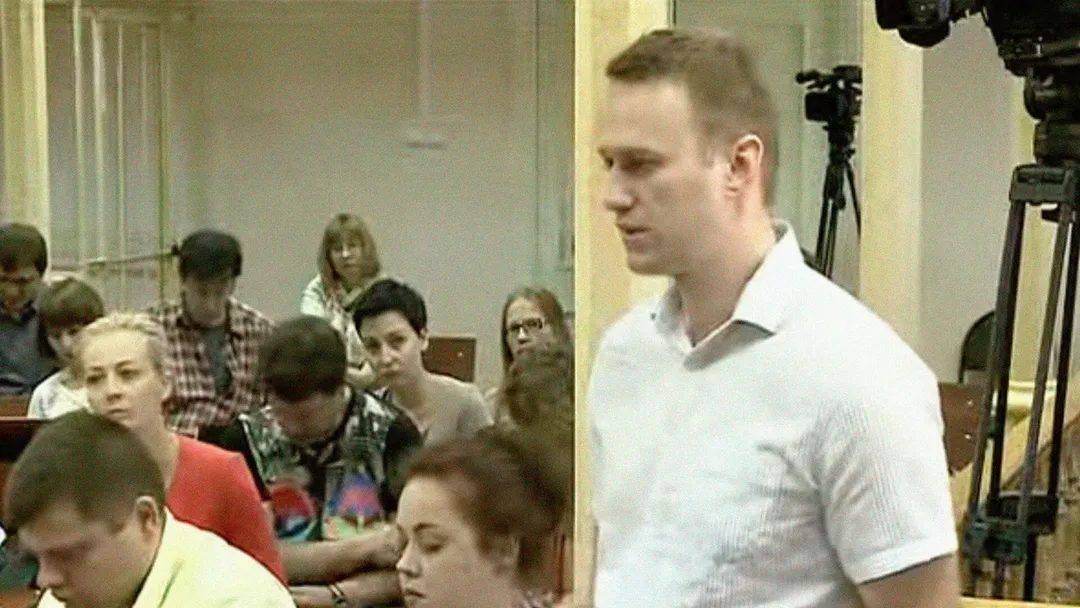
Please be seated.
The court session is now open.
of the Leninsky District Court of the city of Kirov.
In this open court session,
the court continues hearing the criminal case
against Navalny and Ofitserov.
The composition of the court has not changed.
The secretary and the defense are present in full.
The defendants are present.
The state prosecutor is absent,
Cheremesinov. The court is deciding the issue of
whether it is possible to continue hearing the case
in his absence. Your opinion,
please.
>> I believe we can continue. The opinion of the...
defense side.
>> We do not object.
>> We do not object.
>> We do not object.
>> We object.
>> The court has heard the parties and rules:
to continue hearing the criminal case in
the absence of the state prosecutor
Cheremesinov. Regarding the motion filed
to attach to the materials of the criminal
case for examination at the court session
the lawyer's request, a copy of the register
of payment orders, and copies of documents
concerning settlements between the Vyatka Forest Company and
KOGUP Kirovles.
The court has examined
the attached documents and has made the following
decision.
The motion to attach photocopies of documents,
which, according to defense counsel, are
presumably reconstructed
accounting records of KOGUP Kirovles,
the court does not consider it necessary to grant
this motion and denies it for the following
reasons. These documents are not
certified by the bankruptcy trustee from whom,
according to defense counsel, they were
obtained. And most of the documents do not
contain either signatures or seals, and
it is unknown by whom and on what basis these
documents were prepared.
Accordingly, the court cannot verify their
authenticity,
>> or the other circumstances set out in them.
Please return them.
To the defense.
The defense may continue
presenting evidence.
>> I will now read out a motion for
the production of evidence
in written form. On the basis of the
ruling of the Arbitration Court
of the Kirov Region dated February 9, 2011,
in case No. 28-11373/210/20,
the application to declare KOGUP Kirovles
insolvent (bankrupt) was found
to be well-founded with respect to KOGUP Kirovles,
city of Kirov, Avtotransportny Lane,
building 4; the OGRN (Primary State Registration Number) is indicated; supervision proceedings were introduced,
and as bankruptcy trustee / insolvency manager
Vladimir Anatolyevich Pereiminov was appointed.
On May 29, 2013, the defense
applied
to the bankruptcy trustee with an appropriate
request seeking
the opportunity to make copies of documents
related to deliveries of timber products by
Kirovles to VLK.
What follows is a list of
the documents requested
by counsel from the bankruptcy trustee. I will not
go over them again,
as they were set out in detail in the
previous motion. I think the court
can review the text.
The defense moved to attach the said documents
to the materials of the criminal case as
evidence and to examine them as
defense evidence in a motion filed on
July 2, 2013. The court denied
that motion.
The defense insists that the above-listed
documents have a direct and immediate
bearing on the circumstances
of the case under consideration. The defense once
again asks the presiding judge to pay attention
to the fact
that Navalny
and Ofitserov are charged with committing
an offense under Part
3 of Article 33 and Part 4
of Article 160, and respectively Part 5
of Article 33 and Part 4
of Article 160 of the Criminal Code of the Russian Federation, as amended by Federal Law
No. 26-FZ of March 7, 2011.
The defense believes that the presiding judge in
this case is aware that,
under Article 160 of the Criminal Code of the Russian Federation, criminal
liability for committing this
offense applies to persons who have committed,
in particular, embezzlement or misappropriation of another person's
property entrusted to the offender. At the same time,
the defense is also convinced
that the presiding judge is aware of
Note 1 to Article 158 of the Criminal Code of the Russian Federation,
according to which theft is understood as
the unlawful, gratuitous taking and/or conversion, committed for mercenary gain,
of another person's property
for the benefit of the offender or
other persons, causing
damage to the owner or other lawful possessor
of that property. Under Article 73
of the Criminal Procedure Code of the Russian Federation, the circumstances
to be proved include the event
of the crime, the guilt of the accused,
the nature and extent of the harm caused
by the crime, as well as circumstances
excluding the criminality or punishability
of the act, and so forth. The defense for the defendants
maintains that the basis of the charges was
a civil-law transaction between VLK and
KOGUP Kirovles, on the basis of which
the goods were delivered and paid for. That
concerns disputes related to
untimely payment for timber products, then
they were resolved in civil
proceedings in the Arbitration Court
of the Kirov Region. Furthermore, the documents listed
in this motion, whose
examination as
evidence by the defense
we insist upon, are evidence
that demonstrates the absence in
the actions of Navalny and Ofitserov
of any signs of unlawfulness, since
the provisions of Article 244 directly and unequivocally
guarantee the defense the opportunity
as well as the exercise of the right to present
evidence on an equal footing with the prosecution, and
Article 286 of the Russian Criminal Procedure Code provides for
the possibility of requesting documents
by the court on the basis of the above provisions
we ask, first, that the court request from the bankruptcy trustee
of KOGUP Kirovles, Perminov
Vladimir Anatolyevich
at the stated address, copies of the following
documents: a copy of the register of payment
orders from OOO VLK to KOGUP
Kirovles for the period from April 2009 to
February 2013; copies of documents concerning
settlements between the Vyatka Timber Company
and KOGUP Kirovles, in particular
and settlements with the following forestry enterprises
branches of KOGUP Kirovles: Vyatskiye Polyany
Yuryansky, Sanchursky, Podosinovsky,
Orichevsky, Nagorsky, Lebyazhsky.
Kumyonsky, Kirovo-Chepetsky, Luzsky,
Nemsky, Orlovsky, Tuzhinsky, Yaransky,
Uninsky, Kirovsky, Belokholunitsky,
Darovsky, Kotelnichsky, Sovetsky,
Shabalinsky, Urzhumsky, and Oparinsky. July 3
2013, signed by the attorneys. I
believe that if the court
grants the motion, then
the defense will then have
the opportunity to submit to the court as
defense evidence copies of the documents
that the court previously refused to admit.
properly certified, that is,
certified at least with the seal of the bankruptcy
trustee of KOGUP Kirovles, affixed
with a signature, in bound and numbered
folders, respectively. Please pass it along,
if you would. Please.
>> Thank you.
>> Views on the motion that has been filed.
The others, please.
>> I support it, Your Honor.
>> Please, go ahead.
>> I support it. I would like to note that
I also object to the court’s earlier actions
in refusing to admit
the bankruptcy trustee’s materials. Our entire
case is devoted exclusively
to the analysis
of the accounting records of the company
Kirovles. We are constantly talking about
Kirovles, about the accounting
documentation. We are talking about inflated
or understated prices. We are talking about
equivalent and non-equivalent
compensation. And you, Your Honor,
are refusing to admit the very
materials that are the main
subject of examination. The source
of these materials is completely
obvious. We stated that these are documents
from the bankruptcy trustee. There is no
doubt that these are documents
from the bankruptcy trustee.
As for other documents, we submitted them
exactly as they exist at Kirovles. We, unfortunately,
do not have the ability
to control Kirovles’s accounting department or
the correctness or incorrectness
of the way invoices were prepared. The fact that you
refuse to admit those materials
that should be the main subject
of examination, once again shows that
all of our motions for recusal that we
have filed were entirely
well-founded. In other words, either you want
to obtain the material that must be
examined in order to reach a fair decision,
or you refuse to do so. In
that connection, I support counsel’s motion
that the necessary materials be requested
through the court process
and obtained. Thank you.
>> Please, Ms. Mikhailova. Yes, I
support it. I wanted to note that
the documents that were submitted
to the court were submitted in the form
in which the defense received them. Since we do not have the powers
of the court, naturally we cannot properly
obtain documents with all the necessary seals
and certifications. That is, we received them
in the form in which the bankruptcy
trustee gave them to us. There is a note to that effect in
the request. Accordingly, if the court
has doubts about the quality of these
documents, then I believe it is necessary
to request them and add them to the case
file. Especially since they contain
data that we heard presented in a somewhat
different interpretation by the directors
of the forestry enterprises. These documents show that
a compilation was made and figures were calculated
showing the actual
indebtedness, or the complete absence
of indebtedness. This, incidentally, completely
refutes, in some instances,
the testimony of those forestry enterprise directors
whom we heard here. I believe
it is simply necessary to request these
documents. Please, your view,
Attorney Kobelev.
>> I support it.
>> Attorney Kobelev. The prosecution’s
position.
>> Your Honor, having reviewed the motion,
As was similarly presented yesterday at the
court hearing, we believe that
the request for these
documents should be denied. The criminal case file
contains primary documents
showing payments to VLK
both by counterparties and by VLK to the relevant party.
In addition, the primary documents served
as the basis for conducting
a forensic accounting examination, uh,
No. 79 EK, which is also included in the
criminal case file and has been
examined during the court hearings.
The court has heard the parties and, on the
motion, makes the following ruling.
So,
the court first assesses
whether these documents relate to
this criminal case, that is, to the subject
matter to be proven. And,
uh, I believe that, more precisely, the documents and
the charges brought establish that
Navalny and Ofitserov are not charged with
causing damage by failing to make payment under
Contract No. 1 01/2009
dated April 15, 2009. Accordingly,
documents showing
indebtedness or the absence of
indebtedness under this contract cannot
fall within the subject matter to be proven in
this criminal case. And on that basis
the court has ruled to deny
the motion seeking
the production of
the register of payment orders from OVLK to
Kogubkerovles
for the period from April 2009 through February
2013, and a copy of the document on settlements
between VVLK and Kogubkerov Les.
Please continue. And
further, Your Honor, uh, the defense asks
that
the person who has appeared
at the initiative of the defense and was summoned
by the defense, namely Ratova
Natalya Nikolaevna, be questioned as a
witness. Uh, as we all know, she
headed
the group and signed the auditor's report on
the audit of the Kirov Regional
State Unitary Enterprise
Kirovles. The defense independently
arranged for this witness to appear.
Witness Aratova Natalya Nikolaevna
is in the corridor, awaiting a summons
outside the courtroom. The defense
asks the court to take into account, when
deciding this motion,
the provisions of Part 4 of Article 271
of the Criminal Procedure Code of the Russian Federation, under which the court may not
deny a motion to examine
at the court hearing a person as a
witness or specialist
who has appeared in court at the initiative
of one of the parties. The defense insists on
the examination of witness Aratova Natalya
Nikolaevna.
That is all.
>> Understood.
The views of the other participants on the side. Everyone's
I support it.
>> I support it.
>> I support it.
>> Support it. Support it.
>> The prosecution's position?
>> No objection.
>> Guided by Part 4 of
Article 271
of the Criminal Procedure Code
of the Russian Federation, the court rules
to grant the defense motion. And
the person invited into the courtroom
who appeared at the initiative of the defense
is Ratova. Please identify yourself.
Hello.
>> Good afternoon. Ratova Natalya Nikolaevna.
When and where were you born?
>> Once again
>> When and where were you born?
>> I was born on July 19, 1976, in the village of
Sotkina, Uzhumsky District, Kirov
Region.
>> Ethnicity?
>> Russian.
>> Citizenship?
>> Russian.
>> Education?
>> Higher education in economics.
>> Marital status?
>> Married.
>> Where do you work, and in what capacity?
>> I work as the general director
of the auditing firm, uh, the auditing
and consulting firm "Analitik."
What is your residential address, and where are you
officially registered?
>> Kirov, Studenchesky Proezd
19, Building 2,
>> Apartment 41.
>> You have been called at the initiative of the
defense to testify as a
witness, and in this connection I explain
that, in accordance with Article 56
of the Criminal Procedure Code
it is your civic duty and obligation
to tell the court everything you know about the case.
At the same time, I explain that you have the right
to refuse to testify against
yourself, your spouse, or other
close relatives. If you agree
to testify, you are warned that
your testimony may be used as
evidence in the case, including
in the event that you later
withdraw that testimony. You also have the right
to testify in your native language or in a
language you speak, and to use
the assistance of an interpreter free of charge, and to make
to challenge the interpreter, to file motions,
to file complaints about actions or failures to act
and court decisions, to appear for questioning with
a lawyer, to petition for protective measures
if necessary. And
I am explaining to you the liability that
is предусмотрена
for a witness for an unjustified refusal to
testify and for knowingly giving false
testimony, criminal
liability may arise under Articles 308 and 307
of the Criminal Code of the Russian Federation.
Do you understand your rights and responsibilities?
>> Yes, of course.
>> Please sign an acknowledgment to that effect
for the court. Secretary,
>> please answer the defense counsel's question.
Tariya Nikolaevna, hello.
Please tell us, did you conduct
an audit
of the state enterprise Kabros?
An audit was conducted there under
a state contract. We had
entered into
for 2008–2009, along with a special
terms of reference. That is, under those
terms of reference, we conducted
the audit. Please tell us,
who prepared the technical
specification?
>> The Department of State
Property. And was this audit
carried out within the full scope of the
terms of reference? Yes. Did you answer absolutely
all the questions?
>> Yes. All the questions set out in
the terms of reference were answered.
>> Please tell us, did you have the right, at your own discretion,
not to answer certain
questions in the terms of reference?
>> We did, but I believe we answered everything.
>> Well, we tried to answer everything that
we saw; we answered everything.
>> Please tell us, do you clearly remember
the opinion you gave at the time?
>> We did not issue an opinion. We submitted a report
on the terms of reference. I brought it with
me, but I do not remember all the details.
>> Uh-huh.
Please tell us, do you remember
how long this
audit took? I'll answer now.
>> It is not stated in the report, but I think it took
about two months to conduct
the audit. The audit was
fairly lengthy, yes. And was that
because the enterprise was so
large, or because of some other specific factors?
>> No, that was specified in the contract. That
is, the time frame was set. We applied,
participated in a tender, a tender was announced,
and in accordance with that
tender, the time frame was established
by the state contract. That is, within
the framework of that contract, we performed the work.
Please tell us, do you remember the
conclusions you reached based on
this report?
>> By heart? No.
>> But generally, what were they about? Do you remember?
>> About what? What were they about?
>> What exactly were they about?
>> A specific question, or in general? That
is, there were several questions
in the terms of reference. There was one for each
question in those terms of reference.
>> I am interested in the state of affairs at the
enterprise in terms of its losses. Was it
found to be operating at a loss?
>> Yes, it was found to be loss-making and
insolvent as of December 31,
2009.
>> Do you remember the reasons that led
specifically to this enterprise's losses
and loss of solvency?
>> We identified several reasons,
which, in our opinion, were the
causes. That is, a
loan agreement was entered into, and a
state contract for leasing forest
land was concluded; that is, there were several
factors listed there.
These reasons were identified as the main ones, along with
an increase in accounts payable
as a result.
>> An increase in accounts payable.
Please tell us, could this
enterprise have somehow
you know that it is now in bankruptcy proceedings,
>> yes? I know. And
>> could it somehow have avoided
this bankruptcy?
We did not make such conclusions. That is,
as to how it could have avoided it, we gave in
the final section our recommendations on
keeping this enterprise from becoming
insolvent. That is, there was
a conclusion that it would be possible to carry out
a separation, that is, to split the enterprise into
several
>> several enterprises out of the existing
enterprise, in order to avoid this.
Please tell us, do you remember
about that, and
approximately what volume or quantity of
timber Kabros harvested?
>> No. Yes.
>> Well, we have the tables here now,
I'll say. Uh-huh.
In 2009, the permitted volume was
3,918
>> cubic meters.
>> Yes, cubic meters. The actual amount
harvested was 1,363
cubic meters.
Permitted, actually
>> permitted means what was set out in the
state contract and specified by the state. That is,
what they could have done, and what they actually did
how much did they do?
>> In fact, they did 1,363,000.
>> 1,363,000.
Yes.
Just a second.
I understood from your calculation.
>> Please tell us, Natalia Nikolaevna,
as part of this review of Kerofles,
did you examine the supply contracts that
Kerofles entered into with counterparties for
the supply of timber to Krad?
>> Yes, we reviewed individual contracts. That is,
we conducted a price analysis. One of the
questions put before
us was price analysis. In other words, we reviewed both
the contracts and the prices at which
the sales were made.
>> Uh-huh. Please tell us, do you remember
the supply contract for timber products
concluded between the VOS company and Kogor
RF? No, you do not remember. Please tell us,
if there had been anything
unusual in that contract, would you have remembered it?
I think so, yes. Please tell us, if
if—
let me put the question differently. In practice,
when a supply contract is concluded for
timber products
with some counterparty, a general
contract is signed. And the price for each specific type
of timber product supplied, and the technical
terms of supply, are then set out
later in appendices. Is that
normal practice, or is that something out of
the ordinary? A company may initially conclude a contract
and then move on to
additional agreements in which
completely different terms are set out. Well,
look, if you had noticed
that in one of the
appendices to a contract between Kogubterov
Les and some counterparty, the price for
timber products was substantially lower
than the price for similar
timber products with other counterparties,
would you have paid attention to that?
>> Yes, of course. I will bring up the table now.
We have a table of prices. What did we
notice? We pointed it out.
I was not asking about the appendix.
The children's forestry company Mashakazana
sold sawn timber. The price analysis, if
compared with other counterparties,
does not differ significantly. That is,
it is within the range of the prices at
which supplies were made to other counterparties.
Please tell us, if you had established
that even VLK was purchasing
timber products at a price lower than
with other counterparties, substantially lower,
would you have noted that separately in
the report? Would that have affected
any particular conclusion in your
report?
>> We would have noted it and stated that
it was material. That is, within a single
period, which is what we examined in this case,
only the third quarter of 2009
was analyzed. Within that period, we would have
noted it, and here we state that prices
ranged from one level to
another, from the minimum to the
maximum. Therefore, if we had seen
that the price here differed materially,
that is, if it had been, well, in that sense,
then that transaction would already have raised concerns for you,
correct? Yes, of course.
>> Please tell us, Natalia Nikolaevna,
with regard to the price of timber products, then,
a supply contract is concluded between Pkerov
Les and some counterparty. Must the price for
the timber products being supplied
necessarily be stated in
the contract, or can it be stated
later in an appendix? It can be stated
initially; an essential term
of the contract is considered to be the price. Later,
if it changes, it can be stated
in supplementary agreements.
>> All right. Please tell us, and, and
do you remember what the state of the
accounting department was?
We received two audit opinions
before proceeding. We relied on
the accounting records, in this case
the 1C Enterprise software, because all
branches and management units used it and
kept their accounting records in the software.
In effect, in our
report we confirm and state that we considered
the records reliable. Please tell us,
with regard to how
the accounting was maintained at Kagubrovles,
can you provide any explanation regarding
the quality of that record-keeping?
>> In this case, we did not examine
the quality of the bookkeeping.
>> Uh-huh.
Please tell us, can you give us
an explanation of what a market price
for timber products is?
>> A market price is the price that
has formed in the market at a given time
for these goods or services. That is, if we look at
the products that, at a given time,
were supplied to several counterparties
by a particular company, then
the average price—that market price—is
the price stated in the contract.
Different terms in different contracts may
result in different prices; that is, the terms
of supply may vary. Therefore,
the market price for a comparable supply,
under
those conditions that are identical
across several contracts, is
the market price.
Could you please say what factors
influence the market price
formation?
I believe that, in this case, the situation
in the region as a whole is affected by remoteness,
well, that is, by the demand for the product
that existed at that particular time. Here,
look, we have just looked at
the table—you, rather, were looking at the analysis
of timber product prices.
And can you say, taking this
table into account, whether the timber products that
were purchased by VLK, and their price level—whether they
were purchased at the market price or at a
lower price? That I cannot say.
>> Could you please explain how, in general,
it is possible to determine the fact
of a purchase being made below market price? What
documents are needed for this, and what
analysis would need to be carried out?
In order to carry out such an analysis,
it is necessary to review documents for
such products, for comparable products, the prices,
the contract terms, that is, the agreements
to be examined, the contracts on the basis
of which the purchases were made, and the terms under
which these products were purchased.
Accordingly, the price is made up of several
indicators,
and if it differs materially,
a material difference is considered
to be a deviation of more than 20%,
>> more than 20%. So is that written
somewhere?
>> It is written in Article 40 of the Tax
Code, with a deviation of more than 20%.
>> Please tell me, are there any, um,
agencies, perhaps statistical ones, that
have information on
average market prices for one type or another of
timber products?
>> I think there are. We have—there is
statistical monitoring, there are
certain forms of statistical
reporting in which product prices are indicated
for the products.
>> for each specific period of time.
>> Could you tell us where these
statistical
>> Well, we had such experience—we
requested them from the statistics office.
>> From the statistics office for Kirov Region
(a federal region of Russia). Kirov Region.
>> And what is its exact name?
>> Kirovstat.
I cannot say exactly.
Natalya Nikolaevna, could you please say,
based on the fact that you conducted
this inspection—if that is the correct term—
can you say, essentially,
whether VLK caused any kind of financial damage
to Rafle’s counterpart?
There was no such question in our terms of reference.
From what we
reviewed,
that sample did not make it into our report. That is,
that is,
>> it did not make it in.
>> No, that is, as for factors—the factor
that affected the solvency
of the enterprise, the losses of this
enterprise, and the factor that
subsequently led to the bankruptcy of this
enterprise, was not the activity of OOO VLK
(a Russian LLC).
>> This is not stated in our specific report.
Whether it was or was not,
I cannot explain.
>> Wonderful.
>> Well, essentially, we have no
further questions. Thank you.
You’re welcome. Are there any more questions?
>> Yes, Pyotr, you go ahead.
>> Good afternoon. Please tell me,
when they informed you of the
tender conditions, and it stated 2
months—was that a lot or a little for a project
involving such an enterprise?
>> I do not remember how much time was specified.
Two months.
>> Well, I said approximately two months.
>> Approximately, yes. Exact precision is not
necessary here. Roughly two months. Is that a lot
or a little for an enterprise project? I
believe that was sufficient, because
we were conducting the analysis, and for us
>> and for the questions that were posed,
we had enough time. In our
audit team there were several
people; it was not just two of us working.
>> Six people.
>> Six people. So, six people
for almost two months. And if you had been told
that under the assignment terms this work had to be
done by three people in six days,
what would you have said? Well, you would have refused, right?
>> Why?
>> Because it would be unrealistic to carry out the review.
>> Completely unrealistic. Is that because of
the qualifications of your staff, or is it
simply physically impossible?
>> Physically impossible, because in
Kirovles there are several enterprises—I do not remember
exactly how many. That is,
>> the volume of work is substantial,
>> so it is impossible.
>> It is impossible.
>> Thank you.
>> Thank you very much.
You’re welcome.
For what amount did Kirokles sell its
products in 2009? Mm-hmm.
What did you ask?
Please say it again right away.
Sales revenue amounted in 2008 to
982,152,000,
and in 2009 to 758,310,000.
Revenue from product sales.
>> Specifically timber products.
>> Uh-huh.
for 2008: 783,136,000
in 2009: 598,673,000
598,673,000
>> What page of your notes is that on?
>> Page twenty-eight.
>> Any further questions, please.
>> Yes. And please tell me this as well, you
explained that price is a material
term of the contract. Please tell me,
if the price is not specified in the contract, can
it be said that the contract has been concluded?
I think not.
>> So am I correct in understanding that
the contract will be concluded only when
the appendices specify the prices and
the subject matter, that is, the suppl...
>> Or the terms will be set out under which
they will be determined; that is, it will be
either an addendum stating that in
the referenced contract the price
is established by an additional agreement.
>> So, accordingly, when the parties
sign an appendix to the contract,
it turns out that each time they are concluding
a new supply contract. They
are agreeing on the terms.
>> Well, then the contract is considered concluded.
>> An additional agreement is concluded
to the contract. Within
>> the framework of the contract, an agreement is concluded.
>> Any further questions.
>> No, Your Honor. Thank you.
>> Please, the other side may ask questions.
>> Thank you. I have a few questions.
Am I correct in understanding that
the period your report actually covered
was the third quarter of 2009?
No, we reviewed 2008 and 2009. Prices
were examined. Specifically, product prices in
the third quarter of 2009
>> up to and including the third quarter.
>> No, we looked only at the third quarter specifically.
That is, the price analysis was conducted for
the third quarter of 2009. That is,
for the other months we carried out a selective
review, that is.
>> Uh-huh. I see. Did you review
the materials of the criminal case?
>> No. We are considering this
And which specific documents, um, did you
review while preparing this
report?
>> Financial statements, accounting
documents, all local internal regulations
in force at the enterprise, and
accounting registers, bookkeeping
records. In this case, we were provided with
the 1C accounting software
for the forestry enterprises, separately by branch and
separately for the central administration.
What interests me is whether you reviewed, in
particular, the conclusions of the auditor
from the Vyatka Center for Management Consulting
of the Audit Academy, Ms. Zagoskina.
>> We reviewed the opinion itself. That
is, the opinion is the report that
briefly provides the summary section, that is,
the opinion itself and the attached financial statements. That
is, we do not have the right to review
the auditor's report. It is a document
for internal company use.
>> I see.
I am interested in your qualifications,
how many years of work experience do you have?
>> Work experience as an auditor.
I received my auditor's certificate in 2006, and
as an audit assistant, and later
as an auditor, I have been working since 2002.
>> Do you have any academic publications?
>> No.
Now tell me, you refer to statistical
observation data as something that may
contain certain information about
average market prices in this particular
region, say, Kirov Region
(a federal subject of Russia).
Are these data binding,
for example, for these same business
entities, or are they merely advisory?
>> I believe they are advisory,
because each specific contract
is concluded individually, and those terms are considered market-based
which are set out in that
contract, unless proven otherwise.
>> I see.
Tell me, then, would it be correct
to say, if we summarize your, um,
testimony regarding market price, that
market price is essentially the price at which
a particular product can be sold
in a particular area?
>> Yes,
we look at it from the standpoint of the Tax
Code when we conduct an audit.
That is, we check to ensure that the price
within a given
period, limited, for example, to
a month, a day, or a quarter, does not
differ substantially from others under
identical contract terms.
Well then, tell me,
>> tell me, and
yes, in the statistical
data, are the contract terms taken into account?
>> No.
>> Then what kind of information can it contain?
It provides, for a certain, well,
as I recall, statistical forms,
that is, it lists a specific type,
for example, sawn timber, and gives its price
applicable in that month
without taking contract terms into account.
And also tell me, if you had not
been required to conduct a full review
for 2008-2009
but instead had needed to review
for a shorter period, would it also have taken you
2 months?
>> So, a specific period?
>> Well, if that period had been one
quarter.
>> Your Honor, your question does not relate to
the circumstances, the factual
circumstances of the case that fall within the scope of
proof. I ask the court not to ask this
question.
It has nothing to do with Article 73,
Your Honor.
>> You asked a similar question. I would like
to clarify.
A similar question, Your Honor,
>> please answer anyway.
>> When approaching an assignment, we look at
certain conditions. That is, we have
a questionnaire. In accordance with this questionnaire,
the company sets out its main
indicators and the period they
would like us to review. Based
on that, we estimate our labor costs,
the time we need for
reviewing this particular
company. Therefore, possibly, in that case,
if it had been a quarter, the time required would have been
shorter.
>> Thank you. No further questions from me either.
>> May I ask one more?
>> Yes, please.
>> And if it had been three people, and it
had been a quarter, two quarters,
yes, say the first half of the year, then
roughly speaking, about how long would that take?
>> I can say,
>> but it would have been more than 5 days.
I need those same conditions,
>> everything else the same, only the first
half of the year and three people.
>> So the same as what we
reviewed,
>> right? Everything the same, only for the first
half of the year.
>> The first half of which year?
>> 2009.
>> Unfortunately, I no longer remember what
was in that half of 2009, but
I think it would have taken less
time.
>> Well, would 5 days have been enough?
>> No.
>> And how long would it take?
>> Well, I think about three weeks. Weeks
>> three,
>> right?
>> Uh-huh.
>> So, three people after all.
>> Uh-huh. All right. There it was two people
and 5 days.
What on earth were they eating?
>> Well, this isn't a comedy contest, please
continue.
>> And
>> we are not taking part in a comedy contest.
>> I'm not taking part; I simply said thank you,
Your Honor.
>> All right. Any questions?
>> I would also like to draw attention to the fact that we
were conducting an analysis. We were not conducting
an audit. An audit
is something different.
>> No, I'll just clarify. We also had
testimony from auditor Zaguskin from
the wonderful company Vyatka Akademaudit.
And in just 4 days they reviewed
the activities of KOGUP Kirovles and said that
it was enough for them—they neither ate nor slept.
>> The two of them, for the first half of the year.
>> That is precisely why these questions
arise. But an audit there
is selective. We conducted an analysis, that is,
they cannot simply be compared. How—
>> Any further questions?
>> No questions.
>> No.
>> May we excuse her?
>> Yes.
>> Yes.
Thank you very much, everyone.
>> All the best to everyone. Thank you very much.
>> Let's sign.
No, I
right now.
No, I still have one more
third issue to raise
Your Honor, a motion to examine and admit
evidence
in writing. The defendants Navalny and
Ofitserov are accused of committing
the crime предусмотренного
respectively under Part 3 of Article
33 and Part 4 of Article 160
of the Criminal Code of the Russian Federation, and respectively under Part 5 of
Article 33 and Part 4 of
Article 160 of the Criminal Code of the Russian Federation. In particular, one of the
components of the accusation is the
assertion that the limited liability company
Vyatka Timber Company
purchased timber products from KOGUP Kirovles
under contract management favorable to
Kirovles, contract No. 01/2010 dated
April 15, 2009, at a deliberately
undervalued price that was
non-equivalent, that is, below market price.
At the evidence presentation stage, during
the judicial investigation, the defense
presented, as
evidence, the minimum prices for
timber products for 2009-2008
approved
by the general director of KOGUP Kirovles
Oplium, and by the directors of the Belokholunitsky forestry enterprise
branch of KOGUP Kirovles and the Orlovsky
forestry enterprise, a branch of KOGUP Kirovles. Volume 12, page 24
case file 118–119, case file 33–34. The
prosecution insists that the price in
Contract No. 01/2009 dated April 15
for 2009, and the related agreement was
deliberately understated by all participants
in the crime. At the same time, the case materials
do not contain
the minimum prices for timber products for
2008–2009, approved by the General Director
of Kogubka Rafles, Opolev
and by the directors of the following forestry enterprises
— branches of Kogubkerov Les
Vyatskiye Polyany, Yuryansky,
Sarvizhsky, Podosinovsky,
Orichevsky, Nagorsky, Lebyazhsky,
Kumyonsky, Tekhnursky,
Kirovo-Chepetsky, Luzsky, Nemsky,
Tuzhinsky, Yaransky, Oninsky,
Kirovsky, Dorovsky, Kotelnichsky,
Sovetsky, Shabalinsky, Urzhumsky,
Oparinsky. The defendants and their defense counsel
insist that the timber products from
Kogobkerov Les were purchased by LLC
Vyatka Timber Company at prices
equivalent to market prices and not lower than
the minimum prices established
by the General Director of Kogubka Refles and
the directors of the forestry enterprise branches of Kogobka
Refles. The defense has no ability
to independently obtain the minimum
prices for timber products for 2008–2009
approved by the General Director
of Kogobkerov Les and the directors of
Vyatskiye Polyany, Yuryansky,
Sarvizhsky, Podosinovsky,
Orichevsky, Nagorsky, Lebyazhsky,
Kumyonsky, Kiknursky,
Kirovo-Chepetsky, Luzsky, Nemsky,
Tuzhinsky, Luninsky, Kirovsky,
Dorovsky, Kotelnichsky, Sovetsky,
Shabalinsky, Urzhumsky, Aparinsky,
forestry enterprises, branches of Kogubkerov Les. At the same time,
the defense notes that Article 244,
as the defense has consistently noted,
guarantees the defense and the prosecution
equal opportunities to present
evidence. The defense asks
the court to take into account, when deciding this
motion, that defense counsel does not have the same
opportunities as the prosecution when it comes to
obtaining evidence. The defense also
asks the court to take into account that the Federal Law on
Advocacy and the Legal Profession
of the Russian Federation does not oblige
officials to respond to an attorney's
request. No law provides for
liability for failing to provide
an attorney with a response to such a request. Meanwhile,
Article 286 of the Criminal Procedure Code of the Russian Federation provides that
the court has the power to request
documents which may subsequently
be submitted by the parties as
evidence. Given that with respect to
Kogobki Les, insolvency proceedings have been introduced
(bankruptcy proceedings), and the insolvency administrator of
Kogobkirovles has been appointed as Vladimir
Anatolyevich, 6104, Kirov, Surikova Street,
Building 33
with reference to the ruling of the commercial court (arbitrazh court),
it follows that all documents of Kogobkirovs
are in the possession of the insolvency
administrator. Based on the foregoing,
pursuant to Articles 15, 524
and 286 of the Criminal Procedure Code of the Russian Federation, we ask the court to request from the insolvency
administrator of Kogobkerov Les, Perminov
Vladimir Anatolyevich, whose address is indicated,
a copy approved by the General Director
of Kogubkerovle, Sopolev, and by the directors of
Vyatskiye Polyany, Yuryansky,
Sarvizhsky, Podosinovsky,
Orichevsky, Nagorsky, Lebyazhsky,
Kumyonsky, Kiknursky,
Kirovo-Chepetsky, Luzsky, Nemsky,
Tuzhinsky, Yaransky, Uninsky,
Kirovsky, Dorovsky, Kotelnichsky,
Sovetsky, Shabalinsky, Urzhumsky,
Parinsky, forestry enterprises, branches,
of Kogubkerov Les, the minimum
prices for products for 2008–2009. Counsel,
for three years. I would like to draw attention
of the honorable court to the fact that the requested
information is highly relevant for
the defense. In addition, I
would like
to remind the court that the defense side previously
submitted as
evidence the minimum prices for, uh,
for
the Belaya Kholunitsa and Orlov forestry enterprises. And,
uh, after the defense submitted
these minimum prices for 2008–2009,
it was indeed established that
in 2009, uh, there was
a decline in timber product prices. And after
that, having in hand the market prices for
2009 and, uh, in the case materials,
uh, delivery notes and invoices in
which the price is indicated for that
specific product that VLK
purchased from Kogubkerovles, it is possible
quite simply to confirm the position
of my client, officer Pyotr
Yuryevich, that the prices for timber products, uh,
which VLK purchased from Kogubka Refles,
were, well, at a minimum, equal to those
minimum prices that Kogub
set for its forestry enterprises. And for
some items they were even higher,
as we saw when comparing the prices of, uh,
the Orlov and Belokholunitsky forestry enterprises,
when the difference in cost there was
around 300 rubles between timber products. I
ask that this be attached in writing and
that everything I have said be taken into account when deciding
the motion filed.
Please, the defendants' opinion
to be stated.
I support the defense.
>> I support it.
>> I support it. Support.
The prosecution, Your Honor, believes that
The motion is not subject to being granted.
That means we examined, in the course of the court
hearings, the testimony of the directors of the forestry enterprises,
as well as the testimony of witnesses, Opolyev,
the Zagorskins, and other witnesses. As for
the minimum prices,
I ask the court to take into account that the defendants are not charged with
the sale
of timber at below-minimum
prices. What they are charged with, rather, is the sale
of timber below market prices. Therefore, I
believe this is not relevant to the matter at hand.
>> Your Honor, allow me to add something. I ask
forgiveness for the inadvertent violation
of procedure, but, esteemed court, I want
to say this. Please listen to me.
Please. Pyotr Yuryevich Ofitserov is
accused of committing economic
crimes, correct? That is, Ofitserov is
accused of having forced Opolev
to enter into a knowingly disadvantageous contract
and of purchasing timber products from Kirovles
at prices not equivalent to market prices. And,
Your Honor, we cannot allow ourselves
to establish these figures,
whether a price is market or non-market, based
on witness testimony. I remind
everyone present that
crimes in the economic sphere are
quite specific. And, as a
rule, damage is proven, and
the equivalence or
non-equivalence of timber product prices is proven.
All of this is proven by documents. It
cannot be proven by witness
testimony. I think we all know
that. And we cannot attribute guilt to
Ofitserov for purchasing timber products from
Kirovles at below-market prices,
based solely on witness
testimony. Documents are needed. Some
of the documents were submitted by the prosecution, or rather,
excuse me, by the investigative body, and it
included them in the case materials, but this is
only part of them. And if the investigative body
submitted part of these documents, then
why can the court not request the second
part of these documents? And again, we cannot
substitute calculations, we cannot
substitute documents containing figures,
with witness testimony. And moreover,
I want to say one more thing.
Ofitserov is accused of purchasing from
Kirovles timber products at a price
below market. Very well, esteemed
prosecutor, we have heard the testimony
of the prosecution witnesses, the directors
of the forestry enterprises, who said that Kirovles
and the forestry enterprises coordinated
minimum prices. But, Your Honor, we all
remember very well how we all asked
and the esteemed court also asked a number of questions
about how this
minimum price was formed. The directors
of the forestry enterprises explained that they conducted
monitoring of market prices. And on the basis
of monitoring those market prices in this
district for the purchase of timber products by
sole proprietors, various companies, and so on,
they set this
minimum price, which
was coordinated with the state enterprise. Therefore, I
believe that this motion, Your
Honor, is directly relevant to the case. And
moreover, without these documents we are
simply at a dead end, because
we cannot replace documentary evidence with witness testimony
as documentary proof; we
cannot. Can you say,
>> please, what is it that the prosecution is alleging?
It first alleges losses of 16 million rubles (about 16 million RUB).
Then, in the middle of the trial, it says: "You
know, it’s not really 16 million rubles,
rather the prices were non-equivalent, but at the same time
they determine that the prices were non-equivalent
by feel and based on what some old woman said,
yet there is no calculation." Yes,
moreover, market price, as was said today by a competent
expert—actually,
the auditor said that market price
is the price at which the parties
agreed to sell the product in
that region during that period of time.
Market price is the price that
has formed in that region. It is the price
confirmed by the statistical authorities.
That is, market price is the price at which
the goods are actually sold. And yet
the prosecution has never presented proof
of the market price. It has not
submitted even any documents
that would even remotely resemble
evidence of a market or non-market
price. And throughout the proceedings, the prosecution operates
with phrases like “in our view,” “in their
opinion,” “in that guy’s opinion.” But
neither that guy nor their opinion
constitutes an objective factor, because
there is no economic expert examination, and
the prosecution did not even request documents from a single
company in order to
assess this average market price. And
so it turns out all along that the entire
case is built on the opinion of Mr.
Bogdanov, Mr. Cheshinov, as well as
some people who have never even been to Kirov
and have never traded timber. And
their understanding of the concept of average market price comes
from television, from programs they have watched,
and probably not even
economic ones. Therefore, I would like
to ask the court, after all, to request
the evidence that will shed
light on those economic
questions that neither
the investigation nor, it would seem,
the esteemed prosecution has been able to clarify. Thank you.
>> May I add something, please?
>> Yes, please.
>> Your Honor, this entire accusation is
it is about figures and prices and so on,
but all of it is based on the oral testimony
of three people.
of the crook Opalev, his daughter, and
their accountant Bastrygina. From the very
beginning I have said that I know for certain
that at the same time the company
Kirovles was shipping, was selling
products at even lower prices
to other buyers. Just now, the auditor
who prepared the audit report
also said that VLK's prices did not stand out
in any way from the other prices.
Even the directors of the forestry enterprises here
whom the prosecution called in one after another,
told us that minimum prices had been set,
so-called minimum prices, and that
VLK bought above those minimum prices,
and there were even prices below cost,
at which they also sold products
with Opalev's permission. Therefore, I do not
understand how we can continue
to examine this case at all, to engage in
any kind of inquiry, if the court
refuses to request the very
documents that show who
bought what and at what price.
If these documents are brought here, into
the courtroom, and are examined
by the court, then the question of this accusation
will be settled immediately, because everyone
will see and verify from the documents, in
the figures, that the company Kirovles
during the same period sold the same
products as VLK at even lower
prices to other counterparties. And everyone will see
that this case is absolutely and completely
fabricated. And this fabrication can
exist only under conditions where
the honorable court refuses to request
the documents necessary for verification.
Thank you.
In order to resolve this motion, the court
needs to
review the testimony of the directors and
of the forestry enterprises that they gave during
the court hearing precisely on the issue of
minimum prices. Therefore, a recess is declared.
That is, I will announce the ruling
at 10:30.
>> All right, write everything down so I don't have to run around with
this anymore.
Having heard the parties' positions and examined
the testimony of the witnesses concerning
the motion submitted, the court has found:
"None of the forestry enterprise directors questioned
stated in their
testimony that there was any dependence of timber product prices
of timber products
on the prices, on the minimum prices,
set by KOGUP Kirovles (a regional state-owned forestry enterprise). Nor did anyone
say that this price took into account the delivery terms
to the buyer. Nor did anyone
indicate that the prices at which they
sold timber products to other
counterparties were stable and did not
change upward or
downward. They stated that prices in
each case were agreed upon with
Kirovles. That is, the court has established that
the minimum prices were formal in
nature and were not determinative when
selling timber products. Therefore, the court
considers it impossible to base its
conclusions on these established minimum
prices and, consequently, does not consider
or rather considers unfounded
the motion for their
request and inclusion in the case file.
Yes,
>> please. I would like to object, Your
Honor, to your actions. I believe that
you are artificially manipulating
the evidence, admitting or not admitting,
requesting or not
requesting certain evidence in order
to artificially
ensure that the case file contains
only the prosecution's evidence,
even if it is purely unsubstantiated. Thank you.
>> Please. Proceed.
>> We continue. Next,
>> we have a motion. A motion
to admit a specialist's opinion.
Before the Leninsky District Court
of the city of Kirov there is a criminal case
charging Navalny with committing
an offense under Part
3 of Article 33 and Part
4 of Article 160 of the Criminal Code
of the Russian Federation, and Ofitserov.
With committing an offense
under Part 5 of Article
33 and Part 4 of Article
160 of the Criminal Code of the Russian Federation. The essence of the charges against Navalny
and Ofitserov is that, acting
in collusion with Opalev, Navalny and Ofitserov
signed 36 appendices to contract
No. 01/2009
dated April 15, 2009, which
specified the names of timber products,
the volumes and delivery terms, as well as the price,
which, without any
economic necessity, was
deliberately understated by all participants in the
crime compared with the price at which
the products of KOGUP Kirovles could have been
sold directly to the counterparty
OOO VLK. At the same time, Navalny and Ofitserov
were aware that Opalev was unlawfully
depriving KOGUP Kirovles of the ability
to independently sell the timber products it had produced
at market prices, thereby
transferring these timber products into
the disposal of OOO VLK without
corresponding and equivalent
reimbursement of its market value.
However, the materials of the criminal case
contain no data whatsoever
to support the above-mentioned assertion
by the prosecution. The prosecution did not
conduct any analysis of market prices for
timber products. No experts were engaged
who possessed specialized
financial and economic expertise in
the field of pricing and valuation
activities. No study of the prices
that prevailed during the period relevant
to the investigation in the timber market
was conducted at all.
It is entirely obvious that without carrying out
an appraisal of the allegedly stolen products, given
the complete absence of information about the market
value of timber products as of
2009 in Kirov Region (a federal subject of Russia), and without
researching and analyzing the prices
set by OOV VLK in the appendices
to the contract and stated in the shipping
documents, against the prices prevailing at that
time in the timber market in
Kirov Region. The prosecution’s use
of assertions of this kind
employing terms such as
deliberately understated price, market
price, non-equivalent price, knowingly
inflated price, is entirely
unsupported and inadmissible in
criminal proceedings
which, under criminal law, are classified as
crimes in the sphere of the economy.
In its ruling, the Constitutional Court
of the Russian Federation, dated October 21, 2008,
No. 514-O-O, refusing to accept for consideration
the complaint of citizen
Bugorsky concerning the alleged violation of his constitutional
rights by the provisions of Articles 58, 80, and 168
of the Criminal Procedure Code
of the Russian Federation, the following
legal position was stated. As the
Constitutional Court of the Russian
Federation has repeatedly indicated in its decisions,
the right to judicial protection guaranteed by Article 46, Part 1,
of the Constitution of the Russian Federation,
presupposes the existence of
specific legal guarantees
that make it possible to exercise this
right in full and ensure
the effective restoration of rights
through justice that meets
the requirements of fairness and equality.
In criminal proceedings, this
presupposes, at a minimum,
the establishment, on the basis of examined
evidence, of the circumstances
of the incident in connection with which
the criminal case was initiated, its
proper legal characterization, and the identification of
the specific harm caused to society
and to individual persons, as well as the actual
degree of guilt of the person in committing
the act imputed to him.
In order to safeguard the rights and lawful
interests of the accused, he must be
given the opportunity to bring to
the court’s attention his position on the merits
of the case and those arguments that he considers
necessary to substantiate it.
This is stated, among other things, in the ruling
of the Constitutional Court of February 14, 2000,
No. 2-P, as well as in the ruling of December 8, 2003,
No. 18-P, and others. This rule
is embodied in a number of provisions
of the Criminal Procedure Code
of the Russian Federation, under which
suspects, accused persons, and their defense counsel
are vested with rights to participate in the process
of proving, including the right to engage
a specialist of their choosing to participate in the case.
According to Part 3
of Article 80 and Parts 2 and
3 of Article 86 of the Criminal Procedure Code of the Russian Federation,
the defense has the right to obtain from
a specialist an opinion and submit it
to the investigative authorities and the court for
inclusion as evidence in
the materials of the criminal case. The accused
and his defense counsel may be refused
the inclusion in the criminal case file of
a specialist’s opinion only if
the circumstances that it may
establish are irrelevant to the case.
In exercising the right to defend against
an unfounded accusation, on April 25,
2013, the attorneys applied to LLC
Expert Consulting Firm Eskon with
an attorney’s request
No. 56 dated April 25, 2013, asking
for an analysis of the prices of
timber products specified in Contract No.
0129 dated April 15, 2009, Volume 2, page
70–72 of the case file,
in Appendix
Nos. 1 through 36 to Contract
No. 0129 dated April 15, 2009, Volume
2, pages 73 through 130 of the case file,
Volume 4, page 135 of the case file,
and in VLK shipping documents, Volume 8,
pages 185–249 of the case file, Volume 9, and pages
1 through 127.
And
the request is attached to this motion.
And also in the shipping documents—as I have already
said—the following questions were put to the specialists.
First:
What was the market value of
the timber products specified in
the documents submitted with this request
in April, May, June, August,
and September 2009? Second: determine
the extent to which the prices of the timber products
specified in the submitted documents deviated from
market prices.
On May 20, 2013, Marina Vasilyevna Kolobova
prepared an expert opinion.
specialist No. 3S-13/592.
Marina Vasilyevna Kolobova is
Deputy Director of EKFSON LLC
with the performance of the functional
duties of an appraiser. She has a higher
technical education and a higher
economic education from Vyatka
State University
with a specialization in Economics and Management at
the Enterprise. Qualification:
Economist-Manager.
In 2005, the specialist completed
professional retraining at the
Moscow International Institute of
Econometrics, Informatics, Finance, and
Law, specializing in Valuation of
Enterprise and Business Value, qualification:
Appraiser. By decision of February 9, 2005,
the State Attestation Commission
granted the right to conduct
professional activity in the field of
business enterprise valuation.
Professional retraining in the field of
forensic economic examination in
the specialty of forensic examination
for the valuation of intellectual
property and intangible assets.
Institute of Law, Economics, and Forensic
Examination under the Ministry of Internal Affairs of Russia, in 2008.
By decision of
February 21, 2008, the State
Attestation Commission granted
the right to conduct professional
activity in the field of
forensic economic examinations. Appraiser
Kolobova, on the basis of a certificate of
membership in the self-regulatory organization of
appraisers, the All-Russian organization
of appraisers, the Russian Society of Appraisers (a nationwide professional association),
was entered into the register of members of
the RSA on July 9, 2007.
Registration No. 30137, and has the right
to carry out valuation activities throughout
the entire territory of the Russian Federation in
accordance with the Federal Law on
Valuation Activities in the Russian
Federation.
By the All-Russian public organization
the Russian Society of Appraisers, there was issued
a certificate bearing registration number
0124
conferring the qualification/title of
Certified Real Estate Appraiser.
Her work experience dates from 1982,
and her work experience at the institution
conducting the examination dates from 2001,
while her property valuation experience dates from 2002;
appraisal experience totals 7 years. Supporting
documents are attached to the report.
Accordingly, regarding the qualifications
of this appraiser, I believe no questions
can arise. In preparing the
report, the specialist used
statistical data on average producer prices
and producer price indices
for forest products,
prevailing in Kirov Region in 2009,
as well as regulatory and technical
documentation on forest products. Information
on average producer prices for
forest products from January through December 2009
in Kirov Region was
provided upon request to
Ekskun LLC by the territorial body of the
Federal State Statistics
Service for Kirov Region, that is,
Kirovstat. The letter providing
the information, dated April 30, 2013,
is attached to the report and contains
the following information.
The table included in the report
lists prices
in rubles per cubic meter. In particular,
commercial timber. In April 2009,
the listed price was 680 rubles 7 kopecks.
Commercial timber in May: 553 rubles 76 kopecks.
Commercial timber in June: 570 rubles 81 kopecks.
In July: 595 rubles 40 kopecks.
Round timber for the production of
sawn timber.
April: 1,115 rubles 57 kopecks. In May: 940 rubles
23 kopecks. In June: 1,002 rubles 77 kopecks.
Sawn timber.
April: 3,696
rubles 52 kopecks. May: 3,714
rubles 62 kopecks.
And June: 3,263 rubles 83 kopecks. July: 3,445
rubles 72 kopecks. Edged sawn timber.
April: 4,006 rubles 6 kopecks. May: 3,982
rubles 30 kopecks. June: 3,798
rubles 54 kopecks. July: 3,584
rubles 62 kopecks.
Unedged sawn timber. April: 1,972
rubles 75 kopecks. May: 1,865 rubles 71 kopecks. June:
1,728 rubles 8 kopecks.
And July: 2,000 rubles 25 kopecks; 2,025 rubles 87 kopecks.
In addition, the specialist used
average 2009 prices for commercial timber
and sawn timber published
in the statistical yearbook
"The Timber Industry Complex of Kirov
Region,"
issued by the territorial body of the
Federal State Statistics
Service for Kirov Region. A copy
of this page of the yearbook is also attached
to the report.
In addition, the specialist used
data from the timber industry complex of
Kirov Region, methodological
provisions on monitoring producer prices
for industrial goods and
calculating price indices. Appendix to
the order of the Federal State
Statistics Service dated March 11,
2008, No. 55. Methodological
notes to the regional database of
State Statistics, Kirov
scope, provisions of the Tax Code
of the Russian Federation, Federal Law
dated November 29, 2007, on official
statistical accounting in the system of
state statistics in the Russian
Federation, the Regulations on the Federal
State Statistics Service
GOST 9463-88
round coniferous timber
technical specifications
GOST 9462-88
round deciduous timber
technical specifications GOST 17462
-84 interstate standard
logging industry products
terms and definitions
GOST 18288
-87
sawmill production
terms and definitions
In addition, the specialists were instructed as follows
the following. In order to answer the
questions posed, it is necessary
to determine the market prices for
timber products prevailing in 2009
in the territory of Kirov Region.
To identify the product groups
of timber products specified in the
documents submitted. To determine
the average prices for the timber products specified
in the submitted documents. Based on
the total volume of deliveries and broken down by
months of delivery, to carry out
a comparison of the data obtained and
establish the degree of deviation of the prices for
timber products specified in the submitted
documents from market prices.
In addition, the opinion stated
the following. The market price of goods,
work, or services is recognized as the price
formed through the interaction of supply and
demand in the market for identical, or in the absence of such,
homogeneous goods, work,
or services, under comparable economic
and commercial conditions. Part six
of Article 40 of the Tax Code. When
determining the market prices of goods, work
or services, information is taken into account about
transactions concluded at the time of sale of these
goods, work, or services, involving
identical or homogeneous goods,
work, or services under comparable
conditions. In particular, such
transaction terms are taken into account as quantity and volume
of goods supplied, for example, the size
of the shipment lot, сроки исполнения
of obligations, payment terms, usually
applied in transactions of this kind, as
well as other reasonable conditions that
may demonstrate an effect on prices.
This is also Article 40 of the Tax
Code. By Federal Law of November 29,
2007, on official
statistical accounting in the system of
state statistics in the Russian
Federation, the legal foundations were established for
implementing a unified state
policy in the field of official
statistical accounting aimed at
meeting the information needs
of the state and society through complete, լի? and
reliable and scientifically grounded,
official statistical information provided in a timely manner
on social,
social, economic,
demographic, environmental, and
other social processes in
the Russian Federation.
The Federal State Statistics
Service, Rosstat, is
a federal executive body
that performs functions related to
the development of state policy and
legal regulation in
the field of official statistical
accounting, and also provides, in the
prescribed manner, official
statistical information to state
authorities, local self-government
bodies, mass media
outlets, organizations, and citizens.
Official statistical accounting covers
consumer prices, prices in the
housing market, producer prices, and prices
for consumption. Prices for timber products
are recorded by Rosstat in the producer price
group. The Methodological Provisions
for monitoring producer prices
for industrial goods and
calculating price indices, approved
by the appendix to the order of the Federal
State Statistics Service dated March 11,
2008 No. 55, establish a system
of producer price statistics indicators
for industrial goods and
the purposes of their use. Subject to registration
by the statistical authorities are:
Actual prices for products manufactured and
shipped in the current month
to the domestic Russian market, excluding value-added
tax, excise duties, and other
taxes not included in cost,
which prevailed in the market during
a given reporting period
month, quarter, half-year, or year. Based on
the recorded actual prices
the state statistical authorities
calculate the system
of producer price statistics indicators
for industrial goods,
which are characterized by the following
set of interrelated and
mutually complementary indicators, one
of which is average producer prices
.
Average producer prices are formed
under the influence of various
assortment and structural shifts in
different organizations, seasonal
fluctuations, market conditions, and so
on. They are used to study
the characteristics of pricing processes
in the economy, for comparative analysis of prices for
products of specific types of economic
activity, carrying out various
economic calculations, and forecasting
at the macro level. The calculation of average prices for
representative goods is based on
actual price levels and
quantities of products manufactured,
recorded for each type of
product in all organizations within the constituent entity of the
Russian Federation during the reporting period.
Based on the calculated weighted average
prices for representative goods, through
successive aggregation,
average prices are calculated for commodity
groups in a constituent entity of the Russian Federation,
and then in the federal districts and in Russia
as a whole.
Further on, the conclusion presents tables
containing data provided
by the Federal State Statistics Service
for Kirov Oblast. Production volumes
of forest products in Kirov Oblast.
In particular, in Kirov Oblast
in 2009, 3.5
million cubic meters of commercial timber and 1 million
cubic meters of sawn timber were produced.
Average producer prices in Kirov
Oblast for forest products in 2009.
Thus, in Kirov Oblast in 2009,
the average price of commercial timber
was 630.6
rubles per cubic meter, while sawn
timber was 3,448.3
rubles per cubic meter. Average prices
for price changes in 2009 for
forest products for each calendar
month. The specialists were presented with
a chart
showing the dynamics of average prices for
forest products of producers in Kirov
Oblast in 2009. Thus, prices for
round timber intended for the production of
sawn timber were
fairly stable in 2009. The minimum price
was 940.23
rubles, and the maximum was 1,111 rubles 41 kopecks.
Slight price fluctuations were noted for
unedged sawn timber. The minimum
price was 1,728
rubles 8 kopecks, and the maximum was 2,364
rubles 23 kopecks. The greatest price fluctuations
were observed in the market for sawn timber and
edged sawn timber. The minimum
price for edged sawn timber was
2,879
rubles 72 kopecks, and the maximum was 4,103 rubles
36 kopecks. The minimum price for
sawn timber was 2,628 rubles 23
kopecks, and the maximum was 3,975 rubles 13 kopecks.
The specialists conducted an analysis of
the commodity groups in the waybills
issued by the KOGUP Kirovles in favor of
OOVLK, submitted by the defense,
contained in volume 8 of the case file, pages 185–249,
and volume 9 of the case file, pages 1 through 127.
According to the specialist, the volume of deliveries
of products from Kagurafles to OVLK under
the waybills amounted to 9,166.259
cubic meters for a total amount of 13,910,352
rubles 22 kopecks. Of this, 7,764.423
cubic meters were commercial timber, with an average price
excluding VAT of 1.61
rubles 25 kopecks. Another 1,080.891
cubic meters
were sawn timber, with an average price of
3,453 rubles excluding VAT
85 kopecks. These data indicate
that the prices at which OOVLK
purchased products from KOGUP Kirovles,
fell within the range of the dynamics of average prices
for forest products of producers
in Kirov Oblast in 2009,
set out above. An analysis comparing
average prices for forest products under the waybills with
average market prices
of producers in Kirov Oblast for 2009
showed that commercial timber was purchased by OOVLK
from KOGUP Kirovles at an average
price of 1.61
rubles 30 kopecks per cubic meter. With
the average producer price in Kirov
Oblast being 630 rubles 60 kopecks per cubic
meter, that is, 430 rubles 70 kopecks higher than
the average market price,
the deviation from the average market price was 40.6%.
Sawn timber was purchased at an average
price of 3,453
rubles 80 kopecks per cubic meter. With
the average market price being 3,448
rubles 30 kopecks per cubic meter, that is
5.5
rubles above the average market price, which
amounted to a deviation of 0.2%.
An analysis of the prices at which OOVLK purchased
products from KOGUP Kirovles and the average market
prices of producers in Kirov Oblast, broken down
by month, yielded the following
result. In particular, for the item
commercial timber, the following
data were provided. In April, the total volume supplied by
KOGUP Kirovles amounted to 1,121.32
cubic meters for a total amount excluding VAT of
1,369,240
rubles 74 kopecks. The average monthly price
of the product excluding VAT was 1 million—sorry,
1,221
per cubic meter. The average monthly price,
according to Kirovstat, was 680 rubles
7 kopecks. Thus, the average monthly
price at which OVLK purchased in April
2009 products from KOGUP Kirovles, was
541 rubles per cubic meter higher than
the average monthly price recorded in
the same period in Kirov Region. In May
2009
93,381
cubic meters of commercial timber were
sold by Kogub Kirovles at a price of 1,138
rubles 76 kopecks per cubic meter, which was
585 rubles above the average monthly price for
similar products in Kirov
Region. Commercial timber was also purchased at prices above
the average monthly prices in Kirov Region
by OOVLK in June
and July 2009. The deviation of average prices
under the waybills from the average prices in
Kirov Region amounted in April to
+79.6%,
in May +105.6%,
in June +2.6%,
in July +234.9%.
Thus, during the period from
April through July 2009, OOVLK purchased from Kogubkeryfles
commercial timber in the amount of 7,764.423
764.423
cu. m, which accounts for more than 70%
of the total volume of products purchased at a
price significantly exceeding
the average market price of similar products,
as applied by other
producers in Kirov Region during that
period. According to the Federal State
Statistics Service for Kirov
Region, the specialist's opinion contains
an analysis comparing average monthly prices
under the waybills with the average monthly
prices of producers in Kirov Region, as well as
for other product groups. In the section
"Conclusions," I answer question number one.
What was the market value of
the timber products specified in
the documents submitted with this request?
In April, May, June,
August, and September 2009, the specialist
states the average market prices for
timber products of producers that
were recorded in Kirov Region in
2009. April. Commercial timber: 680
rubles 7 kopecks. Round timber for the production of
materials: 1,115 rubles 57 kopecks.
Sawn timber: 3,696 rubles 52 kopecks.
Edged lumber: 4,006 rubles 6 kopecks.
Unedged lumber: 1,972 rubles 75
kopecks. May. Commercial timber: 553 rubles 76
kopecks. And round timber for the production of
sawn timber: 940 rubles 23
kopecks. Sawn timber: 3,714 rubles 62 kopecks.
Edged lumber: 3,982
rubles 30 kopecks. Unedged lumber:
1,865 rubles 71 kopecks. June. Commercial timber:
570 rubles 81 kopecks. Round timber
for the production of sawn timber: 1,200
rubles 77 kopecks. Sawn timber:
3,263 rubles 83 kopecks. Edged lumber:
3,798 rubles 54 kopecks.
Unedged lumber: 1,728 rubles 8
kopecks.
The data for July, August,
and September follow.
The same categories. In answering
question number two, which asks to determine
the degree of deviation of timber product prices
specified in the submitted documents from
market prices, the specialist sets out
the degree of deviation for the timber products
specified in the submitted documents,
from market prices, broken down by product
groups and months, and all the data obtained
are consolidated into a summary table. The degree
of price deviation is determined in rubles and
percentages. According to the opinion,
based on statistical data from
the territorial body of the Federal
State Statistics Service for
Kirov Region, the average monthly prices
at which Kogubkerov Les sold
timber products to VLK, in particular commercial
timber, were significantly higher than
the average monthly prices at which the same
timber was sold by other
producers in Kirov Region.
The deviation from the average market price was 541
rubles 5 kopecks per cubic meter. This was
79.6%
in April 2009. 585 rubles per cubic meter
105.6%
in May. 14.85
rubles
per cubic meter, 2.6%.
June 2009. 1,398
rubles 72 kopecks per cubic meter — this was
234.9%
for July 2009. This specialist's opinion
shows that
OVLK purchased timber products from
Kogubkirov Les not at deliberately
undervalued prices without corresponding
equivalent compensation for their market
value, as the prosecution claims, but rather
at market prices, which, moreover,
for some product groups
substantially exceeded the average market prices
charged at that time by producers in
Kirov Region. On the basis of the foregoing,
and pursuant to Articles
47, 53, 80, 86, 244, 274, 285, and 286.
We ask that the following be added to the case file:
the specialist's opinion
dated May 20, 2013, and admitted as
evidence in this
criminal case. Attached are the attorney's
request and, accordingly, the opinion
itself.
Please, the parties' views on this
issue.
>> Your Honor, I support the motion, well,
the defense lawyers' motion. I would like to note that this is
an economic opinion prepared by
specialists
living in this region, who
had the opportunity to communicate with local
manufacturers that have a large
database. Moreover, I would like
to note that this opinion is
economic,
not psychological or any other kind, but
specifically economic. I would also like
to point out that the conclusions of this opinion
state that VLK purchased
at prices that, in many cases, were far
above market rates, which also
refute the prosecution's position that
these prices were not equivalent.
the average market level, and they are equivalent only in one
direction: they are substantially higher. That is,
Kogubkirovles, by working with VLK, received
greater profit than it did when working with
other companies. I would also like to note
that this is an economic opinion, like
the previous economic opinions
that were in the case, the expert examinations
that were commissioned by the Kirov
Investigative Committee in Kirov
and which also state that
Gubkerov Les suffered no losses
from working with VLK. And, in summary, I want
to emphasize that this is the third
economic opinion that, within
the framework of this case, likewise on economic grounds,
completely refutes the prosecution's position,
which is based solely on speculation and
the judgments of non-professionals, as well as
a psychological examination.
Thank you.
Your opinion.
>> Yes, Your Honor, I support
the position set out by counsel, especially since
this is a joint motion. I would like to say to
the court that under Article 286 of the Russian Code of Criminal Procedure,
the court may admit documents
submitted by the parties and allow their
examination as evidence. I
would like to remind everyone that this
specialist's opinion constitutes
evidence within the meaning of Article 74
of the Russian Code of Criminal Procedure. I would also like to say that this
specialist's opinion has a direct
and immediate relation to Article
73; that is, it falls within
the scope of proof in this
criminal case, because
under paragraph 7 of part 1
of Article 73 of the Russian Code of Criminal Procedure, the parties
have the right to present, and the court is obliged
to examine evidence that may, among other things,
exclude the criminal nature
of the act imputed to Ofitserov. I believe
that this is, in essence, the only
piece of evidence that should have been
presented, that the party should have
presented—the prosecution—but
for some reason it did not. And when the indictment says
that my client
Ofitserov purchased timber products from VLK at a
price below market value. Well then, the
prosecution, presumably, could also have
taken the trouble to conduct some kind of
economic analysis, if
the investigator did not consider it necessary to do so.
I believe that this specialist's opinion
completely rules out the criminal nature
of the act imputed to Ofitserov. It
confirms that Ofitserov purchased
Kogubkerov Les products at a price not merely
below market value, but at a price far
above market value at that time.
Therefore, I ask the court to admit this
evidence. Investigat-
>> Please.
Your Honor, I support this
motion, because I would very much like
for the case file finally to contain
at least one document based
on figures and genuinely based on
expert analysis, prepared by specialists.
Because right now all our, uh,
speculation about prices is based either on
some investigators' fevered fantasies
or simply on the oral testimony
of witnesses. This expert examination was prepared
by an organization whose qualifications
are beyond doubt. This examination was
written by people whose qualifications
are beyond doubt. This examination
was commissioned from a local expert
organization in Kirov, and not, as the
investigation did, somewhere in Moscow
or in some obscure offices in
Volgograd.
In this examination, the sources of all
prices and the sources of all data, as
required by law, can be traced.
They rely on local statistics,
local data, and so on. Therefore I
insist that this examination
be admitted. And from this examination
it will be perfectly clear that everything
that the Moscow
researchers, who understand absolutely nothing
about timber of any kind, came up with is
simply part of the effort to fabricate this
case. Thank you.
>> Please.
>> Support. The prosecution supports it.
would like to review the motion on the spot and
the examination itself so that the court may assess it.
Well, it is lengthy; I am giving you time until
11:45
.
A recess was announced.
Re-,
>> Please, your position.
Your Honor, having reviewed the defense's motion
to admit specialist's opinion
No. 3SI/13/59
592, excuse me, as well as the
opinion itself,
the prosecution objects both to
the admission of this opinion and
both the motion and the examination in
the court hearing for the following
reasons: in the course of it, as source
data for conducting the examination
by the specialist, in the prosecution’s
view, there were, uh,
not all of the case materials attached. In
particular, there is only contract
No. 01/2009 with its appendix and delivery
notes.
The source data for the opinion do not
include, for example, documents,
evidence of Kagub’s work with
counterparties that later moved to
VOV VVK.
During the court hearing, moreover,
the report of auditor Ratova has already been examined, in
which an assessment is given of deviations from
market prices under contract No. 0129 between VLK
and Kirovlesk. It also confirms, in
particular, that the data
of Rosstat statistics on market prices are
advisory in nature. And in fact
the market price is the price at which
a given product can be sold
by a specific business entity
to another entity. The same point was made during
questioning by auditor Zagoskina as well
with reference to the conclusions of her audit
report, including deviations
from market prices in the performance of contract
No. 0129.
In addition, during the court hearing
the opinion of the
forensic accounting examination No.
79 EK was also examined; its source data
included both primary accounting
documents and other materials
from the criminal case. The examination materials
contain information about the prices at which
VLK purchased timber and
sold it to its counterparties.
The total amount has also been established of
the timber purchased by VLK from OKGUB and
sold by it to its counterparties.
There are no grounds to doubt the conclusions
of the experts in this examination.
The economic calculations were carried out on the
basis of the materials available in
>> Please pass it over.
>> Thank you.
The court heard the parties’ views on
the motion filed and ruled as follows.
Accordingly, the specialist’s opinion
submitted by the defense,
meets the admissibility requirements and
relates to the subject matter to be proven in
this case. Therefore, the court
admits this opinion into the case
file of the criminal case
and permits it to be examined at the court
hearing.
>> Please read it out yourself. The
specialist’s report No. 3SI13/592
introductory section: grounds for conducting the
examination: attorney request No. 56
dated April 25, 2013, from the attorneys of the MGC
Dalit, Mikhailova, Davydova, contract No.
592
of April 2013.
Institution conducting the examination: LLC
Expert Consulting Firm Eskon.
Date the materials were received for
examination: April 25, 2013.
The materials were submitted to the specialist.
A copy of contract No.
01/2009
dated April 15, 2009; copies of appendix
No. 1–36 to contract No. 01/2009
dated April 15, 2009; copies of delivery
notes totaling 140 items. Subject
of the examination: the price of timber products
specified in the submitted documents.
Questions put to the
specialist. First: What was the
market value of the timber products
specified in the documents submitted with this
request in April, May, June,
July, August, and September 2009?
Second: Determine the extent of deviation
of the prices for the timber products specified in
the submitted documents from market
prices.
Place where the examination was conducted:
OOKF Skon.
Date and time of commencement: April 26,
2013. Completion: May 20, 2013.
Date the examination was signed: May 20,
2013. The examination was carried out by
specialist
Marina Vasilievna Kolubova. Information on
the specialist’s education and specialty
is provided here. I already indicated it earlier in the motion,
so I will not repeat it
now.
The specialist’s examination was conducted using
statistical data on
average producer prices, producer price indices
for timber products,
as recorded in Kirov Region in 2009,
and regulatory and technical
documentation on timber products.
Information base for the examination, first:
Regional statistical database of
Kirov Region of the territorial body of the
Federal State Statistics Service
for Kirov Region,
Kirovstat, available in
open access at the following Internet
address. Section: Prices and Tariffs
(web address provided). Timber industry
Second: The Timber Industry Complex
of Kirov Region, statistical yearbook,
Kirov: Territorial body of the Federal
State Statistics Service for
Kirov Region, 2012, page
52.
Third: Statistical data for 2009
year at average prices for 2009,
provided to the territorial bodies of
the Federal State Statistics Service
for Kirov Oblast (region)
letter No. 17-01-12/131
dated April 30, 2013. Methodological
guidelines for monitoring producer prices
for industrial goods and
calculating price indices. Appendix to
Order of the Federal State Statistics Service
dated March 11
2008, No. 55. Fifth.
Methodological notes to
the regional database of state
statistics for Kirov Oblast. The document
is available on the official website of
territorial body of the Federal
State Statistics Service for
Kirov Oblast. The full
web address is given below.
Sixth. The Tax Code of the Russian
Federation. Part One.
Seventh. Federal Law of November 29
2007 No. 282-FZ on official
statistical accounting in the system of
state statistics in the Russian
Federation.
Eighth. Regulations on the Federal State Statistics Service
as amended by
Government resolutions of November 7
2008 and January 27, 2009, with amendments for the 2010s
including 2011–2012. Ninth.
GOST 9463-88
Round timber of coniferous species.
Technical specifications,
approved by a resolution of the USSR State Standard Committee
of April 21
1988, as amended on March 1
1990. GOST 9462-88
Round timber of deciduous
species. Technical specifications, also
approved by a resolution of the State Standard Committee.
GOST 17462
-84, an interstate standard
for products of the logging
industry. Terms and definitions,
approved by a resolution of
the State Standard Committee.
And GOST 18288
-87, Sawmill production. Terms and
definitions. Also approved and put into
effect by a resolution of the State
Committee for Standards dated June 29
1987.
Methods used in conducting the
study. In carrying out the
study, the following
general scientific methods were used: observation,
description, comparison, and methods of
logical analysis. In conducting the
study, the following
specialized methods were used:
statistical methods.
Appendix to the specialist's opinion.
Listed here are a copy of the letter, uh,
from Kirovstat (the regional statistics office).
Next are copies of pages from the statistical
compendium *Timber Industry Complex*, copies
of documents confirming the specialist's education and
qualifications.
Research section.
In order to answer the questions posed,
it is necessary to
determine the market prices for
timber products prevailing in 2009 in
Kirov Oblast. Determine
the product groups of timber products specified
in the submitted documents. Determine
the average prices for the listed products,
specified in the submitted documents,
based on the total volume of deliveries and
broken down by month of delivery. Carry out
a comparison of the data obtained and
establish the degree of deviation of prices for
the timber products specified in
the submitted documents from market
prices.
The market price of goods, works, or services
is recognized as the price formed through
the interaction of supply and demand in the market for
identical goods, works, or services, and in their absence,
homogeneous goods, works, or services, under
comparable economic and commercial
conditions. Further in the research
section, the provisions of
the legislation are cited, which had previously been
set out in the motion.
And
it also explains here how
average producer prices are determined. The average
price is given, and formulas are provided for the
weighted arithmetic mean
and the calculation of average prices for representative
goods is carried out on the basis of
the actual price levels of the recorded
products, registered for each
type of goods in all organizations of
the constituent entity of the Russian Federation during the reporting
period. Based on the calculated
weighted average prices for representative
goods, through successive
aggregation, average
prices are calculated for product groups within the constituent entity of the
Russian Federation, and then in
Russia's federal districts as a whole.
And
the following tables are then provided,
which contain
data from the
territorial body of the Federal
State Statistics Service for
Kirov Oblast for 2009,
recording the following indicators: volumes
of timber production in Kirov
Oblast under the category of commercial timber
for the period from 1990
through 2000, 2005, 2006, 2007, and 2008–2009
and, uh, for 2009 the volume is indicated
3.5 million solid cubic meters, including
3.3 million cubic meters of round timber,
cubic meters,
and sawn timber
1 million.
Average prices are also presented in the table
of average producer prices in Kirov Oblast
for timber products in 2009.
Commercial timber: 630 rubles 6 kopecks per
cubic meter. Round timber
for sawn timber production: 1,045 rubles
30 kopecks. Sawn timber: 3,448
rubles 3 kopecks. Edged sawn timber: 3,670
rubles 4 kopecks. Unedged sawn timber:
2,031 rubles 10 kopecks.
Table 3 presents the average producer prices
in Kirov Oblast for
timber products over the course of 2009,
by month from January through December.
The period under review.
Accordingly, we have already stated these
prices from May to June for the following items:
commercial timber, round timber,
sawn timber, edged sawn timber,
and unedged sawn timber.
The table also shows the change in prices
over the year. Commercial timber: 119.5
rubles. Round timber for the production of
sawn timber: 8.1 rubles. Sawn timber:
28.45.
Edged sawn timber: 72.77.
Unedged sawn timber: -78.18
rubles. The annual price change in percentage terms
was: commercial timber, 20.85%.
Round timber for the production of
sawn timber: 7.8%.
Sawn timber: 1.4%.
Edged sawn timber: 2.43%
and unedged sawn timber: -3.60%.
Next,
a chart table is provided showing the dynamics of
average prices for timber products
of producers in Kirov Oblast.
For the categories of round timber,
sawn timber, edged sawn timber,
unedged sawn timber, and the dynamics
are shown in prices for each month.
Very nice color charts.
Chart. Next, in tabular form,
information is presented on prices for
timber products and delivery volumes
contained in the submitted
documents.
There is a heading:
Summary Table 4. Summary
information on timber product prices and
delivery volumes contained in
the submitted documents. This is followed by
a list: payment order number,
payment order number, number
of the appendix to contract No. 012009 dated 15
April 2009. Date, number of the waybill.
Date of issue of the waybill.
Name of the goods as listed on the
waybill. Quantity
in cubic meters, price
per cubic meter excluding VAT, total
delivery amount excluding VAT, in rubles. Total
delivery amount in rubles including VAT, price in rubles including
VAT.
Accordingly, these
data were submitted by the defense from the
materials of the criminal case.
Well, I do not think we need to list all the
prices once again that are indicated
in the waybills.
The next table presents the summary
results for the waybills.
And the number of waybills is 140.
The delivery volume according to the
waybills, quantity in
cubic meters:
9,166.259000
cubic meters.
The total amount of deliveries under the waybills excluding
VAT is 11,997,997.874
rubles. The total amount of deliveries under the waybills
under the waybills
including VAT is 13,970,352
rubles 22 kopecks.
It was previously established that the average
market prices for timber products were determined
by the territorial body of the Federal
State Statistics Service for
Kirov Oblast, the territorial
body, using the weighted-average method
for the following product groups: commercial timber,
which includes
the product group of round timber
for the production of sawn timber.
Sawn timber, which includes
the product groups of edged sawn timber and
unedged sawn timber. For
comparability
of the data being compared, it is necessary to carry out
a grouping of the goods listed in the
waybills and determine the average
prices for the product groups using the
weighted-average method.
The terms and definitions used to carry out
the grouping of
timber products are set out below.
The term “timber materials.”
Its definition is given in the specialist’s
report. It is a material made of wood
that has retained its natural physical
structure and chemical composition, obtained
from felled trees, stems, or
their parts by means of crosswise or
lengthwise division. Crosswise and
lengthwise division includes sawing,
splitting,
planing, peeling, milling,
and shredding. Commercial timber includes round
and split timber materials, excluding firewood and
wood unsuitable for industrial
processing, as well as
resinous stumpwood and industrial wood chips.
The following also provides definitions of what
round timber, sawlogs,
veneer logs, matchwood logs,
pulpwood, firewood, and sawn timber are.
Sawn timber: edged and unedged.
The first classification by product groups
of commercial timber and sawn timber
was carried out by assigning the goods
listed in the waybill to one or another
product group in accordance with
the above terms and
definitions. To eliminate the impact on
the results of calculating average prices for
the product categories of firewood and defective
products, they were consolidated into
the corresponding groups. The calculations
were performed using the standard
Microsoft Office software package.
The results of processing the data
contained in Table 4 for the first
classification are presented below in the text.
A table is provided
below. Indicators obtained as a result of
data processing for the first classification.
Commercial timber. Delivery volume
of products: 7,764.423.
cu. m. The share of this group in the total volume
of products was 1.3%.
The total value of deliveries under goods waybills
excluding VAT was 8,240,29
rubles and 83 kopecks. The total value of deliveries under goods
waybills including VAT was 9,751,036
rubles and 36 kopecks. The average price per cubic
meter of products excluding VAT was 1,061 rubles and 25
kopecks. The average price per cubic meter
of products, including VAT, was 1,256 rubles.
86 kopecks. Sawn timber. Delivery volume
of products
1,080,891.000.
The share of the product group in the total volume
of products was 2.48%.
The total value of deliveries excluding VAT was 3,733,235
rubles and 38 kopecks. The total value of deliveries under goods
waybills including VAT was 4,130,277
rubles and 51 kopecks. The average price per cubic
meter excluding VAT was 3,453
rubles and 85 kopecks.
Including VAT: 3,821
rubles and 18 kopecks.
Firewood. Delivery volume: 93,965.000
cubic meters. The share was 84.71%.
The total value of deliveries was 7,296 rubles and 71 kopecks.
Including VAT, deliveries amounted to 8,000, 1,610 rubles and 15 kopecks.
The average price was 77 rubles and 65 kopecks.
Excluding VAT; 91 rubles and 63 kopecks including VAT.
Defective products. Delivery volume: 226.98,
share: 11.79%.
The total value of deliveries was 17,312
rubles and 9 kopecks.
Including VAT: 20,428.
28 rubles and 20 kopecks. The average price per cubic meter
was 76 rubles and 27 kopecks. And the average price including VAT
was 90 rubles.
Total
delivery volume of products under goods
waybills: 9,166
9,166,259.000
cu. m.
The share of the product group was 100%. The total
value of deliveries under waybills excluding VAT was 11,997,874
rubles. The total value of deliveries including VAT was 13,910
rubles.
13,000—sorry, 13,910,352
rubles and 22 kopecks. Next, a chart is provided
showing the volume of forest product deliveries, from
which it is clear that commercial timber
accounts for the largest share in the goods
waybills in cubic meters. And there was
delivered
less sawn timber, and only very small amounts of
firewood and defective products.
The second classification was carried out within
the groups of the first classification. The classification
"Commercial timber" includes
the product group of round timber for
processing into timber. All other round
forest materials were included in the product
group "forest materials and other materials not
intended for the production of
sawn timber." The sawn timber classification
is subdivided into the product groups
edged sawn timber and sawn timber
edged.
As a result of carrying out the
second-level classification, the following
results were obtained.
Table of indicators obtained
as a result of data processing for the product
group "Commercial timber."
Delivery volume of forest materials:
4,077.721.
Forest materials and other materials not intended
for the production of sawn timber: 3,686.702
cubic meters. Total for the "Commercial timber" group:
7,764.423
cu. m.
Share of the product group in the total volume
of products, in percent: forest materials
52.52%
52.52
forest materials not intended
for the production of sawn timber: 47.48%.
Total for the "Commercial timber" group: 100%.
Total value of deliveries under goods waybills excluding
VAT. Round forest materials: 5,714.33
rubles and 43 kopecks.
Other forest materials: 3,733,235
rubles and 38 kopecks. Total for the "Commercial timber" group:
9,447,568
rubles and 81 kopecks. Next, the amounts excluding
under goods waybills, including
VAT, are provided.
And a table of indicators obtained
as a result of data processing for the product
group "Sawn timber."
Delivery volume of products under goods
waybills. Edged sawn timber
1.80,891.
Unedged sawn timber — none. Total
for the sawn timber product group
1,080.891.
The total value of supplies amounted to 3,733,235
rubles 38 kopecks. Including VAT: 4,130,277.
7.51.
Average price
per cubic meter of product: 3,453
rubles 85 kopecks excluding VAT, 3,821
rubles 18 kopecks including VAT.
Table 10. Results of the comparison
of average prices for forest products in shipping
documents and average market prices
in Kirov Oblast for 2009
year. Commercial timber. Average prices for
products according to shipping documents, excluding VAT,
at 1,061.3
rubles. Including round timber
1,401 rubles 40 kopecks. Sawn timber
3,453 rubles 80 kopecks. Including
edged sawn timber: 3,453 rubles 80 kopecks.
Average producer prices in Kirov
Oblast on average for 2009. Commercial
timber: 630 rubles 60 kopecks. Round timber
for wood processing: 1.45
rubles 30 kopecks. Sawn timber: 3,448 rubles 30
kopecks. Edged sawn timber: 3,670 rubles 40
kopecks. Deviation of average product prices
in shipping documents from the average prices
in Kirov Oblast, in rubles: 430 rubles 70
kopecks, which amounted to 40.6%.
For round timber: 356.1
rubles, which amounted to 25.4%.
Sawn timber: 5.5 rubles, 0.2%
and edged sawn timber: -216.6,
which amounted to -6.3%.
Next, grouping was carried out within
the product categories, taking into account the month
of execution of Appendix No.
1/29
dated April 15, 2009, and the following
comparison results were obtained
for average prices of forest products in shipping
documents and average market prices
of producers in Kirov Oblast with
a monthly breakdown.
Results. The table is provided below.
Results of the comparison of average prices for
commercial timber in shipping documents
and average market prices of producers
in Kirov Oblast with a breakdown by
month.
Supply volume according to shipping documents
April
1,121.32
cu. m.
Total value of supplies
1,369,240
rubles 74 kopecks. Average monthly prices for
products according to shipping documents, excluding VAT
1,221
rubles 12 kopecks. Average monthly producer prices
in Kirov Oblast for 2009
were 680 rubles 7 kopecks. Deviation: 541 rubles.
or 79.6%.
May.
Supply volume: 5.93
5,093 cu. m.
And the total value of supplies excluding VAT was 5,800,146
rubles 3 kopecks.
Average monthly product prices: 1,138
rubles 76 kopecks. Average monthly producer prices
in Kirov Oblast: 553
rubles 76 kopecks. Deviation: 585
rubles. 105.6%.
For June
the figures and supply volume were 1.4342
cubic meters.
Amount: 839
839,848
rubles 30 kopecks. Average monthly prices for
products: 585 rubles 66 kopecks.
Average monthly producer prices
in Kirov Oblast: 570 rubles 81 kopecks.
The deviation in average prices amounted to 14 rubles
90 kopecks, or 2.6%.
July. Supply volume: 115
115 cu. m.
Total value of supplies: 230,759
rubles.
Average monthly prices according to shipping
documents: 1,994 rubles 12 kopecks.
Average monthly producer prices
in Kirov Oblast: 595
595 rubles 40 kopecks. Deviation: 1,398
rubles 70 kopecks, which amounted to 234.9%.
Table 12. Results of the comparison
of average prices for sawn timber in shipping
documents and average market prices of producers
in Kirov Oblast with a breakdown by
month.
And the supply volume of sawn timber in May
amounted to 460.410000
cubic meters. Total value of supplies: 1,594,866
rubles 33 kopecks. Average monthly prices for
products according to shipping documents, excluding VAT
3,464
rubles.
Producer prices in Kirov Oblast
were 3,714 rubles 62 kopecks. Deviation of average
prices: -250 rubles 60 kopecks. Supply volume
-6.7%.
June.
Supply volume: 382
cu. m.
for 1,314 rubles 300
1,314,330
rubles 42 kopecks. Average price: 3,435 rubles 79
kopecks. Average prices in Kirov
Oblast: 3,263
rubles 83 kopecks. Deviation of average prices: 172
rubles. In terms of supply volume, in
percentage terms: 5.3%.
In July
the supply volume according to shipping documents
237.940000
for a total of 824 rubles 30 kopecks, 824,038
rubles 63 kopecks.
The average monthly price was 3,463 rubles 22 kopecks.
For Kirov Oblast, the price was 3,445
rubles 72 kopecks.
The deviation was 17 rubles 50 kopecks, which
amounted to 0.5%.
The following are the results
of a comparison of average prices for
round timber for the production of
sawn timber, based on waybills, and
the average producer prices in Kirov
Oblast, broken down by month.
The volume of deliveries of round timber
for the production of sawn timber in
April amounted to 1,449.830
830.000
cubic meters, totaling 1.33.762
rubles 97 kopecks. The average monthly price for
the goods according to the waybills was 1,270
rubles 46 kopecks.
According to the average producer prices
in Kirov Oblast, it was 1,015 rubles 57 kopecks.
The deviation of the average prices in the waybills
from the average prices in Kirov
Oblast was 254 rubles 90 kopecks.
25.1%.
In May,
uh, the delivery volume
was 2.61,21.
cubic meters, totaling 3.983.71
rubles 74 kopecks. The average price according to the waybills
was 1,531 rubles 35 kopecks.
The average producer prices were 940.23
rubles. And the deviation of the average prices from the prices
in Kirov Oblast was 591 rubles 10
kopecks, or 62.9%.
In July, only 426
cubic meters were purchased for a total of 397.498
rubles, at a price of 931 rubles.
The average price in Kirov Oblast was 1.2
rubles 77 kopecks. The deviation was 71 rubles 60 kopecks.
A negative deviation, and the delivery volume was -7.1%.
Table 14. Results of the comparison
of average prices for round timber for
the production of sawn timber according to waybills and
average producer prices
in Kirov Oblast, broken down by
month.
Also, in May the delivery volume was 460 cubic meters.
for a total of 1.94.
The amount according to the waybills
the average price according to the waybills was 3,464
rubles. Kirov Oblast: 3,982
rubles. -518.3
rubles deviation, -13%.
June. Delivery volume: 382 cubic meters for
1.314.330
rubles.
The price according to the waybill was 3,435,
in Kirov Oblast, 3,700
9854
kopecks. Deviation: -362.8
in percentage terms, -9.5.
July. Delivery volume: 237 cubic meters totaling
824.038
rubles. Average price: 3,463 rubles 22 kopecks.
3.584
rubles 62 kopecks. -1.4
and, accordingly, the deviation was -3.4%.
Conclusions section.
Question one. In 2009, the following average prices were
recorded in
rubles per cubic meter by producers
in Kirov Oblast for timber products.
A table follows,
showing which amounts in which month,
what amounts,
and what the average prices were for commercial timber,
round timber,
sawn timber, edged and
unedged lumber. That is, we have already, in fact,
stated all these prices. I think
there is no point in repeating them.
As to the second question.
The level of deviation of timber product prices
stated in the submitted documents from
market prices, broken down by product
groups and months, has been determined in rubles and
percentages and summarized in a consolidated table.
So, the product groups are listed here,
the months,
the average monthly producer prices
in Kirov Oblast for 2009. In April,
680 rubles 7 kopecks.
In May, 553 rubles 76 kopecks. In June, 570 rubles.
81 kopecks. In July, 595 rubles 40 kopecks.
The average monthly prices for products according to
waybills, excluding VAT. April: 1,221
rubles 12 kopecks.
In May
rubles 76 kopecks. June: 585
rubles 66 kopecks. And July: 1,994
rubles 12 kopecks. Deviation from the average producer prices
in Kirov Oblast. In
April
it was 541 rubles 5 kopecks. 585
rubles in May. In June, 14 rubles 85 kopecks. In
July, 1,398
rubles 72 kopecks.
The deviation from the average producer prices
in Kirov Oblast in
percentage terms was: April, 79.6%,
May, 105.6%,
June, 2.6%,
July, 234.9%.
That was the Commercial Timber group.
for the product group.
Round timber for the production of
sawn timber.
And the following prices.
Producer prices in April: 1,015 rubles.
57 kopecks.
In May, 940 rubles 23 kopecks. In June, 1.2 rubles.
77 kopecks.
Average monthly prices according to the waybills.
April: 1,270 rubles 46 kopecks. In May,
1,531 rubles 35 kopecks. And June: 931 rubles 19
kopecks. Deviation from the average producer prices
.
In April, 254 rubles 89 kopecks. In May, 591 rubles.
12 kopecks. June: -71 rubles 58 kopecks. The deviation
from the average producer prices in Kirov Region
in percentage terms amounted to 25.1%
in April, 62.9
in May, -7.1%
in June.
For the sawn timber group,
the average monthly producer price
in May was 3,714
rubles 62 kopecks.
In June, 3,263 rubles 83 kopecks. In July, 3,445
rubles 72 kopecks. Average monthly prices for
products according to waybills, excluding VAT,
3,464
rubles 1 kopeck in May. In June, 3,435
rubles 79 kopecks.
In June and in July, 3,463 rubles 22 kopecks.
The deviation from the average market prices amounted to
-250 rubles 61 kopecks in May, plus 171.96
in June and 17 rubles 50 kopecks in July.
The deviation in percentage terms for May,
June, and July was, respectively, -6.7%,
p,
and +0.5%.
Edged sawn timber.
Average monthly prices: 3,982 rubles 30 kopecks.
May. In June, 3,798
rubles 54 kopecks. In July, 3,584 rubles 62 kopecks.
According to waybills, 3,461
3,464 rubles 1 kopeck. 3,435 rubles 79 kopecks.
3,463
22 kopecks. The deviation amounted to -518 rubles,
-362 and -12.1.
In percentage terms, this amounted to -13, -9.5,
-3.4%.
signed by specialist Kolobova,
director of OOKFK
Kolobov. And the date given is May 20, 2013.
Accordingly, the signatures and seal
are present.
And the appendix to the opinion, as we have already
said, as well as the
certificate from the territorial office
of the Federal State Statistics Service
for Kirov Region, which
sets out
the average producer prices of industrial
goods for certain types of products for
2009 in Kirov Region, broken down
by groups and months, from January through
December.
for 2009, as well as price indices and average
producer prices of industrial goods
for certain types of products.
Accordingly, these are also statistical
data for 2007, 2008, and 2009
presented in tables for the same
same
product groups. And then all
documents relating to the qualifications and experience
of these specialists.
>> Please proceed, defense.
Again
of course,
>> Perhaps a 5-minute recess.
>> Yes, yes, we have a number of motions. We
need a recess to discuss the
order in which to present them.
>> How much time?
>> 5 minutes. 5 minutes.
>> All right. A recess is declared. 5 minutes.
Please be seated,
>> please. Go ahead.
>> A motion from the defense. So,
I ask that the case file be supplemented with
data from Kirovstat
providing information on average
producer prices of industrial
goods for certain types of products for
2009 in Kirov Region. In
particular, these data specify
prices for timber products in 2009 during
the period relevant to us. That is April, May,
and June, that is, the three months in which
the supplementary agreements were concluded
to the April contract, in which
the prices were set at which Kirovles traded
with the company. I request
that it be admitted.
>> Please hand it over,
the parties' positions have been stated, please.
>> I support it.
>> the request.
>> Yes, I support it.
>> I support it.
>> I support it. Your Honor, Your Honor,
the prosecutor
>> Your Honor, I do not object, but the source
of receipt should be clarified.
>> There is a corner stamp, as well as
the seal of the territorial office
of the Federal State Statistics Service
for Kirov Region
Kirovstat No. 2
dated June 25, 2013, No.
1701/51
in response to incoming correspondence of June 21
2013 addressed to attorney Kobelev
received, signed by the deputy
head, Zhuravleva
>> no objection
The court grants the defense motion
and admits the specified information to the criminal case file.
The specified information, please, you may
read it out to the extent necessary.
>> So, what is indicated here are
data, uh, on average market prices.
Commercial timber for April: 680 rubles 7
kopecks. For May: 553 rubles 76 kopecks. For June: 570
rubles 81 kopecks.
Round timber for the production of
sawn timber
for April: 1,115 rubles 57 kopecks. For May: 940
rubles 23 kopecks. For June: 1,002 rubles 77 kopecks.
Sawn timber for April: 3,696 rubles 52
kopecks. For May: 3,714 rubles 62 kopecks. For June:
3,263 rubles 83 kopecks. Timber materials
edged timber
for April: 4 rubles 6 kopecks. For May: 3,982
rubles 30 kopecks. For June: 3,798 rubles 54 kopecks.
unedged timber for April: 1,972
rubles 75 kopecks; for May: 1,865 rubles 71 kopecks. For
June: 1,728 rubles 8 kopecks.
Also listed is firewood for heating for
April: 112 rubles 17 kopecks. For May: 160 rubles
57 kopecks. For June: 290 rubles 30 kopecks.
Please continue.
We have a joint household.
on the appointment of a forensic examination.
We believe that for a full, comprehensive, and
objective consideration of this
criminal case, it is necessary to order
a repeat forensic
financial and economic examination, as well as
a commodity evaluation examination.
The need to conduct these
examinations is due to the following.
Navalny and Ofitserov are accused of the fact that
acting in collusion with Oplev, they signed
36 appendices to supply agreement No.
01/29
dated April 15, 2009, which
specified the types of timber products,
volumes, delivery terms, and also the price,
which, without any
economic necessity, was
deliberately understated by all participants in the
crime compared with the price at which
Kogubkis's products could have been
sold directly by the counterparty
OOVLK. At the same time, Navalny and Ofitserov
were aware that Oplev was unlawfully
depriving Kogubkirovles of the opportunity
to independently sell the timber products it produced
at market prices and thereby
transferring these timber products into the
disposal of OOVLK without corresponding
and equivalent compensation for their market
value. On this basis, the investigation
concludes that Oplev,
acting jointly with Navalny,
who organized and directed the commission of the
crime, and with Ofitserov, using
his official position
as general director of Kogubki
Refles, out of self-interest,
unlawfully embezzled property under
his control belonging to another party, namely
the timber products of Kogubki Rafles in the amount of
10,084.277
cubic meters, in the amount of 16,160,165.826
rubles 65 kopecks. That is, on an especially large scale
for the benefit of third parties, participants in the
crime, and OOVLK controlled by them,
thereby causing property damage to
the owner of this property,
Kogubkerplesk.
The conclusions that Navalny, Ofitserov,
and Oplev committed embezzlement, that is, theft
of property entrusted to Oplev in the form of
timber products of Kogubki Refles in the amount of
10,084.277 84.27
cu. m. in the amount of 16,165,826
rubles 65 kopecks for the benefit of Navalny
Ofitserov and the allegedly controlled by them
is based
on the assertion that Kogubki Refles transferred
timber products to the disposal of OVLK without
corresponding equivalent
compensation for their market value, made
by officials of the Main
Investigative Directorate of the Investigative
Committee of the Russian Federation and
by representatives of the state
prosecution supporting these
charges in court, without conducting
the expert examinations required in such cases,
and without obtaining the opinion of specialists
in the financial, economic, and valuation
fields. We particularly note that prices for
timber products are not regulated
by the state. Firm fixed prices
for raw materials and supplies, including
timber products, are not
set by the state. In a market
economy, the principles of free
enterprise, freedom of contract,
and freedom of pricing apply. However, this
circumstance is being completely ignored
by the prosecution. The prosecution
did not conduct any analysis of market prices. For
timber products, no experts were engaged
who possessed specialized
financial and economic knowledge in the
field of pricing and valuation
practice. The prices for
timber products specified in the thirty-six
appendices to supply agreement No.
01/29
dated April 15, 2009, and in the shipping
invoices, were not examined. The charges brought
required expert examinations that
should have analyzed comparable
prices on the timber market and taken into account
the influence of various factors on the market in 2009,
including supply and demand factors,
the impact of the region's geographic
location, seasonality,
and the delivery terms for timber products. No forensic
examinations aimed at determining
the cost of timber products or the market
price of timber products during the period of interest to the
investigation in this criminal case
were conducted either. It is entirely
obvious that in the absence of an expert
opinion based on an analysis of prices
that existed on the market at the time of the alleged
commission of the crimes, the prosecution's assertion
that the prices were non-equivalent
is clearly contrived and
unfounded, as is the conclusion drawn about the
commission of a crime
under Article 160 of the Criminal
Code of the Russian Federation. Nevertheless,
the state prosecution
continues to support the charges in
court.
During the investigation of this criminal
case under Article 160 in the Main
Investigative Directorate of the
Investigative Committee of the Russian Federation, no
forensic accounting, commodity valuation,
or financial-economic examinations were
conducted. Specialists with expertise
in these fields were not
involved. The charges were based
exclusively on the subjective assessments
of investigators who did not possess
specialized knowledge of the mechanisms of
the market economy.
The only expert examinations contained
in the materials of this criminal case
were ordered and carried out as part of
the investigation of a criminal case
opened on suspicion of an offense
provided for in Paragraph B of Part 3
of Articles 160 and 165 of the Criminal Code
of the Russian Federation, by investigators
of the Investigative Directorate of the
Investigative Committee of the Russian Federation for
the Kirov Region. These are the forensic
accounting examination No. 79 IK dated
December 12, 2011. Volume 17, case file pages 13
-54. The forensic financial-economic
examination No. 6/2
dated March 6, 2012, Volume 17, case file page 779
and the forensic economic examination No.
9/2012
dated April 9, 2012, Volume 17, case file page 94
through 102. The examinations carried out during
the investigation of this criminal case
by the Investigative Directorate of the
Investigative Committee for the Kirov Region
including the forensic
financial-economic examination, containing only
nine pages of text, and the economic examination on
eight pages, contain no information about
any underpricing of
timber products, nor do they contain
any data on damage to KOGUP Kirovles
in the amount of 16,165,826
rubles and 65 kopecks. We would especially note that it was precisely
the data obtained in the course of
these examinations that allowed the investigation to issue
a ruling terminating the criminal
case and criminal prosecution of
Navalny and Ofitserov on the grounds of
the absence in their actions of the elements of a
crime. Nevertheless, the examinations conducted
in the case are incomplete
and answer only an extremely limited
range of questions. When the examinations were ordered,
Navalny and Ofitserov were restricted
in their ability to exercise the rights
provided for by Article 198 of the
Criminal Procedure Code.
Thus, in conducting the forensic
accounting examination, the experts were asked
only three
questions, and even those concerned only the volume
of VLK LLC's turnover. First question: What
was the total value of timber products shipped by VLK LLC
to its counterparties? LLC AVS, Steimi, Yarzhen
Domostroitel, KMDK, Volga, Zyutvest, Mamedov
Match Factory Pobeda, sole proprietor Podgorny
Krasny Yakor, Sevlespil, Ufimskie Spichki
Krymskie Zori, Montazhnik, Plespichprom
Mari Pulp and Paper Mill, Firma Orbita, VE, OOA, and Mon
during the period from April 15, 2009, to
September 30, 2009? Second question: What
was the total value of timber products purchased by VLK
from KOGUP Kirovles that were then sold
to the above-mentioned
counterparties during the period from April 15 to
September 30, 2009? Third question:
What was the difference between the price of
the timber products purchased by VLK and the price at which they were
sold by the counterparties during the period from
April 15, 2009, to September 30, 2009
? In conducting the forensic
financial-economic examination
dated March 6, 2012, the expert was asked
to resolve the following
questions. First: What was the
financial and economic condition of
KOGUP Kirovles during the period from April 15 to
September 30, 2009, according to its
accounting records? Second: How
would the
financial and economic condition of
KOGUP Kirovles during the period from April 15 to
September 30, 2009, have changed in the event of
receiving additional profit in the
amount of 1,221
221,893
rubles and 87 kopecks?
In conducting the forensic economic
examination dated April 9, 2012, the expert was asked
only the following
questions.
What share of the sales of timber products by
the limited liability company
Vyatka Timber Company in the amount of
14,785,944
rubles and 66 kopecks represented in the total sales volume of
timber products of KOGUP Kirovles for the period from
April 15 to September 30, 2009? And
the second question: what was the difference between
the cost of timber products purchased by
VLK from KOGUP Kirovles and the price at which they were
resold by the former counterparties of
KOGUP Kirovles: LLC AVS, LLC Lesgarant,
LLC Domostroitel, KMDK, Vlada, Krasnaya
Yakor, during the period from April 15, 2009, to
September 30, 2009.
Thus, the experts examined
only issues related to the value of
the total volumes of purchase and subsequent
resale of timber products by VLK. At the same time,
the most important questions for the purposes of this criminal case were neither put to the experts nor
examined—questions
that were central to the proceedings in this criminal case
and concerned the examination of prices.
for timber products during specific periods.
The actual value
of the timber products was not established, nor was there any
analysis of the movement and
expenditure of funds.
Resolution of the Plenum of the Supreme Court
of the Russian Federation dated December 27, 2007
No. 51 on judicial practice in
cases involving fraud, misappropriation, and
embezzlement states: when determining the value
of property stolen as a result of
fraud, misappropriation, or embezzlement,
one should proceed from its actual
value at the time the
crime was committed. In the absence of information about
the price of the stolen property, its value
may be established on the basis of an
expert opinion. However, in this
criminal case, the actual value
of the timber products of Kogubkirov Les was not
established, and experts were not engaged to
determine the actual value
of the timber products.
Moreover, during the preliminary
investigation, Navalny and Ofitserov were
limited in their ability to exercise
the rights granted
by criminal procedure
legislation to suspects and
defendants in the conduct of forensic
examinations. In accordance with paragraph
9 of the Resolution of the Plenum of the Supreme
Court dated December 21, 2010 No. 28 on
forensic examinations in criminal cases,
suspects, defendants, and their defense counsel
must be familiarized with the order
appointing the examination before it is
carried out; however, Navalny, Ofitserov, and
their defense counsel were familiarized with
the investigator's order appointing the
forensic accounting examination,
issued on October 4, 2011, only
after that examination had been conducted,
namely on February 15 and 16, 2012,
respectively, Vol. 17, case file pp. 5–8. On those same
dates, Navalny and Ofitserov were
also familiarized with the expert opinion itself,
Expert Opinion No. 79 dated December 12, 2011,
Vol. 17, case file pp. 56–57.
Thus, Navalny and Ofitserov were
deprived of the opportunity to exercise
the rights provided for in Part 3 of
Articles 195 and 198 of the
Criminal Procedure Code
of the Russian Federation. In particular,
they were unable to put additional questions
to the experts or petition for
the examination to be conducted by a different
expert institution, as reflected in
the records of familiarization with the order
appointing the forensic accounting
examination. In addition, the investigators
denied the motion
filed by Navalny and Ofitserov for
a forensic accounting examination
to be conducted at the Federal Budgetary Institution of the Russian Federation,
the Russian Federal Centre of Forensic Science under
the Ministry of Justice of the Russian
Federation, since the examination had already been
conducted by experts of the forensic
center of the Ministry of Internal Affairs of Russia
for Kirov Region, Vol. 17, case file
pp. 6, 9.
Two other forensic examinations,
a financial-economic one
and an economic one, were conducted by the same
expert, Olga Gennadyevna Rykova.
As follows from the materials
of the criminal case, Rykova is an
expert in the forensics department
of the Investigative Directorate of the Investigative
Committee for Kirov Region. Earlier,
in this same criminal case, she had
prepared Document Examination Report
No. 4/2011
dated April 5, 2011. However, the fact
that expert Rykova was in a position of official
subordination to the Investigative Directorate
of the Investigative Committee for Kirov
Region was reflected neither in the
orders appointing the examinations,
nor in the expert opinions themselves.
Paragraph 2 of Part 2 of Article
70 of the Criminal Procedure
Code provides that an expert may not
take part in criminal proceedings
if he or she is, or has been,
in official or other
dependence on a party to the case. Thus,
expert Rykova could not
participate as an expert in
the criminal proceedings,
the investigation of which was being conducted
by investigators of the same body in which
the expert of the Investigative Committee works
of the Russian Federation. In addition, on June 18,
2013, Federal Judge Debnov
denied the defense side's motion
to summon and question in court
expert Rykova, who had issued two
opinions in this criminal case,
thereby depriving the defense of the opportunity to obtain
clarifications regarding the opinions given and
to obtain additional information necessary
for the defense from an expert
possessing specialized knowledge
in the financial and economic field. In addition,
the investigation left unaddressed
the motions of Navalny
and Ofitserov for examinations to be conducted by the Federal Budgetary Institution,
the Russian Federal Centre of Forensic Science under
the Ministry of Justice of the Russian
Federation, submitted during
their familiarization with the order
appointing the forensic, financial-eco-
nomic, and economic examinations.
According to paragraph 15 of the
Resolution of the Plenum of the Supreme Court
of the Russian Federation dated December 21, 2010
on forensic examinations in criminal
cases, the court is entitled
to order a repeat examination if
facts are established showing violations of the procedural
rights of the participants in the judicial
proceedings in the appointment
and conduct of a forensic examination,
which affected or could have affected
the substance of the experts' conclusions. We believe
that the above violations of the rights of
Navalny and Ofitserov, as well as their
defense counsel in the appointment and conduct of
forensic accounting, financial,
economic, and economic examinations
indicate the need
to appoint and conduct in this
criminal case a repeat
financial and economic examination by the Federal Budgetary Institution,
the Center for Forensic Examination under
the Ministry of Justice of the Russian
Federation, located at the address
specified in the case file. For the experts' consideration,
we consider it necessary to put forward
the following questions. Was contract
No. 01/29
dated April 15, 2009, between OVLK and
KOGUP Kirovles onerous (for consideration)? In what volume
did KOGUP Kirovles sell timber products
to OOO VLK under contract No. 01/29 dated 15
April 2009? Did OVLK make payment
for the products purchased from
KOGUP Kirovles under contract No. 01/2009
dated April 15, 2009? If so, on what date and in
what amount? At what price did OOO VLK
purchase timber products from KOGUP Kirovles
in April, May, June, and July 2009?
What financial result did OVLK obtain
from the sale of timber products,
purchased from KOGUP Kirovles under contract
No. 01/2009
dated April 15, 2009, and sold to
the counterparty?
What was the cost of the timber products
sold by KOGUP Kirovles in
accordance with the appendices to contract
No. 01/29
dated April 15, 2009, to OVLK? Were the
prices at which KOGUP Kirovles sold
timber products to OVLK lower than the prices at which
KOGUP Kirovles sold
similar products under comparable
delivery terms to other buyers in
April, May, June, and July 2009?
Did the price at which OVLK
purchased timber products from KOGUP Kirovles
under contract No. 012009 dated April 15,
2009 correspond to the average market price for
similar timber products as of
April, May, June, and July 2009,
as established in Kirov Region?
What were the sources of funds credited
to the settlement account of
OOO VLK? What were the directions
of expenditure of funds from
OVLK's settlement account? Was there
any transfer of funds from
the settlement account of OOO VLK to
Navalny and Ofitserov?
In addition, taking into account the provisions of the order of
the Ministry of Justice of the Russian
Federation
No. 237 dated December 27, 2012, on
approval of the list of classes and types of forensic
examinations carried out in federal
budgetary forensic institutions
of the Russian Ministry of Justice, and the list of expert
specialties for which
the right to independently conduct
forensic examinations in
federal budgetary forensic expert
institutions of the Russian Ministry of Justice, which
establish that where it is necessary
to examine industrial non-food
goods, including for the purpose of carrying out
their valuation, a forensic
merchandise examination is appointed. The defense
considers it necessary to appoint
and conduct in this criminal case
a forensic merchandise examination,
the performance of which should be entrusted to the Federal Budgetary Institution, the Center
for Forensic Examination under the Ministry
of Justice of the Russian Federation. For
the expert's consideration, we propose the following
questions. What was the
average market value of the timber products
purchased by VLK from KOGUP Kirovles
under contract No. 01/29 dated April 15,
2009? Did the price at which
VLK purchased timber products
from KOGUP Kirovles under contract No. 012009 dated
April 15, 2009 correspond to the average market price for
similar timber products as of
April, May, June, and July 2009,
as established in Kirov Region?
We believe that for the purpose of conducting
the above-mentioned examinations, the expert
or experts should be provided with
contract No. 01/29
dated April 15, 2009, together with its appendices
accounting and banking documents of VLK
and KOGUP Kirovles; and the opinion
of the specialist obtained by the defense
and containing indicators of average prices
of producers in Kirov Region for
timber products for 2009. It is entirely
obvious that without carrying out the necessary
forensic examinations, without obtaining
specialists' answers to the above
questions, without a proper assessment of the allegedly
stolen products, without examining and
analyzing the prices set by OOO VLK in
the appendices to contract No. 0129 dated 15
April 2009 against the average market prices
prevailing during that period on
the timber products market in Kirov Region.
The court is deprived of the opportunity to render
a fair judgment in this
criminal case. On the basis of
the foregoing, in accordance with Articles
195, 207, and 283 of the Criminal Procedure
Code, we ask that in this
criminal case a repeat forensic
financial and economic examination be assigned to the Federal Budgetary Institution,
the Russian Federal Center of Forensic Examination under
the Ministry of Justice of the Russian
Federation, and that in this
criminal case a forensic commodity examination be appointed
as well, to be carried out at the same
expert institution.
Signatures of the defendants and their defense counsel.
So, the motion has been signed by the defendants,
as well as by attorneys Mikhailova, Kobzev,
and Davydova. Counsel,
Mr. Kobelev, your position, please.
including with respect to the questions submitted.
>> I see. Counsel, do you support the motion?
>> Yes, I support it in full.
>> I fully support it. From the very
beginning I have said that
one of the key issues in this
trial would be,
essentially, our request, our
request for a forensic
examination, because only through
a forensic examination can one
make sense of the contradictory
materials that are currently in the
case file. In the first case, all
documents that can in one way or another be classified
as expert materials
relate to the first criminal case, which was later
closed.
There is an expert report there stating that
the damage, the lost profit,
amounts to 1,200,000 rubles. Then there is
a document saying that the lost profit is
500,000 rubles. Then there are some
police certificates stating that no
money was transferred to Navalny from the company
of officers. There is also this
strange fabricated accusation
by the Investigative Committee (Russia’s main federal investigative authority) that
somehow I stole 16 million rubles.
There are constantly different figures there, both
for the amount allegedly stolen and for the volume of the allegedly
stolen timber. It is simply
some kind of jumble of nonsense and numbers. From the very
beginning I said that in order to
clarify all this, it is necessary simply to conduct
one proper examination and
put proper questions to it
regarding how much was actually
sold, for how much it was sold, at what
price, market or non-market, and how much
money went where. Without conducting
one proper examination on this issue,
none of this can be properly examined.
It is impossible to sort all this out. We have had
36 witnesses questioned. All of them
said that no one shipped anything to anyone free of charge.
All the witnesses
stated that all sales were above
the established minimum price.
The accountants who were questioned,
the auditors who were questioned, even those auditors
who gave clearly
dubious, false testimony, all of them
confirmed that money was transferred for
this product, and so on, which directly
contradicts the theory of the prosecution and all those
statements made by those supporting
the state prosecution.
Therefore, I insist on conducting this
examination. I believe that without it
the entire further proceedings, in many
ways, make no sense. One could simply
take a flash drive with the verdict on it, plug it into
the computer, print it out, and that would,
basically, be the end of the trial. Thank you.
>> Do you agree with the questions as formulated?
>> I do.
>> I see. Please proceed.
>> And I ask that the defense motion be granted,
because our trial is
indeed suffering greatly from
the absence of economic
expert examinations. And over the course of this
trial, one can even see how the respected
prosecution is constantly changing the very theory of
the accusation. At first it was 16 million—
then even today, twice in a single
day, it was changed twice, and
first it was that they bought at not average market prices,
then it became not average market prices,
but non-equivalent prices. In other words,
an economic examination will help
the prosecution finally formulate
the accusation itself so that we can
actually discuss it. Moreover, the absence
of a comprehensive economic examination
does, let us say,
deprive the accusation of a certain degree of credibility,
because in economics, as in
jurisprudence, there are rules, there are laws.
And in order to say that certain
things were or were not complied with,
you have to base that on those laws
and rules. It would be strange if
someone said: I think that
someone did something because that is what
it seems like to me, or because I feel it. Well,
you cannot build an accusation on feelings, guesses, or
gossip. Therefore I
ask you to grant the defense motion and
conduct a full-scale, comprehensive
economic examination that
will show whether there was a crime or not,
what exactly happened, why there was no crime
or why there was one, as well as all the figures
connected with this event, because
without an economic examination no one
can say whether there was or was not. Thank you,
Your Honor.
>> As to the questions submitted—yes,
I agree.
>> Please.
>> Go ahead. I fully share the position
set out by us in this motion. I
ask the court to order a repeat financial,
economic and merchandise valuation
expert examination. I agree with the questions
proposed by the defense. I, um, want
to say that, indeed, we really do have
an alleged economic crime
attributed to my client. And
indeed, there are two expert reports in the case:
a financial-economic one,
and a forensic accounting one.
And we all remember that these
expert examinations were conducted at a time
when Ofitserov's actions were being reclassified as
the commission of an offense provided for by
Article 165. That is, after all, a different
offense, a
different set of charges. And, of course,
the defense will gladly use these
expert reports when
it argues that there are no elements of a crime in
Ofitserov's actions.
But, Your Honor, in order for
the defense to have
the opportunity to provide the court with information
excluding, in my view, my client's guilt,
in the commission of the offense,
that is, information confirming
the absence of elements of a crime in his actions,
that is, information that would constitute
evidence falling directly
within the subject matter to be proved. Moreover, this
expert examination would also be useful to the prosecution
again from the standpoint of
Article 73 of the Criminal Procedure Code, because
Ofitserov is accused of
having purchased, through VLK, from Kirovles
timber products from Kirovles at prices
below market rates. And, in fact,
we do not have a single expert study
on that issue. Article
83 states that during
trial proceedings, a forensic examination may be
ordered. In addition,
the meaning of this Article
283 is clear: it is ordered in cases
where the court or the parties, yes, in the course of
the proceedings, have questions that
at the trial stage, without
conducting this additional
examination, cannot be clarified. These may be
contradictions or
ambiguities that cannot be resolved without an expert examination.
But in this case, precisely that situation has arisen
where we
simply cannot proceed any further, because
the charge brought is under Article
160. The prosecution asserts that
the elements of misappropriation
consisted in VLK purchasing from Kirovles
at knowingly disadvantageous prices, at prices
known to be below market for timber products. And
therefore, in essence, the purpose
of ordering this expert
examination is for
the expert to calculate,
to bring together all the information we have
in the waybills, as listed in
the appendices, and throughout all
this accounting documentation, and
to answer the question: during this period
what was the price of one or another
timber product, and whether there was
in fact any theft from Kirovles
or not, and so on.
Essentially, on the questions
set out in the motion, I wholly
and completely share my colleagues' position and
ask the court to order this examination. Yes,
>> Understood. Prosecution, please.
>> For the most part, the prosecution
believes that conducting a
financial-economic and merchandise valuation
expert examination is not advisable.
There are no grounds to grant the defense
motion.
I would like to remind the court that the prosecution did not
examine as evidence
the financial-economic forensic
examination and the economic forensic
examination dated March 6, 2010, and
April 9, 2012. Accordingly, that same
forensic accounting examination,
conducted within the framework of
the investigation of case No. 79/IK, um, both
at the time it was ordered and during its
conduct, involved no violations
of criminal procedure law, in our
view. All the questions
put to the experts were
sufficient for the matters to be proved in this
criminal case. Accordingly,
there are no grounds for conducting a repeat
forensic accounting examination.
Also, in court, at this
hearing, the court examined
specialist opinion No. 3SI
-13/592,
which, in particular, addresses issues
of market price formation in Kirov Region
and deviations, um, that is, in prices,
under the performance of supply contract 01/29
of that year.
This examination—or rather, this
specialist opinion—may be
used by the court and assessed
alongside the other evidence in the
criminal case. In addition, we believe
that there are no grounds for conducting a
merchandise valuation examination,
because, in our view,
the owner determines the price of its own
timber products based on market prices in
the specific region.
What are we even sitting here for?
>> in that connection, do you object to it
the question that was asked?
>> Yes, of course.
>> Am I understanding you correctly on
>> We didn't quite understand. Could you repeat that once more?
the prosecution's position? Vyacheslav, I somehow
didn't just miss the last few phrases,
I didn't hear them clearly. Your Honor, Prosecutor, please repeat
that, please.
>> All right. Especially for you.
>> Thank you.
In our view, there are no grounds for conducting
a commodity valuation examination
because
the owner determines the price himself, including
for the timber products at issue
in this criminal
case, based on market prices in
the specific region.
>> Stop arguing with each other. If there are objections, please state them.
If there are objections, please.
>> Yes, Your Honor, please excuse me,
I'm not arguing with anyone. It's just that then
this is what I don't understand. You see, if
the owner
sets the pricing himself, and if,
in fact, in this case the owner is the
injured party, then, correctly speaking,
he says that he does not even have any civil claims.
And moreover, we cannot,
you understand, establish
a deviation from market prices on the basis of
the owner's testimony, because that
cannot be done. We cannot determine
all these issues we are discussing
and are asking to put to an expert, and asking that
the expert resolve them. We cannot
establish the circumstances for
which these questions are being asked by means of
an ordinary witness examination. Even if that witness is
the owner, because after all
the market price is not formed by
the owner. The owner simply
forms his view on the basis of those
market prices as to
what amount of money he should sell this timber
product for, nothing more,
you understand? And in this case it is simply
the prosecution's position that is unclear. I want
to add, Your Honor, that
indeed, we cannot—and this is why we
urgently need this
expert opinion on the questions
set out in the motion, because
in this case we cannot
substitute the information that we
want to obtain from experts—we cannot
replace it with witness testimony. Yes. And
today we examined the specialist's opinion.
It will greatly help the defense later on.
Yes, it is important
evidence for the defense, but still we
all understand—the defense, the court, and
the prosecution—that there is a specialist's opinion
and there is an expert opinion,
and that these are, after all, two different kinds of opinions
even in procedural terms. As far as
I understand
the criminal procedure law is concerned. Therefore,
Your Honor, first, I do not understand
the prosecutor's position, and second, I ask that you
grant our motion.
>> May I, Your Honor? I simply interpreted the prosecutor's phrase
in such a way
that he is withdrawing
the charges, because either they themselves
determine the prices and everyone is satisfied with that,
or else it turns out that I am being accused of
forcing some people
to sell at an undervalued price, and then
at the same time stealing everything that
was sold at an undervalued or
reduced price. If the prosecutor nevertheless
maintains such charges, then let us
determine what price was undervalued and what was not,
what the price actually should have been,
who stole what,
how much was stolen, and where it was taken. Because
otherwise this becomes a very strange situation.
No civil claim has been brought against me.
No one explains where the allegedly stolen property went.
You cannot simply
steal something and have it just vanish. It is unclear,
unclear what was stolen, unclear where it
went, yet for some reason they want
to put me in prison for 10 years. So once again I say:
we need an expert examination in order
to understand who paid what to whom,
whether anything was stolen at all or whether it was paid for,
and what the market price was. Thank you.
>> Any further additions?
The court withdraws for deliberation. The ruling on
the motion submitted. The court rules as follows.
At 14:45.
Ruling of July 3, 2013, city of
Kirov. The Leninsky District Court of the city of Kirov
composed of presiding Judge Blinov, with the participation of
the state prosecutor,
head of the state prosecution department
of the Kirov Region Prosecutor's Office,
Bogdanov, defendant Navalny,
defense counsel, attorney Mikhail Kobzev,
defendant Ofitserov, defense counsel
attorney Davydov, and press secretary
Korshunov, having considered in an open court hearing
the materials of the criminal case against
Alexei Navalny
Anatolyevich, charged under Part 3 of
Article 33 and Part 4 of Article 160
of the Criminal Code of the Russian Federation, and Pyotr Yuryevich Ofitserov,
charged with committing an offense
under Part 5 of Article 33 and Part
4 of Article 160 of the Criminal Code of the Russian Federation, established: "During
the court hearing, the defendants and their
defense attorneys Mikhailov, Kobzev, and Davydov
filed a motion to appoint in this case
a repeat forensic
financial and economic examination and
to appoint in the case a commodity valuation examination
of the Federal Budgetary Institution of the Russian Federation, the Center for Forensic
Examinations under the Ministry of Justice of the Russian Federation."
When requesting a repeat
forensic financial and economic
examination, the applicants ask that
the following questions be put to the expert.
First. Is contract No.
01/2009 dated April 15, 2009, between
VVLK and Kogub Kirovles a contract for consideration?
Second. To what extent did Kogub
Kirovles sell timber products to VLK under
contract No. 01/2009 dated April 15, 2009
? Third. Did OOV VVLK make payment
for the products purchased from Kogub
Kirovles under contract No. 01/2009 dated
April 15, 2009? If so, in what
amount? Fourth. Did VLK purchase
timber products from Kirovles in
April, May, June, and July 2009?
Fifth. What financial result did
VLK obtain from the sale of timber products
purchased from Kogub Kirovles under contract
No. 01/29 dated April 15, 2009, and
resold to counterparties? Sixth.
What was the cost of the timber products
sold by Kogub Kirovles in
accordance with the appendices to contract
No. 01/2009 dated April 15, 2009,
to OOVLK? Seventh. Were the prices at which
Kogub Kirovles sold timber products to
VLK lower than the prices at which
Kogub Kirovles sold similar
products under comparable delivery terms
to other buyers in April,
May, June, and July 2009? Eighth.
Did the price at which VLK
purchased timber products from Kogub Kirovles
under contract No. 01/2009 dated April 15,
2009 correspond to the average market price for
similar timber products as of
April, May, June, and July 2009,
as established in Kirov Region?
Ninth. What were the sources
of funds credited to
OVLK’s settlement account? Tenth. What
were the directions of expenditure of funds
from VVLK’s settlement account?
Eleventh. Did there occur
transfers of funds from
VVK’s settlement account to Navalny
and Ofitserov? When requesting
a commodity examination, the applicants
ask that the following questions be put to the experts.
What was the average market
value of the timber products that
VLK purchased from Kirovles under contract
No. 01/2009 dated April 15, 2009?
Second. Did the price at which
VLK purchased timber products
from Kogub Kirovles under contract No. 01/29
dated April 15, 2009, correspond to the average market
price for similar timber products
as of April, May, June, and July
2009, as established in Kirov
Region? Attorney Kobelev supported
the motion as filed. State prosecutor
Bogdanov objected to the motion
as filed. Having heard the parties’ views
and examined the case materials, the court finds
that the motion is not subject to being granted. Under
Article 196 of the Criminal Procedure Code of the Russian Federation,
the appointment of an expert examination for
clarifying the circumstances which
the defense refers to,
is not mandatory. In accordance
with part 2 of Article 207 of the Code, in cases
where doubts arise as to the validity
of an expert opinion, or where there are
contradictions in the conclusions of an expert or
experts on the same questions, there may be
a repeat examination appointed,
the conduct of which is entrusted to another
expert. The materials of the criminal case contain
a forensic accounting
examination No. 79k dated December 12, 2011,
a forensic financial and economic
examination No. 6/2012 dated March 6, 2012,
and a forensic economic examination
No. 9/212 dated April 9, 2012,
which were ordered and conducted during
the preliminary investigation.
The court established that in conducting
these examinations, the requirements
of Chapter 27 of the Criminal Procedure Code of the Russian Federation were complied with,
and the rights of the defendants in the case,
Navalny and Ofitserov, including the right
to review the orders appointing
the examinations, were respected. They were not deprived
of the opportunity to pose additional
questions or to petition for
the examinations to be conducted at another
expert institution, and they had the opportunity
to file motions for the conduct of
repeat and additional examinations. Nor
does the court find any violation of the requirements
of Article 70 of the Criminal Procedure Code of the Russian Federation, which provides for the disqualification of
an expert, since expert Rykova is not
subordinate in an official capacity to
the investigator or the head of the investigative
body that conducted the investigation of the
criminal case. Under these
circumstances, the court finds these
expert opinions to be admissible
evidence. The court also finds that
the expert opinions are reasoned,
their conclusions scientifically grounded,
and made on the basis of the materials of the
criminal case, the reliability of which
is disputed by neither the prosecution nor the
defense. The conclusions are set out
fully and clearly, and therefore
there are no grounds to doubt the validity
of the expert opinions.
The expert opinions do not contain
contradictions. Thus, the grounds
for conducting a repeat forensic
financial and economic examination
provided for by part 2 of Article 207 of the Criminal Procedure Code of the Russian Federation are absent.
on the same issues. The court also
finds that the questions raised
in connection with the appointment of a repeat forensic
financial and economic
expert examination, as requested by the applicants, do not require
an additional expert examination.
The court has been presented with evidence regarding
the volumes and value of the sale of
timber products under Contract No. 01/2009
dated April 15, 2009. As to payment for these
timber products and the financial result
of this transaction for VVLK, as well as on
the other issues specified in the motion.
Determining all sources of funds credited
to the settlement account of OOV
VLK and the directions in which the funds were spent
from VLK's settlement account does not
fall within the scope of proof in the present
case. The transfer of funds
from VLK's settlement account to Navalny
and Ofitserov is not disputed by the defendants. At the
request of the defense, the court has added to
the criminal case file and examined
specialist opinion No. ZS
-13/592
and information from the territorial office
of the Federal State Statistics Service
for Kirov Region, which
sufficiently answers
questions concerning the average market price of
timber products in Kirov Region and their
relationship to the price of the timber products
that VLK purchased from KOGUP Kirovles under
Contract No. 01/29 dated April 15, 2009
year. Under these circumstances, the court
also sees no grounds for
ordering in this case
a commodity evaluation expert examination. And on
the basis of the foregoing, guided by
Article 256, part 3
of the Criminal Procedure Code of the Russian Federation, the court ruled to deny
the motion of the defendants
Navalny, Ofitserov, and defense counsel Mikhail
Kobzev and Davydova for the appointment in this case of
a repeat forensic financial
and economic expert examination and for the appointment
in the case of a forensic commodity evaluation
expert examination by the Federal Budgetary Institution, the Russian Federal Center of Forensic
Science under the Ministry of Justice of the Russian Federation.
The ruling has been signed. Please be seated.
Your Honor, may I please state
an objection to your actions? I do state
an objection to your actions. I believe
that the further course of the trial and the verdict
are absolutely predetermined. I believe that
you quite deliberately made it so
that the trial would be predetermined. I
believe that from this point on you bear personal
responsibility for the fact that there will be
an unjust verdict. You were obliged,
in my view,
to order this expert examination,
if you had even the slightest desire
to genuinely get to the bottom of this case.
You did not do that. It is very symbolic
that this happened today. This is
the climactic day of our trial, on
the birthday of the famous writer Franz
Kafka, who in his works
essentially wrote, many years ago,
the script for what is happening in this
courtroom. I ask that the record reflect my
personal congratulations on this occasion to
Judge Blinov. Thank you.
>> I ask the defense to continue, if
there are any further motions.
>> Yes, there are, Your Honor.
Very well, a motion from the defendants and
their lawyers. As the defense
has already noted, the criminal case materials
contain only those
selective excerpts
of audio recordings of conversations presented by the investigation.
The complete audio files of the recordings
of the telephone conversations are not present in the
criminal case materials, which places
the defense in an unequal position vis-à-vis
the prosecution and gives rise to
reasonable doubt as to the admissibility of
the submitted excerpts as
evidence in the criminal case. A complete
transcript of the audio recordings of the telephone
conversations between Navalny and Ofitserov could
have contained information showing the non-involvement of
Navalny and Ofitserov
in the acts imputed to them. At the stage of
the preliminary investigation, Navalny's defense
sent a request to the FSB of the Russian Federation
for Kirov Region asking for
the provision of a number of items of information, including
the complete set of audio files
of the recorded telephone conversations. However, to
this day, no response to this
request has been received by the defense. At the same time,
the court also did not provide the
defense with the opportunity to obtain all
audio files of the recorded telephone
conversations, having denied the corresponding
motion. The prosecution
submitted as evidence
the record of inspection of items and
documents dated August 2, 2011, volume 12
sheet 541
containing details of telephone
connections, and the record of inspection and
listening to the audio recording dated August 8,
2012, in volume 12, sheets 168-226.
Having compared these documents, the defense
comes to the conclusion that the court was presented with
audio files containing
a selection from the telephone connections between
Navalny and Ofitserov. According to the information
provided by the mobile operators,
the number of connections between the telephone
numbers belonging to Navalny and
Ofitserov significantly exceeds 26
connections. However, the investigation submitted only
those selected at its own discretion
at the discretion of officers of the FSB Directorate for
the Kirov Region, 26 audio files containing recordings of
conversations, which are
selective recordings taken out of context
of conversations. If the court
is presented with all audio files
of all conversations between Navalny and
Ofitserov, they will include
audio files confirming the defense's position
and showing
that Navalny and Ofitserov were not involved.
in the acts imputed to them. In addition,
the originals of all recordings of telephone
conversations are necessary for the defense
to clarify the following circumstances.
When, and during what period, was the
wiretapping of telephone conversations
of Navalny and Ofitserov carried out? This information
is necessary to establish the exact
time period during which the recordings
of telephone conversations were made, and
whether the ruling of the Kirov Regional Court
dated August 3, 2009
applies to that period.
granting authorization to conduct
wiretapping of telephone conversations
between Navalny and Ofitserov. In addition
to this, the defense does not rule out that
the submitted copies of the audio recordings may
not correspond, may not correspond
to the original recording and may include
elements of editing. Especially since, during
the forensic audio examination,
only the discs were examined, which were
media containing information copied
from another device. And
the device on which the original information
was stored was not identified
by the investigation and, accordingly,
was not provided to the experts.
Under Article 286 of the Russian Criminal Procedure Code, the court
has the authority, either at the request
of the parties or on its own initiative,
to request evidence. In addition,
under Part 1 of Article 243 of the Russian Criminal Procedure Code,
the presiding judge in the case
takes all measures предусмотренные by the Code
to ensure adversarial proceedings and
equality of the parties in the process. As was
noted earlier, the defense does not have
the ability to independently obtain
the specified information and present it to the court
as evidence. The information whose
production the defense is requesting
under Article
73 of the Russian Criminal Procedure Code has a direct
bearing on the subject of proof in
this criminal case. In this connection,
we are compelled to apply to the
court once again with a motion to request from the FSB Directorate
for the Kirov Region all original
audio files, recordings of telephone
conversations obtained in the course of
operational-search
activities in relation to Navalny and
Ofitserov. Based on the foregoing,
in accordance with Article 248 of the Russian Criminal Procedure Code,
we ask that the FSB Directorate of Russia for
the Kirov Region be ordered to produce all original audio
files of recorded telephone conversations
obtained in the course of operational activities conducted in
relation to Navalny and Ofitserov
as part of operational-search measures.
I ask that this be added to the case file.
>> Please, the parties' views on this
motion.
>> I support it.
>> Your Honor, I support the motion filed.
Indeed, if we compare
the record of the inspection of items and the responses to
the investigator's requests from the mobile phone companies,
which are contained in volume five, we
see a significant discrepancy between
those twenty-six recordings that we
listened to and the number of telephone connections
that actually existed,
including between
the two subscribers using
subscriber numbers belonging to
Ofitserov and Navalny. Also, Your Honor,
I would also like to draw your attention
to one more point. If
we obtain complete audio recordings of all
telephone conversations between Navalny and
Ofitserov — and now I will speak about
my client Ofitserov — then we can
indeed, from these telephone
recordings, from these audio recordings of telephone
conversations, draw a great deal of useful
information, including information concerning
the absence in my client's actions
of the elements of a crime. As witness
Dmitry Yuryevich Ofitserov explained to us yesterday,
he repeatedly witnessed
how Pyotr Ofitserov, my
client, spoke by telephone with
Mr. Oplev. And those conversations had
an extremely unfriendly character. And I
think that if, on these recordings of all
of Ofitserov's telephone conversations,
there are also telephone conversations
between Ofitserov and a person whose voice
resembles Opolev's, then those recordings are
extremely necessary for us, because the preliminary investigation authorities,
while claiming that
the crime was committed
in complicity by Navalny, Ofitserov, and
Opolev, are presenting some kind of
extracts from audio recordings of conversations
between Navalny and Ofitserov. It is not a fact that these are
authentic recordings, and it is not a fact that these are not
some compiled recordings. But at the same time
for some reason Mr. Opolev is being overlooked,
even though he also had
a mobile phone and, as follows
from Dmitry Ofitserov's testimony, at
the very least had several conversations
with him, my client Pyotr Ofitserov.
Yuryevich. Therefore, Your Honor, I ask
the court to grant the motion, since
the information referred to in the motion
has a direct
and immediate bearing on the subject
of proof. Moreover, it has
a direct and immediate bearing on
the issue of, in accordance with paragraph
7 of part 1 of Article 73,
being able to establish
the absence, in Officerov's actions, of
the elements of a crime.
>> Understood. Please proceed.
>> We support it.
>> We support it.
>> Prosecution side.
>> The prosecution objects to
the motion filed by the defense.
We believe there is no need to request in
full—indeed, it is not even established that, uh, all
audio recordings from the FSB (Federal Security Service) exist.
A similar motion by the defense was previously
ruled on by the court during earlier hearings.
The evidence contained in the case file
has been found admissible by the court, including
the derivative evidence from it,
that is, the forensic audio examination and
the psychological and linguistic examination.
In addition, we believe that the defense's arguments that
the files submitted contain
some kind of excerpts are also contrived. In our view,
each file fragment contains both
the beginning and the end of the conversation.
If I may, Your Honor. I support
my colleague's position. I would also like to add to what has been
said above that
the audio files we examined
were obtained within the time period
granted by the Kirov
Regional Court. These files were
dated. We stated each date aloud.
Moreover, indeed, each
fragment of the conversation that we
listened to contains both a beginning and an end,
that is, a greeting and a farewell. And
these files themselves were
examined only in the part that
directly relates to
the case under consideration, between those
interlocutors who are in the dock today.
Therefore, I ask that the request for
the production of the specified information be denied.
>> The court has heard the parties' positions
and, on the motion submitted, I make
the following ruling. In essence,
the defense, in substantiating its motion, has not
provided any information about the existence of
other audio recordings.
The law does not provide for a requirement to
conduct listening to all
telephone conversations.
Therefore, the court has no grounds to believe
that there are any other audio recordings
besides those contained in the case
file. Accordingly, the court denies
this motion.
Inadmissi-
on the exclusion of evidence
Under Article 75 of the Russian Code of Criminal Procedure,
evidence obtained in violation of
the requirements of criminal procedure
law is inadmissible and
has no legal force. It may not
be used to prove any of the
circumstances provided for in Article
73 of the Russian Code of Criminal Procedure. Part 3 of Article 7
of the Code provides that violations of the provisions of
this Code by a court, prosecutor,
investigator, body of inquiry, or
inquiry officer during criminal proceedings
entail the recognition as
inadmissible of evidence obtained
in such a manner. Under Article 83
of the Code of Criminal Procedure,
records of investigative actions
are admissible as evidence
if they comply with the requirements
established by the Criminal Procedure
Code of the Russian Federation. The prosecution
submitted as evidence and
they were examined during
the trial, as contained in
the criminal case file. The record
of inspection of items dated October 17, 2012
Volume 12, case file pages 207–209; the record
of inspection of items and documents dated
October 17, 2012, Volume 12, case file pages
123–128.
The defense insists that the evidence
submitted by the prosecution
contains information that does not correspond
to reality, and that this
circumstance, in turn, calls into
question the reliability of all the data contained
in the records, as well as the admissibility
of the said evidence as a whole and
the admissibility of the physical evidence attached to the
criminal case file.
Thus, in the record of inspection
of items and documents dated October 17, 2012,
the attesting witnesses who took part
in the inspection of optical discs
containing audio recordings of telephone
conversations are listed as: Vitaly Yankovich
Vyacheslavovich, residing at
4/3 Vlachaevskaya Street, Moscow,
Building 4; and Kharen Gagikovich Tarasyan,
residing at Moscow,
22 Yunatov Street, Apartment 49. In the record
of inspection of items and documents dated
October 17, 2012, the attesting witnesses
who took part in the inspection of optical
discs containing information about
subscriber number connections,
obtained from the Kirov regional
branch of the Ural affiliate of OJSC
MegaFon, OJSC Mobile TeleSystems,
the Kirov branch of OJSC VympelCom, as well as
the addresses of a number of other items are indicated. Also,
Vitaly Vyacheslavovich Yankovich,
residing at the address: Moscow, ulitsa (street)
Ulachaevskogo, building 4/3, block 4, and Yeshchuk
Ilya Yuryevich, residing at the address:
Moscow, Vlachaevskaya Street, building
4/3, block 13. The defense had previously
filed a motion, in particular, seeking
to have declared inadmissible as evidence
the record of inspection of items and documents
dated October 17, 2012, prepared
by an investigator of the Main Investigative
Directorate of the Investigative Committee, with
the participation of attesting witnesses (neutral civilian witnesses required for certain investigative actions under Russian law) Yankovich and Tarasyan.
However, the court denied
the motion.
Nevertheless, the court added to the case file
the responses to defense counsel's requests submitted by the
defense,
received from the South-Eastern
Territorial Bureau of Technical
Inventory, the Northern
Territorial Bureau of Technical
Inventory, as well as the Moscow
City Information Agency
Mosgorspravka, which show that
the addresses Volochevskaya Street, building 4/3,
and Yunatov Street, building 22, in Moscow do not
exist. They also show that the buildings
located at the addresses
Volochevskaya Street, building 4/3, and Yunatov Street, building
22, are not recorded in the BTI (Bureau of Technical Inventory). At the same time, in denying
the defense motion, the court
completely refrained from assessing
the documents obtained by the defense,
which confirmed that the procedural
document contained nonexistent
residential address information for the attesting witnesses. In addition,
the court did not assess
the documents submitted during the court
hearing by the prosecution, which
stated that Yankovich and Tarasyan
study at the Military University
of the Ministry of Defense of the Russian
Federation, and are housed in barracks
at the address: Moscow, ulitsa (street)
Volochaevskaya, but in building 3/4.
At present, the defense has received a response
from the Moscow Office of the Federal Service for
State Registration, Cadastre, and
Cartography, under the Ministry
of Economic Development of the Russian
Federation, namely the Moscow office of Rosreestr (the Russian state real estate registry),
stating that the Unified
State Register of Rights to
Real Estate and Transactions Therewith contains no
information about a building located at
the address: Moscow, Volochaevskaya Street,
building 30/4.
This response is attached to the motion.
Moreover, although the court denied the defense's
motion, it nevertheless
sent an inquiry to the Military
University of the Ministry of Defense
of the Russian Federation requesting
information as to whether the university has on its books
barracks premises at the addresses:
Moscow, ulitsa (street)
Volochaevskaya, building 4/3, block 4; Moscow,
Yenatov Street, building 22. As for the status
of this inquiry, at present we
know nothing. We would particularly note that
the procedure for conducting investigative
actions and the procedure for drawing up
records of investigative actions, including
inspection records,
is governed by Articles 164-166
of the Criminal Procedure Code of the Russian Federation. As follows from the meaning and content
of Article 166 of the Criminal Procedure Code, a record of an investigative action
may not contain
false information. In addition,
under part 5 of Article 164
of the Criminal Procedure Code, when involving
attesting witnesses in an investigative action, the investigator
must verify their
identity. However, in this criminal
case, these requirements of
criminal procedure
law were not complied with. During
the investigator's inspections of items
on October 17, 2012, volume 12,
pages 279, 123, 128, the procedural
procedure prescribed by
Article 164 of the Criminal Procedure Code was not observed, since the identities
of the attesting witnesses were not properly
verified when the records
documenting those
investigative actions were prepared; in violation
of the requirements of Article 166 of the Criminal Procedure Code, the inspection records included
false
information concerning the witnesses' addresses.
Given that two inspection records
of items and documents dated October 17,
2012 contain false
information about the residences of the attesting witnesses
who participated in the
investigative actions, the defense has
doubts as to the reliability both of the
records themselves, allegedly prepared with
the participation of those witnesses, and of the information
contained in those records, as well as the
integrity and preservation of the items
that were inspected with the participation of those
witnesses, in particular CD-R discs
containing audio recordings of Navalny's conversations with the officer, as well as
optical discs
containing information on
subscriber number connections.
Based on the foregoing, in
accordance with Article 75 of the Criminal Procedure Code and part
2 of Article 50 of the Constitution
and Article 248 of the Criminal Procedure Code, we ask the court to declare
as obtained in violation of the requirements of the
Criminal Procedure Code
of the Russian Federation and to exclude from use
in the evidentiary process
the following documents: the inspection record
of items dated October 17, 2012, volume 12
personal file 207209
record of the inspection of items and documents dated
October 17, 2012, Volume 12, states
123-128
CD-R discs containing audio recording files
of conversations between Navalny and Ofitserov, as well
as optical discs containing
information on connections between subscriber
numbers, obtained from the Kirov
regional office of the Ural
branch of OJSC MegaFon, OJSC Mobile
TeleSystems, and the Kirov branch of OJSC
VimpelCom.
Signatures.
But I ask that this motion be added to
the case materials, as well as
the response from the Federal Service for State
Registration, Cadastre and Cartography,
which was received in response to a request by
our intern, Denis Vitalyevich Belyatsin.
That is, all
supporting documents are present here. I ask
that they be added to the case file.
Any objections to adding the documents and to the
motion? Please.
Defense counsel.
>> I support it.
>> I support it.
>> I support it.
>> I support it.
>> The prosecution's position.
Your Honor, we object to
recognizing this evidence as
inadmissible,
>> but we do not object to adding
the information from the relevant agencies.
>> Please state your position.
>> As for adding it, then
I also do not object to adding
the motion and its attachments to the materials of the
criminal case. As for
the motion that has been made, I will state
my objections to this
motion. Similar motions
have already been raised before the court. The inspection records were
recognized as admissible evidence.
It should be noted that, in accordance with the requirements of
Article 60 of the Criminal Procedure
Code, an attesting witness is involved by
the investigator as a disinterested person
in the outcome of the case solely to certify
the fact that procedural
actions were carried out. After participating in
procedural actions, the attesting witness
reviews the record once it has been drawn up,
submits any comments on it,
or objections, and certifies those
comments or objections with his signature. As
we can see from the records examined,
there were no comments
or objections from the attesting witnesses, including
Tarosyan and Yakovich.
In addition, the prosecution, in
order to confirm that these persons actually
exist, submitted to the court copies of
passports and statements from Tarasyan
and Yankovich, as well as certificates from the Military
University, also confirming that
the persons in question do indeed exist
and that they did in fact take part in
the procedural actions in question.
Therefore, I believe that there were no
violations of the law in the conduct of the
inspections of items and documents, including
the inspection of the contract of the Vyatskaya
Timber Company and the inspection of
the audio recording discs.
I ask that the motion be denied.
>> Your Honor,
as I understand it, we have some
misunderstanding with the prosecution. We do not understand at all
each other as to what we are asking for right now. We
are not saying that the persons in question did not
attend the inspection of
the items. We are saying that the law
contains fairly clear requirements,
set out in Articles 164-166 of the Criminal Procedure Code, as to
how a record of an investigative action
must be drawn up. The law states that
in a record of an investigative
action, as follows from the meaning of the
law, false information may not be entered.
If false information is entered into a
investigative action, there were entered
action, then the record
must be deemed unreliable,
because it is written evidence;
it cannot be considered unreliable
only with respect to the attesting witnesses' addresses.
That means this record is unreliable as a whole.
We are not saying that
there were no attesting witnesses. We are saying that
somehow, into the record of the
investigative action, there were entered
nonexistent, invalid data.
Right now you are saying, "We oppose
granting the motion that has been made,"
but you are in no way refuting it,
although you should be doing so, and the burden
of refuting it lies with you. How did it
happen that into the record of the investigative
action the investigator dared to enter
false information, even if only about
the attesting witnesses' place of residence? How
did that happen? Why did it happen? What was the
investigator guided by at that time?
What was he trying to achieve? You cannot enter into an
inspection record data that
do not correspond to reality. We
are saying that
nonexistent addresses were entered. We
are proving this. We obtain certificates from the Bureau
of Technical Inventory, from
Mosgorspravka (a Moscow city address information service). We apply to
Rosreestr (the Russian state register), to the cadastral service. We
establish that these addresses in Moscow
do not exist. You say, "All right, the attesting witnesses
live in the barracks of a military
of the university. In fact, their address
is 3/4 Volochaevskaya Street." But this
address, just like the two previous
addresses listed in the report, also does not exist. This
building does not exist. It is not in the cadastre; it is
not registered in Rosreestr (Russia’s state real estate registry).
That simply cannot be the case if this
property actually exists. And now,
properly speaking, you should stand up and
try to refute this information,
and present some arguments.
>> Here, nothing further.
>> Therefore, Your Honor,
I believe that the prosecution has in no way
refuted our arguments. I
believe that you still must, well,
determine that, uh, the issue is not
whether attesting witnesses were present or not.
The point is that the report really does contain
false information.
That is all very well, that we have
an explanation from these, from some
people who say that they were
attesting witnesses, that we have a copy of the passport
of one of them with
a copy of the passport page showing registration
for one of them. We do not, by the way, have a copy
of the passport page showing registration for the second
attesting witness. I remind the court,
that the inspection report includes
two addresses. They are Volochaevskaya Street, building
4/3, block 4, and Yunatov Street. And,
as I recall, the court sent an inquiry to the
military university. And I believe that even
if a response has been received, it is unlikely that at these
addresses there are also barracks of the military
university of the Ministry of Defense.
Therefore, I ask that our arguments be assessed and that,
uh, the ruling state that the prosecution
presented no
reasoned objections and did not
refute the defense’s argument that
false information was entered into the inspection
report, which is contrary to the requirements of
Articles 164 and 166 of the Criminal Procedure Code.
>> Understood.
The court grants the motion by the
defense and admits into the case file
a certificate from the
Moscow City Bar Association
stating that Denis Vitalyevich Belyaev
is a trainee lawyer.
Now then,
information from the Moscow office of the Federal
Service for State Registration,
Cadastre and Cartography,
according to which the type of property is a non-residential
building; the building name/address is: city of
Moscow, Volochaevskaya Street, building 3/4;
there are no claims of title.
No rights asserted through court proceedings,
claims, arrests, or prohibitions
are present.
In addition, the court informs
the parties that today, literally just before
12 o’clock, the court received
a response to its inquiry.
It came from the military university, addressed to
the federal judge of the Leninsky District
Court of the city of Kirov, Blinov, dated July 3, 2013,
No. 22/345.
In response to your inquiry of June 13,
2013, I inform you that in the city of
Moscow, at 3/4 Volochaevskaya Street,
there are barracks and a dormitory of the Federal State Public Institution
Military University, intended for
the accommodation of cadets who are
quartered in barracks.
Head of the Military University,
Marchenkov. Actually, we asked about something else.
asked.
>> I also sent an inquiry about something else. I, I
have read you the response exactly as it was received.
There is no other information here. If you
wish, you may review it. I have read
it in full.
>> So it turns out that the university
refused to provide the requested
information because it had nothing to say in response.
Well, it turns out that it has not been confirmed that
yes, at those addresses—that is, Yunatov
22 and Volochaevskaya 4/3—there are barracks or
a dormitory of the military university.
Any further additions in connection with the
document that has been announced? Will there be
any motions?
>> The party will include it. No, the prosecution has none
on this matter.
Then the court will retire to deliberate.
The court will announce its ruling on the motion at
3:00 p.m., uh,
55 minutes.
Ruling. July 3, 2013. City of
Kirov. The Leninsky District Court of the city of
Kirov, presided over at the court session with the participation of
the state prosecutors:
head of the department of state
prosecution and appeals of the Kirov Region Prosecutor’s Office,
Bogdanova; prosecutor of the department
of state prosecution and appeals
of the Kirov Region Prosecutor’s Office,
Cheremesinova; defendant Alexei Navalny and his
defense counsel, attorneys Mikhailova and Kobzev;
defendant Ofitserov and his
defense counsel, attorney Davydova;
press secretary Korshinova, having considered in
open court the materials of the
criminal case against Navalny,
Alexei Anatolyevich, accused of
committing the offense provided for in Part
3 of Article 33 and Part
4 of Article 160 of the Criminal Code of the Russian Federation; and Pyotr
Yuryevich Ofitserov, accused of committing the
offense provided for in Part 5 of Article
33 and Part 4 of Article 160
of the Criminal Code of the Russian Federation, established in the course of the court
hearing that defense counsel for the defendants, Mikhailova,
Kobzev, and Davydova, defendant Navalny
Ofitserov filed a motion seeking recognition
of the inspection report as inadmissible evidence
for the inspection of items dated October 17, 2012
Volume 12, case file pages 123
128, the inspection report dated October 17
2012, Volume 12, page
207–209 of the case file
CD-R discs containing audio recording files
of conversations involving Navalny and Ofitserov
and optical discs containing information about
subscriber number connections,
obtained from the Kirov regional
branch of MegaFon's Ural division
and MTS (Mobile TeleSystems) in the Kirov
branch of VympelCom. In the opinion of the defendants and
their defense counsel, because in two
inspection reports of items and
documents dated October 17, 2012,
false information was entered regarding the place
of residence of the attesting witnesses, there are doubts about
the reliability both of the reports themselves and
of the integrity and preservation of the items
that were examined with the participation of these
attesting witnesses. Attorney Kobzev supported
the motion filed. State prosecutors
Bogdanov and Chermisin objected
to granting the motion,
stating that violations
of the law's requirements in the collection and
preservation of evidence had not been established. Having heard
the parties' views and examined the materials
of the criminal case relating to the motion filed,
the court finds that the motion is not
subject to satisfaction. The investigative
action, namely the inspection of items and documents
dated October 17, 2012, the reports of which
are contained in Volume 12 on case file pages
123, 128, and 207–209, was carried out
with observance of all
requirements provided for by Articles
164, 176,
and 177 of the Criminal Procedure Code of the Russian Federation, in the presence of attesting witnesses
No comments of any kind from the participating
persons, who personally
reviewed the relevant
reports during the inspections, were
received. The fact that attesting witnesses were present during
this inspection is confirmed by their
handwritten signatures in the report
and by the information about their identities set out in
the report. In addition, the court was presented with
copies of the passports of the said attesting witnesses,
Yangoevich and Tarasyan, in connection with which the court
concludes that the identities of the attesting witnesses
were verified by the investigator and that these persons
are not fictitious. The assertion in the
motion that false information was entered into the report
regarding the place of residence
of the attesting witnesses, in the court's view, does not call into
question the fact or the results of the conducted
investigative actions. The optical discs and
other documents inspected in these reports
were presented to the court
and examined during the court hearing, as a result of which
the court came to the conclusion that
the information set out in the inspection reports
dated October 17, 2012
corresponds to reality. In
accordance with the Criminal Procedure Code of the Russian Federation,
an attesting witness is a person not interested in the outcome
of the criminal case, who is brought in
by the inquirer or investigator for
the purpose of certifying the fact that
investigative actions were carried out, as well as
the content, course, and results
of the investigative action.
The fact of the attesting witnesses' participation in carrying out
the specified investigative actions
has been established by the court and is not disputed by
the defense, which filed the motion.
The attesting witnesses certified the fact that
the investigative actions were carried out, as well as the content
and results of those investigative actions. Under
these circumstances, the court considers that
the investigator's failure to establish the actual
place of residence of the attesting witnesses does not affect
the admissibility of the investigative actions
carried out. Based on the foregoing,
the court concludes that there are no grounds for
granting the motion of the defendants and
their defense counsel to declare the evidence
inadmissible, and it must be denied. On
the basis of the foregoing, guided by
Article 256 of the Criminal Procedure Code of the Russian Federation, the court ruled to deny
the motion
of defendant Navalny, Ofitserov, and defense counsel
Mikhail Kobzev and Davydova, seeking recognition
of the inspection report as inadmissible evidence
for the inspection of items dated October 17, 2012
Volume 12, case file pages 123–128
the inspection report dated October 17
2012, Volume 12, case file pages 207–209, CD-R
discs containing audio recording files
of conversations involving Navalny and Ofitserov
and optical discs containing information
about subscriber number connections
obtained from the Kirov regional
branch of MegaFon's Ural division
and MTS (Mobile TeleSystems) in the Kirov
branch of VympelCom. The ruling has been signed.
Please be seated.
>> I ask, please continue.
>> And next, Your Honor, there is also, in order,
a motion
to obtain evidence.
The following motion is submitted
in writing. On June 18, 2013,
by the defense
as evidence there was
submitted a communication contained
in Volume 14, case file page 116,
addressed to the Deputy Chairman
of the Government of Kirov Region, dated January 12
2011, signed by investigator
of the Investigative Unit of the Kirov Region Internal Affairs Directorate
Captain of Justice O.M. Lobastov. From the text
of the said communication it follows that
on January 12, 2011, in relation to
the General Director of Kogubkerov Les
Vyacheslav Nikolayevich Opolev was
the subject of criminal case No. 140034
on suspicion of an offense
provided for by Part 1 of Article
201 of the Criminal Code of the Russian Federation — abuse of authority
the defense considers it necessary
to petition for the retrieval from the investigative department
under the Internal Affairs Directorate for Kirov Region, 6103, city of
Kirov, 96 Lenin Street, a copy
of the decision to initiate criminal
case No. 140
034 against Vyacheslav Opolev
Nikolayevich, dated January 12, 2011, and
the defense also considers it necessary
to request information about
the disposition of the said criminal case. In
particular, the defense considers it necessary
to obtain information on what final
procedural decision, and when, was
issued in criminal case No. 14034,
initiated against Vyacheslav Oplya
Nikolayevich, and to request copies of this
procedural decision. The defense draws
the court’s attention to the fact that witness testimony
as well as other
circumstances, as well as other
evidence in the case, must be
admissible and reliable. A
conviction may be based only on
evidence that does not
raise doubts as to its reliability and
admissibility. At the same time, a party must
be afforded the opportunity to defend
its interests in court by all
means provided by law,
including filing motions to verify
witness testimony by means of other
evidence, as well as through
the use of other means that
help prevent, identify, and
eliminate errors in the adoption of judicial
decisions. The defense insists that
the testimony of Vyacheslav Nikolayevich Oplya
is unreliable and is subject to
verification. Moreover, the fact that
criminal proceedings were initiated against Vyacheslav Oplya
Nikolayevich
for alleged abuse
of authority during the period when he was performing the duties of
General Director of
Kogubkerov Les, in the defense’s view,
led to Vyacheslav Opolev
Nikolayevich giving unreliable
testimony concerning the defendants
Navalny and Ofitserov.
The defense does not have the ability
to obtain the said
information independently. Under Article 286 of the Criminal Procedure Code of the Russian Federation,
the court may request documents and
subsequently decide the issue of their
inclusion in the materials of the criminal case
and examination as evidence. In
view of the above, pursuant to Articles
53, 244, 271, and 286 of the Criminal Procedure Code of the Russian Federation, we ask the court to request
from the investigative unit of Kirov Region, 6103
Kirov, 96 Lenin Street, a copy
of the decision to initiate criminal
case No. 140034
against Vyacheslav Nikolayevich Opolya
dated January 12, 2011, and to request information
on the progress of criminal case No.
140034
against Vyacheslav Nikolayevich Opolya
to request information as to
what final procedural decision
and when it was made in criminal case 04
140034
initiated against Vyacheslav Oplya
Nikolayevich, and to request copies of the final
procedural decision in the said
criminal case. July 3, 2013
defense counsel
>> please state
>> the parties’ positions on the motion filed
defendant, please
>> Your Honor, I support it
>> I see. Defendant, please
>> I support defense counsel
Kobelev
>> the prosecution’s position, Your Honor, we
>> object to the granting of this request
for these documents; in our view, these
documents have no
relation to the case. The defense has not, after all, presented
convincing evidence that, uh, Ople,
when giving testimony in the present
criminal case, gave false testimony in connection with
the initiation of that case against him,
from which the documents are being requested.
>> I object to the request, because
the initiation of a criminal case against
someone, moreover in connection with abuse of his
official powers, does not relate to
the subject matter to be proven in the present case.
The court heard the parties on the motion filed
and ruled to deny the defense
the request to obtain from the investigative unit for
Kirov Region a copy of the decision
to initiate criminal case No. 14
2034 against Opolev dated January 12,
2011, to request information on the progress of
the criminal case under that number against
Oplev, and information as to what
final decision, that is, final procedural
decision, and when it was made in this
criminal case against Opolev, and to
request a copy of the final procedural
decision in this criminal case,
because, in the court’s view,
more precisely, the information requested by
the defense
does not relate to the present criminal
case.
We are considering a different criminal case.
Nor has the court been provided with
a justification as to why
consideration of that criminal case
may affect the reliability of the testimony
of Opolev in this criminal case
.
>> The defense also filed motions to obtain
evidence.
Also, in writing, on October 17, 2011,
the investigator for especially important cases
of the Investigative Committee of the Russian Federation, Lieutenant Colonel of Justice
Akhmetov, issued a ruling to sever
the criminal case (Vol. 1, pp. 214–215),
on the basis of which the materials of the
criminal case against Oplya
Vyacheslav Nikolayevich were separated into
separate proceedings from the criminal case
against Navalny and Ofitserov.
The said ruling was read out
by the prosecution at the stage of
presentation of evidence during the
trial proceedings on May 20, 2013.
The reason for separating the materials of the
criminal case against Opol
Vyacheslav Nikolayevich into separate
proceedings was the conclusion of
a pre-trial cooperation agreement with Opov
Vyacheslav Nikolayevich. The severed
criminal case was assigned the number
2011 460674
-12. After that, it was sent
to the prosecutor for approval of the indictment
and from there to the Leninsky District Court
of the city of Kirov for consideration on the
merits. The said ruling
on severing the criminal case against
Opliv into separate proceedings does not
contain information about which
physical evidence from the
criminal case against Navalny and
Ofitserov was included in the criminal case
against Opol Vyacheslav Nikolayevich.
On June 11, 2013, the prosecution
read out a copy of the judgment of the Leninsky
District Court of the city of Kirov dated December 24,
2012, in respect of Opolev. Vol. 26
pp. 289–294.
As follows from the text of the judgment,
issued in respect of Opolev, the court
ordered that the physical evidence
in Opolev's criminal case—four
optical discs—be kept with the criminal
case file.
At the same time, in the criminal case against
Navalny and Ofitserov there is
a ruling dated July 19, 2012, by the acting
head of the FSB of Russia for Kirov Region
Colonel Tryasov (Vol. 12, section
1334)
according to which the Main Investigative Directorate of the Investigative Committee of the Russian Federation received
the authorization ruling granting permission
to conduct operational-search measures, namely wiretapping
of telephone conversations, No. 1309/45
dated August 3, 2009, as well as two
CD-R optical discs with audio
files obtained during the
monitoring of telephone conversations
of Navalny and Ofitserov. Two optical
discs containing 26 audio
files were examined during the court
proceedings in this criminal
case. It should be noted that the
materials of the criminal case contain
only selective fragments of audio recordings
presented by the investigation
of conversations. The complete audio
files of the recorded telephone conversations are
absent from the case materials.
Moreover, as is clear from the text
of the judgment in respect of Opolev, together with
the criminal case against him, the court keeps
physical evidence—
four optical discs. It should
be noted that the materials of the present
criminal case against Navalny and
Ofitserov contain differing information about
the number of optical discs. In the
record of inspection of items dated
October 17, 2012 (Vol. 12, section 27209),
it is stated that an inspection was carried out of
one white paper envelope,
sealed with a paper label bearing an explanatory
inscription reading as follows, and one
optical disc, expert opinion in criminal case
No. and so on. Upon
opening this envelope, two
CD-R optical discs were found. According to
the cover letter forwarding the
expert opinion in criminal case
No. 2011 71306811
(Vol. 13 of the case), from the expert institution to
the Main Investigative Directorate of the Investigative Committee were sent three
optical discs, packed in three
paper envelopes, sealed with the signatures of the
expert. The defense believes that in the
materials of the criminal case against
Opliv, which is kept in the archives of the
Leninsky District Court of the city of Kirov,
there may be information about the
optical discs of interest to the defense,
which may contain recordings of
telephone conversations between Navalny and
Ofitserov. In addition, the physical
evidence in Opolev's case—four
optical discs—may also
be of interest to the defense, since
they may contain complete recordings
of telephone conversations, whereas the selection from them
was made under unknown circumstances.
The defense believes that the said information
is directly relevant to
the criminal case under consideration and to
the charges brought against Navalny and
Ofitserov and therefore falls within the scope of
proof in this criminal
case. The defense has no ability
to obtain the said
information independently. Moreover, the discrepancy in
the number of optical discs in the present
criminal case and in the criminal case against
Oplev is not regarded by the defense as
a technical error. Under Article 286
of the Criminal Procedure Code of the Russian Federation, the court may request documents
and subsequently decide the issue of their
inclusion in the materials of the criminal case
and examination as evidence, taking into account
the foregoing, in accordance with
Articles 53, 244, 271, and 286 of the Criminal Procedure Code of the Russian Federation, the defense
requests
that the court obtain from the archives of the Leninsky
District Court of the city of Kirov the criminal
case No. 1a-722/2012
against Vyacheslav Nikolayevich Opol
together with the physical evidence kept with the criminal case,
namely the physical evidence
consisting of optical discs in the amount
of four. And on July 3, counsel
please give
your views on the motions submitted by the parties.
Please.
>> Your Honor, I support the defense motion and
would like to add that in those requests
that the defense is submitting to the court,
there is a request for materials that
may prove complete innocence and
complete
fabrication and fictitiousness of this
case. And I ask that, at long last, at least some of them be
granted. Thank you.
I support the defense motion.
Please... the prosecution in this
>> We object, Your Honor; we believe that these
items of physical evidence
have no relation to the present criminal case;
they were not examined in that
criminal case, which was considered under
special judicial procedure (a simplified trial procedure in Russia).
I support my colleague; moreover, I want
to remind the prosecution. Information was
presented as to which disc
is contained in the criminal case against Opol,
when the record of inspection
of items and documents dated October 17
2011 was examined, that is, it was specifically
that optical disc containing
audio recordings of telephone conversations, uh,
that is, under the number that was
noted in the inspection record of
October 17, 2012.
>> But there are four optical discs there,
>> not one, but four.
And the other three, ladies and gentlemen,
>> where did they come from
>> and what is on them?
>> A recess is declared in the court hearing
for 15 minutes, until 4:30 p.m.
After that, adjourned until tomorrow
morning,
>> maybe until tomorrow.
>> He is not obliged to, after all.
>> He just went off on recess.
I'm already tired of going in and out.
go ahead, go ahead,
>> sit down.
>> So, the court has heard the parties on the
motion submitted and has ruled as follows:
namely, in the materials of the criminal case,
of the present criminal case, there is
a record of inspection
of items dated December 17
dated October 17.
There. And the court was also presented with
orders on
the severance of the criminal case into separate
proceedings with respect to Opol. And
based on these documents, the court has established
that in the materials of the criminal case
against Opolev, the same
documents were severed, namely both the record
of inspection and listening to these
audio recordings, which are also contained in
the present criminal case. In this connection,
the court has no grounds to believe
that any materials other than those
already examined in the court hearing were severed, and
on the basis of the foregoing, the court denies
the motion.
>> I'm not saying anything,
your Honor,
>> Yes, I'm listening to you.
During the recess, my client approached me,
Pyotr Yuryevich Ofitserov. And
the matter is that my client has
a chronic illness. Documentation of this
will of course be submitted to the court at the
next hearing. He
says that he feels unwell and
asks that consideration of the case be postponed until
tomorrow.
>> Let's determine what other
motions you will have.
>> In principle, we have a motion to read out
a small number of documents. And I also have
a repeat examination of my
client. And Navalny's defense also wishes
to question defendant
Navalny once again. And after that we will finish.
It's just that my client says he cannot
in this condition give
testimony.
>> All right, I understand. Well, if you are
feeling unwell, the court will now call
an ambulance.
>> I think they may take him away in the ambulance,
and then we will be adjourned for a very long time.
>> Well then, let's check whether he really
can continue participating or not.
>> Ah, Your Honor, I would also ask, if
possible, to announce our plans for
the week through the end of the week, because everyone has
many other matters. Yesterday we arranged for
today, and they refused to speak with us.
I would like to understand, generally speaking,
what our prospects are, whether everyone will have enough
clothes, money for a hotel, and so on.
How, how, how do you plan to hold hearings in
the near future?
At the previous court hearing, it was
It was announced that starting July 2, we would be in session
every day.
>> You said, "Prepare to be in session every
day." I wanted to clarify what the plan
actually is.
>> Actually, the court is granting your motions,
and at this point it follows that
it is probably up to you to present evidence and to say something about your plans,
namely how much longer you will continue
to present evidence,
that is probably for you yourselves to determine. We already told you about
our plans: we will finish tomorrow.
If you adjourn until tomor- tomorrow, then if
you do not adjourn until tomorrow, we will finish
today.
>> I wanted to understand whether we will have time
to prepare for closing arguments or not,
or whether you will schedule them for the next
day. Will we still have time there for any
other
>> Yes, that issue will be decided after
the defense presents this
evidence.
Well, do you need medical assistance?
>> Well, overall, I think not. Well, if if
it is needed, then call for it.
>> No. What do you think yourself? You are saying
that you are feeling unwell. I have been ill for 20
years, so I will manage somehow.
>> He just needs time to take a pill and lie down.
Since the defendant says that
he will manage and that he does not need medical
assistance, then we will continue. So, the reading out
of the documents continues.
>> Please,
go ahead.
Well, I want to say right away that if you
really need to take a pill,
the court will take a recess so that you can
rest. Yours is the kind of
condition where one simply needs
to pause and lie down after taking this
pill.
We will provide information about this.
>> I have the medication with me.
If we can break for an hour and a half, then
yes.
Please,
>> While Navalny's defense is looking for the documents, I
ask to be given the opportunity to read out
volume 3, case file page 104. This is the profit and
loss statement of the Vyatka Forestry
Company.
>> And once again, the case file pages: volume 3, page
102, 104.
>> Page 104 has not previously been examined.
>> That has not been examined. Your Hon-
>> Your Honor. Yes, may we step out for 5 minutes?
>> Well, the court will now get the criminal case materials,
and then, please.
>> And we ask for volume 4, case file pages 157-14
Protocol No. 2 of the meeting
of the interagency commission on
effective forest management in Kirov Region
dated May 21, 2009. Volume 4, case file pages
165-171.
The same type of document, Protocol No. 3, only dated July 13,
2009, as well as volume 4, case file pages
220-226, the ruling of the Arbitration Court
of Kirov Region dated February 9,
2011.
>> And the first one is on case file pages 157, did you say?
>> 157-164.
>> 164, 165-171, 220-226.
>> I see. The parties' views on the motion
that has been made, please. Your position?
>> I support it,
>> I support it.
>> I support it,
>> I support it.
>> I support it.
>> I see. Masha,
>> no objection.
>> The court grants the motion
and a recess is declared.
How long? 5 minutes. 10.
>> 5 minutes.
>> Then a five-minute recess.
You may ask to say some-
just a second. No, the third one. And the
fourth?
>> The fourth.
Go ahead.
Why?
And
>> I don't remember.
volume 4, case file page 157
>> Protocol No. 2 of the meeting
of the interagency commission on
effective forest management in Kirov Region
dated May 20, 2009. Place place
of the meeting:
office 500, building No. 1 of the administration
of the Government of Kirov Region.
Chair: Kononov. Secretary:
Ravel Gabrakhipovich Akhmadulin.
Quite a large number of commission members were present.
On case file page 158,
Alexei Anatolyevich Navalny is listed,
as an unpaid adviser to the regional governor.
Agenda. Hearing from the tenants
of Kirovlesprom, Luzsky LPK, Silikat
Lesprom, Poleko. On the issue of fulfilling
the terms of forest plot lease agreements
and the social obligations they assumed.
Implementation of the plan for
preventing illegal logging
and timber trafficking in Kirov Region for
2009-2011
based on the results for the first quarter of 2009,
and далее it states,
who was heard at this meeting,
and so on.
And,
in fact, the second document that
we asked to have read out is Protocol No.
3 of the meeting of the interagency commission
on efficient forest management in
Kirov Region.
sheet No. 165
176
dated July 9, 2009
venue: Room 500 of the building
No. 2 of the Government of Kirov Region
chairing: Sergei Shcherchkov
Vladimirovich, Deputy Chairman
of the regional government, Chairman
of the commission
Ravil Gabrakhipovich Akhmadulin, assistant
to the head of the Department of Forestry
of the region, secretary of the commission.
Members of the commission were present,
a fairly extensive list, including
Alexei Anatolyevich Navalny, adviser
to the governor. Section 166.
Agenda. Fulfillment of the terms
of lease agreements for forest plots
by the lessees OOrsgrup, OOTsK, Vyatkakoy
Lesinvest LLC, Darovsky LPH LLC, Lesnoy
Bor. Results of implementation of the plan for
preventing illegal logging
and timber trafficking in Kirov Region for
2009–2011 for the first 6 months
of 2009.
What follows is a detailed list of who
spoke
and on these issues.
And
Volume Four, sheets 220.
226.
Then it is announced
sheet 220
ruling of the Arbitration Court of Kirov
Region recognizing the applicant's claims
as well-founded and introducing supervision
ruling in case No. A28-1373/2010
251/20
February 9, 2011, in the city of Kirov
the Arbitration Court of Kirov Region, composed of
Judge Shakhleina.
Having reviewed the application of the Department
of Forestry of Kirov Region
against the Kirov Regional State
Unitary Enterprise, operating under
the right of economic management, Kirovles
for a declaration of bankruptcy, examined
at the court hearing the substantiation
of the applicant's claims against
the debtor.
established:
the Department of Forestry of Kirov
Region applied to the Arbitration Court
of Kirov Region with an application for
the bankruptcy of KOGUP Kirovles
by ruling of the Arbitration Court of Kirov
Region dated November 24, 2010, the application
was accepted for proceedings and
a court hearing was scheduled to consider
the substantiated claims of the applicant against
the debtor
the creditor, in the application to declare the debtor
bankrupt
requests inclusion in the third-priority register
of creditors' claims in the amount of
90,372,000
rubles
including arrears on lease payments
of 86 million
and 3,920,000
in penalties. The validity of the claims
of the creditor is confirmed by, and submitted
to the case file, final and legally effective
decisions of the Arbitration Court
of Kirov Region
from 2010
dated July 28, 2010, July 28, 2010, and
three decisions of the same date; the debtor
indicates the absence of funds
and property in the amount necessary to
repay the debt owed to
the department in full
during the court hearing, the following was established
as follows: KOGUP Kirovles was registered as
a legal entity through
reorganization in the form of transformation in
2007 by the Inspectorate of the Federal
Tax Service for the city of Kirov; KOGUP
Kirovles was entered into the Unified
State Register of Legal Entities
under the primary state registration number
specified in the ruling
it was assigned an identification number, also
the taxpayer number is indicated. On May 25
2009, the department filed with the
arbitration court a claim against KOGUP Kirovles for
recovery of 26 million rubles
including arrears on lease
payments
>> and penalties. In addition, on May 25, 2009
the department filed with the arbitration
court a claim against Kirovles for recovery of 43 million
rubles, including debt for
lease payments and penalties.
On May 25, 2010, the department filed with the
arbitration court a claim against KOGUP Kirovles
for recovery of 20 million, including
arrears on lease payments in the amount of ___ million and
a penalty of 1,200. By decision of the Arbitration
Court of Kirov Region dated July 28, 2010
year
from the Kirov Regional State
Unitary Enterprise in favor of
the Department of Forestry of Kirov
Region, a total of 86
million rubles and 3,920,000
in penalties were recovered.
The decision of the Arbitration Court of Kirov
Region.
Under these circumstances, the following entered into
legal force, and enforcement proceedings were
initiated.
The debtor's outstanding
monetary obligations in the total amount of 90
million rubles, with the delay in performance
exceeding 3 months, became
as grounds for the Department to file
this petition with the court seeking recognition of
Kirovles as bankrupt.
The court then lists the provisions of
the federal law on insolvency
bankruptcy.
and states that the creditors' petition for
declaring the debtor insolvent
(bankrupt) refers to a debt owed by
Kirovles in the amount of 90 million rubles (about 90 million RUB).
The existence of this debt
is confirmed by the legally effective
rulings of the Arbitration Court of Kirov
Region.
The court finds that at the time of
filing the petition
the debtor displayed signs of
bankruptcy as provided for in paragraph
2 of Article 3 of the law on
bankruptcy.
At the time of reviewing the merits of
the applicant's claims, evidence of
compliance with the cited judicial acts, in
part or in full, was not presented in the case materials.
The debtor has
outstanding monetary obligations totaling
more than 90 million rubles (over 90 million RUB),
of which the debt for rent
amounts to 86 million rubles and 3,920,000
in penalties.
The creditors' claims comply with
the conditions established by Articles 33, 34, and 39
of the bankruptcy law. The debtor did not contest the creditor's claims
for inclusion of the debt in the
register of creditors' claims.
No evidence of repayment of the debt in
the amount of 90 million rubles was presented; the amount
and composition of the monetary obligations
are confirmed by the materials submitted
in the case, including duly executed reconciliation statements
of mutual settlements signed between
the debtor and the creditor, as well as by the rulings
of the Arbitration Court of Kirov Region. At
the court hearing, the debtor presented
information from registration authorities on
the existence of real estate, self-propelled
equipment, and vehicles.
No inventory of the debtor's property
was conducted. No valuation of the property
was available. At the hearing,
the debtor confirmed the insufficiency of
assets to satisfy the creditor's claims.
The submitted materials were examined.
Materials.
Guided by the bankruptcy law, the court
considers the petition of the Kirov Region Department of Forestry
seeking recognition of
Kirovles as insolvent
to be well-founded. And the claim for inclusion in
the register of the debtor's creditors' claims in
the amount of 90 million rubles
is subject to satisfaction.
On the basis of Article 48 of the law on
bankruptcy, the arbitration court considers it
possible to introduce, with respect to the debtor,
the bankruptcy supervision procedure for Kirovles
("nablyudenie," the initial stage of Russian bankruptcy proceedings).
In the petition to declare the debtor
insolvent, the applicant
requested the appointment of, as temporary
manager of Kirovles, Terentyev
Vladimir Anatolyevich, who is a member of
the non-commercial partnership
National Association for
Restructuring and Insolvency
Organizations.
The court concludes that this candidate
meets the requirements applicable to
an arbitration manager under federal
law and grants this
motion.
Uh, guided by the articles of the law on
bankruptcy, the court ruled to recognize
the claims of the Kirov Region Department of Forestry against the
Kirov Regional
State Unitary Enterprise
Kirovles as well-founded;
to introduce supervision with respect to the Kirov Regional
State Unitary
Enterprise operating under the right of
economic management, Kirovles.
To include the creditor's claims of the
Kirov Region Department of Forestry
in the amount of 90 million rubles, including
the principal debt, mandatory payments, and penalties, in
the third-priority section of the register of
creditors' claims of the Kirov Regional
State Unitary Enterprise
Kirovles. To schedule the case for trial
at a hearing of the
arbitration court on July 27, 2011, at 9:00.
To approve Terentyev as temporary manager,
Vladimir Anatolyevich.
The ruling is signed and bears the court seal.
Please.
>> Your Honor, I would like to draw your attention to the fact that
it is now 5:05 p.m., and when yesterday I, together with my
defense lawyers, approached your—your
secretary with a request that either you
or the chief judge receive us at
5:15 p.m.,
we were told that the court's working day
ends at 5:00 p.m., and that neither you nor
the presiding officials could meet with us
because the working day
was over—you smoke cigars and drink
cognac. Therefore, uh—
we were told that we could only be received
at 8:00 a.m., and therefore our
defense team—my defense team—arrived
today at 8:00 a.m. Thus, their
working day has already lasted more than nine hours.
Since for overtime work
they charge me a higher
fee, I urge you to limit
today's hearing right now and
adjourn it until tomorrow, because
the requirements of the Labor Code, the requirements
the terms of my contract with the defense, and so
on; they are demanding an eight-hour
workday. Thank you.
>> Attorney Kobelev, have you finished?
>> Yes.
Please pass the...
>> This morning, uh, the court session began
at 9:00 a.m. Recesses were announced, including
one of more than an hour and a half, during which
the parties were able to have lunch. There were also
many other recesses, so
we have been in session for less than eight hours today.
>> Your Honor, court recesses for lunch
are also provided for.
I understand. We will continue
the proceedings. What has already been said? [He/She] expressed
his/her opinion. Please proceed. The following is being read into the record:
volume of the case file, pages 102 and 104.
Tax
reporting that was submitted to the Federal Tax Service (FNS)
of the Russian Federation in the city of Kirov,
namely, a profit and loss statement in the form
approved by the appendix to the order of the
Ministry of Finance of the Russian
Federation dated July 22, 2003, No. 67n,
as amended by the Ministry of Finance order of
September 18, 2006, No. 115n. And, as I
have already indicated, this is a profit and
loss statement submitted by the chief accountant of LLC
Vyatka Forestry Company, Ovsyanikova, for the first 9
months of 2009. It is dated October 26,
2009. As follows from this
document, as of the first 9 months of 2009,
the limited liability company
Vyatka Forestry
Company had a loss from sales for the first 9
months in the amount of 16,000 rubles.
And the loss before taxation was
137,000
rubles. The net loss was also
137,000
rubles for the first 9 months of 2009. That is all, Your
Honor, the reading is complete.
>> Are you starting, or are we starting?
What are we starting? Yes,
>> if you want,
>> perhaps, perhaps we agreed that we could
submit the documents now and proceed to questioning.
What are you saying?
>> Could we clarify whether it makes sense now, before
that is, until what time we will be in session, whether it
makes sense to conduct questioning now or whether it does not
make sense?
>> I propose that we continue presenting
the defense's evidence.
For now, I ask that the documents be collected...
Your Honor, a motion to admit
documents concerning the personality of the defendant
Ofitserov
and their subsequent, so to speak, examination
during the trial, and
the defense asks that the following be admitted and examined:
a character reference for Pyotr Yuryevich Ofitserov
from the Russian United
Democratic Party Yabloko
The reference was issued on January 21, 2013,
that is, practically on the eve of the filing
of charges against Ofitserov; it is signed
by the party chairman, Mitrokhin,
and certified with the seal. And if
the court grants the defense's motion to admit
the character reference, the defense will simply
examine it. Next, this is a request
from an attorney of the Moscow City Bar Association
Dalit, dated January 18, 2013,
No. 06/2013
addressed to the chief physician of the healthcare institution
Central District
Hospital of Baryatino District, regarding
the provision of a copy of the medical history
of Pyotr Yuryevich Ofitserov, born May 4, nineteen seventy-
five,
and, if available, copies of the medical records
from specialist doctors concerning
Pyotr Yuryevich.
Next, the response to that request, provided by the treating
physician
of Mr. Ofitserov and the chief physician
of the Central District Hospital
of Baryatino District. This is in Kaluga
Region, Baryatino District. In fact,
this is the place where Ofitserov's parents
live. In response to my request,
a copy of the outpatient medical record for
Pyotr Yuryevich Ofitserov was issued; it states the diagnosis
in the copy of the record as diagnosis F, Latin letter, 06.822
and in the medical record itself there is an explanation of this
diagnosis; accordingly, it was established
that this illness is
chronic.
But in my client's case
it was first diagnosed
and the first appointment was on October 30, nineteen ninety-
one.
>> As for the motion that has been made,
please, your position? I support it.
>> Please...
>> please.
>> I support it.
>> We support it.
>> I support it. Here...
>> The prosecution has no objection.
No objection follows.
>> Well, is it necessary to review them?
>> So, is it necessary or not? Maybe it isn't?
>> No. Let's...
flo...
Yes.
Once again, please state your position.
>> Your Honor, we do not object to
the admission of character materials regarding
the convicted Ofitserov and their further
examination. Support...
>> The court grants the motion of the defense
and admits into the materials of the criminal case
the submitted documents, and the following is read into the record:
the character reference for Pyotr Yuryevich Ofitserov
from the Russian
United Democratic Party
Yabloko
dated January 21, 2013, officer
Pyotr Yuryevich is a member of the Russian
United Democratic Party
Yabloko from 1998 to the present; in
the Yabloko party, he has now been a member for 14 years, and during
this time he has been characterized only from
a positive side. During this period he
was a member of the party’s regional council,
head of the public reception office and
an active participant in political work.
The Moscow branch of the Yabloko party
Pyotr Yuryevich has proven himself to be
a law-abiding and decent person,
distinguished by friendliness and
goodwill toward all citizens.
His distinguishing trait is
a commitment to observing the law.
He is characterized by such qualities as
gentleness and modesty. He takes a particularly active
stance only in cases of
extreme injustice with regard to
citizens’ rights. Pyotr Yuryevich tends
to avoid conflicts. He is
a supporter of peaceful and civilized
dialogue as a means of resolving conflicts.
Pyotr Yuryevich’s colleagues in the party
note his calm temperament,
intelligence and high
professionalism. He is also
a father of many children. He has five children.
Signed
by party chairman Mitrokhin.
Attached next is a request, a lawyer’s
request from attorney Davydova
asking
for a copy of officer’s medical history
of Pyotr Yuryevich and a copy of the medical
record.
Attached next is the response
of the chief physician
of the hospital,
which states that a copy has been issued of the
outpatient card
of Dr. Reznikova for patient Ofitserov,
who was under observation from 1992 to 2009 with
an illness.
And a copy of the medical record is attached.
for officer Pyotr Yuryevich
according to which he repeatedly
sought medical assistance
has an illness
which are certified by entries in this
medical file
Is it necessary to read out in more detail
the documents examined? Please,
continue.
>> Yes, Your Honor, we have a motion
the defense would like to question
further regarding circumstances
characterizing the personality of our
client, Alexei Navalny
Anatolyevich.
This is the general view, the general course.
>> I see. Any objection from the party?
>> Defendant Navalny, please,
stand up. Do you agree to testify?
>> I agree to testify. I would only
ask that all this be postponed until tomorrow,
because right now, as I already said, it is 15
minutes past five. Today we all experienced
strong emotional distress in connection with
your decisions. The light, please.
>> I again explain to you that in the event
that you agree to testify, your
testimony may be used as
evidence in the case, including
including in the event of your subsequent
withdrawal of that testimony. And, accordingly,
under Article 51
of the Constitution of the Russian Federation
you have the right not to answer the
questions asked.
>> You have been informed of these rights. Please,
answer the question on the merits. Alexei
Anatolyevich, please tell us about
yourself, about your activities after
you served as an adviser to the governor
of Kirov Region, and about the results of your
work.
I am a lawyer who
specializes in investigating
corruption in corporations that
are under state control,
and, in fact, here in Kirov
Region, I was an adviser on a
voluntary basis, without holding any
formal position, in order to
have the opportunity here as well, in Kirov
Region, to engage in such
work. The fact is that in Russia, up to 80%
of the economy is controlled by the largest
corporations,
including corporations under
state control. Corruption in
these state corporations
is simply unimaginable in scale,
In fact, enormous sums of money
flow into Russia from the sale of
oil and gas. This is natural-resource rent,
which belongs to all citizens of
Russia. Since 1999, about
$3 billion has come in here.
However, these funds are squandered
and stolen first and foremost. This
is not election campaigning, after all,
this is a criminal case hearing, and I ask
that testimony be given on the subject matter
to be proved. That is,
>> As I understood the defense counsel’s question, and
the purpose of this questioning, they wanted
to hear some characteristics of my
personality, of my work. That is why I am
speaking and explaining the motives. As for
therefore
>> Then please be brief, without
details; we are not examining them.
>> No, this is important so that
everyone understands, so that you, Your
Honor, understand what it is that I
do. I am explaining to you that you,
respected representatives of the prosecution, as
citizens—respected court secretary, you as
citizens of Russia have a right to
a share of the country's natural-resource rents, and all of you are being robbed.
Even despite the fact that you yourselves
are engaged in trying
to stop the person who prevents
you from robbing people, you are still
being robbed, and I still regard you
as citizens of Russia who are
being robbed, and I am still trying to
defend you, to protect you from those people who
are violating your interests in Gazprom, in
Rosneft, and so on. And I, formally,
act in the capacity of a shareholder in these companies—
Rosneft, Gazprom, VTB Bank, and so
on. I investigate corruption in
these companies and file, both within the framework of
commercial arbitration law and within the framework of
criminal procedure, reports of
crime and so on, in order to
stop this corruption. After
I ceased to be an adviser to the
governor of Kirov Region, I
continued this work. For
several months I did an internship
in the United States, at Yale
University, where I studied at the
law school and
specialized in
issues of holding accountable
those people who are engaged in
money laundering—that is, who steal
money here from you, from the prosecution, from the
court secretary, and invest it somewhere
in the United States. That is what I was working on,
studying all these issues, after which
I returned to Moscow and continued my
work within the framework of
investigating this very corruption.
This kind of activity of mine naturally provokes
very strong resistance
from those people who carry out this corruption,
who provide political cover for this corruption,
and who are, well, the beneficiaries
of this gangster-like and corrupt
regime that has been established in the country.
And did you create any projects?
>> My work, in this sense,
has a project-based character,
because I am not simply trying on my own
to investigate this corruption; it is too
vast and too multifaceted. It
exists at the state level, at the
highest level; it exists at the local
level, at the level of regions, cities, and
so on. Therefore, one of the important
features of my work is
that I try to involve citizens in
such investigations. That is why we
launched various projects: RosPil, Ros
ZhKH, RosYama. We have the Anti-Corruption Foundation,
and so on, and so forth.
>> And please tell us, have you conducted
investigations into the activities of the highest
state officials
and of whom? Well, in fact, all
our largest investigations—mine and those of my
colleagues—are, in one way or another, investigations
into the activities of the highest state
officials. That is because it is precisely
state officials who are
the top figures, the principal
mafia bosses and organizers of all this
corruption. And it is precisely on their
direct orders, thanks to
their connivance, thanks to their direct
actions, that such astonishing
things exist as, for example, the operation of
the company Gunvor, which sells a large
share of Russian oil and, uh, petroleum
products. Despite the fact that the
head of this company renounced
Russian citizenship and lives in
Switzerland; such companies as
Rosneft and Gazprom can exist,
which steal billions
through their investment programs alone. Therefore,
of course, I have repeatedly stated that
the investigation of these
crimes cannot be separated
from investigations into the activities
directly, for example, of President
Putin, Prime Minister Medvedev,
certain key security officials, uh, the head of the
Investigative Committee, Bastrykin,
who is engaged in fabricating
criminal cases, even though he himself is obviously
guilty of committing criminal
offenses, guilty of
concealing real estate abroad, of
holding public office
and having access to
state secrets, despite the fact
that he applied for a residence permit in a
foreign country, and so on, and
so forth. So the answer is yes. And
>> Could you tell us whether you are a member
of Aeroflot's board of directors?
>> I was
a member of Aeroflot's board of directors.
I ceased to be one a week ago, after
the company's regular general meeting
was held. So yes, for
a year I was a member of Aeroflot's board of directors
and was elected there
by minority shareholders.
>> And did you take part in elections
or in any protest actions
related to elections?
>> I took part in election
campaigns when I was a member of the Yabloko
party. I ran for the Moscow
City Duma. At present I
I am a nominated candidate,
a candidate for Mayor of Moscow. Therefore,
in fact, at the present time, uh,
I am running an election campaign. Thanks to
this trial, I have the opportunity to address
our voters. Uh, vote for
Navalny. And I, without any doubt,
have
a direct connection to the political
events taking place around
the elections, because elections in Russia
are characterized, of course, by a monstrous
level of fraud above all,
because, in essence, power in
our country has been seized by these
corrupt officials and bandits precisely through
the mechanism of falsification, because they
rig elections to the State Duma (the lower house of Russia’s parliament),
mayoral elections, elections for the presiden-
presidency. Through this they seize
representative power and gain
the ability to control both
the executive branch and the judiciary. Those
who do not agree with these results
and with this fraud are then given
the hypocritical suggestion to appeal to
the courts, but the judiciary is already
controlled through the same mechanisms of these
very falsifications. So we have this kind of
vicious circle. Naturally, as a
responsible citizen of the country, I call on
all citizens to break this vicious circle
and to take part in various
protest actions against all of this.
>> Did you put forward any kind of platform
when you were nominated as a candidate?
>> The question is withdrawn; it is not relevant to
the materials of this case.
>> All right. And why do you believe that your
criminal prosecution is
politically motivated?
Well, in fact, the very beginning of
this criminal case dates back to
exactly the time when I
published documents about the company
Transneft, showing that
managers at Transneft, just
during the construction of the Eastern
Siberia–Pacific Ocean pipeline, stole about $4
billion. These are not even my conclusions,
they are the conclusions of the Accounts Chamber of the Russian
Federation. After I published
these documents and demanded
an investigation, the first
still-anonymous statements from the Ministry of
Internal Affairs appeared, saying, ah, so
we ourselves will investigate Navalny,
meaning he is not an anti-corruption fighter but
some kind of crook. And there were the first
statements about Kirovles. Then
it gradually died down, because
it was completely obvious even to the Interior Ministry and
the investigators that the whole case was sewn with white
thread. The case was opened and closed several times
at various levels
here in Kirov, in the Volga Federal
District, and so on.
But as,
well, you could say, the intensity of the political
struggle increased, as I
published more and more investigations,
all of my activity, my political
activity there, was subjected, well,
to such close scrutiny by
the security services that, in fact, there is
even formal proof of it,
because there is an opened criminal
case over the illegal installation, for example,
of listening devices and hidden
cameras that were placed in our
all of which were discovered. That case has been opened,
and is currently under investigation. So
all these security services, which, unfortunately,
act in the interests of this
corrupt group, whose goal
is simply to plunder the natural-resource
rents and steal them from the citizens,
that flow into Russia—they are doing everything
to stop me. But
since they were unable to find anything more serious,
they returned once again to this Kirovles
case, which was taken away from here, from
Kirov, and moved to Moscow. And there, without even
basing it on, or even trying to provide any
legal foundation for the case,
this case was cooked up all over again. An
absurd accusation was invented of stealing
16 million rubles (about 16 million RUB). Because the previous
fabricated accusations of stealing
500,000 rubles were not impressive enough
to broadcast on television. And this
case is being used against me. And you
can see that instead of sitting in
Moscow and carrying out my
investigations, I am here in
Kirov and, in violation of the labor code,
giving testimony in this court.
>> Please tell us, have you
received any awards
connected with this kind of
public activity of yours?
>> I very much want to answer that question.
I was awarded the Nobel Prize, but, unfortunately,
that is not the case at all. I
regularly receive, uh, various
recognition from various media outlets
and public organizations,
which assess my contribution and my
work in fighting corruption,
and in organizing citizens to fight corruption,
but, uh, I have not received any
state awards. I have regularly
been named something like Thinker of the Year
by *Foreign Policy* magazine or included in the list of
the 100 most influential people in the world. Well, I
of course—such awards
really were given to me, but they should be
treated with a certain degree of
ironic, because, as we can see here,
for example, Judge Plenov is, of course,
a far more powerful
person than I am, despite the fact that I am
on Time magazine’s list
>> Please tell us, how well
known it is that you have a fairly
popular blog. How many readers does your
blog have?
>> The question is withdrawn; it is not relevant to
the case materials.
>> Why? It pertains to the defendant’s character.
>> For example, I think few people can
boast of such activity
or we are establishing personal information about someone who
is a very well-known blogger; that is
personal information. What else would it be?
>> And does that characterize the person positively or negatively?
?
>> That is what we are trying to determine now. I am trying
to present all this to you in such a way that
you will consider it positive.
>> Question denied. No, please, the next
question.
>> Please tell us, let us move on
to the more formal matters. Do you
have children, and how old are they?
>> I have two children. My daughter is 11 years old,
my son is 4, so I have two
minor children.
>> Please tell us, does your
wife work?
>> My wife does not work. In that sense,
my entire family—my wife and my two children—
are supported by me.
>> Mm-hmm. And do you have any other
relatives or loved ones whom you
support financially?
>> I have parents, both of whom have reached
retirement age. For many years they
ran small businesses. They
had a small business, which was
quite a modest enterprise, but it
allowed them, generally speaking, to live quite
normally and with dignity. Unfortunately, over
the past year, that small business has been
completely destroyed thanks to the gentlemen from
the Investigative Committee,
who carried out weekly searches there,
inspections, and so on. Therefore,
indeed, yes, now my
elderly parents, generally speaking, are also
partly dependent on me.
That is all, thank you. I have no more
questions.
>> Are there any further questions?
>> Perhaps the prosecution?
>> Questions.
>> I am ready to speak in detail about Gunvor,
Transneft, and VTB.
>> Does the prosecution
have any questions?
>> Thank you. You may sit down.
>> And as an attachment to this examination, we have
a motion to admit
um
printouts from
uh
web pages, from online newspapers,
in particular Gazeta.ru,
which published
the article “Navalny Made the Global
Thinkers List” on November 30, 2011, which states that
the well-known anti-corruption campaigner
in Russia and critic of United
Russia, Alexei Navalny, became the first
Russian to make the list of 100
leading thinkers of the modern era, compiled by
the American magazine Foreign
Policy. And this year the publication decided
to honor those whose civic and
political activity is leading to
global change. In particular,
it states here that
on this list, uh, Navalny
ranked twenty-
fourth. French President
Nicolas Sarkozy ranked twenty-first.
The Federal Chancellor of Germany,
Angela Merkel, ranked twenty-seventh. So, and
what
>> In addition, there is a printout
from
>> the newspaper’s own website, showing that
such a publication did indeed appear. And
then
an article—
the Financial Times published a list of
20 Russians who represent the driving force
in the country. Also, this is a Gazeta.ru article from
December 17, 2011, which states
that the respected British newspaper
published a list of 20 Russians
who, in the publication’s view, represent the driving force of Russia.
The list included
representatives of different strata of society,
politicians, journalists and bloggers,
members of the business elite and figures
from the society pages.
Accordingly, the smallest
category was politics. It included
only three people. In first place was
the well-known blogger and minority shareholder in Rosneft,
Alexei Navalny. In second place was Russia’s permanent representative
to NATO, Dmitry Rogozin. And in
third place was the then acting
head of the Presidential Administration,
Vladislav Surkov.
Next, there is also a printout from the
Financial Times website,
where this information is in fact published.
And, in addition, a printout from
the newspaper Vedomosti,
which, so to speak, awarded
the title of Politician of the Year
to Alexei Navalny.
And accordingly,
there is an article about that here.
We are also attaching copies of the inquiry sent to
the newspaper Vedomosti. They confirmed that
such authority did exist. And their
certificate of registration as a mass media outlet
mass media outlet,
is also attached.
And in addition,
um,
the publication Lenta.ru reported on April 18, 2012 that
Time magazine included Navalny in its list of
the 100 most influential
people. Russian blogger and public figure
Alexei Navalny was included in the list of
the 100 most influential people of the year according to
Time magazine. The magazine's editors and experts
noted Navalny's achievements in
fighting corruption and bringing people together
through social media. Navalny
was the only representative of
Russia included on the list.
And there is also a printout from the Time website, where this
information is confirmed. We ask that
these documents be added to the case file
as character evidence regarding
Mr. Navalny.
>> The parties' views on the motion, please.
Please.
>> We support it.
Navalny's
>> Support.
Your Honor. Under paragraph 3 of part
1 of Article 73, information about the defendant's character also
falls within the scope of proof, so I ask that it
be admitted.
>> We support it.
>> We would like to review part of it.
review it.
That was missing.
For the most part, we do not object to admitting as
character evidence all
the documents read out by Navalny's defense
except for the document that
is printed on a separate A4 sheet
in typed text of unclear origin.
>> Please.
The court grants the defense motion
and adds to the criminal case file
the certificate of registration of the mass media outlet,
mass media outlet,
a printout from the website
containing information that Navalny was included
among the global thinkers.
an article from an internet website
publishing a list of 25 citizens
representing the driving force in Russia.
a printout—or rather, no, a response to
an inquiry,
according to which the newspaper Vedomosti named
Alexei Navalny Politician of 2011
according to the newspaper's editorial board.
Further,
and the corresponding excerpt from
the newspaper "Vedomosti" is attached.
Further, to admit
a printout from an internet site stating that
Navalny was included in the list of 100
most influential people.
The court refuses to admit into the case file
documents attached in
English, on the grounds that
the proceedings are, after all, conducted in
Russian
and
also refuses to admit into the case file
the attached sheet with the text 'creator of
the Garage Gallery (Garage Museum) Darya Zhukova' and text
whose place, manner, and time of printing are unclear.
printed.
>> So, the documents have in fact been read out
by defense counsel.
>> Please, continue.
>> Go on.
>> Yes, Your Honor, I also have a motion
to ask the defendant a few
questions—my client, officer Pyotr
Yuryevich—also in the context of information about his
character, which, I hope, the court
will also need when delivering
its judgment, and accordingly for the defense
to state its position at the end of the trial
proceedings.
>> Does the defense have any objection
to the motion?
>> No objection. The prosecution's position?
>> No.
>> The court grants it. If he agrees,
the officer may testify. I also explain to you
that you have the right
to refuse to testify, but if
you agree, your testimony may
be used as
evidence in the case, even if
you later refuse to confirm that testimony.
Will you testify?
>> Yes, I will.
>> Please answer the question
with permission.
>> Pyotr Yuryevich, please tell us,
what else your line of work has been, apart from
the fact that you were once
the general director of LLC Vyatskaya Timber
Company? Well, for the past seven years my main
occupation has primarily been providing
consulting services.
I own and manage a company that provides services to
companies in the area of
management, building management systems,
optimizing management systems,
increasing sales and company profits.
That is my main
job.
>> Pyotr Yuryevich, please explain what
consulting services are.
>> Well, they are intellectual services, um, in the course of which
management technologies are transferred,
as well as technologies for organizing
commercial departments, and during which
a company is helped to build
management processes, as well as any
other processes that improve
the efficiency of companies, increase their
profits, yes, and generally improve, well,
their overall viability and
competitiveness, specifically, of our Russian
companies. Mr. Gerovich, in what way
do you provide these consulting services? What does that
mean? Do you give lectures, seminars,
conduct training programs,
what does that involve?
>> A whole range of services, from seminars and
training sessions, during which
various kinds of employees are trained,
from ordinary sales managers
to the owners of large companies.
Uh, and also work within the company,
as, well, an invited specialist,
where I not only carry out
diagnostics and an audit of the company, identifying
its weak points for further
correction, but also help eliminate those weak points
by reorganizing the company in such a
way that it becomes better and
stronger. In other words, my task is to make sure
the task set by the
client is accomplished. And, at a minimum, to generate additional
sales volume.
>> Pyotr Yuryevich, is this your main source of
income?
>> Yes, this is my main source of income.
Pyotr Yuryevich, are you involved in any
academic or teaching work
in addition to what you've described?
>> Well, I used to teach at an academy, uh,
but now, basically, I am engaged mainly
in this line of work and this
process.
Do you publish books,
write articles? Yes, as part of
my work, more than
thirty articles have been published in various
publications in Russia and abroad. Also,
I have written three books, two of which
are already, well, bestsellers; they cannot
be bought anymore. And the third has already spent two months
at the top. And these books specifically concern
sales organization, that is, in your field?
>> Yes, these are all books that deal with
management organization; in the latest
book, it is about working
with networks.
>> Pyotr Yuryevich, what other sources
of income does your family have besides the income
that you receive from your
work?
>> There is no other income.
>> And tell me, Pyotr Yuryevich, could you give
some explanation of what your
family is like in general, how many dependents you have?
I have five children; two are grown up and
studying, and three are under the age of seven.
For now they are not studying yet; they are only just
about to start school. The older two are still
under five years old and two years old. And my wife,
who also works, is occupied with
raising the children. And also my parents,
who are already pensioners (retirees) and live in
the countryside.
>> Tell me, how old are they?
>> And my grandmother is also 82 years old. Grandmother is 82,
and my parents are 61 and 62.
>> So, accordingly, they cannot work
either, because
>> No, they do not work, yes, and there is nowhere to work there,
and besides, their pensions are very small.
>> Is there anyone besides you who could
provide any financial help to your family if
it so happened that you
were no longer able to
support the family?
>> No, no one could. My brother used to be able to,
but after an accident he became disabled and cannot
any longer.
Pyotr Yuryevich,
please tell me,
I will not name, generally speaking, the
diagnosis that you have had for
20 years, but does this illness
that you have affect
the quality and pace of your life in any way?
>> Well, it is very limiting, yes, because
it is necessary to take a large number of
medications. That's that, and
well, that's probably all.
Well, how does it affect your life?
>> Are there things you can allow yourself and things you
cannot?
>> Well, a large number of activities are
forbidden, and some kinds of work
are impossible to perform, and I have to
strictly observe a regimen in terms of
physical strain, overexertion, and again
the medication.
That is essentially all.
>> You need to take medication every day,
>> right?
>> Pyotr Yuryevich,
>> three times a
>> Look, you have had this illness for 20 years already.
It is a chronic form. Why did you not
apply for disability status?
>> Well, the thing is that I have five children,
and if I were to obtain disability status, then
it would be practically impossible to get a job. And I
only recently started my own
business. In this case, uh,
it is not really needed, right? But while I
was not an entrepreneur, having
disability status would have severely limited my
ability to earn money.
Tell me, Pyotr Yuryevich, if
it suddenly happens that
well, if it happens that you suddenly
find yourself in places where you would be
isolated from society.
>> Would this illness somehow
further worsen your condition?
>> Well, I think it will keep progressing,
and I will keep... getting worse all the time. Which,
is probably for the best.
>> All right, I understand.
Probably for the best, yes. Pyotr Yuryevich,
could you please tell us what kind of
education you have?
>> Well, I have, uh,
two higher education degrees and two
additional postgraduate qualifications.
My first degree was in
agriculture, and the others were in
business. All of them are related to my
work.
>> Pyotr Yuryevich, I understand that you probably
do not want to answer this
question right now, but I still ask you to do so,
because I probably will not have another chance to ask you
it. So.
>> So let us not be modest
and tell us whether you engage in
charitable work. If so, to what extent
and whom do you help?
>> Mm, yes, I do.
>> I would like to hear the details.
>> Well,
well, lately, uh,
it is awkward. Lately I have been helping
a children's home for young
>> children with developmental disabilities. That's all, I understand.
Petrovich, thank you.
Please tell us,
let us wrap up here. And if you
still want to say something regarding, uh,
regarding, well, that
charge that was brought against you,
anything you did not tell the court, anything you
would like to say taking into account the
additional
evidence that has now been presented, you have the opportunity
to answer this question. What else can you
say about the charge of
stealing 10,000 cubic meters of timber
worth 16 million rubles (about 16 million RUB) that has been
brought against you?
>> All right.
As for the charge, I would like to say
the following. First, the charge is
unclear because, as I already
said once today, during the course of
the proceedings it was changed repeatedly. And
every time I come to a court hearing,
I wonder what I will have to defend myself against
today: against a charge of
theft, against a charge of embezzlement, against
a charge
of buying at inflated prices, against
a charge of coercion, or a charge
of stealing babies, I do not know. And,
accordingly, this particular
approach to the prosecution, frankly speaking,
makes me uneasy, and since
I understand, uh, considering the great people with
whom I am sitting on the same bench, I mean,
I understand what is happening, yes, so
I have one request. If we are going
to do something, then please do it
properly, and that is all.
>> Pyotr Yuryevich, did you participate in the theft of
10,000 cubic meters of timber worth 16 million?
>> No, I did not participate in the theft of 10,000
cubic meters of timber. I bought it.
For all the timber for which documents were provided,
I transferred the money in full.
The money I did not transfer
was connected with the fact that there were no documents
for it. And yesterday, or perhaps today, the court
refused to admit documentation relating to
the logging by Kirovles, because it had neither
a seal nor a signature, nothing. I understand
the court: documents printed out on a printer
are not always documents, but that is
what Kirovles has. As for the, uh,
outstanding amounts for which there is
a debt from VLK to Kirovles,
payments are being made. And
recently we received arbitration rulings,
and accordingly, in the course of payments under
them, after the data is reconciled, they will also
be reimbursed as well. But the point is different:
this activity is not
and never was, yes, and still is not
criminal under the laws of the Russian Federation. And therefore
ordinary trade, uh, even without having one's own
production base, even without having
one's own timber, without harvesting it,
is not a crime. Yes, so I did not
steal timber, I did not misappropriate it, I did not
embezzle it, I did not coerce anyone into anything,
I bought at average market prices, and
sometimes even above market prices. Therefore
to speak of equivalent or non-equivalent
compensation when we are talking about the formula
goods-money, described as far back as Karl
Marx in *Capital*, is, I think, unnecessary.
Petrovich, does your family know that you have been
charged, that you are on trial?
>> Well, I think everyone, both the older ones and
the younger ones, is watching now, so
of course they know — it is on every channel.
>> Thank you. I have no further questions.
>> Does the defense have any further questions?
>> No, I do not.
>> No,
>> the prosecution has none.
No questions from Your Honor.
>> Thank you. You may proce—
>> please continue.
>> Your Honor, the defense has finished
presenting its evidence.
>> Do the defendants Opalev and Ofitserov wish to present
any additional evidence?
>> No.
>> Does the defendant Navalny wish
to present any evidence?
Does defense counsel Mikhailov wish to present any
evidence? Does defense counsel
Kobzev wish to present any
evidence.
>> Preferably, counsel for Kobelev should present it.
any evidence.
Does the prosecution have any additions to the judicial
investigation? No.
The court announces that there are no additions.
>> Does the defense have any additions to
the judicial investigation?
>> I have no additions.
>> Please, defendant Ofitser.
>> No, I do not.
>> Mr. Navalny.
>> I have none.
>> And what about Mikhailov?
>> I have none.
>> Azev?
>> I have none.
>> And Kobelev?
>> No.
>> Do the parties need time to prepare?
Yes. Yes, yes,
>> Yes.
>> Certainly.
>> Speaking for the prosecution?
>> Yes, Your Honor, we need time to
prepare. Literally just one day will do.
>> How much?
>> How much?
>> You said
>> one day. You heard correctly.
>> We did not hear.
>> We did not mishear. You are simply speaking very unclearly,
dear prosecutor. I told you
about this just the other day.
>> Accordingly, the court session is hereby adjourned.
A recess is declared
until 9:00 a.m.,
or rather, excuse me, until 10:00
a.m.
on July 5.
On that day,
the following will be invited to the court hearing, including
the victim's representative, who
whom we excused from participating in
the judicial investigation, as well as his repre-
>> Yes, as well as his representative. The court will
hear his opinion as to whether he has any
additions to the judicial investigation, after
which the court will proceed to the parties' closing arguments.
The prosecution says that
one day is enough for it. On that day, the court
will hear the prosecution. In addition,
if the prosecution on that day
finishes its presentation in
the closing arguments, the court will proceed to
the closing argument of the representative
of the victim, his counsel, as well as
the defense.
Wait, wait, wait. Your
Honor, I would ask that we be given two days for
the closing arguments, because otherwise it would only be on
Friday. And if we then do not
finish the arguments, it creates some kind of
strange interruption, with two weekend days in between
and so on. Perhaps we could have two days
to prepare for the arguments. Then we could start on Monday,
then,
>> If the defense side or the prosecu-
tion finishes on Friday, we will continue on
Monday; a recess is declared.
>> I understand that I cannot discuss this issue outside the courtroom,
so
look, our next hearing
is on the 5th, correct? Correct.
Today is the 3rd. And I cannot
leave for Moscow today and return
on the morning of the 5th. On July 4, I have
a hearing at the Moscow City Court.
Could I have some kind of certificate, with any
wording, stating that I am in the city of Kirov,
because for July 5 I have been scheduled for
closing arguments, because tomorrow I need
to report there.
>> I understand. You can obtain
that certificate through the secretary. You may come by tomorrow morning
or whenever you need it. Now or
tomorrow?
>> Better give it to me now, so that tomorrow morning
I can already send it by fax.
>> All right. Through the secretary. The final
statement will go ahead directly on Friday.
right away again