The “Kirovles Case.” Court video recording. Hearing 18
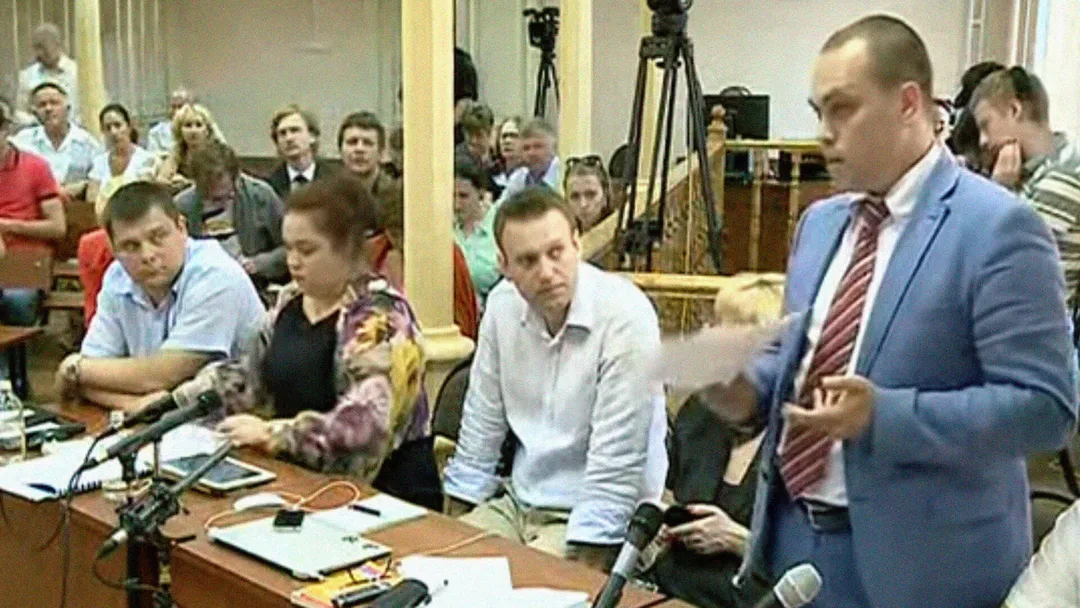
Please be seated.
The court session is open to the public.
Before the Leninsky District Court of the city of Kirov.
In this open court session, the court continues
the examination of the criminal
case against Navalny and Ofitserov. The following have arrived at
the court hearing:
the state prosecutors, the representative
of the injured party, and his counsel. The defense side
is present in full. Accordingly,
at the previous court session it was
announced that today additional submissions would be heard.
Such additions are available from
the representative of the injured party and the defense counsel.
After that, the court will proceed to closing arguments.
Uh, please, representative
of the injured party, stand up.
Please tell the court, are you familiar with
the results of the judicial investigation?
Do you have any additions? And,
>> I have familiarized myself with the results of the judicial investigation and with
all the materials.
Noted.
>> Thank you. Please be seated,
defense counsel for the injured party.
>> Your side? Have you familiarized yourselves with the materials of the judicial
investigation in full?
Any additions?
>> The judicial investigation is declared closed.
The court proceeds to the parties' arguments. Is
the prosecution ready? Your
>> Yes, Your Honor, we are ready.
>> The court will now hear the parties' statements.
Please proceed.
>> Thank you.
Your Honor, esteemed participants
in the proceedings, those present in the courtroom. For more than
two months we have been examining the criminal
case against the defendants Ofitserov and
Navalny. We heard witnesses,
and examined the written materials of the case.
It took us more than two months
to complete the judicial
investigation.
Today we have been given the right
to speak in closing arguments. As
a rule, crimes in the economic sphere,
to which this case also belongs,
are often not so interesting to
listeners. In their ordinariness they
are banal and dull, and do not arouse
much interest. People do not die in them, nor is
harm caused to citizens' health, and
the circumstances of their commission do not lie
on the surface. On the contrary, crimes of this kind
are carefully concealed,
made to look like civil-law
relations. The persons who commit them
enrich themselves unlawfully and cause damage
to the property of citizens and the state. In
this lies their danger to
society. There are a great many examples of such crimes.
And in our criminal
case there is nothing new in either the goals or the
motives, the means, or the methods
of their commission. There is only one difference: the composition
of the defendants. And it is precisely this that arouses
genuine public interest,
and gives this case a certain
resonance. This criminal case has become the subject
of discussion and dispute both in society and in
the mass media, where there have appeared
corresponding articles, with evidence and the investigation's conclusions distorted
beyond recognition,
There is nothing worse for
justice than when, in the court's view,
public opinion comes first,
which, as a rule, boils down to the opinion
of individual persons who do not know the details
of the case. The law requires objectivity
and impartiality from us, and therefore a conclusion as to
the guilt or innocence of the defendants
will be made by us on the basis
of the evidence examined and analyzed.
Let me remind you of
the circumstances of the case.
In January-February 2009, Navalny
knowingly aware of his ability to exert influence
over the activities of the state
unitary enterprises of Kirov Region
by virtue of his actual exercise
of the powers of an unpaid adviser to the governor,
formed the intent to steal
property belonging
to KOGUP Kirovles (a regional state-owned forestry enterprise).
Acting out of self-interest as
the organizer of the crime,
Navalny, while also planning
to direct its execution jointly with
his acquaintance Ofitserov, brought in as
an accomplice to the crime, developed
a criminal plan to steal
the property of KOGUP Kirovles by
misappropriating it in favor of a newly created and
organization under their control, which
Ofitserov was to establish and head.
While preparing for
the impending theft, around February
2009, Navalny, while in practice exercising
the above-mentioned powers of an adviser
to the governor on an unpaid basis,
acting on the instructions of the leadership
of Kirov Region, which was unaware of
the crime being committed, together with
Ofitserov, allegedly for the purpose of studying
and analyzing the efficiency of the operations of KOGUP
Kirovles, arrived at the said
enterprise. After that, Navalny
introduced Ofitserov to the general
director of KOGUP Kirovles, Opalev, and
instructed him to provide Ofitserov with
information about the structure of KOGUP Kirovles,
the range of timber products harvested and
processed, as well as
other necessary data, which Opalev
did provide. Around February-March of that year,
Navalny, continuing to carry out his
criminal intent aimed at
the theft of property belonging to KOGUP Kirovles,
while directing the commission of the crime,
while in the government building
of Kirov Region, informed Opalev about
the forthcoming creation by Ofitserov of a
company to provide intermediary
services for the sale of harvested and processed
timber products of KOGUP Kirovles for the purpose of
the subsequent embezzlement
of the property entrusted to Opalev.
Under these circumstances, Opalev,
being aware that as a result of the creation
of this company and its further operations
KOGUP Kirovles would suffer
property damage, took no actions
aimed at preventing
Navalny’s unlawful actions,
and agreed to proceed with
the latter’s proposal. Thus,
he entered into a prior criminal conspiracy with Navalny and Ofitserov,
a prior criminal agreement,
aimed at embezzling the property entrusted to him,
that is, the property of KOGUP
Kirovles on an especially large scale.
Ofitserov, carrying out the role assigned to him
for the purpose of implementing Navalny’s criminal plan,
acting jointly and
in coordination with him, in March 2009
arranged for the establishment and state
registration in Kirov Region
of a limited liability company controlled by him and Navalny,
a limited liability company
Vyatskaya Timber Company, hereinafter LLC VLK, and
also the opening of a bank account, thereby
facilitating the commission of the crime
by providing information
and the means for carrying it out. Subsequently, the
Inspectorate of the Federal
Tax Service for the city of Kirov
carried out the state registration
of LLC VLK.
Its sole founder
and general director was
Ofitserov, who also opened for LLC
VLK a settlement account with JSCB Vyatka Bank.
Around March and the first half of April
2009, in the city of Kirov, Ofitserov,
acting on the instructions of the organizer
of the crime, Navalny, and continuing
to aid in the commission
of the embezzlement, arranged the drafting of a
contract that was knowingly disadvantageous for KOGUP Kirovles
supply agreement with LLC VLK and signed
it on behalf of LLC VLK.
Under this agreement, KOGUP Kirovles
undertook the obligation to supply
timber products entirely at its own expense
to consignees that were legal entities and
individuals, including those who
were in fact existing
buyers of timber products from KOGUP
Kirovles. Therefore, refusing
to conclude direct supply contracts with them
made no economic sense and
entailed causing damage to
Kirovles.
Moreover, in the said agreement
there was initially no information about the price
of the timber products that would correspond to
and equivalently compensate, on the part of
VLK, the market value of the timber products supplied by
KOGUP Kirovles. Next,
Ofitserov submitted the said agreement
to Opalev for signature, and on 15
April 2009, while in the building
of KOGUP Kirovles at the address: Kirov,
Avtotransportny Lane, Building 4,
acting deliberately and in coordination with
Navalny and Ofitserov, being
the general director of KOGUP Kirovles,
and using his official position,
signed the said supply agreement
No. 01/2009 with LLC VLK, providing for
the execution of appendices to it
defining the main terms for the supply
of timber products, including their price.
At the same time, Opalev fully understood
the social danger of his actions and
the inevitability of socially dangerous
consequences resulting from
the conclusion of the supply agreement with LLC VLK in
the form of embezzlement of the timber products
entrusted to him from KOGUP Kirovles in favor of
LLC VLK and the causing of property damage
due to the absence, on the part of
VLK, of equivalent compensation for the market
value of the said timber products.
Under the agreement concluded with LLC VLK,
KOGUP Kirovles undertook to supply
timber products to the consignees
specified in the appendices to this
agreement, while LLC VLK would pay for the
goods. At the same time, Navalny, Opalev, and
Ofitserov knew for certain that
LLC VLK would pay for the goods
under the terms established by the agreement and
its appendices, at a knowingly
undervalued price compared with the price
that KOGUP Kirovles could have obtained
from buyers without using
the intermediary services of VLK. And the said
agreement was aimed exclusively at
creating the appearance that KOGUP
Kirovles had civil-law obligations
to LLC VLK.
Supposedly, it was to transfer
timber products to consignees for consideration, whereas in
reality these goods would be
transferred without equivalent and
appropriate compensation from
LLC VLK.
From 15 April to 13 July 2009, in
Kirov, in execution of their joint
criminal intent, Opalev, using his
official position as general
director of KOGUP Kirovles, as well as
Ofitserov, the general director of LLC VLK,
acting deliberately and in coordination, in
in complicity with Navalny, who organized
the commission of the said crime and
directed its execution, signed
36 appendices
to supply contract No. 01/2009,
which specified the types
of timber products, volumes, delivery terms,
as well as the price, which, without any
economic necessity whatsoever,
was deliberately understated by all
participants in the crime compared with
the price at which the products, as timber, could
have been sold directly by the counterparty
LLC VLK
for his part, Ofitserov, during the above-mentioned
period of time, acting on behalf of LLC VLK,
entered into supply contracts for the sale of the produced
KOGUP Kirovles timber products with
buyers for the purpose of increasing the volume of
KOGUP Kirovles property subject
to embezzlement, as well as creating for VLK
conditions allowing it to exclusively
supply and sell the produced
KOGUP Kirovles timber products. Opalev,
acting on Navalny’s instructions,
deliberately and in coordination with him and
Ofitserov, using his
official position, as general director issued
Order No. 76 establishing the procedure
for the sale of timber products by KOGUP
Kirovles dated May 19, 2009, under which
a ban was introduced on forestry branch offices
of KOGUP Kirovles independently
entering into supply and
purchase-and-sale contracts for timber products with
legal entities and individuals, as well
as sole proprietors.
At the same time, Navalny and Ofitserov were aware
that Opalev, in part, was unlawfully depriving
KOGUP Kirovles of the ability
to independently sell the produced
timber products at market prices, thereby
placing these timber products at the disposal
of LLC VLK without
appropriate and equivalent
compensation for their market value. During the
period from April 15 to September 30, 2009,
in Kirov, Opalev, using
his official position, and Ofitserov,
acting deliberately and in coordination with
Navalny and on his instructions, ensured
the performance of the terms of supply contract
No. 01/2009 and its appendices, as a result of which
KOGUP Kirovles shipped
timber products in the amount of 10,842.7 cubic meters
for a total sum of 16,165,826
rubles and 65 kopecks to the following
counterparties of LLC VLK: LLC Domostroitel,
LLC AVS, LLC Lesgarant, OJSC KMDK, OJSC
Volga, LLC Vlada, OJSC Vantazhnik, LLC
Sevlespil, sole proprietor Podgornov, OJSC Mari Pulp and Paper Mill,
CJSC Krasny Yakor, LLC Match
Factory Pobeda, LLC Ufimskie Spichki, LLC
Krymskie Zori, CJSC Spichprom, Zoo and
Mont. During the trial,
Navalny and Ofitserov did not admit guilt in the
crime charged, explaining that in their
actions the elements of theft, namely
self-interest, unlawfulness,
and gratuitous infliction of damage
on the owner, were absent. The charges brought
against them were unclear to them. The crime
is alleged to have been aimed at the theft of state
property. They regard it as skillful
performance by Navalny of the duties
of adviser to the regional governor in 2009,
and Ofitserov’s actions as having been carried out
within the framework of lawful business
activity.
This is the defendants’ version—that is, the version of persons
facing criminal punishment, persons
who are interested in a favorable
outcome of the case. Therefore, whether deliberately or not,
they color all the events of the crime
and their own participation in it in a defensive light,
softening or passing over in silence the
points most unfavorable to themselves.
But let us step out of the world
of fantasies and fairy tales and look objectively
at the events of 2009, relying on
the evidence and the established facts.
Let us assess the defendants’ version.
It should be noted that in this
criminal case there are two defendants. They are
Navalny, the organizer of the crime, and his
accomplice Ofitserov. As for the third
participant in the crime, the direct perpetrator,
the former general director of KOGUP
Kirovles, Opalev, the criminal case
was separated into a distinct proceeding due
to the conclusion with him of a pre-trial
agreement requiring a full
admission of guilt.
The case was heard, and by the judgment
of the Leninsky District Court of the city of Kirov
dated December 24, 2012, Opalev was found
guilty of embezzling
timber products in the amount of 10,842.77
cubic meters, worth 16,165,826
rubles and 65 kopecks—that is, theft of property
belonging to KOGUP Kirovles, entrusted to Opalev,
using his official
position, on an especially large scale, by
prior conspiracy, together
with citizens N and O, that is, of committing
the crime provided for by
Part 4 of Article 160 of the Criminal Code of the Russian Federation
The judgment entered into legal force.
Since the criminal case against
Opalev was considered under a special procedure
of criminal judicial proceedings
and the available evidence was not examined
by the court, it cannot therefore be
used in full as prejudicial evidence
in the present criminal
case. However, the numerous
items of evidence examined during the court
hearings fully confirm
Navalny’s involvement in organizing
the embezzlement jointly with Sopolev
of timber products from KAGUB Perv Les, and
Ofitserov’s, accordingly, in aiding and abetting
the embezzlement of these timber products.
From the testimony of witness Opolev,
who in 2009 held the position of
general director of KGUBles, it follows that
the initiative to create an organization
to act as an intermediary between KAGUB and the end
consignees, as it turned out, VLK,
came personally from the governor’s adviser
of Kirov Region, Navalny. It was
Navalny who, while in his office,
office,
introduced Ofitserov to him as
a person who would provide KAGUB
with assistance in organizing the sale of
timber products. The subsequent familiarization
of Ofitserov with the activities of KAGUB
was also carried out on the direct instruction
of Navalny.
Opolya’s testimony indicated that
Navalny promised to assist in
increasing budget funding for
KAGUB Kirovles. However, the general director
of the state enterprise understood that these promises
were connected solely with Navalny’s interest
in selling timber products
through OOO VLK and receiving from its
operations profits for himself and Ofitserov,
with whom he maintained friendly relations.
In addition, Ofitserov, referring to
Navalny, promised that after
KOGUB Kirovles secured for OOO VLK
significant volumes of timber
supplies, his personal interest in the form
of receiving part of the profits from the activities
of VLK would also be taken into account. Thereafter,
acting on Navalny’s behalf, Ofitserov
presented Opol to a draft contract between
KOGUB Kirovles and OVK for the supply of
timber products, containing one-sided
liability for the state
enterprise. The supply contract was
submitted by Opolev for review to
employees of KAGUBrofles, who expressed
the unanimous opinion that it was disadvantageous and
inadvisable.
Despite this, understanding that OVLK
was merely an intermediary, and that
this cooperation and contract could
cause property damage to
KOGUB Kirovles, since the price difference,
that is, the profit earned, would
remain with OOO VLK rather than with KOGUB Kirovles,
Ole, in April 2009, on behalf of
KOGUB Kirovles, signed supply contract
No. 01/2009
with VLK, and later 36 appendices to
it.
For Opolev, this decision became the key
circumstance that brought him and the other
defendants in the case to the dock.
Further, acting jointly and according to the testimony
of Ofitserov and Navalny, Oplev organized
the renegotiation of contracts that had previously
been concluded with major clients of
KGUBles. He persuaded Ofitserov to employ in
OOO VLK his foster daughter Bura and issued
an order prohibiting directors of
forestry enterprises from independently concluding
contracts for the supply of timber products. As
follows from Opolev’s testimony, he
understood that KOGUB Kirovles,
by working through VLK, was receiving a smaller
amount of revenue than it would have if
it had worked directly with its clients
and new buyers.
Such sales of timber products through VLK
were also unprofitable for the branches of
the forestry enterprises, which mainly
sold timber products locally
to local buyers, since they did not have
their own transport or the ability
to deliver.
And when working with OOO VLK, the forestry enterprises bore
costs for loading and
loading/unloading operations, transport
services, and did not receive money directly. Nevertheless,
for nearly 3
months, Opolev took no measures to terminate the contractual
relations with OOO VLK.
The owner of the enterprise, the regional government,
was not fully informed about the situation
that had arisen. Witness
Bastrygina, questioned at the court
hearing, explained that in 2009 she
held the position of deputy
general director of KAGUB Kirovles. In the spring of 2009,
in the KAGUB administrative building
a meeting of the directors of the forestry enterprises
of KAGUB was held, at which Opolev, in the presence of
Navalny as the governor’s adviser, introduced
the general director of OOO VLK, Ofitserov, and
announced the need to sell
products only under contracts through the LLC,
while promising that the company would
purchase all timber products, which
Ofitserov confirmed. However, in practice
everything turned out differently, since in fact
OOO VLK began taking for resale
primarily only
high-quality timber and
sawn timber. And the sale of low-grade timber
promised by Ofitserov was not
carried out. In addition, the forestry enterprises
saw increased costs as a result of
transporting timber to the place
of shipment in other districts. In this connection,
the management of KOGUB Kirovles received
numerous complaints from forestry enterprise directors
about this. Having studied the contract,
she reached the unequivocal conclusion
that the contract was disadvantageous, and informed
Opolev of this. Opolev explained that the initiative
to conclude the contract came from
the regional government. With the conducted in
with respect to KAGUP in June 2009
by an audit that confirmed the arguments about the clear
disadvantageous nature of the contract between the state unitary enterprise and LLC
VLK, at a meeting with the regional governor in the presence of
Navalny and Ofitserov, there was
a meeting at which the aforementioned persons
stated that the inspection had been biased.
According to
Bastrigino, Navalny and Ofitserov
maintained friendly relations,
and worked as a team. Ofitserov, together with
Navalnaya, took part in meetings of
the regional government. Their calculations and ideas
fully coincided, as if they had developed them
together. Similar testimony
was given by witnesses Makaveev and Zmeev, who also
in 2009 held the positions of
deputy directors of KOGUP Kirovles.
Thus, Makoveev explained that the terms
of the Kirovles-VLK contract were, literally speaking,
luxurious for one side, since the contract
provided only for unilateral
liability on the part of the state enterprise for performance of
the contractual obligations, and therefore he was
categorically opposed to its conclusion.
In addition, the subject matter of the contract
provided that LLC VLK would render
intermediary services in the sale of
timber products, although KAGUP could have done
this independently. Subsequently,
contracts with the main counterparties of
KOGUP Kirovles were reassigned to LLC
VLK. At the same time, the price for the end buyer
or recipient and the delivery terms did not
change, which once again indicated
that there was no need for VLK's involvement.
He expressed his opinion about the inexpediency
of concluding the contract with VLK to
Opolev, who nevertheless
signed the contract and entrusted its performance
to Bura. In June 2009, Makaveev
resigned from his position. One
of the reasons was, among other things,
the sales policy, which he found incomprehensible,
of Kirovles, represented by director
Opolev.
Witness Zmeev told the court that, due to
the disadvantageous nature of the supply contract between
LLC VLK and KOGUP Kirovles, the management began receiving
relevant complaints
from the directors of the forestry branch offices of
KOGUP Kirovles.
At the end of the summer of 2009, addressed to the
general director of KOGUP Kirovles, he prepared
an analytical memorandum in which,
on the basis of the data obtained,
an unequivocal conclusion was drawn about
the inexpediency of the contract's conclusion.
From the testimony of witness Bura, who in 2009
held the position of head of
the commercial department of KOGUP Kirovles,
it follows that, on Opolev's instructions, she
dealt with matters relating to the organization of
the supply of timber products from KOGUP Kirovles under
the contract with LLC VLK. According to Opolev, she
knew that this arrangement had been coordinated
with the government of the Kirov Region.
Later, Ofitserov sent her a draft
supply contract. After reviewing the contract, she
repeatedly informed Opolev of
the disadvantageous nature of such cooperation, including
because of the pre-set and
completely unjustified percentage markup
charged by LLC VLK on the sale of timber products produced by KAGUP.
However, Ofitserov constantly
pressed her to conclude this
contract, asserting that its
conclusion and the start of supplies of
timber products through LLC VLK were being insisted upon by
the regional government. Ofitserov
demanded that the contract be concluded in
an ultimatum-like manner, stating that if
they refused to conclude it, Popolev
and Bura would be removed from their positions. The same
would happen to the directors of the forestry enterprises
who opposed supplies to
VLK.
Opolev was also informed about the disadvantageous nature of the supply contract
by other employees of KOGUP
Kirovles,
to whom the draft contract had been submitted
for review. Nevertheless, in April
2009, Opolev signed the contract with VLK.
In May 2009, at Ofitserov's suggestion,
she took a second job at LLC VLK as
a part-time employee in the position of
commercial director. In addition,
while complying with Ofitserov's demands regarding
the need to re-execute through LLC VLK previously
concluded contracts of KOGUP with
buyers of timber products, she
using a special script prepared by Ofitserov,
visited clients of
KAGUP in order to convince them of
the need to re-sign their contracts with
LLC VLK as the alleged official dealer of
KAGUP. Thus, contracts were reassigned to LLC VLK
with six
major buyers of timber products from
KOGUP Kirovles, and contracts were also concluded
with six enterprises with which
KAGUP had been conducting negotiations and with respect to which they
were already at
the stage of finalizing those agreements.
Subsequent dealings confirmed
her conclusions about the disadvantageous nature of the contract with
VLK, which imposed requirements regarding
timing, volume, and product assortment
that did not correspond to the capabilities of KOGUP
Kirovles. As a result, the products
had to be collected and shipped from
several forestry enterprises, thereby placing
transportation costs on them.
Witness Zagoskina, questioned at the
court hearing, explained that in the summer of
2009, together with auditor
Shulyatyeva, on instructions from the Department of
State Property of the Kirov
the region conducted an audit
of KGU Kirovles for the second quarter of 2009
The audit's objectives included, among other things,
examining the company's sales policy.
Based on the audit results,
it was established that one of the main
buyers of Kirovles timber products
was OOO VLK.
Other companies and individual
entrepreneurs purchased
timber products through the forestry units, branches
of KOGUP Kirovles.
From the moment products were shipped to
the consignee OVLK, previously
concluded supply contracts with a number of enterprises
were terminated and
re-entered into, but this time with OVLK. At the same time,
the price of the timber products sold was
reduced by 17% to 35%, which indicated
the economically disadvantageous nature
of relations with OOO VLK.
The audit findings were discussed at
a meeting with the regional governor, during
which Navalny and Ofitserov,
who were present, expressed their
disagreement with the auditors' conclusions.
Witness Belykh, questioned at the trial,
explained that in 2009,
after being appointed governor of Kirov Region,
while forming his staff and
advisory team, he invited Navalny to take the said
position; he had known him since
2005 through their joint political
activities. Officially, Navalny was appointed to the said
adviser position
in May 2009. However, even before
that date, he took part in
various meetings and sessions, including
meetings introducing him to the heads of
state-owned enterprises.
Navalny was introduced as a member of his
new team. Press releases stated
his position. In the first
half of 2009, he instructed
Navalny to analyze the financial
condition of KOGUP Kirovles, in connection with which
the latter was included in the
working group. Following the analysis carried out,
Navalny prepared an internal memorandum,
according to which the enterprise
had serious debts and problems with
selling timber products, and also needed
reorganization.
In order to improve the situation in the
timber industry sector, together
with Navalny, he visited OOO Salkhans
Bumprom, having preliminarily agreed on
increasing the volume of timber product supplies.
He gave Navalny no instructions
to prepare a written proposal to
the said enterprise; he did not
give any. They were not coordinated with him.
He was not personally acquainted with Ofitserov. He did not invite him
to engage in business activities in
Kirov Region.
He saw him only at a meeting in
Kirov Region administration on
the issue of reforming KOGUP Kirovles and
removing General Director
Opolev from office. One of the reasons for
this decision was that
Opolev's daughter, in addition to KOGUP Kirovles, also
worked at VLK, that is, at one of the
counterparty companies of KOGUP, which
could indicate an interest on
Opolev's part in cooperation with
the company. He had not reviewed the materials of the criminal case,
so he could not
say with certainty whether
damage had been caused to the region as a result of
Navalny's activities.
Witness Shcherchkov, who since 2009 has held the position
up to the present time of
Deputy Chairman of the Government
of Kirov Region, explained that in addition to
other duties, he also oversees the regional
Forestry Department. Navalny
is known to him. In 2009, he held the
position of adviser to the governor. In the
regional administration building, he had his own
office. On Belykh's instructions, he studied
the region's forestry sector.
In Opolev's presence, Navalny took
part in working meetings
devoted to this issue. At them, he had
the right to an advisory voice,
and offered his opinion, including
voicing the idea of creating a timber exchange.
In spring 2009, at Opolev's suggestion,
together with Navalny, he visited
KOGUP Kirovles, after which the latter began
regularly contacting him on issues concerning
the enterprise's activities. At the beginning of summer
2009, Opolev asked for his
opinion regarding the commercial
relations between KOGUP Kirovles and OVLK,
cooperation with which had been requested by the
government of Kirov Region, to which
he proposed that all interested parties
be referred to him. Navalny introduced him to the director of OOO VLK,
Ofitserov, and at Navalny's
initiative, later
Ofitserov took part in meetings
of the working group made up of employees of the
Kirov Region administration on
assessing the effectiveness of the activities of
KOGUP Kirovles.
Among other things, Ofitserov also took part
in the discussion of the audit
conducted in relation to KOGUP Kirovles in
early summer 2009, expressing his
dissatisfaction with the auditor's conclusions.
Navalny also disagreed
with the audit results, questioning
the conclusion that
cooperation between KOGUP Kirovles and VLK was unprofitable.
Cherchkov believes that as a result of
the cooperation between KOGUP Kirovles and OVK
the enterprise suffered corresponding
damage.
Witness Votina, questioned during the court
hearings, explained that in 2009,
while serving as an adviser to the regional governor,
he oversaw matters relating to the economic
sector, including studying the structure
of the timber industry complex. In this connection,
in the winter of 2009, together with
Opolev, he traveled around the forestry units of the KOGUP
Ruffles. Also taking part in this trip
was Ofitserov, whom he later
met several times in the government
of Kirov Region, including in
Navalny's company.
Witness Rzamassy, whose testimony
in accordance with the requirements of Part 2
of Article 281 of the Russian Criminal Procedure Code was read out at
the court hearing, stated during
the preliminary investigation
of the criminal case that in 2009
he, while holding the position of director
of the regional state property department,
supervised the activities of KOGUP
Rafles, headed by Sopolev. The enterprise
had large debts due to non-payment of
lease payments for the forest fund,
transferred to KAGUP. In the spring and summer of 2009,
at his initiative there was conducted
an audit of KAGUP's activities,
as a result of which it became known that
a contract had been concluded that was knowingly disadvantageous for
this enterprise: a supply agreement
with SOVLK, headed by Ofitserov.
The audit results were reviewed at
a working group meeting attended by Navalny,
who cast doubt on the conclusions
of the audit, demanding a repeat
audit. He believes that the audit concerning
KOGUP was conducted objectively by a company
holding a strong position in this
market. After that meeting, Opolev
explained that before concluding the supply
agreement, Ofitserov had promised to expand the market
for KAGUP's timber products. The representative
of the injured party, Smertin, questioned at
the court hearing, explained that at
present he holds the position
of director of the department of state
property of Kirov Region. In the autumn of
2009 he took part in
a meeting held at the initiative
of the acting general director
of KGUB Gerofle, Bastrygina, who believed
that after Opolev's departure, Navalny
was trying to direct the activities of KOGUP
Kerofles. In addition, the meeting also
discussed the issue of the concluded contract
between OVK and KOGUP Kerofles, which was
clearly oppressive and contained only
one-sided liability for Kirofles.
At the same time, the price and terms for timber deliveries were not
specified.
He agrees with the investigators' conclusion that as a result
of the defendants' actions, there was
damage caused to KAGUP Kirovles in the amount of
16,165,826
rubles and 65 kopecks.
Former directors of the forestry branch units of KOGUP
Kirofles — Kiselyov, Krylatov, Kozlov,
Osapov, Zentsov, Sergeyev, Panteleyev,
Sadriev, Buzmakov, Beloglazov, Koretnyuk,
Posnov, Baldin, Smertin, Yu. N., Litvinenko,
Sukhikh, Bulatov, Grebneva, Glazyrina,
Knyazev, Barantsev, Kuznetsov, Shutova.
questioned during the court hearing,
explained that in 2009 they were required
to follow the instructions of the general director
of Kokubkirov, Sopolo, since he was
their immediate superior.
The forestry units were vested with the right
to independently sell
timber products at prices that had been approved
by KOGUP Rafles,
independently concluding the relevant
contracts.
Contracts with the largest
timber-purchasing enterprises
were concluded directly by
the administration of KOGUP Kirovlyas, one of
which was OOVLK. The need
to cooperate with this enterprise
was communicated by Opolev at a meeting
of directors in April 2009. According to
Opolev, VLK was supposed to take all
timber products, including
low-grade products, which was also confirmed by
Ofitserov, the general director of OOVLK,
who was present at that meeting.
Subsequently, in May 2009, Opolev
issued Order No. 76 on
the need to sell all
timber products directly through
KOGUP Kirofles. By Opolev, as well as
by Kirofles's commercial department headed
by Bura, the forestry units were sent
the relevant specifications, or
they were informed orally of the volumes,
assortment, and prices of the products
that had to be shipped through OOV
VLK to the final consignee. However,
the proposed terms of cooperation with
OOVLK were disadvantageous.
Transportation of timber products to the shipping station
or from warehouse to warehouse
of the recipient was carried out at the expense
of the forestry units. Prices for
timber products remained unchanged without regard
to seasonal logging patterns and demand.
They were often lower than those at which
similar timber products
were sold to other counterparties. Payment for
the delivered products was
untimely, or the goods were not
paid for at all. Moreover, despite
the unchanged delivery terms
for timber products to former
counterparties of KGUP Kirovles, namely OAO
KMDK, ZAO Plits Pechprom, ZAO Krasny
Yakor, OAO Domostroitel, cooperation
was also unprofitable, since OOO VLK
kept a certain percentage of
the amount received from the timber sold.
Thus, the director of the Tuzha forestry enterprise
Kolchin explained that, according to Opolev,
he knew that VLK received from 5 to
7%. Despite the fact that cooperation
with OOO VLK was unprofitable, the directors
of the forestry enterprises were obliged to comply with the terms
of the contract and the instructions of the general director of KGUP
Kirovles. The director of the Kirovo-Chepetsk
forestry enterprise, Kuzyakin, testified that questions
about the sale of timber products at reduced prices
were put to Sopolev by the directors
of the forestry enterprises, to which he explained that
the initiative to sell the produced
timber products through OOO VLK came from
Navalny, who, on behalf of
the Kirov Region government,
oversaw the activities of KGUP Kirovles. According to
Opolev, Navalny had a personal interest in
the activities of OOO VLK. If not for
Opolev's instruction, he would not have
cooperated with OOO VLK because of the unprofitability
of these arrangements.
Witnesses questioned during the court hearing
— Chernikh and Fursov — explained that in
2009, AOKMDK, where they
worked, had a valid contract
for the supply of timber products with KGUP Kirovles,
the terms of which fully satisfied both parties.
In the spring of 2009, on the same
terms and at the same prices, at the initiative of
Opolev and Bura, a supply contract was concluded
with OOO VLK, which, according to the latter,
was a representative of KGUP.
Present at the meeting with Bura was
OOO VLK General Director Ofitserov,
witness Ovchinnikov, director of OOO Vlada,
and witness Minin, a representative of ZAO Vest
Lesprom, stated in court that there were
contractual relations with
KGUP Kirovles in 2009. There was no need
to change them. However, in the spring
of 2009, at the initiative of KGUP Kirovles,
a contract was concluded with OOO VLK. At the same time,
the supply terms and prices did not change. They were
introduced to OOO VLK director Ofitserov by
Bura, who presented him
to the company's management as a dealer of
KGUP.
Witness Fedotov explained that since 2008
he has held the position of director for
timber supply at OAO Syktyvkar Pulp and Paper,
which purchases timber, including
in the Kirov Region. At the beginning of
May 2009, a conversation took place with the participation of
its general director
Baranov of OAO Syktyvkar Pulp and Paper and the governor
of the Kirov Region, Belykh, during which
Belykh proposed cooperation with the Kirov
Region, where it was planned to create
procurement platforms for timber products in order
to improve the unfavorable situation with
timber sales in the Kirov Region. Baranov
confirmed the possibility of continuing
relations with logging
enterprises of the Kirov Region on the same
terms as before. During the conversation,
issues of timber shipment,
logistics, and payment were discussed. Belykh did not name
any logging
enterprises in the Kirov Region that might later
become partners of OAO
Syktyvkar Pulp and Paper. A little later, a letter was sent to
OAO Syktyvkar Pulp and Paper
signed by Navalny regarding timber supply,
informational in nature.
The letter stated
the possibility of supplying timber products
through OOO VLK.
In addition, during the court hearing
written materials of the
criminal case were examined.
According to the charter of KGUP Kirovles,
the owner of the enterprise is
the regional government, and its interests are represented by
and the enterprise is managed on the basis of sole
executive authority by the general
director. In accordance with Order
No. 07-158 of December 7, 2007, and
the employment contract of December 12, 2007,
the general director of KGUP
Kirovles in 2009 was Opolev,
appointed to that position on
December 12, 2007. During the examination of
the lease agreements for forest plots
in federal ownership,
Nos. 1, 2, and 3 of November 10,
2008, and state contracts Nos. 4, 5, 6,
7, and 8 of March 30, 2009, and Nos. 92, 93, 94,
95, and 96 of August 12, 2009,
it was established that the harvested timber
is the property of KGUP Kirovles.
According to Order
No. 76/6 of May 19, 2009, establishing
the procedure for the sale of timber products by KGUP
Kirovles, as of May 20, 2009, a ban was introduced
prohibiting forestry enterprises from independently concluding
supply and sale contracts for
timber products.
In accordance with the order of
the governor of the Kirov Region dated May 21,
2009, No. 60, Navalny was
appointed as an adviser to the governor
on a voluntary basis as of May 20, 2009.
According to the record of document inspection dated
October 17, 2012, the employment
contract between Bura and OOO VLK was examined,
confirming the existence of an employment
relationship between the said persons.
The employment contract was added to the case materials
of the criminal case as physical
evidence. Based on the responses to inquiries sent to
OOO KMDK, OOO Vlada, OAO
Domostroitel, the price of timber products
after the contract with Kogub was renewed
Kirovles to VLK LLC remained unchanged.
According to the response to the inquiry,
from Kirovo-Chepetsk Leskhoz (a state forestry enterprise), the price of
timber products supplied to KMDK through
OOVLK was lower by 70–90 rubles per 1
cubic meter than the price for
direct deliveries of timber products.
seized during the search and seizure on June 8, 2011, from
OOV VLK General Director Ofitserov: the contract
between Kogubkirovles and OOVLK, an appendix
to it, contracts of OOOV VLK with
counterparties, primary accounting
documents of OOVLK concerning
the purchase and sale of timber products, from Kogubki
rovles and its payment, documents
concerning Bur’s employment, as well as
documents seized from the Volgo-Vyatka Bank
of the Udmurt branch of Sberbank of Russia, namely
the legal file of Kogubkirovles, an account statement
for transactions on the account of Kogubke
Rafles for the period from April 15, 2009,
to October 1, 2009, as well as seized
from VCB "Vyatka Bank," namely the legal
file of OOV VLK, containing copies
of certificates of state registration of the LLC,
Ofitserov’s application to open
a settlement account for the company and the agreement on
opening a bank account, as well as
statements of transactions on the company’s accounts with
counterparties for the period from April 15, 2009,
to October 1, 2009. These
documents were examined on October 5,
2012 and added to
the case materials.
The examined documents show that on April 15,
April
2009, a contract was concluded between OOVLK and Kogubki Rafles
under No. 01/2009 for
the supply of timber products, with appendices,
which confirm the existence
of business relations between OOV VLK and Kogubki
Rofles regarding the supply of timber products during
the period from April 15, 2009, to
October 1, 2009. The contract
provides for unilateral
liability of the supplier, namely
Kogubkerofles, for breach of its terms,
which indicates the deliberate and
disadvantageous nature of its conclusion.
Contracts between OOV VLK and LLC
Domostroitel, LLC Kirov
Furniture and Woodworking Plant,
LLC AVS, ZAO Lits, Spichprom, OAO Volga,
LLC Lesgarant, LLC Match Factory
Pobeda, LLC Vlada, OAO Mari
Pulp and Paper Mill, ZAO Krasny
Yakor, LLC Sevlespil, sole proprietor Podgorny, OAO
Montazhnik. They confirm the fact
of business relations between OOVLK and
its counterparties for the supply of timber products
from April 15, 2009, to October 1, 2009.
A review of the said contracts
showed that they provide for
mutual liability of the parties.
The examined waybills and invoices
of Kogubkerafles, issued to
the timber buyer OOVLK,
confirm that OOVLK purchased
timber products in a total volume of
10,084.277 cubic meters
with a total value of 16,165,826
rubles and 65 kopecks from Kogubkerovles for
subsequent resale under contract
No. 01/2009.
Invoices, waybills,
invoices, cargo customs declarations
of OOOVLK, issued to buyers
of timber products supplied by Kogubke RFS under
contract 01/2009, confirm
the fact of its sale.
The payment order for the transfer
of funds from OVLK’s settlement account
to the settlement account of Kagub Kirovles
confirms the transfer of funds
for the purchased timber products under
contract No. 01/2009.
Registers of amounts credited to
OOV VLK’s settlement account confirm
the transfer of funds
from OOVLK’s counterparties to OOVLK’s settlement account
for delivered timber products in the
total amount of 16,3,880
rubles and 28 kopecks under contract No.
01/29
as evidenced by payment orders.
OVLK timesheets dated April 30,
2009, May 31, 2009, and June 30,
2009, and OOV
VLK payroll sheets for April, May, and June 2009
confirm that Bur was employed on the staff of
OOVLK.
OOVLK’s legal file indicates
that the enterprise was registered as a
legal entity on March 18, 2009, and
the bank account statements show the fact
that OOVLK used VCB
"Vyatka Bank": a settlement account in
rubles and a current account in euros.
Bank account statements from Sberbank
of Russia for the period from April 15, 2009, to
October 1, 2009, confirm the existence and use
by Kogubki Refle of a settlement
account in rubles. These documents were
added to the case materials as
physical evidence.
The forensic accounting expert report
No. 79 EK dated December 12,
2011 states that during
the period from April 15, 2009, to September 30,
2009, OLK purchased timber products from UKGUBKOS
which were subsequently sold
to counterparties LLC AVS, LLC
Lesgarant, LLC Domostroitel, LLC KMDK, OAO
Volga, LLC Vlada, LLC Match Factory
Pobeda, sole proprietor Podgornov, ZAO Krasny Yakor
LLC Sevspil, LLC Ufimskie Spichki, LLC
Krymskie Zori.
Uvaumo, Montazhnik, Zalpichprom.
Mari Pulp and Paper Mill, Iman, in the amount of 14,785.94
rubles and 66 kopecks.
During the period from April 15, 2009, to
September 30, 2009, LLC VLK shipped
timber products to its counterparties: LLC
AVS, LLC Lesgarant, Domostroitel, KMDK,
Volga, Vlada, the Pobeda Match Factory,
Podgornov, Krasny Yakor, Sev, Lespil,
Ufimskie Spichki, Krymskie Zori,
Montazhnik, Plispichprom, Mari Pulp and Paper Mill, and
Imond, in the amount of 16,165,826
rubles and 65 kopecks.
According to the appendix to the expert opinion,
the total volume of timber products
sold by Kogubkirovles to
LLC VLK amounted to 10.084
277.000
cubic meters.
Most of VLK's counterparties were
former counterparties of Kogub
kirovles. According to the inspection report,
on October 22, 2012, a letter from the
administration of the government of Kirov
Region, signed in the name of adviser to the
Governor of Kirov Region, Navalny (Alexei Navalny),
addressed to the president of Salikans BumProm
Baranov, concerning possible options for developing
VLK's timber supplies, which
is the official dealer of
Kogubkirovles, indicates
Navalny's interest in the development of the
enterprise and his use of his
status to resolve this issue.
According to handwriting expert opinion
No. 363 dated December 6, 2012,
the signature in Navalny's name on the
letter from the administration of the government
of Kirov Region was made by Navalny.
The prosecution also examined and
presented email correspondence between
Navalny and Ofitserov, confirming
Navalny's direct and obvious interest in
the operations of Gubki Rufles and LLC VLK and
refuting the defendants' testimony about
the absence of mutual contacts between them and
Navalny's non-involvement in the activities of LLC
VLK and Kogubki Reflies.
Thus, even before the contract was concluded,
between LLC VLK and Kogubkirovles,
Ofitserov coordinated with Navalny the scheme for including
LLC VLK in the supply of timber products from
Kogubkirovles, as well as the legal details
of the draft contract between LLC Vyatka Timber
Company and Kogubkirovles. Headed
by O., as referred to in the text as O.'s friend, including
the amount of planned profit. Also,
Ofitserov coordinated with Navalny
the current activities of LLC VLK, financial
issues, and marketing policy. Also,
Navalny and Ofitserov planned
to work on substantiating the creation, on the basis of
LLC VLK, of a unified trading platform for
the sale of timber products, with discussion of
the issue of the subsequent allocation of
credit funds for the development of
LLC VLK as a structure already created
with the consent of the government of Kirov
Region.
In addition, Navalny and Ofitserov
planned measures to monitor
compliance by forestry enterprises, branches of
Kogubkirovles, with Opalev's ban on
independently concluding contracts for
the supply and purchase/sale of timber products with
legal entities and individuals, as well as
sole proprietors.
Also, Navalny and Ofitserov repeatedly
discussed in their correspondence issues
concerning the need to maintain secrecy when
communicating both by mobile phone using
subscriber numbers
registered to third parties, and by
electronic communication using
email addresses whose domains
were registered outside
the Russian Federation, with the use of
encrypted files.
In addition to the email correspondence between
Navalny and Ofitserov, the court examined
files containing the text of draft contract
No. 012009 between LLC VLK and
Kogubkirafles; a profit and loss report;
the accounting balance sheet of Kogubki
Rofles for 2008; a work plan for
analyzing the financial and economic
situation at Kagubka Rafles; a letter from the
administration of the government of Kirov
Region addressed to the president of LLC
Salikansbumprom, Baranov; a negative
review of the report by the firm Vyatka Academy
Audit, in Navalny's name; a memorandum on
the results of the joint activities of VLK
and Kogubkerovles, in Ofitserov's name.
The court examined information on more than
a thousand connections between the subscribers and
subscriber devices of Ofitserov and
Navalny during the period under review in 2009, which
confirms the fact of постоянных
contacts between Navalny and Ofitserov and
Navalny's participation in the activities of LLC
VLK and Kogubki Rafles. Also examined
in court were recordings of telephone
conversations between Navalny and Ofitserov,
as well as the phonoscopic and
psychological-linguistic examinations conducted on them.
These quite clearly confirm the facts of
the interest and agreement of
Navalny and Ofitserov in obtaining
benefit from the management activities of
Kogubkerafles in favor of LLC VLK.
They had common goals and objectives, planned
and carried out joint actions with regard to
Gubkerovles, including
discussing Ofitserov's participation in managing
this organization.
Your Honor, after this it becomes
clear what the defendants' position and their
the defense's motions to have the aforementioned
evidence declared inadmissible. Their unwillingness
to examine the aforementioned evidence,
which the court found admissible at the trial
hearing, since this
evidence unequivocally confirms
the facts of deliberate, joint, and
coordinated actions by Navalny
and Ofitserov in the interests of OOO VLK and to the detriment of
KOGUP Kirovles.
Thus, the events that took place in
2009 are straightforward and logical.
They show that in 2009
the general director of KOGUP Kirovles, Opalev,
together with Navalny, on whose instructions
and with the participation of his acquaintance Ofitserov, there was
created OOO VLK, and as a result of concluding
a knowingly disadvantageous contract, there was
misappropriation of timber products
belonging to the state enterprise in the amount of
more than 10,000 m³ worth more than 16 million
rubles (about 16 million RUB).
Why deny that entering into a knowingly
disadvantageous contract caused losses to
KOGUP Kirovles, if that is obvious? Why
was it necessary to create an intermediary company
to sell the products if
the supplying state enterprise
could do so on its own? Did
the employees of KOGUP Kirovles and
its district branches not understand this? More than 30 people,
questioned at the trial,
testified to the disadvantageous nature of cooperation
with OOO VLK, but nevertheless were forced
to carry out the instructions of their
immediate superior, Opalev, regarding
the supply of timber products under the contract and
the corresponding demands of the management of
OOO VLK.
During the proceedings, the defense repeatedly
stated its view that it
did not understand what exactly constituted
Navalny's organizing role, if
it was Opalev and the employees subordinate to him who gave forest enterprise directors instructions on selling
the products, and the employees subordinate to him
from the commercial department
of the state enterprise. Why is Ofitserov, acting
within the framework of the timber supply contract,
being accused of aiding and abetting
embezzlement? The director of Kirovles
is Opalev. The property was entrusted
to him. He is the one who should have borne
responsibility. Indeed, Opalev
is guilty; he is the direct perpetrator, but we are not
trying him. He has already been convicted of embezzling
the property of KOGUP Kirovles, and that verdict
has been examined by us. In this criminal
case, however, we are dealing with the organizer and
the accomplice to this crime. Their guilt
is what we are proving. In accordance with Part
3 of Article 33 of the Criminal Code of the Russian Federation,
an organizer is recognized as a person who
organized the commission of a crime
or directed its execution. In 2009,
Navalny, having the ability
to influence the regional state
enterprise, having studied the structure of
the KOGUP, its financial situation,
and its contractual relations, deliberately
undertook actions to organize OOO VLK,
whose role was to provide
intermediary services in the sale of
Kirovles timber products. Despite
the fact that there was no need for an intermediary,
he instructed Ofitserov
to create OOO VLK, convinced
Opalev of the need to cooperate with it,
and demanded that he conclude the contract as quickly as possible,
promising
to take the latter's interests into account in the event of
successful contractual relations.
Knowing full well that the contract between
the KOGUP and the LLC was disadvantageous, he took measures
aimed at preserving the relations that had arisen
between them and increasing the sale of
timber products through the LLC.
He organized working group meetings,
proposing that the sale of
timber products be centralized specifically through OOO VLK,
thereby justifying the expediency
of its creation and the increase in the volume of
timber sales.
He instructed Opalev to issue, in connection
with this, the relevant orders,
and prepared and sent a letter to OAO
Syktyvkar Pulp and Paper.
Being an adviser to the governor and a member
of the working group on improving the efficiency of
KOGUP Kirovles, he defended the interests of
the LLC he had organized and challenged
findings, including those of the audit
inspection.
Thus, Navalny, fully aware
of the economic and financial
position of KOGUP Kirovles and of its
counterparties, deliberately undertook
actions aimed at creating OOO VLK,
an intermediary for the sale of KOGUP timber products,
concluding between these enterprises
a contract, and taking steps to preserve
the contractual relationship and increase the volume of
products supplied, as a result of which
property damage was caused to the KOGUP
.
In accordance with Part 5 of Article
33 of the Criminal Code of the Russian Federation, an accomplice
is recognized as a person who facilitated
the commission of a crime by advice,
instructions, the provision of information,
means or instruments for committing
the crime, or by removing
obstacles. Acting on Navalny's instructions, Ofitserov,
having created OOO VLK, opened
the company's bank account and drafted
a draft timber supply contract knowingly disadvantageous to
KOGUP Kirovles,
containing one-sided liability for
the supplier. He also drafted an appendix to
under this contract, on knowingly unfavorable
pricing and transportation terms. Taking advantage of
Navalny's support, he persuaded Opalev
to sign the said documents.
He facilitated the employment of VLK,
Opalev's adopted daughter, and facilitated
the renewal of contracts with the former
counterparties of Kirovles, a state unitary enterprise, through LLC "VLK,
presenting himself as the official
representative of the state enterprise.
Thus, Ofitserov, acting
at Navalny's initiative and on his instructions,
committed acts that facilitated
the embezzlement of the state enterprise's property.
According to the verdict of the Leninsky
District Court of December 24, 2012,
which entered into legal force, the direct perpetrator of the
crime, Opalev, used his
official position while serving as
general director of Kirovles, the state enterprise, and at
Navalny's initiative concluded with VLK
a contract for the supply of timber products that was knowingly disadvantageous to the enterprise,
and later, in
the period from April to September
2009, entered into supplementary
agreements to it, under which
timber products were supplied to VLK
at a knowingly
reduced price, lower than the price at which
the company subsequently
resold them to Kirovles' former buyers.
Thus, Opalev, possessing
the right to dispose of the property of
Kirovles entrusted to him as general director,
deliberately committed acts
aimed at embezzling timber products at
below-market prices.
As for the defense's arguments regarding
the absence of signs of theft in the actions of
Navalny and Ofitserov, under the meaning of the law
embezzlement is understood as unlawful
actions by a person who, for selfish purposes,
expended entrusted property against
the will of the owner by consuming
that property, spending it, or
transferring it to other persons. The selfish purpose in
this case consists in the fact that the person
seeks to turn another's property to
his own benefit or the benefit of others.
The evidence examined during the court hearing
reliably established and confirmed
including, among other things,
by numerous financial documents,
that the property of Kirovles was
embezzled for the benefit of third parties, namely
LLC VLK, created at Navalny's instruction
by his acquaintance Ofitserov.
The defense believes that Ofitserov's actions
should be considered within the framework of
contractual relations between the state enterprise and LLC
VLK, that is, as the actions of a person
engaged in entrepreneurial
activity in accordance with the law.
However, these arguments are also unfounded.
Under current civil
legislation, the conclusion of a contract
must be preceded by the free and voluntary
expression of will by both parties. An analysis of the conditions
under which the supply contract and
its appendices were concluded shows
that the issues of the sale price
of timber products, delivery volumes,
product assortment, and the terms of its
transportation were decided not by both
parties freely, but solely by
LLC VLK, specially created and
acting on Navalny's instructions.
In fact, there was no genuine agreement
between the parties on the price of the goods in the sense
given to it by law. And the
contract itself and its appendices were
concluded solely in the interests of LLC
VLK. Thus, the contract and its appendices,
under which the state enterprise sold its
timber products to LLC VLK, were transactions
in form only.
In view of these circumstances, it follows
that the supply contract and its appendices
recorded the fact, as well as the time and place,
of the transfer of another's property for the benefit of LLC
VLK and at the same time concealed the true
meaning of what had occurred and its legal
consequences for Kirovles, which
was ultimately excluded from the sphere of legal relations
connected with the sale of its own products,
thereby causing the enterprise direct
actual damage.
All of this confirms the presence in the actions of the
convicted persons—excuse me,
the defendants—of such features inherent in
any theft as selfish intent,
unlawfulness, gratuitousness,
and causing damage to the owner. Therefore,
the relations between the state enterprise and LLC "VLK
based on civil
law cannot be described as such".
This relationship is criminally
punishable and is classified as embezzlement.
The defense also disputes the amount of damage
caused to Kirovles by the actions of
Ofitserov and Navalny, arguing that its
obligations for the supplied timber
products were fulfilled by VLK when it transferred
funds to the settlement account of
the state enterprise. These arguments are also
unfounded. According to the evidence examined
during the court hearing, including payment
documents between the state enterprise and VLK,
forensic accounting examinations, and bank statements
on the movement of funds, it was reliably
established that as a result of the actions of
Navalny and Ofitserov, Kirovles suffered
damage in the amount of 16,165,826
rubles and 65 kopecks, in the form of embezzled timber
in the volume of 10,842.7 cubic meters
(10,842.7 m³), which, under paragraph 4 of the
note to Article 158 of the Criminal Code of the Russian Federation, exceeds 1
million rubles and constitutes an especially large amount.
scale. Moreover, based on the overall
meaning of the note to Article 158 of the Criminal Code of the Russian Federation,
gratuitousness means that
the appropriation for one’s own benefit or for the benefit
of another person of someone else’s property is not
accompanied by the simultaneous
provision to the owner
of equivalent compensation, and thereafter
the offender does not intend voluntarily
to return the stolen property or provide
equivalent compensation in its place. From
the clarification contained in paragraph
25 of the Resolution of the Plenum
of the Supreme Court of the Russian Federation dated 27
December 2007 No. 51, it follows that
when determining the amount in which
the misappropriation of property was committed, it is necessary
to proceed from the full value
of the misappropriated property without taking into account a less
valuable substitute, which has been taken into account,
and reflected in the charges brought against the defendants
.
At the request of the defense. The following was
added to the case file and examined:
specialist’s opinion No. 3S-13/592
on the issue of the formation of market prices in
Kirov Region during the period under consideration
and the deviation of procurement prices from them
of OOO VLK and KOGUP Kirovles.
The specialist’s conclusions indicate that in
most cases, the purchase prices
for timber products by OOO VLK from KOGUP Kirovles either
corresponded to average market prices
in Kirov Region, or
were higher than them.
At the same time, in analyzing and evaluating this
evidence, one must proceed from the fact
that the source materials for
this study were not
all the materials of the criminal case, but only
contract No. 01/2009 with its appendix and
the corresponding waybills. And
there are no documents showing,
for example, the work of KOGUP with
counterparties that subsequently
moved to OOO VLK,
and therefore the conclusions of the opinion are
generalized in nature, without connection
to the specific circumstances of the performance
of contract No. 01/2009 in their totality
with the other materials of the criminal case.
In fact, the case materials establish,
and this follows, among other things, from the testimony
of auditors Zagoskina and Ratova, that
a market price is the price at which
a given product can be sold at
a specific time by one business entity
to another. There is no regulatory
regulation of market prices for
the type of activity under consideration
in existence. These statistics on
average market prices for timber products
are advisory in nature.
Thus, the examination during
the trial
and the evidence have reliably
confirmed that Navalny and Ofitserov,
by organizing and facilitating the conclusion
of transactions between KOGUP Kirovles and OOO
VLK, diverted timber products from
the state enterprise for the benefit
of the Vyatka Timber Company, that is,
they committed theft by one of the
independent methods
provided for by law.
Based on the foregoing, we believe
that the legal classification of Navalny’s actions under
Part 3 of Article 33
and Part 4 of Article 160 of the Criminal Code of the Russian Federation, that is,
organizing the commission of the crime
and directing the commission of embezzlement, that is,
the theft of another person’s property,
entrusted to the offender, on an especially large scale,
as well as the classification of the actions
of Ofitserov under Part 5 of Article 33
and Part 4 of Article 160, that is,
the commission of aiding and abetting as
assistance in the commission of embezzlement, that is,
the theft of another person’s property, entrusted
to the offender, on an especially large scale, by
providing information and means
for committing the crime, is correct,
their guilt has been proven and has been fully
confirmed.
During the court hearing, the following were
examined: the case materials,
materials characterizing the defendants, as well as
circumstances mitigating and aggravating
punishment. Defendant Navalny has not previously
been convicted. At his place of residence, he
is characterized positively. He is not registered
with a psychiatrist or narcologist,
and is involved in raising his children.
He has repeatedly been held liable for
administrative offenses.
Defendant Ofitserov also has no prior convictions. He has not
been held liable for administrative
offenses. At his place of residence, he
is characterized neutrally, and also
takes part in raising his children. No aggravating
circumstances provided for by Article
63 of the Criminal Code of the Russian Federation, with respect to
either defendant in this case have been established.
In accordance with Article 62
of the Criminal Code of the Russian Federation, the prosecution considers it possible
to treat as mitigating circumstances
the fact that both defendants have dependent
minor and young children.
Turning to the question of the type and extent
of punishment for the crime committed,
it should be noted that the sanction of Part
4 of Article 160 of the Criminal Code of the Russian Federation provides
only for the following principal punishment:
imprisonment for a term of up to 10 years.
Taking into account the factual
circumstances of the case, the nature and degree
of the social danger of the crime,
and the role of each defendant in its
in the commission of the offense and their attitude toward what was done.
We believe that there are no grounds for applying
the provisions of Part 6 of Article 15 of the Criminal Code of the Russian Federation
on changing the category of the crime to
the application to the imposed sentence of
the provisions of Article 73 of the Criminal Code of the Russian Federation, concerning
a suspended sentence, as well as Article 64 of the Criminal Code of the Russian Federation, that is,
the imposition of a sentence below the statutory minimum
or of another type of punishment, do not
exist.
The prosecution takes into account
that during the investigation of the criminal
case and its judicial examination,
the defendants did not violate public
order, appeared at court hearings,
and did not change their place of residence, and therefore
finds no grounds for imposing on them
the additional punishment
provided for by the sanction in Part 4
of Article 160 of the Criminal Code of the Russian Federation in the form of restriction of
freedom. At the same time, taking into account that
the damage caused to the state-owned
enterprise by the defendants has not, on a voluntary
basis and in full, been compensated,
we consider it necessary to impose on
the defendants an additional
punishment in the form of a fine, provided for by
the sanction in Part 4 of Article 160 of the Criminal Code of the Russian Federation.
In order to ensure enforcement of the judgment,
the seized property must be
turned over to the state.
There are no procedural costs in the case.
None.
In view of the foregoing, I ask the court to find
Alexei Anatolyevich Navalny guilty
of committing the crime provided for
by Part 5 of Article 33 and Part
4 of Article 160 of the Criminal Code of the Russian Federation, as amended by
Federal Law No. 26-FZ of 7
March 2011, and sentence him to
6 years of imprisonment without
restriction of freedom, with a fine of
1 million rubles. The principal punishment of
imprisonment, in accordance with paragraph
"b" of Part 1 of Article 58
of the Criminal Code of the Russian Federation, shall be served in a correctional
colony of the general regime; the additional
punishment in the form of a fine, in accordance with
the requirements of Article 46 of the Criminal Code of the Russian Federation, shall be
executed independently by its
payment to the state.
to find Pyotr Yuryevich Ofitserov guilty
of committing the crime
provided for by Part 3 of Article
33 and Part 4 of Article
160 of the Criminal Code of the Russian Federation
as amended by Federal Law No. 26
-FZ of 7 March 2011, and sentence him to
5 years of imprisonment
without restriction of freedom, with a fine of
1 million rubles. The principal punishment of
imprisonment, in accordance with
Part 1 of Article 58
of the Criminal Code of the Russian Federation, shall be served in a correctional
colony of the general regime; the additional
punishment in the form of a fine, in accordance
with the requirements of Article 46 of the Criminal Code of the Russian Federation,
shall be executed independently
by payment to the state.
to change the preventive measure for defendant Navalny and
Ofitserov from a recognizance not to leave
and proper conduct to detention in
custody, taking them into custody in the courtroom
and calculating the term of punishment from the moment of
their placement in custody. The physical evidence
in the case—the contract and
timber supply agreements, waybills,
invoices, payment
orders, registers of amounts, memorial order,
agreement, application for opening
a bank account, timesheets,
employment contract between VLK and Bura,
certificate of registration of Vyatskaya
Forest Company as a legal
entity, certificate of tax
registration of the company with the tax authority,
optical disc containing a copy of
audio recordings of telephone conversations,
optical disc containing a copy of
account statements of KOGUP Kirovles and its
branches, and information on telephone
connections—shall, in accordance with Part
3 of Article 81 of the Criminal Procedure Code of the Russian Federation,
be kept with the materials of the criminal case.
No civil claim has been filed in the case.
The representative of the victim has been informed of the right
to seek compensation for the damage caused. For
the purpose of ensuring execution
of the additional punishment in the form of a fine,
levy execution on the seized
property of Navalny and Ofitserov.
Your Honor, we believe that the punishment proposed
by the state prosecution
will be fair and proportionate
to the crime committed and to the amount
of damage caused to the state-owned
enterprise, and also corresponds to the aims
and objectives of criminal liability and
will serve as a lesson to others for the purpose of
preventing the commission of similar
crimes in the future. Written submissions
have been prepared with the wording of decisions on
the issues specified in points 1–6
of Part 1 of Article 299 of the Criminal Procedure Code of the Russian Federation. We ask
that they be added to the materials of the criminal case.
Thank you for your attention.
>> Do you have anything to add?
>> Your Honor, I fully share the position
regarding the evidence that was
analyzed by my colleague. I believe that
the prosecution has fully
proven that Navalny committed precisely
the crime provided for by Part
3 of Article 33 and Part
4 of Article 160 of the Criminal Code
of the Russian Federation. As for Ofitserov,
the crime provided for by Part 5
of Article 33 and Part 4
Article 160 of the Criminal Code of the Russian
Federation. In my view, this crime was reflected in
the analysis of the evidence that was
presented by the state prosecutors.
presented by the state prosecutors.
I believe that Navalny and Ofitserov committed
a crime, and therefore
it is necessary to follow the aims and objectives of
justice, namely the inevitability of
punishment for crimes committed.
I believe that the punishment proposed
for Navalny and the punishment proposed
for Ofitserov
by the state prosecutors is
proportionate and fair in relation to what was done.
Therefore, I also support the position
and ask that our statement be added
uh, to the materials of the criminal case. That is all
I have. Thank you.
>> The right to speak in the closing arguments
is granted
to the victim's representative.
>> Your Honor, as I already explained today,
I have familiarized myself with all
the materials
from the judicial investigation.
I can say that our position
has not changed in any way. We
fully support the side of the
prosecution.
And since earlier in this court
in my testimony and in what I previously stated
regarding the accusation, I have nothing of principle
to add; that is all I would like
to say.
>> Thank you.
Defense counsel, please.
>> Your Honor, there is essentially nothing
to add. I believe that an objective assessment
of the evidence examined during the hearing
speaks for itself for us.
>> Is the defense side ready...
...Your Honor, we have a request; in connection
with our other commitments, we ask to be excused if the parties
do not object.
>> Does the prosecution have any objection?
>> No, Your Honor, none.
>> Defense side?
>> No objection.
>> No objection.
>> No objection.
>> No objection.
>> You are free to go.
Is the defense side ready?
>> Certainly, Your Honor.
>> Let's take a short recess.
>> Before hearing the defense side,
a recess is declared until 11:15.
Please be seated.
The hearing continues with the arguments. If
the defense side is ready, I suggest
beginning the statements.
Yes, we are ready.
>> Please, who will begin first?
>> If possible, my counsel will begin, and I... Yes,
of course.
>> And then
>> I understand, please proceed. So, the objections
have been prepared in writing; I will now
read them out
as my statement.
The consideration of this criminal case in
the Leninsky District Court of the city of Kirov
has clearly confirmed that the charges brought
against Navalny are
contrary to the norms of current
law and unclear both to the
defense and to the prosecution.
The nature of the charges brought,
the prosecution's lack of genuine
evidence, and the court's refusal to grant
virtually all
defense motions indicate that
these proceedings do not serve the purposes of
justice, but pursue only one aim:
guided by political motives,
to publicly discredit and subject to
criminal punishment a well-known
public and political figure.
Navalny is accused of committing
an offense under Part
3 of Article 33 and Part
4 of Article 160 of the Criminal Code
of the Russian Federation, namely
organizing the embezzlement of timber products
from KOGUP Kirovles in an especially large amount.
At the same time, the prosecution has not
presented any specific
evidence as to where, when, and under what
circumstances Navalny entered into
a criminal conspiracy with Opalev and
Ofitserov, allegedly joining together in advance
to commit a crime.
Nor has any specific
confirmed factual information been presented as to
what exactly Navalny's role
as the organizer of the
crime consisted of, namely where, when, to whom,
in what form, and under what
circumstances, and what specific
instructions he gave to commit criminal
acts. No evidence of the events
of the crime imputed to Navalny
has been presented by the prosecution.
On the contrary, the evidence examined during
the trial
shows that the act did not
take place.
Thus, during the trial there was not
a single piece of evidence presented
to support the state prosecution's position
that Navalny organized
the embezzlement. All of Navalny's actions
that were examined during the
trial are not
criminally punishable,
and do not contradict the authority that
Navalny possessed while serving as an adviser.
the Governor of Kirov Region.
In essence, Navalny is being accused of the fact that
he took an interest in the work
of the state-owned enterprise
KOGUP Kirovles, proposed ideas and principles
for its development, and spoke out against
the company’s financial, sales, and personnel policies
that were leading the enterprise
toward an inevitable collapse.
As evidence for the prosecution,
an interim regulation on the
adviser to the Governor of Kirov Region was submitted.
The interim regulation defines the status
of the adviser as serving on a voluntary basis and
grants the adviser the right to provide
consultative assistance to the governor.
The adviser’s duties also included
participation in drafting programs for
the restructuring and reorganization
of inefficiently operating enterprises
of various forms of ownership.
In addition, the adviser’s duties
to the governor included participation in working
meetings under the governor and in sectoral
committees, directorates, and departmental
bodies of the Kirov Region administration. These were precisely
the duties Navalny carried out during
his time in Kirov.
This document attests to
the lawful nature of all of Navalny’s
actions, as, while serving as an adviser
to the governor, he acted strictly within
the scope of the authority granted to him.
Moreover, he carried out his duties responsibly,
making efforts
to understand the operations of the loss-making
enterprise KOGUP Kirovles and proposing
ways to reorganize it.
The court examined the minutes of meetings
of the interagency commission on
efficient forest use in Kirov Region,
as well as the minutes of meetings of the working
group on assessing the effectiveness
of KOGUP Kirovles, in which
Navalny took part throughout 2009.
Navalny.
Questioned at the court hearing as
a prosecution witness, the Governor
of Kirov Region, Belykh, testified that
Navalny had the right to give advice,
take part in meetings,
commission sessions, and working groups
held by the regional government,
and express his views. At the same time,
he had no official powers.
He had no managerial authority whatsoever
with respect to civil servants
or employees of budget-funded and
other enterprises. Among
the assignments given to Navalny
by the governor was a set of issues concerning
state property management,
as well as matters related to the operations of
KOGUP Kirovles. The witness also
stated that Navalny prepared
documents concerning the reorganization
of the enterprise’s operations.
Moreover, recommendations of this kind
were made not only by Navalny, but also by many
other people, including experts from
the relevant departments.
The witness also noted that the enterprise
was in severe financial
difficulty and had a large amount
of debt, both in rent payments and
taxes, and could not continue its
operations for long, which required
its reorganization, both overall and
in certain specific areas, including those
related to sales and procurement
activities, management functions,
and staffing.
Questioned at the court hearing as
a prosecution witness, the Deputy
Chairman of the Government of Kirov
Region, Cherchkov, who oversaw in 2009
the forestry department,
also testified that Navalny was not
a public official and therefore had no
supervisory or administrative functions.
The witness also noted that the financial
condition of KOGUP Kirovles was severe.
The governor instructed Navalny to deal with
Kirovles, and he put forward his ideas
regarding the operations of this
enterprise,
in particular, about conducting a comprehensive
audit of the enterprise by one of the world’s
leading auditors in order to understand what
was happening with Kirovles. In addition,
the witness stated that Navalny had
put forward the idea of organizing a timber exchange
in Kirov Region, where
forest products could be sold.
This was because in 2009, for all
enterprises in Kirov Region, the sale
of products was the main problem due
to the global financial crisis.
The witness also reported a conflict
between Navalny and Opelev in connection with
Navalny’s demands to reduce
the enterprise’s own costs and
to conduct an audit of the enterprise,
which Opelev refused to do.
In addition, the witness testified that
the losses of KOGUP Kirovles as of
mid-2009 amounted to around 200
million rubles (about US$6.3 million at the 2009 exchange rate). The witness also explained
that the arrears in rent payments
could not simply be written off, and all
enterprise directors knew this.
Despite the fact that today in court
the representative of the state
prosecution said that Cherchkov acknowledged
the damage, in fact everyone who was
present at that hearing during the questioning
knows that Cherchkov said no such
thing. And in essence, the state
the testimony cited by the prosecution was reviewed.
The witness. Questioned in court
as a defense witness,
former adviser to the governor of Kirov
Region and deputy chair of the
government of Kirov Region, Maria
Gaidar, testified that Navalny and the
governor had been given assignments to work on
various loss-making
enterprises as part of anti-corruption
efforts.
The witness explained that Navalny and
the governor were repeatedly given
assignments related to the operations of the
forestry sector: the regional state enterprise
Kirovles, its reorganization, and
the organization of its sales. The witness noted
that Kirovles’s problems were constantly
being discussed, including by members of the
regional government, who voiced the idea that
the enterprise could be saved by helping it
sell its products.
Later, ideas emerged about centralizing sales
and subsequently, mainly about removing
Opalev from his post and reorganizing the
enterprise. Navalny, moreover,
spoke about Kirovles’s management
in his characteristically blunt manner: “Crooks,
thieves, they should all be removed.” He said
they should be held accountable and
that they were all ineffective. In the court
hearing, the minutes were examined
from meetings of the working group on assessing
the effectiveness of the regional state enterprise
Kirovles, chaired by the deputy
chair of the government of Kirov
Region, Shcherchkov, which show that
Navalny, adviser to the governor of Kirov
Region, was instructed
to finalize the tender for selecting an
audit firm by October 26,
2009. On December 2, 2009, during a
similar meeting, Navalny,
Opalev, and Vakulin were instructed, by
December 9, 2009, to hold negotiations
with the audit firm Deloitte & Touche CIS and,
if its proposal complied with
the terms of reference for the provision of
audit services approved by the working
group, and if the quoted price remained
unchanged, to conclude
a contract between the regional state enterprise Kirovles and Deloitte
& Touche for audit services.
At a meeting on February 4, 2010,
Navalny stated that no
economic calculations had been made for the
reorganization project of the regional state enterprise Kirovles. Contrary
to the working group’s decision, no audit had been conducted
of the enterprise’s activities.
It is entirely obvious that, in order to organize
an embezzlement scheme, as the prosecution is trying
to portray Navalny as having done, it would be extremely strange and
illogical to make such statements,
let alone insist on carrying out an
audit.
of the enterprise whose products he allegedly
arranged to embezzle.
Moreover, they cannot prove
the commission of a crime, namely Navalny’s actions
aimed at
reorganizing the work of a loss-making
enterprise, or his dissatisfaction with Opalev,
whose work in the position of
general director of the largest
forestry enterprise led to
that enterprise’s bankruptcy.
Navalny’s acquaintance with Ofitserov,
which was never concealed, also cannot
prove the commission of a
crime.
As evidence that Navalny committed
a crime, the prosecution
cites the testimony of the former
general director of the regional state enterprise Kirovles,
Opalev, the former deputy
general director of the enterprise, Bastrygina,
the former head of the
commercial department of Kirovles, and
Bura, the daughter of Opalev’s common-law wife,
as well as Zagoskina, an auditor at the Center for Management
Consulting “Vyatka Academy Audit”,
and the directors of forestry branch offices
of the regional enterprise. In addition, among the
evidence used are recordings
of telephone conversations between Navalny and
Ofitserov, their email correspondence, and
also the judgment handed down under a special procedure
by the Leninsky District Court of the city of
Kirov on December 24, 2012, in relation
to Opalev.
It is entirely obvious that Opalev,
Bastrygina, and Bura, who were
officials of the regional state enterprise Kirovles,
whose management’s activities
Navalny criticized, had grounds
to falsely incriminate him.
In particular, Opalev has a personal
interest in giving testimony favorable to the prosecution
regarding Navalny’s allegedly unlawful
actions, because in
recent times he has constantly been under
the threat of criminal prosecution for
actions that led to the bankruptcy
of the largest state-owned enterprise
in Kirov Region. It is entirely obvious
that, in trying to avoid criminal
punishment, the former director of the regional state enterprise
Kirovles is prepared to give any testimony.
Earlier, during the investigation of the criminal
case opened against
Navalny under Article 165 of the Criminal
Code of the Russian Federation, and
later discontinued, Opalev
claimed that he had been the victim of deception and
abuse of his trust. However, at
present a new version has been put forward:
that Opalev was not deceived by Navalny and
Ofitserov, but had joined forces with them in advance.
for the embezzlement of timber products entrusted to him
Kogubkerovles.
In addition, the general director of Kogub
Kirovle, Sopolev, was implicated in
several criminal cases initiated in
connection with his activities in the position of
general director of Kogub Kirovles,
without any connection to Navalny, concerning
entirely different episodes related
to the establishment and operation of LLC
Kirovlesproekt, as well as the conviction of
the governor’s adviser Votinov. In addition,
there is no doubt that the actions of
Opolev caused especially large-scale damage
to Gubke Ryfles and led to the bankruptcy of
the largest state-owned enterprise
in the Kirov Region. However, proper
criminal-law qualification of these
actions has not been given to this day.
In addition, the Kirov Region officials questioned during the trial
during the proceedings, the leaders of the Kirov
Region, gave a clearly negative
assessment of Opolev. In particular,
the governor of the Kirov Region, Belykh,
stated that in 2010, from the
government and administration of the Kirov
Region, a number of statements were sent to
the law enforcement bodies of the Ministry of Internal Affairs,
and the prosecutor’s office, requesting that they conduct
inquiries and initiate criminal cases against
Opolev and other officials of
Kogubkirovles.
I would especially note that no one other than Opolev
confirms the prosecution’s assertion
that Opolev was among the persons
to whom Navalny could have been introduced in
late December 2008 or early January
2009 by the governor as
an adviser. Thus, the governor of the Kirov Region, questioned in court
as a prosecution witness,
testified that
Navalny was introduced to members
of the regional government, but was not
introduced to enterprise directors.
Accordingly, Opliv’s assertion that
in late December 2008 or early January
2009, that is, before Navalny’s official appointment
in May 2009 to the position of
volunteer adviser to the governor
Navalny was introduced to him
precisely in that capacity and could
influence decision-making is
false.
Nor does the testimony
of witness Zagoskina, an auditor of Vyatka
Akadem, prove the charges, since this witness is clearly
interested in the outcome of this case. She
prepared a report so unreliable
that even the prosecution,
despite the fact that this report is included
in the materials of this criminal case, did not
seek to read out or rely on this document
during the trial.
Moreover, witness Zagoskina,
while asserting in court that
OOVLK purchased products from Kogub
Kirovles at understated prices, different
from the prices of companies comparable to Kirovles,
not only failed to provide supporting
documents, but did not even name the
company whose sale prices she allegedly
examined. At the same time, the witness
claimed that, in her assessment, the difference
between the purchase price of timber products
paid by Ryfles and average market prices
amounted to 700 rubles per cubic meter.
Nor does the testimony prove that there occurred
the act imputed to Navalny; the testimony of
those questioned as prosecution
witnesses, namely the directors of the forestry enterprises, does not. Not one
of them confirmed that he was acquainted with
Navalny. Moreover, not a single director
of a forestry enterprise confirmed that
timber products from the enterprises they headed
had been stolen.
The recordings of telephone conversations do not prove that Navalny committed
a crime; the recordings of telephone
conversations between Navalny and
Ofitserov. These recordings were
made during the period from August 2009
to October 2010, that is, long
after the conclusion of the contract between OVLK and
Kogubkerafres.
Moreover, neither the recordings of telephone
conversations nor the email correspondence
contain any information that could
indicate criminal
intent on the part of Navalny or Ofitserov. Nor
can the judgment rendered against
have legal significance, the verdict issued with respect to
Opolev, because it was
issued without the participation of Navalny and Ofitserov
in violation of the principle of the presumption
of innocence and, in accordance with Article
74 of the Russian Criminal Procedure Code, is not evidence in a
criminal case; it was issued under the procedure
provided for by Articles 316 and 317
of the Russian Criminal Procedure Code, without holding a trial
and without examining or evaluating
the evidence collected in the case, due to
Opliv’s conclusion of a pre-trial
cooperation agreement and his consent
to the charges brought, about which
the defense подробно repeatedly pointed out
in its motions during the
trial.
Thus, in this case it has not been
proven that a criminal act
actually occurred or that Navalny committed
a crime.
The absence in Navalny’s actions of
the elements of the offense provided for in
Part 3 of Article 33 and
Part 4 of Article 160 of the Criminal
Code is confirmed by the following.
The essence of the charge against Navalny comes down to
the claim that, acting in complicity
with Sopolev and Ofitserov, he took part in
the signing of three appendices to the contract
supply contract No. 01/2009
dated April 15, 2009, between OOVLK and
Kagub Kirovles,
in which the stated price, without any
economic necessity,
was deliberately understated by all
participants in the alleged crime compared with
the price at which the products
of Kogubkirovles could have been directly
sold by VLK’s counterparty. At the same time,
the prosecution claims that the Navalnys and Ofitserov understood that
Opalev, by unlawfully depriving Kogub
of the opportunity to sell timber products at market prices, thereby
transferred those timber products into
VLK’s control without corresponding
equivalent compensation for their market
value. On this basis, the prosecution
concludes that Navalny
organized the embezzlement of timber products belonging to
Kogubkerovles in the amount of 10,84,277 84,277
cubic meters, worth 16,165,826
rubles and 65 kopecks. That is, on an especially large
scale, including for his own benefit, thereby
causing property damage to
the owner of that property, Kogubke
Kerovles.
This accusation is entirely
groundless, because it contradicts
the provisions of current Russian
law.
Under Article 160 of the Criminal Code
of the Russian Federation,
criminal liability for committing this
offense applies to persons who have committed,
in particular, embezzlement, that is, the theft
of another person’s property entrusted to the offender.
In accordance with Note 1 to
Article 158 of the Criminal Code of the Russian
Federation, theft is understood as
the unlawful, gratuitous seizure and/or
appropriation of another person’s property
for the benefit of the offender or other persons,
committed for selfish purposes and causing
damage to the owner or other lawful possessor
of that property.
Thus, under criminal
law, for the lawful
bringing of a person to criminal
liability under Article
160 of the Criminal Code of the Russian
Federation, and for the proper classification of
the acts of the accused under this article,
it is necessary to establish all elements
of theft. The defendants’ actions must be
unlawful. The owner’s property
must have been taken without compensation. Another person’s
property must have been appropriated for the benefit of
the offender or other persons. The owner
must have suffered actual damage.
A similar approach to defining
the elements of the offense provided for in
Article 160 is reflected in paragraphs 19 and 20
of the Resolution of the Plenum of the Supreme Court dated
December 27, 2007, No. 51, on judicial
practice in cases of fraud,
misappropriation, and embezzlement, and in the ruling
of the Constitutional Court dated July 2, 2009,
No. 1037, which in particular
notes that Article 160 of the Criminal
Code of the Russian Federation
does not provide for the possibility of
bringing to criminal liability
persons who enter into lawful
civil-law transactions.
However, in this criminal case
there is no evidence whatsoever
confirming the existence of the above-mentioned
elements of theft of property. Moreover,
the evidence in the case
confirms the lawful, rather than
unlawful, nature of the actions of all
defendants in this criminal case.
Thus, the absence in the defendants’ actions
of such a mandatory element of theft
as unlawfulness is confirmed by
the presence in the criminal case file of
contract No. 0129
dated April 15, 2009, signed
by the parties, as well as supplementary
agreements to that contract. These
documents confirm that between
Kogubkerov Les and OVLK there arose genuine
civil-law obligations for one
party to deliver, and for the other
party to pay for timber products.
The fact that business activities were carried out
and that the mutual rights and obligations under
this contract were actually performed
is confirmed by accounting
records, transport waybills, invoices, tax
invoices, and bank statements,
payment orders, and documents of
Kogubkirov Les, OOVLK, and OOVLK’s buyers.
Moreover, this contract was not challenged by the parties
through civil proceedings and, from the standpoint
of civil law, it is
valid. Nevertheless, the prosecution
attributes a criminal character to
a transaction governed exclusively
by the operation of civil
legislation, in particular Article
1 of the Civil Code,
which guarantees recognition of the equality
of participants in civil relations,
freedom of contract, and the inadmissibility
of arbitrary interference by anyone in
private affairs, as well as Articles 421-42
of the Civil Code, which guarantee
freedom of contract. However, the prosecution
ignores the fact that the contract between
Kogubkerov Les and OVLK was concluded in
strict compliance with the provisions of the
Civil Code. In addition, it has not been
proven that the timber products of the owner,
Kogubkerykh Les, were taken by the defendants
without compensation. During the trial,
payment
payment orders and bank statements,
confirming the receipt of funds
for timber products and transportation
expenses from VLK’s account to the settlement account
of the Reflies state enterprise for a total amount of 14,785,
785.994
rubles and 66 kopecks. This indicates
the absence of any gratuitous transfer
of timber products and that Kogubkirov Les received
appropriate compensation from
OOVLK for the timber products supplied.
In addition to the fact that OVLK paid for
the timber and materials purchased from Kogubkerov Les, as well as
transportation services, OVLK also has
accounts payable to
Kogubkerov Les, the existence of which
is not disputed by either party. Moreover,
the fact that the parties concluded the contract
and the supplementary agreement to it shows
the compensated nature of the agreement concluded
by the parties, in accordance with
the requirements of Article 423 of the Civil
Code, under which
a contract under which a party is to
receive payment or other consideration
for the performance of its
obligations is a compensated contract.
A gratuitous contract, according to paragraph 2
of that article of the Civil Code,
is recognized as a contract under which one
party undertakes to provide something
to the other party without receiving from it
payment or other consideration.
The investigation has not
presented a single document
confirming the prosecution’s version of
the gratuitous seizure of the owner’s
property.
Thus, Kagut Kerovlest received, as
payment under Contract No. 0129
dated April 15, 2009, for the supplied
timber products, monetary funds, which
indicates the absence of any signs
of theft of timber products from the Reflies state enterprise.
Accordingly, the accusation of theft
of timber products from the Reflies state enterprise in the volume of
10,084.277
cubic meters, in the amount of 16,165,826
rubles and 65 kopecks,
is completely absurd.
In addition, the prosecution has not presented
a single piece of evidence of actual damage caused
by the actions of the defendants, Kaggubkerov Les,
to cause real losses. At the same time, it makes
an entirely unsupported conclusion that the price
of the contract
dated April 15, 2009, and the supplementary agreement to
it were deliberately understated by all
participants in the crime.
At present, within the territory
of the Russian Federation, there are legal provisions in force
guaranteeing freedom of
economic activity, freedom
of contract, and freedom to determine contract prices.
The price of a contract is regulated
exclusively by the provisions of
civil law legislation.
Part 1 of Article 8 of the Constitution
guarantees, throughout the territory of the Russian
Federation, freedom of economic
activity. Article 421 of the Civil
Code guarantees freedom of contract.
Article 424,
which governs the determination of the contract price,
provides that performance of a contract
is paid for at the price established
by agreement of the parties. In cases provided for
by law, the applicable prices,
tariffs, rates, fees, and the like
are those established or
regulated by authorized state
bodies. A change in price
after the conclusion of the contract
is permitted in the cases and under the conditions
provided for by the contract, by law, or
in the manner established by law. In
cases where, in a compensated contract,
the price is not specified and cannot be
determined from the terms of the contract,
performance of the contract must be paid for
at the price that, under comparable
circumstances, is usually charged for
similar goods, work, or services.
As was repeatedly stated during the court
hearings, timber products are not included in
the list of products
for industrial and technical use,
consumer goods, and services,
the prices and tariffs for which, on the domestic
market of the Russian Federation, are subject
to state regulation
by the Government of the Russian Federation,
federal executive authorities,
and executive authorities
of the constituent entities of the Russian Federation. Under
market economy conditions, the principles
of free enterprise,
freedom of contract, and freedom of pricing apply.
Thus, the price of timber products is not
set or regulated
by state authorities, and therefore,
the unsupported
assertion of an allegedly deliberate
understatement of the price of timber products is
plainly unlawful.
Moreover, the prosecution has not presented
any analysis of market prices for timber products.
No experts possessing
special financial and economic
knowledge in the field of pricing and
valuation were engaged. Obviously,
the necessary economic examinations
were not carried out either during
the investigation of this criminal case
or during the trial.
Despite the clear and obvious
need, indeed the necessity, to conduct
expert examinations in this criminal case,
who were supposed to analyze
comparable prices on the timber products market,
take into account the impact on the market in 2009
of various factors, including factors of
supply and demand, the influence of
the region’s geographic location,
and the seasonality of supply conditions
for timber products, and determine the cost price
of the timber products. No such expert examinations
were conducted, and their appointment and
performance were denied by the court.
The expert examinations reviewed at the court hearings,
held as part of the investigation
of the criminal case initiated on
suspicion of an offense under
Article 165 of the Criminal Code
of the Russian Federation, are incomplete
and contain answers to
an extremely limited range of questions.
The experts examined only questions
related to the value of the total volumes of
purchases and subsequent sale
of timber products by OVLK. At the same time, the experts
were neither asked nor did they examine
the most important issues for
the proceedings in this criminal case,
namely, issues related to examining prices
for timber products during specific time
periods. The actual value
of the timber products was not established, nor was there
any analysis of the movement and expenditure
of funds. I would especially note that
it was precisely the data obtained during
these expert examinations that made it possible for
the investigator to issue a ruling on
the termination of the criminal case and criminal
prosecution of Navalny and Ofitserov in
connection with the absence in their actions
of the elements of a crime.
It is entirely obvious that without carrying out
an assessment of the allegedly stolen timber products,
in the complete absence of information about
the market value of timber products as of
2009 in Kirov Region,
and without examining and analyzing the prices
set by OOV VLK in the appendices to
the contract and indicated in the shipping
invoices, compared with the prices
that were in effect during that period on
the timber products market in Kirov Region.
The prosecution’s use
of assertions employing the terms
“deliberately understated price,”
“non-equivalent price,” and “knowingly
inflated price” is entirely
unsupported and inadmissible in
criminal proceedings
classified by criminal law
as economic crimes.
It is entirely obvious that in the absence of
an expert opinion based on
an analysis of the prices prevailing on
the market at the time the alleged
offenses were supposedly committed, the prosecution’s claim of
price non-equivalence is clearly
contrived and unfounded, as is
the conclusion that there was a commission of
the crime provided for by Article
160.
Moreover, the defense submitted and
examined at the court hearing
specialist opinion No. 3s13/592,
which analyzes the prices for
timber products specified in contract No.
012009
dated April 15, 2009, and in the appendices to
the contract, as well as in the shipping invoices
of OOVK. According to the opinion, based
on statistical data from
the territorial office of the Federal
State Statistics Service for
Kirov Region, the average monthly prices
at which KOGUP Kirovles sold
timber products to OVLK, in particular commercial
timber, were significantly higher than
the average monthly prices at which the same
timber was sold by other
producers in Kirov Region.
The deviation from the average market prices amounted to
541 rubles,
that is, 79.6%
in April 2009; 585 rubles per
cubic meter, that is, 105.6%
in May 2009; 14.85
rubles per cubic meter, that is, 2.6%
in June 2009; 1,390 rubles; 1,398 rubles
72 kopecks per cubic meter, that is,
234.9%
in July 2009. The opinion also states that
VLK purchased during the period from
April through July 2009 from KOGUP
Kirovles commercial timber in the amount of
7,764.423
cubic meters, which accounts for more than 70% of
the total volume of purchased products at
a price significantly exceeding
the average market price of comparable products,
as charged by other
producers in Kirov Region during that
period. According to the Federal State
Statistics Service for Kirov
Region,
this specialist opinion
shows that VLK
purchased timber products from KOGUP Kirovles
not at deliberately understated
prices without corresponding
equivalent compensation for their market
value, as the prosecution claims, but rather
at market prices, which, moreover,
for some product groups
substantially exceeded the average market prices
charged at that time by producers
in Kirov Region. I would especially note
the absence of any evidence from the prosecution
that the property of
KOGUP Kirovles was converted for the benefit of
any of the defendants.
All financial and business transactions
are reflected in OVLK’s accounting records,
and those records show that no
payments were made in favor of Navalny, Opliv, or
Opliv. Ofitserov,
while serving as OVLK’s general director,
received only his salary. The
materials of the criminal case also do not
contain any information indicating that
Navalny, Ofitserov, or Iopolev received
any property-related or
non-property benefit. Moreover, OVLK
did not incur any
expenses not directly related to its
core business. According to the
profit and loss statement for 2009,
OVLK posted a net loss of
1,130,000
rubles (about 1.13 million rubles). In other words, the company’s operations were not
profitable in 2009.
Thus, none of the defendants received any benefit,
let alone any unlawful benefit, from OVLK’s activities.
No defendant obtained any such gain.
The property of KOGUP Kirovles was not diverted
to their benefit.
All of the above indicates the absence
of such elements of theft as
unlawfulness, since title
to the timber products
passed from KOGUP Kirovles to OVLK
on the basis of a contract. Gratuitous taking is also absent:
the timber products were paid for by OVLK
in accordance with the terms of the contract.
Causing damage to the owner is likewise absent. Neither in
2009 nor during the investigation of the case did
the Department of State Property
of the Kirov Region
claim that it, as the
owner, had suffered damage as a result of the alleged
actions. The actual value of the
property was not established by the investigation.
It was never determined.
Self-serving intent. Neither Navalny personally, nor
Opolev, nor Ofitserov received any
income from the transactions described.
The absence, in the alleged actions, of
even one of the above-listed
elements makes it impossible
to classify them under criminal law as
embezzlement by misappropriation. In this case,
all elements of the offense
provided for in Article
160 of the Criminal Code of the Russian
Federation are absent.
In conclusion, I would like to draw the court’s special attention
to the fact
that the criminal prosecution of Navalny and
the other persons in this case has no
legal basis, contradicts
the requirements of the law, and is connected
exclusively with his active
political activity.
Taking all of the above arguments into account,
I ask that, with respect to Navalny, the court render
the only possible judicial decision:
an acquittal.
I ask that this be entered into the record.
>> Thank you
Defense counsel, please.
Go ahead.
>> Your Honor, I support all of counsel Mikhailova’s arguments.
In addition,
I would like to note the following. During the
investigation, it was established that at the
beginning of 2009, KOGUP Kirovles was in a
difficult financial situation, which
is confirmed by the testimony of most
of the witnesses questioned in the case, as well as by
the written materials in the case file.
The enterprise was experiencing serious
problems both with timber harvesting and with
selling its products. A new governor, Nikita Belykh,
was appointed in the region, and he
began assembling his management team,
one of whose members was Alexei
Navalny.
Alexei Navalny was appointed as an adviser
to the governor. At first he served as acting adviser,
and was then formally appointed
as adviser. He was given oversight of
the timber industry and, in
particular, matters concerning the region’s largest
enterprise in the sector, KOGUP Kirovles.
Navalny actively and conscientiously
set to work and considered ways
to improve the company’s financial health.
First, he proposed the idea of creating
a single unified timber trading platform,
a timber exchange. And after this idea failed
to gain support, he proposed increasing
KOGUP Kirovles’s profits
by expanding sales volumes
of timber products, the stockpiles of which, according to
Kirovles employees, were enormous.
For the role of counterparty that would help
sell off stagnant inventory, including
by finding new buyers and
new markets, a limited liability company was chosen:
VLK, owned by Pyotr Ofitserov.
Joint work between VLK and
Kirovles began. VLK found a significant
number of new timber buyers, including
foreign ones. However, it then became clear
that the supposed huge stockpiles of products
in Kirovles warehouses were a falsehood
invented by Kirovles management. In other words,
it was impossible to stabilize Kirovles’s financial position
by increasing sales,
because there was simply
nothing available to sell, including
harvested timber.
As a result, exactly as one might have
expected, Navalny entered into a sharp
conflict with the management of
Kirovles, and VLK, due to the absence of
product, ceased
cooperation with it.
At the same time, it should be especially emphasized that
over several months of working together
VLK effectively performed
the functions of Kirovles’s sales department, in
which, prior to that, effectively did not
exist, since it was
represented by a single person, Bury,
who was engaged very little in searching for new counterparties
at all. Also, during
the period of cooperation, employees of
VLK found and proposed for Kirovles
several dozen new
clients whom Kirovles
had not found on its own.
In addition, VLK
took on several
former clients of Kirovles. It should also
be noted that witness testimony shows
that the problems with
transportation costs in the
sale of timber, on which the state
prosecution constantly focused during the trial,
were
exclusively problems of logistics and
management at Kirovles, not VLK,
since VLK had no
involvement in the choice of a particular forestry enterprise
as the supplier of one type or another of
timber products.
Thus, the relationship between Kirovles and VLK
was purely economic in nature and
was the result of Navalny’s attempt,
as an adviser to the governor, to improve
the financial condition of and reform
Kirovles. This attempt was carried out
by Navalny with the full approval of
the governor and on his direct instructions,
of which the governor was aware, and about which Navalny
periodically reported to the governor, as
follows from the detailed testimony
given by Governor Nikita
Belykh.
Navalny’s sole aim in this was
to perform, properly,
efficiently, and conscientiously,
his duties as an adviser. The reason
for the failure of this attempt to improve
Kirovles’s condition,
as we established, was
the falsehoods of Kirovles’s management
regarding the remaining stock of harvested and
unsold products, as well as
the enormous amount of Kirovles’s debt to
the regional budget in lease payments, which
ultimately led to bankruptcy.
In addition, I would like to remind the court, as was already
stated by attorney Mikhailov, that as a result of
the cooperation between VLK LLC and Kirovles,
according to the report that was examined
at the hearing on profits and
losses of VLK LLC for 2009, VLK’s net loss
from its operations amounted to 1 million,
approximately 1.3 million rubles.
Now I would like to turn to the main
arguments of the prosecution
from the standpoint of whether they have been proven. In
particular, Your Honor,
it has not been proven
by the evidence examined in the case and collected
that at approximately
January–February 2009, Navalny
formed an intent to steal property
belonging to Kirovles. It has not
been proven by a single piece of evidence that
Navalny acted out of selfish motives
as the organizer of a crime
and developed a criminal plan aimed at
stealing Kirovles’s property by means of its
embezzlement
— I am quoting the decision to bring him
as an accused person. Moreover, it has not
been proven by a single piece of evidence that
at approximately February–March
of that year Navalny informed Opalev about
Officerov’s impending creation of an
enterprise to provide intermediary
services for the sale of harvested and processed
Kirovles timber products. I draw
attention to the fact that, according to the prosecution, Navalny informed
Opalev, with the
purpose of subsequently embezzling
property entrusted to him. No such
testimony was given by Opalev, to the effect that
Navalny came to him and said
that they were creating an organization in order to
embezzle property entrusted to you.
It has also not been proven by the evidence examined in the case
that Navalny entered into
a prior criminal conspiracy with Officerov and Opalev
—
one aimed at embezzling entrusted
property. It has not been proven that
Officerov, for the purpose of carrying out Navalny’s criminal
plan, arranged for the creation and
state registration in
the Kirov Region of a
limited liability company, VLK.
Because, as should have been
established, Officerov registered
VLK not for the purpose of carrying out Navalny’s criminal
plan, but for the purpose
of conducting business
operations, doing business in order
to make a profit, which is why he came
to the Kirov Region after an invitation
from Governor Belykh, which had been addressed
to all entrepreneurs in our country.
It has also not been proven that, approximately in March,
in the first half of April 2009,
Officerov organized the preparation of a draft
contract that was knowingly unprofitable for Kirovles
for the supply of timber to VLK and signed it
on behalf of VLK. Officerov could not have
organized the preparation of a knowingly
unprofitable contract, because, as we
saw from the text of the contract itself, in
the text of the contract itself the price was not
specified. It was determined in an
appendix
has not been proven and is not supported
by the evidence examined
the allegation that the contract
concluded between Kirovles and the company
VLK, lacked any economic rationale,
because,
first, VLK assumed responsibility for
servicing a number of clients of the state enterprise
Kirovles. Second, VLK promised to
find new clients for Kirovles, which it in fact
did, and I emphasize once again that
this included foreign
clients, and the range of sales channels was significantly
expanded for Kirovles's products.
Also, Your Honor, the prosecution has not proven
its assertion that
VLK was supposed to pay for the goods
on the terms established
by the contract and its appendices, at a knowingly
undervalued price compared with what
Kirovles could have received from
buyers without using
VLK's intermediary services. The case materials
establish that without VLK's services, the enterprise would not have
obtained more than two dozen new
clients, including foreign ones.
In addition, I would like to draw special
attention to Order No. 76 issued by Opalev
on establishing the procedure for the sale
of timber products at KOGUP Kirovles. The prosecution
relies on this order as
evidence that Navalny
organized embezzlement. However,
under the prosecution's version, this
order was issued to create conditions for VLK
that would allow it single-handedly
to supply and sell the timber products produced
by Kirovles.
This assertion does not correspond
to reality, because, as we
have established, this order was
examined during the court hearing.
Order No. 76 does not contain a single
mention of the limited liability company
VLK. Thus,
this order cannot, could not, and did not
create any
exclusive preferences for VLK. And
the sole purpose of this order, as
follows from its text, is
the centralization of KOGUP Kirovles's sales
through the head office in order to eliminate
corrupt practices in the forestry units
and create a transparent sales system.
I believe that the charge brought
of organizing the embezzlement of property on an especially
large scale is, in essence,
an artificial criminalization of ordinary
business activity
by independent economic entities—
LLC VLK and KOGUP Kirovles. The indictment does not
contain a description of any acts or
actions bearing the elements
of crimes предусмотренных by the Criminal
Code of the Russian Federation, and instead represents
an attempt to portray lawful
acts as criminal. Indeed, on 15
April 2009, a supply contract was concluded between VLK and
Kirovles for
products No. 01/2009,
and later 36 appendices to it. This
contract fully complies
with the requirements of civil
law, is valid, and was
actually performed. In particular, KOGUP
Kirovles supplied, from 15 April to 30
September 2009, in full accordance
with the contract, timber products to the consignees
specified in the appendices
thereto.
In accordance with the terms of the contract, VLK
paid for these products in the total amount of
14,785,994
rubles and 66 kopecks, and sold them
to counterparties for a total amount of 16,165,000
rubles, earning 165,826
rubles and 65 kopecks in profit as a result.
Trying to conceal the knowingly false
nature of the accusations and create the appearance
that they are well-founded, the investigation substitutes
concepts and treats intermediary
business activity
as criminal. Negotiations with counterparties,
the preparation and conclusion
and performance of a civil-law transaction as,
quote, the selection of the object of criminal
encroachment, quote, the recruitment of
accomplices to commit the crime,
the organization of theft, and so on.
The conclusion of the contract and the execution
of its appendices are portrayed as concealment
of the unlawful nature of the decision
to sell property and the creation merely
of the appearance of a civil-law
obligation.
At the same time, the amount of revenue
the prosecution treats
as the amount of damage caused to the seller.
Thus, I will repeat once again, and we
are prepared to repeat this a thousand times.
There are no
signs of theft present, namely
all the elements of theft that
are set out in the note to Article 158,
specifically unlawfulness, since
the transfer was carried out on the basis
of a contract, and gratuitousness, since
the timber products were paid for
in accordance with the terms of the contract.
I would especially like to note that
the prosecution constantly uses the concept of
equivalence, which is not
a legal category.
Moreover, throughout the trial, over the course of
two months of examining
dozens of witnesses, we kept clarifying
one question: was the contract beneficial or not
beneficial? Your Honor, I have formed the impression
I have a persistent feeling that I am not in
a court of general jurisdiction
hearing a criminal case, but rather in this
chamber of commerce and industry, where we
are discussing the expediency and
profitability of one contract or another.
And I believe that the question of whether something is profitable or
unprofitable has nothing to do with
the crime of embezzlement
whatsoever. Another missing element is
the hallmark of theft, namely the infliction of
damage on the owner. I would like to note
that neither in 2009 nor during the
investigation of the case did the Department
of State Property claim that it had suffered
damage in its capacity as the owner
as a result of the alleged actions. A
representative of the Property Department was summoned to the Investigative Committee
and the investigator told him
that, in the opinion of the investigation, the department had
suffered damage. The representative
had nothing left to do but
say, “Uh-huh.” And that was essentially
the end of it. I would especially like to draw
attention to the fact that by now
the judicial investigation in this case has already
been completed. Yet the representatives of the Department
of State Property have still not filed a civil claim
for damages. And there is a simple
and obvious explanation for that, because
filing such a civil claim would be
absurd. If it were to be filed, then
it would have to be filed for 16 million rubles. But if
it is filed for 16 million rubles, then in civil proceedings
it cannot be awarded in the amount of
16 million, because there are
payment records confirming payment of 14 million.
That, in fact, is why no such claim has been filed. And,
as I understand it, none will be filed,
because it would then be established that
the amount of damage under the criminal judgment
of the court,
well, under the same judgment against Opalev, is 16 million rubles, while in
civil proceedings
only 2 million would have to be recovered, which would
contradict
one ruling would contradict
the other.
Another missing element of theft is
self-interest as a purpose and motive. Here I would
like to say that, according to the prosecution’s logic,
Navalny, Opalev, and Ofitserov were stealing
property purely for sport,
because the indictment suggests that three
people over the course of three months
embezzled timber products worth 16 million rubles
for the sake of one of them receiving
income in the form of a salary of
several tens of thousands of rubles. The other two
received nothing. Under
such circumstances, other than, I don’t know,
out of sporting interest or out of
a desire to spite Kirovles (a state timber company), committing
a crime, I believe, would be impossible.
In addition, I would like once again to draw
attention to the alleged
amount of damages: 16 million rubles.
And let me repeat once again that there is not a single
document explaining, either to
the defense or to the prosecution,
where this alleged amount came from.
Moreover, during the trial this amount
of the supposedly inflicted damage was mentioned three
times. The first time was when the prosecution read out the outline
of the charges at the beginning
of the proceedings. The second time this amount was mentioned
was when Opalev’s verdict was announced, and the third
time this amount was mentioned was today, when
the prosecution once again quoted
the outline of the charges brought. Not
a single document, not any report,
not any memorandum, has been presented to show how
this amount was calculated or what
it consists of.
Thus,
not just one but all of the elements
of theft
provided for in the note to
Article 158 of the Criminal Code
of the Russian Federation.
And in conclusion, Your Honor, I would like
to note that, by a twist of fate, Navalny and
his defense team are staying in a hotel
which, in terms of its legal organizational
form, is a KOGUP (a regional state unitary enterprise).
Every time I go in there
and see that KOGUP sign, I keep having
the same thought, you see? A bottle of soda in
the hotel restaurant costs 50 rubles. The same bottle
the very same bottle of soda in a nearby
restaurant costs 100 rubles.
So, following the prosecution’s logic,
every time one bottle of
soda is sold, the hotel director, the director
of this KOGUP, is causing 100 rubles’ worth of damage to the KOGUP
If you take the turnover over a couple of years, I
think from soda alone it would add up to
damage on an especially large scale, and the sales clerk would be perfectly
suited to the role of perpetrator or
accomplice.
>> Organizer.
>> No, I didn’t see that.
Yes, it is absurd and funny, but if we
imagine a situation in which the director
of the KOGUP hotel confesses that he
committed embezzlement, it would be absurd,
but no longer funny. And repeatedly during
these proceedings people have asked:
“So what is this? A political
political motive behind the criminal
prosecution?” Well, I believe that
a situation in which Navalny and
Ofitserov are in the dock,
Opalev has already been convicted, while the business operations
of the hotel and its director
are treated as a model of civilized
and successful state-run business, then
This situation is an example of
a politically motivated criminal
prosecution.
I ask that the defendants be acquitted. That is all.
Your Honor, esteemed participants in the proceedings,
I support all of the arguments set out by the defense counsel
and join in that position.
First of all, I would also like to address in detail
the legal classification
of the acts imputed to the defendants.
The act imputed to the defendants
does not constitute a crime, even if
one assumes that all of the prosecution's evidence
is credible.
Thus, the defendant Alexei Navalny
is charged with organizing
and directing a crime committed
specifically, the misappropriation, in the form of embezzlement,
of products entrusted to a person from the enterprise
Kirovles.
Also charged in this case is Ofitserov
Pyotr Yuryevich, on the allegation that he was
an accomplice to the embezzlement allegedly committed by
Opalev.
According to Article 33
the Criminal Code of the Russian Federation,
among all accomplices, only the principal perpetrator
carries out the objective elements
of the crime. In our case, according to
the prosecution, the objective elements
of the crime were carried out by Opalev. Therefore, in order
to properly classify the act and assess
the indictment, it is necessary
to analyze the actions
imputed to Opalev.
During the trial, it was in fact
established that
the following occurred:
the sole executive body
of a legal entity, its director, entered into
transactions, supply contracts, with another
legal entity, under which
property, namely timber products, of one
legal entity passed into the ownership
of another for the consideration specified
in the contract. So how, then,
does the prosecution regard ordinary commercial
activity as theft in the form of embezzlement? In order
to distinguish embezzlement from a lawful
civil-law transaction, it is necessary
to analyze the wording of Article 160
of the Criminal Code of the Russian Federation.
Under that article, embezzlement
is the theft of another person's property
entrusted to the offender.
Theft, according to the notes to Article
158 of the Criminal Code of the Russian
Federation, is the unlawful
gratuitous taking or conversion, committed for selfish gain,
of another person's property
for the benefit of the offender or
other persons, causing damage
to the owner or other lawful possessor of that
property.
In accordance with paragraph 19
of Resolution No. 51 of the Plenum of the Supreme Court
of the Russian Federation, issued in 2007,
embezzlement should be classified as
the unlawful
actions of a person who, for selfish purposes,
has spent entrusted property
against the owner's will by transferring it
to other persons. On the basis of the above
legal provisions and the explanations
of the Supreme Court of the Russian Federation,
it follows that embezzlement as a form of theft
must have the following mandatory
elements. First, the unlawfulness
of the actions in transferring property to
other persons. Second, the alienation of property
against the owner's will. Third,
the gratuitous conversion of property
for the benefit of other persons. Fourth, the causing of
damage to the owner of the property. And fifth,
the presence of selfish intent.
Only if a person's actions contain the full
set of the above-listed elements
can such actions be classified as
a crime. If, if
even one of these
elements is absent, such actions must be classified
either under another article of
the Criminal Code of the Russian Federation,
or as other legal relations, such as,
for example, civil or
corporate matters.
Thus, on the basis
of all the evidence examined,
it is necessary to determine whether all the mandatory
elements of embezzlement were present in Opalev's actions
as the perpetrator of the objective elements
of the crime.
Uh, the first element, the unlawfulness
of actions in the transfer or conversion
of property to other persons, means that
the alienation of property consists in
the offender's lack of a right to that
property or lack of the right
to dispose of that property. That is,
the absence of legal grounds for
disposing of the property, or the absence
of the property owner's consent to its
disposal. In our case, the transfer
of property from the injured party took place
through the shipment of goods under supply
contracts; specifically, the Kirovles enterprise
through its director entered into
a supply contract with VLK LLC for
the shipment of timber products to the consignee.
This transfer of property was lawful,
because the contract on the basis of which
the property was transferred was genuine,
valid, and performed; it was concluded
by duly authorized persons.
Thus, in entering into such transactions,
he acted within the scope of his official
powers granted to him
by federal law and the charter.
enterprise.
This circumstance is confirmed by the decision
of the Arbitration Court of the Kirov Region,
which characterized the relationship between
the state enterprise Perkh Les and VLK LLC as
a relationship under a supply contract, recognized
these contracts as valid,
duly concluded, and on that basis ordered
the recovery of funds under them.
Moreover, in the event of an unlawful transfer
or other unlawful appropriation of property,
the person who acquires the property, that is,
the buyer, does not become the owner
of that property, and the person who transferred
the property, namely the seller, does not become
the owner of the money
received for that property. In the case of
an unlawful transfer or unlawful
appropriation, the property passes into
unlawful possession, that is, it constitutes
unjust enrichment. In our
case, VLK LLC, on the basis of
lawful transactions, acquired title
to the timber products
supplied by Kirovles, while the
enterprise itself acquired title
to the funds
that were transferred by the company as
payment for the goods delivered, and
it disposed of those funds
at its own discretion. That is,
unlawful possession of neither the money nor
the timber products arose on either
side.
These conclusions are supported by extensive
case law of the Supreme Court
of the Russian Federation, which is available
in publicly accessible sources, as well as by
doctrinal legal sources. In
my written closing submissions, I
provide the citations for the judicial decisions
of the Supreme Court that confirm
this position.
Judicial practice identifies only two
instances of theft through the conclusion of
civil-law transactions.
The first is the conclusion of so-called
sham contracts.
That is, contracts that
conceal unlawful acts,
that contain terms
that do not correspond to reality,
are signed by unauthorized persons,
and are performed using forged
payment documents, and so on. The second
is the conclusion of a contract with
a deliberate intention not to perform the
obligations under it. This type of theft
is referred to in paragraph 5 of Resolution
No. 51 of the Plenum of the Supreme Court.
There is no such method of theft as the transfer
of title to property under a
valid and lawful contract.
It does not exist.
In our case, the contracts under which
the timber products were supplied did not bear the hallmarks
of fictitiousness, because they
were signed by authorized persons,
the obligations under them were performed
in reality, that is, the products were shipped,
and funds were transferred. No terms
in these contracts that
did not correspond to reality
were included, and no forged payment
documents were produced.
Nor, in our case, was there any
deliberate non-performance of these
contracts, since the obligations
were performed by both parties.
>> The validity of a contract for the transfer
of an item is in itself a factor
that prevents the transfer from being classified
as theft precisely because
the acquirer becomes the owner
of that item. It is not someone else’s property to him.
Whereas criminal law punishes
the taking of another person’s property.
If a valid transaction cannot be
challenged by lawful means, if such a
transaction is free from defects, then theft,
therefore, is excluded.
In this regard, I ask the court to pay special
attention to the decisions of the arbitration courts,
in particular the decision of the Arbitration Court of the Kirov
Region, submitted by the defense.
The alleged victim itself, the Kirovles enterprise,
applied to the court for protection of its rights. In
substantiating its claims, it relied on
the supply contract with VLK LLC. In
the arbitration court’s rulings,
the following circumstances were established.
Between the Kirovles enterprise and
VLK LLC, supply contract No.
01/2012 dated April 15, 2009, was concluded, under
which the Kirovles enterprise supplied
timber products to VLK LLC, and the company
VLK LLC undertook the obligation
to pay for those products. In particular,
these circumstances were established
in the decisions in case No. A28-11251/2012,
A28-1943/2012,
A28-7386/2012
and A28-8799/2010.
According to Article 90 of the
Criminal Procedure Code
of the Russian Federation,
circumstances established by a court decision that has entered into legal force
and was adopted within
civil or arbitration
proceedings are recognized by the court and
the prosecutor without additional verification.
In Resolution No. 30-P of December 21, 2011, the Constitutional Court of the Russian Federation
interpreted
the constitutional and legal meaning
of this
criminal procedure provision.
Thus, according to the position of the Constitutional
Court of the Russian Federation, the provision
Article 90 of the Criminal Procedure Code of the Russian Federation does not contradict
the Constitution to the extent that, according to its
constitutional and legal meaning within the
system of the current legal
framework, these provisions mean
that facts having prejudicial significance for the
court, prosecutor, investigator, and inquiry officer
in the criminal cases under their
consideration are the factual
circumstances established by a judicial act that has entered
into legal force,
and resolved the case on the merits in
civil proceedings.
That is, when in criminal
proceedings the issue is being considered
of the rights and obligations of a person
whose legal status has already
been determined by a previously issued court decision.
In our case, the legal status of the parties,
that is, Kirovles and the company
VLK, with regard to the circumstances of the conclusion and
performance of Supply Contract No. 01
dated April 15, 2009, has already been determined.
The arbitrazh court (state commercial court) recognized this contract as
valid and duly concluded. Under
this contract, there was a
transfer of ownership of the
timber products supplied,
for which monetary payment was collected.
Also, in the cited
ruling of the Constitutional Court
of the Russian Federation, it is stated that, under the
meaning of Article 90 of the Criminal Procedure Code, for the
investigator and the court in criminal
proceedings, the prejudicially
established fact is the lawful
transfer of property.
Unless and until this fact is refuted in the course of
proceedings in a criminal
case initiated on indications of falsification of
evidence.
Consequently, Article 90 of the Criminal Procedure Code of the Russian Federation cannot
be regarded as preventing
the investigation of forgery, falsification
of evidence, or another crime against
justice committed by any of the
participants in the proceedings, that is, in our
case, either by a representative of Kirovles or by
a judge or judges of the arbitrazh court (state commercial court) of the
Kirov Region.
But rebutting the prejudicial effect of a judicial
act adopted in civil
proceedings solely on the basis of
the investigator's or the court's disagreement
conducting the criminal
case with the conclusions of that
judicial act, as was the case in the
previous version of Article 90 of the Criminal Procedure Code,
would make it possible to override the legal force of
a judicial decision, in violation of
the constitutional principle of the presumption of
innocence and the related
specific features of proof in criminal
proceedings, and would ignore the
reasonable doubt as to a person's guilt arising from that prejudicial effect
if the decision in the civil case
speaks in that person's favor.
Thus, unless and until, within the framework of
a separate criminal case, there is no
proof of the falsification of evidence
in the civil case, for the Leninsky
District Court of the city of Kirov,
which is hearing the present case against
Navalny and Ofitserov,
the fact is binding and not open to doubt that
the conclusion
of a lawful and valid contract
between Kirovles and VLK, under which
from the Kirovles enterprise
ownership passed to VLK
of the supplied
timber products.
I remind you that the decision of the Constitutional
Court is universally binding on all
state bodies and officials,
including the panel of the Leninsky
District Court of the city of Kirov,
which is hearing this case. Thus,
in this case, such an element as
the unlawfulness of actions in the
transfer of property to other persons,
is absent.
The next element is the alienation of property
against the owner's will.
The will of a legal entity is formed
by its governing bodies, which consist of
natural persons and are expressed in their
decisions. A unitary enterprise is
a special type of legal entity. The
formation of the will of a unitary
enterprise is influenced by the owner of the enterprise's property
and by its executive bodies.
According to Article 18 of the law on
state and municipal
unitary enterprises, such
enterprises dispose of movable
property belonging to them under the right of
economic management independently.
Thus, the will to dispose of
the movable property of a unitary enterprise
is formed by its director, appointed by
the owner of the property in the manner
prescribed by law. The materials of the criminal
case contain an order by the owner of the
property appointing Opalev
as head of the Kirovles enterprise. Thus,
the owner expressed its will and
authorized Opalev, on behalf of the enterprise, to
dispose of the property independently,
including timber products.
Acting independently within the scope of his
authority, Opalev entered into transactions for the
disposition of timber products, that is,
he was carrying out the will of the property owner.
Thus, the property was transferred
to third parties in accordance with the owner's own will.
The state prosecutor, in his
closing argument
stated that the freedom and free will
of the parties in this transaction
were, um, influenced by certain forces. However,
the prosecution presented no evidence of this.
That is, there is not a single piece
of evidence in the case file that would confirm
that my client, Navalny, gave
instructions to Opelev as to what prices
to set in this contract.
The case materials do not at all
establish that Navalny knew at what
prices the Kirovles enterprise was selling
timber products to VLK LLC. Therefore
this statement by the public prosecutor is
untenable.
The next element is gratuitousness
in the transfer of property to other persons.
A transfer of property is considered
gratuitous if it is made without
corresponding proportional
compensation, that is, free of charge or with
symbolic or inadequate
compensation. In our case, the subject
of the alleged theft is said to be
products from various товар groups and
assortments specified in the appendices and
consignment notes. The prosecution did not
submit to the case file a single piece
of evidence that would confirm
that the funds paid for
timber products supplied by the enterprise
Kirovles, constituted inadequate
compensation, disproportionate or of lesser
value.
The defense submitted to the case file
the opinion of specialist Kolova and
information from the statistical authorities on
average market prices for timber products in
the Kirov Region during the period under
review.
Thus, in the specialist's opinion, prices were analyzed
for all product groups specified
in the invoices and appendices.
The specialist then compared these prices with
the average market prices provided
by the statistical authorities. As can be seen from
the summary tables set out in the opinion,
industrial timber was purchased
by VLK LLC at a price above market, while
sawn timber was purchased at a price slightly below
market. However, given that industrial timber
was purchased by VLK LLC in much greater
quantities than sawn timber, in the end
VLK LLC purchased all
the supplied products at prices even
above the average market level.
Thus, all statements that
the price at which the company purchased
timber products from the Kirovles enterprise, was at
non-market, understated, or disproportionate
prices are baseless and
contradict the evidence
presented by the defense.
I would also like to note that the public
prosecutor stated
that the expert opinion submitted
by the defense should be treated
critically because, in the view
of the public prosecutor, the expert
was not provided with copies of all
the necessary documents.
However, in order to compare the price at which
goods were supplied by Kirovles
to VLK LLC,
with the statistical prices, it is necessary
to examine only the contract itself, the appendix
to it, and the consignment notes,
that is, those financial documents in
which the price was determined at which
the company purchased timber products from
the enterprise,
and, accordingly, compare them with the
data provided by Kirovstat (the regional statistics office).
What other documents are needed to compare
one price with another? I do not understand.
Consequently, the actions involving the transfer
of timber products by the Kirovles enterprise
lack the element of gratuitousness.
The next element is the causing of
damage to the owner of the property.
An essential element of any theft
is the occurrence of a specific
consequence: the infliction of direct
material damage on the owner and/or
possessor of the property. In accordance with
Article 15 of the Civil Code
of the Russian Federation, losses are understood as
expenses that a person whose
right has been violated has incurred or must
incur in order to restore
the violated right. Loss of or damage to
property, that is, actual damage, as well as
lost income that this
person would have received under ordinary
conditions of civil commerce if
their right had not been violated, that is,
lost profits.
Thus, the damage encompassed by
the objective element of theft is limited
to the loss or diminution of property. Other
losses, such as lost profits,
non-pecuniary harm, and so forth, are not covered by the objective
element of theft and do not
affect the legal classification of the act.
Such losses are subject to compensation through
civil proceedings.
In our case, the defendants are charged with
the theft of timber products. Therefore, the prosecution's claim
that the Kirovles enterprise
incurred transportation costs, costs for
loading and unloading
operations, and so forth, has no bearing whatsoever on
the legal classification of the act and does not constitute such
an essential element of theft as
causing damage. Moreover, the high
transportation costs of the enterprise
were caused not by the actions
of VLK LLC or its director.
by Officer, rather than by inefficient work
of the management apparatus of the
Terlits enterprise.
The text of the indictment also
contains the following assertion. According to the
contract, Kirovles undertook
the obligation to supply timber products
exclusively at its own expense to
consignees, both legal entities and
individuals, including those who
were in fact actual
buyers of timber products from Kirovles
itself. Therefore, the refusal to conclude
direct supply contracts with them
had no economic rationale and entailed
causing damage to the enterprise Kirovles.
Thus, the prosecution, as far as
I understand it, is implying lost profits
for the Kirovles enterprise, which could
have arisen from selling its products
directly to consignees.
However, first, causing damage in the form of
lost profits is not being imputed
to the defendants. Second, lost profits
do not affect the classification under Article 160
of the Criminal Code of the Russian Federation,
because, as was already mentioned earlier,
the objective element of any theft offense
covers only the infliction of actual
material damage, and not lost
profits. Therefore, if the Kirovles enterprise
in 2009 began selling
its products to ULC LLC at a price
5% lower than it had sold those products
to individual counterparties in 2008, that
does not mean that the enterprise began
selling its products below the market
price. The enterprise's previous supplies
by Kirovles could have been carried out at prices
above market level.
Fourth. The prosecution's assertion that
the Kirovles enterprise's refusal
to supply goods directly
to consignees had no economic
sense is merely an assumption. The existence
of economic benefit from one transaction or another
within criminal
proceedings can be established only
through a financial-economic expert examination.
There is no such examination in the case file. In
the case materials there is an expert opinion
by an expert, volume 17, page 98, in
which the expert found that the difference
between the cost of timber products
purchased by VLK LLC from Kirovles
and the price at which they were resold
to former counterparties of Kirovles such
as ABC LLC, Lesgaran LLC,
Housebuilders JSC,
KMD JSC, Vlada LLC,
Krasny Yakor LLC, amounted in total
to 589,000 rubles and some kopecks.
However, in carrying out this
examination, the expert was bound by
the questions and source data that
were provided to him by the investigator. Thus,
the expert did not examine supply transactions
of timber products to Joint-Stock Company
Volga, Joint-Stock Company
Montazhnik, Lev Sevlespil LLC, individual entrepreneur
Podgornov, MCBK JSC,
Pobeda Match Factory LLC,
Fimskie Spichki LLC,
Krimskie Azore LLC, Joint-Stock Company
Spichki Prom, and others.
and other deliveries for which
contracts had been concluded, that is, appendices,
but which fell through because of the lack of
goods at the Kirovles enterprise. Thus,
the experts did not assess what
economic benefit was obtained by
the Kirovles enterprise from cooperation with
VLK LLC across all consignees, and what it
could have obtained in the event
that the Kirovles enterprise had
fulfilled all of its contractual obligations.
That is, the economic benefit was not examined
for Kirovles from attracting, with the help of
LKA LLC, new consumers
of its products. Nor was there any examination of
the economic benefit that Kirovles
could have received if it had fulfilled
its obligations under the signed
appendices, that is, those appendices
that were also signed by Officer Opolet.
Consequently, in this case it cannot be asserted
that the Kirovles enterprise
from cooperation with VLK LLC
incurred lost profits.
I would also like to note that
the state prosecutor, in his
remarks, while substantiating the economic
disadvantage of the transaction in question,
relied on the auditors' opinion, on
a copy of the auditors' opinion by Yama Audit.
However, under
criminal procedural
law, the parties are not entitled
to rely on evidence that
was not examined at the court
hearing.
In our case, this copy of the opinion
was neither examined nor read out, which
essentially confirms that the prosecutors themselves
accepted its
lack of merit.
At the same time, the prosecution's assertion that
the Kirovles enterprise could itself have
sold its products
to the customers attracted by BK,
is nothing more than an assumption.
This assumption looks even more
implausible against the background of the established
fact of ineffective, poorly organized
marketing work at
the Gergles enterprise.
In accordance with Article 14 of the
Code of Criminal Procedure
Under the law of the Russian Federation, a conviction
cannot be based on
assumptions.
This element of the presumption of innocence
is an important safeguard protecting citizens from
unfounded accusations based
on the opinions and conjectures of individual
officials.
Thus, no damage was caused to the Kiros enterprise
either in the form of direct
material loss or in the form of
lost profits.
The next element is the existence of
self-serving intent. Self-serving intent is
the desire of the guilty party to obtain
material gain by unlawful means,
the desire to enrich oneself and satisfy
one's material needs at someone else's expense
without one's own labor. According to the prosecution,
the victim's property was alienated
for the benefit of third parties: Navalny, Ofitserov,
and VLK LLC. Thus,
unlawful enrichment should have arisen
precisely for these persons. In our
case, VLK LLC paid for
the goods supplied.
VLK LLC also handled the search for
clients, market research,
negotiations, and so on, for which
it earned its profit in the form of the difference
between the sale price and the purchase price of
timber products. Put simply,
the company's goal was to obtain
the goods, pay for them, resell them, and
thereby make a profit. And
therefore, such a goal cannot be considered
self-serving within the meaning of criminal
law.
Thus, no one was unlawfully
enriched. What occurred was the lawful
earning of profit from the business
activities of a commercial organization, and
therefore, there could have been no self-serving
intent.
Opolev's testimony that he hoped
that his property interest
would be taken into account in the future if he concluded
a contract with VVK LLC, does not affect
the issue of self-serving intent in this case, and may
instead be classified as an attempt by Opolev
to obtain a commercial bribe.
Thus, the actions of the head
of the enterprise, acting within lawful authority
to transfer movable property on behalf of
the enterprise under a valid supply
contract for the agreed market price
does not contain the elements of theft and cannot
be recognized as such by the court.
I would also draw the court's attention to the fact that
the prosecution has not proven the involvement of
Alexei Anatolyevich Navalny
in the conclusion of the contract between the enterprise
Kirovles and VLK LLC.
According to the prosecution, Navalny's involvement
in these transactions
is confirmed by the testimony read into the record
of the accused, Opolev. Thus, according to this
testimony, Ofitserov allegedly told
Opolev that he was acting on
Navalny's instructions.
When giving such testimony, Opolev himself
was accused of committing a crime and
held the status of an accused person, alongside
Navalny and Ofitserov. Moreover, Opolev
was also a suspect in
other criminal cases during the same period.
Therefore, when assessing this
evidence, the court must take into account
the well-established case law of the European Court of
Human Rights regarding the application of the Convention
for the Protection of Human Rights and Fundamental
Freedoms, which forms an integral
part of the legal system of the Russian
Federation.
In its judgment of January 14, 2010, in
the case of Melnikov v. the Russian
Federation, paragraph 75, the European Court
stated that there is a significant risk
that the testimony of co-defendants may
be unreliable, given in their own
obvious interest in shifting
responsibility onto another person; thus,
a higher degree of scrutiny may be required in assessing such
testimony,
because the position in which
an accomplice finds himself when giving testimony
differs from that of ordinary
witnesses.
They give testimony without an oath, that is,
without any formal affirmation
of the truthfulness of their statements that could
entail liability for giving
false testimony. The European Court has
reached this conclusion repeatedly in
various decisions. This
legal position of the ECHR was published in
the bulletin of the Supreme Court of the Russian
Federation. Thus, proceeding from
the principle of fairness in judicial
proceedings, when assessing
the testimony of the accused Opolev,
the court must take into account his interest in giving
testimony against Navalny and Ofitserov,
verify this testimony against any contradictions with
the other evidence in the case, and
also assess Opolev's conduct in court
after he was warned of criminal
liability for knowingly false
testimony.
In our case, Opolev's interest in giving
precisely such testimony was obvious.
Opolev was complying with the terms of the pre-trial
agreement with the investigation, under which
he was required to give
incriminating testimony against Navalny
and Ofitserov.
Clause 31 of the pre-trial agreement. In return for this,
the prosecutor promised him leniency in
the imposition of punishment. This pre-trial
agreement is located in volume 26, on page
228 of the case file.
At the same time, Opolev fully understood that
he bore no responsibility
for giving false testimony, since
under Russian criminal procedure law
defendants are permitted to give false
testimony, as this is one of the means
of defense not prohibited by law.
It is necessary to note Opolev's conduct
after he was warned about
criminal liability for giving false
testimony in court. Witness Opolev forgot
many circumstances, and his testimony in
court contradicted the testimony he had
given during the preliminary investigation.
In this connection, the prosecution
petitioned for the reading into the record of his
testimony given in his capacity as an
accused person.
Opolev's testimony to the effect that
Ofitserov told him that he
was acting on the instructions of Alexei Navalny,
cannot be verified for reliability,
since Opolev claims that all these
conversations with Ofitserov took place
in private, while the officer himself denies
these facts.
The only time, according to Opolev, that Navalny
directly demanded that he sell
the products of Kirovles through the company
VLK at a meeting with Shcherchkov
in the government of Kirov Region. However,
witness Shcherchkov did not confirm this fact
in court. Navalny himself also stated
that this was false.
Moreover, it is also surprising that
the texts of the interrogation records
of the accused Opolev dated 21
September, 10 and 16 October 2012, almost
repeat each other word for word.
According to Article 190 of the Russian Code of Criminal Procedure,
the testimony of the person being questioned is recorded in the first
person and, where possible, verbatim. This raises
doubt that Opolev was able three times
to recount the same
circumstances word for word at different
times. Most likely, this text of the
record was simply copied
by the investigator and presented for
Opolev's signature.
All of the above circumstances
do not allow the testimony read into the record to be recognized as
evidence free from
doubt from the standpoint of its
reliability.
All the other evidence
presented by the prosecution in no way
proves that Ofitserov acted
on Navalny's instructions.
Thus, the prosecution did not present
evidence that would confirm
Navalny's involvement in concluding
the supply contract between the enterprise
Kirovles and VLK LLC.
I also ask the court not to consider as
evidence the judgment of the Leninsky
District Court of the city of Kirov dated 24
December 2012 in relation to Opolev
for the following reasons.
In accordance with Article 74 of the Russian Code of Criminal Procedure,
evidence in a criminal case consists of any information
on the basis of which
the court, prosecutor, investigator, or
inquiry officer, in the manner established
by this Code, determines the existence
or absence of circumstances subject to
proof in criminal proceedings,
as well as other circumstances
relevant to the criminal case.
The judgment concerning Opolev does not contain
information on the basis of which the court may
establish circumstances that are
relevant to the case. The court considering
Opolev's case came to the conclusion
that the charge was supported
by the evidence collected in the case.
This court cannot rely on these
findings made in the judgment regarding
circumstances that are
the subject of consideration in the present case,
because in that event the
principle of direct examination of
evidence would be violated. The court hearing
the present case must
independently examine all
the evidence, assess it, and make
its own conclusions on that basis, rather than
relying on conclusions from another
judgment.
The court also should not bind itself to
the position of its colleagues, who have already
expressed their opinion regarding
the circumstances being considered in
this case. Therefore, I ask the court not to
use the judgment in relation to
Opolev as evidence.
Analyzing all the evidence
evidence
by the prosecution, from
witness testimony
to expert examinations,
the conclusion suggests itself that this
evidence
is being used by the prosecution
to create the appearance of a crime
that in fact never occurred. The text
of the indictment only superficially
describes a crime. If one examines
its substance, it becomes clear that this is
nothing more than an attempt at artificial
criminalization of commercial
activity by two business
entities.
The prosecution uses many clever
words, but those who understand legal
terms know criminal and civil law.
law, understand that the prosecution’s arguments,
to put it mildly, are untenable.
Thus, upon close examination,
unde
a detailed analysis confirms
the statement by my client, Navalny,
Alexei Anatolyevich, that this
charge is unfounded, the criminal case
has been fabricated, and the criminal
prosecution is being carried out for
political motives. I ask the court to issue
the only lawful decision possible in this case,
namely,
an acquittal due to
the absence of any criminal act.
I still hope that the court
will prove to us that we live in
a democratic state governed by the rule of law,
where, in principle,
the rule of law prevails. Everyone is equal before
the law and the courts. The court is independent of
the executive branch and
is guided only by the Constitution and
the law.
>> Thank you, your statement has been received.
>> Your Honor, respected representatives
of the parties.
As children, all of us at least once wanted
to ride in a time machine. It seems to me
that today that dream of mine
has come true. I have the impression that I
have found myself back in April of this year, when
we were just beginning our remarkable
trial and the prosecution was reading out
the indictment here. It is as if there had not
been these 20 days of our
trial, as if we had not questioned
witnesses, as if none of this
had happened, as if there had been no
evidence, no judicial
examination at all. From the very beginning, I maintained,
and I think this trial has, uh,
demonstrated and examined
that Ofitserov here is a person who
ended up here entirely by chance. And there are many people like Ofitserov—
you could put 25 of them here in the dock.
Because all of my work while I was
serving as an adviser to the governor
of Kirov Region, consisted of
interacting with various
businesspeople, requesting information
about various state-owned
enterprises and passing that information
from one place to another—to the governor,
to businesspeople, to the enterprise managers themselves,
to various officials, and
so on. That was the essence of my
work.
I was a member of the board of directors here
of a motor transport company. I
analyzed the operations of pharmacies,
because I opposed their
privatization, and there was a major conflict. I
studied a huge number of regional
enterprises. For each one I requested
information, sometimes ten times more than
Govkervle. Well then, let’s simply
write down what I’ve just said and
send it to Bastrykin, and let’s open a criminal case for each
episode as well.
Ofitserov is an ordinary businessman.
who was engaged here in his ordinary
business activities. And within
the scope of these powers
I provided him with certain information. Within
the scope of my authority, I requested from
them—from him—this or that information. Here
in this trial, there has been much discussion of
equivalent pricing,
non-equivalent pricing, market pricing,
non-market pricing. Some expert reports were read out,
while some expert reports were not
requested or read out, which
is perhaps an even more
eloquent indication that we are right.
But I would like
uh, even now, not to touch on this
part, since it has been by my defense,
I think, uh, examined and discussed
in sufficient detail during the closing arguments.
The respected representative of the prosecution told us
that the defense,
quote, is glossing over unclear points and
smoothing over the rough edges. Well,
I have a clear sense that
things are being glossed over and rough edges smoothed over with regard to
the main episode,
of this case. And where, exactly,
am I in all this? Your indictment
begins with the words:
"Navalny, wishing to enrich himself by criminal
means, blah blah blah blah blah, committed
terrible crimes, arranged everything
with everyone." And where is even the slightest
evidence of any of this at all? Let us
look back and assess
any statements and any witness
testimony as evidence
contained in the case file regarding the claim that
I, seeking to enrich myself by criminal means,
did something. We have the testimony of
Opalev,
who stated that I offered him
to sell everything through Kirovles in an office
on the fifth floor,
which, as it turned out, as many witnesses confirmed,
did not exist at all. And this
conversation, by Opalev’s own admission,
he never told anyone about, and for some reason
kept secret. We have
the testimony of Bura, Opalev’s daughter, who
has this information from the words of that same
Opalev, who never
spoke to anyone by phone about it,
discussed nothing with anyone, and discussed it with Ofitserov
only in the presence of his
Ofitserov. Burazha stated that once,
she may have seen me on the premises
...of the Vyatka Timber Company from behind. And I am not
sure that it is me. Even though all the other
questioned employees of the Vyatka Timber
Company confirmed that I had never once in my
life been inside the premises of the Vyatka Timber
Company. We had a witness
for Bastrygin (head of Russia’s Investigative Committee), who also knows what
my role supposedly was, exclusively from the words
of Opalev and from no other source.
We have phone conversations, and we have
emails.
We have testimony from the directors
of the forestry enterprises, each of whom testified that
I was not present at any meeting
where Ofitserov was introduced. Despite
that, and despite all this, the respected
representatives of the prosecution here
are, excuse me, simply misleading us
by saying that witnesses
supposedly confirmed that I was at
the meetings. Every head
of the forestry enterprises said that Navalny was not
at the meeting, but the prosecutor’s office still
did not hear that. So, in fact,
these are all the
pieces of evidence available: three individuals,
who have obvious motives to slander me,
which I have spoken about at length, each
of whom is precisely a member
of the criminal group that I
repeatedly demanded be brought to
justice. And we have both
witness testimony from Belykh,
Shcherchkov, and Gaidar, and there is written
testimony, specifically written
evidence, including my response
to the audit report, where I directly
state that this trio is carrying out
fraudulent schemes at the company Kirovlesproekt.
And on that basis, a criminal case was opened.
Opalev was charged,
they tried to hold him liable
for the theft of 45 million rubles (about 45 million RUB).
But for some reason, this ended not with
Opalev being imprisoned, but with him giving
false testimony against me, and he was
released from liability. As for
the phone conversations, this is
quite remarkable,
we repeatedly requested here, in
this hearing, that all the phone conversations
be provided in full.
Why is it that, despite the respected
representatives of the prosecution talking about
some tens, thousands, and
millions of phone connections, we were shown
only, I don’t know,
10 of them? And where are my phone
conversations with Soplev? And where are my
phone conversations with Belykh? And where are
the rest of the conversations with Ofitserov,
information about which exists
in the case materials? Where are the phone
conversations of Opalev with anyone? Why
is none of this there? And it is not there for a very
simple reason: the FSB
of the Kirov Region
cut together some kind of hodgepodge from all these conversations,
which leaves some vague,
murky impression. And all the other
conversations, which would have completely
refuted the entire prosecution narrative, they
threw out. And the fact that, unfortunately,
the respected court refused to request these
phone conversations, which should
be stored by the FSB of the Kirov Region, since
they were wiretapping me as part of
some case to which I have no
connection.
That was not done. Therefore, even
this very hodgepodge, this edited selection, which
is in the case file, itself clearly
directly testifies to my
innocence. Where in these conversations is there even
a hint that Ofitserov owed me
any money? Or that I was asking him for
money, or giving him any
instructions? There is information there that
I requested data from him to prepare
a response to the audit
report. That response is in the case
materials. It is clear from that response that I
used in it information obtained
from Ofitserov. What is the problem? How and
in what way does this prove that
I, with criminal intent, wanted
to enrich myself by criminal means? There is nothing
of the sort there, not even close. The emails
read out here were available for
the entire honorable public to see
for four years after my
email account was hacked.
These emails in fact confirm
the exact opposite of what the investigation
claims. I had no
personal interest.
Ofitserov never promised me any
money. Yes, I received information from him about
the activities of Kirovles and the activities
of his company, but I also received information
about the activities of dozens of other
enterprises. At that time, in the Kirov
Region, so-called
state guarantees for loans were being issued. I,
when receiving information about various
enterprises, even made recommendations
on whether or not to allocate them multi-billion-ruble
preferential loans. Well then, by that logic,
that would make it an absolutely terrible crime,
for which everyone ought to be brought to
justice.
as evidence for the prosecution
is being presented. In other words, our
uh
investigation and the prosecution are so lacking
in any convincing legal
evidence that they are presenting this
— this miserable letter to Solikamsk BumProm.
which was written, as was said here by
Belykh, Shcherchok, and all the others,
simply so that
Governor Belykh could save face
before the management
of Solikamsk BumProm, where he had gone
to negotiate shipments that
never took place, and after his
letter, nothing happened either.
And this letter shows exactly the opposite:
whether you write or do not write, whether you appeal or do not
appeal, Kirovles could do nothing.
It received no financial benefit of any kind.
So my main question, and
the main thing I want to say, is that there is
absolutely no evidence for all these
stories and rumors that I
had some kind of criminal intent. But if I did have
such intent, or discussed it with someone, then let us,
at the very least, rely on the testimony
of at least one credible witness, and
not only Opalev, who obviously
gave false testimony only because
he wanted to avoid liability in the
Kirovlesproekt case.
The second and final thing I want to say is
that I want to draw attention once again to the fact
that you cannot commit a crime in the
economic sphere,
you cannot steal something in such a way
that, in the end, well, nobody
gets anything out of it. What kind of strange
crime would that be?
The Vyatka Timber Company is a very small
company. All of its payments and all of its
transactions are plain to see. In the
case materials there is an expert opinion
from a police specialist stating that I
never received any payments
from the Vyatka Timber Company. We can simply
see all the transactions right in front of us, as clear as day.
How much money they received,
how much money they lost, how much they
paid, and where each payment
went.
We have an absurd situation in which
not only is the prosecution demanding
some unimaginable prison term,
but also a million-ruble fine. From whom are you
demanding it? From Ofitserov, who suffered
losses in this case, or from me,
when I did not receive
a single kopeck, and never planned to receive
a single kopeck? And there is nothing in the case file
showing that I received
even one kopeck. How can 16 million rubles
be stolen in such a way that nobody
profited at all?
Even that initially
fabricated charge under Article 165
which spoke of causing
damage without signs of theft—it was
a fabricated case too, but at least it did not
look absurd.
Now, however, when they claim there was a theft of
16 million rubles, when we can see, well, we can see
every kopeck, nobody received
absolutely anything. Searches were conducted
everywhere. All documentation was seized from
Ofitserov; all documentation was seized,
searches were carried out everywhere. Well then, show us
what was seized and where. And this is an absolutely
hypocritical situation, in which the
representatives of the property department stand up here
knowing that all of this is
a complete sham, knowing that they would
lose any civil suit, and
so, naturally, acting rationally,
they say: "Well, we are not filing any
civil claim." Then I do not understand
whom we are protecting here, whose
property interests we are protecting, who
was harmed. Show me where the money was taken
from and where it was put. Who
profited from what? None of this exists. Nevertheless,
this case continues.
I will not even now speak about the
obvious things regarding the political
motivation behind this case. There have already been
several such cases against me, and they all
actually look even more
absurd than this one. So
against the backdrop of what
happened later, even the Kirovles case seems almost normal.
But nevertheless, I would like to address
the court and say that
that
even absurdity must have
some limit, some meaningful boundary.
It is impossible
in the opening lines of the indictment
to state that Navalny,
seeking to enrich himself by criminal means,
took certain actions, when there is
not a single piece of evidence
to support that. You cannot say that
someone stole 16 million rubles if no one
took even a kopeck, and all that money
is fully traceable. Accordingly, I ask that both I and
my co-defendant Ofitserov be, without question,
acquitted. Thank you.
The court session is adjourned until
2:00 p.m. After that, the court will hear
the closing argument of the
defense counsel for Ofitserov.
>> The court will now hear the closing statement of defense counsel
Davydov and the defendant Ofitserov.
Please proceed.
>> Your Honor.
And today, at last, the trial proceedings in this
very important and highly significant criminal
case for me have finally come to an end.
case.
I want to say that never in my
practice have I had a case so
difficult—difficult both from a
procedural point of view and in terms of its
moral dimension.
For the defense in this trial, it is very difficult
and highly problematic to defend itself against
such a vague, amorphous, and
unsubstantiated charge that
has been brought against Pyotr Ofitserov.
The position that was presented today
by the prosecution
amounts at once to both
complete legal helplessness and
a kind of boundless cynicism. Because
it is obvious and clear to anyone, even a layperson,
that if a person
is accused of committing an economic
crime,
if a person is accused of committing
embezzlement, then at the very least, at the very least,
the charge must be supported not
by testimony, not by the highly questionable
testimony of three witnesses who
have both motive and reason to give false
testimony. At a minimum, however, this charge
must be supported by written
documentary evidence.
Despite the fact that the prosecution
today vividly described how
the defense, while insisting on the complete
innocence of its clients,
is somehow ignoring part of the
evidence presented by the
prosecution,
I can say that the defense is not afraid of anything,
the defense has nothing to hide, and
the defense, unlike the prosecution,
is not ignoring your evidence.
On the contrary, the defense clearly and
persuasively says: "Why is your
evidence untenable?"
Why does your evidence have nothing
to do with the charge
that has been brought?" Moreover, the defense
itself
uses your own evidence,
prosecution,
to substantiate its position.
In addition,
I want to say to the honorable court that
it is genuinely difficult for me now
to speak, because unfortunately neither I
nor my client has any
illusions about what the outcome
in this case will be.
And unfortunately, at this moment I
feel absolutely helpless,
like a person who is simply
escorting Pyotr Ofitserov forward along
a green corridor, knowing that my position,
as expressed to you, will essentially
change nothing. But in any case, I
will consider that I have fulfilled my
duty as defense counsel, even if only in the
sense that the honorable court may have
at least some doubts, even the slightest
doubt as to the validity of the charges,
because if such doubts arise,
then the court
will be able to interpret those doubts in
favor of the defendant, Pyotr Ofitserov.
Although, unfortunately, neither I nor my
client harbor any illusions. I want to say
that a verdict cannot be based on
assumptions.
And of course, one would hope that the prosecution
would not be based on assumptions either,
but the task of all of us in these proceedings
is to prevent a court verdict from being based
simply on assumptions or circumstantial
evidence. We all know that
we can speak of an act as proven
only if that proof
is supported by a body of
admissible, reliable, and relevant
evidence in the case.
That is, when the evidence
presented by the defense
taken together constitutes a substantial
evidentiary basis enabling
the court to retire to the deliberation room and,
after evaluating that evidence, render
a judgment on the guilt of my client. On the
other hand, the defense continues
to insist that this body of
prosecution evidence has not been presented.
This evidence is either disputable
or it fits within the defense's
position. For its part, the defense says
that we are presenting to the court precisely
that body of evidence which is relevant,
admissible, and whose reliability
raises no doubts for anyone, because
not a single piece of evidence was
challenged in court. And so, this
body of evidence proves
that the defendant was not involved
in the act imputed to him. Moreover, this
body of evidence shows
the absence of the very event of the
crime itself.
I will not now speak at length about
the objective element of the act imputed to my
client, or about
the subjective element, or the position of the
Supreme Court. My colleagues have done that
excellently. I want to focus
on the evidence
to which the prosecution appeals before the court.
Moreover, before turning
to that, I want to say that the
prosecution, unlike the defense,
in substantiating its position,
acted in an impermissible manner, not
a lawful one. It acted outside
the bounds of the law, because the
prosecution allowed itself, in my view,
truly outrageous conduct in that
the evidence, the witness testimony,
was simply distorted. In
particular, the testimony of
witness Shcherchkov was heavily distorted, and
the testimony of many directors has been distorted
of the forestry enterprise's branches of Kabukeropris.
So,
my client, uh,
Pyotr Yuryevich Ofitserov is accused of
aiding and abetting embezzlement
of entrusted Kokupki Rofles property in the amount of
16 million rubles.
The defense believes that to the question of whether
this act took place, the court should answer:
"No, it did not." I will explain why. We have all
heard the position of my client, Pyotr
Ofitserov, that in 2009, in
February and March 2009,
entirely of his own free will,
and having learned that the Kirov Region had a new
governor, having learned that the new governor,
that the policy of the new governor, Belykh,
was aimed at, uh,
bringing entrepreneurs into the region so that, uh,
they would carry out
business activity,
through which the
budget would be replenished.
And he came to the Kirov Region. He
analyzed what he could
do in the Kirov Region and decided
that he would engage in the timber trade.
After that, Ofitserov met
with Soplev, and entirely voluntarily there was
a contract concluded for the supply of
timber products to the limited liability company
Vyatka Timber
Company, which had been established before that.
We note that the contract for the supply of
timber products was signed voluntarily,
without any coercion on the part of
Ofitserov.
And we insist that the communication
between Ofitserov and Navalny had no
criminal element. It was
ordinary interaction between two young men from
the city of Moscow, who met in the city of
Kirov. The defense insists that the contract
was a typical one. There was nothing criminal or
unusual about this contract.
The defense insists that the prices at which
timber products were supplied to
OOVLK
by Kokupkerov Les were
reasonable, that is, they were
equivalent
to the market prices that were
established, uh, during a certain
period of time, uh, for a certain type of
timber product.
The defense insists that this
contract is nothing other than
an ordinary civil-law transaction
concluded in accordance with the
requirements of civil
legislation.
Despite the fact that the prosecution
spoke at length and very vividly about how
in reality, in my client's mind,
there was maturing a cunning, monstrous
plan for how to disguise with this
transaction his criminal actions,
his criminal intent, his self-serving intent, in order
to enrich himself at the expense of Kogubki
Refles. Yet apart from some colorful
assertions, any concrete
circumstances, any concrete evidence
confirming this, I did not hear. But I,
for my part, am ready to present the opposite
proof.
What does the prosecution rely on in
support of its position? The prosecution
for some reason, uh,
did not want to conduct any
financial or economic analysis of timber-product prices
in order to
simply, uh, establish the
market price that was in effect in a given
month of 2009, namely from
April through September, and compare those prices
with the prices at which VLK purchased products from
Kogubkerovles, which are available in large
quantities in delivery notes and
in invoices. And it would have been enough
simply to establish that there was no
deviation, uh, in the direction of underpricing from
those market prices. Instead,
the prosecution,
speaking of, uh, the presence of
a criminal element in my Ofitserov's actions,
saying that Pyotr
Ofitserov forced Mr. Opolev
to enter into a contract disadvantageous to Opolev,
knowingly disadvantageous, saying that
Opolev, that Ofitserov purchased
timber products from Kogo-Les at knowingly
understated prices, poaching major
suppliers from Kogubkerov Les, and the prosecution
relies on the testimony of
witnesses Kopolev, Bura, and
Obostryga.
I want to tell the honorable court
something quite obvious. We all
know that the evidence that
is presented by the parties must, uh,
be examined. It must be examined for
its reliability. That is,
whether this evidence is reliable or
unreliable. And checking that is very
simple. That is, one must take
the evidence, in particular a witness's testimony,
and compare it with other
evidence, and then on that basis
draw a conclusion as to whether it is reliable or
unreliable. Moreover, in order
to speak of the reliability or
unreliability of evidence, one must
understand whether the witness has any
other motive, uh, besides the desire to give
truthful testimony.
So, I note that witness
Opolev, whose testimony is very flimsy,
Witness Opolev had no
desire to give the court truthful and
reliable testimony.
Witness Opolev,
and the defense insists on this. Witness
Opolev falsely incriminated my client,
and this is easy to verify.
This is verified
by the fact that, with respect to Opliv, as we
know from the document submitted
by the defense, which is contained in Volume
14, page 116 of the case file, there was
a criminal case opened for
abuse of authority.
Moreover, from the findings of the
audit review
analytical report,
also read into the record by the defense, which
is contained in Volume 7, pages
793,
it is stated directly and unequivocally that, in
essence, the inept actions of the general
director of KOGUP Kirovles, Opliv, led
to the bankruptcy of the principal
enterprise of the Kirov Region, the main
taxpaying enterprise contributing to the budget
of the Kirov Region.
Witness Opolev, answering a question
from the defense,
who, as we know, was convicted under
a pre-trial cooperation agreement. So,
when Opolev, answering the defense's question,
whether he understood that he was not now entitled
to give any testimony other than that
which he had given במסגרת this
pre-trial agreement, even if it
was inaccurate, answered, "Yes, I
understand that." Witness Opolev, answering
a defense question, which, incidentally, was not disallowed by the court,
about whether he understood what consequences
awaited him if he
changed his testimony, even if it had been
inaccurate, replied: "Yes, I understand.
These circumstances, Your Honor,
speak to the questionable nature
of Opolev's witness testimony." And they
show
not only its flimsiness, but they
also show that, in essence, this is not
evidence. Because witness
Opoli,
wishing to avoid responsibility
for a more serious offense,
wishing to make life and his own
fate easier for himself, simply entered into
a bargain with his conscience, because this is not even
a bargain with justice, it is simply
a bargain with his conscience, and he falsely incriminated Ofitserov
and Navalny. Moreover, Opolev had
substantial grounds for personal animosity toward
the defendant Navalny,
which gave rise to these questionable,
flimsy statements. Repeatedly during the
court hearing
witness testimony was heard. In
particular, witness
testimony was given by witness Shcherchkov, witness
Belykh, and witness Gaidar that
Navalny
had extremely bad
relations with Opolev,
and that Navalny pursued
one single goal while serving as an adviser
to the governor of the Kirov Region. Navalny's
goal was to remove Opolev
from the management of KOGUP Kirovles. Navalny,
without hesitation and without concealing his position,
said that Opolev was simply a crook
who belonged in prison. Moreover,
Navalny was able to prove that
Opolev was in fact such a crook,
because as a result of Navalny's
activities, a criminal case was opened
against Opolev, the details of which
are in the materials of the criminal case. And to that
volume of the case file I have already referred.
Therefore, witness Opolev,
either risked losing everything he had,
losing his reputation, losing his job,
and was hardly in a position
to have strong reasons
to tell the truth and nothing but the truth at this
court hearing.
Moreover,
I believe that one cannot, on the basis of witness
testimony from Opliv, and only that
testimony, prove that pressure was exerted on
Opolev when concluding the contract with
the Vyatka Timber Company,
because this false
assertion by Opolev must be—we, rather,
how can we—or the prosecution—
say that it is true that pressure was exerted on
Opolev and rely
on Opliv's testimony? But
only in one case: if
the testimony in this part, in the part concerning
the conclusion of the contract with OVLK, were, uh,
in the part concerning pressure being exerted during the conclusion
of the contract with OVLK, corroborated
by something other than the testimony of
Opolev himself.
And, uh,
you see, Your Honor, what we have here is that
that
this can be refuted only by
Ofitserov's testimony. But Ofitserov's
testimony—and we will return to this later—
is consistent with other
evidence. But the testimony of
Opolev, even in the part concerning the conclusion of this
disadvantageous contract and the pressure exerted on him,
does not align with other
evidence. In
particular, it does not align with
the testimony of witness Merkusheva,
which the defense will address later. And
it does not align with that document,
which the defense also submitted in support of
its position. In particular,
which is contained in volume 27, on pages
1720 of the case file. This is a fragment of electronic
correspondence between Ofitserov and Bura, from which
it is clear that before the contract was concluded,
as early as April 6, the head of the commercial department
of KOGUP Kirovles (a regional state-owned forestry enterprise) sent it for approval to
Ofitserov. And, in fact, there is no
evidence that during this period any
pressure was being exerted on Opolev,
we have none.
And I believe that
likewise, the testimony is disputable and insufficiently
weighty in the case of the witness
Bura.
Witness Bura, as was established
here, is the adopted daughter of
Opolev.
And witness Bura, just like Opolev,
Vyacheslav Nikolaevich,
after Opolev was removed
from the management of KOGUP Kirovles, after
criminal cases began to be opened against Opolev,
criminal cases,
it was not only Opolev's career that collapsed,
the career of witness Bura also collapsed,
which could hardly have increased the witness's sympathy toward
the defendants present here,
in particular, my client Ofitserov.
Witness Bura stated that she
had heard that Opolev had allegedly been
subjected to pressure
for the purpose of making him conclude an unfavorable contract with
the limited liability company
Vyatka Timber Company.
But again, I would refer to
the testimony of witness Merkushov,
who said that witness
Bura's,
did not look like a distressed person
while working on this contract.
She expressed no complaints while working on
this contract. She did not say that she was
dissatisfied with this contract, that she did not
agree with any of the terms in this
agreement. She did not say that
any pressure was being exerted by
Ofitserov. Moreover, all of her
behavior indicated the opposite.
In addition, as explained by
witness Merkusheva, and in fact,
this is why I speak of the unreliability of
Bura's testimony—Merkusheva's, sorry,
Bura's,
and
before Opolev entered their lives and
before she became his adopted
daughter,
they had a completely different quality of
life. And with Opolev's appearance in the life
of this family, as witness
Merkushov explained to us, witness Bura's quality of life
improved substantially. Moreover,
witness Bura felt for Opolev
enormous respect and a deep sense
of gratitude for everything he had done for
their family.
I believe that witness Bura's testimony
amounts to nothing more than
an attempt by witness Bura simply
somehow to save
her adoptive father, Opolev, because
witness Bura understands perfectly well that
the matter of Opolev has probably not yet been fully resolved,
that the terminated
criminal case could also
be reopened. And witness Bura,
quite simply, by giving
unreliable testimony here, was trying to save
her adoptive father, a man who
fundamentally changed her life, a
man whose arrival made her life
completely different.
As for witness Bastrygina,
who likewise was not herself
an eyewitness to the conclusion of this contract, but
who said that it seemed to her that
Opolev was depressed, in fact she gave no other
testimony regarding the circumstances of the conclusion of the
contract.
But she did speak about the circumstances of the
acquaintance
between Opolev and Ofitserov, and about the participation of
Navalny and Ofitserov in a general meeting
attended by the directors of the forestry enterprises
that are part of KOGUP Kirovles. I
would like to remind the honorable court that
witness Bastrygina essentially did not
answer a single question from the defense.
Witness Bastrygina
delivered her testimony smoothly to the prosecution,
well prepared and repeating the
testimony that had been given during the
preliminary investigation. But when it came to
the defense's questions, witness Bastrygina
tried in every possible way to evade them. Moreover,
I do not understand how an economist with
such experience, essentially the second-ranking person at the
enterprise, could fail to remember
obvious things—for example, what
the accounts receivable at the
enterprise were, what percentage of
that debt was attributable to Vyatka Timber
Company, and so on. I believe that
witness Bastrygina was also being somewhat
disingenuous in these court proceedings, because
she has no basis for feeling
any impartial attitude toward
the defendant Navalny either,
because as a result of the actions of
the defendant Navalny, Opolev lost his
job, and witness Bastrygina also lost
hers. And as she has now
explained to us in the court hearing,
she is now forced to work five
jobs. Whereas when she worked at what was essentially
the city's main enterprise
Kogubkerovles, in one of the senior positions,
I think, felt the pressure on herself
much more strongly. Besides that,
I believe that as a result of
Navalny's activities once again,
connected with
attempts to find out what exactly
was going on in Kogubka
Rafles. So, as a result of this
activity, witness Bastrygina, just
like witness Opliv, suffered a very
serious damage to her business reputation, because
I do not think that Kirov is such a
large city, and after all the chief
economist of Kogubka Refles is a person
to whom
a certain amount of attention is directed.
And with such a reputation,
to leave now and go work somewhere else
and find comparable employment
is highly problematic.
Uh, as for
the prosecution's assertion that
the contract was disadvantageous because
it contained terms
that were beneficial exclusively
to the Vyatka Timber Company. This
assertion can also be easily
refuted.
As part of the defense evidence, we examined
the actual
final text of the contract dated April 15,
2009, and we also examined the
text of the contract that had been sent
by Marina Valeryevna Bura to my
client, Opalev Pyotr Yuryevich, on April 6,
2009 for approval.
Having compared these two texts,
we come to the conclusion that,
the terms of the contract did indeed
change, but an additional
clause was added to the second part of the contract, on price
and payment procedure, stating that the goods, as soon as
as soon as their
loading is completed, the owner of the goods
ceases to be responsible for them.
This is, of course, a beneficial
clause for Kogubkirafles, because
in that case Kogubkirafles bears
no responsibility for what happens to
the goods thereafter.
How long they will travel to the destination station,
whether they will spoil, whether their quality will change,
and so on. The next
clause that was added to the supply contract and,
as the prosecution says,
—
these additional clauses placed
Kogubki Refles in an obviously disadvantageous
position compared with VLC. So,
the next clause of the contract—this clause
was added to the third part of the contract.
Under it, under this clause,
the parties agree that all
documents under the contract will be
prepared in
accordance with the requirements of current
Russian law. This
applies to the preparation of invoices and
waybills.
I believe that this clause carried no disadvantage for
Kogubkerov Les;
on the contrary, this clause in the contract
obliged the parties to act
in compliance with the requirements, to be guided
by the requirements of the law, and to observe those
legal requirements. And later, if
those legal requirements were complied with and
all documents were properly
executed, that would simply
speed up the financial settlements under
the contract. But we all know that
at Kogubke Rafles they had very
peculiar
ideas about how the accounting department should work,
how accounting documents should
be prepared. And,
in fact, that is what affected the
emergence of the accounts receivable
of LLC VLC to the buyer RFS. And the third
change in the contract was that
all disputes under the contract related to
its termination would be resolved in
the arbitration court. From the contract, from this
clause of the contract, one
sentence was removed, stating that the parties would, 60
days in advance, notify each other of their intention
to terminate the contract. But in fact
these were simply two duplicative
provisions, because current
legislation provides that
a contract is terminated within 45 days.
So it is entirely understandable why this
happened.
The prosecution,
when saying that
the Vyatka Timber Company purchased from
Kogubkerov Les timber products
and paid for them at non-equivalent prices,
that is, at prices below
market rates, relies on the testimony of the same
Opalev, Bura, and Bastrygina, and on
the testimony of several directors of
the forestry branch offices of Kagubkeroplesk.
In my view,
if
a
a transaction was carried out
legally, in accordance with the requirements
of the law,
then all claims concerning it should
be resolved through civil-law
procedures in the arbitration court.
If the prosecution has
questions about this transaction, if
the prosecution says that the prices were
non-equivalent,
then in that case the prosecution should
to present some clear
evidence that this was
indeed the case. In my view,
clear evidence that
the prices may have been non-equivalent,
could include an expert opinion,
I mean an economic
expert examination
or at least statistical data.
Yes, the prosecution will probably now
object that statistical
data are merely advisory in nature.
They are, um, compiled without taking into account
specific contracts and so on. But
let us not deny
the obvious. Statistics are numbers.
Statistics are a generalization. Statistics
show in which month—in April, in
May, in June, in July, in August, and in
September—what the average price in Kirov Region
was for this or that
type of timber, for commercial wood, for
saw logs, for matchwood logs, and so on—that is,
for those types of forest products that,
um, VLK purchased from Kogubkerovles
.
The prosecution did not present even
minimally convincing evidence
that this timber product
was purchased at non-equivalent prices.
Meanwhile,
the defense, as
evidence, submitted both the supply
contract and the appendix to the supply
contract.
Moreover, in the appendices to the
supply contract, the price was agreed,
the technical terms of delivery, and how this
delivery would be carried out, and so
forth—that is, everything that is entirely
legitimate and lawful. And in the contract
the prices were specified, as I have already said.
Moreover, in support of its position, the prosecution
submitted
appendices to inspection reports,
which consist of, um, invoices
and waybills. The
defense also relied on invoices
and waybills relating to VLK’s operations.
And so, based on this, the defense
argues that the prices were equivalent to
market prices. Moreover, in this
case the defense does not appear to be making a baseless claim,
because in support of its
position the defense relies on the opinion
of a specialist appraiser, which was
recognized as admissible evidence and
examined at the court hearing. Thus,
according to that opinion,
the prices at which the Vyatka Forestry Company
purchased timber products from
Kogubkerovles were not only
equivalent to market prices, they were actually higher than
market prices. And, um, the degree of deviation
of these prices upward from
market prices ranged from 4% to 40%.
That is a great deal; it is far above
market level. In addition,
the same Opolev, Buray, and Bastrygina said
that
the contract with the limited liability company
Vyatka Forestry Company
was disadvantageous because VLK, um,
had promised to purchase low-grade
timber, but in fact purchased exclusively
high-quality timber. Now then,
again, if we turn to the waybills,
invoices, and the appendices to the
supply contract of April 15, 2009,
we will see the assortment that
the Vyatka Forestry Company purchased
from KOGUP Kirovles (a regional state-owned forestry enterprise). These invoices,
waybills, and appendices to the contract were
provided to the specialist who
later prepared the specialist’s
opinion, which was admitted in the court
hearing. Thus,
um, specifically, on page 42
of that opinion there is a definition of, um,
those assortment categories that VLK
purchased from Kogubkerovles.
In particular, VLK purchased from Kogubkerovles
um,
timber materials that can be grouped
under the category called Commercial
Wood. What does that mean? It means
round and split timber materials, except
firewood and wood unsuitable for
industrial processing, as well as stump
resin and industrial wood chips. This is
low-grade timber, timber of
low quality. On page 43,
um,
the expert—or rather, the specialist—illustrates
his opinion and provides a chart
according to which the share of this
low-grade timber in the total volume
of timber materials purchased from Kogubkerovles
amounted to 70%.
But besides commercial wood, low-grade
timber, as follows, again,
from the specialist’s opinion, which is based
on data from the appendices to the contract and
the invoices,
the Vyatka Forestry Company
purchased a large amount of defective products
and also purchased a large quantity of firewood,
which likewise is not high-grade timber
and which Kogubkerovles
simply loaded into the railcar in order
to increase the shipment volume.
Further,
the defense believes
that in the event
that if the parties had any claims regarding
the contract, they could be, and were, resolved
through civil proceedings
in the commercial arbitration courts.
The defense insists that the decisions
of the commercial courts, which were examined during
the trial, unlike
the verdict against Opolev, have
prejudicial significance. We all
know that
if a dispute arises over a transaction, in
this case over a supply contract, and
if one of the parties believes that
the contract was disadvantageous, that the contract was
entered into under duress, and so on,
it may file an appropriate
claim with a commercial court.
And I would like to note that during the trial
the court examined the decisions
of the commercial courts dated November 27, 2012,
October 18, 2012, November 25,
2010, September 25, 2012,
April 17, 2013, December 24,
2012, February 16, 2010,
October 29, 2012, April 29,
2010, December 20, 2009,
and February 26, 2013.
A fairly recent commercial court
decision.
And these commercial court decisions
were issued after Popolev
had ceased to be the general director
of Kogubki Rafles. That means, accordingly,
there was no wrongdoer at Kogubki Rafles
who
had entered into a knowingly disadvantageous contract, knew about it,
and at that time had no wish to
admit it. At the time these decisions were made,
Kogubki Rafles already had a different
director. Later, supervision proceedings were introduced
at Kogubki Rafles, and
the affairs of Kogobki Rafles were then handled by
a bankruptcy trustee.
So, I would once again emphasize that in
the commercial court decisions I have mentioned
of the Kirov Region, and those decisions
were issued with the participation of a representative of
Kogubkerovles. All of the decisions.
Not in a single hearing did the representative of Kogubki Refles
state that
the transaction, the contract, the supply agreement
between VLK and Kogubki Rafles was
disadvantageous, had been concluded under pressure, or that
this transaction was unconscionable,
sham, or fictitious.
And all of these decisions concern the fact that
Kogubkerovles is seeking to recover from Vyatskaya
Timber Company money for
delivered products, that is, it is trying
to recover part of the accounts receivable.
I would like to note that
in some decisions, specifically in
the decisions dated
November 27, 2012, and October 18,
2012, the court denied
Kogubkerovles's claims.
All of these decisions have entered into
legal force.
And evidence, once again, that
the accounting at Kogubkeras
was handled improperly,
that it was in terrible condition. In
fact, evidence of this is found in
these last two decisions mentioned
of the Commercial Court of the Kirov Region,
because Kogobkirovles was not even able
to produce documents
substantiating its claims. Not
a single document concerning the supply of
timber products.
Therefore, the defense believes that the supply
contract is an entirely lawful
civil-law transaction. The prosecution
says that
our client is guilty of committing
the act imputed to him, relying in part
on
the findings of the forensic voice analysis,
as well as the recordings of telephone
conversations. We listened to them carefully during
the trial.
I want to say that even this
evidence,
which the prosecution considers
the very foundation of its entire
closing argument, still this
evidence is not
evidence confirming
Ofitserov's involvement in the act imputed to him
or confirming that the alleged
crime even occurred. As attorney
Mikhailova correctly noted, the audio recordings
that we listened to in court
were made
during the period from August to
October 2009. At the same time, as follows
from the prosecution's narrative,
as early as March 2009, Navalny and
Ofitserov had formed the intent to commit
the crime.
In April
a contract was concluded with Kogubkerafrez,
yet we are listening to telephone
conversations from August, September, and October
2009. We do not have telephone
conversations between Navalny and Ofitserov for
March, April, May, June, or July 2009.
In other words, these conversations fall outside the period of
the alleged crime.
Moreover, having listened to
these telephone conversations, the defense does not
find in them anything that could
indicate that Navalny and
Ofitserov, acting together with Opolev,
entered into a knowingly disadvantageous contract,
united by a single intent to
pursue some selfish
motives, that is, to appropriate the property
of Kogubkerovles for their own benefit. As
follows from these telephone conversations
what was actually discussed was a completely
absurd conclusion
by the audit company Vyatka Akademaudit.
The state of affairs at Kogubkerov
Les. Navalny very actively discussed in
his conversations the need
to remove Opolev
as a crook and dishonest person from
the management of Kogubterov Les.
Navalny spoke a great deal and very actively
about the need
to conduct, uh, an honest audit of
Kogubkerov Les.
And that, essentially, is all. Please tell
me, where are the telephone
conversations between Navalny and Ofitserov
confirming that Navalny and Ofitserov
pressured Opolev, persuaded
him to enter into a knowingly advantageous contract,
discussed the consequences of that contract,
discussed the possibility of receiving money from
this deal, and so on. And in the end,
Your Honor, if we are indeed
saying that this trio was
united by some common motive, yes,
that they pursued a common goal, then why in
this criminal case have we not heard a single
telephone conversation involving Opolev? Everyone
knows his phone number. Everyone knows
that Opolev used his own phone.
Moreover, witness Dmitry Ofitserov
said that between, incidentally, Pyotr
Ofitserov and Opolev, relations were also
not very simple or smooth, and they
were in contact repeatedly. And Ofitserov
complained that Kogubki
Rafles was behaving extremely inappropriately,
failing to meet
its obligations. And it would be, uh, very
interesting, after all, to hear this
third component, that is,
the conversations between Navalny and Ofitserov specifically
during the period of the alleged offense, and the conversations of
Opolev. Then perhaps, perhaps
it would be easier for the defense
to present its defense position.
Next,
I want to say that the prosecution
also very
actively relies on the email
correspondence between Navalny and Ofitserov.
But this email correspondence, just like
the telephone conversations,
has not been presented in full. That
is, if with regard to the phone connections we
had only 26 of them, whereas, uh, according to
the detailed phone records,
there were many more. And, in fact,
that is why the defense says that these
phone connections are simply
some kind of
meaningless collection of these
conversations; essentially, the same thing
happened with the email correspondence.
As I recall, when the prosecution
presented this evidence,
mm, it constantly repeated itself, that
is, it was clear that these were the same
emails, simply scattered
across different pages of the criminal case file. That
is, it was obvious that this was being done in order
to, uh, give this
evidence more weight. But even turning to
the text of the emails themselves, we do not
find in them anything that
would indicate that
Navalny and Ofitserov
joined together with Opolev in order
for the Vyatka Timber Company and
Kogubkerys to conclude this ill-fated
supply contract, that they pursued
self-serving aims, or that they corresponded about
which of them would receive what benefit from this
deal. But in this
correspondence there is absolutely nothing of the sort. I
do not consider it evidence
of my client's guilt that
Pyotr Ofitserov
tried to get advice from his
associate Navalny regarding the text
of the contract. But, as we remember,
Mr. Navalny did not even
reply to that email.
Nevertheless, the prosecution
says that Ofitserov and
Navalny had active correspondence
related to the contract that was
later dated April 15, 2009.
But we all remember this
email—Ofitserov's email, with the attached
contract file—and there was no reply to that email.
There was none.
I see no criminal
element in this correspondence.
I believe that the prosecution
is trying to artificially create some kind of
evidentiary basis in order
simply to prop up this
absurd position about my client's involvement
in the offense imputed to him.
I
would also like to dwell on
the testimony of witness Zagoskina,
which the prosecution also, also
considers
to be the main evidence supporting its position.
I remember witness
Zagoskina's examination very well.
I remember well how she gave
testimony about how capable she was of working,
and so on. Based on
witness Zagoskina's testimony,
the contract between Kogub Kerovles and VLK was
disadvantageous for Kogub. Moreover, based
on witness Zagoskina's testimony,
the work performed under the contract with the timber
company led to adverse
consequences for Kogubki Rafles,
strictly speaking, what she had been asked about
to address. Ms. Zagoskina said that
the Vyatka Timber Company
had been purchasing products from KOGUP Kirovles
at knowingly below-market prices. I, like
my colleagues, cannot deny myself the
pleasure of saying that the testimony
of witness Zagoskina is, of course,
remarkable, but when questioning this
witness and claiming that these
statements very reliably and very
objectively shed light on this
case, the prosecution was, apparently, too embarrassed
even to submit the opinion of Vyatka
Academ Audit as evidence,
because it is an absurd, unreliable
commissioned auditor's opinion that
is contradicted by other evidence.
As for the claim that
the transaction between KOGUP Kirovles and the Vyatka
Timber Company caused damage to KOGUP
Kirovles and that the prices were
non-equivalent under that deal, witness
Zagoskina provides no
specific persuasive arguments. Her
arguments are general and abstract. Meanwhile,
the testimony of witness Zagoskina
is contradicted by the opinion
of auditor Ratova. This opinion
is an analytical one and is located, as I
have already said, in volume seven on pages
of the case file 793. And, in fact, by the very
testimony of witness Orakula, also
an auditor with substantial professional
experience.
So, based on the testimony of witness
Ratova,
the contract concluded between
Kirovles and the limited liability company
Vyatka Timber
Company was an ordinary contract, in no way
remarkable, a standard supply
agreement, one of many that were
concluded by Kirovles with other
suppliers. The appendices to this
contract were also entirely
ordinary. As for the formation
of prices, as for the prices for timber products
at which these timber products
were purchased by the Vyatka Timber Company, those
prices—if we recall, she even
referred to a table in which they
were listed—those prices correspond
to the prices for the same timber products
at which Kirovles shipped those
timber products to other buyers, not
just the Vyatka Timber Company.
And if we have no complaints against other
counterparties of Kirovles, which during that
same period purchased the same timber products
for the same money and shipped them to other
companies, then why are we saying that
the Vyatka Timber Company purchased the same
timber products at the same prices, and that those
prices were knowingly below market?
Therefore, I believe that the testimony
of auditor Zagoskina is not
reliable.
The prosecution also argues that
that
Opalev
at the request, accordingly,
Ofitserov
of Navalny, issued Order No. 76,
which prohibited independent
trading by the forestry enterprises in their
timber products. And this was allegedly done
so that all timber products
would be sold exclusively through the limited
liability company Vyatka
Timber Company.
But, Your Honor, let us not forget
that the Vyatka Timber Company was
a very small firm,
which simply could not
handle the entire volume of timber products
produced by Kirovles. From the testimony
of witness Ratova, in 2009
Kirovles harvested 1,300,000
cubic meters of timber. That is, physically
LLC VLK would not have been able to handle that entire
volume of timber products.
And as for the substance of Order No. 76 itself,
there is nothing in it that could
directly link that order to the
activities of the Vyatka Timber Company.
Moreover, the prosecution witnesses
themselves—in fact, I draw your attention to this—
the same Shcherchkov said
that
this order was, in fact, necessary
because there was no
proper oversight on the part of KOGUP
Kirovles over the activities of the forestry enterprise branches
of Kirovles.
The branches were essentially beyond the control of
Kirovles. And the issuance of this
Order No. 76
simply helped centralize
sales. Moreover, it helped
to at least track the receipt of
funds for the sold
timber products, so that those
funds could then be fairly
distributed among those same forestry enterprises.
Therefore, I see no criminal
element in this. Furthermore,
the prosecution refers to the claim
that Vyacheslav Nikolaevich Opalev forced
the general directors
of the forestry enterprises, branches of Kirovles,
to comply with this order. But
I remember how we questioned all
the representatives of Kirovles' forestry enterprises.
Not one of the witnesses representing
the forestry enterprises of Kirovles—not one, I emphasize—
said that
this Order No. 76 had been
complied with it. Not one of them said that this
was the case, and this order was mandatory for
execution. Moreover, speaking of the claim that
this order was issued exclusively
for VLK, the directors of the forestry enterprises, they, uh,
some of them, of course, referred to this,
but none of them could
show either the defense, or the court, or the prosecution
how, when, and under what
circumstances this information became
known to them. It is very strange to me
when a witness gives testimony,
when a witness says that he possesses
some information, but at the same time
the witness is unable to say when,
where, under what circumstances, and from whom
he received that information. Therefore, all of this
is at the level of rumors and gossip. And in
court proceedings, we do not consider
rumors and gossip; we consider
evidence and try, with the help of that
evidence, to establish whether a fact exists
or does not exist.
Next,
the prosecution relies on
the testimony of witness
Arzamas. I will not dwell on that testimony in detail.
I
will only say that
much has been said in these proceedings about the relationship between Arzamastsev and Navalny
in the present court
proceedings. But for the defense,
that is not the notable point. For the defense,
what is notable is that
we did not examine witness Arzamasov’s testimony
uh, as
well, rather, we did not examine it through
the direct questioning of witness
Arzamas. Therefore, the testimony
of witness Arzamasov, whatever it may
be,
no matter which side of the scales it may
favor, that testimony is not
verifiable.
That testimony was not verified either during
the preliminary investigation or during
the trial. If
evidence cannot be verified,
then that evidence is inadmissible.
But again, the defense does not believe that
witness Arzamasov gave any
testimony that could help
the prosecution
state convincingly and with justification that
my client has any connection
to the charge brought against him.
Again, speaking of the testimony of the witnesses,
the directors of the forestry enterprises, which was
presented to us in these
proceedings, the defense notes that
it is very strange when
the prosecution tries to establish
the equivalence or non-equivalence
of the prices of the timber products sold by means of
witness testimony, specifically the testimony
of the directors of the forestry enterprise branches
of Kagubkerov Les.
The defense proposes taking a different approach.
The defense submitted, as
documentary evidence, documents. In particular,
the minimum prices for timber products
of the Amuninsky and Belounitsky forestry enterprises for
2008–2009. These minimum prices
are
attachments to the interview records of
the witness directors of the branches of Kogubki
Refles
namely the Amutninsky and Belokhlunitsky
forestry enterprises. The directors of these forestry enterprises also
submitted, together with these minimum
prices, invoices and waybills,
under which timber products were shipped
to OJSC Vyatka Timber Company. I
remember that they contained—the documents contained
the prices at which the timber products
were shipped.
I remember the court’s position on these documents,
which was set out at the previous court
hearing. But nevertheless, nevertheless,
the defense
remembers the testimony of the witnesses, including those from
the Amakninsky and Belokholuminsky forestry enterprises.
The defense remembers that these witnesses
said that at the beginning of each year, including
at the beginning of 2008 and at the beginning of
2009,
Kogubkerovles
agreed with them on the minimum prices
at which one or another type of timber product could be sold.
These minimum prices
were agreed
with the forestry enterprises on the basis of the data
that the forestry enterprises provided to Kogubke
Refles, that is, on the basis of data on
how much, on average, one or another type
of timber product cost in this, uh, or that
forestry enterprise.
Therefore, the defense believes that the data on
these minimum prices were formed
on the basis of average market price data.
Having compared, first of all, the data for
2008–2009,
we can see a substantial decline in prices
for timber products,
which, in fact, uh, also
confirms
our position that in 2009
it was impossible to purchase timber products
at the same prices as in 2008.
And therefore, for this simple reason, uh,
the difference between
the prices at which Kokubke Les
sold timber products to its former five
counterparties, and the prices at which
VLK was already selling those timber products in 2009
to the counterparties of Kogubkiraflets,
which had been its counterparties in 2008, this
There was practically no difference. There was none.
for one simple reason: in 2009
there was a drop in prices for
timber products. If in 2009 there had been
an increase in prices for
timber products, then of course this
difference would have existed. Moreover, when in
2009, as we know from the testimony of those
same witnesses, by the end of 2009
the situation, and the price on the
timber market, had stabilized,
the curve started to rise, but by that time VLK
had already stopped working with
Kogubkerovles.
Moreover, if we compare these
established minimum prices with the prices
at which VLK purchased
products from these forestry enterprises, we will arrive at—
we will simply see that VLK
purchased timber products
at a price
on average 50% higher than the minimum prices.
But again, if we compare
the price at which VLK bought
timber products, say, from the same Amutninsk
and Belaya Kholunitsa forestry enterprises, unfortunately,
we have no other minimum prices. From
the statistical data, which form
the main part of the specialist’s
report, we will also see that
VLK purchased this timber as well
at prices above market rates. That is,
the compensation for the timber products was
equivalent.
And I would remind the honorable court that, again,
with regard to fluctuations in timber
product prices, during the court hearing
witness Sadreev was examined; he is
the director of the Dorovsky forestry enterprise, a branch of
Kogubki Reflies. He also
explained, in response to the question whether they could have sold this
timber product for a higher price
than they sold it to VLK—whether
they could have sold it to someone else at a higher price. I
would like to quote the witness’s testimony verbatim
on this point. So,
witness Sadriev said that
a higher price was unlikely; in 2009 everything was cut off
as if with a knife. And in general, supply prices
were set by Kagub. In other words, the forestry enterprises did not
set the supply prices.
The only
witness who recalled that the prices for
timber products
were set by Vyatka Timber Company and that
those prices were below market rates, was
witness Gribnyova. However, later
witness Gribnyova, the director of
the Slobodskoy forestry enterprise, clarified that
her forestry enterprise did not work with VLK.
None of the directors of the forestry enterprise branches
of Kogubki Reflies said anything about undervalued
timber prices. No one said anything
about the absence of paid or
equivalent compensation. The directors
of the forestry enterprises spoke about transportation
costs. They spoke about the need
to process the timber.
They said that
there were instances of untimely payment,
delays in settling debts for
payments by VLK,
but nothing more than that.
And again, turning to the testimony of
the directors of the forestry branches of Kogobkirov
les, which the prosecution relies on
to substantiate this alleged
non-equivalent compensation,
the prosecution forgets to mention that
some of the directors of the forestry branches
of Kogubki Reflies did not work with VLK, yet
nevertheless it includes these witnesses’ testimony
in its body of evidence. I
would in particular like to remind the court that we
questioned Posnov, who is also
the director of a forestry branch of Kogubkirafle.
Now, Posnov did not work with VLK, but
the prosecution, in its
closing argument, referred to
this witness’s testimony while speaking about
non-equivalent compensation for timber
products of Kogubkerovles.
And I would like to note that
when speaking of the disadvantageous nature of the contract,
the prosecution claims that
Kogubkerovles incurred additional expenses
for transport and for delivery to the
railway station,
including road transport costs
and so on. Moreover, witness
Bastrygina explained to us that
it was disadvantageous for Kogubkerovles to work with
Vyatka Timber Company because
Vyatka Timber Company did not want
to work on a prepayment basis.
I would remind the honorable court that we
examined for a very long time, over the course of
several days, quite thoroughly,
not only the invoices, but the defense also
submitted for examination
the payment order under supply contract
No. 1/20 dated April 15, 2009. In addition,
among other things, the defense examined
appendices to the supply contract in the
number of 36. So, based on
these documents, based on these
documents I have just
mentioned, first, Vyatka Timber
Company worked with Kogubkerovles
exclusively on a prepayment basis under all
appendices, all thirty-six
appendices to the contract. In all
thirty-six appendices to the contract
it is established that the parties agreed
that prepayment would be made for
the timber products supplied. That is the first point.
Second, as regards
transportation costs. In each
This was described in the appendix. Moreover,
this is confirmed by the submitted
payment orders showing that Vyatka
Forest Company promptly, without
any procrastination or delay,
reimbursed Kogubkerovles for the railway
tariff. Turning to the appendices to
the supply contract, let me remind you once again
that there are 36 of them, and some of the appendices
set out terms providing that
the delivery of timber
and wood products would be carried out by road transport. So,
in those contracts—that is, in the appendices—it was stated
that either
this was included in the cost of the timber products,
namely road delivery,
or, alternatively, these expenses were reimbursed by
Vyatka Forest Company under a separate
payment document, or
the counterparty of Vyatka Forest Company
independently bore the road transport
costs. That is, it would itself
arrive at a particular forestry enterprise (leskhoz) in its own
vehicle, collect the timber products, and
transport them to its own location. Therefore,
accordingly, these conclusions
of the prosecution are contrived, they are
unreliable; in fact, they do not
make the charges any more convincing,
for what kind of accusation is it that can be
caught out on minor details, inconsistencies, and
discrepancies?
Next,
and next I would like to say the following.
Witness Bastrygina stated that,
as did witness Makaveev, incidentally,
a lawyer by training,
they said that the contract between
Kogubkerovles and Vyatka Forest Company
was also disadvantageous because
Kogubkerovles incurred losses in the form of
lost profits, since Vyatka
Forest Company, on the timber products
that it purchased from Kogubkerovles and
then sold to its own counterparties,
applied a certain markup. And this
markup, this percentage markup,
is what witnesses Bastrygina and Makaveev consider to be
Kogubkerovles’s lost profit. But,
Your Honor, lost profit
is not an element of
the charge brought against my client.
Moreover, all issues related to
the contract, including those concerning lost
profits, are all resolved in the commercial arbitration court
(state commercial court). I will again refer to the decisions of the
commercial courts and remind you that no
claims regarding the transaction or its legitimacy
were raised by the parties, although
the representative of Kogubkerovles was present at
every court hearing.
I believe that the prosecution has not
presented a body of
relevant, admissible,
reliable, and mutually consistent
evidence.
It has not presented irrefutable evidence that would
demonstrate the occurrence of the
crime imputed to my
client, and my client’s participation
in that crime. I
believe that the prosecution cannot
prove Officerov’s involvement in
the embezzlement of Kogubkerovles’s property, and
simply lacks the courage to withdraw
this absurd accusation.
The defense, stating that
Pyotr Yuryevich Officerov
is innocent
and that the fact of a
crime has not been established, wishes to present
in support of its position also the
following evidence.
First, during the trial
witness Merkusheva was examined,
who
gave consistent, clear, and truthful
testimony regarding the circumstances of
the conclusion of the contract between Vyatka Forest
Company and Kogubkerovles.
And I want to remind the court that the defense
witnesses, unlike the prosecution
witnesses, answered clearly, coherently, and
consistently all
questions put to them. There was no need with defense witnesses
to read out their prior statements four times
over. There was no need with defense witnesses
to ask leading
questions, as was the case with the witnesses
for the prosecution. And the defense witnesses,
they
did not lie in court. So
witness Merkusheva explained that
that
the contract between Kogubkerovles and LLC
Vyatka Forest Company was concluded
voluntarily, without any pressure
from Officerov, without any influence
on Officerov’s part. As for Merkusheva, I
will once again dwell on her testimony,
she said that she saw how Bura,
the head of the commercial department, was working
on this contract. Bura did not give the impression
of a person who was being
pressured. She very
cordially and
warmly received Officerov. They
discussed the contract in a calm and peaceful setting, and
Officerov required only
one thing from Marina Valeryevna Bura:
that the contract comply with the requirements of
current civil
legislation, so that no violation of the law
would be committed in drafting the contract.
Officerov had no other requirements regarding
the form and content of the contract.
In addition, witness Merkusheva
explained that subsequently
in the course of work under the supply contract between
Kogubki Rafles and Vyatka Timber Company
there was no pressure whatsoever from
Vyatka Timber Company on Kogub to the effect that, uh,
VLC wished to purchase exclusively
high-grade timber, or regarding
the fact that VLC wished to purchase this
material within certain time frames, and so
on. Witness Merkusheva explained that
uh, Kogubkirov Les,
based on the data it
received from forestry enterprises and branches, had
an understanding of what kind of
timber products it wished to sell.
Having an understanding of what kind of
timber products Kogub wished to sell,
a representative of Kogubki Rafles would contact
Vyatka Timber Company and say that
this or that timber product was available in their warehouse.
timber product.
After that, the managers of Vyatka Timber
Company would look for counterparties who
were prepared to purchase these timber products.
After that, uh,
an offer was prepared on the basis of
Kogubki Refles's request and sent,
accordingly, to Kogubki Rafles.
No coercion, no
influence, no pressure on
Kogubkerofles on the part of Vyatka Timber
Company was permitted. Moreover,
Kogubkerovle itself decided whether it would
work under a particular appendix or not,
or whether it would not work at all. As
witness Merkusheva also explained, Kogub, uh,
was very rarely satisfied with anything. And,
uh, Kogub worked only on those requests
that, uh, matched its
preferences. That is to say,
Kogubkerovles was satisfied with the price,
Kogubkerofles was satisfied with the type
of timber product, Kogubkerafles was satisfied with
the volume of that timber product. Moreover,
Kogubkerofles itself set the deadlines within
which this timber product
could be delivered.
which, accordingly, refutes
the testimony of the prosecution witnesses Opolev,
Bura, and Bastrygina that Ofitserov, uh,
personally set the prices, personally said at what
price he would buy this
timber product from them, and, uh, pressured Kogubkerov
Les so that they would ship to him
only one type or another of timber product and
personally set the delivery deadlines. Moreover,
he practically even determined from
which forestry enterprise (state forestry unit) this
timber product would be supplied.
Witness Dmitry Yuryevich Ofitserov also
gave clear and consistent testimony
regarding how the work was carried out
between the limited liability company
Vyatka Timber Company
and Kogubkerov Les. This testimony
is consistent with the testimony of witness
Merkusheva and with the testimony of the defendant
Pyotr Yuryevich Ofitserov.
Witness Ovsyannikova, the chief accountant
of the limited liability company
Vyatka Timber Company. She stated
that, uh, VLC had
transparent accounting, and at VLC
the movement of funds
through the accounts of Vyatka Timber
Company was very easy to monitor. All payments were made
by bank transfer, and no transfer
of money
received into the account of Vyatka Timber
Company to Alexei Navalny
Anatolyevich, or to the accounts of any
other outside organizations not connected
with the activities of Vyatka Timber Company,
was ever made.
Witness Ovsyannikova also complained
that the accounting department of Kogovki Refles
prepared payment documents very incorrectly and poorly,
which
made timely
payment for timber products
that VLC purchased from Kogubkerovles difficult.
In particular, Ovsyannikova explained that
uh, Kogub Kerov Les submitted invoices
and waybills in which
the numbers did not match, or in which
the figures did not match, that is, the amount
for the timber products. These had to be
redone an endless number of times,
which, accordingly, complicated
the ability to settle accounts. It was impossible to make payment
on the basis of inaccurate documents or documents that
had been improperly
prepared. The accountant could not do so, again,
for the simple reason that all payments
were made by bank transfer,
and the law imposes fairly strict
requirements on how such payments
must be made.
The accountant also explained that
transportation costs were always
reimbursed to Kogubkerov Les. And in
cases where Kogubkerofle incurred
the costs of transporting the products,
then, accordingly,
those costs were included in the cost price
of the timber products sold by the limited
liability company Vyatka
Timber Company. Moreover, Kogub, uh,
really could do this, since it
independently set the prices for one
type of timber product or another.
Witness Ovsyannikova also described
how the work of VLC and
Kogubki Reflets was carried out, and how product requests were formed.
She also confirmed
the testimony of witness Merkusheva that
uh, Kogubkerov Les, having
an understanding of what kind of timber there
or what goods needed to be sold, what
stock they had sitting in warehouses, and so
on, he would submit an application to the limited liability company
"Vyazkaya
Forest Company." After that, the managers of
VLC would begin looking for buyers at the price for which
Kogob could sell this
timber product. And if
Kogobkerovles was satisfied with everything, then
Vyazkolesnaya Company would work with that
counterparty.
I
want to say the following. The prosecution,
while claiming that the defense, um,
does not itself believe in what it is doing,
because the defense does not refer to and
keeps silent about certain prosecution evidence,
has itself, in turn, provided no
analysis and no assessment of the
defense evidence that was
presented. Just now I spoke
only about witness testimony.
Next I will move on to the documentary
evidence that was
presented to this honorable court. So, I
note that the prosecution, um,
while speaking of the proven nature of
the act imputed to the officers, itself, in turn,
was unable to refute
the defense's arguments and the evidence that
the defense presented during the court
proceedings. This means that even the
prosecution has doubts about whether
the act imputed to my
client has been proven. And those doubts are probably
well-founded, since the prosecution was unable
to respond
to this evidence.
I would once again like to emphasize the testimony of
witness Ratova and refer to, um,
the opinion of CJSC AKF ATK regarding the audit of
Refles,
which was conducted for 2008–2009.
I want to say once again that
the testimony of witness Ratova, unlike
the testimony of witness Zagoskina, carries
more weight; it has, um, a stronger
legal foundation, so to speak. The testimony of
witness Ratova is truthful.
Witness Ratova's testimony
is consistent with the other evidence,
unlike the testimony of witness
Zagoskina. Witness Ratova's testimony
is not unsupported, because all of her
testimony is based on the
opinion that was included in the case file
and that the defense submitted to the court, and which
was recognized as admissible
evidence, unlike the statements of
witness Zagoskina, who was unable to refer to anything
in support of her position or testimony
at all.
And
moreover, based on the testimony of
witness Ratova, we conclude that
the financial condition
of Kogubki Refles, and based on the
opinion she signed,
the financial condition of Kogubki Refles
deteriorated not because
of its dealings with the forest company. I would once again
draw attention to the fact that Ratova
stated that the contract with VLC was
one of many. The prices at which
VLC operated were no different from
other prices offered by other suppliers. But
the situation at Kogubkerovles
worsened precisely because of ineffective
management at Kogubkirovles. First.
Second, because of, um, incompetent
profit distribution at Kogubkerofles.
Third, because of, um,
disastrous, uh, credit arrangements
into which Opolev dragged Kogubkerovles,
taking out loans worth many millions of rubles. The last loan
was for 50 million rubles (about 50 million RUB). This loan
was taken solely
to pay off wage arrears.
At the same time, Opolev himself, um,
having operated at a loss the previous year, um,
did not shortchange himself and awarded himself a bonus of
500,000 rubles. Auditor witness
Ratova issued an audit opinion.
She particularly emphasized that
those loans should not have been taken out and that
this also worsened the financial
condition of Kogubki Refles, because
Kogubki Refles then assumed
the obligation to repay those loans.
These loans, this money, were not
used for development. Moreover,
Kogubkirafle also later bore financial
obligations to, um, pay interest on
those loans.
Witness Ratova also explained that
the poor state of affairs at Kogubka
Rafles was also due to the fact that
there was, so to speak, not entirely proper
use of funds and
improper distribution of the assets of
Kogubka Raflets.
According to witness Ratova, and
the analyst's opinion says absolutely nothing
about VLC having in any way
affected the operations of such a
successful enterprise as
Kogobkerovlest.
Further,
as the defense has already indicated, in support of
its position, we rely on the decisions of the
commercial courts regarding the contract with Kogobki
Rafles, which unquestionably have
prejudicial significance. I will not dwell on them a second
time.
Further, I want to say that
the defense, um, submitted, um,
to this honorable court copies of payment
orders of Vyatka Forest Company in
in favor of Kogobkerovles, which
confirmed the payment that had been made
for products purchased from Kogubka
Refles in the amount of more than 14
million rubles (about 14 million RUB). Also, during the court proceedings,
there was submitted, or rather attached,
a payment order in the amount of
more than 300,000 rubles (about 300,000 RUB), dated February of this
year.
And it follows that, taking this into account,
that by adding up the payment
orders contained in the case file,
and adding to them the
payment order that was
attached during the court
proceedings,
and taking into account the rulings of the commercial courts (arbitrazh courts),
under which the claims against Kogubka Refles
were found to be unfounded,
it turns out that the limited liability company
Vyatka Timber Company
has an outstanding debt to Kogubkerov
Les in the amount of, if I am not mistaken, 1
million 300 thousand rubles (about 1.3 million RUB).
In fact, no one denies this,
and no one is taking any steps
to avoid repaying this debt.
I would also like to refer once again to
the specialist's opinion, which was
attached to the criminal case file,
and which refutes the prosecution's arguments regarding
the absence of equivalent compensation for
the timber products of Kogubka Refles. It
is admissible and reliable.
I would also like to refer to evidence
that Kogubka Rafles products
were purchased for equivalent
compensation, namely the documents that
are contained in volume 22, page 445 of the case file.
These concern the sale of products by the Luzsky branch
of the Kagubkerovles forestry enterprise
at the minimum prices I have already mentioned
and the invoices, which are contained in
volume 23, page 445 of the case file
from pages 46 through 88.
In volume 24, on pages
33, 34, 118, 119, and 126 through 142, and in volume 25
on pages 33 and 34.
All of this documentary evidence
shows the existence of
equivalent compensation for
the timber products purchased under
the supply agreement with Kogubka Rafles.
As for
the drop in timber prices in 2009,
we have already discussed the fact that
2009 was a crisis year.
And the prosecution
claims that
the criminal nature of Ofitserov's actions
is proven by the fact that five counterparties of
Kogobkerov Les, and those contracts were
transferred to the limited liability company
VLC. So, the prosecution
argues that the prices at which
Vyatka Timber Company sold
to these counterparties, the former counterparties of
Kagub, timber products did not differ
from
the prices at which Kogub also
traded with these organizations. I
recall that the prosecution
submitted evidence,
namely contracts between Kogubkerovles and these
counterparties. As I recall,
these included Vlada, KMDK, and so on. So,
I would remind the court that these contracts
were concluded in 2008, while the
timber company began working with these
organizations in 2009. Therefore, when saying that
Vyatka Timber Company could not
sell this timber to them at a higher price,
the defense once again draws attention to the fact
that in 2009 there was a drop in
timber prices. If
Vyatka Timber Company had worked with these
organizations in 2008, then yes, perhaps
it would have sold this product for
different prices, but in 2009 it was
impossible to do so.
Evidence that there truly
was a decline, that a drop
in timber prices did occur, among other things,
is also a document of Kogubka Ravle, namely
in volume 2, pages 24 and 25 of the case file. This is
the performance summary of Kogubka Les for
the first half of 2009. This
document was signed by witness
Bastrygina. And this document stated
that the situation at Kagub
was quite dire. The document
also stated that
the level
of timber sales was falling. And since it was a
because it was a
crisis year, first of all there was a decline,
a large number of enterprises disappeared
that needed these timber products, because
many of them simply went bankrupt in
that year. And second, because there was
a drop in timber prices, Kogo
Ravle was naturally incurring
certain losses, because at the same
price as a year earlier, this timber
could no longer be sold.
In volume 2, on pages 26 and 69 of the case file,
there is an explanatory note to the
financial statements of Kogubkerafle for
the first 9 months of 2009. It
contains information that
Kogorov Les had a large amount of
accounts payable and accounts
receivable. And, in fact,
VLC's share in those receivables
was negligible and,
accordingly, it could in no way
have affected the deterioration of affairs at Kogubka
Rafles.
Further,
I would once again like to refer to
the evidence presented in support
of our position. This is the supply contract
dated April 15, 2009. Volume 2
case file pages 72–702.
Also, Volume 27, case file pages 17–20, contains an email
from Marina Valeryevna Bura
containing the supply contract, which
she sent to Ofitserov for approval.
I will not dwell once again in detail
on the text of this contract,
since I have already spoken about the provisions
that were later
included in the contract. Volume 2, case file pages 73–130,
is an appendix to the supply contract, in which
the prices, delivery terms,
and transportation costs are specified.
Further,
Volume 26, case file page 59 and onward up to
page 91 of the case file.
These documents constitute
correspondence of
the Kirovles company with the Vyatka Timber Company.
And these documents contain information
that directly refutes the prosecution's position that
the limited liability company
Vyatka Timber Company,
and in particular its general director,
Pyotr Yuryevich Ofitserov,
exerted pressure on Vyacheslav Nikolayevich Opolev
in order to make him
provide the Vyatka Timber Company
exclusively with high-quality products
within certain timeframes
convenient for the Vyatka Timber Company and on
terms that were likewise beneficial
exclusively to the Vyatka Timber Company. All
this correspondence proves that the reality was
exactly the opposite: Ofitserov
spent a long and difficult time coordinating with
Opolev when it was convenient for Opolev
to deliver the timber products that
Opolev had in surplus.
As a rule, this concerned
low-grade products.
Moreover, this correspondence
contains information giving the defense grounds
to believe that, as a rule, the
timber products that were delivered to
the Vyatka Timber Company were
either of inadequate quality, or
not the products ordered at all, or
defective products, which
subsequently led to the Vyatka
Timber Company bearing liability
to its counterparties, and to the fact that
the counterparties of the Vyatka Timber Company could, in turn,
bring claims against
the Vyatka Timber Company,
and could demand from it
the return of funds, payment of penalties,
or fines.
I would also like to address
the evidence contained in
Volume 17, case file page 779: expert report
No. 6/212.
According to this expert report, in
2009 there was a deterioration in the financial
condition of KOGUP Kirovles. But this deterioration
was not connected with the supply contract between KOGUP Kirovles
and the Vyatka Timber Company,
as is in fact also stated in
the auditors' analytical report.
This expert report states
that even if
KOGUP Kirovles had received additional
profit in the amount of 1,200,000 rubles,
this would in no way have affected its financial
well-being. In this report,
the experts say that the difference between
the timber products purchased from KOGUP Kirovles
and the prices at which these
timber products were sold by
VLC to its counterparties amounted to
1,200,000 rubles. But in this report
the experts did not say a single word about
whether these timber products had been
purchased by VLC from Kirovles at
non-equivalent prices and then sold, in turn,
at above-market prices. In
this report, the experts say nothing about market
prices or about the formation of the cost
of production,
unfortunately.
And further,
I would like to draw attention to the fact that
according to the expert report as well,
contained in Volume 17, case file pages 94–102,
the total share of timber products
that VLC purchased from KOGUP Kirovles
amounted to 5%. And again I return to
the point that VLC simply could not
have purchased more timber products from KOGUP
Kirovles. Therefore it is utterly absurd
that Opolev allegedly told everyone
that all of the timber would be sold through the Vyatka Timber Company,
all 100,000 cubic meters (100,000 m³) of timber
that Kirovles
harvests over the course of a year. Physically,
LLC Vyatka Timber Company could not
have done this, because in the period from April
to July 2009, VLC as a whole
was able to purchase products from KOGUP only in the amount of
5% of all products of KOGUP Kirovles.
And speaking of the fact that
the act itself did not occur, that there were no
preconditions for committing this act, and that,
properly speaking,
no evidence whatsoever was presented
showing that
Ofitserov and Navalny received
any profit from the act imputed to them.
I would like to focus on the evidence
contained in the case file at pages
102–104. This is a profit and loss statement.
of the Vyatka Timber Company for the first 9 months of 2009
year. So, according to this certificate,
the loss incurred by the Vyatka Timber Company over 9
months of 2009 amounted to 137,000 rubles.
Accordingly, no profit from the contract
was received by the Vyatka Timber Company.
According to
the document that appears in Volume 5,
numbered 2839, this is an examination report,
which was also prepared by the specialist
who also carried out the expert findings in the case
and the expert conclusions — that is Rykovo. So,
according to this document examination report,
indeed, all of VLK LLC’s settlements
were transparent, they were
easy to verify, because everything
was carried out in non-cash form,
by bank transfer. According to this
document examination report, the money
that VLK received from its
counterparties for the timber supplied,
was then transferred, in turn, to Kogubkis,
that is, yes, certain
settlements were made with Kogubkis.
Part of the money went toward paying
wages, part of it went toward
rent payments, and overhead expenses
such as the purchase of office supplies,
equipment, and so on.
According to this specialist’s opinion, and
this is consistent with the testimony of witness
Ovsyannikova, there were no transfers
of funds to other persons who were not
employees of the Vyatka Timber Company, nor
to any other organizations
that had no connection to
the activities of VLK LLC,
those transfers simply
did not exist.
Therefore, I believe there was no motive whatsoever
in Officerov’s actions, and no benefit
from those actions he simply did not
receive.
And besides that, I would note that
I find it very strange that in a case involving
an economic crime,
with charges related to the theft of
funds allegedly stolen by my client in the amount of
16 million rubles, civil claims have been
filed.
And I know why that did not happen.
It is no secret to anyone. And there is
evidence showing that the Vyatka
Timber Company made payments under the purchase contract
to Refles.
And if the court finds that
the criminal act did occur, and that
my client’s actions contain the elements
of this offense,
and even if a claim had been filed, the court would
have granted it,
it is still simply unclear. If settlements under the contracts
have already been made
and the court grants this claim for 16 million
rubles,
then
what is to happen to that money, those 16 million rubles? To
which account should they be transferred, and how
should they be distributed, if 14 million
under this contract has already been paid,
and taxes on it have also been paid? And those 16
million would simply be left hanging in the air.
And the injured party understands this perfectly well. And
I do not understand why he cannot find within himself
the strength, the courage, to say that
this accusation is fabricated. It is
fabricated from the first word to the last.
The aims of this prosecution are obvious,
and it is obvious what guides
the prosecution when it says that
its case is highly convincing,
very forceful, and supported by a mass of
evidence.
But, Your Honor, speaking
of justice,
I want to say that
the justice the prosecution is asking for
is not justice at all,
it is some kind of
meaningless string of letters
plain and simple, because
that punishment,
with such an absurd accusation,
well, in my view, it is simply beyond all bounds.
I do not understand, I truly do not understand,
who would derive moral satisfaction if
my client were to be sentenced to
9 years of deprivation of
liberty.
I do not know, and I have no answer to
that question. The prosecution thinks
that in a little while the court will
retire to the deliberation room and that
will be the end of this case. Yes, the court
will return from the deliberation room and pronounce
its verdict, and that will be
the end of it, and we will all forget about this case. I
do not think we will forget.
It is clear why I will not be able to forget. I
understand why my
client, Officerov, will not forget either,
but I think the prosecution, too, will not be able to forget
this episode, because
once you have gone against your conscience,
you must either keep doing it constantly or
live with it for the rest of your
life.
And
that is what will greatly complicate all of that
remaining life.
I believe that in this case, of course,
the just outcome would be to acquit my
client.
But I think I will return to what I said
at the beginning: unfortunately,
neither I nor Officerov have any illusions.
I, uh,
understand that
Under these circumstances, for me as a defense attorney,
it is very difficult to provide an effective defense.
I understand that right now the only way
I can help Ofitserov
despite all my knowledge, despite
my experience, whatever skills I have, and perhaps
a fairly good knowledge of the law.
The only thing I can do for
Ofitserov is to behave like
a hospice doctor,
simply to offer him whatever moral
support I can, because, it seems to me,
what I am saying now
is probably useless.
Nevertheless, I still hope that
for the court, justice is not
a meaningless string of letters. I very much
hope that the court will make
the right decision. I very much hope
that I will be able to accept that decision with
a clear conscience. Thank you very much.
Ofitserov, please.
Your Honor, uh, I...
I... yes, I have no illusions about
the reasons why I am here, right? I
understand perfectly well why, uh, why
this case came about. I am, uh, an adult
man, I understand all of this. At the same time, I am
an ordinary person, that is, someone
who simply lives his life. Uh...
studies, works, and so on, but
at the same time I have no illusions either, because
basically, uh, having listened throughout
the entire trial to the respected prosecution,
and understanding how they build
their case, I am sometimes astonished
because, well, you just cannot do that, uh, you simply cannot, in
principle, because it is, well, not exactly
proper. Because, in principle, in
any field, regardless of what
we do,
whether it is jurisprudence or medicine or, I don't
know, something else, or driving a bus, in
any field one must strive for
the people around you to see in you
a professional and understand that you are not
here for nothing. So it seems to me that some
things, well, should be valued, yes, and there are
things that, in principle, cannot be
crossed. You know, when
well, literally about a year ago I
started being interrogated every week at the
Investigative Committee, when the FSB (Russia’s Federal Security Service) carried out
a search of my apartment, driving out
the children, and my friends and relatives
asked me: "Pyotr, why don't you
make a deal?" Well, Opol already
made a deal. So why don't you
want to avoid prison? No, I do not want to go to
prison. And I am sure prison is awful, yes? And
I
value my freedom, uh, I value
my reputation, well, I value what I have been
working for. But
there are things that cannot be stepped over,
right? There are things that, once you cross them,
you remain beyond the line forever. And I have
five children, three sons and two daughters.
And I know that today, if I were to make
a deal, I would be there for them. That would
be wonderful. But, you know, when they
grow up,
they will ask: "Dad, how did you
do it?" Of course, I can hide it for 2
years, while they still do not know, do not read the internet,
only watch cartoons, but when they
grow up, they will find out, they will be told. And then
that question will arise.
But even that is not important. The court should not concern itself
with what will happen to my
family. The law is what matters most. There are other things as well.
And there are things that are, uh, more important. And I
know that I am not guilty. I obeyed
the law. I obeyed all the laws that
I was required to obey, and I did everything
properly.
And
almost everyone who knows anything about us, all of them
know that I am not guilty. I am sure,
absolutely convinced, that the respected
prosecution is convinced that I am not
guilty. They had time, they had
documents, to convince themselves of that.
What else would I like to say? You know, in
the course of life there are moments when
you have to make a decision, because, well,
it is one way or the other. I have made my decision. And, in
principle, in accordance with that decision, I
know that when you retire to the deliberation
room and come back here, there will be two
possibilities. Either I will go out through that door,
yes, or I will go out through that door. And I
understand that perfectly well. And again,
well, returning once more to
the question of
who needs all this, right? And who will
need it if
the verdict is guilty and the prosecution
prevails?
Does the prosecution need that? I strongly
doubt it. Does Kirov Region need that?
I am absolutely certain it does not. Who
needs it? Who will benefit from
a guilty verdict?
It seems to me, no one. But there are, uh, many
people for whom a guilty
verdict will be a problem. Those who still
have illusions, those who believe in
justice and think that it is not
just a meaningless string of letters.
Therefore
when you retire to the deliberation room,
I am not asking for leniency; I am not
guilty, I know that, and therefore I do not
need leniency. I ask only one
thing: that when you are considering
the verdict, you deliver an honest verdict,
one that will be honest for me, for
my lawyer and, of course, first and foremost
first and foremost
the verdict that you consider
to be sincerely fair.
And that is all, really. Thank you.
>> Will the parties make rebuttal statements?
Please, the side,
>> the defense may make a
rebuttal.
>> Thank you. No,
>> no,
>> no,
>> no.
>> Everyone has declined. Then the judicial proceedings
are concluded.
Will the defendants deliver their final
statements today?
>> As the court decides. Well, if you are ready, then
the court is ready to hear you,
>> please proceed.
>> Well then, dear friends, our
>> remarkable court hearing,
which resembles a television series, and at times even
a television series in place of a court
hearing, is coming to an end. That is,
I am not even trying here in any way
to insult the court by calling it a television
series, because, well, it
really does resemble television
series. Hardly any of us
has ever attended such an event or
will attend such an
event again.
Especially since all of us, myself included,
understand perfectly well that one of the main
tasks of this trial was, once again, simply
a made-for-TV task, namely
to make sure that on the news on
the federal television channels someone could always
talk about, uh, mention my name in
the context that I am that very
man who stole all the timber in
Kirov Region, that same crook, as if
that could somehow
change everything I write about those people,
who really are crooks, about those
people who, who
steal billions from all of us and
who have seized power in our country.
And when I talk about a series, I myself keep
trying to define the genre. Is it more
a comedy or some kind of drama? Probably,
I would treat all of this more ironically
if there were not
other people here who nevertheless give
everything happening here the character
of a drama.
And, of course, first of all I would like
standing here now
to apologize to Pyotr Ofitserov and his
family for what
they have had to go through because of me. And they, they
have become people who were
completely randomly seized as
hostages in this and are now going through all of this
because, well, they had to
attach someone to me. You cannot simply
just take and imprison a person for
some, uh, economic crime.
They needed a businessman. That
businessman turned out to be Pyotr Ofitserov.
And I would like to address the court and the
prosecution
with a, with a simple ordinary request. Please, enough
tormenting this unfortunate man, and enough
tormenting his family, because everyone understands perfectly well
that Ofitserov ended up here
completely by accident. It is simply
absurd even to demand that this
man be imprisoned for five years. Five years for what? What kind of
one million rubles? They have seized his one-quarter share of an
apartment in Ochakovo. Is it not enough that you want
the sole breadwinning father of five
children to end up in prison? Do you also want his
children thrown out onto the street as well?
Therefore, I urge you, even within the framework of
obviously,
forgive me, obviously a political
order, a political trial, and so
on, nevertheless not to take
those steps that are excessive even within
this political order. Ofitserov, within
the framework of this order, does not need to be imprisoned.
So, uh, I urge everyone to remember that.
The goal is achieved even without that. As for
as for
myself, I can say that I am standing in
this place
understanding why from here I can
look honestly into the eyes of
any person, my defense team,
the prosecutors, you, the court clerk, into
this camera, and indeed absolutely any
person in this courtroom and any person
watching the live broadcast from this courtroom.
Because I know that every person
who
watches this broadcast and follows
the case materials, will come up to me and
say: "Alexei, you are not guilty. Not in
this case, nor in any of the other cases
that are constantly being fabricated against me
either."
And our esteemed prosecutor today
uttered an absolutely, simply brilliant
phrase which, I think, will become a kind of
perhaps subtitle of this
trial: "Let us leave the world of fantasies and
fairy tales." So I would like to address, from
this place, those who ordered this
trial. Let us leave the world of fantasies
and fairy tales. If anyone thinks that I or
my colleagues will stop the
work we are doing because of
this trial, or because of the trials that
are taking place in the Bolotnaya case (the prosecution of protesters after the 2012 Bolotnaya Square rally) or other
trials taking place across the
country, then they are deeply mistaken.
Perhaps some people think this is not
the best place for me to stand here and
lay down conditions, make threats, or talk about
my plans, but I believe
it is. I believe this is the best
place I could possibly find
to speak about my plans,
to warn everyone, and
to state my terms. So I
declare that both I and my colleagues
will do everything we can to destroy
this feudal system that is being built
in Russia, to destroy
the system of power under which 83%
of the nation’s wealth belongs
to half a percent of the population. And in that sense
I am very glad that this process is unfolding
here, in Kirov Region,
where it is very easy to step out of a world of fantasy and fairy tales.
Because when you are in
Kirov, Kumyony, or Omutninsk, you
can see that there is no world of fantasy
or fairy tales, that 15 years of inflows
of enormous amounts of oil and gas
money have turned into what for ordinary residents? What exactly?
Did any of us get better access? To
healthcare,
to educational infrastructure, to
new housing—what did we all actually gain?
Both those who are on this side
of the defendants’ bench, and those who are
on the other side of it—what have we received
from all these people? Nothing. We have received
only one thing. You probably know
that the only product that has become more
affordable for the population since Soviet
times is vodka. In terms of purchasing-power
parity, only vodka
has become more accessible. So for all of us, the residents
of this country, only degradation and
alcoholization are guaranteed.
And these people, who are building their
feudal system on the basis that they have
seized power—all these FSB
generals have stuffed their children into banks,
all these deputies from United Russia have sent
someone off to Switzerland, all of them have opened
foreign accounts there; entire villages in
Morbier belong to United Russia members.
We will destroy this feudal
system that is robbing all of you here. And
despite the fact that you have put me
in the dock, I and my colleagues
will still defend you, do you understand, from
all of this—you who live in Omutninsk, in
Kumyony, in Kirov, in Vladivostok, and in
everywhere else. If anyone thinks that
after hearing these six years and the threat of six
years, I will run abroad or
hide somewhere, they are very much
mistaken. I am not going to run
from myself anywhere.
I have no other path, and I do not want
to do anything else. I want
to devote myself to helping the people
of my country, to work for all those
people who are my
fellow citizens.
I believe that not one of us has
the right to neutrality now. Not one of
us has the right
to evade the duty of making the world
better. We simply do not have that right.
Because every time one of
us thinks, "Let me just stand aside somewhere
and everything will simply pass
me by, I’ll wait," that person is simply
helping once again that disgusting
feudal system that sits there like
a spider in the Kremlin. Specifically, 100 families
that are sucking the lifeblood out of all Russia, helping
them once again
to lead the people of Russia, the Russian people,
down the path of degradation and alcoholization.
and to haul away from here all
the nation’s wealth.
I would like to conclude my speech
by calling on all people like
me, those who have worked with me, those
who want to work with me, not to be afraid
to do so. There are more of us anyway. There are
hundreds of thousands and millions of us. A strange thing is happening:
indeed, this absurd situation in which
these 100 people, by the power of television,
inertia, and public apathy,
have seized power here. It cannot
go on forever that a single
140-million-strong
giant country, one of the largest in the world,
one of the richest countries in the world,
should submit to a bunch of creeps,
who are really nobodies, not even
real oligarchs, people who simply did not,
I don’t know, build their fortunes through cunning, intelligence, or anything of the sort.
They are just some
insignificant former Komsomol members (the Soviet Communist youth organization). Then they
became
democrats, and now they have become some kind of
patriots. They grabbed everything. This is
a misunderstanding, an aberration. This aberration will be
corrected by our work. Thank you
very much.
>> Is the defendant Ofitserov ready to make his final statement?
>> Please.
Your Honor.
Whew. I am, of course, nervous, but
I want to say the following: in
principle, well, I understand everything, and
to say that I am not nervous would be untrue. And
you know, Alexei said that there was something
unfortunate, accidental about it.
I do not think that I am some kind of
accidental person here; yes, I ended up
here because anyone could end up
here, but no, again, what matters is this. And
the point is that, as I already said,
when it was offered to me, I refused.
But why, right? Because we, we
as men, must answer for our
actions, and moreover, we answer for them
for our entire lives—not today, not
tomorrow, but our whole lives.
And once you have, so to speak, falsely accused yourself or
someone else, trying to save yourself, sort of,
then, as it were, you hand down a sentence
of life imprisonment. Here, under this charge,
the prosecutor is asking for five years, but instead I received
a life sentence. It is not an equal exchange. Deals
with one's conscience are always, as they say,
unequal.
Therefore,
of course,
again, I would like to remain
free, but if I had to
go back to
the beginning of last year, when investigators
from the Investigative Committee approached me
and spoke with me, I would say
the same thing, because, again, there are
lines that cannot be crossed.
And so, again, I will repeat that
I am not asking for leniency, because
I am innocent,
and an innocent person does not need leniency. So
on that cheerful note, thank you.
>> The court is retiring to deliberate and reach
a verdict. The verdict will be announced
on July 18
2013, from 9:00.
in the morning, right?