The Kirovles Case. Court video recording. Hearing 3
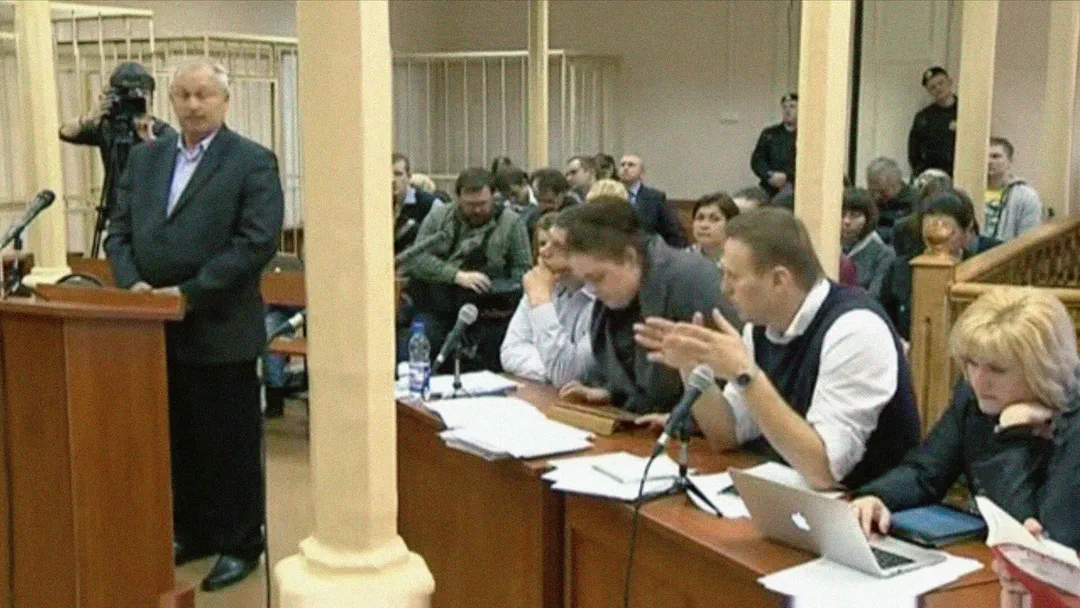
Court session.
In open court, the criminal case against Navalny is continuing to be heard.
Ofitserov.
The parties are present at the court session.
The witnesses were called.
Votchina, Postnov, Sukhikh, Shutova, Kuznetsov.
All have appeared except for one witness.
In the courtroom
there is already a witness present.
Please stand and introduce yourself to the court.
When were you born? ... born in 1973, city of Perm.
State your date and place of birth.
Zero eight zero four.
Ethnicity: Russian. Russian.
Russian citizenship.
Do you have a higher education?
Marital status? Your wife?
Where did you work, and in what position, before your conviction?
Where did you work, and in what position, before your conviction?
I worked as an adviser to the governor of Kirov Region.
Where are you officially registered?
I can't hear you. Registered where? In the city of Perm.
Chelovek avtorstvo 17 75.
You have been brought to court to be questioned as a witness in a criminal case.
I explain to you that, in accordance with Article 56
of the Criminal Procedure Code, you are required to tell the truth.
You have the right to refuse to testify against yourself, your spouse,
or other close relatives; if you agree to testify,
you are hereby warned
that your testimony may be used as evidence in the case,
including if you later refuse to confirm that testimony.
You also have the right to testify in your native language
or in a language you speak, and to use the services of an interpreter.
You have the right to file motions and complaints regarding actions, inaction,
and court decisions concerning your questioning, and to appear for questioning in the presence of a lawyer,
and, if necessary, to request protective measures
if you require them.
In addition,
if you do not have
objective grounds for refusing to testify, I explain to you that
you may incur criminal liability for refusing to testify
and for knowingly giving false testimony under Articles 307 and 308 of the Criminal Code
of the Russian Federation.
Do you understand your rights and responsibilities?
Yes, I understand.
Now you will sign the acknowledgment for the court.
But I would like to say right away that I am prepared to testify
in the presence of my lawyer, my attorney.
Are you requesting that a lawyer be present?
I request that a lawyer be present during the proceedings.
Who is your lawyer?
Viktorovich, or your defense counsel?
My spouse is Ekaterina Andreeva Bunina.
And how are we to call them?
In a year?
Ekaterina Andreeva.
I am also ready to provide whatever is necessary.
So what should be done here?
Entirely?
Minister?
Can we question the witness without his defense counsel?
We propose postponing the questioning of this witness,
questioning the witnesses who are currently present and who were announced by the court,
who were announced by the court, and taking steps
during the questioning of the witnesses to summon the witness's defense counsel.
Based on the information available to the court.
Then the issue can be decided.
The defense's position on this issue?
I believe that witness Osipov has the legal right
to testify in the presence of his defense counsel.
Therefore, we ask that it be postponed.
The reading of his written testimony and his questioning should be postponed until defense counsel appears.
And I support that and believe that
I have the right to testify in someone's presence.
The right to defense is a constitutional guarantee.
Therefore, the motion is entirely well-founded and should be granted.
The defense motion should be granted.
The court has granted
the witness's motion, and his questioning will be postponed.
Defense counsel is being called now.
A recess is declared.
Do you have your lawyer's phone numbers, or someone through whom they can be contacted?
We will call them.
If they can arrive during the day, then your questioning will take place today.
Your defense counsel are from Perm, and your spouse as well.
And the one from Perm? They will not be able to come today.
In any event, a recess is now being declared; there is an opportunity to dictate
a 10-minute recess.
Into the courtroom,
the witness is invited
Postnov or Panteleyev.
I can't hear very well.
Witness Panteleyev is invited in.
Read it out, read it out.
17. 213 216.
I was informed that they were seated.
Panteleyev did not appear today.
Let's move on to the next one.
But Postnov will.
There as well.
Hello.
Hello.
To the stand, please.
The stand
is on that side.
Introduce yourself.
Postnov, Alexander Alexandrovich.
When and where were you born?
December 5, 1957, in Gorky Region (the former name of Nizhny Novgorod Region).
What locality?
The settlement of Tisha, Gorky Region.
Ethnicity: Russian.
Russian citizenship.
Higher education.
Marital status: married.
Where do you work, and in what position?
I work as a director of...
Where are you officially registered? Where do you live?
Living in the city on Materinskaya or Solnechnaya?
House 11. I am registered there.
I am registered there.
You have been summoned to court to be questioned as a witness.
In accordance with Article 56 of the Criminal Procedure Code,
you are required to tell the truth.
I explain your rights: you have the right to refuse to testify
against yourself, your spouse, or other close relatives,
and if you agree to testify, you are warned
that your testimony may be used as evidence in the case,
including if you later retract this testimony.
You have the right to testify in your native language, or in a language
that you speak, and to use the services of an interpreter if necessary.
to file motions and complaints regarding the actions, inaction, and decisions of the court.
to appear for questioning with a lawyer if necessary.
to petition for security measures if required.
I also explain to you that, under Articles 307 and 308
of the Criminal Code,
criminal liability may arise for knowingly giving false testimony
and for refusing to testify if you have no objective grounds for refusing.
Do you understand? Please sign here.
Do you have
grounds to refuse to testify? No.
The prosecutor for the state then asked questions.
Officially. Alexandrovich, please explain,
are you acquainted with the defendants Ofitserov and Navalny?
I do not know them personally, only by hearsay.
Do you bear them any ill will?
Do you?
Please state your place of work
and the position you held in 2009.
Director of the Matyushinsky forestry branch.
So, the same position you hold now?
And who was the director, the general director of Kirovles, at that time?
Vyacheslav Nikolaevich?
Please explain what authority
your forestry enterprise had in the area of selling harvested timber products.
Specifically, I am asking whether it was entitled independently
to look for buyers, sell products on its own,
and set prices for the products.
Well, generally speaking, yes, yes.
I would independently conclude sales contracts,
and independently set prices at the prevailing level,
that existed at that time in our district.
And what was that based on?
Who granted those powers, and by what authority?
Well, as branches, we had powers of attorney
from the general director of the parent company.
How were the prices set
for the products?
Well, they were set more or less at market rates.
Again, I mean the rates that existed in our region at that time.
And how were they determined,
were they coordinated with anyone, or set independently?
That is, I would find out the prices for veneer logs and pulpwood,
find companies that accepted timber, and submit those prices
to the Kirovles management, and Kirovles would either approve them or not.
So the prices were set by agreement?
Yes, approval was usually given.
Why?
Please explain who, in 2009,
was the largest buyer
of the products sold by the forestry enterprise?
In 2009
I worked with a company called Alliance
there in Minsk (Belarus), and with individual entrepreneurs.
We did not really have any especially large buyers.
Are you familiar with the Vyatka Timber Company?
The timber company?
I am not familiar with the company itself.
But I had heard of it by hearsay.
What had you heard?
What can you tell us about that?
Well, I had heard that there was such an organization, a timber company.
And there was, as it were, a proposal from management
regarding the Vyatka Timber Company.
But the Matyushinsky forestry enterprise did not have its own rail spur. No,
I explained to Vyacheslav Nikolaevich Opalev that
hiring a crane
was no longer profitable.
It was more profitable to sell otherwise.
Vyacheslav Nikolaevich agreed with me at the time,
and therefore I did not work with them.
Were there, in connection
with the need to conclude a supply contract with the timber company,
any meetings held or directives issued?
In that connection, were any orders issued, and were you familiarized with them?
In particular, there was Order No. 76 of May 2009,
which prohibited forestry enterprises from selling products independently.
Well, I recall that there was such an order, one that prohibited it.
I will say again: I spoke with Vyacheslav Nikolaevich about this issue
and said that we did not have the necessary rail spur and loading facilities, so it was unprofitable for us.
So no obstacles were put in my way.
I was allowed to sell it independently.
I did not work with VLK.
So it was unprofitable because of transportation?
Not just because of transportation; to load it,
it was necessary to conclude a contract for use of a rail siding and crane services.
And crane services and railcars were very expensive, so it was not worthwhile.
Or did the supply contract not provide for that?
Did the contract with VLK provide for covering loading costs?
I did not see that contract, so I cannot say anything
about it.
We have no further questions for the witness.
I would like to.
May the defense ask questions?
Yes, please.
Please tell me, you told the prosecution that you had never seen me,
but have you ever spoken with me by telephone?
No. Has anyone among the staff,
perhaps from the governor's advisers' office, or anyone else, ever called you
claiming to be acting on my behalf or anything like that?
No, I had only seen you on television.
Nice to make your acquaintance in person.
And please tell me, am I correct in understanding
from your written testimony and from what you have just said,
that cooperation was unprofitable for you, and so you simply did not cooperate, correct?
And in
connection with your decision not to cooperate, did you receive
any threats from me, such as that if you did not cooperate,
you would be fired, your house would be burned down, or some other sanctions would follow? No.
And please tell me, did the fact that you refused
to cooperate with VLK seem to you like any kind of risk?
That is, did you take a risk
by refusing to cooperate with VLK, or did you simply decline?
No, not at all. I had no problem selling the timber.
Was it more profitable for you
to load it on site? There was no risk at all.
On the contrary, thank God I did not go through with it.
Why would I? It would only have meant red tape.
So that was the right decision?
As I understand it, this was just an ordinary episode of business activity?
A counterparty was proposed, you looked into it, said it was unprofitable for you, and refused,
and no one bothered you about it afterward.
There were no threats from me.
Any questions from the parties present?
Ofitserov, were there any threats or anything of that sort
from Ofitserov? No.
The defendant, Ofitserov.
A question, Alexander Alexandrovich,
I will ask you a somewhat similar question.
How often did various counterparties, different companies,
approach you asking to buy timber on various terms,
but did you?
If you saw that the terms were not of interest
to you, did you refuse?
No, no one approached me.
The forestry enterprise worked afterward.
I simply cooperated with the enterprises that we had
in the district.
I had worked with them for many, many, many years.
They were always the same ones, so no one else approached me.
I see.
So if they had approached you, you would have refused.
If it was unprofitable, of course.
Thank you.
Question.
No, I have a question.
Counsel for Mikhailov.
There is a question.
May I ask this question?
Alexander Alexandrovich, a question.
In 2009, do you remember, in the spring,
around February or March,
And the question is this.
Did local buyers increase or decrease the volume of sales
of purchases from you, rather?
No, the sales volume remained the same.
It was just that in 2009 there was such a price spike.
The prices, so to speak.
How much did they fall?
Quite significantly.
I think holding on just to preserve things,
was no longer profitable.
The lease was expensive,
and the organization was large.
All right, thank you.
Any questions from defense counsel Kobelev?
No questions.
I did not understand from your answer to the prosecutor's question whether there actually was a meeting
regarding the need to make deliveries to VLK.
And did you in fact see that order, or were you told that such an order existed?
About the prohibition
on sales, was that discussed?
I just cannot say exactly when, the date or the month.
A meeting was indeed held.
The directors were gathered and it was explained that VLK would need supplies
as a major consumer, so that we would not lose major
customers, we would need to accommodate them.
But it was, so to speak, a general meeting,
and all forestry enterprises were left to decide for themselves.
I, for example, decided in my own way that it was unprofitable for me,
and told the general director that it was unprofitable for me.
The general director agreed.
I said when.
Did you see an order prohibiting
the sale of products to anyone other than VLK?
I cannot say.
That is all I can say.
Thank you, I have no further questions either.
May we release the witness, sir?
No objections?
KOBELEV: No, no objections.
Thank you.
Thank you. Goodbye.
Goodbye.
Kuznetsov.
Please, Sergei
Kuznetsov.
Hello.
Please introduce yourself.
Alexander Pavlovich. When were you born?
On August 6, 1954.
Where were you born?
... by nationality, a citizen of Russia.
Your education?
Marital status.
Married, two children.
And also.
Where do you work and in what position
now?
Site manager at UK.
Company.
At what address are you registered?
Where do you live?
Settlement, Leninskaya Street, Embankment, 3.
Resided.
Central Russia.
Of which district,
district? Kirov Region?
You have been duly summoned to court for questioning as a witness.
I explain to you
that in accordance with Article 56 of the Criminal Procedure Code
you are obliged to tell the truth, and I explain to you your right
to refuse to testify against yourself, your spouse,
or other close relatives, should you agree to testify.
I explain to you that your
that your
testimony may be used as evidence in the case.
Even if you later refuse to confirm that testimony.
You also have the right to testify in your native language or in a language you speak,
and the right to testify in the presence of an interpreter.
You also have the right to file motions and complaints regarding actions, inaction, and decisions of the court,
to appear for questioning with a lawyer if necessary, and to request
the application of security measures if they are required.
In addition, I explain that in the event of an unjustified refusal to testify
or the giving of knowingly false testimony, criminal liability may arise
under Articles 308 and 307 of the Criminal Code of the Russian Federation.
Is the legal responsibility clear?
Please tell us.
Do you have any grounds for refusing to testify? No.
Answer the question,
Alexander Pavlovich.
Please explain whether you know the defendants Ofitserov and Navalny.
Are you acquainted with Ofitserov?
What kind of
relationship did you have with these people?
Do you have any feelings toward them?
No, none at all.
Please explain,
what position you held and where you worked in 2001?
I worked as the director of a forestry enterprise.
Who was your immediate
supervisor, through the general director?
It was Vyacheslav.
That gentleman himself.
Stalin Pavlovich.
In 2009, the forestry enterprise
was granted the right to independently search for counterparties
for the sale of its timber products,
determine its product range, and set prices for oil.
We did not have a commercial department on staff
the most important thing.
The first department.
They were looking more for sales channels, and of course we were looking too.
So you had that authority?
Well, we had the authority, but contracts were concluded.
How were
the selling prices for the products set?
Prices.
For us, probably the most
it was stopped fairly quickly.
As far as you remember.
Please explain.
What exactly are you asking about?
The actual procedure for setting these prices?
Were they approved or not?
Yes, they were based on that.
In what way? Well?
The contracts were concluded in Kirov.
As far as you remember.
Who were the largest buyers in 2009
of the timber products released by Smolensky Resource?
Of course, we shipped a lot of products, but
the larger ones...
I remember we shipped a lot of products to Krymskiye Zori, to Crimea.
We managed quite a lot.
I don't remember,
all right.
Are you familiar with the enterprises of the limited liability company
Vyatka Timber Company?
Well yes, some of the contracts were
with that company.
I mean, some of the contracts were with that company.
When did they find out?
We found out.
We were probably called to a meeting.
Where to?
To a meeting, to...
The administration, the administration? Yes,
then it was probably presented there.
And during what period?
Was it in spring or autumn?
It was probably in autumn.
In the autumn of that year.
It was very winter-like then.
I see.
What exactly was said at that meeting, and who was present?
The meeting was chaired by the general director.
The general director. Yes,
we probably had a bit of
a problem there.
A problem with the products.
And they turned to VLK,
and said there would be no problems.
Was a representative of VLK present at the meeting?
Probably, yes?
Well, probably.
Yes, he was there, he was there.
And who was there?
The director, Ofitserov, was there.
Had you known Ofitserov before that, before this meeting?
No, I had not.
OFITSEROV
Did he make visits as well, as far as you know,
to familiarize himself with the activities of your forestry enterprise?
I don't remember.
Now
please answer more clearly.
I didn't hear that, I don't remember
it was a long time ago.
Alexander Pavlovich, please explain.
So then.
Regarding the contractual relationship with the timber company,
how was it structured, and how did
the shipment of timber products take place, and at what prices?
Well,
there was a contract,
the administration
concluded the contract, and under the contract we shipped boards.
With whom was the contract concluded? With VLK.
By outgoing letter or not?
However it came through.
To you?
How was this information communicated?
That it was necessary to ship some products to VLK?
We were branches, after all; we reported to the general director.
I see. How exactly—did they call by phone, send it by mail?
By mail, through the administration.
You fulfilled the instructions—what was more common?
I did. I can't recall now.
Regarding the fulfilled obligations.
Please explain the procedure—how was the delivery of the products carried out?
Well, I don't remember now,
but some of it we hauled with our own transport.
We had a site there, near the boiler house
there. What site exactly?
Motor transport, road...
Road-related,
I can't say exactly right now.
It all had to be loaded somewhere, at least.
Transportation was arranged by the side of
the Vyatka Timber Company, the costs of transporting the timber.
No. The contract was up to the railcar.
Two years.
So the obligation for transportation and the costs up to the railcar were borne by you?
Yes. In your opinion,
did the enterprise incur any
additional expenses because of this?
It's hard to say now,
very hard.
At that time
sales were difficult too, and...
In some places the market was bigger, in others smaller.
It depended on who could find what.
Everyone has worked things out now,
and even now, in my work, it is very difficult to go direct.
I see.
Can you answer more specifically whether it incurred additional expenses?
At first, sort of,
as I recall, the prices were acceptable.
We did not feel that there were
any extra percentages there, so to speak.
I worked on it only a little; I stepped away from it.
I started working,
because
at first they settled accounts properly, and then the payments started coming in.
For some reason.
The payments stopped coming.
From whose side?
From Volok, I suppose.
I wouldn't have worked.
What was the reason the payments did not come through?
There was a delay there, apparently,
maybe the clients hadn't paid; I can't say.
know your address.
Approximately how much, what amount did
Belka owe your forestry enterprise for the goods delivered?
The amount was small there, probably 1,400.
How much did the forestry enterprise spend on delivery?
Without counting delivery of the goods to the railcar?
I can't calculate that right now.
So you don't remember exactly.
Either I don't remember, or I can't say right now; I won't lie.
As far as you
remember, as far as you know, was the delivered price
or the price of the goods including transportation to the railcar
lower or higher than the prices that had been set?
Well, somewhere around 10 to 15 percent.
10 to 15 percent what—higher or lower?
Well, roughly speaking, if you take the average district prices
and the prices were guided by those before.
More or less.
I see.
Do you think that because of this it was unprofitable
for your forestry branch to cooperate with
us? The district is remote
the center is far from us to begin with.
If everything had fully suited us,
I wouldn't have done that.
Were there, in general,
problems with selling the forestry enterprise's products during that period?
During that period, yes?
For some reason
the products sold poorly—what exactly do you mean?
In the fall we mostly
had industrial production, so to speak.
We sawed everything,
made boards,
kiln-dried everything,
that was our product.
There were problems with that.
But that involved different money.
In terms of value, after all. It usually...
Usually several hundred
were sold per year.
And what about the more expensive goods?
And did you supply products to VLK?
If memory serves, beams or...
Everything was cut to 100
we sawed it all, of course, all dark
blue-stained, not particularly high quality
but we sent it all out anyway.
Alexander Pavlovich, please explain whether you are familiar with the order
of Kirovles General Director Opalev, No. 76, dated May 19, nine...
of the year, which prohibited the forestry enterprises from selling their products independently,
and provided that the products were to be sold
only directly through the parent company, Kirovles.
The order may have existed, but
we did not, so to speak, fully
comply with it, did not comply with it.
For what reason?
Because delays then began
in returning the money,
and I stopped.
At that time the workforce was 140 people,
we had to pay wages,
so I stopped cooperating.
I see.
Was the General Director aware of this
of Kirovles?
Well, probably yes.
He was informed.
A small enterprise like ours, probably,
he would also know about.
Question: Did you coordinate this non-compliance?
Of this agreement with Sobolev?
Well,
we did, of course, ask him; we went to the director and asked
let's not keep working this way, we need the money.
What was it like? To put pressure on him?
Someone there—I don't know what the reaction was.
You also said there was pressure on him.
I think—though of course I don't remember clearly now—I think he
more or less agreed with me, with my argument.
If anything.
And what do you mean by the words 'pressure was put on him'?
That expression.
I don't know, because...
I don't know either. I was told that.
How else to understand it, I
can't explain.
All right, in your opinion, was the pressure coming from above, from the whole system?
I have also explained that he cannot explain it.
It was from above.
Perhaps the defense was admonished once already for similar questions.
Here the witness has answered three times.
Nevertheless, your questions were not withdrawn.
And you did not ask about that?
You were simply commenting while sitting at the table.
The court heard it; he did indeed say that pressure had been exerted.
Please explain.
We were doing our work.
And what was coming from above to us?
We don't know what was going on there.
I see, that is purely your
People, subordinates, yes?
So that is your assumption, is that correct?
That was the situation as it was.
We worked.
The honor of the state.
The prosecution has a motion.
A motion to read out
the testimony of witness Kuznetsov due to significant contradictions.
So he is mistaken.
In the chronology and sequence of events we have
no exact date given for when the meeting took place.
Also, regarding his acquaintance with Ofitserov
he cannot say whether the enterprise suffered losses.
Although all of this was indicated in the interrogation record from the session.
Case file pages 19 or 21 and 183, 181,
Volume 25.
I did not give any testimony.
In the officers' case.
You were not questioned.
During the investigation?
[He] asked to draw the attention
of those present in the courtroom to the fact that we are in a circus.
During the court hearing, courtroom procedure and silence must be observed.
Therefore, a warning should be issued
that they may be removed from the courtroom if this happens again.
The court agreed with the position of the prosecution.
I ask those present to remain silent.
If there are any reactions, please do not express them loudly or demonstratively.
It interferes with the proceedings.
If these requirements are violated,
those present may be removed from the courtroom.
The motion that has been filed, and the opinion
of defendant Ofitserov regarding the reading out of the witnesses' testimony, are before the court for decision.
Because of contradictions.
I object.
Your position.
I object on the same grounds that were stated yesterday.
We would like to ask witness Kuznetsov questions ourselves, and he,
it seems to me, is answering the prosecutor's questions quite clearly,
in detail, and there is no doubt that he remembers certain dates.
Counsel for the prosecution, I remind you that in your question
you did not ask for an exact date and were quite satisfied with the answer 'in the autumn.'
That is entirely normal, given that the witness is expressing doubt as to whether
he gave testimony at all.
We ask that our right to ask questions before the testimony is read out be respected.
Not as defense counsel.
We object to
the reading out of the testimony, on the same grounds as before.
Before the defense has questioned the witness, there can be no reading out of testimony whatsoever.
Your position, Your Honor.
I also object to the reading out of this witness's testimony.
I support the position set out by defendant Navalny.
I believe that the clarifications the prosecution is referring to
can be made during the witness's examination.
The prosecution is simply not putting its questions to the witness very well or very effectively,
and I believe the chronology can still be clarified.
Moreover, despite the court's view that there are gaps
in the current legislation regarding the procedure for reading out a witness's testimony
during trial proceedings, the defense nevertheless insists
that, in order to ensure the parties have equal opportunities,
the court should probably allow the defense to question the witness.
It is entirely possible that, in answering the defense's questions, the witness
will give a different chronology of events.
And unlike what he indicated to the prosecution,
the defense, among other things, must be allowed to hear his testimony.
It is necessary to hear the witness's testimony
as it is, not the version that the prosecution representatives
will now remind him of by reading out what the witness
may or may not have said during the preliminary investigation.
Moreover,
the witness explained that he had not been questioned during the investigation,
so that issue must also be resolved before discussing
whether his testimony should be read out or not.
There is simply a sense that it should not.
Subject to.
Granting the motion and.
The court grants the motion filed by the prosecution
to read out the witness's testimony due to contradictions.
Explaining its position: since the right to ask the first questions
belongs to the prosecution
and substantial contradictions were indeed revealed in the witness's testimony
substantial contradictions
with the testimony he gave during the preliminary investigation.
What is the record about, then?
The prosecution is entitled to the opportunity
to obtain answers to its questions, including by means of
reading out the testimony and then asking follow-up questions about the contradictions.
Therefore, the court granted the defense's motion.
In this connection, there is a motion to show the witness the record
so that he can, after all,
examine his signature.
Simply show it to the witness.
Volume 25 of the criminal case file
No. 17002811 minutes.
The investigation record is being read out.
Case file pages 19 to 21, for inspection.
Witness Kuznetsov is shown the record of his questioning dated July 8
2011, during which he was questioned by a senior investigator
of the interdistrict investigative department of the Investigative Committee of the Russian Federation
for Kirov Region, in criminal case No. 201
71360811.
The record is shown to the witness for inspection.
Please explain your words.
Giving testimony like that in a case takes a great deal of time.
But that is your signature there.
In addition, also for inspection,
the record of witness Kuznetsov's questioning is being provided.
In the same volume, on case file pages 180 and 181.
Questioning
Additional questioning of witness Kuznetsov dated April 6, 2012; he was also questioned
by a senior investigator of the Kotelnich district department
of the Investigative Committee of the Russian Federation for Kirov Region.
Olin, in criminal case No. 2017130811.
Witness, please explain: are those your signatures on the questioning record?
Yes. That's what they said then.
It seems so.
This record is being examined.
May I?
We object to the reading out of this record, because investigator
of Kotelnich
of the Investigative Committee's investigative directorate for Kirov Region
Olin was not included in the investigative team.
Accordingly, this questioning record is inadmissible evidence
in this criminal case and cannot be read out.
Your Honor, we object to the objection raised
by the defense,
because procedural matters, including the questioning of witnesses,
will be clarified during the examination of the written case materials.
The case materials contain an instruction from the investigator
of the Investigative Committee directorate for Kirov Region,
assigning the questioning of witness Kuznetsov specifically
to that investigator.
Therefore, all of this is subject to examination.
If such data or materials
are absent from the case file, then during closing arguments the defense
may directly raise the issue of this evidence being inadmissible.
The court granted the prosecution's motion to read out the testimony.
The issue of
declaring this questioning record inadmissible has not been raised.
If necessary, the court may examine the admissibility of this questioning.
At this point, it has not been found inadmissible.
The evidence—on what basis is the motion being granted?
Please,
let the questioning record be examined.
The interrogation was conducted on June 8, 2011, in the settlement of Leninskoye.
from 08:45 to 09:35 exactly.
Witness Kuznetsov was questioned in the criminal case, the number of which was announced
earlier by Senior Investigator Polin of the inter-district investigative department.
The witness was warned under Articles 307 and 308 of the Criminal Code.
The witness was cautioned. During this interrogation,
the witness stated the following. The interrogation record was read in the first person.
I have been working in this position since 2000.
The identifying section of the interrogation states that.
Director of the Shabalino forestry enterprise, a branch of Kirovles,
and in 2009 I was likewise working in that position.
My official duties included, and still include, overall management of
the Shabalino forestry enterprise as a structural subdivision of KOGUP Kirovles.
I reported, and still report, directly to the general director of KOGUP Kirovles.
In 2009, that was Vyacheslav Nikolayevich Opalev. In 2009,
the Shabalino forestry enterprise operated under a state contract it had won for forest management work
in non-leased forests in the territory of Severnoye
and Shabalino districts of Kirov Region.
The structure of the enterprise included the Leninsky workshop section in the territory of Shabalino District,
a workshop section; that is, the number of employees was about 140 people.
As director, I acted under a power of attorney from Kirovles, and therefore had
the right to independently conclude contracts for the sale and supply of timber products.
That is, all major contracts were concluded by KOGUP.
We concluded smaller contracts; all prices for our enterprise's products
were approved by the general director of KOGUP
Kirovles, who approved average market prices.
We were required to sell products at those prices.
These prices
applied to all our buyers; this applied throughout the entire period of work.
That is, for all of 2009, as well as at the present time, to list all
all sales and deliveries made by our enterprise in the fourth
quarter of 2008 and the first, second, and third quarters of 2009.
To specify all contracts with their details
I cannot, as that is a very large volume of information.
On average, there were about 100 to 150 deliveries per quarter.
The number of deliveries to various organizations in the second and third
quarters of 2009 did not decrease compared with previous periods.
I know nothing directly about the circumstances of the conclusion of the contract between KOGUP Kirovles
and the Vyatka Timber Company, No. 1/2009, dated 15
April 2009, nor about deliveries under the said contract.
For the Shabalino forestry enterprise, they were disadvantageous, since this
company frequently delayed payment for shipped products.
As of the time of this interrogation, about 500,000 rubles remained unpaid.
In fact, these deliveries brought no income to the Vyatka Timber Company,
as they transferred money to the account of KOGUP Kirovles.
As for the Shabalino forestry enterprise, my personal attitude toward cooperation with the Vyatka
Timber Company.
Initially it was positive, since it was assumed
that we ourselves would not have to look for buyers for the products,
and that the money would come in on time.
And subsequently,
when delays in transferring the money began, my attitude became negative.
When supplying sawn timber under the contract
with the timber company, all transportation costs were borne by our enterprise.
The sawn timber was shipped from the town of Kotelny, accordingly,
and the timber was delivered there by KamAZ truck.
In doing so, an average of 98 liters of diesel fuel were used
at a price of about 14.50 rubles per liter,
that is, approximately 1,421 rubles each time.
In total, we shipped 190 cubic meters of timber in seven trips.
The total cost of fuel and lubricants
for delivering the materials to the town of Kotelny amounted to approximately.
Only insofar as contradictions are concerned.
As far as I recall, and I believe this is confirmed by the record of the court
hearing, the prosecution did not even ask the witness
what quantity of fuel and lubricants, and at what price,
is spent on delivering timber products to one outlet or another.
If the prosecution moved solely to eliminate contradictions
in the part concerning the chronology of that ill-fated Order No. 76, then
please, let them eliminate contradictions in that part.
There is no need to read out the testimony in full.
Moreover, there is no need for that.
This testimony
on issues that the prosecution did not even bother to clarify.
Your Honor.
First,
we requested that all interrogation records be read out in full
in connection with the contradictions that had arisen.
No questions were asked about
reading out the interrogation only in the part concerning the contradictions that had arisen.
The court granted this motion.
Therefore, I believe the defense counsel's objection is unfounded.
The witness was asked questions about the expenses
incurred by the forestry enterprise in supplying timber products, including
fuel and lubricants as part of those expenses.
I understand, the court granted the motion in full.
Proceed with the material.
The total cost of fuel and lubricants
for delivering the sawn timber to the town amounted to approximately 9,947 rubles.
The loading of the sawn timber was carried out by a forestry enterprise, which billed us
150,626 rubles for loading operations.
The total transportation expenses amounted to 160,573 rubles,
which comes to 845 rubles per cubic meter of sawn timber.
In total, as I have already said, we sent to the Vyatka Timber Company
190 cubic meters of low-grade softwood sawn timber for a total amount of
662,262 rubles, VAT included,
which comes to 3,485.59 rubles per cubic meter, VAT included.
Taking transportation costs into account, the average sale price comes to 2,640 rubles.
The average list price during that period
was 4,307 rubles per cubic meter, VAT included.
The managers, including
Opalev, at all meetings and board sessions held with forestry enterprise directors,
said that it was necessary to carry out the sale
of all products only through the Vyatka Timber Company,
having concluded the corresponding contract with them.
The same was said by Ofitserov, who was constantly present at all the board sessions.
He sat on the presidium; all the meetings were held on KOGUP premises.
I myself was not present at all the meetings.
As for the meetings I attended, I cannot state what decision was adopted.
I cannot do so now.
I do not remember.
I know Pyotr Yuryevich Ofitserov only through work.
Ofitserov was introduced by Opalev when they came together to the settlement of
Shabalino District to familiarize themselves with the production operations.
This was around the end of February 2009.
Opalev introduced Ofitserov
and the military man who arrived with him as advisers to Governor Belykh.
That was the only personal meeting.
After that, I saw Ofitserov only at meetings.
I did not speak with him personally again,
and had no further contact. Employees of the
Vyatka Timber Company did not contact me directly regarding timber deliveries.
As far as I know, all issues were resolved through the sales department of KOGUP Kirovles.
And regarding the relations between Ofitserov and Opalev and other
Kirovles managers, I know nothing in detail.
I only know that because of non-payment for the products delivered
they often quarreled. I am not personally acquainted with Navalny.
I have never seen him even once.
He did not come to the settlement in Leninsky District.
And I know nothing about the relationship between Navalny, Opalev, and Ofitserov.
Before, during, or after the questioning of the witness and the persons taking part,
no statements or comments regarding the interview record were made.
Same volume, case file pages 180–181.
Record of the additional questioning of witnesses.
Kuznetsov was questioned in the settlement of Leninskaya on April 6, 2012.
From 13:15 to 13:30 by the senior investigator
of the inter-district investigative department of the Investigative Committee of the Russian Federation
for Kirov Region, warned under Articles 307 and 308 of the Criminal Code of the Russian Federation.
To the question, “Are you familiar with Opalev’s order?”
No. 76 of May 19, 2009, according to which contracts for the supply of products
were to be concluded not by the directors of the forestry enterprises, but by the management of KOGUP Kirovles,
he explained: “That order may have existed.
It is possible that it did, but I cannot say anything more specific about it.”
“Did you comply with that order?”
“I also cannot answer that question,
because, as I already said, I do not remember that order.”
During the questioning, the witness made no comments on the interview record
whatsoever.
Alexander Pavlovich, we have heard your testimony.
The one you gave during the investigation—now?
Do you confirm it
fully or partially?
The time has faded from memory as well.
Four years have passed since all this happened.
So when did you understand the circumstances better—now or
when you gave your testimony then, which is practically long ago by now?
It is clear regarding the amounts of the expenses that were announced.
Do you agree with the testimony that was read out?
Quite.
As chief accountant, that was my understanding.
As for acquaintance with Ofitserov,
according to the statement that he came to familiarize himself with things.
He did come, but not in the capacity of a director; he came as a private individual.
Meaning?
He did not come in the capacity of director? No.
There were six of us in total.
No questions about the timing,
about when the meetings were held, or about when Ofitserov arrived.
According to the testimony that was read out.
Does it follow from your testimony that the meeting took place in the spring?
I was not present at all the meetings.
I kind of
was definitely at one of them.
As for that meeting,
you do not agree that Ofitserov was present there?
In the spring?
In the summer.
I was there, probably in the summer.
First of all.
That is all, six questions.
For the defense.
You may ask questions.
Please.
Good afternoon.
I have a question.
And first, Krymskie Zori.
Did you send a truck to Krymskie Zori,
or railcars?
And what kind of lumber was it, do you remember?
Squared timber?
So it was several starting grades.
And did you fulfill all the orders for Krymskie Zori?
Well, that is not the problem.
It is just that
I cannot say right now. I...
But the money did seem to be coming in.
But four railcars were shipped.
So the timber was shipped to that address.
It looks attractive.
There is no advertising,
several hundred tons.
Ordinary stuff, probably—not the fastest-moving.
So what?
All right.
To court, peacefully.
One hundred percent.
You confirmed that you said it was shipped to Krymsky.
That was the order; that was what was supposed to be there.
I would not say it was complete junk, but of course it was shipped with difficulty.
All right. Thank you.
Alexander Pavlovich, a question.
You said that in the spring of 2009
in winter and spring, you had problems with sales?
Well, people started buying less.
Yes? Usually, usually
somewhere around February or March.
No, everything is completely stalled now.
All right.
And another question.
About loading into a railcar.
So if I understand correctly, this is...
I was not involved in the loading.
Well, the purchase of goods by the railcar.
So for that, you needed to accumulate stock.
Is that right or not?
Well then, sell the New Year stock?
Well, before that, it seems
I was told that transport would be separate,
then, then apparently we had to build up the volume ourselves.
Then you wrote that the railcar had to be handled by yourselves. That is all.
When they started a little
to sort that out, apparently the amount there
was acceptable.
Alexander Pavlovich, a question—only in...
In all your practice,
was it only Volga that bought by the railcar?
And no other companies either?
A lot was stolen.
Is that normal practice?
Well, then they threatened the sick man.
Well, the management bought it.
A dead-end siding was assigned for three districts.
All right.
Everything worked out.
Thank you.
Alexander Pavlovich, a question.
Did you in any way monitor the receipt of money into the account, as the central one?
How could I monitor that?
In your testimony, the prosecution stated
that the money was transferred directly into your account.
And what about KOGUP?
Well, the money was coming in, the funds were coming through.
And can you know for certain that the delays were not on Volga’s side,
but due to the account?
That is what we were told there,
they called us, of course—we were basically living off that money.
people, wages were paid, purchases were made there
and so on.
LIGHT They said that.
We are checking.
The money has come in.
How are we supposed to give you this money?
We could not verify this, and neither could you.
And how can I believe that? All right, thank you.
A question.
Do you believe that these figures, which the prosecution read out,
about the cost per cubic meter, came from the accounting department?
Yes, yes.
Yes, yes.
With this
sheet.
The figure of 841 per cubic meter was mentioned there.
My question is this: how would you comment on the
fact
that, for example, when the company shipped to its counterparties from Kirov to Moscow,
while VLK's costs were 740 rubles per cubic meter?
And for you, it was nothing—there the distance came to 840 mil
cubic meters.
I simply can't answer that.
We would need to look into it.
And how many kilometers? 100.
So
that is, for 108,145 rubles, it comes to 700, 800, 740 rubles.
Well, that's clear. The accounting issue is a separate matter.
Maybe the contract was structured that way; I can't say right now.
But there was no transport contract.
That was not money for that.
That was probably under the supply appendices, probably like that.
Well yes, you paid money for the route
to some other outside organization
and there was a separate invoice just for delivery.
Then what were we supposed to pay for transport with?
Well then, who paid 800 rubles per cubic meter?
No one paid—paid.
So there are organizations that transport goods free of charge.
They transported it with their own vehicles, of course.
So it turns out the accountant calculated that with your own transport
it was 845 rubles per 100 kilometers.
Well, the overhead costs are included there too.
Everything is probably fine.
We need to sort this out.
But all the overheads are included there, all of it falls on...
A question.
Did you personally ever see the appendices for VLK yourself?
I did not see them either.
Do you see such a specification?
Yes. We were sent a specification and told that we were to work under it.
There was an order, and we carried it out.
That's all, thank you.
May I, then.
Please, Alexander Pavlovich.
Please tell us.
Did you, any, did you...
You have already told the prosecution
that you did not see any instructions, perhaps from me, from my subordinates
or from people referring to me—did you ever receive any directions or orders?
And since I...
I am asking just in case there was some other such situation.
Perhaps they were given to our management there.
Do you have any information about that?
As for me personally. Honestly, please.
You said that all issues were handled through the sales department.
And just now you said that the specifications were forwarded to you from Kirovles.
Do I understand correctly that the arrangement worked as follows:
VLK bought products from central Kirovles,
and then central Kirovles decided who would ship them?
And that was a decision made by Opalev and the commercial department as to what would be supplied from where.
And if it had been shipped from some nearer forestry enterprise,
the transport costs would have been different there, correct?
So in fact, for you to ship to the address of
VLK, that was what Opalev told you.
A contract had been concluded.
And it was binding on all directors.
It had been concluded.
But for example, we just had
the previous witness, the head of one of the enterprises.
He said that we supplied nothing,
and accordingly, apparently no deliveries were demanded from him either.
So was it simply a request from the central Kirovles office to ship?
Or was it your own decision?
Maybe there was nothing to ship?
That is.
who made the decision about that.
In some way, after all, it was central Kirovles that handled supply,
the one based here in Kirov,
this dispatch office that decided who shipped where.
Is that correct? Of course, now.
So the Kirov management decided who shipped where.
Well then, accordingly, all these expenses arising
from transport deliveries were in fact regulated from Kirov, correct?
Because they were the ones deciding.
No, they did not decide everything.
And what did they not decide?
Some of it we handled ourselves.
Meaning
that if you send everything to one place, you may never see the money.
We used different places.
That is not what you are being asked about, is it?
Ask a specific
question, because I do not understand. Perhaps, Alexander Pavlovich, the question should be put this way
differently.
As for the fact that boards were shipped to the address of
VLK, was it I who determined that your forestry enterprise and ours should ship them
or was it your management at central Kirovles?
So you did not receive those instructions from me.
Not from you personally, no.
Thank you.
One more question I wanted to ask.
Besides VLK, did you have other clients
that year?
Well, we had...
There is witness testimony saying there were 100 to 150 deliveries.
A great many deliveries, a great many deliveries.
And what is the question?
Thank you.
After that I focused on VLK, because there was a delay with the money,
I moved quickly.
Alexander Pavlovich, and
as for sales to VLK
in the overall sales volume of your forestry enterprise,
in your opinion, did they account for a large share or a small one?
No. A large share.
We are a large enterprise, with very high output.
We have drying facilities.
We're listening.
As I understand it, you only had one drying kiln. Yes,
I remember.
Then I have this question.
PAVLOVICH: If some order
was unprofitable for you to fulfill, what did you
do?
I went to management and said that
it was not profitable to work that way.
Did you come to some kind of arrangement?
VLK: The same thing became unprofitable for me.
I stopped shipping. At first it was profitable.
At first, more or less.
All right. So I suppose it was acceptable.
Let me clarify the last question.
You said that at first the price
was acceptable to you, then it became unprofitable, and you ended the relationship, correct?
That is how it was.
Then,
well, there was a slight
difference of four.
Please tell me, did you ever receive requests, instructions,
or directions to ship goods free of charge?
Meaning that you understood
that you would ship something and receive no money for it at all?
We shipped everything first, and then the money came later,
there was no prepayment.
So there was nothing without payment.
Was that payment
treated as a debt?
There was no prepayment.
Meaning, you shipped first, and then payment came afterward.
Usually, usually, we don't just give goods away for free—
stores pay, money is paid.
So you didn't give anything away to anyone for free?
No, we... There was an agreement, wasn't there, Alexander Pavlovich?
I'm asking whether there was ever a situation
in which you shipped products
knowing that no payment would be made for them?
Never? No.
Someone might ask that.
It was said at the meeting; everyone was present.
Basically, 'Don't worry, the money will come right away.'
At first we were worried; maybe someone said
that Alexander Pavlovich came over and said, 'Go ahead and ship it, Alexander Pavlovich,'
'so many cubic meters of timber free of charge, just let it go.'
'It needs to be done that way. We won't get any money for it.'
Well, something like that would have had to happen
—but it didn't.
And was there ever a situation where, Alexander Pavlovich, you were told to ship
at a price three times lower than the market price, so there would be very little money?
Like, 'This is what needs to be done.'
At the meeting, they mentioned 10% there.
It seemed
there wouldn't be that, that's what they said.
But you said that at first the prices suited you.
Well yes, what we were shipping was, more or less, acceptable to us.
Please, here is Order No. 76.
Returning to Order No. 76,
did I understand correctly from what you said
that it was apparently issued, but in practice
those who wanted to complied with it, and those who didn't want to, didn't?
Well, what do you mean, 'those who wanted to'?
You were the one asking
whether it was complied with. Was your case an exception or not?
All of our witnesses who have been questioned so far explained
that the order existed, but no one complied with it, and there were no sanctions for that.
That was the situation.
The question is withdrawn for now. We
have not questioned all the witnesses yet, so let's not substitute conclusions.
Again, foundation first, then questions.
Excellent.
Later.
And Alexander Pavlovich,
please tell us: yesterday the witness Zmeyev
explained that the company's accounts receivable
amounted to 130 to 150 million rubles.
So there were a great many debtors.
Did anyone owe money specifically to your forestry enterprise?
Were there clients who had outstanding debts?
Yes, of course.
How many, I can't say right now.
But approximately how much?
Roughly?
I can't say right now.
Are we talking on the order of 1 million rubles, 10 million?
I can't say.
A lot of time has passed since then.
Indeed, the court is not withdrawing the question.
If you can answer,
what was the approximate amount of debt owed by other counterparties?
It was probably about 1 million.
There, sort of,
some paid and some did not,
including VLK as well.
That is my next question.
Is it correct that, roughly speaking, as far as you remember,
the total debt was 2 or 3 million, and of that, you said 400,000 rubles was theirs?
That's right, 400—just over 400.
So the rough ratio was 3 million, of which a little over 400 belonged to VLK.
And you knew that there was a debt on VLK's part?
From Kirovles management, because VLK paid money into their account.
Correctly
understood.
About the fact
that there was a debt on VLK's part—you learned that from representatives
of Kirovles, since VLK transferred money to their account.
Correct?
You yourself did not actually see whether they paid or did not pay, did you?
The products were loaded somehow, and they said the goods had to be shipped.
The money was expected to come in.
You know,
we went to the commercial arbitration court.
Who owed money?
We have
won many cases.
That was me.
That is absolutely wonderful.
Let me just clarify once again: regarding the debt on VLK's part,
you learned about it from Kirovles's head office—you simply asked them
whether money had been transferred to the settlement account or not?
So they were the ones informing you about that, correct?
Yes, all of that was
tracked by the accounting department.
So we knew who owed what.
Let me still try to get to the point of the question.
How did you know that?
Was that information given to you by Kirovles, or did you have other sources?
It was treated as our goods, our product.
To us, these...
The money was not credited to the account.
How so?
Who informed you of this, after all—KOGUP Kirovles?
Or did you have your own accounting department?
Who reported to you that the money had not come in?
GUP Kirovles?
So the information came from there.
The money there was still in a general account.
Management said there was no money,
no funds.
Please continue.
Attorney Davydov, a question from Attorney Mikhailov.
No questions. And you,
may we release the witness?
Yes, we do not object.
Execution.
No. Any objections?
Thank you.
On Saturday.
The next one
will be with...
City.
The 13th, exactly.
Meaning?
The main thing is not to lose it.
The order.
Please identify yourself, Russian...
When were you born and where
were you born?
January 11, 1961.
The village of Shutki, in what was then the Tatar ASSR (Tatar Autonomous Soviet Socialist Republic).
Ethnically Tatar, fluent in Russian.
Interpreter? No.
Do you have a higher education?
Marital status: married.
Where do you currently work, and in what position?
Section manager at the Leskhoz management company.
Where do you live, and where are you registered?
Urban-type settlement, Kirov Region, 9 Misharina Street.
Registered there, living there.
Russian citizenship? Yes.
You have been called for questioning as a witness.
I will explain to you that, in accordance
with Article 56 of the Criminal Procedure Code, you are obliged to tell the truth.
At the same time, I explain to you that you have the right to refuse to testify against yourself,
yourself, your spouse, and other close relatives,
if you choose to testify.
You are warned
that your testimony may be used as evidence in the case,
including if you later retract that testimony.
You also have the right to testify in your native language or another language you speak,
and to use the assistance of an interpreter.
To file motions, to lodge complaints about actions, inaction, or court decisions,
to appear for questioning with a lawyer, if one is
needed, and to request protective measures if necessary.
In addition, I explain the liability: under Articles 307 and 308
of the Russian Federation, criminal liability may arise
for refusing to testify and for knowingly giving false testimony.
Is that clear to you?
Please sign the acknowledgment.
Do you have any grounds for refusing to testify?
No. No.
Then please answer the prosecutor's question.
Please explain.
Let me remind you: the defendants are Navalny and Ofitserov.
I only saw
Mr. Navalny once, at a meeting
at the Government House; the second time I am seeing him is today.
As for defendant Ofitserov,
I know him.
At that time, when I was the director of the leskhoz (state forestry enterprise),
he was the director of a timber company.
Thank you.
What kind of relationship do you maintain now?
Any relationship at all? No,
because there is no relationship.
At that time, the relationship was only
strictly business.
Do you bear any ill will?
No, I do not.
Please explain where and in what position
you worked in 2009.
In 2009, I held the position of director
of a leskhoz branch of KOGUP Kirovles.
Who was your immediate superior, the general director?
Vyacheslav Nikolaevich Opalev.
Please explain what authority was vested in
the management of your leskhoz regarding
the sale of timber products.
Was it entitled to independently seek buyers, determine the assortment,
sell the products, and set prices for them?
Of course; at that time, that was provided for.
Yes, 2009 was like that.
It was a very bad year in terms of product sales.
And there was no strict regulation here regarding the shipment of timber products.
For example, I did not feel any pressure from the leskhoz administration.
Understood.
Were you issued any powers of attorney or other documents granting you the right
to independently search for buyers of timber products
and sell timber products on the authority of the general director?
Powers of attorney were issued there every year.
What did they cover?
I do not remember the powers of attorney in detail now.
They covered the entire activity of the leskhoz, since I was its manager,
including commercial sales activity.
Hiring, dismissals, everything there,
everything that falls within the duties.
Please explain.
In 2009, which enterprises were
the largest buyers of the timber products you sold?
In 2009.
If I try to remember.
There was an enterprise, well,
it was a private company, I think.
We shipped to...
the Vyatka Timber Company.
To private entrepreneurs as well.
And regarding the contractual relationship
with the timber company, when did it arise?
The first railcar
we shipped, I believe, in May.
Yes, from May through August
2009.
Before 2009.
Please explain,
how you learned of the company's existence in the first place.
How? How did he find out? He told us that such an organization existed,
and that it was possible to sell products through it.
A contract arrived,
signed by
Vyatka Timber Company and KOGUP Kirovles,
and it set out the assortment for shipment.
I remember that even the first railcar was shipped—round timber, for house-building, as I recall.
I see. Were the price and transportation terms specified in the contract
or were they set out in separate agreements or appendices
of that kind?
The price—in the letters,
I saw the prices for the sawn timber we shipped, for example.
Trusovo station and the right
bank—somewhere around 4,400 was the price there,
but I don't remember exactly.
Then, as far as you can now recall, during the period from
May to August 2009, when shipments were made to VLK, did the price for timber products change
or was it fixed?
I can't say that for certain,
but, as I recall, it was specified in the letters for each shipment,
because those letters
listed the assortment, what exactly
was supposed to be in the railcar, the details, and the procedure
for submitting documents after shipment.
That much I do remember.
How was the timber delivered
and how was it dispatched to VLK's recipients?
The shipping station was designated as Kotelnich,
and it was shipped from there.
From the city district.
How was it transported?
How? It was hauled by truck to the loading site.
The transport was our own.
Why, the enterprise's own vehicles,
the forestry unit's, the branch's,
that is,
the amount spent on transportation
to Kotelnich—those expenses were included there.
And the price there was already indicated per railcar—the price of the sawn timber.
So, per railcar? Yes.
Could the enterprise have sold at more favorable prices?
For the products in that period of time?
Hardly in 2009, because
from the beginning of the year everything had been cut off, as if with a knife.
There was nothing anywhere.
That January was completely dead.
I don't think those were such huge prices.
That was when all export relations came to an end as well.
How do you assess, as the head of the forestry unit,
your cooperation with the Vyatka company?
Why did the deliveries stop,
why did they stop?
Because they stopped paying.
About 400,000 rubles remained unpaid, as I recall.
Owed by Vyatka Timber Company for the products that had been shipped.
That's all.
After all, nobody gives things away for nothing.
It's not like in a store where things are just handed out for free—nobody gives anyone anything for nothing.
Did you look into what this issue was connected with?
Or what the delay in payment was related to?
Our job was to ship it, and we shipped it.
And later, when all this was explained to the general director—that
no one is going to work for free,
sooner or later someone will be held accountable for it.
Are you aware of Order No. 76
issued by Kirovles General Director Opalev, which prohibited independently
selling forestry-unit products and provided that the products
had to be sold directly through the parent enterprise,
through KOGUP, directly.
I can't say exactly what the order number was,
but the shipments were formalized by order,
for example, for Kotelnich, which railcars were supposed to be there.
That was formalized by order.
But how can I say what number it was?
It wasn't just the loading method that was determined there.
It listed everyone involved in shipping,
set out the objectives, and then they came.
And probably my last question will be this:
Can you clarify, if you remember at this point or not?
What total volume of timber products was supplied to VLK?
I can only
say that, approximately, we shipped one railcar—
that was that many cubic meters.
Maybe, well, on average 63 to 65 cubic meters, no more.
That was round timber.
And sawn timber.
Three railcars and one truckload were shipped.
How much does a truck carry on average?
Thirty to thirty-two cubic meters with a trailer, roughly.
And the railcars, probably about 75 cubic meters on average.
I'm only giving you an approximate figure.
I'm not asking for an exact number.
Do you remember?
Please tell us, we have answered my colleague's question.
As for 70—
do you remember Order No. 76?
Well, in general, such an order was indeed communicated,
because you were required to ship timber products
under a centralized contract.
I will say
this: I regarded it that way, because that's how discipline works.
After all, we were branches.
In that connection, a question.
Was it fully or partially?
Were there discussions with Lev about your refusing to partially carry out
those same prior instructions?
That did happen to us, for example.
Did he demand that you ship what you were able to?
We said that, for example, we would not be able to ship a railcar with that assortment.
We could.
That very railcar,
he included it in the Kotelnich order, and we sawed it and shipped it.
In that
manner it was formalized in the orders.
I see.
Besides shipments to VLK,
did you work with anyone else during that period?
Products were supplied.
As I said.
There was not much else there.
That same
private entrepreneur Bakaev,
Alexei.
As for VLK, I really don't remember anything else, to be honest.
No, no.
Defense, please. May I proceed?
Please tell me, I am looking at your written testimony.
The investigator asks you a question
any orders or instructions, including oral ones.
And did the director of Kirovles State Unitary Enterprise
Opalev give you any instructions regarding cooperation with the Vyatka Timber Company?
And you answer:
No orders or instructions were received.
I made deliveries on the basis of the contract and its appendix.
Do you confirm this testimony?
There is a contract
and an appendix to the contract.
I already said that they were formalized by shipping letters, for example,
the Trusovo station was indicated, along with the list of timber products,
details, and price.
That is, everything was done under the contract.
So there were no additional instructions, as you say here?
Of course not. What instructions could there be?
No questions.
Thank you.
Questions for him, Ofitserov.
Over the course of the year, VLK's share
was it small or large?
Just
the proportion.
Much more significant in terms of the overall balance.
They loaded as much as they could.
Those would be documents; we'd have to think it all through again.
All right, thank you.
For Mikhailov? No.
You may go.
We do not object.
Although the defense
objects to this?
No. Thank you.
Goodbye. Goodbye.
Goodbye.
Next, Sukhikh, Sukhikh.
1004043.
What was that again?
140. 143, 22.
Bring him in.
Hello.
State your name.
When and where were you born?
June 10, 1957
in Kirov Region, in a rural district.
Nationality: Russian.
Yes, Russian, a citizen of Russia.
Higher education, specialized secondary education.
Marital status: married.
Where do you work now, and in what capacity?
As an individual entrepreneur.
Where are you registered?
Where do you live? City of Rzhev, 11 Lesnaya Street,
in Kirov Region.
Understood.
You have been summoned to court for questioning as a witness. I
inform you that you are obliged to tell the truth.
I also explain that you have the right not to testify against yourself,
yourself, your spouse,
or other close relatives, though if you choose to testify,
you are warned that your testimony may be used as
evidence, even if you later retract it.
In addition, I explain that you
have the right to testify in your native language or another language you speak,
to use the assistance of an interpreter if necessary, to file motions,
or complaints regarding actions, inaction, or decisions of the court,
and to appear for questioning with a lawyer
and request security measures if necessary.
You are also warned of your liability,
which may arise for refusing to testify under Article 308 of the Criminal Code of the Russian Federation,
and for knowingly giving false testimony
under Article 307 of the Criminal Code of the Russian Federation.
Do you understand your rights and your liability?
Understood. Please proceed.
Tell me, do you have any grounds
to refuse to testify? No.
Answer the question.
Prosecutor Viktor Mikhailovich, please explain whether you know
the defendants Navalny and Ofitserov?
Navalny?
I do not know Ofitserov; I may have seen Navalny once.
How do you know Navalny? I don't.
Ofitserov, yes.
When at the administration, when the directors were gathered?
No. Answer clearly.
Do you currently maintain any kind of relationship with them
at present?
With Navalny and Ofitserov?
I have no relations with either of them.
Please explain.
In 2009, where did you work and what position did you hold?
I worked as the director of the forestry enterprise.
Who was your immediate supervisor?
What authority did you have?
What powers did the forestry enterprise you headed possess?
Regarding the sale of harvested timber products.
That is, were you able to independently search for counterparties,
set prices, and determine the range of products sold?
There was independence itself,
you could say, one hundred percent, except
for the sale price.
That was coordinated with the administration.
So there was some specific threshold?
Yes, there were average prices for
sales in the region.
Well, and in each area—say, north and south—they were slightly different.
They differed.
And, so to speak, each local cluster had its own prices.
Those prices were adhered to.
Everything is clear.
Please explain whether you were familiar with the company Vyatka Timber Company.
Well, familiar in the sense that with it
we worked during that period
for the sale of timber.
Let's go into more detail.
When did you learn about this company
and where?
Well, right now I can't even say exactly
the date when it was.
Learned about it.
When all the directors were gathered at the administration.
When was that, what year?
Two thousand nine.
What time of year?
Again, autumn.
Do you allow for the possibility that it was spring?
What? Do you allow that it could have been in the spring?
They very much...
All right.
Let me put the question differently: shipments to VLK.
During what period were the contractual relations in place?
It was already sometime from spring onward.
When was the meeting?
It was around then, in the spring.
Please explain what was said at that meeting.
They gathered us and explained,
that, for example, there was
a company.
How did it happen?
That everything depended on pricing, prices, prices,
that the prices it offered were, so to speak, acceptable to us, that was the arrangement,
and through them would go
the processing of sales documents
in this situation.
You explained that at this meeting
Ofitserov was present, and that was basically the first and last time you saw him.
Aside from him, who else was present besides the directors of the forestry enterprises?
That was everyone.
There was no one else.
The forestry enterprise directors, Ofitserov, and that was all.
The administrative office.
Who was there?
What was your attitude toward the need to do this through Europe?
Well, how should I put it?
There was no great need
for that on our part, because
for us, to the railway
it was 200 kilometers (about 124 miles) in either direction.
Well, the thing there was that
we had that lower-grade material going out,
aspen was being sent to a match factory, so we
shifted over and, so to speak, agreed to work with them partially.
That is why.
It suited us only because of the transport distance involved.
But we did not handle the transport ourselves; the management took that on.
The trucks came.
They were terrible.
Please, very much so.
Please repeat the last question.
In Russian?
Yes, yes.
And as for what was shipped
by railcars, it had to be taken to the railway.
Even timber had to go by road.
For us, the distance was 200 kilometers (about 124 miles) in either direction.
Transport costs were
higher
than the cost itself, so the price per cubic meter was acceptable.
But overall, transport costs affected the management side.
The total expenses affected the cost price.
Viktor Mikhailovich, please explain: with whom were these matters discussed
when setting these timber product release terms?
The prices were agreed with the management,
and the management, apparently, coordinated them with the timber company,
because we only issued the accompanying documents
for direct transportation.
Do I have any documents on VLK? No.
Are you familiar
with Order No. 76,
which was issued by Opalev, the director of Kirovles?
About the ban on independently selling the forestry enterprises' products and the requirement
to conduct all product sales through the parent enterprise
and through Kirovles?
Well, such an order did exist.
But it was not that absolutely everything fell under it.
It specifically stated
by specification what was needed,
what the assignments were, and what could actually be shipped.
Because we did not have processing; we only shipped raw timber.
There was no processing.
This order was issued only for that particular enterprise.
Why, in general?
The entire management directive concerned all forestry enterprises.
Viktor Mikhailovich, as of now,
can you say exactly?
For the period from spring to autumn 2009, the dates of product shipments.
Specifically, what was shipped by you to VLK?
Value, volumes?
Well, I cannot say exactly.
What exactly did we ship?
It was assorted timber of various types.
And we also sawed blanks,
as they came.
I do not remember whether we made poles.
Right now, I think they were 9.7 there,
that sort of assortment, because that was the kind of timber we had, for example,
And where the terms suited us better, more went there.
But the total volume was small.
We sent a couple of truckloads, KamAZ trucks.
And where exactly they went, even now I cannot say for sure.
Whether it went through VLK, or whether it was simply managed and sent here to Kirov, I cannot say.
Then they processed it further there.
Probably not the last question.
Viktor Mikhailovich, please explain,
whether you considered cooperation with
the company beneficial?
Why did the contractual relationship with it end?
Well, on our side, the volumes
were simply not there, and we could not
provide any meaningful volume for that company.
So that it would make sense there.
Perhaps we did build up some sales volume,
and we worked with them only briefly, probably
for about a month and a half in total.
That is, our situation was such
that we did not have enough material,
and there was no real demand for it.
Well, you see, from the other forestry enterprise directors,
people still spoke with him, and he became known through his work.
Whether it was profitable or not to work with him.
But mainly the northern districts
mostly said that they were able to ship on their own.
They had their own advantages, outside warehouses, and established supply arrangements.
Apparently, they already had contracts as well.
But here,
it was already centralized in some way.
So your volume was smaller than in the northern districts?
Estimated
because of that overall? That's all.
We have no further questions.
No questions.
Question.
Good afternoon.
A question: you mentioned aspen.
And is aspen classified as commercial timber, or...
How is it classified, roughly speaking?
Yes, yes, we shipped it that way.
for thinning.
SUKHOY: So then, is the timber from this considered valuable commercial wood or not?
Why is that?
Well, there are tolerances there, so naturally a buyer can be found,
it’s not firewood
that is. Already,
yes. And there, of course.
As you can see, it was classified as balance timber,
and here.
We had this kind of thinning cut.
For us specifically, it was kind of only a small
profit; more of it was going out.
Where it was cheaper
right away nine and more, so
part.
That’s Mikhailovich.
If I put it this way, shipments to VLK were going out,
let’s say, not several hundred cubic meters of commercial timber,
but non-commercial wood, pulpwood, and matchwood.
I’d be glad to.
Yes, thank you.
One more question for you.
What share of your timber was aspen?
Those are accounting figures.
I can’t say exactly right now. Well,
the percentage was...
More than 50 percent.
Well, it depended on the age.
So basically that was all you had to trade in?
Well, yes. Because although not much of it was taken, it still sold
all right.
And you stopped shipping to VLK because
why, by the way?
There simply were no longer any
orders for it anymore, apparently,
at that time.
And by then the relationship had already changed,
the traders, so to speak, everything
all right.
Thank you very much.
May I?
Viktor Mikhailovich, please clarify.
In your written testimony, and just now as well, you stated
and essentially confirmed that you performed the contract according to the shipping instructions
that came down from Kirovles,
and that it included not only the Vyatka Timber Company but other buyers as well.
Am I right in understanding that you were simply sent an attachment
saying ship this much to one party, that much to another, and you carried out that attachment?
That’s correct.
Contracts were concluded not only with that company.
Well, for example, we would ship
we had no other type of supply arrangement than through our own enterprise.
So, in other words, there was nothing unique about it.
It was a standard arrangement: a shipping order,
listing different companies and how much to ship to each, and you carried it out, correct?
Excellent. All right. And one more question.
You explained to the investigator that
the circumstances of how the contract was concluded were unknown to you,
and that no additional instructions
from management were given to you regarding supplies to VLK?
Correct? Yes, that’s all, the defense has no further questions.
If I may, one question.
Please tell us, did anyone from the management
of Kirovles, from Kirovles’s commercial department, ever give instructions
to ship timber knowingly without payment being expected,
that is, to ship timber materials to Kazan and warn in advance
that payment for them would never be received at all?
No, of course not, nothing like that happened. We processed the shipments.
At the boiler house
the forestry documents would remain, for lot 11,
and then at the station they would complete the remaining paperwork.
And did the money come in afterward or not?
Mikhail doesn’t have them.
It’s impossible to say for sure.
Because.
Thank you.
You’re welcome.
A recess is declared. Ten minutes.
After that, of course.
Please come into the courtroom.
Shutov was seated.
Shevchuk.
Hello.
Please introduce yourself. Vera Alexeyevna.
When were you born? November 6, nineteen...
1958, in the village of Klyuchi, Orlovsky District, Kirov Region.
Ethnically Russian.
Russian citizen.
Higher education, marital status
widowed.
Where do you work now, and in what position?
At the moment, I’m not working anywhere.
Where are you officially registered, and where do you live?
City?
ORLOV: I’m in a different city now.
Orlov, 36 Baumana Street; I was registered at the state farm.
You are currently residing and registered there, therefore
you have been summoned to court for questioning as a witness.
I explain to you that, in accordance
with Article 56 of the Criminal Code, you are obliged to tell the truth.
I also explain that you have the right to refuse to testify
against yourself, your spouse, or other close relatives
if you choose to testify.
I warn you that your testimony may be used
as evidence, even if you later retract it.
You also have the right to testify in your native language,
or in a language you know, to use an interpreter free of charge, and to file
motions and complaints regarding the actions, inaction, and decisions of the court.
You may appear for questioning with a lawyer if necessary and submit motions.
You may also request security measures.
If necessary as well.
And I explain to you the liability that may arise for refusing
to testify or for knowingly giving false testimony.
In such circumstances, you may be held
criminally liable under Articles 307 and 308 of the Criminal Code of the Russian Federation.
Do you understand this liability?
Yes, I understand. Please sign here.
Do you have any grounds to refuse to testify?
No. Questions from Prosecutor Yuri Alexeyevich.
Please explain whether you know the defendants Ofitserov and Navalny.
I do not know Navalny.
Ofitserov...
I saw Ofitserov when he was introduced to us at a general meeting,
he was introduced to us at a general meeting of managers.
Do you currently maintain any kind of relationship with him?
Business or personal?
None.
Do you bear any ill will toward Navalny?
And to Pyotr?
Please clarify: in 2009,
what position did you hold, and where did you work?
In 2009, I worked as director of the Orlov forestry enterprise, a branch of KOGUP Kirovles.
Who was your immediate supervisor?
Our immediate supervisor?
Vyacheslav Nikolaevich.
Please explain.
In 2009, could the forestry enterprise you headed independently carry out
the search for counterparties?
When selling harvested timber products, could the forestry enterprises set their own prices
for the products?
Well, we worked under Kirovles contracts.
They were concluded directly by the management.
Who was the main buyer of the timber harvested in 2009?
I can't say now.
I don't remember.
How was the price determined
for the timber products released?
The cost of the timber was taken into account,
as well as all expenses.
Please explain.
Are you familiar with a company called Vyatka Timber Company?
Yes, I am.
When did you first
learn about it? At a meeting of managers.
When Ofitserov
was being introduced, that was when I learned about Vyatka Timber Company and Ofitserov.
He was invited, as I understand it, as its director.
Director of VLK.
That meeting—when did it take place?
It was—I don't know.
I can't say now exactly when it was.
It was a long time ago, in 2009.
Is it possible that it was in the spring of that year?
It could have been. I suppose so.
Please explain what exactly was discussed at that meeting,
what events?
That's a very difficult question, because...
So much time has passed that I can't answer it.
What role was VLK supposed to play in the operations of KOGUP Kirovles?
I can't answer that question.
Was it one of Kirovles's counterparties?
Yes, but at that time, when we were just being introduced to him,
they were planning to draw up contracts. I see.
Did your forestry enterprise have any contractual relations with Kirovles?
Did it supply them with any
information or anything else? Not much, but we did supply them.
How did all of that take place?
Please.
That is, who sent the orders?
There was a contract?
Under that contract,
a contract had been concluded.
Under that contract, since we were subordinate to KOGUP,
we shipped timber under it.
We received the order...
what kind of sawn timber needed to be cut.
We cut it and shipped it.
I see. Did they pick it up directly from Orlov, or was it delivered somewhere else?
Some of it we transported to the boiler house.
At Zheleznodorozhny station.
The chemical wood products were delivered by our own means.
By our own resources, by the forestry enterprise.
Or we hired someone.
Those transportation costs for delivery had not yet been paid.
By VLK, or was the transportation carried out at the forestry enterprises' own expense?
I can't answer that question,
I don't remember, I simply don't remember.
Its payment obligations
for the delivered products—did VLK fulfill them?
Very slowly, and not completely.
I don't remember how much remained owed, but VLK still had a debt
to us, to the forestry enterprise.
Some amount remained outstanding.
Maybe later that was paid too.
But I'm saying that at some point there was a dispute, and we wrote to them,
saying that they owed us, as we wrote.
As far as you can recall now,
was the price for products supplied to VLK and the price for products
supplied to other counterparties at the same time
by the forestry enterprise the same
or did it differ?
If at that price
it was released from the site
for example, from us in Orlov, then it might have been acceptable,
if you do not take into account that we also incurred hauling costs.
So transportation costs were in fact incurred at that point?
At that time?
Yes, but I just don't remember whether they later paid us or not.
A follow-up question.
Was it profitable?
In that way, compared with your other
counterparties, to transport it?
To be honest, it was not profitable for us.
But as a rule, how was
transportation of products handled with other counterparties?
Didn't they pick it up directly from the site?
We are located in such a place
that is inconvenient; we have no rail station, only road transport.
So it was more convenient for us if they picked it up
on site.
Can you now say exactly
how much was shipped to VLK consignees in 2009?
I can't say how much product.
I was questioned once before, and documents were shown then.
It's probably in the documents, isn't it?
In part
Your Honor, the prosecution
has a motion in connection with contradictions in
the witness's testimony, since during the investigation she spoke specifically,
stating the quantity of sawn timber, the price, and the assortment.
At present, she is unable to state this.
This is on pages 23-26 of the case file
of volume 25, only in the part concerning the shipped timber products under the agreement.
The motion is to present the testimony given during the preliminary investigation.
I support it specifically with respect to those contradictions.
The defense's position on the motion?
Mr. Ofitserov's position?
Yes. I object.
And defendant Novak?
I object until the witness has been examined by the defense.
Defense counsel's position?
Counsel.
As usual, they object
and do not agree that there are grounds to allow
the reading out of the witness's prior testimony.
Given earlier.
At the preliminary investigation stage, during questioning, since, nevertheless,
less.
Still, the requirements of the law are the same for everyone.
And I would like to remind you that two completely different articles of the Criminal Procedure Code
govern the procedure for questioning a witness and the procedure for reading out testimony.
Moreover, again according to the Criminal Procedure Code,
the chapter that defines the course of the trial,
the questioning of a witness and the reading out of witness testimony previously given by that witness
are two different stages of the trial.
Therefore, in my view, it is entirely impermissible from a procedural standpoint
to read out a witness's testimony before the completion of that witness's examination,
and it is also impermissible from the standpoint of
the legal requirement to provide the parties with equal opportunities
to read out a witness's previously given testimony so that
the witness can refresh their recollection of their testimony.
And that is before the defense has even begun questioning the witness.
I still ask that everything I am saying be taken into account,
Your Honor, and that you somehow reconsider your ruling.
As for attorney Mikhail's opinion.
Yes, I fully support it.
No, to delay.
The court granted the motion of the state prosecution.
There are indeed contradictions.
At present, the witness cannot answer.
The questions.
Concerning
the number of deliveries and their amounts,
and with regard to the contradictions, the court will permit
the testimony to be read out.
Proceed.
Record of the questioning of witness Vera Alexeevna Shutova
on case file pages 23
to 28 of volume 25, deliveries were made
of timber products to the consignee.
The questioning was conducted on December 2, 2011
by investigator Kotelnicheskaya and
reduced to the other side of the office room.
Where [illegible] 26.
So, on the 15th
of April 2009, KOGUP Kirovles and the director of the LLC entered into contract number zero
one 209 with the Vyatka Timber Company for the supply of sawn timber.
Under this contract, products from Orlov were released in July and August
of 2008 and 2009 in the form of sawn timber,
edged boards.
And so on.
By the forces of the Orlov forestry enterprise, sawn timber from the town of Orlov
was sent to Kotelnich-2 railway station,
where it was placed in storage, after which the Kotelnich forestry enterprise
loaded the timber material for the buyer LLC into railway cars
in accordance with the appendix to contract no. 01-209/2009.
Loading into railcars for the buyer took place on June 20, 2009.
Sawn timber. Total volume 50.91 cubic meters.
Cubic meters in the amount of 207,967.35 rubles.
On June 21, 2009, sawn timber with a total volume of
10.27 cubic meters of coniferous species in the amount of
41,952.95 rubles.
On August 6, 2009, sawn timber of coniferous species, total volume
30.2 cubic meters in the amount of 111,760 rubles.
All issues
of pricing and the quantity and assortment of products are determined by the management of
Kirovles.
The Orlov unit only carried out the terms of the concluded contract.
As for the delivery dates,
I can explain that the terms of the contract were fulfilled depending on carrier availability.
I cannot state the amount of expenses for delivering the products to the shipping point
because I do not remember. If necessary, I can уточнить later.
On average, the cost of delivery to the point of departure is
from 30 to 50 rubles per cubic meter of sawn timber.
Alexeeva, do you confirm your testimony?
I confirm it fully; I have simply forgotten.
Today, only time has passed.
When I was questioned, I remembered better.
Well, at least there were documents there.
Understood. Thank you.
In total
no questions.
For the defense. Ask your question.
Because.
Good afternoon, good afternoon.
I have the following question. AV21009G.
Do you remember what year that was?
And tell me, what happened
with product sales during the period
from winter to summer?
What could have happened there?
If sales were poor, then it just sits there and is not sold.
When the product sits there, with timber products it happens.
It deteriorates.
It deteriorates.
Accordingly, to sell it, to sell it.
What I want to say is that we did not release old products to VLK,
you asked.
I am answering your question.
Accordingly, when the product is delayed.
And what happens to the price?
Do they rise or fall?
It falls, of course it falls.
All right.
A question:
who made the decision to ship specifically from your forestry enterprise?
The instruction came from Kirovles, not from me.
With you?
I had no contact whatsoever.
No authority to manage. And who did you work with there?
With the commercial
department? With the commercial department.
It was headed there by [inaudible] Valeryevna.
That is who we worked with.
Not with her personally, but with her subordinates.
Now working there is
right. Sasha, what period are we talking about?
That? I do not remember.
All right.
So, you received instructions from them
to prepare shipment of some volume? Yes.
And one more question.
Apart from VLK, were there other cargo recipients
before?
I cannot say how many, but there were.
And around that time, more rather than fewer.
It is just that the periods
I may not remember who it was during that period.
It is very difficult to remember.
2009 was a long time ago.
But there were other buyers.
Were you sawing specifically for them during that period?
Not in that period, but others were operating as well.
It was not just one buyer.
Of course, there was more than one.
And naturally, there were no more.
No large ones.
We didn't have large volumes, so there weren't very many buyers.
We didn't have very large volumes; we were only just starting to saw timber, so to speak.
The sawmills had only just been launched, and we didn't have very large volumes.
Did you restore the old site?
Yes, we restored the old sawmill that came into our possession.
All right. One question.
Please clarify,
how shipments to the Russian Foreign Ministry arose?
We shipped lumber to Kotelniki.
What kind?
For example, how did they load it into railcars there?
I can't say. Well, and you shipped it out.
By truck?
No, not 10 cubic meters.
We send a full truckload.
For example, how much is written in our documents?
We send a truckload; as for how it was shipped onward?
I can't answer that question because I don't know exactly what of what.
Lumber—I misspoke—what exactly, how much lumber,
was put into which railcar, we can only see that from
your documents.
They said there were 10 there.
I asked.
Is that what's in the documents?
We ship a full truckload.
And what was then sent in the railcar, we can only see from the documents sent
for the railcar. All right, then another question.
You said that he stopped paying.
And you?
He wasn't working directly with you?
Through whom were you working?
After all, money started coming to us from somewhere.
So you definitely can't say whether money started coming in or not?
I can't say. Thank you. Right.
Well, that's basically all,
please,
have I ever approached you with such requests?
I don't know you.
I'm telling you right away that I don't know you; I'm seeing you
here in person for the first time.
I'm also very pleased to meet you.
But perhaps someone spoke on my behalf,
Vera Alexeevna, Navalny said that loading it that way was cheaper.
No, more expensive; not free.
Please tell us: in your written testimony, you stated the following.
Opalev introduced Ofitserov and said—quoting him directly:
Let's try working with him.
And you received no other oral or written instructions?
Correct?
I personally did not.
All right.
Please tell us: you write here that the instructions, and indeed that
everything you mentioned, you received from the commercial
department, whose employees controlled the entire shipment of products?
There were orders there saying
that we worked under those orders, under certain contracts.
Is this the standard arrangement for all forestry enterprises, when the commercial department sends you instructions
on what to ship to whom?
And am I right in understanding
that the commercial department sent you the instructions?
Who gets what,
and then the representatives of the commercial department themselves
would inform you whether payment had been made for that timber or not?
It came through accounting.
All payments went through there.
One more question, please.
You indicated here that there was a rule under which the forestry enterprise had no right
to enter into an independent contract for more than 1,000,000 rubles.
Yes, there was such an order.
There was an order.
You mean that was Order No. 76. Excellent.
Some other one. An order—I don't remember the number.
So, in principle, there was some rule
under which the forestry enterprise could not enter into a contract exceeding 1,000,000 rubles.
And this order,
which the prosecution referred to, saying that you were prohibited
from working directly at all—through Skype—those are two different orders, right?
We would coordinate it.
That order came up during the witness questioning.
All right, then I want to clarify, in principle,
if some client came to a forestry enterprise—any one, for example yours—and said, 'I want to buy from you'
products worth 1,100,000 rubles, were you required to send him to the head office?
We coordinated all those matters and submitted a written request.
If it was signed off and approval was given, then we proceeded.
That kind of approval was required in any case. Thank you.
No further questions.
No, Mikhail, there is no such lawyer.
We may proceed.
No longer.
Thank you.
Goodbye.
Goodbye. Bye.
No other witnesses are present in the courthouse.
A witness was summoned, but did not appear for the court hearing.
However, the court has received documents stating that
Arzamas is on an international wanted list.
The prosecution had promised to ensure the witnesses' appearance.
Were any measures taken?
In that regard.
We can only also provide the order declaring him
wanted internationally.
In addition, at present there is being carried out, but,
unfortunately, the instruction to verify his place of residence has been carried out,
that is, verification of his permanent residence registration in the city of Krasnoyarsk.
If the documents are submitted a little later,
then the issue will be raised for determination
of examining the records of his interrogation given during the preliminary investigation.
For 2:00 today
witnesses Baldin and Grebneva were summoned.
Until then
we have no one, so a recess is declared.
May I address two technical matters?
Yes. Your Honor, if I may,
I would like to make a motion, since
what has now been imposed on me?
A preventive measure has been imposed on me, excuse me,
defense counsel Kobelev's handwriting is difficult to read, sorry,
namely, a written undertaking not to leave and to maintain proper conduct,
and given that the next hearing after this one will be
on May 15,
and the court was notified on May 6 of a hearing at the Moscow City Court.
I would ask to be allowed to go on vacation and leave my permanent
place of residence from May 7 through May 14 in order to vacation with my family.
I inform the court that in two other criminal cases as well
I am under similar travel restrictions.
But if the court makes a decision on this,
then I will also apply to those investigators with a similar request.
Regarding
seven passengers into the water on May 7–8.
Attorney Davydova promised to provide
written certificates.
And when will you stop.
I can send it to the court by fax.
As soon as she arrives in Moscow, on the very first day.
This motion needs to be decided now.
And since you have not yet submitted any documents justifying
that you are unable to appear, I cannot decide this motion at present
at this time.
It will be considered a little later.
And if the court hearing indeed cannot take place
on the 8th, then the court will grant your motion.
And will make a decision.
Two more points. Yes.
A motion from the defendant Ofitserov
in his interests, since with respect to
Pyotr Yuryevich, on August 6, 2012,
a travel restriction was imposed as a preventive measure.
Under this preventive measure, he is prohibited from leaving
his permanent place of residence in Moscow without the court's permission
in the city of Moscow, and there is no criminal case against Ofitserov.
No other
preventive measure, apart from the one already imposed on Ofitserov, has been selected,
since Pyotr Yuryevich Ofitserov's parents live in Kaluga Region.
Baryatinsky District,
the village of
Mila Techa.
And accordingly.
Since August 6, 2012, he has not seen them
because he has had no opportunity to visit them.
We ask the court to allow Pyotr Yuryevich Ofitserov
to travel outside the city of Moscow during the period from May 1 to May 5, 2013.
Those are public holidays/weekend days.
Accordingly, no court hearings for those weekend
days can be scheduled.
The written motion
is requested to be added to the case file.
The views of the other parties
regarding the defense motion on behalf of Ofitserov.
No, there are no objections.
We object, because
it concerns a serious crime.
Secondly, no supporting documents have been provided showing that it is precisely
this particular locality, this particular region
that is involved.
Therefore, we cannot verify the validity of changing
the preventive measure in this case.
In our view, it is therefore not entirely advisable.
However, to prove that, we
are not asking for that; we are asking the court to proceed accordingly.
As I understand it, there is no request to change the preventive measure or cancel it.
The only issue is permission to travel, please.
I support my colleague.
Everyone considers it
possible to grant the request and allow defendant Ofitserov to travel
from May 1 to May 5 to the village in
Baryatinsky District, Kaluga Region.
Thank you very much,
Yulia! With a recess for.
We will continue calling witnesses.
Baldin.
Please come in, witness Baldin.
Good afternoon.
Please introduce yourself.
Introduce yourself.
Sergei Nikolayevich, when were you born?
03.12.
1960. Where were you born? In a village in Kirovsky District.
Kirov Region.
Ethnicity: Russian. Citizenship: Russian Federation.
Higher education.
Marital status: married.
Where do you work, and in what position?
Currently unemployed.
What is your registered address, and where do you actually live?
Officially registered in Kirov
Region, Iransky District, the village of Pugalki, 21 Zelenaya Street.
I live in the town of Iran.
Lane, apartment 1.
I explain to you that you have been summoned to court to be questioned as a witness.
And I explain that, in accordance with Article 56 of the Criminal Code
you are obliged to tell the truth.
At the same time, I warn you that you have the right to refuse to testify
against yourself, your spouse, or other close relatives,
and if you agree to testify, your testimony may be used
as evidence in the case,
including if you later refuse to confirm that testimony.
You also have the right to testify in your native language
or in a language you speak, and to use the services of an interpreter,
to file motions, and to complain about the actions, inaction, or decisions
of the court, and to appear for questioning with a lawyer if
you need one, and to request protective measures if necessary.
I also explain that, under Articles 307 and 308 of the Russian Criminal Code,
criminal liability may arise
for refusing to testify and for knowingly giving false testimony.
Do you understand your rights and responsibilities?
Understood. Please sign with the court secretary.
Do you have any grounds for refusing to testify? No.
Please answer the question.
Sergei Nikolayevich.
Please explain whether you know the defendants Ofitserov and Navalny.
Ofitserov?
I met him once.
At a meeting.
I do not know Navalny.
Do you currently maintain any relationship with Ofitserov? No.
Do you bear any hostility toward the defendants?
No.
Please explain.
What position did you hold in 2009, and where?
In 2009, I held the position of
director of the Iransky forestry unit, a branch of KOGUP Kirovles.
Who was your immediate supervisor?
Vyacheslav Nikolayevich Opalev.
Please explain what powers the forestry unit you headed
had in the area of timber sales.
It could independently conclude contracts
with the consent of the parent enterprise, and contracts concluded
by the parent enterprise
for the sale of products had to be fulfilled.
Was the forestry unit entitled to set prices independently
for products in coordination with the parent enterprise?
How was that coordination carried out?
Guilt in
the prevailing market prices in the district?
Were the prices communicated?
The proposed prices for the sale of the parent company's products.
If the manager signed at these
prices, then the products were sold.
Please clarify whether you are familiar with the enterprise of the limited liability company
Vyatka Timber Company LLC?
Yes. When and where did you first
hear about it—at a meeting in the administration?
When did the meeting take place?
In 2009, sometime during the year.
Unfortunately, I don't remember. The season was
either spring or summer.
At that time, the director of the Vyatka
Timber Company.
As I recall, Oficerov was introduced
at that meeting.
Yes. Did he express any, let's say, wishes
regarding cooperation with Kirovles at that meeting?
I don't recall anything being said about working
specifically with
Vyatka Timber Company.
Please clarify regarding the contractual relationship.
Did they exist between your enterprise and the Vyatka Timber Company?
Not directly, no.
As far as I know, a contract was concluded
between the parent enterprise and the Vyatka Timber Company.
And then, under the
allocation order, so to
speak, from the parent enterprise,
products were supplied to VLK.
How were the products delivered?
It was collected from the Iransk area or taken to some other point,
and delivered to another district.
Match-grade aspen, in the amount of two truckloads,
we sent to the Kotelniki station,
to the railway station?
Yes, somewhere there,
it was shipped.
Well, they handled the acceptance there,
so to speak.
And birch pulpwood
we sent to the Vyatka Timber Company
for the Mari Pulp and Paper Mill.
This was done using
our own transport, not hired vehicles.
Whose—
at whose expense and by whose means was it delivered,
exactly?
I think we used a truck from our own motor pool.
Who covered those transportation costs?
Ours did.
The price for the
products—who set it?
The parent enterprise, Kirovles? Yes.
Your contractual relations—
how were the funds handled, to which account were they transferred?
Or was there a cash form of settlement between you?
There was no cash settlement; payments were made by bank transfer to the current account.
of the forestry enterprise.
Were the settlements made on time between you?
I don't remember right now.
But as for debts owed by VLK to
the Iransk forestry enterprise, there were none.
So, as far as I remember,
large volumes of products were supplied.
Well, this is probably the last question.
Sergey Nikolaevich, please clarify: are you aware of the order by Kirovles's general director
Opalev prohibiting the independent sale of products
and requiring products to be sold directly
through the parent enterprise?
Such an order did exist.
Was it communicated to you that it was necessary to coordinate
all timber product contracts directly with the parent enterprise?
All contracts
went through the parent enterprise and were coordinated anyway.
So the enterprise did not trade independently?
That's right.
The products were still reviewed
by the parent enterprise.
Sergey Nikolaevich, please clarify.
Can you now recall at what price, in what assortment,
and in what volume timber products were supplied to VLK?
Unfortunately, I don't remember the price.
As for the volume,
as I said, about two truckloads were shipped to Kotelniki.
That was no more than 5,000 cubic meters.
And birch pulpwood to the pulp and paper mill
in a volume of probably more than 300 cubic meters.
Unfortunately, I can't recall the price at all right now.
Please tell us, were these contractual relations
for supplying timber products to VLK beneficial
for the forestry enterprise or not?
Not entirely beneficial.
The price was a little lower than the
market price in the district.
This was not sold in our district
aspen material at a different price.
As for birch pulpwood,
it was not so much that it was profitable, but that it could lose its commercial quality if not sold.
During that period, in spring and early summer,
the birch material, the product, would deteriorate badly in quality.
Please clarify: before the contract
with VLK, were there any supplies
from your forestry enterprise to the Mari Pulp and Paper Mill?
Was there
such a practice? What was it based on?
Was there some kind of contract or what?
As of today, I don't remember
whether there was a direct contract with the pulp and paper mill,
most likely it was through an intermediary.
In general.
That's all, we have no further questions.
The defense, you could say.
Good afternoon.
My first question is:
Please tell me, what is the difference between the grades?
I'm not very familiar with it.
But essentially, for now, there is no difference.
Essentially, no. That's my answer, yes.
You said that in your district they were practically not sold.
Because we do not have match production.
Even this aspen
was cut into boards and sold
as sawn timber, but not here.
And who processes this product?
And you did not process it?
No, we had no production facilities.
for wood processing.
We worked only through another party.
So, can it be said that, essentially, this was an outlet for your products?
Was it aspen to begin with?
No, no. All right.
A question,
how would you,
aspen pulpwood and birch pulpwood
is that difficult timber to handle, or not really?
Pulpwood?
No, well, yes, all right.
When we were supplying the Mari Pulp and Paper Mill,
through Volkov, Volkov picked it up with his own transport.
His own, or by transport
Volkov's transport.
And all the transport costs were paid by Volkov?
Yes. Another question.
And the instruction to have timber supplied from the Iransk forestry enterprise
to Kotelniki?
Did you receive that from VLK?
Or from the central office? Right, from the office.
A question.
How many kilometers is it from the Iransk logging site to Akademika?
160 kilometers. 160.
In your opinion, was it generally practical
to make such hauls for inexpensive raw material
Aspen?
Was that expensive raw material?
Yes, pulpwood of that kind, so to speak, under that management.
Well, as of today, market price for commercial-grade aspen here is up to 1,200 rubles.
Ah, all right.
Right. Another question.
Did you have any contact with VLK in any way?
No. There was only a representative who brought the waybills.
I no longer remember who came, but they brought the waybills,
so that, using those waybills, for example, we could deliver
birch pulpwood to the pulp and paper mill.
That is.
As a question.
And why did you stop supplying the pulp and paper mill?
It had run out.
If there was only a little, yes.
We had to.
No further questions.
Sergey Nikolaevich, please tell us, in your written testimony
you stated, and have now confirmed, that there were no special instructions, uh, no instructions.
I withdraw this question; it concerns the witness's written testimony.
I apologize, I withdraw the question and will rephrase it.
You have just stated
that you did not receive any special instructions from Opalev
or anyone else regarding cooperation with VLK.
Do I understand correctly?
So the arrangement was as you said: an assignment would come in, and under that assignment,
you carried it out. Were there any special additional instructions about that?
No, there were not.
Were there any instructions to sell it for free, or rather,
to load the products free of charge? No.
Or to load the products at half the market price?
Well, as for the price,
there were no discussions, because yes, the price had already been set.
So Kirovles itself set the prices for the commercial product.
I don't know, whether they set them themselves or by agreement; most likely the contract
specified the price.
Did I understand correctly from your words that there was no debt
owed by VLK to the Iransk forestry enterprise?
Yes. As of today, no,
as far as I remember.
You said
that supplying this pulpwood, namely birch pulpwood,
was beneficial, and otherwise it would simply have gone to waste.
Do I understand correctly that if VLK had not bought
the birch pulpwood, there effectively would have been no market for it?
None at all.
It would have had to go as firewood, just firewood.
Which is much below market value.
The price is lower.
Which is cheaper to sell, pulpwood or firewood?
As of today, the price of firewood in the Iransky District is 700 rubles per cubic meter.
The price of birch pulpwood today is 930 rubles.
So, in other words, is it more profitable to sell it as pulpwood?
As of today, it is more profitable to sell it as firewood.
And Iransk birch pulpwood still has to be hauled 200 kilometers
to the pulp and paper mill, with transport costs.
But if you sold it locally.
So it is more profitable for you to sell it locally?
And the fact that you sold it elsewhere, that was in accordance with the order
that came from head office.
Thank you very much.
Just
please tell us,
what was the level
of petroleum product prices in 2009?
What do you mean by level?
Compared with 2008?
Compared with 2013, or what?
Were timber product prices in 2009 lower than, for example, in 2008?
Yes, of course they were lower, because there was an economic crisis,
the price was several times lower than in 2008.
That is all on this question.
Mikhailov, please.
No, we have no questions.
The defense has no questions.
May the witness be excused?
We do not object.
Defense?
Likewise.
Thank you.
The court now calls into the courtroom
witness Grebneva.
Investigators.
Please step up to the stand.
Hello, please introduce yourself.
Grebneva Ivanovna.
When were you born?
July 2, 1955.
Where were you born? Thank you.
In Verkhotursky District, Sverdlovsk Region.
Ethnicity: Russian. Citizen of Russia.
Higher education.
Marital status.
Same place.
Where do you work, and in what position?
At the moment, I am not working anywhere.
I am retired.
Where do you live?
The city of Slobodskoy, Lesoparkovaya Zone, apartment 85. Yes.
Are you registered there? Yes.
You have been summoned for questioning as a witness.
That you are obliged to tell the truth.
And I explain that, in accordance with Article 56
of the Criminal Procedure Code of the Russian Federation,
you have the right to refuse to testify against yourself,
your spouse, and other close relatives; if you agree to testify.
We warn you
that your testimony may be used
as evidence in the case, including
if you later refuse to confirm that testimony.
You also have the right to testify in your native language
or in a language you speak, and to have the assistance of an interpreter during the proceedings,
You also have the right, if necessary, to file motions and to lodge complaints about actions or inaction
and court decisions, and to be questioned in the presence of your defense counsel,
and to request protective measures if necessary.
In addition, I explain to you that, under Articles 307 and 308
of the Criminal Code of the Russian Federation, criminal liability may arise
for knowingly giving false testimony and for refusing to testify.
Do you understand your rights? The responsibility? Is that clear?
Understood. Please sign here.
Do you have any grounds for refusing to testify?
No, no, I have answered the question.
Prosecutor
explained. Please clarify: are you acquainted
with the defendants, Ofitserov and Navalny?
Well, I had never seen Navalny,
except on television.
As for Ofitserov, I do not know which one.
Because they introduced him to us when there was a meeting, or at least that is how it was presented to us.
There was something like that.
Are they known to you?
Probably not, because they said there were apparently two Ofitserovs.
I honestly did not even remember exactly how he introduced himself.
All right.
Please explain.
Olga Ivanovna, please state your place of work and position in 2009.
In 2009, I worked as a branch director.
Who was your immediate supervisor?
The head.
...Nikolaevich.
Please explain whether the forestry enterprise you headed had the right independently
to sell the timber products it harvested.
Well, we coordinated that
with the head of our department.
Those were the obligations associated with it.
It was understood that I
was mainly selling large volumes.
Did you set the assortment and prices yourselves, or...
Our prices were also approved in Kirov.
And how exactly?
We were given minimum prices.
What prices?
When, during what period—at the beginning, in the middle, or at the end?
Of the year—I do not remember right now.
They gave them to us at some point then, but usually always at the beginning
of the year.
The minimum price.
Yes, we were not allowed to sell below the minimum prices.
We could sell...
that is, we could sell a great deal.
As far as you now remember, in 2009
who were some of the major buyers of timber products from the forestry enterprise?
Oh, I cannot say right now, because there were very many of them.
Our main buyer was the mill
on the coast.
And the full name was the Plywood Mill.
A closed joint-stock company—I cannot even recall now,
the exact name when I...
because it was called something a bit different there.
Are you familiar with the limited liability company
Forest Company?
There was. How so?
They introduced them to us in 2009
as someone we would be working with, heaven knows.
Who introduced them, and where?
At a meeting—there was a meeting convened, and they were introduced to us there.
A representative came; they said, they said what his name was.
I wrote down what his name was. And...
let us go into more detail.
Where did the meeting take place?
It took place at the department office.
Our... transport...
Meeting.
When did this take place?
Well, I do not remember now.
In 2009.
Probably.
Approximately what time period?
I do not remember that either.
Was it in the spring of that year, 2009?
I just...
Let us not dwell on that.
Can you clarify who was present at that meeting?
Well, I remember there was also... there was
someone—they said there were two of them there, a father and son, as it was put,
and someone else was sitting there too.
I do not even know.
Besides you, were there other directors there?
All the directors were there; I mean those who were present from above.
In what capacity was Ofitserov introduced?
Well, how?
As a representative.
As a representative, as the person in charge,
through whom we would be working.
That is,
they said that we would work through this company,
because they might
arrange some additional contracts and improve where the products could be sold.
They would provide new buyers.
Yes, yes, yes.
Because there was timber for which there was no market,
such as firewood and other materials.
We had pulpwood, pulpwood as well; we started working, but only to a limited extent.
Well, what was the end result?
It was not only that
we understood that he had taken over the plywood mill,
the enterprise we had already been working with for a long time.
And then we began
to have weak sales at reduced prices.
For me, that was—I considered it...
because we were in such a situation that we did not have much money.
Well, how did that manifest itself? In underpriced sales?
Please explain in more detail.
I do not remember now how large the difference was.
But I wrote a letter; I tried to find it just now and could not find it on my computer.
Maybe—anything is possible—I may simply have thrown it away.
And...
there was a big difference there.
I would say it was a very big difference.
There wasn't such a big difference, but there was a difference.
I'm saying that we counted every kopeck.
And so we worked.
And with Solikamsk, there was also a contract, so to speak, that went there.
And with the other contracts, we, we had no time.
That is.
Did I understand you correctly that before concluding the contract with the Vyatka
Timber Company, you were making shipments, as collateral of a sort, to Solikamsk?
Yes. Then what was the need to sell the products through VLC?
So we realized that something was wrong here, and we started objecting.
And at one meeting, Vyacheslav Nikolaevich was just addressing that point.
NIKOLAEVICH.
We said that we did not want to work like that either.
What was the reaction?
What was his reaction? His reaction was also...
He understood us and said then that it was understandable,
that if we did not work, then we would cease to exist.
And in what way
procedurally were timber deliveries carried out based on VLC's requests?
That is, how exactly were the products shipped and transported?
If anything was announced on our side, we did not see a single one.
During that very period, we did not manage to haul away a single cubic meter.
We transported it, for example,
to the plant using our own transport.
Using our own transport.
Using our own transport.
And who bore the transportation costs?
Well, at the plant they had a price depending on whether it was their transport or not.
Did you compare where it was more profitable?
No, why?
Sometimes they came themselves as well.
But when our transport
was not heavily used, it was more profitable for us if they did not come, wasn't it?
Of course, we asked them to haul it away.
And if, so to speak, we had transport available and there weren't many trips, we tried
to keep our own workers occupied, because we had three timber trucks,
and we hauled it ourselves.
Was the KIM price determined based on deliveries through VLC?
Probably by VLC.
Here I
cannot say for certain, because that was not decided by us.
At that point...
Did you approach the general director of Kirovles
Opalev regarding the contract that had been concluded?
In a letter.
I wrote to them in a letter.
What did the letter roughly say?
I wrote that it was unprofitable.
I roughly calculated how much had been sold and how much money I was short.
In that sense.
What was Opalev's reaction?
Well, after that we were all, so to speak, already gathering, and
his reaction was that he also agreed to get out of it.
But he told us then that if we pulled out now,
I understand you, that yes, none of this is necessary, but we will be gone.
After that, everything started spinning out of control, and now we are gone.
Everything in the world, everything.
Did he tell you that someone was putting pressure on him,
including from the regional government?
He did not really tell us anything like that.
I did not hear that, though anything is possible there.
Pressure was being exerted there, because there were words to the effect that we would be gone.
So.
Was full payment made
by VLC for what was delivered to the police?
We found a discrepancy; not a single cubic meter was sold.
That is, I have no claims.
And after that, I no longer know with whom they worked there.
Only the commercial department there might know.
That's all. We have no questions for the witness.
The defense may proceed.
Your Honor,
given that
the witness GREBNEVA
has made statements that significantly differ from the testimony she gave in writing.
I ask your permission
to read out, in the part containing contradictions, her written testimony.
For the prosecution? Yes.
We will sort this out now.
The case.
Excuse me.
GREBNEVA. Les case file 88.
In some...
24. Right away, one second.
It's fine, nothing terrible.
I will ask for your explanation in a moment.
I think you will tell us everything. Ah.
Now
what was the investigator's question?
Please wait, let's first read it out.
If there are contradictions, we will hear them out first, then...
You may ask your question.
I—state what the contradictions are.
No, let's keep to the proper procedure.
When the state prosecution
moved to have testimony read out, I asked all parties.
After that.
I have already explained that the contradictions concern the exertion of
pressure by Opalev regarding compliance.
Counsel, please, do you support this?
Of course, Your Honor, we do not object.
We do not object.
I see, is it 24 or 88 there?
Investigator's question: What instructions were given?
Wait.
Yes, excuse me, please.
Yes, I just...
The motion is granted.
From case file 88, volume 24.
He told me that...
It is located on page 24.
Case 84 90
was conducted on June 20, 2011.
288. The following testimony.
May I read it?
Please.
I still wanted to read it with expression.
Thank you very much.
Investigator's question: What orders or instructions were there, including
oral ones, from Opalev, director of the Kirovles state unitary enterprise, regarding cooperation with VLC?
Answer: Opalev gave me no oral or written instructions.
In effect, it was prescribed by the contracts that had been concluded.
But I would like to note
that me,
as director of the Slobodskoy forestry enterprise, Opalev did not pressure very much
to cooperate with VLC.
Therefore, I stated directly that this was unprofitable for us.
Perhaps for that reason
The Slobodskoy forestry enterprise supplied a small amount of products.
I didn’t even deliver it, excuse me.
May I ask a question?
Please tell me, so what was it after all?
Did Opalev put pressure on you or not?
If, having realized for yourself that this cooperation was unprofitable,
did you say, “I’m not going to sell anymore,” or did you simply stop selling,
correct?
May I? Yes.
There was some wording in that question,
that we had a plywood mill, only the contracts were concluded with Venera.
The mill and you. With whom exactly?
I don’t know.
Yes, well, I know that.
There was only the plywood mill, and with the others
we sold sawn timber and firewood.
That is.
I’m asking you this: when you realized for yourself
that this cooperation, these deliveries, were unprofitable for you, what did you do?
You said it was unprofitable.
And Opalev said to you, “All right then.”
And you stopped supplying. Why not?
And that was when he was going to terminate the contract afterward.
But I didn’t have time,
I couldn’t, and I didn’t carry it out.
Please tell me. I said that there.
Because I assumed that back then we were supposed to carry it out within one or two years.
After that I came to compare things, then went to the lottery.
And if not, then for how long?
No, we still won’t make it in time.
Please, just hear me out.
The question is: when did you decide?
To stop the deliveries and the cooperation,
did you do so—did you stop the deliveries and the cooperation?
Correct. You gave notice in writing.
You gave notice and stopped.
After that, the contract was terminated, if it was terminated at all.
I had to carry it out, for example, the mill under your contract,
because we had our own contract with LK and with
a presidential candidate.
What month did all this happen in?
I don’t remember now.
Do you remember approximately?
No, I don’t remember.
To be honest, I don’t remember, because I haven’t worked there for a year now.
I’ve completely erased it from my memory.
So, once again, the sequence was as follows.
You said, “I don’t want to supply anymore; it’s unprofitable.”
And you stopped supplying.
After that, were you fired, deprived of your bonus, did something happen?
Please explain.
Several times in your testimony you said, “we won’t be here anymore.”
“We won’t be here anymore.” And that is what happened.
You were gone?
I was dismissed later, during the staff cuts.
Staff cuts.
Because. Well.
There were staff cuts, and at that time they created a management company for us.
And what is that?
UK means a management company; I don’t know who set it up there.
After that, it was no longer coming from us.
Let’s still explain this carefully to the court:
these consequences—that you were told you would be gone, and then you were gone.
Do they, after all, have anything to do with Ofitserov or the timber company?
I have no complaints about that.
Perhaps you could.
Can you explain to me, to the prosecution, and to the court that
all those words about “we won’t be here anymore,”
that the forestry enterprises would be broken up, and so on—this does not relate to cooperation with VLK.
That happened when the management company was created, or because of some other events.
Correct?
That did happen.
I don’t know why it happened, because at that time,
when the new government came in, all of this started for us immediately.
And do you think this could somehow be connected with the fact
that Kirovles had losses of 200 million rubles (about 200 million RUB).
Rubles,
Kirovles had losses because the lease payments were high.
And we were hit by that crisis when it happened.
But afterward, little by little, things would have been fine anyway.
So, after all, there is no connection between your being dismissed
and the letter you wrote at the time—those are unrelated things? No.
They are unrelated. All right.
Please tell me this. Here.
Did you receive any
threats or instructions from me, or from any people who referred to me, on my behalf?
On my behalf. You did not? No.
So no one spoke to you while claiming to represent me
or citing Opalev, and told you anything, Olga Ivanovna? No.
And to remove
nothing from you.
I want to clarify. Simply that.
There were no instructions.
Please tell me, were there any instructions from Topolev
or from the commercial department to ship products free of charge?
Free of charge, without payment.
And without money. No, nothing like that was ever instructed.
Or perhaps you understood that you would have to ship the products and there would be no payment?
No, never.
That never happened.
No further questions.
Ofitserov.
Question.
Please tell us the figures:
how many cubic meters of products did you ship to VLK?
Not a single cubic meter, definitely.
Back then, when they ask me at the prosecutor’s office, I can only assume that during that period
we were supposed to continue for one or two years.
I asked for the documents.
No, I came,
we still were not able to determine it exactly.
And the first time?
Do I understand correctly that you simply did not want to work with them?
It was unprofitable, you didn’t like it, and accordingly you chose not to continue working?
No, it wasn’t of interest to us; we weren’t going to do it.
No, why?
I had no right
to just decide that on my own, because the contract had in any case previously been through whom?
Through the plywood mill.
And when they started routing more and more through VLK,
I supposedly could not, on my own, refuse and say that I did not want to.
You could have said no and not worked.
Why not?
I would have had to put it in writing,
but at that time it had not been terminated,
that contract, so I would have had to continue with it.
They simply went ahead with it.
No, as things stand now, it turned out that I do not know of a single document.
Work through it.
The issue.
Olga Ivanovna, regarding the minimum prices.
I would like to clarify this, because over these two days I have already gotten confused,
what was the procedure?
You calculated the minimum prices for the forestry enterprise and sent them to KOGUP (a regional state unitary enterprise),
and then they either approved them or not. That is how it was.
So you calculated your minimum prices and sent them to... where exactly?
Roughly speaking, each region had its own prices; everyone did it their own way.
That is, in some places they were lower, in others higher.
And our price was always kept at a good level.
The city of Kirov. We shall see.
And we tried to avoid changing it every day, because the price in spring is one thing,
then another in... and in summer yet a third, so that it would not be the case that every time
I would, on average,
take something roughly between those prices
more for the market.
It is clear that the process was: they calculated it, sent it, and it was confirmed.
And after that, how did you work?
With private entrepreneurs?
For the most part, we worked,
because we had a great many
entrepreneurs who bought it.
We did not. All right.
Thank you very much.
No questions.
Olga Ivanovna, please tell us,
twice in your testimony you said that you worked with Solikamsk.
Do you mean that Solikamsk was directly
that pulpwood was loaded with Alexander? Which Solikamsk mill was that, exactly?
As of now, I do not remember exactly.
I know that.
It was in 2009.
I will not say right now, because I do not know for certain how much we... no.
Just please clarify.
Because I may be mistaken, but I know that we worked with Solikamsk.
Here in court, from where you are sitting now, we were told
by witness Opalev and witness Bura that there were no deliveries to Solikamsk in 2009.
There were none. I do not know for certain.
So it was some
earlier period, but not in 2009.
Right now I could simply, so to speak...
Can it be taken that witnesses Bura and Opalev misled us?
Or have you simply forgotten?
We ask that this question be disallowed.
Because she does not have all the information about what happened earlier...
She cannot answer that question. No.
Just one moment, yes. I have one question.
Please tell us.
The price of.
Did the price of timber products in 2008 differ from the price of products
in 2009?
Well, I can tell you that it differed not so much by year,
but mainly by season.
Please tell us, did the crisis in any way
have any consequences for the rest?
In 2009,
the economic crisis.
It did, but I do not even remember what the prices were back in 2008.
Because
please understand,
all of that was long ago, especially since I no longer work there.
As I said, I tried to forget all of it and not recall it.
No, no questions.
Olga Ivanovna, I have a question,
it is purely technical, and
simply
did it ever happen, especially in 2009,
that certain types of products, as it were,
or some quantity of pulpwood had to be left in the forest,
because there were no buyers for them in the spring period?
For two years.
We did not leave a single batch in the forest,
so to speak.
I cannot speak for others.
As for us, we hauled everything out. Closer to the road, yes.
Not exactly by the road.
What kind of sanctions? Very large... well done.
It was used for firewood in the workshop, but selling it was unprofitable.
So, is that all right with you?
Thank you,
defense counsel. Do you have any questions?
No, I do not.
She may be excused.
We do not object.
No objection.
Thank you, you may go.
We cannot say that a telephone call...
There are no other witnesses for today.
We have a motion
to attach to the case file a report stating that
the witness,
however, she refused to accept the summons.
Therefore, I ask you.
To admit
it as proof that measures were taken.
She refused to accept the summons when it was delivered to her.
Therefore, a report has been submitted to the court
from police driver Podosin,
who reports that on April 19 at 9:00 p.m.
on the duty officer's instructions, they went out with a police officer to serve the summons.
They went to the settlement of Proletarsky, to the Karenikova family residence,
but she said she had not seen it and refused to sign for receipt.
So
in this connection, we will move, with the parties' leave,
Since the witness was duly notified,
but nevertheless refused to appear at the court hearing,
we ask to read into the record her testimony given during the preliminary investigation.
I have here
Volume 22, pages 61 through 66 of the case file
this is the director.
Do you
support
the defense's position on this issue?
Your Honor.
Of course, the procedural code provides for the possibility of reading out
a witness's testimony when the witness is not present at the court hearing,
but it seems to me that the prosecution
has still not exhausted all possibilities for summoning this witness to court.
I would like to note that.
The investigator, one might say...
This witness did appear before the investigator.
Therefore, I believe that the prosecution can indeed bring
her to this court hearing in order to preserve
the principles of openness and immediacy.
The witness should be examined.
Here, in the presence of the parties.
Yes, I object, of course.
I support it, we so state.
The court denied the motion.
There was testimony in general, when things were different, in connection with the fact that
she was located in connection with this, but refused
to appear at the court hearing, and we ask that a compulsory appearance order be issued for
May 15, 2012.
Will be detained.
Defense.
The court's consideration.
Motion
of these materials, deliberation in the conference room for this purpose,
decision.
A submission that in 2013 there was
to present that his press secretary Korshunova
68 people; the prosecutor of the state department will not be required.
Kirov Region Prosecutor's Office
at the level of attorneys Mikhailova,
Kobeleva, the official defense counsel, was summoned.
The court hearing was considered.
The case materials concerning Navalny, Part 33 33,
part 4 of Article 160 of the Criminal Code of the Russian Federation, under part
5 of Article 33, part 4 of Article 160 of the Criminal Code of the Russian Federation.
Established on April 26, 2012, 2010, of Kirov witnesses.
It was called the collective that refused, having received summonses.
At the court hearing, the state prosecution appeared, and its motions
requested the witness, to which they agreed regarding their questions.
On the 13th, Pogorelov ordered that the witness be brought in by compulsion.
Alexandrova.
September 2, 1955, from the city of Arkhangelsk, Arkhangelsk Region
registered in Kirov Region
50 73 residing in Kirov Region.
For May 15, 2013
at 09:00 of the present drafting of the execution plan
of the federal state in Kirov Region 14.
There are no other witnesses.
Submitted a fax
from senior investigator Polishchuk of the Investigative Committee of Russia,
in which she states that on May 7 and 8, 2013,
with attorney Dovolno Viktorovna of the city bar association, it is planned
to conduct investigative actions with the participation of her client, the accused
48, 17 and a person, which will take place, which will take place
at the FSB of Russia at the address: 3A Energeticheskaya Street, Moscow.
Certificate dated April 26, 2013
A motion had previously been filed by O.
Defendant Navalny.
The text of the motion is as follows: In your proceedings there is a criminal case
charging me with committing an offense under part 3 of Article 33 and part 4 of Article 160 of the Criminal Code of the Russian Federation.
In this case, a recognizance not to leave has been imposed on me as a preventive measure.
Proceedings are being conducted according to the schedule of court hearings in this case.
The next hearing is scheduled for May 15, 2013.
In view of the above, I request permission
to leave my permanent place of residence in Moscow at the above address
during the period from May 7 to 14, 2013, in order to vacation with my family.
Signed as of today.
He stated that he signed it at the first stage.
Please, you see, the question is: where are you planning to go? At your
the court's discretion.
I would like to travel either to Egypt or, if the court is against that,
if I am not allowed to travel outside Russia, then to any region, to Astrakhan—I would even go to a
sanatorium, anywhere at all.
The court does not issue vouchers for sanatorium stays.
I ask you to calm down.
If you specify where you want to go, the court must know where you will be.
If the court permits it.
That is why I am asking you where you intend to go.
Astrakhan.
Astrakhan.
The city of Astrakhan, in Astrakhan Region, locality.
I can't say. I don't have a voucher or anything.
Right now I
still need to ask permission
from those investigators who, up to this point,
have never allowed me to travel anywhere outside Moscow.
Therefore, I have no plans, tickets, and so on.
If you grant it, I will ask them.
If they approve it, then I will buy tickets.
I support it,
because really, in principle, it would be nice over the holidays
if Alexei Navalny were allowed to go somewhere to отдыхнуть at the court's discretion,
if that is possible
abroad, or if not, then at least within the territory of the Russian Federation, to Astrakhan.
So why would I?
Yes, I support it.
I would like to draw attention to the fact that since the preventive measure was imposed
—that was on July 30, 2012—and up to the present, Navalny has not once
been allowed to go anywhere, despite repeated motions.
That is how it was.
Certainly, I supported it, Your Honor.
I would also like to note that throughout the entire period, defendant Navalny
while under the recognizance not to leave has in no way committed
any actions that would contradict the requirements of the article in the latter part.
And, Your Honor, I certainly support
the state.
And honor.
The prosecution objects to the motions that have been filed.
We believe that since at present we do not have
documents confirming exactly where Mr. Navalny intends to go,
we have no grounds to trust that he will not violate the preventive measure imposed on
him,
supports.
The court, taking into account that he has not yet received permission
from the judge, cannot present any documents.
And taking into account that the next court hearing
is scheduled for May 15, the court considers it possible to allow travel
for defendant Navalny to Astrakhan Region
during the period from May 7 to 14, 2013.
Are there any others that can be resolved
at today's court hearing, from the state?
defense counsel
none?
No. No, no.
Then the court hearing is adjourned for the summoning of
witnesses until May 15, 2013
for 09:00.