"The Kirovles Case." Court video recording. Hearing 5
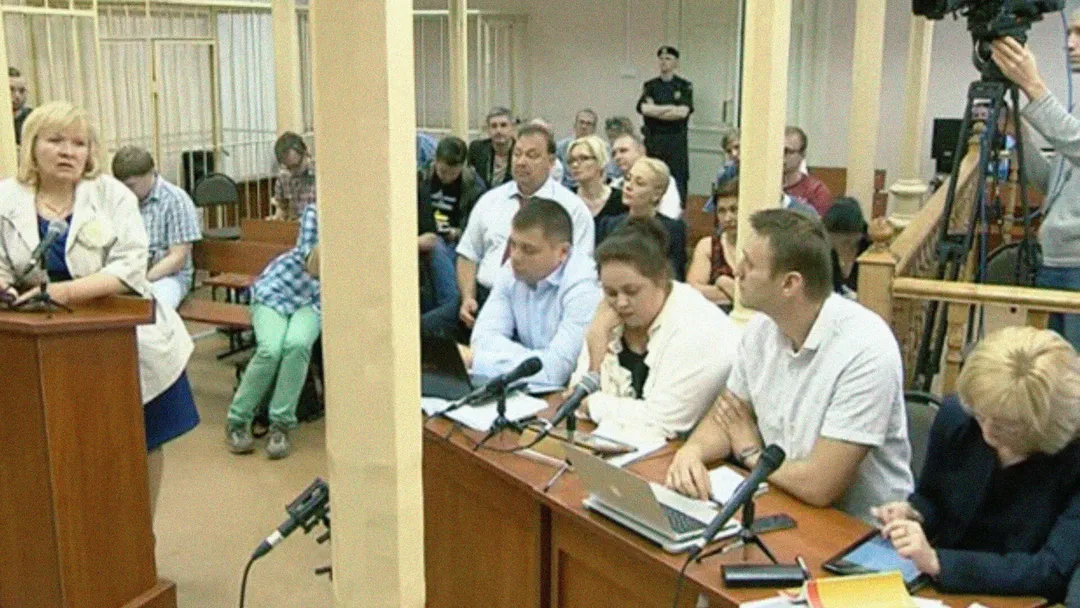
Please be seated.
The court session is hereby declared open.
The hearing of the criminal
case
against Navalny and Ofitserov is continuing. The following have been summoned to the court
session and have appeared as witnesses:
Barantsev, Kuzyakin, Smertin, and Bastrygina.
At this time,
the courtroom invites
Bastrygina.
death
death already
death
>> Today is the 16th.
All right, please state
>> Please step up to the stand.
>> 269
>> Please identify yourself for the court.
>> Larisa Gennadyevna Nastrogina.
>> When and where were you born?
>> April 28, 1959, in the city of Kirov.
>> What is your ethnicity?
>> Russian.
>> Russian citizenship?
>> Russian.
>> Your education?
>> Higher education.
>> Marital status?
>> Married.
>> Where do you work, and in what position
>> currently?
>> Yes.
Economist at Versniki LLC.
>> At what address do you live, and where
are you registered?
>> I live at
6 Prudnaya Street, the village of Zaboryan,
and I am registered at 49 Kalinina Street in the city of
Kirov.
>> In the city of Kirov.
>> You have been called to court for questioning as
a witness. I explain to you that
in accordance with Article 56
of the Criminal Procedure
Code, you are obliged to tell the truth and have the right
to refuse to testify against
yourself, your spouse, and other
close relatives. If you agree
to testify, you are warned
that your testimony may be
used as evidence in the
case, including if you later
withdraw that testimony.
You also have the right to file motions,
to lodge complaints regarding the actions or inaction
and decisions of the court, to appear for questioning with
a lawyer, and to request protective measures
if necessary. And
I also explain to you that in accordance with
Articles 307 and 308 of the Criminal Code
of the Russian Federation, criminal liability may arise
for giving
knowingly false testimony and for refusing
to testify. Are your rights and
responsibilities clear to you?
>> Yes, they are clear.
>> Please sign the acknowledgment to that effect for the court.
Audible.
The microphone.
Please tell us, do you have any grounds
to refuse to testify?
>> Please answer the prosecutor's question.
>> Thank you, Larisa Gennadyevna, please explain,
are you acquainted with the defendants,
Navalny and Ofitserov?
>> Yes, I am. What kind of relationship are you currently in
with them?
>> None.
>> Do you bear them any ill will?
>> No.
>> Very well. Please explain, in 2009
where did you work, and what position
did you hold?
>> I worked as deputy general director
of Kirovles.
>> What were your responsibilities?
I was engaged in,
in general, drafting and adjusting,
monitoring, and analyzing
the production and financial plan,
and I handled the allocation of cash
flows within the enterprise.
>> Please explain, Larisa Gennadyevna,
who was the general director
of Kirovles in 2009?
>> Opalev.
>> Was he your immediate supervisor
or not?
>> Yes, he was. He appointed me
to the position, and I reported
directly to him.
You stated that you are acquainted with
the defendants, both Navalny and
Ofitserov. Please explain in more detail
where you met them. Let's start
with Navalny. Under what circumstances?
>> It was at the beginning of 2009.
There was
a meeting in Shcherchkov's office
and at that meeting
Navalny was present. After that
meeting, Vyacheslav Nikolayevich said
that we needed to go to
Navalny's office and talk. This man
promises to help us solve our problems.
Let's dwell on that in more detail
and clarify it simply for everyone
present. In Shcherchkov's office—
where was that, and who is Shcherchkov? Let's
clear that up right away.
>> He was the deputy chairman
of the government of Kirov Region.
>> Uh-huh. And where was the meeting held?
In the building of the regional government
administration.
>> The government administration building.
>> All right, please continue.
>> I no longer remember, uh...
>> Can you get the hundredth one, switch it off.
>> No, switch it off.
We went downstairs, I don't remember whether it was to the fourth
or maybe the third floor. I remember that
we went down. Well, to which floor? From the fifth.
From the fifth floor.
>> And
it was a large office, I remember who it was.
So, there I was asked a question:
"Explain the problems at Kirovles."
That is, why, Navalny, that is, what
what causes them, what problems there are, and what
leads to the enterprise's losses? Well, I gave
a description of those problems. I was
asked to provide it in writing, to which
I said that in a day or two
the material would be prepared in written
form.
>> All right, I see. Two clarifying questions.
Did Navalny hold some position
in the regional government? Who exactly was he
there?
>> At that moment, I had not been
told who he was. I was simply
told that this person would help resolve
Kirovles's problems. Later, he was introduced to me
as an adviser to the governor.
>> Uh-huh. Um, specify what problems,
what financial problems of the enterprise you
raised when Navalny asked?
>> Well, the main problem was
the unprofitability of the state contract
and the lease that had been taken on by the
enterprise. From that stemmed smaller
financial problems of the enterprise.
>> I see. What happened next?
How did events develop? Did you carry out
Navalny's request and prepare it in
writing?
>> Yes, I prepared the documents in writing,
and gave them to Vyacheslav Nikolaevich. I think
he passed them on. Some time later
there was another meeting with Sherchkov. At that
meeting, Navalny was present.
So, as he had promised, he raised
the issues that were, uh, set out
in those documents.
>> Which ones exactly?
>> Namely, the issue that it was necessary
to terminate the previous state contract and
enter into a more profitable one. And the second
issue raised was the creation of
a single trading platform for the Kirov
region for the sale of timber products. This
platform was proposed to be created so that it
would be established on the basis of Kirovles, and
later other large enterprises would also
be included in it.
>> So please explain the essence of it: what did
the creation of this single trading platform involve? Was it
supposed to be
a state enterprise or
some kind of commercial organization?
>> No, I think it would be commercial,
because what was being proposed here was
specifically to collect products from all
the major enterprises in the city of Kirov. And those
major enterprises are commercial
enterprises. In other words, a state
enterprise cannot force
commercial organizations to work with
it.
>> Products of some specific
assortment, or everything? And in general, what
kind of
>> The discussion was that this, this
platform would take all products,
all timber products from Kirovles.
>> Well, be more specific—low-grade? Well, you see,
our products were divided. At our
enterprise we have workshops, so we had
both
raw timber and sawn timber.
Well, I don't think sawn timber
needs much explanation. But
timber can be low-grade
or high-quality. The difference is,
so, where is the problem? The thing is,
the problem at Kirovles was always
the sale of low-grade timber.
Why did this problem arise? Because
it was a
forestry enterprise. We mainly
obtained timber from thinning operations.
From thinning operations, high-quality
timber amounted to, well, about 30%, and
sometimes on some plots only
10%.
And, uh, in final felling operations,
which are usually carried out by
logging operators, the share of high-
quality timber
is 70%.
And so, when we work a plot,
70 to 80% of it remains low-grade
timber, and the problem always arises of how
to sell it. No entrepreneur
wants to take poor-quality timber.
>> What was your opinion of this
initiative to create a single trading
platform?
Our view was that, under those terms, when
we heard that
all timber products would be taken, frankly
speaking, we were pleased that this would happen,
because it was specifically stated that
a commission agreement would be concluded
and all products would be taken. That suited us
very well.
>> I see. Did Navalny subsequently have
any further involvement with Kirovles,
did he visit the administrative building
of Kirovles? Did he perhaps meet
with the enterprise's management
team?
>> Well, later on,
some time later there was a meeting of
directors organized,
And Navalny was at that meeting. He
introduced Ofitserov as the acting director
of LLC VLK.
Right. And, well, after that I saw Navalny several times
in Opolev's office as well,
well, and after Opolev had already been
removed, Navalny was there.
>> Well, let's probably go through it in order
and in more detail. Uh, Ofitserov—
when and where did you first see him?
>> The first time I saw Ofitserov was
after those events, when
I handed the written documents over to Navalny
in writing. And after that, Ofitserov started appearing
— Ofitserov —
in Opolev's office.
At that point he had not been introduced to us
in any way. To put it mildly, he even
showed up when directors' meetings were being held.
He would pass through the director's office, well,
into the office there, into the house, into Opolev's
break room.
And officially, Ofitserov was then
introduced both to me and to the directors at
a directors' meeting.
Right. And what was that directors' meeting
about, and roughly when did it take place?
>> It was
either in late spring or early summer,
somewhere around that time.
>> Of what year?
>> 2009, I think.
The meeting was basically devoted
to the fact that,
as Navalny presented it,
a trading platform was being created,
and that the director of LLC VLK would be
the one through whom you would
sell your by-products. The meeting
was devoted to conveying this information
to the directors and, accordingly,
the directors were told that all
production now had to go through this
company.
>> I see. At that meeting, did anyone,
besides Navalny, as you say,
introduce Ofitserov? Did anyone else
from management speak, so to say, on
Ofitserov's behalf? Did the forestry enterprise directors
speak? And in general, what was their
opinion of this proposal that
everything would have to be centralized specifically
through LK?
When this information was announced,
the directors were initially
indignant, asking why they needed a middleman,
why they should give up a percentage. But then
Ofitserov spoke up and said
that for a year all of the production would be taken
off their hands. Again, the emphasis was on
all. And when it was said that all
production would be taken, the directors, of course,
understood that this was advantageous. And then, basically,
they agreed to it.
Moving on. Please explain,
whether a contract was in fact concluded
between KOGUP Kirovles and
Vyatka Timber Company?
>> Yes, it was.
>> Well, please tell us in more detail about
the circumstances known to you,
the circumstances surrounding the conclusion of this
contract. When were you informed of it? Were you
informed of this contract at all?
If you were, then
what were its terms? As for the circumstances
of the contract being concluded, I do not know them,
but I learned about the contract after
that meeting, roughly
a week or two later, when calls started coming in
from the directors to me,
because I was the one handling
the distribution of funds,
and the forestry operations were either not receiving money or were receiving
different amounts. Also, all the directors
understood that there was no money to spare at that point, and everyone
was counting every kopeck. So they
called me—one director, then another—
saying that the supply contract
being proposed by VLK was unprofitable. We probably
don't want to sell under those terms. So I
went to Opolev and asked, "What's going on?
How was this contract concluded?"
Opolev gave me the contract to review,
and I read it. First of all, as
had been said earlier, the discussion had been about
a commission agreement. In reality, however, it was no longer
a commission agreement but specifically a contract for
the supply of timber.
The difference between those two types of contract is enormous. And
most importantly, the supply contract was
concluded with one hundred percent
liability placed on KOGUP.
That is, KOGUP was obligated and bore responsibility for
everything. So,
uh,
there was, accordingly, no liability at all on the part of
VLK. In other words, VLK
simply received the money.
This contract did not specify
either the volume of products or the types
of products.
It said that all of that, including the place
of sale, would all
be set out in supplementary agreements.
>> And were supplementary agreements
subsequently concluded?
>> Well, there was a supplementary agreement for each
shipment.
>> Go on.
When I read that contract, the
next day—I had taken it home with me—
yes, the next day I went to
Vyacheslav Nikolaevich and said, "Have you
signed your own death warrant?"
It looked like nothing else, absolutely. It
was clearly one-sided in nature.
And Opolev said to me in response that
let's bring management together and
work out some measures, some changes to the
contract. Prepare your
proposals on what you want to add and
what changes should be made. Then, a day or
two later—I don't remember exactly, it's not
that important—a meeting was convened
at which the following were present:
Popolev, Buran,
Makaveyev, Efitserov, and me. So, I
stated my, well,
proposals.
They listened to all of it. They said that
changes would be made, but in the subsequent
version no changes were made
to the VLK documents. Well, do you know why?
>> I don't know.
>> Let's go back to that as well. Uh, you explained that
the directors expressed
their dissatisfaction to you. Could you say,
well, maybe you don't remember their surnames, but at least
which district forestry enterprises
had complaints?
>> You can't say that, for example,
the same forestry enterprise was involved in every deal. In
each deal, there were different forestry enterprises.
At various times, Kumyonsky, Orlovsky,
Orekhchevsky,
and Slobodskoy, I remember, voiced complaints.
It depended, generally speaking, on where
the loading took place, because the main
disadvantage of the contract was precisely that
the
timber products were gathered in one
particular place, and they had to be delivered
to that place. So in each specific
case, as we would say, under the supplementary agreements,
depending on where the shipment was coming from,
different forestry enterprises found it
unprofitable. Larisa
Ignatyevna,
since you were directly involved
with the financial
documents, please explain what
the payment procedure was for the Vyatka Forest
Company for the timber products supplied by
Kirovles?
>> By the way, that was also one of the
unfavorable
terms of the contract. You see, when we
sold
our products, we took an advance payment of either 50%
or even full, 100%
prepayment. The contract stated that
payment would be made
after
—I don't remember whether on the same day or
some number of days after the money was received
into VLK's account. First, we had no way
to verify whether that money had actually been received.
Second, it delayed things; that is,
we didn't have the money. We normally worked on
prepayment terms—usually 50/50,
with an advance payment.
>> So the funds from VLK's account to
your settlement account, that is, to the settlement
account of KOGUP, were transferred? As I understood from the
contracts, the money for the products sold
for the products being sold
went to VLK's account, and after that VLK
transferred it to us
>> To KOGUP Kirovles.
>> KOGUP Kirovles.
>> But if the timber products were supplied not by KOGUP
Kirovles, but directly by one of its branches,
some forestry enterprise, then how
>> did the money get into KOGUP Kirovles's account?
>> We had
>> subsequently
>> we had agreements with the bank
in order to monitor income and
expenses. We had only one revenue account
at KOGUP, while the expenditure accounts were in the
forestry enterprises, and they operated under a
budget system. That is, money was sent to them for
specific expenses. In other words, money was sent
for salaries, and then only
salaries could be paid from those funds.
If we ourselves sent money for
materials, then that money could
be spent only on materials.
That was the budget system.
>> Did KOGUP Kirovles have any financial obligations to its
branches, any monetary
obligations in connection with its cooperation with
VLK? In other words, were there cases when
funds were not transferred in full
to
the branch forestry enterprises because, as a result of
delays by VLK, funds that had been fully
transferred by VLK to the
settlement account of KOGUP were withheld
by KOGUP for some of its own purposes?
>> Right.
Well, whether specifically VLK or not,
that's not really the point. The money flow system was simply
set up this way: all funds came
into one, so to speak, common cash pool.
So, the money that came into KOGUP's
account was
allocated to each forestry enterprise; despite the fact that
it was a single account, there was
a breakdown showing which forestry enterprise had
which funds. In other words, each forestry enterprise
had its own wallet.
>> Uh-huh. Now, from that wallet, we had a
support fund. This fund
received 5%. This fund was used for
the development of the enterprise and for dealing with
certain emergency situations. For example,
those same fires were financed
through this support fund; into this fund
of course, they immediately took
5%. The remaining money was sent
to the forestry enterprises as needed
according to the budgets that were drawn up at the
beginning of the year during planning.
The only thing was that in 2009,
when there were difficulties, but even then this was how it worked.
We would call the directors; we had
several forestry enterprises. For example,
the Kilmetsky forestry enterprise was a strong one; it was located in
the southern districts. There,
their sales were good, and
they had substantial cash inflows. And I
would make arrangements with the director, and he would allow part
of their funds to be transferred to
other forestry enterprises so they could pay
wages.
>> I see. As for the financial,
so to speak, side of things.
Were payments made in full, so to speak, and
were they made on time by
the intermediary company for the timber products delivered to
its address, or how did that work?
As I already said,
we cannot track when the money
reached their account. All right. In
full, yes,
>> not in full, but there was a delay; if
you compare it with the terms on which we
sold directly ourselves, there was definitely a delay.
Of course, as I said, we received
a 50% advance payment immediately, whereas there the money came in
only at the very end.
>> A 50% advance payment immediately with other
counterparties.
>> Yes.
Regarding the counterparties, as far as you
know, who were the main
buyers,
and who were the counterparties?
The Novovyatsk Ski
and Slobodskoy were among them here.
>> Slobodskoy, Slobodskoy. Right. No,
Slobodskoy shipped to Novovyatsk... Oh, I
probably can’t say this precisely. I know
that there were 10 major counterparties, around
ten major counterparties with whom
we worked on a regular basis. I was not directly involved in
sales matters,
so I can’t say anything specific,
but I do know there were about ten
major contracts with parties we
worked with constantly, and they were simply
transferred to VLK.
>> constantly. So, before the conclusion
of the contract with
>> those were long-standing relationships, going back many years.
Kirovles had been working with it all along.
>> Please clarify, regarding, so to speak,
how the price and the transportation terms
were determined for products shipped
through VLK. Were those
terms the same as with other
counterparties, or did they
differ in some way?
The price, of course, remained the
same. If we take, for example, the same
Novovyatsk Ski Plant: if it bought from us
at that price, it bought from VLK at the
same price. But from that price we were
forced to pay a sales commission to
VLK. That meant we were left with
less money. That is one aspect. And the second
aspect is that, as I already said, VLK contracted volumes
far larger than ours.
Previously, our forestry enterprises individually
entered into contracts based on the volume
they actually had in each forestry enterprise. VLK
would sign contracts for a larger
volume, and because of that, the forestry enterprises had to
concentrate timber in one
particular location. And that meant
additional transportation costs.
That’s it.
>> And who paid those transportation costs?
Who covered the transportation costs?
>> The transportation costs were, of course, borne by the forestry enterprises.
>> That affected the overall cost basis.
>> It did not change the price. The price did not change, but
it increased the cost price. The overall
cost price. That was the issue that interested me.
interested me.
>> Mm-hmm.
In 2009, during the period from
April to October, were there any
audit inspections, so to speak, concerning Kirovles?
audit inspections?
>> At the end of the first half of the year, we
reported the results of our financial
performance to the Department of
Property.
And,
there was a demand that we explain
the reasons for the losses. Several reasons were
given. Some of those reasons,
well, could not really be changed, were accepted
and dealt with by our own means. But
the head of the department ordered an inspection
of the enterprise.
>> ordered an inspection of the sales
activities of the enterprise.
An audit inspection.
>> Yes, an audit inspection.
>> The inspection was carried out.
>> The inspection was carried out.
>> And who conducted
it? Vyatka Audit? The firm Vyatka Audit.
>> Please explain in more detail
how this inspection was conducted, what
documents were requested, and who,
in that connection, was involved?
And what conclusions were drawn from it?
Well, the documents requested included supply contracts,
supply contracts,
contracts from previous years were compared with
those from the current year. An analysis
was carried out,
and invoices and payment records were reviewed.
And
the people who handled these matters were also questioned.
Makaveyev,
uh, Bura. And of course they questioned me, as
one of the managers as well.
That was the issue.
>> Were the financial statements requested?
>> I don't think so,
because the issue was specifically the sales
policy; as far as I remember, I did not look at the balance sheet.
So I can't confirm that.
>> You don't remember?
>> Uh-huh.
>> What were the auditors' conclusions?
The auditors' conclusions
were that
roughly speaking, Piro got involved. After analyzing
the sales, that is,
as regards Kirovles,
that, well, first of all, there was a decline in output
and sales; everyone had that in 2009
because there was a crisis that year. And secondly, yes, it was
concluded that the issue of OOO
VLK had to be addressed, because sales through OOO VLK
were not working out.
Were the auditors' conclusions, uh,
discussed in the regional government, in
particular
at the department for
property management? As I understand it, the initiative
did not come from Kirovles.
>> Yes, of course. The results of the audit,
of course, were discussed extensively.
>> Who was present for the discussion?
>> Well, Mertin was there, his deputy. Then
the chief accountant was there, I was there, and the auditor
our chief accountant.
>> What was Arzamassov's opinion?
>> Well, it was the same opinion.
>> He agreed.
>> He agreed with that opinion. Was this audit
discussed anywhere else?
>> Later on. So, this audit
was discussed
with the regional governor.
>> Who was present at that discussion?
>> Navalny, Ofitserov, Sherchkov,
the auditor,
Arzamassov, and me.
>> What were the views of the people gathered at
the meeting?
Who expressed what opinion?
Let's start with Navalny. Did Navalny
speak about the audit
findings?
>> Navalny said that the audit
had been conducted incorrectly,
improperly.
So,
and in principle Navalny was defending the interests
of VLK at that meeting.
>> More specifically: did he explain
why he thought that? Why did he
believe the auditors' conclusions were wrong?
Do you remember that or not?
>> Well, at this point I don't remember his exact words.
>> Who else spoke?
>> Ofitserov also spoke, which honestly
surprised me a lot.
>> Why?
>> Well, a commercial organization was taking part in
the regional government's discussion of issues concerning
a state-owned enterprise.
>> Was he a member of some working group
or what exactly was his role there?
>> I don't know. I really don't know that.
I'll say again, I was surprised that he was
there.
>> I see. Uh, as a result of the discussion,
were any conclusions or decisions reached?
>> One moment. The witness did not answer the
question of who brought Ofitserov to the
meeting.
The witness answered only that he also expressed his
opinion.
>> He also said he was against the audit,
>> but of course I no longer remember the specific words
he used.
Let me ask again—what are you asking?
>> As for the outcome of the discussion: uh, what
decisions were made?
>> As a result,
as a result of the discussion, Opalev was
removed from his position.
>> Could you explain in more detail why?
>> Well, I don't really know many details either.
When that discussion took place about Opalev
with the governor and at the meeting,
the reason I was there was that
Opalev was away on a business trip. Opalev
returned from the trip, and that very
day he was summoned to the governor. In the evening,
almost at night already, he called me
and said: "Get ready, Lisinalna, because
tomorrow you'll probably be acting as
general director." I asked:
"What happened?" He said: "I'll explain everything
later."
But in the morning, when I came
to work, Tyshlik had been appointed director.
So I can't give any details.
>> Do you know Tyshlik's first name and patronymic?
>> Pyotr. Pyotr—I forgot his patronymic.
He was with us there for literally about half a year,
I think.
>> How long?
>> He worked there, at most, probably
half a year. I see. And as
director?
>> No, he had worked there before that. He was
actually in charge of, among other things,
sales.
>> And as director, for how long after that?
>> As director, I don't know,
a month or two, maybe.
>> And then who was supposed to take over as director
of Kirovles after Tyshlik? Who took
the position of Kirovles director?
>> After Tyshlik, it was Opalev again.
During the period when Tyshlik was, uh, serving as
acting director or had been appointed
director, was he interested in, that is,
what kind of
financial activities of the enterprise?
whether he had requested any documents for
himself or for anyone else.
Oh,
basically, I think it was even that same
day he was appointed, or that same
or the next day—I no longer know that for sure either—
Shlik summoned me to
his office and told me to prepare the documents.
He said Navalny was coming to conduct an inspection.
Right. And that I should vacate my office and
bring all the financial documents there.
Well, of course I vacated the office, since
the director had instructed me to do so. But
I refused to hand over the documents. I said
that I would provide the documents only
if there was an order
from the government stating that I had to
submit the documents.
Then
a few days later, Tyshlik summoned me
to his office. In the office there was
Navalny sitting there.
Uh, they again raised the issue that I had to
hand over the documents.
I again replied that I would provide the documents
only if there was a request from
the government, since we are
a regional state-owned enterprise.
Navalny said that the government order
would be issued. I said, "All right,
once there is an order, I will hand over all the documents
within a day or two as well."
Then Tyshlik brought me
some piece of paper that had no signature
on it at all—no signature, no
seal. I said that this was not a proper document,
and I would not hand over anything.
But apparently they decided to proceed
by another route. After that, Navalny started
coming in; he sat in my office, and
our specialists were called in there one by one.
I do not know what was discussed.
I was not called in.
Were there any other meetings with
the governor, or with Cherchkov, or with
someone else from the senior leadership
of the regional government concerning
the activities and purchase arrangements involving Raflemi
apart from the meetings that have already been listed?
Well, that was probably after all those events,
all of them,
when by that point
Tyshlik had already
been dismissed.
>> I see. Larisa Gennadyevna, in your view
as deputy director,
was it beneficial at all for Kirovles
to work with that company?
>> No, definitely not.
>> Was the contract with that company
terminated, or was it still in force?
>> It was terminated. In fact, incidentally, it was at that
time, when Tyshlik was in charge.
And here, to be honest, Tyshlik did listen to me.
He called me in, I told him, well,
and in the end he terminated it.
But at that point, I know for certain,
there were still debts outstanding. And after
the contract was terminated, invoices came to KGU
for penalties claimed by VLK. That is,
even after the contract had been terminated,
there were invoices saying that certain contracts
had been concluded in violation of the rules.
During your questioning, you stated that
about 10 major counterparties moved over
to VLK, and contracts with them were renegotiated.
During that period,
during that time,
given Kirovles's prior experience working with those companies,
could Kirovles have dealt directly
with those counterparties?
>> Of course it could. As I said before, we had worked with
those counterparties even before
that.
>> You are familiar with Opelev, Ofitserov, and
Navalny. You saw them together. Please explain
your view: were their relations
friendly in nature, or were they
ordinary business relations? What can you
say about this, in your opinion?
>> Well, whether they were friendly or not, I cannot say,
because I only saw them in
a work setting.
As for anything outside the work
environment, I cannot say. In a work
environment, I think that
at least at the meetings that
took place with Sherchkov, Navalny and
Ofitserov always arrived together and,
to put it mildly, expressed the same
point of view.
Do you know
from anyone—and if so,
from whom specifically—that Opelev
was subjected to any pressure in connection
with the conclusion of the SLK contract?
>> Opelev did not personally tell me that he was
under pressure, but I am originally trained
as a teacher, and I simply
could see that his condition was
abnormal, not quite himself. Several times
I went up to him and asked, "What
is the matter, what is happening, Vyacheslav
Nikolayevich?" He replied to me:
"Calm down, it has to be this way."
>> Your Honor, I have no questions for
the witness.
>> No questions.
The defense may question the witness.
Witness Bastrykina, please tell us,
from the very beginning, you worked
at the Kirovles enterprise,
>> correct?
>> Since the enterprise was founded?
>> Well,
>> You said it was a long time, almost
a decade. How long exactly,
since Kirovles was established?
>> The enterprise.
there.
At first, I had just started working.
>> When was the Kagub Kirovles enterprise established
please tell us?
>> In 1997 or 1998?
>> In 1997 or 1998. You worked there
from 1997 or 1998, you do not remember exactly
?
>> I worked from—there was a reorganization there,
I moved from one enterprise to another
as part of it.
>> The forestry enterprises were merged there. Kagub
Kirovles. That large enterprise specifically
was created in 1997 or 1998.
You have worked there from the very beginning. Am I correct
in understanding that you are one of the people
who is most familiar with
its financial
and economic condition, since you
worked there from the start?
>> Please tell us, try to recall
those reports you prepared for me,
yes, on the financial condition of the Kagolov Krovles
enterprises. What were some of the main
indicators contained in those
reports? The enterprise's liabilities,
the enterprise's accounts receivable, and
the remaining finished goods in warehouses—
what were they at the beginning of 1999
?
>> I cannot give the figures today.
Even approximate figures. You see, part of it is that
I am an economist by profession. I am used
to speaking in figures. Five years have passed, and I
am now working, just to get by, at five
enterprises. In my head are the figures for those
five enterprises.
>> [inaudible]. Well,
>> No. I am saying once again, I am asking
you approximately, please. You
were the director of this enterprise, and
as it appears from what you are saying now,
you remember some details
very well.
And these are the key financial indicators
of the enterprise where you were the chief
economist. Can you not remember at least
the order of magnitude? Well, what was the debt—
was it 1 million rubles or 200 million rubles? Not
1 million, of course.
>> Approximately how much?
>> Well, hundreds.
>> Hundreds of millions of rubles.
>> Because there were payables as well.
>> Please answer my questions, please.
That will be your next
question. Am I correct in understanding that
accounts payable—what you owed—
you estimate it at hundreds
of millions of rubles, correct? Now,
what were the accounts receivable?
>> About the same. Hundreds of millions of rubles. And
please explain to the court and to me,
what exactly are accounts receivable
?
>> Money owed to us.
>> Money owed to you. And please tell us,
you said that everyone settled their accounts with you,
and that money was owed to you. How
did it happen that in 1999 you were
owed hundreds of millions of rubles? That
means that someone simply did not
pay you on
>> I said again, there was a 50-50 system,
so such a situation could occur.
>> 50-50, meaning 50%.
>> Please explain it to the court once again.
Are accounts receivable
overdue debt, or
debt provided for under
the contract?
>> Provided for under the contract. Moreover,
within the accounts receivable,
the main portion
was owed by state-funded institutions.
We supplied goods to such institutions even without
prepayment. That was by order
of the government.
>> So you supplied kindergartens and hospitals, yes,
yes, we supplied firewood to those institutions without
prepayment.
>> And there were a large number of enterprises, including
state-owned ones, that
did not pay. And please tell us,
how much did you later write off from accounts
receivable as uncollectible debt?
>> That was written off after I had left; I do not know.
>> But as for overdue receivables, in
those reports you brought me,
there was also information on overdue
accounts receivable, that is,
not just the 50% deferred amount, but rather
amounts that were specifically not paid under the contract. And you
were supposed, indeed obliged, to collect them
through the courts. What was the approximate
amount of such debt?
>> I do not remember.
>> And did you pursue collection through the courts?
>> We did.
>> How much did you recover?
I am saying again, it has been 5 years now.
>> In terms of scale, are we talking millions of rubles,
tens of millions, or hundreds of millions
of rubles?
>> Well, there were hundreds,
>> Hundreds of millions of rubles, that is,
overdue accounts receivable amounted to
hundreds of millions of rubles.
>> From time to time, documents for filing
these matters in court
were submitted.
>> Please remind me, what was the total volume
of your sales with the VLK enterprise
?
Just the approximate scale.
I am now—
>> Well then, please tell us, and in
The case materials indicate that
the total sales volume, the total sales volume, was 16
million rubles. And you said that you had
overdue accounts receivable
in the hundreds of millions of rubles just now.
Please tell me,
all right, one or two hundred? And what is the reason for
such close attention on your part
both in your testimony and everywhere else to these
16 million in turnover, against the backdrop of hundreds, one
or 2 million rubles in overdue accounts
receivable?
>> I didn’t understand the question.
>> All right, I’ll ask you another question.
Please tell me, you, uh, said here
and repeated twice that there was
a meeting with the heads of the forestry enterprises, at which
I was present, where I introduced
Ofitserov as the representative of the company through which
everything was supposed to be sold. Now, in
this court hearing, the following were questioned as witnesses:
Opolev, Makaveyev, Zmeyev, and 20
heads of forestry enterprises. Not one of them
testified, despite the fact that the prosecution
asked them, not one of
them said that I was at that, uh,
meeting, much less that I introduced
Ofitserov. Who is giving false
testimony now? You, or were they all giving false
testimony?
>> You were at that meeting.
>> I introduced Ofitserov?
Please answer very clearly.
Did I introduce Ofitserov and did I tell
the directors of the forestry enterprises that through him
all sales now had to go?
You have been warned about liability
for giving false testimony?
>> Let the witness answer.
>> Well, I can’t say definitively, but, but
the fact that you were at that meeting is certain,
you definitely were.
>> So, what did I say at that
meeting?
>> I’m saying once again, five years have passed, I do not
remember word for word what happened.
>> Then please tell the court and
the representative of the prosecution whether you remember
what happened at that meeting and what
I said there. Do you remember what I
said at that meeting?
>> I’ve said everything I remember. You just
said that at that meeting I
introduced Ofitserov and told all
the directors of the forestry enterprises that now they
would sell products through him. Maybe,
maybe you introduced him not at
the meeting, but before the meeting to me, and I, I had
that association left in my mind, but the fact that you
introduced Ofitserov to me, I definitely
remember.
>> All right, let’s talk now about
the meeting. We’ll get to who
introduced whom there in a moment. We are talking about
the meeting at which
dozens of people were present. Those dozens of people have already
given testimony
here. So please tell me, at that
meeting, do you remember what I said?
>> I already answered that question.
>> You do not remember—you answered that question.
>> Well then, please explain to me what
your answer to that question was. Do you remember what
I said at
>> I already answered that question.
The question has not been withdrawn.
>> Your Honor, the question has not been withdrawn. Please answer,
please,
>> the witness answered that possibly
you told her this before the meeting, and she
formed an association. I am now asking
the question specifically about the meeting. Do you
confirm the testimony that you
just gave, which contradicts all
the other witnesses, namely that at this
meeting I introduced Ofitserov to everyone and
said,
>> I answered your question.
>> I did not understand the answer to this question of yours,
forgive me, please, you—I said that
maybe before the meeting you introduced him
and I formed an association
that it may have been at the meeting, that such a
situation was possible, but as for him being introduced
Ofitserov was not introduced as director precisely at
that moment.
>> At what moment?
>> Either before the meeting or at the meeting itself.
That is, that Ofitserov was the director of OVLK,
I learned from witness Bastrykina. Did I speak with you before
the meeting, and in general at the company
Kirovles, with anyone other than Opolev,
or not?
Now please tell me, I was an adviser
to the governor of Kirov Region, so for what reason
would I, to you, an economist at the enterprise,
have needed to introduce Ofitserov? Well,
then write this down: I was not an economist at the enterprise.
No, not the chief economist. I was
the deputy general director.
>> And when people came
to the director’s office for the meeting, I was the one who greeted everyone.
>> Excellent. Please explain this to me. I met you
and you could have.
>> Please tell me exactly when I
introduced Ofitserov to you at the meeting
I answered that question.
>> I did not understand your answer. Right now you are
trying to launch—I answered this
question.
>> Are you trying to confuse me with the question now
No. Indeed, the witness has already
answered
>> I’ll rephrase. I would like to understand very clearly
once again whether witness
Bastrykina stands by the information she has already
given, namely that at this meeting
in the presence of the directors of the forestry enterprises, I
introduced Ofitserov to everyone and stated that
from now on, the products would be sold through
... Please strike the question. She has already
indeed answered twice that it was either
before the meeting or at the meeting. She
did not
>> the witness has not answered in that wording.
>> This question still concerns one and
the same point. Let's still
clarify it. Yes, that's all. Are you asserting that
this happened specifically at the meeting?
>> No,
>> it could have been. It might not have been at the meeting. Yes.
>> Now please answer the next question. So,
you say that I introduced
Ofitserov to you.
Was the phrase actually said that this was
Ofitserov, through whom from now on
all products would be sold? Did I tell you that
in any setting there, with Sopliv,
without Oplyv, one-on-one, somewhere else? Was it said
or was it not? I repeat once again,
this event was 5 years ago. I do not remember
the exact wording. The meaning was that you
presented him as a director, and that
the products would be marketed. Even at the
first meeting with you, the sense was that
the sale of all products would go through
one enterprise,
>> through KOGUP Kirovles or through VLK? So
then
>> when was that
>> perhaps the name was not mentioned; when we first
met for the first time in the
government offices, the conversation was about the fact that
there would be an enterprise through which
all products would be sold.
>> Witness Postroiki, you are currently
in court,
>> where the possibility is being considered of
a criminal offense having been committed. I do not
understand why the witness here is not
answering my questions. Yuly, through
which enterprise there
>> Defendant Navalny, please compose yourself,
one moment. The court does, after all, warn about
liability. And the court did so at the
beginning of the hearing. About which she signed an acknowledgment.
She signed it. First of all. Second,
there is no need to frighten her with criminal
liability.
>> You ask questions, and she answers those
questions. Indeed, if her
testimony is disproved, then there may
eventually be a question of bringing her
to account for knowingly false testimony. But
there is a separate procedure for that.
>> Then please clarify: you
several times mentioned a single
trading platform. What exactly did you mean, in
your understanding? The single trading
platform I was talking about—what was it?
Was it sales through Kirovles or sales
through an outside commercial
enterprise?
>> Through an outside enterprise.
>> Your Honor, I also ask that this question be struck
as well. It has already been asked; the prosecutor clarified it.
>> The question was not asked in that wording.
>> It was asked in that wording.
>> One moment. Let's proceed in order, one
at a time at least. Yes. The clerk cannot
record the parties' interjections
simultaneously. Please answer the question.
Through an outside organization.
>> Then please explain: here you
said—I'm quoting almost verbatim—
that Kirovles was supposed to collect all
the products and sell them. So, did you mean
sales through Kirovles or through an
outside enterprise?
>> I did not say that. I said that
VLKAS would sell all the products.
>> Said by whom? Who said that?
I am saying once again: it was after the first
meeting, when you were in our office with us,
that you said this outside
organization would take all the products
and sell them.
>> Let's go over this again. Which meeting was it, and who
was present at that meeting?
>> The witness has already answered that question.
>> Your Honor, the witness is clearly confusing
the creation of a single trading platform and VLK.
And she is talking about some
meeting where first it was one thing,
then another. At one point the single
trading platform is Kirovles, then the single
trading platform is VLK. What I want to establish
is something very simple: that she now
explain when, with whom, and under what
circumstances she heard from me
the statement that someone would be
selling something through VLK. From me or from
Topolev?
>> That is, at which of the meetings
>> at which meeting, who was present
there, and what exactly was
said?
I will answer the question once again:
at the first meeting you said that
a single trading
platform for the region would be created on the basis of—who would be included in it—
Kirovles, and then all the other
major
enterprises in the region would be brought in.
>> So
>> I never spoke about a single Kirovles platform,
because that would be disadvantageous
for KOGUP Kirovles. Strange. So perhaps
you are now talking about the timber exchange,
which by definition, of course,
must include all enterprises
working in the forestry sector. Is that
what you are talking about now, please
or not?
>> I am talking about what was said. You
said that about
>> When was it, please answer—when exactly?
Who said it, and in whose presence?
>> At the beginning of 2009, after a meeting in
Shcherchkov’s office, you and I went down one floor
or two to an office. And this was discussed
there. Who else was present?
>> You, me, and Opolev.
>> Excellent. So, at the meeting where
only you, me, and Opolev were present,
according to you.
>> That was not a meeting. After the meeting,
>> we went down to your office.
>> You just said several times that
there was a meeting. Was it a meeting or
wasn’t it?
>> The meeting was in Shcherchkov’s office. And after that
meeting, you and I went down one floor
or two. And there were three people
there. And you said,
>> what was said, once again
>> you asked for an assessment of
>> this enterprise. Which enterprise?
>> Which enterprise?
>> Kogubkirovles. And you promised to help. One form of
that help was that
the contract would be revised.
>> All right, please wait. We are talking
about the trading platform. So after which
meeting with Cherchkov did these weekly meetings take place?
After which meeting did we go downstairs, and
then what? That is exactly right.
The meetings were held weekly. I do not remember the exact dates.
I said at the outset that it was at the beginning
of the year.
>> There, that is the testimony.
>> Yes,
>> please, the question.
Either the creation of a single trading platform,
or the issue of selling everything through VLK.
So what exactly was being discussed?
>> I refuse to answer. I have already answered.
>> You cannot answer that question.
So,
>> I have already answered. I do not understand what
I am being asked. I have already answered several
times. Your Honor, the witness, as you
can observe, is simply
either seriously confused and
remembers nothing, or is plainly
>> trying to change—just a second, no, no,
do not argue.
>> I can also see that you do not like the answers
to the questions. You are trying to get the witness, uh,
by asking the same questions over and over,
simply to make her give different testimony.
>> I would like to understand at which meeting
what was said. Excuse me, the witness
first said that I, in the presence of
some directors of the forestry enterprise, said that
everything would be sold through VLK.
Now it turns out that nothing
of the sort was said at all.
>> Mm-hmm.
>> So, that phrase was said. And who, who heard
that phrase? Kopolev, incidentally, also
gave testimony. So tell us, who
actually said that phrase? Did you hear it
from me? Or perhaps you simply mixed it up
plain and simple?
>> I answered the question.
>> I did not understand the answer.
>> The question was asked, yes. The question is withdrawn.
Please tell me,
>> and
>> in your testimony, you said that the problem
with working with VLK was that VLK
formed very large batches.
Correct?
>> Well, yes.
>> Now please remind me, just
you said there were hundreds of millions
in debt, hundreds of millions
in accounts receivable, and remaining
finished goods in warehouses. What
were the amounts? In those reports you gave me,
you wrote them down; they are probably in
the case materials.
>> They must have been large. At the beginning of the year, as far as I
recall, also on the order of hundreds of millions of rubles,
tens, maybe single digits.
>> First of all, this is a feature of the forestry
industry. In the first—wait—in the
first quarter
>> there is always stockpiling, because the first
quarter is for harvesting, and in the second
quarter sales begin. Therefore
there should have been timber inventories
in the warehouses.
>> What was the volume of those stockpiles?
>> I do not remember. I am saying again, is the figure
correct—
>> 5 million rubles.
>> I see. Once again, rubles.
>> Is that correct? Because I remember that the remaining
inventory at that time amounted to 220 million
rubles.
>> I do not know; if I do not remember, how can I
tell you whether you remember correctly?
>> Well, as you said, you were the deputy
director. You cannot possibly fail to remember such
important—Your Honor, please. She does not
remember.
>> All right, and
>> your witness seems not to remember anything. And
please tell me, were you
a witness, repeatedly a witness
to the fact that the director of your
enterprise, Opolev, repeatedly appealed to everyone
with the request: please help me with the
sale of our products. Did that happen or not?
>> Opolev appealed to the directors.
>> Opolev appealed to Shcherchkov, for example,
and at meetings said that my
problem was that there was no market for the products. Was
that so or
>> it was discussed at meetings, but specifically it concerned
low-grade timber.
Please tell me, then, and for the sale of
sales, right.
>> for selling this product, so what exactly was
the problem with some company that
was assembling large batches?
>> Because those were large batches,
they were assembled for high-quality
timber, not low-grade wood.
>> So am I right in understanding that they
put things together, found customers
and buyers, assembled these
large shipment batches, and then
sent you an order request, and you
could not fulfill it.
Did situations like that happen?
>> You could not fulfill it, despite
the fact that, on paper, you had inventory remaining
worth 220 million rubles.
>> Let me say once again, the specific feature
of a forestry enterprise is that
70-80% of the timber there is
low-grade. And when inventory balances are recorded,
they are recorded without specification.
And you were asking for high-quality
timber, and it might simply not have been
available in stock.
>> Please remind me,
>> One second, excuse me. And who are you?
officer
>> I was demanding high-grade timber from you.
Excellent. Please tell me,
>> and remind me, what was the volume of the allowable
annual cut allocated to Kirovles,
at the beginning of 2009?
>> I don’t remember that either.
>> Well, listen, that was basically the main thing,
the main asset Kirovles had — its allowable
cut... I was left without work and had to survive.
I run five enterprises. I remember these figures.
Tell me, we’ll get to the point
of why you were left without work. We will. I
will ask you about that.
Am I right in understanding that Kirovles
had millions of cubic meters under lease
in allowable cut? It was the largest
forest lessee in Kirov Region.
Is that correct or not?
>> I won’t speak in numbers, but it was one
of the largest. Yes.
>> One of the largest, or the largest?
>> Well yes, the largest.
>> The largest.
>> Am I right in understanding that large
volumes of timber — the largest volumes — could
be supplied only by Kirovles? And the question of
whether it was low-grade or not low-grade
depends on how you
process it. If you just cut it up and
leave it in a swamp, then it becomes low-grade and
turns blue. But if you properly
saw it and turn it into lumber,
then it is high-grade. Correct? No,
that’s incorrect.
>> Why is that incorrect?
>> Because you are not a forestry
specialist. And
>> I’ve become one already.
>> No, you haven’t.
>> You have not understood that it is determined
when the tree is still standing
on the stump, not after it has been felled.
When the quality and price of timber are determined,
the price of the cutting area is set, and each tree
is assessed, and the cutting area is evaluated accordingly.
>> Please answer my question. Let me
make it more specific so that you
don’t, as if lecturing like a teacher,
drift off into generalities.
Please answer me: am I right in
understanding that Kirovles was the largest
enterprise in the forestry sector, and therefore
Kirovles could, and should have,
assembled the largest shipment volumes
of timber anywhere — yes or no? No, not
exactly.
>> Why?
>> Because it was the largest
forestry management enterprise, not a
timber industry enterprise. There is a difference.
That was the difference.
>> You had forest...
>> What we had left were forests that were not
profitable for businesses — swampy areas and
low-quality timber.
>> And please tell me, why was it that
district heads at every meeting,
for example with the governor, in your
view, kept raising the issue that Kirovles
should be broken up because it
had taken all the forest for itself and was not
giving any to anyone else? Did that happen or not? And was there
a situation in which both the regional governor
and I had to defend you in
such situations?
>> I don’t remember such situations. I don’t remember
such situations. I do remember that when we were drawing up the leases,
on the contrary, signatures were being collected
from all the governors on how much should be given to whom in
which district, and how much volume
should go to Kirovles so that this forest would remain with
businesses in Kirov Region.
>> All right. Please tell me, you
said
when describing the interaction with VLK, that
the price difference was enormous. Am I
understanding correctly? Given that
your total sales volume to VLK was 16 million
rubles, and the difference was enormous — enormous
by how much? I’m quoting you: “the difference was enormous” —
those are your words, which you
said here.
>> Well, the difference was in the cost structure. The point was,
as I’m saying again, there was no difference in price.
The price was the same, but at
the state unitary enterprise, yes, there remained
profit; yes, the difference was enormous, because
as I say again, first of all, we
were selling at the same price that had existed
previously, but from that price we were giving a share to VLK.
the amount, and the second part went to additional expenses
transportation expen-
>> The difference was huge—what exactly was it?
So what was the difference in the end? Well,
all right, you are estimating it, but the damage, how
you believe there was damage from
the activity in what amount?
It would have to be calculated—how would I
>> Well, in your written testimony there is
an amount by which you assessed it at the time
somehow, apparently without any calculation.
>> Why without any calculation?
>> Well, in your written testimony
it is there. That is why I am asking you: do you
remember it or not?
>> I don't remember.
>> The loss consisted of the difference, this
that is, what VLK was taking. And the most
important thing is that it is impossible to calculate what
was left in the forest, because our
forestry enterprises sold timber. If, for example,
a cutting area was unprofitable—I am again returning to
the specifics of forestry
operations. If a cutting area is unprofitable, then
90% of the timber there is low-grade. This
cutting area we sold either standing stumpage or
right there in bulk to anyone who would take it. And we
were left with only a few grades.
>> Please tell me this. In
Kirovles's sales volume, the sales volume
for 2009, do you remember at least that
figure? Do you remember?
>> No, I don't remember.
>> What was the rough order of magnitude?
>> Once again, I do not remember the figures.
>> Am I correct in understanding that the figure was around
1 billion rubles
If I said I don't remember, then I am not
going to give you a figure.
>> Am I understanding correctly? That the total
sales volume was on the order of 1 billion
rubles, while VLK accounted for 16 million rubles?
>> Did you hear me or not? If I do not remember
the figure, I will not tell you. I will not
state something as fact if I do not remember. All right.
Am I correct in understanding that the volume
of VLK's purchases from Kirovles amounted to approximately
2% of the total volume?
That is the same question, just in different
units of measurement. I am not going to answer
it. I said: "I don't remember."
>> All right, please tell me, so you
do not remember the specific figures,
>> right?
>> But please tell me, was VLK nevertheless
a significant client for Kirovles in terms of
its sales volume or not?
Let us approach it indirectly.
If we said that the scale
of the enterprise is reflected
in the figures you were able to recall.
That is hundreds of millions of rubles
in debt, hundreds of millions of rubles
in accounts receivable, hundreds
of millions of rubles in overdue
accounts receivable, and hundreds
of millions of rubles in inventory remaining in warehouses. We
have in the case materials the figure for the volume
of sales to VLK: 16 million rubles. In that connection,
please assess the significance of VLK for
Kirovles.
significance—what kind of signifi-
>> Well, its significance was that it was large, a lot
depended on it. It was a key
client, the most important client. Was it
that kind of client?
>> It—it took away the main contracts.
>> The main contracts with the largest
enterprises, yes. And this, this, this
took that revenue for itself, yes. And once again,
you do not want to hear me and
you keep interrupting. Fine, go ahead. I will once again
say that the timber that could
be taken from thinning and maintenance cuttings was sold
to those ten main buyers. And
the rest, which could not be sold,
was sold either as firewood or
in bulk to private buyers in order to
move the low-grade timber. And when
the high-grade timber has been removed, then it
becomes harder to sell.
>> All right, explain something to me that
seems completely unclear to me, and to
the court as well. If the total sales were 1 billion, and
sales to them were 16 million rubles, how is it
that all the key clients were—
One moment, please rephrase the question.
The witness did not state a figure of 1 billion.
What you mean is that an enterprise whose
sales volume
amounts to hundreds of millions of rubles,
which has warehouse inventory worth hundreds
of millions of rubles—how is it that
VLK was able to take away all the key
clients and at the same time buy from you
products worth only 16 million rubles? How
can those two things both be true?
>> I do not know the figures.
>> But you can count, can’t yo-
>> And what is funny about that?
>> I don't know. So are you—I don't—do you want
to understand me or what? It is the same thing over and over, I
am not even asking you for a specific
figure. I am trying to
>> to
roughly
One moment. Everyone calm down. The court is declaring
a recess in the hearing. Five minutes.
Witness, please remain here
and do not speak with the parties, but please
calm down.
Five minutes, calmly.
>> I ask everyone to sta-
>> phone
remain seated, then come to the lectern
the procedure, uh, works as follows
Your Honor, Navalny, you and all
the others may begin asking
question. I will resolve that for you. But we will proceed as follows.
You ask a question,
after that, we hear
the views of the other parties, including the prosecution,
regarding your question. If
they raise objections, the court
considers those objections, and after that
gives the witness permission either to answer
or not to answer. Is that clear to you? No, of course not.
>> I understand that, Your Honor, but I
object. I believe that you are giving
the witness, a key
witness, a key witness
for the prosecution, who in my view
is giving false testimony. And I will
explain why he is giving false
testimony. Simply put, in fact, yes,
you are giving him the opportunity to evade my
direct questions, and you are also giving
the prosecution the opportunity to strike
my questions, which completely expose its lies
for what they are. Thank you.
>> The prosecution has the right to request
that questions be struck. That is, that is, that is first.
Second.
You want your answers, your
questions, to receive full and
truthful answers. Therefore, this is how
the conflict situation is now developing,
when with the witness, you ask the same
questions over and over, essentially. Second, you do not allow
the witness to finish speaking and begin asking
other questions. To prevent that,
so that the conflict does not escalate,
please, you ask a question, and after
that, if no objection is raised and
the question is not struck, the witness answers
that question.
After, after
the witness has fully answered the question,
you may ask other questions.
Is that clear to you? Clear. Please,
continue.
>> I have a technical question about this.
>> Go ahead.
>> Please tell me, this remark of yours—
does it apply to every question from the
defense? That is, the defense asks a question.
After that, we wait for the prosecution's
reaction, then we hear
the court's view. And only after that
does the witness answer.
>> But those are unequal conditions.
>> Every question is put up for discussion by the
parties. Have I understood correctly? Since
this conflict situation is developing,
when you begin adding
questions, your own questions, the prosecution
begins to object, and you begin arguing
with the prosecution. I believe that during
the examination of this witness, as we continue
the examination, we will proceed in this manner.
If
>> Your Honor, there is a provision in the Criminal Procedure Code (CPC),
which I will open now and remind myself of, by the way,
and probably remind all parties as well. Its number is.
It governs the procedure for examining
a witness. It is Article 278.
It sets out very clearly, plainly, and
unambiguously the procedure for examining
a witness. The rule that you are
trying to impose on us now—that
for example, Navalny, Ofitserov,
Mikhailova, Kobzev, Koblev, I, Davydova
must ask a question, hear the views
of the participants on that question, and only then
receive the witness's answer. Well, that
procedure does not exist in the CPC. What you are
trying to impose on us now will
quite simply lead to the fact that we
will not be able to exercise our right to
examine the witness. Which, in turn,
entails a violation of the right to
defense as a whole, which in turn
gives the defense grounds to
object to your actions
as unlawful actions
by the presiding judge in this case.
I, I
>> Your Honor, you are now very vividly,
very clearly demonstrating your partiality
toward the prosecution, because when
the prosecution was examining the witness,
the defense also did not always
like the form and the order
of the questions, and the defense also did not always
like the tone in which
the witness answered one or another
of the prosecution's questions. But the defense did not
try to impose some kind of its own
extra-procedural view on the court, going beyond
the bounds of the CPC, and push the court toward
making unlawful
decisions. All right. Then let us
Yes, let us do that then.
>> If the parties assure the court that
the witness will answer questions and
no one will interfere with him, if during
the answer no one interrupts, if
the parties do not speak to each other
during the answers to questions, we will continue under the
usual procedure. If such a procedure
is impossible, then it is necessary,
I believe, to establish this order.
>> Your Honor, you have procedural tools
at your disposal: warnings,
removal from the courtroom, whatever is necessary.
Naturally, the examination of the witness will proceed
in the manner
provided for by the CPC. That is beyond question. Otherwise,
you are entitled to admonish
me, the prosecution, and
the witness, and the defendants, and my
colleagues—anyone you deem necessary.
>> I agree with you. But such procedures
are provided for
there is no broad scope to these tools.
>> Let's not argue or bicker.
First, when you start arguing between
the prosecutor and the witness, and also
by repeating questions or adding to them
the defendant, who is currently examining
the witness,
you do not allow the court to exercise
these powers. Correct. Correct.
Because I simply do not have time, to be honest with you,
I—I do not have time to respond both to
one side and the other, and to all those
comments, objections, and all
the questions. We will proceed very strictly:
question, answer.
>> Let's work that way. I
agree. If this procedure is
observed,
then please conduct the examination without, uh,
asking all the other parties
about these questions. But if this
procedure is not observed, then
we will proceed in the order that I
proposed.
>> If this procedure is not observed,
it would be easier for us simply to dispense with
this witness altogether, because the procedure
is unlawful. And the testimony that
the witness gives under such a procedure is as well.
Please, let's stop arguing and
continue the examination. Defendant
Navalny, please ask your next question.
>> Please tell us, witness
Bastrygina, uh,
you explained that
the company VLK took away from the company
Kobukerov Les its key clients, and that
interaction with VLK was
one of the reasons for the dire financial
condition of the company Kagukerov Les.
How does that square with the fact that
the company Konbukerov Les shipped to
VLK products worth only
16 million rubles. With total sales of
around 1 billion rubles, and with VLK's share
of sales being around 1–2%.
>> That is not how I answered. I was asked
the question of whether
working with VLK was beneficial. I
answered that it was not. Why?
>> Not the way you paraphrased it.
>> Your Honor, I formulated the question, I believe,
quite clearly. Could you
answer the question as asked?
>> Perhaps you could break your question into
smaller parts so it is easier to answer?
>> All right. I'll try. Uh,
>> given
the sales volumes of Bukerov Les, which
amount to around 1 billion rubles,
was interaction with VLK
significant and key for the company
Kogubkerov Les?
What should be written down?
I ask visitors not to ask
questions themselves and not to make
suggestions.
>> taking into account that these
main suppliers would have remained so, yes,
go ahead.
>> Which suppliers would have remained so,
>> the ones that were transferred to VKATI?
May I?
>> Well, clarify the question.
>> I am clarifying my question. Please tell me,
with sales of 1 billion
rubles, can a company
accounting for 16 million
rubles be considered a key client?
One of the major ones. Yes.
>> Thank you. Please tell us, how do you
personally assess
the amount of possible damage that
was caused by dealings with VLK, given
that the total volume of such dealings was 16
million rubles?
>> First of all, I did not state an amount of damage. I
said that the damage consisted of
the price difference and the fact that
in effect, because the
high-quality timber was taken away, while
lower-grade timber remained. That is where the
loss lay. But I did not state
a figure.
>> The case materials contain information that
the total volume of dealings
between VLK LLC and Kogubkerov Les amounts to
16 million rubles. This figure was calculated on the basis of
the information that was provided
to the investigation by Kakbkerafles. Given that
this figure—I'm telling you now—
how would you assess the amount of damage
or possible losses?
>> I—I did not assess the damage. I did not state or
assess the amount of damage. If, on the basis of
the materials, someone assessed it, then
it was not me who did so.
>> Please tell us, were you questioned during
the investigation stage or the preliminary
investigation?
>> I am asking: please tell us, did you
give the investigator any estimated
figures regarding possible damage?
>> I do not remember.
>> They simply asked me about everything, I do not
remember; I only remember in general terms.
>> One moment, Your Honor.
And what are you requesting?
>> This.
>> Yes.
Your Honor,
witness Bastrygina gave testimony during
the preliminary investigation, and we would
like
to read out part of her testimony that
concerns exclusively, uh, the damage caused,
because there are
contradictions between the testimony she
is giving now and in these court proceedings.
hearing. And we ask that volume
twenty-six
case file page. Now I
her testimony on the case file pages
>> 109, 116, but we ask that the paragraph on
case file page 100 be read out
>> the sixteenth, I think, now
page 115
That is all,
>> yes.
>> This motion is put before the court for resolution,
please, the parties' views; counsel for the defendant
Navalny, do you support the motion?
>> I support it, support it.
>> your position is clear.
>> I support it. As for my position, I do not object, do not
object.
>> The defense's motion is granted in full
and, in view of the contradictions, the following are to be read out:
Gina's testimony
given during the preliminary investigation
in volume twenty-six
case file page 115.
say that
>> Let me read it.
26.
>> Right, case file page 115.
Investigator's question: In your opinion,
was any damage caused to KOGUP Kirovles by LLC VLK
of any kind? Answer: Yes, LLC VLK
caused damage to Kirovles in the form of
lost profits. I do not know the amount; according to
the audit, it was something around
1.5 million rubles. I
agree with that figure.
Is that your testimony? Well,
>> Please keep reading.
>> Read further. All right. I just wanted
specifically to read the part about the amount of the damage assessment
out.
>> No, continue. We had also
moved to have that part read,
when the paragraph was being read out, so
I ask that it be read.
>> And if this phrase really has been taken
out of context, I ask that it be read.
>> And 1.5 million rubles—with that
figure I agree. If
cooperation with VLK had been terminated, then
the damage, the losses, would have been much worse for
the enterprises, if turnover had been
increased because of stockpiled firewood timber
and unfavorable various
forestry enterprises and unfavorable for various
forestries that were located in different
districts of the region, prices for the sale of
timber.
>> Your Honor, while the defense is reading this out,
I asked that the date of the interview record be stated.
So, by what question? Which one is it?
>> I beg your pardon. This is the record
of an interview
dated June 1, 2011, conducted
in the city of Kirov by investigator
Sosnin. That is all, thank you.
Is that your testimony?
>> Mm-hmm.
>> So
you assess the damage as lost profits?
Please explain what, in your
understanding, lost profits means.
It is what the enterprise could have sold at a different
price, that is,
>> or received this—th-that some
actions prevented the enterprise from
receiving that income.
>> Please explain what the difference is
between lost profits and
direct losses?
>> Losses are already real losses; they are already
an accomplished fact. But lost profits can
even be invisible on paper.
>> Please answer the question.
Given that you previously stated that
unrecovered, unreturned accounts receivable
amounted to hundreds of millions
of rubles, the remaining balances were hundreds of millions
of rubles, and the damage, the enterprise's losses, were
hundreds of millions of rubles.
How can you explain your
statement that Kirovles's dire condition
was connected, among other things,
with its dealings with VLK, given that,
in your own view, the damage to
Kirovles was assessed as lost profits
of 15 million rubles.
>> No, that is not what I testified. I said
that the audit assessed it at 1.5 million, but it could have
been more if things had developed further. Well,
I do not see any contradiction at all. I told you
the same thing, I just did not state the
sum, the amount.
>> Please tell us, witness Bastrykina,
what if
>> What is this, did you come to a circus or what?
>> Witness, please address the
court.
>> Please tell us, what if
the KOGUP Kirovles enterprise were attacked by
aliens—the damage would probably be
very large indeed, but does that have
anything to do with this question? A hypothetical
assumption. Please tell us,
>> I would like to admonish those present in the
courtroom. What is this noise?
>> Funny, funny.
>> Please, let us keep quiet.
>> And with
>> if you have finished, I will declare another recess
once again. Those present, I ask you to conduct yourselves
properly. The questioning is conducted by the
parties, and all these snickers, first of all,
are irritating
not, not only, so to speak,
to the presiding judge and the witness, but also
to all parties.
I think this behavior is unacceptable
in a courthouse.
>> Given that in your written
testimony you agreed with the auditor’s assessment
regarding lost profits. And
just now you confirmed that you agree with
the auditor’s assessment. How do you assess this
this
damage from the hypothetically lost profit of
1.5 million rubles (about 1.5 million RUB) compared with the company’s losses
overall, which, as you
said, amounted to hundreds of millions
of rubles?
I’m saying once again, the enterprise operated
for a month or two. She did that in a month.
I said there as well that if the work had continued
and the volumes had increased.
>> The witness is not answering the question. I am not withdrawing this
question.
I will rephrase it.
>> Yes, please. Go ahea
>> Please tell us, if we set aside
your assumption about what might
have happened over the next 10
years?
How do you assess
the ratio between the losses, the actual
losses in the hundreds of millions of rubles
recorded on the balance sheet, and the lost
profits of 15 million rubles (about 15 million RUB)?
>> 1.5%.
>> 1.5% of what amount?
Of 100 million rubles. Well, you said hundreds
of millions of rubles. Then perhaps you
remember the exact amount of the loss?
I said that I do not remember the figures.
>> Please tell us, just now you
said 1.5%.
That is
>> I calculated that from your figures
>> mine,
>> yes, the ones you gave: 100 million and 15 million.
>> Your Honor, I ask that you admonish
the witness, because
the witness may not like jokes, but she
is trying to joke here herself, instead
of answering my question,
I am answering your question.
Witness, please,
let’s proceed this way. If you
do not understand the question, say that you did not
understand it.
You are testifying about circumstances
that are known to you in this case. If something
in the case is unknown to you, you are entitled
to say that it is
unknown to you, and that you will not speculate.
And second, please do not ask
hypothetical questions. After all, you are
asking for assumptions.
>> Your Honor, the only hypothetical question I
asked was only about
aliens. You struck it. I am asking the witness
about a real situation. She is answering me:
“But what if in the
future?” I am asking her to assess the actual
damage in relation to the testimony she gave
about 15 million rubles.” That is all.
>> All right. What exactly do you want
to establish—what specific damage was
caused to the enterprise by SVLK’s activities?
Is that correct?
>> Not exactly. I believe that no
damage was caused, and the materials of this case
show that. In the witness’s testimony
that she has confirmed, I see her
opinion regarding lost profits. And
I want to find out from the deputy director
of the enterprise how
the enterprise,
which allegedly caused possible lost
profits of 15 million rubles, affected the fate of
an enterprise that had hundreds of millions
of rubles in actual losses on its balance sheet.
>> Have I understood your question correctly?
Did this amount
of lost profits from dealings with VLK
in any way affect the operations of the
enterprise itself? Did it lead to any
consequences, for example in the form of
bankruptcy or other negative
consequences for the financial condition of the
enterprise?
>> Correct, that is the right question.
>> Well, not exactly, but let us at least get an answer to
that. I have already answered,
I believe I answered that question,
that as we understood it, this contract
would not be beneficial in the long run. At this
stage it led to 15 million, but if things had continued
further, that is why it was reinstated,
of course, now these 15 million in
turnover measured in billions were not so
significant.
Please tell us, Sveti Vostregin, and
over what period of time did the
contractual relationship with VO VLK take place?
>> Four months, correct?
>> Well, yes, depending on how
you count it. Around spring, roughly.
>> Since we have started speaking in such
subjunctive terms. Am I correct
in using your own math,
extrapolating as follows: the lost profit over 4
months would have been 15 million rubles, if
everything had started developing according to the worst
scenario; then the lost profit for a year, accordingly,
would have amounted to approximately 3.5 million
rubles. Correct?
>> No,
>> then how
>> million? Even during those 4 months many
directors refused to carry this out,
to sell all the products. By the way,
there were even complaints from officers
constantly. No, if everything had, as we were saying,
if all contracts and all
requests had been fulfilled, then the damage would have been even
greater.
>> And why were they not fulfilled?
>> Because it was not in the directors' interest. I
already said that as well. The directors had to
pay wages; they needed to
get the money right away.
Bastrykina, here you are holding the keys to
a car. I am offering to buy your car for
3 rubles. Would you sell it to me or not?
>> No.
>> That's it, our deal did not go through.
Can we say that I have already,
since our deal did not go through, I
did not buy your car for 3 rubles,
and therefore I effectively, potentially caused you
1 million rubles in damages?
I am simply saying this to make the point that
we should look at the real figures. Here we
have an audit report, and you agreed with
it. Tell me,
please, this:
you agreed with the audit report's assessment
regarding lost profits
of 15 million rubles from this cooperation.
If someone told you that this
cooperation caused Kirovles direct
damage of 16 million rubles, how would you assess
that figure?
>> I would not assess it, because I am not
an auditor.
>> You were the chief deputy at the enterprise,
the deputy director of that
enterprise.
>> The audit established
the figure. Why would I dispute it?
>> I am no longer talking about the audit.
Let me ask you a clear question.
>> And I answered you clearly. I agree with
the audit. Do you agree with
the audit? With that in mind,
here is my question. Since you saw the contract,
you saw the payments, and you know the specifics
of this cooperation,
how would you assess the claim that
this cooperation caused 16 million
rubles in damage with a turnover of 16 million rubles?
>> I ask for clarification: are you now trying
to require the witness to state her view on
the charges brought?
>> Well, I am trying to understand. Was it possible, with
a turnover of 16 million rubles, to cause damage of
16 million rubles? That is not exactly the charge
as brought.
Your question is also unclear to me. It
is evaluative in nature and requires
that any answer to it be excluded.
Ask a specific
question about the circumstances that
are known today in the criminal case, and
not about what would have happened if
>> All right, thank you. Then let me move
to a slightly different topic now.
And please tell me, this
audit report that you
are referring to, and that everyone mentions,
you stated in your testimony
just now, in response to the prosecution's question, that the company's balance sheets
were not examined by the auditors.
Is that correct?
>> No, that is not what I said. I said I do not
remember whether they did or not, because the purpose
of the audit was
sales policy.
>> Your Honor, the witness said verbatim, I wrote it down,
"they did not look at the balance sheets." Perhaps
the court clerk can also
>> Your Honor, I ask that this be struck. The witness
answered, then there was a clarifying question. Remember,
I said, "I do not remember."
>> Yes, indeed, in response to
the clarifying question the witness said that she did not
remember; they may have been provided. Then
she explained that since
sales policy was being examined, therefore
she remembers that
supply contracts were examined.
>> Please tell me, was the purpose of this
audit report
to examine sales policy?
>> Yes.
>> Were any other issues examined?
>> No, only sales policy. And how can you
then comment on
the terms of reference for this audit and
the testimony of the witness,
>> what was her name,
>> Zagoskina and witness Shcherchkov? About the fact that
in the terms of reference for the Kirovles audit
six questions were posed, and
only one of them concerned sales
policy.
>> I cannot comment on someone else's
testimony.
Please tell me, did you provide
documents to the auditors for the
audit?
>> Based specifically on the documents you provided,
the documents you provided,
the auditor prepared the report.
>> Yes.
>> And please tell me, in light of
what, given that, as you already said,
accounts receivable, overdue
accounts receivable amounted to
hundreds of millions of rubles, did the audit report
devote so much attention
to the dealings with VLK, whose volume
was only 16 million rubles?
>> First, I said that accounts
receivable were in the hundreds of millions, but
I did not state the amount of overdue receivables.
That is the first point.
>> First. And second, I say again, I cannot
comment on the wishes and orders
of the Property Department. That
was Rzanov's decision. He gave
the instruction to conduct an audit specifically of
sales policy, not me. Am I correct in
understanding that the documents you
provided were documents
relating to sales policy?
>> Yes.
>> Did anyone—Arzamasov or
someone else, Opolev—give you
instructions to provide, first and foremost,
documents specifically concerning VLK?
>> Was there, was there an instruction to check VLK?
Why did it turn out that
the audit report says so much about
VLK and practically nothing about the other
debtors? There is nothing at all about the other
debtors. I repeat once again, I do not have the right
to comment on someone else’s conclusions
or testimony.
>> For now, until the judge strikes the question, you
do have the right.
>> The question is struck; you are directing it to the wrong person.
The witness did not conduct the
audit, and why so much attention was paid there
to LK. It is hardly the case that the
standards of audit
work are such that
an auditor conducts a review based on
only those documents that
the enterprise provides. Witness
Bastrykina explained that she
provided
documents for the audit.
Earlier, witness Zagoskina and witness
Cherchkov testified that there was an audit
that was supposed to examine
financial and business operations and
many other things—six issues in total. One of the
issues concerned sales policy. Now
the witness is effectively confirming that
the audit report was, in a certain sense,
fabricated, because within its
framework only sales-related
activity was examined.
That is why I am trying to understand why,
despite the issued terms of reference,
only sales-related
activity was studied. Did you see the terms of reference for the
audit?
>> Of course, I did.
>> You did? The terms of reference for the audit
listed six issues. Why did you
provide documents only on sales
policy?
>> I provided the documents that were requested.
>> Who requested them?
>> The auditors.
And in your view, does the fact that the auditor
requested precisely those documents
indicate that she
was manipulating the audit
>> The question is struck.
>> Please tell us in more detail about
that meeting with the governor at which
the audit report was discussed.
And you said that
following the audit, following that
meeting, he was removed from his post.
How did that happen?
I said that I cannot
comment on that, because he simply
told me by phone that he had been removed
from his post. Just now, in answering
a question from the prosecution, you explained
that as a result of that meeting, Opol was
dismissed. Did that happen in your
presence or not?
>> I said that he called me on the
phone and said that he would most likely
be dismissed and that tomorrow you will be the director.
At the meeting itself.
>> I was not at the meeting itself.
Where was Opolev removed?
>> Please tell us, you were present
at the meeting you mentioned, where
Belykh, Shcherchkov,
and Arzamas were present. Opolev was not there, and you
were present at that meeting.
Did Governor Belykh make any statement
that Opolev was being removed from
his post?
No, the meeting ended with the understanding that we
would sort it out.
>> Then why did you just testify
that as a result of the
meeting, Opolev was dismissed? You
spoke incorrectly. One moment. You
>> You are also giving somewhat
incorrect information right now. Perhaps you
did not write it down completely.
The witness said the following.
Opolev was present at the meeting. He
was on a business trip. Did I understand correctly?
Then afterward, since he was not there, he
was invited later, the next day or
a day later, when he returned from
his business trip. After that, Opolev called
and said that he would most likely
be dismissed and that by tomorrow she should
prepare to assume the position of
general director. Have I conveyed the meaning of the testimony
correctly?
>> Yes.
>> What exactly are you asking about now? I, I
simply, since Your Honor
was present at that meeting, after which
Belykh stated that
Opolev was being removed from his post.
That is why I am trying to ask witness
Bastrykina whether she remembers this or not.
>> I do not remember.
>> And please tell us, at that point you
said that the contract with VLK was
terminated later by Tyshlik, and so on.
Do you not recall that Belykh, at
that same meeting, said, when he
said: "The Opolevs have been dismissed, and all
contracts have been terminated"? Did that happen or not?
>> I do not remember.
>> You do not remember? Please tell us, and as for
your emotional state during
that meeting, can you in any way
assess?
>> Were people upset there, worried, crying?
>> After the meeting? Yes,
>> people were crying at the meeting. And what was the reason?
Well, just tell us simply. What was the reason?
As I recall, you burst into tears right
at the meeting. Why did that happen?
I felt hurt because the issues
being addressed concerned VLK, not Kogubkiroplesk. As I already
said, not a single issue there was
resolved regarding the state enterprise.
Only issues concerning PVLK were raised. I went to see
the governor thinking that they would address
the issue of the financial condition
of the enterprise.
>> And please tell me, was the topic, uh,
was the topic of this meeting the discussion of
the audit report,
correct?
Well, the topic wasn't really announced to us. We
were told that we were being summoned to the governor
and that certain people were to be there.
>> Well, the audit report was discussed at the meeting
report
>> at the meeting. Yes.
>> If half of the audit report
is devoted to interactions with VLK, then it is logical
that VLK would be discussed at the meeting.
Correct.
>> Correct. I do not deny that, but I felt
hurt that not a single question was asked about the condition of Gubkiraflet
.
Please tell me, in general, how often
were meetings held in the region on
the condition of Kogubki Les?
>> Well,
lately, often, but the issue was always framed as
how to pay this
excess stumpage fee, the above-norm amount. Tell me,
please, is it correct to say that
the condition of Kogubki Les
was discussed at weekly meetings with
Cherchkov and at virtually weekly
meetings in the Finance Department?
>> Well, I can't say that, because I attended the meetings with Opol only.
I only went
when I was there.
>> Am I right in understanding that Kirovles
was the largest
debtor among all enterprises in Kirov Region
?
>> At that time, yes.
Well then, even so, despite the fact that
these meetings were taking place and Kirovles was
the largest debtor, it had a large
wage debt, you still were not satisfied
with the number of meetings
wage debt. Here I do not quite
agree. Our pay regulations
state that when there was
arrears, we paid out base salaries; we
did not pay bonuses or allowances, but the
base salary, that is, the mandatory part
of employees' wages, was paid.
>> Let's go back. And the debts were specifically for
the payment of stumpage fees
above the norm, the part that went to the budget. And
at every meeting we asked to be given
an installment plan specifically for these payments to the
local budget.
>> Let's return to that meeting. You
said that you cried because
you were upset that we were discussing
VLK and not discussing the state
enterprise. Please tell me, then,
was your severe
emotional state and crying not
also the result of the fact that I accused you and
Oplilevo of corruption?
>> Well, there was a phrase to the effect that all 3,000
people were thieves. There was such a phrase.
Could you clarify: was it in fact said
that all 3,000 people were thieves, as you
are now saying, or was it said that
Opolev, together with his relatives and with you,
had set up a corrupt little operation?
>> I don't remember the exact wording, but that was the meaning.
>> Please tell me, so there was
an accusation of corruption against you and Opolev.
Please tell me, and was there any
information voiced at the meeting, including
from Ofitserov, who had conducted
an analysis of your fuel and lubricants supplies and your
transportation expenses and indicated that you
were paying for them at a price three times
the market rate. Was that said or not? Three
times above the market rate.
I don't remember. That is, was there, uh, from
Ofitserov as well, information stated that
in Kogubkerov Les there was
corruption, and that you together with Soplev and
his daughter were stealing money from Kokubki?
>> Your Honor, we ask that this question be withdrawn.
It has no relevance to the case whatsoever,
>> Your Honor, I insist on this question,
because it is of key importance. I
said at the beginning of the trial, and I now
repeat, that the entire case of the witness
is built on the false testimony of three
people: Popolevo, Bury, and Bastrygina. And
all three of these people
are giving this false testimony in order
to avoid responsibility for the
thefts that they systematically
committed at Kokubkerov Les. And the issue of
their thefts was the most important issue
discussed at that meeting.
>> Why was the complexity of the testimony established
by a certain procedure?
>> Let's put it this way. You have asked the question
of whether such a conversation took place at the
meeting; I allow it to be answered.
Was there in fact discussion at the
meeting, including any thefts
at Kogubkerov Les by its officials?
>> I do not remember anything like that being discussed.
Please tell me, was there any
information voiced at this meeting that
that Vyacheslav Opolev and his relatives
set up the company Kirovlesproekt,
which is unlawfully located at
the enterprise, on the premises of the enterprise
Kirovles, receives money from it
and other illegal
assistance.
I don't remember that.
>> You don't remember that?
>> No.
>> All right. Please tell us, had you ever
heard anything about the existence of this company
Kirovlesproekt?
>> I had.
>> Did Opolev's son work at the company Kirov
lesproekt?
>> Yes.
>> Had you heard that criminal proceedings had been initiated
against Obolev?
>> I had.
>> Can you explain that?
>> You don't know anything about it?
>> No. Please tell us, you were
the deputy general director and
handled all financial matters.
Were you aware that 45 million rubles
to the company
Kirovlesproekt were unlawfully
transferred? (about 45 million rubles)
>> Your Honor, I ask that the question be withdrawn, the question is based on
the answer already given.
>> Can you answer whether you knew about that?
>> No,
>> I did not know.
>> No. Please tell us, do you know whether
any of Opolev's relatives worked
at Kirovles or at
companies that were located
on the territory, in the premises
of Kirovles?
>> Burak's stepdaughter
>> and that's all.
>> Well, the son also
>> Opo's son,
>> which company did he work for?
>> Kirovlesproekt.
>> And on what basis was Kirovlesproekt
located on Kirovles's premises? It was
a commercial company.
>> A lease agreement for the premises.
>> Under that lease agreement, rent payments were made,
payments,
>> and on what basis were the 45 million rubles paid? You
don't know anything about that.
>> Please tell us, did any of your relatives
work at the companies
Kirovles, Kirovlesproekt, or similar
enterprises?
>> My son worked for literally a month
at Kirovles as a programmer.
>> I see.
And please tell us, you stated in
your testimony that at the meetings
with Cherchkov, Navalny and Ofitserov came
together.
>> Uh-huh.
>> Given that minutes were kept at every meeting
including a record of
those present.
How many times was that?
>> I don't remember.
>> Well, you say they always came
together. At every meeting where
you were present, Ofitserov was there.
No, I didn't say that he was present at
every one. That
>> no. Maybe I expressed myself
incorrectly. That's why I'm trying
to clarify. You said verbatim that at
meetings with Cherchkov, Navalny and Ofitserov
always came together. How many times did you
see Ofitserov at meetings with
Cherchkov?
>> I saw him two or three times.
>> Two or three times. And when was that?
>> Well, I can't give a date. As far as
I remember, Ofitserov over the whole period only once
was at a meeting with Cherchkov. Are you sure
you're not mixing anything up? There are minutes
and attendance is recorded at each
meeting.
I don't know.
>> So after all, your statement that
they always came together, that was
something of an exaggeration, yes? Because
the meetings were weekly. Even in your
view, he came only two or three
times.
What I meant was, when you came
together, you—oh, when Ofitserov was there, you
came together, not that you came together to
every meeting.
Maybe I expressed myself incorrectly.
>> That is, since I came to every
meeting, and Ofitserov came a couple of times,
then, well, obviously at those meetings
we were there together, since I
attended every meeting. Right,
>> yes,
>> understood.
And please tell us, you stated
that directors of the forestry enterprises called and
complained, but we have questioned 20
forestry directors here, and all of them said
they did not complain to anyone. And if they
had any grievances, they simply
terminated the contracts, and that was all. Could you
name these directors or
the forestry enterprises? When, under what circumstances
did they call, complain, and what did they say?
Your Honor, we ask that this question be withdrawn.
The witness has already answered; she does not remember
the surnames, she named only the organization.
>> The witness clarified that she does not remember
the surname. Are you starting again? Yes.
The witness did indeed say that
she does not remember the surnames; she named
the forestry enterprise, but she did not
answered the question of when exactly they
called. So, if you can, please answer,
please.
Well, as I said once again, after
the meeting at which there was
an officer introduced, apparently the deliveries
began, and after some time
the directors of the forestry enterprises started calling. And what
period of time was that? A month.
Well, if the contract was concluded in
April, then sometime in May
the calls started coming in.
>> Please tell us, when
it became clear
that the directors of the forestry enterprises did not want to proceed with
shipping the products because it was not
profitable for them. They could not assemble such
large batches.
They refused to fulfill these, uh,
to fulfill these contracts. Did you apply any
sanctions to them, threaten them?
Did you force them to do it?
>> I was not involved in sales. That was not my
area of responsibility.
>> Well, did you hear that anyone
was forcing them to carry out contracts that were unprofitable for
them?
Well, I only heard that Officerov very
often made these demands
to Kopolev, asking how things were going,
why the shipments were not going out in the volumes that
were needed.
>> Well, look,
>> Officerov entered into a contract with Opoplev,
so under that contract Opolev was supposed to
assemble and supply these large
batches of products to him. Naturally, from
Officerov's side, he would demand performance of
that contract. For some reason, Opolev and
the directors of the forestry enterprises could not
fulfill that contract. The directors of the
forestry enterprises found themselves in that situation. What happened
next? Did someone call the directors of the enterprises,
threaten them, put pressure on them? What exactly
was happening?
>> I am not aware. How would I know who called
which directors?
>> Well, perhaps you heard something.
>> No, I am not aware.
>> Did someone call Opolev and threaten him?
>> I am not aware.
>> You do not know. You stated that Opolev
told you there was no pressure, but you
>> No, Opolev did not tell me anything. I
said that Opolev did not tell me that
he was under pressure. I do not know.
>> Your Honor, the witness explained that
there was no pressure, but since she
has a psycho-pedagogical
education,
>> I said that I do not know whether there was
pressure. No one told me about it,
but I saw that his emotional state
was abnormal. And tell us more about that
in more detail? I did not say that
>> More detail on that. What was the reason for
his, uh, abnormal emotional
state.
>> I have essentially already answered that question as well.
It is because when I went up to him
and asked what was wrong,
>> Let us put it this way then. Do you know
what caused his poor
emotional state?
>> No. Do you think that his poor
emotional state was
because of Officerov?
>> I do not know.
>> So do you in some way connect
these two facts at all—his poor
emotional state and some
contracts,
I do not know, with VLK or something else,
>> I do not know,
>> with me, his poor emotional
state.
>> The witness has already answered. She cannot
say that it is connected.
>> Already.
>> And now,
that is, I just want to clarify once again:
after the contract was terminated,
nothing happened.
>> It was terminated, terminated, they stopped
cooperating, correct?
You did not answer. Were there any
consequences after it was terminated?
>> I said that an invoice was issued with
penalties. As for any other consequences,
>> other consequences, dismissals, threats.
>> No, apparently not.
And please tell us, this debt of
Kirovles, it was large—hundreds of millions
of rubles, as you said—and it was connected
with the fact that it leased
forest land and from some point could no longer
pay the lease payments. Please tell us,
as someone who
worked as a deputy at the enterprise,
interacted with the government and so
on, do you think that this
debt could somehow have been
written off entirely?
Reduced? What, what could have been done
with it? What was the legal status
of this debt in general? Formally, Kirovles
owed it to whom?
>> The local budget.
>> The budget. So it was a payment to the budget.
>> And as a person who has
financial knowledge, please tell us,
does anyone have
any power or authority to
cancel a budget payment for which
there is already an outstanding debt?
No,
>> no,
>> we were not asking for it to be canceled; we were asking
an installment payment plan. an installment payment plan
we did not have the authority to grant that amount
We were not asking for it to be reduced; we were asking for an installment plan.
>> And witness Oplev explained to us here that
I allegedly promised to forgive him
the outstanding payment debt
I will not comment on Opolev's testimony.
>> So, as a lawyer—well, not as a lawyer,
but as an economist—you understood that it
could not be reduced, that it could not simply be forgiven?
>> No, I understand. Please tell me,
did you understand that a new, um,
renewal of the agreement, renewal
of the contract, in any case
is governed by Federal Law No. 94
and has to be carried out through
a competitive tender?
>> I understood all of that, but let's also
remember that when this issue came up, we had
a meeting with Sherchkov on the
renewal of the contract, and we had it mapped out
day by day, who would do what so that
this contract would be in place: this one would be terminated, and
the second one would start operating immediately, a day or two later
at most. We had it scheduled
day by day, but in fact that did not happen.
Well,
>> And why?
>> Why was it delayed? The Forestry Department
again delayed this
auction paperwork. In fact, we
got the auction in June or July,
somewhere around then, but we only entered the forest in
September.
>> And that was the rainy season there.
>> So it was the Forestry Department that delayed it.
>> In your opinion, why might that have happened?
I mean, who exactly
was to blame for all of this?
>> I don't know. Well, do you believe that
harm was done to the state-owned
enterprise? Who was responsible for that
overall?
And was there any official who
could have sped all this up, for example,
shortened the time frame for holding the auction,
made the publication period for the documentation not 30
days but 15?
No, when we were drawing up the schedule there,
for how exactly to renew this contract,
the auction paperwork was supposed to be underway already at the time
when we were still working under this
contract—that is, it was all supposed to happen simultaneously—but instead
what happened was that we
closed the contract and
only after that started collecting
the documents needed for the auction.
Please tell me, in your opinion,
did you tell Opolev that this
debt to the budget for lease
payments could not simply be forgiven? Did you
tell him that renewing
the contract was tied to formal
procedures under Federal Law No. 94
and so on? Did he understand all that?
>> I think so, yes.
>> So he may not have had
any misunderstanding about the fact that
a governor's adviser could simply
step in and forgive debts owed to the budget. I
don't know what views Opolev
held on that.
>> Please tell me, um,
the governor of Kirov Region specifically
traveled—and you were aware of this, it was discussed at the meeting—
he specifically went to
Solikamsk to conclude an agreement with Solikamsk
Bumprom in order to increase the supply quota
from Kirovles to Solikamsk. Do you remember
that?
I don't remember.
>> You don't remember?
>> I am saying again, I was not involved in sales.
>> But that was such a significant event
for Kirovles, because at Opolev's request the governor
went to another region and
arranged supply quotas. But even so,
no deliveries ever took place.
Do you know why?
>> I am saying again, I was not involved in sales.
I was not allowed into that area at all.
>> Please tell me, on the one hand
you say you were not involved in sales, but on the other hand
you know in considerable detail
everything that happened with VLK. Why is that?
With VLK, because I was the one
collecting and providing documents to the auditor.
>> Well, if you were collecting documents for the auditor
on sales policy, then you
would have had to gather all the documents on
sales policy. Yet somehow you...
>> Not all of them—I wasn't collecting all of them, actually.
I don't know, they selected some of them
from several enterprises, because
the auditors had a very
short time allotted for the audit.
They did not take all the contracts,
but, well, I don't know, maybe about 50 percent
of those contracts were reviewed.
>> Please tell me, how exactly
did they decide which enterprises
to include? Which projects?
>> I don't know, that was their
>> they decided that themselves,
>> yes.
>> Please tell me, did Opolev or
anyone else—or perhaps you
heard something, knew something, heard some rumors? Is there
any information that I received
any money from Opliv
or paid money to Opliv myself?
Money? I have not heard anything of the sort.
>> You have not heard anything like that? Is there any
information, or did you hear something?
Did Opolev say that I received
financial resources from VLK or the officers.
>> I haven't heard anything.
>> Bribes, gifts, promises.
>> No.
>> Did you hear anything? Well, maybe that—
that someone, whether me or an officer, promised something
to Oplev? To take Arter's financial
interests into account. He promised to take our financial
interests into account. Fourth.
>> Please tell us in more detail,
why was Oplev ultimately dismissed?
You just said that he was suspended,
then reinstated. He was reinstated.
By whose order?
>> I think it was by Arzamassov's order.
After all, Arzamassov was our
for our owners—depar... uh, the department
of property, or rather Arzamassov.
Explain this interesting thing: on the one hand,
he was removed for a month.
>> No, he wasn't fired, he was sus—
>> he was suspended from his position. So he was
suspended from his position. Who
suspended him?
>> Razamasov suspended him, and then went ahead and
reinstated him a month later.
>> I'm saying once again, how can I
comment on
>> your assumptions?
He was suspended because there was no auditor—
you don't need to speculate. Please
tell us what you actually know.
Do you know why he was once again
allowed to return to work?
>> I don't know.
>> And do you know why he was ultimately
dismissed?
>> Actually, he resigned of his own accord.
He left voluntarily.
>> And after he left, did you continue
working at Kerfles for some time? I
worked as general director.
>> As general director?
>> Yes.
>> For long after that?
>> Yes. Until August.
>> And what happened then?
>> And then Solyatin was appointed
general director.
>> Did you also submit a resignation letter of your own
free will?
>> Yes.
>> And what were the reasons?
Well, if I was, to put it mildly,
ignored as an employee?
>> And who was ignoring you as an employee?
>> She does not need to answer that question.
>> How is this relevant to the case? It is directly
relevant to the case, because both
Opolev, Bastrykina, and Bura were
removed from their positions, including
because a case was opened against
Opolev. There was also another criminal
case there. In other words, this whole series of criminal cases
and uncovered abuses
led to all of them being driven out
of the enterprise. But all of it was
formally processed as resignation of their own
free will.
And that is the motive for the false accusations
they are making now, because
the first person to start speaking out about these
abuses and demanding that the whole
company be held criminally
liable was me.
>> Just answer the question: you, you
said that you resigned. Wait
a second. You said that you resigned of your
own free will. The reasons for that—
you said that you were being ignored as
an employee.
were
>> he brought in
a young woman who was in fact performing
my duties and sitting there duplicating my work. I
understood that I was not responsible for this
work. And I'm the kind of person who
>> I understand you. Defendant Navalny has just
said that the reason behind your
dismissal, as I understand it, and the ignoring of you
included your demands that
they were incompetent—or what exactly
were those demands? Demands for
the removal of both Bastrykin and Opolev were made by me
at the very beginning, but then
Arzamassov reinstated Opolev in his position
I just wanted to clarify
why, already about half a year later,
after I had left Kirov Oblast (a region in Russia),
all of you were dismissed.
>> I'm saying once again: I resigned myself.
>> You resigned yourself. Well then, what about this:
why were you being ignored? In fact, you're
saying that you were forced
to leave.
>> Because—And why did you move me out of my office?
Why was I evicted from my office?
Because I believed that
>> that instruction came from above. That's it. That's
>> I moved you out of the office because I
wanted to get rid of all of you. Uh-huh.
>> Please don't ask that question. I have
no further questions. Thank you very much.
>> You're welcome. Your witness, defendant.
>> Good afternoon.
>> Good afternoon.
>> Thank you. First question: what was characteristic
of the first and second quarters
of 2009 for
the financial situation?
>> There were difficulties. There were financial
difficulties. First of all, 2009 was
a crisis year.
>> And
our timber harvesting in 2008, again,
that state contract was unprofitable; it
was signed late, and we sold timber in
2008
We were harvesting in January; in January there was
stockpiling, stockpiling to close out the year.
2008. So yes, there was a large stockpile
built up.
>> Mm-hmm.
>> But in that connection, and then things changed further—
in December, did the rules of the Forest Code
change, the timber harvesting rules? So
why did leasing become unprofitable?
Because due to the changes
in the timber harvesting rules, leased areas lost
about 40% of the timber that
could previously be harvested. If earlier we
could cut any logging plot, then under the new
rules, around a plot that we
cut the previous year, around it
you could not harvest timber for, I think, three years.
And so it turned out that
the lease payment, with all the related
cost components, as we say, increased by almost
twofold. Mm-hmm.
>> So in fact, during the first quarter,
whatever we earned was essentially
all directed toward
paying the state,
or rather the federal budget, all debts, and
at least paying people something. All right. And
what was happening with sales
during that period?
>> Sales were difficult at all
enterprises during that period.
>> So it was hard to sell, right?
>> That was basically the situation at all
enterprises. In 2009,
right? Yes. Yes.
>> Here’s a clarifying question. So
in that case, when we—in April we
locked in the contract, right?
>> Well, yes,
>> yes. So by April, these difficulties
connected with the introduction of the Forest Code
and with the unprofitable contract had built up, and
VLK had nothing to do with that.
>> Well, they were related to the difficulties.
>> To the Forest Code, of course not. Well, I was just
>> saying that just to make it clear.
>> And one more question—I’m asking some
questions to clarify things for the court,
which is dealing with the commercial side. Second question.
Can you recall the approximate number
of clients that, in principle, in
2008–2009—was it 2, 3, 8, 100, in that sense,
roughly speaking?
>> Well, the number of clients—2, 3, 100, 200,
300,
>> so, hundreds of clients.
I can’t say; I didn’t even try to
remember that, because earlier our
directors—as I said, we had 10 of them—
who worked with everyone, or rather,
all the leskhozes (state forestry enterprises) worked with them, while
in general, in the districts, the leskhozes mostly
worked with their own local entrepreneurs, with
their own companies. After all, the directors
had the right to sell. The only thing
they were restricted on, they had a restriction
on price.
>> And whom to trade with—that was their right.
>> All right. And another question: can it be
said that all clients of the leskhozes were also,
among other things, clients of the KGUP (state unitary enterprise), because
KGUP was a single organization,
>> right?
>> So then, in that case, what
order of magnitude could we talk about? If
I say it was several
hundred clients, and not much more than
several hundred clients—would that be fair?
>> So VLK was one of several
hundred clients.
And here’s another question.
For all those hundreds of clients, did you know
how much they were earning on your timber
when they bought it and resold it?
>> No, I didn’t understand the question. They were mostly
processors in our case,
>> well, that doesn’t matter. How much
the processors were earning—there were also
intermediaries too, that is,
the directors of the forestry enterprises said that
there were many intermediaries. So did you
know at all how much they were making
down the line?
Like 10%, 50%, 2%?
>> Roughly, probably, we did know, because
the market price—well, the market price for
that same product was known to them.
Did they provide you with accounting documents?
>> No.
>> A question: why did you, and Olev as well,
want to know how much VLK was earning?
Why? Why would we want that?
>> You repeatedly said that you did not,
>> well, that you didn’t know what they were earning.
It sounds like an accusation. And by the way,
Oplevo as well.
>> I said that I do not know how much you
earn. I did not say that.
>> Didn’t you?
>> No?
>> All right then. And,
the next question.
Other companies that worked with
Rakhles purchases, did they use in their
contractual, uh, relations appendices to
the contract that specified
the supply terms, delivery terms,
specifications, requirements for
the assortment, and the price accordingly? Or
was that only VLK’s prerogative, when the
contract stated the subject of the agreement, while
all the details were set out in
an appendix?
>> That was common practice.
>> Not everyone, but some did that.
>> So, in other words, VLK didn’t invent that,
right?
>> So there were quite a lot of clients like that.
>> Well, not many, but there were some.
>> Well, those who had a wide product range,
were the ones who started using the application. Those who had just one
item, one kind of product—
>> Uh-huh. They had a wide product range,
right?
>> Yes.
>> All right. Uh, one question. You said that
you had a budgeting policy
under which the forestry enterprises
received money according to an estimate
that had been approved earlier. Did I understand that correctly?
>> Yes. Yes.
>> And at the same time, the forestry enterprise could receive, uh, money
not for the entire volume sold, but only as much
as it had requested the month before. Right.
Before the crisis, when money was coming in,
it would be credited to the account and then, well,
this support fund would be set aside,
it was retained, and the rest was immediately sent
to the forestry enterprises. According to the estimate.
>> We were working with you already after the crisis began,
or rather, during the height of the crisis,
>> during the worst of the crisis. Uh, the money that came in,
basically, there was hardly anything
left over. Even this support
fund, basically,
was being redistributed. We handled things a little differently then.
First of all, the following were paid:
federal taxes,
>> payroll taxes were paid first
and wages, and only after that whatever
remained was allocated to materials so that
people could keep working.
>> Do I understand correctly that if, say, a forestry enterprise
sold 100 rubles' worth, then the money
100 rubles—went to the central account
of the state unitary enterprise,
>> yes, and then they were passed on to the forestry enterprises.
>> The full 100 rubles, or
>> the full 100 rubles. The only thing is, as I already mentioned,
there were several
forestry enterprises. Well, taxes, of course—taxes were
paid first, as were the central office's
expenses, right? No, not the central office itself,
but its expenses. What I mean is that the central
office accounted for roughly 1% of all
revenues in terms of administrative overhead.
>> Not much.
>> And in the timber industry, 1.5% is a lot.
>> No, look, that 1% also included payment
for all those, what do you call them, bank
accounts and everything else. So those were also
costs borne by all the forestry enterprises. Right.
All right. And what were your, uh,
duties—what exactly was your role,
what were you responsible for?
>> As I said, planning, oversight, and
financial and production-related
and financial and operational activities, as well as
the redistribution of cash flows.
>> So you also oversaw production activities?
>> Well, in terms of coordination, the foresters, for example—
for instance, how was the price determined?
The foresters provided the characteristics of the logging plots,
>> and after the foresters provided
the characteristics of the plots, we assessed those
plots. You can't really separate
those two things.
>> I'm not separating them. I just need to understand
what part was production.
>> Pure production? For forestry operations,
there was the chief forester, and for
the sawmills, there was the commercial director,
Maket.
>> Uh-huh. At KOVEY.
>> At KOVEY.
>> Right. I just wanted to clarify the question
regarding production. I need to understand
whether that was part of your responsibilities, that's all. And
one more question: you mentioned
minimum prices. What exactly does
minimum prices mean? Are those the minimum
profitable prices?
>> The minimum price was determined as follows:
when the forestry enterprises' plan was being drawn up.
The forestry enterprises compiled all the costs
they were expected to incur,
>> and then I added taxes to that—all
the mandatory ones. I would tell the sales
department that this or that price
had to be the minimum for that forestry enterprise
in order to cover its costs.
>> On top of that, they would discuss
that market segment and look at what
the price level was in that segment,
>> and the price would then be adjusted to the market
segment. In other words,
>> the only thing is, as I already said, some forestry enterprises—
for example, the Sanchursk forestry enterprise—there,
that Sanchursk one,
>> it was loss-making for us, and it was subsidized
at the expense of the Kilmез enterprise. No, it wasn't the only one. I'm just,
using it as an example because it's the clearest case.
There, in fact, almost all the timber was
from swampy areas and consisted of aspen.
>> Uh-huh. It was basically 100% low-grade timber there.
>> So do I understand correctly that if
an enterprise sells at prices slightly above these
set levels,
>> they all sold above them.
>> Well, I mean even just slightly above—I'm interested in the principle here,
just slightly above,
then it is already operating correctly, meaning
that this is acceptable and, as it were, no longer
a loss for the company.
>> That's profit, yes.
>> That's all. Ah, good. Now I have another
question. When you analyze
production activities—and you did analyze them—
did you also analyze, uh, in terms of volume,
the proportion of production made up of low-grade
timber? Was all of that included?
>> Absolutely.
>> And please explain what
low-grade timber is.
>> I’m writing it down verbatim.
Well, if its diameter is, for example, 5 cm,
>> or, say, it’s 10–20 cm, and it’s all
crooked like that, you can’t really make anything out of it,
it’s rotten, diseased.
>> Let me, so to speak, take the lead here, well,
>> sanitary logging—what are you going to cut out of that?
>> And if we use GOST terms (state standards in Russia) now, then
it would be classified as pulpwood. That’s not really my area anymore,
that’s for the people who apply the GOST standards.
>> No, but this is, this is a product that is not
suitable for pulpwood processing.
>> I can’t say. I wasn’t involved in
sales. I was involved in production.
>> So how can I put it again—the assortment, I’m not
not quite... I said that forestry-related
activities were handled by the chief forester
and the production staff. I simply
collected those volumes and converted them into monetary terms. That
is, a little bit.
>> No, not like that. In order to
>> and what I was monitoring was that the volume
was being met.
I just noted this for you in order to
understand, uh, the proportion of low-grade
low-grade timber. You need to clearly
establish the grading there, of course. “Rotten” is not
a grade, right? There is a percentage
of rot. The GOST standards specify dimensions there
and other wood defects, but there is
high-grade commercial timber, high-quality timber,
for example sawlogs, commercial veneer logs,
commercial—well, edged lumber,
and unedged lumber. There are several
grades. Well, the directors of the timber enterprises said more than once
that this includes pulpwood, this includes
matchwood logs, firewood, and what else? Ah, and
no, right, that’s all correct. So: pulpwood,
matchwood, yes, firewood, and third-
and fourth-grade boards are also
considered low-grade, correct? Mm-hmm.
>> So, uh, well, do you agree with that?
>> I do.
>> Here’s my question. Since, as I
was listening to the previous
questions, I understood that you don’t remember much—5
years have passed, or four.
Let me phrase the question this way. So,
as a specialist, how would you assess it if
a company purchases more than 10%
of low-grade timber, and the remaining 40%
it purchases commercial timber, then which type does it
predominantly purchase,
low-grade or commercial timber?
>> I didn’t understand. You yourself said 60
percent low-grade, 40 percent commercial.
>> Well then, which does it predominantly
buy—commercial or low-grade?
If 60% is low-grade,
then predominantly it’s low-grade.
>> And when you assessed the work at LK, what
analyses did you look at? How did you conclude that it
that VLK, out of its 10,000 cubic meters,
was buying mostly commercial timber?
>> I didn’t say that VLK was buying it; I
said they were taking it from us.
>> And who was taking it?
>> VLK?
>> Are you saying we took it for free?
>> No, I didn’t say it was free.
>> When we paid money from Davichi, we
were buying it.
>> Well, you bought it. Then here’s the question: I
>> again am simply saying that I’m just
going by the reports, uh, I just, well,
can’t attach them, so it was kind of
like this. So who told you
that we were predominantly buying commercial,
well, high-grade commercial timber?
>> Well, besides the
assortments you named, there is also
an assortment called firewood. You weren’t
buying that.
>> We were, we were, unfortunately.
Rather, it was in every railcar. And also,
to note this as well: more than once you
said that they were taking the commercial
high-grade timber, and leaving the low-grade timber to us.
>> Well, if you had firewood, was that
some kind of defect—maybe a percentage,
0.5%, or was it specifically a percentage of
the railcar load?
>> Well, that can’t be the case.
>> The documents are in the case file.
>> Counsel for the defense, are you testifying or
asking a question? In fact, right now you are
essentially providing certain information
to the witness, rather than obtaining
information from her. So, once again, how did you
analyze
what report did you have in order
to understand that VLK was buying
low-grade timber? You’ve said that repeatedly.
>> I’m saying again, I was looking at the volumes
from the cutting area. We had a breakdown by
timber type,
like, say, crooked aspen—you weren’t
taking that. It had to go somewhere, right?
Well, again, that’s testimony. Let’s move to the question.
So am I understanding correctly
that right now you cannot say for certain
because a lot of time has passed,
presumably?
>> Which report did you use?
>> The report we had was,
>> well, if we’re talking about it,
>> the forest products movement analysis.
>> The forest products movement analysis. And did it
specify VLK there, or did it simply indicate
the names and where the shipments were going?
Were client names actually listed
in that report?
>> No, in the report, in this report,
so to speak, when they compiled the breakdown there,
the clients themselves were not specified. And we—I
I think it was when the audit was being conducted,
>> that’s when we made a table for those, for
they made us prepare a table. Ah, so,
if you prepared it, then it should have been
part of the reporting, generally speaking. Yes,
>> probably.
>> Mm-hmm. All right. So, that means
you worked with an analysis of the movement of
goods, but the clients’ names were not
specified there. Here’s a question. Is matchwood log stock
low-grade timber or
high-grade timber?
Aspen matchwood log stock.
And
>> in general, what is characteristic of this product?
I wouldn’t comment on that.
>> So you don’t know that in thinning operations
that is, aspen is one of the
problems,
>> right?
>> You know that, right? That is, it
is a problem because it is very
difficult to sell
>> and therefore those who carry out thinning operations,
try not to harvest it. So,
>> well, aspen, as far as I know, if it is
good quality, they take it for veneer, but if
it has some defect, then very little of it is
usable, and the yield is very low.
The good-quality one is taken as logs, while matchwood stock is
short one-meter billets.
>> That’s clear.
>> Right. Then here’s the question. If you
say that VLK was collecting
branchy, low-quality timber, then how do you
comment on the fact that
the penalties you are talking about,
>> yes, were imposed mainly
for failure to deliver
>> aspen matchwood log stock under our
contracts?
I don’t know, I—I’m saying once again
I was not allowed to be involved in sales,
in sales.
>> But you were the deputy director for
production.
>> Not for production, for financial
and economic affairs.
>> And as, uh, the plant’s management, you didn’t, so to speak, not
look into the movement of goods?
>> I wasn’t allowed to.
>> And who, who didn’t allow you?
My—my required functional duties.
>> All right.
And
just a second now.
That’s all, I have no further questions.
Thank you.
>> Those present are finished,
>> please.
Please tell me, please tell me,
please.
>> And please tell me, could you give
a definition of the term “lost profit”?
What is it? Please explain it to me,
please. I’m not an economist, and I would like
to hear it from you.
How do you understand it? I think I
already gave comments on that. Explain
to me, please, what in your understanding
constitutes lost profit?
Lost profit is money that
was not received as a result of some
actions that were not taken, perhaps.
And unrealized profit?
Unrealized profit.
>> Yes, explain what that means,
>> how do you understand it?
>> It is basically the same thing.
>> Mm-hmm.
Please tell me, how do you understand
such a term as—what was it again?
I mean, theft. Well, what is that?
Taking possession of some property. Oh,
someone else’s property. Just like that
or for money?
Well, for money, that’s a purchase,
>> right? And without money?
>> Without money. Theft.
Excellent. Please tell me, do you
consider intermediary
activity to be criminal
activity, and that it is in fact the same as
theft?
>> And who said that to me?
>> No, I’m just asking for your opinion.
>> No, of course not.
>> You don’t think so?
>> No.
And please tell me, regarding
the counterparty Kogubka Raflesg, did you
track how much money each of the
counterparties of Kogubkiraplets earned from timber
supplies on one type of timber or another?
timber?
>> I already answered that question. No,
>> don’t answer. That’s all, I have no more
questions. Any more questions,
please.
>> And please tell me, you said earlier
that some audit firm was requesting from
you documents. Could you describe in detail
how long you spent preparing
the documents that had to be
submitted to them? Uh, as I understand it, you
were the one providing the documents, right, for
>> Well, how long could it take? We had the contracts, they were right there.
We had files of
contracts and invoices; they were all in the primary documentation,
it was all there. So what? They brought it
from another office and handed it over.
>> And was that a large number—many counterparties, many
contracts to submit?
I don’t remember now either,
what exactly—at least in what volume they
were filed; they were kept with us like
archives.
>> Did you provide all the contracts
>> The ones they requested, right?
>> Well, like how many counterparties?
>> Well, not all of them. I already said that there was
a selective, sample-based audit
that was incomplete. In other words, not all of them
>> were selected that way.
>> Which ones did they ask me for?
>> How did they know which specific ones they needed?
>> I’ll say it again: I can’t
comment on the auditors’ views or preferences.
auditors.
>> All right. Then what documentation did you
provide to them at all?
>> Documents, invoices, payment orders.
They named the company they needed,
and for those companies we provided
contracts and invoices.
>> And please tell me, um, did you, uh,
take part in setting the prices at which
Kirpress products were sold?
I already answered that as well: when planning was underway,
I told each forestry enterprise
and determined the minimum price at which
the forestry enterprise would not operate at a loss. And then
the commercial director and Opolev, taking into account
the market segment, set and approved
the minimum price for each forestry enterprise.
>> How did you determine those prices?
>> I think I already answered that.
No, I think I just said the same thing
just now.
>> And was market monitoring carried out? Of course.
>> And who carried it out?
>> The sales department.
>> And who took part?
>> I can’t comment on that, because
the sales department handled that.
>> And were there many people working in that
sales department?
Three people, and with Makaveev, four.
>> Could you tell me who approved
the minimum prices?
Oplev. That is,
that’s all from me, if I may.
Please tell me, this
monitoring of minimum prices that
the sales department carried out—was it documented
in some kind of formal document?
I can’t say for sure. Probably not.
Officially, at least, there was nothing
signed or approved,
as far as I remember, no. So accordingly, if it wasn’t
formalized, then it wasn’t governed by any local regulatory
act either, right?
>> Probably, because, well,
I don’t remember the documents. Mm-hmm.
>> That’s all.
>> I have another question. Please tell me,
regarding the audit report after all.
The auditor came in and said:
"Give me the contracts with such-and-such
companies," and named the company to you.
Correct? And what did you do then? No,
first she came in and asked for that
account 62/66,
looked through the counterparties, and then selected
them on a sample basis.
>> Ah, so she took the list of all
counterparties and selected some of them, and the selection principle
for choosing them
was simply whatever was chosen, was chosen.
>> All right. You just explained that your duties included
planning and also
oversight. What do you mean by oversight?
>> When you say “oversight,” what exactly do you mean?
>> Oversight meant that I monitored
whether volume targets were being met.
And in terms of meeting those targets,
>> yes, and costs as well, to make sure costs,
production costs,
>> if production costs exceeded the norm in
certain forestry enterprises, then in principle they
would be called before the board, and a report would be required
explaining where the overspending occurred, what caused it, and
so on. But as for anything
related to contract performance connected with
VLK, those contract matters were reviewed—
I’ll say again—the sales department
looked at those contracts.
>> Then what was the point of the oversight? As I understand it,
if under some contract there was a delivery,
then
>> if the cost of that delivery was higher than
the price in the contract, who monitored that?
Who was supposed to—who was the person
who, in that case, was supposed to raise the alarm and
take some action?
Well,
oh, probably at that time
the directors were tracking that. I’ll say again:
what I tracked was that
revenues and
expenses were in line with the budget. When
a discrepancy arose, I would summon those
people before the board, and then
we would look for the cause. And one of
the possible causes could be exactly what you mentioned;
in that case, the sales department would be asked what
the reason was.
>> Well then, please explain. Suppose a situation arose
connected with the fact that
someone was buying a fairly large volume of products from Kerofles
at market price, but because of
the way your pricing worked,
the cost price
increased because you were
moving goods internally from one forestry enterprise to another,
so the cost price went up. Who was the person
who was supposed to record that and
come and say that the cost price—Bura? Did she
do that or not?
>> Did Bura come to you? After all, you were the one exercising overall
oversight over
costs, weren’t you?
>> I’ll say it again: as for sales and pricing,
that was handled by Bura, Kopolev, and Makaveev.
>> And what made up the cost price?
>> The costs that, under... But one more thing I keep saying is
that you have to take into account that our
cost price also included expenses for
forestry operations as well. That
all of that—so who was the person who
put together, whether on paper or in their head,
the full cost price from all of it? I don't
know—fuel and lubricants, employee bonuses,
forestry work, fire suppression—
we consolidated all of that.
>> The overall totals were consolidated by me. I'll say again,
we had this kind of accounting:
income minus expenses. And I
always, always saw what the
financial result was for the forestry enterprise that day.
>> I see. But if, under a specific
contract, taking into account the overall cost price
that you knew, it turned out that
the cost price had increased because of transportation, for example,
costs, or, I don't know, because of something else—
the goods burned up and had to be written off,
say, and the cost price went up.
Who was the person responsible for recording that
and taking any
measures in response?
Well, as far as I know, if I received
that kind of signal from the directors, then I
would analyze that contract, but
I did not do that on a regular basis. Whether
Bura did it, I don't know.
>> The directors raised concerns about
VLK.
>> Yes, I've already said that.
>> In May, in May, when this
analysis was somehow put down on paper.
So, where can we look at this analysis,
review it, and add it to
the case materials?
>> Well, it was documented in some form. Where it is now, I
don't know. Presumably—was it your
letter addressed to Opolev, was it an order from
Opolev, was it a memorandum? What
exactly was it?
>> It was documented
probably as an internal memo.
Probably as an internal memo.
>> Can you give us at least the approximate details of this
document so we can look for it in
Kirovles. Everything was preserved there. Can't
you remember?
>> Well, when for example? In what month?
>> Well, when the complaints started coming in,
that is, to me. Look, there was still a
procedure in place. You said
that if someone complained, there was a
procedure. Under that procedure, you were supposed
to do first, second, third. What
specifically? That is, what
>> I conducted an analysis and submitted an internal
memo to the manager.
>> An internal memo is a letter addressed
personally to someone. And such letters do exist. We can
look at them in connection with the other materials.
>> They should exist.
>> You wrote them,
>> if they aren't there, I don't know, but they should be.
Yes, I did.
>> And somewhere in Kirovles's documents, those
letters did not make it in.
>> I don't know about that. I wrote them. "Whether they are there
or not?" I can't say.
>> Well, when the investigator questioned you
about this topic—and this is, well,
from the standpoint of this case, an important
matter—why might such memos not have been
included? Nowhere in the case materials does it
say so. Previously, you never said anywhere
that you specifically
>> were asked
>> nowhere has it been recorded to this day
that you wrote a special
internal memo to Olev
regarding the fact that our cost price
was rising under this, this contract.
Why?
I know why.
>> But there was an internal memo.
>> Well, yes, there were—specifically regarding VLK, there were.
>> As for VLK, yes, there were memos based on those calculations.
>> And how did Olev react to that memo?
>> A meeting was called.
>> And was the contract terminated, or what
happened?
>> No,
>> there was a meeting.
>> It was then decided that some
changes would be made, but no changes were made.
>> And you wrote a new internal memo.
After that, the memos were written by Arzamasov.
>> Arzamassa... or Arzamas...?
>> No, Arzamasov. When the analysis for the
half-year
results was done, several reasons were
listed there as to why there were losses.
>> Do you mean the auditor's report?
>> Yes. Yes.
>> So then, please tell us after all:
you took the internal memo to Opolev? He
held a meeting, nothing happened. And
in other similar situations, uh, you
would submit an internal memo, and what
would happen?
>> As a rule, we did not have situations where
we were selling at a loss.
>> Well, please tell us: if there is a
situation where you sell something to someone
and they do not pay, apparently that
must have happened regularly, since
>> No, that did not happen regularly.
>> All right then, where did such
accounts receivable come from? Well,
if we had 200 million on our accounts
and 200 million in debt outstanding, then with
turnover in the billions, even though you
keep citing that figure, the ratio itself
is perfectly normal, especially since
accounts receivable and accounts payable were the same.
>> I completely agree with you here. That
Still, do you recall that
the turnover was around a billion, correct?
>> Of course,
>> if they were paying 200 million in taxes.
>> And overall, yes, the turnover was around a billion. Now,
please tell me: there was billion-level
turnover, there were many different enterprises,
there was substantial accounts receivable, but
you wrote an internal memo only regarding
VLK, or
>> And how many such internal memos in total
did you write?
>> I worked there for 13 years—how many
internal memos do you think I wrote there? Since 2007,
you couldn't possibly have worked there for 13 years.
Perhaps there were some other earlier
internal memos, I mean, when
we worked at Kirovles. It was established,
as you said, in 2008. How many
internal memos were written during that time
regarding the performance of
specific contracts?
>> I don't remember.
>> Ten or a hundred?
>> I don't remember.
>> One?
>> No.
>> So you don't even remember the rough order of magnitude?
>> Well, not 10. It's definitely not 10, but
I don't remember how many.
>> Please tell me, within the framework of
carrying out this oversight, if you
had learned that some enterprise was not
paying at all, that products were being shipped free of charge,
what would you have done? According to
your logic of action, if someone found out
that products were being shipped without payment.
>> Well, there were directives under which our lawyer
would go and, where necessary, we went directly to
court and filed claims to recover accounts receivable.
debt.
>> No, that's recovery of accounts receivable.
debt. But what if some contract had been concluded,
perhaps,
an unfavorable one, and products were being shipped
for free—that is, no one was paying for them
at all?
>> We didn't have any such contracts. The only thing is,
>> as I said, as for the budget, well, it wasn't
free of charge; it was simply recorded as debt
owed to the budget. That's, that's, that's
>> there were no such cases where goods were shipped
free of charge.
>> There were not.
>> But if something like that had happened, what
should have happened?
>> That couldn't have happened. It's absurd—
who would ship goods for free? They wouldn't even ship them for 3
rubles.
>> Even for 3 rubles.
>> Well, not everyone in this courtroom agrees with you
on that. But in principle,
such a situation could not have happened, and
if it had, some Kirovles bodies
would have documented it, if goods were being shipped
either for free or for 3 rubles?
>> Yes.
>> And if, well, not 3 rubles, but the price was clearly
visibly below market and the goods were being
shipped at that price—what would happen?
>> I already said: below-market pricing was allowed
for several leskhozes (state forestry enterprises). For example,
the Sanchursky one.
There, as I said, the point was simply to get
that crooked aspen out of that swampy area,
because if we didn't remove it,
we would have had to pay a fine
for failing to clear the logging site.
>> All right, so once again: that means there were
cases when products were shipped below
market price. This was connected with the fact that
it was an isolated case; it was connected with
the idea that it should be sold at whatever price possible,
because otherwise it would just be left lying there.
>> Yes. Yes.
>> All right. Were there cases when products
in those leskhozes for which this was not
permitted were shipped below market
price?
And each time sales below
market price were allowed, who authorized it?
>> Price regulation was handled only by
>> Oplyv and Burak. I can't answer for that.
>> So, in order to ship goods
below market price, specifically,
for example, for the Sanchursky leskhoz,
did Oply have to give an instruction? No, for the Sanchursky
leskhoz, first of all, a plan was signed
from the outset with a lower price, as it were, well,
how should I put it—not necessarily below market,
price; in fact, it
may simply have been worth that much; it was below
cost, let's say—that would be the more accurate way
to express it.
>> So, conditionally speaking, harvesting it
cost 100 rubles, but it was sold for 90,
because otherwise
>> otherwise it couldn't be sold, yes.
>> And permission for that was given specifically by
Oplyv. Was this somehow
regulated, set out in writing?
>> It was signed off when the plan
was signed.
In general, that was, so to speak, one of the
elements of the plan.
>> That concerned the forestry operations. But with regard to
particular counterparties, were there
special decisions or
plans allowing a given counterparty,
some company like LLC Romashka, to buy at
a price below market or below
cost?
>> There was nothing like that. But could it have happened
theoretically?
>> I don't know. No, not even theoretically. It
could not have happened
>> theoretically.
>> Well, and in practice?
>> In practical terms.
>> But had you heard about anything like that? You had not?
>> All right. And as for VLK,
were any measures or
procedures applied under which everyone knew that they
were buying below cost or below
the market price?
But whether it was below or above cost does not affect the price.
It does not affect the price.
Price is what matters. Price is what
is formed on the market.
>> Right? That is exactly why I am asking.
>> So whether it was below or above cost there,
that is already, so to speak, in relation to VLK,
there was an instruction to supply
the product. The price, I repeat, the price
was the same as on the market. I do not deny that,
that the price there was not understated. The price
was at market level. But taking into account that
money was deducted here and that
certain amounts were collected and transportation costs increased,
the forestry enterprises were left with less than
>> So, I just want to clarify one more thing regarding VLK:
was there a special procedure, or was it
an ordinary contract, and did you supply it under a contract?
supply it?
>> We supplied it under a contract.
>> We supplied it under a contract at the market price.
It is just that, as a result of the way your
cost for large batches
was calculated differently,
>> yes,
>> the cost increased,
>> yes,
>> and because of that, you believe there was
lost profit, because if
there had not been large batches, then
>> Yes, if this same sale
had gone directly from the forestry enterprises, the loss would have been
smaller. Yes.
Well, while
you were working at VLK, at Kirovles,
excuse me, did you not get the impression
that VLK was stealing this
product?
>> Why would I not get that impression?
>> So it was stealing the product.
Strike that question.
>> Please rephrase it. In what sense? While
you were working at Kirovles,
did you have any facts, information, or perhaps
did someone tell you that VLK
was not buying the product but stealing it or
taking it for free?
>> No, I had no such information.
>> All of your information concerns the fact that
they were buying it at the market price, but there
were issues with the cost structure.
>> Yes, I have no further questions. Thank you.
Does defense counsel Mikhailo have any more questions? And
defense counsel Kovze... counsel Kobelevna,
please tell us, how long did you
work together with Sopol?
Solin.
He came to Kirovles while I was still there. That is,
we
well, probably more than five years, somewhere
around six or seven years, probably, something like that.
>> And before that, did you know this person?
No.
>> And now, do you have any kind of relationship or contact with
him?
>> None.
>> What? No.
>> Does the defense have anything further?
>> No.
>> No.
>> No. May we excuse the witness or not?
Yes. In general,
>> I have no objection.
>> Well, thank you.
The court session announces a recess until
one o'clock in the afternoon.
>> The court session resumes.
I see that attorney
Kobelev is absent from the courtroom. The issue of the possibility
of continuing the court session in the absence
of this defense counsel is to be decided.
>> yes, it may proceed
>> I have counsel
>> I do not object
>> no, there is no objection
>> objection, object...
>> The court has ruled to continue the judicial proceedings
in the absence of attorney
Kobelev. Witness Kuzyakin is invited into the courtroom
for the court session.
>> Kuzyakinkin.
Is that correct?
>> yes
Please come forward.
Who are you? Please introduce yourself.
Please. Dmitry Kuzyakin.
Vladimirovich. When and where were you born? October 25,
1977.
>> Where?
>> The town of Sovetsky, Kirov Region,
ethnically Russian, citizenship
Russian, higher education,
marital status: married. Where do you work?
Where do you work?
At present I work as director of Sovetsky
leskhoz (state forestry enterprise).
>> What is your address? Where
are you registered? Registered in the town of
Sovetsky, Shilo Street 8. Resides in the town of Sovetsk,
Lenin Street, 34-22.
>> You have been summoned to court to be questioned as
a witness. I explain that, in
accordance with Article 56
of the Criminal Procedure Code of the Russian Federation,
you are obliged to tell the truth and have the right not
to testify against yourself,
your spouse, or other close
relatives. If you agree to testify,
I warn you that your
testimony may be used
as evidence in the case,
including in the event that you
later retract this testimony.
you also have the right to file motions and submit
complaints regarding actions, failures to act, and decisions
of the court concerning your questioning, and to appear
for questioning with a lawyer, and to petition for the application
of security measures if
necessary. I also explain that in the
event of an unjustified refusal to give
testimony, or the giving of knowingly false
testimony, criminal
liability may arise under Articles 308 and 307
of the Criminal Code of the Russian Federation.
Do you understand your rights and responsibilities?
>> Yes.
>> Please sign the acknowledgment.
Do you have any grounds for refusing
to testify?
>> No.
>> Please answer the prosecutor's question. Dmitry
Vladimirovich, please explain
whether you know the defendants Navalny and
Ofitserov?
How do you know Mr. Ofitserov? I saw him
once before the trial, and Mr. Navalny
I had not seen. No.
>> Do you currently feel
hostility toward either of them?
>> No.
>> Please explain where you worked in 2009
and what position you held.
>> Director of the Kirovo-Chepetsk branch of the state unitary enterprise
Kirovles. Who was your
immediate supervisor?
>> Vyacheslav Nikolaevich Kopolev.
>> In 2009, was the forestry enterprise you headed
entitled to independently carry out
the sale of harvested timber products on
such transportation terms, at such prices, and in
such assortment as were beneficial
to the enterprise?
>> Only with management's approval.
>> The management of Kirovles.
>> Yes.
>> Please explain how, in 2009,
the selling prices for
the timber products were determined.
They were determined, they were determined under
market conditions, so to speak—demand creates
supply.
>> I see. What influenced them?
What influenced them?
>> Did the prices change over the course of the year?
>> Insignificantly, as usual depending on the season
during the year, in winter.
>> I see. In each district, was there a certain
set price for a particular type
of product, or did it depend on some
other factors?
>> I don't think there was any major
difference by district.
You stated that before the trial you saw
Ofitserov once. Please explain
under what circumstances that happened.
>> He came to a meeting with us.
>> Where?
>> To KOGUP (a regional state-owned enterprise). They gathered all the directo-
directors.
He was, so to speak, urging us to work with
VLK.
>> He was a representative of VLK.
>> Yes.
>> I see. As far as you remember, when did this meeting
take place?
>> The exact date? I don't remember exactly.
>> Well, the period, as I recall—
>> autumn. Oh, not autumn—spring.
>> In spring 2009.
>> In short, did the Kirovo-Chepetsk forestry enterprise continue cooperating with the timber company
after that?
>> correct?
>> Were supplies of timber
products made? What kind of timber products? In what
volume, as far as you remember? I remember that
they were made,
uh, several shipments, but I can't recall the volume
exactly.
>> At what prices at that time? Can you
remember? There were sales
at 1,500 or 1,600 rubles for sawlogs in Kirov, with
delivery included,
as far as I remember.
>> Did the Kirovo-Chepetsk forestry enterprise have other counterparties
besides the Vyatka
Timber Company?
>> Yes.
This sawlog timber was sold to other counterparties as well,
it was marketed,
>> yes,
>> at the same price, or was the price
>> no,
>> around 2,000 rubles.
>> So the price was higher,
>> correct?
>> Well, in that connection, the question arises: was cooperation
with the timber company profitable
for you?
>> No.
>> Did you approach Kopolev about this
for an explanation?
>> Yes.
>> What was his reaction?
Well, in the end he partially
allowed me to work with other
counterparties
in the sense of those who would take from us, from the
logging sites, the full assortment
of our timber products,
because through VLK we were, so to speak, only selling either
sawlogs or pulpwood there. Well, we had one
sawlog category, perhaps.
>> Dmitry Vladimirovich, please explain. Aside from that,
what else did Kopolev explain? That you should cooperate with VLK
because there was some kind of initiative there
coming from
the regional government or some other
structures?
>> Well, yes. Please explain in more detail.
the fate of—what exactly. Well, that Mr.
Ofitserov
how was it again
had been put there by the government at VLK,
that they would, so to speak, be controlling
so at what prices, yes, and all that?
Did, uh, Kirovles General Director Opalev mention
that
Vyatka Timber Company had some connection to
Navalny as well?
>> Yes, several times, uh
>> In what context was that said?
>> That Navalny was overseeing us, so to speak,
that all of this was happening under his
control.
As far as you remember, did you speak during
that period with the directors of other forestry enterprises
about dealings with the Vyatka Timber
Company? What was their attitude?
>> Negative.
>> Why was it negative?
>> Well, the difference in price.
>> I see. Can you recall which
directors of which forestry enterprises you spoke with?
>> Podreshevsky's, in particular.
And probably my last question
will be this. Dmitry Vladimirovich, please try
to recall the meeting that was
held in the spring of 2009, which you
already mentioned during your questioning.
Who was present there, and who spoke?
Well, Opalev spoke, and Ofitserov spoke
as well.
The two of them both spoke there.
You say that cooperation was
unprofitable
in terms of selling products to VLK. Could
you refuse,
>> what
>> could you have declined to carry out Opalev's orders and
the requirements of the supply contract with
>> How could I? I could only refuse by
supplying someone else, but without
approval from management, I could not
do that.
>> Specifically, regarding cooperation with VLK
one more question, clarifying the volumes
and assortment of products, as well as the price at which
it was necessary to supply
timber products to the Vyatka Timber
Company. Who initiated this,
who issued such instructions?
>> Well, from the commercial department they would send us
from the commercial department of
Kirovles.
>> Yes, yes, yes.
Do you know
anything about the relationship between
Navalny and Ofitserov?
>> No—who?
>> Perhaps Opalev explained something to you
about that?
No idea.
We have no questions from our side.
>> The defense may proceed with questioning.
>> Mm-hmm. You said that—good afternoon.
>> Good afternoon. First question. Arochesky
Pereskoy
is located not far from Kirov itself. Yes.
>> Yes.
>> And what are the roads like near your forestry enterprise?
Railways. Yes, how far is it from
your forestry enterprise to the railways, to
paved highways?
>> From the forestry enterprise in what sense?
>> Well, from the place where
>> on the forest fund territory where
from which you can haul timber. Yes.
it is located, so to speak, on the forestry enterprise's territory,
and in the village of Prosnitsa there is a railway
station.
Can it be said that your forestry enterprise
is located somewhat closer to the center
of the region than other forestry enterprises?
In short,
>> you could say that.
>> Mm-hmm. All right. And another question, uh, so
how long have you been working in the forestry sector?
A long time. And
>> please tell us, as an expert,
how does the location of the timber affect the price—
the location of the timber itself relative to the place where it can be
loaded? The farther into the forest it is,
the cheaper it is, or the closer it is to the road, the
more expensive it is?
>> Why? It's practically the same thing.
No, well, if you deliver it at the cutting site,
the price for the same type of material, and
the price by the roadside—how would that change?
>> By the roadside it would be more expensive.
>> By the roadside it would be more expensive.
Right.
Another question. How many people
worked at the forestry enterprise in 2009?
>> Honestly, I don't remember. Around 50
people.
>> 50 people. What were these people mainly
doing? Were they office employees, or were they
workers who were also involved in
logging?
>> Both office staff and workers who were engaged in
forestry operations.
>> And which were there more of?
>> Workers.
>> Mm-hmm. All right. Another question. About how many
truckloads of timber per month in 2009 did you
ship? It doesn't matter what kind—
whether it was pulpwood or sawn
timber.
>> I don't even remember.
>> Roughly speaking.
>> I don't remember. It was more than one truckload
>> per month, yes?
>> All right. And how many truckloads did you ship to
LK? Do you remember?
>> I don't remember.
>> Was that a large amount relative to the overall
production volume?
>> It wasn't much.
>> Uh, so it was a small amount, right?
>> Well, yes.
>> Ah, all right, thank you. And one more question.
In your, uh, forestry enterprise,
did you have a production base?
>> The forestry enterprise did not have its own production base.
So you were unable to process the timber,
>> you were not engaged in processing.
>> Mm-hmm.
All right.
And another question.
Ah, thank you. A question,
>> go ahead. Next question.
>> Is there a question?
>> Yes, there is. Could you please tell me,
you mentioned
that meeting where you saw
the officers. The directors of the forestry enterprises were there, you
mentioned Opelev and so on. Was I at that
meeting?
>> No, I don't think so.
>> Well,
>> I don't remember.
>> You don't remember?
>> I don't remember.
>> But if, uh, suppose,
try to remember whether I was
there and whether I introduced the officers to everyone there.
I don't remember.
Or perhaps, if there is some fact like that,
that might help you remember that I
was present there, introduced the officers,
and said that all forestry enterprise directors
>> Maybe I was, maybe I was late for, well,
for that meeting, you know. That may be
the issue.
>> All right, from what you saw at the
meeting and remember,
>> did I say there that everything needed
to be sold through VLK?
I don't remember.
>> Did anyone at the meeting say that
everything had to be sold through VLK, that
the only
>> you had to work with VLK. You had to work with
VLK.
>> That was the main message at the meeting.
>> All right, please tell me, you
mentioned that Opelev told you that
VLK was somehow connected to me. When
exactly was that, and what exactly
did he say, and who else suggested that? To be
honest, I don't remember when it was now,
so much time has passed.
>> Who might have been present?
>> He said it over the phone. In person.
>> In person. Well, who, who
was present? I don't remember. Whether anyone
was present at all,
>> at the Kirovles office or at yours?
>> At the Kirovles office.
>> And under what circumstances? What was
the conversation about in general?
>> I don't remember the general topic of the conversation. The overall
sense was something like this. Well, why
did you suddenly think of me? Had you even
heard my surname at that point at all?
>> I had heard the surname. Yes, I had heard the surname.
>> And then suddenly in the conversation they say, "So, is Navalny connected
to VLK?" And he
says, "He is." So what
were you talking about in the first place? Why did
that kind of detail suddenly come up in the
conversation?
>> I don't remember the details of the conversation.
>> And you don't even remember the approximate date?
>> No, of course not.
>> And how did you react? He said that
what could be done? Then we'd work with them.
>> We'd work with them.
>> And did he say anything like
if we don't work with them, Navalny
will bankrupt Kirovles,
or, I don't know, fire me,
I don't remember.
So once again, what exactly
was being discussed? Was it about the fact that
Navalny was connected to the company
VLK? Was that exactly how it was phrased?
>> As I recall, I wanted
to coordinate the sale of products
and sort of push that issue. And
>> you wanted to coordinate the sale of products,
>> and you were coordinating it with him, and you were not
satisfied with the price,
>> right?
>> And what did he say in response?
>> Well, we had to work with Kirovles,
>> because Navalny
>> with VLK, yes, because there
>> that's literally what he said. Well, yes,
>> well, because—go on,
>> because, because, as it were,
they were requiring us to work with VLK,
>> did he name someone?
>> Navalny, yes,
>> that it was specifically Navalny who was demanding that we work with them.
>> Well, I remember the general sense of it,
but I can't quote it word for word.
>> And did you take that instruction as
an unlawful instruction,
>> as unlawful.
>> Well, if someone is forcing you to work at a
reduced price, then that suggests some kind of corruption
is involved.
I don't know, I don't know the full substance
or background of all these agreements,
of all of it.
>> But we're speaking specifically about your forestry enterprise.
>> I understood that it would be unprofitable
at that moment, but management would know better. I myself
don't make those kinds of decisions.
>> Please tell me,
>> whether to work with them or not.
>> And in 2009, at least approximately,
what was the total value of the products you shipped
?
I can't remember right now.
>> And roughly how many counterparties
did you have?
>> I don't remember that either.
>> I mean, I don't remember even approximately.
>> I can't recall even roughly.
>> It could have been two or 22.
>> And do you remember the average market prices for the products
at that time, or not?
>> At what price? Did the product differ
for different counterparties? For different
counterparties, if it was on standard
terms, then in principle it did not
differ.
>> It did not differ. And what does "on standard
terms" mean?
>> On standard terms means if
a buyer comes in or, for example, even
sends over a commercial proposal. In
principle, even under commercial
proposals, the difference in their, uh,
pricing is small
in price.
>> Uh-huh. And what does "not on standard terms"
mean?
>> Well, sort of like it was with VL.
>> And were there many like that, not on standard
terms?
>> Just one.
>> Only one?
>> Yes.
>> And was the price very different?
>> Yes.
>> By how much?
>> I'm saying we sold to others at 2,000.
The buyer.
There, they found 1,500.
>> Right. And if we look at, uh, your
price lists and the data on, uh,
shipments under sales records,
from that same period, we won't find
other
uh buyers who bought even
cheaper than that?
>> No, we,
>> but, uh, do you remember your coopera
tion with, for example, sole proprietor Batashov
Dmitry Valeryevich?
To be honest,
>> and do you not recall that if, as you
say, you sold to everyone at 2,000, and
to VLK, as you say, at 1,500, then at that
same time you were selling to Batashov at 1,000.
How can that be explained?
>> We sold to him at 1,000 at the logging site,
remote,
with difficult road access, remote
even from paved roads.
As for VLK, we delivered it to
Kirov at that price using our own truck.
If we look at the price lists, we will not
find that at the same time, under the same
conditions, you sold timber to anyone
even cheaper than to VK. That definitely will not
be the case.
>> I don't remember.
>> You don't remember, or it won't be there? Well, no, you
said quite confidently that VK
bought at the lowest price. And no one bought
even cheaper than that.
So, under those conditions, with delivery to
Kirov, VLK was buying cheaper than anyone else.
>> Please tell me, who determined the delivery
terms?
>> Well, according to the contract.
>> And with whom was the contract concluded?
>> So who entered into the contract with whom?
>> Well. With VLK.
>> So Kagub entered into a contract with VLK,
>> and the delivery terms specified there were
franco railcar. Correct.
>> Well, simply either railcar or lower yard.
>> Or what?
>> The buyer's lower yard.
>> The buyer's lower yard.
>> Yes.
>> How is that designated in your documents? As
the word "site" or the word "Kirov"?
>> I think there was even an address there at first,
but I don't remember which one. I really don't remember.
>> There you have it. So can you still
or can you not say that VK
bought at the lowest price?
Because your price lists suggest
exactly the opposite.
>> Not the price lists, but those shipping
documents
>> under delivery terms. Under identical delivery
terms.
>> I don't remember,
I don't recall that.
>> Don't recall what exactly? That, well, that
there was,
>> that there was something even cheaper and that VLK was
the cheapest. So here I'm simply
trying to understand from you. Don't think that
I'm trying to confuse you. Uh-huh.
>> And was VLK the client that bought
at the lowest price under identical delivery
terms?
>> Well, I don't recall any clients like that, where
it was cheaper with delivery
>> or at the same price.
>> I don't recall.
>> Please tell me, how did the whole arrangement
work in general? Someone sends
an offer to the head office at
Kirovles. Yes,
>> and then Kirovles sends it to you. Yes.
>> And accordingly, under the terms set by Kirovles,
the goods under the delivery
terms had to be delivered to
some specific place. Correct?
>> Yes, yes. Yes. Ac
>> And who determines from which forestry unit
this product should be shipped?
>> Through the sales department they send us
sort of
>> So, in other words, it’s the sales department
that sends it over.
>> So does your buyer affect this in any
way—your buyer, specifically VLK,
in terms of where you deliver from and what your
transportation costs will be?
Well, look, let’s say
some company came in, say, a company called Romashka
>> to KOGUP Kirovles and wanted to buy
products
by railcar
at the railway station or in the city of
Kirov. What happens next?
Negotiations take place at KOGUP,
>> yes, and once they have already signed the contract,
>> once the contract is signed, they call us
to ask how much sawlog timber we have in stock and
where it should be delivered.
>> And the price has already been set, correct? The price
has already been set in the contract. Yes.
>> And this price that was set under the
contract, for example with VLK, was it
already below market in advance?
>> Well, it would seem so, yes. The witness
Bastrygina, who testified before you
earlier, said that the price was
market-based, and that only the transportation costs
were different. How can you explain that?
>> I can’t explain it. She is familiar
with the overall picture at KOGUP, whereas I
only know specifically about Kirovo-Chepetsk.
>> And please tell us, in
Kirovo-Chepetsk, were your prices higher for
similar products than those of other
forestry enterprises?
>> Well, they still weren’t higher than Kirov’s
prices.
Well, compared with...
>> Kirov,
>> yes.
>> And compared with other forestry enterprises,
were the prices considered higher?
>> Honestly, I’m not even aware of what
prices the other forestry enterprises had.
>> And was the fact that your price may have been
higher connected with the fact that you were simply
located near a major railway
station, and all the roads here
led to Kirovo-Chepetsk? Kirovo-Chepetsk is
practically Kirov
30... What is the distance from Kirov to
Kirovo-Chepetsk?
>> 40 km (about 25 miles). Yes. Was that the reason your
price was higher?
>> Yes, of course.
>> So am I right in understanding that when
an order comes in to KOGUP RF
>> Mm-hmm.
>> and some buyer, buyer
X, wants to buy sawlogs, then Gubkeles
can bring it from any forestry enterprise
or decide itself which forestry enterprise to source it from? Do they
look for it themselves there? In other words,
>> they themselves... And as for transportation costs, do you
enter into the transport contract, or do they
do that?
>> We transported it using our own vehicles.
>> And you had your own transport?
>> Yes, we had our own trucks—KamAZ trucks.
>> And how, then, did you calculate
the cost of delivery?
>> The cost of delivery—
there was an average distance to Kirov.
All expenses were calculated based on that.
That’s all, I have no further questions.
>> Counsel Davydov has questions, counsel
Mikhailov has questions.
Please tell us, what exactly were the
prices for sawlogs
at which you sold timber to VMK?
>> I can’t give you the exact figure right now,
but I remember that it was lower.
>> Lower than for whom?
>> Lower than for others, basically.
>> And by “others,” you mean
>> well, with delivery on the same terms.
And to whom else, on those same delivery terms,
did you sell sawlogs?
>> I don’t remember.
>> Specifically, I don’t remember.
>> There were many such organizations. There were,
there were.
>> And how can you explain the fact that in the
materials you provided to the
investigation, there is no such information?
I don’t know,
>> honestly, I don’t even remember what
materials I provided. Thank you very much.
>> Please tell me, I have one more
question. So then later you decided
to stop cooperating and stopped
shipping, correct?
>> Yes.
Did any of these
threats that, in your view—or maybe not
threats, but circumstances—which, according to
your testimony, Vamopolev told you about, namely that
there was, I don’t know, pressure from
regional officials, specifically
Navalny, ever actually materialize?
Did anything happen when you stopped
shipping?
>> I don’t remember.
>> Well, did anyone call you?
No one threatened me.
>> Opolev said that someone
called him and threatened him.
>> I don’t remember.
>> So how do you assess this overall? Given
that at first you were told
that there were certain circumstances which, according to
your testimony, required
the contract to be signed, but then you
terminated it and nothing happened?
How do those things fit together? Were there
really such circumstances or not?
>> Were there any negative consequences?
>> Personally, there was nothing for me. As for
KOGUP Kirovles.
>> As for KOGUP Kirovles,
it has its own history, so to regard this as
its bankruptcy
>> Please answer. Do you know anything about
this?
>> No.
>> Do you know anything about any consequences, or
not?
>> I don't remember.
>> And that these consequences are connected
specifically with the refusal, your refusal
to deliver timber to VLK.
>> I don't remember.
Please tell us, why do you think
KOGUP Kirovles is going bankrupt?
>> I don't know,
to be honest.
>> Debt.
>> Debt, when Kirovles owed
lease payments to the budget, correct?
>> Well, probably.
>> And were there delays in wage payments? Did they happen
at all?
>> Minimal.
>> Minimal. And please tell us,
did other counterparties ever have accounts receivable
owed to you?
>> I don't remember.
>> Please explain what
accounts receivable means.
>> Accounts receivable is when
someone owes us money.
>> When someone owes you money, right. Were there
debts owed to you by other suppliers
at any point?
>> Short-term. And there were no long-term ones?
>> Well, there were long-term ones too, but that was already
kind of
>> About how much?
>> I honestly don't remember, of course.
>> Well, witnesses here at the hearing explained that
the amount of accounts receivable
was recorded in the hundreds of
millions of rubles. How much of those
hundreds of millions fell to your share—1
million, 2, half a million, 10?
I honestly don't remember, there was even a figure
for it.
>> Was there any debt that
ultimately had to be written off as uncollectible?
>> There were some, but the amount was minimal.
>> Approximately how much?
>> Around 10,000,
5,000.
>> So there were no debts,
no accounts receivable that
ran into millions of rubles. You didn't have
anything like that?
>> I don't remember.
>> You don't remember? But after all, you were
the director of the forestry enterprise. If there had been
debt in the millions of rubles, you
should have known about it.
>> Oh, well, it happens.
>> Please tell us, these prices
that did not satisfy you, but nevertheless
they were in place—was LK paying
for this product?
>> I don't know. The contract was concluded with KOGUP,
and as for the money, it was
settled with KOGUP.
>> And then did KOGUP return the money to you
afterward,
>> I think so.
I don't remember. What?
>> And please tell us, if you
say that you don't know the amount at which
KOGUP concluded the deal, yet you still
compare it and say that it was
unfavorable. How did you assess that?
>> No, I don't remember the exact figure.
It was around 1,500-1,600
rubles
with delivery to the city of Kirov.
>> Is that the total volume of cooperation on your side
with LK? 560, 500-600,000 rubles. No, 1,500-1,600
rubles. That's the purchase price and sale price.
>> That's the price of the product.
>> Yes, yes, yes.
>> So you did, in fact, see the contract?
>> I saw the contract,
>> but you didn't know what the price was.
>> I saw the contract; we were told that
the price would be that.
>> But this money went to the central office,
and after that you didn't see it; it was not
returned to you.
>> It was accounted for to us, as with all
incoming payments that came in. Please tell us,
did most other
clients conclude contracts with
KOGUP or directly with you?
>> Both with KOGUP and with us, the forestry enterprises, by
agreement with management.
>> And which was more common? Directly, or through
them, so to speak?
>> Probably directly.
>> More often directly, yes.
>> Well then, in your shipment volume, which was greater:
direct shipments or
shipments through them?
At that time,
probably direct shipments,
>> direct shipments were greater. Please tell us,
was your dissatisfaction
with the concluded contract ultimately
connected with the fact that the price was different?
>> The price, right?
>> Or with the fact that the money from that price went to
KOGUP, and not directly to you?
>> The money went the way it went.
>> Well, if that's the case—sorry for interrupting—
>> I'm dissatisfied with the price. But if the money
goes directly to—what difference does it make to you in this
situation what the price is? You still
you still won't see it.
>> Which question are we supposed to answer?
>> So, in our case—
>> Let me rephrase. Yes.
>> Ah, please tell us,
was your dissatisfaction with the interaction with SLK
connected with the fact that you were not receiving
the money, and the parent enterprise was receiving it,
or with the fact that there were different, as you
believe, prices?
>> Different prices.
>> Please tell us, what difference did it make to you
what the price was in that situation,
if the money was going to Kagu anyway?
Those funds were returned to us anyway,
so to speak, conditionally,
according to how much we sold, we
also received that money.
>> So the money was in fact returned to you later.
>> Well, basically, yes. Not specifically in the sense that
well,
this or that amount was owed or not owed.
Even if, for example, we could not
earn enough for payroll, we would still, so to speak,
be given money regardless of
whether we had sold enough product to cover
the amount we needed or not.
>> So Kagub reimbursed you for the amount of
payroll and the amount of expenses
that you incurred, yes, and for the
operational work carried out?
>> Of course,
>> and in that sense it was some kind of
fixed amount. If your
cost of all this, including payroll,
came to, say, 1 million rubles
(about 1 million RUB), regardless of how
you performed, they would return 1 million
rubles to you. Correct?
>> Yes.
>> And if you received the money directly, then
what happened?
Did you keep 7 million rubles and send the rest on?
send the rest on.
>> We did not receive money directly.
>> But you just said there were
direct contracts.
>> There were direct contracts, but the money under
those contracts still went to Kagub.
>> And how did you receive that money?
>> We did not receive it; it went by bank transfer
through non-cash settlement.
>> By bank transfer, to the settlement account.
>> And did you accept cash?
>> Well, where permitted.
>> I'm not saying that this was
illegal money. But you could accept it
into the cash desk, couldn't you?
>> And what did you do with it afterward?
>> Deposited it into the account somehow?
>> Under a power of attorney.
>> Under a power of attorney, yes.
>> I see.
>> Please tell us, are you aware of any instances
of gratuitous shipments,
shipments made free of charge?
>> No.
>> In relation to VLK or other companies? Cases where
no money was paid at all.
>> I don't remember, to be honest.
>> So, if someone had been shipped goods for free,
if goods were shipped to someone free of charge,
you wouldn't remember that?
>> What do you mean, free of charge?
>> If there was a contract, I mean, a contract
was concluded, but
the money was not paid and there was no plan to pay it.
Did you know that there was ostensibly a contract, but
in effect it was free of charge?
They would not pay it back.
>> I don't remember.
And here, you believe that the price
there was below market, which means the contract was
disadvantageous. How do you assess that
disadvantage? What price difference
would amount to that disadvantage?
Some kind of damage, and so on.
>> Well, that means the enterprise is not receiving all it should.
>> Specifically, lost profits for your
forestry enterprise. What amount of lost profits would you
estimate?
Well, according to the documents on the shipment materials,
I don't remember the amount, to be honest.
>> Please tell us, all those
individual entrepreneurs who
at the same time, on the same terms, sold even
more cheaply—was that also lost
profit?
>> We did not sell even more cheaply on the same
terms.
>> Your documents indicate otherwise.
>> That's all, thank you. I have no further questions.
>> Does the prosecution have any questions?
Does the defense have any further questions?
>> Does Officerov have any further questions?
>> No.
>> Does attorney Mikhailov have any further questions?
>> No.
>> No. We can proceed, and in connection with the defense's questions, there will be a couple more questions for the witness.
the defense will have a couple more questions
for the witness.
>> Dmitry Vladimirovich, please clarify,
please. You state that
using your own road transport
you delivered products to Volkalis.
What covered the transportation costs?
How was that paid for?
>> At the expense of the forestry enterprise. Well, in fact,
at its expense, as it were.
>> Mm-hmm. The court also asked
how many counterparties you had, and you were unable
to answer. Who were the largest
counterparties?
>> To be honest, I can't even recall right now
the specific names.
I don't remember.
>> I see. Through the timber company, who
was the final consignee?
>> As the consignee,
>> yes.
As far as I remember, we transported it to
MDK. MDK, as I recall, was the recipient,
>> right? KMDK is the Kirov KMDK, yes.
>> Uh-huh. Before VLK, there was cooperation with KMDK
from your logging operation.
>> There were several truckloads, I think.
>> So you supplied it directly
to that company,
>> yes.
Dmitrovich, one last question. Did Oleg tell
you that Navalny had some kind of personal
interest in VLK's operations?
VLK?
I don't remember.
Question.
Did your
company supply this timber?
>> No.
>> You didn't produce it? Yes.
>> No. No.
>> All right. One more question, um, when
Alexei Navalny spoke about another
client to whom you shipped it for 500 rubles
less, but then you said that
the difference there was 1,000 to 1,500 rubles, well,
the difference between Russian VML and what he
bought at the logging site, while we bought in Kirov,
correct?
>> Uh-huh. Yes.
>> But if those 500 rubles do not, um, include
the delivery cost, usually.
>> No.
Then how was it accounted for when you
sold not at the logging site, but in other
locations? The price becomes higher when
you sold on terms such as pickup from
the roadside or somewhere else?
>> No, if we delivered to NDK
on the same terms, well, meaning with our own
delivery
it would be 2,000-something, while with VLK it was 1,600.
>> I just asked a question. I asked, um,
when the price is lower in the forest, and then
when the price is higher by truck or by railcar,
you see,
>> it's always cheaper in the forest,
>> that it's cheaper in the forest, and that difference
also accounts for transportation costs.
>> It should account for them, correct?
>> Yes.
>> That's all, no further questions.
>> I also wanted, in connection with the prosecution's questions,
to clarify something. You said that
when you delivered for VLK,
under delivery terms in Kirov, you transported it
with your own vehicle, your own
KamAZ truck, correct?
>> For all your other clients, when they
bought in Kirov, how did you deliver
it?
>> With our own KamAZ truck.
>> With your own KamAZ truck. Therefore,
to any client who bought
from you in Kirov, you would deliver it with your own
transport, your own KamAZ truck.
>> Yes,
>> and those costs would be included in the price,
correct?
>> Well, accordingly, yes.
>> Thank you.
>> Does the defense have any further questions?
No,
>> we may release the witness.
>> Yes, release him.
>> What an odd way of reading that. May we release him or
not?
>> Thank you. You may go. Into the courtroom
the witness Vchinnikov is invited.
>> Who else?
Could the air conditioner
>> be turned down a bit? There are people there
with you
Please step up to the stand.
Here.
>> Yes, behind the podium. State your name.
>> Roman Alexeyevich Uchenikov.
>> When and where were you born?
>> Once again.
>> When and where were you born?
>> Settlement of Karbash. November 5, nineteen eighty-
one.
>> What is your nationality/ethnicity?
>> Russian.
>> Russian citizenship.
>> Yes.
>> Your education?
>> Incomplete higher education. Marital status,
>> married.
>> Where do you work, and in what position?
>> Director. LLC Vlada.
>> At what address are you registered?
Where do you live?
>> Vlada is registered at one address.
>> You personally?
>> Karbash settlement.
>> Go on.
>> Kirov Region, Kolznaya Street,
>> under which
>> house two, apartment four.
>> Do you live there?
>> I used to live there. I come by occasionally.
>> You have been summoned to court to be questioned as a
witness. I explain to you that you
are obliged to tell the truth and have the right
to refuse to testify against yourself,
your spouse, and other close
relatives. If you agree to testify,
I warn you that these
statements may be used
as evidence in the case, including
in the event of your subsequent
withdrawal of that testimony. You have the right
to file motions and complaints regarding
actions, inaction, and court decisions concerning
your questioning, and the right to appear
for questioning with a lawyer; do you have any motions?
the application of security measures, if this
is necessary. I also explain that
in the event of an unjustified refusal to give
testimony or the giving of knowingly false testimony,
criminal
liability may arise under Articles 308 and 37
of the Criminal Code of the Russian Federation.
Do you understand your rights and responsibilities
?
>> Yes.
>> Please sign an acknowledgment to that effect
with the secretary.
Sign it.
>> Do you have any grounds to refuse
to testify?
>> No.
>> Please answer the prosecutor's question.
>> Roman Alexeyevich, please explain,
whether you are acquainted with the defendants Navalny and
Ofitserov?
>> No.
I only heard about them on television back then.
>> I see. Do you currently bear any ill will
toward either of them?
>> No.
>> Very well. Please explain where you worked in 2009
and what position you held.
>> In 2009, I was the director of Olada.
>> What did your company do?
>> Sale of sawn timber.
>> I see. Did the company Vlada have
contractual relations with Kogubkirovles
in 2009? They did.
>> Mm. As far as you remember, when did they
begin, and what exactly did these
relations consist of?
>> Well, three years have passed; I don't remember when they
when the contract was signed, I don't remember.
On the basi
>> Uh-huh. What did the relationship consist of?
Supply of sawn timber.
>> Ukgupa.
>> Ugupa.
>> Uh-huh. Are you familiar with the company
Vyatskaya Lesnaya Kompaniya LLC, VLK?
Yes, I know it; there was also a contract with them.
>> As far as you remember, who was
the director of the Vyatka company?
>> Ofitserov, Arkady.
>> I see. Were you personally acquainted with him?
>> No.
>> Did the company Vlada have
contractual relations with VLK? Well, as it were,
you've explained that they did, and then
the question will be properly phrased. What
was the essence of that contract?
Supply of timber materials.
The contract with Kirovles, the contract with Vyatka
Forest Company, were they in effect
at the same time?
>> No. First we worked with Kokup,
and then the deliveries stopped. Word got around
that
Kogub had started working with Kirovles. I
instructed my manager to find everything out.
>> Kogub with Kirovles, or Kogub with Vyatka
Forest Company? Oh, sorry. I meant
the forest company.
Who initiated the conclusion of the contract
with your company on the part of the Vyatka
Forest Company?
>> I can't say. I instructed my
manager to find everything out, and in the end
a contract was signed as a result.
>> What volume of products, and for how long
did the contractual relations generally remain in force
between Vlada and VLK? Well, I can't tell you
what volume of products there was for
the same reason, because that was
three years ago.
>> Well, how long did the relationship last?
>> Not long.
>> After the relationship with the Vyatka
Forest Company ended, were there deliveries from Kogubkiles
of timber made to
Vlada?
I don't remember that.
>> Once again.
>> I don't remember. Look at the document.
If we compare the contractual relations
between Kogubkirovles and Vlada, and
the contractual relations between Vlada and
the Vyatka Forest Company, were there any
differences in delivery terms, in price, in
assortment, and the like?
>> Well, there probably were some differences
anyway, but they were insignificant. To be
honest, I don't remember.
>> And what were those minor differences?
>> Well, in price, in delivery terms. In what way?
>> The witness will answer that there probably were differences,
he just doesn't remember exactly what they were.
>> Well, we have clarified the question. Well,
rephrase it then, yes, well,
please. Were there differences in price,
do you remember?
>> Well, I don't remember about the price. You see, the thing is
that we worked with Kogup. Kagub
stopped working. Kirovles appeared. I have
several counterparties. Whoever
supplies, that's who I work with.
>> And as for price or not price, I think that
well, there was a difference, but it was insignificant,
because I kept working, it was
worthwhile for me.
As for delivery terms, they also
did not differ much from anything.
>> I would remember if there had been any
Regarding the end of the contractual relationship
with the Vyatka Forest Company, was the contract
terminated, or did it simply cease
to be in force because it had been concluded for
a certain period?
>> The deliveries simply stopped. I do not
remember that we
>> with Kogup. Then the relations resumed
.
>> No, there are enough counterparties.
They simply stopped coming to me. I myself
am not looking for anyone.
>> And with KAGUP as well, there was a so-called
temporary contract, meaning for
a certain period of time.
>> Why? A contract was simply signed; they
supplied us, and while they were supplying, we
bought from them. Accordingly, when they stopped, we
started looking for other suppliers.
That is all, your honor. No questions from the witnesses’ side.
Do you have any questions?
>> Any questions?
>> No. Defense, please, you may proceed.
>> Please tell me, did I understand correctly
that OO Vlada is also a
company acting as an intermediary in the sale of
timber products?
>> We are intermediaries, you mean?
>> Yes.
>> Yes.
I have buyers in the CIS, and here I
bought the material and shipped railcars there.
>> Very good.
Please tell me, what is your
percentage
between your purchase price and your sale price?
Your intermediary margin, that is.
I wouldn’t say it is significant. After all, we
work on VAT refunds.
>> Well, approximately,
>> basically close to zero.
>> And what is a VAT refund?
>> I’m listening.
>> Well, we get reimbursed.
>> How does that work? What is your benefit?
Please explain it to me. Our profit is that we
in trading
operate practically at break-even. The VAT refund—
the state reimburses VAT at 18%. Therefore,
>> so the VAT refund comes to 18%,
>> right? That is our profit.
>> All right. Please tell me, do you have many
counterparties?
>> Well, there were quite
a few. The business is still operating now.
>> Uh-huh.
Please tell me—I may have missed it, perhaps you
already answered this question, but I was
taking notes, so I may not have heard properly.
And
the prices at which you bought
timber products from VLK,
did they differ from the prices at which you bought
products from Kirovles?
>> I think that if they did differ, then
it was only slightly, because if they had
differed significantly, I would simply have gone to
others. Or maybe they did not differ at all?
>> They may not have differed at all.
>> Are you familiar with, um,
an employee of KOGBU Kirovles by the surname Gura?
>> Yes. We worked with her—Maria.
>> Please tell me, with regard to a supply contract,
as a rule, do you enter into
any additional
agreements, or do you prepare
an appendix to the contract in which there may be
>> stated the price and the delivery terms?
>> Of course, that happens. And in what cases does that
happen?
>> Well, if one of the parties—
if the price changes, accordingly,
>> the price changes. Or if the product range changes?
>> The product range changes. And not only that—
the product range; the shipping station may also
change. The shipping station,
the product range, and the price.
>> So when you understand, when
the contract is concluded, that some
terms may change over time,
then it is stipulated that
all of those terms will be set out in
appendices. Correct? That is all. Correct.
This is normal, lawful business
practice, correct?
>> Well, that is how I prefer to do it. Yes.
>> Excellent.
>> Simply wonderful.
Proceed.
>> Uh-huh.
>> Roman Alexeyevich, once again, as to the substance of
your business. You, in fact,
are essentially a timber trader. You collect
timber around Kirov Region and
send it to the CIS or elsewhere in Russia,
correct? Well, yes, I buy from
my suppliers.
>> This kind of activity—how
common is it generally in
the timber industry, when
>> very common.
>> This is very common, that is,
>> am I right in understanding that this is a very
common type of business, when
someone consolidates and gathers timber and
resells it?
>> Well, I do come across people like that; I know
they exist.
>> So these intermediaries, these traders,
are a common part of the business. And tell me this:
please tell me, why, for example,
didn’t KOGBU Kirovles itself supply, well,
to the CIS and earn that 18%
on VAT itself?
>> Well, let us ask KOGBU, excuse me,
that is why they are asking; I am simply interested in
your opinion. Why could they not
do that?
>> Well, I do not know. Maybe they did not have certain
contracts, maybe they were not interested in
going out and looking for such contracts.
>> So they were not engaged in that kind of
activity specifically in terms of—
>> No, maybe they were not looking for sales channels. They
sold to people like us, local buyers, and
apparently that was enough for them. I do not
know whom else they supplied. I was simply
one of them.
>> Well, can it be said that you bought from them
and sold it to someone else, thereby
causing them harm, for example, because
they could have sold it themselves?
What kind of question is that? They sell to me
>> at one price, and I sell at another. If
they don’t want to deal directly, that’s
their own business. Please tell me, and as for this—
regarding the termination of
your cooperation, did they terminate
the contract with you then, or did they simply stop
shipping?
>> I don’t remember. I remember that the deliveries
stopped. I can’t tell you for certain
now.
I don’t even remember where the talk about
Kirovles came from. Possibly—I really don’t remember.
Well, there was some story that you went there
and specifically said that,
basically, you were saying, “We only sell through
VLK, we’re terminating all contracts, and
from now on contracts are to be made only with them,” and so on.
>> I got sidetracked again.
>> There was some issue, ah, connected with the fact that
you were being pressured to sign a contract
with your own... [inaudible].
>> Why not? First of all, let me step
slightly away from the question. Most likely, all of this was
handled commercially in KOGUP (a state unitary enterprise). They
signed a contract with us and started
working with us. I myself didn’t ask them for timber,
because they somehow always reached out;
mostly Maria handled it, she called
and said, “There’s timber” or “There’s no timber.”
Well, at one point
it stopped. In exactly the same way, we signed
a contract with Kirovles. I assigned that
to a manager, I remember that clearly. And how he,
by what means he got in touch with them,
I don’t remember.
>> Are you mixing up the company names? First
you mentioned one, and then said that in exactly the same way
you also signed a contract with Kirovles.
>> Oh, Kirovles. By Kirovles I mean
the Vyatka Timber Company. Excuse me,
please. Uh, at first we worked with KUP (likely a municipal/state enterprise),
then with the Vyatka Timber Company. Uh, I heard
about the Vyatka Timber Company, assigned it
to the manager, and after some time he
told me, “We’ll be signing a contract.”
He said, “We will.” We signed it and started
working together.
>> All right. Please tell me,
the quality of the products that Kirovles supplied—
was it satisfactory? Were there any complaints
about quality? What kind of
sawn timber were you supplying?
>> First and third grade.
>> So you had high-quality,
what would of course be called high-grade
timber, right?
>> And were there any quality complaints about
the products?
>> No, I had no complaints from anyone about the quality.
There were none.
>> All right.
So would you describe your cooperation with VLK
as
lawful cooperation that
was carried out at market
prices?
Well, they would—
>> you settled accounts with them, they provided you with all
the documents, everything was done
by bank transfer, and so on.
>> So everything was entirely legitimate,
>> of course.
>> And then you said that Kirovles stopped
supplying altogether. Well, as I understand it,
the cooperation there
came to an end. What do you think that was connected with?
What caused it?
So neither VLK nor Kirovles
was supplying products.
>> I never really thought about it becau—
>> So it didn’t matter to you whom
you bought from? Whoever was selling, you bought from them?
Because I didn’t work with just one Kirovles
or just one Vyatka Timber
Company. At that time there were several.
So when VLK disappeared, did you stop
buying Kirovles products altogether?
That is,
>> Let me put it this way: I did not suffer any
difficulties, I felt no impact either after
Kirovles or after the Vyatka Timber
Company, because some come,
some go. That’s how it always is in the work I do.
>> I understand. That was connected with the fact that at the time there was
what was called a buyer’s
market, because there was a crisis. No one
was buying. And there was a line of people
wanting to sell timber to you.
>> Always? Well, there are always people
who reach out to us.
>> Mm-hmm.
>> And at the very beginning, you’re the one looking for someone, right? And once
everything is already running on its own?
>> All right. Thank you very much. I have no further questions. Any more
questions? Please.
>> No questions from the defense, Mikhail?
>> Do you
>> have no questions. May the witness be excused, Your Honor?
Your Honor. Your Honor, we do not object.
>> The defense does not object. I object
to the wording. [inaudible]
>> You object to excusing him?
>> Ah, no, I do not object.
>> Thank you for setting me free.
>> Well, that’s all for today.
>> That’s everything, completely.
>> Goodbye.
>> Goodbye.
The court session calls witness
Smerti
27
252 256.
>> Hello.
>> Hello. Please step up to the stand,
and stand there.
>> Please state your name.
Yury Nikolaevich Smerten.
>> When and where were you born?
>> I was born on August 23, 1946, in the village of Sarvizh
in Kirov Region, Arabazhsky District.
Ethnicity: Russian. Citizenship?
>> Russian.
>> What is your level of education?
>> Higher education.
>> Marital status?
>> Married.
>> Where do you work, and in what position?
>> I am retired.
>> What is your residential address? Where
are you officially registered? Sovetsk, Mira Street,
building 56, apartment.
>> You have been summoned to court to be questioned as
a witness. I explain to you
that under Article 56
of the procedural code, you
are required to tell the truth and have the right
to refuse to testify against
yourself, your spouse, and other
close relatives. If you agree
to testify, you are warned
that your testimony may be
used as evidence in the
case, including if you
later refuse to repeat that testimony.
You also have the right to file motions,
and to lodge complaints about actions, inaction,
or decisions of the court regarding your questioning.
You have the right to appear for questioning in the presence
of your legal representative. If you require
protective measures, you may
apply to the court. I also explain to you
that in the event of an unjustified refusal to
testify, as well as knowingly false
testimony, criminal
liability may arise under Articles 307 and 308
of the Criminal Code of the Russian Federation.
Have your rights and responsibilities been explained to you?
Is that clear?
>> Yes.
>> Please sign to acknowledge this.
.
Mm-hmm.
>> Please step back to the stand.
Tell me, do you have any grounds
to refuse to testify?
>> No, I don't.
>> No. Please answer the prosecutor's
questions.
Yury Nikolaevich, please explain,
whether you know the defendant Navalny and
Ofitserov?
>> I have seen Navalny once in my life. At
Cherchkov's there was a meeting about
the reorganization of Kirovles. You were there,
so I have seen you more than once.
>> All right, and Ofitserov?
>> As for Ofitserov, he was introduced to us by Opalev
at a meeting.
I don't remember exactly how he put it, but that he would be
the manager.
of the trading company.
>> He said that we would be working with him. That's all.
>> Understood. Do you bear any hostility toward
the defendants?
>> But I don't know them, so what hostility could there be?
Understood.
>> Yury Nikolaevich, in 2009 where did you
work, and what position did you hold?
>> Director of the Sovetsky forestry enterprise.
>> Was it an independent entity, or
>> no? It was a branch of Kirovles.
>> Who was your immediate
supervisor?
>> At first? When I started working, and
in 2009
>> We are only interested in 2009,
it was Vyacheslav Nikolaevich, as I recall.
>> Please explain whether, as a rule,
the enterprise you headed in 2009
— that is, the Sovetsky forestry enterprise —
could independently sell
the timber it harvested at whatever prices
and on whatever transportation terms, and in whatever
assortment, were most advantageous for
the enterprise? Well, the prices — those prices
changed more than once a year,
>> they were always coordinated with management, that is,
with the parent organization. And all the prices that we at the
forestry enterprise announced were, yes, approved by Opalev
and everyone else.
Were those prices average, or
as high as possible? It's just that Sovetsk
stands at the crossroads of all the main roads.
.
And there, the purchasing
power was always, well, the highest in terms of prices
in the region.
It has always been that way. Long-haul drivers travel from Moscow
through Sovetsk to Kazan,
to Gorky (the former Soviet name for Nizhny Novgorod), to Syktyvkar, to the south — everything
goes through Sovetsk.
And when
the forestry enterprise established relations with someone
on terms more favorable for the enterprise, well,
that meant higher prices, right? Contracts were signed
subject to approval by the parent organization.
When a contract expired, whoever wished
could extend it. No, no, that's all.
>> That's clear. So the prices were subject to
approval. Thank you. Now,
>> No, the prices were set by the forestry enterprise,
proposed to Opalev, but the forestry center
would suggest the prices at which to sell. Well,
clearly, they were coordinated with
management. Well, that is what I am asking you
about.
>> Of course,
>> please explain: during the questioning
you stated that Ofitserov was introduced to you as
the director of the Vyatka Timber Company.
Opolev introduced him at the meeting. When
was the meeting held?
>> I don't remember exactly when it was, but
>> it was in 2009,
>> I honestly don't remember.
>> So, Oficerov and Pyotr Yuryevich came in,
Boris, that's right,
>> together with Opolev. He said that from
that day on, we would be working on the sale
of sawn timber products with this company.
He introduced Pyotr Yuryevich.
That's all.
>> I see. Please clarify:
did the Sovetsky forestry enterprise
make any deliveries to the Vyatka
Timber Company?
Yes. Yes. The thing is that
we already had a department there, headed by
Marina
Zavoche. You've already mentioned the surname,
>> right? She was in charge of it, and they
would send us
the addresses, the prices, and where to ship.
But the point is that Sovetsky is not located on
the railway line.
>> Uh-huh.
>> The nearest rail point is 100 km away.
So we had to deliver
to Kotelnich,
and at first we did deliver
>> there.
>> Go on, I'm listening.
>> No, that's all we decided.
All right. So the terms were
communicated to you by the Kirovles management,
and those terms specifically provided for
shipment by railcars, rather than
>> they provided the railcar.
>> To the Kotelnich forestry enterprise. How
was the timber delivered there? Well,
here we had to hire
road transport ourselves, whatever was available. Yes,
I hired trucks in town all the time;
they were different people, different vehicles,
different volumes.
>> In the town of Sovetsky,
>> right?
And each time we shipped it out.
>> And at whose expense? At the expense
>> of the forestry enterprise, of course.
>> Were those transport costs
later reimbursed to you?
>> Well, who would reimburse them? When we started
trading with the Vyatka
Timber Company, the first money we received
for the cubic meters we had shipped, right?
The chief economist and I sat down
and calculated
the costs that were going into
this transportation. The costs, yes,
we counted all the railway tariffs
and it turned out that we
could sell it more profitably in Sovetsky.
What did you do after that?
>> After that, we prepared economic
calculations and went to see Opolev together with
the chief economist. We arrived and explained
that it was more profitable for us not to haul it to the railhead
toward Kotelnich, but rather
to sell it in Sovetsky.
Opolev agreed.
And from that moment on, you no longer shipped anything to
that address?
>> No, in the autumn, when there was
an oversupply
of sawn timber and it was the off-season for sales,
>> in the autumn of 2009, I think,
yes, in 2009 we shipped
unfinished timber, 100 by 100 mm.
Well, here it was made from lower-grade wood...
>> It's unclear there.
All right, all right.
And probably one final question.
Yury Nikolayevich, did Oficerov himself, the director
of the Vyatka Timber Company,
visit the Sovetsky forestry enterprise?
>> Even before he became director, Pyotr Yuryevich came to us
just to look over the facility.
>> Did he come alone or with someone?
>> I don't know who he came with. I mean,
when you see a person for the first time in your life,
>> What did he arrive in?
>> In a car.
>> Did the car have any distinctive
features?
>> I don't remember that now. It feels like a hundred years
have passed.
They came, looked over the facility,
looked at the quality of the sawn timber
we produced. And at our
sawmill we had an R63 frame saw operating, so
the profile and geometry were precise.
That's all.
>> Uh-huh. For the timber products delivered to VLK,
did the Vyatka Timber Company
pay in full, in your opinion?
As of the day I left, that was about two years
ago, on September 21, they still owed 300
and something thousand rubles. Sorry, I don't
remember exactly.
>> Maybe 350, 360, or 370 thousand, somewhere in that range.
>> And why did that debt arise? Did you seek
an explanation from the management of
Kirovles?
>> Well, Balbukh, I'm an economist. And I also
asked about it. How should I put it?
Not everything gets sold right away, does it?
And, say, we haul it to Kotelnich
today by truck, but to fill a railcar you need
to cover 60 cubic meters.
And there, part of our products
was simply kept out in the open
>> for two and a half years.
>> No, why? Maybe while the other
forestry enterprises had not yet brought in that assortment
to the yard there, so that there would be enough
to load a railcar.
>> I see. Is that your opinion, or were you told that?
Is someone saying that? It’s my personal view, because
Pyotr Mirovich and I met in
Kotelnich on this issue. Do you remember that
at that time the site still wasn’t ready,
there was no canopy at all. Everything was
open; nothing was enclosed.
>> That’s all, Your Honor, no further questions.
I see. The defense may proceed.
>> Yuri Nikolaevich, one question. What
was the approximate scale?
You know, I find it difficult to
say exactly. The thing is, over those three
years, the Suvodsky forestry technical school and
the Sovetsky forestry enterprise were being merged. And during those three years, we had
different numbers all the time.
>> I see. Roughly speaking, was it 20, 30, 50?
>> No, well, around 70 to 80 people.
>> All right. No need to be more precise there. Another
question: when you submitted
minimum prices to Kagub, to the central
office, were there often cases when you were
told, “No, the prices need to be made
lower”?
>> No, no, that never happened.
>> There were no such cases. So they either
accepted your prices, or they could
raise them? Yes.
>> No, they always accepted my prices.
>> They always accepted your prices. So they were not the highest
in the department.
>> Uh-huh. And the highest in the department were,
>> right?
>> All right. Do you remember how much
product you produced in total in 2009,
how much you supplied to ADK?
>> I don’t remember.
>> And roughly how many truckloads per month
did you sell? Or were they standing idle?
>> No, the thing is, do you mean
selling to
others,
>> yes, to others. To other buyers.
>> We had regular
buyers from Kazan.
>> Uh-huh.
>> From Nizhny Novgorod and from Dagestan.
>> Uh-huh. So when buyers came,
we would agree by phone that
these were the prices by grade.
>> Uh-huh.
>> We sent them the actual grades available there,
our own assortment. They agreed and came. We
loaded by grade as well; for example,
they would bring in three or four trucks’ worth.
>> Uh-huh.
>> We loaded them and counted how much there was of each
type of board, what size, what grade,
and what prices.
>> That’s all.
>> Well, and how much in total in cubic volume, well,
what was your sales volume—do you remember at all,
even approximately? I don’t remember. The thing is,
that in terms of volume,
well, around 150 to 200 cubic meters we processed at the
sawmill altogether, right?
>> And how much to LGA did you sell? Do you remember—one
truck, two, three?
>> I don’t remember. No, I don’t remember that either.
>> Well, as you recall, was Volga for you
a big client or a small one?
>> At first, a big one. In the early days.
>> In the early days.
>> So in the first days, the first months of working together,
>> right?
>> Uh-huh.
>> And then we stopped altogether.
>> Uh-huh. All right. And another question—about that
matter of having to haul goods from
Sovetsky to the academy, 100 km (about 62 miles)—was that something I
told you, or was that something they told you in the
central office, in the commercial department?
>> I don’t remember, not once. Whose responsibility was
those 50 cubic meters—yours or Kirovles’s?
>> I don’t know.
>> Once they sent that truck,
but the costs turned out to be even higher.
>> Uh-huh. From Kirov to Sovetsky the run is
one route. From Sovetsk to Kotelnich they haul it. From
Kotelnich to Kirov via Sovetsky
it’s that many kilometers.
>> Well, I definitely wouldn’t have sent it.
>> Well, I don’t know.
>> The question is this: I wasn’t the one who
decided where to ship it, was I?
That was determined by the central office, am I understanding correctly?
They were the ones saying that something needed
to be transported,
>> right?
>> So it wasn’t me, it was the
central office. Correct,
>> honestly, I don’t really care.
>> I see. Well, I couldn’t have given you an
order. You
>> no, no, no.
>> Here’s another question. You said that
there was one time when there was a shipment in our
direction—to our company—of 100 by 100
timber made from lower-grade wood.
Please explain what that means.
>> That means at the very end of, so to speak,
our work in the autumn, when
we had used up our entire stock of good raw material
and shipped it out, there was left
only timber that was, well, not
fourth-grade timber. From it
you could produce 100 by 100 mm beams. More
than that, in millimeters,
>> nothing else could really be made.
>> Uh-huh.
>> And then, as I recall, Roman in Kotelnich
I think,
>> Uh-huh.
>> He told me that to fill the railcar
there was still remaining, before the railcar was fully loaded,
that many cubic meters left. Saw some of this
material.
>> We sawed it all up.
>> Uh-huh. Can it be said that if not for
if there had been orders for this timber, then you would have
had to either sell it as firewood
for much less, or throw it away?
>> No, we sold it anyway. Well,
the price was the same.
>> Well, in this case it was advantageous for you
to ship the timber.
>> No, but in principle, what would have been better:
to ship it as firewood, or
>> no? You didn’t ship it as firewood, you sawed it up, but still
the main thing is, you got the shipment out.
>> So, in other words, the VLK order was
issued. So was that why they were loading so much
timber there? No, it’s just that we, well, accommodated
this Roman on the shipping issue.
So how exactly did you load it? Was it
unprofitable for you or not?
>> We didn’t load it ourselves. Yes, we brought it to
that site, released it there, and Roman
organized things there.
>> So he was completely in charge there, right?
>> Uh-huh.
>> All right. And there’s one point about that
site you already mentioned.
Whose site was it? Mine, or what?
What do you mean?
>> How would I know? How would I know?
>> I had some kind of arrangement at that site.
>> Well, no, you and I only met once, as far as I remember
and no more than that. Well,
>> but we did see each other once, right? Yes. Before it all started. All right,
I have nothing further. Thank you.
>> More questions. Yuri Nikolaevich, please tell me,
you said that you saw me
at a meeting. At one meeting
or at a couple of them?
>> At one. At Porechkov’s.
>> At one, Shcherchkov’s.
>> Well, the deputy for economics was speaking,
proposing a development path for Kirovles.
>> Uh-huh. No, but try to remember, maybe
you saw me at some other meeting at
Kirovles. No. And were you at the
meeting where, well, as you mentioned,
there was a meeting where Opolev
introduced Ofitserov? Were you at that one?
>> I was there at that meeting. I was,
maybe you just forgot. And at that
meeting I was there and also spoke,
saying that from then on all products would be
shipped through VLK.
>> I don’t remember that. Maybe Olev
said it, or someone else?
>> We all understood that, yes.
>> So you believe you saw me only
at one meeting. Have I ever
spoken with you about VLK?
>> No.
We never spoke.
>> In your presence, did I ever speak
to anyone else? Have you ever heard
either personally or through someone else that I
ever said anything to anyone
about VLK?
>> I’m saying: “There was no general conversation between us
at all.” Right? Well, there never
was.
>> No, there was nothing personal. Maybe with other
people
>> you spoke, you gave remarks there,
asked two questions while that deputy
for economics was speaking and making proposals. Yes, you
asked him a couple of questions. That’s all. Beyond that
we didn’t meet again.
>> Well, I never spoke about VLK in your
presence. But perhaps
some other forestry directors
told you that I had something to do with VLK?
>> I never heard that.
>> You didn’t hear that?
And maybe Opolev told you
something like that?
>> No, also
>> he never said that either. So my name never
came up in connection with VLK.
>> So there was no conversation about you at all?
>> Well, there was no conversation about me at all.
All right, please tell me this.
And, well, I don’t know,
the prosecution asked you
questions about who came, in
what car, with what license plates. Maybe
there was some car with AKO plates,
an official administrative car, that I
arrived in.
>> No,
>> there was nothing like that.
You did arrive in some car, you were
driving around the forestry operations here, remember, you came to us
first
>> in the morning,
>> we spent some time with you at the sawmill, and then you immediately
left
>> somewhere. And who were you traveling with? I don’t know.
>> Yuri Nikolaevich.
>> And the car was standing out on the road, there
>> you couldn’t make out the plates from there.
>> Yuri Nikolaevich, please tell me,
you concluded—or rather, Kabukb
Kirovles concluded a contract, then it began sending you
specifications so that you would
ship the products. You realized,
calculated, as you said, that this was
unprofitable, went with those figures
to Opolev, explained to him that it was unprofitable, and
stopped performing under that contract.
Correct.
>> With Opolev’s consent.
>> With Opolev’s consent. When you came and
said that this was not profitable for you and that you
did not want to perform it, did Opolev in any way
pressure you, threaten you,
force you, say: “No, Yuri Nikolaevich, you still
must perform this
contract”?
>> No, nothing like that happened, because we, how should I put it,
well,
you’ve known him for far too long.
>> Well, that’s why I’m asking. Maybe,
he said it had to be done because
the regional government was requesting it, or
something like that? There was nothing of the sort. No,
we simply proved it. Well, look, so
am I understanding correctly: you found
all of this unprofitable and stopped working.
Then after some time, a few
months later, you found it profitable
to sell, I don’t know, something like 100 cubic meters
of something, and you sold it, and that was that.
>> Business is business. Right.
>> Right. No one forced you—business is
business: if it’s profitable, you sell; if it’s not, you don’t.
You were under no pressure.
>> Of course not. No.
>> Uh, please tell me,
did it become unprofitable because of
these transportation issues? I also
have the same question.
>> The fact that someone was driving an empty truck
from Kirov to Sovetsk, and then
a loaded truck was going from Sovetsk to
Kotelnich, and so on—that’s some kind of
mismanagement. I mean, only
a foolish person would do that, right,
sending trucks back and forth like that.
>> Well, in fact, that’s how it was for you. I mean,
these were some strange actions that
led to transportation costs
being very high.
>> Yes.
>> And who—well, who made the decision
about where the truck should come from? Which truck?
>> What do you mean which one? I constantly sent
lumber trucks from Sovetsk to Kotelnich; I personally
hired them from a local businessman in the town of
Sovetsk
we made arrangements with him, signed
a contract, and within a day or two he hauled our
lumber.
Different trucks—KamAZ, Ural, and others,
all sorts.
>> Mm-hmm.
>> Everyone knew the rate for their truck. So
am I understanding correctly that
this rather senseless way of
sending trucks around Kirov Region
basically led the management of
Kirovles to act this way, because whoever
buys by the railcar in Kotelnich doesn’t really care
where it’s brought from or by what
transport. Right.
>> Right.
The point is, as they say, if
at the meeting they said that
we would be working with VLK, right?
>> Yes.
That’s how I understood it—that I had to work
that way.
>> Well, if they had a contract, then under
the contract they were supposed to ship the product.
I never saw the contract.
>> So you didn’t see the contract.
And
>> you look for and find a way out of the situation,
there weren’t many other trucks available,
that was the objection.
>> Please tell me, when at LK, at the time of your departure, they said
that there was
a debt of 300,000 rubles,
and that they had paid off all the rest of the debt.
When I was leaving my job, I asked
the chief accountant. Well, it’s standard practice,
>> who owed us what. And she said,
the biggest debtor was VLK, with 300-something
thousand rubles owed. I just don’t remember
the exact amount.
>> And who else owed money?
>> Well, there were some small ones. For example,
someone promised to pay
3,000 to 5,000 rubles by a certain date, and paid
a week later; well, we were in constant contact
by phone.
>> And what was the total amount owed?
Well, not much.
Well,
>> Please tell me, even so,
there was a debt—do you know whether
that debt was eventually paid off
or not?
>> Yes,
>> it was paid off.
>> That 360,000—not 360.
>> Was that paid off or not?
>> No, it wasn’t. It was not paid off. Even
>> even after you left?
>> Yes.
>> Wait, hold on. So when, at the time
you were leaving, you checked with
the accountant, the debt was 300,000.
>> It’s just that when they draw up the handover report, all that
gets written down,
>> right? And then you left your job, well, retired.
Were you aware whether they paid off
that debt or not?
>> Well, when I was invited
to court for the first time, I specifically asked the chief
accountant: “Does the Vyatka Timber Company still have
an outstanding debt for
expenses, for Kirovles?” She answered that
it was approximately 360,000 rubles.
>> And the chief accountant of which
company did you ask?
>> The one who was still working at
Kirovles at the time; later I was laid off too.
>> When did that happen? I mean when you
checked that—when was it?
>> Before the first hearing, when
they started telling us that
there would be a trial—I don’t know exactly either.
>> So, about three weeks ago.
>> Yes, around three weeks ago.
>> So did you call the director of Kirovles
management, or the office there in Sovetsk?
>> The one in Sovetsk. And
>> and what is happening with Kirovles now
now?
>> I don't know.
>> Well, I mean it's in bankruptcy, under arbitration
administration.
>> You don't know?
>> I don't know.
>> I think, I think, it's temporary
administration.
If it's temporary administration, then the debts
are collected by the temporary administrator, and he
has—well, I don't know.
>> And where do you think that accountant got
that information from?
>> The thing is, she
was recently still listed at
Kirovles.
And then the interim administrator decided that
she wasn't needed in Sovetskoye.
>> And from what point was she then considered
to be on Kirovles's staff? Does Kirovles still
exist now or not?
>> I don't know.
>> You say you don't know, yet you're asking
someone. Strange situation.
Fine. Well then, tell me,
please, did you load timber free of charge, gratuitously,
for Kirovles?
>> No.
>> Okay, sorry. So what about free of charge?
>> Nothing like that.
>> Or at some knowingly reduced
price.
>> No,
>> that never happened.
>> No.
>> Did anyone ever ask you
to load anything for free?
>> No, I'm not at the age for that,
>> for that sort of thing,
>> well, you never know, maybe under contracts
in the Kirov region.
>> Nothing like that. No.
>> No further questions. Thank you.
>> One second, just one question.
Please tell me, could you explain
the payment procedure. So, you
ship timber, correct?
>> No. Lumber,
>> lumber. You shipped lumber according to
the specification, correct? And then, who
does the counterparty pay?
Directly to the forestry enterprise?
>> No,
>> to the administration.
>> To the administration. After that, the administration
transfers the money to the forestry enterprise.
>> Yes,
>> that's right.
>> Well, I don't know. The thing is, they
—the administrators—transferred all the money to us.
So I can't say.
>> So you can't vouch for the fact
that they transferred to you in full the
funds that came in from
this or that counterparty?
>> Correct. That's it. The thing is,
those funds, they didn't come only from
that source; they also had money from other things,
and they sent us money for
wages and for purchases that we
requested, and so on.
How can I say whose money went where?
>> Ah, so you can't guarantee
that these 360,000 rubles
are in fact your money for
your materials, and that they are not now
sitting in that account? No,
the thing is, every
month reconciliations are carried out.
>> And when was the last reconciliation statement
drawn up? Did you indicate it somewhere? I don't remember.
>> No further questions.
Any more questions, please. Yuri Nikolaevich,
one question. Please tell us,
what forms of sale
you used for the goods. You didn't sell—well, you
say not timber, but sawlogs, right? You
had a good sawmill operation, you
sold lumber, right? For example,
was it sold at the lower yard, at the
upper yard, on a truck, in a railcar,
right?
>> Only at the lower yard,
>> that is, only by the workshop.
>> Only there, by the workshop, including firewood.
And now a question like this:
as experts, we've been working for a long time
in the industry,
>> many years,
>> that's right.
>> Right. So if someone were
buying from you and, let's say, asked,
if it costs 100 rubles
for that cubic meter of lumber, and he
says, "And if I buy it in
central Sovetskoye, uh, by truck, or
maybe in Kotelnich, how
would the price change?"
>> I don't know.
>> Well, it would go up, because those are your
expenses, right? No, if I
if I had those costs, naturally the price
would be higher.
>> Right, he says: "I want to buy
today not from you by the workshop,
I want to buy in central Sovetskoye—then
the price would be higher, correct?"
>> Well, I can't say. I wouldn't be the one
selling it.
>> No, no, I mean if you were selling it,
>> But why would I, if I'm in Sovetskoye,
be delivering it to the center of
Sovetskoye?
>> Well, if that's what he asks for,
>> He can ask for anything. What if he asks for two apples?
>> All right. And if, for example, a client
from Dagestan says, "I want
to buy from you in a railcar?"
>> "I want to buy it in a railcar in Kotelnich." Yes, that's it.
Uh, would you change the price for him in some way?
>> No, we did not change it at all.
You cannot bargain.
>> I see. All right, all right. And one more
question: when you, well,
in your opinion, should transportation costs
be included in the price?
The price?
>> Yes.
>> If they are specified in the contract, then yes, they should be.
>> So, that is, depending on
let's say, the method of delivery there—
by truck or by railcar. You understand perfectly well: if it is stated in
the contract, then it will be included. I, I
understand perfectly well, though the others may have understood it a bit differently,
because everyone else
reads it differently. I just want this
to be stated by you, that if
>> That, that is how I see it as well.
>> Well, because you are the expert; what you say
carries more weight,
>> right?
>> All right, fine. And that is all I have for you
for now.
>> Any further questions?
Mikhaylachko.
May we excuse him?
>> We may excuse him.
>> I have no objection.
>> No objections.
>> No objection.
>> Thank you, you may step down.
>> Well, thank you. Goodbye. Into the courtroom,
the witness is invited
Barantsev.
Ours
>> Hello. Please step up to the stand,
please.
Please identify yourself.
>> Sergey Ivanovich Barantsev.
>> When were you born? Where?
>> 1959.
>> Where were you born?
>> The city of Svernuvsk. In the Nekaterinov area.
>> What is your nationality/ethnicity?
>> Russian.
>> Are you a citizen of Russia?
>> Yes.
>> Your education?
>> Higher education.
>> And your marital status?
>> Married. Two children.
>> Where do you work, and in what position?
I work as the head of the administration of the Serveyskoye
settlement.
The Serverskoye settlement.
>> Of which district?
>> Arbashsky
>> Arbashsky District, Kirov Region.
At what address are you officially registered?
Where do you live? The village of Sarovizhi, on
Yubileynaya Street, 1. That is where I live.
>> You have been summoned to court for questioning as
a witness. I explain to you that
in accordance with Article 56
of the Criminal Procedure
Code, you have the right not to testify against
yourself, your spouse,
or other close relatives. If
you agree to testify, you are warned that your testimony
may
be used as
evidence in the case, including
if you later refuse to confirm
that testimony. You have the right to file
motions and complaints regarding the actions,
inaction, or decisions of the court concerning
your questioning. You have the right to appear for questioning
with a lawyer and to petition for
the application of security measures if
necessary. I also explain to you your
civic duty to tell the truth in this case
and warn you of criminal
liability for knowingly giving
false testimony under Article 307
of the Criminal Code of the Russian Federation
and for unjustified refusal to testify
under Article 308 of the Criminal Code
of the Russian Federation. Are your rights and
responsibility clear to you?
>> Yes, clear. Please sign to acknowledge this.
To that effect. Are there
any grounds for refusing to give
testimony?
>> No.
>> Please answer the prosecutor's
question.
>> Sergey Ivanovich, please explain:
are you acquainted with the defendant, Ofitserov?
>> No.
Do you bear him any ill will?
>> No.
>> Please explain where you worked in 2009,
what position you held, and during what period?
Because from August I became director,
or from Aug—
Before that, please start from the beginning.
>> From April, from April 2009
onward,
>> I was the chief engineer of the Sovezhsky forestry enterprise,
working there,
>> and then from August
>> I was the director.
>> Director?
>> Well, from the end of August.
>> I see. Please explain whether
the enterprise where you
worked had the ability, as far as you know,
to independently sell
the harvested timber products at prices
and on transportation terms, and in the assortment,
that were advantageous for
it?
>> Well, everything was coordinated with Kirovles first.
>> Well, did it have such an opportunity or not?
Well,
>> you could say that with approval, yes,
>> only after approval.
Well, I understand that as the chief engineer,
because the director at that time
of the team.
>> I see. As far as you know, how
was the price determined for
products sold independently?
>> No, I was mainly responsible for
the technical side of things, so to speak.
>> I see. Are you familiar with the company Vyas
Lesna or the company OVLK?
Well, yes, around that time such a
company did appear in the documents somewhere,
because from time to time I had to
sign on behalf of the director, that is, in
his absence, documents. And such a company
was listed in the documents.
>> As I understand it from your
answer, Sorvezhsky Forestry Enterprise had
some contractual relations with VLK
?
>> I think so, yes, it seems there
were. And what exactly did they consist of, as far as
you know?
>> It seems they supplied sawlogs.
>> To whom?
To, I think, that company VLK.
>> As I said, I mainly dealt with the technical
side, so these issues
more or less passed me by. They were outside my area.
Well, again, as far as you know,
who were the main counterparties of, uh,
the Soverzhsky forestry enterprise, and was
OJSC Montazhnik among them?
>> I don't remember.
So much time has passed since 2009, I don't
remember.
>> Did Sarvizhsky Forestry Enterprise arrange shipments
through VLK to Montazhnik?
>> I don't remember that either. I can't say.
I don't remember. I'm serious, because
that was in 2009, and as I said, I only
handled the technical side of
the timber products. We had engineers there,
the director handled it, the sales engineer,
the director.
>> In 2009, in connection with the activities of
your forestry enterprise, a rather significant
event took place. You probably should
remember it. Timber belonging to Montazhnik was stolen
that had been harvested by
Sarche... I don't remember the exact name,
but about 49 cubic meters were stolen
(about 49 m³). I went out from the forest area, yes, to
the Verkhoshizhemsky District
with the foreman, but we still got no
results.
>> So how did those 49
>> With that enterprise, Sorvizhsky forestry
acted through the Vyazka Forestry Company
or through some other company?
>> That I don't know, I can't say.
Your Honor, given that the witness
does not remember most of the matters in question,
we request that the record of his interview
containing the testimony he gave at the stage of
the preliminary investigation be read out, but only in the part
where the contradiction consists in
the following. Since the witness explained
at today's court hearing that
he does not remember how
the contractual relations with VLK were structured,
who was the ultimate
buyer of the timber products that
were supplied to VLK. And despite the fact that at the
preliminary investigation stage he
clearly stated that the ultimate pur-
recipient of the timber products was
Montazhnik LLC. Therefore, in this
part, we ask that his testimony be read out
so that the court may confirm or
alternatively
verify them. Therefore, for examination we propose
Volume 23, pages
221 to 224 of the case file
specifically in the part concerning these
contradictions.
>> What is your position on the motion?
Pros-
ecution: I support my colleague.
The defense's position is somewhat unclear.
>> Your Honor, well, basically, as usual,
the defense traditionally believes that this
motion has been made, has been made
prematurely.
Overall, if the issue is only that
Sarvizhsky Forestry Enterprise had
shipments to Montazhnik, then in general we do not
object,
but only after we first
question the witness ourselves.
>> Your opinion on
>> I agree with counsel.
>> Your opinion? Yes, I also believe that this, uh,
testimony should be read out only
after the questioning.
Your
>> Yes, I agree as well.
That is, after the questioning.
>> The court rules that, at the request of the party,
testimony given during
the preliminary investigation may be read out in the part
where contradictions exist.
The record of the witness interview is being read out:
Volume 23, case file page 221
to 224. Sergey Ivanovich Barantsev was questioned on 22
December 2011 from 10:47 to 12:01.
That is, on the case file pages
223, his testimony changes in the part concerning, uh,
interaction
with counterparties.
In 2009, Srobishsky Forestry Enterprise concluded
a state contract for timber harvesting,
carrying out
forest fire protection, forest
restoration, and maintenance of the forest fund.
At the beginning of 2009, the number of
employees was 78. I know that on 15 April 2009
between Kokupkirov Les and Vyazkaya
was concluded with the forestry company before
>> as the public prosecutor has just announced
is reading out something other than what was requested
>> 01d/2009
regarding the supply of timber products to which companies
were supplied by the Strovichesky forestry enterprise
I do not know about the timber products. I
do not know. I know only one of them. Ua
Montazhnik. At that time our
was logging plots in the Verkhozhimsky District
of Kirov Region, and the vehicles
belonged to Urala Uralovoy Montazhnik. They themselves
came and took the timber from the logging sites. Where
they took the timber, I do not know.
The Strovichesky forestry enterprise supplied Montazhnik with
conifer sawlogs—pine and spruce. At what
prices, and who paid the costs of
transporting the sawlogs, I
do not know.
As for the sale of sawlogs with the forestry enterprise
to Montazhnik, an instruction came from Kirovles
(Kirovles). Whether this instruction was given orally or in writing
I
do not know.
>> Sergei Ivanovich, you heard the testimony of your
previous statements that were given. And how
do they differ
>> in this part? Do you confirm that
you indeed had dealings with Montazhnik
in 2011?
Please tell us, during your questioning
as a witness, did you submit
any documents—perhaps
contracts, invoices, bills,
specifically related to the contracts with
Montazhnik?
>> Do you remember or not?
>> I don't think I submitted anything.
>> No, I can't remember. Thank you.
You did submit them. So then,
what explains the contradiction: back then
you said that yes, indeed,
there were contractual relations, that is, there were
shipments to Montazhnik. Now
you do not remember that—why?
>> Well, you mentioned Montazhnik, didn't you? I remember that
such a company exists. After all, it's been
so many years already.
>> But at that time you remembered and testified about it,
correct?
>> Well yes, we released it to Montazhnik.
I remember the situation—I personally went out there when 50
cubic meters were stolen. Defense, please proceed.
>> I have no questions.
>> Ah, Sergei Ivanovich, one question. So,
uh, when
they were shipping to Montazhnik, do you remember what
the volumes were?
I'm saying that mainly, uh, my responsibility was
the technical side, that is,
vehicles and equipment.
>> All right.
>> And who was the director of Iskhod? Vlas Sergei
Ivanovich.
>> It was Sergei Ivanovich, yes.
>> And at that time, wasn't he also, well,
a deputy of the district assembly,
>> I think so, right?
>> And doesn't the company Sarovichleni mean anything to you?
>> But that's his
>> his company, right?
>> Well, not exactly his alone, but he is one of the
founders; there are six people in total.
>> And how much did the Sarveshsky forestry enterprise
ship to the company Sarvishlyas?
>> I don't know that.
>> But there were shipments.
Please try
to remember.
>> No, I don't think there were.
I'm speaking seriously: I don't remember, or
maybe there weren't any?
>> I don't think there were.
>> Mm-hm. All right.
Any more questions? Please go ahead.
>> Please tell us, this theft
that the prosecution asked you about,
you said that
30 cubic meters were stolen.
>> 49,
>> as I recall, 49.
>> They did not find them. Who stole them?
>> No. And
>> they were stolen from a logging site in the Verkhoshinsky
District.
>> Yes.
>> And did you go there to the site?
>> We did. Well, I didn't go to the logging site itself; later we
went out looking for the person
who had, well, organized the removal.
>> So in the end, you did not find out who it was?
>> Well, it seems we sort of did, but there were no results
afterward.
>> So you did find someone?
>> Did someone perhaps report that at the logging site in
the Verkhoshinsky District officers were seen
or others carrying out the theft? Was there nothing like that?
There was nothing like that.
And please tell us, in your
opinion, was VLC (Vyatka Timber Company) in the course of its cooperation with
your forestry enterprise involved in the theft of
this timber from the logging site in the Verkhozhinsky
District?
>> I do not think there was any involvement at all.
>> And this theft, it simply happened like this:
the timber was lying there, men came at night,
loaded it onto a truck, and drove away with it.
>> It happened on the weekend, right? We
determined that it was on the weekend, so
well, those who
were involved, it seems some of them,
that was our assumption, but as for what
the investigation ultimately concluded there, I do not even
know.
>> All right. And beyond
this particular episode,
was the interaction between your forestry enterprise and
the Vyatka Timber Company lawful?
going on?
What, I...
>> Everything—the contract, the deliveries—everything was as
it should have been, and no one had any complaints
at all.
>> Well, I can't really say, because I wasn't
the director at that time, and those documents didn't pass through
me. I think that,
probably, because, well, I know
Sergei Ivanovich, and he wouldn't have done something like that.
>> That's all, thank you very much. Just
>> one more question?
>> No.
>> Mikhail,
>> no.
>> You have conc...
>> may we release him for today? Your Honor,
>> I do not object. Defense counsel's position? Perhaps,
>> no objection? I do not object. I do not
>> object. Thank you. You may be excused
>> thank you.
>> The court session invites witness
Kursov.
Kursov
>> He was not listed by us...
>> I'm saying, I reported this in the morning, yes.
Sidelny arrived by 9:00 a.m.
>> And who has arrived now? You mentioned
four witnesses.
>> I was saying who had arrived by 9:00. And
who has arrived now
>> And who has arrived now? At this point, of those
who came, I believe only one remains
left.
>> Possibly one more,
>> possibly one more witness will come,
of course.
Please come forward
to be processed.
>> Please state your name.
46.
>> When and where were you born?
>> April 23, 1970
>> place of birth: the village of Nema, Kirov Region.
ethnicity: Russian
>> citizenship: Russian Federation, meaning
>> citizen of Russia. Your education?
>> vocational secondary education
>> where do you work and in what position?
>> I currently work
as a foreman
>> for individual entrepreneur Natalya Vladimirovna Maisarova
>> what is your residential address, and where
are you registered? Kirov, 164 Lenin Street
building 2, apartment 4
>> You have been summoned to court for questioning as
>> a witness. I explain to you that
you are required to tell the truth. I also explain
that you have the right not to testify
against yourself, your spouse,
or other close relatives. If
you agree to testify, you
are warned that your testimony
may be used as
evidence in the case, even if you
later withdraw that testimony. You also have the
right to file motions and submit complaints
regarding actions, inaction, or decisions of the court concerning
your questioning; you have the right to appear for
questioning in the presence of your lawyer;
you also have the right
to request protective measures
if needed. And I explain to you
the liability that may arise
in connection with an unjustified refusal to give
testimony or the giving of knowingly false testimony.
Liability for this is provided for
under Articles 308 and 307 of the Criminal Code
of the Russian Federation. Is that clear to you?
>> Please sign an acknowledgment of this for
the court.
Do you have any grounds to refuse
to testify? Please answer
the prosecutor's question. Mikhail Nikolaevich,
please explain whether you know
the defendants Ofitserov and Navalny?
>> No.
>> Do you bear them any
ill will?
>> No.
>> Please explain where you worked in 2009 and
what position you held.
>> In 2009 I worked at Kirov MDK,
as head of the department
>> Which department?
>> Timber.
>> Head of the timber department. Please explain, what kind of business was KMDK
engaged in?
Wood processing, timber manufacturing.
>> In connection with that, did it purchase, Andrei
Vishino?
>> Yes.
>> Did KMDK have contractual relations with
Kirovles?
>> Yes.
>> As far as you remember, when did they begin
and what did they consist of?
>> Well, I worked there from 2009, that is,
I had only recently started there at that time,
so therefore,
>> well, do you remember approximately the month,
January, February,
>> well, that is, uh,
>> well, from February 2009, would you say,
>> that you were working there from February 2009.
>> Mm-hmm.
>> The contract was already in force,
>> correct?
>> What product did Kirovles mainly supply?
>> Sawlogs. Spruce.
>> By what means of transport?
>> Mainly
by truck.
>> Its own, or
>> I wasn't interested in that. Our price included
delivery,
>> right? That is, it was already included in the price,
>> Yes?
>> Are you familiar with the Vyatskaya Forestry Company?
company?
>> I've heard of it.
>> Did KMDK have contractual relations
with the Vyatskaya Forestry Company?
>> Well, I can't say for certain right now, because
there may have been negotiations, but
I definitely can't recall whether we actually worked together.
>> Uh-huh.
>> Because it wasn't a well-known company.
Are you familiar with an employee of the commercial
department of Kirovles, Marina Valeryevna Bura
?
>> Well, we did communicate, yes. That is, at our level,
as a manager, that is,
>> Did Bura say in 2009 that
it was necessary to conclude a contract with the Vyatskaya
Forestry Company, which was
the official representative of brokers? Did she
say that their products might
go through that company?
>> Those plans were later carried out.
That is, I want to clarify that all issues
regarding the conclusion of contracts were decided at
the level of the general director.
>> Well, I'm asking about what you know,
that is, not about the substance of concluding
the contract.
>> That is, I can't remember that now,
because the company wasn't one people talked about.
>> I see. How long did you work at KMDK
as head of the department? Two years. Two years.
>> Two years. So, until 2011, right.
The contract with KOGUP (a regional state unitary enterprise) was in force at that
time, yes, it was renewed, that is,
extended every year.
>> Please tell us, could you clarify
the price at which KMDK purchased
timber raw materials from VLK—was the price
compared with other suppliers higher or
lower? Our price was determined, once again
I repeat, the pricing policy
was determined directly by the general
director. The price was the same for everyone.
Well, as far as I remember, there was nothing like that
there.
>> Thank you.
Your Honor, the prosecution has
a motion to read into the record the testimony of witness Fusov
Mikhail Nikolayevich in the part concerning
interactions with VLK; that is,
there are contradictions regarding, that is,
the contracting process and the subsequent work
with them. On pages 4 through 6 of volume
two, but we are interested only in this
part.
Witness, did you give testimony
during the investigation?
>> Once again.
>> Did you give testimony to the investigator
during the investigation?
>> Yes.
>> The prosecution is now asking
to read out your testimony. Perhaps
you may remember your relations with VLK, or
something of that sort? Did you tell the investigator?
>> I just explained, in general terms, what was there,
>> Well, you were asked this question repeatedly
in various forms.
Did KMDK have contractual relations with the Vyatskaya
Forestry Company?
>> I can't remember right now what exactly I was told about.
Did Bura approach you with
a request to renew
the contract in the name of the Vyatskaya Forestry Company,
acting as its representative?
>> I said that she—I already said that she
came by, and I repeat once again,
the conclusion of contracts and decisions on whom to work with
that is, possibly the contract as well—
>> She came directly to the
enterprise. And,
>> Yes,
>> It's just that two minutes ago I wasn't given a chance
to explain that she called. She
also came by,
>> No, she called, as it were; the issue was
that all these matters are resolved with
the general director. That is, moreover, the director of
the director of
KOGUP Kirovles (a regional state forestry enterprise), he could communicate directly
with Sergei Stepanovich.
>> Well, let's go into more detail. Did Bura
come to your enterprise regarding
resolving the issue of the Vyatskaya Forestry Company?
Was she alone or with someone else present?
>> Mm, she called, and then she came by. That
is, the issue was that she called
about how to resolve the matter that timber would be
supplied, possibly through another
company.
That is, this issue was resolved
directly.
>> So you referred her to the director?
Of course,
>> Did she later inform you whether
a contract had been concluded with that company?
>> I don't remember right now.
>> Well, Your Honor, we insist on this
part; it will literally
take just a moment, of course.
>> Do you support it?
>> The defense does not support
the motion as stated.
>> Your Honor, the defense's position on the stated
motion is no different from the position
that was previously expressed on
similar motions.
Your position is clear
your position
the defense supports,
when, on the prosecution's side, participation
where contradictions exist allows for the reading out of
testimony given by the witness even at the
preliminary stage
>> Volume twenty-one: pages are being examined
of the case file, page six. I address the witness
Mikhail Alavich, please listen carefully.
Almost literally one paragraph. Is that so
was it?
Oops, it changed there.
>> Right, case file page 46. Examination of witness
Fursov, on October 25, 2011, in
the city of Kirov, from 14:25
to 15:40, questioned by the Investigative Committee
investigator Nosov
warned under Articles 307 and 308
of the Criminal Code.
So, regarding the relationship with Vyatskaya
Timber Company, in April 2009 I
received a call from employees of Raffles and they asked me
to arrange a working meeting with
the management. I informed
the general director about this, and he agreed
to meet. At the working meeting there arrived
the head of the commercial department, Bura, and
a representative of Vyatskaya Timber Company.
Bura introduced the director of Vyatskaya
Timber Company, Ofitserov. His first name
and patronymic I do not remember. I never met Ofitserov again
after that. I escorted Bura and Ofitserov
to the reception area of the general director. They went into his
office. After the meeting with Chernik
the director of KMDK told me that
we would work with Vyatskaya Timber Company
on the same terms as with Kogubkerov
Les. That is, the price for saw logs
would remain the same.
In May 2009, a supply contract was concluded between KMDK and
Vyatskaya Timber Company.
As I recall, deliveries
of pulpwood from Vyatskaya Timber Company
were very few. As I recall,
Vyatskaya Timber Company supplied to
KMDK coniferous saw logs. In what volume,
I do not remember. That would have to be checked against
the accounting documents. Deliveries
from the Vyatskaya company were priced the same as for
all other suppliers.
What did he say?
In principle,
you are confirming the following testimony.
>> First, you did not say that with
Ofitserov came to the enterprise.
>> Second, you did not explain on what, on
what terms the cooperation with
Vyatskaya Timber Company was carried out.
At KMDK the price was the same for everyone,
>> including for the timber company, no
different from the one that also applied to
Kogubkirovles. So you agree
with that? That's all. Thank you. I didn't
hear clearly. Do you confirm this
testimony? Including the part about Ofitserov.
>> Well, I can't remember now, but if I said it then
I must have said so. What year was that?
In 2011, and now, well,
I simply can't physically remember.
>> Please, the prosecution. May I
proceed? Viktor Nikolaevich. Good afternoon.
Hello. Viktor Nikolaevich, a question:
did KMDK work with one or two
suppliers, or with a larger number of suppliers?
>> There were many counterparties.
>> And how were the terms of work with
counterparties determined? Well, with suppliers, wasn't it
of interest?
>> Well, as I said, we had
a certain list of documents that
had to be provided,
>> by the suppliers. After that
the legal department, as well as the accounting department,
would review them.
A question about price. Please clarify:
was pricing policy determined only by
the general director personally?
>> Well, he set the price, yes, at which you could
buy,
>> yes.
>> And another question. When you bought from
your suppliers, were you interested in
how many kilometers they transported it to you, how
they harvested it? As for delivery, with us,
>> so you purchased it on your own premises
>> from the truck, correct? The
>> finished product, right? And how far they
hauled it from and how they gathered it was not
of interest.
>> And one more question: was that normal
practice, in your opinion? Is that how everyone
does it when buying?
>> I don't know how everyone does it. At that time
KMDK bought that way,
>> and do they buy that way now?
>> I don't know, I don't work there anymore.
>> And when you buy now, you're a foreman in a sole proprietorship, you still
work with timber there too, don't you?
>> Yes, but I don't handle procurement.
>> Ah, all right. So when you were buying for KMDK,
what mattered to you was the price at
your gate, correct? And as for
who hauled it through the forests there, that did not
concern you. Thank you.
>> No questions.
>> Do you have any follow-up
Nikolaevich, please tell us, did you or
did anyone, perhaps Chernik,
tell you that they had been forced to conclude
the contract, pressured into it, and so on?
Anything like that? Please tell us, in general,
were there any difficulties in dealings with
Kirovles? Did they disrupt deliveries or
anything else?
>> I can't say anything on that question. That
is, my role was different.
That is, everything was within the framework
of the contract: whatever was set out
in the contract was what applied.
>> No questions. Defense, please.
>> May we excuse the witness?
>> Yes, no objection. Will you have any further questions?
May we excuse the witness?
>> You do not object? Thank you. You are free to go.
So, reported. Arrived before the judge at
The hearing is still ongoing. Please
be so kind as to invite him in.
the twenty-fourth.
>> I will explain to the defense. These witnesses
were summoned, including for the twenty-
fourth, the twenty-fifth, and the twenty-
sixth. At that time, they simply could not
be examined, so they were summoned
for other days.
Well, could the defense somehow, at the end of
today's proceedings,
inform us which witnesses are being called for
the next court day, and which for the one after
that? So that we can have some
clarity as to who exactly is going to
be questioned, because compared with the
list that was originally provided, well, we
>> Do you mean this morning? I already
explained that this morning I said who had arri-
That's not what I mean. What I mean is
that by the end of today's
court day, we should clarify who
is being called for the next court
day and who for the day after, because
compared with the original list that was
presented to us, there are fairly substantial
differences specifically in the order of
questioning.
>> And what list was provided to you?
The prosecutor's list, then? Do you mean the one
the prosecutor provided? It changed because
we were unable to examine all the witnesses
completely.
>> I have already heard you and said that yes, we will discuss it in court.
Please step up
to the stand.
>> And state your name.
>> Vladimir Sergeyevich Rlatov.
>> When and where were you born?
>> April 21, 1980.
Novocheboksarsk.
>> Nationality?
>> Russian.
>> Are you a citizen of Russia?
>> Russia.
>> Your education?
>> Marital status?
>> Where do you work and in what position? Director
of a property management company.
>> At what address are you registered and
where do you actually live? In fact, 140...
>> in the city of Kirov.
>> Yes.
>> You have been summoned to court to be questioned as
a witness. I explain to you
that in accordance with Article 56 of the
Criminal Procedure
Code, you are obliged to tell the truth. You
have the right to refuse to testify against
yourself, your spouse,
or other close relatives. If
you agree to testify, you
are warned that your
testimony may be used as
evidence in the case, including
in the event of your subsequent
refusal to maintain that testimony. You have the right
to make motions and file complaints regarding
the actions, inaction, and decisions of the court in
connection with your questioning. You have the right
to appear for questioning with a lawyer,
and to request protective measures
if necessary. I also explain
to you that in the event of an unjustified refusal
to testify, or the giving of knowingly false
testimony, criminal liability may arise
under Articles 308 and 307
of the Criminal Code of the Russian Federation.
Are your rights and responsibilities clear to you?
Do you understand?
>> Yes, I understand.
>> Please sign an acknowledgment to that effect.
Do you have any grounds to refuse
to testify? Please answer
the prosecutor's questions. Mm-hmm. Thank you.
Vladimir Sergeyevich, please explain
whether you know the defendants
Ofitserov and Navalny.
>> I do not know them personally.
>> Do you bear them any
ill will?
>> No. In 2009, please explain where you
worked and what position you held.
>> In 2009, I worked as director
of the Kirov forestry branch of KOGUP Kirovles.
>> Who was your immediate
supervisor?
>> My immediate supervisor was
Olsov Nikolayevich.
In 2009, did the Kirov
forestry enterprise have the right independently to sell
timber products?
Yes, it had that right within the scope of a power of attorney issued
by the general director in coordination
with the commercial department.
>> Uh, what kind of timber? All of it.
>> Well, the power of attorney was without restrictions
of any kind.
>> Were prices coordinated with management?
>> There was, there was a price
>> a price list approved by the general director. Could you
explain in more detail how this price, uh,
price list was formed
?
>> The price was proposed based
on average market prices.
The price lists were prepared by the commercial department.
>> Who were the main counterparties in
2009 for the purchase of timber products
from the Kirov forestry enterprise?
Among the large enterprises there was Krasny
Yakor.
Then the Kirov furniture and
wood-processing combine, but I do not remember
the others.
The others were not very large, so
there were quite a lot of them.
Familiar.
>> Are you familiar with the company Vyatka Timber Company?
Company? Yes. At that time, UKGUPA
had a contract with the Vyatka company.
>> Well, when did you first learn about it?
>> From the moment the contract was concluded.
>> How did you learn about the contract? Well, copies
of the contracts were sent out accordingly.
>> Did Opolev ever say at any
meeting or general assembly to the directors
of the forestry enterprises that it was necessary to trade
through the Vyatka Timber Company?
At the meeting
nothing of the sort was said,
about trading through that company. We
worked under the contracts provided
to the commercial departments. That is, we were
given technical assignments from above.
>> Uh-huh.
Accordingly, we were obliged to
carry them out.
>> What products did you supply to
VLC, or were there some end
recipients? We supplied the products under
the contract with your company.
Well, as of today, I cannot say for certain
exactly what products were involved.
There were saw logs and poles.
That is all I can remember. And where
were they shipped?
>> Well, as for the poles, we, that is,
picked them up ourselves from our warehouse.
>> And as for the other products,
as for the saw logs, we delivered them to the
buyer.
>> And who were these buyers, can you
remember? In particular, you mentioned
KMDK; Krasny Yar was not related to this
matter.
>> Well, with Krasny, yes, include KMDK.
>> So, have I understood you correctly? Before
the contract with VLC was concluded, you supplied products
directly to these enterprises.
After the contract with
VLC was concluded, you supplied products to these
enterprises through it.
For us, nothing changed. We
continued supplying the products to the same addresses,
just as before.
>> Did anything change?
>> We worked only under those contracts
that Kagub had concluded.
>> I see. Did the price change, or
the transportation terms, or any other
material terms in connection
with this, as far as you remember? That is,
the transportation terms did not change. As for
the price, I cannot explain.
And in general, how was payment for
the delivered timber products made?
What was the procedure? Well,
>> The payment procedure, that is, the system
under which the forestry enterprises operated, was such that the money
was first received into the settlement accounts of the parent organization,
and then transferred to us based on our
requests.
>> Uh-huh.
What was your attitude, uh,
toward working with the said
company? Negative, neutral, or
positive?
Well, I cannot give that kind of assessment, because
we worked according to the technical assignments
that were given to us.
So you acted within the framework
of the management's instructions?
>> Yes, within the framework of those instructions.
>> As far as you know, was it only the Kirov
forestry enterprise that worked with the Vyatka Timber
Company, or did other district forestry enterprises
in the region also, uh, supply their
products to it?
As far as I know, they did, but I cannot
say which ones. Well, as far as you
know, what was the general opinion regarding
this cooperation among the other directors
of the forestry enterprises?
I know nothing about that. Your
Honor, that is all. We have no further questions for the witness.
Please, the defense
may ask questions.
Valery Sergeyevich, uh, good afternoon. I have
the following question: please tell me,
how many people worked at your forestry enterprise
>> at that time? Around 100.
>> Around 100. Please tell me, what, uh,
as far as you remember, characterized
the first and second quarters of 2005
in terms of sales, from the standpoint
of product sales?
What characterized it? Well, a decline in sales due
to a large volume of products being brought onto the market,
since it was the winter period.
But did the crisis nevertheless affect
this?
>> Well, I cannot give that assessment, whether it affected
it or not. That is, there was a seasonal factor
in logging.
>> Uh-huh. So, in that first
half of the year, sales were not brisk.
They were normal for that, so to speak,
time of year. Uh-huh. Well then, one more
question. The Kirov forestry enterprise—where is its territory
located? Is it far from the city of
Kirov,
>> within a radius of 100 km.
>> Those are your forests,
>> right?
>> And the site where you kept the timber, well, the upper and lower yards there,
the upper and lower ones,
>> was it far from the city?
>> Well, there was no single site as such.
There were simply temporary
storage sites.
>> Uh-huh. They were not far from Kirov,
correct? Ah, Vladislavovich, what is your question?
Have you been working in the industry long? Since 2005,
>> so by that time you had already been working for 4 years.
You had been working then. And one more question, please tell me, if
Timber—uh, how does the price of timber change? So, uh, depending on...
depending on the distance to a good...
road: the closer it is to the road, the more expensive it is,
and the farther it is from the road, the cheaper it is? Am I
understanding that correctly?
That applies if shipments are made from the warehouse to buyers through
sellers. If the timber price is, say, set at an intermediate level,
then this factor does not affect it.
What matters here is only the factor of
haul-out costs.
>> Well, I just mean—I mean, let me rephrase
the question. Who do you think it is easier, uh, to sell to there:
the Kirov forestry enterprise, right? Or
to, for example, the Yaransk forestry enterprise,
that is, where do more potential buyers come
to?
Well, I wouldn’t say that it is easier to sell right away in Yaransk.
Here, everything depends on the
logistics that are put in place.
That’s the key thing, yes. So, logistics...
The logistics infrastructure—where is it better?
In Yaransk, in Urzhum, or in Kirov?
Well, you know, I think that on this question
experts in this field would be better able
to answer where the logistics
situation is better. Well, where do you think there are more roads,
rail lines, and access routes?
>> I believe that each district
has its own specific characteristics.
>> All right. Uh, please tell me,
is matchwood a valuable type of timber or not
particularly?
Match logs, but they are in
fairly steady demand.
>> Uh-huh. So can that be considered high-grade
timber, or not? What is
match logs?
Match logs are, well, roughly speaking,
aspen timber without significant
defects or rot, and so on. It must
meet the standard, you understand.
>> According to GOST (Russian state standards)? I don’t understand. They come in
four- and six-meter lengths. And 1.2-meter matchwood...
The four- and six-meter lengths are very good, yes, I understand.
I understand.
>> Those are the billets that are used in
production, if that’s what you mean.
>> Well, match factories buy them.
>> Right.
>> So, matchwood is cut from
timber by trimming away the defects, correct?
So is it easier to find a whole piece without
defects—a six-meter log—or to cut it into 1.2-meter sections?
It’s easier with aspen stands; it’s easier to make it that way.
There isn’t much of that kind of aspen anymore, you understand. Any
plant that produces, say,
match logs, when it buys them, is in fact buying
long-length timber in any case.
>> Uh-huh.
>> And then afterward it is simply cut in multiples of 1.2 m,
that is, 1.2 m, 3.6 m,
those sizes. All right, so you supplied to Blits...
Kvichprom, right? Aspen? Yes.
>> And why did you stop supplying it?
>> Yes, we stopped supplying it because, basically,
the aspen we had in that
area where the Kirov operation was working
was not really of the quality that
meets match-production requirements. That is, there was
a lot of rot.
>> A lot of it was rotten,
>> yes. There were complaints about rejected material. So
in your
forestry enterprise it was much easier to find
a six-meter aspen log without defects
than a shorter one? Yes,
>> it’s not exactly that
it was easier. It’s just that in that area
it was not very suitable for match logs. Well,
all right.
Here’s another question.
When you set prices in the form of
a price list, how were they calculated?
Based on the average market level for that district.
>> So, the average market prices for that
district—did you calculate them, or did the
head office?
>> Head office. They gave us the figures.
>> It’s just that others were saying they
made the calculations themselves, sent them to the central
office, and then they were approved.
>> We made a proposal. The central office
reviewed it, if necessary. And
>> was it the same for you,
>> yes?
>> So first you made your own calculation.
We made, so to speak, a proposal, and they
adjusted it for us.
>> Ah, and how often did they adjust it
downward? Saying, this needs to be submitted
at a lower price.
Were there cases like that?
>> I don’t remember that. Well, the price list
was periodically revised, but in which direction—
upward or downward—I can’t say.
>> Well, so basically you just don’t
remember, right? I don’t remember. Well then, I won’t
press you. Thank you.
>> Next question, please.
Vladimir Sergeyevich, please tell me,
did the investigator who questioned you
show you a photograph of my passport?
>> He did.
>> So that you could identify me?
>> Uh-huh.
>> And after that, did you tell him that
you had nevertheless never seen me
in person?
>> No.
>> Well, from my point of view, we are also seeing each other
for the first time, but still
it needs to be clarified. And at that meeting where
you saw Ofitserov, was I
present at that meeting?
>> I wasn’t at that meeting at all...
>> Which meeting were you not at? So
you did not see me at any meeting?
>> Please tell me,
>> Or perhaps someone else told you about
some meeting where I spoke and
talked about the Ventsk company?
>> As far as I know, we cannot identify anything like that.
No one...
>> So, in no way at all, uh, did anyone
mention me
when speaking with you about Kerovles or
the Vyatka Timber Company for any purpose?
>> No, I never heard anything about that.
>> Never happened. And from other directors
of forestry enterprises, I never heard anything like that either.
Please tell me, perhaps there was some
talk from someone about how
people were being forced to enter into contracts,
pressured, threatened by the government of
the Kirov Region
or something of that sort—was there any such information?
>> No one told me anything about that. No one
ever said anything in a private
conversation, perhaps in confidence.
>> Well, at that time I had only just started working there,
so I hadn't heard anything about it.
And please tell me, those
business relations you had
with the timber company—were they
official contractual relations,
deliveries, non-cash
payments? Was payment made for the products
to VLK? Yes, there was a contract,
I mean, I saw it, of course, we
worked under the existing contract.
As for payments, I can say: "I can't
track that—I wasn't monitoring the accounting of the head
enterprise." And tell me, is there
a possibility that products were taken
without payment? After all, you wouldn't have
seen immediately that you shipped them, but
the money wasn't paid.
>> Invoices and waybills were signed
by representatives.
>> So there were invoices and waybills. On what basis
can you conclude that all
the products were paid for?
>> As for whether they were paid for, I can't say,
because I do not track the payments.
>> Well, do you have any information that
products were shipped free of charge or
at a knowingly reduced price?
As for products being shipped free of charge,
I have no such information. On the question of
understated prices, no, I cannot say
because there was a contract in place. I
have no further questions.
>> Please tell me, in the event that
you shipped timber products to VLK and
transportation costs were involved,
to whom was the invoice issued?
I can't say that now, because
I simply cannot remember whether those
invoices were issued or not. Perhaps
the price already included delivery to the site
under the terms.
>> Please tell me, during your
questioning at the preliminary investigation,
did you submit any documents to be added to
the case materials?
>> I can't say right now.
>> Mm-hmm.
All right. Your Honor, I have a motion.
I ask that the witness be shown, in volume 21
page 334, the documents attached following my
questioning, uh, the invoices for
compensation of transportation costs addressed to
OVK. Grounds for objection
none.
>> I support the motion.
>> I support it.
>> I support it.
>> I support it. Prosecution,
the prosecution, please.
>> No objection.
>> No objection. The only thing, as usual,
I ask that the source be established—how
these documents were obtained, and if they were not attached during the questioning,
then perhaps it would be appropriate
to make a formal request.
At the request of the defense, and
the documents are shown to witness Krylov.
>> The documents located in volume twenty-one
at pages 33–34 of the case file
so, on these pages there is Appendix
No. 16 to Supply Contract No. 31 dated
August 22, 2006; page 34 is a contract for
... not invoices.
>> No, one second. Just now—
33–34. Yes,
>> You said volume twenty-one, if it's the case file.
the case file.
>> Oh, it's volume twenty-four, Your Honor.
My apologies.
>> Volume twenty-four, pages 33–34.
Indeed, there is an invoice
No. 9/1003 dated July 31, 2009.
Consignor.
The seller is listed as Kolubkerovles,
consignee
not specified. Buyer: Vyatka Timber
Company. Uh, transportation services, vehicle
OO 555
Region 43.
Trailer AE 077
region, amount 65,500 rubles
signed by Krylatov, and act No.
9/10003
dated July 31, 2009, customer: Timber
Company
uh, in the amount of 67,500 rubles
for transportation services
yes, including the company's seal.
Please, witness, look at these
documents.
>> So, the first document bears your
signature, and the second one also bears your signature. How
could these documents have ended up in
the materials of the criminal case?
>> That's exactly what's being asked now.
Apparently, the investigative authorities made a request.
All right. Go on.
>> I would like to ask the respected witness.
We have just shown you an invoice
invoice,
>> signed by you and issued to
VLK for timber transportation services
>> and a certificate signed by a representative of your
forestry enterprise and VLK LLC, certified with seals.
So what do these documents mean,
>> that under the supplementary agreement,
which was mentioned above, it was billed by the
transport company,
>> and who was supposed to pay it?
>> so it turns out that if, as it were, from the context
an invoice was issued on this account
prosecutor, how would you pay it?
>> So the transportation costs were supposed to be
reimbursed by LLC Vyatka Timber
Company. Correct? If you are saying
under the supplementary agreement, then yes,
>> I am speaking on the basis of the documents.
>> According to the documents and the supplementary
agreement.
>> I have no further questions.
>> The supplementary agreement has not been read out.
Tell us, did this supplementary
agreement exist?
>> Could these invoices, without any agreement,
have been
drawn up out of thin air, with your forestry enterprise billing VLK
by invoice, and then you sign a certificate
of completion,
the customer accepts everything and assumes
the obligation to pay. In any
case, we must have done all this
under some kind of contract anyway,
>> Of course. So, according to the documents,
VLK assumed the obligation to
settle accounts with
the transport company, that is,
to pay for transportation services.
Correct?
>> That's all, I have no further questions.
>> Still, please explain to us what exactly these
services were for.
Services under what contract, if earlier you testified that shipments were connected
only
on the basis of applications
from Rafles, then why was it the forestry enterprise
that billed the transportation services to the Vyatka
Timber Company? Please answer fully. So
what do these invoices actually mean?
>> Well, most likely this is connected with the
products that we manufactured in the form of
posts. And
the company
reimbursed the transportation
all of it
reimbursed it in full, apparently.
>> No, well, we issued invoices, but in any case
the money never came into our accounts.
>> This was specifically under a shipment request addressed to
VLK.
>> There were no other dealings.
All of this was within the framework of the existing contract.
Defense, do you have any further
questions?
>> No.
>> May we be excused?
>> Yes, we have no objection, as does the defense.
Thank you, you are excused.
>> There is still
another 5-minute recess. We will determine which
other witnesses, uh, have arrived.
the point is that,
as was presented to me,
the secretary's note says that Baranov was also summoned today,
Baranov,
Minin
and Fedotov,
but so far there is no information as to why they have not
appeared. The other
witnesses did not appear at the court
hearing.
For reasons unknown to the court, the following were also summoned today:
Krylatov, Baranov, and Minin.
The only thing we have established is that Minin
is away on a business trip; he will return
on the 20th. The prosecution,
when making its motion,
promised to ensure the appearance of the listed witnesses
on the specified dates itself. Perhaps
you have taken some measures?
>> Yes, a request to that effect was made by the defense.
Such a request was made.
>> Mm-hmm.
>> And please state for the record who is being summoned for
the 20th.
>> Just slowly, please, for the record.
>> May 20, 2013. The following will be
examined: witness Votinov.
>> Mm-hmm.
>> As for witness Votinov, we contacted his
lawyer. He promised to come on the 20th,
so Votinov will be brought
to court then.
Witness Knyazev.
>> Knyazev.
>> Knyazev.
>> Mm-hmm.
>> Witness Panteleev.
>> Mm-hmm.
>> Sergeyev.
>> Mm-hmm.
>> And witness Cherni.
>> Mm-hmm.
>> And, accordingly, the witnesses
who did not appear today are
witness Fedotov,
Minin
and Baranov.
We also plan to summon them on the 20th,
that is, on May 20, 2013,
and we are taking a number of steps to secure their appearance.
As for witness Arzamastsev,
I ask the court to admit
into the materials of the criminal case the order
for the search for the suspect dated January 29.
of 2013, which was issued
by an investigator for especially important cases
of the Main Investigative Directorate
of the Investigative Committee of the Russian
Federation, according to which
the suspect, Armasov, was placed on the wanted list
Konstantin Vyacheslavovich, born in nineteen seventy
one, who
is registered at the address: Krasnoyarsk Krai
(a region in Siberia), the city of Zheleznogorsk, Lenin Street
27, apartment 17. In this connection, um,
that is, to the said witness, at the address of
his place of residence and place of registration,
the relevant summonses were sent
and the appropriate
instructions were also sent,
which I also ask to have added
to the case file. Responses to these instructions
have been received. That is, from Police Department
No. 5
of the Inter-Municipal Directorate of the Russian Ministry of Internal Affairs
for Krasnoyarsk, stating that as a result of
repeated checks of the address specified in the request,
that is, the actual place
of residence of Zamassov: Aviatorov Street, building
39, apartment 160, for the purpose of establishing
the place of residence of the citizen in question,
no one opened the door. For the purpose
of identifying the persons living at the указанному
address, neighbors were interviewed and explained
that no one
lives at that address.
Also, one more response was received
from
the Inter-Municipal Directorate of the Russian Ministry of Internal Affairs
for the closed administrative territory of the city of Zheleznogorsk, um, in
which it is reported that with regard to
citizen Razamatsev, upon visiting
the address in the city of Zheleznogorsk, ul. Lenina
27, apartment 17, the door was opened by a man
who identified himself as Arzamasov
Vyacheslav Alexeyevich, that is, the father of
Arzamassov. When asked to provide an explanation,
Arzamasov refused to give any
statements, invoking Article 51 of the
Constitution, and the corresponding statement is attached.
Also submitted are reports
from officers of the Russian Ministry of Internal Affairs for Kirov
Region, according to which
they also took measures
to locate Postumassov, but he likewise could not be found immediately.
Therefore, in connection with
this, I ask that the said
documents be added to the case file; if necessary, the party may
present them for inspection. And
we move, in view of the fact that
all measures, every possible measure, to
summon the witness Zamassov were
taken.
We ask that his testimony given during
the preliminary
investigation, that is, which is contained in
Volume 26, pages 26–30 of the case file, be read into the record.
This is the examination of Zamassov, which was
conducted by the investigator Akhmetov, that is,
the head of the investigative team.
>> Do you support the motion?
>> Yes.
>> So, first we will decide the motion on
adding these documents to the case
file.
>> The defense would like to review them.
>> Well, I can read this out now. Is that not enough,
or would you like to look at them yourselves?
>> We’ll read them ourselves.
>> Thank you.
Excellent.
Let’s do
>> January 29.
Now
Go ahead.
It doesn’t matter.
a minu-
then photograph it, it’s just that right now you’re
record-
just
One second. Once again
so here it turns out,
the chief is stating
that Krasnoritsa
Kopi
Yes, that’s all.
Right, as to adding these documents
to the case file, the defendant’s position
the officer does not object, your
>> The defense does not object.
>> I object. We object.
>> object...
The court grants the prosecution’s request and adds to the case file
the search materials
regarding Zamassov, and they are read into the record, namely:
the order to search for the suspect, dated 29
January 2013, issued in the city of
Moscow by an investigator for especially important cases
of the Third Investigative Department of the Directorate
for the Investigation of Especially Important Cases
concerning offenses against state
authority in the economic sphere of the Main
Investigative Directorate of the Investigative
Committee of the Russian Federation, Justice
Pishchulina
who established that
by the Main Investigative Directorate
of the Investigative Committee, with respect to
the former director of the department
of state property of Kirov
Starzamassov, on the grounds of his exceeding
his official powers in the privatization of
shares in the Urzhum Distillery
a criminal case was initiated under Article
286, Part 1, of the Criminal Code
of the Russian Federation.
As a result of the operational-search measures carried out,
it was not possible to establish the whereabouts
of Arzamasov. In
connection with this, the investigator declared
Arzamasov, Konstantin Vyacheslavovich, born 29
November 1971, wanted.
registered in the city of Krasnoyarsk
the city of Zheleznogorsk, Krasnoyarsk Krai
27/17 Lenin Street
wanted
the search was assigned to
the Information Center of the Ministry of Internal Affairs of Russia
further
they mixed up
all the documents
Further, there is
a request to the head of Police Department No. 11 of the intermunicipal department of the Ministry of Internal Affairs
of Russia for Krasnoyarsk
from the deputy chief, a police lieutenant colonel
of police
of the Ministry of Internal Affairs of Russia for Kirov Region
a request in connection with official
necessity
he asks that the whereabouts and
residence at the place of registration be checked
of citizen Arzamastsev, and asks that the results be
sent by fax and by similar means
A similar request was sent to the head of Police Department No. 5
of the Ministry of Internal Affairs of Russia for Krasnoyarsk.
A similar request was sent to the head of the municipal department of the Ministry of Internal Affairs
of Russia for the city of Zheleznogorsk.
Next come
the responses to these requests. The first is from the district
police officer of Police Department No. 5 of the Ministry of Internal Affairs of Russia
for Krasnoyarsk.
He reports that, in response to the request,
he reports that, as a result of repeated
checks of the address listed in the request on
Aviatorov Street, building 39/160, for the purpose of establishing
the place of residence of citizen Arzamasov
Konastin Vyacheslavovich, born on November 26, 19
71, no one answered the door at the указан address
and, for the purpose of identifying who lives at
the указан address, the neighbors were interviewed
and explained that they did not know who lived at this
address, but that renovations were being carried out in the apartment
the apartment is under renovation
further
A response to this same request was also provided
by the head regarding the execution of the request in
relation to Arzamasov Konstantin
Vyacheslavovich, stating that when visiting
the address: Zheleznogorsk, Lenin Street
27/17, the door was opened by a man who
identified himself as Azmasov Vyacheslav
Alekseevich, the father of citizen
Arzamasov K.V.
When asked to provide an explanation, Arzamasov
refused to give any statement, citing
Article 51 of the Constitution.
Next, there is an explanation by
Vyacheslav Alekseevich Arzamasov,
who refused to give any explanation whatsoever.
Also submitted were two
reports by an operative officer
of the Economic Security and Anti-Corruption unit of the Ministry of Internal Affairs of Russia for Kirov Region.
The first is from Police Captain Pestov,
who reports that Razamasov
Konstantin Vyacheslavovich does not live in Kirov.
Instructions were sent to Police Department No.
5 of the Ministry of Internal Affairs of Russia for Krasnoyarsk, at the place
of Arzaomassov's registration, to the Ministry of Internal Affairs of Russia
for the city of Zheleznogorsk
and to Police Department No. 11 of the Ministry of Internal Affairs of Russia in Krasnoyarsk, at the address
of Arzamassov's possible residence, regarding
the establishment of his whereabouts and
his detention, since Arzamasov is on
the federal wanted list. Report
by Police Major Perets, who reports
that, for the purpose of locating Arzamassov,
who is on the federal wanted list,
an instruction was sent to the police department
No. p
to the same addresses to verify the address
of possible residence. During the inspection
of the specified addresses by police officers,
Arzamassov's whereabouts were not
established; at the time of the inspection, no one was at the addresses
no one was present,
>> Please, the defense may respond.
The court asks whether it is possible
to read out this witness's testimony
given during the preliminary investigation
as requested by the
prosecution. Please.
Please.
Your Honor, I would like to note that
a witness's testimony in court
is not only evidence
in the case, but also an opportunity, in
essence, to confirm or refute
the possibility of unreliability
in the testimony that was given by him
during the investigation. That is, it is an opportunity
to verify his testimony that was
given by the witness during the preliminary
investigation. The only situation in which
the defense would probably not object
to the reading out of
witness testimony would be if
during the preliminary
investigation, between the officer and
Arzamassov in particular, there had been
a face-to-face confrontation, during which
my client would have had the opportunity
to ask Arzamasov all the questions of interest to him
questions. I believe that the examination
of witnesses, namely the examination of prosecution witnesses,
must take place under conditions
in which the accused and his
defense can examine the witness under the same
conditions and with the same
information as when that witness was examined
at the stage of the preliminary investigation. If
the witness testimony
given during the
preliminary investigation is read out,
the defense will not have such an
opportunity. That is, we will not have
the opportunity to question the witness, to ask
him all the questions of interest, which,
incidentally, were not asked by the investigator in the
criminal case. We will not have
the opportunity to verify the reliability of this
the witness testimony and thereby
we will be placed
at a significant disadvantage compared with
the prosecution, which
has the statements given by the witness during
the pretrial investigation, that is,
when he was questioned by the investigator. I
believe that in this case these
statements cannot be read out for these
reasons. In addition, the Criminal Procedure
Code states that witness
testimony may be read out, in particular,
in cases where, for example, the witness
cannot appear at the court hearing due to
the fact that, well, some kind of
natural disaster or other extraordinary
circumstances has occurred. I believe that, in light of the
documents that were presented to us
today, well,
by the investigative authorities, the representatives of
the prosecution have not carried out even the
minimal steps that could have
allowed the defense to say, yes, we
do not, in fact, object; you have done
everything. And, by and large, we are ready
to waive our right to question
the witness and, well, agree to the reading out of his
testimony. I believe that the set
of measures, well, that was undertaken is not
exhaustive.
Moreover, it seems to me
that from, from 23
January 2012, when on 29 January
2012, that is, when the order was issued
to search for Mr.
Arzamastsev, and up to the present day, that
is, up to 16 May 2013, that meager
list of actions that we are now
hearing from the prosecution as they try
to convince us of the need to read out
the testimony of witness Arzamassov, is clearly
insufficient. I believe
that the witness’s testimony should not be read out
.
>> We also believe that reading out the testimony
of witness Arzamas in this court
hearing
is impermissible because, first of all, as we
can see from the documents that
the investigation has submitted, only
a truly minimal number of
steps were taken aimed at establishing
Arzamastsev’s whereabouts.
Only
his residential address was checked.
the administration was contacted, and one of his relatives was questioned.
And, naturally, such a list
of actions is clearly insufficient to
actually find Razamastsev. And
moreover, the last document that
was submitted is dated
6 May 2013. Today is 16
May. So I think that perhaps over
these 10 days the situation may have changed somehow.
And perhaps this witness, after all,
well, has become known to the prosecution, his
whereabouts. In addition, these
court proceedings are not yet
finished; witnesses are still being examined. And
reading out Arzamastsev’s testimony is clearly
inadvisable, at least
today. In any event, I believe that
this motion is premature,
there are no grounds for reading out
this witness’s testimony, and I ask
that the prosecution be denied in this
matter.
Your position?
I support my colleagues and ask
that it be denied. I would like to draw attention to the fact that
no one even called him, strange as that
may seem, despite the fact that
two addresses were checked.
>> By the way, yes, yes,
>> I didn’t quite understand just now. Call him? At
what phone number? Do you, do you
have one?
>> Well, I think the investigator in Moscow
has a phone number,
his phone number, the one by which he was summoned
to the investigator to give testimony in
this matter.
>> Ochkov, I think, knows the phone number.
>> I can tell you that the secretary
did in fact call, but those numbers did not
answer. Your view, please.
>> Your Honor, I support the view of
counsel. I support the defense’s objection.
>> I see.
The court, at this time, denies
this motion,
because I believe that not all
the necessary documents have been submitted; in my
view, it is still necessary to make
an inquiry to the investigator who issued
the order declaring
the suspect Razomasov wanted, and
to find out from him what measures
have been taken. And it is possible that
indeed this person, this
witness, has already been detained and is being held in
a place of detention, perhaps in prison or
in a pretrial detention center, and therefore at his
place of residence he is not there. Therefore
at the present time the court refuses
to allow the reading out of the witness’s testimony.
>> Is there anything further from the prosecution at this
stage? No. No,
>> Does the defense have anything further for the court
to address?
We have a motion for the provision of
the transcripts of the court hearings in
this criminal case dated 17 April,
24 and 26 April 2013, and 15 and 16 May 2013
... the motion has been submitted in writing; please pass it up.
Please.
The court will rule on your motion.
This is not the subject of the court’s consideration.
>> in the ordinary course.
>> Once again, please. Yes, one more motion,
Your Honor, we sent the motion
by fax on Tuesday and by email.
I don't know why it didn't get through.
get through. And Navalny is a director
at Aeroflot.
Ah, and according to the letter addressed to him, on May 21
in Moscow
at 2:00 p.m. there will be a meeting of the board
of the company's board of directors, which he, as a
board member, has been called to attend.
We ask that this circumstance be taken into account
when scheduling the next hearing
session, since otherwise.
May I add something
Is that all from you?
>> Actually, such a motion was indeed received by fax.
was received.
>> Well, that's what the fax...
>> May I add something, Your Honor. I ask
that, when considering this
motion, you take into account the fact that yes, I
am a member of the board of directors at
Aeroflot. It is the largest airline carrier
in the country, with state participation and a
controlling state-owned stake.
There are only 12 people on Aeroflot's board of directors.
Often, when voting
taking into account, uh,
when making, for example, a decision on
approving related-party transactions,
only a small number of board members vote.
And therefore every board member
really counts there. Because of our court hearings,
I have already missed one
board meeting. The meeting on the twenty-first
will be a key session
before the general meeting of shareholders, at which
issues will be decided concerning
the allocation of profits and losses,
dividends, and so on. Therefore I have
a direct duty to be
present there. In that sense, the
state, among others, pays me
to sit on the board of directors.
And it is possible that my absence will cause
such lost profits and losses to
the airline that any 16 million will seem
simply ridiculous, and all of us, including
the representatives of the prosecution, will end up
paying more for tickets. Therefore this is extremely
important. And I ask, well, just for
one day, for this key meeting, that I be
allowed to go. For the previous meeting,
which was not so crucial, I did not even
make such a request. Thank you.
You have already spoken. The only request is
to take this into account when adjourning the court
hearing. The court hearing, since
we have finished with the witnesses today and there are no more,
is adjourned until May 20, as had
already been scheduled, at 9:00 a.m.
There. As for your motion,
the court will issue you a summons, which you
may present to the board of directors as
justification for the valid reason for, yes,
>> your absence. That is all the court has on this
matter at this hearing.