The “Kirovles Case.” Appeal hearing at the regional court
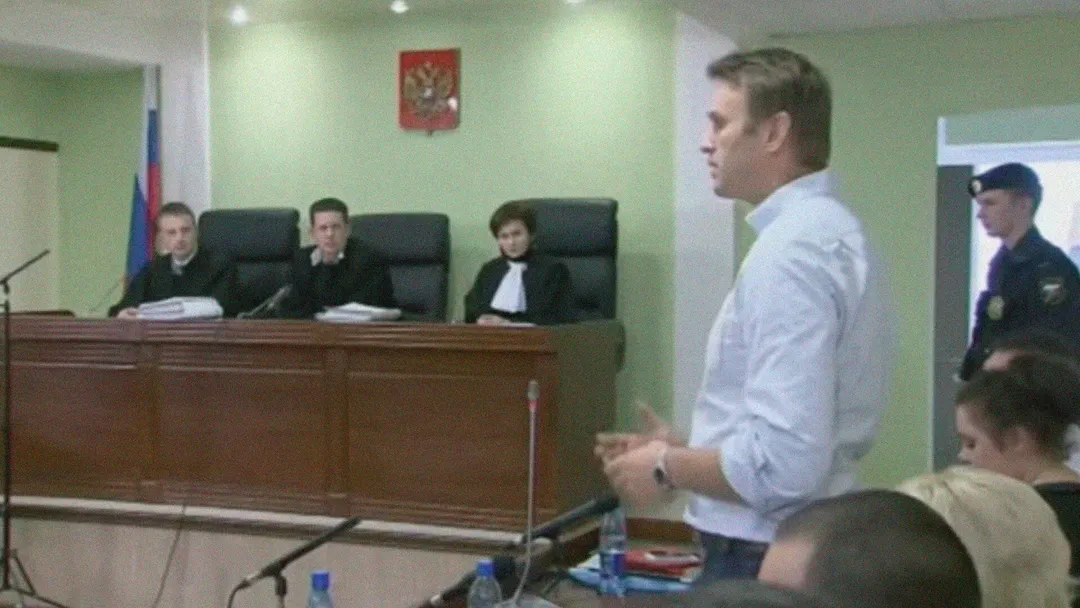
Good day to everyone present in
the courtroom and to those watching
via the online broadcast.
The court session is now open,
and the criminal case is being considered on
the appeals filed by the convicted persons
Navalny, Ofitserov, and by defense counsel
attorneys Mikhailova, Kobzev, Kobelev, and
Davydova against the judgment of the Leninsky
District Court of the city of Kirov dated July 18,
2013. Court clerk,
please report appearances.
Present at the court session are the convicted persons
Alexei Anatolyevich Navalny and Ofitserov
Pyotr Yuryevich. Defense counsel for the convicted
Alexei Anatolyevich Navalny are attorneys
Olga Olegovna Mikhailova, Vadim
Dmitriyevich Kobzev, Sergey Vasilyevich Kobelev,
and defense counsel for the convicted Pyotr
Yuryevich Ofitserov, attorney Svetlana
Viktorovna Davydova.
The state prosecutors are Petelina
Larisa Gennadyevna and Chermesinov
Yevgeny Nikolayevich. Not present at the court session are
the representatives of the injured party,
Pavel Valeryevich Smertin and Maksim
Vladimirovich Grinov. They were duly
notified and submitted a motion for the case to be considered
in their absence.
>> Thank you. The identities of the convicted persons are now being established.
Convicted person Navalny, please stand.
Please.
Please state your surname, first name,
patronymic, date, and place of birth.
>> Navalny, Alexei Anatolyevich, June 4,
1976, the village of Butyn
in Odintsovsky District, Moscow Region.
No prior convictions. According to the documents in
the case file, you were notified of the date,
time, and place of the court session on September 20,
2013, and of the adjournment of the
court session to October 4, 2013.
Is that correct?
>> Yes.
>> Very well. Please be seated. Convicted person
Ofitserov, please stand and state
your surname, first name, and patronymic.
>> Ofitserov, Pyotr Yuryevich.
Born May 4, 1975, place of birth
the city of Kansk. According to the documents in
the case file, you were notified of the date and time
and place of the court session on September 20,
2013, and of the adjournment to October
4. Very well,
>> please be seated.
>> Defense counsel and the prosecution were notified on those same
dates as well.
>> Defense?
>> Yes, Your Honor, yes.
>> Everyone has been notified for today.
>> Good.
The composition of the court is announced. The case
is being heard by the Judicial Panel for
Criminal Cases of the Kirov Regional
Court, consisting of Judge Albert
Aleksandrovich Rytkov,
Judge Nikolai Vladimirovich Sichikhin,
and Tatyana Nikolayevna Mazyuta; court clerk
Natalya
Viktorovna Prokhorova; state prosecutors Petelina
Larisa Gennadyevna and Cheremesinov Yevgeny
Nikolayevich; defense attorneys Mikhailova
Olga Olegovna, Kobzev Vadim Dmitriyevich,
Kobelev Sergey Vasilyevich, and Davydova
Svetlana Viktorovna. The parties are hereby
advised of their rights and obligations in
the court session. The parties have the right
to participate in the proceedings,
to challenge the composition of the court or
any of the judges, as well as other
participants in the process, on the grounds
provided by law; to file
motions, including motions for the examination of
evidence; to submit to the appellate court
additional
materials; to address the arguments of
the appeals, and also to present
objections to them; to participate in
the examination of evidence; and to speak in
oral argument. A convicted person has the right
to the assistance of defense counsel and the right
to make a final statement. The parties also have the right
to review the record of the court
session and submit comments on it,
as well as to receive a copy of the court decision and
appeal it by way of cassation.
The parties are required to observe the rules of
the court session.
Convicted person Navalny, please stand.
Please. Do you understand your rights?
>> Yes, I do.
>> Understood. Uh,
please sit down for now,
convicted person Ofitserov. Are your rights clear?
>> Yes, they are clear.
>> Understood. Parties, please be seated. Parties,
are your rights understood?
>> Understood. Understood.
>> Understood. Are there any challenges to the court?
Convicted person Navalny?
>> No.
>> None. Convicted person Ofitserov?
>> No.
>> None. Defense?
>> The defense has no challenges.
>> None. Prosecution?
>> The prosecution has no challenges.
>> None. Good. The parties are hereby informed
of the use of technical means
for online broadcasting
in the conference hall of the Kirov Regional
Court for those who have come to attend the hearing,
as well as on the internet. Also present at the court
session are representatives
of the mass media. Accordingly,
accreditation is being verified
based on the information available to the court. Thus,
uh
The Center has appeared for the court hearing.
RAPSI Legal Information Agency. Present here?
Representatives of RAPSI.
So, how many of you are there? There are three of us.
Camera operator.
>> Please state your surnames.
Labazov.
>> All right, once again. Labanov.
>> Andreev, Krivko.
>> Andreev.
Krivko. Good.
NTV.
Present or not?
>> NTV. Please state the surnames of those present.
>> Romanov, Verikov.
>> All right, photo and Tartaz.
>> Present.
>> Surname?
>> Lakhadze.
>> Mm-hmm.
All right, the Moscow representative of the agency...
France-Presse.
>> Present.
>> Present.
>> Surnames, please.
>> Maksimovshe and Annas.
Mm-hmm.
Good. The online publication Russian Planet.
>> Here.
>> Who is present?
>> Malyshe. Aurora Media...
news.
>> Submitted.
>> Present. All right. TV company, Reuters agency.
>> Present.
>> Present. Who?
>> Novik.
>> Novik.
>> Kotelpel. Shemetov and Bachinskaya. Mm-hmm.
European press photo agency.
>> Present, the news agency...
press.
>> Lovetskovdotov.
>> Present.
>> All right. BBC Moscow.
>> Lomatda.
>> All right. Mm-hmm.
>> No. Interfax.
Polzhi.
>> No.
>> RNTV television company. Bugaev, Samolov.
Mikhailov.
>> All right, thank you. Reporter newspaper.
>> Here. Yes.
>> Kotelnikov, Novaya Gazeta.
>> Good. Maria FM radio station.
No.
Channel One.
>> Here.
Kiyanovsky, Ivanov.
>> All right, good.
L
No.
>> Present.
>> Present.
>> Good.
>> Kommersant.
>> Walking around. I’m walking around.
>> Good. Forbes magazine.
>> Present.
>> All right, Nov...
>> All right, Blyokh, Novikov.
Radio Svoboda (Radio Liberty).
>> Luchnikova, Tatarski.
>> Good. Uh, the First City Channel in...
Kirov.
No.
The Vesti program, State Television and Radio Broadcasting Company.
Nazar already.
>> All right, good.
GTRK Vyatka.
>> No. Shvetsov, Okhotnikov.
No. RIA...
>> Novosti.
This is again...
>> the internet portal gorodkirov.ru.
All right, do the parties have any objections to...
the work of representatives of the mass media,
the introduction of an online broadcast,
and media coverage of the proceedings? Prosecution?
>> No, Your Honor, there are no objections. The court hearing...
is open to the public.
>> Convicted defendants,
if you are asking about media coverage, then we...
would like Channel One and, secondly,
NTV to cover this more objectively.
Thank you.
>> No objections?
>> No objections.
>> The defense has no objections. No, no...
objections.
>> Very well. The judicial panel authorizes...
photo, video, and audio recording
during these proceedings. Accordingly, the issue is permitted...
regarding the possibility of hearing, uh,
the case in the absence of representatives
of the injured party. That is Pavel Valeryevich Smertin
and Maxim Vladimirovich Blinov.
Opinion of the state prosecution?
Your Honor, I believe that it is possible, given the present attendance,
to begin consideration of
the criminal case on appeal,
since the injured party was duly
notified in the proper manner and did not wish
to participate in the court hearing.
>> All right, the opinion of the convicted defendants?
>> I do not object.
>> No objections.
>> Defense opinion?
>> No objections. I object.
>> Very well. So,
the parties are informed that, along
with the supplements to the appeals,
motions have been filed by defense counsel to summon
witnesses to the court hearing and
to order expert examinations. Accordingly, these
motions are subject to consideration during
the judicial investigation. In addition,
the motions indicated, any other
motions from the parties, are there any from
the prosecution?
>> No, there are none. there are
>> at this time we do not have any, Your Honor
>> none, the convicted person
the other defense counsel have none, good
we proceed to the judicial examination
thus, by the verdict of the Leninsky District
Court of the city of Kirov, dated July 18, 2013,
Alexei Anatolyevich Navalny
whose identity was established at the present
court hearing, was convicted under Part
3 of Article 33 and Part
4 of Article 160 of the Criminal Code
of the Russian Federation, and sentenced to five years
of imprisonment with a fine of
500,000 rubles (about 500,000 RUB) payable to the state, with
the principal sentence to be served in a
general-regime correctional colony.
Pyotr Yuryevich Ofitserov, uh, by the same
verdict, was convicted under Part 5 of Article
33 and Part 4 of Article
160, and sentenced to four years of imprisonment with a
fine of 500,000 rubles (about 500,000 RUB) payable to the
state, with the principal
sentence to be served in a correctional colony
of general regime. The preventive measure with respect to
Navalny and Ofitserov was
changed in the courtroom from a written undertaking
not to leave and to maintain proper conduct to
detention in custody. The term of punishment
for both convicted persons was ordered to run from July 18
2013. By the appellate ruling
of the Kirov Regional Court
dated July 19, 2013, the decision to
change the preventive measure for Navalny and Ofitserov
to detention in custody
was overturned. Until the verdict entered
into legal force, the convicted persons retained the preventive measure
in the form of a written undertaking not to leave and
proper conduct, with release
from custody in the courtroom. The previously imposed
seizure of Ofitserov's property was maintained,
as was the prohibition on carrying out registration
actions with Navalny's property. In
the event Ofitserov lacked
sufficient funds,
it was ordered that recovery be levied
against the seized property toward payment
of the fine. The disposition of
the physical evidence in the case was also determined.
Navalny was convicted for organizing and
directing the commission of embezzlement, that is,
the theft of another's property
entrusted to the offender, on an especially large
scale, and Ofitserov for aiding and abetting
the commission of embezzlement, with the same
qualifying element, by means of
providing information and means
for committing the crime.
Under the circumstances set out in detail in the verdict,
Navalny, being
an unpaid adviser to the governor of Kirov Region,
as the organizer
and leader of the crime, together with
Ofitserov, whom he involved as an accomplice,
decided at the beginning of 2009
to steal property belonging to Kirovles (a state-owned timber enterprise).
According to the plan they developed, Navalny and
Ofitserov, in February-March 2009, in
Kirov, under the guise of carrying out the powers assigned
to Navalny, which included, among other things,
the task of
developing programs for the restructuring
and reorganization of inefficiently operating
enterprises of various forms of
ownership, studied and
analyzed the operations of KOGUP Kirovles
(a regional state unitary enterprise), the structure of the enterprise,
the range of harvested and
processed products, after which
they informed its general director,
Opalev, that
the enterprise's products would thereafter be
sold through an intermediary.
Having obtained the consent of Opalev, who understood
that damage to Kirovles was inevitable,
Ofitserov, in order to create the appearance
of civil-law
obligations arising and of the lawfulness of the actions,
registered a company controlled by
Navalny, a limited liability company
called VLK, opening a bank
settlement account, and prepared and signed
on behalf of the company a supply contract that had no
economic purpose and
entailed causing damage to
KOGUP Kirovles. On April 15, 2009, this
contract was signed by Opalev, and in the
period from April 15 to June 13, Ofitserov and
Opalev, with Navalny's participation, signed
36 appendices to it establishing
prices for products that were knowingly disadvantageous to KOGUP Kirovles.
Further, Opalev, acting on
Navalny's instructions, used his
official position in order to increase the
volume of the enterprise's property. By order
dated May 19, 2009, he prohibited
the enterprise's forestry branches from
independently selling products.
After Ofitserov concluded supply contracts
with a number of buyers, in the period from
April 15 to September 30, 2009,
by embezzling property entrusted to Opalev on the basis
of state contracts,
with Navalny organizing and directing
this and with Ofitserov's assistance,
the counterparty, VLK LLC, was shipped
timber products in the amount of 10.84
10,084
277,000 cubic meters, for a total amount of 16,165,826
rubles and 65 kopecks, which constitutes an especially large
amount and resulted in
property damage to KOGUP Kirovles. In
their appeals, the convicted persons
Navalny and Ofitserov, and defense counsel, attorneys
Mikhaylova, Kobzev, Kobelev, and Davydova
They express disagreement with the verdict, considering
it unlawful, unfounded,
unjust, and issued in violation of
criminal and criminal-procedural
law, as well as due to the inconsistency of
the court’s conclusions with the actual circumstances
of the case. In support of this, they point to
the absence of any crime having occurred,
since no theft, with the mandatory elements
required under criminal law,
was committed by Navalny and Ofitserov,
and what took place was
a civil-law transaction between KOGUP
Kirovles and LLC VLK on the basis of a supply contract
and its appendices, which has not been
challenged and, from the standpoint of civil
law, is valid. The court
did not refute this circumstance.
The witness testimony cited in the verdict
from Bastrygina, Bur, Merkusheva,
Makaveev, and Opolev in this part consists of
value judgments, while other information regarding
amendments to the contract does not
indicate otherwise.
Confirmation of the absence, in the actions of
Navalny and Ofitserov, of any unlawfulness
is provided not only by the supply contract, but
also by the court-examined decision
of the commercial court ordering recovery from VLK
of funds for products supplied by
Kirovles on the basis of the
above-mentioned contract. They consider
the court’s conclusions untenable regarding
damage caused to the owner on the grounds of
the theft of property with
its simultaneous replacement by something of lesser value,
since no such replacement took place,
and for the products supplied, Kirovles
received payment, which
refutes the court’s conclusions about
the uncompensated taking of property.
They consider unsupported by evidence
the total value of products sold through LLC VLK
to be unproven. The court failed to take into account the provisions of
the law guaranteeing freedom of
economic activity, freedom of contract, and
the determination of contract prices in
conjunction with the fact that prices for
timber products are not regulated
by the state. The court did not seek to establish
the actual market prices for timber and
timber products in Kirov Region
in 2009, and instead made
an unfounded conclusion that products were transferred to LLC VLK
without equivalent and
adequate compensation. The verdict
contains no assessment of the opinion submitted by the
defense, prepared by a timber-products specialist,
with an analysis of prices in
the appendices to the supply contract and
the delivery invoices, which
show that more than 70% of
the total volume of products was purchased by LLC VLK
from KOGUP Kirovles at prices significantly
higher than the average market prices for comparable
products charged by other
producers in Kirov Region. The court
denied the motion for
the appointment and conduct of a repeat
financial, economic, and
merchandising forensic examination,
instead basing the verdict on expert opinions
obtained during the period of
the preliminary investigation, which
are incomplete and answer only an extremely
limited range of questions concerning
the overall turnover of LLC VLK and
the financial position of KOGUP Kirovles, but
do not determine the cost price of
timber products. They also consider untenable
the court’s conclusions that selfish intent
was proven. The case file contains no information about any payments
made in favor of Navalny or
Opolev, while Ofitserov merely received
a salary, nor is there any evidence of
any of the three receiving any other
material or non-material
benefit. It was not established that LLC
VLK incurred expenses not directly connected with
its core business. The court also gave an incorrect
assessment to the fact that
the loss-making operations
of LLC VLK, referring to Ofitserov’s management of
the company’s financial
activities and the distribution of
profits at his own discretion. All
actions of Navalny, who was
an adviser to the governor of Kirov Region
with relevant authority over
the socio-economic sphere, as well as
the actions of Ofitserov in conducting
entrepreneurial intermediary
activity, are not prohibited by criminal
law and therefore cannot
be regarded as criminal. The appeals further
state that the court violated
criminal procedure law,
by refusing to schedule and hold
a preliminary hearing despite
a motion having been filed, which the law does not require to be
supported by any special justification.
In such circumstances, in the opinion of
the convicted men and their defense lawyers, the court had no
right to delve into an assessment of the
reasonableness, necessity, and
expediency of holding
a preliminary hearing. By doing so, the court
demonstrated a lack of
impartiality.
The court violated the right to a defense by granting
an obviously unreasonable amount of time to review
the case file to Navalny’s newly retained defense lawyer,
attorney Obelev. Attention is also drawn
to the insufficiency of time
for the defendants and their lawyers to familiarize themselves with
the case materials, from which the court restricted them on
contrived grounds.
The convicted men and their defense lawyers believe
the court’s refusal to return the case was unlawful
to the prosecutor in order to remedy
the violations committed in drawing up
the indictment, in which, when
setting out the circumstances of the committed
crime, the amount
of the damage caused was not specified.
Two different amounts appear
for the damage allegedly caused to Kirovles.
The defense evidence was not set out.
The charge itself
was vague and unspecified. And the text
of the decision to bring [him] as an ac-
of bringing Navalny in as
an accused person, dated January 17, 2013,
does not correspond to the text
of the indictment. The court
ignored the defendants’ and
defense counsel’s statements that the charge was vague and
that they did not understand its substance, contrary to
the requirements applicable to a judicial
verdict. Violations were committed during
the questioning in court, as a witness,
of Opalev, who had previously been convicted and who
was deliberately not warned about
criminal liability for refusing
to testify, which allowed Opalev
to evade answering a number of questions
that were of material significance to the case,
and allowed the court to disallow questions, answers to
which would have helped establish that Opalev falsely implicated
Navalny and Ofitserov. Another
violation consisted in reading out, at the request
of the prosecution, in full
rather than only the contradictory parts,
Opalev’s testimony given in the context
of another case as an accused person, and
before his direct examination by
the defense and the court. Before the questioning,
the parties read out the testimony of
witnesses Burashutova, Kuznetsov,
Kiselyov, Koritnyuk, Osapov, Bulatov,
Barantsev, Vkursov, and others. The court deprived
[them] of the opportunity to obtain answers from
witnesses Bura and Opalev to Navalny’s
questions regarding circumstances having
significance for the case. There was a violation of the provisions
of Article 121 of the Criminal Procedure
Code. The court did not immediately rule on
the defense motion for
the exclusion of a number of inadmissible
items of evidence, thereby allowing
the prosecution to present them and
subsequently use them as the basis
for the verdict. The motion was denied
to obtain from the regional FSB office (Federal Security Service)
evidence that could not be
obtained independently by the defense,
namely audio files of telephone
conversations between Navalny and Ofitserov, the operational
surveillance file concerning them,
and information that would have made it possible
to establish the lawfulness of the wiretapping of
their telephone conversations. It was also denied to re-
quest accounting documentation
on settlements between LLC VLK Kirovles
and its forestry branch offices for the period from
April 2009 through February
2013 on the grounds that
this did not fall within the subject matter to be proved.
At the same time, an earlier
motion to attach to the case copies
of those documents obtained through
an адвокатский request (formal attorney inquiry) was not granted on
other grounds. Also denied were
defense motions for
the production of minimum prices approved by the directors of
Kirovles and its branches
for products, physical evidence,
and copies of procedural documents in
the case against Opalev, as well as
documents from the bankruptcy case of Kagub
Kirfles. The court ruled formally and, on
contrived grounds, refused and declared
inadmissible as evidence the materials of
operational-search activities concerning Navalny and Ofitserov,
which had been transferred to the
preliminary investigation authority with
violations of the federal law on
operational-search activity.
Documents concerning the obtaining of information from
mobile network operators about subscriber
numbers, the forensic voice and
psychological-linguistic expert examinations,
inspection records of physical
evidence, as well as the judgments in
the case against Opalev. The convicted men and their
defense lawyers believe that the judgment in
Opalev’s case could not have been examined
in court, because the case was considered
under a special procedure, and it had already predetermined
the guilt of Navalny and Ofitserov. The court
unlawfully left without satisfaction
the reasoned motion by the defense
to summon and question witnesses examined during
the preliminary investigation,
Akhmadulin, Klimov, Stalypin,
Kryuchkova, Atipolikhin, Kashin, Makarova,
Shchstlivtsev, Potappinko, as well as
experts Kislyakov, Ionova, Rykova, and
specialist Ratova, thereby depriving [the defense] of the opportunity
to have the statements of the above-mentioned persons read out,
thus violating the adversarial principle and
equality of arms. The appeals also
point to a violation of
the rights of the accused provided for by Article 198 of the Criminal
Procedure Code
when expert examinations were ordered and conducted in
the framework of a criminal case that was initiated and
later terminated under paragraph “b”
of part 3 of Article 165 of the Criminal
Code of the Russian Federation, the results
of which were used as the basis
for the appealed judgment. Attention is also drawn
to the untimely preparation
of the record of the court
hearing and familiarization with it.
The convicted men and their defense lawyers ask that the verdict
to overturn it and issue an acquittal
judgment. In addition to the appellate
complaints, defense attorneys Mikhailov and Davydov,
citing the testimony of the victim's representative,
all witnesses, and
the written evidence as set out
in the judgment, point out that this
testimony and evidence refute
the court's conclusions that Navalny and
Ofitserov were guilty of embezzlement in the form of
misappropriation, and confirm the position
of the convicted men and the defense that there was no
criminal act and that Navalny and Ofitserov were
objectively imputed with
committing the offense
provided for in Part 4 of Article
160 of the Criminal Code of the Russian
Federation. In the defense attorneys' view,
the testimony of the persons questioned in the case
indicates only alleged
additional costs for the production of
the forestry enterprises' products. Witnesses Opolev, Bura, and
Bastrygina testified that the supply contract
met the basic requirements, and that
the inclusion of penalty clauses in it did not
contradict civil
law.
The contract between Kogutirov Les and VLK LLC did not
bear the hallmarks of a sham transaction and was not
gratuitous. And the court's subjective
conclusion to the contrary on this point
is contradictory and unsupported by anything.
The difference in the price of the products after
the contracts were re-executed with
the consignees does not indicate
that the transaction was invalid, while possible
lost profits, as described by a number of
witnesses, do not constitute the elements of a
crime. Attention is drawn to the fact
that for the former counterparties of
Kogubkerafles, the prices and terms after
the contracts were re-executed did not change.
They consider the court's conclusions
regarding the determination of a price corresponding to
the actual market value of
timber products to be unfounded. The written evidence set out in the judgment
shows
that VLK LLC
paid for the shipped
Kogubtirovles timber products,
and that the price difference constituted equivalent
compensation. They regard as wholly unsubstantiated
the court's conclusions that the products were sold
at knowingly understated prices.
The text of the order establishing the procedure for
the sale of Kogubtirovles products does not
state any aim of creating for VLK LLC
the most favorable conditions. The content
of the email correspondence relied on as a basis for the judgment
indicates
Ofitserov's intention to conclude a contract.
Attention is again drawn to
the inadmissibility of the results of the wiretapping of
telephone conversations involving Navalny and
Ofitserov, the inspection of those recordings, and the experts'
conclusions. The court did not properly substantiate their
evidentiary value, nor did it
take into account that the allegedly established intent to
commit the crime arose and was
carried out during a period different from the one covered by the wiretapped
period
conversations. In the defense's view,
the court misinterprets the clarifications given in
the resolution of the Plenum of the Supreme Court
regarding the indicia of gratuitousness and
the taking of property and the causing of damage
to the owner.
Defense counsel consider it unlawful and
unreasoned for the court to have ruled
that the following evidence was inadmissible:
information on the operating results of Kirovles
for the first half of 2009, and
the explanatory note to the accounting
statements, since such a step is not
provided for by criminal procedure
law at the stage of rendering a
judgment without taking the parties' views into account.
This violated the provisions of Part 2 of Article
307 of the Russian Code of Criminal Procedure. The court did not assess
the evidence submitted by the defense to rebut the claim of gratuitous taking,
namely
payment orders and
a payment order showing the transfer by VLK LLC of
funds to Kakbrovles.
The judgment was based, as evidence, on
a report on the examination of
documents concerning the prices of the supplied
Koguptirov timber products, in the part
that was not read out in court. The judgment contains no assessment of
the absence in that report of information confirming
the transfer of money to Navalny or to other
individuals or legal entities.
In the defense's view,
the court committed substantial violations of
criminal procedure law and failed to take into account
the clarifications set out in the resolution
of the Plenum of the Supreme Court on judicial
judgments, by issuing a conviction
based on assumptions,
and on conclusions about the proven guilt of Opolev, in
respect of whom the case was severed into
separate proceedings, and also despite the presence of
unresolved doubts and
the failure to prove the guilt of Navalny and
Ofitserov. In additions to the appellate
complaint, defense attorney Kobelev points to
Navalny's non-involvement in the act
that the court found criminal, because
no evidence was presented that he was aware
of the underpricing of Kogubkirovles products
before the results of the company's audit
were available, nor was there evidence
of a prior conspiracy between
Navalny, Ofitserov, and Opolev specifically
to steal property by way of embezzlement. He also considers unfounded
and unsupported by the evidence
the court's conclusions regarding
the awareness of all three of
the inevitable infliction of damage
on the enterprise, since at the time
the supply contract with VLK LLC was signed
the prices for the products had not been determined. No
evidence has been presented
confirming that Navalny
organized the preparation of a knowingly
loss-making contract and knew of his
ability to influence
the activities of state-owned enterprises
in the region. In connection with this, uh,
considers the court's conclusion unfounded that
Opolev could not have been mistaken about
Navalny's lack of authority to give him
any binding
instructions. Contrary to the arguments
of the appeal, it expresses
disagreement with the court's finding on
the unreliability of Kirovstat data and
the expert opinion on average prices
for timber products. Defense counsel considers
the conclusions speculative regarding the absence
of any need to sell the products
of Kirovles through VLK LLC, since
the enterprise's profit from sales
of products to newly engaged
counterparties was not established. With
reference to an incorrect understanding
of the clarifications set out in the resolution
of the Plenum of the Supreme Court of the Russian
Federation, in the supplement to the appeal
the arguments are again set out in detail concerning
the absence of all elements of theft, the
validity of the supply contract, and
disagreement with the conclusions set out by the court in
the judgment to refute
the defense position. In written objections,
the state prosecutors, the head
of the state prosecution department
for appeals of the criminal judicial directorate
of the Kirov Region Prosecutor's Office, Bogdanov, and
prosecutor Cheremisinov of the same department, with
a detailed presentation of their position
regarding the arguments in the appeals
of the convicted persons and their counsel, ask that
they be denied. So,
the floor is now given, please,
to the convicted persons and the defense on the arguments of the
appeals. So, before that
let us determine the order of speaking on the
appeals. At the same time,
the court draws attention to the fact that
the contents of the appeals and
the supplements to them contain the same
arguments. Uh,
whether it is advisable to repeat them
in each of your statements.
All right. So, the order of speaking on the
appeal arguments: first, counsel for
Navalny, and then counsel for,
respectively, Ofitserov.
>> All right, please. No objections, your hon-
>> No, there are no objections.
>> Please, we are listening.
>> Then we will begin. Actually, I will
start.
>> So, we believe that the appealed
judgment, issued by Judge
of the Leninsky District Court of the city of Kirov
on July 18, 2013, does not comply with
the requirements of criminal procedure
law, is unlawful,
unfounded, and unjust.
The judgment was rendered contrary to the current
criminal law, in the absence
of both the event of a crime and the elements of a crime,
with glaring distortions of the factual
circumstances of the case, with the gravest
violations of the law, and not only
of Russian law, but also
of international legal instruments.
Such a judgment is unquestionably subject to
reversal. And the first thing I wanted
to draw attention to is that the text
of the appealed judgment, from page two through
page fifty-two, completely
repeats the text of the indictment
drawn up by an investigator
of the Main Investigative Directorate
of the Investigative Committee of the Russian
Federation.
Even the witness testimony, excluding
the first five,
is presented in the judgment in the same
order as in the indictment.
Only minor changes were made by the court,
and the testimony given by witnesses
in court was not taken into account.
Thus, uh, Judge Blinov
simply copied the indictment
and, uh, called this
document a judgment.
And the court found Navalny and Ofitserov
guilty of committing a crime, in
the absence of both the event and the elements
of a crime.
We believe that these conclusions of the court are
completely unfounded,
and contradict the requirements of both Article 160
of the Criminal Code and
Note 1 to Article 158,
which require the presence
of a certain number of qualifying
elements in order to find a person
guilty of committing the offense
provided for by that article.
And when
rendering the judgment, the court failed to take into account that
the defendants' actions must be
unlawful,
and the owner must suffer
actual damage. Property must be taken from the owner
without compensation,
and another person's property must be converted to the
benefit of the guilty party and other persons. But these
circumstances were not
established by the court.
Uh, at least in our view, and
This is clear from the judgment, because
the court, in its judgment, did not provide a single
convincing argument based on
documents examined during the trial
documents,
that would confirm the existence of
the above-mentioned elements necessary for
classifying the actions as theft of
property.
Moreover, the evidence in the case
confirms the lawful, rather than
unlawful,
nature of the actions of both Navalny and
Ofitserov.
Nevertheless, in its judgment the court
repeatedly refers to, as an
established fact, that in entering into the contract
between Kirovles and VLK, Opalev,
Navalny, and Ofitserov acted
in accordance with a common purpose aimed
exclusively at creating the appearance
of Kirovles incurring
civil-law obligations to
VLK, allegedly on a compensated basis, to
transfer timber products
to the consignee.
And in support of this conclusion, the court
cites the testimony of a number of witnesses, which
contains only evaluative
assertions.
And there is no data indicating
how the court could have reached such a conclusion,
anywhere else in the judgment.
In addition,
the defense submitted to the materials of the criminal
case, and they were examined at the
hearing, the decisions of the Arbitration Court
of the Kirov Region, by which the contract
between Kirovles and VLK was recognized as
valid, duly concluded,
and not contrary to civil
law.
Moreover, as was clear from these
decisions, funds were recovered from VLK through civil proceedings
for
the timber products supplied.
However, all of this was
ignored by the court, and, uh, in its judgment the court
states that
Kirovles's property was transferred for the benefit of
VLK unlawfully and against the will of the
owner.
In addition, I would like to note that
the court, in asserting in its judgment that
the owner suffered damage,
refers to the Plenum Resolution of the
Supreme Court on judicial practice in
cases involving fraud, misappropriation, and
embezzlement,
and, uh, states that there was
a substitution of valuable property for less
valuable property.
However, as we know from the case materials,
for the 10,000 cubic meters of timber supplied.
Well,
Kirovles did not receive some substitute property.
There was no substitution of property in this case,
rather, money was transferred.
Clearly, funds in the amount of
14,785,000 rubles
cannot possibly be regarded as less valuable
property, since these were monetary
payments, and what was transferred was specifically
money. Nevertheless, in its judgment the court
states that the result of the unlawful
actions of the accomplices to the crime
was the transfer for the benefit of VLK of
timber products in the amount of 10,000 cubic meters
worth 16 million rubles, and says that
the compensation was inadequate.
Moreover, the trial court
completely withdrew from an objective
examination of this case and did not
seek to establish or assess in
its judgment the actual market prices
at which, uh, timber products
were purchased and sold in the Kirov
Region in 2009.
At the same time,
despite the clear and obvious
need in this criminal case for
expert examinations that should have
analyzed comparable
prices on the timber market,
the court denied the defense's request for
such examinations. No such
expert reports are contained in the case file. And
how the court arrived at conclusions about
whether the value was equivalent,
whether the compensation was adequate, and so on,
is completely unclear. All such
assertions are entirely unsubstantiated and
are not supported by anything, including
the case materials. On the contrary, the
defense submitted to the court
an expert opinion showing that
VLK, uh, purchased timber products from
Kirovles not merely at non-discounted prices,
but at prices that were
many times higher than the prices that
prevailed in the Kirov Region at that time.
For some items, uh, the excess of
the prices at which the products were purchased
from Kirovles reached 200%.
And in addition, I would like to note that
all of Navalny's and Ofitserov's actions
were examined in detail during the
trial, and they are
entirely lawful
and
not criminally punishable.
Nevertheless, the court concluded otherwise. And
despite the fact that
Navalny had
the opportunity
to familiarize himself with Kirovles's activities,
this was entirely a lawful part of his
activities, since his authority
specifically included, uh, monitoring the work
of financially loss-making enterprises
in Kirov Region, he put forward his own
ideas and principles for development, but nevertheless
for some reason the court concluded that such
activity was unlawful.
The court withdrew from upholding the rule of law
in this criminal case and violated
the provisions
of Article 8 of the Criminal Code,
which establishes that the basis
for criminal liability is
the commission of an act containing all
the elements of a criminal offense. And in addition
to this, we believe that such a
position taken by the court runs contrary to the provisions of
Article 7 of the European Convention,
which provides
that punishment may be imposed only
strictly on the basis of law, in
accordance with the general principles of law
recognized by civilized nations.
As for violations of the
Code of Criminal Procedure,
that were committed by the court. The reporting judge
has already set them out in considerable detail
I would like to focus on
several of them. Indeed, from the outset
from the very first days of the trial
in the Leninsky District Court, the court adopted a position under which
the defense was clearly restricted
in its ability to exercise its rights
as provided for by the Code of Criminal Procedure
.
On a contrived pretext, the court refused
to hold preliminary hearings,
refused to provide sufficient
time to review the case materials,
which in turn gives rise to
a violation of Article 6 §3(b)
of the European Convention.
It refused to return
the criminal case to the prosecutor, despite
clear violations of the law, and
committed numerous violations during
the questioning of witnesses, in particular
Mr. Opolev, not allowing
the parties to ask questions or fully
exercise their rights, while, uh, allowing
the prosecution to read out the testimony
of witnesses before they were examined by the defense.
Under such circumstances, despite
objections, the testimony of
a large number of witnesses was read out, including
in particular Opolev, Bura, Shutova,
Kuznetsov, Kiselyov, Koretnyuk, Osapov,
Bulatov, Barantsev, Furtsev, and others.
And, of course, such violations
constitute, in addition to violations of Russian
law, also a violation
of the provisions of Article 6 of the European
Convention.
In addition, the court violated
the requirements of criminal procedure
law when considering our
motions. The motions were not
considered
without delay.
All of this concerned motions
seeking the exclusion of evidence. And
the court
would spend several days considering
a motion, thereby allowing
the prosecution to present that
evidence and have it examined in court. And
only after that would it rule on our
motion, 7 to 8 days after
it had been filed, and would rule on our
motion concerning the inadmissibility
of the use in the proceedings of inadmissible
evidence.
In addition, the court denied our
motions seeking
the production of materials important to the case.
In particular,
it refused to request materials
relating to the prosecution of Opolev
on criminal charges. The court also
refused to request the case file on
the bankruptcy of Kagubkerov Les, documents
from the Federal Security Service (FSB) and
materials from
the criminal case against Opolev,
which was heard in the Leninsky
District Court.
And in addition, the court
rejected all of our numerous
reasoned motions concerning
the exclusion
of evidence obtained improperly.
As a result, during the trial
audio recordings were played
and relied on in full as the basis
for the verdict: recordings of telephone
conversations between Navalny and Ofitserov,
which, under the applicable
law, should have been
destroyed back in 2010. This
is a requirement of the law, specifically
the federal law on
operational-search activities,
which requires such materials to be destroyed
after 6 months if no criminal case has been
opened. And that is exactly the situation
that arose in this case, when
court authorization was obtained for
the wiretapping of Navalny's
and Ofitserov's phones within another criminal
case, in which they were not involved
in any capacity whatsoever, even as witnesses; that
is, they were not participants at all.
Accordingly, if such authorization
was obtained, but no criminal case
was opened against them, then such
audio recordings should have been destroyed.
They were not destroyed, but were instead used
in these court proceedings, despite the clear
a violation of the law in obtaining them.
Moreover, the court based its verdict on
the judgment against Opolev,
who had entered into a pre-trial cooperation agreement.
In this judgment, in violation of the norms of
current Russian
legislation, as well as the provisions of
the European Convention for the Protection of Human Rights
and Fundamental Freedoms, the court
used wording that directly
indicated the establishment of guilt
not only of Opolev, but also of Navalny and
Ofitserov. At present, on this matter
we have filed a complaint with the European Court
and hope that in the near future
there will be some result on that complaint.
In addition, we believe that it is impossible
to regard as fair any trial
in which the defense
was denied the right to call and question
witnesses, including experts. And
such a violation of the provisions of, uh,
Russian legislation also constitutes
a violation of the provisions of Article 6(3) as well. Uh,
I believe that we have submitted such a motion
and that the court will ultimately rule on it.
And furthermore, by stating in the judgment
that timber products were purchased by Sukhoguzhles
at allegedly reduced, non-equivalent
prices, the court completely refrained from
examining timber prices. I
said that the defense was denied
its motion; we believe that this
was the key motion, for the conduct of
a financial, economic, and
commodity valuation expert examination. It is entirely
obvious that the nature of the charges
considered by the court
required such an examination. Yet
no analysis or comparison of timber prices
for timber products
was carried out. And the prices on the timber market
were not compared with the prices at which
VLK Kirovles products were sold
to Kirovles in any way
whatsoever.
We believe that in the absence of this kind of
expert opinion from specialists possessing
specialized knowledge in the field of
economics, all of the court’s assertions about allegedly
non-equivalent prices are entirely
unsupported and contrived.
We, uh, believe that during the trial
the court, uh, in addition to violating
Russian legislation, also violated
a number of provisions of the European Convention on
Human Rights and Fundamental Freedoms,
in particular Article 6, which guarantees
the right to a fair
trial, as well as Articles 7,
8, 13, and 18.
We believe that such a verdict must be
overturned. And taking into account the circumstances
of this case, we ask that our clients be
acquitted. That is all.
>> Thank you.
>> Your Honor, I fully support the arguments in the appeal.
I support them in full.
I believe that no crime took place.
The elements of a crime are absent in
the actions of both Navalny and Ofitserov.
They are absent.
An entirely lawful and ordinary
civil-law transaction was deemed by the judgment
to be
a crime by Blinov. In effect, in the view
of the trial court,
the purchase and sale, the purchase and sale of goods
is a crime. I consider this
absurd.
the verdict, in view of its unlawfulness,
lack of foundation, unfairness,
and lack of reasoning.
And I ask that the conviction of Navalny
be overturned and that he be acquitted.
Counsel.
Your Honor, I fully support
the arguments set out in the appeal,
which were presented quite fully and
in detail by the reporting judge.
I also support the positions of my colleagues and
support
the arguments set out in the supplements
to my appeal. In
particular, this is the argument that
Alexei Anatolyevich Navalny was not involved in
the act described in the judgment.
Uh, Alexei Anatolyevich Navalny did not
know the prices at which the company’s products were being shipped,
the products of the Kirovles enterprise, and
therefore he could not have organized the shipment
of those products at reduced prices. And
I also support the second argument
set out in the supplements to the appeal,
which is that
the circumstances established
by the trial court do not constitute
a crime, because they do not contain
all the mandatory elements of theft,
such as unlawfulness,
gratuitous taking, and the existence of damage.
Therefore, I ask that the judgment of the Leninsky
District Court of the city of Kirov be overturned, and that
Navalny and Ofitserov be acquitted.
>> Your Honor, first of all, I would like
to join all of the arguments
presented by my defense. Second,
I would like to say that I consider the decision of
the Leninsky District Court of the city of Kirov
to be unfounded, unlawful, and unsupported
either by law or by the factual
circumstances of the case. In fact, Judge
Blinov simply, uh, turned into a judicial
decision that fabricated indictment prepared by the Investigative
Committee,
which was drafted in Moscow and which
was prepared with an obvious political
motivation. And it seems to me that the political
The motive behind this case is obvious to any
observer. And clearly, even from here in the
Kirov Regional Court, since it was precisely here that
rather
unprecedented and unique events unfolded regarding
my sudden, our sudden
release, and so on, which of course
I was pleased about, but nevertheless
the uniqueness of these strange
events, when a person is arrested and
sentenced to five years in prison, and the very next day, at the request of
the prosecutor's office, is released,
obviously after surprising and
sudden instructions from Moscow,
the political motivation behind this case
was completely obvious. I would like
to draw the court's attention to the fact that in
the case materials, in the indictment,
in the verdict, on every
page there is mention of damages being caused,
prices being understated, and so on, and so
forth. But there is no evidence of this whatsoever.
Despite our repeated demands for
a financial, eco-
nomic, accounting,
and commodity valuation examination, none of them were carried out.
And this is absolutely crucial.
It is impossible to examine in court
questions of price understatement or
causing damages without any materials
or documents. But who among us is qualified to judge
timber prices? A senior investigator for especially
important cases from the Investigative Committee,
sitting in Moscow? Of course not. And in
the Leninsky District Court, this issue was not
examined either.
The entire case is essentially built on the false testimony
of Mr. Opalev and his
daughter, his chief accountant. These are exactly
the people against whom I
repeatedly tried and demanded
that criminal proceedings be initiated. I fired Opalev.
And the materials from those criminal cases
exist in the possession of law enforcement agencies.
The judge of the Leninsky District Court also refused
to request all of those materials.
I believe that the court, the Leninsky District Court of the city of
Kirov, completely distorted the meaning of
the official duties of absolutely any
public official. Yes, although I
was not formally a public official, I was
an adviser to the governor of Kirov
Region, but I said it then and I want
to insist now that, broadly speaking,
90%
of the time of any official, any adviser
to a governor, any deputy
governor, any department head—90%
of their time is spent
in negotiations with various
business representatives. A public official does little else
but communicate with representatives
of contractors, with companies
that deal with housing and public utilities (communal services), and other
sectors. All day long he is on the
phone talking to representatives
of business. And under the perverse
logic applied by the Leninsky District Court
of the city of Kirov, any official at all
would have to be arrested immediately for
discussing prices for timber, gasoline,
kerosene, utilities, heating, or water. That is,
after all, how the system
of governing the country works. In other words, officials
interact with business entities.
And during the proceedings, the question was not examined at all:
what, exactly,
was the personal gain for me or even
for Ofitserov? Where, exactly,
did those 16 million rubles go that someone
supposedly stole? Where are they? Into whose accounts were they
deposited, where did they disappear to? None
of this exists at all. And despite the fact that
we repeatedly demanded
that an expert examination be conducted, that we
carry out an audit. After all, from the bank
statements it is absolutely clear where
every kopeck of those notorious
Kirovles funds went. This issue was not
examined at all, for a very
simple reason: because if
a financial or
economic examination of all this had been carried out,
the case would have had to be dismissed immediately.
Not only should the case have been
dismissed, a new criminal case should have been opened
instead, but this time against
the investigators of the Investigative
Committee who fabricated
and unlawfully initiated this case.
And
no commodity valuation examination was conducted,
despite the fact that
the issue of prices for this
timber was constantly discussed, and it is quite easy to examine.
Kirov Region is a timber-producing region,
a region with a huge number of
forestry enterprises. A comparison
of the prices at which
Kirovles and VLK dealt, with other prices, or
a comparison of the prices at which the same
Kirovles, during the same period,
sold its products to other
counterparties, would unequivocally have shown
that during that same period VLK was not
buying anything more cheaply. It was buying
at exactly those prices, or even
sometimes higher. This was not
examined at all. In the matter of the
commodity valuation examination, we were also
refused for precisely the same reason,
because comparing these figures
would instantly have led to the dismissal of
this case.
was not questioned
the bankruptcy administrator of Kirovles. This is
astonishing, because yes, not
the formal owner, the department
the property of Kirov Oblast (a region of Russia), but
the insolvency administrator of the company
Kirovles, who is handling
the bankruptcy of this company, could have
provided comprehensive information about
which companies did or did not cause
damage. In fact, this same insolvency administrator
when approached by
members of the media,
said in every interview
that this was nonsense, and that in the overall scale of
Kirovles’s problems, in terms of the losses
suffered by Kirovles, VLK’s share was
negligible, and no one bought anything
at artificially low prices. But,
despite this, the court for some reason did not
take any interest in that testimony.
Therefore, I would like to say that
consideration of this case at first
instance or here on appeal
is absolutely impossible without
conducting expert examinations
in financial economics, accounting,
and merchandise valuation. I believe such
examinations must be carried out during
these proceedings. I believe that
no outcome in this case other than
my acquittal and the acquittal of
Pyotr Ofitserov, who is in fact
an incidental person and an incidental
businessman, whom this case
dragged in merely to
manufacture it—no other outcome
in this case is possible. Thank you.
>> Thank you.
The floor is given to Ofitserov’s defense.
>> Attorney Davydova, counsel for Ofitserov.
Dear colleagues, I respectfully ask that you
grant the appeal that has been filed.
I maintain that
the new judgment issued against my
client is
unlawful, unfounded,
and unjust. Moreover, I note
that both in rendering the verdict and in
the conduct of the case, that is, during
the trial proceedings, the requirements of the
Criminal Procedure Code were violated. And these are precisely the
violations that must, without question,
result in the reversal of the
verdict. I do not consider it necessary
to repeat all the arguments set out in my
appeal. I believe they were
presented quite fully by you, and
in addition,
my colleagues also spoke at sufficient length. But I want
to say to the honorable court that, unfortunately,
in rendering the verdict
under the presiding Judge Blinov at the
Leninsky District Court of the city of Kirov,
Judge Blinov in effect
set aside the requirements of the presumption of
innocence. In my view, the presumption
of innocence means that unproven
guilt is equivalent to proven
innocence.
I believe that in this case the innocence
of my client has been fully and conclusively established.
And all doubts,
contrary to Judge Blinov’s position,
as set out in the verdict, must
be interpreted in favor of my client.
It is very troubling to me that,
as is clear from the verdict that was issued,
as is clear from its text, instead of
applying the requirements of the presumption
of innocence, Judge Blinov
applied a presumption of reliability
to the materials of the criminal case, and all
the doubts that existed in the
evidence presented by the prosecution,
instead of
interpreting those doubts in favor of my
client, Judge Blinov interpreted those doubts
in favor of the prosecution,
which, in my view, is impermissible and
contrary to the requirements of the Criminal Procedure Code and
the Constitution of the Russian Federation.
And I believe—and we have all read the verdict,
we have all read the appeals and the objections to them—
that with the evidentiary record as
it is presented even in the text of the verdict, there can be no
question whatsoever of
finding my client guilty of
embezzlement. I believe that this
contradictory evidentiary record
can serve only as the basis for
an acquittal. In addition,
I would like to draw your attention,
dear colleagues, to the fact
that again, as is clear from the text of the
verdict,
Judge Blinov,
in fact, cannot himself
determine what exactly constitutes
embezzlement: whether it is the purchase
of timber products by VLK from Kirovles at
non-equivalent prices, or whether it is
non-equivalent compensation, or whether it is
a purchase at knowingly
below-market prices. But then
let us determine what constitutes
non-equivalent compensation, and whether the concept of equivalence
applies at all to
contracts of this kind. Because we all
know that the universal equivalent
in sale-and-purchase transactions, in
contracts of sale, the universal
equivalent is money. And replacing
goods with money can no longer be
non-equivalent.
And I want to say that, again, when speaking
about the presence of the element of gratuitousness,
Presiding Judge Blinov relied on
Resolution No. 51 of the Plenum of the Supreme Court
of the Russian Federation, dated 27
December 2007. But again, that
reference is incorrect and inapplicable here.
to this case, because in
this reference to the Plenum resolution
point 25 concerns the replacement of property
with less valuable property. And perhaps
this requirement of the Plenum
applies to a different category of cases. But
for example, when the accused was entrusted with
certain property, misappropriated it,
converted it to his own benefit and replaced it with some
other property whose value was substantially
lower. But that is an entirely different
category of cases.
If, however, we are talking about the acquisition of
property at a price knowingly below market value,
then it would be appropriate, properly speaking,
to prove, once again, that this
property was acquired at a price
knowingly below market value. And I stand by my
position; it has not changed in the slightest. Namely,
that this element—proving this
knowing disadvantage of the acquisition—
must be established not by witness testimony, but by
documentary evidence; there must be
reports, expert opinions; it is necessary
to calculate and assess at what price
this product, or products similar to it,
in this particular region
could have been sold as of
April, May, June, and July-August 2009
.
And I want to say that one cannot substitute
this statement about a knowingly
below-market price with what
some witnesses said, for example,
about imposing on the forestry enterprises of the branch
Kogubkerovles the obligation to bear
additional expenses. Because those
additional expenses either
should have been included in the cost of this
product, or, as can be seen from the
materials of the criminal case,
which were examined by the court
of first instance, these additional
expenses were reimbursed by the limited liability company
Vyatskaya
Forest Company. And we examined these
documents. This includes, in particular,
a payment order which, if I am not
mistaken, is contained in volume 27
of the criminal case file.
If, however, we are talking about some alleged lost
profit, then that lost profit
does not constitute an element of embezzlement; it is not
embezzlement. Lost profit is
still something else.
In addition, I want to draw attention,
colleagues, to the fact that
again, when the judgment was issued,
the requirements of
Article 90 of the Russian Criminal Procedure Code were violated; that is, there was no
recognition of the prejudicial effect of the decision
of the Arbitration Court of Kirov Region (a state commercial court in Russia).
These arguments are set out in detail in the
appeal. I do not want to dwell on them
again, but I ask that they be
taken into account when deciding
this case.
And, of course, I maintain my
appeal. I ask that the judgment rendered
in this case, which is being appealed, be set aside. I ask
that in respect of my client
an acquittal be entered.
>> Thank you.
Ofitserov.
>> Your Honor, as for the proceedings,
well, the sentence handed down by the district court,
is astonishing in a number of respects. First of all,
because, as my
colleagues said, in this
economic case there is not a single
economic expert examination; that is,
questions of price, questions of
equivalence and non-equivalence—neither
Judge Blinov, nor the respected prosecution,
and certainly not the investigators of the
Investigative Committee of the Russian Federation, could
properly assess them, because they do not have
the relevant education or
competence to give a
correct assessment. And yes, no such
assessment was provided to me either. The overall impression from
the investigation and the court was that
"good enough as it is" would do. In childhood I watched a
cartoon called *Good Enough As It Is* (a well-known Soviet animated short).
And in it, all the characters strove
to make things worse for those around them,
for the positive characters, and also to make
everything turn out badly. Because
"good enough as it is" is always bad. Because
if everyone does their job
well in their proper place, then everything around us
becomes better: the roads,
education, healthcare. But in these proceedings,
again I repeat, there was not
a single expert examination, and all
the conclusions, both by Judge Blinov and by the prosecution,
were made based on gut feeling.
For some reason, it seemed to them that this
was probably so. And of course I can
assume that they are
clairvoyants, but they are legal
professionals and representatives of the state. Therefore
the matter of feelings, I think, should
be dealt with in a different
room, and not on behalf of the state.
And so I want to remind you once again that
in the course of these proceedings, the witnesses who
testified for the prosecution, for the most
part—apart from three people, namely
Opalev and his associates—gave testimony
in our favor. They said that this
transaction was ordinary, and that the sales were at
the same prices as for other clients.
Moreover, some of the forestry enterprise directors
said that if it had not been for VLC,
they would have had nothing with which to pay wages, and that
VLC's work helped them through a difficult, hard
period when there were no sales at all.
Therefore, uh, what took place during the proceedings and
the verdict that was handed down, they
at the very least contradict each other. And
the second thing I would like to say in
conclusion is that the Leninsky District Court
did not pass sentence on Navalny and Ofitserov.
The Leninsky District Court passed sentence on
the Civil Code of the Russian
Federation, which permits free
economic activity, within the framework of which
trade is just as legitimate.
Incidentally, trade is one of the
revenue-generating
sectors of the economy. But
Judge Blinov, in his verdict, prohibited
this activity. Because he
considered that buying and selling, uh,
is unlawful,
and compensating goods with money is
non-equivalent. Thus, all people
who buy in stores everything from
household appliances to bread, are engaging in
non-equivalent transactions, and they all
are potential criminals.
Either Judge Glenov, in the verdict, got something
wrong
wrongly decided and wrongly wrote, or
the Civil Code needs to be rewritten.
Therefore, I believe that the motion
of the defense and the appeal against the verdict should, I ask, be
granted and accepted with regard to our
agreement.
>> Thank you.
The floor is given to the state prosecutors.
Order. Decide among yourselves who will speak.
Your Honor, we believe that the arguments
of the convicted Navalny and Ofitserov
set out in their appeals, as well as the arguments of their
defense counsel, presented in the appellate
complaints, are not subject to satisfaction.
A more detailed position of the prosecution, then,
we will set out during the parties' closing arguments.
Your Honor, I object to
the appeals of the convicted persons and their
defense counsel; in more detail, the prosecution's position
will be presented during argument.
>> Very well. The parties are advised that
the arguments set out in the appeals and supplements
to them may be examined both during
the appellate court's review of
the case materials and by means of
direct examination in
the court hearing of all or отдельных
individual items of evidence that were examined by the court
of first instance, if, in the opinion
of the parties, there is a need for this. So, at
this moment we are moving on to the consideration of
those motions that were filed
together with the supplements, that is, to
the appeals. And there are two
motions. The first motion is to summon
to the court hearing witnesses,
experts, and a specialist. And the second
motion is for the appointment of two expert examinations.
Uh,
I believe the parties will not object
if the defense states both
motions. On both motions
the prosecution will state its position, and the court will
decide these motions in
the deliberation room, since with regard to
the appointment and conduct of an expert examination, this is
a mandatory requirement. As for the summoning of
witnesses to the court hearing,
since the microphones are on and
the confidentiality of judicial deliberations
cannot be ensured, this motion will also be
decided in the deliberation room.
Please, the floor is given to the defense
regarding the motions that were
identified at today's court
hearing.
>> Ah, Your Honor, I did not quite catch
the procedure. May I present both motions
at once?
>> Yes, that is, both motions, and
the parties will speak.
>> And once again, Your Honor, they
were submitted in writing. I believe that
the prosecution has reviewed them.
Is there a need to read them out in full
or is it enough simply to make the request?
>> The prosecution has been familiarized with these
written motions; it is familiar with the contents of the stated
motions and believes that
there is indeed no need to
read them out.
Therefore, at this point, attention,
>> therefore, only the substance of the motion and
a brief justification, so that not only
the prosecution, but also those persons
who are present in the courtroom
and are observing the proceedings
via the online broadcast, know what
the motion concerns and what grounds it is based on.
>> Mm-hmm. All right. Motion for the appointment of
a forensic examination to the Judicial Panel
for Criminal Cases of the Kirov Regional
Court, from attorneys Mikhailova and Davydova,
counsel for Navalny and Ofitserov.
Unfortunately, the court of first instance
refused to conduct such an
examination, and this served as
the basis for renewing the
motion already at the stage of
appellate review of the case.
The need to conduct the examinations
is due to the following. We request
the conduct of a forensic financial,
economic, and commodity examination.
And as is clear from the charges brought
and the verdict rendered, the Navalnys
and Ofitserov are accused of having, uh,
entered into a supply contract and signed 36
proposals that specified
the type of timber products, as well as
the price, which was deliberately
undervalued.
Moreover, as is evident from
the judgment that was rendered,
this timber product was taken from
Kogubkerovles without appropriate
equivalent compensation for its market
value.
And the prosecution did not conduct
an analysis of market prices for timber products, nor did it
engage experts possessing
special financial and economic
expertise in pricing and
valuation; nor did it examine
the prices for timber products specified in the 36
appendices to Supply Contract No.
012009 dated April 15, 2009, and in the goods
delivery notes. And it is entirely
obvious that the absence of an expert
opinion based on an analysis
of market prices at the time of the alleged
commission of the offense, and the assertion by the
prosecution that the prices were improper, are
clearly contrived. The same applies to the
conclusion that a crime was committed,
as provided for by Article 160 of the Criminal Code of the Russian Federation.
And
in this connection, we insist on
the conduct of a forensic
forensic accounting
and forensic financial-economic
and commodity evaluation examination.
And we ask that the following questions be put to the experts
for determination.
Thus, what was the average market
price of the timber products that
UVLK purchased from Kogubkerovles under
Contract No. 0129 dated April 15, 2009?
Did the price at which
UVLK purchased timber products
from Kogubkerovles under Contract No. 012009
dated April 15, 2009 correspond to the average market
price for similar timber products
as of April, May, June, and July 2009
as established in Kirov Region?
In addition,
furthermore,
was Contract No. 012 dated
April 15, 2009 between OVLK and Kogubki
RFS a contract for consideration? In what volume did Kogubki
RFles sell timber products to OVLK under
Contract No. 012009 dated April 15, 2009?
Did OOVLK make payment for
the products purchased from Kogubkefles under
Contract No. 012009 dated April 15, 2009,
and if so, when, in what amount, and at
what price did UVLK purchase timber products
from Kogubkerovles in April-May, June, and July
2009? What financial result
did OOLK obtain from the sale of
the timber products purchased from Kogubkerov
les under the said supply contract,
and sold to counterparties? What was the
cost of the timber products
sold by Kogubkefle in accordance with
the appendices to the said contract? Were
the prices at which
OOVLK sold the products lower than the prices at which
Kagub Kerofles sold
similar products under comparable
delivery terms to other buyers in
April, May, June, and July 2009?
Did the price at which
OOVLK purchased timber products
from Kogubterovles under the contract, the details of which are indicated,
correspond to the average market price for similar
timber products as of April, May,
June, and July 2009 established in
Kirov Region? What were the sources
of funds credited to
OVK’s settlement account? What were the
directions of expenditure of funds
from the settlement account
of OVLK?
And did any transfer of funds take place
to the account of the convicted officer? This
examination, we ask, be ordered and
its conduct entrusted to the Federal Budgetary Institution of the Russian Federation, the Center
for Forensic Examination under the Ministry
of Justice of the Russian Federation. Uh,
that is essentially
all.
>> All right, good. One second, uh,
convicted officers, please stand up,
please. Do you support the defense motion
? All right.
>> Do you have any other questions that
you would like to submit for the experts’
consideration?
No,
>> no.
Please sit down. Uh, convicted person
Navalny, Navalny’s defense.
>> I support it. No further questions.
>> No additional questions.
>> Yes, we support it. We have no questions.
>> We simply support it.
>> Understood. Good. Now let us move to
the second motion, concerning the calling of
witnesses to the court hearing.
>> Your Honor, we also filed
a similar motion during the consideration of
this criminal case on the merits. And
since that motion was denied,
we are submitting it again
before the appellate court, and we ask
that the witnesses listed
in the attachment to this motion be summoned to court.
Its only difference is that
the only difference from the previous motion
from the one submitted to the judge of the first
instance is that specialist
Ratova is not listed there, since she was questioned
at the defense’s initiative in the court of first
instance; the need to question these
witnesses,
with the exception of the expert specialists
named in the list, is
due to the fact that these persons
were questioned at the stage of
during the preliminary investigation, and their
testimony was recorded in the case materials
of the criminal case. Moreover, I would like
to note, and I ask the court to take into account, that in light of
this testimony, the investigators made
a decision, or rather, issued a ruling on
refusing to initiate criminal proceedings against
Navalny and Ofitserov. I note
that the testimony of the witnesses, which may
be given by them during the court
proceedings, has a direct
and immediate bearing on the subject
of proof in this criminal case.
I believe that the defense, in order to fully
exercise its defense function and its right
to present evidence,
must nevertheless be given the opportunity
to question these witnesses. Again,
the list, surnames, and addresses are set out in
the motion. As for the experts,
the psychologist-linguist, as well as the specialist
in market matters, the economist, the defense also
has a need to question these
witnesses. I believe that only
by obtaining the right to question these persons
and to present their testimony as
evidence will the defense’s right
to present evidence
and to have equal opportunities
as compared with the prosecution in
the proceedings be realized. In addition, the defense
has argued that it is inadmissible
to submit as
evidence the findings of the
psychological and linguistic expert examination. And,
indeed, among other things, for the purpose of
substantiating the defense’s arguments on
this point, it is also necessary to question
the psychologist and linguist expert, whose details
are indicated in the defense’s motion.
The defense also insists
that the above-mentioned persons must be
questioned, since there are questions for them
regarding how exactly
this examination was conducted. And the defense would like
to receive answers to questions regarding
how, after all,
the experts arrived at the conclusions
set out in this report. Because
in my view, and my position
coincides with that of my colleagues, from the
descriptive and reasoning section of this
expert report, broadly speaking,
some of the conclusions set out in this
expert report—or rather, as
the expert wrote in the reasoning section—
contradict the conclusions
stated in this expert report. And
the need to question economist
Rykova is again обусловлена тем, что
during the judicial examination we still have not
questioned, in essence, a single person
possessing specialized knowledge in
this field. And I do not believe that
for the proper resolution of
this criminal case, the testimony of
the auditors, Ratova and Zagoskina, is sufficient.
What is necessary, in my view,
what is necessary, in my view, is the testimony
of an economist, a person
with specialized knowledge. Because
again, I consider it
inadmissible to substitute
judgments about market prices with the testimony
of witnesses who are employees of forestry branch offices
of KOGUP Kirovles, and not to question
a person who has specialized
knowledge in this area, that is,
economist Ratova—Rykova, rather,
who conducted three
studies in this criminal
case.
>> Thank you. Are we understanding you correctly? In
the part of the motion concerning the summoning and
questioning of Ratova, are you withdrawing it?
>> Ratova was not listed there, if I am not mistaken.
>> We
>> No, she is listed.
>> Yes, we are withdrawing it. Ratova was questioned
withdrawn.
>> She was questioned at the end of the judicial examination.
In that connection, in this part
you are withdrawing it.
>> Mr. Ofitserov, do you support
the motion as stated?
>> Yes, Your Honor.
>> You do support it. Ms. Sudinva.
>> I do.
>> Defense.
>> I support it.
>> Do you support
>> the position of the state prosecutors on the motions submitted?
motions.
Your Honor, the materials of the criminal
case under consideration today contain
sufficient information to resolve
the issues raised in the appellate
complaints. In addition, during the consideration
of the case on the merits by the court of first instance,
the court, including
the defense and the prosecution,
examined the reports contained in volume seventeen
of the criminal case: the accounting
expert examination dated December 12, 2011;
the financial expert examination dated March 6, 2012;
and
the economic expert examination dated April 9,
2012. The reports were prepared
by experts with sufficient professional experience
and adequate
knowledge in this field. They
considered and resolved all issues
relevant to the subject of proof
and other matters to be established in
these proceedings. At present
the prosecution sees no
grounds, just as it saw none at the time of
the consideration of the case by the court of first
instance. In this connection, the motion for
the appointment of a repeat
financial-economic
and commodity evaluation expert examination, in our
view, should not be granted.
>> Your Honors, esteemed colleagues, I support
my colleague's view that there is no
need to conduct, in the form of a
forensic financial examination,
or a commodity evaluation examination regarding
the defense's motion to
summon witnesses whose appearance it
insisted on. I also believe that it
should not be granted for the following
reasons. The witnesses may know
about the circumstances surrounding the conclusion of the supply contract
between KOGUP Kirovles
and the Vyatka Timber Company only
from the words of Opalev, who was questioned by the parties at
the trial court regarding the extent of
Navalny's participation in the activities of KOGUP
has been established, among other things, by other
evidence, including the testimony
of the persons examined: Chekov, Belykh, and Gaidar
whose statements are also contained in
the materials of the criminal case. Moreover,
the extent of Navalny's involvement
in the activities of KOGUP Kirovles
is also confirmed by audio recordings
of telephone conversations and materials
from electronic correspondence between the convicted persons.
The circumstances on which the
defense seeks the examination of Klim, were
fully explored during the court
hearings, including with respect to the participation
of Navalny in the work of the working group
on evaluating the effectiveness of the activities of
KOGUP Kirovles. The results of the audit
were the subject of examination, including
during the questioning of witness
Zagoskina. Employees of the Vyatka Timber
Company—Stalypin, Kryuchkova, Tipalikhin,
Kashina, Kashin, Makarova, Slifov, and
Potapenko—regarding circumstances connected with
the conclusion of supply contract No.
01/2009 concluded between KOGUP Kirovles
and the Vyatka Timber Company. They do not
have knowledge of this, as the convicted person himself explained.
Further, the financial relations of
KOGUP Kirovles and the Vyatka Timber Company
were studied during the examination of
physical evidence,
financial and accounting documentation, as well
as during the questioning of Bura, Bastrygina,
Ovsyannikova, and others, whose testimony
is contained in the case materials. Other issues
identified in the defense motion, under which
it asks to summon the indicated
witnesses, are not included in the scope of the charges against Navalny
and do not fall within the subject matter to be proven,
as provided for by Article 73
of the Criminal Procedure Code.
In addition, as
was rightly noted in the defense's motion,
the statements of the indicated persons are also
contained in the materials of the criminal case, and the judicial
panel has the opportunity to
review them in order to
form its own opinion.
As for the need to question
experts Kislyakova and Ionova regarding
clarification of the report of the panel
psychological and linguistic examination,
I believe that summoning them is also not
necessary, since
the experts' report was examined by the judges
of the trial court, volume fourteen, pages
214-260.
This report is complete,
well-reasoned, and contains no
ambiguities or doubts requiring
clarification or elaboration. There are no grounds
to doubt the qualifications or objectivity
of the experts, who possess sufficient
specialized knowledge. As
was also rightly noted by the
defense, witness Rykova conducted several
studies and reports in this case,
which were also examined at the court
hearings, and for the stated reasons
I also believe there is no need for
her questioning. Therefore, I ask that
the motion to summon these persons also be denied.
May I add something, please? Your
Honor, I would like to add, in response to
the defense's statement, which
indicated that the case file contains
accounting expert examinations and
economic expert examinations. These examinations
were ordered by an investigator of the
Investigative Committee here, in the city of
Kirov, within the framework of a case opened under
a different article of the law—not embezzlement, as
it is now,
what is now being imputed to me, but rather
causing damage without signs of theft.
I want to draw the court's attention to the fact that
the case was discontinued three times by the Investigative Committee, by the department of the
Investigative Committee for the Kirov
Region. And in the end
it concluded with my receiving
official notice that I had been
fully rehabilitated and had the right to
an apology from the prosecutor. And only after
the case was taken to Moscow
was it reclassified there.
Therefore, references to the expert examinations
contained in the case file are, in this sense,
completely unfounded, because
under those examinations—all of those examinations
support our position. They
were conducted under a different article,
a different legal classification, and there
entirely different questions were posed there,
not the questions that now require
answers within the framework of this case. Thank you.
>> Your Honor, if I may, I would just like
to clear up a few things now.
inaccuracies, if you will allow me to do so
to do that,
>> Please. And simply
the representative of the prosecution,
in responding and objecting to the granting
of the motion to call witnesses, said
that indeed, as the defense correctly noted,
the testimony of these
witnesses is contained in the criminal case file,
and may be examined by the court.
But, you see, Your Honors, they cannot
be examined by you for one
simple reason, namely during the trial
proceedings. And they cannot be
presented by us as evidence.
They cannot be examined by you for
one simple reason, because that is
precisely the point: these witnesses have not
been questioned. And we can examine their testimony
only if there are
material contradictions between what
they said orally, directly at
the court hearing, and what they
said at the preliminary investigation
stage. We cannot simply examine them now
just like that. It is unlawful. And again,
I want to clear up some
inaccuracies. I also want to say that,
you see, they were questioned during the investigation,
but we have for them not only
the questions that the investigator
put to them. We have questions
that the investigator simply did not
ask them. And we cannot be deprived of this
right to ask them those questions. And if
we were already denied in the court of first instance
the opportunity to question these persons, then I ask, Your Honors,
not to refuse to grant our
motion, at least at this stage.
>> Thank you. The panel of judges is retiring
to deliberate.
The ruling is announced.
The Judicial Panel for Criminal Cases
of the Kirov Regional Court, composed of
presiding judge Predkov,
judges Sechikhin and Mazyuta, with secretary
Prokhova, considered at the court hearing
the motions of defense counsel, attorneys
Mikhailova and Davydova, representing the convicted persons
Navalny and Ofitserov, and found as follows:
Defense counsel Mikhailova and Davydova,
along with filing supplements to
the appeals against the judgment in
relation to Navalny and Ofitserov, also
submitted written motions.
The first motion sought to summon to the court hearing
for questioning as
witnesses Akhmadulin, Klimov,
Stolypin, Kryuchkov, Akipalikhina,
Kashin, Makarova, Shchastlivtsev,
Potappinko, as well as experts Kislyakov,
Ionova, and Rykova. The second motion sought
the appointment of a repeat
financial-economic, as well as
merchandise valuation examination. A number of questions
were submitted in writing for the experts to resolve.
The motion to call
witnesses was justified by the fact that all
of the above-listed persons had been questioned during
the preliminary investigation and that their
testimony is of substantial importance to
the case and falls within the scope of proof.
The request for the examinations was justified by
the need to refute the substance of
the charges brought against Navalny and Ofitserov
and the factual circumstances
established in the judgment of the court
of first instance. Having heard at the appellate court
the opinions of
the convicted persons Navalny and Ofitserov,
defense counsel, attorneys Mikhailova and
Kobzev, Kobelev, and Davydova,
who supported the motions and the arguments
set out in support of them, and the prosecutors Petelina
and Cheremesinov, who considered that
the motions should be denied,
the judicial panel finds
that the motions are not subject
to being granted for the following reasons.
A review of the case materials showed that
the testimony of Akhmadulin, Klimov,
Stalypin, Kryuchkova, Tipovitina,
Kashin, Makarov, Slivtsev, and Potappinko, in
the form in which it is set out in the interview records,
does not have substantial significance
for the case. No sufficient and convincing
grounds showing that the said
witnesses could answer other
important questions were presented by the defense.
The summoning to the appellate court
of experts Kislyakov, Ionova, and
Rykova is also not necessary,
since the judicial panel does not
discern in the opinions any
ambiguities or doubts that would
require clarification. The arguments
in the appeals and supplements to them, with
detailed references to the evidence examined
by the court of first instance, including
the conclusions of the forensic
accounting, financial, and economic
examinations, are entirely clear and allow
the judicial panel to make a decision on
the merits. The defense's disagreement
with the experts' conclusions and the court's findings
is not grounds for ordering
a repeat financial, economic, and
merchandise valuation forensic examination.
On the basis of the foregoing, and guided by
Articles 271 and 389.13 of the Criminal Procedure Code of the Russian Federation,
the judicial panel ruled:
to deny the motions of defense counsel
Mikhailova and Davydova to summon to
the court hearing for questioning as
witnesses Akhmadulin, Klimov,
Stalypin, Kryuchkov, Tepalikhina, Kashin,
Makarova, Shchastlivtsev, Potappinko,
and experts Kiskova, Ionova, and Rykova.
and also to deny the request for the appointment of a commodity expert examination and
a repeat financial and economic
expert examination. Please, take a seat.
The court hearing
is resumed.
Moving on. Do the parties have any
motions for a renewed examination
of the evidence examined by the court
of first instance? Other than those on which
the judicial panel has already made a ruling,
uh, or those which the parties agree
may be omitted from examination in considering
the case. Defense?
>> Yes. Your Honor, I will state the general
position. We do not insist on a full
examination of all the case materials. I
believe they were thoroughly examined in
the court of first instance. Besides, the respected
colleagues had sufficient time
to review them before appearing in court.
>> The convicted defendants support this position.
>> Yes, I support it. I believe that after
the rejection of our motion, this no longer
makes the slightest sense.
>> Yes, I support that.
>> I support it, yes.
>> The prosecution
considers it possible to consider
the case without a repeated examination
of the evidence.
The court may conclude that there is no
need to re-examine those
items of evidence that were examined by the court
of first instance and are contained in the case
file.
>> Very well. Do the parties have any additions
to the judicial investigation? Convicted defendants, defense?
just a moment, just a moment
none?
None from the prosecution?
>> No, none, Your Honors. Very well.
Are the parties ready for closing arguments?
Debate.
>> Yes, ready?
>> Yes, we are ready.
>> Defense side, convicted defendants, are you ready?
>> Everyone is ready.
>> The side is ready.
>> What? The judicial investigation is declared
concluded. We now proceed to closing arguments.
The floor for closing arguments is given to the defense.
The order of speaking in closing arguments: as before.
>> As before, please. We are listening.
Your Honor, we have already set out in detail
our appeals, and I would like, as it were, to
sum things up. We believe that
the verdict of the Leninsky District Court
was delivered with the most serious violations
of criminal procedural
law.
The Navalnys and Ofitserov were found guilty
in the absence, in the complete absence,
of both the elements of a crime and the criminal act itself.
In considering the case, the court violated such
fundamental principles as
adversarial procedure and equality of arms. And
in addition, the court committed numerous
violations of the right to defense
and deprived the defendants and
their counsel of the right to question
witnesses. And furthermore, the court based its conclusions
on inadmissible evidence obtained
in violation of the law,
which is absolutely
unacceptable.
Moreover, the court showed clear
partiality and took the side
of the prosecution. And all these, uh,
violations, I believe, can lead to only
one result: the reversal of the unlawful
verdict. And accordingly, we ask the court
to issue an acquittal.
>> I ask that the verdict be overturned and the convicted persons
be acquitted.
I fully support all the arguments set out in
the appeal and the supplements to it.
I would especially like to support the argument of my
client, Alexei Navalny,
Anatolyevich,
>> that his criminal prosecution
is connected to political motives. I
believe that absolutely everyone understands this,
including all participants in these proceedings.
>> I see no point in taking part in the closing arguments.
I do not understand at all what the court will later
be examining, what it will rely on,
and
what circumstances it will take into
account, given that our motion for
an expert examination and for calling witnesses was
denied.
Thank you.
>> Yes.
Your Honor, I want to say that
today all of us, myself and my colleagues,
have been given the rather honorable duty
of defending innocent people. I have always
given due credit to my client's courage,
his bravery, his honesty,
but that has never prevented me from objectively
assessing the evidence
that was presented in the criminal
case and during
the trial.
And I believe that everything that was
presented during the judicial
examination on the merits in
the consideration of this criminal case at first
instance objectively and indisputably
demonstrates the innocence of my
client and the need, of course,
for his unconditional acquittal in view
of the absence of any criminal act itself.
I believe that the case contains a great deal of
evidence of this. And a detailed analysis of my
position, an analysis of the evidence,
and, in essence, why I express
disagreement with the decision rendered in this case
the verdict, as set out in the appeal filed by the defense.
I do not consider it advisable or
necessary to repeat all of that. I
believe that the court has reviewed the case materials
and has examined our appeals.
I only ask the court
to treat with understanding what is written there.
I ask the court not to disregard those
arguments set out in them, because
in my view, they are substantial
and weighty enough for this honorable
court to reach a unanimous decision on
the need to overturn the judgment issued in
this case, because that verdict
is indeed unlawful,
unfounded. And, most importantly for me,
this verdict is
unjust, because an innocent
person should not be in prison.
An innocent person must not be declared guilty,
because that undermines faith in
justice itself.
That is all.
Your Honors, I support my
lawyer, and
I will speak briefly, as I consider the agreement
unlawful, because it is not only illogical,
but also contrary to the laws of our country, and I
ask that it be overturned and that the case be
remanded.
>> So, has everyone for the defense spoken?
>> Yes.
>> The floor is given for closing arguments. The prosecution, please.
>> Honorable judges, I fully
stand by my objections in full,
submitted in response to the appeal
of the convicted persons and their defense counsel. I would like
to focus only on the following, that is,
to be more specific. In my view,
the Leninsky District Court of the city of Kirov
in considering this criminal
case correctly established both
the factual circumstances of the case and
also correctly assessed the legal classification of
the actions of the convicted persons themselves. It was correct
to classify Navalny's actions under
Part 3 of Article 33 and Part
4 of Article 160 of the Criminal Code
as those of a person who organized the crime and
directed its commission, that is,
embezzlement on an especially large scale, and
Ofitserov's actions were correctly classified
under Part 5 of Article 33
and Part 4 of Article 160 of the Criminal
Code of the Russian Federation as
aiding the commission of embezzlement on an especially
large scale by providing
information as well as the means for committing the
crime. The court's conclusion as to the guilt
of Navalny and Ofitserov in committing
the said crime is confirmed by
the totality of evidence collected in the case and
examined during the court hearings,
evidence that was obtained
in compliance with the requirements of the law and
objectively set out and assessed in
the verdict in accordance with Article 88
of the Criminal Procedure Code. They
are consistent with one another both as to
the factual circumstances of the case and do not
contain contradictions, and therefore
were rightly recognized by the court as admissible,
reliable, and taken as the basis
for the verdict. The court's conclusions regarding
the object, subject matter, and method of committing
the crime, the form of guilt, and other
data provided for by Article
73 of the Criminal
Procedure Code, also
received proper legal assessment in
the verdict. The court also examined
the version advanced by the defense of the convicted persons,
which we heard again today. All of it was given
a proper assessment in the verdict, which
explains why some evidence
was found reliable and why other
evidence was rejected. Moreover,
the arguments set out in the appellate
complaints have repeatedly been the subject
of judicial review. And no
new circumstances affecting the conclusions
of the court of first instance have been presented
by the defense. Contrary to the defense's claims,
the requirements of Article 217
of the Criminal Procedure Code were not
violated. The time for reviewing
the materials of the criminal case was not
limited. Defense counsel were provided with
all volumes of the criminal case, both during
the preliminary investigation and in the course of
the consideration of the criminal case, and therefore
they had the opportunity to return to
those volumes and review them
again. Moreover, during the court
hearing, the defense's motion
for additional review
of the case materials was granted. There were no
grounds either for returning
the criminal case under Article 237
of the Criminal Procedure Code
to the prosecutor, since the indictment
states in sufficiently specific terms
the substance of the charge, the place and
time of the crime, its
methods and motives, its consequences, and other
circumstances relevant to
the resolution of the case, which fully
complies
with the requirements of Article 220
of the Criminal Procedure Code. The argument
that the right to defense was violated by the court's
refusal to call new witnesses to the hearing
is unfounded and is not
supported either by the materials of the criminal
case or by the provisions of current
legislation. From the provisions of paragraphs 1
and 3(d) of Article 6 of the Convention for the Protection
it follows from human rights law that all
evidence must be presented at
public hearings, in the presence of
the accused, in order to ensure
the adversarial nature of the proceedings. At the same time,
the accused must be afforded
an adequate and full opportunity
to summon and examine persons
testifying against him. During
numerous court hearings,
all prosecution witnesses were examined
who had been called to testify at trial, with
the exception of witness Baranov, whose
appearance and examination the parties did not
insist on, as well as witness Arzamass,
whose testimony given during
the preliminary investigation was
read into the record, but was not taken by the court into
account when rendering the verdict.
Acting within the law, in accordance with
Article 274 of the Criminal Procedure
Code, the prosecution was granted,
as the party examining the witness, the right to be the first
to obtain the information it sought, including
by reading out witness statements
given earlier. After
the statements were read out, the court also did not
prevent the parties from putting questions
to those persons, and therefore both the
defense and the prosecution were afforded
equal conditions during the examinations, as is
evidenced by the transcript of the court
hearing, including in the part concerning
the testimony of witnesses Opol, Bur,
Bastrygina, and others. Given the requirements
of the law that a criminal case be considered
only on the basis of the charges brought, the trial court
reasonably disallowed
questions from both the defense
and the prosecution to witnesses, including
those specifically identified as not
relevant to the subject matter to be proved,
as established by Article Seventy-
Three of the Criminal Procedure
Code, which is a necessary
condition for ensuring the lawfulness of
the trial proceedings. Nor was there any
violation of criminal procedure law
in the rendering of the verdict.
According to the charges brought,
Navalny and Ofitserov committed
the crime in complicity with Sopolev,
who was convicted by the judgment of the Leninsky
District Court of the city of Kirov on December 24,
2012. Therefore, when appearing as a
witness in this criminal case,
in accordance with the requirements of Articles 47
and 56 of the Criminal Procedure Code,
he was entitled to refuse to give
testimony against himself and
was not warned under Article 308 of the Criminal Code
in court, since the guilt
of Oplyav in committing the crime had been
established by a judgment that had entered into legal force.
by a court judgment. In accordance with
the requirements of Article 252,
of the Criminal Procedure Code,
the court reasonably identified him as a
co-perpetrator of the crime, giving his
actions the appropriate legal assessment.
Contrary to the arguments in the appeal, restrictions
on the defense in exercising its rights
provided for by Articles 47 and 53
of the Criminal Procedure Code were, by the court,
in accordance with Article 271
of the CPC. The parties were informed of their right
to file motions and challenges, which
the defense actively exercised throughout
the entire
trial, submitting and examining
financial documents, and calling
witnesses and contesting evidence.
Thus, in the case, the following defense witnesses were examined:
Merkusheva, Ovsyannikova, Ratov,
Gaidar, and Ofitserov, whose testimony formed part of the
basis for the verdict; financial documents were examined,
including report
No. 4/2011
dated April 5, 2011, as reflected in
the trial transcript. At the same time,
the argument in the appeals that the said report
was assessed only in the part that was not
examined is unfounded,
since the court, in accordance with
the requirements of Part 3 of Article 240
of the Criminal Procedure Code,
assessed the evidence as a whole after
verifying it under the rules established
by Articles 87 and 88 of the CPC, which does not constitute
a violation of the law, since the requirements
of oral trial proceedings do not
exclude the possibility of visually
examining the necessary case materials and
setting out in writing a position on the assessment of
the evidence under examination. When reading out
a number of documents and examining witnesses,
in accordance with the requirements of Articles 73, 74, and 75
of the CPC, the defense was reasonably
refused. Some of the documents
submitted by the defense were copies
that had not been properly certified.
They contained no seals or signatures, that is,
they did not meet the requirements
applicable to evidence. No data were
presented as to what
circumstances, as provided for by Article
73 of the CPC, could be addressed by
the testimony of the witnesses whose appearance
the defense insisted on, nor that the information
requested from the FSB Directorate for Kirov Region
and from the bankruptcy trustee
could be relevant to the case. On
similar grounds, the rejected
decisions of the Arbitration Court of Kirov
Region, which reflected only issues
of debt recovery under obligations
arising in connection with the performance of some
contract of the Rafletsk Forestry Company
Supply Contract No. 01/29
dated April 15, 2009, and not
the circumstances subject to proof
in this criminal case. The court's decisions
did not establish the guilt
of Navalny and Ofitserov, nor did they assess
the nature and degree of their responsibility within
the framework of the charges brought for
the embezzlement of Kirovles property.
The refusal to conduct repeat
economic expert examinations is also
well-founded, since the expert evidence in the
case—namely the forensic accounting, financial-eco-
nomic, and economic examinations—
fully complies with the requirements
of criminal procedure law,
having been conducted by experts possessing
the proper qualifications and
sufficient professional experience. In the conclusions
of those experts, all
questions relevant
to the subject matter to be proved in
this case were fully resolved. Also unfounded under the law
is the defense's demand
for the immediate adoption of a ruling recognizing
evidence as inadmissible. In
accordance with the Convention for the Protection of
Human Rights and Fundamental Freedoms, as well as Part
4 of Article 88 of the Code of Criminal Procedure, the court may
declare evidence inadmissible upon
a motion by the parties or on its own
initiative; at the same time, pursuant to the requirements
of Part 4 of Article 7 of the Code of Criminal Procedure,
any ruling issued by the court must be
reasoned, explaining the grounds
for the decision taken, which makes it possible
for either party to appeal it, and
for the appellate court
to review it accordingly. At the same time,
the law does not contain any unconditional
requirement for the immediate resolution
of a motion to exclude evidence.
In every instance of considering motions
by the defense to declare evidence
inadmissible, to recuse the judge, to order
an expert examination, to summon for
questioning witnesses, and so forth, the court
of first instance, after retiring to
the deliberation room, issued
a reasoned ruling taking into account
the information presented by the defense
and the prosecution, stating the reasons for
which it denied or granted
the motion. After the court's decisions were announced,
they were, at the parties' request,
made available to them for review and
subsequent appeal, which the defense
actively made use of
by challenging them on appeal
both independently and together
with the judgment, as follows from their
appeal complaints; that is,
it exercised the right provided by law.
In this connection, I believe that the court
reasonably treated as admissible and
relevant evidence, including
materials examined during the court
hearings,
materials from operational-search activities.
Responses were obtained from mobile network
operators, as well as records of the inspection and listening
to audio recordings. A comprehensive
forensic phonoscopic examination, as well
as a psychological examination. The arguments
in the appeals that the charges
brought against Navalny and Ofitserov were erroneous,
and that their actions lacked the general
elements of theft, are likewise unsupported by
the case materials. As a result of
the consideration of the criminal case, it was lawfully
established that Kirovles property
was embezzled for the benefit of third parties,
namely the timber company created at
Navalny's instruction by his acquaintance
Ofitserov. An analysis of the conditions under which
the supply contract and
its appendices were concluded indicates
that issues concerning the sale price
of timber products, delivery volumes,
the product range, and the terms of its
transportation were not decided by both
parties freely, but only by
the Vyatka Timber Company, specially
created and acting on the instructions
of Navalny. In fact, as such,
there was no agreement on the price of the goods in the sense
given to that term by law. And the
contract itself
and its appendices were concluded solely
in the interests of the Vyatka Timber Company.
Thus, the contracts and appendices
under which Kirovles sold its
timber products to the Vyatka Timber Company,
were transactions in form only. Taking
these circumstances into account,
it follows that the supply contract
and its appendices formalized
the fact, as well as the time and place, of the transfer
of another's property for the benefit of the Vyatka Timber
Company, while simultaneously concealing
the true meaning of what had occurred and its
legal consequences for Kirovles,
which was ultimately excluded from the sphere of
legal relations connected with the sale of
its own products, thereby causing the enterprise
direct actual damage.
All of this confirms the presence in the actions
of the convicted persons of those features inherent
to any theft, such as selfish intent,
unlawfulness, gratuitous taking,
and causing damage to the owner. At the same time,
the court correctly determined the role of each
accomplice in the crime committed:
Navalny as the organizer, and Ofitserov
as an aider and abettor. The court also reasonably
concluded that as a result of
the actions of the convicted persons, Kirovles suffered
damage in the amount of 16,165,826.
65 kopecks. In accordance with the law,
when determining the value of property
stolen as a result of fraud,
misappropriation, or embezzlement, one should
proceed from its actual value at the
time the crime was committed. During
the consideration of the criminal case in the court
of first instance, all
evidence was examined, including
financial and accounting documentation,
contractual relations with Kagub's former
counterparties, which testified to the
correct determination of the value of the stolen
timber. All data were taken into account,
which, taken together, reflected its
value at the time the
crime was committed.
Thus, the Leninsky District Court
of the city of Kirov, when delivering its judgment
on July 18, 2013, committed no violations
of the requirements of criminal,
criminal procedure,
domestic or international
law in considering the
criminal case against Navalny
and Ofitserov. Having fully
examined all the evidence available in the case,
the court reasonably came to the
conclusion that the convicted defendants' guilt in the
crime imputed to them had been proven, correctly
classified their actions, and imposed
punishment, which is consistent with the
generally recognized legal principle: there is no
crime and no punishment without a provision
to that effect in the law. At the same time, in imposing
the sentence, all circumstances were taken into account
that affected its specific extent, including
the nature and degree of the public
danger posed by the crime committed,
the role of each participant, and the conduct
of the guilty parties both during and after
the commission of the crimes, the impact
of the imposed punishment on their
rehabilitation, the living conditions of their families,
and information about the offenders' personalities, including
that presented by the defense, as well as
the existence of mitigating circumstances.
In view of the foregoing, I believe that the judgment
of the Leninsky District Court of the city of Kirov
dated July 18, 2013, rendered in
relation to Navalny and Ofitserov, should
be left unchanged, and the
appeals filed
by the convicted Navalny and Ofitserov, as
well as by the defense, should be denied.
I fully support the position of my
colleague, believing that the judgment of the Leninsky
District Court of the city of Kirov of July 17,
2013, in relation to Navalny and Ofitserov,
should be left unchanged,
since it is lawful,
well-founded, reasoned, and
the punishment imposed under it is fair. And the arguments
in the appeals of defense counsel and of the
defendants themselves should be dismissed.
Before the convicted defendants are
given the last word, bailiff,
please escort them
over.
>> Not all at once
>> to the deliberation room. 300 300
All right, thank you. Now then, the convicted defendants
are given the last word. Next,
Navalny, please, if you would.
Thank you very much.
The defendant's last word is supposed to be
some kind of very
dramatic and important moment in his
life. As it happens, it is only
in the city of Kirov that for the third time I am being
asked to deliver a last word.
And my life has unfolded in such a way that around
me, lately, everyone keeps repeating these
words: Navalny committed a
crime. Navalny is accused of
committing a crime. All of this
looks very absurd. And it seems to me
that even the very people who utter these
words will suddenly start laughing, throw down
these papers, and shout: "Surprise! All of you
on the bench, light the sparklers!"
And all of this will turn out to be some kind of joke. But
it does not turn out to be a joke. So many criminal cases have already
been opened against me that I still have
many more last
words ahead of me. So I would not like to treat
lightly
this lofty genre. And I want to say
only that I am prepared for any turn of
events. I would like once again to thank
all those who support me and Pyotr
Ofitserov. Thank you.
Ofitserov, you are given the
last word,
Your Honor,
and I will begin by saying that I came here with
a bag. The bag is ready so that, under the old sentence, I can
go to one of the pre-trial detention centers (SIZO)
in the city of Kirov. But before I begin
to speak about the emotional part
of my last word, I would like to say
one simple thing first, which
relates to mathematics. Your Honor, my
child has started first grade, and he is 7
years old, and he is learning—they are studying the basics of
mathematics. If similar courses
were given to the gentlemen working in the
Investigative Committee and the prosecutor's office, then
we would not have this case, because
what is this? Look:
KOGUP shipped goods to VLK worth 16 million
rubles.
VLK transferred 15 million rubles to KOGUP.
16 plus 15 equals 31 million rubles.
Thus, the gentlemen from the prosecutor's office
and the Investigative Committee assessed the volume
of products supplied from Kirovles
to VLK at 31 million rubles. At the same time
which amounts to 16 million rubles. So it turns out
VLK should receive twice as much as Kagup, than
Kagub himself wanted to receive this. This is
a mathematical contradiction that is resolved at the level of
first-grade math. Check
the textbook. And now, uh, about the case itself. This
case has been going on for 4 years already. And it has already exhausted everyone from
all sides. They close it, they
reopen it. Then they reopen it again, they
close it again.
And you know, in
over these 4 years, the Investigative Committee
of the Russian Federation and the prosecutor's office have not
been able to find anything or produce
any documents that would
prove the crimes they invented. And
all the documents they referred to
and the expert examinations, they prove our
innocence. In fact, that is exactly what is written in
the expert reports: that there was no damage. On the basis of
these expert reports, the case was closed.
But I want to say that today
it is not Alexei Navalny and
not Pyotr Ofitserov who are in the dock. Today, in the dock,
there are two other parties. They are
Russian justice and people's faith in
fairness.
And the verdict will be passed on them. Thank you. Well,
that's all.
>> The panel of judges is retiring to the deliberation room.
The time for announcing the decision is
the decision
12:30.
The judicial panel has issued its appellate ruling.
The parties are informed that
the full reasoned ruling
will be ready on October 18, 2013,
therefore its introductory and
operative parts are being announced. Kirov, October 16
2013. The Judicial Panel for
Criminal Cases of the Kirov Regional
Court, presided over by Judge
Krybkov, with Judges Sichikhin and Mazyuta
with Secretary Prokhorova, considered in
an open court session on October 16
having considered in an open court session
on October 16, 2013, the criminal case on the basis of
the appeals filed by the convicted persons
Navalny, Ofitserov, and the defense counsel
attorneys Mikhailova, Kobzev, Kobelev
and Davydova against the verdict of the Leninsky
District Court of the city of Kirov of July 18
2013, ruled: the verdict of the Lenin
District Court of the city of Kirov of July 18
2013 with respect to Alexei Navalny
Anatolyevich and Pyotr Yuryevich Ofitserov
is to be amended on the basis of Article 73
of the Criminal Code; the sentence imposed on
Navalny and Ofitserov in the form of
deprivation of liberty shall be considered suspended, with
a probation period of 5 years for each
and the following obligations shall be imposed on Navalny and Ofitserov:
not to change
their permanent place of residence without
notifying the specialized
state body responsible for
supervising the conduct of conditionally
convicted persons; to report to
that body twice a month for registration
In all other respects, the verdict shall remain without
change. The appeals
of the convicted Navalny, Ofitserov,
the defense counsel, attorneys Mikhailova,
Kobzev, Kobelev, and Davydova are left without
satisfaction. The appellate
ruling may be appealed in
cassation to the presidium of the
Kirov Regional Court within
one year from the date of its pronouncement.
The parties have the right to ознакомиться with the record of
the court session and to submit
comments on it. To do so, it is necessary within
three days to file the appropriate
application. The court session is closed.