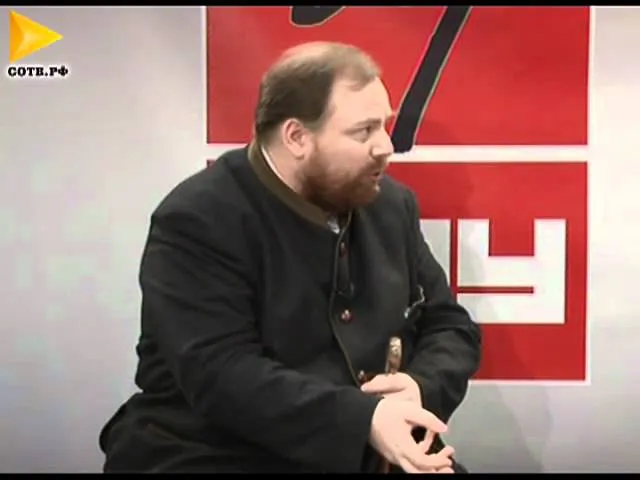
An interview with Yegor Kholmogorov and Alexei Navalny about the Pussy Riot case
On February 21, five young women wearing masks
performed a punk
song in Moscow's Cathedral of Christ the Savior: "Mother of God, Drive Putin Away".
Mother of God,
[applause]
drive
Putin away.
Drive
Putin away. The action lasted less than a minute.
The women and their film crew were escorted out
of the cathedral, but the very next day a music video appeared online
that included
footage from the performance. Police detained two
members of the punk group, Nadezhda
Tolokonnikova and Maria Alyokhina. They faced
up to seven years in prison. A week later,
the action became the number one topic on
the internet.
The Church rightly points to
the inadmissibility of such behavior in a
church and the offense caused to the feelings of millions of
Orthodox believers. Their opponents argue that
sending two young
mothers to prison for seven years is absurd. Around
the offenders, a halo of victims
of the regime begins to form. Many participants in the civil
protest movement shift their
attention from the rigged elections to
this particular case. Should freedom
of self-expression be limited by respect for
the traditional values of other people?
Hooliganism and sheer stupidity
or something else, and who benefits from it?
Good evening, dear
viewers.
It's Friday, and this is our talk show. Our guests are
Yegor Kholmogorov—hello—and Alexei
Navalny. Good evening, good evening. Today we
will be talking about the group
Pussy Riot—or, if you prefer, there are other less
polite translations of the name—and
all the events that unfolded
around
it. Who shall we start with? Let's start with Yegor
Kholmogorov. Yegor, what do you think? Well, first of all,
let's use the informal "you." We're all
among friends here. Fine, informal it is. Well, I
think this was, all in all, quite a
successful—brilliantly successful—
provocation, a provocation that was
directed both against the Russian
Orthodox Church, which now every
Lent a certain part of our
"progressive" public seems to make a habit of attacking. You see,
last year the Church was being hounded by
Anastasia Volochkova, who loudly
came out denouncing and cursing, as they say, and
so on, because one of the
priests had said something not especially approving
about her photos in a nearly nude style posted
online. And this year we have another
story, a more serious one. On the other
hand, this is also, broadly speaking, a provocation against
our civil society and, in a sense, against
the democratic
movement. Why? Because it really struck it
at what I think is its weakest
point. And that weak point is that
a significant part of our
democratic movement consists of people who are very
sharply, painfully anti-clerical,
and this is not an ideological
or philosophical anti-clericalism; it is
a crude, street-level anti-clericalism. In that
style. Today this is already the second TV show
I've appeared on about this topic.
Mr. Gozman, on Vladimir Solovyov's program,
started explaining that the cathedral
is somehow fake, improper, and that it was
built with kickback money, and that
the patriarch has the wrong kind of watch, and that in this
lower hall, which in fact,
by the way, does not even belong to the Church at all
but to Moscow City Hall,
something improper is held there.
And therefore, we are told,
these young ladies had the right, as it were,
to express themselves in this way regarding
Orthodoxy and the Orthodox Church: supposedly, if
we don't like your sacred things, then
we have the right to mock them, and
most importantly, to emphasize that this is
done with impunity. And this reaction was
completely obvious. That is, beforehand,
after a decade of the activities of people like,
for example, Marat Gelman,
funded by the state,
which, by the way, should attract Alexei
Navalny's attention,
there had been a corresponding
conditioning of public opinion. And so,
naturally, the first automatic
reaction of the liberals, so to speak—
well, not only liberals; there are also
neo-pagans and many others—was:
"Oh, great, sock it to the priests! How
right, how cool, what an awesome
thing—those bastards had it coming, smack them in the face,
right in the face!" That was the kind of
delight that switched off any
rational, critical
perception and created what you might call
a herd effect, a group stampede
in the direction of this unrestrained
apologia for these actions. And when
that apologia kicked in, instead of
what should have been a completely
straightforward legal response from civil society—
that this was outrageous, that it was wrong, within the
limits required by law—this
It should be punished; it’s just that these boundaries
should not be crossed, and because of that
since that reaction did not follow, there came
a defensive reaction from Orthodox believers
in earnest. What does that mean if now
these ladies are made into an example, demonstratively...
so to speak, before the whole world, with them
being punished under the code—that is what you’d call
what is in the code
with the help of pre-trial detention (SIZO, remand jail) and so on and so
forth, and so on. We ourselves, we
Russian nationalists, know all this perfectly well
we’ve been through all of this; we went through it in the case of
Mirzaev, that there would have been much
more, perhaps, of a calm
attitude, less emotionally charged
if there had not been an element of threat in it
of demonstrative
impunity—that because you’re some favorite
of blogger Oleg Kozyrev and other
representatives of the liberal crowd, over
some wonderful LiveJournal and so on—this does not
give you
the right to mock an Orthodox church
and Orthodox saints. Now tell me
please, from your point of view, is this
really a threat to the Church? Well, how
shall I put it—a threat to the Church
is the acknowledgment of the fact of demonstrative
socially approved sacrilege. There are no
guarantees that tomorrow there will not
appear, say, some kind of
radical, some pseudo-left
radical terrorist group
that will kill priests
or plant bombs in churches, or
something else, citing the fact that
these disgusting priests—and we saw that these
priests are disgusting; the girls showed us everything
clearly enough, got it.
All right, Alexei, well, what would you say to us
to argue for another hour? I understand that I am 85% on
Yegor’s side, and the Pussy Riot action was
quite thoroughly disgusting
anti-social, immoral, and
apparently contains signs of a serious
offense. But here we simply need
to step back a little from emotions and
think about whether this was
an anti-social act, and whether it deserved
for these people to have unleashed upon them
some state machine with all its stupidity and
senselessness
which in fact turned the whole
situation upside down. I would just
like to remind you of the chronology: when Pussy
Riot carried out their action, everyone knew who
these people were. Everyone understood perfectly well who
these people specifically were; everyone condemned them
and said it was terrible stupidity. As
a political action, it was meaningless. They
were met with broad consensus on
this point; even people with anti-clerical
views said: all right, you may not
like the Orthodox Church, you may not
like the Patriarch—criticize him somewhere else; you
burst into a church and behaved like idiots
Everyone discussed and condemned them. What happened
after that? There was a lull for a while
then there was a political order, and then
these girls were hunted down by Center E (the anti-extremism police unit), the FSB (Federal Security Service), and others
they were arrested amid shouting; 40 people are in
the investigative group, and now there are
five investigators for especially important cases
We don’t investigate terrorism like this; we have
very few crimes at all for which
such forces have been thrown at them. These
girls are hunted down and arrested, and what do we see?
They receive universal sympathy. Why?
Not because anyone supports their
idiotic action in the Cathedral of Christ the Savior
but because everyone perfectly well
understands—this is a very loose use of
the notion of universality, this talk of ‘universal’
sympathy. For example, I do not feel the slightest
sympathy. Everyone condemned them here
too—I observed what I observed. Everyone
lives in some kind of media environment, and in the
media environment, among people of my
circle, from what I observe in the media
in newspapers and so on, I saw
unqualified condemnation of their action in the
Cathedral of Christ the Savior. After they were
arrested, it became obvious to everyone that their
arrest, first of all, had
an obvious political subtext, and
secondly, from the standpoint of procedure, from
the standpoint of, I don’t know, their specific
personalities there, from the standpoint of the danger of their
misconduct, it was somewhat disproportionate
They received sympathy. Why? Not because
people support their action, but because
all people, including foolish
young women who carried out a disgusting action in a
church, have a right to justice, to
some kind of equal treatment from the secular
state machine. And I, as a lawyer,
know perfectly well that there is no such thing as
hooliganism for which women would
be arrested when they have small children
And if we look at the personalities
of those arrested, we will see that they simply do not
have the ability to influence the investigation, intimidate
witnesses, flee punishment, and so on
Further, I don't think there's anything to thank anyone for. I believe they should
be subjected to an honest, impartial
trial and receive whatever punishment the judge deems appropriate.
Today I was tried by Judge Borovkova
Borovkova. It was a completely dishonest
and biased trial, but that does not
mean that I should—this is what I do not
dispute—this is what they deserve, they should
receive it. And I especially do not understand
you see, all this is happening within a certain
information context. They released
a local police officer in Kazan who had unlawfully
arrested a man,
falsified the detention records, and there
he was tortured to death.
And he was released to house arrest.
All I demand from, I don't know, from
society, from the state—from here, I demand
justice. So if they have
the possibility of being released on bail
or under house arrest, or on a pledge not to
leave, then that is what I want, and that is why I stood in
a one-person picket. I demand that they, in
accordance with the Criminal Procedure
Code, be released on a pledge not to
leave, or under house arrest, and then at
trial be judged fairly, without staging
some kind of show trial. An interesting
thought. Here is what I want to draw your
attention to. Let me take the floor, uh, if we
are talking about a fair trial—well, in
Russia there is no fair judicial system,
but nevertheless one has to respond to this
somehow. If we speak from the point
of view of jurisprudence, you say
that this bad local police officer behaved
badly and yet he was released. Well,
presumably the logic should be that we
should not compare the behavior of these
crazy girls with that police officer. They are not
competing with each other; it is not a
competition between them. Rather,
their actions must be compared with
the law. What does the law say about arrest? You
didn't list all the grounds for arrest, as far as I can tell,
for example
the assumption that they will continue
their criminal activity. Actually, do you
have any doubts that they will continue? I, for
one, have no such
doubts. I have serious concerns. Their
track record consists in the fact
that this is a radical group that
carries out what some call
artistic actions; others
call them acts of hooliganism.
As I understand it, for their previous
actions they were not subjected
to any criminal prosecution, only
mainly administrative penalties.
They could commit a similar act again. I believe, I believe
that they could do so. I believe that
if they were under house
arrest, for example, and had the opportunity
to communicate with their children, then
the possibility of continuing to commit
any kind of
antisocial acts, and so on, would be completely ruled out.
I do not feel sorry for the mother; I feel sorry for
the law. So I want—No, but right now you are
playing on the 'mother' angle here.
Excuse me, Tolokonnikova, please show us here
the attack on
a police officer, a representative of the
lesbian community. And here, and here,
a mother is expecting, expecting a baby. Here she is,
waiting, preparing for
childbirth—a wonderful mother, a прекрасная
woman.
One angle is better than the next. They say she has
not been in contact with the child for several months
now; the child lives somewhere else.
Well, I don't know about that. I know one thing:
any person, no matter what disgusting
images of them might be shown
on screen, still
deserves an honest and fair trial.
After all, it wasn't us who brought these postcards; it was
—I agree that these people deserve
a completely
fair hearing and trial.
Was there a certain deliberate
act involved—that is, did they do it deliberately
or not deliberately? They did it
quite clearly deliberately. It seems to me
that the whole question here is one of legal definition:
whether what they did
was petty hooliganism,
an administrative offense, or whether it was in fact
hooliganism of medium gravity,
which is, generally speaking, a criminal
offense—that is, whether they did it
for reasons of religious
discord or hatred, with the aim of inciting
enmity, and so on. This is something that
must be examined in court, so let us
examine it in court. Exactly right. I
honestly am not at all a fan
of all these extremist-related additions
to our Criminal Code, with all those
motives of this kind, that kind, and so on—
this or that kind of hatred. Yesterday, one
representative of the Orthodox Church, when we
were discussing this topic with Nevzorov,
said, 'Let's convict them under Article 282,'
and I had to pull him up right there
and explain why Article 282 should not
be applied anywhere, ever. And these
aggravating formulations—I also, I...
I completely agree that the wording from
this or that kind of hatred is
equally inapplicable here; in this
case, from this point of view, their crime
consisted in trampling on the freedom
of conscience of believers who
And in this church, people pray according to certain
rules established by Orthodox canon
law over a thousand years, and other rules, uh,
someone said there, well, they were also
praying too. But different rules of prayer are, as it were,
not provided for in this church; they are
excluded. But now look further regarding
the matter of
the next part — arrest. So, uh, the idea of
house arrest, for example, appeals to me
that is, I think that of course
house arrest would have been a more appropriate measure than
detention in a pre-trial detention center (SIZO). But, say, to let them go
free — why is that impossible? In my
view, because it is not about those
pictures Volodya showed us, but
for example
those, yes — and there are even more
terrible pictures. That is, you showed us
rather mild pictures, whereas in
those, let's say, for example
the facts that are also publicly known
to all of us, for example from
the diary of that same Lursarno
regarding the way, uh,
Ms.
was involved in getting one of the activists jailed
also a rather unpleasant one, of course
a pretty unsavory character, Shiman, but she
in fact, together with her husband and
Verzilov, handed him over to the Ukrainian
police for one of the actions, and
the reasoning was, well, he'll sit in jail — that's
a great PR stunt. It's great PR for us
all. It's great PR for the group, and so
on. At the same time, when this
comrade quickly broke and led
the cops to their apartment, accordingly they
after that accused her of betrayal
and that same Nadya began demanding that he
be raped anally, and so
on. These are not the kinds of things
that should be discussed in court
— no, look, here's the problem
here, in my view. Of course I'm not a lawyer, and
I'm just trying to convey the full
complexity of this situation. Further,
it turned out that Verzilov and To
lokonnikova also robbed this Shitman
and stole his belongings, some money, and
so on. What I'm saying is that, unfortunately,
the facts known to us indicate
that at least one of these ladies
who are now in custody represents
a certain objective public
danger. Very good — may I
pick up on what you said: in the case materials,
as far as I know — I haven't worked on
this case — as far as I know, none of this
is there. None of this is in the case materials
there. There is video, there are some
witness statements, but no, none of the
other facts that would tell us about
the subjective side, about the personalities of these
defendants under arrest — none of that
is there. Therefore, I simply stand by
the simple fact that in Russia there currently are no
women with young children
who are charged with
hooliganism and are being held in
custody. There just aren't any; these are extremely rare
cases. I'm not even sure there have been any. And
the existing practice
shows us — well, there was that high-profile
case when the daughter of the head of the
Irkutsk election commission ran over two
people, killing one of them outright, while
the other was left disabled. Yet she did not spend
a single day in custody, and then she
was given 2 years with the sentence deferred for 14
years because she had a young child. The fact
that Tolokonnikova may be vile, the fact
that Tolokonnikova may be
repulsive to all of us because of her photographs
some vile acquaintances, whatever she
was doing there — that does not mean that Tolokonnikova should have the
criminal procedure code applied to
her differently. But
many people don't like that. Tell me, please, are you
speaking now as a human rights advocate,
as a lawyer, or as a politician? I am speaking as I
speak — as a politician, as a lawyer, and as a
citizen. I believe that as a politician I cannot
stand on any other, uh, norms
and rights. No other ground there
— concrete... Let's talk about you as a
politician. Well, actually
there is such a field of knowledge as the psychology
of the masses
Yes, of the masses
they have difficulty simultaneously handling two
ideas on one issue. There is a
phrase: "Execute, not
pardon" — understanding the nuances is very difficult
for the masses; they would like to know where to put
the comma: either "Execute, not pardon,"
or "Do not execute,
pardon." Here, it seems to me, the dichotomy is
as follows: either you support
— in your position, and in how people
on the outside perceive you — either you
support the outrage that in a church
you must not defile the place, or you say that
Listen, let’s show mercy to those
who desecrate a church. That’s an excellent question.
So, that claim means there is no
dichotomy, and I am not going to be
the kind of politician who reacts to
the psychology of the masses. I don’t care, in that
sense, about the psychology of the masses. I want to be
a politician who says what he believes
in and the things he
stands for. So I hold, I believe, to
moral principles, and it is necessary, and
at the same time I can stand on the side of
the law. I am saying quite clearly: I find
their act disgusting. If I were, if I
were in a church and saw some girls
run in and start running around, I would call
the police and demand it, because I see that they are
committing hooliganism. I would demand that they be detained
and taken away. After that, let the court deal with them.
But at the same time, my moral and civic
position tells me that just because they are
disgusting to me and caused a disturbance, that does not
mean that there should be applied to them
some kind of double standards because someone
is demanding their crucifixion, someone doesn’t
like a drunk person on the street—shall we
beat them with sticks? Someone doesn’t like a drug addict—
About standards, then—don’t you think it’s
actually strange that they let go
these
those very district police officers in Kazan, that these
children of officials are being shielded
from investigation, from trial, given deferred sentences
and so on? Doesn’t it seem to you that
in this situation you are not so much
acting as a human rights defender for
the observance of a general standard with respect to
them, but rather that in fact you are demanding
for yet another privileged
category of persons the same kind of
exceptional justice, that is, the same
special measures. From my point
of view, a violation of the law in
one case does not justify a violation of the law in another.
That is, the general standard must be
truly uniform, and if that standard
requires, so to speak, severity and not
leniency, then it must be
the same for everyone. It must apply to
that district police officer, to Mirzaev, to
the daughter of a female official, to Tolokonnikova. Not
because Orthodox believers somehow hate her in particular,
but because she committed
a socially dangerous act. That’s it.
That is my view.
Under the Criminal Procedure Code, there are two grounds.
There is the likelihood that criminal
activity will continue; there is the likelihood
that the person will evade justice. Given that
some of the other members of the group
did in fact go into hiding—though today, it seems,
someone else among them was detained—well,
that factor is present too. Accordingly, is it not
the norm in this case, what one might call
so to speak,
serving
Tolokonnikova’s pre-trial detention in a SIZO (pre-trial detention center) until trial, and serving time in
the same kind of SIZO, only in Kazan, for those
district police officers, and the absence of any absurd
leniency, so to speak, for the daughters
of officials, and no justification for Mirzaev
because he is, you see, some kind of public asset, and so
on? In other words, isn’t it the case—aren’t
you trying to suggest to us
that we should in effect soften the standard for these people
because crooks and thieves have softened the standards?
That is exactly how the situation looks.
I, on the contrary, am defending a certain legal position.
As a person who investigates
corruption, for example, I
filed a complaint concerning Gazprom executives
and a criminal case was opened on the basis of my
statement; charges were even brought, and
they were supposed to go to court. It’s not even that they weren’t
arrested or placed under travel restrictions—
they were not even removed from their positions.
Then the cases fell apart. These
people continue their comfortable
existence, swimming in money, and so
on. But that is not a reason to let others go.
Right, it is not a reason. But aren’t we creating
yet another category? Not at all, that’s not correct.
And in fact, the position of some
people who say, “Well, you see, they
first of all, are right to speak out against
the Patriarch because he is covered in
gold and rides around in a Mercedes,” or
“Let’s release the artists because
an artist can do whatever he wants” —
that position is just as
disgusting to me. I don’t care that they are
artists, I don’t care. But I know, I know
a certain legal practice. I know
the Criminal Procedure Code. So,
specifically, Tolokonnikova
is officially registered in Norilsk, and from that
someone might conclude that
she could evade the investigation and go
to Norilsk because she is not registered in Moscow.
But on the other hand, I see
another side of the case, which is that
she has a young child; she
could be placed under house arrest; her
foreign passport could be taken away, and so on.
And the degree of danger posed by her act, it is not
that is, she cannot intimidate anyone.
she cannot threaten witnesses
the investigation, and so on. If we want to broaden this
it shows us that she may be capable of intimidating
witnesses. I don't know, but I clearly
clearly say this: then let it be raised during the court proceedings
they promised to break her, to rape her
with a strap-on, they said. But that's a completely different matter. And
don't twist things, because at the
court hearing where, at the two
court hearings where decisions were made
about keeping her in custody
none of this was mentioned at all. And if
it was not said at the court hearing
then, as far as the court is concerned, it does not exist. For example, I
am hearing about this for the first time; for me, it does not
exist. We are in court, after all, in court. But these
people—well, if we're not in court, we can
call each other whatever we like here. But
if we are deciding the question of any person's freedom
even the most repulsive person, we
must adhere to the rules. Moreover, I
want to say, as an Orthodox Christian, that
this whole situation is working against us
because their unjust
arrest really fueled anti-clerical sentiment and
gave additional trump cards to the most
unhinged people
and objectively fed anti-Navalny sentiment
This is a game
for someone—Raevsky, for someone else—anti-... In other words,
each of us has moments when, when I
do something or speak out publicly
in defense of Arakcheyev and Khudyakov, purely on
procedural grounds, I have absolutely
a procedural attitude here. I did not work on the case
myself. I know one thing: twice
these people were acquitted by a
jury, and then with a different panel and a whole host of
procedural violations, these people
were imprisoned unjustly
On the other hand, from the
left-liberal side, I get a whole lot of
criticism: 'That's it, Navalny, we've
lost faith in you, we hate you'
anti-Navalny sentiment—I don't care, because I
demand that Arakcheyev, Khudyakov, Ulman—whoever
it may be—they all deserve
a fair trial, regardless of the supposed will
of the Chechen people or whatever, I don't know
the media situation, the political situation
because it may be useful to Putin there for
pacification, blah blah blah—I don't care
If we are talking about categories such as
life and death, freedom and
lack of freedom, we cannot give in here
to emotions. Why is Themis depicted with
a blindfold? It means her eyes were covered
so that she would not see all these
photographs, she would not see posts about
some kind of 'shitman' and so on—none of that
exists for her. If it does exist, then it
must be brought to court, and in court it
is examined. I am saying once again that, well
there is nothing like this in Russia now—no one would
for hooliganism, whether minor or criminal—it is still unclear
whether it is a criminal offense
for hooliganism, two women with small children
would be sitting in detention while there was
an investigative team of five
investigators for especially important cases. This
this obvious political
taint simply ruins everything for us. We
say: these hooligans came into a church, they
insulted us, they should be punished, and they
should indeed be punished. But when
politics gets mixed into this, these hooligans
gain sympathy, and no one any longer
discusses their antisocial act. Instead
everyone discusses how they are political prisoners. And
that, by the way, is where the real
danger of this whole story actually lies
Why? Let's say that despite all this, I
am categorically opposed to
them being locked up for long
terms at all, and that
would be a major problem for, say,
the civic movement, for
the democratic movement, for
the Orthodox Church, for anyone else
if, for example, they then receive a prison
sentence or something else, rather than
community service. Why? Because in
fact, the authorities would thereby solve a very
important problem: they would close off the issue
of political prisoners, almost. Why? Because
well, we know perfectly well, in general
most of our liberal public would
push them into any list
of political prisoners and put them in first place
after which the automatic reaction
of, say, the entire more or less Orthodox
conservative public would be to throw
that list of political prisoners into the trash. Yes
we don't need that list, because as for
Khodorkovsky, people have already cooled off, so to speak
over nine years; that is, he no longer provokes
that same intense butthurt, but, well
the man has served his time, he's done his time already
let him come out. But here this is
an absolutely fresh, new story in which
a political
tinge will be given to it. So this is, in fact, a very dangerous
and very risky thing. But
the whole question is where, where exactly, in my view
the decisive point lies
From one point of view, the key element of this whole story
for Alexei lies in the equal
application of the law; from my point of view,
perhaps precisely because I am not a lawyer
or some failed theologian or
someone else, it
consists in this: for as long as we do not have
there will not be
a painfully inflamed anti-clerical mood in society
that treats absolutely any, so to speak,
any middle finger shown at
the Church, at the Patriarch, at
priests, with delight
justification, flowers, praise, and so on
until then, these situations will
keep reproducing themselves
The Church is supposedly in league with the repressive
machine; right now it looks as if
the Church has sicced the repressive machine on them
which has broken all the rules and is beginning
to grind everything up there. I absolutely
agree with Yegor that this deals
a colossal blow to the human rights
movement and to the issue of political prisoners. If they
are convicted unjustly, with
these procedural violations
that keep occurring, they will be put on the
list of political prisoners, and instead of
discussing the problem of the existence of
political prisoners, we will endlessly debate
whether Pussy Riot is one or not
This is an absolutely harmful thing. And in
fact, the stupidity of these Pussy Riot girls and
the cunning and meanness of the state
machine lie in the fact that this case
has now displaced our entire
real political agenda, which
consists of election fraud, what
Yegor was talking about at the very beginning,
real lawlessness, the dispersal of
rallies and demonstrations, and so on. We
are now running around; I go, I go to this
picket and stand there for Pussy Riot because
I demand that the criminal law be applied to them
properly
Alexei, again, a serious question:
you know, by the way, I wrote a very
sharp text right after you
went out to that picket, not at all because
of the fact that you went there, but because
you came out with a poster, with that kind of
portrait on it. I mean, right away this
already seemed to me absolutely
an incomprehensible move for a lawyer and a complete
blunder for a politician: in this case, to defend
not some abstract people
who broke the law, but Nadya and Masha
That immediately turns into: they’re good girls
Yes, that’s true, that’s true, but here it’s
that kind of genre: everything gets mixed together when we
move into things like this, all of it
gets mixed together. If we say, you
know, I’m saying that they were put under arrest
unjustly, then what arises from that is
the whole Nadya-and-Masha theme
poor unfortunate girls, and everyone has already forgotten that
they were running around in there and so on. No need for that.
I don’t want people to love Nadya and Masha
I want to go out myself and say:
I demand that Masha and
Nadya
I demand that hooligans and
those who desecrated a church be tried according to
the law. From the very beginning I said this was an act of
action
hooliganism. I was not standing there with a poster because
there is no need to stand there with a poster if, when
they were jailed, when they began to be
deprived of their freedom unjustly, I considered it
necessary to express my
position. Likewise, when they did this,
despite the fact that Verzilov, Tolokonnikova’s husband,
served 15 days with me in detention
on the neighboring bunk, I said that I
condemn them; they should be held
accountable for it. In my view,
give them 15 days each and send them
home, and after that it would have been a great
victory for the Orthodox Church and a major
humiliation for the radical part of the
anti-clericals. That would have been excellent, but unfortunately everything
got turned upside down
They turned into some kind of strange
political prisoners, and anti-clericals, again, all of them
or at least their hard core. I admit that for
25 years I was some kind of crazed
militant atheist. Well, life goes on, I
stopped being an atheist, but I was one, and
people have the right to hold such
positions, of course. They can say whatever
they want. There is no need to hand them trumps, and
there is certainly no need for the state
to work on their behalf. Because right now
the state, the police, have made it so that
the Church now looks like some kind of
aggressor. So everyone has already forgotten that
they were running around the altar, and the Church
looks like this aggressor, I don’t know, some kind of
destroyer and all the rest of it
There are fights near the courthouse, some kind of
fights near the Cathedral of Christ the Savior
some prayer services in defense of it in the church. What
do we need all this for? And all of this
was provoked by one very simple thing:
the application to them of an unjust measure of
detention pending trial. What exactly did it provoke?
This is an unjust use of force. And it seems to me
that originally, after all, this was
the appearance of desecrators in a church. Look,
look, first we had this appear:
these crazy people from Ukraine with their bare breasts
running around out front — FEMEN. Yes, and quite recently she
was jumping around on the church steps around
the Cathedral of Christ the Savior. A few
weeks after that, there was another
attack — this time by those so-called “rabid wombs”
jumping around there. I believe that once
is an accident, twice is a coincidence, and
now there will be a third time. We live in
a modern society, and we must
proceed from the fact that there are many
people who hold
extreme views. Here is a small example:
I lived in the States for half a year when I was studying at
Yale University. Every day when
I was going to the university, I passed by
a family planning clinic — in fact,
it was basically an abortion center.
There was a picket there every day. Interestingly,
they call an abortion facility a
family planning center. They call it that precisely
in order to avoid
criticism, but it is still clear that it is
an abortion clinic. There was a picket there by radical
Christians who stood there with rather
harsh slogans — and rightly so,
they were right to stand there; that is their position. There are
people who hold
anti-clerical views. Some people find it interesting to watch,
some do not, but we have
the law, the police, the prosecutor’s office, and the courts
that draw exactly this line and
determine whether a person has crossed it or
not. If he has crossed the line into
the territory where criminal offenses begin, then
that very blindfolded Themis (the goddess of justice)
draws her sword and cuts something off with it,
with that sword. But as for everything else — if Themis does not
work, how will things develop? Well, if
Themis does not work, what must we do? We
must at least call for
Themis to work. But they are calling for: well, let’s
kill them, then. Let’s just
take them, hand them over from Petrovka 38 (Moscow police headquarters), give them
to some other madmen who
consider themselves Orthodox and who will kill them for the
glory of, I don’t know, the Russian Orthodox
Church. By the way, I for one do not at all
rule out such a possibility. If they are released now,
if they are let go — I’d wager on their
heads. The only problem is that I,
for example, would not be sure
that if something like that happens,
it will be done by Orthodox believers and not by someone else in order
to, as the newly elected
president put it... Why are you taking, forgive me,
the position of some kind of commander
of a Chechen OMON unit (special police force) who, for example,
calls for blood revenge? They have it
traditionally.
I’m talking about the fact that this is inevitable, you see.
For me
around the courthouse, if you please.
They found a place to shout against Putin
there — that’s what I think.
I sympathize with them
as
foolish... “for I know my transgressions, and my sin is ever before me”
“Against You, You only, have I sinned, and done evil in Your sight”
...
There they are.
Damn, stand next to the other
poster — “for I know my...”
...“transgressions... Against You only have I sinned.”
[music]
before You. Faith...
People — nonsense.
What nonsense? What does this have to do with Christ? All right,
let’s step away from the court. Are you feeling brave or what?
Come on then.
Girl, all right, all right.
Fine. What filth, really, what
some people started some kind of fight.
What is all this for? We
built a society and invented law
so that this kind of ugliness would not happen — so that some
wouldn’t be doing things to others there, some tearing up
posters.
We created the police so that they would
maintain public order,
enforce it; so both sides need to be
separated, and let them stand there picketing, while the court
— this Moscow City Court — should make
a fair decision. When some start
splashing others there — fine, today
these people came and they have force. And tomorrow there will come, I
don’t know, 500 supporters of Pussy Riot and
they’ll beat up another picket — would that be a normal
situation? Today vigilante justice can happen to one side,
and tomorrow vigilante justice can
happen to the other. Alexei, what do you
think — if we do not ignore
this
problem, did it harm the protest
movement of the opposition? Of course.
Of course. Objectively, what they did, and
the timing in which they did it — as I said,
they shifted it. They completely shifted
the political agenda. Yes, they are now
under attack from the repressive
machine. We are forced to defend them, and I am
forced to defend them purely from a human-rights
standpoint, despite their rather disgusting
actions. By doing so, well, they
shift the whole plane of the discussion. Well, it would be
better if you defended them not for their
disgusting actions, but defended them on the grounds
that their rights have been violated. But as for
their actions — to defend those? Good Lord, I said.
I said: by defending their rights, I am defending
myself, in fact, because in exactly the same
way I myself was being tried there today.
It was completely unjust: the witness was not
called, the motion was denied, and so
on. The same thing is happening to him.
That is why I am defending
the Criminal Procedure Code; I am defending
the law; I am defending myself and other people
in a similar situation.
Since we are now discussing this, although we
really ought to have been discussing the Chechen
"carousels" (organized voter fraud schemes) caught on video cameras, and
why these people are not being sent to prison
immediately — that is a genuinely
anti-social act, a very dangerous one.
At the same time, roughly speaking, does it make sense in
some situations — situations that are clearly, as they say,
provocations, setups, and a mess —
to keep banging your head
against the wall, so to speak?
having explained the reasons why you are doing it.
Not to support these ladies, while saying
that yes, a great deal of
injustice and lawlessness is happening to them. But
since a significant part of this
story was created by them quite consciously,
dragging people into a situation where people
are forced, as the saying goes, to be up to their necks in shit,
having to clean up these, so to speak,
legal wreckages created by them, their
actual crime — shouldn’t one
call it exactly that? So what we
see is that what is happening is not justice.
I stated my position on this point
quite clearly. I said that it is not merely that I do not
approve of their action — I consider it
offensive and unacceptable. It is a
serious offense. Let them, let them
sort out whether it is a crime,
a misdemeanor, or an administrative
offense — let that be determined.
I am speaking out so that they
are released, because I believe that
the Criminal Procedure Code requires
it, gives grounds for their release.
Let them be released, that’s all. I am not
interested in, so to speak, some elaborate
dirty trick. For example, people come to you on behalf of
a large group of the progressive
public and ask that Alexei
Navalny become
their lawyer. Well, no one came to me
asking me to be their lawyer,
because they understand perfectly well that I
would refuse. Yes, there are other people there,
quite qualified ones. But of course
I am not going to defend them. Uh, I do not know
how many people may listen
to my position, but if you
claim to be a politician,
a public figure, then I state my
position. They ask me: do you think
they should remain in custody? I
say: no, I do not. Are you afraid to
say that publicly? No, I am not afraid, I, I
will say publicly that they should be
released before trial, and publicly I also
say that their act was
disgusting; I condemn them. And if they are
jailed, if the court convicts them on criminal charges and gives them some
term — well, let us see. We will
watch.
After all, it is a court. If the court does everything procedurally
correctly, if new
circumstances come to light, and everything is
examined, if there is truly
an adversarial process and everything
that is required, if it is a fair
trial, then of course everyone will
accept that court decision.
Ladies and gentlemen, in fact, judgments often have a
biased character. That is why we
came up with the adversarial nature of the court process;
humanity invented it for a reason.
That is why I believe I will accept a fair
trial — well, from the point
of view, again, of my own level of
legal consciousness. If I follow
the proceedings, then I will accept it. But honestly
speaking, it seems to me that in this
situation, unfortunately, we again
have very weak civic institutions. And unfortunately,
the events of the last few weeks there
have weakened them even further.
As a result, we cannot, for example,
carry out something like a civic
investigation of this story. That is,
to be honest, I am afraid that, let us say,
the investigation and the court will establish neither
the organizers, nor those who ordered it, nor
the instigator of this crime. They
will stop at the perpetrators, although there
even from the style of the texts that
are published in this LiveJournal, it is
clear that they were written, at the very least, not
by these young women; that this is, that this is a man’s
hand — you can feel it, you can feel that it is
someone much more deeply involved in
certain political processes.
In terms of organization...
Well, let us put it this way: he may rather be
the cover in this situation.
Excuse me, that changes the matter completely if
it turns out — in that sense, if there are
such concerns and someone really
thinks so, then this truly deserves
a genuinely serious judicial
examination, if it turns out that
the person was acting on some kind of, I do not know, some...
close to state structures
perhaps someone arranged that money
if it was deliberate, then we're dealing with a different intent
that comes into play if those Pussy Riot people were simply there
carrying out an artistic action and wanted
to get publicity or make some kind of statement
some sort of manifesto. Do you consider this
to be art? No, well, just a second, this is
a matter of examining whether there was intent to
offend or not. If there was intent on the part of
those behind it to stage a political
provocation or something else, that changes
the case. That's exactly what needs to be examined
but I have the feeling that
these five investigators for especially important
cases—I don't know what exactly they're doing in
the case there—and there
they arrested these two young women who were already
well known to everyone. There were 40 people
from the FSB special forces (Federal Security Service). I have the feeling that
all this is being done not in order to
establish the real circumstances of the case
but in order to demonstrate: we
will crush you. You know how people say
Muslims say: Allah gave a person a tongue on one
side to speak the truth, and on the other
to conceal it. So what, then, is the purpose of
having five investigators for especially
important cases? So that, God forbid, they don't
actually investigate? My first impression
was that this was purely a police
provocation aimed simply at
openly sinking this protest
movement. Cui bono—who benefits?
Who benefits most from this situation? It seems to me
that the ones who benefit most are precisely
the Kremlin puppeteers. Yes, I don't know who
benefits from it. But what is happening
and its consequences, right—judging by
the consequences and the context of what
we have now, in the end, what we are
discussing—it is obvious that all this has gone
clearly beyond the bounds of an ordinary
investigation into that offense
an administrative one, that is. Here already
absolutely everyone has gotten involved, and each of them
is pulling out their own meanings and using this whole
situation
for political
manipulation, and so on. And that already
of course changes the matter, and that, of course, again
should now be interpreted in favor of
the idea that, all right, folks, let's have
more
of the Criminal Procedure Code
and less intrigue, less politics, less of
some people trying to worm their way into this. Here
right now everyone is saying it openly, even
the investigators there are saying, well, we're waiting for
a phone call—whether to release them or not. What is
that supposed to mean? What rule of law are we even talking about when
these people are effectively saying publicly
and again the Church is trying to insert itself into
all of this, saying that supposedly
the Patriarch should decide, should call someone
and determine whether they should stay in jail or not
This is completely unacceptable
It is completely unacceptable for such
discussions to take place. As a lawyer,
advise me: can this case be terminated
on the grounds of reconciliation between the parties, conditionally speaking, or
No, this is not a private prosecution case
So then what kind of phone call from
the Patriarch could there be here? A call from the Patriarch, from a legal
point of view—well, we see that
there have been a large number of leaks, yes
these are anti-clerical rumors, but a large number
of leaks have come specifically from the investigation, from
the authorities. The point is that
there was and still is a legend that keeps mutating
actively among the anti-clerical camp, saying, well,
supposedly the Patriarch called Putin, and
Putin said to jail them all, and now
the Patriarch should also call Putin and
say, like, release them all. Well, that
if that existed, it was a leak from the side of
the anti-clerical community. I don't know who
came up with it, but the fact is that we see
a great deal of political context and not
much sign of
a legal one. Tell me, as a political expert,
well, actually
this dealt the protest movement
a colossal blow. Yes,
seriously, it dealt a colossal blow
to all of us. I think it dealt
a colossal blow to the Church
a colossal blow to human rights defenders who stand
simply on the side of the law. It dealt a blow
to the protest movement. It dealt a blow
to politics in the country in general, because
the main thing is this: what we started with, what we're talking about
is not rigged elections
but a hooligan-style action in a church. There you have it
What did you think of the last rally?
Look at the last rally—even
if you go around asking what people were talking about at that rally
In
the end, there was support for businessman
Kozlov in
his very controversial dispute with Mr.
Slutsky. Frankly, I don't know who there
is right, who is to blame, or what happened
Today Maxim Katz, whose
existence I only learned about at that rally,
turns out to be a presidential candidate, and
has a wonderful proposal
There was some kind of joke from the stage, haha, and we all
appreciated it and laughed at that joke. It was
very funny — that was the main thing, very
rational and productive. Yes, very, very
funny. Everyone is joking, everyone, everyone, everyone, just
and then they went on and proposed standing up for
Pura, and the majority of
those present took it not in
the sense that what happened should be
punished within the framework of the law, but rather in the sense
of, "Aha, they went after the Church — well done, let's
come on."
"Freedom for our heroines" was proposed.
Nationalists were told to roll up their flag.
Well, I was at the rally. I wasn't on stage,
I was just there in the crowd, and I did not
get the impression that
this was how nationalists took it. Yes, well,
in fact, people took it in the following
way. And most importantly, fewer people came to the rally
than to the previous one. Yes, that, that
is an important thing. In my opinion, these are all links in a chain
that lead to... I stood at this
rally there in the middle of the crowd and saw how
people were taking it all in. It seems to me they
were taking everything, on the whole, quite
reasonably. But what you're right about is that
actions like this, they shift
the center of discussion and the real agenda into
some kind of nonsense. What they did there
— Pussy Riot — was an aggressive, aggressive
act, an unacceptable act. But it is
certainly not some crucial part of
the country's political agenda, of the country's life.
It's absolutely nonsense, an insider squabble, and
an insider squabble, just some kind of nonsense.
They've made up, supposedly, some important
issues, but conflicts in the sphere of religion
happen constantly. Well, some
pastors in America burn Qurans, and that
leads to certain consequences. This
happens. Well, it's just part of people's lives, it
happens all the time. It is not
some kind of background to our lives — various more
or less significant conflicts around
religion. But when we start, instead of
discussing substantive things, discussing this stuff instead,
that's wrong. And there is a feeling
that what happened here — whether it was planned
or unplanned — but the fact that our
discussion is being deliberately pushed in that direction is a fact.
Tell me, please, from your point of view,
can a successful mass political movement
in Russia afford to treat
Orthodoxy (the Russian Orthodox faith) as such disrespectfully?
Does such a
movement have the potential to become truly mass?
A movement of that kind... I think that
a movement that lays claim to
representing the majority
of course cannot treat
anything at all disrespectfully,
including, naturally, religion.
Therefore, people who insult
other people on religious grounds
will presumably be unlikely to gain any
majority. Nevertheless, we should remember
that just 20 years ago our country was
predominantly a country of atheists. Or else
of some kind of strange pagans,
who... well, that ended badly,
ended badly, but nevertheless there is
a large number of people who
amount to percentages, or
possibly even tens of percent,
who still hold fairly
aggressive atheist positions, so I do not
rule out that... But atheism and
anti-clericalism are different things, after all.
Different things, different things, with different
definitions. Nevertheless, people who
hold such views, obviously, they
are also numerous enough to be
represented in the Duma (the lower house of Russia's parliament) or somewhere else as well.
Well, apparently right now they probably cannot
form a majority. Roughly speaking,
in my view, say, for a person who is an
anti-clericalist or anti-Christian
in Germany, joining the CDU/CSU would make no sense; he should
go to some other
parties. By the way, that does not mean environmentalists
must necessarily be anti-clerical. I,
for example, support environmentalism, support the Greens.
That is an inalienable right of the Russian people, but with
what gesture... The Greens are, generally speaking,
a kind of, how should I put it,
left-liberal party there, in favor of
LGBT rights and all the rest.
All the other things... maybe.
But that's not the point.
The German situation is not ours; our situation
is different precisely in the sense
that here, completely, these kinds of
political cores have not been formed.
For me, for example, the big problem is that
we completely lack
a Christian-democratic core.
If anyone does try to work on this,
on this,
it is mostly... that is, an Orthodox
Christian-democratic
political core, with a kind of national-
democratic element, ideally — that too
in that context — has not been formed in
politics at all. And yet,
objectively speaking, this ought to be
the largest political force in our
society, because after all, in our
There is a public demand for democracy, and
there is also a demand for traditional
Christian values, broadly speaking, and for
there to be no doubt that
marriage is something entered into between
a man and a woman.
That abortion is something that may be
tolerated in society at times, and in
legislation, but cannot, so to speak,
be regarded as something inspiring
enthusiasm; that blasphemy is something
that is unquestionably
condemned, along with many other things. At the same time,
Of course, again, just as
we as a society need to move away from this kind of
paternalism toward the state,
so too we Orthodox Christians need to move away
from this kind of paternalism toward
the authorities—the idea that, well, they'll throw us something,
they'll build a church there with budget funds,
while stealing most of the money
for themselves—but, well, it's a holy cause, isn't it?
How could they not steal from something sacred?
And by the way, there was a funny moment when we
were arguing yesterday with Nezo; there was this amusing
moment. He apparently decided he was going to stump me
just then. He said: so, what do you think
about the fact that in Germany and
many other European countries
people pay a church tax? Let those who
want to support the church do so. I said:
I'm perfectly fine with that. In fact, I think
that's exactly how it should be: Orthodox believers themselves should
support their own church, rather than shifting it
onto the state, which in return gets
a great many different benefits and
advantages in terms of spiritual justification,
spiritual apologetics for things that cannot
be justified, uh, justified. And so
for some reason here, very aggressively, very
aggressively, democratic and
liberal values are being tied to
anti-clericalism. And for me, precisely,
the tragedy is that those Pussy Riot girls made
yet another attempt at making that connection, and
a huge part of the liberal crowd, for
one emotional reason or another,
swallowed it. But we should—people
are trying to speak not in their own name, right?
Here Yegor is now trying
to speak on behalf of liberals,
and punk women staging a profane spectacle in a church
start speaking on behalf of Orthodox believers.
It's ridiculous. To conclude, let's have each of you
take literally one minute
to state your position personally,
addressing the people you want to speak to.
You have that opportunity on this issue
related to this matter. It's time to sum up briefly.
My position as a person and as a citizen
is that any people, no matter how
disgusting their actions may have been,
deserve justice; they deserve
equal treatment from the courts, the police,
the prosecutor's office, the FSB (Russia's security service), whoever it may be. And I
absolutely do not approve of this action.
Pussy Riot is repugnant to me as
an Orthodox believer, as a human being, and as a citizen.
They behaved offensively, but the fact that
they are now being subjected to political
repression is, to me, completely obvious.
The identities of these suspects,
the subjective side of the case, the degree
of social danger posed by this offense
do not require that they now
be held in custody, and their detention
is obviously politically
motivated and, I believe, causes damage—
serious political damage—to the protest
movement, to Orthodox believers, and to the Russian
Orthodox Church. Therefore, the sooner
their civil rights are restored
and they receive a truly fair
trial and fair punishment,
the better. I believe that blasphemous acts,
insulting the Orthodox Church, and
violating the rights of believers are acts
that unquestionably should be
punishable under the law, and the punishability
of these acts should be established as
a norm, as an absolutely objective norm, not
tied to any completely false
pseudo-legal wording such as
"inciting"
religious hatred, and so on, but simply
on the basis of the fact that there are certain
profane actions in a church, and they should
be punished severely, but according to the law.
Therefore, the main task, in my view,
is to ensure that, on the one hand, our
society does not, out of hostility toward
the Orthodox Church, fall into apologetics for
such acts; and on the other hand, that
an Orthodox-minded rational attitude
does not come to see the punishment of these
acts of blasphemy by the state
when it is disproportionate as, so to speak, its
some kind of internal justification. That is,
we must not justify
lawlessness; we must not justify
blasphemy by saying that it is directed against
lawlessness, and we must not
justify lawlessness by saying that it is
directed against it. Thank you. And finally,
I want to say the following: in my
view, they are vile female provocateurs.
which were used, at best,
without their knowledge to
discredit the opposition and the protest
movement. This is very
bad. I hope that in the future no
similar actions will be repeated, and for that
to not happen again, there must be
appropriate punishment. Let the court
assign credit where it is due. Thank you for your attention.
[music]